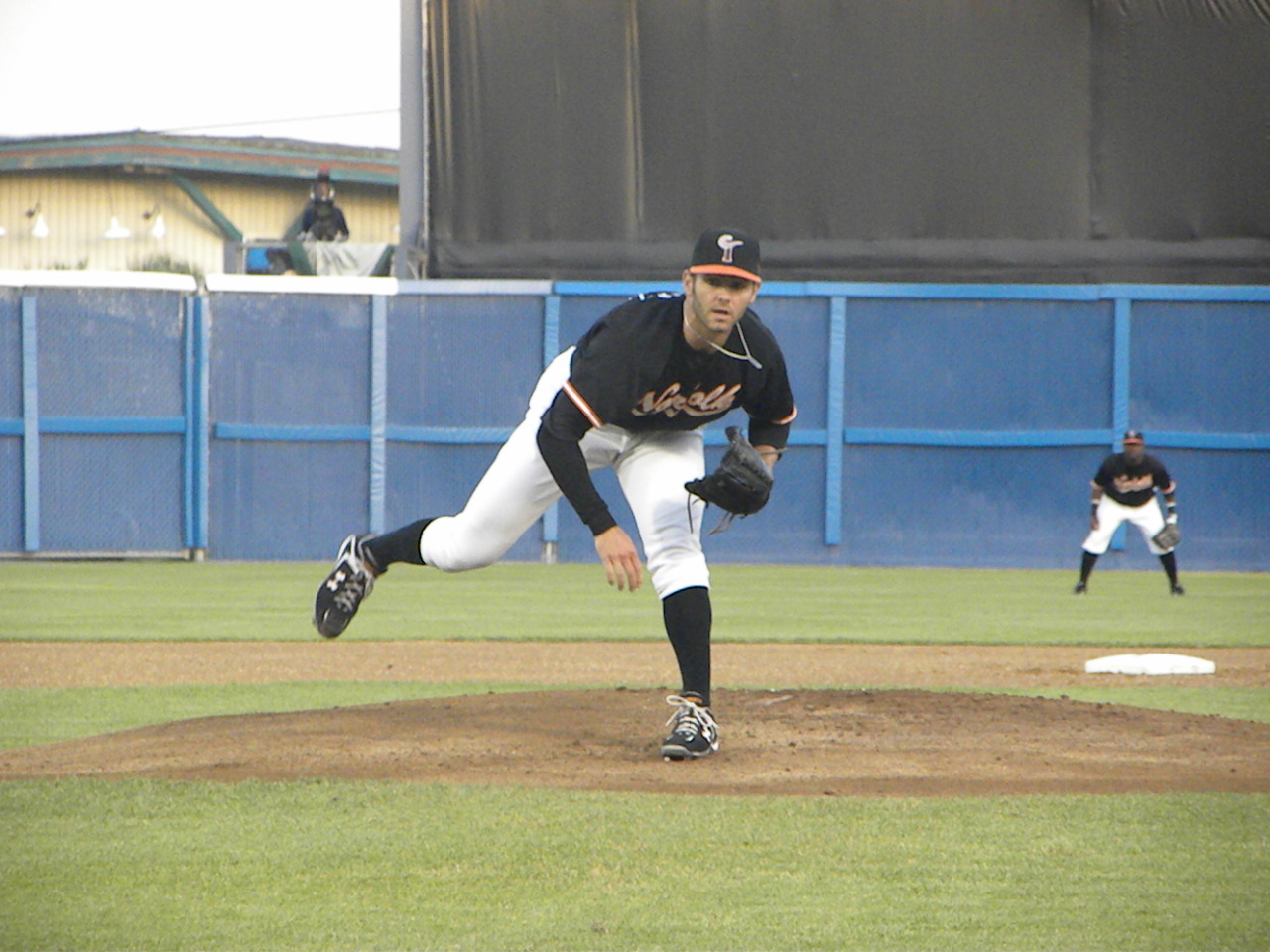
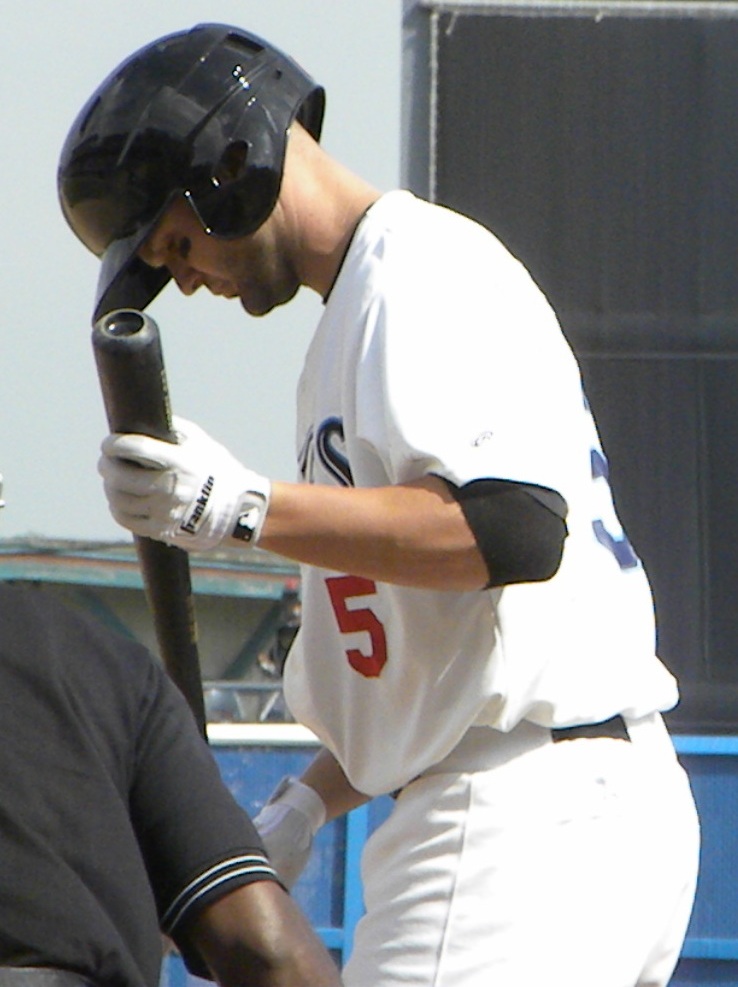
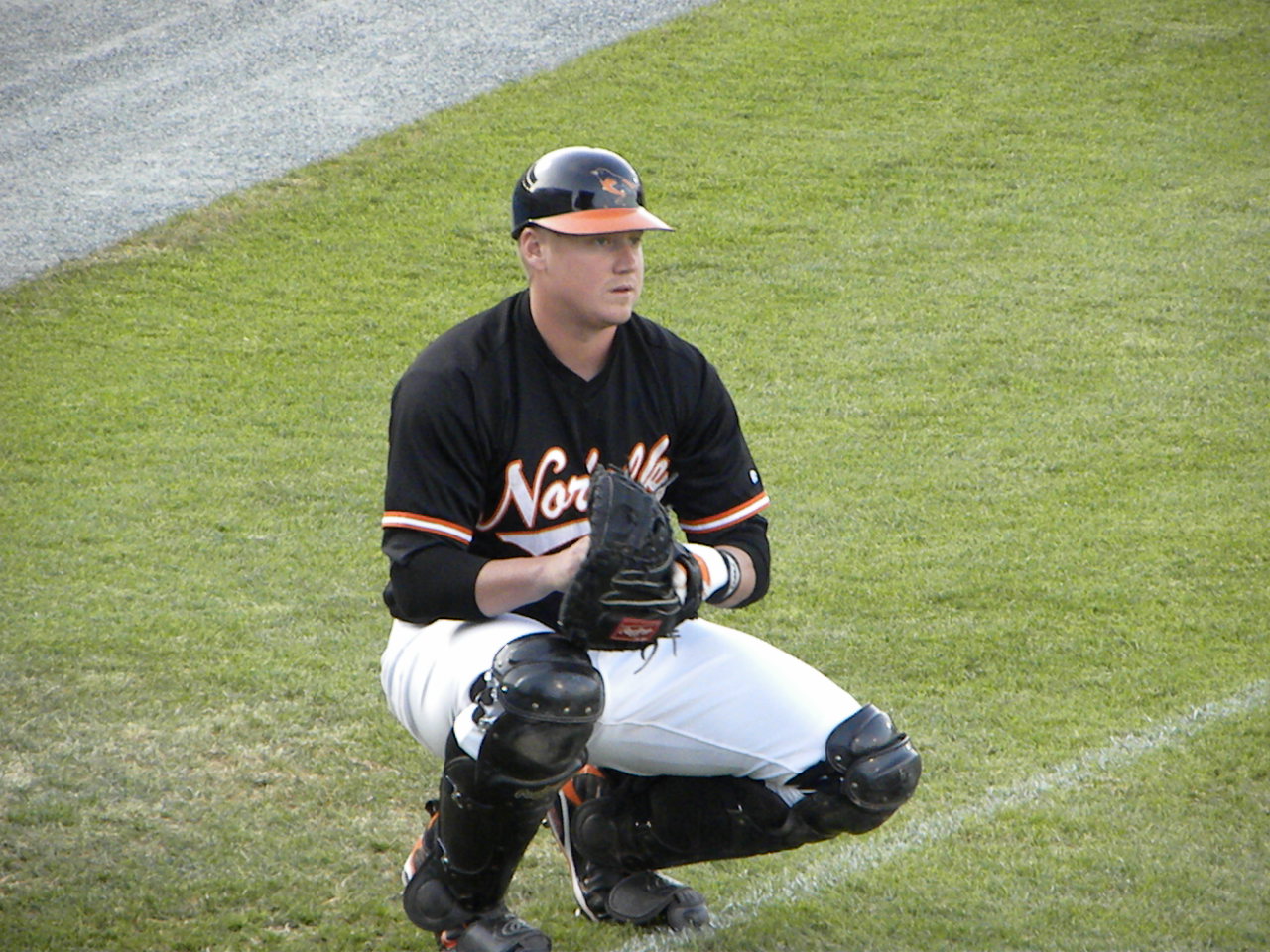
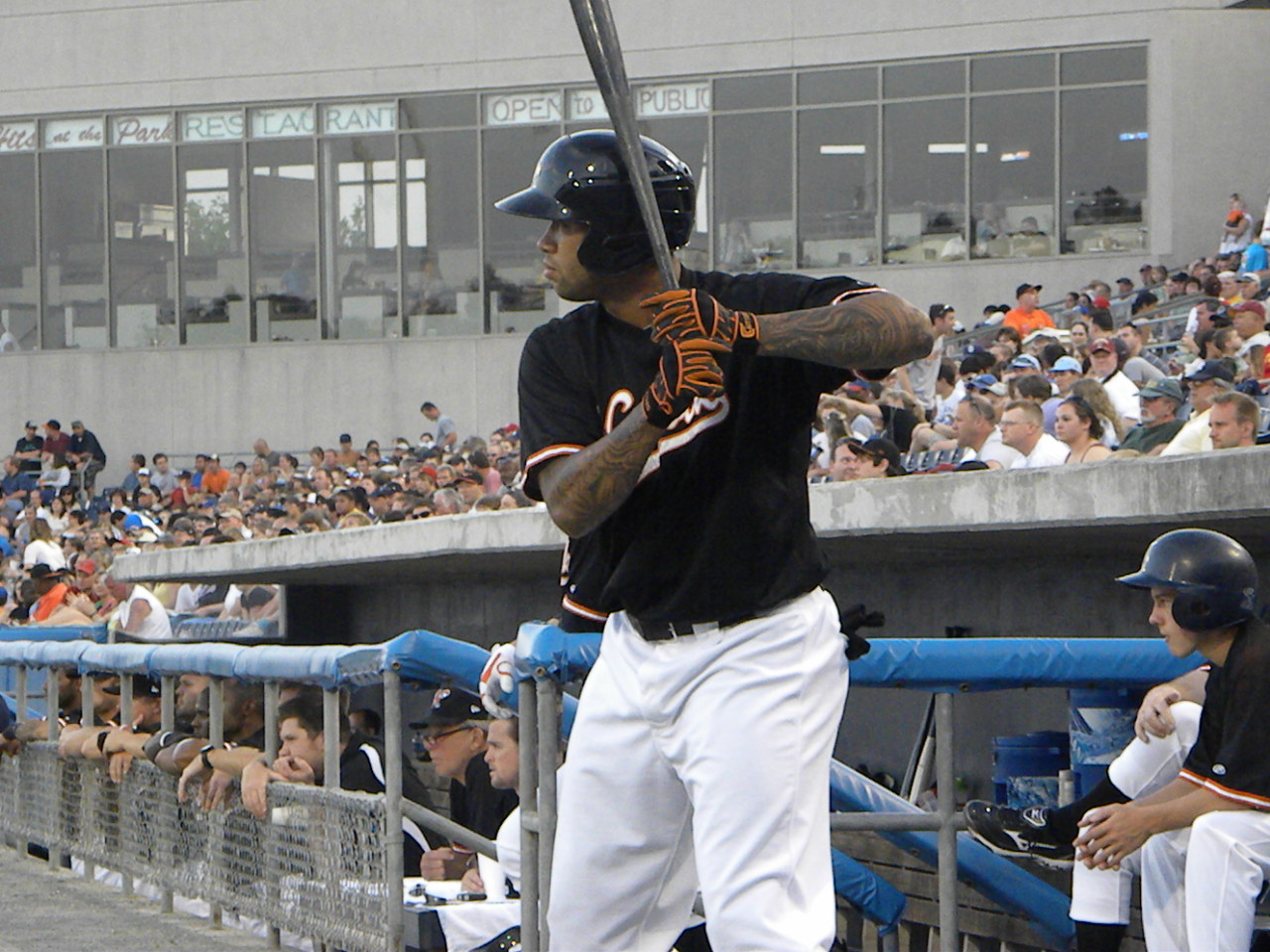
Author Archives: padresteve

padresteve's avatar

About padresteve

I'm a Navy Chaplain and Old Catholic Priest

Padre Steve Might be a Mad Cow Carrier and Can’t Give Blood…He’s “Mad” as Hell and isn’t going to take it anymore!

I am guilty yes guilty my friends.  I have about a one in a zillion chance of having the dreaded variant Creutzfeldt-Jakob Disease but if your believe those who promote conspiracy theories and unscientific assumptions I am probably something like Typhoid Mary just waiting to unleash death and destruction on millions of unsuspecting God fearing beef eating Americans by donating blood.  That is my alleged crime and while it is not a ‘crime’ in the truest sense of the word it might as well be as it ostracizes me and hundreds of thousands, maybe even millions of veterans and their dependants from a civic duty that many of us did before all the media hype that surrounded the decision to ban us from being able to give blood.  It is discriminatory, exclusionary and for that matter bad public policy.

Now my dear readers what is my crime and the punishment that has been inflicted on me?  I was in the military and lived in Europe in the 1980s and 1990s for a period of about four years. That my dear reader makes me ineligible to donate blood even if I am otherwise healthy and willing to give in time of need.  However the rule is rather arbitrary in nature. It specifies that living in most of Europe for 6 months or more if you are in the military is enough for a person to be a risk.  However the rules tolerate those who go on beef eating and haggis hogging binges for limited amounts of time while wearing kilts in Great Britain. It is an absurd standard to hold anyone to as the fact is simple, if you didn’t eat high risk cattle you have almost no chance of contracting or carrying the disease.

I readily admit that in that time in Europe I did eat beef. Mind you dear reader it was always well cooked and I certainly never ate Haggis.  However I am now and have been for many years treated as if I had some exotic and deadly plague like I was infected with HIV or Hepatitis B, diseases that are proven to be transmitted through contaminated blood products. I my friends am the poster child of what it is to be discriminated against based on special interest groups and media fear mongering.  That absurd fear mongering got our wonderful Food and Drug Administration and other government regulatory agencies to take draconian measures to stop something that in the scope of infectious disease is rather low on the threat scale.  I say that such action is not based on legitimate public health concerns but on a political agenda that uses fear to accomplish what it never could at the ballot box.

Now mind you Creutzfeldt-Jakob disease (CJD) or the variant Creutzfeldt-Jakob Disease (vCJD) or the real “Mad Cow” disease is no laughing matter but statistics underlying the incidence of the disease in the United States of vCJD show that if there is a threat it is very limited and that the chances of the Cubs winning the Worlds Series are better than getting this dread disease. Even statistics of a supposed “second wave” of vCJD in Great Britain estimate about 70 persons over a period of years during a “second wave” of vCJD might die, at worst case the number is 600.  In fact in Britain only one case of transmission of vCJD though blood products has been confirmed and if all people who had eaten beef lived in and eaten beef in Britain were barred from  donating blood the British would likely have to convert oil tankers to bring blood in from around the world. But they are not while people in the United States who lived in Europe, not even Great Britain are banned as a class from donating blood and the vast majority of these Americans are military members and their dependants.

I am a supporter of stringent policies on infectious diseases but if in Britain, the very epicenter of a disease that reared its ugly head in the early 1980s people can and do donate blood and the incidence of the disease is miniscule and is scientifically regarded to having more to do with genetics than eating beef.  Yet the Federal Government responding to fear mongering press reports and conspiracy theory maniacs have banned an entire class of people from donating the gift of life to those in need.  It is absurd and dishonest and plays into the hands of fear mongering power seeking special interests groups that claim the public good while discriminating against a whole class of people whose only crime was to serve their country.  Bill O’Reilly and Steven Colbert do you hear me?

Before this I was almost a religious blood donor I learned it from my dad who I think had his golden bucket from the Delta Blood Bank in Stockton. In fact he took me to donate for the first time and I continued because it was the right thing to do. I donated until I was branded with the scarlet letter of being a potential carrier of variant Creutzfeldt-Jakob Disease and have been refused ever since.  This is also true for hundreds of thousands and possibly millions of healthy military members, veterans and family members who ate a steak in Germany or some other western European country because we might have eaten a significant amount of “Bully” British Beef or perhaps a butt load of Scottish Haggis even though the chances of having these delicacies is significantly lower in good old Deutschland where people would rather eat Argentinean beef than beef from a country that they thought they should own by now and where the vast majority of the beef is well rather “brown-shirted” if you get my drift.  If the CDC or FDA has banned a whole class of patriot Americans from donating blood at least do it based on a preponderance of evidence and not speculation and paranoia.

In the United States we often run short of blood but we exclude by default one of the healthiest and giving groups of people in the world from giving. There are times in every major medical center that blood products run in short supply because of supply and demand.  Most donations centers have on hand no more than a 3 day supply for normal transfusion needs and if a major catastrophe involving vast numbers of traumatic injuries occurred, the supply would be gone in no time and people would die for the lack of blood.  Unfortunately in the world of potential mass casualties caused by terrorism or natural disaster this is a more likely occurrence than a mass outbreak of vCJD. Quite often there is more demand than supply and red blood cells have a short shelf life of 35-42 days at refrigerated temperatures and plasma can be frozen but has a shelf life of only about a year meaning that those stocks are also limited.

So rather than looking at statistics and solid data military members are banned from donating blood unless they choose to dishonor themselves by lying about it.  I have never done that as much as I wanted to give blood.  Heck we have an Armed Service Blood Center in our very hospital whose outreach director is one of my former Lieutenants from my days as a company commander in Germany.  I may be at times “mad” but my “madness” is both genetic as from a bit of PTSD, but my blood is a-okay high test 104 Octane B positive blood and I cannot donate when I want to because the debate is being driven by anti-beef eating, anti-military food Nazis who use this ‘cause’ to spread fear and increase their power relative to the rest of us.  Just take a look at their websites which are populated with hyperbole even more hyperbolous than what I spout.

I contend that I and hundreds of thousands of veterans and military members have been damaged by the zealotry of the “Mad Cow” fear mongers and their media accomplices which did its best to spread panic about this incredibly rare disease by showing infected cattle lurching around barnyards. Now it is true that this is a heinous disease but incredibly rare and for the most part has been controlled even in docile cows.

My argument is that there is a terrible need for blood products and a whole group of people are being discriminated against on the basis of media hype and pressure by special interest groups.  I know by saying this that it makes me a target and that once this post gets some hits that I will have one of these anti-beef eating, anti-military and national security ignoring bozos will post nasty things about me. So far as they don’t call me a Dodger fan I will be civil despite the fact that they won’t rest until none of us can give blood because we ate beef once in our lives.

I wish that some bold law firm would take this up as a class action suit naming the FDA, CDC and every major television network that spread the fear which drives the decision to bar an entire group of healthy people from giving blood.  This may seem callous and insensitive but I say let’s stick it to these guys and let them see the shoe is on the other foot. Let’s kick their vegan asses back to the planet Vegan where they belong. It’s late tonight but tomorrow its cheeseburger time for Padre Steve, pass the condiments please and get my stein ready.

So until the next time I say peace and may the law be with us. Maybe there is a reason that some of my classmates in seminary said that I should have gone to law school.  Maybe that’s what I’ll do with my GI Bill when I retire go to law school pass the bar and be a Priest-Lawyer, but not a Canon Lawyer, no money in that is there? So let’s go out and win a billion dollars or so from these oppressors of individual liberty and the common good.

Anyway Peace Out my brothers and sisters, have a burger or steak tonight.

Love ya,

Padre Steve+

23 Comments

Filed under healthcare, laws and legislation, national security, Political Commentary

Tides Fall to Chiefs 4-3 in Syracuse

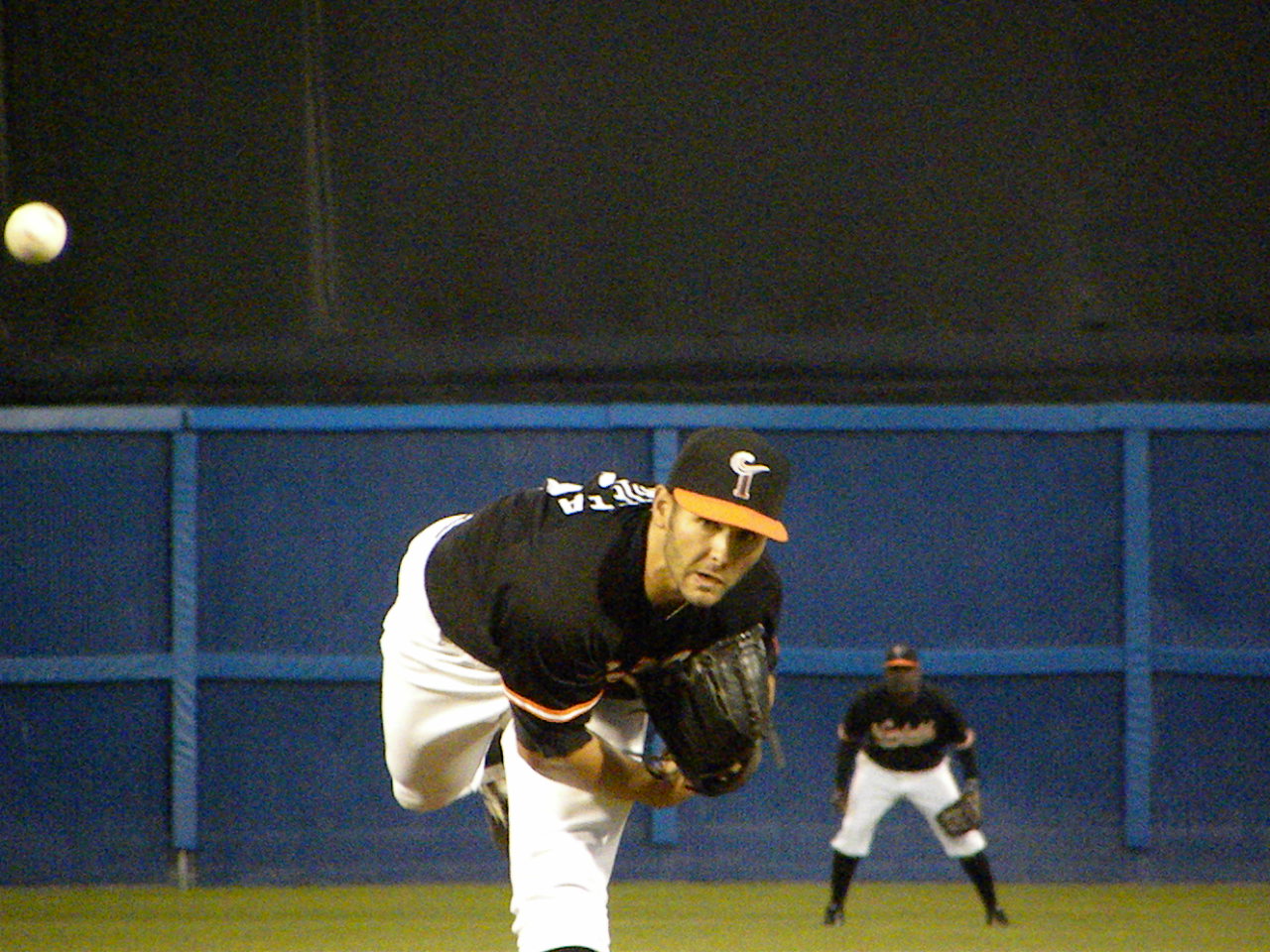
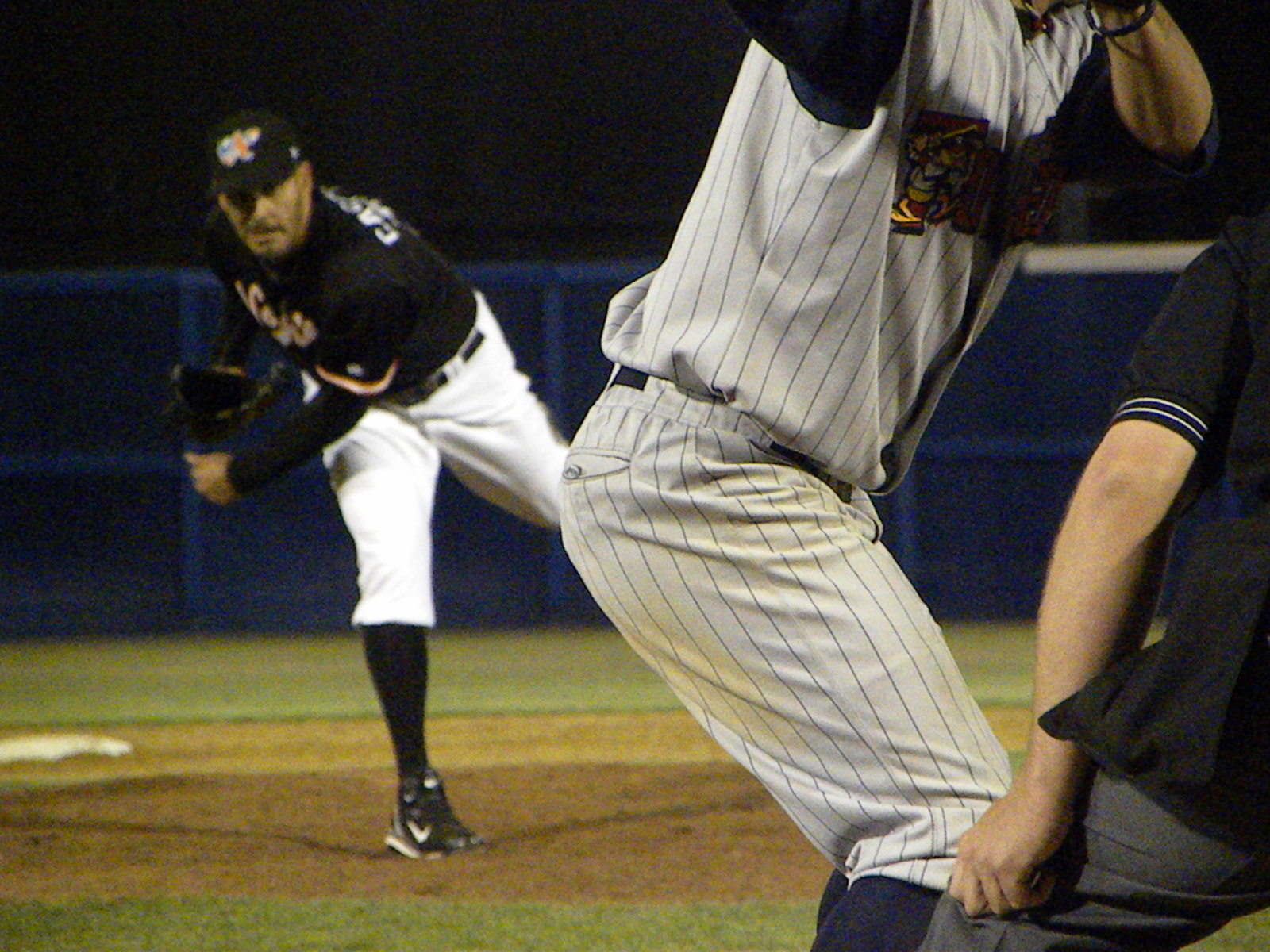
Jake Arietta pitched 7 innings but got a no decision

The Norfolk Tides travelled north to Syracuse on faced the Chiefs in the opening game of a four game series at Alliance Bank Field.  The Chiefs who are the AAA affiliate of the Washington Nationals lead the North Division of the International League with a record of 18-11 and are playing very good ball.  Even more surprising for the Nationals organization is that the Nationals have an 18-14 record and sit in second place in the NL East trailing the division leading Philadelphia Phillies by two games.

In front of a crowd of 3612 fans who braved temperatures that fell into the 40s as the night wore on and variable winds of 11 miles an hour the teams took the field.  Although it was cold the weather was nowhere near as bad as the weekend where two games between the Chiefs and the Gwinnett Braves were postponed due to winter weather including snow on Sunday. The Tides started Jake Arietta who faced Sharion Martis of the Chiefs. Arietta (3-1 1.67) pitched seven innings allowing 2 earned ruins on 4 hits.  He gave up an unearned run in the bottom of the 4th inning when after walking Josh Whitesell and then on a 1-1 count hit Mike Morris.  This brought up Pete Orr who bunted to Arietta who fielded the ball the throw was late to First Baseman Brandon Snyder but also wild which allowed Whitesell to score on the play.  Orr was given a hit on the play but Arietta the error as the throw enabled Whitesell to score and Orr to advance to second.

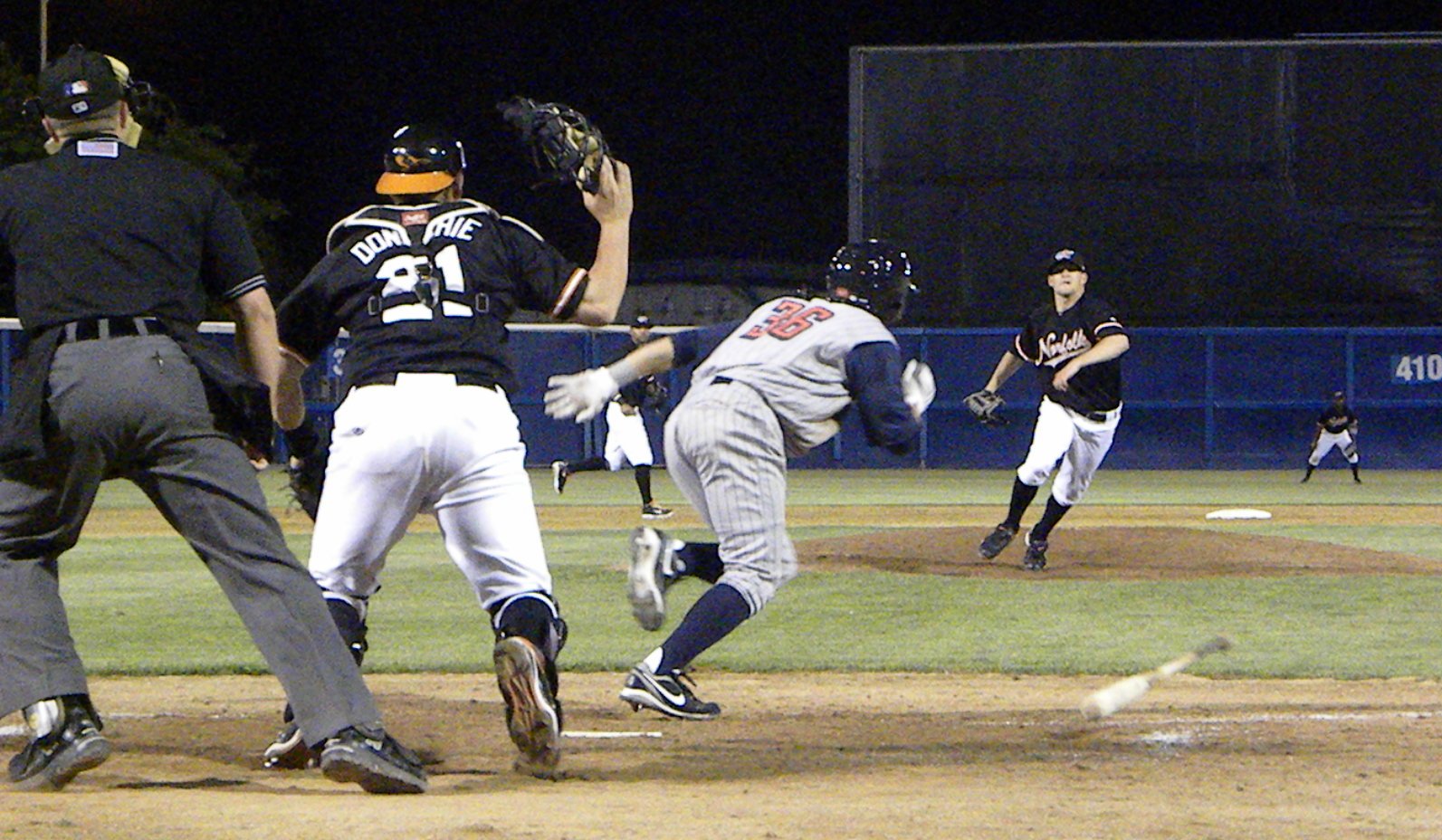
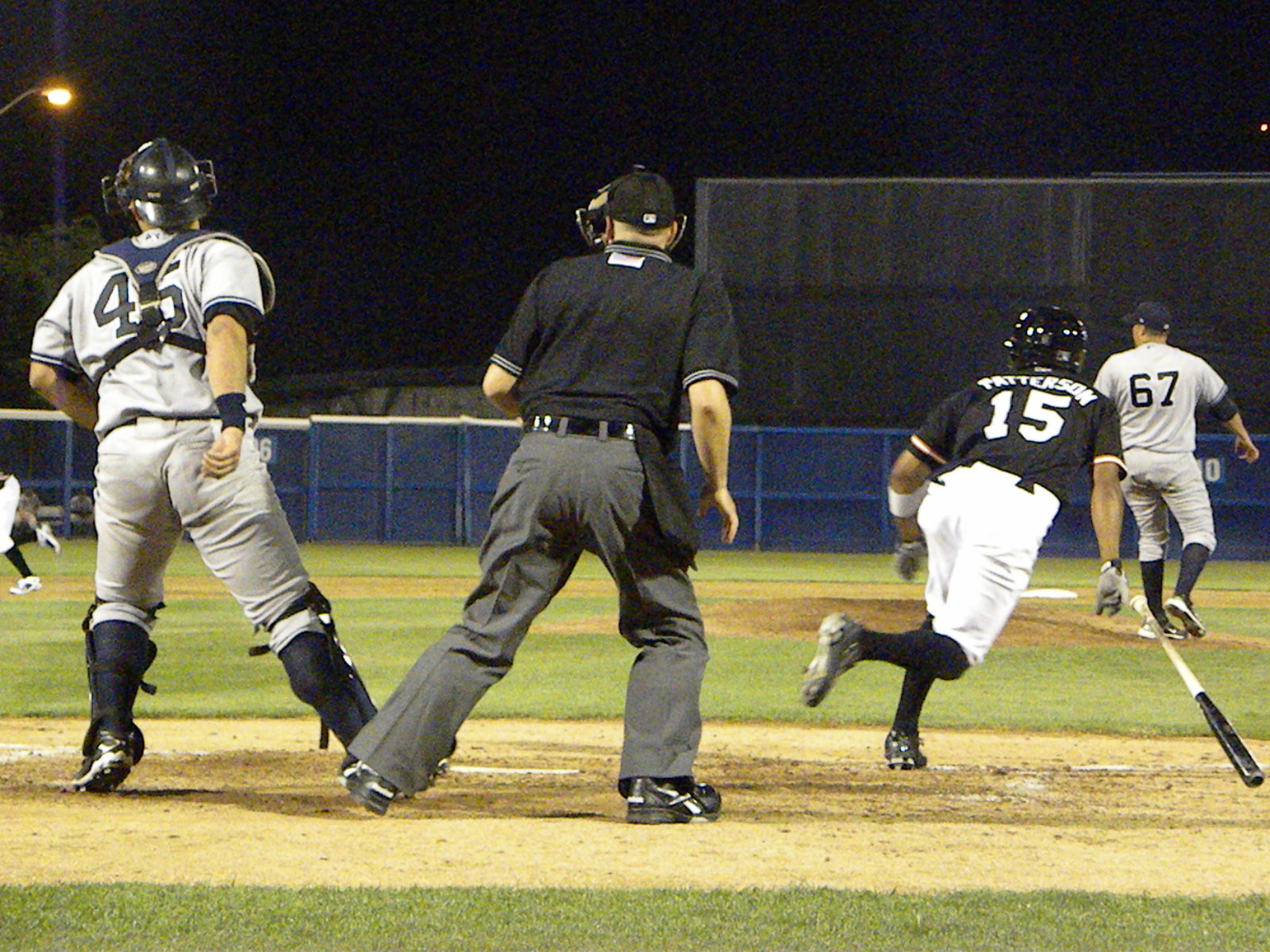
The Tides scored one run in the top of the 4th inning when Corey Patterson continued his ferocious hitting by launching a triple to right field and scored on a sacrifice fly to center by Josh Bell his 20th RBI of the season.  The Tides would score again and tie the game in the 6th inning.  Corey Patterson walked to lead off the inning and was followed by Josh Bell who popped up to third baseman Pete Orr in foul territory.  Scott Moore then singled and Patterson was held at second base.  To the plate came Brandon Snyder who had a key role in the Tides win against the Mud Hens on Sunday. Brandon took a called strike from Martis and then fouled tow pitches off before taking ball one.  With a 2-1 count Snyder tripled to right to bring both Patterson and Moore home to tie the score.  Justin Turner struck out swinging and when the ball got away from catcher Carlos Maldonado Snyder attempted top come home. Maldonado threw to relief pitcher Drew Storen who tagged Snyder out at the plate to end the inning.

Brandon Snider had 2 2 RBI Triple in the top of the 6th inning

The game remained knotted at 3 until the bottom of the 8th inning. Arietta left at the end of the 7th and was relieved by Ross Wolf who has been very effective in relief this year.  Wolf faced Kevin Mensch who after working the count to 2-2 by fouling off four pitches took the seventh pitch and doubled to center.  Josh Whitesell singled to right fielder Michael Aubrey scoring Mensch.  Wolf would work his way out of the inning but the damage was done and the Tides were unable to score in the 9th inning despite a single by Corey Patterson and the Chiefs took game one by a score of 4-2.

Arietta went seven innings and got a no decision giving up 2 earned runs on 4 hits. His problem came due to control; he gave up five walks and hit one batter as well as the throwing error that cost the run in the 4th inning.  Ross Wolf (0-2 2.89)  got the loss in relief giving up one run on two hits.  Chiefs reliever Ron Villone (1-1 9.53) got the win and Joel Peralta (0-0 S8) got his eighth save of the season.  The teams meet again on Tuesday with Chris George (1-1 4.50) getting the start for the Tides and Chuck James (2-0 4.85) taking the hill at home for the Chiefs.

The Tides made a number of personnel moves over the weekend sending pitcher Jim Miller and catcher Steve Lerud to Baltimore’s short season “A” team the Aberdeen Ironbirds, and activating pitcher Denis Sarfate and catcher Michel Hernandez from the disabled list.  Pitcher Jim Johnson who had been sent down from the Orioles last week was placed on the 7 day disabled list for elbow pain.

Peace,

Padre Steve+

Leave a comment

Filed under Baseball, Batlimore Orioles, norfolk tides

Dallas Braden; Perfect Games and Memories of Home in Stockton California

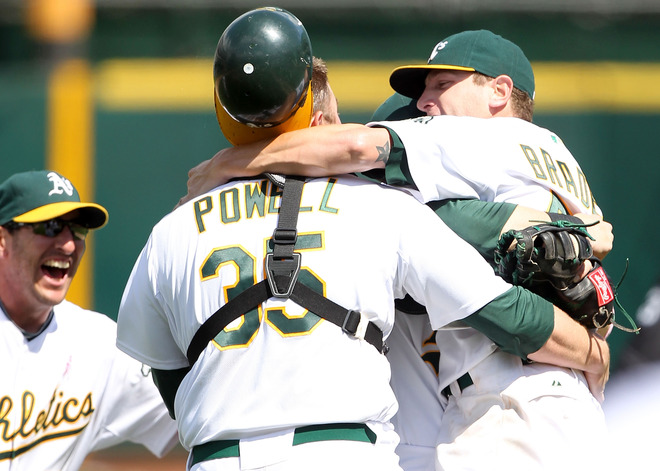
Dallas Braden celebrating with teammates (Getty Images)

On Sunday Dallas Braden of the Oakland A’s did what only eighteen men had done in the history of Major League Baseball, he pitched a perfect game.  However there is more to this story than meets the eye and some that touches me personally.

The setting of Braden’s feat was the venerable Oakland-Alameda County Coliseum, the “other” ballpark in the Bay Area.  Sitting in an area just off of the Nimitz Freeway the coliseum and its surrounding parking lots are in one of the most un-picturesque venues in the Bay area.  While one can see the Oakland Hills to the East the Park is just far enough away from San Francisco Bay to lack the ambiance of the San Francisco Giant’s home across the bay AT&T Park which sits on the bay with views of the Bay Bridge and the Skyline of the City of San Francisco.  While the ballpark has been the home of multiple World Series Champion A’s teams, numerous League Championship teams and had its share of Hall of Fame players tread upon its natural grass it has never been considered a great ballpark for either pitchers or hitters.   The fact that it is a multi-use stadium and the home of the Oakland Raiders football team contributes to un- remarkableness as a baseball venue.  All of this said it is a place where magic has occurred before when in 1968, in fact almost 42 years to the day of Braden’s magical win, May 8th 1968 Jim “Catfish” Hunter threw a perfect game against the Minnesota Twins.  Like Hunter’s win in 1968 the A’s won the game by a score of 4-0 however Hunter’s win came before the American League adopted the Designated Hitter meaning that Hunter had to hit for himself in the game.  That being said he did hit and I mean that he really did hit.  Hunter went 3-4 including a double and knocked in 3 of the A’s 4 runs.  That was no fluke as Hunter had a .226 lifetime batting average with 6 career home runs and 51 RBIs.

Dallas Braden with Grandmother (Getty Images)

With that little bit of trivia said Braden who is not your typical power pitcher that usually pitches perfect games pitched a solid game which was far different than one year ago when he was hit in his pitching hand with a 109 mile an hour line drive off of the bat of Vernon Wells which left the imprint of the seams on his hand.  Braden as I said is not a power pitcher.  He has one of the 10 slowest fastballs in the game topping out at a mere 87 miles an hour.  Normally an 87 mile and hour fastball is a dish served at a perfect temperature for most good hitters and they eat the pitchers that throw them for lunch.  However Braden has a remarkable equalizer, it is not his curve or slider but his change up.  I drive faster than his change up on a typical commute to and from work.  Braden’s change up comes in at a leisurely 72.9 miles and hour.  This pitch is the slowest change up in the league and it baffles batters by making his fast ball seem faster than it is. Batters at the Major League level are not used to this type of ultra-slow deception for a pitcher and it served Braden well but even so coming into the game he had a lifetime record of 18 wins and 23 losses and a 4.49 ERA.  He is not the pitcher that one would put money on to throw a perfect game and I’m sure that Jimmy the Greek, Larry the Latvian, Johnny the Walker and even Pete Rose would have wagered against him pulling this off. Yet he did it against the hottest team in baseball, the Tampa Bay Rays.

Braden’s biggest notice came earlier in the year where he and Alex Rodriguez had an exchange of rather terse barbs following an incident where Rodriguez ran across the pitcher’s mound during the game.

Braden pitched for 5 or parts of 5 years in the minors for 7 different clubs in the A’s organization, the Kane County Cougars of the Midwest League, the Vancouver Canadians of the Northwest League, the Arizona Athletics of the Arizona League, the Stockton Ports of the California League, The Midland Rock Hounds of the Texas League and the Sacramento River cats of the Pacific Coast League.  This year he has stayed in the majors and now after the win has a record of 4-2 with a 3.33 ERA in 7 starts.

Braden’s story is that of a young man who lost his mother Jodie Atwood in his senior year at Stagg High School in May of 2001.  His parents had separated when he was young and his father was estranged from the family.  His grandmother Peggy Lindsey took over and helped him through that last year of school providing the stability, love and care that he needed to survive his mother’s loss and not fall into the mire of Stockton’s often violent and crime ridden streets.  The story of this young man and the women who raised him is the story of how mother’s day ought to be.  Braden had the love and support of his late mother and grandmother during the turbulent times of his youth and as a result still remains closely connected to his grandmother and his home town.  In fact he commutes the 67 mile trip daily from Stockton to Oakland which means unlike many professionals, athletes, businesspersons, those in other professional fields to include the military that leave their home town and only make occasion visits home is able to keep himself ground in reality.  He does not live in a glamorous town; he plays for a very blue collar city on a very “Green Collar” team.  I think that is one of the stories that some people will miss, not all, Jeff Passan mentioned Braden’s connection to home in his column on Yahoo Baseball.

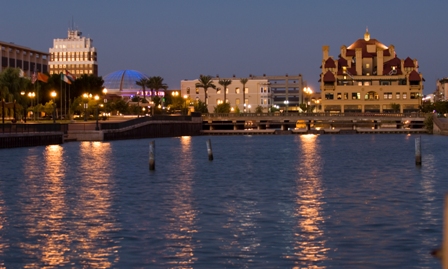
Downtown Stockton

You see there is something about this story of relationship and connectedness that I think may be uniquely Stocktonian.  You see for the past number of years Stockton has been ranked number one or at least in the top 5 of the nation’s “Misery index.”  This year it dropped to second as it was edged out by Cleveland Ohio, I guess Cleveland does rock. It is routinely in the highest percentage of crime, violent crime and murders in the nation.  In the economic downturn and the real estate crash it was hit particularly hard and for a fair amount of time led the nation in foreclosures, or may still I just haven’t checked.  It is a town that in many ways has experienced for many years and reflects the reality that many other locations in the country are just beginning to know in today’s economy.

Foreclosure capitol (Getty Images)

All this said there is still something that native Stocktonians appreciate about our city, even those of us that have moved away.  We tend to remain in contact with our friends who still remain in town or have moved away.  I currently am in contact with over 100 friends on Facebook alone. My Edison High School Class of 1978 still has well attended reunions and is very well connected to each other and the classes that came before and after us. I look at the Stockton Record website every day. I used to read the obituaries until the Record started charging for them.  When I go home there is a certain familiarity with the city and though it has grown to a rather sizable city it still has a small town feel to me. I can still go to Arroyo’s Café when I go home and see the same people. The same is true with Donut King, Chucks , Manny’s burgers, the Fox Theater and a bunch of other places.  While other cities built huge super-malls Stockton still has Weberstown and Sherwood Mall.  Yes they have changed some over the years but they are still much the same. Yes much has changed but much is still the same in Stockton and I think that it one of the things that makes Dallas Braden’s story so remarkable to me he has not forgotten where he came from.  He still loves and cares for Stockton.  In an age where the really “successful” people move to New York, Los Angeles or San Francisco Braden didn’t cut himself off from his roots.  Are there others who have done such as this one that comes to mind is Joe Mauer in Minnesota but why leave if they will pay you more money than God gets in a season?

Another interesting thing that stuck me about Dallas Braden was his mother.  She was close to my age and I remember her, I thought it was in Junior High School but I couldn’t find t  find her in the yearbooks, it could have been the church youth group when I was in High School but regardless I am sure that I knew her.  I mentioned this to my mother today and she remembered the name.  Interesting how closely peoples’ lives are linked together.

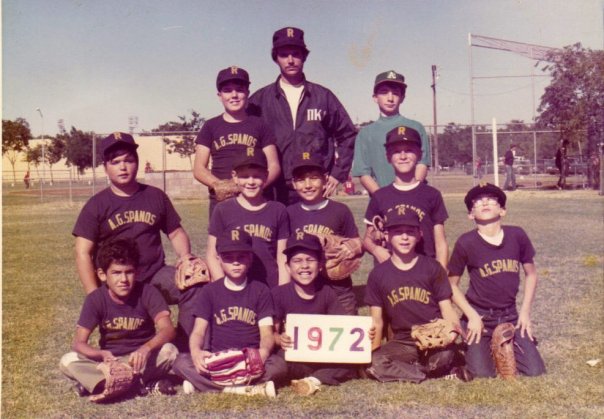
My Oak Park Little League team back in 1972

I guess what strikes me the most about this game even more than the game itself which I must say that I am in awe of is the story of a man, Dallas Braden  who despite pitching in the Major Leagues still remembers home and family and stays connected to them.  This is becoming rare in our society and maybe given the state of the nation and how deeply divided we are it is time to return home, maybe not physically but returning to relationships with the people that we grew up with, schools, workplaces, churches and other activities.  Maybe Dallas Braden points us to something that matters more to many of us than the achievements of athletes or entertainers but to where we really need to be connected to one another as Americans, friends and families.  Yes it is wonderful to succeed and all should strive to be the best at what they feel called to be or do, but if that success destroys and alienates people from family, friends and home is ti really success? Maybe it is the pastoral environment of the baseball field that makes this happen for some of us.  Maybe like Terrance Mann played by James Earl Jones in Field of Dreams we can understand that

“The one constant through all the years has been baseball. America has rolled by like an army of steamrollers. It’s been erased like a blackboard, rebuilt, and erased again. But baseball has marked the time. This field, this game, is a part of our past. It reminds us of all that once was good, and what could be again.”

Thank you Dallas Braden for helping to remind us what is important as you play this game of baseball.  I do hope that you do well in your career and that this perfect game is a foretaste of a great career for you.

Peace,

Padre Steve+

Leave a comment

Filed under Baseball

Tides Lose Saturday 10-3 but Tillman Dominates Toledo on Sunday Tides Win 4-1

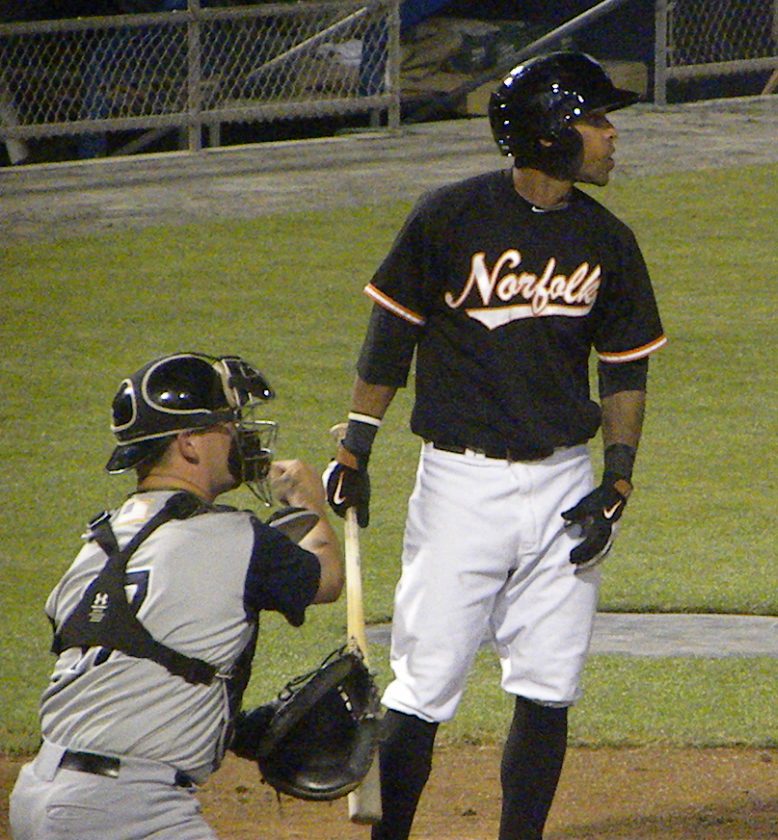
Corey Patterson Smacked 3 doubles in Saturday’s loss

The Norfolk Tides won their first series of the season taking three of four at Harbor Park from the Toledo Mud Hens.  After taking the first game of the series in a slugfest 12-7 on Thursday night, the Tides and Toledo battled into the 12th inning on Friday with the Tides getting a 3-2 win on Josh Bell’s walk off home run with no outs in the bottom of the 12th.

Brandon Erbe took his 6th loss on Saturday

On Saturday in front of 6795 fans in warm and windy weather it would turn out to be a different sort of ball game as the Mud Hens got to Tides starting pitcher Brandon Erbe (0-6 7.20) early and often hitting the young pitcher hard for 6 runs on 9 hits in 5.2 innings. After driving Erbe from the game they continued on getting Pedro Viola for 2 runs on 3 hits in 1.1 innings.  They scored another unearned run in the 8th and another earned run off of Kam Mickolio in the 9th.  The Mud Hens pounded out 13 hits and were helped by 6 walks and a hit batsman from Tides pitchers and two errors one of which contributed to the run in the 8th inning. Erbe was pasted with the Mud Hens hitting him for 3 home runs, two by Clete Thomas and two doubles. Although Viola only gave up three hits all went for extra bases two doubles and a triple.

On the offensive side the Tides got 11 hits but only put them together to produce runs in the 1st and the 7th innings.  In the first Robert Andino led off with a double, Corey Patterson walked and Josh Bell singled to load the bases. Scott Moore sacrificed Andino home for the Tides first run.  In the 2nd inning they put the first two men on base but could not get them to the plate. In the 3rd inning Corey Patterson doubled to lead off the inning but was left on base. In the 4th inning Blake Davis tripled with one out and was left on base.  In the 7th things started to turn around Robert Andino singled and with one out Corey Patterson nailed his second double of the night to drive him home. Patterson advanced to second on a ground out by Josh Bell and scored on a single by Scott Moore before Michael Aubrey grounded out to end the inning.  The Tides went down in order in the 8th and with two outs in the 9th Corey Patterson hit his third double of the night but was left on base.

In all the Tides only brought home 2 of 14 runners in scoring position and left 10 runners on base. Erbe got the loss his sixth loss of the year.  Alfedo Figaro (4-1 2.55) got the win for Toledo.

Chris Tillman got his third win with a 4 hit 10 strikeout performance on Sunday

On Sunday Chris Tillman got the start for the Tides and while not quite as sharp as his no hitter he was still very much in control of this game pitching seven innings giving up only 1 run on 4 hits while striking out 10. The run came on a 7th inning home run by Jeff Larish.  Alberto Castillo came on in the 8th and allowed a single and two walks before being pulled for Frank Mata.  Mata stuck out Danny Worth and got Larish to ground out to end the inning stranding all three Toledo runners.  Mata came back out in the 9th and though walking Clete Thomas with two outs then stuck out Caspar Wells to end the game and get his 5th save.

Brandon Snyder blasting his 2nd home run of the season in the 5th inning

The Tides got their first run in the 1st inning when Robert Andino walked to lead off the inning and advanced to second on an excellent sacrifice bunt by Joey Gathright. Corey Patterson singled Andino to third and Josh Bell grounded out to score Andino.  The score would remain 1-0 until the 5th inning when Brandon Snyder ended his drought by launching a home run way over the deep left center field wall to extend the Tides lead to 2-0.  In the 6th the Tides added another run. Joey Gathright singled to lead off the inning and went to second on a missed forced attempt when Will Rhymes and Brent Dlugach could not complete the play Rhymes first bobbling the ball and then Dlugach missing the toss from Rhymes.  Josh Bell hit a sacrifice fly to move Gathright to third.  Gathright scored when Scott Moore hit a sacrifice fly to center.  Toledo then got its only run on Larish’s home run in the top of the 7th.  In the bottom of the 7th the Tides added their final run as Brandon Snyder singled and went to second on a ground out by Blake Davis.  Snyder scored on a single by Robert Andino.

Frank Mata got his 5th save

The game ended with the Tides on top with a final score of 4-1.  The Tides have had 4 runs on 6 hits and no errors leaving 5 men on base while the Mud Hens had 1 run on 5 hits and 2 errors with 7 left on base. Chris Tillman (3-3 3.49) got the win and Frank Mata (0-0 S5 1.23) got the save.  Toledo starter Ryan Ketchner (0-1 2.77) got the loss.

The Tides are now 14 and 17 and in third place in the International League South 5 games behind the Durham Bulls. The Tides departed today on an eight game road trip to Syracuse and Buffalo.  Syracuse could be interesting as the Chiefs and the visiting Gwinnett Braves were snowed out today. The Tides return to Harbor Park on the 18th to face the Pawtucket Red Sox.

Peace,

Padre Steve+

Leave a comment

Filed under Baseball, norfolk tides

Tides Win on Bell’s 12th Inning Walk-Off Home Run

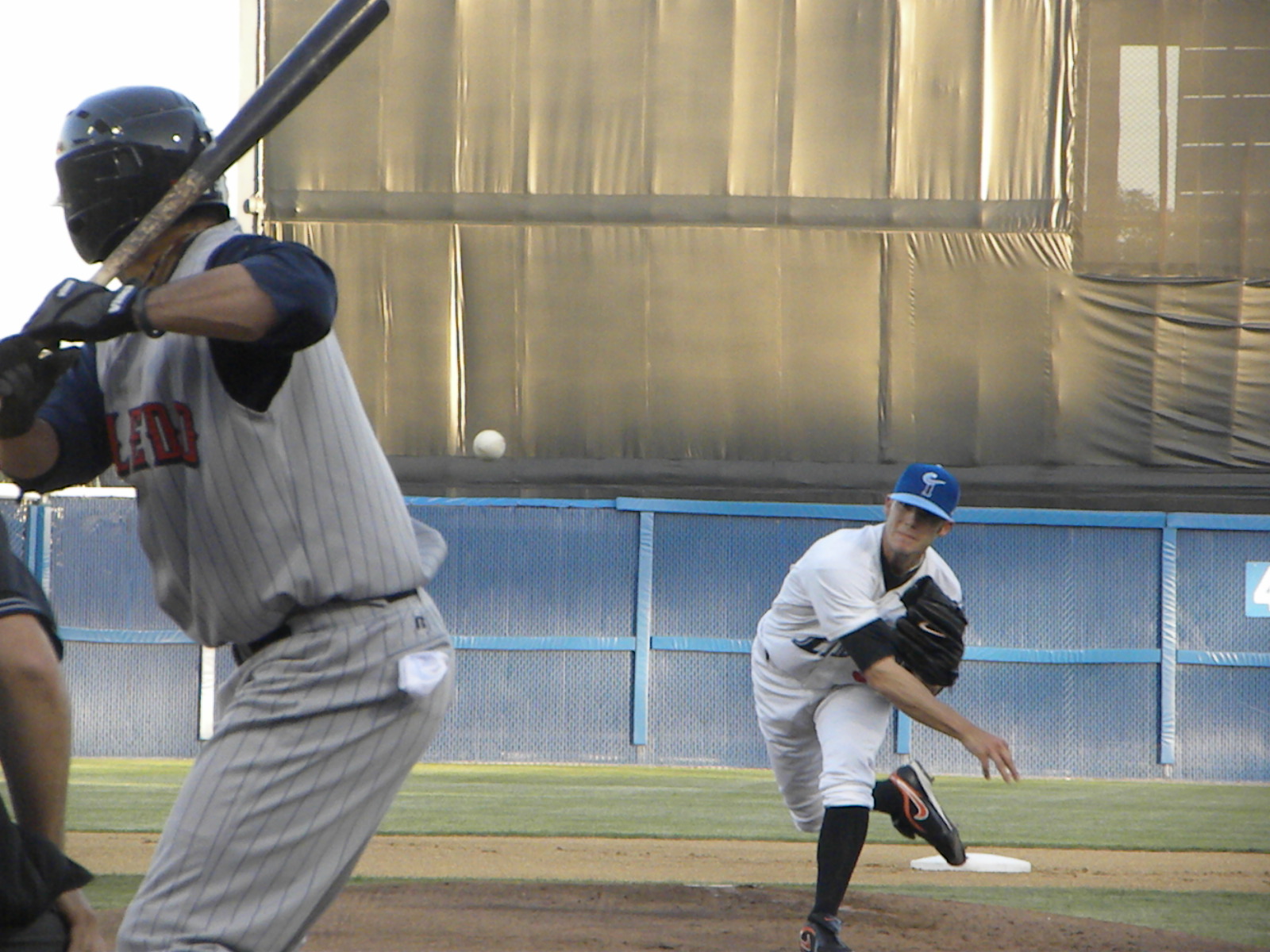
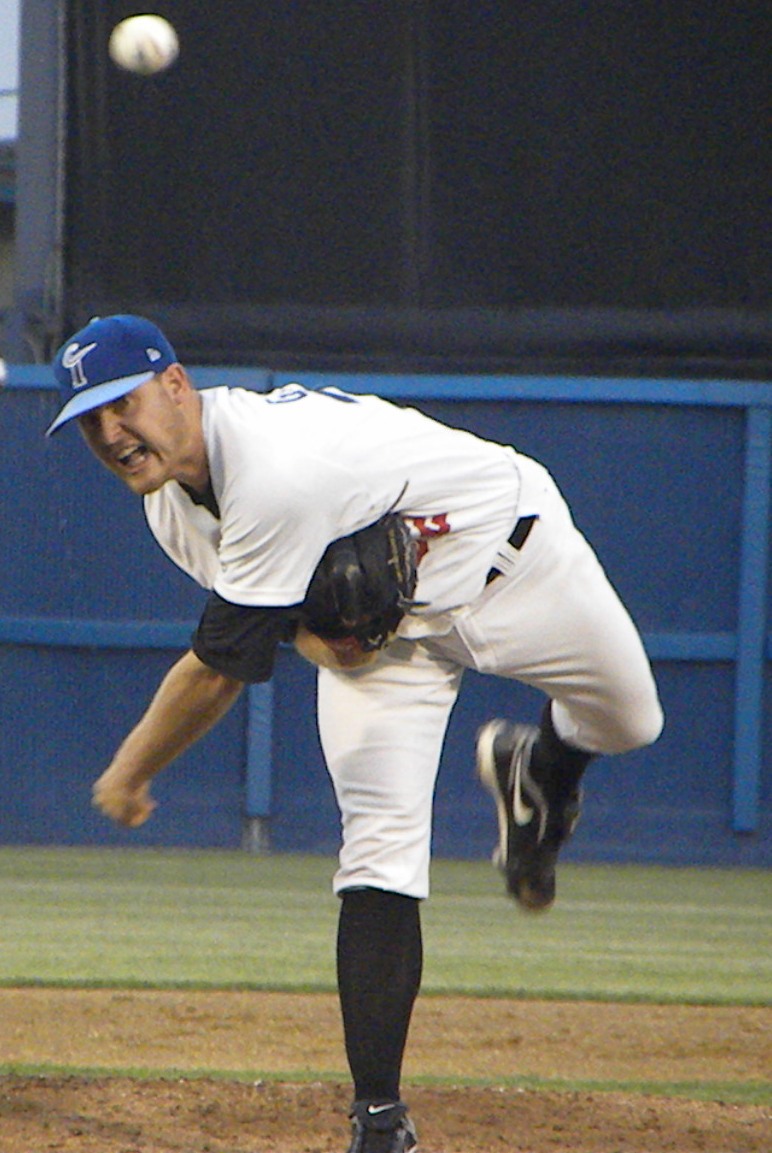
Troy Patton pitched 6.2 innings allowing 2 runs on 5 hits but got a no-decision

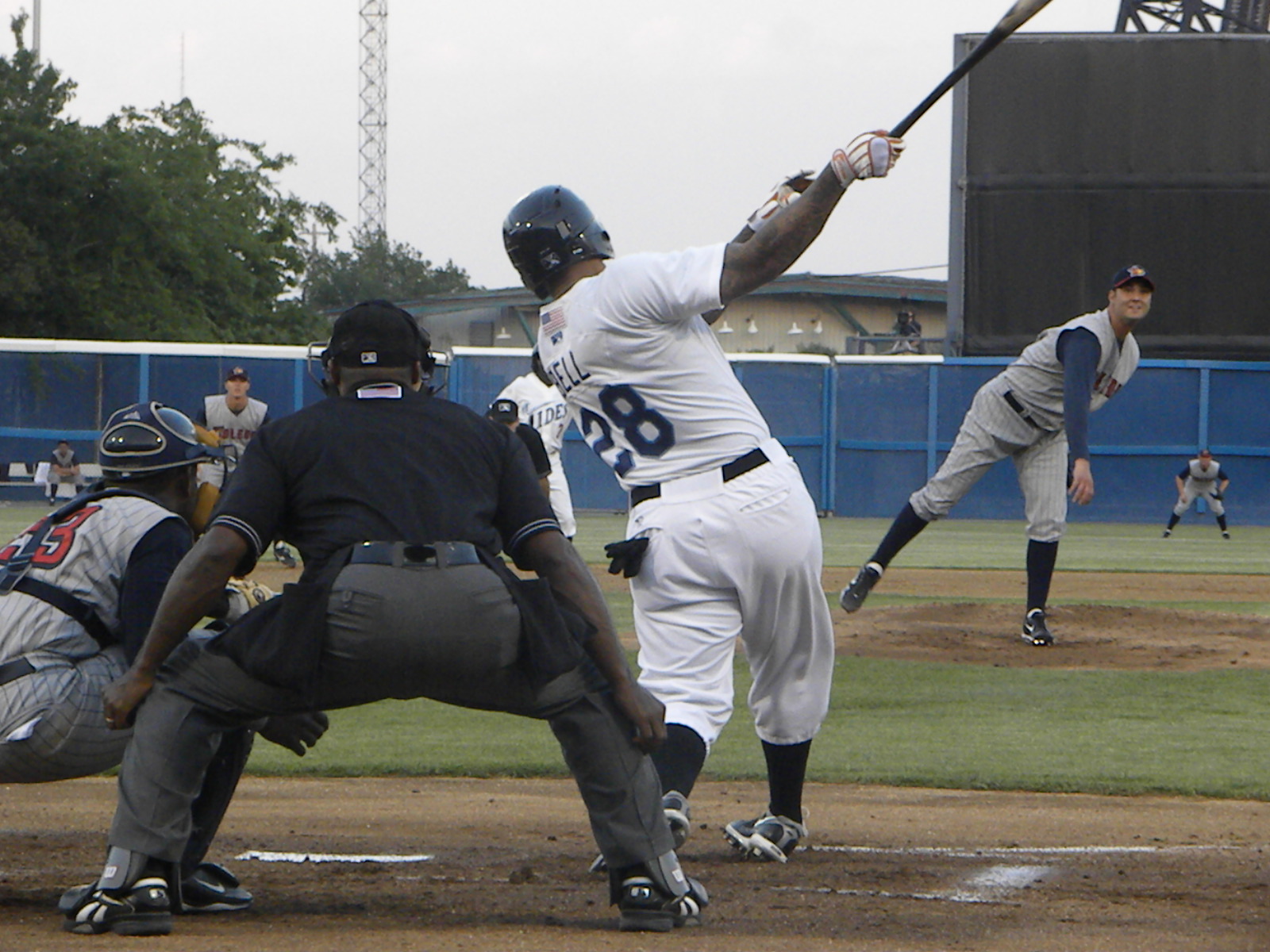
Josh Bell did something that has seldom happened at Harbor Park.  It was not the walk off home run but it was the feat of having a home run in three consecutive games in a ballpark that is a pitcher’s paradise and a power hitter’s nightmare.  Harbor Park opened in 1993 when the Norfolk Tides were the AAA affiliate of the New York Mets.  The dimensions of the park are very similar to the Mets’ old home Shea Stadium.  The left field line 330 feet, right field 318, and dead center 410 feet.  In fact not very many of today’s Major League parks have as deep dimensions as the home of the Norfolk Tides.  Not only is it a big yard but the prevailing winds during the season also mitigate against a lot of home runs as does the air which often is heavy with humidity.  The winds usually come off the East Fork of the Elizabeth River and blow in knocking down balls hit to right or right center.  Typically the leading Tides home run leader since the team has moved to Harbor Park in 1993 hits an average 16 home runs a season and of course many of those come in other parks.  By contrast the Durham Bulls have averaged over 25 home runs a season since coming into the International League in 1997 the same is true of the Pawtucket Red Sox who have been in the International League since 1993 and the Toledo Mud Hens during the same period average 26. The Buffalo Bisons average 16 per season for their leading home run hitter over the same time period but face some of the worst weather in the league.  The truth is that Harbor Park for its beauty as a ballpark is a pitcher’s paradise and hitter’s nightmare all of which sets the stage for the story of Friday evening’s game between the Tides and the Mud Hens.

Alberto Castillo made his first appearance since returning from Baltimore

With warm and windy conditions in front of a crowd of 5943 the Tides and the Toledo Mud Hens met for the second game of a four game series.  This game was dominated by the pitchers and it was a long night for both teams because of how well the pitchers worked.  Prior to this game only two teams in the International League had not played an extra inning game and both were on the field Friday. I guess it was destiny that the game would go extra innings how could it not? In 12 innings the two teams pitchers allowed a combined 5 runs only 4 of which were earned runs.

Daniel Schlereth after the wild pitch that allowed Michael Aubry to score

After a scoreless first inning the Mud Hens took a one nothing lead in the top of the second when Max Leon singled to score Jeff Frazier. They extended it to 2-0 in the top of the third when Jeff Frazier singled to drive in Brent Dlugach but after that would manage just three more hits as Troy Patton, Ross Wolf, Frank Mata, Alberto Castillo and Jim Miller shut down a potent Toledo line up allowing no extra base hits.

The Tides offensive production also lagged as compared to the previous two outings where they scored a dozen runs per game.  Friday however the Tides hitters were contained by the Toledo pitchers who scattered 9 hits in the 12 innings.  The Tides got on the board in bottom of the 3rd inning when Josh Bell singled to drive in Robert Andino.  The score would remain 2-1 until the bottom of the 6th inning.  Michael Aubrey singled to lead off the inning and then Brandon Snyder stuck out swinging.  The Mud Hens then took out starter Enrique Gonzalez bringing in Daniel Schlereth in relief.  With Blake Davis at the plate Mud Hens catcher Angel Flores allowed a passed ball which allowed Aubrey to take second Troy Patton the Tides starter allowed two walks which placed runners on second and third.  Ross Wolf came on in relief and on his first pitch got Brent Dlugach to pop out to second.  The Tides would have a runner on second in both the 8th and 10th innings bit were unable to bring the runner home.  In the 11th the Tides threatened again. Blake Davis singled and advanced to second on a very well executed sacrifice bunt by Adam Donachie.  Robert Andino hit an infield single which did not advance Davis.  Joey Gathright grounded out to advance Davis to third and Andino to second.  Corey Patterson the grounded out sharply and the 11th inning ended with the teams still tied at two.

Tides players mob Josh Bell after his walk off home run

Jim Miller came on in the 12th inning in relief of Alberto Castillo who in his first appearance at Norfolk since he was optioned back to the team by the Orioles when Koji Uehara completed his rehab work. Miller put the Mud Hens down in order striking out Diek Scram, getting Angel Flores to pop out in foul territory to Adam Donachie and retiring Will Rhymes on a line drive to left fielder Joey Gathright.

In the bottom of the 12th the Mud Hens sent in Jay Sborz to pitch.  The first batter that Sborz faced was Josh Bell who had homered in his last two games at Harbor Park.  Bell slammed the ball to deep center and it kept going out of the park. As Bell crossed the plate he was mobbed by his teammates.

Jim Miller got the win and Sborz the loss. The Mud Hens had 2 runs on 9 hits with no errors with 8 men left on base. The Tides 3 runs on 9 hits and no errors with 13 left on base.

The teams met again Saturday night but that article will be posted sometime later Sunday.

Happy Mother’s Day to all the Mothers out there!

Peace,

Padre Steve+

Leave a comment

Filed under Baseball, Batlimore Orioles, norfolk tides

Tides Hit Parade Continues: Big Hits Power Team over Mud Hens 12-7

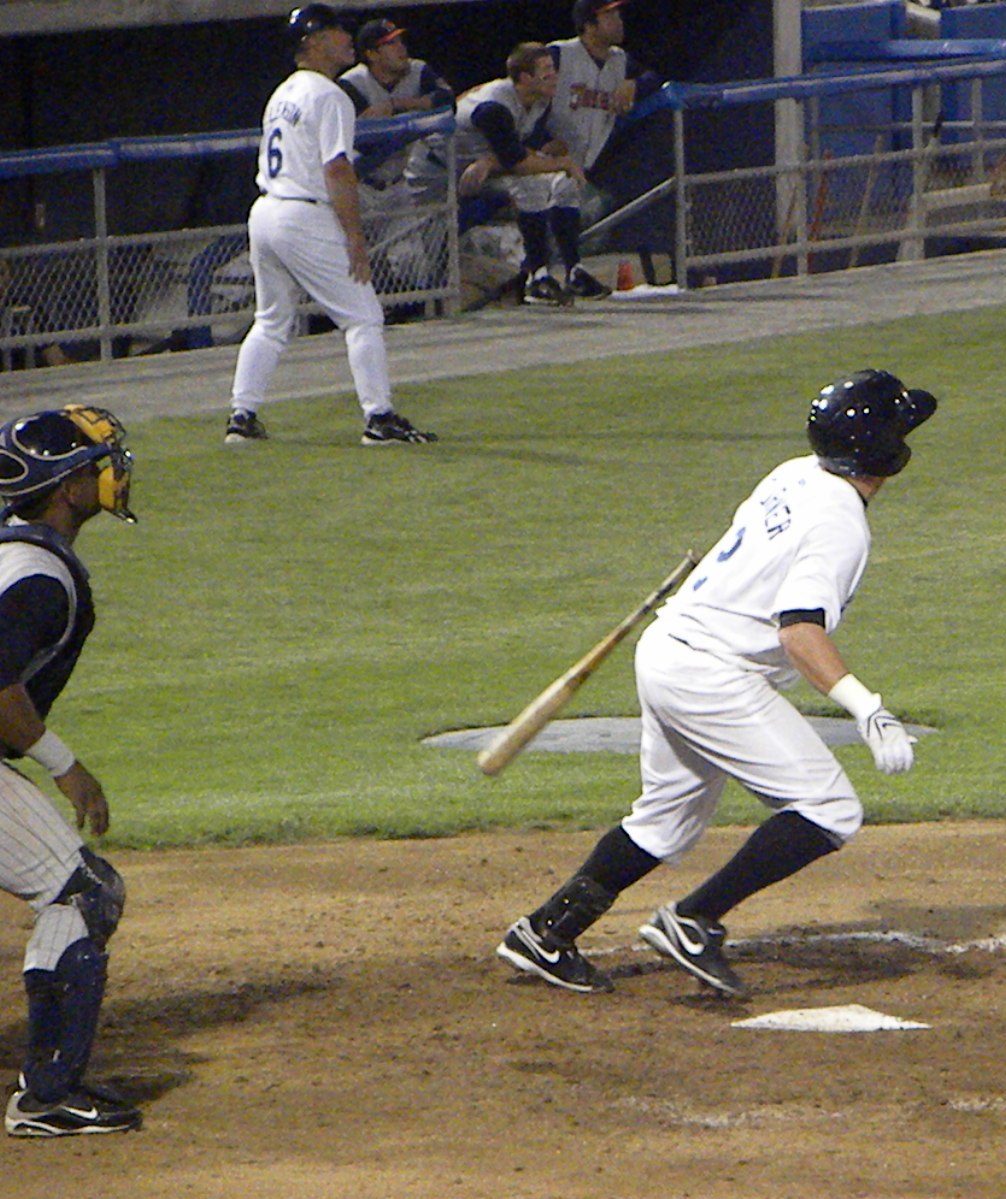
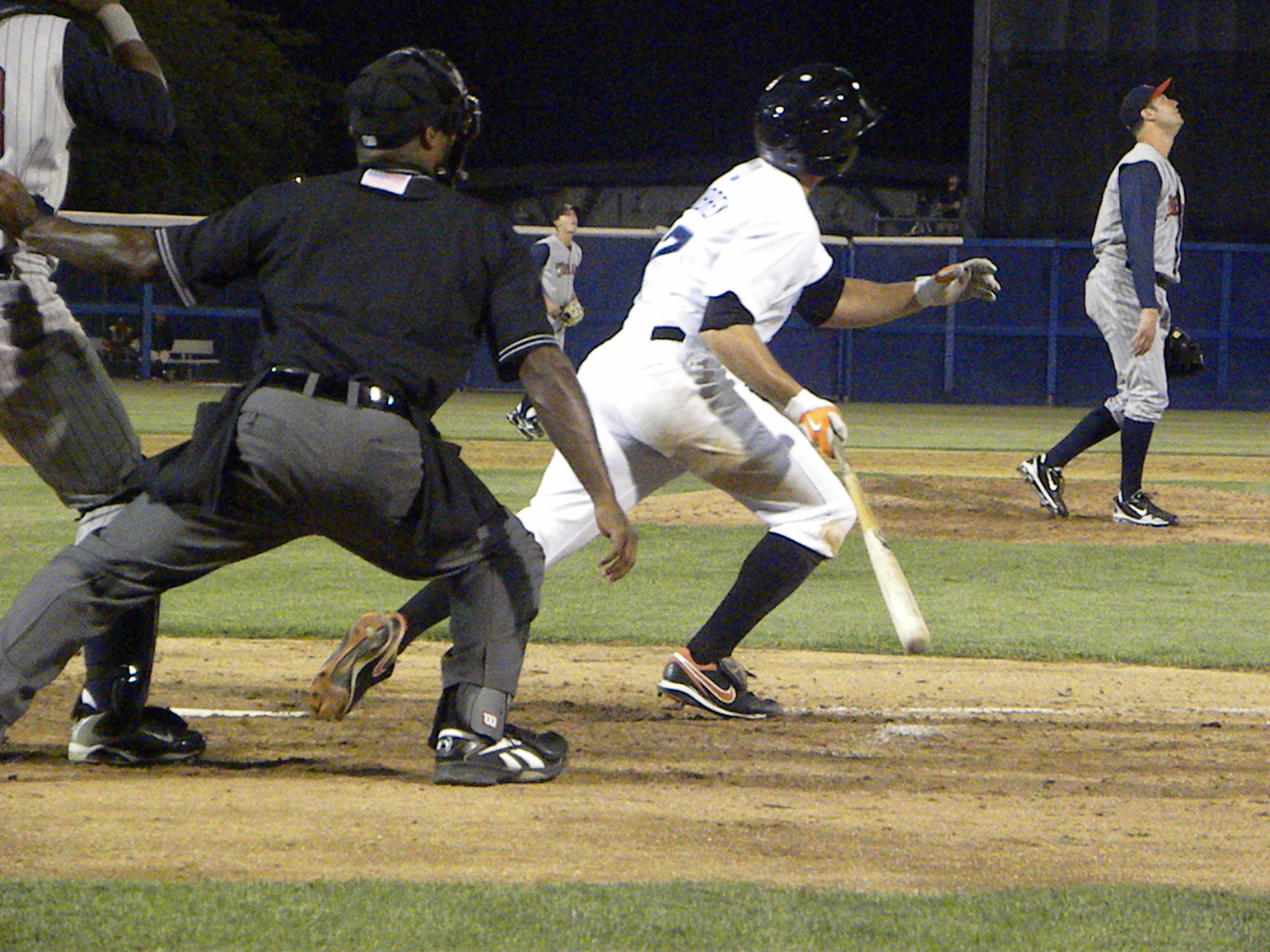
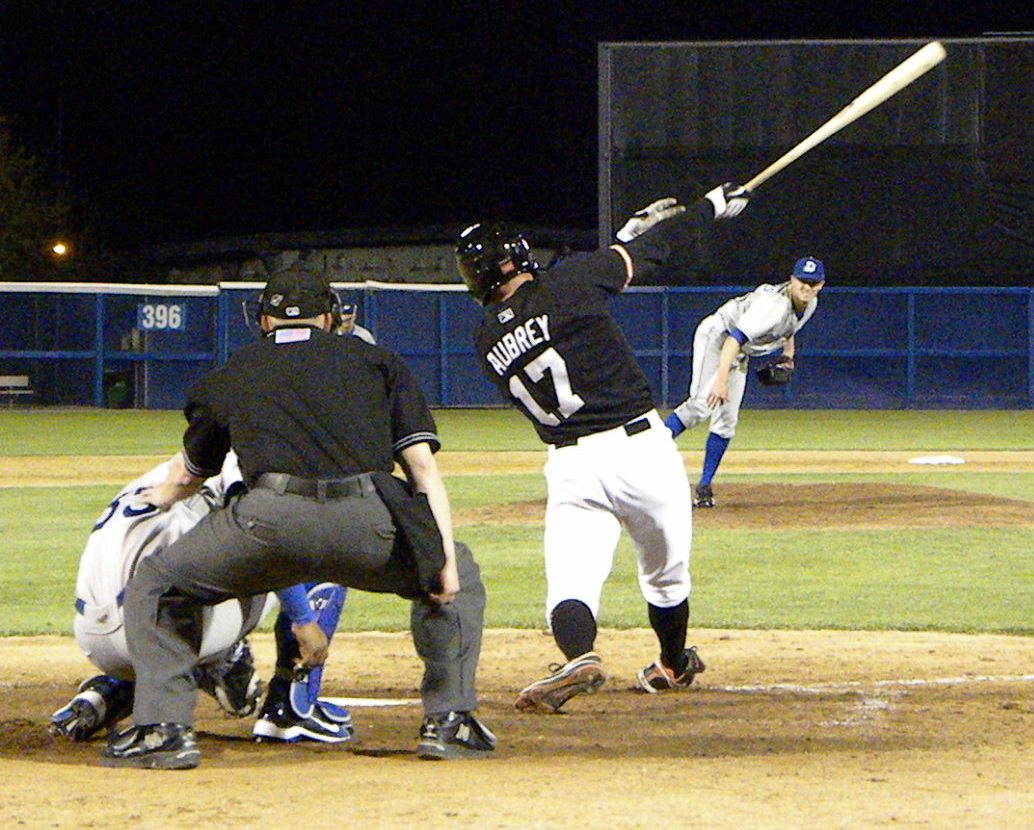
Josh Bell smashes a three run homer in the 1st inning

And after a drought the hits came and with them the runs and with them the wins.  The Norfolk Tides appear to have snapped out of their hitting funk and like a like a battleship are now plowing through the waves and blasting whatever appears on their radar.  In the past two games, actually the past 16 innings the Norfolk Tides have scored 24 runs on 25 hits.

Justin Turner slams a 3 run double

After a bad slump where it seemed nothing went right offensively the Tides have managed to put hits together and get the all important big hits to break the backs of the Scranton Wilkes-Barre Yankees and the Toledo Mud Hens in back to back 12 run offensive displays that featured 6 home runs.

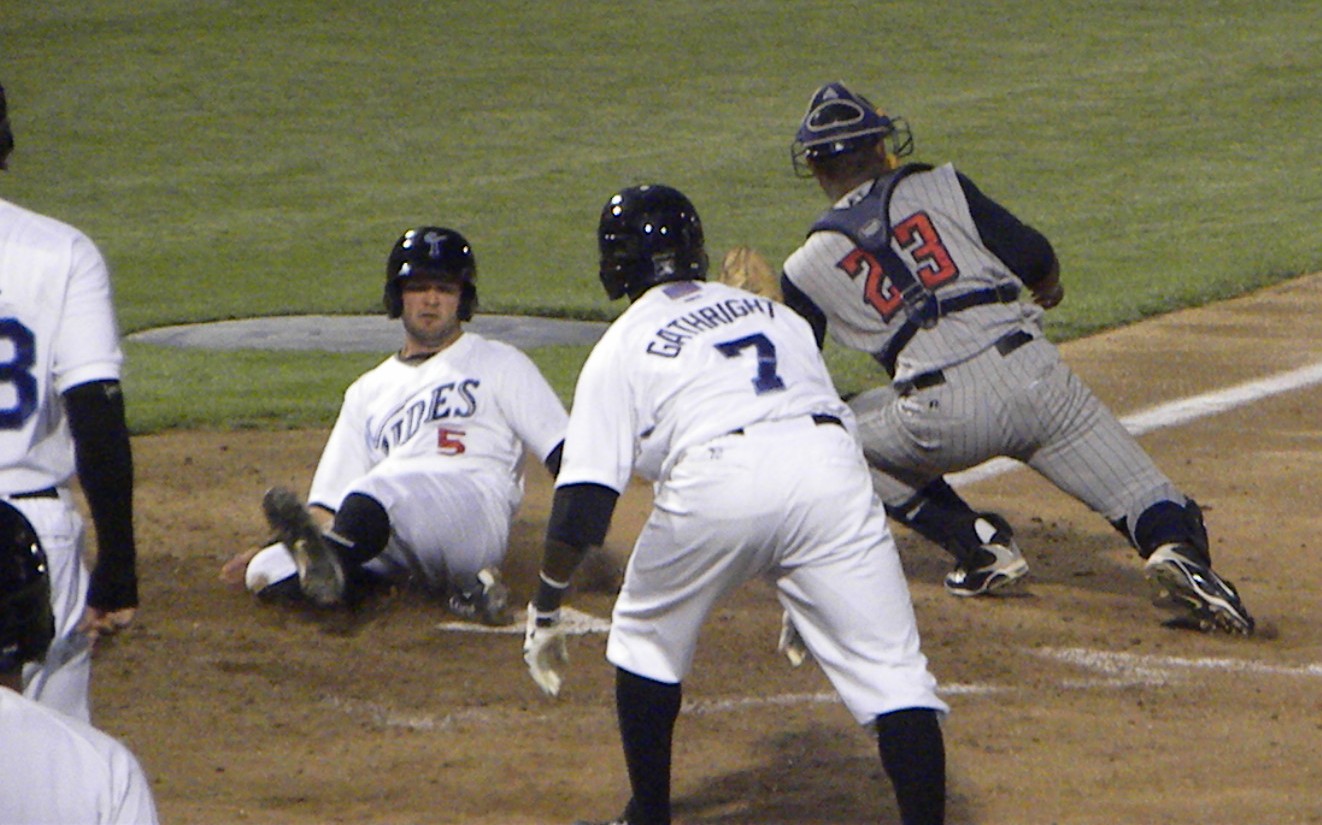
Scott Moore safe sliding into home after Justin Turner’s  3 RBI double

After taking their first day off since the season began the Tides following the thrashing that they gave the Yankees the team came back and on what was an initially a warm and humid night pounded the Mud Hens with another ferocious offensive display.  The Tides wasted no time in putting runs on the board.  Following a ground out by Robert Andino grounded out to short and the avalanche began and the Tides began to light up the Hens like a Kenny Rogers Roaster on a rotisserie.  Joey Gathright who changed his number from 10 to 7 in the classic baseball superstition of doing anything to break a slump bunted for a single.  Corey Patterson singled to left to move Gathright to second and up came Josh Bell who is rapidly becoming a major hitting threat in the IL south.   Bell who had three home runs in Charlotte and has continued making key hits during this home stand hammered the second pitch by Toledo starter Armando Galarraga over the right field wall to give the Tides a three run 1st inning lead.

Chris George threw 5 strong innings but got a no decsion

With the early lead Tides starter Chris George went to work setting the Mud Hens down in order in the 1st and 2nd innings and allowing a single in the 3rd before working a pick off play to cut down the runner attempting to steal 2nd.

The Tides struck again with another crooked score in the 3rd inning.  With one out Joey Gathright singled on an infield hit to second.  Corey Patterson struck out swinging and the Galarraga gave up walks to Josh Bell and Scott Moore.  This brought Justin Turner to the plate and Turner doubled on a deep fly ball to center field which drove in all three Tides base runners.  Chris George went back on the mound and after getting the first two Mud Hens runners off base with a double play gave up two runs on two hits.  In the bottom of the 4th Michael Aubrey took a one ball one strike pitch from Galarraga and pounded it for a lead off home run.  George was tapped for 3 runs in the top of the 5th with two the result of an error by right fielder Michael Aubrey which occurred on a routine fly with two outs.

Michael Aubrey slams a solo shot in the 4th inning

Toledo sent Robby Weinhardt to the mound in relief of Galarraga in the 5th and the Tides sent Armando Gabino to relieve Chris George in the 6th. Both Weinhardt and Gabino pitched scoreless innings until Weinhardt came out in the 7th and Gabino in the 8th.  Fien pitched a score 7th and was relieved in the bottom of the 8th by Jason Waddell.

The Tides sent the left hander Pedro Viola in to relieve Gabino in the top of the 8th.  Viola walked the left handed batter Jeff Larish and was pulled by Manager Gary Allenson for the big right hander Kam Mickolio.  Mickolio has struggled this year especially after his return from Baltimore.  Jeff Frazier doubled off of Mickolio and then the big man walked Casper Wells to load the bases with no outs.  Clete Thomas grounded into a force play to score Jeff Larish.  Thomas then stole second and advanced to third on a single by Robinzon Diaz which scored Frazier.  Mickolio was able to retire the next two batters end the inning but not before the damage had been done and the game was tied 7-7.

The Tides did not take this lying down exploding for 5 runs in the bottom of the 8th.  With Jason Waddell now on the mound Corey Paterson singled to start the inning.  Josh Bell flied out to right but Patterson took second.  Scott Moore doubled to bring Patterson home and then Waddell walked Justin Turner and Blake Davis replaced Scott Moore as a pinch runner at second.  Brandon Snyder walked to load the bases.  With one out Michael Aubrey hit a sacrifice fly on which Davis scored, Justin Turner advanced to third and Brandon Snyder took second on a throwing error by center fielder Caspar Wells.  Adam Donachie walked to load the bases yet again.  Robert Andino then split the right center gap and doubled to score both Turner and Snyder.  Finally Joey Gathright grounded out to end the inning.

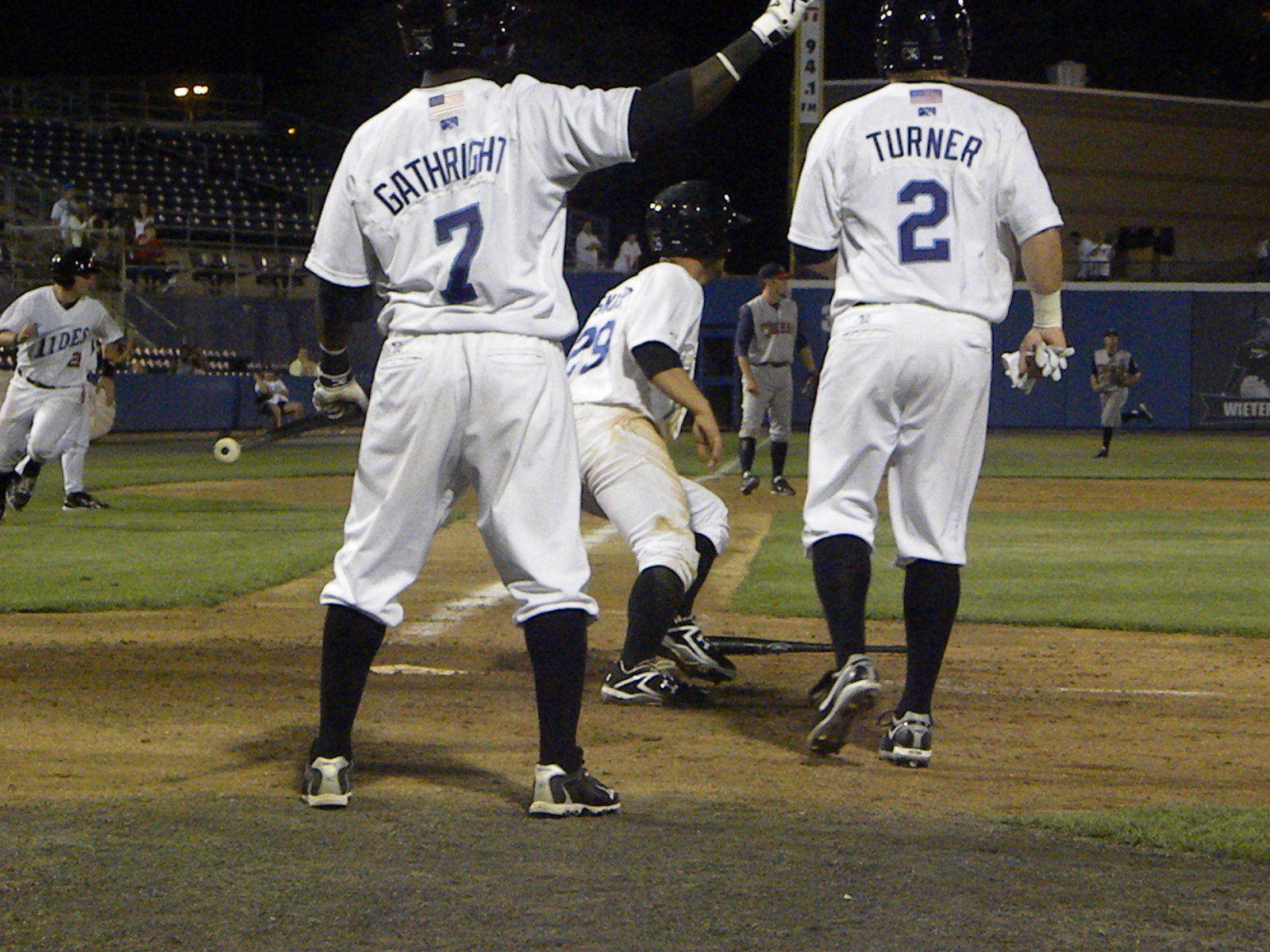
Justin Turner and Brandon Snyder already across and Adam Donachie coming home on Robert Andino’s 3 RBI double in the bottom of the 8th

Jim Miller came in with a five run lead in a non-save situation.  He allowed two base hits but surrendered no runs and the Tides were able to celebrate with another win in which they scored 12 runs.  Kam Mickolio got a blown save but the win while Chris George got the no-decision on a game that save for two out error in the top of the 5th the blown save by Mickolio that he should have won.  Jason Waddell got the loss for Toledo.

Jim Miller closes the deal Tides win 12-7

The teams will meet again tonight at Harbor Park where Toledo’s Enrique Gonzalez will match up against Troy Patton of the Tides.  As for other news and notes Koji Uehara ended his rehab and was promoted to Baltimore and Alberto Castillo optioned back to Norfolk.  The Orioles defeated the Twins in their first appearance at Target Field by a score of 2-0 with Brad Bergeson pitching 6 scoreless innings for his second win of the season. Tonight’s Orioles and Twins game has been postponed due to rain and will be made up in a double header on Saturday.

Peace and see you at the ball park.

Padre Steve+

Leave a comment

Filed under Baseball, Batlimore Orioles, norfolk tides

Thoughts on the National Day of Prayer Controversy

Today like many institutions in the Federal Government our Medical Center observed the National Day of Prayer. Ours was a very low key affair which I led where we simply invited people to pray after reading the Presidential Proclamation for 2010 and a short opening prayer.  People were invited to pray silently and for the benefit of our Nation and its people, especially for those serving in the military and their families.  Likewise tom offer prayer for the victims of war, natural disasters and accidents in this county and around the world.

The National Day of prayer was recently ruled unconstitutional by U.S. District Judge Barbara Crabb who ruled in favor of a suit brought about by the Freedom from Religion Foundation against The National Day of Prayer Task Force, former President George Bush and others which was expanded to name President Barack Obama when he requested that Judge Crabb to dismiss the case in 2009 when the administration argued that the foundation had no legal standing to sue.  The President and administration appealed the ruling and went ahead with the proclamation and observance of the National Day of Prayer.

The modern National Day of Prayer was enacted by President Truman and Congress in 1952 in the 36 U.S.C. § 119 : US Code – Section 119: National Day of Prayer and various Presidents at different times have called for days of fasting, prayer or thanksgiving.  The heart of President Truman’s proclamation is contained in this section:

Now, Therefore, I, Harry S. Truman, President of the United States of America, do hereby proclaim Friday, July 4, 1952, as a National Day of Prayer, on which all of us, in our churches, in our homes, and in our hearts, may beseech God to grant us wisdom to know the course which we should follow, and strength and patience to pursue that course steadfastly. May we also give thanks to Him for His constant watchfulness over us in every hour of national prosperity and national peril.

In 1982 a group of Evangelical Christians led by Shirley Dobson formed The National Prayer Committee. This organization was exclusively Christian and was formed to coordinate and implement a fixed annual day of prayer, the purpose of which was to organize evangelical Christian prayer events with local, state, and federal government entities.  This organization has since grown in popularity and prominence often being the primary organizer of such events.

Ronald Reagan eloquently stated the purpose and significance of the National Day of Prayer in his 1983 proclamation which in part read:

It took the tragedy of the Civil War to restore a National Day of Prayer. As Abraham Lincoln said, “Intoxicated with unbroken success, we have become too self-sufficient to feel the necessity of redeeming and preserving grace, too proud to pray to the God that made us.”

Revived as an annual observance by Congress in 1952, the National Day of Prayer has become a great unifying force for our citizens who come from all the great religions of the world. Prayer unites people. This common expression of reverence heals and brings us together as a Nation and we pray it may one day bring renewed respect for God to all the peoples of the world.

From General Washington’s struggle at Valley Forge to the present, this Nation has fervently sought and received divine guidance as it pursued the course of history. This occasion provides our Nation with an opportunity to further recognize the source of our blessings, and to seek His help for the challenges we face today and in the future.

Now, Therefore, I, Ronald Reagan, President of the United States of America, do hereby proclaim Thursday, May 5, 1983, National Day of Prayer. I call upon every citizen of this great Nation to gather together on that day in homes and places of worship to pray, each after his or her own manner, for unity of the hearts of all mankind.

President Reagan’s 1983 and subsequent proclamations stood firmly in the American tradition of Civil Religion and was decidedly non-sectarian.  It acknowledged that our citizens “come from all the great religions of the world” and called on Americans to gather on the day “in homes and places of worship to pray, each after his or her own manner, for unity of the hearts of all mankind.”  In fact the spirit of the declaration is much like that of the hymn God of Our Fathers which is recognized as our National Hymn.  This hymn is not explicitly Christian and never mentions Christ or the Trinity yet it is widely sung in churches on days such as the Sunday nearest to Independence Day.  The lyrics to that hymn are here:

God of our fathers, Whose almighty hand, Leads forth in beauty all the starry band

Of shining worlds in splendor through the skies, Our grateful songs before Thy throne arise.

Thy love divine hath led us in the past, In this free land by Thee our lot is cast,

Be Thou our Ruler, Guardian, Guide and Stay, Thy Word our law, Thy paths our chosen way.

From war’s alarms, from deadly pestilence, Be Thy strong arm our ever sure defense;

Thy true religion in our hearts increase, Thy bounteous goodness nourish us in peace.

Refresh Thy people on their toilsome way, Lead us from night to never ending day;

Fill all our lives with love and grace divine, And glory, laud, and praise be ever Thine.

While the American religious tradition is highly Christian and even more so from the Reformed tradition this has always existed in tension with a decidedly secularist philosophy embodied by many of the Founding Fathers who were very careful to recognize the importance of religion but at the same time both sought to protect religious liberty by NOT enacting laws to establish a particular religion nor to entangle the government in the affairs of religion which could in their view be detrimental to true religious liberty.

In fact both Thomas Jefferson and James Madison were very careful about proclamations and ensuring that government was not favoring any particular religious body. Jefferson wrote to Reverend Samuel Miller in 1808 that:

Fasting and prayer are religious exercises; the enjoining them an act of discipline. Every religious society has a right to determine for itself the time for these exercises, and the objects proper for them, according to their own particular tenets; and right can never be safer than in their hands, where the Constitution has deposited it. …civil powers alone have been given to the President of the United States and no authority to direct the religious exercises of his constituents.”

Madison who was the author of the Bill of Rights and included religious liberty in the First Amendment in support of Virginia Baptists who were under pressure from those who were determined to make and keep the Episcopal Church as the state religion of the commonwealth. Madison wrote to Edward Livingston in 1822 that:

“There has been another deviation from the strict principle in the Executive Proclamations of fasts & festivals, so far, at least, as they have spoken the language of injunction, or have lost sight of the equality of all religious sects in the eye of the Constitution. Whilst I was honored with the Executive Trust I found it necessary on more than one occasion to follow the example of predecessors. But I was always careful to make the Proclamations absolutely indiscriminate, and merely recommendatory; or rather mere designations of a day, on which all who thought proper might unite in consecrating it to religious purposes, according to their own faith & forms. In this sense, I presume you reserve to the Govt. a right to appoint particular days for religious worship throughout the State, without any penal sanction enforcing the worship.”

Even Republican Presidents such as Ronald Reagan and George H. W. Bush were careful to attempt to keep this in tension only holding one official event each during their presidencies.  It was not until George W. Bush that the President hosted events in every year of his presidency.  Remember the language of the law was that the President shall issue a proclamation for the people of the nation to pray.  Likewise the proclamations are a call for Americans, as Ronald Reagan and Harry Truman wrote to gather together on that day in homes and places of worship to pray, each after his or her own manner, for unity of the hearts of all mankind. The Day of Prayer was not intended to entwine the government in exclusively religious observances by any particular religious tradition as many of the National Day of Prayer observances in many local, state and federal government agencies.

I have in my military career been ordered to attend such events.  I have no problem with praying or even gathering for prayer but there was pressure to attend and often the observances were quite exclusivist and dominated by Evangelicals aligned with the National Day of Prayer Task Force.

While I cannot agree with Judge Crabb who I think applies the law to the manner in how some groups brazenly enmesh their particular faith tradition into these observances.  However I think that she misses that actual intent of the law and proclamations which are both non-sectarian and voluntary focusing on people observing this in their homes and places of worship.  To make the blanket judgement that the law itself is unconstitutional as Judge Crabb did is a brazen overreach.  She may rule that observances which are sectarian but done or sponsored by government agencies where employees feel pressured to attend are unconstitutional is another matter. When any religious group uses their position to organize and promote their particular view in a setting where military members or other government employees are “encouraged” to attend and where the senior leadership of these agencies is present there is the presumption that attendance is mandatory even if it is not explicitly stated.  In such cases military personnel or government employees could feel that promotion or fair treatment could be negatively impacted by not participating in what some could arguably call an establishment of religion.  Such could be the case with any faith and not just the Christian faith. This was something that the Founding Fathers despite the overwhelming Christian make up of the country strove to avoid.  They recognized the importance that religion played in public and private life and many were not afraid to use explicitly Christian in referring God but did not want the Christian faith, any denomination of it or any other religion to be either the master of or the servant of the state as was the case in all of Europe at the time of the founding of this country.

What I think has happened within the time of my military career is that many Evangelical groups have made the National Day of Prayer “their event” and use people withing government agencies or the military to organize events which lean heavily toward Evangelical Christianity.  I have seen it myself especially when I was in the Army. Not only has this occurred but many times the leadership of these religious groups promote the political agenda of a particular political party or philosophy and as such that political philosophy sometimes becomes part of the event.  It happens quite often.  When it does happen a perilous boundary is crossed and the group or groups that do this invite opposition including legal challenges such as happened in Wisconsin because such proceedings give the appearance of the establishment of religion.

To be fair to Evangelicals and others it also appears to me that some strident atheist groups are bent on removing religion from the public square and quite often use the courts and legislatures to push their agenda.  I think that the founders did not intend for this to be the case either.  The secret to the American political and religious tradition is that for the most part we have maintained the tension needed to ensure that religious liberties are protected without establishing a state religion.  This is something that people throughout the world have admired about this country as opposed to Europe where state churches worked hand in hand with their governments to persecute religious minorities even engaging in progroms or religiously based mass murder.  The same is true in much of the rest of the world where leaders of other faiths act as agents of their government and persecute those who are not of their faith.

Our society now is extremely polarized and there is little middle ground or moderation in regard to religion, politics or civil behavior.  Instead rhetoric is heated. Liberals often mock conservative Christians or others who hold their faith deeply and believe their faith to have a public voice. Likewise some political and religious people that would trample the in response to the increased secularism of modern times want to restore some sort of balance even if it means overriding the long standing tradition in American life, that tradition of tolerance and protection of the rights of others, even those that that are different or even unusual.  Such behavior on both sides becomes more heated and less compromising.  The opposing parties mirror each others attitudes, actions and tactics and use the media to stir up people to support their side and use the courts and legislatures to promote their agendas which they all believe are more in keeping with the founders intent than the other side.

This is why there is such a controversy in an event that was intended to be a unifying activity, an event that was to help Americans of all religious traditions to work for the common good of all Americans and not just their party and I use the term in a non-political sense.  My hope is that Americans in all places will have the freedom to gather to observe the National Day of Prayer but in the sense that it was originally intended, a religious observance in a civil context which promotes the public good and recognizes the influence of God and religion in the life of the country.

I know that my views will not make zealots of both sides of many faiths and creeds happy.  It seems that moderation and civility is out and those who actually believe in tolerance, respect and civility are marginalized by extremists of many forms.  Since in the past few months I have been called various names including “Communist, Marxist, Liberal, non-Christian and unbeliever” I expect that once again I will collect some fan mail.  I’m okay with that so long as you don’t call me a Dodger fan.

Peace,

Padre Steve+

2 Comments

Filed under faith, philosophy, Religion

The Pacific Part Three: Tarawa Paving the Way to Peleliu, Iwo Jima and Okinawa

Introduction to Part Three

While the First Marine Division slogged its way through the hell of the New Britain campaign the battle for the Pacific’s primary focus became the Central Pacific which was a far different sort of war than had been fought in  the South Pacific including the Guadalcanal and New Britain campaigns.  Instead of the steaming nearly impenetrable jungles and muck of the Solomons battles shifted to small heavily fortified and defended atolls and islands garrisoned by elite Imperial Naval infantry or veteran Imperial Army units.  The battle of Tarawa in the Gilbert islands was the first step in pushing across the Central Pacific and eventually on to the Japanese home islands.

Tarawa was the combat test bed of many of the weapons and tactics that would be featured in the key battles of the drive across the Central Pacific.  Weapons and tactics that would be applied by the First Marine Division at Peleliu and Okinawa.  Tarawa was a battle that shocked the American public. On this island which was  barely one square mile of coral and sand the Marines of the Second Marine Division suffered over 1000 dead and 2300 wounded while annihilating the Japanese garrison of over 4000 troops.  The carnage of Tarawa would be seen again at Peleliu where the First Marine Division as depicted in the series “The Pacific” fought a no-quarter battle against a determined and well prepared enemy.

This is the story of that battle.

The Decision: Operation Galvanic

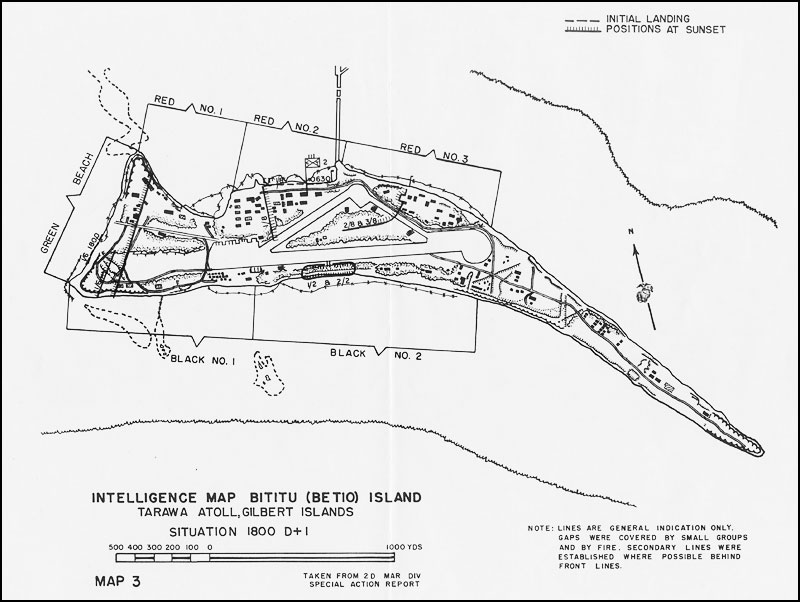
The Target: Betio Island at Tarawa Atoll

Following Guadalcanal and the shift of significant naval forces from the Solomons the focus of the US shifted to the thrust across the Central Pacific.  Unlike the Solomons which were initially a Navy and Marine Corps Operation and shifted to the Army under MacArthur as the campaign shifted to Borneo, despite the participation of the 1st Marine Division in the New Britain campaign the operations here would be an almost total Navy and Marine Corps operation.Operation Galvanic, the first offensive operation in the Central Pacific, came about as a result of the Joint U.S. Strategic Committee decision in April 1943 to favor an advance in the Central Pacific while maintaining the offensive in the South Pacific.[i] The driving force behind this strategy was Admiral King who fought for the plan and “insisted that any campaign should focus on the destruction of Japan’s overseas resources, which meant an offensive directed only toward the Western Pacific sea lanes.”[ii] The Joint Chiefs believed that a simultaneous attack by Nimitz in the Central Pacific and MacArthur in the South Pacific would “keep the Japanese guessing.”[iii] The decision was presented to the British at the TRIDENT meetings in May 1943 and though the British resisted the American plans a compromise was reached allowing the Americans to “simultaneously…maintain and extend unremitting pressure against Japan….”[iv]

The decision to begin operations in the Central Pacific meant that MacArthur’s priority in logistics and personnel would be reduced in order to launch the Central Pacific operation.  MacArthur protested, to no avail and the Joint Chief’s stood firm in their decision that the Central Pacific operation “would make it easier to isolate Japan from her domain in the south.”[v] MacArthur was allowed to continue OPERATION CARTWHEEL while Nimitz seized the Marshall and Caroline islands.[vi] Nimitz’s staff began preparations and decided on a conservative course to capture the Gilberts first before taking the more heavily defended Marshalls.[vii] This was in part due to the “need to minimize the risks to his untried amphibious forces against such heavily fortified enemy bases out of reach of air cover.”[viii]

Several factors were considered by Nimitz and his planners considerations in this choice.  Nimitz did not have enough troops to capture all of the vital heavily defended locations in the Marshalls without dividing his forces.[ix] Additionally the Gilbert operation could be supported by land based bombers.[x] A final consideration was the Joint Chief’s decision to allow MacArthur to retain control of 1st Marine Division which Nimitz had hoped would be available for operations in the Central Pacific.[xi] CINCPAC did a thorough photo reconnaissance of the Gilbert’s convinced the Joint Chiefs that Tarawa and Makin needed to be taken to provide air bases for the assault on the Marshalls.  Finally the order forGalvanic was issued on 20 July 1943 with its execution planned for November 1943.[xii]

Japanese Preparations
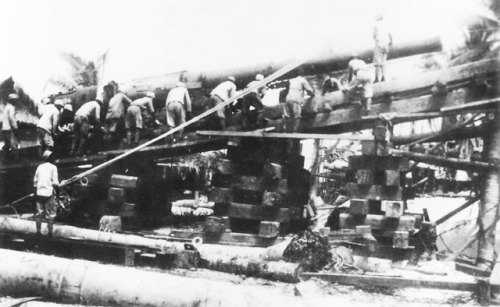
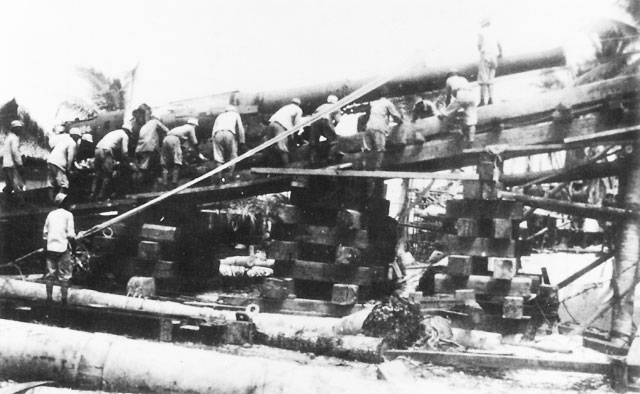
Japanese emplacing 8″ Naval Gun on Tarawa

The Japanese did little to prepare against potential American offensive operations against the Gilbert’s until Makin Island was raided by elements of 2ndRaider Battalion in August 1942.  The Makin raid shook the Japanese and at which time they reinforced Makin and occupied Betio.[xiii] The Japanese occupied Betio with the Yokosuka 6th Special Landing Force, essentially Naval Infantry or Marines[xiv] and the 111th Construction Battalion on 15 September 1942, over nine months after they attacked Pearl Harbor.[xv] These forces were commanded by Admiral Tomanari, who at once began to fortify Betio. Recognizing his need for more troops  Tomanari asked Tokyo for reinforcements.  The reinforcements came in the form of Commander Sugai’s 7th Sasebo Special Naval Landing Force, which landed on 14 March.[xvi]Commander Sugai’s troops were the Rikusentai, the best of the Japanese Navy’s land forces.

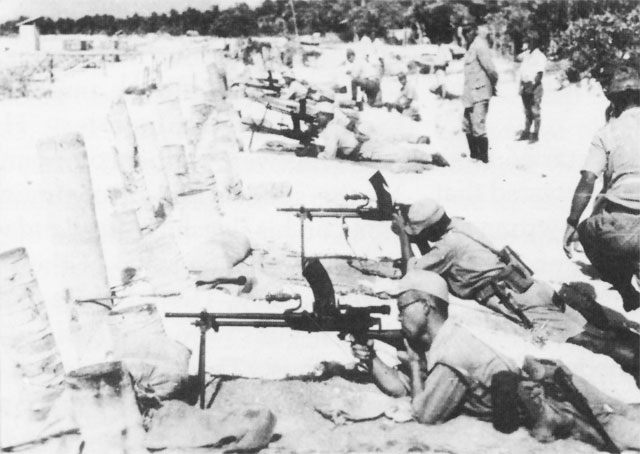
Japanese Naval Infantry conducting live fire exercise on Tarawa

The fortification of Betio proceeded slowly until the arrival of Rear Admiral Shibasaki, who relieved Tomanari who returned to Japan.[xvii] Shibasaki, a tough veteran of service at sea and ashore including 19 months as aRikusentai[xviii] officer in China was chosen by Admiral Koga to instill a better fighting spirit on the island.  The Imperial General Headquarters “New Operations Plan” ordered the outer defensive islands, such as Tarawa, to “hold up any American advance while an inner line of fortresses was constructed….”[xix]

Fortified 8″ gun position on Tarawa

Shibasaki drove the garrison hard, inspiring them to “extraordinary heights of labor that resulted in Betio’s superb defenses.”[xx]Betio mounted four 8” Naval guns[xxi], four 14 cm guns, four dual mount 5.5” dual purpose guns[xxii] six 80 mm anti-boat guns, eight 75 mm dual purpose guns, ten 75 mm mountain guns, six 70 mm guns and nine 37 mm anti-tank guns, numerous machine guns and light AA guns and 14 light tanks.[xxiii] These weapons were mounted in well camouflaged armored or reinforced pillboxes.[xxiv] In accordance with the directives of the high command Shibasaki ordered his troops “to defend to the last man all vital areas and destroy the enemy at the waters’ edge.”[xxv]

Admiral Shibasaki boasted that it would take a million men a thousand years to take Betio

The Japanese records note that Shibasaki “immediately began to strengthen morale and carried out advanced training, and as a result…the garrison remarkably enhanced its fighting capability and they were full of confidence.”[xxvi] Even the service troops were thoroughly trained to fight from their superb defensive positions.[xxvii]Shibasaki reportedly told his men that it would take a million men a thousand years to take Betio.

Japanese conducting gunnery exercise prior to the invasion

American Preparations

The LVT- Landing Vehicle Tracked or the Amtrack

Nimitz organized his forces into three major commands, the 5th Fleet, commanded by Admiral Raymond Spruance, the 5th Amphibious Force under Admiral Richmond “Kelly” Turner and the V Amphibious Corps under Major General Holland “Howlin’ Mad” Smith, USMC.[xxviii] The 2nd Marine Division which would make the assault at Tarawa was commanded by Major General Julian Smith. The force that sustained in this operation and subsequent amphibious operations was the Service Force Pacific Fleet.[xxix] This was a collection of ships whose mission it was to sustain the fleet in mobile operations,[xxx] which greatly “increased the range and power of the Navy in amphibious operations.”[xxxi] The planned assault called for the Army’s 27thDivision take Makin and the veteran 2nd Marine Division which had been blooded at Guadalcanal to take Tarawa supported by the carriers and battleships of 5th Fleet.

Tarawa marked the first use of dedicated amphibious ships such as theUSS Ashland LSD-1

This was the first application of new amphibious tactics developed for the Pacific war.[xxxii] Air and sea bombardment would precede the actual assault. The Marines would be transported ashore in a new vehicle called an LVT (Landing Vehicle Tracked) and other amphibious ships and craft including the LSD (Landing Ship Dock), LCM (Landing Craft Mechanized) and LCVP (Landing Craft Vehicle Personnel).  The LVTs were absolutely vital, nicknamed “Amtracks” or “Amphtracks” they were essentially a tracked amphibious personnel carrier. They were developed from a commercial vehicle used by U.S. Forrest Service Rangers in the Florida Everglades and were capable of crossing coral reefs that would cause other craft to go aground.  The early LVTs had retrofitted armor and mounted a .50 cal. machine gun.  At Tarawa the Marines deployed 75 LVT-1s[xxxiii] and 50 LVT-2s. 93 LVTs would be part of the first wave of the Marine assault.[xxxiv] The LVTs were transported to Tarawa aboard LSTs (Landing Ship Tanks.)  Other innovations included the assignment of Naval Gunfire Support teams to the Marine Regiments and some battalions,[xxxv] and the first use of the M4 Sherman tank by the Marines.[xxxvi] Tarawa was a proving ground for the tactics and equipment which would be improved on and used in every subsequent amphibious operation in the Pacific.  Tarawa would also mark the last major use of rubber landing craft by the Marine Corps in an opposed landing.[xxxvii]
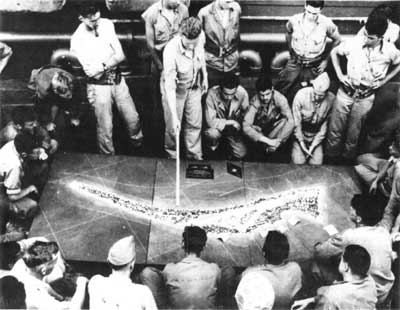
Shipboard Briefing

There were limitations to American preparations. First the size of the force meant that it could not be assembled in one place for rehearsals or to train as a team.[xxxviii] A second problem for the Americans was the assumption that high and low tides would be sufficient to get their landing craft across the reef in spite of warnings to the contrary.[xxxix] Likewise the Americans failed to completely anticipate the scope to which the Japanese had fortified the island. This was despite good intelligence that they had done so. In particular aerial photos taken by the air force and ULTRA intercepts provided good information on the Japanese units on the island and the layout of the defenses.[xl]Additionally some equipment shortages were not remedied. The Marine Bazooka’s did not arrive, and neither the 6th or 8th Marines had made an actual amphibious assault.  At Guadalcanal they made an administrative landing and few field-grade officers remained from the 2nd Marine Regiment who had landed at Tulagi.[xli] They were far from “amphibious experts” that they would become.[xlii] However, they made up for their lack of experience by their cohesiveness, high morale and esprit, being well armed and equipped, in top physical condition and knowing the basic tools of their trade: “weapons proficiency and field firing, close combat techniques, fire and maneuver, tactical leadership, fire discipline.”[xliii]

The most critical aspect of the operation was to get across the reef onto the island.  There were few good landing sites and it was decided to make the landings from inside the atoll’s lagoon onto the Betio’s north shore.  This decision meant that transports embarking the Marines would unload outside of the lagoon and that the landing craft would have to make a 10 mile trip.[xliv]There was only one entrance into the lagoon and it was not deep enough for heavy ships to enter.[xlv]This meant that heavy ships such as battleships and cruisers would not be able to have direct fire on the Japanese positions best situated to disrupt the Marines.

The execution of the plan involved land based bomber strikes beginning on D minus 7. Carrier aircraft would begin their operations on D minus 2.  Cruisers and destroyers joined the cacophony of destruction on D minus 1 and the battleships on D Day itself.[xlvi] On D-Day itself Navy planned to bombard the island with 3,000 tons of shells in 2 ½ hours.[xlvii] The Navy was confident in the bombardment plans. Rear Admiral Kingman commanding the fire support group declared “We will not neutralize; we will not destroy; we will obliterate the defenses on Betio!”[xlviii] Four battalions of Marines would land in the first wave, the three battalions of the 2nd Marines and 2nd Battalion 8th Marines all commanded by Colonel David Shoup. Colonel Shoup who would win the Medal of Honor on Betio and later became the Commandant of the Marine Corps assumed command of 2nd Marines when its Regimental commander fell ill on the journey to Efate.[xlix] The division reserve was the remaining 8th Marine Regiment battalions. The 6th Marine Regiment served as the corps reserve.[l]The assault units would be reinforced by tanks and the 1st and 2nd Battalions 18th Marine Regiment, the division’s combat engineers.

Invasion: Day One

Landing craft going ashore at Tarawa

The naval gunfire bombardment commenced at 0542 on 20 November, and the assault waves began their trek to the beaches.  The transports were out of range of Japanese guns but ththat ensured boats would have to make a 10 mile trip.[li]At this point things began to go wrong.

USS Colorado at Tarawa

The Navy had “badly miscalculated the amount of softening-up that could be done in two and a half daylight hours bombardment.” Although major coast defense guns were silenced not enough damage was done to the Japanese defenses.[lii] The Japanese helped the Marines by firing their larger guns at warships, identifying their positions to Navy gunners.[liii] The bombardment lifted to allow an attack by carrier based aircraft. However the aircraft were late to arrive and the ships did not resume fire, allowing the Japanese to emerge and re-train their weapons.[liv] Likewise the destroyers Ringgold and Dashiell inside the lagoon had to cease fire, knowing the Japanese gunners along the shore were still active.[lv] Some believe that an extra half hour of direct fire from the destroyers would have saved many lives.[lvi] The LVTs in the first three waves were delayed by heavy chop and did not make landfall until 0913 throwing off the landing schedule.[lvii] The expect and planned for rise in tides did not materialize and they remained unpredictably low for the first 48 hours. No landing boats could cross the reef and the Marines were forced to wade ashore from 600 to 1000 yards.[lviii]
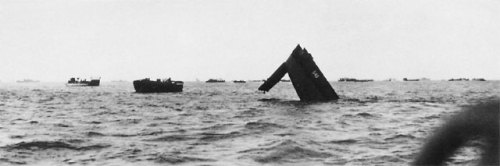
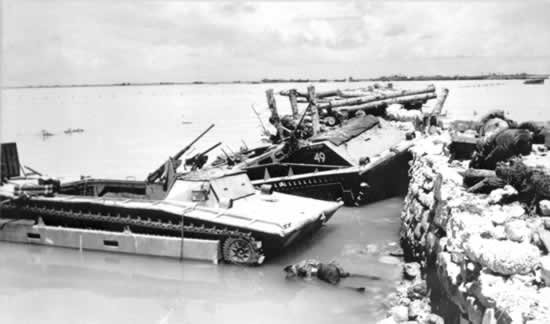
LCM sinking at Tarawa

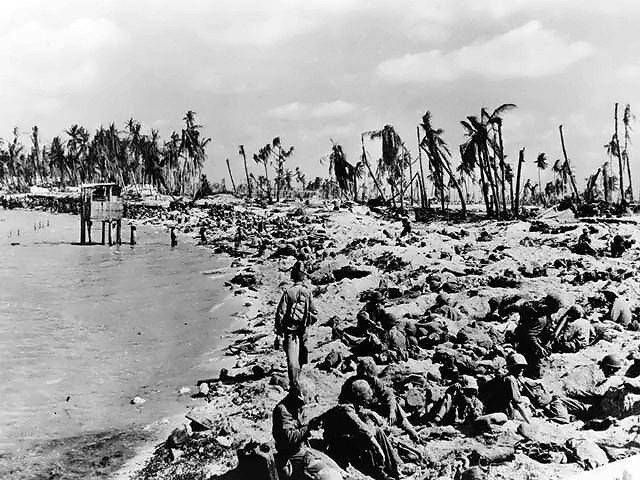
Shoup’s Marines landed on three beaches.  Red one and two lay to the west of a 500 yard long pier and Red three lay to the east.  3/2 landed on Red-1, 2/2 on Red-2, 2/8 on Red-3, elements of 1/18 and the scout snipers on the pier, with 1/2 in reserve to land behind the battalion making the best progress.[lix] As soon as the Amtracks hit the reef the Japanese began firing.  Every “working weapon along the north and west shorelines….blazed forth in fierce, interlocking fields of fire.”[lx] As they watched the Amtracks craw over the reef that Japanese knew they were in for a tough fight, one of Warrant Officer Ota’s men exclaimed “Heavens! The God of Death has come!”[lxi] The Marines of 3/2 on Red-1 received enfilade fire from Japanese guns emplaced in a U around the beach.  Before the Marines landed they began to take causalities, Amtracks were hit in the lagoon and most that were not sunk or destroyed were unfit for further use.[lxii] The 2000 Marines who landed in the first hour were badly disorganized, the commanding officer’s of 2/2 and the Amtracks were killed, 3/2’s commander was isolated on the reef and only 2/8’s commander was with his troops. 2/8 was the only battalion being to reach the shore relatively intact.[lxiii] 3/2 was down to 65% of its strength and K/3/2 had taken over 50% casualties.[lxiv] The Marines in the fourth to sixth waves were struggling to wade ashore from the reef. Landing craft “ran aground or milled about helplessly outside the reef, which was swept by crossfire from behind the beaches and from a grounded hulk northwest of the pier.”[lxv] Most of the tanks were put out of action either through accurate fire by Japanese guns or by sinking in deep areas of the lagoon, the Tank battalion commander was blown out of his Amtrack, wounded and survived 24 hours by clinging to a pile of dead bodies to keep from drowning.[lxvi]
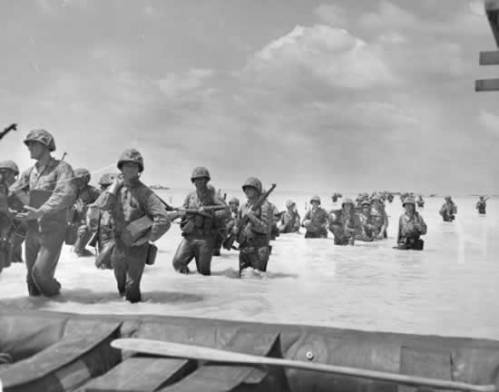
Marines wading ashore at Tarawa, since many landing craft could not cross the reef many waded hundreds of yards under constant Japanese fire

Shoup himself landed at Red-2 and began directing operations on the beach.  He knew that he had to get more troops ashore to exploit the minimal gains his Marines had made.  The news from Red-1 and Two was bad; he decided to bring 1/2 in at Red-2 thought that 3/8 should go in at Red-3.[lxvii]
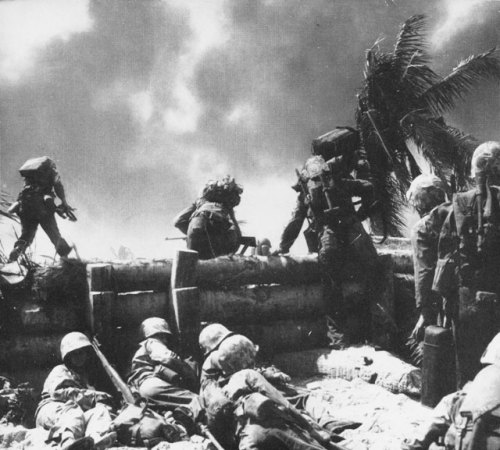
Marines attempting to advance from behind sea wall

At 1018 General Julian Smith ordered the 8th Marines to dispatch 3/8 to Red-3.[lxviii] 3/8 had to make their way across 700 yards through the water to get to the beach.  It was a slaughter, only 30 percent of the first wave got ashore, in the second less and the third “were practically wiped out.”[lxix]

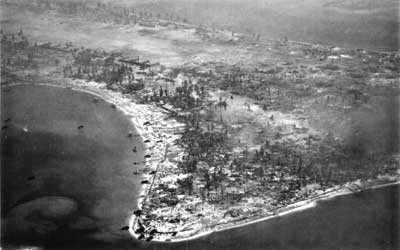
Aerial view of Tarawa on D-Day

As his Marines struggled ashore those who had gotten ashore engaged the Japanese at point blank range.  Lt. Hawkins of the 2nd Marine Scout and Sniper platoon and 5 of his men engaged the Japanese on the pier in vicious hand to hand fighting,[lxx] Sergeant Bordelon of the Engineers on Red-2 though grievously wounded knocked out four gun positions, some by lobbing dynamite charges into them and galvanizing survivors into action, finally being killed while taking on a Japanese position alone.  He would be awarded the Medal of Honor.[lxxi]
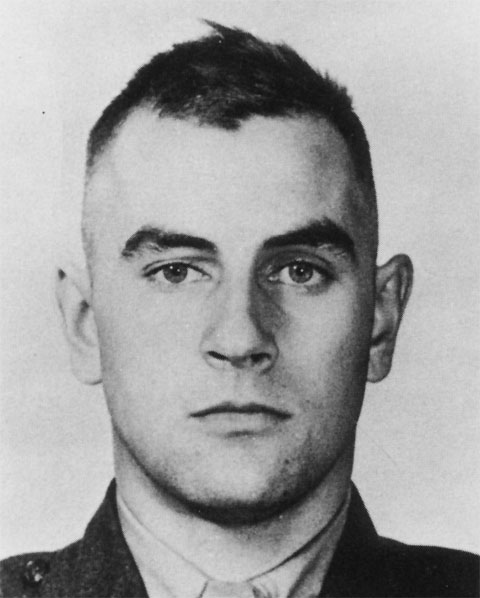
SSGT William Bordelon a Combat Engineer won the Medal of honor posthumously at Tarawa

By afternoon Julian Smith realized that he needed more troops, his last battalion, 1/8 waited to go ashore.[lxxii] Smith asked for the 6th Marines and had Admiral Hill send a message to Admiral Turner stating “Issue in doubt. I concur.” This sent a chill through the listening Naval Staff.[lxxiii] Ashore Shoup brought howitzers from 1st Battalion 10th Marines on surviving Amtracks to the eastern edge of Red-2 near the pier,[lxxiv] which landed in the early evening.[lxxv] He sent Lieutenant Colonel Carlson to make a personal report to General Smith that he would hold his beachhead no matter what happened. Shoup ordered his Catholic Chaplain to lay out a cemetery and begin burying the dead who were already decomposing in the tropical heat.[lxxvi] As this transpired 2/8 got two 37mm anti-tank guns into position to drive off Japanese tanks approaching the beachhead.[lxxvii] The Division Band assisted corpsmen in bringing back wounded Marines.[lxxviii]

Close Combat on Tarawa

The rest of the day the Marines continued to eke out a beachhead; Shoup’s Marines on Red-2 and Red-3 managed to advance about halfway across the island, 3/2 and elements 1/2 and 2/2 was isolated and Major Ryan of Lima Company pulled them back to meet an expected Japanese counter-attack.[lxxix] The Marines had taken over 1500 casualties of 5000 men landed the first day.[lxxx] There is no evidence that Shoup considered withdraw that night.[lxxxi] No counterattack occurred due to Japanese command and control problems, Admiral Shibasaki and his staff were killed while shifting headquarters during the afternoon,[lxxxii] and their communications were in shambles.

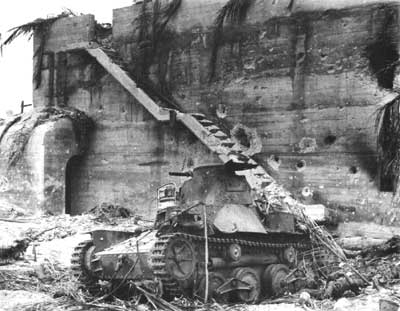
Admiral Shibasaki’s HQ and a knocked out light tank

A counterattack would have been disastrous in their condition,[lxxxiii] yet they assembled over 1000 men to oppose the Marines on day two.[lxxxiv] Had Shibasaki lived and communications survived a counterattack might have had ramifications far beyond Tarawa.[lxxxv]

Day Two: D+1
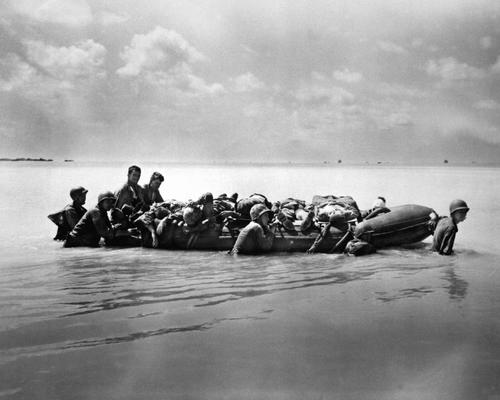
Wounded Marines at Tarawa being moved on rubber raft

The second day began with 1/8 landing on Red-2 and the 6th Marines began to land on Green Beach at the far western tip of Betio.  1/8’s landing turned into a bloodbath, the tide fell even lower than the previous day and as they hit the reef and waded ashore drifted into some of the heaviest Japanese defenses. Japanese guns, including the dual 5.5” guns took direct aim at the boats, and Marines ashore watched helplessly, and correspondent Robert Sherrod noted: “This is worse, far worse than it was yesterday.”[lxxxvi] Only half of 1/8 reached the beach with none of their heavy weapons or equipment.  Shoup ordered the remnants of the battalion into line on his western flank in preparation for an advance inland.[lxxxvii] During five hours of landings on day two, the “Marine casualties reached a higher rate than that sustained on the first morning.”[lxxxviii]
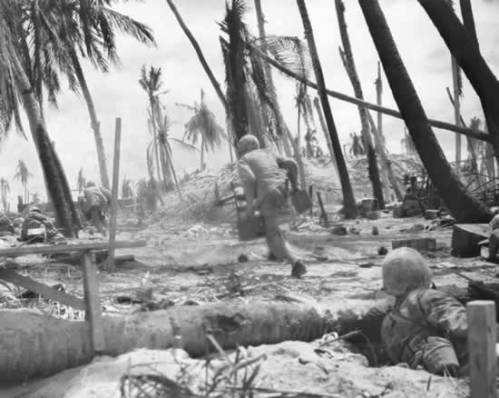
Marines advancing

Meanwhile, Shoup ordered Ryan’s “orphans” to make an attack down the right flank of the Japanese positions on Green beach and the “ultimate American victory at Betio evolved from the attack during one intense hour the second morning.”[lxxxix] Taking every available Marine, two surviving Shermans and some mortars, Ryan gathered his force and coordinated Naval Gunfire support.  The area contained a number of heavy guns including two of the 8” mounts.  A destroyer blanked the Japanese positions with 5” shells and fire from her light AA guns.[xc] Attacking behind the beach, Ryan’s Marines isolated and destroyed everyone and everything that looked hostile.[xci] Against minimal opposition Ryan’s Marines quickly seized the gun positions and the western end of the airfield.  Within an hour his Marines occupied the entire western side of Betio up to a 200 yard depth by 1200 and he radioed to let Shoup know the good news and that he intended to advance east against the airfield.[xcii] The attack allowed the Marines to be able to land intact battalions with supporting arms for the first time battle.[xciii]

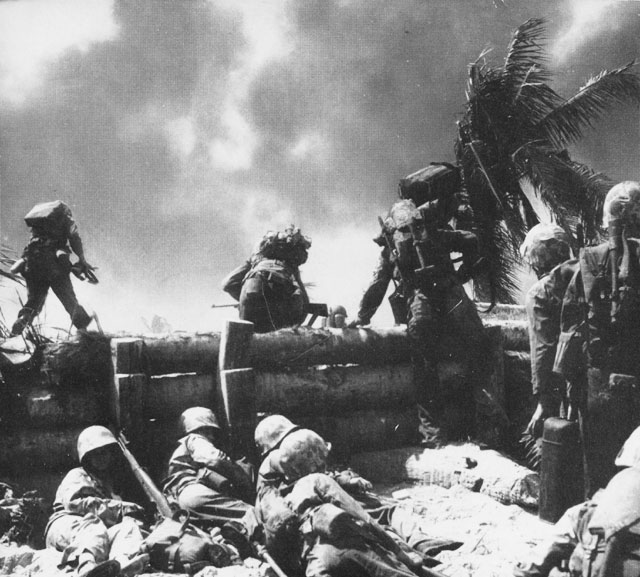
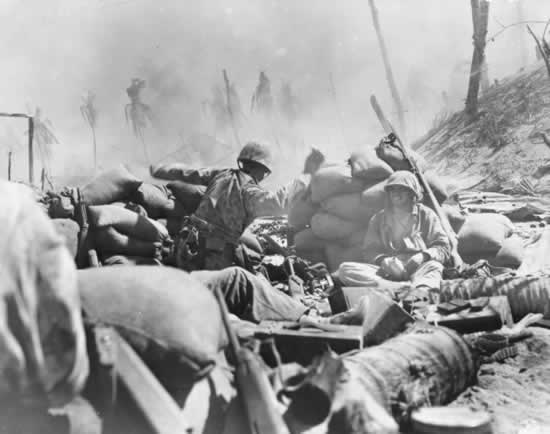
Marines in action at Tarawa

To the east behind Red-2 and Red-3 The 8th Marines and survivors of 1/2 and 2/2 attacked against fierce Japanese opposition near Shibasaki’s former command bunker and two other large bunkers which were mutually supporting.  The attack by the 2nd Marine survivors eventually succeeded in getting completely across the south side of the island.[xciv] During the attack Lt. Hawkins of the Scout Snipers was mortally wounded.  He too would win the Medal of Honor.  The attack cut the island in two but the Japanese launched a counterattack on the Marine positions which was beaten back.[xcv]
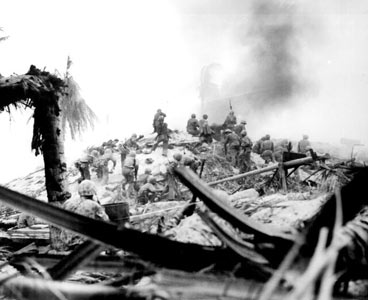
Marines moving inland against tough resistance

The 8thMarines faced a more difficult task going against what was now the heart of the Japanese defense, as its defenders had been reinforced by Lt. Minami and his third company of the 7th Special Naval Landing Force.  Vicious fighting ensued and by nightfall “the Marines had little to show for their heavy losses,[xcvi] but they did make significant inroads against the Japanese to warrant optimism for D+2.[xcvii] By evening the Marines on Red-1 and Red-2 had consolidated their beachhead so that reinforcements were landing, including jeeps, artillery and heavy equipment, and other Marines noted that Japanese defenders were beginning to commit suicide and they began to feel that Japanese morale had broken.  By late afternoon Shoup transmitted the message: “Casualties many. Percentage of dead unknown. Combat efficiency-We are winning.”[xcviii] By late afternoon Major Jones’ 1/6 landed on Green beach in their rubber boats, reinforcing Ryan’s orphans, it was the first of the 7 battalions landed to get ashore intact and the two officers coordinated their units for a night defense and an early attack the next morning.[xcix] 2/6 cleared the nearby island of Bairiki allowing 2/10 to land its howitzers on the island.  This in effect cut off any line of retreat for the defenders of Betio.[c] Colonel Edson came ashore during the evening to relieve Shoup[ci], who remained ashore to help coordinate the next day’s attack.  Again there were no coordinated Japanese counterattacks, the only senior officer, Sugai was isolated in the pocket between the Red and Green beaches and no senior officer could coordinate any attacks.[cii]

Day Three and Four: D+2 and D+3
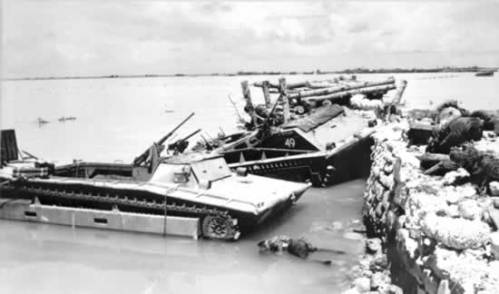
Wrecked LVTs and dead bodies

Day three began with attacks against Japanese strong points and the arrival of more reinforcements including 3/6 which landed on Green beach and three light tank platoons which landed on Red-2.[ciii] The Marines attacked off of Green beach sweeping east to join the 2nd Marines who had cut the island in two the day before.  The 8th Marines continued to attack the heavily fortified bunker complex eventually taking these heavily fortified and defended positions.  During the assault Lt Sandy Bonnyman of 1/18 won the Medal of Honor for leading the assault on these positions.[civ] Fighting remained fierce throughout the day and General Smith arrived to take command on shore.  The Marines attacked supported by tanks, artillery and naval gunfire.

Tarawa beach after the fight

By the evening they were established at the east end of the airfield.  The Japanese launched a series of Banzai charges which beginning about 1930 hours and ending about 0400 when the Marines annihilated the last attack with the assistance of artillery.[cv]The attack, which could have succeeded the first or early the second day, now aided the Marines by sacrificing strength that might have been used to exact a higher price for the tail of the island.[cvi] The next morning the Marines pushed forward and eliminated the last Japanese defenders and by 1200 Betio was secured.  Of about 5000 defenders only 17 Japanese and some Korean laborers were taken prisoner.[cvii] The Marines lost over 1000 killed and 2300 wounded.[cviii]

One of the few Japanese prisoners being interrogated

Epilogue

The Marines paid a heavy price for Betio, but it was not to be a useless sacrifice, though it was a source of great controversy especially among politicians.[cix]Spector wonders if waiting for better tides or a full moon would have saved lives.[cx] Holland Smith later argued that Tarawa should have been bypassed, but Nimitz’s biographer Potter notes “if the lessons of the amphibious assault had not been learned at Tarawa, they would have to be learned elsewhere, probably at greater cost.”[cxi]The lessons learned alone aided all future amphibious operations in the Central Pacific and elsewhere.  Timing and coordination of naval gunfire support, air strikes and combat loading of transports were all refined in future operations. Large numbers of armored and up-gunned Amtracks would be part of every future operation.[cxii] Intelligence was emphasized and replicas of the Japanese fortifications were built and tested to determine the best way of destroying them.[cxiii] The Marines shocked the public by releasing photos and films of the carnage on Tarawa to awaken them to the challenges ahead.[cxiv]

Today the battle is remembered annually by the 2nd Marine Division at Camp LeJeune, an ever shrinking number of veterans of the battle attend the ceremonies.  Samuel Eliot Morison put it best: “All honor, then, to the fighting heart of the United States Marine. Let the battle for that small stretch of coral sand called Betio of Tarawa be remembered as terrible indeed, but glorious, and the seedbed for victory in 1945.”[cxv]

Appendix: Leaders on Tarawa
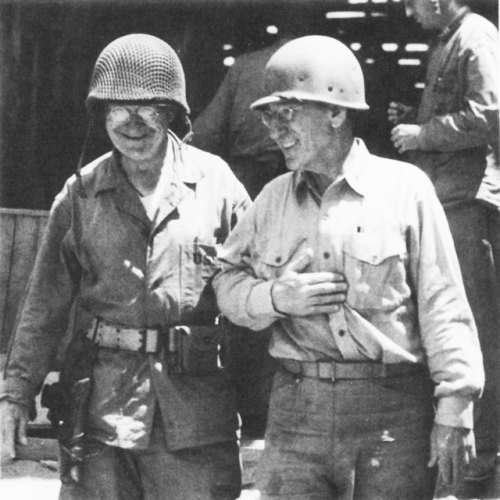
General H.M. Smith and General Julian Smith at Tarawa

General Holland M. “Howling Mad” Smith USMC: (1882-1967) Lieutenant General Holland M. Smith command V Amphibious Corps during the Gilberts operation.  Prior to the war he had worked extensively on amphibious warfare doctrine for both the Marine Corps and Navy. Unlike many senior officers Smith was not a Academy graduate having matriculated from the Alabama Polytechnic Institute (now Auburn University) in 1903 and law school in 1903.  Smith served as Adjutant of the 4th Marine Brigade in the First World War and served in Panama and the Dominican Republic in addition to other Marine tours afloat and ashore.  He served well and had many key assignments between the wars culminating in as the Assistant Commandant of the Marine Corps.  Subsequent to the Gilbert campaign he served as Commanding General of the Fleet Marine Force, Pacific and later commanded the Marines at Iwo Jima.  He retired in 1946.

Major General Julian Smith USMC: (1885-1975) Major General Julian Smith served as Commanding General 2nd Marine Division at Tarawa.  He graduated from the University of Delaware and was commissioned as a Second Lieutenant in 1909.  He served in Haiti, Santo Domingo and the Vera Cruz expedition. During the First World War he served as an instructor in the Marine Officer training camps at Quantico. After the war he served in Cuba, Nicaragua and various command and staff posts including the Army Command and General Staff College.  He commanded 5th Marines in 1938 and in 1942 was promoted the Major General serving as director of Fleet Marine Force Schools, New River, NC.  He took command of 2nd Marine Division in May 1943 and served there until April 1944 when he became Commanding General, Expeditionary Troops, Third Fleet and in December 1944 took command of the Military Department of the Pacific.  He retired in 1946.

Colonel David Shoup of the 6th Marines won the Medal of Honor at Tarawa and would rise to become the Commandant of the Marine Corps

Colonel David Shoup USMC: (1904-1983) Colonel David Shoup commanded the 2nd Marines at Tarawa, being appointed as commander when its commander fell ill.  Shoup won the Congressional Medal of Honor for his actions on Tarawa.  A 1926 graduate of DePauw University, Shoup was commissioned a Second Lieutenant through the ROTC program that year.  He served in various assignments to include service in China, at sea on the battleship Maryland and Marine Barracks Puget Sound Navy Yard. He joined the staff of 6th Marines in October 1940 and assumed command of 2/6 in February 1942.  He was assigned as the Assistant Operations Officer for 2nd Marine Division in July 1942 and promoted the Lieutenant Colonel.   He went with the Division to New Zealand where he became the G-3 and from which he was fleeted up to command 2ndMarines at Tarawa.  After Tarawa he served as the Division Chief of Staff at Saipan and Tinian.  After the war Shoup continued to be assigned in key billets at the Pentagon and as commanding General, 1st Marine Division and then the Third Marine Division.  He became Chief of Staff, HQMC in 1958 and was appointed as the 22nd Commandant of the Marine Corps by President Eisenhower, a post that he retained until his retirement in 1963.

Admiral Tomanari Sachiro IJN: (1887-?) Commander of Tarawa garrison until relieved by Rear Admiral Shibasaki.   Graduate Naval Academy 1910, initially a communications officer he held various commands including Heavy Cruiser Haguro and Battleship Kirishima and two smaller ships.  Assigned to Tarawa in February 1943 he helped design and supervised the initial construction of Tarawa Defenses until relieved by Admiral Shibasaki on 20 July1943.  He returned to Japan and served the remainder of the war on Navy Division of Imperial General Headquarters.  Tomonari survived the war though nothing is mentioned as to his postwar fate.
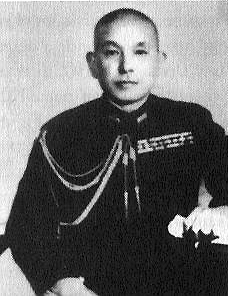
Rear Admiral Shibasaki Keiji IJN: (1894-1943) Commanded Tarawa Garrison until his death during the battle.  He graduated from the Naval Academy in 1915 and he was a skilled navigator and instructor.  Prior to the war he had served afloat and ashore and ashore and had commanded a ship and naval station and served as a naval attaché to a member of the Imperial Family.  Among his assignments was 19 month combat tour with the special Naval Landing Forces in China, where he served as Chief of Staff of Shanghai Special Naval Landing Force.  Shibasaki’s leadership helped the garrison improve their defensive capabilities and combat skills as he inspired them to great heights and executed an intense training program. He was killed in the battle.

A Personal Note

I have not been to Tarawa but feel that I know it well.  I served in Second Marine Division from April 1999 through December 2001.  Due to my prior service experience I was used to fill gaps where chaplains were needed and ended up serving in four different battalions.  I served in 2nd Combat Engineer Battalion, the descendant of 1/18, the combat engineers.  We had a WWII Bulldozer outside our command post named after Sergeant Bordelon, the Medal of Honor Citations for Bordelon and Boonyman were prominently displayed.  I also served in 1/8 and 3/8.  I knew the accounts of the slaughter of these Marines as they attempted to land but as I re-read the accounts I was moved by their courage under fire.  The CPs of these battalions are also adorned with citations of their heroes lost at Tarawa.  Veterans would visit our units during Tarawa Days at Camp LeJeune, worn by the battle and the years they always made an impression. There is almost a mystical connection between the Second Marine Division and the Marines of Tarawa; it was a crucible that defined the division, whose motto is the same as the Army Infantry School. “Follow Me!”

Semper Fidelis,

Padre Steve

[i] Spector, Ronald H. Eagle Against the Sun: The American War with Japan.  The Free Press, New York, NY 1985. p.253

[ii] Murray, Williamson and Millett, Allan R. A War to Be Won: Fighting the Second World War, The Belknap Press of Harvard University Press, Cambridge, MA 2000. p.338

[iii] Ibid. Spector. p.253

[iv] Ibid. p.255 The conference also set a date for the invasion of France.

[v] Toland, John. The Rising Sun: The Decline and Fall of the Japanese Empire, 1936-1945. Random House, Inc. New York, NY 1970. p.468

[vi] Ibid. Spector. p.255

[vii] Costello, John. The Pacific War 1941-1945. Quill Publishing, New York, NY 1982. p.430

[viii] Ibid.

[ix] Potter, E.B. Nimitz. Naval Institute Press, Annapolis, MD, 1976, Third Printing with Revisions 1979. p.243. Nimitz’s forces would have had to seize 5 major Japanese bases and his staff was not sure that the Pacific carrier force would be strong or experienced enough to provide the necessary air cover for the operation.

[x] Ibid.

[xi] Ibid. pp.243-245

[xii] Morison, Samuel Elliott. The Two Ocean War: A Short History of the United States Navy in the Second World War. Little Brown and Company, Boston and Toronto, 1963. p.296.

[xiii] Hammell, Eric and Lane, John E. Bloody Tarawa: The 2nd Marine Division, November 20-23, 1943. The Zenith Press, St. Paul MN 2006.  Text copyright 1998 Eric Hammell and John E. Lane. p.4

[xiv] See Alexander, Joseph H. Utmost Savagery: The Three Days of Tarawa.Ivy Books, published by Ballantine Books, New York, NY. 1995. pp. 39-40.  This unit became the Third Special Base Unit on its deployment and was joined by the 111th Construction Battalion.

[xv] Ibid. Hammell. p.4

[xvi] See Alexander pp.39-40. This unit was basically a reinforced infantry battalion with 3 rifle companies, a weapons battery, anti-aircraft battery, a light tank company and support units numbering about1600 men.

[xvii] Ibid. Alexander. p.43

[xviii] Alexander p.27 The Rikusentai was the Japanese equivalent of Marines, who numbered about 50,000 men.  The officers attended Army schools and qualified enlisted men attended additional Army specialist training.

[xix] Ibid. Costello. p.431

[xx] Ibid. Hammell. p.22

[xxi] See Alexander p.77. While most writers say that these guns were brought from Singapore, Alexander notes that British writer William H Bartsch submitted proof (serial numbers) that the guns were sold by Vickers to Japan in 1905 as a legitimate business transaction.

[xxii] These are the same guns (127mm) mounted as the secondary armament of Nachi and Takao Class Heavy Cruisers and later mounted on light cruisers to replace the main battery with a more effective anti-aircraft armament.

[xxiii] Ibid. Hammell. p.22

[xxiv] Hammell notes that many of these bunkers and pillboxes were so well concealed that they could not be seen.

[xxv] Ibid. Toland. p.469.

[xxvi] Ibid. Alexander. p.43.

[xxvii] Ibid. Hammell. p.28

[xxviii] Ibid. Morison. p.297

[xxix] Ibid. Costello. p.429

[xxx] At this point the force could provide everything except major permanent repairs to warships.

[xxxi] Liddell-Hart, B.H.  History of the Second World War. G.P. Putnam’s Sons, New York, NY 1970. p.511

[xxxii] Ibid. Costello. p.431

[xxxiii] The older LVT-1s had boiler plate armor added as a field modification and were given a heavy machine gun. Prior to this they were unarmored and had two light machine guns.

[xxxiv] Ibid. Morison. p.303

[xxxv] Hammell includes a by name list of these officers in Appendix B.  Of note for today, each MEUSOC (Marine Expeditionary Unit, Special Operations Capable) has an assigned Naval Gunfire Support Team.

[xxxvi] Ibid. Alexander. pp. 61-62.  The Shermans had to be transported aboard pre-loaded LCM-3s carried in the well decks of the LSDs.

[xxxvii] Ibid. Alexander. pp.58-59

[xxxviii] Ibid. Morison. p.297.  As a sidebar discussion it should be noted that Galvanic helped provide the model for the organization of all further Marine Corps amphibious doctrine now known by the acronym PERMA; Planning, Embarkation, Rehearsal, Movement and Assault, which describes the 5 phases of a amphibious assault.

[xxxix] Ibid. Hammell details the intricacies of the particular tides seen at Tarawa and the knowledge that the Marines had from the former Resident Commissioner of the Island, Major Frank Holland who warned the division staff that he knew that there would not be enough water over the reef to get landing craft across it. (pp.18-20)

[xl] Ibid. Alexander. pp.75-77

[xli] Ibid. Alexander. pp.67-68.

[xlii] Ibid. p.70

[xliii] Ibid. p.71

[xliv] Ibid. Morison. p.302

[xlv] Ibid. Hammell. p.16

[xlvi] Johnston, Richard W. Follow Me! The Story of the Second Marine Division in world War II.  Copyright 1948 by the Second Marine Division History Board and published by Random House Publishers, New York, NY 1948. p.106

[xlvii] Ibid. Liddell-Hart. p.511  Johnson says 2,700 tons. (p.106)

[xlviii] Ibid. Johnston. p.106

[xlix] Ibid. Hammell. p.17

[l] Ibid.

[li] Ibid.. Hammell. 46-47

[lii] Ibid. Morison. p.303

[liii] Ibid. Alexander. p.113.  Alexander notes that the Japanese would have been better served by using these guns on the stalled out landing craft.

[liv] Ibid. Hammell. p.47.

[lv] Ibid. Hammell. p.58

[lvi] Ibid.

[lvii] Ibid. Morison. p.303

[lviii] Ibid. Alexander. p.79

[lix] Ibid. Hammell. p.17

[lx] Ibid. Alexander. p.121

[lxi] Wukovits, John. One Square Mile of Hell: The Battle for Tarawa. NAL Caliber, published by New American Library, a division of Penguin Group USA, New York NY, 2006. p.112

[lxii] Ibid. Johnston. p.116

[lxiii] Ibid.

[lxiv] Ibid. Wukovits. P.119  Other companies suffered as grievously, K/3/2 was not alone in its suffering.

[lxv] Ibid. Spector. pp.263-264

[lxvi] Ibid. Alexander. pp.136-138

[lxvii] Ibid. Hammell. p.90

[lxviii] Ibid. p.95

[lxix] Ibid. Spector. p.264

[lxx] Ibid. Wukovits. p.114

[lxxi] Ibid. Alexander. pp.139-140

[lxxii] 1/8 did not arrive on the beach due to botched communications until D plus 1.

[lxxiii] Ibid. p.150  The last time this signal had been sent it was by Major Devereaux at Wake Isalnd

[lxxiv] Ibid. p.151

[lxxv] Ibid. Johnston. p.132

[lxxvi] Ibid. Hammell. p.112

[lxxvii] Ibid. p.130

[lxxviii] Ibid. Johnston. p.122

[lxxix] Ibid. Johnston. p.122

[lxxx] Ibid. Costello. p.436

[lxxxi] Ibid. Alexander. p.163

[lxxxii] Ibid. Alexander. pp.157-158  Hammell notes that Shibasaski was most likely killed by fire from Ringgold or Dashiell.

[lxxxiii] Ibid. Hammell.pp.139-140

[lxxxiv] Ibid. Alexander. p.162

[lxxxv] Ibid.  Wukovits. p.176. Wukovits notes how this could have affected the planning for the Normandy invasion.

[lxxxvi] Ibid. Alexander. p.173

[lxxxvii] Ibid. Hammell. p.160

[lxxxviii] Ibid. Costello. p.437

[lxxxix] Ibid. Alexander. p.170

[xc] Ibid. Hammell. p.163

[xci] Ibid. Hammell. p.166

[xcii] Ibid. Wukovits. p.178

[xciii] Ibid. Alexander. p.170 Ryan would be awarded the Navy Cross for his efforts.

[xciv] Ibid. Hammell. p.172

[xcv] Ibid. Alexander. p.179

[xcvi] Ibid. Alexander. p.181

[xcvii] Ibid. Hammell. p.178

[xcviii] Ibid.. Wukovits. p.194

[xcix] Ibid. Hammell. p.202

[c] Ibid. Hammell. p.212

[ci] Shoup would be awarded the Medal of Honor and eventually go on to be the Commandant of the Marine Corps.

[cii] Ibid. Alexander. pp.191-192

[ciii] Ibid. Johnston. p.134  2 platoons landed on Red-2 and one on Green Beach.

[civ] Ibid. Alexander. pp.202-205

[cv] Ibid. Johnston. pp.145-146

[cvi] Ibid. Johnston. p.147

[cvii] Ibid. Toland. p.470

[cviii] Ibid. Murray and Millett. p.345

[cix] Ibid. Liddell-Hart. p.511

[cx] Ibid. Spector. p.266

[cxi] Ibid. Potter. P.264

[cxii] Ibid. Murray and Millett. p.347  The Amtrack in improved forms has been part of the Marines ever since. The current model serves in a traditional amphibious role as well as a Armored Personnel Carrier for Marines involved in ground combat operations ashore.

[cxiii] Ibid. Costello. p.439. The method found to work best was long range plunging fire by heavy guns found on battleships and heavy cruisers.

[cxiv] Ibid. Murray and Millett. p.346

[cxv] Ibid. Morison. p.306

Bibilography

Alexander, Joseph H. Utmost Savagery: The Three Days of Tarawa. Ivy Books, published by Ballantine Books, New York, NY. 1995.

Costello, John. The Pacific War 1941-1945. Quill Publishing, New York, NY 1982

Morison, Samuel Elliott. The Two Ocean War: A Short History of the United States Navy in the Second World War. Little Brown and Company, Boston and Toronto, 1963

Hammell, Eric and Lane, John E. Bloody Tarawa: The 2nd Marine Division, November 20-23, 1943. The Zenith Press, St. Paul MN 2006.

Johnston, Richard W. Follow Me! The Story of the Second Marine Division in world War II.  Copyright 1948 by the Second Marine Division History Board and published by Random House Publishers, New York, NY 1948

Murray, Williamson and Millett, Allan R. A War to Be Won: Fighting the Second World War, The Belknap Press of Harvard University Press, Cambridge, MA 2000

Potter, E.B. Nimitz. Naval Institute Press, Annapolis, MD, 1976, Third Printing with Revisions 1979

Spector, Ronald H. Eagle Against the Sun: The American War with Japan.  The Free Press, New York, NY 1985 Toland, John. The Rising Sun: The Decline and Fall of the Japanese Empire, 1936-1945. Random House, Inc. New York, NY 1970

4 Comments

Filed under History, Military, world war two in the pacific

Tides Pound Yankees 12-4 at Harbor Park

Jake Arrieta got his 3rd win of the season on Tuesday against the Scranton Wilkes-Barre Yankees

The big guns of the Norfolk Tides finally opened fire at Harbor Park on a cloudy, warm and humid Tuesday afternoon at Harbor Park and left the pitching staff of the Scranton Wilkes-Barre Yankees in shambles.  4541 fans came out for this business person’s special which began at 1215 and the Tides fans among them went away very satisfied as the Tides pounded out 12 runs on 16 hits and committed no errors to split the series with the Yankees.

Scott Moore hit his 3rd home run of the season

Tuesday was a far different affair than the previous three games against the Yankees where in 27 innings the team managed just 5 runs and had no home runs.  Jake Arrieta was not as sharp as he has been but still picked up the win going five innings giving up 2 runs on 2 hits but surrendering five walks to the Yankees.  Yankees starter Zack McAllister went just 3 innings and was tagged for 7 runs on 9 hits including 2 home runs while reliever Amaury Sanit fared little better giving up 5 runs on 5 hits including 2 home runs in two innings work.

Adam Donachie had key hits including a bunt single and a RBI double

The Tides offensive barrage began in the 1st inning when leadoff batter Robert Andino hit the fourth pitch of the game over the left field wall off of Zack McAllister.  In the second inning the Tides went back to work.  Corey Patterson who went four for four on Monday connected and doubled to right. He was followed by Scott Moore who homered to right field getting down in the count 0-2.  The Tides threatened more in the inning as Michael Aubrey came to the plate and singled and Adam Donachie was safe on a force attempt on a throwing error by McAllister.  Blake Davis flied out to center and then on an unusual play hit a fly ball to right which Yankees Right Fielder David Winfree caught and threw back in to McAllister.  On the play Aubrey had advanced to third but was called out when the Yankees claimed that he had tagged too soon and McAllister threw to Eduardo Nunez for the double play.

Josh Bell hit his 4th home run of the season

After a scoreless 3rd inning the Yankees went quietly in the top of the fourth.  It was then that the Tides hits blitzed McAllister and Sanit with a fearsome hitting attack.  Scott Moore and Michael Aubrey both singled to put runners on first and second with no outs.  Adam Donachie then bunted successfully to load the bases.  Up came Blake Davis who doubled to left scoring Moore and Aubrey.  This ended McAllister’s day and Amuary Sanit (1-0 5.54) got the call to try to stop the Tides barrage.  Like McAllister he faced Robert Andino as his first batter and Andino wasted no time whatsoever blasting the first pitch over the left center field wall top clear the bases.  Joey Gathright grounded out and the Yankees must have felt that the worst was over.  However that would not be the case.  Jeff Salazar singled and was driven home when Josh Bell hitting from the left side of the plate hit his first Harbor Park home run taking the first pitch from Sanit to the opposite field over the left field wall.  Corey Patterson grounded out and with no one on base and two outs the Yankees found that the Tides were not finished.  Sanit walked Scott Moore on four pitches and was followed by Michael Aubrey who doubled to score Moore.  Adam Donachie doubled to right on the first pitch delivered by Sanit to score Aubrey to make the score 12-0.  At long last following a wild pitch which allowed Donachie to take third Sanit was able to get out of the inning by striking out Blake Davis.
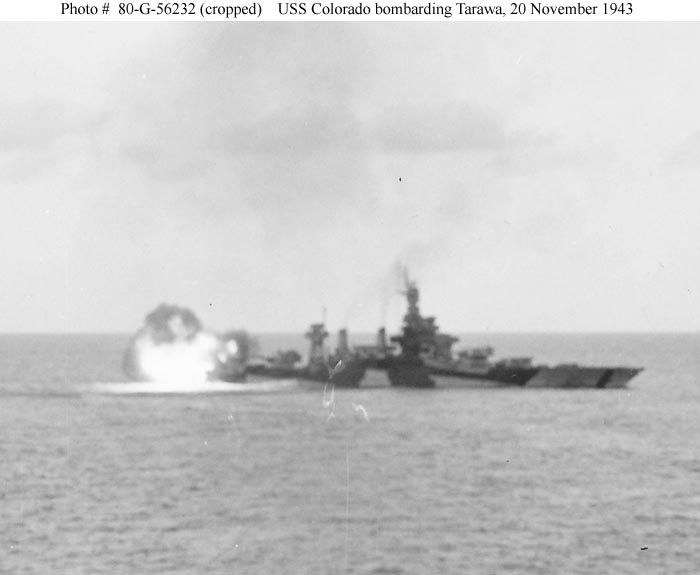
Robert Andino hit his 3rd and 4th home runs of the season Tuesday

The Yankees got two runs back in the top of the 5th inning as Arrieta began to have some control problems. Jake walked former Tides Catcher Robby Hammock and then former Tides Catcher Chad Moeller singled.  Hammock had been released by the Orioles at the end of last season and Moeller during spring training and both were signed to minor league contracts by the Yankees.  Kevin Russo walked to load the bases and the Yankees got their first run when Arrieta walked Reegie Corona scoring Hammock. Edaurdo Nunez then grounded into a force out which scored Moeller before Arrieta got Juan Miranda to hit into a 5-4-3 double play.

Michael Aubrey went 3 for 4 with a double and an RBI

Ross Wolf (0-0 2.76) came in at the top of the 6th inning to relieve Arrieta who had made 92 pitches. Wolf sent the Yankees down in order in the 6th and finally the Yankees were able to put a lid on the Tides offensive juggernaut although the Tides had another big scoring opportunity in the bottom of the 6th when Zack Segovia (1-1 7.71) who had come on in relief of Sanit hit Josh Bell, gave up a single to Corey Patterson and had Scott Moore reach on a throwing error by Eduardo Nunez.  Segovia got out of the inning by striking out Michael Aubrey, Adam Donachie and Blake Davis in order.

In the 7th inning Ross Wolf retired the first two batters and then walked Kevin Russo. Russo was followed by Reegie Corona who after getting down in the count 0-2 kept fouling balls off until he launched a home runner over the right field wall.  Wolf then retired Eduardo Nunez to end the inning but pounded his fist in his glove in frustration for giving up the two out home run after nearly having Corona out.

In the 8th inning Jim Johnson (0-0 0.00) made his first appearance for the Tides this year after being sent down from Baltimore when Brad Bergeson was brought back to the team from the Tides. Johnson allowed a 2 out double to Jon Weber but allowed no runs.  The Yankees brought in Tim Norton (0-0 0.00) to pitch to the Tides.  Norton gave up a leadoff double to Josh Bell.  Corey Patterson grounded out and Scott Moore flied out.  Michael Aubrey walked and with runners on first and third Adam Donachie flied out to center to end the inning.  Frank Mata (1-0 1.50 S4) came in to close the game for the Tides in a non-save situation and put down the Yankees in order.

In all the Tides scored 12 runs on 16 hits with no errors leaving 8 men on base. The Yankees had 4 runs on 4 hits and two errors with 6 left on base. Corey Patterson went 2-5 today and ended the series with the Yankees at 9 for 16.  Josh Bell hit his fourth home run, Robert Andino got numbers three and four and Scott Moore got his third dinger of the season.

Jake Arrieta (3-1 1.50) got the win and Zack McAllister (0-2 5.52) got the loss.  The Tides get a well deserved day off on Wednesday and return to Harbor Park to face the Toledo Mud Hens with Chris George (1-1 4.24) taking the hill for the Tides going up against Toledo’s Armando Galarraga (3-2 2.30).  The weather should be great with daytime highs in the mid- 80’s and clear skies. See you there.

Peace

Padre Steve+

Leave a comment

Filed under Baseball, Batlimore Orioles, norfolk tides

Yankees Double up Tides 6-3; Patterson has Four Hit Night

Chris Tillman got a no-decision in his first game following his no-hitter

On a warm and windy Monday night in front of a crowd of 2932 fans the Norfolk Tides dropped their second straight to the Scranton Wilkes-Barre Yankees at Harbor Park. Once again the Tides lack of offense despite 11 hits spoiled a good pitching performance by Chris Tillman.  Tillman (2-3 3.98) making his first appearance since his historic no-hitter in Gwinnett was not as sharp as his last two outings but still only allowed 2 runs in five innings work and left the Tides in position to come back and win the game.  Unfortunately for Chris and the Tides hitters failed to capitalize on 11 hits, two walks and 2 Yankees errors and save for an error in the bottom of the 6th inning could have been shut out a second straight night.

Despite this Corey Patterson has definitely got his bat back in the groove and probably making the Mariners wish that they had kept him or other Major League teams wish that they had picked him up. Patterson went four for four getting four singles.

Corey Patterson went  4 for 4

The Yankees scored two runs in the top of the 4th inning as Jesus Montero led off with a double. Tillman then got Jon Weber to fly out and struck out Chad Huffman. He then walked Greg Golson which brought Kevin Russo to the plate. Russo who is hitting .290 and has 5 doubles, 2 triples hit a sharp line drive double into the right-center gap which scored both Montero and Golson. This prompted a visit to the mound by pitching coach Mike Griffin.  Tillman then got Reegie Corona out to end the inning.

Tillman left the game at the end of the 5th inning and was relieved by Koji Uehara who pitched the 6th inning. Uehara, who was making his second rehab appearance with the Tides gave up a hit but no runs serving up 14 pitches of which 12 were strikes. Uehara was effective in both appearances at Harbor Park and it seems apparent that he is ready to rejoin the Orioles bullpen.

The Tides got on the board in the bottom of the 6th when with one out Corey Patterson got on with a single.  Pattersonwas then called out attempting to steal second after having appeared to slide under the tag.  Josh Bell then singled as did Jeff Salazar. With two on and two out Scott Moore came to the plate.  Moore who is hitting .237 and has two home runs and 10 RBIs, hit a routine pop up to left center, which unexpectedly became anything but routine when Yankees Center Fielder Greg Golson dropped the ball allowing both Bell and Salazar to score.  Justin Turner walked but Brandon Snyder grounded into a force out to end the inning.

With the score now tied it seemed that the Tides were poised for a comeback.  Pedro Viola (0-1 27.00) came on in relief of Uehara. Viola who was claimed off of waivers by the Orioles and placed on the team’s 40 man roster after being designated for assignment by the Cincinnati Reds on April 21st was rocked in this outing as he was in his first two appearances for the Tides.  Viola pitched but two thirds of an inning and gave up 4 runs on 4 hits and a walk despite striking out two Yankees batters.  The inning began with some promise; Viola struck out Reegie Corona then walked Eduardo Nunez before striking out Juan Miranda.  It was then that things went bad in a hurry for the Tides new reliever.  David Winfree singled to left. Jesus Montero hit his 6th double of the season driving in Nunez and advancing Winfree to third.  Jon Weber then singled to score Winfree prompting a visit to the mound by Gary Allenson.  Chad Huffman then came to the plate and singled to score both Montero and Winfree.  This drove Viola from the game and brought in Jim Miller who struck out Kevin Russo swinging.

The Tides attempted a two out rally in the 7th inning when Robert Andino walked and was advanced to third on a single by Corey Patterson.  Andino then scored when Josh Bell connected on a single but the inning ended when Jeff Salazar flied out to Chad Huffman.

Neither team added to their run totals while Jim Miller finished the game for the Tides giving up no runs on two hits with a strikeout in 2.1 innings work.  Yankees closer Jonathan Albaladejo (1-1 S8 1.32) got the save giving up two hits but surrendering no runs.

The Tides and Yankees meet again on Tuesday with Jake Arrieta pitching for the Tides against Scranton’s Zack McAllister and the Tides hope to bounce back and get their hitting on track.

Peace

Padre Steve+

Leave a comment

Filed under Baseball, Batlimore Orioles, norfolk tides