Yearly Archives: 2019

Wings of Gold: U.S. Navy Carrier Aircraft 1941-1945

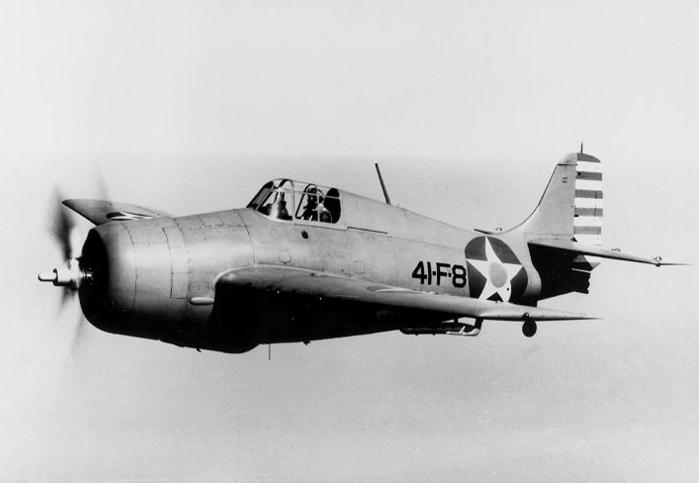
F4F-4 Wildcat of VF-41 in 1942

In 1941 with war raging in Europe and with the Japanese continuing their war in China and occupying French Indo-China the United States rushed to build up its Naval Air Arm and the Arm Air Corps.  New models of aircraft of all types were being rushed into production to replace aircraft already known to be obsolescent.  The Navy brought aircraft already accepted into full production even as it planned more advanced models.  The events in Europe and Asia demonstrated that new fighter designs were needed quickly.
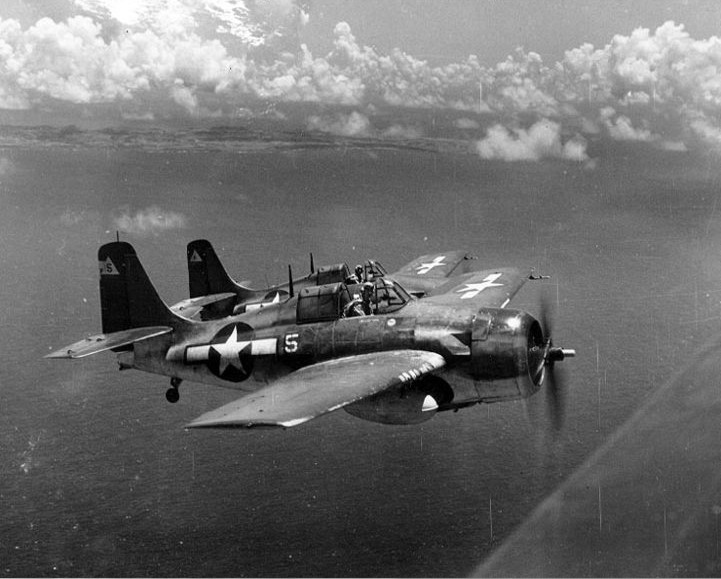
As 1940 dawned the standard fighter aircraft found on U.S. Navy carriers were the F2-A Brewster Buffalo, the Grumman F-3F biplane.  In February 1940 the Navy accepted its first F4F-3 Wildcat which in an earlier for had been rejected in favor of the Brewster Buffalo.  The new Grumman fighter was powered by a 1200 hp Pratt & Whitney R-1830-76 double row radial engine, mounted 4 .50 cal. Machine guns and was heavily armored.  It had a maximum speed of 331 mph range of 845 miles and ceiling of 39500 feet. This would serve it and its pilots well as they aircraft was incredibly tough, often amazing experienced Japanese pilots in their A6M2 Zeros in their ability to suffer heavy damage and remain in the air.  The plucky Wildcat would become the main line of defense in the Pacific against the advancing Japanese Imperial Navy in the months following Pearl Harbor.
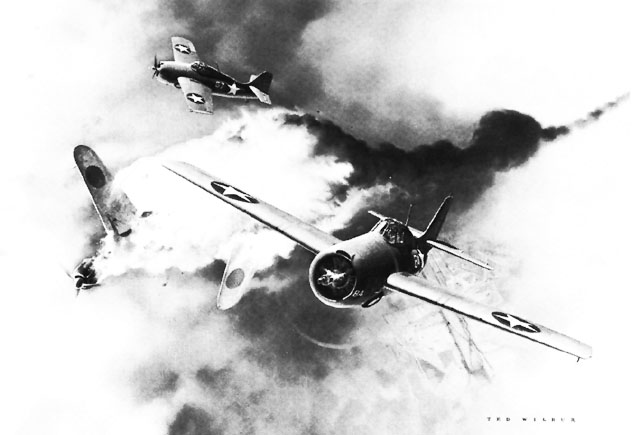
The early F4F-3s were superseded by the F4F-4 model which incorporated folding wings, additional armor and an extra two machine guns.  This decreased its maximum speed to 320 mph, rate of climb and ceiling but nonetheless the aircraft gave a good account of itself in Navy and Marine Corps service.  F4F-3’s and F4F-4s served in the British Royal Navy where it was called the Martlet until the end of the war.  When Grumman closed out F4F production in 1943 to concentrate on its replacement the F6F Hellcat production was continued by General Motors and Eastern Aircraft as the FM1 and FM2 Wildcat. The FM1 was identical to the F4F-4 but armament was reduced to 4 machine guns and bomb racks for two 250 lb bombs or depth charges were added.  The FM2 was based on an updated version of the F4F and had a more powerful engine as well as a higher tail assembly to account for the increased torque of the engine.  These aircraft served aboard the tiny Escort Carriers and performed valiantly, especially in the Battle off Samar during the Battle of Leyte Gulf.  A total of 7860 Wildcats of all varieties were built.  They accounted for 1327 enemy aircraft shot down with the loss of only 191 Wildcats.
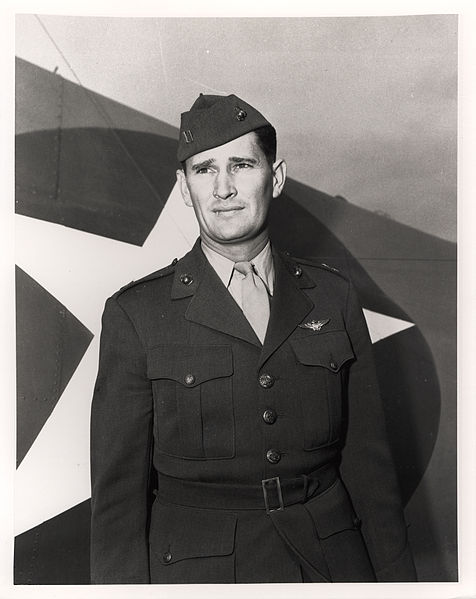
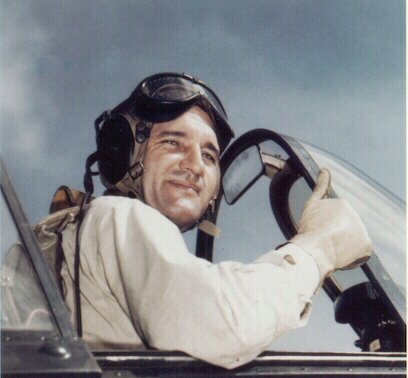
Aces Capt Joe Foss USMC and CAPT David McConnell USN both Medal of Honor Winners and CDR Jimmy Thatch (below)
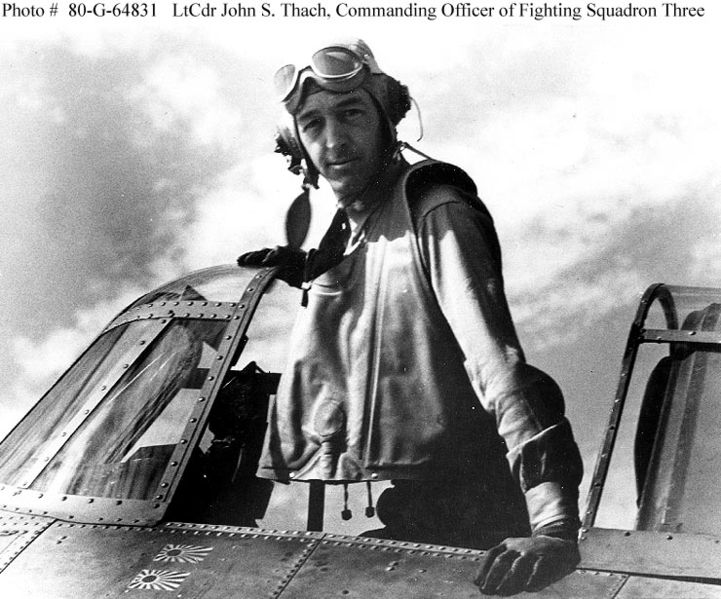
The top aces who flew the Wildcat were all Marines, CAPT Joe Foss (26 victories) MAJ John Lucian Smith (19 victories) and MAJ Marion Carl (16 victories in the F4F and 2 in the F4U Corsair). Foss and Smith both won the Medal of Honor.  Foss would go on to become Governor of South Dakota and the first Commissioner of the American Football League in 1959. Smith retired as a Colonel in 1960 and Carl as a Major General.  Other distinguished F4F aces included LT Butch O’Hare, the first U.S. Navy ace and Medal of Honor winner and LCDR Jimmy Thatch who developed the highly successful “Thatch Weave” which enabled the U.S.pilots whose machines were slower and less maneuverable than the speedy and nimble Zeros to achieve good success against their Japanese foe.  Thatch retired as an Admiral in 1967.  O’Hare rose to become commander of the Enterprise Air Group and was killed in action in November 1943. Chicago’s O’Hare International Airport is named for this brave aviator.
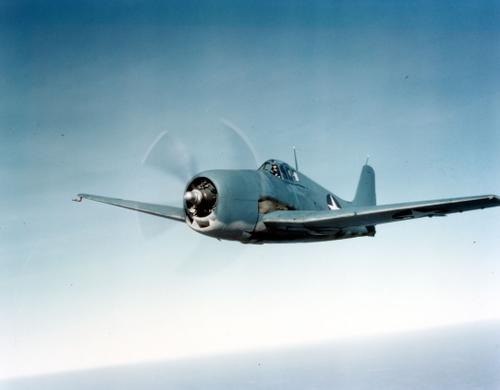
F6F Hellcat

The Grumman F6F Hellcat took over front line fighter duties on the Fleet Carriers from the Wildcat in early 1943 and established itself as the dominant fighter in the Pacific Theater of Operations.  Although it had a resemblance to the F4F the F6F was a totally new design built on combat experience against the Japanese.  The aircraft was built around the powerful Pratt & Whitney R-2800 engine which produced 2000 hp.  The Hellcat mounted six .50 caliber machine guns and had a rate of climb of 3500 feet per minute and a 37300 ft operational ceiling.

Faster than the Zero and other Japanese fighters and piloted by more experienced pilots the Hellcats took a brutal toll of Japanese aircraft.  They accounted for more Japanese aircraft kills than any other with 5163 confirmed kills with a loss of 270 aircraft an overall 19:1 kill ratio. They were piloted by 305 Navy and Marine Corps aces including Meal of Honor winner Captain David McConnell the Navy’s Ace of Aces, and highest surviving United States ace of the war that scored all 34 of his victories in the Hellcat.  The greatest achievement of the Hellcats were when they swept the rebuilt Japanese Naval Air Arm from the skies in the Great Marianas Turkey Shoot. By November 1945 12275 Hellcats had been built with 1263 going to the British Royal Navy. After the war the Hellcat was replaced by the F8F Bearcat as the primary fighter and served in a night fighter and trainer role until the 1950s.  The French Navy used the Hellcat in to provide heroic close air support to beleaguered French Soldiers in Indochina.
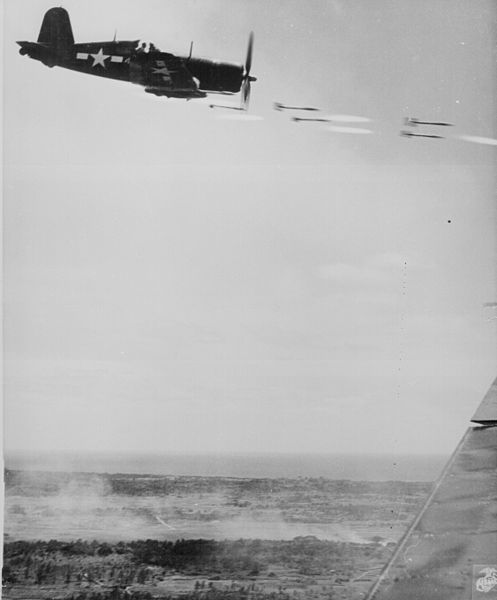
USMC F4U-4 Corsair providing close air support

Flying alongside the F6F was the Vaught F4U Corsair. The Corsair first flew in 1940 and the Navy was slow to adopt it due to difficulties in carrier operations and negative reviews of Navy pilots.  However Marine Corps aviators flying the Corsair had great success and legendary aviators like MAJ Gregory “Pappy” Boyington and VMF-214 the Black Sheep.  The Navy would adopt the aircraft later in the war as the Corsair’s carrier operation deficiencies were remedied, but its real success was a land based aircraft operated by the Marines.  Likewise the first squadrons to operate the aircraft successfully from carriers were the Marine Corps VMF-124 and VMF-213.
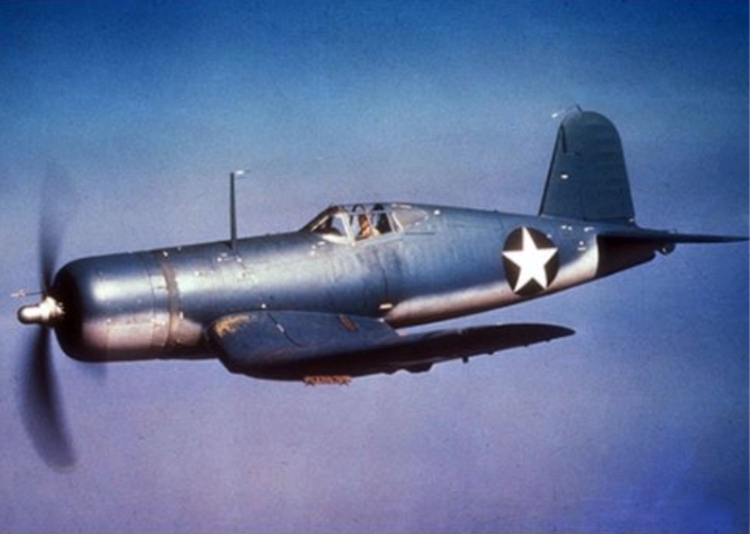
Early F4U-1

The Corsair mounted the same Pratt & Whitney R-2800 engine as the F6F but had a highly streamlined gull wing design as well as a turbo-charger which allowed it a top speed of 425 mph.  Later models such as the F4U-4 had a top speed of 445 mph. The F4F was armed with six .50 cal machine guns as well as rockets and a bomb load of 2000 pounds and the F4U-4 could carry 4000 pounds of ordnance.

Less than 10000 of the over 64000 combat sorties flown by F4Us were flown from carriers, the vast bulk of the sorties coming from land based Marine Corps squadrons.  The Corsair was often used as a fighter bomber where its capabilities to drop sizable amounts of ordinance including rockets, bombs and the nearly developed Napalm in a close air support role cemented the importance of Marine Air for future generations.  They were beloved by the Marine Corps and U.S. Army infantrymen in their brutal battles with the Japanese on many hellish island battlefields.  Corsairs accounted for 2140 confirmed kills during the war against a combat loss of 189 aircraft. The aircraft remained in production until 1952 with 12571 aircraft of all variants being built.  Many Japanese pilots considered the Corsair to be the best fighter of the war.

During the war many Corsairs served in the British Royal Navy and Royal New Zealand Air Force with good success, and after the war the French Navy had success with them in a close air support role in Indochina and Algeria.  Following the war the Corsair remained in service for many years in the U.S. Navy and Marine Corps as well as the French Navy and other smaller navies and air forces until the 1960s.

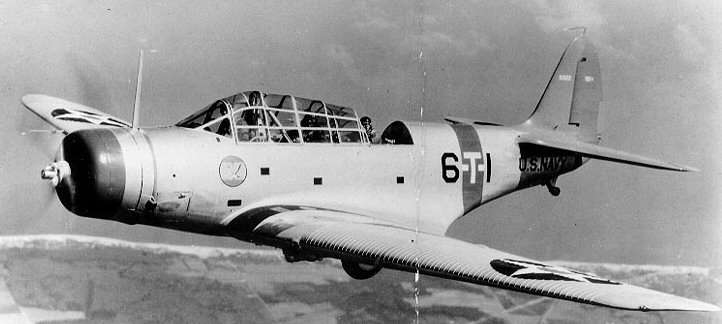
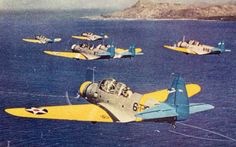
The Douglas SBD Dive Bomber was arguably the most effective Naval dive bomber of World War II, and possibly the best single engine dive bomber of all time. Other aircraft may have been faster or carried a larger bomb load, but the SBD, which served at a time when the U.S. Navy did not have air superiority and battled seasoned Japanese pilots and aircrews, achieved remarkable results,

The SBD was developed from the Northrop BT-2, after Douglas took over Northrop. The first model of the Dauntless, the SBD-1 began operations with the U.S. Marine Corps In 1940, the SBD-2 with the U.S. Navy in 1941. The SBD-3 which included more armor for the crew, and self sealing fuel tanks began entering service in late 1941.

The SBD combined a heavy bomb load, excellent bombing optics, great defensive armament, rugged construction, excellent handling characteristics and maneuverability, and superb dive bombing capabilities. It became the workhorse of the U.S. Navy between 1941 and 1944, flying about 25% of all missions flown from Navy carriers during that time. SBDs sank or damaged six Japanese Aircraft carriers, one Japanese and one French battleship, 14 cruisers, 6 destroyers, and many other ships including transports and submarines. It was the Dauntless which turn the tide of the Pacific war when at Midway they sank the Japanese aircraft carriers Akagi, Kaga, Soryu, and Hiryu and the heavy cruiser Mikuma. The SBD also accounted for more enemy aircraft in aerial combat than were lost to enemy aircraft, an amazing accomplishment by any bomber of any type.

In late 1944 after the Battle Of the Philippine Sea the Dauntless was phased out of U.S. Navy squadrons by the SB2C Helldiver. Though the Helldiver was bigger, faster, and carried a higher bomb load, many pilots preferred the Dauntless due to its superior handling characteristics, especially at low speeds, essential to landing on a carrier. It is hard to believe that the United States would have prevailed in 1942 without the Dauntless.

It was used in combat by other allies, a variant, the A-24 Banshee was built for the U.S. Army Air Force. The French operates it from the carrier Arromanches in Indochina until 1949.
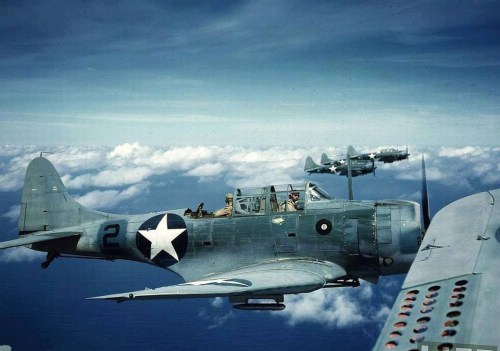
SBD Dauntless Dive Bomber above and at Midway below
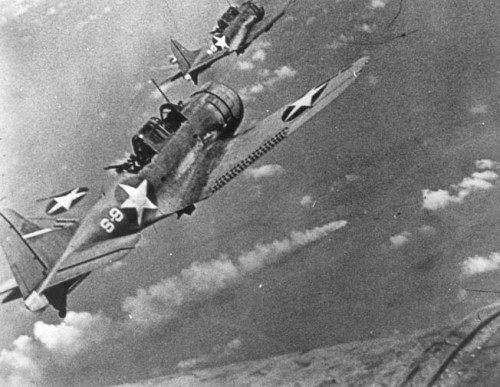
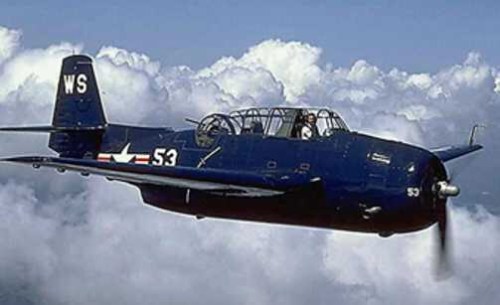
TBF Avenger above and below

The TBF Avenger torpedo bomber was developed as a replacement for the TBD Devastator by in 1940 by Leroy Grumman of Grumman aircraft. Production began in 1941 and the first combat by the aircraft was at the Battle of Midway. During that battle, 6 aircraft from VT-6, based at Midway while the rest of the squadron flying TBD Devastators from the USS Hornet attacked the Japanese carrier strike force. All of the TBD were shot down, as well as 5 of the 6 TBFs.

Despite the inauspicious start the TBFs became one of the deadliest aircraft of the Second World War. They helped sink the largest Battleships ever constructed, the Japanese Musashi and Yamato, as well as many other warships and auxiliaries. They conducted bombing missions of land targets, and operated from Escort Carriers in Anti-Submarine Warfare operations and supporting invasions and shore operations. The Avenger was particularly effective in the ASW role and was credited with sinking about 30 German U-Boats and Japanese submarines during the war.

The TBF was the largest single engine aircraft of the war, only the P-47 Thunderbolt was anywhere close to its size. Despite this the TBF was able to operate from the smallest aircraft carriers. Powered by a 1900 HP Wright R-2600-20 Twin Cyclone 14 Cylinder radial engine it could cruise at over 30,000 feet at a top speed of 275 MPH while carrying 2,000 pounds of bombs or a Mark 13 Aerial Torpedo. They also carried racks for 5″ High Velocity Aircraft Rockets and depth charges.

After the war it served in a variety of roles in the U.S. Navy, Royal Navy, Canadian Navy, French Navy, and other militaries until the 1960s. In peacetime it was used for many years as a fire fighting aircraft in the United States and Canada.

LTjg. George H. W. Bush in the cockpit of his Avenger

The most famous man to pilot a TBF/TBM was LTjg George H. W. Bush, later the President of the United States whose aircraft was shot down over Chuchi Jima In 1944.

SB2C Helldiver above and in French Service below
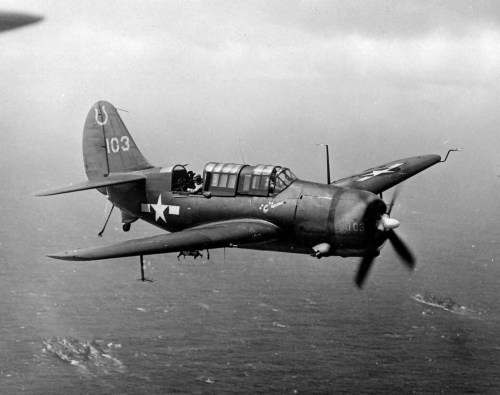
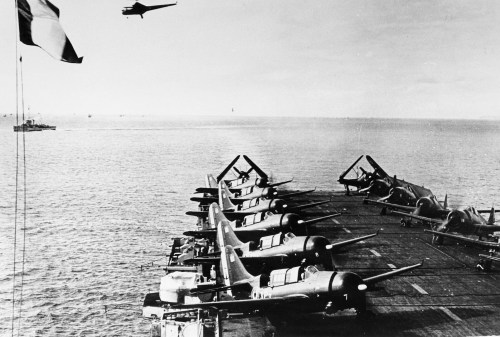
The replacement for the Dauntless was the SB2C Curtiss Helldiver. The Helldiver was bigger and faster than the Dauntless but for its size it was underpowered, and had a shorter range that the beloved Dauntless. The Helldiver had very poor performance in flight, had unreliable electrical and hydraulic systems and frequently was poorly manufactured. The defects made it less than popular among the aircrews which had previously flown the Dauntless who came to call it the Beast. The problems would lead to a Congressional investigation headed by Senator Harry Truman. During the hearings Assistant Secretary of the Navy for Air, Artemis Gates said: “When we needed the SB2C Helldiver neither we nor it was ready.”

The British Royal Navy and Australian Air Force evaluated the Helldiver and rejected it for service, cancelling their orders for it.

Despite the many flaws of the aircraft the superbly trained pilots and air crews made the most of it, sinking hundreds of Japanese ships and watercraft. From late 1944 until the end of the war it established a good combat record, though it never had to fight against the well trained Japanese pilots that the Dauntless aircrews had to face.

However, the Navy, and most air forces were moving away from the dive bomber as an attack aircraft. The U. S. Navy found that its F6F Hellcats, and F4U Corsairs could carry as heavy as payload in rockets and bombs as the Helldiver though the ordnance decreased their range. But even so the fighters were far better able to defend themselves against enemy fighter aircraft.

The aircraft served in the U. S. Navy and Naval Reserve until 1950. It also served in Greece where it was used in counter-insurgency (COIN) missions during the Greek Civil War, and by the French Navy during the Indochina campaign, including providing closer air support to French troops at Dien Bien Phu. The Italian Air Force was the last to operate the Helldiver, retiring it in 1959.

With the advent of rockets the dive bomber was replaced by single seat fighters and attack aircraft. The Helldiver was the last purpose built dive bomber. In the U.S. the Hellcat, Corsair, the postwar F8F Bearcat, the P-51 Mustang, and the P-47 Thunderbolt took over ground attack missions. The A4D Skyraider was designed as a ground attack aircraft, and eventually jet powered fighter-bombers would enter service.

These amazing aircraft and the men that flew them established a tradition of excellence that the Naval Aviators of the U.S. Navy and Marine Corps continue today.

Peace

Padre Steve
Leave a comment

Filed under aircraft, History, Loose thoughts and musings, Military, US Navy, World War II at Sea, world war two in the pacific

Wings of Gold: U. S. Navy Carrier Aircraft 1935-1941

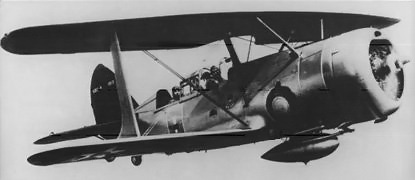
Curtiss BF2C Goshawks (US Navy Photo)

Friends Of Padre Steve’s World,

I have decided to occasionally write about aircraft again and I begin with an ancient article from deep in my vault about U. S. Navy Carrier Aircraft from the mid 1930s until 1941.

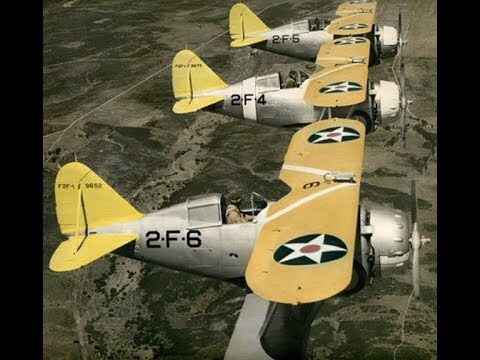
As the United States Navy built up its Carrier Force in the mid to late 1930s it continued to develop aircraft specifically designed to operate from aircraft carriers.  It continued its development of fighter, dive bomber and torpedo bomber aircraft.  In 1935 the Navy was operating the Grumman FF-1 biplane fighter which it had began using in 1933 and the Curtiss F11C and BF2C Goshawk. The Curtiss aircraft were built in fighter and bomber variants and while initial aircraft had an open cockpit and fixed landing gear later aircraft had an enclosed cockpit and retractable landing gear. They had top speed of 157 miles an hour and due to limited success and were retired from service by 1939.  The Goshawk was operated against the Japanese by Nationalist China and also served in a number of air forces including Thailand where they were used against the French and Japanese.

Grumman FF-1 (US Navy Photo)

The Grumman FF-1 was a two-seater that had a enclosed cockpit with retractable landing gear and a top speed of 201 miles an hour.  The FF-1 was faster than any naval aircraft of its era, a follow-on variant designated the SF-1 followed and 120 aircraft were built. Most of the operational aircraft served aboard the USS Lexington CV-2 in a fighter and scouting role. The FF-1 and SF-1 were withdrawn from first line service and placed with the reserve as well as being used in aviation training commands. The aircraft was manufactured under license by the Canadian Car and Foundry Company and served in the Canadian Air Force until 1942 as the Goblin and 40 of the Canadian aircraft were used by the Spanish Republican forces in the Spanish Civil War.

Grumman F2F-1 (US Navy Photo)

The FF-1/SF-1 was followed by the Grumman F2F a single-seat model with improved speed and maneuverability over is predecessors.  54 F2F’s were ordered in 1934 with the production models being delivered between April and August 1935.  The aircraft were armed with 2 .30 machine guns mounted above the cowl and had a top speed of 231 miles an hour and maximum range of 985 miles.  The aircraft would remain in service until they were replaced in 1939 with the Grumman F3F. However they remained in service as utility and training aircraft until retired from service toward the end of 1940.

Grumman F3F (US Navy Photo )

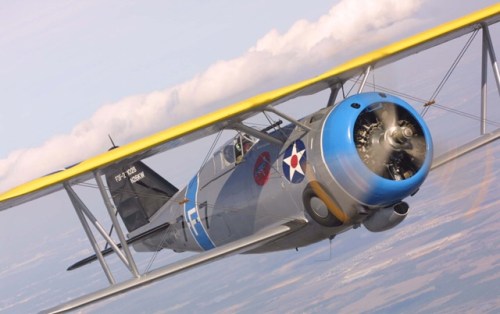
The Grumman F3F followed the F2F with 157 production models. It was more aerodynamic and had a more powerful engine that the F2F which enabled it to achieve a top speed of 264 miles an hour.  It was operated by seven Navy and Marine Corps Squadrons and entered service in 1936 and would serve aboard carriers until replaced in late 1941. It continued with 117 aircraft being stationed at naval air stations and used for training until 1943.

F2A Brewster Buffalo (U.S. Navy Photo)

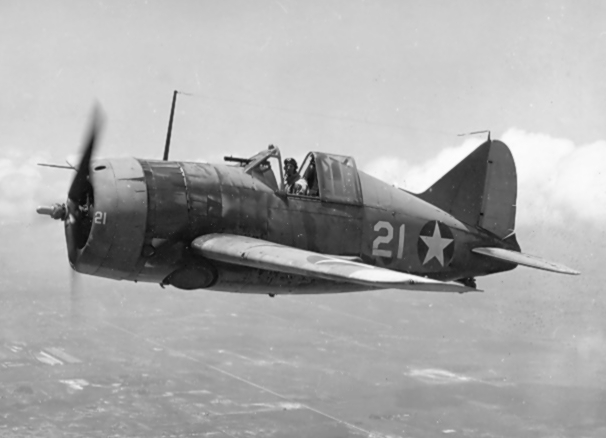
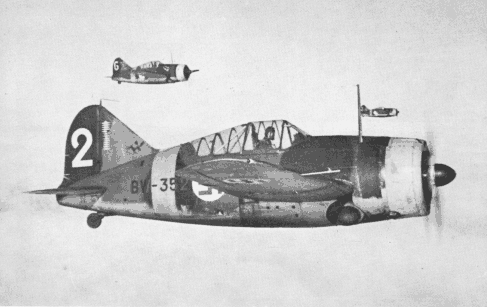
The first monoplane fighter developed and placed in service by the Navy was the F2A Brewster Buffalo. The Buffalo served with Navy and Marine Corps squadrons and was purchased by Great Britain for service in the Royal Australian and Royal New Zealand Air Forces which received 202 Buffalos. They would also serve with the Royal Navy. The Royal Netherlands Air Force received 144 most of which served in the East Indies. The final nation to receive the Buffalo was Finland which received 44 aircraft.  Buffalo was underpowered and the addition of armor and added fuel capacity further diminished the speed and performance of the aircraft.  The Navy placed its Buffaloes in advanced training squadrons in early 1942 and one of the two Marine Corps squadrons (VMF-221) operated it at the Battle of Midway where they endured fearful losses at the hands of Japanese Zero fighters.

Brewster Buffalo 239s of the Finnish Air Force

Despite the lack of success in U. S. service the Buffalo performed in a heroic manner for the Finns destroying over 500 Soviet and German aircraft and producing 36 Buffalo Aces.  The highest scorer was Captain Hans W. Wind with 39 of His 75 victories flying a Buffalo.  British Commonwealth and Dutch aircraft did not fare as well during the campaign in the Dutch East Indies as the Finns, as the tropical climate degraded the aircraft considerably and they were flying against far better trained Japanese Navy pilots.

Martin T4M over Lexington or Saratoga (US Navy Photo)

The Navy also developed aircraft for bombing missions as well as that could launch aerial torpedoes. The first aircraft built were dual purpose in that they could be used in level bombing and torpedo missions. In 1935 the primary aircraft of this type was the Martin T4M which had entered service in 1928 and replaced the Douglas DT and Martin T4M aircraft.  The T4M was a biplane with a crew of three that had a maximum speed of 114 miles an hour (I have driven much fast than this on the German Autobahn but I digress) and it could carry a torpedo or bombs.  155 were purchased by the Navy and the Marine Corps between 1928 and 1931.  They were operated from the Lexington and Saratoga until 1938 as no replacement aircraft offered enough improvements for the Navy to purchase and were instrumental in the development and demonstration of the capabilities of naval air power.  They were finally replaced by the Douglas TBD Devastator.

TBD Devastator (US Navy Photo)

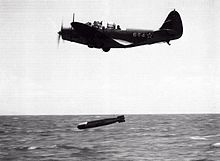
The TBD which first flew in 1935 entered service in 1937 and at the time was possibly the most modern naval aircraft in the world and was a revolutionary aircraft. It was the first monoplane widely used on carriers and was first all-metal naval aircraft.  It was the first naval aircraft with a totally enclosed cockpit, the first with hydraulic powered folding wings.  The TBD had crew of three and had a maximum speed of 206 miles an hour and carried a torpedo or up to 1500 pounds of bombs (3 x 500) or a 1000 pound bomb.  129 were built and served in all pre-war torpedo bombing squadrons based aboard the Lexington, Saratoga, Ranger, Yorktown, Enterpriseand Hornet with a limited number embarked aboard Wasp.  The Devastator saw extensive service prior to the war which pushed many airframes to the end of their useful service life and by 1940 only about 100 were operational. 

TBD from Torpedo 6 dropping Mk XIII during exercise October 1941

They were still in service in 1942 as their replacement the TBF Avenger was not ready for service.  They performed adequately against minor opposition at Coral Sea and in strikes against the Marshalls but the three squadrons which were embarked on the Yorktown (VT3), Enterprise (VT-6) and Hornet (VT-8) were annihilated at Midway. Of the 41 attacking aircraft, only 6 survived the uncoordinated attacks against the Japanese Carrier Strike Force.  They were too slow, had poor maneuverability, insufficient armor and defensive armament.  Only a few were able to launch their torpedoes as the Japanese Combat Air Patrol tore through them. Their sacrifice was not in vain as the Dive Bombers arrived facing no opposition and sank three of the four Japanese carriers getting the fourth later in the day. After Midway the remaining aircraft were withdrawn from active service in the Pacific. The Ranger’s VT-4 operated them until September 1942 and Wasp’s VT-7 operated them in the Atlantic until she was transferred to the Pacific in July 1942.  By 1944 all remaining aircraft had been scrapped.

Vought SBU Corsair

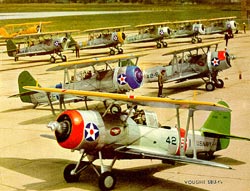
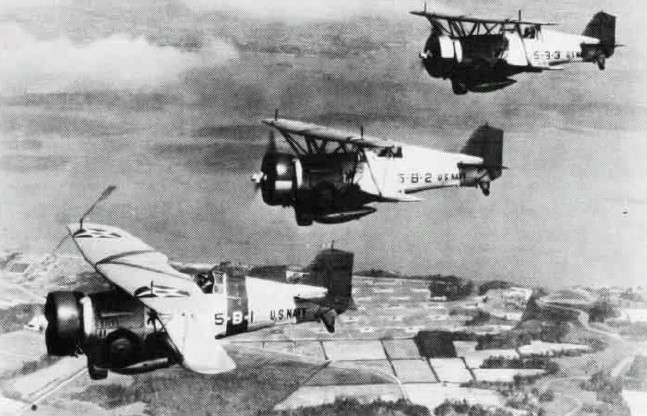
In the mid 1930s the Navy began to develop Scout and Dive Bombers for use in carrier scouting (VS) and bombing (VT) squadrons.  The first of these aircraft types were biplanes.  The Grumman SF-1 was used in a scouting and bombing role and was joined by the Vought SBU Corsair in 1935 and by 1937 both were being replaced by the Curtiss SBC Helldiver, a biplane with a 234 mile an hour maximum speed, retractable landing gear, enclosed cockpit which could carry a 1000 bomb.

Curtis SBC Helldiver

However the era of the biplane was drawing to a close and the Helldiver would be relegated to training squadrons based in Florida.  Although they had a brief service career they were instrumental in develop dive bombing tactics at which the U.S. Navy Pilots excelled. These tactics were copied by the German Luftwaffe operating the Junkers JU-87 Stuka and the Japanese with their Aichi 99 Val naval dive bomber.  50 aircraft were transferred to the French and served aboard the carrier Bearn but due to the French surrender in June of 1940 saw no action and spent the war rotting in Martinique.

Vought SB2U Vindicator flying ASW Patrol Of Atlantic Convoy, November 1941

The Helldiver’s were joined by the first monoplane dive bomber in U.S. service the Vought SBU2 Vindicator in 1937. The Vindicator was used by the Navy and the Marine Corps serving aboard the Lexington, Saratoga, Ranger and Wasp. They would remain in service until September 1942. The Marine aircraft equipped two squadrons VMSB 131 and VMSB-241, VMSB 241 suffered heavy casualties at Midway as the aircraft were underpowered and were limited to glide bombing missions.  After they were taken out of the operational squadrons the Vindicator served as a training aircraft until retired in 1945.   A French Naval Air Squadron was equipped with the Vindicator but they served ashore against the German invasion.  Most were lost to enemy action.  The Douglas SBD Dauntless was introduced in 1940 and 1941 but I will cover that aircraft in the World War II aircraft article that will follow this in a week or two.

These aircraft helped pave the way to aircraft that would be the mainstays of the Navy in the Second World War, aircraft with names such as Dauntless, Helldiver, Avenger, Hellcat and Corsair.  Naval aviation earned its “wings of gold” in these early years wings that continue to shine in the 21st Century.

Peace

Padre Steve+

2 Comments

Filed under aircraft, History, Loose thoughts and musings, Military, US Navy

Jerry Falwell Jr. and the Christian Nationalist Church Of Trump

President Trump and Jerry Falwell Jr.

Friends of Padre Steve’s World,

Atticus Finch, the hero of the book and film To Kill a Mockingbird said: 

“Sometimes the Bible in the hand of one man is worse than a whisky bottle in the hand of (another)… There are just some kind of men who – who’re so busy worrying about the next world they’ve never learned to live in this one, and you can look down the street and see the results.”

I think that most people like to believe that religion is a benign or positive influence in the world. As much as I want to believe the positive aspects I have to admit based on the historical and sociological evidence that this is not so, especially during unsettled times of great change.

We live in such an era and when it comes to identity, God is the ultimate trump card, or in the case of Jerry Falwell Jr., Donald Trump is the ultimate God card. Falwell exemplifies the ideal of Christian Nationalism in his idolatrous and uncritical support of the President.

When asked the question Is there anything President Trump could do that would endanger that support from you or other evangelical leaders? during an interview with the Washington Post, Falwell said: No.

The interviewer who had listened to a number of long winded and theologically unbelievable answers in which he attempted to tie his uncritical support of the President by linking it to Martin Luther’s teaching of the “Two Kingdoms” then noted, That’s the shortest answer we’ve had so far, to which Falwell using perfect circular logic responded:

Only because I know that he only wants what’s best for this country, and I know anything he does, it may not be ideologically “conservative,” but it’s going to be what’s best for this country, and I can’t imagine him doing anything that’s not good for the country.

Truthfully whenI saw and then read the interview which you can see here:

https://www.washingtonpost.com/lifestyle/magazine/jerry-falwell-jr-cant-imagine-trump-doing-anything-thats-not-good-for-the-country/2018/12/21/6affc4c4-f19e-11e8-80d0-f7e1948d55f4_story.html?noredirect=on&utm_term=.8fd8a874afb5

Falwell’s arguments are very similar to Reichsbishof Müller and the Nazi supported German Christians, or Otto Dibelius, who before he became an anti-Nazi and General Superintendent of the Confessional Lutherans claimed:

“We have learned from Martin Luther that the Church cannot get in the way of State power when it does what it is called to do. Not even when [the state] becomes hard and ruthless…. When the state carries out its office against those who destroy the foundations of state order, above all against those who destroy honor with vituperative and cruel words that scorn faith and vilify death for the Fatherland, then [the state] is ruling in God’s name!”

Robert Jeffress, the Pastor of the mammoth First Baptist Church Of Dallas, Texas, is another who seems like Falwell Jr. for the Office of Reichsbishof of Trump’s MAGA State, said:

“You know, I was debating an evangelical professor on NPR, and this professor said, ‘Pastor, don’t you want a candidate who embodies the teaching of Jesus and would govern this country according to the principles found in the Sermon on the Mount?’” Jeffress said. “I said, ‘Heck no.’ I would run from that candidate as far as possible, because the Sermon on the Mount was not given as a governing principle for this nation.”

I wonder what some of Jeffress’s predecessors in that storied pulpit would think of his and Falwell’s unlimited support and blessing of the lawless President would say. Actually I don’t wonder a bit, I know what they would say. George Truett Who pastored First Dallas and served as the President of Southwestern Baptist Theological Seminary wrote:

“Constantine, the Emperor, saw something in the religion of Christ’s people which awakened his interest, and now we see him uniting religion to the state and marching up the marble steps of the Emperor’s palace, with the church robed in purple. Thus and there was begun the most baneful misalliance that ever fettered and cursed a suffering world…. When … Constantine crowned the union of church and state, the church was stamped with the spirit of the Caesars…. The long blighting record of the medieval ages is simply the working out of that idea.”

So, if one wonders why the most fanatical individuals and groups on earth are tied to religions, it is because they honestly believe that they are acting in the Name Of God. Sadly,mit is the theology of Falwell and others like him that leads to genocide. In that as Pact, Christian history is often little different from the bloodthirsty if the non State actors of Islamic State: Al Qaeda, Boko Haram, or Hezbollah, although it is much closer to the State sponsored acts of the Christian Crusaders, the Ottoman Turks, and the Catholic versus Protestant wars of the Reformation. Likewise, some Ultra-Orthodox Orthodox Jews, radical Hindus, and Buddhists Of course all of these groups have different goals, and some are less violent than the others, but their overall thoughts and philosophy are quite similar: they desire to impose their religious authority on others using the means of the state or if they cannot gain control of government, through terror.

Robert Heinlein wrote:

“Almost any sect, cult, or religion will legislate its creed into law if it acquires the political power to do so.”

Heinlein, the author of the classic Starship Troopers was absolutely correct. Just look at any place in any time where any religion, sect or cult has gained control of a government. They are not loving, they are not forgiving and they use the police power of the state to persecute any individual or group that is judged to be in error, or even worse has the gall to question their authority. Samuel Huntington wrote in his book The Clash of Civilizations:

“Whatever universalist goals they may have, religions give people identity by positing a basic distinction between believers and non-believers, between a superior in-group and a different and inferior out-group.”

That distinction is on display all over the world and in our own country when conservative Christians write laws that allow them the right to discriminate against other people based solely on their religious beliefs and to secure themselves the preeminent position in society. Gary North, one of the most eloquent expositors of the Christian Dominionist movement and a long time adviser to Ron and Rand Paul and other conservative Christian politicians wrote:

“The long-term goal of Christians in politics should be to gain exclusive control over the franchise. Those who refuse to submit publicly to the eternal sanctions of God by submitting to His Church’s public marks of the covenant–baptism and holy communion–must be denied citizenship, just as they were in ancient Israel.”

Huntington was right, you see the true believers, those who follow their religion without question and believe that it is superior to all others also believe that their religion entitles them to be atop the food chain, others who don’t believe like them be damned both in this life and the next. That is the certitude of the true believer, especially the religious one. Secular or atheistic fanatics could care less about the next life, for this life is all that they have. But the religious “true believers” are not only interested in destroying someone in this life, but ensuring that in the next that they suffer for eternity, unless they believe in the annihilation of the soul after death, which really spoils the whole Dante’s Inferno perspective of the damned in the afterlife.

The great American philosopher, Eric Hoffer wrote:

“The impression somehow prevails that the true believer, particularly the religious individual, is a humble person. The truth is the surrendering and humbling of the self breed pride and arrogance. The true believer is apt to see himself as one of the chosen, the salt of the earth, the light of the world, a prince disguised in meekness, who is destined to inherit the earth and the kingdom of heaven too. He who is not of his faith is evil; he who will not listen will perish.”

That is why they, the religious true believers of any faith, men like Jerry Falwell Jr., are capable of such great evil, and why such people can bless the murder innocents in the most brutal manner simply because they do not believe correctly.

Under President Trump, conservative American Christians are getting their chance to do their worst, and will only get more militant and violent as the walls close in around the President and they form the last protective barrier around him, like a Praetorian Guard, unless they are fought at every turn. As Falwell and others including Robert Jeffress, Franklin Graham, and hundreds of other conservative Christians leaders rally around him, Trump, knowing that their worship,is directed toward him will cleave to them ever more faithfully.

Based on the unwavering and increasing loyalty of men like Falwell, Jeffress, and their followers, Trump was right about his supporters when he claimed in 2015:

“You know what else they say about my people? The polls, they say I have the most loyal people. Did you ever see that? Where I could stand in the middle of Fifth Avenue and shoot somebody and I wouldn’t lose any voters, okay? It’s like incredible.” 

It is incredible, and dangerous.

So until tomorrow,

Peace

Padre Steve

15 Comments

Filed under christian life, ethics, faith, History, Loose thoughts and musings, nazi germany, News and current events, Political Commentary

Padre Steve: Your Not for Profit Prophet

Friends of Padre Steve’s World,

I neither claim to be a prophet nor the son of the prophet, but I do have a pretty good sense about the future, not because I am in any sense a seer, but because I am a historian and student of how people of any age deal with turbulent times.

On March 14th 2016 I wrote:

“I am afraid. Over the past few weeks violence has become commonplace at the campaign rallies of Donald Trump. In the past week a reporter from the Breitbart News service, an organization that is solidly behind Trump was assaulted by Trump’s campaign manager, and Breitbart threw her under the bus for him. Protesters have been assaulted, reporters threatened, Trump not only condones the actions, he encourages them, threatening to use the law and courts to ruin people’s lives, and offering to pay the legal bills of his supporters who have been charged with crimes. He labels any opponents as “bad people” who need to be punished. The ultimate cruelty is that though he is the one inciting the violence, he and his supporters blame that violence on the victims, be they Democrats or Republicans, protestors or media, pundits, politicians or preachers. He is creating a frenzy among his most violent supporters that demands victims to satiate their new found bloodlust…

If he succeeds in his takeover bid, it will forever change American politics, especially if he is able to ride the fear, and to the White House. I don’t think the latter will happen, but I would not exclude it from the realm of the possible…”

On May 4th 2016 I wrote:

“What this signals for the GOP is yet to be determined, but like many others I beleive that it signals the end of the GOP as we have known it. The party leadership may attempt to unify behind him and to control him, but it will be an uncomfortable alliance, and one which Trump holds the winning cards. The GOP is broken, it ignored the advice of those who wrote the post-mortem of the 2012 defeat of Mitt Romney, and now they have been “Trumped” so to speak. Trump’s negatives are such that even if he wins the general election, which based on current polls that pit him against either Clinton or Sanders show him losing hardly, the GOP may well lose the Senate, and many seats in the House. The fact is that Trump does not give a damn what Reince Priebus and GOP leadership think, he will do what he needs to win and if he does win, he will take the credit and do as he pleases. Some influential members the GOP conservative media base are already saying that in spite of the collapse that they will not support Trump. 

At first the GOP dismissed Trump. Then they tried to marginalize him, then when it was too late attempted to stop him. At every turn Trump outmaneuver end them, appealed to the anger and frustration of GOP voters, harnessed that energy, and “Trumped” the GOP leadership at every turn. It was quite fascinating to watch, and if I wasn’t a historian and well aware of the kinds of emotions Trump is playing to I would laugh it off. 

But as I have said since November, Trump cannot be underestimated, and if the Democratic nominee and party underestimate him, they too may end up being Trumped. So if there are Democrats or progressive out there feeling a sense of satisfactory schadenfreude in this, don’t celebrate too soon.

On July 20th 2016 I wrote on this site:

“Once ensconced in power Trump will use his executive powers in ways never imagined by the Founders. He has no respect for the separation of powers and will ignore the Constitution, Congress, and the Courts anytime that he desires, and sadly, if he has a Republican majority in Congress, he will get all that desires. Like the Nazi dominated Reichstag, Congress will become nothing more than a rubber stamp for Trump’s edicts. Those conservatives who thought they would be able to restrain Trump will, like the German conservatives of the 1930s will be disappointed. Those who don’t support him will be purged.

I could go on, but since all of these comments were posted before anyone, including me thought that Trump would actually be elected, I think that I was pretty spot on. Truthfully, I would have rather been wrong about all of this. However, when I look back I have been pretty accurate.

Since I am retiring from the military in the next six months please tell MSNBC, PBS, CNN, the Washington Post, the New York Times or any other news organization that might need a pretty sharp talking head that I am available.

Until tomorrow,

Peace,

Padre Steve+

2 Comments

Filed under News and current events, Political Commentary

The Emancipation Proclamation: The Antidote to the Cornerstone

Friends of Padre Steve’s World

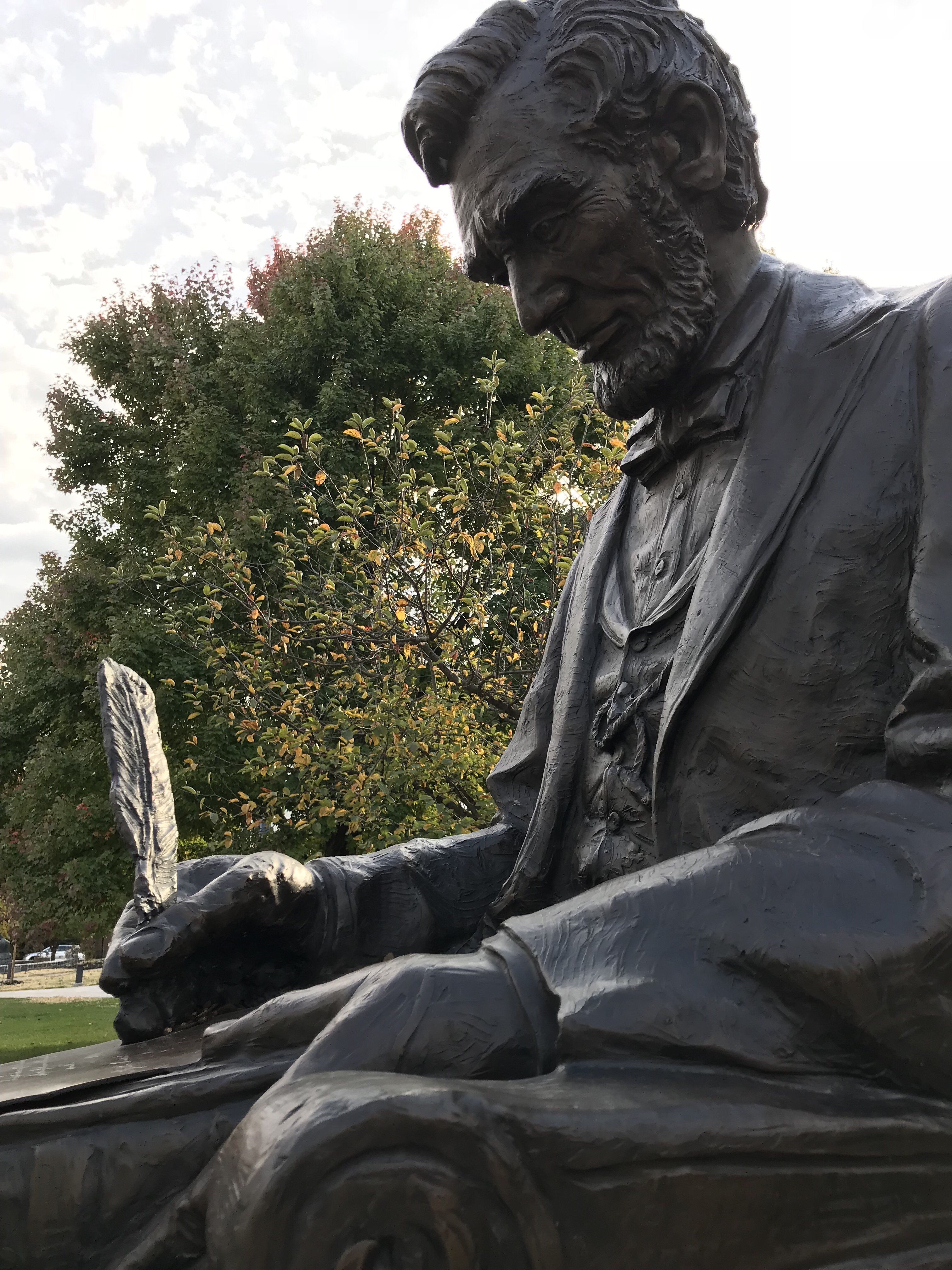
Yesterday was the 156th anniversary of the Emancipation Proclamation. The proclamation made by Abraham Lincoln when the outcome of the rebellion of the Southern slave states against the Union was still up in the air was a watershed for civil rights in the United States. Though it was a military order that only affected slaves in the rebellious states, it also set the stage for the 13th, 14th, and 15th Amendments and other legal rulings that affected not only African Americans and former slaves, but also Native Americans, Women, other racial minorities and LGBTQ people. It is something that in our era when so many civil rights are under threat that we must remember and continue to fight for in the coming years. Freedom is never free.

This article is a part of my hopefully soon to be published book “Mine Eyes Have Seen the Glory!” Race, Religion, Ideology, and Politics in the civil War Era. 

Peace

Padre Steve+

From the beginning of the war many Northerners, especially abolitionists and radical Republicans believed that “as the “cornerstone” of the confederacy (the oft-cited description by the South’s vice-president, Alexander H. Stephens) slavery must become a military target.” [1]When some Union generals made their own attempts at issuing emancipation orders, Lincoln countermanded them for exceeding their authority. Lincoln resisted the early calls of the abolitionists to make that a primary war goal for very practical reasons, he had to first ensure that the Border Slave States did not secede, something that would have certainly ensured that the Union would not survived. As a result in the first year of the war, Lincoln “maneuvered to hold Border South neutrals in the Union and to lure Union supporters from the Confederacy’s Middle South white belts. He succeeded on both scores. His double success with southern whites gave the Union greater manpower, a stronger economy, and a larger domain. These slave state resources boosted free labor states’ capacity to should the Union’s heavier Civil War burden.” [2] His success in doing this was instrumental in enabling him to turn to emancipation in 1862.

Finally, some twenty months after Fort Sumter fell and after nearly two years of unrelenting slaughter culminating in the bloody battle of Antietam, Abraham Lincoln published the Emancipation Proclamation. Emancipation was a tricky legal issue for Lincoln as “an executive order of emancipation would be beyond the powers of the president, but not, Lincoln concluded, if such an order were issued as furtherance of the executive’s war powers.” [3] Lincoln had desired to issue the order during the summer and sounded out elected officials and soldiers as to his plan.

Lincoln discussed his views with General George McClellan during a visit to the latter’s headquarters. McClellan stated his strident opposition to them in writing. McClellan did not admire slavery but he despised abolitionists and he wrote one of his political backers “Help me to dodge the nigger – we want nothing to do with him. I am fighting for the Union…. To gain that end we cannot afford to mix up the negro question.”  [4]

Lincoln then called border state Congressmen to sound them out on the subject on July 12th 1862 only to be met with opposition. Such opposition caused Lincoln “to give up trying to conciliate conservatives. From then on the president tilted toward the radical position, though this would not become publicly apparent for more than two months.” [5]

Lincoln’s cabinet met to discuss the proclamation on July 22nd 1862 and after some debate decided that it should be issued, although it was opposed by Postmaster General Montgomery Blair who believed that “the Democrats would capitalize on the unpopularity of such a measure in the border states and parts of the North to gain control of the House in the fall elections.” [6] Wisely, Lincoln heeded the advice of Secretary of State Seward to delay the announcement until military victories ensured that people did not see it as a measure of desperation. Seward noted: “I approve of the proclamation, but I question the expediency of its issue at this juncture. The depression of the public mind, consequent on our repeated reverses, is so great I fear…it may be viewed as the last measure of an exhausted government, a cry for help…our last shriek on the retreat.” Seward suggested that Lincoln wait “until the eagle of victory takes his flight,” and buoyed by military success, “hang your proclamation about his neck.” [7]

After the Battle of Antietam, President Lincoln issued the Preliminary Emancipation Proclamation. This document served as a warning to the leaders of the South, and insisted that there was much more at stake in their rebellion unless they surrendered; their slaves, the very “property” for which the seceded. The document “warned that unless the South laid down its arms by the end of 1862, he would emancipate the slaves.” [8] This was something that they could not and would not do, even as their cities burned and Confederacy collapsed around them in 1864.

The proclamation was a military order in which Lincoln ordered the emancipation of slaves located in the Rebel states and areas of those states occupied by Union troops. It was not designed to change law, which would have to wait until Lincoln felt he could have Congress amend the Constitution.  Instead of law it was “the doctrine of military necessity justified Lincoln’s action.” [9] The concept emanated from Boston lawyer William Whiting who argued “the laws of war “give the President full belligerent rights” as commander and chief to seize enemy property (in this case slaves) being used to wage war against the United States.” [10] There was a legitimate military necessity in the action as Confederate armies used slaves as teamsters, laborers, cooks, and other non-combatant roles to free up white soldiers for combat duty, and because slaves were an important part of the Southern war economy which could not function without them. The proclamation gave inspiration to many slaves throughout the South to desert to the Union cause or to labor less efficiently for their Confederate masters. A South Carolina planter wrote in 1865:

“the conduct of the Negro in the late crisis of our affairs has convinced me that we were all laboring under a delusion….I believed that these people were content, happy, and attached to their masters, But events and reflection have caused me to change these positions….If they were content, happy and attached to their masters, why did they desert him in the moment of need and flocked to the enemy, whom they did not know….” [11]

The proclamation authorized that freed blacks be recruited into the Federal army and it ensured that freed slaves would not again be surrendered back into slavery. As Montgomery Blair had warned Lincoln and the Republicans suffered sharp electoral reverses as “Democrats made opposition to emancipation the centerpiece of their campaign, warning that the North would be “Africanized” – inundated by freed slaves competing for jobs and seeking to marry white women.”  [12]

Lincoln’s response was to continue on despite the opposition and issue the Proclamation in spite of electoral reverses and political resistance. The vehemence of some Northern Democrats came close to matching that of white Southerners. The “white Southerner’s view of Lincoln as a despot, hell-bent on achieving some unnatural vision of “equality,” was shared by Northern Democrats, some of whom thought the president was now possessed by a “religious fanaticism.” [13] But Lincoln was not deterred and he understood “that he was sending the war and the country down a very different road than people thought they would go.” [14] He noted in December 1862:

“Fellow citizens, we cannot escape history….This fiery trial through which we pass, will light us down, in honor or dishonor, to the latest generation….In giving freedom to the slave, we assure freedom to the free – honorable alike in what we give, and what we preserve.”[15]

For Lincoln the Emancipation Proclamation was something that he believed was something that he had to do, and he believed that it would be the one thing that he did in life that would be remembered. He had long been convicted of the need for it, but timing mattered, even six months before it might have created a political backlash in the North which would have fractured support for the war effort, and in this case timing and how he made the proclamation mattered.

The Emancipation Proclamation had military, domestic political, and diplomatic implications, as well as moral implications for the conduct of the war.

The military implication would take some time to achieve but were twofold. First, Lincoln hoped that the Emancipation Proclamation would encourage former slaves, as well as already free blacks in the North to join the Union cause and enlist to serve in the Federal Army. The act would vest African Americans in the Union’s cause as little else could, and at the same time begin to choke-off the agricultural labor force that provided the backbone of the Confederate economy. Frederick Douglass eloquently made the case for African Americans to serve in July 1863, telling a crowd in Philadelphia, “Do not flatter yourself, my friends, that you are more important to the Government than the Government is to you. You stand but as a plank to the ship. This rebellion can be put down without your help. Slavery can be abolished by white men: but Liberty so won for the black man, while it may leave him an object of pity, can never make him an object of respect…. Young men of Philadelphia, you are without excuse. The hour has arrived, and your place is in the Union army. Remember that the musket – the United States musket with its bayonet of steel – is better than all the parchment guarantees of Liberty. In you hands the musket means Liberty…” [16] By the end of the war over 180,000 African American men would serve as volunteers in the United States Army.

Politically the proclamation would the diplomatic purpose by isolating the Confederacy from European assistance. This it did, after the proclamation public sentiment, especially among Europe’s working classes turned solidly against the Confederacy. Domestically it would break-ground for the Thirteenth Amendment, which Lincoln, the pragmatic lawyer was needed to actually abolish slavery. Morally, it  would serve as the guarantee of The United States Government’s public, irrevocable pledge of freedom to African Americans if the North won the war.

Lincoln signed the order on January 1st 1863. As he got ready to sign the document he paused and put down the pen, speaking to Seward he said “I never, in my life, felt more certain that I was doing right, than I do now in signing this paper….If my name ever goes down in history it will be for signing this act, and my whole soul is in it.” [17] The opening paragraph read:

“That on the first day of January, in the year of our Lord one thousand eight hundred and sixty-three, all persons held as slaves within any State or designated part of a State, the people whereof shall then be in rebellion against the United States, shall be then, thenceforward, and forever free; and the Executive Government of the United States, including the military and naval authority thereof, will recognize and maintain the freedom of such persons, and will do no act or acts to repress such persons, or any of them, in any efforts they may make for their actual freedom.” [18]

At the ends of the proclamation he added the words suggested by his devoutly Christian Secretary of the Treasury Salmon Chase: “And upon this act, sincerely believed to be an act of justice, warranted by the Constitution, upon military necessity, I invoke the considerate judgment of mankind, and the gracious favor of Almighty God.” [19]

The response throughout the North was euphoric as celebrations took place throughout the North. In some cities one hundred gun salutes were fired. At Boston’s Tremont Temple people broke out singing a hymn “Sound the loud timbrel o’er Egypt’s dark sea, Jehovah hath triumphed, his people are free.” [20] The Boston Daily Evening Telegraph predicted, “Slavery from this hour ceases to be a political power in this country…such a righteous revolution as it inaugurates never goes backward.” [21]

Frederick Douglass wrote about his reactions to the Emancipation proclamation as he had nearly despaired wondering if the Lincoln administration would actually take up the fight for emancipation:

“The fourth of July was great, but the first of January, when we consider it in all of its relations and bearings in incomparably greater. The one we respect to the mere political birth to a nation, the last concerns national life and character, and is to determine whether that life and character shall be radiantly and glorious with all high and noble virtues, or infamously blackened, forevermore, with all the hell-darkened crimes and horrors which we attach to Slavery.” [22]

The proclamation was not all some had hoped for and it was certainly provoked a negative response in the South and among many Northern Democrats. Southerners accused Lincoln of inciting racial warfare and Jefferson Davis responded “The day is not so distant when the old Union will be restored with slavery nationally declared to be the proper condition of all of African descent.” [23]

But the proclamation did something that politicians, lawyers did not comprehend, that “the details of the emancipation decree were less significant than the fact that there was an emancipation decree, and while the proclamation read like a dull legal brief, filled with qualifying clauses and exceptions, it was not language made for this, finally, a moral document. It was its existence, its title, its arrival into this world, its challenge to the accepted order, and from that there was no turning back. In this sense it was a revolutionary statement, like the Declaration itself, and nearly as significant.” [24]That the proclamation most certainly was and it was a watershed from which there was no stepping back. “It irrevocably committed the government of the United States to the termination of slavery. It was an act of political courage, take at the right time, in the right way.” [25]

However, it would take another two years, with the Confederacy crumbling under the combined Federal military onslaught before Lincoln was able to secure passage of the Thirteenth Amendment to the Constitution in January 1865.  The amendment abolished slavery and involuntary servitude throughout the country, as well as nullified the fugitive slave clause and the Three-Fifths Compromise. It would be followed after Lincoln’s death by the Fourteenth Amendment which reversed the result of the Dred Scott decision and declared that all people born in the United States were citizens and entitled to the rights of citizenship. During the Grant administration the Fifteenth Amendment was passed, and this finally extended to African American men, the right to vote in every state.

Though limited in scope, the Emancipation Proclamation had more than a domestic military, social and political effect. It also had an effect on foreign policy which ensured that Britain, and thereby France would not intervene in the war on behalf of the Southern Confederacy. It stopped all British support for the Rebels to include seizing warships that had been contracted for by Confederate agents that were building or being fitted out in British Yards. Likewise the British rejected various proposals of Emperor Napoleon III to intervene in the war in late 1862 and during the summer of 1863.

Effects of the Emancipation Proclamation on Military Law

The Emancipation Proclamation and the elimination of slavery also impacted the Union war effort in terms of law, law that eventually had an impact around the world as nations began to adapt to the changing character of war. It was important because for the first time slavery was accounted for in the laws of war. The “Instructions for the Government of Armies of the United States in the Field, General Orders No. 100 by President Lincoln, April 24, 1863; Prepared by Francis Lieber, LLD noted in Article 42 of that Code:

“Slavery, complicating and confounding the ideas of property, (that is of a thing,) and of personality, (that is of humanity,) exists according to municipal or local law only. The law of nature and nations has never acknowledged it. The digest of the Roman law enacts the early dictum of the pagan jurist, that “so far as the law of nature is concerned, all men are equal.” Fugitives escaping from a country in which they were slaves, villains, or serfs, into another country, have, for centuries past, been held free and acknowledged free by judicial decisions of European countries, even though the municipal law of the country in which the slave had taken refuge acknowledged slavery within its own dominions.” [26]

It continued in Article 43:

“Therefore, in a war between the United States and a belligerent which admits of slavery, if a person held in bondage by that belligerent be captured by or come as a fugitive under the protection of the military forces of the United States, such person is immediately entitled to the rights and privileges of a freeman To return such person into slavery would amount to enslaving a free person, and neither the United States nor any officer under their authority can enslave any human being. Moreover, a person so made free by the law of war is under the shield of the law of nations, and the former owner or State can have, by the law of postliminy, no belligerent lien or claim of service.” [27]

The Continued Fight for Emancipation: Dealing with the Copperheads and the Passage of the Thirteenth Amendment

But there were still legitimate concerns that slavery might survive as the war continued. Lincoln knew that in issuing the Emancipation Proclamation raised the stakes of the war far higher than they had been. He noted, “We shall nobly save, or meanly lose, the last best hope on earth.” [28] The threat of the destruction of the Union and the continuance of slavery in either the states of the Confederacy, the new western states, territories, or the maintenance of the Union without emancipation was too great for some; notably, the American Freedmen’s Commission to contemplate. With Grant’s army stalled outside Richmond the Copperheads and the peace party gained influence and threatened to bring about a peace that allowed Confederate independence and the continuance of slavery; members of that caucus they Edwin Stanton in the spring of 1864:

“In such a state of feeling, under such a state of things, can we doubt the inevitable results? Shall we escape border raids after fleeing fugitives? No man will expect it. Are we to suffer these? We are disgraced! Are we to repel them? It is a renewal of hostilities!…In the case of a foreign war…can we suppose that they will refrain from seeking their own advantage by an alliance with the enemy?”[29]

The effort of the Copperheads and the peace party to was soon crushed under the military successes of William Tecumseh Sherman’s armies in Georgia. This was especially true of the capture of Atlanta, which was followed by Sherman’s march to the sea and the Carolinas. Additionally the naval victory of David Farragut’s fleet at the Battle of Mobile Bay served to break the stranglehold that the Copperheads were beginning to wield in Northern politics.  These efforts helped secure Lincoln’s reelection by a large margin in the 1864 presidential election over a divided Democratic opposition, whose presidential nominee McClellan could not even endorse his party’s platform.

In his Second Inaugural Address, Abraham Lincoln discussed the issue of slavery as the chief cause of the war. In it, Lincoln noted that slavery was the chief cause of the war in no uncertain terms and talked in a language of faith that was difficult for many, especially Christians, who “believed weighty political issues could be parsed into good or evil. Lincoln’s words offered a complexity that many found difficult to accept,” for the war had devastated the playground of evangelical politics, and it had “thrashed the certitude of evangelical Protestantism” [30] as much as the First World War shattered Classic European Protestant Liberalism.  Lincoln’s confrontation of the role that people of faith brought to the war in both the North and the South is both illuminating and a devastating critique of the religious attitudes that so stoked the fires of hatred.  His realism in confronting facts was masterful, and badly needed.  He spoke of “American slavery” as a single offense ascribed to the whole nation.” [31]

“One-eighth of the whole population were colored slaves, not distributed generally over the Union, but localized in the southern part of it. These slaves constituted a peculiar and powerful interest. All knew that this interest was somehow the cause of the war. To strengthen, perpetuate, and extend this interest was the object for which the insurgents would rend the Union even by war, while the Government claimed no right to do more than to restrict the territorial enlargement of it. Neither party expected for the war the magnitude or the duration which it has already attained. Neither anticipated that the cause of the conflict might cease with or even before the conflict itself should cease. Each looked for an easier triumph, and a result less fundamental and astounding. Both read the same Bible and pray to the same God, and each invokes His aid against the other. It may seem strange that any men should dare to ask a just God’s assistance in wringing their bread from the sweat of other men’s faces, but let us judge not, that we be not judged. The prayers of both could not be answered. That of neither has been answered fully. The Almighty has His own purposes. “Woe unto the world because of offenses; for it must needs be that offenses come, but woe to that man by whom the offense cometh.” If we shall suppose that American slavery is one of those offenses which, in the providence of God, must needs come, but which, having continued through His appointed time, He now wills to remove, and that He gives to both North and South this terrible war as the woe due to those by whom the offense came, shall we discern therein any departure from those divine attributes which the believers in a living God always ascribe to Him? Fondly do we hope, fervently do we pray, that this mighty scourge of war may speedily pass away. Yet, if God wills that it continue until all the wealth piled by the bondsman’s two hundred and fifty years of unrequited toil shall be sunk, and until every drop of blood drawn with the lash shall be paid by another drawn with the sword, as was said three thousand years ago, so still it must be said “the judgments of the Lord are true and righteous altogether.” [32]

Notes 

[1] Ibid. Foner Forever Free: The Story of Emancipation and Reconstruction p.42

[2] Ibid. Freehling The South vs. The South p.47

[3] Brewster, Todd. Lincoln’s Gamble: The Tumultuous Six Months that Gave America the Emancipation Proclamation and Changed the Course of the Civil War Scribner a Division of Simon and Schuster, New York and London p.59

[4] Ibid. McPherson The Battle Cry of Freedom p.364

[5] Ibid. McPherson The Battle Cry of Freedom p.504

[6] McPherson, James M. Tried by War: Abraham Lincoln as Commander in Chief Penguin Books, New York and London 2008 p.109

[7] Ibid. Goodwin Team of Rivals p. 468

[8] Ibid. Foner Forever Free p.49

[9] McGovern, George Abraham Lincoln Times Books, Henry Holt and Company, New York 2009 p.70

[10] Ibid. McPherson Tried by War: p.108

[11] Ibid. Zinn The Other Civil War p.39

[12] Ibid. Foner Forever Free p.49

[13] Ibid. Brewster Lincoln’s Gamble p.169

[14] Ibid. Guelzo Fateful Lightning p.184

[15] Ibid. Foner Forever Free p.49

[16] Douglass, Frederick. Philadelphia Speech of July 6th 1863 recorded in the Liberator in The Civil War and Reconstruction: A Documentary Collection edited by William E. Gienapp, W.W. Norton and Company, New York and London 2001 p.221

[17] Ibid. Goodwin Team of Rivals p. 499

[18] Lincoln, Abraham The Emancipation Proclamation The National Archives & Records Administration retrieved from http://www.archives.gov/exhibits/featured_documents/emancipation_proclamation/transcript.html 14 June 2014

[19] Ibid. Lincoln The Emancipation Proclamation

[20] Ibid. Brewster Lincoln’s Gamble p.244

[21] Ibid. McPherson The Battle Cry of Freedom p.501

[22] Ibid. Guelzo Fateful Lightning pp. 180-181

[23] Ibid. Goldfield America Aflame p.263

[24] Ibid. Brewster Lincoln’s Gamble p.245

[25] Ibid. McGovern Abraham Lincoln p.78

[26] Reichberg, Gregory M, Syse Henrik, and Begby, Endre The Ethics of War: Classic and Contemporary Readings Blackwell Publishing Ltd, Malden, MA and Oxford UK 2006 p.570

[27] Ibid. Reichberg et al. The Ethics of War p.570

[28] Ibid. Goldfield America Aflame p.263

[29] Ibid. Guelzo Fateful Lightning p.534

[30] Ibid. Goldfield  America Aflame p.358

[31] Ibid. Wills Lincoln at Gettysburg p.186

[32] Lincoln, Abraham Second Inaugural Address March 4th 1865 retrieved from www.bartleby.com/124/pres32.html 24 March 2014

Leave a comment

Filed under civil rights, civil war, Gettysburg, History, laws and legislation, News and current events, Political Commentary

A New Year Resolution: Read, Read, and When You Can’t Read Anymore, Read Some More

Friends of Padre Steve’s World,

Welcome to 2019. I know, we’re all still a bit hung over from last night, but welcome to the New Year. Admittedly it doesn’t yet feel a lot different than 2018, but I really expect that 2019 will mark an epochal change in our history. Since I wrote about that yesterday I won’t go back for more.

That being said there is one resolution that I think that all people, the great and the small, should do, and that is not to cry boo who, but read like our lives depended on it, which in a sense they do. By reading, I don’t mean just the news, commentary, or opinion sections of print or online news services, but get real books, especially works of history, biography, philosophy, and the classics.

Barbara Tuchman wrote:

“Books are the carriers of civilization. Without books, history is silent, literature dumb, science crippled, thought and speculation at a standstill. Without books, the development of civilization would have been impossible. They are engines of change (as the poet said), windows on the world and lighthouses erected in the sea of time. They are companions, teachers, magicians, bankers of the treasures of the mind. Books are humanity in print.”

Likewise, the French philosopher Voltaire hit the nail on the head when he said:

“Despite the enormous quantity of books, how few people read! And if one reads profitably, one would realize how much stupid stuff the vulgar herd is content to swallow every day.”

That my friends is fact. If you want to be able to better distinguish fact from fake, read.

Last year I committed to read more, even as I stayed current on the news, analysis of it, and commentary, even as I continued to write. My office at work is crammed with books, as is much of our home. I think that we follow well the advice of Dr. Seuss who wrote:

“Fill your house with stacks of books, in all the crannies and all the nooks.”

So I read, and I read, until my eyes they turned red. I read with those eyes that had turned red, in bed and even in the head.

I read as I eat, and eat as I read, because somewhere in my soul I have this great need, which I ever did cede I would be a great deal poorer indeed.

The pages they turned and as my eyes burned I knew I could never be through so long as my fingers don’t turn blue. I read and read with voices sounding through my head I, but I will not stress even though I digress…

But really, I read a lot last year and will continue to do so in the coming year. I cannot remember who said it, but someone that oI respect recently said that we should all read at least thirty books a year. That comes out to a bit over half a book a week.

I write about reading rainbow quite frequently, so today after a little extra inspiration last night I decided to look back at what I actually read this year. Here is the list which includes printed books and those that I read on my Amazon Kindle reader in no particular order:

The War that Ended Peace by Margaret McMillan

Castles of Steel: Britain, Germany and the Winning of the Great War at Sea by Robert Massie

Das Reich: The March of the 2nd SS Panzer Division through France, June 1944 by Max Hastings

The Nightmare Years: 1930-1940 by William Shirer.

Silent Night: The Story Of the World War One Christmas Truce by Stanley Weintraub

The Guns Of August by Barbara Tuchman

The Proud Tower: A Portrait Of Europe Before the War, 1890-1914 by Barbara Tuchman

1913: The Year Before the Storm by Florian Illies

The Path to Genocide: Essays on Launching the Final Solution by Christopher Browning

The Nazis: A Warning from History by Laurence Rees

The Holocaust: A New History by Laurence Rees

Denying the Holocaust: The Growing Assault on Truth and Memory by Deborah Lipstadt

Stalingrad by Anthony Beevor

The Fall of Berlin 1945 by Anthony Beevor

Hitler by Joachim Fest

Where Ghosts Walked: Munich’s Road to the Third Reich by David Clay Large

The Trial Of the Germans by Eugene Davidson

Vietnam’s Forgotten Army: Heroism and Betrayal in the ARVN by Andrew Wiest

The Anatomy Of the Nuremberg Trials by Telford Taylor

Incredible Victory by Walter Lord

Telling Lies about Hitler: History, the Holocaust, and the Trial Of David Irving by Richard Evans

The Eichmann Trial by Deborah Lipstadt

A Bright and Shining Lie: John Paul Vann and America in Vietnam by Neil Sheehan

Street Without Joy: The French Debacle in Vietnam by Bernard Fall

After Tet: the Bloodiest Year in Vietnam by Ronald Spector

Waterloo: The Story Of Four Days, Three Armies, and Three Battles by Bernard Cornwell

Grant by Ron Chernow

Lies My Teacher Told Me by James Loewen

Landscape Turned Red by Stephen W. Sears

Ill Fares the Land by Tony Judt

On Tyranny by Timothy Snyder

Ordinary Men: Reserve Police Battalion 101 and the Final Solution in Poland by Christopher Browning

Hitler’s Thirty Days to Power by Henry Ashby Turner

The Night of the Long Knives by Max Gallo

The Nazi and the Psychiatrist: Hermann Goering, Dr. Douglas M. Kelly, and a Fatal Meeting of Minds at the End of WWII by Jack El- Hai

Hitler’s Generals on Trial: The Last War Crimes Tribunal at Nuremberg by Valerie Hebert

Buchenwald : ostracism and violence 1937 to 1945 : guide to the permanent exhibition at the Buchenwald Memorial edited by Volkhard Knigge in collaboration with Michael Löffelsender, Rikola-Gunnar Lüttgenau and Harry Stein on behalf of the Buchenwald and Mittelbau-Dora Memorials Foundation ; translation: Judith Rosenthal

The Participants: The Men Of the Wannsee Conference by Hans-Christian Jasch

The Good Years: 1900 to the First World War by Walter Lord

Munich Playground by Ernest Pope

The Fall of the Dynasties: 1905-1922 by Edmond Taylor

Pearl Harbor Christmas: A World at War, December 1941 by Stanley Weintraub

Eichmann Before Jerusalem: The Unexamined Life Of a Mass Murderer by Bettina Stangeth

Enemy of the People: The Untold Story Of the Journalists Who Opposed Hitler by Terrance Petty

Hunting Eichmann: How a Band Of Survivors and a Young Spy Agency Tracked Down the Most Notorious Nazi by Neal Bascomb

The Eichmann Kommandos by Justice Michael Musmanno

The Road to Unfreedom: Russia, Europe, America by Timothy Snyder

Perpetrators: The World Of the Holocaust Killers by Gunther Lewy

Thinking the Twentieth Century by Tony Judt with Timothy Snyder

The Butcher Of Poland: Hitler’s Lawyer, Hans Frank by Garry O’Connor

Third Reich in History and Memory by Richard Evans

The First Salute: a View Of the American Revolution by Barbara Tuchman

Fear: Trump in the White House by Bob Woodward

Dereliction Of Duty: Lyndon Johnson, Robert McNamara, the Joint Chiefs of Staff and the Lies that Led to Vietnam by H. R. McMaster

Dispatches by Michael Herr

The Last Battle by Cornelius Ryan

Everything Trump Touches Dies by Rick Wilson

The Best and the Brightest by David Halberstadt

The Final Hours: The Luftwaffe Plot Against Goering by Johannes Steinhoff

Bring the War Home: The White Power Movement and Paramilitary America by Kathleen Belew

The Somme by Peter Hart

July 1914: Countdown to War by Sean McMeekin

Hitler Ascent: 1889-1939 by Volker Ulrich

What Have We Done: the Moral Injuries of Americas Longest Wars by David Wood

QB VII by Leon Uris

Russian Roulette by Michael Isikopf and Davis Corn, Operation Eichmann: The Inside Story Of History’s Most Notorious Manhunt Told by its Chief Investigator by Zivi Aharoni and Wilhelm Dietl

The Road not Taken: Edward Lansdale and the American Tragedy in Vietnam by Max Boot

Hue 1968 by Mark Bowden

Why Don’t We Learn From History by B. H. Liddell-Hart

Lincoln’s Lieutenants: The High Command Of the Army Potomac by Stephen Sears

The Collapse of the Third Republic: an Inquiry Into the Fall of France 1940 by William Shirer

The Wehrmacht: History, Myth, Reality by Wolfram Wette

War of Annihilation: Combat and Genocide on the Eastern Front, 1941 by Geoffrey Megargee

Sherman’s March by Burke Davis

Antietam by Bruce Catton

The Culture Of Defeat: on National Trauma, Mourning, and Recovery by Wolfgang Shivelsbusch

The Nanking Massacre: History Of China, Japan, and the Events Surrounding the Nanking Massacre by Mukuro Mori

The Miracle Of Dunkirk by Walter Lord

Note that very few books that I read this year deal with current events. I have always been that way. For the most part books on current events tend not to have stood the test of time.

I also read quite a few of the transcripts of the Nuremberg Trial, and still have many more to go. It kind of do those in between, and since each volume is the size of a book, they should count as books, but I don’t count them as books, although maybe I should.

Not counting the Nuremberg transcripts I read about 78 books this year, that’s about a book and a half a week, and I am not a speed reader. Yet it is not only about quantity, it is about content. Likewise, if one is to read one must understand and learn the lessons of the the past and the men and women have already learned and passed down. As Will Rogers notes:

“There are three kinds of men. The ones that learn by readin’. The few who learn by observation. The rest of them have to pee on the electric fence for themselves.”

Reading is the key to not falling for what the vulgar hoard is both eager and content to devour. That includes the average 15 lies, falsifications, and distortions of truth that the American President tweets or speaks every day. So I close with the words of Dr. Seuss:

“The more that you read, the more things you will know. The more that you learn, the more places you’ll go.”

Until tomorrow,

Peace,

Padre Steve+

2 Comments

Filed under books and literature, History, Loose thoughts and musings, philosophy