Category Archives: leadership

Managing the “AAA” Franchise: A View from 102

“Baseball is a simple game. If you have good players and if you keep them in the right frame of mind then the manager is a success.” Sparky Anderson

“I believe managing is like holding a dove in your hand. If you hold it too tightly you kill it, but if you hold it too loosely, you lose it.”  Tommy Lasorda

This has been an interesting year for the Norfolk Tides.  For me the year has been the first where I have had the opportunity to observe the game on nearly a daily basis from field level behind the plate. The proximity of where I sit to the playing field in Section 102, Row B Seat 2 at the Church of Baseball, Harbor Park Parish has given me the chance to sharpen my eye for the nuances of the game.  Part of this has been lessons on life, leadership, strategy, player development and the psychology of winning and organizations that win.  In fact if you are a regular reader of this website you will likely note that baseball is pervasive in my writings.  Likewise the subject of baseball is usually entwined with my local team the Norfolk Tides who inhabit the parish church with me.  Thus my closest observations of the game come from watching the Tides.  Over the course of the season I have become familiar with the players met a decent number of the starting pitchers on more than one occasion each as well as talked with scouts and former players.  Additionally one of the best baseball men round who really needs to be hired as a color man for the Tides radio show is Elliott the Usher. Elliott and I have had numerous discussions regarding strategy, player development and baseball philosophy throughout the season, not always agreeing, but each hearing what the other had to say.  Elliott knows the game, knows the players and despite being a Red Sox fan, not that there’s anything wrong with that is a great human being.  Thank the Deity Herself that he is not a Dodgers fan, yeech!

So anyway, here are a couple of Padre Steve’s observations about the Tides this year that I think hurt player development and kept them out of the playoffs.   Now I don’t think being in the playoff as a minor league team is the end all of life, but it does not hurt the organization.  My thesis is that although the Tides suffered an end of July and August collapse that need not have happened and may have hurt a number of player’s chances of making the majors.   The collapse was like the old “June Swoon” days of the San Francisco Giants only worse.  Yet despite the swoon the Tides continued to maintain one of the highest batting averages in the league and their pitching, though not as reliable as earlier in the season was constantly around the middle of the league.  I think that there is a reason for what happened to the reliability of the pitching and it is not because the pitchers suddenly went bad. I’ll explain this further on in this article.

Fielding, in regard to the number of errors committed by the infield was not that much different than their International League South rivals.  However it seemed that the errors committed by Tides players tended to come at the worst possible time and often scuttled solid performances by pitchers.  My thesis is that this was not a case of the talent available to the team despite mid-season call ups and injuries. Nor is it just because the players did not play as well as they could thus I would take issue with those who would who want to simply blame the collapse on these factors.  Did they play a part? Yes, were they the over-riding factor? I don’t think so.

The most important person on a Triple “A” team is the Manager.  The manager sets the tone for the team and is the face of the team.  The manager is not simply a teacher, but someone who has to have a feel, almost a 6th sense for how players are doing at given points in the game or season, what their strengths and weaknesses are and what makes them tick…in other words the way that a manager deals with his players is as important to their development and success as is the talent and ability that the players bring to the team when they show up.  A minor league manager cannot allow himself to just be a cog in the big league club’s system.  The manager needs to be able to make the hard calls of telling the big club what he thinks of where players can fit and when and where they should play. A manager should never be a slave to arbitrary pitch counts, especially if he sees a pitcher is really doing badly early, or if he sees a pitcher doing well enough to complete a game.   Psychology is as important as numbers.  There are times players need to be handled with great care and other times that they might need a dressing down or boot up their ass, but this must be well thought out and not an arbitrary process.  Likewise, there is the emotional tone that a player sets in the clubhouse.  There is no right or wrong as to style, but the manager needs to be able to make his style work. If he cannot the cohesion of the club will suffer as will the hardiness of the players, individually and as a team to weather difficult times during the season.   All this said it is my belief that Tides manager Gary Allenson was not effective in this, especially during July and August.  This is certainly not to be interpreted as a sour grapes kind of accusation.  As someone who has had the responsibility for over a hundred personnel, and a couple of million dollars worth of equipment and property as well as regularly dealing with people in life and death circumstances I am sensitive to the weight on a manager’s shoulders and I have taken my share of criticism.  The job is not easy and Allenson has had a lot of success during his managing career.  So I am not saying that he is a bad manager, but that this year his management of the team was a causal factor in the collapse.

To go into specifics the biggest places that this was apparent was with the pitching staff.  When a starter of reliever got in trouble it seemed that Allenson was often disengaged.  Maybe he was trying to reach a pitch count with them or maybe trying to teach them how to pitch through difficult situations. Patently these are important in grooming pitchers but cannot be seen as the goal itself.  They are rather measurement tool to assess the pitcher’s development and readiness to play at the current level or move up in the organization.  However, the tools cannot be allowed to dictate the manager’s decision making process.  Observing this close hand watching the pitchers at various points during the game and season and watching Allenson’s body language in the dugout as well as how long it would take to have  a reliever ready makes me believe that these were overriding factors in the decision making process.

I do not know if Allenson’s intent was to let pitchers try to work through rough outings without relief every time that they pitch, or if it is something that the Orioles have instructed him to do.  Regardless of what it is that plan did not work.  The pitching staff became demoralized it was evident in their body language and by what was heard around the park.  It is fine to occasionally let a pitcher work through a difficult patch and even get roughed up a bit.  That builds character and perseverance, in fact not to do it promotes a false sense of confidence that hurts the pitcher later on.  However it is not a good policy to do this in every game as it becomes counterproductive as the pitcher loses confidence because they are not winning.  This appeared to be what was happening with Tides pitchers.  The psychology of pitchers depends a lot on winning. To take a pitcher out before he gets in trouble while he is ahead is not a bad thing. Winning helps promote a winning attitude that carries over from game to game.  Pulling a pitcher before he gets in trouble can be used to the benefit of the pitcher and the team.  This is the way of great major league managers including Earl Weaver.  Allowing pitchers to be roughed up and have no relief waiting in the bullpen on a regular basis is detrimental to their development and serves no purpose.  Thus if a pitcher is beaten and the manager knows it leaving him in the game serves no purpose unless it is simply to preserve the bullpen.  If a manager senses that a pitcher is in trouble he should be more like Earl Weaver and get the guy out of the game for his good as well as that of the team.  Losing is contagious.  Lose a lot, especially when the losses could have been avoided and a team loses its fire and often its heart.  Take a look at perennial winning and losing teams and you will find that it is not just the talent that makes a team, it is the management and manner in which they work with the talent available that make them the organizations that they are.  Winning organizations promote winning at all levels.

Another aspect of the management of Tides pitchers has been the lack of consistency in developing relief pitchers.  It is important to work to individual pitcher’s strengths in how they are employed.  If a reliever finds his particular niche then it is incumbent on management to build on this.  Relievers are a quirky breed and by the time that they are in Triple “A” ball the management should have a relatively good idea of where they fit in the organization and start preparing them for that role on the big league club.  Thus at Triple “A” it is not the best policy to give players shots at all the different relief situations, especially if it takes someone who has the potential to be a great closer out of his game.  Case in point for the Tides was the use of Jim Miller.  Miller became the Tides closer early in the season and by the All-Star break had 15 saves.  When Miller went in during the first half of the season it was almost automatic that he would close the game successfully.  After the All-Star break Miller was bounced to middle relief and occasional set up roles as the Orioles according to Gary Allenson “wanted to turn him into a two-inning pitcher, because he’s probably not going to close games in the big leagues.”  Miller said recently that he would rather finish games. “That’s what I’ve done my whole career. They wanted to stretch me out, have me throwing 30-35 pitches. If that’s what they want, of course, that’s what I’ll do. But I like closing games.” It was noticeable how uncomfortable Miller was and how his effectiveness went down when moved out of the closer role.  I’m a firm believer that if someone does something better than others that you play to strength and build on it. Guys who can close a game and have a closers mindset are rare; those guys need to be coached to be even better and not bounced around.  Miller has come into the game in the 9th in close situations since the 31st and has been his old self, even games where he had no chance at a save he shut the opponent down.  It may be the case that the Orioles do not need Miller as a closer, however he could be the 8th inning set up man, not the 5th to 7th inning middle reliever and still keep a closer mindset.

Winning organizations know when a player is in his element and from thereon work hard to make him the best at that position and to put complementary players around him. To win an organization needs no only to produce a lot of middle of the road jack of all trades utility players but guys who can become All-Stars.  Utility players do not end up on the All-Star team and while important to an organization are not the building blocks of it.  I have heard it said that giving infielders experience at a lot of different positions helps them get to the majors.  While I believe this has some validity,  I think if an infielder is gifted at a certain position, say 2nd, 3rd or shortstop and has the potential to be a starter in that position on the major league club then it imperative that the organization focus on making him the best possible player at that position.  Can the player be used at other positions occasionally?  Of course, they need to be somewhat versatile but to use a military expression, I think it is best to “train as you fight.”  In other words of the player is being groomed for a certain position don’t waste too much time trying him at other positions, or moving him to allow someone who is a utility player to play in his spot.  A Triple “A” team might have one of these players on their team at any given time; they should be the linchpin around which utility players are utilized.   I think that 2nd Baseman Justin Turner was this player on the 2009 Tides and should be used in this manner in 2010 as the Orioles prepare to bring him up. Can he play other positions? Certainly, but watching him the further he was moved from 2nd base the less effective and sure of himself he became.

Next year should be interesting.  Several of the late season call ups from Bowie should be good additions to the club, notably outfielders Jonathan Tucker and Dave Krynzel.  Guillermo Rodriguez should remain at catcher as he has the potential to develop pitchers and be available on short notice to play in Baltimore as a backup for Matt Wieters.  Injured Scott Moore, Donnie Murphy and Justin Christian should be back as should Rhyne Hughes, Brandon Snyder and Brandon Pinckney.  Pitchers Chris Waters if not taken up to Baltimore or traded should be back, as should Jake Arrieta, Chris Lambert and Chris George.  Andy Mitchell would be an ideal middle to long reliever to follow hard throwing starters with his submarine style delivery. Jim Miller needs to be kept if not brought up to the Orioles or traded, as should Josh Perrault and Troy Patton.  Other pitchers on the current staff could still be of use; Bob McCrory seemed to be doing well at the end of the season and as did Ross Wolf.  I believe that starter David Pauley is a free agent after this season so I do not know if he will be back.  Of the other position players I think it unlikely that 37 year old Jolbert Cabrera comes back and wonder if Melvin Dorta and Blake Davis need to be at Norfolk as both had significant numbers of errors.

If I was the Orioles organization I would re-look to see if Gary Allenson is the man to continue to lead the team.  The last half of the season the team has not performed to the level that it could have. Some of this maybe a lot has to do with management.  It is possible that Allenson’s superiors in Baltimore are calling the shots at Norfolk and that he wants to manage differently.  However my assumption has to be that Allenson was unable to get the team to gel after the loss of players to mid-year injuries and call-ups and did not adjust well to losing so much hitting at that time.  Again my take is not that of a disgruntled fan, but an observer trying to make sense of what happened from the end of July until the end of August.  My assessment is that it is largely a managerial problem, likely at the field level, though possibly higher in the Orioles organization as well.

It is too easy to criticize a manager and I have tried to be as fair as possible, however a team’s success is always to a great degree dictated by the manager and at the end of the year every organization has to ask itself if it has the right man for the manager’s job.  It is incumbent to the organization to do so.

Peace, Steve+
1 Comment

Filed under Baseball, leadership, philosophy

Leave no Soldier Behind? I think not…A letter from an IOF Vet and Reader

Note: This is the sanitized version of an e-mail that I received last night from a OIF 05 and OIF 07 Veteran Army Officer who has been awarded two Bronze Star Medals for his service in Iraq and was Medivac’d out of Iraq during his second tour when he was diagnosed with an exceptionally rare incurable and eventually  fatal lung disorder that he contracted in Iraq with two separate Brigade Combat Teams.  Since then he has developed other medical conditions brought on by his lack of pulmonary function.   He is in process of being medically boarded out of the Army and is despairing to the point of having suicidal thoughts and ideations, wondering if it would be better for him to die on active duty so his wife and child would have a better financial support than if he waited to die a few years from now as a medical retiree.  I was able to contact this officer to listen to him at length this morning and afternoon. He has agreed to get help for these thoughts and I have given him the means to contact me any time and he has contracted with me to get help, I suggested a trip to his local medical facility Emergency Room.  He has given me permission to share this as he no longer feels protected enough by the Army to say it on his blog.  Please pray for this man and take care of the Combat Veterans, active duty, disabled or retired that you know.   His letter follows.

Peace,

Steve+

Dear Padre Steve,

This is why I am not posting on line…(I would say things like the following…)

I really do not know how much more I can take! I am beaten down, first by my own body and the diseases that are exacting a high price; second by the fight waged to receive some kind of medical care; third by the callus medical care provided; fourth by the institution of the Army attitude and treatment of “broken” people; by how the institution seeks to downplay and disregard the sacrifices of those who have sacrificed so much–by trivializing the toll of the disease–especially when not clearly visible.

Without a thirteen round prize fight the Army will throw me off the back of metaphoric  5-ton and act like they are doing me a favor by slowing down to 55 mph! “Look, you worthless scum-bag, we are doing you a favor by slowing down. Don’t, worry, you should be OK…we will try and get you off to the side so the tank does not role over you…”

The system, and the people within it, constantly questions your “worthiness” of any consideration. Then if you insist  on getting help for things that you know are wrong with you they double and triple question as if there is no way you could be telling the truth.

It is easy to say that I am at my wits end with all of what is going on in my life lately. The constant fight to receive what is necessary right is darning. I have been dealing with this callused indifference since being Medivac’d in the middle of my second Iraq tour. The system seems to be designed to wear you down so that rather than continuing to fight for the care that you need, just take what little the Army is willing to give.  I found out this week that after I am med-boarded out of the service that I will have to fight the Army all over again to be able to keep my Army benefits when I apply to the VA.  This is happening despite the fact that the Congress recently allowed for this compensation for veterans.

Will justice EVER be given? At what price?

Does the “Army” GIVE A DAMN!? The short answer is NO! There may be some individuals who do. What is experienced is the Teflon affect. Not many, if any, are willing to get dirty and fight for or on behalf on another. People end up getting treated as paper and numbers–not the individual they are, or for the sacrifices they have made. The individual is trivialized through the bureaucratic process that most involved in processing hide behind to separate them from the reality and often pain experienced by those suffering in the system.

I have recently started trying to get help from my PTSD.  A board certified Army physician that I wrote a consult for me to see someone.  I was contacted and told that the people who run the program here no longer take appointments or consults and that I would have to be “triaged” by a medical or psych tech to get an appointment that might be 3 months from now?  I might be dead by then. I don’t feel safe.

People may listen, but they usual will not, cannot, or do not know what to do. So trying to get help is like trying to find a particular molecule of water in the ocean.

This process SUCKS. It is worse than my first, very trauma filled, combat tour in Iraq (OIF 05-07). It is demoralizing. I squarely wish I had lost my legs them the lung function that I have lost!

I am an officer with TWO BRONZE STARS for my Iraq service.  I gave all that I had and my honesty, integrity and faith in the Army that I joined is being called into question.  If it is happening to me, what is happening to junior personnel? Who is their advocate? Is it any wonder that soldiers are committing suicide and unheard of rates?  Shit I have even counted up the money and figured that my family would be better off if I died on active duty than after my medical retirement.  What the hell is up with that? Why should I have to die for the Army to take care of my family?

What do I have to do to be heard? Does God even care? I’m just asking. Thanks for listening.

Sincerely,

Joe Smith (a pseudonym)

1 Comment

Filed under healthcare, iraq,afghanistan, leadership, Military

Scouts Out: My Neighbors in Section 100

ScoutsGuns up: Scouts and Players with Radar Guns at Harbor Park
“If you don’t find high-caliber marble … you can’t create classic statues” John Schuerholz

One of the interesting views from my pew in the Church of Baseball, Harbor Park section 102, Row B seat 2 is that of the scouts.  I often talk with my friend Elliott the Usher about the nuances of the game including the realm of the scouts, that often unsung group of men who find the raw talent that helps build the team.

Scouts are an interesting breed.  They work for a Major League club, but dwell in obscurity, as any true scout would do.  The seek talent, both raw and developed that will in their analysis help their club.  The scouts travel throughout the minors, colleges, high schools and independent leagues to see what talent might be available.  Sometimes they are former pro-ball players such as Bob Kison who works for the Orioles and Bill Singer who works for the Nationals, both of whom I have met this year at Harbor Park.  In addition to the team scouting organizations the Major League Baseball Scouting Bureau provides teams centralized scouting organizations which all have access to.  Currently the Major League Baseball Scouting Bureau employs 34 full time and 13 part times scouts in the USA, Canada and Puerto Rico.

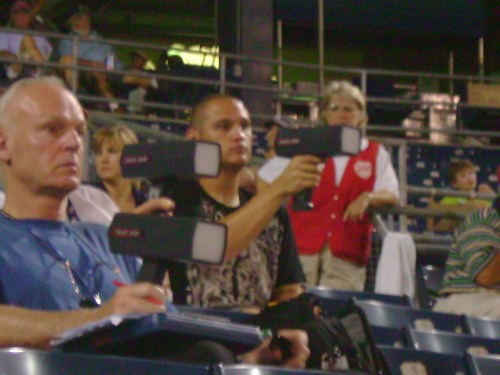
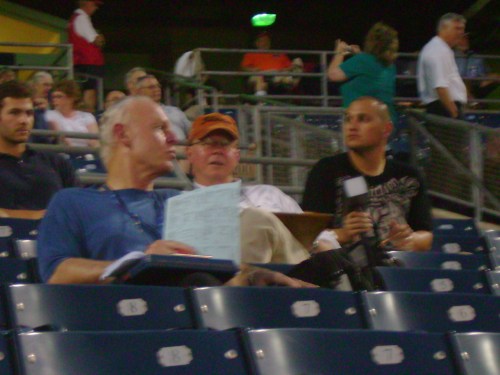
I encounter a good number of scouts at Harbor Park.  They as well as player’s wives, families or friends and VIPs sit in section 100 to my left.  In addition to the scouts the Tides and the opposing teams frequently have at least one of their own players charting the game from that section.  I have had a number of interesting conversations about the game with scouts from the Orioles, Nationals, Pirates, Cubs, Mets, White Sox, Yankees and Braves as well as a scout from the Japanese Major League team the Yokohama Bays Stars.  There have been scouts from a good number of teams, including the Korean Baseball League that I have not chatted with prior to games.  One is very careful not to bother them during the game itself as they are looking closely at what is going on.  This is their bread and butter and they need to be respected while they work.

scouts 2Mets and Rays Scouts

Of course the job of the scout is directly impacted by both the current and projected needs of their teams, including the minor league system as well as how the teams are doing at the moment.  Thus from day to day scouts may be scouting individual players, or looking more in general for players that might of help to their team and its associated minor league system.  Once in a while I get to look at the sheets that scouts use in evaluating talent.  Since pitching is always a needed commodity they are seldom without their radar gun to measure the speed of pitches as well as charting pitch type, placement and what happened to the pitch.  It is a very detailed job collecting data on players as well as making first hand observations that could be as important as the numbers in determining whether a play is right for the organization.

The key to the success of any Major League organization is how well its scouting system identifies prospects for the big team.  Teams that are forward thinking spend the time and money to scout players either through the traditional methods or through the Sabremetrics system popularized in the book Moneyball about the Oakland Athletics methods under Billy Beane.  Some teams use a combination of both traditional methods and the more data oriented Sabremetrics. Some teams which are accused of simple “buying” their major league team through free agency like the Yankees actually have a very talented scouting department and minor league system.  The Yankees have built their own middle relief corps from their own system this year.  The bullpen with the exception of closer Mariano Rivera has been a weak spot over the past 8 years for the Yankees and they have remedied this on their own.  Likewise the Red Sox, Rays and Orioles maintain excellent scouting and minor league systems.  The Orioles are the newcomers in this building their team from scratch over the past few years.  In the West both the Angels and the A’s have strong minor league systems as do the Cardinals and Dodgers.

japanese scoutYokohama Bay Stars Scout

Unfortunately many organizations outside baseball, especially churches do not scout or develop talent.  Sometimes it is a organizational approach or prejudice that either seeks outsiders versus home grown talent, mega-churches are particularly bad about this often looking at outsiders to fill the their staffs.  On the other hand older main line denominations often are suspicious of outsiders even those with good track records.  Some Churches such as the Roman Catholic Church intentionally limit those who can serve as clergy to the ranks of unmarried celibate men, with a few exceptions made for married clergy from other churches.  Those men are taken through a process that often discounts any prior ministry they have as of little value and very few make it through the process of being ordained.  On the other side of the spectrum are churches which have no rhyme or reason as to how they choose develop or assign clergy with often very arbitrary means to choose pastors.  Clergy development from identifying young men and women who believe that they have a call to serve;  the nurture and care of these men and women, their education, formation and eventual ordination and assignment are particularly important if the Church is to fulfill its mandate of bearing witness of Christ in the world and caring for the people of God.

One can make application in many other fields.  In the military we typically recruit for most specialties but we look harder for specialties that require a more selective process such as Special Operations personnel.  In the medical field the military employs a very rigorous process of evaluating prospective physicians through medical school, internship and residency.  In specialties which a lot of personnel are required and in which there is a good amount of turnover and attrition many personnel are recruited but at certain career points a good number are weeded out.

Good scouting needs to be part of recruiting.  Talent must not simply be recruited based on test scores, but the whole person.  Organizations that seek excellence will use people to scout for and evaluate talent within their own organization or outside of it.  The goal of course is not to find one person that can play now, but to develop many people to deepen the organization and make it more resilient when it experiences personnel losses or has to make organizational moves. Without good scouting much recruiting effort will be spent and often wasted on people who do not fit what the organization needs at the present or in the future.

Peace, Steve+

Leave a comment

Filed under Baseball, leadership, Military, Pastoral Care, philosophy

Trust in God and Keep a Strong Bullpen

“A fellow has to have faith in God above and Rollie Fingers in the bullpen.” Alvin Dark

043Tides Reliever Alberto Castillo against Charlotte

Organizations often face time when due to either talent, injuries or staffing shortages that they must make adjustments in mid-stride in order to continue to function.  Nowhere is this more apparent than on a baseball team, especially in relationship to the pitching staff.  The bullpen must be good in order for a team to weather the ups and downs of a season as well as the ups and downs of the starting rotation. When the starters are doing well and being supported by good hitting a good bullpen is what ensures the win.  When a starter slips up and has a bad outing a good bullpen steps up and gets the game back under control to give their offense a chance to win.  Conversely if a starting rotation is not doing well, either due to injuries, lack of talent or lack of experience the bullpen has to take up the slack.  In such cases even a good bullpen staffed with experienced relievers can get worn down by being forced to pitch too many innings too many times.  This became apparent to me last night as I watched the Yankees beat the Red Sox.  The Red Sox starter, in fact the last three starters had pitched well, unfortunately due to a number of times during the past few weeks the starters had been beaten up force the relief staff to do a lot more work than they are programmed to do.  Thus when the game got into the deep innings, particularly on when the teams went over 14 scoreless innings, the Red Sox bullpen was ground down.  In the end they ended up losing games to the Yankees despite good performances from the starters but lousy hitting, Yankees pitching blanking the Red Sox for 31 innings before the Red Sox Victor Martinez managed a two run home run in top of the 8th in Sunday night’s game. It was then that the Red Sox bullpen fell apart with Daniel Bard and Hideki Okijima combining to give up 4 runs on 5 hits including 2 home runs, all with two outs and no one on base.

To have an effective bullpen you have to have a staff that knows their roles and are comfortable coming on in relief. By way of analogy my military career has been marked where I have had to go into a situation in relief of someone who had been fired, transferred early or was hurt, I experienced this as a Company Commander and a good number of times as a chaplain.  All of these came with little or no notice, much the way a relief pitcher is called upon to do.  If you have worked in some institutional setting such as the military, this is a common occurrence.   The key to such situations, just like baseball, is that the person coming in relief needs to know what their role is.  Is this a short relief outing, to get a specific task done, like a pitcher might be put in to face one batter and no one else?  Or is it to recover a situation and stay in the game for an extended period of time, or even to come on in the final inning to close out the game?  No matter what it is the reliever must know his role, just as someone being brought in a institutional setting to take over in a difficult situation needs to know what he or she is expected to accomplish and how much time they are expected to be in.  Thus the onus is on the organization, in particular the leadership to know what the abilities of their “relievers” are and be forthright in telling them what they need to accomplish.

In building an organization you need people on your staff that are suited to change gears in the middle of something and go into a relief situation.  It is true in baseball as well as life.  As a season ticket holder for the Norfolk Tides Baseball Club, the AAA affiliate of the Baltimore Orioles I watch a lot of baseball from my seat in section 102, row B seat 2.  The Tides started out the year with a great starting pitching rotation most of who have been called to the majors as well as relief staff.  The still have decent pitching but it is not up to the level that it was at the beginning of the season. Whereas earlier in the season up until the All-Star break the starters we getting good starts and relievers were able to come in later in the game in roles that they were ready to fulfill.  Now with our losses and the addition of pitchers called up from AA or A ball we are struggling in this department.  With starters not getting quality starts or not going deep into the game the relief staff has been worn down. Pitchers who were solid earlier in the year are not as dependable, and this comes often from having to come in too early, too often in situations where the games are already out of hand.  Yet even so tonight I saw relievers Kam Mikolio and Alberto Castillo regain control of the game in the 8th and 9th inning, but too late to do any good because the damage had been done earlier against Andy Mitchell the statrer and Jim Miller who came on in middle relief.

In the majors a staff needs a couple of guys who can come in to do long or middle relief, a couple of set up pitchers and a good closer.  Ever since the Oakland A’s used Rollie Fingers in this role the relief pitchers have become an vital part of any pitching staff and good managers know when the right time to pull a pitcher and put in the right reliever is.  Good managers also know to let the relief know what is expected.  In places that I have done well in relief I knew what my mission was, how long it was going to be and set myself to accomplish that mission.  When the relief appearance was ill defined and I did not have much experience I would do well for a while and then get in trouble because I had to use the baseball term gone beyond my pitch count or overmatched.

Sometimes even excellent relievers get beat up. Everyone has a bad day and even guys like Mariano Rivera, Francisco Rodriguez and Jonathan Papelbon occasionally get roughed up.  However, most of the time these pitchers have enjoyed success because they were part of a pitching staff that was strong in both starters and relievers.  A good reliever on a bad team often gets worn down.  Likewise when organizations suffer significant losses the people left, experienced and inexperienced, strong and weak are put into situation after situation where they have to do more on less rest.

russ ortizRuss Ortiz

Tonight I met pitcher Russ Ortiz who has played a good number of years in the majors.  He was recently picked up by the New York Yankees after being released by the Astros.  He was assigned to the Scranton Wilkes-Barre Yankees and is making a start tomorrow night.  This evening he was charting the game for the Yankees in section 100.  Now Russ was with the Giants in 2002 when they went to the World Series against the Angels.  With one out in the bottom of the 7th leading 5-0 Ortiz gave up two hits and was replaced by Manager Dusty Baker with set-up man Felix Rodriguez.  Rodriguez gave up a 3 run home run to Scott Spiezio.  The Angles picked up three more off Rodriguez and closer Rob Nen to go ahead and win the game.  I told Ortiz that I still curse the day that Baker pulled him and told him how much I thought that he deserved the win.  Ortiz is a gentleman and nice guy.  Standing back with Elliott the Usher I meet a decent number of players and Ortiz is a class act.  I asked Russ if he would do me a favor and sign a baseball card for me, he said gladly.  So Marty the Card Dealer sold me a card with Ortiz in his Giants uniform and in the top of the 9th Russ signed it for me on the concourse.  It goes into my kitchen baseball shrine where so many of my other signed cards, balls and memorabilia are on display.

Without going into a sermon it is important to remember that many businesses and organizations are going through difficult times with many trying to do more with less.  In the military we are seeing our numbers go up a bit but with mission increases that stress our system.  These are like teams where there are gaps in the starting rotation and where guys and gals have to come in to relieve folks more often that should be the case.

Yes we do trust God, and patently the Deity Herself tells me that such is necessary especially for a miscreant Priest like me.  At the same time we need to have a strong bullpen in order to weather difficult situations. May we all have our Rivera’s, Papelbon’s, and guys like Rollie Fingers and Dennis Eckersly on our team with some good set up guys as well as some long and middle relievers.

Peace, Steve+

On a side note I was charged with an error by Barry the Scorekeeper when I lost track of my beer and kicked it over when it was still 2/3 full.  Since to waste good beer is a sin, I’m sure that Martin Luther believed this to be the case, I had to buy another and trust that the Deity would forgive me.

Leave a comment

Filed under Baseball, leadership, Loose thoughts and musings, philosophy

Breaking Slumps and Losing Streaks

Fiorentino HR against ColonJeff Fiorentino, seen here Hitting a Home Run off Bartolo Colon has Come up Big for the Norfolk Tides in 2009

The Norfolk Tides came home Tuesday after their worst road trip of the season in which they fell behind both the Durham Bulls and Gwinett Braves.  When things are not going well for a team, organization or individual it seems that events almost conspire against them.  It was that way for the Tides, errors and bad decisions at the plate, on the base paths and the field plagued them over the road trip.  The problems continued on Tuesday where the Tides lost their 9th of the last 10 games.  Now it was not that the team was bad, they made some great comebacks but fell short each time sometimes in heartbreaking ways.

Tonight after getting out to an early lead the Tides were behind 5-2 in the bottom of the 7th.  Elliott the Usher and I as well as Barry the Scorekeeper wondered what was happening.  It seemed that there was no energy on the team.  Unfortunately when a team, organization, military unit or individual gets on a losing streak it is hard to get motivated, especially when you come close but come up short. I remember being told in my Pastoral Care Residency that I had to stop believing that things were going to be difficult or that I would always come up short.  My supervisor told me that I had the power to actually envision a positive future and make things happen to see it come into being.  Now I have always been a fighter and even a survivor, but being a survivor doesn’t necessarily make you a winner.

The Tides picked up 2 in the 7th as Robby Hammock led off with a hit and Tides hitters Blake Davis, Joey Gathright and Jeff Fiorentino brought the runs across with key hits.  Brandon Snyder singled to drive in Victor Diaz and tie the game the game in the 8th.  Tides reliever Alberto Castillo came in at the top of the 9th and shut down the Indians after getting into a jam after giving up a hit and an error by 3rd Baseman Brandon Snyder.

Sometimes the key to breaking a losing streak is in how one player can raise help lift the team.  Following the promotion of Matt Wieters, Nolan Reimold and Oscar Salazar to the Orioles and the loss of Scott Moore, Jolbert Cabrerra to season ending injuries and temporary absences to injury of Justin Turner and Joey Gathright, it was Jeff Fiorentino that stepped up.  He now stands near the top of the International League in hitting with a .315 batting average and has been a clutch player offensively and defensively.  Tonight Jeff went four for four with a walk, drove in a run in the 7th.  Hecame to bat with one out in the 9th to single to drive Justin Turner in for the winning run.   It broke the losing streak and hopefully will begin a rebound for the Tides.  Since the Tides have played well the bulk of the season even allowing for significant numbers of call ups and injuries it is well possible that they will turn things around.  It was significant that other Tides were involved in the comeback and that instead of giving in to going through the motions they came together to win.  The team still has a lot of heart and character and still can only continue to get better.

May we all do the same, with a little help from the Deity Herself.

On a side note, Tides pitcher Chris Tillman had his first Major League start in Baltimore against Kansas City.  He had a no decision but the Orioles won the game 7-3.  Former Tides relievers Matt Albers came in in the 5th to hold the Royals and Jim Johnson got the save.  Baltimore continues to get great performance out of the pitchers called up from Norfolk this year.

Peace, Steve+

Leave a comment

Filed under Baseball, leadership, Loose thoughts and musings, philosophy

Going to War: Ministry amid Training

Two years ago my group of Individual Augmentees was leaving Ft Jackson South Carolina on the way to Kuwait, which was our final training site before going on to our assignments in Iraq, Afghanistan, Kuwait and other locations in the CENTCOM Area of Operations.  In the two weeks prior to our departure  we received training in a number of areas, especially weapons which I was exempted from as a Chaplain, though I did fire the crew served weapons for the fun of it.  I wasn’t always a chaplain and have a hard time not enjoying a Mk 19 Automatic Grenade Launcher, M-240 series machine gun or the classic .50 caliber Machine Gun.  Since I used to call in 155mm Artillery fire these are little guns, but still fun to play with.  When you are chaplain and are exempted from actual training it does not mean that it is time to go to the Food Court at the Post Exchange to chow down on Pizza and Ice Cream.  Ministry abounds if you want to go hang out.  One of the fun things about hanging out with Navy guys unfamiliar with small arms is to watch them trying to clean them and get them past an Army armorer in an Arms Room.  To see the looks of shock as my fellow sailors brought back their M-16s and M-9s for more cleaning.  They had not yet learned the dirty little secret that a good armorer can find things dirty on a weapon that you didn’t even know existed.    It was at this point with me calmly pointing out tricks of the trade that a physician who I had gotten to know looked at me and said: “Chaplain, you were in the Army weren’t you?”  He looked at me as several others who had just had their weapons rejected stopped what they were doing and waited for my response.

I was kind; I acknowledged that indeed I had served in the Army and that I was not always a Chaplain.  I then looked at the physician and said “Give me the weapon.”  I took it from him, broke it down and gave a quick lecture on how to clean a weapon of the M-16 series.  The dirty secret on these things is that you almost never get your weapon through the inspector on the first try.  There are more places for carbon to hide on an M-16 than places you can find Waldo.  Thus a good inspector knowing that he has a bunch of novices coming through simply rejects every weapon.  I think that it builds character.  I showed those around me all the little places where carbon was hiding on this officer’s weapon and how to get it clean to pass inspection.  Knowing such things gives you additional “street cred” as a chaplain as you go off to war.  It shows that you care about what your guys have to do enough to teach them.  This is really vital when your Navy or Air force guys are training with the Army.  It opened doors to ministry with these men and women.  So if any of my deploying friends need some pointers on the care and feeding of an M-16 let me know.

Additionally, ministry seems to happen when you stay engaged with people.  I was blessed that two additional chaplains, Commander Kyle Fauntleroy and Command Dave Rodriguez who were heading off to manage the “Warrior Transition” program in Kuwait.  Together we figured out how best to care for our sailors including how we did services as well as counseling.  We had a pretty good amount of business.  It seems that life and tragedy happens even in training. We had a young hospital corpsman who was diagnosed with Leukemia during our first week there. Both the Navy chain of command and Army trainers expected us, in between and after training to make sure that she and her family were cared for.   Other sailors found out that their husbands, wives or significant others were cheating on them.  Still others were hurt in training accidents and could not deploy.  In every case one or more of us took care of the sailor in question.  It was a community of individuals that for a brief two weeks began to gel together despite the fact that when the training was completed we would go separate directions, some for more training at other bases and others directly to the Middle East.

Apart from the young woman with Leukemia the most notable thing that I got to do was baptize a young Navy Reserve Intelligence Officer who had been raised in the Episcopal Church but who’s parents had forgotten to have him baptized…oops.  The subject came up when he became engaged to a Catholic girl. He needed to prove that he was a baptized Christian, only problem when he went to his parish they could find no record.  So he inquired of his parents when he learned of the “oops we should have done that” situation.  I like to baptize people, they way we do it you don’t have to wear hip-waders or make up anything because it is all in the Prayer Book so it’s not that hard.   So I did it on our last Sunday morning with his fiancé present.  It was really cool.  The young officer had the bunk next to me in the barracks so we had gotten to know each other during conversations as we checked or put together equipment, packed gear, washed clothes or went to chow.  He was very smart and friends as well as unassuming.  When asked what he did in civilian life he simply said that he worked intelligence and foreign policy in DC.  I figured as most would infer that the young man was with the CIA or DIA or some other outfit.  We saw each other a couple of times as Nelson and I traveled about Al Anbar Province the last time in the Wal-Mart sized chow hall number three at Al Asad as we waited for a flight out west.  After I returned and was having my PTSD meltdown I found that the young man was then Senator Barak Obama’s senior National security adviser.  We had stayed in touch in the following months but finding out this was a surprise. We have remained in touch and he now serves as Chief of Staff for the National Security Council.  I think it’s cool that he is up there working with General Jones on the NSC.  He’s a good man who despite his high position remains active in the Naval Reserve.  He is doing well in his marriage and remains in contact with guys like me.  It makes me even more prayerful for him as he advises the NSC and President.   It was one of those moments when I knew that the Deity Herself had placed me in a person’s life that due to his office needs prayer more than we can imagine.

Ministry of all types continued to happen our entire time at Fort Jackson, we dealt with family deaths, birth notifications and medical emergencies.  We counseled, prayed and assisted sailors in need and looked out for each other.  Nelson was engaged not only receiving training but also giving it having run something like 400 convoys in Afghanistan.  He ended up as one of the honor graduates and won a leadership award from the Army staff.  It is really great to have an assistant of Nelson’s caliber when you go to war.  As we got ready to leave Ft Jackson my young friend went off for more specific training at another base with many of the other Intelligence Officers and specialists.   Nelson and I packed up our gear, stacked it and helped load trucks which would take us to our flight.

Leave a comment

Filed under iraq,afghanistan, leadership, Military, philosophy, Tour in Iraq

Loose Thoughts: Can Somebody Tell Me What Sleep is and Why the Old Crap? Why not New Crap?

bean church 1 Mr Bean Trying to Stay Awake in Church.  I can Really Relate See the video at

http://video.google.com/videoplay?docid=-7178785146631188901&ei=UthpSvKcCpv-qAOCyJAd&q=mr+bean+in+church&hl=en

Tuesday and Wednesday were days where the old Crap both my own life and others kept rising to the top.  My current and crap, which in reality is my old crap move to the present are my PTSD related issues or maybe it’s the whole damned subscription.  My stuff came up, because as Elmer the Shrink says that they have been suppressed by my brain and get dredged up by stuff that triggers them.  Thus it is kind of involuntary, something that I hate.  I am a deliberate and logical person and I don’t like this stuff coming up and screwing with my life, which right now is pretty busy and stressful.

Tuesday night I had the “privilege” of getting two and a half hours of sleep after a great seminar on Caregiver Operational Stress management and intervention.  I was proud of myself.  I actually got through an entire daylong seminar without an immediate PTSD meltdown during the seminar.  That last three times I have attended classes or seminars dealing with things related to or that touch on my stuff it has been like a old pitcher who has seen better days getting chased from the mound at Yankee Stadium in the first inning giving up 7 runs without recording an out.   Tuesday it was hard but it was like getting a complete game and the win.  This was a big accomplishment for me as I have not been able to do this since before I went to Iraq.  However, the subject matter did kick up a bunch of my stuff from Iraq and getting to sleep was really; I mean really fun….not.   To use the old pitcher metaphor I may have got the win but my arm and body need some time to recover, only instead of the arm and body it is by pea-brain. So Tuesday I didn’t get to bed until 2:30 AM and was back up at 5:00 AM so I could come to work and take the duty for the house in addition to my regular duties.

Now I don’t mind having duty, especially at night when I get a chance to round through our hospital wards and spend time with staff, especially the folks in the various ICUs and units that are not part of my daily routine. Yesterday I had a couple of meetings today, a long one in the morning and a couple in the afternoon.  The last meeting was like one of those afternoon classes that I dreaded back in college and seminary;  the kind that I took because I was either working or wanted to sleep late, but which kicked my ass.  One time in seminary the “Z Monster” grabbed me after eating a big burger at lunch before going to class.  That afternoon in Philosophy of Religion the Professor, Dr. Yandall Woodfin, decided to enlighten us with a slide show of various art masterpieces and the religious and or philosophical meanings that could be ascribed to them, I think there were several slide trays of them as this was in the technological dark ages before Power Point poisoning.  I was sitting in the front row, my desk almost under Dr. Woodfin’s nose just slightly to the left of the slide carousel.  The lights were turned low so we could see the pictures better and the temperature was just warm enough in the classroom to  make me even more sleepy.  As all the blood in my body rushed from my brain to my burger locker I began to struggle to stay awake.  It was like Mr. Bean trying to stay awake in church http://video.google.com/videoplay?docid=-7178785146631188901&ei=UthpSvKcCpv-qAOCyJAd&q=mr+bean+in+church&hl=en I was fighting hard but the “Z Monster” won.  I was doing the “bob, jerk and sleep” for about 20 minutes when finally catastrophe hit.  I flipped my desk; it was a rollover accident without a roll bar, but it was amazing that I did not hurt myself and just how fast I recovered.  I had that desk righted and had my ass back in it before anyone knew what hit them. My fellow students tried to restrain their laughter as the unflappable Dr Woodfin kept the lecture going without missing a beat.  I don’t know if it was years of training or the fact that he was in his “teaching zone” but his focus was amazing as he showed absolutely no distraction by my roll over.

I had similar experiences in other academic and military settings, but while I may have fallen out of my seat I never again flipped a desk.    However today was tough.  I had been pumping myself with caffeine all day long and evidently it was not having the desired effect. I got to the NOD (Nurse of the Day) meeting where the on call people meet with representatives of the nursing units to get an idea what is going on in the hospital at large.  Today I took my seat and the “Z Monster” showed his well disguised face and zapped me.  Pretty soon I was fighting to stay awake.  I was pinching myself, shrugging my shoulders, sucking down my Coke Zero just to stay awake, a couple of times I caught myself about to fall forward in my chair, thankfully I didn’t snore…yes I have done that in meetings or classes too.  When the meeting ended I was more than happy.  I slowly rose from my chair, shook myself out and downed the last of my Coke Zero.  When I got back onto the ICU I got second wind and was good the rest of the evening, made all of my rounds and finally feeling that things were okay for the night trundled off to the chaplain call room to try to sleep.  I got in the bed, pulled the threadbare hospital sheets and too small blankets over me, arranged the flat pillows so they resembled a real pillow turned off the lights and close my eyes.  Unfortunately though my body was toast my brain did not want to turn off, it was like the brain had a mind of its own and was going to keep my body up even though my body was saying “Oh God let me sleep.”  I was so tired that I couldn’t even write myself to sleep like I normally do. Even my entreaties to the Deity Herself seemed to go unanswered, so a laid there, turned on the television and surfed the paltry selection of channels that Mordoc the Preventer of Information contracted to get finally flipping between late night talk show hosts on the major networks other than Conan O’Brien I didn’t know who the majority of these guys were, one of them who followed Conan started kissing the camera in the middle of his monologue.  I rapidly changed channel as that was frightening.  Finally about 2:30, which must be the new 11:30 for me, I drifted off to sleep to be awakened by the 0600 test of our Code Blue response pager.  I did my duty turnover, pumped myself full of caffeine checked on the ICU and PICU, visited some patients, consulted the staff, answered some hot e-mail and calls regarding our incoming Pastoral Care Residents and realized that my body was starting to tell me that I was done.  I trudged down to our main office, sat down with the boss who asked why I was still at work, discussed a couple of issues with him and got sent home where I kissed Judy, pet the dog and threw my ass in bed.  I feel slightly more human now and pray that the sleep I got this afternoon does not mess up going to sleep tonight.

bean church two

While thinking about how my old crap was exhumed by the class, something that Elmer the Shrink says that my brain has been suppressing, I got an e-mail from a pastor who has syndicated opinion column for a number of newspapers here in the USA.  The guy used to write some pretty good stuff that was encouraging, inspiring and occasionally thought provoking.  But something has changed and his articles have become often become almost venomous.  I guess that he’s really angry about something, probably Obama and the Democrats.  I understand that that is his right as a citizen, there are a lot of people unhappy with the President and Congress, my mother is one of them.  I talk to my mother almost daily almost and for eight years she bitched about Bush and the Republicans and now she is bitching about Obama and the Democrats, but she represents herself, she is not a pastor, she holds no church or public office and thus can do whatever she wants.

Anyway this pastor chose to write an article full of anger and poisonous invective, but not at anything happening now.  He chose to dig up old crap with no relevance to the Gospel, or to anything that is happening now.  He chose to write about a doctoral seminar that he attended several years ago. He discussed a situation where a non-US citizen pastor of an American church in a graduate program was criticizing the USA as a major source of the world’s problems.  Now I might take offense if someone did that, I would defend my country and I might depending on the situation confront him during or after the class.  However, this chose to drag this up when it seems totally irrelevant to anything going on now.  I really don’t think that anyone is concerned about how a foreign pastor pissed this minister off years ago. People are scarred spitless of the Commie North Koreans, Iranian nukes, Pakistani nukes, the expanding war in Afghanistan, the price of gas, the economy and a hundred other very real crisis’s.  But this pastor decided to tell how a long time ago he responded in a class to a guy who dared to criticize the USA.  But this wasn’t the worst of it, this guy ended the column with a particularly acidic comment that was like cup of “America Love it or Leave It” with a shot of Drano.  There was no redemptive point to the article; there was no humor, no spiritual lesson, just a very angry and bitter screed about something that happened in a classroom among a bunch of doctoral students which happened four years ago at the height of the insurgency in Iraq.  I did not think that the article was befitting of him and hope that his ministry is not filled with stuff like this as it is poison.  Like Drano it will clean you out, but it will leave you empty inside.  If this were an isolated occurrence with this pastor I would chalk it up to him having a bad day, but he is trending this way and I’m afraid that if he continues to do so he will hurt his church and the broader Christian church by becoming identified more with a political message than his faith.  In fairness I don’t know what caused him to write the article, maybe something triggered him and caused this to kick in.  I do want to be fair to him.  I do plan on discussing the matter with him because I actually do care.

Now I’m sure that there are people who think that I’m full of crap too, and I’m okay with that, because I know that I have issues and rough edges and sometimes push the envelope.  At the same time I do try to find a point of contact in the present and write, even when I am critical of a person or institution.  I do not believe that anyone or any institution is totally bad or good, even people that I disagree with are like broken clocks, they are right twice a day.

I hope to sleep tonight and I hope none of my old Crap or anyone else’s old Crap shows up tonight. Unfortunately Crap tedns to rise to the surface.

Peace, Steve+

1 Comment

Filed under iraq,afghanistan, leadership, Loose thoughts and musings, philosophy, PTSD, Religion

Roster Moves: No Game, Series or Season in Baseball or Life Goes Without Them

046Norfolk Tides Manager Gary Allenson making a Slight Adjustment to the Outfield with 1 Out in the 9th Inning

Larry: Who’s this? Who are you?
Crash Davis: I’m the player to be named later.

From Bull Durham

Sometimes I feel like the player to be named later.  I am amazed at the changes on a baseball team’s roster during the course of a season.  At the same time being in the military for almost 28 years I have some understanding of them in daily life.  This season with the Norfolk Tides and my place of work at a Major Naval Medical Center has been a perfect example of how no roster survives intact.

Now this is nothing new, as long as there have been baseball teams and militaries there have been personnel changes.  In baseball as in the military there is constant moves of personnel as people are transferred, promoted, demoted, are injured or retire from either the service or the game.  Sometimes roster moves are part of a natural process as an organization decides how it wants to chart its future. Other times they are dictated by a need that occurs that has not been anticipated such as injuries, trades, transfers, retirements or personnel or budget constraints, either expected or unexpected.

In the Minor Leagues the Minor League affiliates exist to supply their Major League organization with young talent, player development, rehabilitation and depth to meet the demands of a long season.  It is similar in the military where support and training organizations exist to meet the needs of the operating forces.  This is true regardless of military branch of service.   When the Major League Team or the operating forces are stretched, experience losses or suffer setbacks it is common for them to draw upon the support and training organizations to fill the holes and meet the needs of the larger organization.

I have watched this close up in two worlds this year both where I work and where I watch the Tides play ball.  At work this has occurred where due to retirements and transfers our department has lost a lot of people who have not yet been replaced, creating a lot of pressure on those who remain, likewise we are tasked with more missions to support the operating forces.  The same is true of the rest of the Medical Center where many physicians, nurses, corpsmen and other sailors have been deployed to meet the demands of the expanding war in Afghanistan while still supporting other worldwide commitments and our own home town mission.  While this is going on other needs have come up in caring for returning warriors, wounded warriors and their families as well as the rest of the military community that depends on us for their primary and specialized medical care.  I have seen more colleagues and friends than I can count be deployed from what is supposedly a pretty safe “non-deploying” shore billet to support the operating forces, Navy, Marines and Joint or NATO.  I have watched the organization adapt to the call ups by moving people around as well as finding people to fill the void, even if they are only on contract.

Our Norfolk Tides began the season with a very solid roster and within two months the big club, the Baltimore Orioles had called up several pitchers as well as the heart of the batting order, Outfielder Nolan Reimold, Catcher Matt Wieters and Infielder Oscar Salazar.  Meanwhile the Tides lost several players to injuries which forced Manager Gary Allenson and the Orioles organization to fins personnel both within and outside of the organization to fill the gaps created by call ups to the big team and injuries.  To do this they brought up players from AA Bowie, moved players down from Baltimore and found and traded for players outside of the Orioles system.  At first the adjustment was difficult but now the new players and those who were left are coming together to keep the team, at least for now in first place in the International League South.   Yet with every move the organization has to decide how to best utilize the players that it has.  In the case of the Tides this comes down to Manager Gary Allenson and his coaches working together with the rest of the Orioles organization.

Even in the midst of a game there are roster changes, sometimes for pitchers, sometimes hitter and sometimes even for running or defense.  Some of the changes are for injuries, or situational based on statistics of what you have empirical evidence to show that one course of action is better than another.  Thus you have relief pitchers and pinch hitters or runners.  No at bat or even pitch is the same, which is like life, nothing remains the same so you must make the adjustments on every play.

At the personal level changes affects everyone in the organization even if their job in the organization does not change.  At the minimum the changes affect the dynamics of the work environment, the chemistry between teams and the concern for friends who have left the organization with whom we have invested significant amounts of time and emotional energy.  Thus when Oscar Salazar was called up by Baltimore it left a huge hole in the team because Salazar was not only a leading contributor on the field but his tremendously positive attitude off the field in energizing the team and working with younger players.  Individual losses while seemingly statistically insignificant can be magnified by the intangibles of what a person brings to the team.  Some who seem to have all the right stuff may not be missed, while others who maybe don’t have the same talent level as others might be more sorely missed.  Since a team depends on the efforts of everyone, especially in baseball where the game is both immensely individual and absolutely interdependent personnel changes must be weighed carefully in the overall mission of the team or organization.  The Tides are fortunate to be with Baltimore as the organization is not only scouting talent for the O’s but their Minor League affiliates.  I met a Baltimore Scout at a Tides game over the weekend who said they were out seeking hitters for Norfolk due to call ups to the O’s and injuries to members of the Tides.  The larger organization, though a work in progress recognizes that its future lies in its Minor League system.  Thus over the past couple of weeks they have picked up Michael Aubrey from the Cleveland organization and Victor Diaz, a former Tides Outfielder when they were in the Mets organization and who later played in New York, Texas and the Houston organization before playing with the Hanwha Eagles in South Korea before being signed by the Orioles and assisted to the Tides.  A good organization not only looks to the situation they are currently facing u to the future.  A bad organization does not plan for the future but only concentrates on the present.  In the case of the Tides we are prospering under Baltimore but suffered for almost 20 years under the Mets, who have continued to neglect and abuse their farm system, especially their AAA affiliates.  The fans in Buffalo despise the relationship.

On the personal level this also means that individuals can be moved around to meet the needs of the organization.  This does not always make players happy be they ball players or military personnel.  There have been times in my career that I did not like what was happening to me in the organization, not so in the Navy but definitely in hte first part of my Army career. Such unhappiness when left unchecked can lead to blow ups.  The movie Bull Durham has a great example where Crash Davis, played by Kevin Costner complains about his reassignment from an AAA team back to a single A team.

Crash Davis: You don’t want a ballplayer; you want a stable pony.
Skip: Nah.
Crash Davis: Well, my triple-A contract gets bought out so I can hold some flavor-of-the-month’s dick in the bus leagues, is that it? Well, f— this f—ing game!
[pause]
Crash Davis: I quit, all right? I f—ing quit.
[Crash exits the office and stands in the clubhouse for a minute before sticking his head back through the door]
Crash Davis: Who we play tomorrow?
Skip: Winston-Salem. Batting practice at 11:30.

I cannot say that in my Navy career I have ever felt like Crash Davis,  in fact I have even when doing a lot of “relief” work and been moved around sometimes faster than I wanted to be because I was needed to put out a fire. At the same time I have  always been dealt with well.  I have not been sent back down in the organization, but have been moved up or laterally to do different jobs, like I said often on short notice like the time when two different chaplains were fired and I went from one job to the next and ended up nine or ten weeks at 29 Palms prior to a 7 month deployment in two different battalions. Those were stressful, but not bad and the organization treated me well.  Some people don’t have that experience however and roster moves on short notice can be a source of consternation, anger and discord if not handled well by the team manager or the command.

However I did come into the Navy at a lower rank than I left the Army in 1999 just to get back in the show that was the cost of getting back in the game full time, something I am amazed that I got the chance to do and every grateful to the Navy, my Bishop and the Deity Herself.   In my current billet I love what I do and who I do it with, but the organization will be making some changes as we graduate our current residents, gain new residents, gain and lose other personnel and adjust to meet an ever changing and increasing mission.  While we do this we seek to set the standard of professional competency not only in the Navy but the civilian world.  For me this will involve changes, changes that on one level I resist, but on another level completely understand and agree with as the way to help the organization move forward.  Come September those changes will be made.  I can say that I don’t feel like Crash because this involves things that I have always wanted to do but unless I am adaptable will not be able to do, unless the Deity Herself creates a couple extra days to the week and makes every day a 32 hour day.  Thus I will adjust as will the rest of the organization as we collectively work together to ensure that we are taking care of those that God has given us.

So far as the story goes tonight, the one constant in the season is change, teamwork and adjustment to change. As Sparky Anderson once said “If a team is in a positive frame of mind, it will have a good attitude. If it has a good attitude, it will make a commitment to playing the game right. If it plays the game right, it will win—unless, of course, it doesn’t have enough talent to win, and no manager can make goose-liver pate out of goose feathers, so why worry?”  Thankfully, our leadership seems to be rising to the task and and we have the talent, so why worry?

Peace, Steve+

2 Comments

Filed under Baseball, leadership, Loose thoughts and musings, Military, philosophy