Category Archives: Navy Ships

The Ships of Pearl Harbor: A Comprehensive List with Short Histories of Each Ship

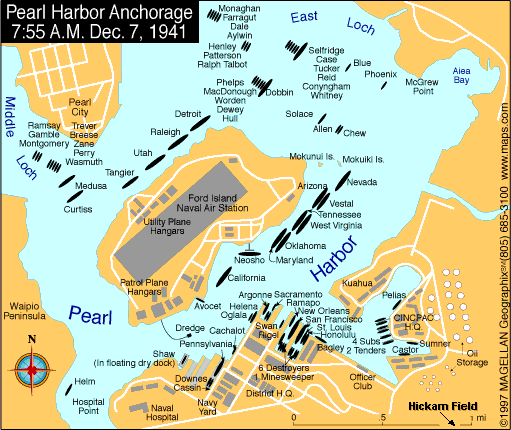
Last year I wrote a piece called The Battleships of Pearl Harbor. I followed that with an article this year entitled “Forgotten on the Far Side of Ford Island: The USS Utah, USS Raleigh, USS Detroit and USS Tangier. Of course most anyone that has see either Tora! Tora! Tora! Or Pearl Harbor is acquainted with the attack on “Battleship Row” and the airfields on Oahu.  What are often overlooked in many accounts are the stories of some of the lesser known ships that played key roles or were damaged in the attack.  Since none of the articles that I have seen have discussed all of the U.S. Navy ships at Pearl Harbor on that fateful morning I have taken the time to list all the ships with the exception of yard and patrol craft present at Pearl Harbor on December 7th 1941.  I have also excluded Coast Guard cutters. A brief account of each ship’s war service and final disposition is included.  I believe that this is the only site that has this information in a single article.

During the attack 18 ships were sunk or damaged but only three, Arizona, Oklahoma and Utah never returned to service.  During the war a further 18 ships were sunk or written off as losses during the war. All ships lost in the war are marked with an asterisk. One ship, the USS Castor remained in active service until 1968 serving in the Korean and Vietnam Wars. One ship, the Light Cruiser Phoenix was sunk in the Falklands War while serving as the Argentine ship General Belgrano. No U.S. Navy ships apart from the Yard Tug Hoga (not included in this article) remain today.  It is unfortunate that the Navy or any organization had the foresight to save one of these ships. It would have been fitting for one of the battleships that survived the war to be preserved as a memorial ship near the Arizona Memorial. While the USS Missouri serves this purpose symbolic of the end of the war it is a pity that no ship at Pearl Harbor was preserved so that people could see for themselves what these gallant ships was like.

Battleships


Nevada (BB-36) Nevada was the only Battleship to get underway during the attack.  As she attempted to escape the harbor she was heavily damaged and to prevent her sinking in the main channel she was beached off Hospital Point.  She would be raised and returned to service by the May 1943 assault on Attu.  She would then return to the Atlantic where she would take part in the Normandy landings off Utah Beach and the invasion of southern France in July 1944.  She then returned to the Pacific and took part in the operations against Iwo Jima and Okinawa where she again provided naval gunfire support.  Following the war she would be assigned as a target at the Bikini atoll atomic bomb tests, surviving these she would be sunk as a target on 31 July 1948. She received 7 battle stars for her WWII service.

*Oklahoma (BB-37) During the Pearl Harbor attack Oklahoma was struck by 5 aerial torpedoes capsized and sank at her mooring with the loss of 415 officers and crew. Her hulk would be raised but she would never again see service and sank on the way to the breakers in 1946.  She was awarded one battle star for her service during the attack.

Pennsylvania (BB-38) Pennsylvania was the Pacific Fleet Flagship on December 7th 1941 and was in dry dock undergoing maintenance at the time of the attack. Struck by two bombs she received minor damage and would be in action in early 1942. She underwent minor refits and took part in many amphibious landings in the Pacific and was present at the Battle of Surigo Strait.  Heavily damaged by an aerial torpedo at Okinawa Pennsylvania would be repaired and following the war used as a target for the atomic bomb tests. She was sunk as a gunnery target in 1948.  She received 8 battle stars for her WWII service.

*Arizona (BB-39) Arizona was destroyed during the attack.  Hit by 8 armor piercing bombs one of which penetrated her forward black powder magazine she was consumed in a cataclysmic explosion which killed 1103 of her 1400 member crew.  She was decommissioned as a war loss but her colors are raised and lowered every day over the Memorial which sits astride her broken hull.  She received one battle star for her service at Pearl Harbor.

Tennessee (BB-43) Tennessee was damaged by two bombs and was shield from torpedo hits by West Virginia. After repairs she conducted operations in the Pacific until she reported to Puget Sound Naval Shipyard in August 1942 for a complete rebuild and modernized with the latest in radar, fire control equipment and anti-aircraft armaments. She returned to active service in May 1943. She provided Naval Gunfire support in numerous amphibious operations and was a key ship during the Battle of Surigo Strait firing in six-gun salvos to make careful use of her limited supply of armor-piercing projectiles, Tennessee got off 69 of her big 14-inch bullets before checking fire.  Her gunfire helped sink the Japanese Battleships Fuso and Yamishiro and other ships of Admiral Nishimura’s Southern Force.  She was damaged by a Kamikaze off Okinawa on 18 April 1945 which killed 22 and wounded 107 of her crew but did not put her out of action.  Her final assignment of the war was to cover the landing of occupation troops at Wakayama, Japan.  She was decommissioned in 1947 and remained in reserve until 1959 when she was sold for scrap. Tennessee earned a Navy Unit Commendation and 10 battles stars for World War II service.

California (BB-44) California was hit by two torpedoes but had the bad luck to have all of her major watertight hatches unhinged in preparation for an inspection. Hit by two torpedoes and two bombs she sank at her moorings suffering the loss of 98 killed and 61 wounded. She was refloated and received temporary repairs at Pearl Harbor before sailing to Puget Sound Naval Shipyard to be completely rebuilt and modernized with the latest in radar, fire control equipment and anti-aircraft armaments. She returned to service in January 1944. She saw her first action in the Marianas and was in continuous action to the end of the war. She played an important part in the Battle of Surigo Strait and in the amphibious landings at Guam and Tinian, Leyte, Iwo Jima and Okinawa.  She was decommissioned in 1947 and placed in reserve finally being sold for scrap in 1959. She received 7 battle stars for her WWII service.

Maryland (BB-45) At Pearl Harbor Maryland was moored inboard of Oklahoma and was hit by 2 bombs.  She would be quickly repaired and returned to action and receive minimal modernization during the war. She would participate in operations throughout the entirety of the Pacific Campaign providing naval gunfire support to the landings at Tarawa, Kwajalein, Saipan, where she was damaged by an aerial torpedo, Palau, Leyte where she was damaged by a Kamikaze, Okinawa and the battleship action at Surigo Strait.  Decommissioned in 1947 she was placed in reserve and sold for scrap in 1959. On 2 June 1961 the Honorable J. Millard Tawes, Governor of Maryland, dedicated a lasting monument to the memory of the venerable battleship and her fighting men. Built of granite and bronze and incorporating the bell of “Fighting Mary,” this monument honors a ship and her 258 men who gave their lives while serving aboard her in WWII.  This monument is located on the grounds of the State House, Annapolis, Md. Maryland received seven battle stars for World War II service.

West Virginia (BB-48) West Virginia suffered some of the worst damage in the attack. Hit by at least 5 torpedoes and two bombs she was saved from Oklahoma’s fate by the quick action of her damage control officer to counter flood so she would sink on an even keel.  She would be raised, refloated and taken back to the West Coast for an extensive modernization on the order of the Tennessee and California. The last Pearl Harbor battleship to re-enter service she made up for lost time as she lead the battle line at Surigo Strait firing 16 full salvos at the Japanese squadron helping sink the Japanese Battleship Yamashiro in the last battleship versus battleship action in historyWest Virginia was decommissioned in 1947, placed in reserve and sold for scrap in 1959.

Heavy Cruisers

New Orleans (CA-32) Minor shrapnel damage from near miss. Fought throughout the war in the Pacific; bow blown off by Japanese torpedo at Battle of Trassafaronga in November 1942, repaired. 17 battle stars for WWII service, decommissioned 1947 and sold for scrap in 1957

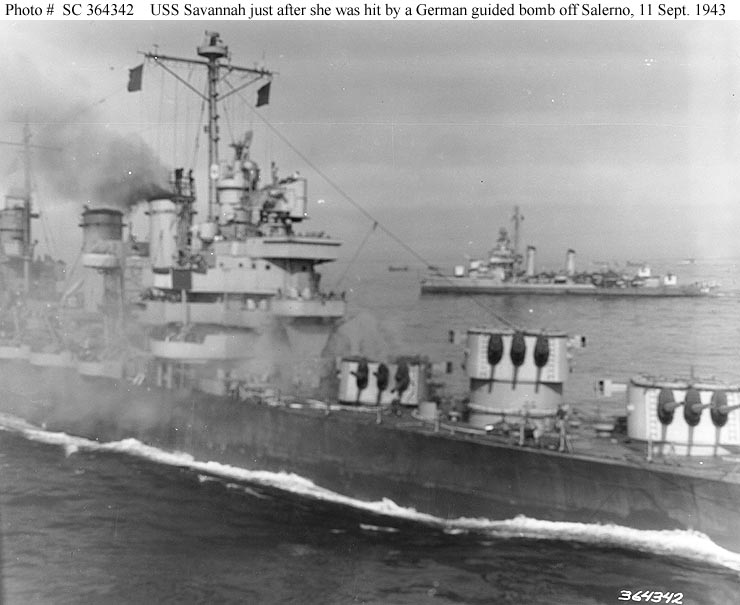
San Francisco (CA-38 Undamaged at Pearl Harbor, fought through Pacific war, most noted for actions at the Naval Battle of Guadalcanal fighting Japanese Battleship Hiei. Decommissioned 1946 and sold for scrap in 1959. San Francisco earned 17 battle stars during World War II. For her participation in the Naval Battle of Guadalcanal, she was awarded the Presidential Unit Citation. For the same action, three members of her crew were awarded the Medal of Honor: Lieutenant Commander Herbert E. Schonland, Lieutenant Commander Bruce McCandless , and Boatswain’s Mate 1st Class Reinhardt J. Keppler (posthumous). Admiral Daniel Callaghan was also awarded the Medal of Honor (posthumous).  During the November 1942 repair at Mare Island, it was necessary to extensively rebuild the bridge. The bridge wings were removed as part of that repair, and are now mounted on a promontory in Lands End, San Francisco at Golden Gate National Recreation Area overlooking the Pacific Ocean. They are set on the great circle course from San Francisco  to Guadalcanal.  The old ship’s bell is housed at the Marines Memorial Club in San Francisco.

Light Cruisers

Raleigh (CL-7) Heavily damaged by torpedo, repaired served throughout war mainly in North Pacific . Decommissioned 1945 and scrapped 1946

Detroit (CL-8) Undamaged and got underway during attack. Mainly served in North Pacific and on convoy duty earning 6 battle stars for WWII service, decommissioned and sold for scrap 1946

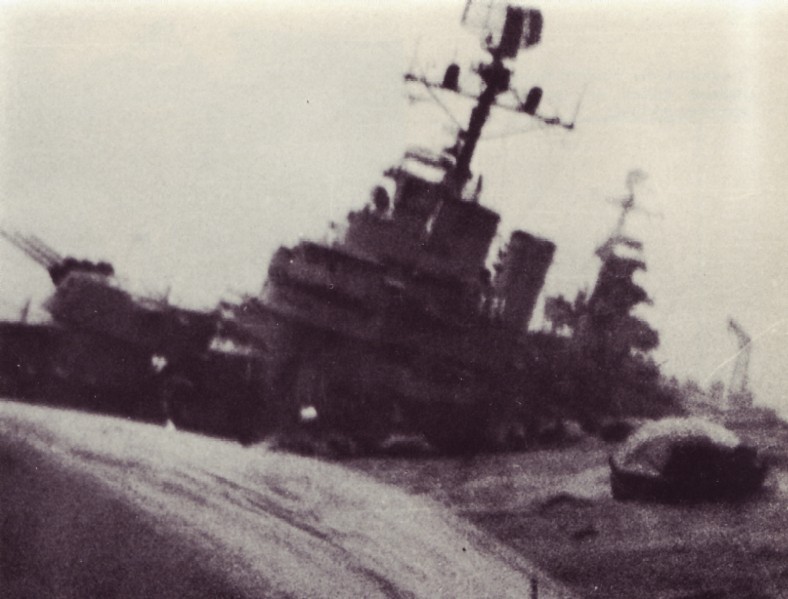
Phoenix (CL-46) Undamaged at Pearl Harbor and served throughout war and at the Battle of Surigo Strait she helped sink the Japanese Battleship Fuso.  She earned 9 battle stars for WWII service. Decommissioned 1946 and transferred to Argentina 1951. Served as General Belgrano and sunk by submarine HMS Conqueror on 2 May 1982 during the Falklands War.

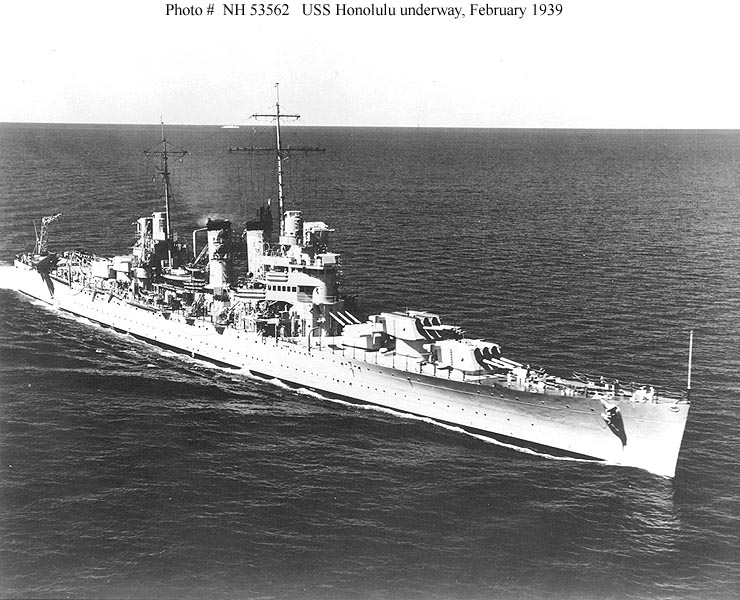
Honolulu (CL-48) Suffered minor hull damage from near miss. Served in Pacific and fought several engagements against Japanese surface forces in the Solomons. At the Battle of Kolombangara on the night of 12-13 July 1943 she was damaged by a torpedo but sank the Japanese Light Cruiser Jintsu. Earned 9 battle stars for WWII service, decommissioned 1947 and sold for scrap 1949

St. Louis (CL-49) St. Louis got underway at 0930 nearly torpedoed by Japanese midget sub. She served throughout war in numerous operations and was damaged at the Battle of Kolombangara. She earned 11 battle stars for WWII service. She decommissioned 1946 and transferred to Brazil where she was renamed Tamandare stricken in 1976 sold for scrap in 1980 but sank while under tow to Taiwan.

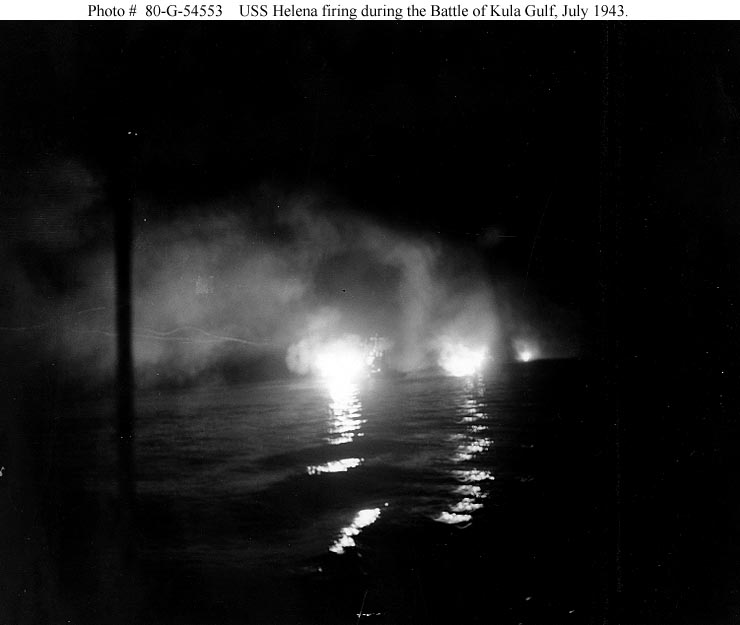
*Helena (CL-50) Damaged and repaired. Engaged in many battles around Solomon Islands where at the Battle of Cape Esperance at Guadalcanal she sank the Japanese Heavy Cruiser Furutaka and destroyer Fubiki. She was engaged during the Naval Battle of Guadalcanal and was sunk at Battle of Kula Gulf 6 July 1943.  She was the first ship to be awarded the Naval Unit Commendation and was awarded 7 battle stars for her WWII service.

Destroyers

Allen (DD-66) Undamaged during attack spent war in local operations in Oahu area. Decommissioned 1945 and scrapped 1946

Schley (DD-103) Being overhauled on December 7th was undamaged in attack. Converted into High Speed Transport (APD) in 1942, earned 11 battle stars for WWII service and decommissioned in 1945 and scrapped in 1946

Chew (DD-106) Undamaged during attack and conducted local operations in Oahu operations for remainder or war, decommissioned 1945 and scrapped 1946

*Ward (DD-139) Ward was underway patrolling Channel entrance to Pearl Harbor on December 7th, sank Japanese midget submarine. Converted to APD in 1943 and served in numerous operations prior to being heavily damaged by Japanese bombers at Ormoc Bay off Leyte in December 1944 starting fires that could not be controlled. She was sunk by USS O’Brien (DD-725) after survivors were rescued. By a strange twist of fate the C.O. of O’Brien LCDR Outerbridge who had commanded Ward when she sank the Japanese submarine at Pearl Harbor. Ward earned 10 battle stars for WWII service.

Dewey (DD-349) Being overhauled on December 7th Dewey served throughout the war earning 13 battle stars escorting carriers, convoys and supporting amphibious operations. Decommissioned October 1945 and sold for scrap 1946

Farragut (DD-348) Got underway during attack suffered minor damage from strafing. During the war she operated from the Aleutians to the South Pacific and Central Pacific escorting carriers and supporting amphibious operations. She earned 14 battle stars for WWII service. Decommissioned 1945 and sold for scrap 1947

*Hull (DD-350) Undamaged at Pearl Harbor she operated from the Aleutians to the South Pacific and Central Pacific escorting carriers and supporting amphibious operations. She earned 10 battle stars before sinking in “Halsey’s Typhoon” on 18 December 1944.

MacDonough (DD-351) MacDonough got underway during attack and was undamaged, during war served in North and Central Pacific escorting carriers and supporting amphibious operations. She earned 13 battle stars for her WWII service. Decommissioned October 1945 and sold for scrap 1946

*Worden (DD-352) Worden got underway during attack and went to sea with ships searching for Japanese strike force. Served at Midway and the South Pacific before being transferred to the Aleutians where she grounded on a pinnacle due to winds and currents at Constantine Harbor Amchitka Island on 12 January 193, she broke up in the surf and was written off as a total loss. Worden was awarded 4 battle stars for her WWII service.

Dale (DD-353) Dale got underway immediately under the command of her Command Duty Officer, an Ensign and joined ships searching for Japanese strike force. During war served in North and Central Pacific and took part in the Battle of the Komandorski Islands on 26 March 1943.  Earned 12 battle stars for WWII service, decommissioned October 1945 sold for scrap December 1946.

*Monaghan (DD-354)  Monaghan was the Ready destroyer on December 7th and ordered underway when Ward sank the midget submarine. On way out of harbor rammed, depth charged and sank a Japanese midget submarine that had gotten into Pearl Harbor. She participated in Coral Sea, Midway, Aleutians, the Battle of the Komandorski Islands and Central Pacific operations before sinking with the loss of all but 6 crewmen during the great Typhoon of November 1944 sinking on 17 November. She received 12 battle stars for her WWII service.

Aylwin (DD-355) Got underway within an hour of the beginning of the attack with 50% of her crew and four officers, all Ensigns manning her leaving her Commanding Officer and others behind in a launch as she was under direction not to stop for anything. This was captured in the movie In Harm’s Way. During the war Aylwin saw action at Coral Sea, Midway, Guadalcanal, the Aleutians, and the Central Pacific up to the Okinawa and due to the action of her crew survived the great typhoon of November 1944. She earned 13 battle stars for her WWII service and was decommissioned in October 1945. She was sold for scrap in December 1946.

Selfridge (DD-357) Manned by a crew from 7 different ships Selfridge got underway at 1300 and was undamaged in the attack. Throughout war she served primarily as an escort to carriers and transports. Torpedoed by Japanese destroyer and lost her bow at Battle of Vella Lavella on 6 October 1942. Repaired and finished war. Earned 4 battle stars for WWII service and was decommissioned in October 1945 and sold for scrap in December 1946.

Phelps (DD-360) Undamaged at Pearl Harbor Phelps was credited with shooting down one enemy aircraft. She was in action at Coral Sea, Midway, Guadalcanal, the Aleutians and the Central Pacific picking up 12 battle stars for her WWII service. Decommissioned in October 1945 and scrapped 1947.

Cummings (DD-365) Sustained minor damage from bomb fragments but got underway quickly. During war served on convoy escort, with fast carrier task forces and provided Naval Gunfire Support from the Aleutians to the Indian Ocean where she operated with the Royal Navy. On 12 August 1944, President Roosevelt broadcast a nationwide address from the forecastle of Cummings after a trip the Alaska. Cummings was decommissioned in December 1945 and sold for scrap in 1947.

*Reid (DD-369) Undamaged at Pearl Harbor Reid escorted convoys and amphibious operations throughout the Pacific until she was sunk by Kamikazes at Ormoc Bay in the Philippines on 11 December 1944. On 31 August 1942 she sank by gunfire the Japanese submarine RO-1 off Adak Alaska. She received 7 battle stars for her WWII service.

Case (DD-370) Undamaged at Pearl Harbor Case escorted the fast carrier task forces throughout much of the war as well as conducted Anti-Submarine Warfare operations and Naval Gunfire Support. She sank a Midget submarine outside the fleet anchorage at Ulithi on 20 November 1944 and a Japanese transport off of Iwo Jima on 24 December 1944. She earned 7 battle stars for her WWII service and was decommissioned in December 1945 and sold for scrap in December 1947.

Conyngham (DD-371) Undamaged during attack she was underway that afternoon. Spent most of war on convoy escort, escorting carrier task forces and conducting Naval Gunfire Support missions she was damaged twice by strafing Japanese aircraft she earned 14 battle stars for her WWII service. Used in 1946 Atomic Bomb tests and destroyed by sinking in 1948.

Cassin (DD-372) Destroyed in drydock but salvaged returned to service 1944 escorting convoys and TG 38.1 the Battle Force of the fleet at Leyte Gulf as well as supporting amphibious operations. She earned 6 battle stars for her WWII service.  Decommissioned December 1945 and sold for scrap 1947

Shaw (DD-373) Sustained massive damage due to magazine explosion, salvaged and repaired served throughout war and awarded 11 battle stars. Damaged by Japanese dive bombers off Cape Gloucester on 25 December 1943 with loss of 3 killed and 33 wounded. Decommissioned October 1945 and scrapped 1947

*Tucker (DD-374) Undamaged at Pearl Harbor Tucker conducted convoy escort operations and was sunk when she struck a mine escorting a transport to Espiritu Santo on 1 August 1942 sinking on 4 August. She received one battle star for her WWII service.

Downes (DD-375) Destroyed in drydock and salvaged. Decommissioned June 1942, rebuilt and recommissioned 1943. After she was recommissioned and used to escort convoys and conduct Naval Gunfire Support to amphibious operations. She earned 4 battle stars for her WWII service. Decommissioned 1947 and sold for scrap.

Bagley (DD-386) Undamaged at Pearl Harbor Bagley conducted convoy escort operations and supported amphibious landings throughout the Pacific earning 1 battle stars ended the war on occupation duty at the Sasebo-Nagasaki area until returning to the United States. She earned 12 battle stars for her WWII service and was decommissioned in June 1946 and sold for scrap in October 1947.

*Blue (DD-387) Blue was undamaged and got underway during the attack under the direction of 4 Ensigns.  Served on convoy escort duties, present at Battle of Savo Island on 9 August 192 and was torpedoed off Guadalcanal by Japanese destroyer Kawakaze on 21 August and was scuttled 22 August. She earned five battle stars for her WWII service.

Helm (DD-388) Helm was underway, nearing West Loch at the time of the attack. Helm served in the Solomons and the South Pacific until February 19. She joined the fast carrier task forces of 5th Fleet in May 1944. On 28 October at Leyte Gulf 28 October 1944 Helm and companion destroyer Gridley made sank the Japanese submarine I-46. She was used for a target during Operation Crossroads and scrapped in 1946. She received 11 battle stars for her WWII service.

Mugford (DD-389) Mugford was on standby status and had steam up which allowed her to get to sea during the attack in which she shot down Japanese aircraft. She spent much of 1942 on convoy duty between the U.S. and Australia. She took part in the Guadalcanal invasion and was struck by a bomb which killed 8 men, wounded 17 and left 10 missing in action. She would go on to serve in the Central and South Pacific being damaged by a near miss from a bomb on 25 December off Cape Gloucester and was stuck by a Kamikaze on 5 December 1944 in Surigo Strait. She escorted the fast carriers of TF 8 and 58 and later served on anti-submarine and radar picket duty. She decommissioned 1946 and was used in the Atomic Bomb tests and after use as a test ship for radioactive decontamination was sunk on 22 March 1948 at Kwajalein. She received 7 battle stars for her WWII service.

Ralph Talbot (DD-390) Ralph Talbot got underway by 0900 on the morning of the attack and joined other ships at sea attempting to find the Japanese strike force. She spent much of 1942 engaged in escort duties and took part in the Battle of Savo Island where she engaged the Japanese as part of the Northern Group and was damaged by Japanese shellfire. She spent the war in the South and Central Pacific escorting convoys and supporting amphibious operations and was damaged by a Kamikaze off Okinawa. She remained in service until 1946 when she was assigned to JTF-1 and the Operations Crossroads Atomic Bomb test. She survived the blast and was sunk in 198. She earned 12 battle stars for her WWII service.

*Henley (DD-391) Undamaged at Pearl Harbor Henley was already at General Quarters when the attack began because a new sailor sounded the General Quarters alarm instead of Quarters for Muster. As a result her weapons were manned. She got underway during the attack under the command of a junior Lieutenant and joined other ships patrolling outside of Pearl Harbor. Henley carried out convoy and anti-submarine patrols mainly around Australian continuing those duties through the Guadalcanal campaign. She was torpedoed and sunk by Japanese bombers on 3 October 1943 while conducting a sweep in support of troops ashore near Finshafen New Guinea. Henley earned 4 battle stars for her WWII service.

Patterson (DD-392) Patterson was undamaged during the attack and proceeded to sea conducting anti-submarine warfare patrols. She would spend the bulk of the war as an escort for fast carrier task forces. She was with the Southern Group during the Battle of Savo Island and suffered a hit on her #4 gun mount that killed 10 sailors.  She was awarded 13 battle stars for her WWII service. Decommissioned in November 1945 she was stricken from the Naval Vessel Register in 1947 and sold for scrap.

*Jarvis (DD-393) Jarvis survived Pearl Harbor undamaged and got underway to join other ships in patrols around Oahu.  She served as an escort for carriers and convoys and the invasion of Guadalcanal. She was heavily damaged by an aircraft launched torpedo during the landings but her crew made temporary repairs and restored power. She was ordered to Efate New Hebrides but evidently unaware of the order her Commanding Officer set sail for Sidney Australian and repairs from the Destroyer Tender USS Dobbin. She passed south of Savo Island as the Japanese cruiser force approached and refused assistance for the USS Blue.  She was last seen on the morning of 9 August 1942 by a scout plane from Saratoga. Already heavily damaged and having little speed, no radio communications and few operable guns was attacked by a force of 31 Japanese bombers sinking with all hands at 1300 on 9 August. Jarvis was awarded 3 battle stars for her WWII service.

Submarines

Narwhal (SS-167) Narwhal was one of a class of three large cruiser submarines that was built in the mid 1920s. Narwhal was 14 years old at the time of the attack. She was undamaged at Pearl Harbor and was used primarily to support special missions and special operations forces in raids against Japanese shore installations. Narwhal earned 15 battle stars for her service in the Pacific and was decommissioned in February 1945 and sold for scrap in May. Her 6” guns are enshrined at the Naval Submarine Base Groton.

Dolphin (SS-169) Undamaged in the Pearl Harbor attack Dolphin made 3 war patrols in late 1941 and early 1942 before being withdrawn from combat service and used for training due to her age. She was decommissioned in October 1945 and sold for scrap in 1946. She received 2 battle stars for her service in WWII.

Cachalot (SS-170) Undamaged at Pearl Harbor Cachalot conducted three war patrols damaging an enemy tanker before being withdrawn from combat service in the fall of 1942 being judged too old for arduous combat service. She served as a training ship until June 1945 and was decommissioned in October 1945 and sold for scrap in January 1947. She was awarded 3 battle stars for her WWII service.

Tautog (SS-199) Tautog was undamaged at Pearl Harbor and made the Japanese pay for not sinking her. She helped avenge the Pearl Harbor attack sinking 26 enemy ships of 71,900 tons including the submarines RO-30 and I-28 and destroyers Isoname and Shirakumo in 13 war patrols. She was withdrawn from combat service in April 1945 and served and operated in conjunction with the University of California’s Department of War Research in experimenting with new equipment which it had developed to improve submarine safety. She was decommissioned in December 1945. Spared from the Atomic Bomb tests she served as an immobile reserve training ship in the Great Lakes until 1957 and was scrapped in 1960.  Tautog was awarded 14 battle stars and a Naval Unit Commendation for her service in WWII.

Minelayer

Oglala (CM-4) Sank due to concussion from torpedo hit on Helena. Raised and repaired, converted to internal combustion repair ship. Decommissioned 1946 transferred to Maritime Commission custody and scrapped 1965

Minesweepers

Turkey (AM-13) Undamaged at Pearl Harbor she was redesignated as a Fleet Tug in 1942. She was decommissioned in November 1945 and sold for scrap in 1946. She received one battle star for her service at Pearl Harbor.

Bobolink (AM-20) Undamaged at Pearl Harbor and redesignated as an Ocean Going Tug in 1942. She decommissioned in 1946 and sold through the Maritime Administration. She received one battle star for her service at Pearl Harbor.

Rail (AM-26) Undamaged at Pearl Harbor Rail was redesignated as a Ocean Going Tug in June 1942. She supported operations throughout the Pacific earning 6 battle stars for her WWII service. She was decommissioned in 1946 and transferred to the Maritime Administration for disposal in 1947.

Tern (AM-31) Undamaged in the attack Tern was redesignated as an Ocean Going Tug in June 1942 and supported the fleet for the remainder of the war. She was decommissioned and struck from the Navy List in December 1945. She earned one battle star for her service at Pearl Harbor.

*Grebe (AM-43) Undamaged at Pearl Harbor Grebe was redesignated as an Ocean Going Tug in June 1942.  On 6 December 1942 Grebe grounded while attempting to float SS Thomas A. Edison at Vuanta Vatoa, Fiji Islands. Salvage operations were broken up by a hurricane that destroyed both ships 1-2 January 1943.

Vireo (AM-52) Undamaged at Pearl Harbor Vireo was designated an Ocean Going Tug in May 1942. At the Battle of Midway she was assisting USS Yorktown CV-5 when that ship was torpedoed by a Japanese submarine and sunk.  She was damaged in a Japanese air strike off Guadalcanal on October 15th 1942 abandoned but recovered by U.S. Forces and repaired supporting damaged fleet units. She was decommissioned in 1946 and disposed of by the Maritime Administration in 1947. Her final disposition is unknown. She was awarded 7 battle stars for her WWII service.

Coastal Minesweepers

Cockatoo (AMC-8) Undamaged at Pearl Harbor Cockatoo operated in the 14th Naval District from Pearl Harbor throughout the war. She was transferred to the Maritime Commission 23 September 1946.

Crossbill (AMC-9) Undamaged in the attack she operated in an in-service status attached to the 14th Naval District from 1941 to 1947.

Condor (AMC-14) Undamaged in the attack she operated in the Hawaiian Islands throughout World War II. Placed out of service 17 January 1946, she was transferred to the Maritime Commission for disposal 24 July 1946.

Reedbird (AMC-30) Undamaged during the attack she operated in Hawaiian waters throughout World War II. Then ordered inactivated, Reedbird returned to San Diego where she was stripped and placed out of service 14 January 1946. Her name was struck from the Navy list 7 February 1946 and on 8 November 1946 she was delivered to the Maritime Commission for disposal.

Light Minelayers (Note: All of these ships were WWI era “four piper” destroyers converted to Mine Warfare ships in the 1920s and 1930s)

*Gamble (DM-15) Gamble was undamaged at Pearl Harbor and served throughout the Pacific. On 29 August 1942 she sank Japanese submarine I-123 near Guadalcanal. On 6 May 1943 she mined the Blackett Strait with her sisters USS Preble and USS Breese. On the night of 7-8 May a Japanese destroyer force entered the minefield one of which Kurashio, went down and two others Oyashio and Kagero were sunk by Allied aircraft the next day. The sinking of Kagero provided a measure of revenge as that ship was part of the Japanese Carrier Strike Group that attacked Pearl Harbor. On 18 February 1945 Gamble was damaged by two bombs while operating off of Iwo Jima. Badly damaged she was towed to Saipan but salvage was impossible and she was decommissioned sunk off of Apra Harbor Guam on 16 July 1945. She was awarded 7 battle stars for her WWII service.

Ramsay (DM-16) Ramsey got underway during the attack and dropped depth charges in the vicinity of what was believed to be a midget submarine. She served in the Solomons and Aleutians and was redesignated as a Miscellaneous Auxiliary (AG-98) in 1944 operating around Pearl Harbor. She was decommissioned in October 1945 and scrapped in 1946. She received 3 battle stars for her WWII service.

*Montgomery (DM-17) Undamaged in the attack Montgomery conducted ASW operations in the wake of the attack. She operated throughout the Pacific until she was damaged by a mine while anchored off Ngulu on 17 October 1944. She was decommissioned on 23 April 1945 and sold for scrap in 1946. She was awarded 4 battle stars for her WWII service.

Breese (DM-18) Breese got underway during the attack and assisted in sinking a midget submarine. She was engaged throughout the war in the Pacific and operated with Gamble and Preble to mine the Blackett Strait in May 1943, an operation that resulted in the sinking of 3 Japanese destroyers. She was decommissioned and sold for scrap in 1946. She was awarded 10 battle stars for her WWII service.

Tracy (DM-19) Tracy was being overhauled during the attack and all machinery and armament was dismounted.  After the overhaul she operated around the Pacific and in February 1943 she Tracy, as task group leader, led Montgomery (DM-17) and Preble (DM-20) in laying a field of 300 mines between Doma Reef and Cape Esperance. That night, Japanese destroyer Makigumo struck one of these mines and was damaged so badly that she was scuttled. Tracy was decommissioned and scrapped in 1946. She received 7 battle stars for her WWII service.

Preble (DM-20) Preble was being overhauled on December 7th and took no part in the action. During the war she operated throughout the Pacific and in company with Gamble and Breese laid a minefield on 6 May 1943 which resulted in sinking 3 Japanese destroyers. She was redesignated as a Miscellaneous Auxiliary (AG-99) and she was regulated to convoy escort duties until the end of the war. She was decommissioned in December 1945 and sold for scrap in 1946. She was awarded 8 battle stars for WWII service.

Sicard (DM-21) Sicard was under overhaul at the Naval Shipyard during the attack. During the war she primarily served on convoy escort duty with and in some mine laying operations. She was reclassified a miscellaneous auxiliary, AG-100, effective 5 June 1945, decommissioned in December 1945 and sold for scrap in 1946. She was awarded 2 battle stars for her WWII service.

Pruitt (DM-22) Pruitt was being overhauled during the attack and served throughout the Pacific during the war. She was reclassified a miscellaneous auxiliary, AG-101, effective 5 June 1945, decommissioned November and stricken from the Navy List in December 1945 being scrapped at Philadelphia Naval Shipyard. She was awarded 3 battle stars for her WWII service.

High Speed Minesweepers (Note: All of these ships were WWI era “four piper” destroyers converted to Mine Warfare ships in the 1920s and 1930s)

Zane (DMS-14) Undamaged at Pearl Harbor Zane saw much service in the South and Central Pacific in WWII. She conducted minesweeping, convoy escort and ASW operations from Pearl Harbor to the Marianas campaign. She was damaged in a firefight with Japanese destroyers at Guadalcanal in 1942.  After the invasion of Guam she was reassigned to target towing duties. Reclassified from high-speed minesweeper to a miscellaneous auxiliary, AG-109, on 5 June 1945 she decommissioned in December 1945 and sold for scrap in 1946. She was awarded 6 battle stars and a Naval Unit Commendation for her service in WWII.

*Wasmuth  (DMS-15) Wasmuth was undamaged during the attack and spent 1942  conducting patrol and convoy escort duties in the Aleutians and the West Coast. On 27 December 1942 while escorting a convoy in heavy seas two of her depth charges were ripped off their racks and exploded under her fantail blowing off her stern.  Despite repair attempts her crew was evacuated and she sank on 29 December 1942. She was awarded one battle star for her service at Pearl Harbor.

Trever (DMS-16) Trever got underway during the attack without her Commanding Officer. During the war she saw extensive service. In 1945 she was regulated to training and local operations around Pearl Harbor. On 4 June 1945, she was reclassified as a miscellaneous auxiliary and designated as AG-110 and decommissioned in December 1945 and sold for scrapping in 1946. She received 5 battle stars for her WWII service.

*Perry (DMS-17) Perry got underway during the attack and was undamaged. During the war she engaged in numerous minesweeping and escort duties. She struck a mine during the Peleliu invasion off Florida Island and sank on 6 September 1944. She was awarded 6 battle stars for her WWII service.

Gunboat

Sacramento (PG-19) The elderly Sacramento was undamaged during the attack and participated in rescue and salvage operations after the attack. During the war she served as a tender for PT Boats and an air sea rescue vessel.  Sacramento was decommissioned on 6 February 1946 at Suisun Bay, Calif., and simultaneously transferred to the War Shipping Administration for disposal. She was sold on 23 August 1947 for mercantile service, initially operating under Italian registry as Fermina. She received one battle star for her service at Pearl Harbor.

Destroyer Tenders

Dobbin (AD-3) Dobbin received minor damage from a bomb burst alongside which killed 2 crewmembers.  During the war she would serve in the South Pacific supporting Pacific Fleet Destroyer Squadrons. She was decommissioned and transferred to the Maritime Administration in 1946. She was awarded one battle star for her service at Pearl Harbor.

Whitney (AD-4) Whitney was moored with a nest of destroyers during the attack and helped them prepare for sea during the attack issuing supplies and ammunition to help them get underway. Her sailors helped in repair and salvage operations on several ships during and after the attack.  She would provide vital support to destroyer squadrons during the war and serve until 1946 when she was decommissioned and transferred to the Maritime Administration and scrapped in 1948. She received one battle star for her service at Pearl Harbor.

Seaplane Tenders

Curtiss (AV-4) Damaged by bomb and repaired. She served throughout the war and was damaged by a  Kamikaze in 1945 while operating off Okinawa. Repaired she finished the war and served on active duty until 1956 when she was decommissioned and placed in reserve. She was scrapped 1972. Curtiss received 7 battle stars for her WWII service.

Tangier (AV-8) Moored just past the USS Utah Tangier was undamaged in the attack and contributed her guns to the air defense as well as shooting at a Japanese midget submarine that had penetrated the harbor. She maintained a very active operational carrier in the Pacific. Decommissioned in 1946 Tangier was sold for scrap in 1961. She earned 3 battle stars for her WWII service.

Seaplane Tenders (Small)

Avocet (AVP-4) Undamaged at Pearl Harbor Avocet Avocet served in the Alaskan and Aleutian theatres of operations as a unit of Patrol Wing 4. During the years, she tended patrol squadrons, transported personnel and cargo, and participated in patrol, survey, and salvage duties. She was decommissioned in December 1945 and sold in 1946. She received one battle star for her service at Pearl Harbor.

Swan (AVP-7) Swan was on the Marine Railway drydock during the attack and was undamaged. During the war she was primarily used on target towing duties. She was decommissioned in December 1945 and disposed of by the Maritime Commission in 1946. She received one battle star for her service at Pearl Harbor.

Seaplane Tenders (Destroyer) (Note: All of these ships were WWI era “four piper” destroyers converted to Seaplane Tenders in the 1920s and 1930s)

Hulbert (AVD-6) Hulbert was undamaged during the attack and spent 1942-1943 conducting support missions for flying boats. Reclassified DD-342 she was used as an escort and plane guard for new Escort Carriers at San Diego until the end of the war. She was decommissioned in November 1945 and sold for scrap in 1946. She received 2 battle stars for her WWII service.

*Thornton (AVD-11) Thornton contributed her guns to the defense of Pearl Harbor and served in varying locales in the Pacific supporting the operations of flying boats. She was lost during the Okinawa invasion when collided with Ashtabula (AO-51) and Escalante (AO-70). Her starboard side was severely damaged. She was towed to Kerama Retto. On 29 May 1945 a board of inspection and survey recommended that Thornton be decommissioned, beached stripped of all useful materiel as needed, and then abandoned. She was beached and decommissioned on 2 May 1945. Her name was struck from the Navy list on 13 August 1945. In July 1957, Thornton’s abandoned hulk was donated to the government of the Ryukyu Islands. She received 3 battle stars for her WWII service.

Ammunition Ship

Pyro (AE-1) Pyro was undamaged in the attack and served the war transporting ammunition to naval bases around the Pacific. She was decommissioned in 1946 and scrapped in 1950. She was awarded one battle star for her service at Pearl Harbor.

Oilers

Ramapo (AO-12) Ramapo was not damaged at Pearl Harbor and due to her slow speed was regulated to fuel transport operations between the Aleutians and the Puget Sound. She was decommissioned in 1946 and transferred to the Maritime Administration.

*Neosho (AO-23) Undamaged during the attack her Captain alertly moved her from her berth near Battleship Row to a less exposed part of the harbor.  She operated with the carrier task forces and was heavily damaged at the Battle of Coral Sea by Japanese aircraft. Her crew kept her afloat for 4 days until she was discovered and her crew rescued before she was sunk by gunfire from USS Henley on 11 May 1942. Neosho was awarded 2 battle stars for her WWII service.

Repair Ships

Medusa (AR-1) Medusa was undamaged at Pearl Harbor and spent the war throughout the South Pacific repairing numerous vessels damaged in combat. After the war she served to prepare ships for inactivation before being decommissioned in 1947 and turned over to the Maritime Administration. She was scrapped in 1950. She received one battle star for her service at Pearl Harbor.

Vestal (AR-4) Vestal was damaged while moored adjacent to USS Arizona. Repaired following the attack Vestal served throughout war in the Pacific and was vital during the critical days of 1942 when she and her crew performed valiant service on major fleet units damaged during the Guadalcanal campaign and actions around the Solomon Islands. Carriers Enterprise and Saratoga, battleships South Dakota and North Carolina, cruisers San Francisco, New Orleans, Pensacola and St. Louis were among the 5,603 jobs on 279 ships and 24 shore activities that she completed in a 12 month tour at Espiratu Santo. She would continue to perform this level of service the remainder of the war. During a stint at Ulithi she completed 2,195 jobs for 149 ships including 14 battleships, 9 carriers, 5 cruisers and 5 destroyers.  She continued her vital work even after the war into 1946 when she was finally decommissioned.  She was sold for scrap in 1950. She received 1 battle star for her service at Pearl Harbor.

Rigel (AR-11) Rigel was at Pearl Harbor completing her transformation from Destroyer Tender to Repari Ship. She incurred minor damage and she served throughout the war conducting vital repairs to numerous ships. She was decommissioned and transferred to the Maritime Administration in 1946.  Her ultimate fate is unknown. She was awarded 4 battle stars for her WWII service.

Submarine Tender

Pelias (AS-14) Undamaged during the attack Pelias supported submarine squadrons based in the Pacific throughout the war. She was placed in commission in reserve 6 September 1946, and in service in reserve 1 February 1947. On 21 March 1950 she was placed out of service in reserve but later performed berthing ship duty at Mare Island until she decommissioned 14 June 1970. She was scrapped in 1973.

Submarine Rescue Ship

Widgeon (ASR-1) Widgeon conducted salvage, rescue and fire fighting operations on the sunk and damaged battleships on battleship row. During the war she served as the duty submarine rescue ship at Pearl Harbor and San Diego.  After the war she supported the Operation Crossroads. She was decommissioned and sold for scrap in 1947. She received on battle star for her service at Pearl Harbor.

Hospital Ship

Solace (AH-5) Solace was undamaged in the attack and provided medical care to many of the wounded after the attack. She served throughout the war caring for the wounded and dying in the Gilberts, the Marshalls, Guam, Saipan, Palau, Peleliu, Iwo Jima and Okinawa.  Solace was decommissioned at Norfolk on 27 March, struck from the Navy list on 21 May, and returned to the War Shipping Administration on 18 July 1946. She was sold to the Turkish Maritime Lines on 16 April 1948 and renamed SS Ankara, rebuilt as a passenger liner. SS Ankara was laid up in 1977 and scrapped at Aliaga, Turkey, in 1981. Solace received seven battle stars for World War II service.

Cargo Ship

Vega (AK-17) Vega was at Honolulu offloading ammunition when the attack occurred. She served in the Aleutians and in the Central Pacific during the war. Decommissioned and scrapped in 1946. She received 4 battle stars for her WWII service.

General-Stores-Issue Ships

Castor (AKS-1) Castor was strafed by Japanese aircraft during the attack but suffered little damage. She would go on to an illustrious career in WWII, Korea and Vietnam before being decommissioned 1968 and scrapped in Japan in 1969. She was awarded three battle stars for World War II service, two for Korean War service and six campaign stars for Vietnam War service.

Antares (AKS-3) Antares was at the Pearl Harbor entrance and spotted a midget submarine. She reported the contact to the USS Ward which sank the sub.  During the war Antares made many supply runs in the Pacific and was at Okinawa. Sailing from Saipan to Pearl Harbor she was attacked by the Japanese submarines I-36, whose torpedoes missed their target and the kaiten-carrying I-165. She opened fire on one of the subs forcing it to dive. She was decommissioned in 1946 and sold for scrap in 1947. She was awarded 2 battle stars for her WWII service.

Ocean-going Tugs

Ontario (AT-13) Undamaged at Pearl Harbor Ontario would support operations in the Pacific throughout the war. She was decommissioned in 1946 and sold in 1947. She received one battle star for her service at Pearl Harbor.

Sunnadin (AT-28) Undamaged in the attack she operated at Pearl Harbor for the duration of the war. She was decommissioned in 1946 and transferred to the Maritime Administration. Her final disposition is unknown. She was awarded one battle star for her service during the Pearl Harbor attack.

Keosanqua (AT-38) Keosanqua was at the Pearl Harbor entrance preparing to transfer a tow from the USS Antares. She took the tow to Honolulu during the attack. She operated at Pearl Harbor and in the Central Pacific conducting towing operations. She was decommissioned in 1946   ransferred to the Maritime Commission 11 July for disposal, she was sold the same day to Puget Sound Tug & Barge Co., Seattle, Wash. Resold to a Canadian shipping firm in 1948, she was renamed Edward J. Coyle. In 1960 she was renamed Commodore Straits.

*Navajo (AT-64) Navaho was 12 miles outside Pearl Harbor entrance when the attack occurred. She operated in the South Pacific until 12 December 1942 when she was torpedoed and sunk by the Japanese submarine I-39 while towing gasoline barge YOG-42 150 miles east of Espiritu Santo, 12 December 1943 with the loss of all but 17 of her crew of 80.  She earned 2 battle stars for her WWII service.

Miscellaneous Auxiliaries

*Utah (AG-16 ex-BB-31) Sunk at her moorings and righted 1944 but not raised, wreck is now a memorial at Ford Island.

Argonne (AG-31) Argonne was undamaged during the attack and served in a variety of capacities during the war supporting operations in the Pacific. For a time she was Admiral Halsey’s flagship as Commander Southwest Pacific in 1942 during the Guadalcanal Campaign.  On 10 November 1944, Argonne lay moored to a buoy in berth 14, Seeadler Harbor, when the ammunition ship Mount Hood (AE-11) blew up, 1,100 yards away causing damage to her and other ships which she assisted after the explosion. She was decommissioned in 1946 and transferred to the Maritime Administration. She was scrapped in 1950. Argonne was awarded one battle star for her service at Pearl Harbor.

Sumner (AG-32) Sumner was undamaged during the attack and was redesignated as a Survey Ship AGS-5. She was damaged by a Japanese shell off Iwo Jima on 8 March 1945. She was decommissioned in 1946 and transferred to the Maritime Administration. She was awarded 3 battle stars for her WWII service.

15 Comments

Filed under History, Military, Navy Ships, world war two in the pacific

Forgotten on the Far Side of Ford Island: USS Utah, USS Detroit, USS Raleigh and USS Tangier

USS Utah BB-31 in 1920s

When you visit Pearl Harbor most eyes are drawn to the USS Missouri and the USS Arizona Memorial on Battleship Row.  On the mooring quays the names of the Battleships California, Oklahoma, Maryland, West Virginia, Tennessee and Arizona mark the places where the proud Battle Force of the U.S. Pacific fleet was moored on the fateful morning of December 7th 1941.  Movies such as Tora! Tora! Tora!, In Harm’s Way and Pearl Harbor have recorded the attack in varying degrees of accuracy for audiences worldwide in the 1960s, 1970s and 2000s. All record the attack on Battleship row and the attacks on the Army Air Corps at Hickam Field but all overlook the former battleship moored on the west side of Ford Island, the two elderly light cruisers and the Seaplane Tender moored nearby.

USS Utah AG-16 in 1935

Of course these ships hold little interest to most people, they were elderly, Utah had been converted to a gunnery training ship years before and the Omaha Class light cruisers Raleigh and Detroit were obsolescent and after Pearl Harbor would serve in the backwaters of the Pacific war.  The Tangier a new Seaplane Tender occupied the berth aft of Utah.


The USS Utah AG-16, ex-BB-31 was one of the early U.S. Navy Dreadnought battleships of the Florida Class. Utah was 521 feet long, displaced 21,825 tons and mounted 10 12” guns making her comparable to British Dreadnoughts of the Neptune and Colossus class and slightly inferior to the German Helgoland class.  Utah was commissioned on 31 August 1911 and served at the Vera Cruz incident where a Naval “battalion” of 17 officers and 371 her prevented the delivery of arms from Germany to Mexican dictator Victoriano Huerta.  The in the clash with Huerta’s forces the sailors distinguished themselves earning 7 Congressional Medals of Honor.

Utah served as part of the U.S. Battle Squadron sent to operate with the Royal Navy operating out of Ireland conducting convoy protection missions and preparing to engage the German High Seas Fleet if called upon.  Utah served from 1919-1931 as a battleship conducting training and goodwill missions to Europe and South America before being converted to a gunnery training and target ship (AG16) in 1931 per the stipulations of the Washington Naval Conference. In 1941 she was modernized and equipped with weapons being installed on modern destroyers before resuming training duties with the fleet at Pearl Harbor.

On the morning of December 7th Utah was moored on the West side of Ford Island and at colors the ship was struck by a torpedo forward and began to heal to port. With the flooding causing the list to increase the senior officer on the ship, LCDR Isquith the Chief Engineer ordered Utah abandoned and while most of the crew was able to escape some were trapped below including Chief Water Tender Peter Tomich who remained below to ensure that the boilers were secured and his sailors safely out of the boiler rooms.  Tomich was awarded the Congressional Medal of Honor for his sacrifice.  By 0812 the mooring cables had snapped and Utah lay on her beam sinking into the harbor her war over.  6 Officers and 58 crewmen died the majority trapped in the ship.  The ship would be partially righted to clear an adjacent berth in 1944.

The Raleigh and Detroit were Omaha Class Light Cruisers 555 feet long, displacing 7050 tons and mounting 12 6” guns and 10 21” torpedo tubes and were capable of 3 knots. This made them more heavily armed than the contemporary Japanese Nagara Class or the British C, D  or E Class light cruisers and larger than all but the two ship E Class. However by the beginning of the war they were inferior to all newly constructed ships.

USS Raleigh CL-7 fighting to stay afloat

The cruiser Raleigh took a torpedo that caused her to list so sharply that it was feared she would capsize, however the heroic efforts of her crew and service force craft and sailors kept her afloat and allowed her to fight another day. Most of her war would be fought in the Aleutians and following the war she would be decommissioned and scrapped.

USS Detroit CL-8 1945, final configuration

Detroit was able to get underway during the attack and avoid damage to join other ships which had escaped to form an ad hoc task group to find the Japanese strike force.  She would also serve in the Aleutians through 1944 when she became flagship of the Replenishment Group servicing the U.S. Carrier Task Forces of the 3rd and the 5th Fleets. She would be present in Tokyo Bay for the signing of the peace treaty ending the war. She too would be decommissioned and scrapped shortly after the war.

Tangier would serve in many parts of the Pacific as a mobile base for PBY Catalina’s which conducted reconnaissance, anti-submarine and search and rescue operations in support of the fleet for the duration of the war. She was decommissioned in 1947 and sold for scrap in 1961.

USS Utah Memorial (Google Earth)

Today a monument is located on Ford Island near the rusting hulk of the Utah. It replaced a bronze plaque which had been placed on the wreck in the late 1940s. The Memorial was officially dedicated on Memorial Day 1972.  The monument is not listed on most tourist brochures and the memorial attracts few visitors. I was able to visit the memorial in 1978 while on a Navy Junior ROTC Cadet Cruise to Pearl Harbor and back.  The official USS Utah association website is linked here: http://ussutah.org/ and the Historical Naval Ships Association webpage on Utah is here: http://hnsa.org/ships/utah.htm and the Naval History and Heritage Webpage is here: http://www.history.navy.mil/photos/sh-usn/usnsh-u/bb31-y.htm

The Raleigh, Detroit and Tangier have no memorials.  Despite the anonymity of these ships and the men who served on them they all played a role in the war and they should not be forgotten.

Peace

Padre Steve+


33 Comments

Filed under History, Military, Navy Ships, world war two in the pacific

High Stakes Game of Chicken on the Korean Peninsula

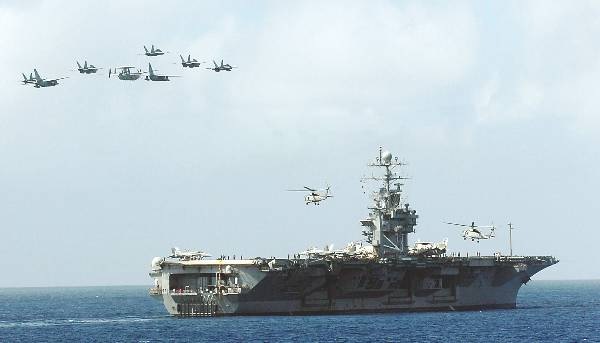
The USS George Washington and her Battle Group arrived in the Yellow Sea

The game is on.  The U.S. Navy and South Korean Navy task forces are moving into position, the South Korean Military is on its highest peacetime alert and the North Korean military is moving fresh batteries of Surface to Air and Ground to Sea missiles into place.  While diplomats from the United States, China and Japan seek to avert a war the North Koreans continue to stoke the fire with fresh artillery fire near Yeonpyeong Island which it brutally attacked earlier in the week.  In the South popular protests are rising against any soft treatment of the North and the commanding General of the South Korean Marine Corps Maj. Gen. You Nak-jun attended the funeral for the two Korean Marines killed in the attack said “Our marine corps … will carry out a hundred- or thousand-fold,” retaliation against North Korea for launching Tuesday’s attack, You said, without elaborating as to what he meant by the comment. The Defense Minister Kim Tae-young resigned after the attack on Yeonpyeong Island, and veterans of the South Korean military protested Saturday in Seoul, stating they were angry that the South Korean government had not done enough to respond to the North’s shelling.

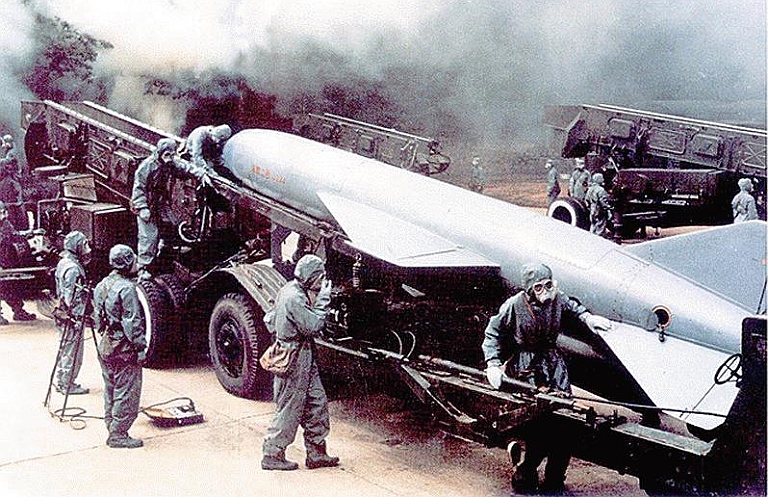
Silkworm Missile being fueled

North Korean rhetoric continues to rise in its belligerence and a North Korean State Committee for the Peaceful Reunification of Korea, the state agency in charge of relations with the South said in a statement carried by the North Korean Central News Agency (KCNA):  “Gone are the days when verbal warnings are served only, escalated confrontation would lead to a war,” and that the North Korean military was “getting fully ready to give a shower of dreadful fire and blow up the bulwark of the enemies if they dare to encroach again upon the North’s territory.”  The KCNA also said “If the U.S. brings its carrier to the West Sea of Korea at last, no one can predict the ensuing consequences.”

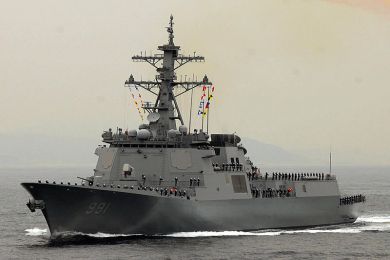
South Korean Aegis DDG

The defense drills begun today by United States and South Korean forces in the Yellow Sea involve the carrier USS George Washington as well as the Aegis Cruisers USS Cowpens and USS Shiloh and the Guided Missile Destroyer USS Stethem. South Korea has deployed one of its Aegis destroyers and two destroyers as well as frigates and anti-submarine aircraft.

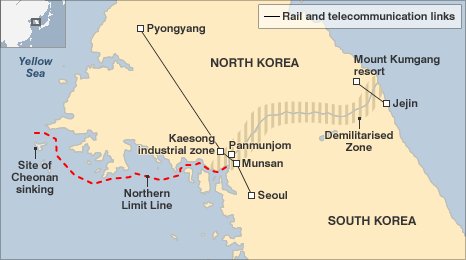
North Korean forces have brought in SA-2 SAM batteries which an anonymous South Korea government source says “appear to be targeting our fighter jets that fly near the Northern Limit Line.” The source also reported that the South Korean “military is preparing for the possibility of further provocations as the North Korean military has deployed firepower near the NLL and is preparing to fire.”

Additionally the North is mounting C-201 Silkworm Ground to Sea anti-ship missiles on launchers along the coast in the disputed area which also hosts bases for submarines like the one that is believed to have sunk the South Korean Corvette Cheonan in March as well as fast attack craft mounting Styx anti-ship missiles.  If they were to attack the task force the North would likely attempt a saturation attack using ground and sea based SSMs against the Allied ships, however the task force includes at least 4 Aegis equipped guided missile cruisers and destroyers is well equipped to meet that threat.

The situation is tense and no one really knows exactly how it will develop is yet unseen but it will not take much to provoke a conflict that could engulf the region.

Peace,

Padre Steve+


3 Comments

Filed under Korean Conflicts, Military, national security, Navy Ships, US Navy

100 Years of Navy Aviation: Part One the Aircraft Carriers

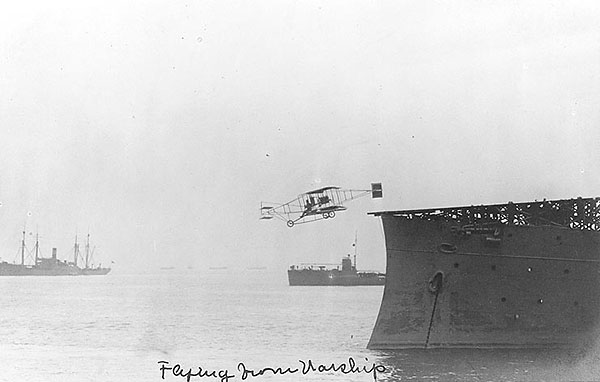
Eugene Ely makes the first takeoff from USS Birmingham on November 14th 1910

On a blustery November 14th in the year 1910 a young civilian pilot hailing from Williamsburg Iowa became the first man to fly an aircraft off the deck of a ship.  At the age of 24 and having taught himself to fly barely 7 months before Eugene Ely readied himself and his Curtis biplane aboard the Cruiser USS Birmingham anchored just south of Fort Monroe in Hampton Roads.  Ely was there because he was discovered by Navy Captain Washington Irving Chambers who had been tasked with exploring how aircraft might become part of Naval Operations. Chambers had no budget or authority for his seemingly thankless task but hearing that a German steamship might launch and aircraft from a ship hustled to find a way to stake a claim for the U.S. Navy to be the first in flight. Weather was bad that day as is so typical for Hampton Roads in November and between rain squalls Ely decided to launch even though Birmingham did not have steam up to get underway to assist the launch.  Ely gunned the engine and his biplane rumbled down the 57 foot ramp and as he left the deck the aircraft nosed down and actually make contact with the water splintering the propeller and forcing him to cut the flight short and land on Willoughby Spit about 2 ½ miles away not far from the southern entrance to the modern Hampton Roads Bridge Tunnel is.  Chambers would talk Ely into making the first landing on a Navy ship the Armored Cruiser USS Pennsylvania in San Francisco Bay on January 18th 1911.  Ely died in a crash at the Georgia State Fairgrounds on October 11th 1911.

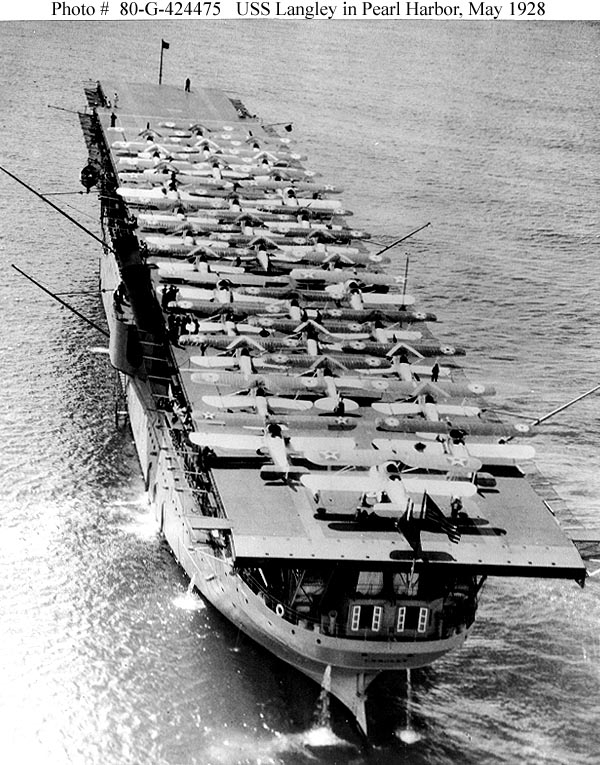
USS Langley CV-1

The Naval was slow to build upon the early achievements and the British and France would commission Aircraft Carriers well before the USS Langley CV-1 a converted Collier was commissioned.  After Langley the Navy commissioned the converted Battlecruisers USS Lexington CV-2 and USS Saratoga CV-3 in the mid 1920s.

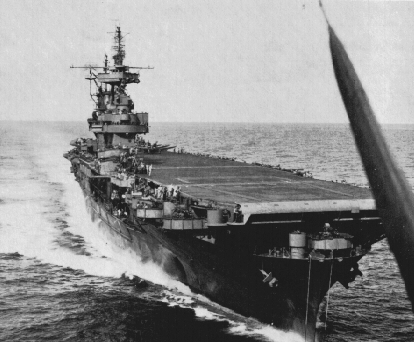
USS Lexington CV-2 October 1941

The three ships formed the nucleus of the Navy’s embrace of aviation and the pilots that they trained and the experience gained would be the foundation of the Navy’s success in the Second World War.  They would be joined by the USS Ranger CV-4 the first U. S. Navy Carrier designed as such from the keel up in 1934.

USS Enterprise CV-6

In 1937 the Navy commissioned the first of its true Fleet Carriers the USS Yorktown CV-5 which was followed by the USS Enterprise CV-6 in 1938, the USS Wasp CV-7 an improved version of Ranger in was commissioned in 1940 and the USS Hornet CV-8 in 1941.   These ships would bear the brunt of US Navy operations in the first year of the war following the disaster at Pearl Harbor. Of these ships only the Enterprise and Saratoga would survive the first year of the war in the Pacific.  Langley now a Seaplane Carrier was sunk during the Battle of the Java Sea in February 1942. Lexington would go down at Coral Sea in May 1942.  Hornet would launch the Doolittle Raid against Japan on April 18th 1942.  Yorktown, Enterprise and Hornet would take on and defeat the Japanese Carrier Strike force and sink the Akagi, Kaga, Soryu and Hiryu at Midway to avenge Pearl Harbor. Yorktown was sunk in the battle but Midway stopped the Japanese advance in the Pacific.

The U. S. went on the offensive in August invading Guadalcanal in the Solomons Islands. The Guadalcanal campaign and the numerous sea battles in the adjacent waterways would claim many American and Japanese ships. Wasp was sunk by a Japanese submarine on September 15th 1942 and Hornet was sunk at the Battle of Santa Cruz on 27 October 27th 1942.  Saratoga spent much of 1942 in the yards having been torpedoed twice leaving the often battered Enterprise as the sole U. S. Navy Carrier facing the Japanese until Saratoga was repaired and the first of the Essex Class Fleet Carriers and Independence Class Light Fleet Carriers entered service and arrived in the Pacific.

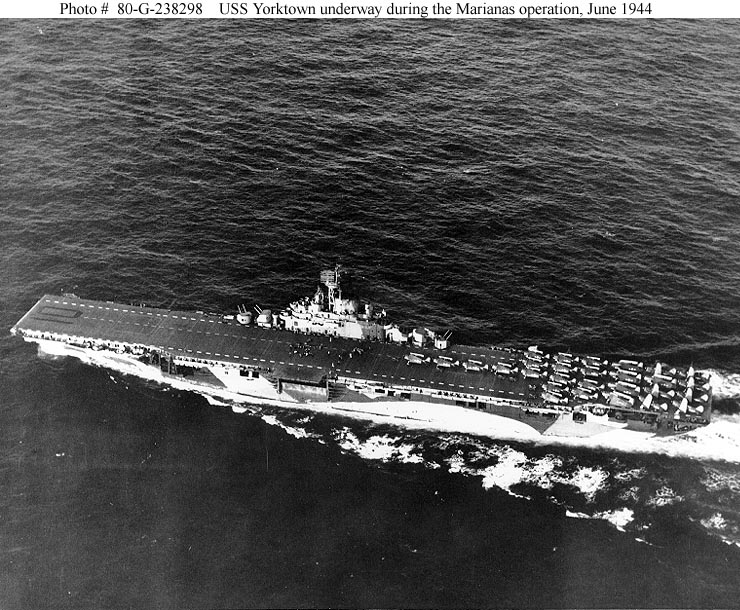
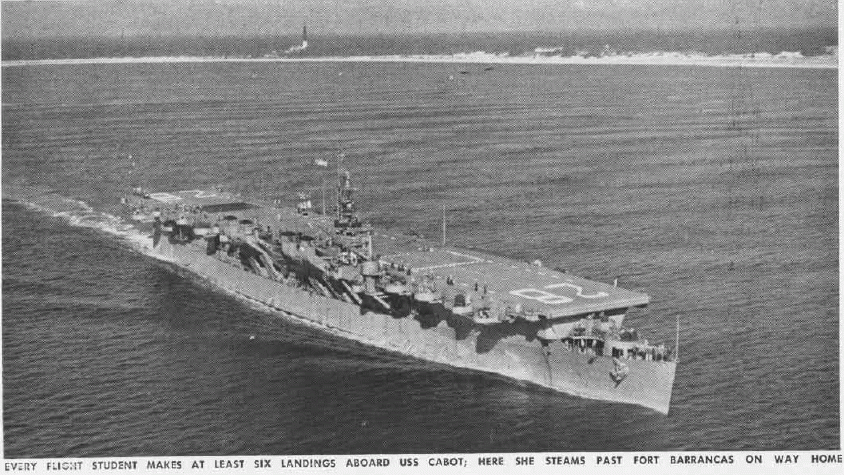
USS Yorktown CV-10 1944 a good example of the wartime Essex class ships  below USS Cabot CVL-28 an Independence Class Light Fleet Carrier


The Essex Class ships became the nucleus of the Fast Carrier Task Forces in the Pacific and with their smaller consorts of the Independence Class would dominate operations at sea from 1943 on.  The Essex class would eventually number 24 ships with several more canceled before completion becoming the most numerous of any class of Fleet Carriers produced by the U. S. Navy.  The Essex class would figure prominently in all offensive operations including the Battle of the Philippine Sea, Battle of Leyte Gulf, the campaigns at Iwo Jima and Okinawa and raids on the Japanese home islands.  In the process they and their air groups would be instrumental in sinking hundreds of Japanese ships including the Battleships Yamato and Musashi and destroying thousands of aircraft.  A number were heavily damaged by Kamikazes but none were lost with the epic story of the USS Franklin CV-13 and her survival after being hit by two bombs from a Japanese plane that slipped through the Combat Air Patrol. The resultant explosions and fires amongst her fueled and armed aircraft nearly sank her but for the heroic efforts of her crew including Chaplain Joseph O’Callahan who won the Medal of Honor caring for the wounded and dying and directing damage control teams. The ship lost 724 men killed and 265 wounded in the attack but survived though without power and dead in the water 50 miles off the Japanese coast.

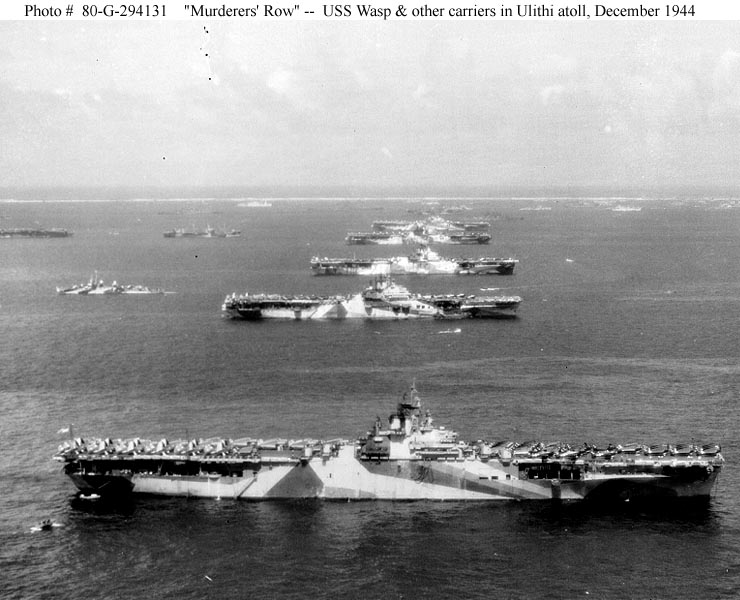
Murderers’ Row

The Essex class were iconic and the ships etched their names in naval history. The Essex, Yorktown, Hornet, Wasp, Hancock, Ticonderoga, Franklin, Bunker Hill, Intrepid, Lexington and the other ships of the class had legendary careers. These ships became known as “Murderers’ Row” for their expertise in killing off Japanese ships and aircraft.  Fittingly four of the ships, the Hornet, Yorktown, Lexington and Intrepid have found a second life as museum ships and Oriskany was sunk as an artificial reef off the coast of Florida where she is a favorite of recreational divers.

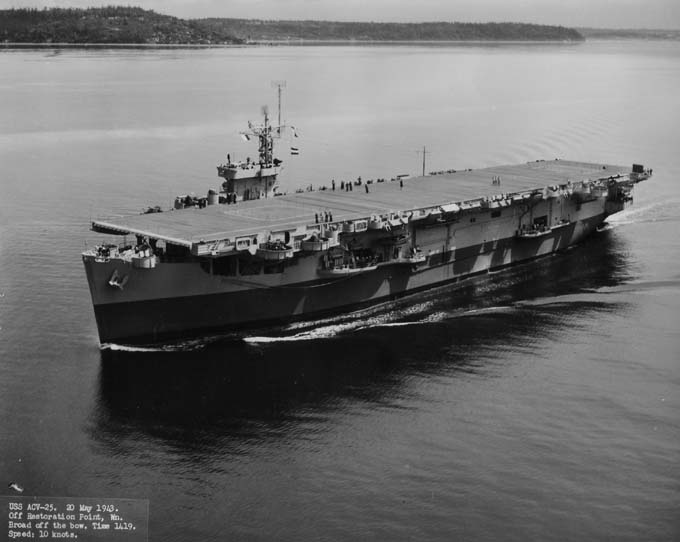
USS Croatan CVE-25 a Bogue Class Escort Carrier

During the war the Navy also built 118 Escort Carriers converted from merchant ships for use as convoy escorts, anti-submarine warfare and close air support for amphibious operations. 38 of these ships saw service in the British Royal Navy during the war.

USS Hancock CVA-19 in 1969 showing the extent of the modernizations that brought the Essex Class into the jet age

In the post World War II drawdown many carriers were decommissioned and the oldest, the Saratoga and Ranger disposed of.  The three ship Midway class entered service after the war and incorporated design improvements learned from combat operations in the war. As the Navy entered the jet era it was found that the existing carriers would need significant modernization to handle the new aircraft. Among the improvements made to the Midway and Essex class ships was the angled flight deck, steam catapults, hurricane bows and improved landing systems.  These improvements allowed these World War II era ships to remain front line carriers into Vietnam and in the case of the USS Midway and USS Coral Sea into the 1990s.

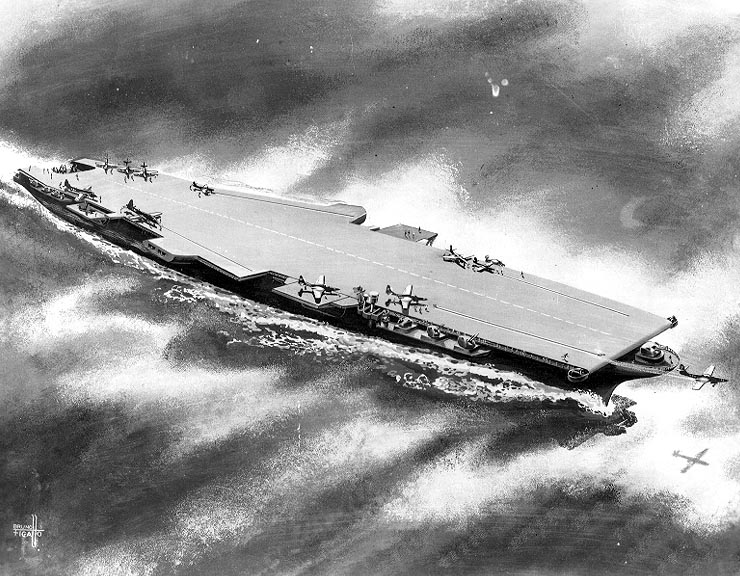
Artists’ conception of USS United States CVA-58 a victim of Truman Era Air Force politics

The Navy began its first super-carrier the USS United States in 1949 but the ship and class was cancelled by Secretary of Defense Louis A. Johnson, not a fan of the Navy or Marine Corps due to opposition by the Army and the newly founded Air Force.  The ship would have carried 12-18 nuclear capable bombers as well as 45-50 jet fighters and attack aircraft and been 1090 feet long and displaced 65,000 tons.  It would not be until after the Korean War that the Navy would begin construction of its first super-carriers.

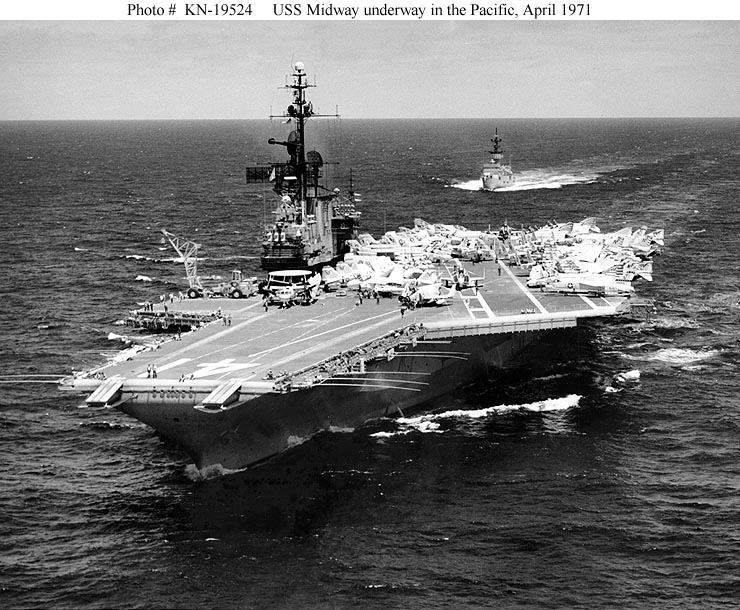
USS Midway CVA-41 in 1971

During the Korean War most of the Essex class ships were called back into service with 15 modified to conduct jet operations while others were converted to serve as ASW Carriers and Helicopter Carriers (LPH) to support Marine amphibious forces. Likewise the Midway’s were modernized as the Navy began to construct the four-ship Forrestal Class which were 1036 feet long and displaced 56,000 tons and designed to carry 100 aircraft. The four ships, Forrestal CVA-59, Saratoga CVA-60, Ranger CVA-61, and Independence CVA-62 would all serve into the early 1990s before being decommissioned. In the past few months Forrestal and Saratoga have begun the journey to be scrapped, sold for a penny each to scrapyards in Brownsville, Texas.

USS Ranger CVA-61

They were all heavily involved in the Vietnam War on Yankee and Dixie Station and both the Atlantic and Pacific during the Cold War. All four have been stricken from the Navy List and are awaiting disposal.  Forrestal was programmed as an artificial reef but she, like Saratoga which had been on donation hold was approved for scrapping. Ranger is still on donation hold and the USS Ranger Foundation is attempting to raise the money to save her. Independence which had been programmed as an artificial reef project was approved for scrapping in 2008.In the past few months Forrestal and Saratoga began the journey to be scrapped in 2014, sold for a penny each to scrapyards in Brownsville, Texas.

USS John F Kennedy CV-67 a modified Kitty Hawk class ship

These ships were followed by the Kitty Hawk class consisting of Kitty Hawk CVA-63, Constellation CVA-64, America CVA-66 and John F. Kennedy CVA-67 which were improved versions of the Forrestal Class with a 60,100 ton displacement and 1047 foot length with the ability to carry 100 aircraft. Kitty Hawk had the distinction of being the last fossil fuel carrier in active U. S. Navy service being decommissioned and placed in reserve in 2009. Her sister the Constellation CV was decommissioned in December 2003 and in 2008 was programmed to be scrapped in the next five years.  America was decommissioned in 1996 after not being given a Service Life Extension Program (SLEP) refit in the 1990s due to budget cuts.  America was involved in much of the Cold War, Gulf War and Vietnam including responding to the Israeli attack on the USS Liberty in 1967, the Intervention in Lebanon in 1983 and the conflict with Libya in the Gulf of Sidra in 1985.  She was sunk as a test bed to see how modern carriers would be affected by battle damage and to incorporate those lessons into future carrier design in May of 2005.  John F. Kennedy was originally planned to be a nuclear ship equipped with 4 A3W reactors.  This plan was shelved and she was completed as a fossil fuel ship. “Big John” served in Vietnam as well as throughout the Cold War and Gulf War and also engaged the Libyans in 1985.  She was placed in the Reserve Force in the 1990s to save money and also served as a training carrier.  Like America she did not receive the necessary maintenance and by 2002 she needed emergency repairs in order to deploy in support of Operation Enduring Freedom. Kennedy made three deployments in support of the War on Terror and decommissioned in 2007.  She was placed in donation hold and currently two groups are making progress to acquire her as a Museum ship. Like the Forrestal’s the Constellation’s served in Vietnam, the Cold War, Operation Desert Shield and Desert Storm and three continued their service into Operation Iraqi Freedom. Constellation began her journey to the scrapyard in August 2014.

USS Enterprise CVN-65

As the Navy continued to develop the capabilities of the aircraft carrier it commissioned the nuclear powered USS Enterprise CVAN-65.  The added capability of nuclear power enabled her to operate without dependence on fossil fuel which in addition to her range and speed allowed her to carry more aviation fuel and munitions than the fossil fuel ships.  Unique among the Nuclear Carriers she produces 280,000 SHP and is powered by 8 Westinghouse (A2W) Reactors driving geared turbines, 4 screws with a classified top speed in excess of 35 Knots and is the quickest carrier going from all stop to full speed. At 1101 feet long and 75,700 ton (93,000 Full Load) displacement she was larger than any other carrier. She served in Vietnam, the Cold War, the Gulf War and Operation Enduring and Operation Iraqi Freedom. She was and was decommissioned in 2013.

USS Theodore Roosevelt CVN-71 of the Nimitz class

The Nimitz Class of nuclear powered carriers is the most numerous class of capital ship in the U.S. Navy since the Essex Class.  Slightly smaller than Enterprise with a 1088 overall length and 91,000 full load displacement the Nimitz CVN-68 and her sister ships are the mainstay of the U. S. Navy carrier force.  These ships have been the symbols of American naval power for three decades and will continue to be for the foreseeable future.  Each of the ships has embodied successive improvements gained from the previous ships and the latest ships of the class the USS Ronald Reagan CVN-76 and USS George H. W. Bush CVN-77 incorporate technologies that were not known when Nimitz was on the drawing board. Thus whenever a ship is taken in for their Refueling and Complex Overhaul (RCOH) it is upgraded to the capabilities of the newest ship.  The class consists of the Nimitz, the USS Dwight D. Eisenhower CVN-69, USS Carl Vinson CVN-70, USS Theodore Roosevelt CVN-71, USS George Washington CVN-72, USS Abraham Lincoln CVN-73, USS John C. Stennis CVN-74, USS Harry Truman CVN-75 as well as the previously mentioned Reagan and Bush. They can carry 90% more fuel and 50% more ordnance than the Forrestal class. Carrying 90 or more aircraft they pack a mobile offensive punch that is not matched by any other surface ship.  The have served in every major military and many humanitarian missions since Nimitz was commissioned in 1974.

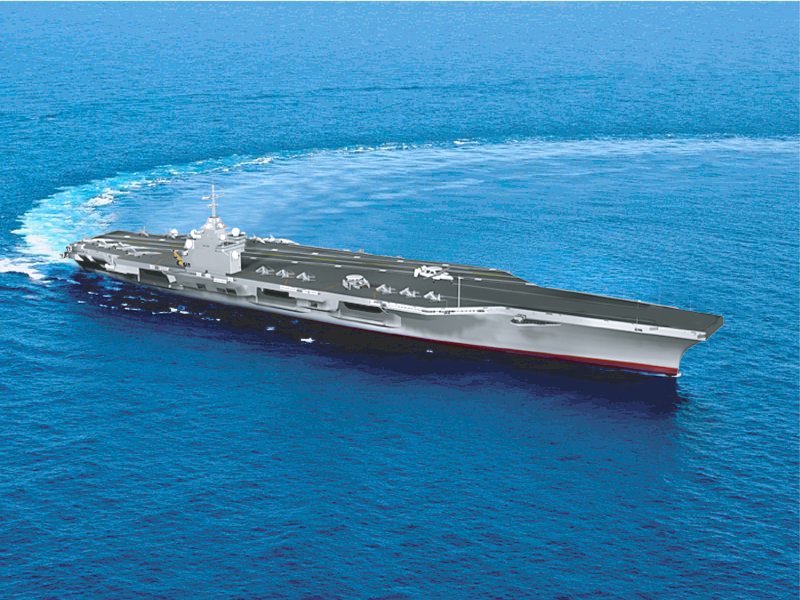
Artist conception of USS Gerald R Ford CVN-78

The Nimitz class will be joined by the USS Gerald R. Ford CVN-78.  The Ford is the first ship of an entirely new class. While approximately the same size as the Nimitz class at 1092 feet long and approximately 100,000 tons full load displacement the Ford class of which three are currently authorized and one under construction will feature many improvements over their predecessors. Among improvements are an advanced arresting gear, automation, which reduces crew requirements by several hundred from the Nimitz class carrier, the updated RIM-162 Evolved Sea Sparrow missile system, the AN/SPY-3 dual-band radar (DBR), as developed for Zumwalt class destroyers an Electromagnetic Aircraft Launch System (EMALS) in place of traditional steam catapults for launching aircraft, a new nuclear reactor design (the A1B reactor) for greater power generation, advanced stealth features to help reduce radar profile and the ability to operate the new F-35C Lightning II. If the class is built as programmed on a one ship every five year rate with the Ford commissioning in 2015 then 6 ships of the class will be in commission by 2040. The next two ships have been named, the John F Kennedy and Enterprise. 

Of course as with any military technology the future never is certain. In 1918 no one would have thought that the all-big gun Dreadnought Battleships would be eclipsed by the Aircraft Carrier in less than 25 years. While the Carriers have ruled the waves since Midway there are threats to them both military and financial.  Countries such as China while building their own carriers have are developing weapons such as guided ballistic missiles designed to destroy carriers.  As of now there is no defense against such a weapon if a carrier is within range. While China has not yet deployed the weapon it could be a game changer in the Western Pacific. Likewise there is the ever present threat posed by new and advanced submarines even those deployed by 2nd and 3rd world nations.  Finally there is the financial cost which could derail the procurement of more carriers in an era of austerity. The cost of the Ford is currently estimated to be $9 Billion Dollars which if stretched end to end would probably reach Vulcan where the Vulcans would come up with an answer to our current problems.

At the same time the carriers have defied those who predicted their demise since the Truman administration.  Currently no sea based platform has the multitude of capabilities of a carrier and its associated air wing and battle group and thus they should remain the Queens of the Sea for some time to come and the United States Navy which has led the world in their development and operation should continue to lead the way.

The next installment which will appear later this week will discuss the aircraft employed by the United States Navy not only those from carriers, but seaplanes, rotor-wing aircraft and lighter than air ships.

Peace

Padre Steve+

6 Comments

Filed under History, Military, Navy Ships

“I have not yet begun to Fight!” John Paul Jones and the Battle of Flamborough Head

Battle off Flamborough Head September 23rd 1779

Two hundred thirty one years ago today a small naval battle occurred off the coast of Yorkshire England. From a purely military perspective the battle was rather insignificant. A squadron of five American and French ships intercepted a convoy guarded by two British ships. However, the battle was one that had immense psychological significance for the Americans as a ramshackle converted French East India ship with an inferior main battery forced a materially superior British warship to strike her colors. In fact the battle is so significant to the United States Navy that the body of the victor, Captain John Paul Jones was returned to the United States in 1905 from an abandoned site in northeastern Paris known as the former St. Louis Cemetery for Alien Protestants to be interred in Bancroft Hall at the United States Naval Academy. Jones had an unusual career as a British merchant skipper accused of murdering a mutinous crewman at Tobago and escaped to Fredericksburg Virginia out of fear that he would be tried in a local versus and Admiralty Court.

John Paul Jones

Jones went to the United States and due to his friendship with Henry “Lighthorse” Lee and other friends in the Continental Congress including a man who became a lifelong friend, Benjamin Franklin obtained a commission in the Continental Navy as a First Lieutenant.  At that time the “First Lieutenant” was the senior officer among the Lieutenants on a ship and often served as the First Officer or Executive Officer.  His first assignment was on the fleet flagship Alfred where he hoisted the first US Ensign aboard an American Naval vessel.  He took part in the raid on Nassau and upon his return assumed command of the Sloop of War Providence where he captured 16 prizes of war and escaped capture by the a British Frigate. He then assumed command of Alfred for a brief time capturing a key supply vessel that had winter clothing for British troops commanded by General Burgoyne in New York.  Following this he took command of the 18 gun Sloop of War Ranger in France received the first ever salute to an American man-of-war by a foreign power 8 days after the French had recognized the American Colonies as an independent nation.

Ranger receives the first salute rendered to an American warship by a foreign power

The nine-gun salute fired from Admiral Piquet’s flagship recognized this and the new Franco-American alliance. Jones wrote of the event: “I accepted his offer all the more for after all it was a recognition of our independence and in the nation.” After this made an epic raid on the port of Whithaven and captured the British 20 gun Brig HMS Drake in an hour long fight.  Jones’ raid on Whithaven struck fear into the British populace and forced the British to allocate more resources to the defense of British seaports than had previously been the case.  The capture of the Drake was of immense psychological importance and along with Jones’ other victories would ultimately lead to the formation of the United States Navy.

Bonhomme Richard

Jones’ exploits made him a celebrated figure and after giving up command of Ranger took command of the Bonhomme Richard a converted 42 gun former French East India ship named after Benjamin Franklin’s book “Poor Richards’ Almanac” and a mixed squadron of American and French ships including the 36 gun American Frigate Alliance, the 32 gun French Frigate Pallas and two 12 gun warships the Vengeance and Le Cerf. Detailed to provide a diversion for a combined French and Spanish fleet the squadron menaced Ireland and Scotland before moving into the North Sea.  As they came into English waters the Americans intercepted a 50 ship convoy on the 22nd of September. The convoy which was enroute to the Baltic was escorted by the 44 gun two-decker Serapis. Serapis was brand new and powerful in comparison with Bonhomme Richard though a larger ship was not designed as a warship nor had as powerful battery as Serapis. A second ship, the 20 gun Countess of Scarborough accompanied Serapis.

Jones directing the battle from the Bonhomme Richard

The battle was joined about 1800 on the 23rd and the Serapis which was more maneuverable than Jones’ flagship pounded the Bonhomme Richard holing her below the waterline and seriously damaging her with little damage to herself and Jones’ problems were compounded when with the first broadside two of Bonhomme Richard’s elderly 18 pounders burst damaging the ship and killing most of the gun crews on the lower deck.  Jones attempted to close the range in order to grapple the Serapis and make the battle a close aboard action. Eventually the bow of Bonhomme Richard ran into the stern of Serapis and the Captain of Serapis Captain Richard Pearson hailed Jones to ask if he had struck his colors (surrendered.) The First Lieutenant of Bonhomme Richard Richard Dale recorded Jones’ response for posterity “I have not yet begun to fight!”

Alliance opens fire on Serapis and Bonhomme Richard

Serapis then collided with Bonhomme Richard and in his attempt to extricate his ship from the American Captain Pearson ended up causing the ships to come side to side and Jones’ crew lashed the ships together.  The fight now became a close quarter fight with the remaining guns on both ships blasting large holes in the other at point blank range while Marines in the rigging poured relentless musket fire and grenade volleys on the exposed crews of their opponents. An American grenade thrower was able to drop a grenade down an open hatch of Serapis where it exploded near a charge of gunpowder placed in readiness setting off a chain reaction of explosions which knocked out five guns and killed or wounded most of the gun crews.

Bonhomme Richard had taken a severe beating with most of her guns knocked out, taking water and burning from fires ignited by the British onslaught. The Bonhomme Richard’s Carpenter and Master of Arms thinking that Jones was dead took it on themselves to hail the British to say that the Americans had struck their colors, which had been shot away in the engagement.  Pearson hailed Jones asking of he had really struck and Jones responded “I have not yet thought of it, but I am determined to make you strike.” The battle continued and the Alliance under the command of a Frenchman with an American commission Pierre Landais came up and delivered a devastating broadside much of which hit Bonhomme Richard, holing her again below the waterline and causing her to settle rapidly. At the same time she caused additional damage to Serapis. With his ship badly damaged and Alliance threatening Pearson stuck his colors in person at 2230 hours.  Jones would take possession of Serapis and the badly damaged Bonhomme Richard would sink the on the 25th of September despite Jones’ best efforts to save her.  Jones made temporary repairs Serapis and sought refuge in the Netherlands.

The battle was militarily insignificant but again a major psychological victory as Jones had for the second time defeated a British warship in British waters within sight of the local population.  Even though Jones had taken Serapis the British warships completed their mission of protecting the convoy. Jones’s post war career would leave him embittered. His opportunity to command the first US Navy Ship of the Line, the 74 gun America disappeared when that ship was given to France. Made a Chevalier of France by Louis the XVI and awarded a gold medal by Congress Jones found employment in the Imperial Russian Navy of Catherine the Great. Though successful against the Turks  jealous Russian commanders conspired against him and had him removed from his command of the Black Sea Fleet.  He retired to France where he died of a brain tumor on July 18th 1792.

In the years since that victory the United States Navy went from a militarily insignificant force to the most powerful Navy in the world. Jones and the ships that he captained would not be forgotten. Two Aircraft Carriers were named after Jones’ Sloop of war Ranger, while several destroyers have born his name.

The odds against Jones in his battle with Serapis were heavily weighted against him.  His victory over Serapis was another demonstration that the Americans should not be taken lightly and began a tradition of valiant service for the Navy that has endured throughout the centuries.  The victory off Flamborough Head reaches into the present as American sailors and their ships ply the world’s oceans keeping the sea lanes open and protecting American interests abroad.

Peace

Padre Steve+

3 Comments

Filed under History, Military, Navy Ships, US Navy

Iconic and Heroic: The Fletcher Class Destroyers

The USS Fletcher DD-445

If ever a class of warships can define a ship type the destroyers of the Fletcher Class were that. The most numerous of all United States Navy destroyer classes the Navy commissioned 175 of these ships between June 1942 and February 1945.  There were two groupings of ships the 58 round or “high bridge” ships and the 117 square or “low bridged” ships. It was a sound design that would be modified for use in the later Allen M. Sumner and Gearing Class destroyers.  Eleven shipyards produced the ships fast, heavily armed and tough the ships would serve in every theater of the war at sea but would find their greatest fame in the Pacific where many became synonymous with the courage and devotion of their officers and crews.

USS Stevens one of the 6 Fletchers equipped with an aircraft catapult

The ships were a major improvement on previous classes of destroyers and were equal or superior to the destroyers of our allies and our enemies in the war.  At 2050 tons displacement and 2900 tons full load the ships were significantly larger than preceding classes and were designed to mount a superior anti-aircraft armament to compliment their main battery of five 5” 38 caliber dual purpose guns and ten 21” torpedo tubes. 376 feet long and flush decked they were an exceptionally tough class of ships which was demonstrated often in the brutal surface battles in the South Pacific, Leyte Gulf and in the battles with Kamikazes off the Philippines, Iwo Jima, Okinawa and the Japanese mainland.  They were the first destroyers of the US Navy which were built with radar as part of the initial design.

USS O’Bannon DD-450 in 1961

The anti aircraft armament was increased throughout the war. Initially this was composed of: 4 x 40mm Bofors in two twin-mounts and 6 to 13 x 20mm Oerlikon in single-mounts. By June of 1943 new ships of the class mounted 10 x 40mm Bofors in five twin-mounts 7 x 20mm Oerlikon in single-mounts. As the Kamikaze threat became dire ships returning to the United States for refit lost one of their torpedo tube mounts and had their AA armament increased to 14 x 40mm Bofors in three twin and two quad mounts and 12 x 20mm Oerlikon in six twin mounts.  One of the more unusual experiments was to equip six ships with a catapult for a float plane. This eliminated some of their AA guns and one torpedo tube mounting. It was not successful and the mounts were removed before the end of the war.

USS Nicholas in action at Kula Gulf

The first ships of the class saw action in the Solomons during the Guadalcanal campaign.  Fletcher and O’Bannon took part in the Naval Battle of Guadalcanal where O’Bannon was one of several destroyers that ganged up on the Japanese Battleship Hiei at ranges as low as 500 yards causing heavy damage to the Battleship which was sunk by naval aircraft the following day.  The O’Bannon would be awarded the Presidential Unit Citation for her actions around Guadalcanal which read:

O’Bannon

“For outstanding performance in combat against enemy Japanese forces in the South Pacific from October 7, 1942, to October 7, 1943. An aggressive veteran after a year of continuous and intensive operations in this area, the U.S.S. O’BANNON has taken a tremendous toll of vital Japanese warships, surface vessels and aircraft. Launching a close range attack on hostile combatant ships off Guadalcanal on the night of November 13, 1942, the O’BANNON scored three torpedo hits on a Japanese battleship, boldly engaged two other men o’ war with gunfire and retired safely in spite of damage sustained. During three days of incessant hostilities in July 1943, she gallantly stood down Kula Gulf to bombard enemy shore positions in coverage of our assault groups, later taking a valiant part in the rescue of survivors from the torpedoed U.S.S STRONG while under fierce coastal battery fire and aerial bombing attack and adding her fire power toward the destruction of a large Japanese naval force. In company with two destroyers, the O’BANNON boldly intercepted and repulsed nine hostile warships off Vella Lavella on October 7, 1943, destroying two enemy ships and damaging others. Although severely damaged, she stood by to take aboard and care for survivors of a friendly torpedoed destroyer and retired to base under her own power. The O’BANNON’s splendid acheivements and the gallant fighting spirit of her officers and men reflect great credit upon the United States Naval Service.

DESRON 23

Fletcher’s composed DESON 23 the Little Beavers” commanded by Commodore Arleigh “31 knot” Burke. The squadron which covered the initial landings at Bougainville in November 1943 fought in 22 separate engagements during the next four months. During this time the squadron was credited with destroying one Japanese cruiser, nine destroyers, one submarine, several smaller ships, and approximately 30 aircraft.  Under Burke the squadron was composed of USS Foote (DD-511), USS Charles Ausburne (DD-570), USS Spence (DD-512), USS Claxton (DD-571), USS Dyson (DD-572), USS Converse (DD-509) and USS Thatcher (DD-514).  At the Battle of Cape St. George the squadron intercepted a Japanese force of 5 destroyers sinking 3.  At the Battle of Empress Augusta Bay the ships were in action as part of Task Force 39 based around Cruiser Division 12 comprised of the Cleveland Class Light Cruisers Montpelier, Cleveland, Columbia and Denver the took part in the sinking of the Japanese Light Cruiser Sendai and a destroyer.  For their efforts DESRON 23 would be awarded the Presidential Unit Citation which stated:

“For extrordinary heroism in action against enemy Japanese forces during the Solomon Islands Campaign, from November 1, 1943, to February 23, 1944. Boldly penetrating submarine-infested waters during a period when Japanese naval and air power was at its height, Destroyer Squadron TWENTY THREE operated in daring defiance of repeated attacks by hostile air groups, closing the enemy’s strongly fortified shores to carry out sustained bombardments against Japanese coastal defenses and render effective cover and fire support for the major invasion operations in this area. Commanded by forceful leaders and manned by aggressive, fearless crews the ships of Squadron TWENTY THREE coordinated as a superb fighting team; they countered the enemy’s fierce aerial bombing attacks and destroyed or routed his planes; they intercepted his surface task forces, sank or damaged his warships by torpedo fire and prevented interference with our transports. The brilliant and heroic record achieved by Destroyer Squadron TWENTY THREE is a distinctive tribute to the valiant fighting spirit of the individual units in this indomitable combat group and of each skilled and courageous ship’s company.”

USS Johnston DD-557

Fletcher’s served heroically with “Taffy-3” in the Battle of Samar at the Battle of Leyte Gulf.  Taffy-3 which was composed of 6 escort carriers, the Fletcher Class destroyers Hoel, Johnston and Heermann and 4 destroyer escorts was assigned the task of providing close air support for troops ashore and anti-submarine protection for transports.  On the morning of October 25th Admiral Halsey took Third Fleet north to engage a Japanese carrier force believing a Japanese surface force of battleships and cruisers to have withdrawn after being heavily hurt by submarine and air attacks.  The carrier force had few aircraft and was considered a decoy by the Japanese. This left the San Bernardino Strait unguarded and the Japanese surface force which by now was comprised of 4 battleships including the Yamato as well as 6 heavy and 2 light cruisers and 11 destroyers doubled back going through the strait during the early morning hours of the 25th.  Just before dawn a patrol aircraft spotted the Japanese force and at 0659 Yamato opened fire on the task group.

USS Hoel DD-533

The three Fletcher’s and the Destroyer escort Samuel B Roberts were launched into a suicidal counter-attack against the Japanese force. Led by Johnston under the command of Ernest E. Evans the little ships engaged their vastly superior foe as the escort carriers edged away as they launched and recovered their aircraft to keep a continuous air assault on the Japanese force.  Johnston scored numerous hits with her 5” guns on the Heavy Cruiser Kumano and when she reached torpedo range launched her 10 “fish” one of which blew off Kumano’s bow and another of which crippled Kumano’s sister Suzuya before she was hit in quick succession by a 14” shell from the Battleship Kongo which hit her engine room and three 6” shells from Yamato which struck her bridge.  Evans kept the crippled ship in the fight drawing fire away from other attacking destroyers and fending off a Japanese destroyer squadron that was trying to flank the carriers. Johnston continued to be hit and was abandon at 0945 sinking 25 minutes later with 186 of her crew.  Evans did not survive and was awarded the Medal of Honor.
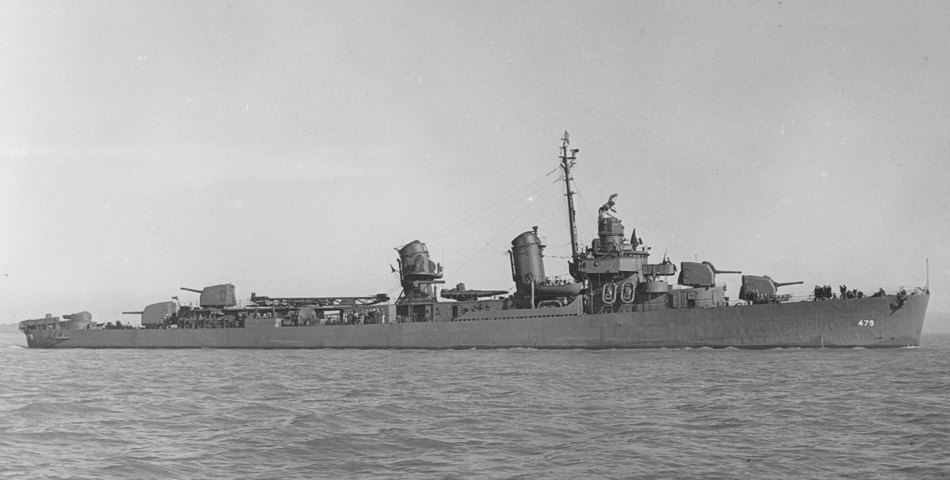
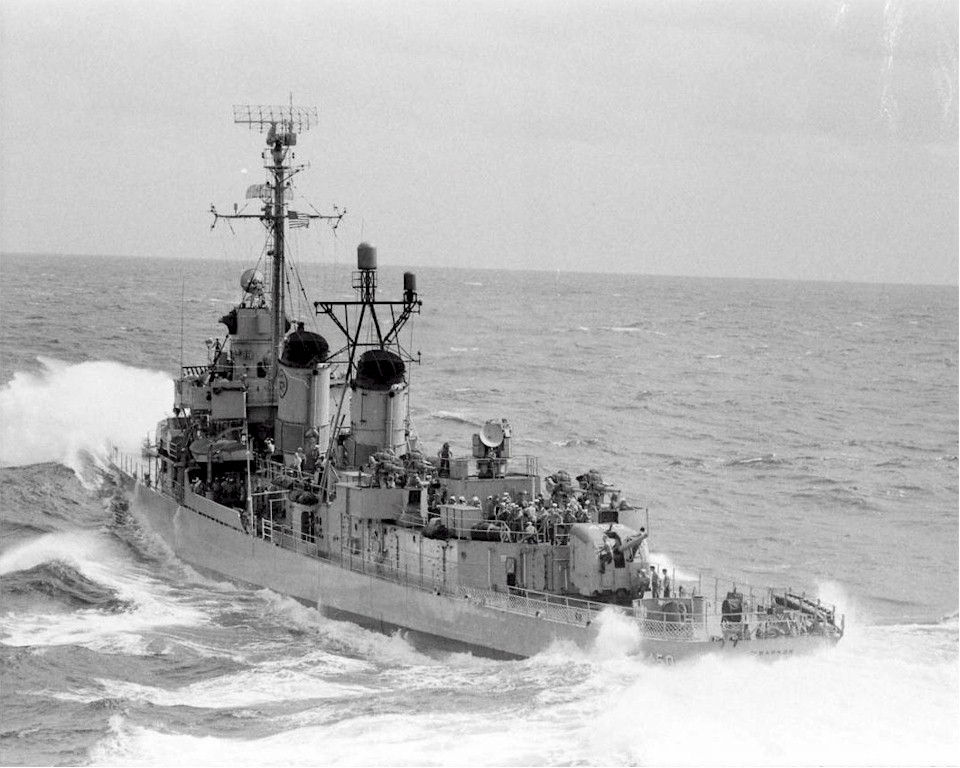
USS Heermann DD-532 in action at Samar

Hoel under the command of Commander Leon S. Kintberger took on the Battleship Kongo and a column of cruisers lead by the Heavy Cruiser HaguroHoel’s torpedo attack on Kongo forced that ship to turn away and torpedo hits were claimed on the Haguro, although that ship remained in action and the Japanese denied any torpedo damage from the attack. The Japanese concentrated on Hoel sinking her at 0855 taking all but 86 of her crew to a watery grave.

Heermann under Commander Amos Hathaway threw herself into the fight engaging Japanese battleships and cruisers. Heermann engaged Heavy Cruiser Chikuma with her guns while mounting a torpedo attack on Haguro. She then attacked the Japanese battleships directly engaging Haruna and forcing Yamato to head away from the action for 10 minutes as she was bracketed by two of Heermann’s torpedoes running on a parallel course.  She engaged the other battleships at such close range that they could not hit her and broke off to intercept a column of cruisers.  Once again she engaged Chikuma in a bloody duel with both ships taking heavy damage. Crippled by a series of 8” shell hits from the heavy cruisers Heermann was down heavily at the bow, so much so that her anchors dragged the water. Carrier aircraft joined the battle and Chikuma withdrew from the fight and sank during her withdraw. Heermann then engaged Heavy Cruiser Tone before that ship, also damaged by air attack withdrew from the fight.  Though she was heavily damaged the Heermann was the only destroyer to survive the action.  Despite their terrible losses the ships and aircraft of Taffy-3 sank 3 heavy cruisers and a destroyer and heavily damaged 3 battleships and 3 heavy cruisers.

Just a bit wet, USS Halsey Powell unrep with USS Wisconsin

For their heroic actions which kept the Japanese from getting to the vulnerable transports Taffy-3 including the valiant destroyers Johnston, Hoel, Heerman and Destroyer Escort Samuel B Roberts was awarded the Presidential Unit Citation which read:

“For extraordinary heroism in action against powerful units of the Japanese Fleet during the Battle off Samar, Philippines, October 25, 1944. Silhouetted against the dawn as the Central Japanese Force steamed through San Bernardino Strait towards Leyte Gulf, Task Unit 77.4.3 was suddenly taken under attack by hostile cruisers on its port hand, destroyers on the starboard and battleships from the rear. Quickly laying down a heavy smoke screen, the gallant ships of the Task Unit waged battle fiercely against the superior speed and fire power of the advancing enemy, swiftly launching and rearming aircraft and violently zigzagging in protection of vessels stricken by hostile armor-piercing shells, anti-personnel projectiles and suicide bombers. With one carrier of the group sunk, others badly damaged and squadron aircraft courageously coordinating in the attacks by making dry runs over the enemy Fleet as the Japanese relentlessly closed in for the kill, two of the Unit’s valiant destroyers and one destroyer escort charged the battleships point-blank and, expending their last torpedoes in desperate defense of the entire group, went down under the enemy’s heavy shells as a climax to two and one half hours of sustained and furious combat. The courageous determination and the superb teamwork of the officers and men who fought the embarked planes and who manned the ships of Task Unit 77.4.3 were instrumental in effecting the retirement of a hostile force threatening our Leyte invasion operations and were in keeping with the highest traditions of the United States Naval Service.”

USS Isherwood (DD-520) underway in heavy weather as she comes alongside the heavy cruiser USS Tuscaloosa (CA-37) in August 1943. National Archives and Records Administration. Photo # 80-G-79429. [Navsource]

During the war 19 of the class were lost and 6 damaged so badly that they were not repaired. 44 of the ships were awarded 10 battle stars or more while 19 were awarded Naval Unit Commendations and 16 Presidential Unit Citations.  Following the war all were decommissioned and placed in reserve. Many were re-commissioned during the Korean War and served through Vietnam. Some of these ships were modernized with newer ASW weapons and re-designated Escort Destroyers (DDE) while others had their air search radar modernized and were re-classified as Radar Picket Destroyers or (DDR). The last Fletcher in US Service decommissioned in 1971.  52 were sold or transferred under military assistance programs to other navies in the 1950s.  The ships served well and the last one in active service the Mexican Navy Destroyer Cuitlahuac the former USS John C Rodgers DD-874 was decommissioned in 2001.

Ex USS Twinning in Republic of China Navy Service, note weapon modifcations

Zerstörer Z-1 Rommel

USS Kidd as Museum and Memorial

Four are currently open as memorial ships the USS Cassin Young DD-793 at Buffalo NY, the USS The Sullivans DD-537 at Boston MA and USS Kidd DD-661 at Baton Rouge LA can be seen in the United States. The Cassin Young is berthed at the old Charlestown Naval Yard in Boston across the pier from the Frigate USS Constitution.  The former the Greek destroyer Velos the ex-USS Charette DD-581 is located in Athens.  The John Rodgers has been purchased by a group in the US but is currently laid up in Mexico and her fate is undecided. I hope that she too will be saved for future generations.

The Fletcher Class really symbolizes more than any class of destroyer the classic look of what a destroyer should be. Their clean lines and classic design are iconic not just in this country but in the 15 other countries that they would serve in during the following years.  Their amazing record and service in World War Two and in the following years in both the US Navy and the navies of our Allies is one that will probably never be surpassed.

I have visited the Cassin Young in Boston; it is well worth the time to see. I hope that I might see The Sullivans and Kidd in the coming years.

The Zerstörer Z-4 ex USS Dyson in heavy seas

I salute the ships of the class and the officers and sailors that served on them in peace and war.

Peace

Padre Steve+

5 Comments

Filed under History, Navy Ships, US Navy, world war two in the pacific

Save the USS Olympia!

I am a historian and for that matter to be more specific a military historian.  I have had a very busy week in “real life” but I saw a couple of articles last week about the cruiser USS Olympia.  It seems that this warship, a symbol of American industry and power at the end of the 19th and turn of the 20th Century is in danger of being scrapped or disposed of as an artificial reef of Cape May New Jersey if a benefactor is not found to help pay the more than 5 million dollars needed to keep this national and international maritime treasure afloat.  The 5 million is just the immediate cost, it is estimated that it may take up to 19.5 million dollars to dry-dock her and make the extensive repairs to her hull.  Olympia is not the first historic US Navy ship to be threatened by the ravages of time, the Frigate USS Constitution,

http://sundaygazettemail.com/Life/Travel/201005270677

The Olympia was one of the first steel and steam warships of the United States Navy and is the oldest steel warship in the United States Navy still afloat.  She was a transitional ship as the Navy entered the modern age and her design was revolutionary for her time.  Displacing 5870 tons and with a length of 344 feet she was She was powered by reciprocating steam engines and capable of 20 knots. She had twin revolving turrets which housed her main battery of four 8 inch guns and mounted a secondary battery of ten 5 inch guns which protruded from her superstructure on the main deck.  She also retained sails as part of her design and was the first US Navy ship with a refrigeration plant and ice making machines.

She was the Flagship of Admiral Dewey at the Battle of Manila Bay during the Spanish American War and her last mission was to bring the body of the “Unknown Soldier” back from France following the First World War.  The launched on November 5th 1892 and commissioned on 5 February 1895 Olympia was decommissioned for the final time in on December 9th 1922.  She would continue her US Navy career in an inactive status after being reclassified as a miscellaneous auxiliary.  She remained as a Navy asset until she was acquired by the Cruiser Olympia Association on 11 SEP 1957 and was classified as a National Historic Landmark on 29 January 1964 and transferred to the Independence Seaport Museum in January 1995.

The ex-Olympia is a national and maritime history treasure. There are but a handful of ships for that era that still remain.  The Imperial Japanese Battleship Mikasa, Admiral Togo’s flagship at the Battle of Tsushima in 1905 is outside the Naval Base of Yokosuka Japan http://www.japan-i.jp/explorejapan/kanto/kanagawa/miurapeninsula/d8jk7l000002rn1h.html. The Russian Cruiser Aurora is moored in Petersburg http://www.aurora.org.ru/eng/ and the Greek Armored Cruiser Georgios Averof http://www.hnsa.org/ships/averof.htm are the only ships of that era remaining.

Olympia is in dire need of dry-docking and major repairs to her hull. Despite Federal Government regulations and sound maritime practices which stipulate that museum ships should be dry-docked and repaired at the minimum of every 20 years the Olympia has not been dry-docked or repaired since 1957.  She has numerous patches and her caretakers keep constant watch on her to ensure that no leak develops that could sink her. Additionally water now leaks through her decks into her hull causing further problems with rust and hull deterioration.

The Olympia is a National Historic Landmark listed on the National Register of Historic Places (1964), a National Historic Engineering Landmark (1977), and National Historic Maritime Landmark (1988) and was awarded “Official Project” status of Save America’s Treasures program (1999).

She will be closed as an attraction on the Philadelphia waterfront on November 22nd as the caretakers and the Navy determines her fate. Ultimately the Navy will have the final say in Olympia’s fate; even so efforts need to be made to enlist private and corporate sponsors to help save this treasure. As of the present time these efforts have been unsuccessful.

Naval Historian and author of a book on Olympia Lawrence Burr commented: “It’s an absolute national disgrace. It’s an appalling situation. She is a national symbol, and she marks critical points in time both in America’s development as a country and the Navy’s emergence as a global power.”

The “Friends of the Cruiser Olympia” http://www.cruiserolympia.org/ as well as former Secretary of the Navy John Lehman and former US Representative Curt Weldon  are leading the charge to see Olympia restored and reopened.

Olympia is not the first US Navy historic ship to be in such dire need. The first was the USS Constitution which was going to be broken up in 1830 until the public inspired by Oliver Wendell Homes’ poem elicited the money needed to repair that ship which was again threatened in the 1920s and was saved by a private-public endeavor urged by the Secretary of the Navy Curtis D. Wilbur which included a drive where children contributed thousands of dollars of pennies to the restoration effort and where prints of “Old Ironsides” were sold for .50 each.  Certainly it will take a creative effort to save Olympia and preserve her for history and those Americans that come after us.

I go to Baltimore to see an Orioles game on October 1st and may take a short trip to Philadelphia to visit the Olympia and if I do I will do an update with my own photos.

Peace,

Padre Steve+

6 Comments

Filed under History, Military, Navy Ships, US Navy

Workhorses: The Brooklyn Class Light Cruisers

The Brooklyn Class Light Cruisers were the most modern cruisers in the US inventory when war broke out in on December 7th 1941.  The ships were built under the provisions of the Washington Naval Treaty of 1922.  Displacing 9700 tons to remain within treaty limitations they mounted a powerful armament of fifteen 6” guns mounted in 5 turrets, three forward and two aft.  Their design, especially their armament was designed in response to the large Mogami Class light cruisers of the Imperial Japanese Navy which initially mounted the same main battery before being converted to Heavy Cruisers.  The layout of the main battery in both classes of cruisers was identical.

Pre-war shot of Honolulu, typical of Brooklyn Class

Authorized in by Congress in 1933 the ships were designed with a large transom which housed the aircraft hangar with twin catapults and crane. This was a departure from previous US cruisers which housed the aircraft and their volatile fuels midships which would prove a liability in combat against the Japanese in the Solomons campaign.  The new hangar design was carried forth on all new cruisers and battleships built by the US subsequent to the Brooklyn Class.

There were 9 ships in the class, one of which the Wichita was completed as a Heavy Cruiser mounting nine 8” guns in triple turrets and is considered a separate one ship class.  In addition to their main battery they mounted eight 5” 25 caliber dual purpose guns and a light AA battery which was continuously increased throughout the war. Their steam turbines produced 100,000 shaft horsepower to give the ships an official speed of 32.5 knots which was exceeded by some of the ships.

The ships Brooklyn CL-40, Philadelphia CL-41, Savannah CL-42, Nashville CL-43, Phoenix CL-46, Boise CL-47, Honolulu CL-48, St. Louis CL-49 and Helena CL-50 were involved in some of the most intense combat of the war serving in both the Atlantic and the Pacific.  Of the ships one, the Helena was lost in surface combat and several others taking severe damage without sinking.  Half of the surviving ships of the class would serve in foreign navies for many years following the war a testament to their toughness and utility.

The lead ship of the class the Brooklyn served exclusively in the Atlantic and Mediterranean where she engaged Vichy warships during the invasion of North Africa and took part in the landings at Sicily, Salerno, Anzio and Southern France where she provided naval gunfire support to troops ashore. Following the war she was decommissioned in January 1947 and transferred to the Chilean Navy in 1951 under the Mutual Defense Assistance Program. She was renamed O’Higgins and served until decommissioned in January 1992 and sold for scrap. She sank while being towed to India for scrapping in November 1992.

Philadelphia had a similar career to Brooklyn. Launched in 1936 and commissioned in 1937 she too served in the Atlantic and Mediterranean supporting the invasions of North Africa, Sicily, Salerno, Anzio and Southern France.  She was decommissioned in February 1947 and transferred to Brazil in 1951. Renamed Barroso she served until 1973 and sold for scrap.

Late war view of St Louis

Savannah was launched in May 1937 and commissioned in March 1938 and like Brooklyn and Philadelphia served exclusively in the Atlantic and Mediterranean supporting amphibious landings, searching for German commerce raiders and blockade runners and supporting various escort missions. At Salerno she was struck and severely damaged by a German FX-1400 radio guided bomb which struck her number 3 gun turret penetrating to the lower handling room where it exploded tearing a large hole in the ship’s bottom and opening a seam in the ship’s side.  Her crew performed heroically to control the damage and get the ship to Malta but she lost 197 sailors in the attack. Following temporary repairs she returned to the United States for repairs and modernization which were complete in September 1944. She served in a number of capacities in the Atlantic and was decommissioned in February 1947, stricken from the Navy List in March 1959 and sold for scrapping in January 1966.

Nashville was launched in October 1937 and commissioned in June 1938 initially serving in the Atlantic until her transfer to the Pacific Fleet in February 1942.  While in the Atlantic she took part in the Neutrality Patrols and following the commencement of hostilities continued convoy escort duties.  Her first mission in the Pacific was to escort the Carrier Hornet CV-8 on her mission to launch Colonel Jimmy Doolittle’s Army Air Force B-25s on the Tokyo raid.  Nashville sank a scout vessel which had discovered the task force.  On return from the mission she was assigned to the defense of the Aleutians until November 1942.  She then was transferred to the South Pacific where she participated in raids and bombardments of Japanese shore installations until while shelling Vila Airfield on Kolombangara on the night of 12 May 1943, she had an explosion of powder charges in one of her forward turrets, killing 18 and injuring 17.  The damage required her to be sent to Bremerton for repair and modernization and she would return to duty in August to join carrier task forces in raids in the Central Pacific before again moving to the South Pacific where she participated in the New Guinea campaign and as well as other missions until May of 1944.  She took part in the invasion of Leyte and the Battle of Leyte Gulf guarding beachheads and transports and fending off Kamikazes while providing naval gunfire support to troops ashore. While conducting similar operations off Negros Island she was struck by a Kamikaze with two bombs aboard. Nashville was struck on one of her port 5” mounts the bombs exploding above her deck. The blazing aviation fuel and explosions killed 139 crew members and wounded 190.  Following repairs at Bremerton she went back to the Southwest Pacific lending her battery to landings at Brunei Bay, Borneo, and protecting carriers in the Makassar Straits.  She was decommissioned in June of 1946 and sold to Chile in January 1951 where she was renamed Captain Prat where she served until she was decommissioned in May 1982 and sold for scrap in April 1983.

Phoenix was launched in March of 1938 and commissioned in October of the same year. She became part of the growing Pacific Fleet and was the first modern light cruiser assigned in the Pacific. She was at Pearl Harbor on December 7th 1941 and would serve throughout the war in the Indian Ocean and the South Pacific and was engaged in heavy operations around New Guinea and other islands in the area frequently involved in shore bombardment, amphibious assaults and raids and having to engage attacking Japanese aircraft.  In September 1944 she was assigned to the covering force of old battleships assigned to 7th Fleet for the invasion of the Philippines.  As part of this force under Rear Admiral Jesse Oldendorf she took part in the destruction of the Japanese Southern Force at the Battle of Surigo Strait where her gunners aided in the sinking of the Japanese battleship Fuso. Phoenix continued operations with 7th Fleet in the Southwest Pacific supporting shore operations and fighting off swarms of Kamikazes without damage to herself. Following the war she was decommissioned in July 1946 and transferred to the Argentinean Navy in April 1951 where she was renamed 17 de Octubre and later General Belgrano. She received a number of modifications while in Argentine service including ASW helicopters and the Sea Cat Air Defense missile system.  Still in active service at the time of the Argentinean invasion of the Falkland Islands in 1982 she was sent to sea with two destroyers.  She was discovered by the British attack submarine HMS Conqueror torpedoed and sunk on May 3rd 1982 with the loss of 323 men, ending a 44 year career of service to the United States and Argentinean Navies.

Boise was launched in December 1936 and commissioned in August 1938. Following her shakedown cruise she was assigned to the Pacific Fleet. On December 7th 1941 she was in the Philippines after having completed a convoy escort mission.  She was sent south to join the rest of the Asiatic Squadron and our Australian, British and Dutch Allies to for the ABDA (American, British, Dutch, and Australia) task force opposing the southern advance of the Japanese aimed at Java and the Dutch East Indies.  She struck an uncharted shoal on January 29th while conducting operations in the Sape Strait forcing her to return to the United States for repairs. This probably prevented Boise from sharing the fate of most of the rest of the squadron including the HMS Exeter, USS Houston, HMAS Perth and Dutch light cruisers DeRuyter and Java, most of which were sunk in the Battle of the Java Sea in February. After repairs she returned to the South Pacific where she took part in a number of actions including the Battle of Cape Esperance where she helped sink the Japanese Heavy Cruiser Furutaka and destroyer Fubiki. She was damaged in this action and returned to Philadelphia for repairs.  Following her repairs she was dispatched to support the landings on Sicily before returning to the Pacific where she served from January 1944 to June of 1945 conducting almost non-stop operations around New Guinea, Borneo and the Philippines. She returned to San Pedro for overhaul and was there when the war ended. She decommissioned in July 1946 and sold to Argentina in January 1951 and commissioned as Nuevo de Julio in 1952.  She served until 1978 when she was decommissioned and was sold for scrap in August 1981.

Honolulu had one of the most active careers while engaged in operations against Japanese Naval units with far less time devoted to gunfire support missions.  She was at Pearl Harbor on December 7th 1941 and following that took part in convoy escort missions until she went north to screen Alaska from Japanese attack in May 1942 a task that she engaged in until November.  She then reported to the South Pacific and was part of operations against the Japanese Fleet in the Solomons. She took part in the Battle of Tassafaronga, the Battle of Kula Gulf where she helped sink a destroyer and the Battle of Kolombangara where she was instrumental in sinking the Sendai class light cruiser Jintsu and a destroyer. She then supported amphibious operations in the Central Pacific including Saipan and Guam and the Leyte Gulf landings in the Philippines.  While operating off Manus Island she was stuck by an aerial torpedo receiving heavy damage which required her withdraw to the United States for major repairs which were still being completed when the war ended. She decommissioned in February 1947, stricken from the Naval Register in November 1959 and sold for scrap.

St. Louis was launched in April 1938 and commissioned in May 1939. After time conducting neutrality patrols at the onset of the war in the Atlantic she was transferred to the Pacific Fleet in November 1940. She was at Pearl Harbor on December 7th 1941 and was one of the few major fleet units to get underway and out to sea during the attack.  She supported carrier operations and convoy escort missions until she was sent north to that Aleutians where she operated until October when she returned to the States for a brief overhaul before being assigned to operations in the Solomons. Operating on a nearly nonstop basis against the Tokyo Express she took part in the Battle of Kula Gulf and the Battle of Kolombangara where she received partial credit for the sinking of the Japanese light cruiser Jinstu. During the battle she was torpedoed in the bow and after temporary repairs returned to the Mare Island. Following repairs St. Louis returned to the Solomons in November 1943. She was struck by a bomb which killed 20 crew members on January 14th requiring her to return to Purvis Bay for repairs. The repairs complete she returned to the Solomons until June when she took part in the invasion of the Marshalls at Guam and Saipan. She damaged her number three propeller and had to return to the States for repair following the Guam bombardment.  Upon her return she served at Leyte Gulf until she was hit by two Kamikazes in a short span receiving heavy damage and resulted in the loss of 15 sailors killed, 1 missing and 43 wounded.  She again sailed for repairs and returned to action against the Japanese home islands and Okinawa. Following this she supported operations against Japanese installations on the Asian mainland.  Following the war she took part in the Yangtze River patrol force and then returned to the United States in January 1946.  She was decommissioned in June 1946 and transferred to Brazil in January 1951 being commissioned as Tamandare. She was decommissioned in June 1976 and sold for scrapping in 1980. While being towed to Taiwan for scrapping she sank on August 24th 1980.

Helena firing at Kula Gulf just before being torpedoed and sunk

The Final ship in the class, Helena was launched in August 1939 and commissioned in the following month.  She was at Pearl Harbor and mooed at the 1010 Dock where she was hit by a torpedo and damaged. After repairs she reported to the South Pacific and the Guadalcanal campaign.  She escorted carriers. Helena had the most modern surface search radars and at Battle of Cape Esperance in Iron Bottom Sound, Helena had sunk cruiser Furutaka and destroyer Fubiki.  She then took part in the Naval Battle of Guadalcanal in which a weaker American force turned back a Japanese force with heavy losses on both sides including the Japanese Battleship Hiei and the American cruisers Atlanta, Juneau and 4 destroyers. Helena continued operations in the Solomons and at the Battle of Kula Gulf was sank by Japanese torpedoes fired by destroyers on July 5th 1943.  168 of her sailors were lost in the action. Helena was the first US Navy ship to be awarded the Naval Unit Commendation.

The General Belgrano ex-USS Phoenix sinking after being torpedoed by HMS Conqueror at the Battle of Falkland Islands

The class found its niche in the war primarily in shore bombardment and Naval Gunfire Support as well as in the sharp surface actions in the South Pacific. Only one, Helena was lost.  Six were transferred to South American Navies making and served for many years in those navies. None survive today but the ships were instrumental in the success of many operations.

3 Comments

Filed under History, Military, Navy Ships, US Navy, world war two in europe, world war two in the pacific

North Korea Tensions: One Misstep could mean War what the US can deploy to the Theater

The USS George Washington

The tensions on the Korean Peninsula following the North Korean sinking of the South Korean Corvette Cheonan on March 26th and the North’s continued bellicose actions are now the highest in years.  Since the United States and South Korea announced naval exercises in the Yellow Sea and the Sea of Japan the North has gone on a propaganda offensive condemn the exercises as a threat to peace and “nothing but outright provocations aimed to stifle the Democratic People’s Republic of Korea [North Korea] by force of arms.” North Korean spokesman Ri Tong Il claimed that the exercise “is a grave threat to the Korean peninsula and also to the region of Asia as a whole,” and “another example of a hostile policy” toward North Korea.

One of a number of Naval Clashes between South and North Korean Navy vessels

The North Koreans announced also that “The army and people of the DPRK will start a retaliatory sacred war of their own style based on nuclear deterrent any time necessary in order to counter the US imperialists and the South Korean puppet forces deliberately pushing the situation to the brink of a war,” and while threats of war are common from the DPRK the situation is now so tense that any miscue from either side could spark a war.

The US State Department dismissed the North Korean threats spokesman P J Crowley stated “North Korea has a habit of trying to deflect, you know, responsibility onto others.”  He noted that some U.S. officials were concerned that North Korea might use the heightened tensions and exercises to make further provocations against the South and US Forces.  Some speculate that such measures might include missile tests or nuclear tests or other military measures.  In response to questions that North Korea might take aggressive steps Crowley noted:  “Are they capable of these kinds of steps? Tragically, the answer is yes….And the very kind of actions that we’ve announced in recent days, including military exercises that will be conducted in the near future, are expressly to demonstrate that we will be prepared to act in response to future North Korea provocations. We hope it won’t come to that.”

South Korean Navy LHD Dokdo

Secretary of State Hillary Clinton remarked at a conference regarding the South China Sea in Vietnam that “an isolated and belligerent North Korea has embarked on a campaign of provocative, dangerous behavior…”

The US Forces Korea Commander General Walter Sharp stated:  “These defensive, combined training exercises are designed to send a clear message to North Korea that its aggressive behavior must stop, and that the ROK and U.S. are committed to enhancing our combined defensive capabilities.”

The Exercise “Invincible Spirit” will include the USS George Washington carrier battle group including the Guided Missile Destroyers USS McCampbell, USS John S. McCain and USS Lassen, as well as South Korean Navy assets including the largest ship in the South Korean Navy the Landing Ship Dokdo. A total of 20 ships 200 aircraft and 8,000 sailors will take part in the exercise which according to the South Korean newspaper Chosun Ilbo “will consist of an electronic warfare simulation with members of the US Cyber Command, an aerial refueling and bombing exercise by the Air Force, command control training by the Marines, and a navy anti-submarine exercise.”  It is also likely that the converted former Trident Missile submarines USS Ohio, USS Michigan and possibly the USS Florida are in the area each armed with up to 154 Tomahawk cruise missiles.  The 4th of these submarines USS Georgia is also deployed and its whereabouts are not known. It is the first time that all 4 subs have been deployed at the same time.   The US Air Force has deployed the F-22 Raptor for the first time to Korea and elements of the 7th Air Force will take part in the exercise.  Invincible Spirit is the first in a series of scheduled summer exercises between the US and South Korea. Admiral Robert F Willard commander of the 7th Fleet said that at the end of the exercise, there will be a counter special-forces exercise. He added “These occur with some frequency in both the East and West Seas, conducted by the [South Korea] and U.S. Navy.” North Korea has a large special-forces establishment and capability.

North Korean YJ-62 Anti-Ship Missile on mobile launcher

The US Navy has additional assets that could be deployed in the event of a major crisis on the peninsula as the USS Ronald Reagan is involved with the RIMPAC 2010 exercises in the Pacific and the carriers USS Carl Vinson and USS Abraham Lincoln are underway off the west coast involved in exercises or deployment work ups.  At this time 123 (43%) of the navy’s 289 ships are deployed and a total of 184 (64%) are underway away from their homeport. Of the submarine force 23 (43%) are deployed and 30 (55%) are underway.  This is a sizable amount of the fleet and represents a significant surge potential should a conflict break out.  In the midst of the current wars in Iraq and Afghanistan many forget that a significant amount of our national military power can be deployed quickly from the sea to danger spots like Korea where their assets based on history can have a decisive affect.

The USS Ohio and her sisters USS Michigan and USS Florida could play a deterrent role

Ground forces are more spares, the major component of land based forces are those of South Korea, the US now has just a Brigade Combat Team stationed in South Korea although other assets not engaged in Operation Iraqi Freedom or Operation Enduring Freedom could be deployed from the 25th Division in Hawaii and Alaska and the 2nd Division based at Ft Lewis Washington.  As of now 1 brigade the 4th BCT of 25th Infantry Division is deployed to Afghanistan as well as the 5th BCT of 2nd Division which also has its 4th BCT deployed to Iraq. The 2nd BCT of 25th Division is schedule for deployment and may already be deployed this summer. The 3rd BCT of the 25th Division is now in a post-deployment cycle after having just returned from Iraq. The deployment of uncommitted assets would take time and the only immediate reinforcements could be a limited number of Marine units from the 3rd Marine Division and III MEF in Okinawa and Kaneohe Bay Hawaii that are not currently engaged in Operation Enduring Freedom.

The North Korean threat of a “retaliatory sacred war” may be the usual propaganda hyperbole used by the North or it may be their “line in the sand.”  It also could be more bellicose than usual because of internal tensions in the North regarding potential successors to the ailing Kim Jong Il. US and South Korea operational planning has contingencies should there be unrest in the North following Kim’s death but a conflict brought on by one of the rival factions the North could plunge Northeast Asia into a regional war. We don’t know what it is but the week ahead could become rather sporty.   China has warned that the exercise could make matters worse on the peninsula and the US apparently in response to China will keep the George Washington in the Sea of Japan.  There are also good tactical measures for doing so to protect the carrier by keeping it out of constricted waters in the vicinity of a good number of North Korean assets should fighting actually break out and the fact that the USS John S. McCain already is equipped with the Aegis Ballistic Missile Defense System.

The Japanese Naval Self Defense Force (Navy) is sending 4 observers to the exercise a tacit measure of support for them and the Japanese have several ships fitted for the Aegis Ballistic Defense System.

With all of this said we now have to wait and see what happens. Will the North do something to instigate a conflict or will it back down?  We don’t know as it is a very unpredictable country with a penchant for raising the ante in the high stakes world of geopolitical dominance in Northeast Asia. The Obama administration seems to be walking a narrow line between war and appeasement, not that we would consider what we do appeasement but what the North would certainly take it to be. The stakes are high and only God knows what will happen in the next several days. An actual conflict could kill hundreds of thousands or even millions of people; especially should the North successfully deploy and use a nuclear weapon. Thousands of American lives are at stake should a conflict break out and besides our Soldiers, Sailors Marines and Airmen standing in harm’s way many of them are non-military citizens that live and work in South Korea and Japan.

That is all for now, pray for peas.

Peace

Padre Steve+

3 Comments

Filed under Foreign Policy, Military, national security, Navy Ships, US Navy

The Beginning of the Nuclear Surface Navy: USS Enterprise CVAN-65, USS Long Beach CG-9, USS Bainbridge DLGN/CGN-25 and USS Truxton DLGN/CG-35

Iconic Photo of USS Enterprise CVAN-65,USS Long Beach CG-9 and USS Bainbridge DLGN-25 during Operation Sea Orbit 1964

Note: This is the first of four articles on the US Navy’s Nuclear Surface Force. Future articles will deal with Task Force One and Operation Sea Orbit, the Nuclear Cruisers and the Nuclear Carriers.

In the 1950s the US Navy recognized the Nuclear power could play a key role in the future Navy.  The operational flexibility of Nuclear powered ships which would not be dependent on underway replenishment provided by tankers or port calls to conduct high speed operations over vast expansions of the world’s oceans.  Orders were placed in the mid-1950s for an attack aircraft carrier, the USS Enterprise CVAN-65, cruiser the USS Long Beach CLGN-160 and later CGN-9 and the USS Bainbridge DLGN, later CLG-25.  These ships would become the prototypes of a Navy which early advocates of nuclear propulsion hoped would become the future of the surface Navy.  This would become the case in regard to Aircraft Carriers but not in regard to cruisers pr smaller surface ships.  While seven more Nuclear Cruisers would be built none would be retained after the post Cold War reduction in force with all of the ships decommissioned, their nuclear plants recycled and hulks scrapped.  However they represented the pinnacle of surface ship design in their time and had the budgetary constraints of the post Cold War world taken place the likelihood is that at least six nuclear cruisers would still be in commission possibly upgraded with the Aegis Air Defense system making them the most versatile of surface ships.

Enterprise in 1978

The first Aircraft Carrier designed and built as a nuclear ship was the USS Enterprise.  Named after the heroic USS Enterprise CV-6, she dwarfed even the Super-carriers of the Forrestal class which preceded her and the Kittyhawk class which followed her.  Laid down February 4th 1958 and launched September 24th 1960 the “Big “E”” was commissioned on November 25th 1961.  At 1,101 feet overall and displacing over 85,000 tons full load she was the largest carrier built until the Nimitz class.  Her power plan was both experimental and revolutionary.  Equipped with 8 Westinghouse A2W nuclear reactors generating 2800,000 SHP powering geared turbines the Enterprise was capable of 35+ knots.  With a air group of over 70 aircraft Enterprise would serve in the Cold War, Vietnam, Desert Storm, the Balkans and Middle East culminating in Operation Enduring Freedom and Operation Iraqi Freedom.  Coming into her 50th year Enterprise still serves on active duty as the oldest warship in the US Navy.  She is scheduled to be replaced in the next few years by CVN-78, the USS Gerald R Ford.

Long Beach firing Missiles 1961

The USS Long Beach was the first nuclear guided missile cruiser and the only cruiser built following ships designed during World War II built as a large cruiser, all others would be on large destroyer platforms.  Previous guided missile cruisers had been converted from World War Two Light Cruisers and Heavy Cruisers, some of which retained their forward gun turrets while mounting missiles aft.  The Albany class also converted World War II ships had their entire main battery exchanged for missiles.  The long beach represented an entirely new type of cruiser.  Laid down December 2nd 1957, launched July 14th 1959 and commissioned September 9th 1961 she displaced over 15,000 tons full load. Large and fast equipped with 2 Westinghouse C1W reactors powering GE turbines producing 80,000 SHP she was capable of 30+ knots.

Long Beach after modernization in 1980s

She was equipped with a twin Talos missile launcher, 2 twin Terrier launchers two 5”/51 dual purpose guns in single mounts, the ASROC anti-submarine rocket system and six 12.75” ASW torpedo tubes.  Long Beach would serve until 1995, taking place in every major operation except the Balkans when she was decommissioned.  Her unique superstructure was razed, her nuclear plant recycled and her hulk remains, the trim cruiser lines still in evidence awaiting the scrappers torch at Bremerton Washington.

The hulk of teh ex-Long Beach at Bremerton Naval Shipyard

Bainbridge 1971

The USS Bainbridge originally classified as a Guided Missile Destroyer Leader and a nuclear powered ship of the Leahy class. Bainbridge displaced 8,500 tons and 565 feet long she mounted two twin launcher Terrier missile systems, ASROC, six 15.5 inch ASW torpedo tubes and four 3” dual purpose guns and crewed by 475 men she like Long Beach had the capability of managing the air defense of the battle group.  She was equipped with 2 GE 2DG nuclear reactors powering geared turbines capable of 60,000 SHP which drove her at 30+ knots.  She was laid down May 5th 1959 and launched April 15th 1961 and commissioned on October 6th 1962.

Bainbridge transiting the Suez Canal 1992

She like Long Beach and Enterprise would serve in most every major operation undertaken by the US Navy and during the post Cold War draw down would be decommissioned on September 13th 1996, her nuclear plant recycled and her hulk scrapped at Bremerton Washington.   She would be modernized throughout her career with upgraded radars, missiles and having her 3” guns replaced by Harpoon Surface to Surface Anti-Ship Missiles and given the facilities to operate LAMPS helicopters.

Truxton 1979

The USS Truxton DLGN/CG-35 was a nuclear powered variant of the Belknap class DLG/CGs and equipped with the same power plant but mounted a 5”/51 single mount gun forward and one twin dual purpose launcher for Terrier and ASROC aft. She would also be designed with helicopter facilities to operate a LAMPS helicopter and like Bainbridge be modernized throughout her career.  Laid down June 17th 1963 and launched December 13th 1964 she would not be commissioned until May 27th 1967.  She also would serve in most of the major operations conducted by the Navy until she was decommissioned on September 11th 1995, her nuclear reactor recycled and her hulk scrapped.

Truxton being “recycled”

Enterprise alone remains of these pioneering ships but each would contribute to the future of US Navy shipbuilding.  Next: Task Group 1 and Operation Sea Orbit.

17 Comments

Filed under Military, Navy Ships