
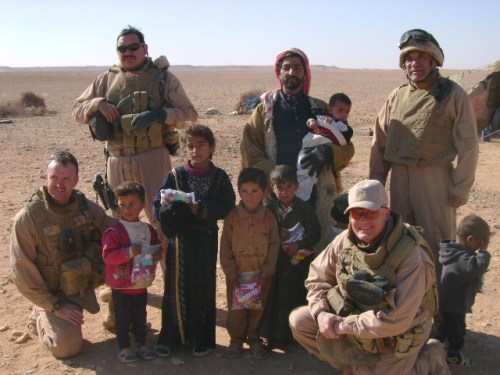
 Me with Advisers to the 2nd Border Brigade with Bedouin Family on Syrian Border 23 December 2007
There are a group of US Military personnel that are seldom thought of or mentioned in the wars that we are waging in Iraq and Afghanistan. These men and women from all branches of the military are those who serve as advisers, trainers and mentors to these nations security forces. The duty is dangerous. The advisers, be they to the military, police, or civil administrations often work in the most isolated places in these countries and are stationed in small teams with the Iraqis and Afghans that they advise. The are often far from the “big battalions” that have lots of firepower available and often operate out of larger and more secure bases with air support close at hand.
Recently there have been a number of incidents where advisers have been killed by either renegade soldiers or police, or by infiltrators posing as security force personnel. In one humanitarian operation a couple of Army advisers were killed in Iraq. These men were working with an Iraqi unit in doing humanitarian work in a village. On March 27th Navy LT Florence Choe and LTJG Francis Toner IV were killed by an Afghan insurgent posing as an Afghan Army soldier. For me these events triggered some anxiety as I remembered how many times I was incredibly exposed to danger from the same kind of events. A couple of days ago I mentioned that I had been feeling some anxiety that I could not explain. I finally figured it out. It began after I read about the death of these Naval Officers serving in Afghanistan. Since then every siren, loud noise and helicopter has raised my alert level.
The advisers are drawn from all services. They are all Individual Augments that come from both the Active and Reserve components. They do not deploy with their own units, which means that they go to war with people that they might have trained alongside getting ready for the mission, but otherwise have not served with. When they come home they go back to their old assignments or new orders and are separated from the men and women that they served alongside for 7 to 15 months. In other words they are isolated when they return home and go back to places where the majority of personnel, even those who have been “in country” have no earthly idea or appreciation of the conditions that they served in and dangers that they faced. This happened to me when I returned and I went through an emotional collapse as the PTSD that I did not know I had kicked my ass. Sights, smells, noises, crowds, airports and in fact almost everything but baseball diamonds caused me to melt down as they all brought the danger back to me. Don’t get me wrong, my tour in Iraq was the highlight of 27 plus years in the military, the part of which I am the most proud.
I have a special place for these men and women. I served with them in Iraq’s Al Anbar Province as the first Navy Chaplain, and on of the first chaplains of any service to be assigned to cover these teams since Vietnam. My assistant, RP2 Nelson Lebron and I deployed together from out unit. I had prepared well. I had been on the bubble to deploy for months. My background in military history and past service with both the Army and Marines helped me. Likewise my military and civilian education helped me. Shortly before we were notified of the deployment I went to the Jordanian Army Peace Operations Training Center course on Iraqi culture, religion and society. I had served as a chaplain in the trauma department of one of the largest trauma centers in the country. RP2 Lebron had deployed multiple times to Iraq, Beirut and Afghanistan where he was awarded the Defense Meritorious Service Medal (no small feat for an E-5). He is also an incredibly gifted boxer, kick boxer and martial artist who has fought on Team USA and holds more title belts than I can count. He most recently won the Arnold Schwarzenegger Classic. I had served with him before and he knew that his mission was to keep me safe. I don’t want to sound arrogant, but the Chief of Staff of the Iraq Assistance Group said that we were “the best ministry team he had seen in 28 years in the Army.”
When we went to Al Anbar we were sent out with the Marines and Soldiers advising the 1st and 7th Iraqi Army Divisions, The Iraqi Police, Highway Patrol, the 2nd Border Forces Brigade and Port of Entry Police. We operated in a area the size of the state of Oregon. In some cases it would take us 2 days by air and convoy to reach isolated teams on the Syrian border. When you travel by air in Iraq you are always at the mercy of the weather and aircraft availability. I had the rare privilege as a Lieutenant Commander to be able to arrange all of my own air transportation. Most people, including people higher ranking than me had to depend on others to do this for them. We worked with our advisers to get out to them. We would be out 5-12 days at a time with anywhere from 4 to 7 days between missions. In our 7 months we traveled over 4500 air miles and 1500 ground miles. Almost all of our air travel was rotor wing. We flew in CH-46, CH-47 and MH-53s and the MV-22 Osprey. Our convoys were usually not larger than 3 American HUMMVs and sometimes a few Iraqi vehicles. Our biggest guns were .50 cal or M240B machine guns. Most of the time we were in places that had no large forces in position to help us if we got in trouble. Even on the bases we were isolated. Our teams were with the Iraqis in almost all cases. We often ate in Iraqi chow halls and used Iraqi shower trailers. Our advisers had us meeting their Iraqi counterparts. We met and dined with Iraqi Generals, had ch’ai (tea) with small groups of Americans and Iraqis and got out with the Bedouins. We were in a number of particularly sensitive and dangerous situations with our advisers. It was an incredible, once in a lifetime tour serving with some of the greatest Americans and Iraqis around. Iraqi soldiers in with our convoys would ask me to bless their trucks with Holy Water like I was doing with the American trucks. I came to admire many of the professional Iraqi officers that I came to know and pray for the people of Iraq, that God would grant them peace. They are wonderfully hospitable and gracious. We were often treated to food and tea by Iraqi soldiers, and civilians. After nearly 30 years of nearly continous war, dictatorship and terrorism, they deserve peace and security.
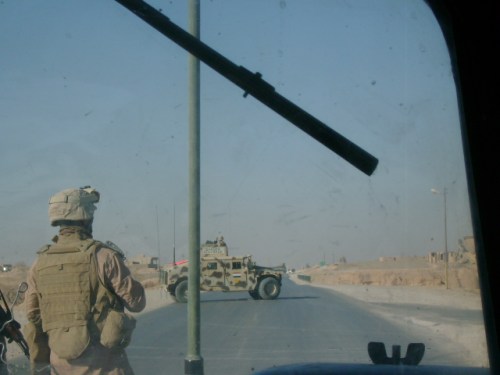 Combined US Iraqi Convoy
I had one Iraqi operations officer, a Sunni Muslim tell me that he wished that his Army had Christian priests because they would take care of his soldiers and had no political axe to grind. He said that the Army did not trust most Imams or Mullahs because they had compromised themselves during the civil war. Another officer, a Shia Muslim came to me to thank me for being there to take care of our Marines. He said that he, an Iraqi Shia Arab, hoped that if they had any problems from the Persians (Iranians), that we would help them. These is little truth to what is floated that Iraqi and Iranian Shia like each other. The memories of the past die hard in the Middle East. When Persia ruled Iraq they treated the Arabs like dirt. Likewise the memories of the Iran-Iraq war are still alive. Iraqi Arabs, Sunni, Shia and even Christian have little love for the “Persians.” General Sabah of the 7th Division had us to his quarters for dinner. We had a wonderful and friendly discussion about similarities and differences in Christianity and Islam. We departed friends. The last time I saw him ws in the Ramadi heliport. He saw me, ran up to me in from of his staff and Americans in the little terminal and gave me a bear hug, telling all that I was his friend. Another Iraqi General told me just before we left to come back as a tourist in 5 years because everything would be better. I honestly think that he is right. I hope to go back someday. It would be a privilege to see my Iraqi friends again.
This is what our advisers get to do every day. Yes they are exposed to great danger, but they are building bridges between peoples of different history and culture. They are the unsung heroes of these wars and will likely never get credit for all that they have done. They have my highest admiration and I hope that if you know one of these men or women that you will thank them. I pray that they will all come home safe and be blessed with success. I would certanly serve with them again at any time and in any place.
Please keep the families of LT Choe and LTJG Toner in your prayers. A link about these fine Naval Officers is below. Peace, Steve+
http://afghanistan.pigstye.net/article.php?story=FlorenceBChoe
 With “Ronin” Advisors to 3rd Bn 3rd Brigade 7th Iraqi Division

 The Inglorius Padre Steve's World