Tag Archives: bowie bay socks

Opening Day at the Church of Baseball at Harbor Park

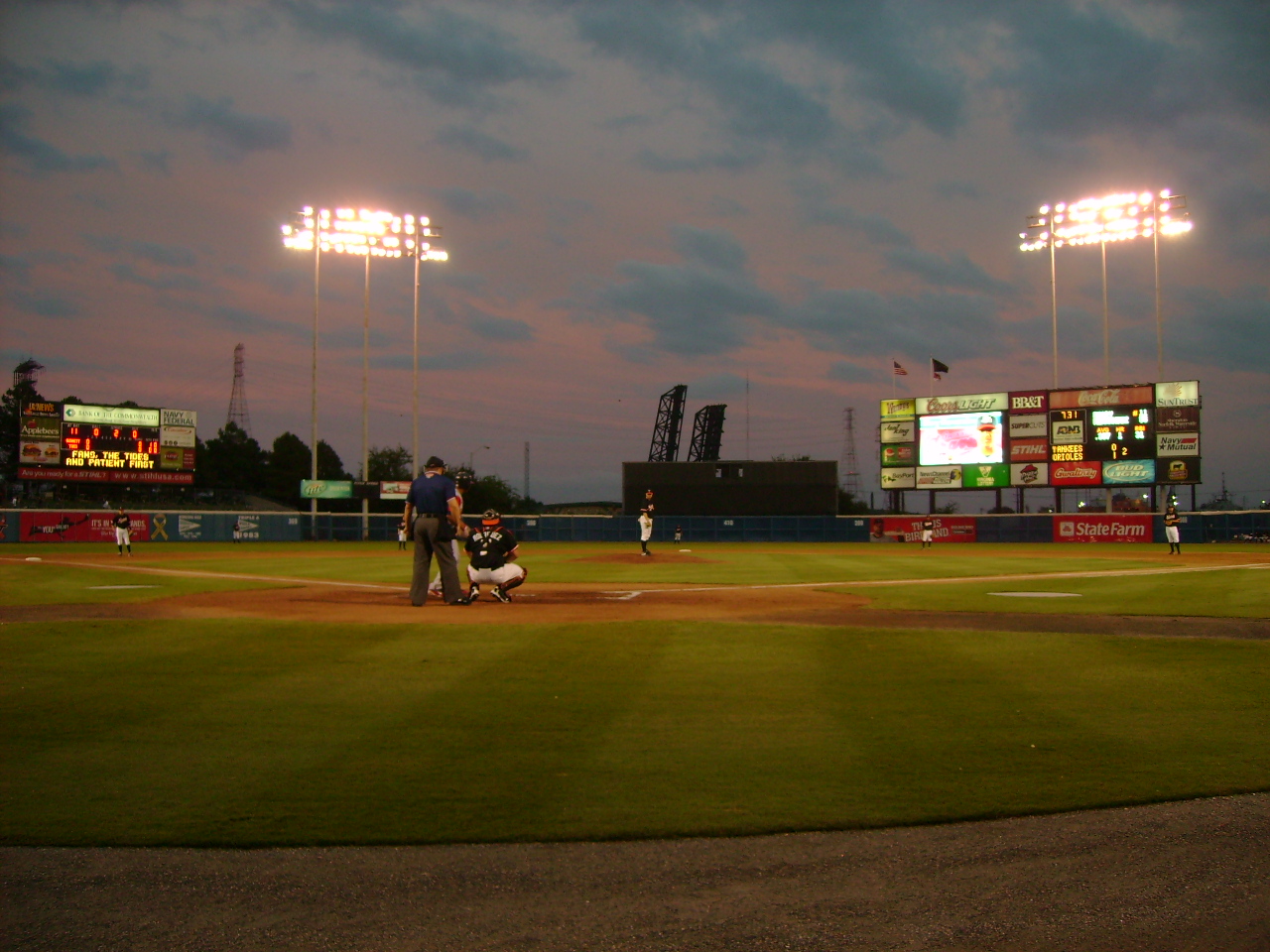
Another season begins at Harbor Park in Norfolk Virginia tomorrow evening.  The weather looks decent but in the evening there is a 30% chance of scattered storms with the chances going up after 10 PM.  Last year we were rained out and hopefully this will not be the case this year.  Both the Tides and their parent club the Orioles are much improved in terms of depth compared to last year.  The Orioles have solidified their offense with a number of solid veterans as well as had a number of last year’s crop of rookies to include Matt Wieters and Nolan Reimold as well as the youthful All-Star Adam Jones and their pitching staff is deep with many young arms.  The Baltimore outfield in particular has depth and could in the long run produce a number of All-Stars with Reimold, Jones and Nick Markakis.  The infield with veterans Brian Roberts, Garrett Atkins and Miguel Tejada and Caesar Izturis The pitching staff is still young but should they mature this year could be a formidable staff.  Added to the mix this year is Brian Matuz who went from AA Bowie directly to the Orioles at the end of last season and veteran Kevin Millwood. Waiting in the wings is another bumper crop of young pitchers who in not too much time could easily be starters or relievers on the O’s or used to help the team acquire other personnel through trades.

The Tides roster is deep.  Last year the Tides were amazing until an injury riddled Orioles team with little depth was forced to call up many of the Tides by the end of May.  Prior to the massive number of call ups the Tides were playing well over .700 baseball and routinely crushing their opposition. The pitching staff suffered similarly to the hitters and after the call ups the power evaporated and even with decent hitting the tables were turned. This year the Tides are deep, many young prospects as well as some seasoned young players who have some major league experience.  I have had the pleasure of meeting many of the young Tides pitchers last year and most are returning this year.  The Tides are stocked with young players with some Major League experience thanks to last year’s call ups. They are deep in pitching and have many excellent position players.  Since the Orioles have some depth at the Major League level the Tides, baring an epidemic of injuries at Baltimore should keep a solid team together for much of the year and with that win the International League South and possibly compete for the Governor’s Cup Championship.  That is great for the fans but even more important is the chance to groom the members of this team for service on the Orioles without having to rush them into service as was the case in 2009.  The Orioles are also deep to the AA level with a number of players at Bowie who will certainly fleet up to the Tides and perhaps like Matuz head up to the Orioles if needed.

Baltimore will probably do much better than last year and while they may not be ready to challenge the Yankees or Red Sox this year could well by 2011.  If the Orioles were not in the same division as New York and Boston they might even this year compete for a playoff spot if they were in the AL Central or the AL West.

Tomorrow I will go and take my seat in Section 102 Row B seat one as the Tides pitch Chris Tillman against Durham.  It should be good as I meet up with the faithful including Elliott and Chip the Ushers, Ray, John and the Vietnam Veterans of America chapter who man the beer stand behind home plate, Marty the Card Dealer, Kenny “Crabman” the Pretzel Guy as well as General Manager Dave Rosenfield and the rest of the staff. I think that it will be a great year for the Tides a good year for the Orioles.

Peace

Padre Steve+

Leave a comment

Filed under Baseball

Managing the “AAA” Franchise: A View from 102

“Baseball is a simple game. If you have good players and if you keep them in the right frame of mind then the manager is a success.” Sparky Anderson

“I believe managing is like holding a dove in your hand. If you hold it too tightly you kill it, but if you hold it too loosely, you lose it.”  Tommy Lasorda

This has been an interesting year for the Norfolk Tides.  For me the year has been the first where I have had the opportunity to observe the game on nearly a daily basis from field level behind the plate. The proximity of where I sit to the playing field in Section 102, Row B Seat 2 at the Church of Baseball, Harbor Park Parish has given me the chance to sharpen my eye for the nuances of the game.  Part of this has been lessons on life, leadership, strategy, player development and the psychology of winning and organizations that win.  In fact if you are a regular reader of this website you will likely note that baseball is pervasive in my writings.  Likewise the subject of baseball is usually entwined with my local team the Norfolk Tides who inhabit the parish church with me.  Thus my closest observations of the game come from watching the Tides.  Over the course of the season I have become familiar with the players met a decent number of the starting pitchers on more than one occasion each as well as talked with scouts and former players.  Additionally one of the best baseball men round who really needs to be hired as a color man for the Tides radio show is Elliott the Usher. Elliott and I have had numerous discussions regarding strategy, player development and baseball philosophy throughout the season, not always agreeing, but each hearing what the other had to say.  Elliott knows the game, knows the players and despite being a Red Sox fan, not that there’s anything wrong with that is a great human being.  Thank the Deity Herself that he is not a Dodgers fan, yeech!

So anyway, here are a couple of Padre Steve’s observations about the Tides this year that I think hurt player development and kept them out of the playoffs.   Now I don’t think being in the playoff as a minor league team is the end all of life, but it does not hurt the organization.  My thesis is that although the Tides suffered an end of July and August collapse that need not have happened and may have hurt a number of player’s chances of making the majors.   The collapse was like the old “June Swoon” days of the San Francisco Giants only worse.  Yet despite the swoon the Tides continued to maintain one of the highest batting averages in the league and their pitching, though not as reliable as earlier in the season was constantly around the middle of the league.  I think that there is a reason for what happened to the reliability of the pitching and it is not because the pitchers suddenly went bad. I’ll explain this further on in this article.

Fielding, in regard to the number of errors committed by the infield was not that much different than their International League South rivals.  However it seemed that the errors committed by Tides players tended to come at the worst possible time and often scuttled solid performances by pitchers.  My thesis is that this was not a case of the talent available to the team despite mid-season call ups and injuries. Nor is it just because the players did not play as well as they could thus I would take issue with those who would who want to simply blame the collapse on these factors.  Did they play a part? Yes, were they the over-riding factor? I don’t think so.

The most important person on a Triple “A” team is the Manager.  The manager sets the tone for the team and is the face of the team.  The manager is not simply a teacher, but someone who has to have a feel, almost a 6th sense for how players are doing at given points in the game or season, what their strengths and weaknesses are and what makes them tick…in other words the way that a manager deals with his players is as important to their development and success as is the talent and ability that the players bring to the team when they show up.  A minor league manager cannot allow himself to just be a cog in the big league club’s system.  The manager needs to be able to make the hard calls of telling the big club what he thinks of where players can fit and when and where they should play. A manager should never be a slave to arbitrary pitch counts, especially if he sees a pitcher is really doing badly early, or if he sees a pitcher doing well enough to complete a game.   Psychology is as important as numbers.  There are times players need to be handled with great care and other times that they might need a dressing down or boot up their ass, but this must be well thought out and not an arbitrary process.  Likewise, there is the emotional tone that a player sets in the clubhouse.  There is no right or wrong as to style, but the manager needs to be able to make his style work. If he cannot the cohesion of the club will suffer as will the hardiness of the players, individually and as a team to weather difficult times during the season.   All this said it is my belief that Tides manager Gary Allenson was not effective in this, especially during July and August.  This is certainly not to be interpreted as a sour grapes kind of accusation.  As someone who has had the responsibility for over a hundred personnel, and a couple of million dollars worth of equipment and property as well as regularly dealing with people in life and death circumstances I am sensitive to the weight on a manager’s shoulders and I have taken my share of criticism.  The job is not easy and Allenson has had a lot of success during his managing career.  So I am not saying that he is a bad manager, but that this year his management of the team was a causal factor in the collapse.

To go into specifics the biggest places that this was apparent was with the pitching staff.  When a starter of reliever got in trouble it seemed that Allenson was often disengaged.  Maybe he was trying to reach a pitch count with them or maybe trying to teach them how to pitch through difficult situations. Patently these are important in grooming pitchers but cannot be seen as the goal itself.  They are rather measurement tool to assess the pitcher’s development and readiness to play at the current level or move up in the organization.  However, the tools cannot be allowed to dictate the manager’s decision making process.  Observing this close hand watching the pitchers at various points during the game and season and watching Allenson’s body language in the dugout as well as how long it would take to have  a reliever ready makes me believe that these were overriding factors in the decision making process.

I do not know if Allenson’s intent was to let pitchers try to work through rough outings without relief every time that they pitch, or if it is something that the Orioles have instructed him to do.  Regardless of what it is that plan did not work.  The pitching staff became demoralized it was evident in their body language and by what was heard around the park.  It is fine to occasionally let a pitcher work through a difficult patch and even get roughed up a bit.  That builds character and perseverance, in fact not to do it promotes a false sense of confidence that hurts the pitcher later on.  However it is not a good policy to do this in every game as it becomes counterproductive as the pitcher loses confidence because they are not winning.  This appeared to be what was happening with Tides pitchers.  The psychology of pitchers depends a lot on winning. To take a pitcher out before he gets in trouble while he is ahead is not a bad thing. Winning helps promote a winning attitude that carries over from game to game.  Pulling a pitcher before he gets in trouble can be used to the benefit of the pitcher and the team.  This is the way of great major league managers including Earl Weaver.  Allowing pitchers to be roughed up and have no relief waiting in the bullpen on a regular basis is detrimental to their development and serves no purpose.  Thus if a pitcher is beaten and the manager knows it leaving him in the game serves no purpose unless it is simply to preserve the bullpen.  If a manager senses that a pitcher is in trouble he should be more like Earl Weaver and get the guy out of the game for his good as well as that of the team.  Losing is contagious.  Lose a lot, especially when the losses could have been avoided and a team loses its fire and often its heart.  Take a look at perennial winning and losing teams and you will find that it is not just the talent that makes a team, it is the management and manner in which they work with the talent available that make them the organizations that they are.  Winning organizations promote winning at all levels.

Another aspect of the management of Tides pitchers has been the lack of consistency in developing relief pitchers.  It is important to work to individual pitcher’s strengths in how they are employed.  If a reliever finds his particular niche then it is incumbent on management to build on this.  Relievers are a quirky breed and by the time that they are in Triple “A” ball the management should have a relatively good idea of where they fit in the organization and start preparing them for that role on the big league club.  Thus at Triple “A” it is not the best policy to give players shots at all the different relief situations, especially if it takes someone who has the potential to be a great closer out of his game.  Case in point for the Tides was the use of Jim Miller.  Miller became the Tides closer early in the season and by the All-Star break had 15 saves.  When Miller went in during the first half of the season it was almost automatic that he would close the game successfully.  After the All-Star break Miller was bounced to middle relief and occasional set up roles as the Orioles according to Gary Allenson “wanted to turn him into a two-inning pitcher, because he’s probably not going to close games in the big leagues.”  Miller said recently that he would rather finish games. “That’s what I’ve done my whole career. They wanted to stretch me out, have me throwing 30-35 pitches. If that’s what they want, of course, that’s what I’ll do. But I like closing games.” It was noticeable how uncomfortable Miller was and how his effectiveness went down when moved out of the closer role.  I’m a firm believer that if someone does something better than others that you play to strength and build on it. Guys who can close a game and have a closers mindset are rare; those guys need to be coached to be even better and not bounced around.  Miller has come into the game in the 9th in close situations since the 31st and has been his old self, even games where he had no chance at a save he shut the opponent down.  It may be the case that the Orioles do not need Miller as a closer, however he could be the 8th inning set up man, not the 5th to 7th inning middle reliever and still keep a closer mindset.

Winning organizations know when a player is in his element and from thereon work hard to make him the best at that position and to put complementary players around him. To win an organization needs no only to produce a lot of middle of the road jack of all trades utility players but guys who can become All-Stars.  Utility players do not end up on the All-Star team and while important to an organization are not the building blocks of it.  I have heard it said that giving infielders experience at a lot of different positions helps them get to the majors.  While I believe this has some validity,  I think if an infielder is gifted at a certain position, say 2nd, 3rd or shortstop and has the potential to be a starter in that position on the major league club then it imperative that the organization focus on making him the best possible player at that position.  Can the player be used at other positions occasionally?  Of course, they need to be somewhat versatile but to use a military expression, I think it is best to “train as you fight.”  In other words of the player is being groomed for a certain position don’t waste too much time trying him at other positions, or moving him to allow someone who is a utility player to play in his spot.  A Triple “A” team might have one of these players on their team at any given time; they should be the linchpin around which utility players are utilized.   I think that 2nd Baseman Justin Turner was this player on the 2009 Tides and should be used in this manner in 2010 as the Orioles prepare to bring him up. Can he play other positions? Certainly, but watching him the further he was moved from 2nd base the less effective and sure of himself he became.

Next year should be interesting.  Several of the late season call ups from Bowie should be good additions to the club, notably outfielders Jonathan Tucker and Dave Krynzel.  Guillermo Rodriguez should remain at catcher as he has the potential to develop pitchers and be available on short notice to play in Baltimore as a backup for Matt Wieters.  Injured Scott Moore, Donnie Murphy and Justin Christian should be back as should Rhyne Hughes, Brandon Snyder and Brandon Pinckney.  Pitchers Chris Waters if not taken up to Baltimore or traded should be back, as should Jake Arrieta, Chris Lambert and Chris George.  Andy Mitchell would be an ideal middle to long reliever to follow hard throwing starters with his submarine style delivery. Jim Miller needs to be kept if not brought up to the Orioles or traded, as should Josh Perrault and Troy Patton.  Other pitchers on the current staff could still be of use; Bob McCrory seemed to be doing well at the end of the season and as did Ross Wolf.  I believe that starter David Pauley is a free agent after this season so I do not know if he will be back.  Of the other position players I think it unlikely that 37 year old Jolbert Cabrera comes back and wonder if Melvin Dorta and Blake Davis need to be at Norfolk as both had significant numbers of errors.

If I was the Orioles organization I would re-look to see if Gary Allenson is the man to continue to lead the team.  The last half of the season the team has not performed to the level that it could have. Some of this maybe a lot has to do with management.  It is possible that Allenson’s superiors in Baltimore are calling the shots at Norfolk and that he wants to manage differently.  However my assumption has to be that Allenson was unable to get the team to gel after the loss of players to mid-year injuries and call-ups and did not adjust well to losing so much hitting at that time.  Again my take is not that of a disgruntled fan, but an observer trying to make sense of what happened from the end of July until the end of August.  My assessment is that it is largely a managerial problem, likely at the field level, though possibly higher in the Orioles organization as well.

It is too easy to criticize a manager and I have tried to be as fair as possible, however a team’s success is always to a great degree dictated by the manager and at the end of the year every organization has to ask itself if it has the right man for the manager’s job.  It is incumbent to the organization to do so.

Peace, Steve+

1 Comment

Filed under Baseball, leadership, philosophy

September Comes to Harbor Park: A New Month and a New Team

batter upBatter Up: September Comes to Harbor Park

Fans of Triple “A” Baseball teams in the International League and Pacific Coast League understand that the on the 1st of September the Major League Team will expand their roster.  With the roster expansion at the Major League level there is a ripple effect and sometimes even a “sucking sound” as the Triple “A” affiliates have some of their most promising players taken up to the big leagues.

On some teams this process may be a season long process, especially if the Major League team is lacking depth, talent or is suffering from injuries to key players.  However it is the roster expansion in September that changes the Triple “A” team significantly and all at once.  A couple of things happen during this time.  First and the most obvious is that key players are taken up to the Major League franchise.  For some players this may be a repeat trip having been called up for a brief amount of time earlier in the season.  For others it is their introduction to the big leagues and intended to give them Major League experience before going back down to the minors to continue working on their game the following year. For all it will be the opportunity for the Major League club to see them on the field, in the clubhouse and evaluate them to see where or if they have a place on the big club.  The move up does not always mean that the organization will even keep the player; some might be traded or given their outright release.

chris georgeChris George in His Win

Simultaneous to the Major League call up the Triple “A” roster is reinforced by players from Double “A” and occasionally even single “A” farm teams.  Again this is a similar process where players are given the chance to play at a higher level and be evaluated by the staff.  The same dynamics apply as with the Major League team, except that for some players this is their last hurrah, they are being called up to fill a roster position and will be off the team or out of baseball the following year.   In lower levels of Minor League ball the end of the season frequently sees those of marginal ability weeded out to make room for draft picks, college players and other prospects to have a place in the organization.

From my view from Section 102, Row B, Seat 2 at the Church of Baseball Harbor Park Parish the September 1st call-up is the culmination of a season of call-ups and trades which began early and continued right up to the end of August.   The Norfolk Tides inhabit the Parish Church with me and my friends, Elliott the Usher, Barry the Scorekeeper, Chip the Usher, Terri the Usher, Marty the Card Dealer, Kenny the Pretzel Guy aka “Crabmeat,” as well as Ray and Charlie and their crew from the Vietnam Veterans of Virginia who man the Beer stand on the concourse behind home plate and several thousand others depending on which night the services are held.  The Tides are the Triple “A” affiliate of the Baltimore Orioles.

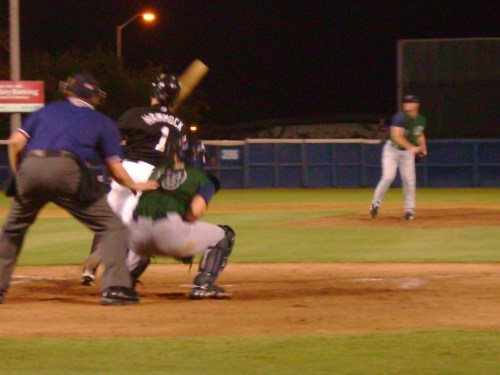
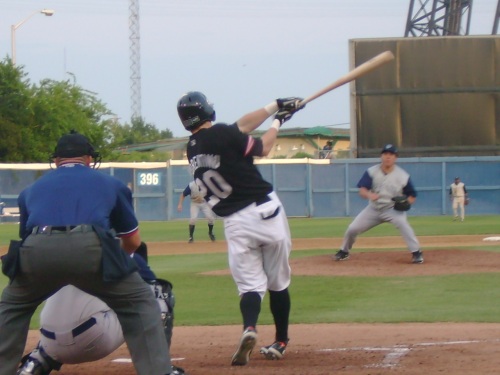
034Robby Hammock Doubles against Charlotte

The past few years the Orioles have been engaged in a rebuilding process which for many has been long and painful and is not yet complete.  They began in the lower “A” level and progressively worked their way up so that their minor league organization is one of the best in baseball at least as far as talent and prospects are concerned.  Some of that talent had filtered up to Baltimore by the beginning of the year but the Orioles were still a very weak team as they entered the season.  By May the team was calling up members of the Tides, Outfielder Nolan Reimold and Catcher Matt Wieters were among the first to go along with pitchers Brad Bergeson, Lance Berken.  Others would follow throughout the year so that even before the call up at least a dozen former members of this year’s Tides team including pitchers David Hernandez, Chris Tillman and Kam Mickalio were up with Baltimore, or who like Oscar Salazar made the Orioles and were traded and are still in the big leagues.  There were others who were traded at the very end of August including Joey Gathright who went to the Red Sox and Freddy Guzman who went to the Yankees.  There were a number of players who had season ending injuries that might have been called up including Justin Christian, Scott Moore and Jolbert Cabrera.  Cabrera’s injury may be a career ender as he turns 37 in December.

scoreSafe!

The players called up on September 1st were pitchers Dennis Safrate, Matt Albers and Alberto Castillo. Outfielder Jeff Fiorentino who is arguably the MVP for the Tides this year was also called up. Unfortunately for Fiorentino the Orioles have a stocked outfield of Nick Markakis, Adam Jones and Nolan Reimold so it unlikely that he will stay up beyond the regular season.  It is expected that the O’s will call up several more players on September 8th following the end of the International League season. There is talk of a couple of pitchers, perhaps Chris Waters and Jim Miller as well a catcher and Second Baseman Justin Turner.

For us in the Church of baseball it meant that we had a season that was very good and really bad. The Tides were probably the best team in Triple “A” at the beginning of the season. By early June they had a large division lead and had close to .700 winning percentage.  With hitting which included power and speed the Tides have had one of the top batting averages in the league all year, even at the end of the season.  Currently they are batting .274 as a team only .001 behind Columbus which is at .275.  The pitching staff was solid but after call ups and injuries mid-season became less effective about the same time the Tides lost most of their power hitters.  This resulted in a All-Star break the team began slump in which the Tides ended up dropping back to 3rd place and a winning percentage of just above .500.

The Tides have 5 games to finish out the season.  The new players are beginning to show some life and the Orioles and Tides management will beginning planning for the 2010 campaign.  Of particular interest to me are catcher Guillermo Rodriguez an excellent defensive catcher with a better bat than we have seen at that position sin a long time with the exception of Matt Wieters and outfielder Jonathan Tucker just up from AA Bowie where he was on the Eastern League All-Star team this year.  He is much like Joey Gathright, a speedy contact hitter with excellent range in the outfield and I expect that Jonathan will be patrolling the outfield for the Tides in 2010.  Recently acquired Rhyne Hughes has added punch to the lineup at First Base hitting home runs in his last two games and I would not be surprised to see the Orioles keep him around.

moon over harbor parkMoon over Harbor Park

September has started better for the Tides and for the first time since August 6th. The win streak has improved the Tides record to 70-68 moving them back to a .507 winning percentage, currently in 3rd place in the IL South. In the three games the Tides have outscored their opponents 21-3 defeating Charlotte 10-0, Gwinnett 8-1 and 3-2.  Andy Mitchell, Chris George and Chris Lambert got the wins in strong performances.  Tides relievers were excellent allowing no runs.  Jim Miller rang up his 17th save tonight having reclaimed his rightful place as the Tides closer.  The two wins over Gwinnett have dropped that former rival from Richmond to 2 games back of Durham for the I South Title with 4 games left to play.

Friday night the Tides will play their last home game of the season at the Church of Baseball, Harbor Park parish at 7:15 against these same Braves hoping to put another nail in the Braves Title hopes.

Peace,

Steve+

Leave a comment

Filed under Baseball

Analyzing the End of Season Collapse of a Baseball Team

Note: I cover baseball and the Norfolk Tides with a Blog on the Virginia Pilot Online entitled Padre Steve’s View from 102. The link to that site and those blogs is here:  http://hamptonroads.com/blogs/padre-steve039s-view-102 Those articles are not re-posted here.

out at homeGathright Out at Home

Baseball is replete with end of season collapses of teams that had started hot and were in first place. The collapses often take place due to injuries to key players, trades gone bad or slumps that never end.  These collapses are even more troubling when there are not injuries or other circumstances that readily explain them.  The 1964 Phillies and the 2007 Mets had meltdowns of epic proportions in the last month of a major league season.  At the Minor League level there are other factors to consider especially with the added dimension of call ups by the Major League team and trades made by the Major League affiliate which impact the Minor League club’s roster.

strike outThe Melt Down Continues Strike Out

This year the Baltimore Orioles AAA International League Norfolk Tides who were playing nearly .700 ball through June experienced a collapse like I have not seen up close and personal.  Early in the season they were nearly unbeatable. Consistent and clutch hitting combines with excellent pitching allowed them to dominate the league taking series after series and recording a number of series sweeps against good teams. The for a variety of reasons the wheels came off.  At first is was merely inconsistent play and basically playing .500 ball. Then came the collapse and the Tides are only mathematically in the post season chase.

Fiorentino HR against ColonBright Spot: Jeff Fiorentino Should be Tides 2009 MVP

As the season draws to a close with the Tides obviously out of the playoff race even with the mathematical possibility of coming back it will be time for some ruthless evaluation of how the club has been managed since the All-Star break.  It is hard to believe that with as much talent as the Tides still have that they are losing this consistently and this badly.  The Orioles can be blamed for pulling players up and depriving the Tides of talent, however they needed to draw upon the Tides because of the weaknesses at Baltimore.  Certainly the call up of players like Nolan Reimold, Matt Wieters and Oscar Salazar has had an effect on the Tides. Likewise  the number of significant injuries to productive position players such as Justin Christian, Jolbert Cabrera, Scott Moore and Donnie Murphy had a large impact.  The loss of these 7 players deprieved the Tides of most of thier offensive power as did the recent call up of Michael Aubrey.

gathriright buntingAnother Bright Spot: Joey Gathright Bunting for a Hit

But even with all of these losses the Tides are tied for the best team batting average in the International League at .274.  So we cannot simply blame the crash on the loss of these position players and loss of power hitters.  We then come to pitching, Despite the collapse the pitching staff ERA is still only 3.94 and not at the bottom of the league, however the relief pithcers including guys who had been almost automatic in being able to close out innings and games has become very incosistent and in the past 10 games have blown 3 9th inning leads.  Convert those to wins and the Tides are still in the hunt.  Rececnt pitching additions from other clubs with the exception of Jeff George have not panned out. So we can say that pitching is a factor.   Fielding and defense is another matter.  Unfortunately Tides infielders have committed 71 errors.  Three players, Melvin Dorta, Justin Turner and Blake Davis have committed 51 of these and former Tides infielder Carlos Rojas another 9. Though the statistic is not found on the MiLB or Tides Websites, Tides pitchers have committed their share of errors at critical points in games.   On the other hand Tides outfielders Joey Gathright and Jeff Fiorentino have only two errors eachand lead the Tides in batting average, on base percentage and are near the top in slugging percentage among the current roster.

046Is it the Manager?

The Orioles organization will certainly address these on the field concerns.  This is something that thye have been working on and I expect that next years team will be more solid in these areas and  hopefully the Orioles with the addition of so many Tides who now have Major League expereince will not need to dip down so often and give the Tides, Baysox and Keys time to develop tallent.  However the Orioles management may need to take a look at the dynamics of what is happening in the dugout with the field staff including Manager Gary Allenson.  We really have to see if the problem is bigger than just a Lemony Snickets Series of Unfortunate Events or an organizational problem.  There are many regulars who question Allenson’s choices as a 3rd base coach as well as his inability to pull a pitcher before they get the team in deep trouble.  Yes giving pitchers the experience of trying to pitch out of jams is important, but it should not be done all the time.  Frequently it seems that Allenson has left pitchers in for one out or one inning too long, often with no-one warming up in the bullpen.  The final thing to ask is how Allenson rotates his infielders to different positions on an almost daily basis. I have to wonder if the constant changes in where the infielders are being played is effecting the number of errors being committed by the club especially in light of the fact that the three biggest error producers are the middle infielders. While the Organization may be at fault for some player personnel issues ultimately it is the Manager who makes the day to day calls on the field that determine whether a team wins or loses.

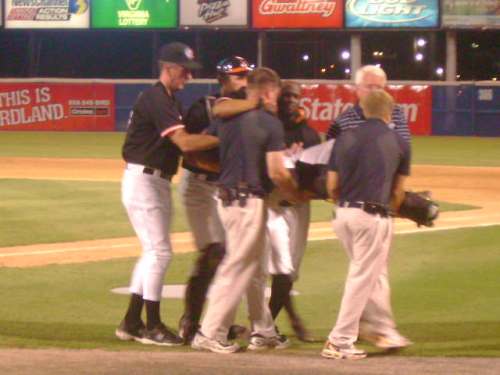
135Injuries: Jolbert Cabrera Being Carried Off teh Field after Breaking Bones in his Foot

The Tides are 10 and 25 since July 20th oin what has been a collapse nearing epic proportions and since the 18th of August have been outscored 65-40.  When one looks at talent, save the inability of the infield to play error free ball;  one has to begin asking questions and getting answers.

The Tides face the Charlotte Knights tonight, with Jake Arrieta facing Jake Peavy.  I will be there in Section 102, Row B Seat 2.

Though the players are here to develop and learn, there is little substitute for winning when building a young team. As Charlie Brown said “Winning isn’t everything, but losing isn’t anything.”

Peace, Steve+

Leave a comment

Filed under Baseball

Roster Moves: No Game, Series or Season in Baseball or Life Goes Without Them

046Norfolk Tides Manager Gary Allenson making a Slight Adjustment to the Outfield with 1 Out in the 9th Inning

Larry: Who’s this? Who are you?
Crash Davis: I’m the player to be named later.

From Bull Durham

Sometimes I feel like the player to be named later.  I am amazed at the changes on a baseball team’s roster during the course of a season.  At the same time being in the military for almost 28 years I have some understanding of them in daily life.  This season with the Norfolk Tides and my place of work at a Major Naval Medical Center has been a perfect example of how no roster survives intact.

Now this is nothing new, as long as there have been baseball teams and militaries there have been personnel changes.  In baseball as in the military there is constant moves of personnel as people are transferred, promoted, demoted, are injured or retire from either the service or the game.  Sometimes roster moves are part of a natural process as an organization decides how it wants to chart its future. Other times they are dictated by a need that occurs that has not been anticipated such as injuries, trades, transfers, retirements or personnel or budget constraints, either expected or unexpected.

In the Minor Leagues the Minor League affiliates exist to supply their Major League organization with young talent, player development, rehabilitation and depth to meet the demands of a long season.  It is similar in the military where support and training organizations exist to meet the needs of the operating forces.  This is true regardless of military branch of service.   When the Major League Team or the operating forces are stretched, experience losses or suffer setbacks it is common for them to draw upon the support and training organizations to fill the holes and meet the needs of the larger organization.

I have watched this close up in two worlds this year both where I work and where I watch the Tides play ball.  At work this has occurred where due to retirements and transfers our department has lost a lot of people who have not yet been replaced, creating a lot of pressure on those who remain, likewise we are tasked with more missions to support the operating forces.  The same is true of the rest of the Medical Center where many physicians, nurses, corpsmen and other sailors have been deployed to meet the demands of the expanding war in Afghanistan while still supporting other worldwide commitments and our own home town mission.  While this is going on other needs have come up in caring for returning warriors, wounded warriors and their families as well as the rest of the military community that depends on us for their primary and specialized medical care.  I have seen more colleagues and friends than I can count be deployed from what is supposedly a pretty safe “non-deploying” shore billet to support the operating forces, Navy, Marines and Joint or NATO.  I have watched the organization adapt to the call ups by moving people around as well as finding people to fill the void, even if they are only on contract.

Our Norfolk Tides began the season with a very solid roster and within two months the big club, the Baltimore Orioles had called up several pitchers as well as the heart of the batting order, Outfielder Nolan Reimold, Catcher Matt Wieters and Infielder Oscar Salazar.  Meanwhile the Tides lost several players to injuries which forced Manager Gary Allenson and the Orioles organization to fins personnel both within and outside of the organization to fill the gaps created by call ups to the big team and injuries.  To do this they brought up players from AA Bowie, moved players down from Baltimore and found and traded for players outside of the Orioles system.  At first the adjustment was difficult but now the new players and those who were left are coming together to keep the team, at least for now in first place in the International League South.   Yet with every move the organization has to decide how to best utilize the players that it has.  In the case of the Tides this comes down to Manager Gary Allenson and his coaches working together with the rest of the Orioles organization.

Even in the midst of a game there are roster changes, sometimes for pitchers, sometimes hitter and sometimes even for running or defense.  Some of the changes are for injuries, or situational based on statistics of what you have empirical evidence to show that one course of action is better than another.  Thus you have relief pitchers and pinch hitters or runners.  No at bat or even pitch is the same, which is like life, nothing remains the same so you must make the adjustments on every play.

At the personal level changes affects everyone in the organization even if their job in the organization does not change.  At the minimum the changes affect the dynamics of the work environment, the chemistry between teams and the concern for friends who have left the organization with whom we have invested significant amounts of time and emotional energy.  Thus when Oscar Salazar was called up by Baltimore it left a huge hole in the team because Salazar was not only a leading contributor on the field but his tremendously positive attitude off the field in energizing the team and working with younger players.  Individual losses while seemingly statistically insignificant can be magnified by the intangibles of what a person brings to the team.  Some who seem to have all the right stuff may not be missed, while others who maybe don’t have the same talent level as others might be more sorely missed.  Since a team depends on the efforts of everyone, especially in baseball where the game is both immensely individual and absolutely interdependent personnel changes must be weighed carefully in the overall mission of the team or organization.  The Tides are fortunate to be with Baltimore as the organization is not only scouting talent for the O’s but their Minor League affiliates.  I met a Baltimore Scout at a Tides game over the weekend who said they were out seeking hitters for Norfolk due to call ups to the O’s and injuries to members of the Tides.  The larger organization, though a work in progress recognizes that its future lies in its Minor League system.  Thus over the past couple of weeks they have picked up Michael Aubrey from the Cleveland organization and Victor Diaz, a former Tides Outfielder when they were in the Mets organization and who later played in New York, Texas and the Houston organization before playing with the Hanwha Eagles in South Korea before being signed by the Orioles and assisted to the Tides.  A good organization not only looks to the situation they are currently facing u to the future.  A bad organization does not plan for the future but only concentrates on the present.  In the case of the Tides we are prospering under Baltimore but suffered for almost 20 years under the Mets, who have continued to neglect and abuse their farm system, especially their AAA affiliates.  The fans in Buffalo despise the relationship.

On the personal level this also means that individuals can be moved around to meet the needs of the organization.  This does not always make players happy be they ball players or military personnel.  There have been times in my career that I did not like what was happening to me in the organization, not so in the Navy but definitely in hte first part of my Army career. Such unhappiness when left unchecked can lead to blow ups.  The movie Bull Durham has a great example where Crash Davis, played by Kevin Costner complains about his reassignment from an AAA team back to a single A team.

Crash Davis: You don’t want a ballplayer; you want a stable pony.
Skip: Nah.
Crash Davis: Well, my triple-A contract gets bought out so I can hold some flavor-of-the-month’s dick in the bus leagues, is that it? Well, f— this f—ing game!
[pause]
Crash Davis: I quit, all right? I f—ing quit.
[Crash exits the office and stands in the clubhouse for a minute before sticking his head back through the door]
Crash Davis: Who we play tomorrow?
Skip: Winston-Salem. Batting practice at 11:30.

I cannot say that in my Navy career I have ever felt like Crash Davis,  in fact I have even when doing a lot of “relief” work and been moved around sometimes faster than I wanted to be because I was needed to put out a fire. At the same time I have  always been dealt with well.  I have not been sent back down in the organization, but have been moved up or laterally to do different jobs, like I said often on short notice like the time when two different chaplains were fired and I went from one job to the next and ended up nine or ten weeks at 29 Palms prior to a 7 month deployment in two different battalions. Those were stressful, but not bad and the organization treated me well.  Some people don’t have that experience however and roster moves on short notice can be a source of consternation, anger and discord if not handled well by the team manager or the command.

However I did come into the Navy at a lower rank than I left the Army in 1999 just to get back in the show that was the cost of getting back in the game full time, something I am amazed that I got the chance to do and every grateful to the Navy, my Bishop and the Deity Herself.   In my current billet I love what I do and who I do it with, but the organization will be making some changes as we graduate our current residents, gain new residents, gain and lose other personnel and adjust to meet an ever changing and increasing mission.  While we do this we seek to set the standard of professional competency not only in the Navy but the civilian world.  For me this will involve changes, changes that on one level I resist, but on another level completely understand and agree with as the way to help the organization move forward.  Come September those changes will be made.  I can say that I don’t feel like Crash because this involves things that I have always wanted to do but unless I am adaptable will not be able to do, unless the Deity Herself creates a couple extra days to the week and makes every day a 32 hour day.  Thus I will adjust as will the rest of the organization as we collectively work together to ensure that we are taking care of those that God has given us.

So far as the story goes tonight, the one constant in the season is change, teamwork and adjustment to change. As Sparky Anderson once said “If a team is in a positive frame of mind, it will have a good attitude. If it has a good attitude, it will make a commitment to playing the game right. If it plays the game right, it will win—unless, of course, it doesn’t have enough talent to win, and no manager can make goose-liver pate out of goose feathers, so why worry?”  Thankfully, our leadership seems to be rising to the task and and we have the talent, so why worry?

Peace, Steve+

2 Comments

Filed under Baseball, leadership, Loose thoughts and musings, Military, philosophy