Tag Archives: church

I Think I Feel a Sermon coming on…How Some Churches Stopped Caring and the Neglect of Pastoral Care

“When they had finished breakfast, Jesus said to Simon Peter, ‘Simon son of John, do you love me more than these?’ He said to him, ‘Yes, Lord; you know that I love you.’ Jesus said to him, ‘Feed my lambs.’ A second time he said to him, ‘Simon son of John, do you love me?’ He said to him, ‘Yes, Lord; you know that I love you.’ Jesus said to him, ‘Tend my sheep.’7He said to him the third time, ‘Simon son of John, do you love me?’ Peter felt hurt because he said to him the third time, ‘Do you love me?’ And he said to him, ‘Lord, you know everything; you know that I love you.’ Jesus said to him, ‘Feed my sheep.” John 21: 15-17

“Take care that you do not despise one of these little ones; for, I tell you, in heaven their angels continually see the face of my Father in heaven.” Matthew 18.10

Back when I was doing my Clinical Pastoral Education Residency at Parkland Memorial Hospital I was astounded to hear my pastor make a comment which I think was one of the most heartless that I have ever heard said from a pulpit.  The church was a large and trendy Evangelical-Charismatic Church which I had attended throughout seminary and had ordained my in October 1991.  The Pastor was recounting an incident where one of our members had been critically ill in hospital and had not been visited by him.  After the parishioner was released from hospital he asked the pastor: “How sick do I have to be for you to visit me in the hospital?”  The pastor told us his response: “Sir, you don’t want to b e that sick.”  The congregation laughed at the pastor’s story and he went on to talk about how he and other senior pastors should not be doing that kind of work because it “distracted them from bigger Kingdom tasks.”  You see according to the pastor the care of sick parishioners did not contribute to the “growth” of the church and thus was a “distraction and better left to others.”  The comment struck a raw nerve now that I was dealing with the suffering and death every day of people who had been abandoned by the churches and pastors.  I lost all respect for him as a man and pastor during that sermon.  The words of my Philosophy of Religion Professor at Southwestern Baptist Seminary Dr. Yandall Woodfin said: “You have not done Christian Theology until you have dealt with suffering and death.”  This pastor had stopped doing Christian Theology in order to be an “Apostle” and CEO.  He was “growing” the church and managing programs, but had for the most part stopped caring as in being a pastoral care giver.

Now this pastor is not alone and nor is the issue confined to Evangelical or Charismatic churches. The trend has has found its way across the denominational spectrum.  Sometimes this is by design as is the case of the Mega-churches.  Pastors of mega-churches are for all practical purposes CEOs of large organizations and have a multiplicity of specialized staff, but often which do little for pastoral care. Sometimes it is by default in cases such as the Roman Catholic Church.  Here the ever worsening shortage of Priests is forcing the closure of smaller parishes and the increase of large parishes with a corresponding decrease in what Priests can do for their people.   Even very good Priests cannot keep pace with the demand of both Sacramental needs as well as pastoral care.  No matter if it is by design or default the result is similar.  The least, the lost and the lonely those “lambs” that Jesus talks about who need care and feeding are shunted aside.  In one case, that of the Catholic Church it is simply a lack of Priests, Deacons and Sisters to provide this care.  The other is more troubling as the focus of the church is growth, sustaining numbers, programs and buildings.  This requires that pastors spend their time with members who can supply the vast financial need that those plans require.  I have seen this in numerous congregations across the spectrum, which sometimes as was the case at a church that I attended in Florida results in a financial meltdown and collapse of the congregation, many of whom gave up and went elsewhere when the extent of the scandal became known.  Likewise the ripple effects that this caused in the denomination were like a Tsunami, it was disastrous and the church is still in recovery mode.  Going back to my pastor back when I was in residency I got the feeling that had he been the shepherd in the Parable of the lost sheep (Luke 15) that he would have let it go as hunting for it might have distracted him from the others.

When I was in seminary there were quite a number of my fellow students who chafed about having to take courses on pastoral care.  I remember friends and fellow students complaining that what they needed were more “practical courses” such as “church growth, evangelism and Sunday School program management.”  Course such as Pastoral Care were seen as a bother and distraction.  Not to mention academic courses such as Systematic Theology, Philosophy of Religion and Church History.  One friend talked about his Master of Divinity only having a “shelf-life of 5 years” because what he learned would be outdated.

Well in a way he was right.  His focus was on classes that dealt with programs and methods of church growth, programs and management.   From that perspective his degree would rapidly be obsolescent as soon as the next trend in church growth came along and everyone jettisoned the last method in favor of the new.  With the ubiquity of the Mega-church which unlike the Leisure Suit is not going away anytime soon.  The rise of the “Superstar” Pastors such as Bill Hybels, Joel Osteen and Rick Warren and the proliferation of massive “Ministry Media” conglomerates and stand-alone television ministries are actually dangerous to the vitality and health of the Christian Church in the United States.  They propagate methods which have the sole intent of getting people into church or giving to a ministry and keeping them there, doctrine, worship, sacraments or ordinances, and pastoral care of the least, lost and lonely be damned.  The methods are pragmatic and impersonal.   Numbers and crowds define expertise, credibility and worth. The bigger the church the better the church, it’s that simple.

Unlike others who pick these ministers apart for their theology or business practices my problem with what is happening is what happens to regular people in these large and often very impersonal churches.  It is easy for people to get lost, forgotten and when they are going through difficulty abandoned when the church stops making a conscious effort to do real pastoral care and focus purely on the programs which lend to growth.  Often the substitute for pastoral care is found in the home cell group, or care group or whatever cute name a church can pin on a meeting at a member’s house.  The cell groups have a noble intention.  They attempt to build community in an otherwise very impersonal organization.  There are some really good things that can come out of healthy home groups as well as long lasting friendships.  We have a couple from our time in San Antonio that is still a very real part of our lives, they showed us genuine love and care and we remain friends.  Of course this couple had an advantage over most home group leaders; he was a Clinical Social Worker by trade who was heading off to seminary.  Most home groups are not that fortunate.  At the same time there are unhealthy groups which are led by people who are poorly trained and equipped to deal with broken people.  The good group leaders recognize their limitations and try to get help for those who are really hurting.  Others who do not know their limitations end up abusing these dear lambs of God. Often this is because sick, depressed or lonely people take too much time, are too needy, or that their problems don’t match up with their church theology.  We know this from personal experience as my wife suffered from a number of ailments throughout seminary and we were going through tremendous health and financial difficulties and in some places we felt cast aside and like we did not matter.  We were fortunate that some people did care and we did make it through, however it was not something that I would ever want to repeat.  I have heard similar stories from hundreds of people that I have come across in my life and work over the years.  Another thing some churches do is to either add a “Christian Counseling” program or refer members to “Christian Counseling” services instead of doing pastoral care.  In a sense it is the outsourcing of one of the most vital missions entrusted to a church, the pastoral care of the flock of God.

I don’t care what you call it, but any church which has multiple services of several thousand or a major service of close to 20,000 as occurs at Osteen’s Lakewood Church is no longer focused on caring for people but sustaining their growth and market share.  I remember reading Charisma Magazine back in the mid-1990s when I still read it regularly about a church in North Dallas that has a period of incredible church growth in which it grew from 1,200 members to well over 7,000.  In the article the pastor touted the church programs which drew people to the church.  What the dirty little secret which was not mentioned was that two exits south of this church a Mega-church of some 10,000 members imploded when the Pastor, one Bob Tilton got caught doing some pretty bad stuff.  This church despite its claims of great programs simple picked up about 6,000 of these people because they were close by and a similar type of church.

All of this is dangerous as to its impact on people.  One only has to look at the latest Barna Polls about what is going on in churches to see that these large churches are alienating people even as they grow.  People come, but others either burn out trying to keep pace with the manic pace of programs proliferated by these churches or they get lost in the crowd and forgotten.  I meet a least a person every day who is a displaced Christian, often hurt, lonely and broken, not only by what they have experienced in life, but by the cold emptiness that they feel when a church surrounded by thousands of people who don’t even know their name.  Some churches do recognize that people have issues that need to be addressed and have in-house “Christian Counseling” programs or refer members to “Christian Counseling” services.   I think that there certainly is a place for clinically trained therapists in the life of a church; however this is not really pastoral care, even when they use “Biblical” methods.   In a sense it is the outsourcing by pastors of one of the most vital missions entrusted to a church, the pastoral care of the flock of God to others, in a sense, “hirelings.”  Again my issue is not with the therapists or Christian counselors, but rather pastors who refuse to do pastoral care as part of their ministry.

Ultimately it is people that are important, even those who are not rich, powerful and who have problems that don’t fit nicely into theological boxes or paradigms promoted by church growth experts. It is high time that churches start reclaiming one of the most vital missions given by Jesus to his Disciples, to care for the least, the lost and the lonely. The onus for this falls on pastors who cannot simply outsource one of their primary missions as given by Jesus himself to others.  If pastors do not set the example of being caring pastoral care givers, it will not matter that they are supposedly “empowering” laypeople to do ministry.  Instead it sends another more ominous message, that if it is not important for the pastor, why should it be important to me?  Every member of the church at some time goes through a crisis when their faith, family, health or vocation.  Sometimes these are not isolated events but rather prolonged periods of anguish, as what Saint John of the Cross described as “the Dark Night of the Soul” where it seems that God has even abandoned the person.  Unfortunately people in this situation are often abandoned by their church as things fail to improve.  Despairing they become the lost sheep whose shepherd has abandoned.  This is the hardest time for pastoral care, the times where we as pastors are called to stand with someone as Mary the Mother of Jesus did at the Cross, just simply being there though nothing else can be done.

Now do I understand that the demands of running a large church can be sometimes become such that pastors have difficulty making time for pastoral care?  Of course I understand this, at the same time pastors, even those who function primarily as pastor-teacher/CEOs still have the responsibility of caring for people, not simply administering programs and preaching.  Pastors need to set the example of care for people, real people, the regular Joes and Jane’s who populate their pews, by their books and give to their ministry, even if it is only in small ways, not just the super-givers or the wealthy and powerful.  James’s “right strawly epistle” (Martin Luther’s words) has much to say about favoring the rich and powerful and neglecting the poor and seemingly insignificant people hanging about the peanut galleries of their large “Worship Centers.”  Even if the pastor has limited time he or she must be about the flock, or they will forget what the needs of the flock really are and instead of the People of God, the lambs who Jesus says to care for they will simply be the consumers of a religious message who we have to keep coming back to keep the operation going.

My sermon is over and I do hope that there will be more “amen’s” than calls for burning me as a heretic.

Peace, Steve+
3 Comments

Filed under Pastoral Care, philosophy, Religion

My Brotherhood of War

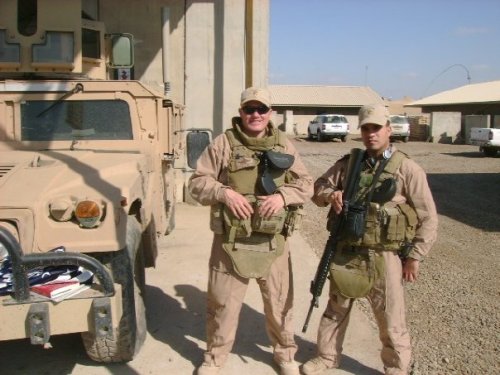
Dynamic DuoRP2 Nelson Lebron and Me- The RST-2 “Desert Rats”
Back in the mid 80s shortly after I was commissioned as an Army Officer there was a series of historical novels by W.E.B. Griffin called the Brotherhood of War. The series traced the paths of several Army officers as well as family and friends beginning in World War II. I am not much of a reader of fiction, but this series, as well as Anton Meyer’s Once an Eagle well captured the unique culture of the career professional soldier through both war and peace.  They treated their subject respectfully while also dealing with the effect of this lifestyle on families as well as the soldiers, reading Once and Eagle I feel that connection with the fictional Sam Damon, the hero of the story and revulsion for the character of the self serving careerist Courtney Massengale.

I’ve been a military officer in both the Army and Navy now for almost 26 years with nearly 28 years total service. It is part of my heart, soul and being.  I was born for this, just as Babe Ruth, Willie Mays and Ted Williams were born to be baseball players.  I grew up in a Navy family as a Navy “Brat” living up and down the West Coast and the Philippines and all I can remember from the earliest age wanted to be in the Navy Officer and later Navy Chaplain.  My dreams came true.  The first 17 ½ years of my service was in the Army, something that that initially my retired Navy Chief Dad had problems with, however he made his peace with it and was proud that I served and proud of the fact that I had made Major.  However, in 1999 in order to return to active duty I resigned my Army Reserve commission as a Major and entered the Navy Chaplain Corps as a Lieutenant with no time in grade.  Outside of marrying my wife Judy, who somehow did not kill me when I did this, going in the Navy was the best thing that ever happened to me.

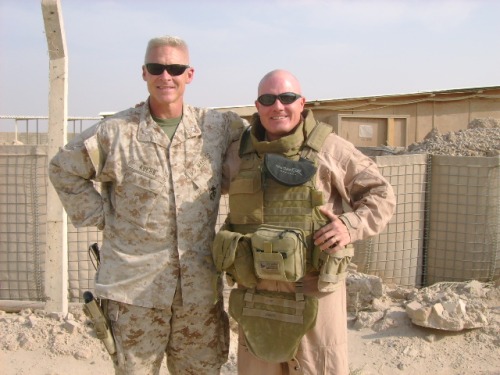
134LtCol David Kuehn and Me

Part of my time in the Army and Navy has been my time in the Chaplain Corps of each service.  I have been a chaplain for 17 years come September.  My best friends in the military are other chaplains, some from my own church and some from other communions.  The ones that I have the most connectedness to are those who have served in combat, especially those who served in Iraq, or ships in the war zone conducting various combat and maritime operations even when we were in different places.  In Iraq I was blessed to have Fr Jose Bautista-Rojas and Chaplain Pat McLaughlin supporting me at my base of operations.  There were others besides these men and many who were not chaplains. In Baghdad I had the staff of the Iraq Assistance Group Chief of Staff Colonel David Abramowitz and Chaplain Peter Dissmore and Captain Mike Langston at II MEF Forward.  Likewise I had Colonel Scott Cottrell and Colonel John Broadmeadow at 7th Iraqi Division Military Training Team, my friend LtCol David Kuehn at 3rd Brigade 1st Iraqi Division Military Training Team, LtCol Stephen Bien with the 2nd Border Brigade and a host of others about Al Anbar Province. As important if not more was my assistant RP2 Nelson Lebron, a true hero and friend.

chaplains and rp2 lebron at TQNelson, Fr Jose Bautista-Rojas, CDR Pat MCLaughlin and Me at TQ
Back in March of this year I was with a number of chaplains from my church gathered for our annual conference.  Some of these men I have now known for at least 10 years, some more.  I’ve seen the young guys start to age and others retired from the service.  We have grown together; we at least in most cases have come to love each other as brothers and friends.   What has made this conference different from past gatherings is that all of us have had one or more combat deployments or are getting ready to go for the first time or back for another tour.

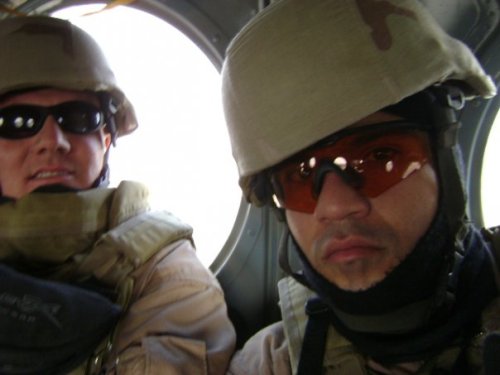
nelson and me flight homeNelson and Me in the Air Everywhere

We have shared our stories but now they are the stories of men who have all seen war.  In our careers we have all experienced success, as well as heartache.  Due to our duty we have been often isolated from the church and each other.  We all came back from the war changed in some way.   Some of this is due to health related issues stemming from our service and for others things that we have seen or experienced.  Of course each of us has had different types of experience in country, but nonetheless our experienced changed all of us in some way or another.  For me the events have been trying to make sense of the torrent of emotional, physical and spiritual distress that I have had to deal with.  While I have made a lot of progress in some areas, there are a lot of places where I’m still sorting through things as are a number of my friends.  I can say that I often feel alienated from my own church.  When I read things that some of our bishops write or say I know that I do not belong.   Based on my service in combat and to my country for almost 28 years  and 13 years as a faithful priest I have tried.  The fact that with the exception of some of my fellow military priests I have no relationships with anyone in my church,   I was at one time banned from publishing by a former bishop.  I was forbidden to have contact with the priests of a my old diocese when I was stationed in it by the same man.  The civilian diocese that I transferred  to has had nothing to do with me for the most part since I was transferred to Virginia and since I moved here no one has bothered to say a thing to me.   None of this was because I didn’t try and the thing is I don’t care anymore.  I just plan on caring for God’s people where I’m at and building relationships with people who bother to invest in my life here. I haven’t the spiritual or emotional energy to keep trying to make something happen with people who obviously don’t care about me and haven’t for years.

This year our gathering was marked by a lot less light heartedness.  There was a lot less bravado than years past, more reflection, less intense discussion of the theological issues that have divided the Christian Church for centuries.  I know for myself I don’t have the energy to spend battling people over things that the rest of Christendom hasn’t been able to settle on.  For me I’m okay with the Canon of Scripture, the Creeds and the first 7 Ecumenical Councils, though I have a great love of the Second Vatican Council.  If people want to fight the other fights they can go ahead without me how many pins you can stick in the head of an Angel.

As far as health concerns I know that at least two of us have confirmed real live PTSD, and one with a case of TBI.  Based on the way others act I’m sure that almost all have at least a combat stress injury, and maybe a couple more have PTSD.  One young Army Chaplain has an Iraq acquired constrictive bronchiolitis, or bronchiolitis obliterans which has no cure. This young man has won two Bronze Stars and now has the lung capacity of a 70 year old man.  At best he can hope that his lungs will not worsen and only age at a normal pace, which means in 10 years he has 80 year old lungs.  This young man is a Priest who I have mentored, coached and been a friend and colleague of since before he was ordained.  He is looking at something that will kill him; it is just a matter of when.  He is going through all of his medical boards now at Fort Hood and expects that in six to eight months that he will be medically retired.  It seems to me that a hero is being kicked to the curb by the Green Machine after laying himself on the line for his country.  He was treated by many people in the Army Medical system with suspicion and made to prove that he was sick at almost every point until a high ranking medical officer found out about his case and sent him to civilian specialist for evaluation.

While I was at our conference I had a major PTSD meltdown where I basically hid in my room of a day and a half, sneaking out at night to gather with just a couple of my friends by the pool for beer and Krispy Kreme Doughnuts.  Unfortunately we could only get the store bought ones because the hot and fresh glazed go great with a good pilsner or lager.

We have several Chaplains who have won Bronze Stars for their service in combat. I was awarded the Defense Meritorious Service Medal for what I did in Iraq.  I treasure that award because it cost me something to get, I still have a lot of Iraq with me and I always will.  Some day when all is said and done I want to see some of my Iraq military friends again and visit the country as part of a journey of discovering the ancient.

Some of my friends and I have experienced the indifference of the medical and administrative parts of the DOD and VA systems, including sometimes people in our own military service.  When I returned I found my personal and professional belongings crammed into a trailer with those of my assistant because the office space was needed and we were deployed.  There are things which I considered important that are still missing and likely never to be found.  I know that it was not intended to hurt because the space was needed because of major unit re-stationing. If I was the Commanding Officer I would have probably done the same thing and since I have had command I know that mission comes first. You try to take care of people but some things fall through the crack. That is simply part of life.

On the other hand some of my friends have had experiences where they felt the cold indifference of bureaucratic systems often staffed by personnel, military, DOD Civilians or contractors who act if the returning or injured vet is there so they can have a job. To be sure there are a lot of very caring people in our organizations, but these coldly indifferent people seem to show up all too frequently. This unlike what happened at my unit is intolerable.

What touched me about my unit was once it became clear that I was a PTSD casualty they did everything to try to get me help.  My first Commodore, now Rear Admiral Frank Morneau pulled me into his office to make sure that I was alright and that I was getting the help that I needed.  The man who replaced him Commodore Tom Sitsch asked me a question that was totally legitimate.  “Where does a Chaplain go for help?”  When I went to Portsmouth Naval Medical Center I was strongly supported by both my department head and his deputy.  I wish that everyone who came back like I did had the support of both line officers and Chaplains in their immediate chain of command.  It makes all the difference in the world.

The chaplains that I have served with in Iraq are part of my brotherhood, be they from my church or not. I believe that most of us who have gone to war have by and large matured. We saw death and destruction and were exposed to danger from enemies that could strike in the most unexpected moments in the most unexpected ways.  We have experienced sometimes difficult adjustments to life back home, a knowledge that we are different and that we are even more cognizant of our own obligation to care for God’s people.  Our brotherhood has deepened as a result of war, of that I am sure.  We are truly brothers.

Peace, Steve+

3 Comments

Filed under healthcare, iraq,afghanistan, Military, PTSD, Religion, Tour in Iraq

Revisiting the Political Captivity of the Church

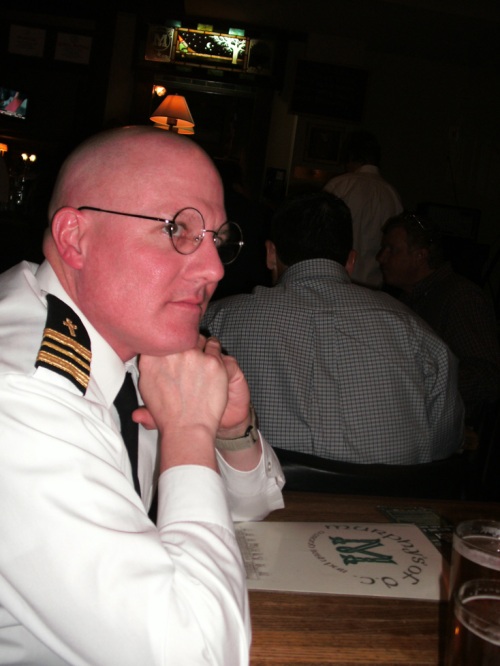
pub2Contemplating Faith and Practice in A Pub

Note: This is an expansion of a topic that I wrote about in the beginnings of Padre Steve’s World.  At that time I had far fewer readers and the post itself was not nearly as fleshed out.  I do expect that some will be really angry with what I write here.  However, I write with no malice, nor condemnation of any particular belief or cause.  The issue for me is how we do things and treat people.  This matters as much as the content of what we say.  On a side note after a dismal road trip the Tides are back in town tonight to play the Lehigh ValleyIron Pigs.  The only saving grace to the Tides “June Swoon” is that their competitor the Durham Bulls who have done even worse. So the Tides remain in first palce in the IL South.

Since I am a “passionate moderate” I figure I should go ahead and continue to dig my grave with my conservative brethren who view anyone to the left of them as a wild eyed raving liberal and quite possibly a Socialist.  Likewise there might be some on the Left with whom I might also dig my grave.  As a passionate moderate I might be classed as a liberal conservative or conservative liberal.  Thus I and people like me stand in the uncomfortable middle of a deeply polarized society.  To the extreme right I might be a raving liberal, and the far left a intolerant conservative but the I choose to live in the tension between the two, although I think that being classed as a raving liberal is far more likely in today’s environment.  Conservatives are now out of power for the first time in a good number of years and mad as hell determined to regain what they lost.  Liberals on the other hand now have power and as any political party would do are advancing their agenda; the Democrat Party won the last couple of elections by a pretty convincing margin.  When Republicans won they also claimed a “mandate” for change.  It is the nature of our body politic.  The fact is that winners get to implement their agenda especially when they have big majorities in the legislative branch as well have the Presidency.

As a passionate moderate who is also a Priest and Christian my goal in life is to get along, find common ground among disparate groups and care for God’s people.  I do this by acknowledging and maintaining the tensions that are inherent in a pluralistic society and not simply going along what whatever is popular or expedient. This takes a lot of effort and does not exclude being prophetic.  However that prophetic role comes in relationship with others where there is mutual respect, civility and care for each other even when we do not agree. It does not come from being angry, acting disrespectfully or making comments that you hope that the government or country fails so you can get back in power.  The prophetic role does not come from the outside looking in railing at your opponents.  That only increases your isolation, eventually to the point that you are no longer a player in the debate, simply an annoying pest with absolutely no say in anything.  It takes more courage to be open and dialogue with people respectfully than it does to rail against them from the outside.  Anyone can be a critic and anyone can be a wrecking ball.  That’s easy.  There is little personal risk in doing so, because you don’t have to open you self up to the possibility that there may be some merit in your opponent’s view and once you have a relationship with someone it is hard to demonize or dehumanize them.  Unfortunately that is what is happening across the religious and political divide in our society.

Despite the rancor on the extremes I think that there are more people out there like me than not. My belief is that voices like ours are drowned out by drumbeat of competing demagogues on the far right and the far left.  Since I am a priest my focus will be on the dangers that I see in the current climate and the captivity that churches have unwittingly placed themselves in making political alliances.  These alliances, particularly of conservative Christians have become so incestuous and so intertwined that they are seen as one and as such these churches and Christian leaders have become the religious voice of political movements fighting a cultural war.  In doing so they have compromised themselves so that only their followers give any credence to what they are saying.  They are so to speak “preaching to the choir” and not reaching out to or even caring about their opponents. In fact opponents are often demonized and declared to be evil.  Many in effect have become like the Taliban and if you do not agree with them on their social-religious agenda you are a heretic regardless of how orthodox you are in your actual theology.  Theology and belief is no longer the test, the test is if you agree with a social-political-religious agenda which often is at odds with the Christian faith has taught.  This is like the Taliban because the goal is to gain control of the government and use the government to impose a social-religious theocracy where the church uses the “police power of the government” to achieve its goals rather that the redemptive message that “God was in Christ reconciling the world to himself, not counting men’s sins against them.” What many churches and Christian leaders have done is to for practical purposes discard any real attempts to engage people with the message of the Gospel in favor of using political power to force non-believers into compliance.  This in stark opposition to the early Church which was martyred for their faith in Christ versus their opposition to government policy or social ills, of which there were plenty that they could have protested.

Early in his “Reforming” days the young Martin Luther wrote a book entitled “The Babylonian Captivity of the Church.” It was a severe critique of abuses in the Roman Catholic Church of his era.  I think churches today have become captive to various political parties, social and economic theories, movements and ideas.  These are not necessarily Christian even though any churches have “baptized” them so to speak.  Capitalism for instance is has many benefits, however unbridled capitalism which is not moderated with true concern for the least, the lost and the lonely, is nothing more that economic social Darwinism.  It is the survival of the fittest with little concern or regard for real people.  People in this kind of world are not people, but consumers and economic units.  In the United States we can see this in practical terms where historically US corporations which at one time employed millions of Americans and produced actual good that were in turn exported to the world have outsourced so many jobs and industries to other nations. This was done in order to increase corporate profits by paying foreign workers almost nothing and not having to abide by US environmental laws or tax codes.  This may bring cheaper goods in the marketplace but it has endangered our economic and even strategic military security. Economic power is one of the key elements of national security.  In the military we call this the DIME:  Diplomatic, Intelligence, Military and Economic power and unless your economy can keep up you will fail.  Just ask the Soviet Union.  It is interesting to see many Christian leaders and churches talk of capitalism as if came down from heaven even using the Bible to try to bolster their argument.  This is just one of many areas where the church is not longer a prophetic voice, but a willing captive mouthpiece for political and economic institutions which at their heart could care less about the Christian faith and wouldn’t mind it going away.

On the left many churches have embraced social reform, the civil rights movement, women’s liberation as well as left leaning and even socialistic economic models and a demonstrated preference for the Democratic Party.   On the right conservative churches beginning in the 1970s in reaction to the social revolutions of the 1960s moved almost lock, stock and barrel to the Republican Party led by men such as Jerry Falwell who founded the Moral Majority in 1979, Pat Robertson who founded the Christian Coalition and Dr D. James Kennedy who founded the now defunct “Center for Reclaiming America for Christ.”  Ronald Reagan was the primary reason for this move as he enunciated a philosophy of limited government, military preparedness, an outspoken advocate of the role of America’s Judeo-Christian heritage and the sanctity of life in at least in what he said. Conservative politicians and religious leaders solidified that relationship in the 1990s during the presidency of Bill Clinton, whose sexual proclivities did nothing to help his cause with Christians despite him signing the Defense of Marriage Act.  The 1994 “Republican Revolution” and “Contract for America” helped solidify Christian conservatives as a central component of the Republican Party and by that point there was a clear alliance between Christian conservatives and the Republican Party.  It was also during this time that politically conservative talk radio became a force in American politics and many on the Christian Right gravitated to broadcasters such as Rush Limbaugh and later Sean Hannity.

I am not going to cast dispersion on the motives of liberal and conservative churches as they made these political alliances.  Far be it, the activity of churches has been an important part of American life and has contributed to many advances in our society including the civil rights movement, which could not have succeeded without the efforts of the Reverend Martin Luther King Jr. and many other clergymen and women, from across the denominational and racial spectrum.  Other examples of where churches spoke to societal wrongs included slavery and child labor.  Now this was not a unified front as many churches especially regarding slavery and civil rights opposed these measures.  This included the major denominations that split into northern and southern factions over the issue of slavery prior to the Civil War.  The Southern Baptist Church is a product of this split.  Other churches such as the Methodists and Presbyterians eventually came back together, the Presbyterian Church USA doing so in 1982, 117 years after the Civil War…better late than never I guess.  This will not happen with the Southern and American Baptist Convention’s as they are now theologically poles apart.

There has been a trend over the last 20 years or so by many clergy and laity in both liberal and conservative churches to be uncritical in their relationships with political parties. In my view this has emasculated the witness of the church.  I have experienced this on both the left and the right. When I was a kid my dad, a career Navy Chief Petty Officer was serving in Vietnam. New to the area we went to a church of the denomination that my parents had grown up in and in which I had been baptized.  This was a mainline Protestant church, the name I will not mention because it is irrelevant to the discussion.  The minister constantly preached against the war and the military probably assuming that he had no military families in the congregation.  At that church I had a Sunday School teacher tell me that my dad was a “baby killer” when I told her that my dad was serving in Vietnam.  If it had not been for the Roman Catholic chaplain at the little Navy base in town who showed my family the love of God when that happened, caring for our Protestant family without trying to make us Catholic I would have probably never reconciled with the church.  I trace my vocation as a priest and chaplain to that man. Since I have spent more of my life in conservative churches in the days since I have seen a growing and ever more strident move to the political right in conservative churches.  I think this has less to do with the actual churches but the influence of conservative talk radio which has catered to conservatives, especially social conservative Christians.  Conservative Christians are a key part of this demographic and it is not unusual to hear ministers as well as lay people simply parroting what these broadcasters are saying. I often hear my fellow Christians on the right talk more vociferously about free markets capitalism, the war on terror and justifying the other conservative causes which are general less than central to the faith in public forums like Facebook.  Some of what is written is scary.  People who pray for the government to fail, pray for the President to be killed, call anyone who disagrees with them pretty horrible names.  I saw an active duty Army Chaplain call the President  Obama “that reject.” The words of a lot of these folks are much more like Sean Hannity than the Apostle Paul.  When I have challenged conservative Christian friends on what I think are inconsistencies I have in some cases been attacked and pretty nastily if I might add.

I see this in stark contrast to the witness of the early church.  Pliny’s letter to the Emperor Trajan sums up how Christians responded to real, not imagined persecution for their Christian faith, not social-political cause.

“They stated that the sum of their guilt or error amounted to this, that they used to gather on a stated day before dawn and sing to Christ as if he were a god, and that they took an oath not to involve themselves in villainy, but rather to commit no theft, no fraud, no adultery; not to break faith, nor to deny money placed with them in trust. Once these things were done, it was their custom to part and return later to eat a meal together, innocently, although they stopped this after my edict, in which I, following your mandate, forbade all secret societies.”

Pliny was perplexed because although he thought their religion to be “fanatical superstitions” he could find no other fault in their lives; they even obeyed his order to stop meeting together.  My view is that Christians some on the left but especially on the right lost any prophetic voice not only in society, in their respective political party alliances.  They have become special interest groups who compete with other special interest groups, which politicians of both parties treat as their loyal servants.  This is what I mean by captivity.  I think that the church has to be able to speak her mind and be a witness of the redemption and reconciliation message of the Gospel and hold politicians, political parties and other power structures accountable for their treatment of the least, the lost and the lonely; caring for those that to those who seek to maintain political and economic control, merely numbers.  The church has to maintain her independence or lose submit to slavery.  There are many examples we can look to in this just a couple of relatively modern examples being William Wilberforce and Dr. Martin Luther King Jr.  We can find many others throughout Church history. These men were not apolitical, but they and their ministries were both prophetic and redemptive.  They maintained peaceful dialogue with their opponents and helped bring about justice.  Billy Graham never gave in to the temptation to endorse any political party.  Instead he had a voice and relationship with every US President during his active ministry, be they Republican or Democrat.

It is incumbent on Christians and other people of faith seek to embody this witness in our divided and dangerous world.  Christians especially cannot allow themselves to be ghettoized in any political party where they are just another interest group. Nor can they allow their public witness to be absorbed and consumed by the promotion of political agendas or causes, even if those causes are worthy of support.  It is a matter of keeping priorities causes can never take precedence over the message of God’s love and reconciliation in Christ.  Unfortunately this is too often the case.  My view is that if you build relationships with people, loving them, caring for them and treating them with the same respect that you would want for yourself; even with those that you have major differences, then you will have a place at the table and your voice will be heard.  If we on the other hand cauterize ourselves from relationships and dialogue we will be relegated, and rightly so to the margins of the social and political process of our nation.  In effect we will ensure that people will stop listening to us not only on the social and political issues, but more importantly in our proclamation of the faith that comes to us from the Apostles.  Unfortunately I believe that at least for the moment we have been marginalized and it is because we have compromised ourselves allowing extremists to be the public face of the Christian church in public debates on social, morale and political issues.  I hope someday we will rebuild our credibility as people who actually care about the life of our fellow citizens and our country and not just those who agree with us.  God have mercy on us all.

Peace, Steve+

2 Comments

Filed under philosophy, Political Commentary, Religion