Tag Archives: dfac

To Iraq and Back: A Bus Ride to Carolina

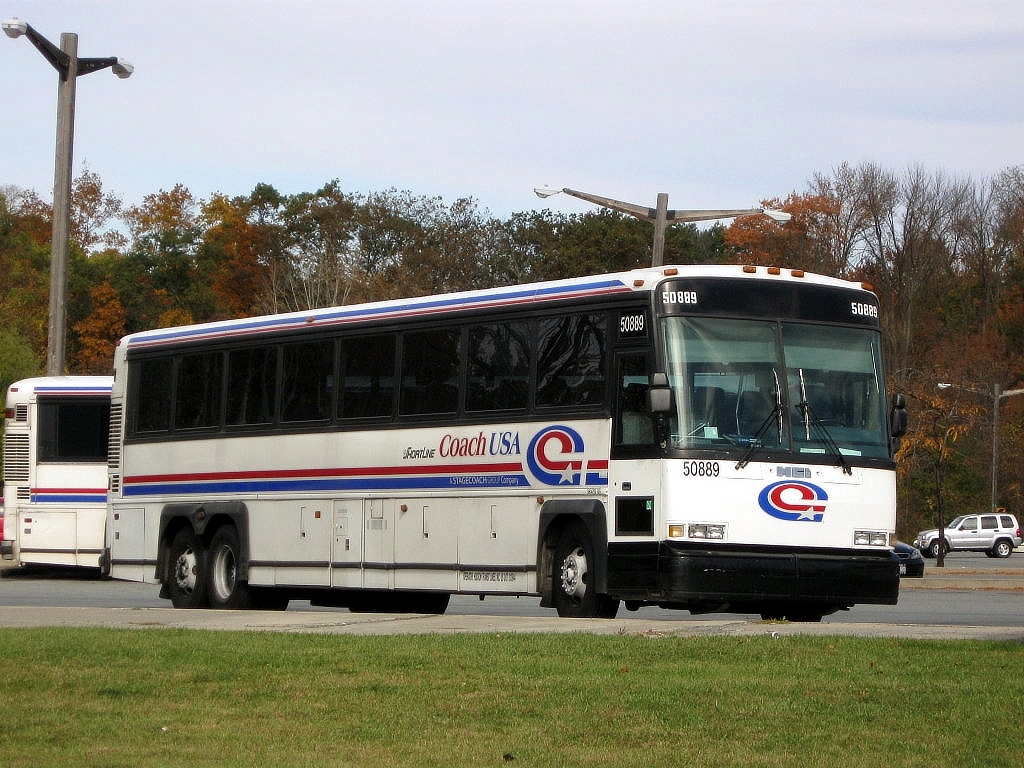
Coach_USA_ShortLine_50889

This is another installment of my To Iraq and Back series.

My CRV with Judy in it pulled away and Nelson and I went about our business. We staged our gear as we waited for the buses to arrive to take us to Fort Jackson South Carolina where we were to receive our training for the deployment.  As we talked other sailors arrived and soon the gear of over 100 sailors was stacked in rows of sea bags just off of the sidewalk.

Nelson’s parents, brother and sister had come to see him off.  His brother is a Navy First Class Petty Officer. His dad a former Vietnam era Marine Recon NCO who made several deployments “in the shit” as many Vietnam vets call tours in that combat zone.  They were really nice folks. Over the years I had heard much about them. They are close to each other and all are supportive of Nelson.

Nelson is a career amateur boxer; kick boxer, martial artist and more recently MMA fighter. He is active in children’s martial arts instruction and has been on Team USA and fought internationally.  During his previous deployment to Afghanistan he helped coach the fledgling Afghan National Boxing Team. A couple of months before this deployment he won the Arnold Schwarzenegger Classic.

So we waited while the other sailors gathered, some individually and some with family.  Some stood alone as couples while others mingled with each other.  For most this was a new way to see their sailor deploy.  No pier side goodbyes, no banners, no manning the rails by the crew as the ship was nudged away from the pier by tugs.

When you have a “normal” deployment of a ship or something like a Marine battalion it is a big deal. Many times media is there, sometimes there are speeches, but most of all there is the understanding that we are all in this together. We are going in as a unit.

In such times families say goodbye to their Sailors, Marines or Soldiers who are going to war together.  When you deploy as a unit there is familiar support system for the families we leave behind. This is not so when you deploy individually.  Those leaving on this day were very much strangers. We would train together, but few would stay together on the deployment.

If you are a ship or unit chaplain and deploy with your people there is a relationship. Generally you know each other, in this case we were strangers.  I was going to war with Nelson but we would not remain with any sailors we were with today when we got to Iraq. This was also the case for others who would serve in isolated posts, mostly working with the Army in support roles. Some would serve in specialized roles such as the Electronic Warfare Officers detailed to work on defeating IEDs and roadside bombs.

As others said their goodbyes and hugged each other I thought of Judy and knew that she was going to be down for some time but I felt that for once that she had an adequate support network. I was right about her being down for a while but this deployment would be harder on her than others and the support network proved woefully inadequate. So much for assumptions.

I looked at our gear as opposed to the others. Our gear was in large and rectangular bags of coyote or sand color. Most everyone else had traditional green sea bags, or what are known in the Army as “duffle bags.”  We already had our personal protective equipment of the EOD/Special Warfare type while others would receive Army issue at Fort Jackson. There are pros and cons to such a arrangement.  The pro is that we had great gear certainly some of the best in theater. The con was that we had to lug the great gear everywhere we went going to and coming back from war.  This would get old, but the benefits do outweigh the advantages when you are actually in a combat zone.

Finally an officer came out and began calling role and giving us our signed “official” orders.  After this we loaded our gear on the buses that would take us to Fort Jackson. These were the first of many buses we would ride and the first of many roll calls and gear load outs in the coming months.

Nelson and I got on the same bus which was not full and took seats near the front.  I got a seat alone because I was the senior officer on the bus and a chaplain to boot. This was not because I asked for it or hogged the seat.  It is actually fairly typical in such a setting where young enlisted guys don’t want to sit next to an officer they don’t know and some are afraid of chaplains because of experiences that they have had in civilian churches.

Many of the sailors had ever darkened the door of a church and many of those that have been in church have been burned in relationships with pastors or religious people.  I have found that many times, even those with a vibrant faith are hesitant to approach a chaplain that they do not know. Some are afraid that the chaplain might try to convert them be judgmental about of the manner in which they live their lives. So as a chaplain I try to be cognizant of this and be friendly and caring without scaring them away.  Of course I did build relationships with a quite a number of these sailors during the next few weeks but on this bus ride I was still an unknown quantity to them.

Sitting alone however was good for me since I general despise bus travel regardless of the company I keep.  For some reason my height works against me, I can never get my feet comfortably on the ground on these new tour buses and I have a terrible time getting comfortable.  Since bus travel takes forever to get anywhere the discomfort is palpable. Now I did a three month tour on buses in 1979 while touring as a spotlight tech for the Continental Singers and Orchestra across the US and in Europe.  Somehow the old Greyhound buses were more comfortable than the new tour buses.  Maybe I’m just nostalgic but they somehow fit people like me better than the fancy new buses.

When you travel by bus with a bunch of sailors, the majority of whom are at least 20 years younger than you, the experience can be entertaining. Part of course is a generational thing. I grew up and came of age the 60’s 70’s and 80’s. The majority of these sailors from the 90’s and 2000’s.

The trip was a chance for me to observe a lot about these sailors just by watching.  Some had their portable i-pods and MP-3 players going, others spent time talking on cell phones, a few read or talked among themselves, but the sailors near me gravitated to the DVD movie which was 300 the comic book style account of the Spartan’s defense of Thermopylae against the Persians.  As the Spartans made their stand I could see the young sailors who were going to war take inspiration from King Leonditis of Sparta.   Since we were going into a place where 50-100 Americans a month were being killed and hundreds more wounded I could understand the need for inspiration along with entertainment.

The bus ride itself was a lot like what I imagine that Minor League teams take in the Carolina League. Our journey reminded me of the bus rides in the movie Bull Durham.  The older guys staying pretty quiet and to themselves and the young guys having fun, playing games and joking around with each other,  We made a couple of stops, one at some little Interstate town with a fair amount of gas stations and a few fast food places.  About half the sailors went to the McDonalds while the rest ran down the street to the Burger King and Taco Bell. Once everyone had their fill the buses pulled back out onto the interstate.

When we finally got near Columbia the buses got of the Interstate highway and onto some small two lane state highway.  We drove down this road about twenty to thirty minutes and pulled into what appeared to be a tiny out of the way base. I wondered where the hell we were. Fort Jackson is a fairly large training base where thousands of recruits are trained every year.  Where we were certainly was not the Fort Jackson that I had imagined.

Instead of the main post we were at the South Carolina National Guard training facility called Camp McCready.  It is here that the Naval Expeditionary Combat Command has a training center set up with the Army to train sailors in basic combat tasks.

Our welcome that first night was simple.  We formed up, checked in, got our linens for our standard issue military beds and were marched to dinner at the chow hall or in the Army vernacular the DFAC by our newest and bestest buddies, our Army Drill Sergeants.  We were met at the DFAC by a civilian.  I can’t remember his name but this guy was most congenial and he put the RED in “Redneck.” He joked with everyone that came through the line, asked where people were from and what they did.  When he found out that I was a chaplain he began to ask me for a joke every meal thereafter. As such nearly every meal would be entertaining.

As Nelson and I sat down for chow with a couple of other sailors we looked at each other.  He said: “Boss I don’t think some of these guys know what is coming.”  I said “I think that your right partner, hopefully they adjust and do well.”  The other sailors, both more senior petty officers nodded in agreement.

Going back to the barracks I met some of the other officers enjoying their first night at Camp McCready.  More sailors from NMPS San Diego were due in later. I introduced myself to a number of the officers near me and engaged in some rather surface pleasantries. When lights out was called lay down on the same type of Army bunk bed that I had first encountered some twenty five years before at Camp Roberts California and Fort Lewis Washington.  I swear the sheets, blankets and pillowcases were of the same vintage.

Much was still on my mind when I laid down and my mind was still thinking about the trip to base with Judy and the final kiss goodbye. I was troubled by it and how I had handed things. Despite that I fell asleep fairly quickly. It had been a long day and coupled with the lack of sleep and stress of the previous couple of days I was tired.

Peace

Padre Steve+
Leave a comment

Filed under iraq,afghanistan, Military, ministry, Pastoral Care, to iraq and back, Tour in Iraq, US Navy

Going to War: Life at TQ, Chuck Norris Visits and Mass Casualties

While we prepared for our first mission we adjusted to what life was like on a large airbase and logistics hub. Ta Qaddum is one of the larger Iraq Air Force bases from Saddam’s time but has a history going back to the old Royal Air Force base at Habbinyah which is just down the hill.  In 1941 the Iraqi Army laid siege to the British forces in Habbinyah from the escarpment that overlooks the town from what is now the northern edge of TQ.  One only has to imagine the feelings of the Iraqi soldiers short on supply and exposed to air attack on the escarpment while waiting for German intervention only to be driven off by the British when their relief force arrived from Jordan.

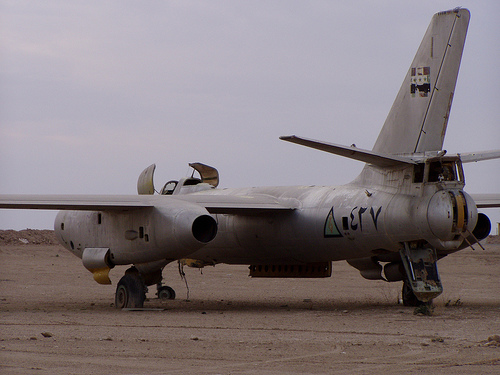
iraqi bomber at tqWrecked Iraqi Bomber at TQ

The Iraqi legacy on the base looms in some of the infrastructure as well as the hulks of Soviet made Iraqi Air Force bomber and fighter aircraft near the edge of the airfield.  When I was there in 2007-2008 the base was under the command of the 2nd Marine Logistics Group or 2nd MLG.  The MLG is a command and control headquarters for logistics support units of the 2nd Marine Expeditionary Force.  It is tailored to support the Ground Combat Element, the 2nd Marine Division and the Air Combat Element, the 2nd Marine Air Wing and attached units.  Its function is similar to an Army Corps Support Command or whatever the Army calls them now.  TQ was also the home of several helicopter squadrons Marine and Army as well as a local defense force at the time made up of the 1st Battalion 11th Marines from Camp Pendleton. 1/11 was an artillery battalion but was being primarily used as a security and convoy protection force.  Other units including Navy Seabees and Army logistics units operated from TQ.  A Marine Infantry Battalion was stationed in Habbinyah while elements of a Marine Expeditionary Unit (MEU) were operating in the area as part of the surge.

The base is about mid-range on the amenity scale for troop comfort. At the time we were there the only non-DFAC/ Chow Hall was the Green Beans Coffee trailer as opposed to places like Al Asad and Camp Victory which had a multiplicity of fast food places for the troops.  The Marines are tougher on communication security than the Army and many websites which troops could use on other bases were unavailable unless one went to the Iraqi internet café or the MWR computer and phone center.  The Iraqi run shop had the fastest internet on the base but you had to contend with huge amounts of second hand smoke and pay a nominal charge to use it.  The MWR facility often had broken machines, had a waiting list to use them and the connections were very poor with pages slower to load that the old dial up days.  On the plus side TQ did have a relatively decent Marine Corps exchange, not as big as Al Asad or Camp Victory, but one of the larger exchanges in Iraq and second only to Al Asad in the West.  Most places including Ramadi had pretty small and not well stocked exchanges.  TQ had nice fitness center facilities which I used a lot being coached by Nelson.

060Chaplains and RPs with Chuck Norris

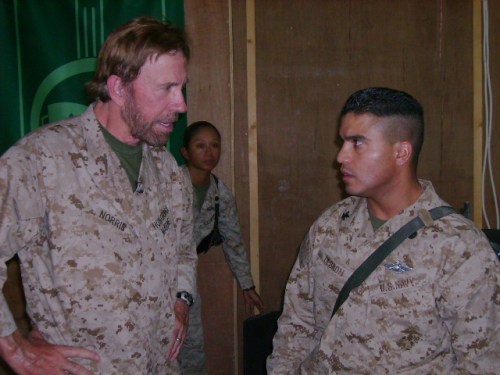
The base MWR worked with the USO and other agencies to bring sports stars or celebrities to the base.  Just before we left on our first mission Chuck Norris came through.  Chuck was made an “Honorary Marine” a few years back and has made it his task to try to meet every Marine deployed in Iraq and Afghanistan, shaking the hand of each one he met.  The chapel was the host facility for the visit which last about 2 hours in which Chuck pressed the flesh and had his picture taken with probably close to 5000 Marines and other personnel, maybe more.  The Chaplains were drafted to be the photographers and I lost count of how many different types of digital cameras that I took pictures with.  Chuck enjoyed the heck out of Nelson and was impressed with his fighting resume.  I think that Nelson got more face time with Chuck than anyone on the base and he deserved it.  Chuck was accompanied by Chaplain Langston and RP1 Roland our friend from Fallujah.  After they were done he had to get on the waiting helo and fly out to his next stop.

058Chuck and Nelson

The chow halls, of which there were two, were large and usually had a pretty good menu.  I especially came to like the Indian nights where Indian specialties were served.  Since many of the cooks employed by Gulf Catering who had the contract were Indian, Pakistani, Bangladeshi or from Ceylon so it generally was pretty good unless they had to scrounge for suitable ingredients.  I like the curry chicken, but occasionally it was made with chicken nuggets when the real chicken was in short supply.  It almost reminded me of the Spam Lamb in the TV series M*A*S*H or the great quote out of the movie Meatballs: “Attention. Here’s an update on tonight’s dinner. It was veal. I repeat, veal. The winner of tonight’s mystery meat contest is Jeffrey Corbin who guessed “some kind of beef.”   I think that there were a number of times when I really wondered what the meat was.  They usually had a pretty good salad bar unless resupply convoys were interrupted and fresh vegetables had run out.  There were a number of times where the pickins were slim and Nelson and I had to get creative.  Breakfast was usually good with a good choice of food choices, some even healthy.  The workers were great, always friendly despite working 12 hour days 6 days a week for $300 a month.  Many had signed up through agencies which cost them $4000 so the first year that many worked was for nothing.  It was in my opinion a case of a KBR/ Halliburton subcontractor using them in effect as indentured servants and pretty well damned close to slaves, all legal by the US Government.  I thought that it was pretty immoral and certainly a case of a company contracted by the government reducing labor costs on the back of some of the poorest people in the world. Back at the end of the Cold War the military downsized and eliminated most of the Army and Marine mess specialists which paved the way for the contracting industry, led by the former Secretary of Defense and his Halliburton team to begin their massive contracting operations with the Bosnia deployments back in 1995.  They were limited to their own compound far away from anything and were always the last to eat.  They were polite and really tried to accommodate sometimes rude and condescending Americans, the local management did the best they could to give them good accommodations but were limited by their parent company.  Many of the workers were Roman Catholic or Anglican Christians  and Fr Jose had a great ministry that he took on to support them by going to their camp a couple of times a week to celebrate Mass.  His masses were packed and what a source of life and the love of God he was to so many people at TQ, Americans and non-Americans alike.

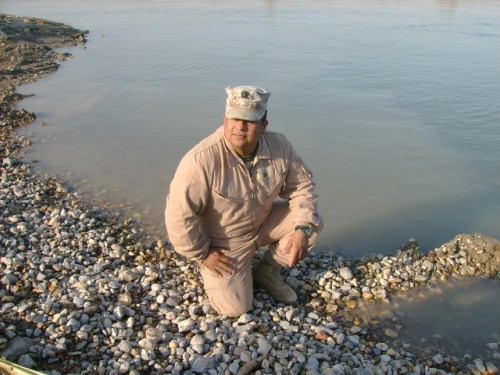
988Fr Jose on the bank of the Euphrates at Habbinyah

About a week after we got to TQ Marines from the battalion in Habbinyah were hit in an IED complex ambush while on patrol.  A couple of vehicles were hit, Jose was across the base celebrating Mass and Pat was in Fallujah.  A chaplain was needed in the Shock Surgical Trauma Unit or SSTP.  Wounded were being brought in, the platoon had been hit hard, 14 wounded and a couple killed.  I figured that since I was a pretty experienced trauma and critical care chaplain who had dealt with over 500 deaths, many traumatic with bullet wounds, burns and the host of other types of trauma, and tended to probably twice that many who did not die that I could handle this.  When I got to the SSTP I was greeted by a couple of nurses and docs and briefed as to what was going on.  Within a few minutes the casualties were beginning to roll in as the UH-60 Dust-off MEDIVAC helicopters landed and teams went out to meet them.  Some were ambulatory, or walking wounded bandaged with lacerations and burns on their faces and upper bodies, other were brought in on stretchers and ushered into the treatment beds in the area outside the OR.  It was like a scene out of M*A*S*H as the well honed surgical teams, surgeons, anesthetists, nurses and corpsmen went to work.  I now work with a number of these fine people. I was able to make my way about to the wounded Marines, praying with some, holding hands as and with a couple performing the sacrament of healing, or the anointing of the sick.  As I listen to Marines, prayed with them or anointed them there was a tremendous sense that this was different than what I did at Parkland or Cabell-Huntington.  These young men wore the same uniform that I wore, served the same country that I served and travelled the same roads that I would soon be on.  As each was assessed and moved off to surgery, prepared for further evacuation or treated and sent to a ward I noticed the little things about each of them.  The wounds, the torn uniforms, the burns and even the tattoos, these were our guys, they weren’t gang bangers or criminals but young Americans fighting a brutal war against a enemy that had terrorized Iraqis and found devastating ways to kill Americans.  Some of the Marines asked if they would be okay, others asked about friends and in those moments I learned what it was to care and be with men traumatized by the violence and brutality of war against an enemy that would not fight by our rules, much as the North Vietnamese and Viet Cong refused to fight our war.  The enemy was clever and determined and his weapons were deadly.

Stars and Stripes sstpTQ Surgical During Mass Casualty Event (Stars and Stripes Photo)
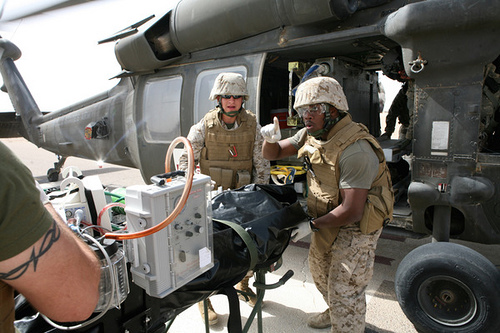
The teams did their work quickly and soon the event in the ER was done as the Marines were moved off to OR, the ward or further evacuation. I spent some time talking with unit Corpsmen and less wounded Marines and learned about the attack. They were in a convoy heading back to Habbinyah when the there was an enemy contact ahead of them.  As they moved forward to engage a primary and secondary IED hit the convoy heavily damaging two trucks with an ensuing firefight.  The Marines fought off their attackers, the wounded were treated and security set up as Dust-off came in to evacuate the wounded.  I thought back to my days as a Medical Service Corps Officer in the Army and remembered my friends who had elected to apply for flight school to become Dust-off pilots.  I remembered learning to call in MEDIVAC missions and some of the Army MSC aviators that I knew; some had flown in Vietnam, being a Dustoff pilot can be a sporty occupation.  They fly an unarmed bird into hot landing zones and get badly wounded troops to medical facilities in 100 degree plus weather without killing them enroute, those guys are good. As the crowd dissipated I spend so time with some of the staff.  Eventually with night having fallen I began the walk back to my office in the Chapel.  I looked up at the night sky, in the darkness a another UH-60 sat down to pick up others being evacuated on to Baghdad or Balad.  I looked up at the sky and saw more stars than I had seen at any time since I was at sea on the USS HUE CITY.  It was amazing; it looked like you could almost walk across them from horizon to horizon. When I got to my office I checked on my our mission status, I had submitted our first Air Support Request earlier in the day, of course it had not moved yet, but at least it gave me something to do.  I checked my unclassified e-mail and knew that there was nothing that I could share with anyone so I looked at baseball scores, checked a couple of news sites and headed off to my “can.”

medivacPackaging a Casualty for Further Evacuation on the TQ Surgical Pad
That night I did not sleep well, the images of the wounded Marines were burned into my mind; I could see their faces, their wounds and their tattoos.  I prayed the office of Compline from the Book of Common Prayer using Psalm 91 and the prayer “Be our light in the darkness, O Lord, and in your great mercy defend us from all perils and dangers of this night; for the love of your only Son, our Savior Jesus Christ.  Amen.” I took some comfort in this, walked out again into the night to see illumination rounds in the vicinity of Habbinyah and the distant sound of automatic weapons fire.   For once my insomnia was not related to jet lag or exhausting night flights, it was instead a realization that what happened to these Marines could well happen to me as I we launched later in the week.

The next morning another eight or ten Marines from the same company came in, this time I went to the SSTP with Jose and we did a tag team match, we tried to determine religious affiliation of the wounded Marines with him taking the Roman Catholics to provide sacramental needs and me taking the rest.  Once again the images were vivid; these Marines were on a mission to recover the damaged vehicles and were hit by IEDs on their way back to base.  This time one Marine was killed.  I walked to the graves registration and mortuary affairs team with the battalion surgeon and a corpsman who were to identify the body.  I listened to their frustration and heartache as they described what they had been through the past two days.  The company had taken over 20 casualties including 3 dead.  A high percentage of casualties for a unit that probably numbered about 120 men.  Once again I walked back, this time in the hot mid-morning sun with Jose to the Chapel.  We talked for a while about the past two days, he knew the battalion that had been hit well as he supported them as well.  The surgeon was one of his parishioners.  After we went our separate ways I did my morning prayer and settled in to study more about where we were going.  Nelson and I got PT later in the evening and I spent a restless night in my “can” playing computer Maj-Jong and Chess on my laptop deep into the morning.  Once again I spent time walking in the dark looking at the vast sea of stars above me.

3 Comments

Filed under iraq,afghanistan, Military, Tour in Iraq

Going to War: Flying Into Baghdad and a Blast from the Past

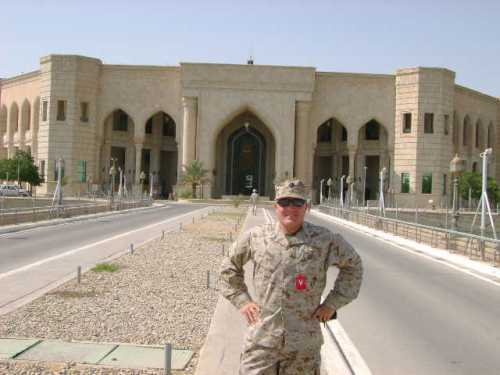
050Outside the Al Faw Palace, Camp Victory the HQ of US Forces and Former Haunt of Saddam Hussein, the Palace was Named after the Victory of the Iraqis over the Iranians on the Al Faw Peninsula toward the end of the Iran-Iraq War.  The Palace sits in the middle of a lake

We made the trip from Camp Virginia to the Ali Al Salim airbase to catch our flight to Baghdad.  As usual there was the seabag drag to the waiting baggage trucks, an accountability formation in the blazing sun and the shuffle, this time in full protective gear to our buses.  Riding in a foreign tour bus in full “battle rattle” is even more uncomfortable than the regular ride.  Packed tightly into the buses the air conditioning of which did little to help after coming in out of the heat, we took our places jammed into the bus and once again with armed personnel in the bus and convoy escorts as we pulled out of the high security entry control point at Camp Virginia and drove to Ali Al Salim.  The trip was uneventful and rather boring as there is not much to see between the two bases except sand and occasional nondescript buildings.

Ali Al Salim is a large Kuwaiti and American air base and logistics hub for air movement operations in the Arabian Gulf.  We arrived there and once again formed up, went through a staging area where were we were able to pick up some water from one of the ubiquitous pallets of bottled water and waited inside the terminal.  Some folks grounded their packs and used them as pillows or recliners, others found seats in the waiting area and others looked around to see how the Air Force lived.  A couple of TVs set to AFN played as we chatted, wandered or dozed.  It was not long before we were moved to yet another staging area and began to get our aircraft briefing and manifested for the flight.  Our group that had began the trip at Fort Jackson was a lot smaller now as the sailors who had gone on to the Horn of Africa, Afghanistan and those assigned to Kuwait were no longer with us.  As we trundled down the tarmac we were guided into position directly behind the aircraft.  We filed into a waiting C-17 Globemaster and sat down in airline style passenger seats which can be added or subtracted by in 10 passenger pallets as needed for the particular mission.  Additional permanent seats lined the bulkhead.  Our gear was loaded at the aft end of the aircraft as we took our seats.  We pretty much filled the seating which at maximum load is 134 passengers and we waited for the aircraft to load.  A loadmaster came through to check that we all were wearing our personal protective gear and had our seat belt fastened.  The C-17 unlike many military aircraft has at least an asthmatic air conditioning capability once the cargo door is closed.   Unfortunately when the door is open it is pretty much like whatever conditions are outside, in our case 130 degree heat with the exception that the sun was not beating down on our heads and that there was no air movement.  It was just a tad hot inside the aircraft.  Eventually the cargo ramp and door were closed and the aircraft prepared for takeoff.  With the door closed we began to feel a little bit of relief from the air conditioning.

For a large cargo aircraft the C-17 has a pretty smooth take off, the four Pratt and Whitney PW2040 engines producing 40,400 pounds of thrust each pushing the hug aircraft which is capable of transporting an M1A2 Abrams Main Battle Tank or 3 Bradley Fighting vehicles into the blue Kuwaiti sky.  In a few minutes the pilot announced that we had crossed into Iraqi Airspace and that it would take us about 45 minutes to arrive in Baghdad.  When the announcement was made there was an almost collective deep breath knowing that we were now going into the war, this was no longer in our future we were there.  I could feel the adrenalin being released into my body and can remember how quickly I became instantly aware of every noise or movement on the aircraft.

Arriving in the skies above Baghdad International Airport our aircraft circled and received permission to land.  Due to the possibility of enemy fire the approach to airports in Iraq is not like you would experience at a commercial airport in the United States, Europe or most other parts of the world.  Unlike most airports where there is a long and slow approach to the runway the descent is a steep spiral as the aircraft comes down from altitude to land.  If the airfield is under fire the aircraft will not land.  Once we were down we had been briefed to be able to move at a brisk pace in case the airfield came under fire, something that was happening on a relatively frequent basis in 2007.

The tail ramp and door opened as if they were a gigantic rearward facing mouth, or maybe like one of those weird fish that have teeth in their ass.  I think I remember some weird science show that talked about such a creature, if there isn’t one there should be.  As soon as the ass-backward maw opened a rush of hot air killed any semblance of what had been an almost bearable air conditioned compartment. Gear in hand we filed out of the aircraft heading for the ramp. Just for your information, it is easy to slip on these ramps; I came close to such an event but caught myself just in time so I didn’t go ass over tip down the ramp.  Nelson certainly would have made me pay for such a breach of protocol.  As we left the aircraft a ground crewman directed us out of the jet blast area and another led us to the terminal.  At the terminal we were greeted by Staff Sergeant Assi, the Chaplain assistant for the Iraq Assistance Group and an RP assigned to the Multi-National Corps Iraq Chaplain Office.  Sergeant Assi was a mobilized reservist  originally from Nigeria.  At least here our gear was palletized and was brought to a gear staging area.  Once it arrived we gathered a total of 4 EOD Issue super-seabags, two regular seabags, our packs, Nelson’s rifle case and my computer bag.  We were assisted by Sergeant Assi and the RP who helped load our stuff into the back of the white Chevy SUV that they were driving.  One thing about military vehicles in Iraq that are not tactical vehicles  is that there is a strong chance that they are the color white. The white paint contractor at GM must be making a killing on vehicles destined for the Middle East.  Once we were checked off the manifest as having a ride were able to depart walking out through rows of Califonia and Jersey barriers.

The ride was interesting as we wove our way around the ever present California and Jersey Barriers as well as “HESCO’s,” which are large wire and canvas containers standing anywhere from5 to 8 feet tall filled with dirt, rock and sand.  All of these are designed to minimze the effects of incoming ordnace by preventing the explosive force of them and teh associated shrapnel from spreading outward. We transitioned through a number of checkpoints where armed soldiers kept a wary eye out on our way to Camp Victory.  Victory which is the home of Multi-National Force and Multi-National Corps Iraq lies next to  Camp Liberty.  They are on the north side of Baghdad International Airport.  As we looked across the runway the only aircraft visible were military transports and contracted cargo carriers.  Unlike a major airport its size anywhere else in the world Baghdad did not have regularly scheduled airline service from any major carrier yet.   We wound our way around the compounds which blended together almost as one, much like the suburbs of the San Fernando Valley in Los Angeles.  Passing palaces and villas that ringed a lake in the center of the compound we continued on.  In the center of the lake connected by a causeway sat the massive Al Faw Palace, built by Saddam Hussein to commemorate Iraq’s victory in retaking the Al Faw Peninsula at the close of the Iran-Iraq War, a victory that resulted in Iran deciding to cut a peace deal with the Iraqis.  Despite a Shi’te majority in Iraq there is no love lost between Iraqis and Iranians.  Iraqi Arabs refer to the Iranians almost contemptuously as the Persians. This goes back centuries to the times when Persian occupied parts of Iraq and treated the Arabs badly.

We turned down an asphalt road which quickly became a packed clay and gravel road over which a tanker truck sprayed water to keep the dust down.  into a pulled up to a wooden building near a tent city where personnel coming in and out of theater were billeted at Camp Victory.  Row upon row of tents, each surrounded by a HESCO barriers were to our right. The ground was a mixture of hardened clay and rock which when driven over or walked upon emitted a cloud of dust which Sergeant Assi told us turned to a sticky goo which is almost impossible to get off of boot when it rains. Overhead helicopter gunships patrolled the skies occasionally flying quickly to the sounds of gunfire just off the base not far from where we were. In the background we could hear the sound of heavy machine guns and automatic weapons.  Not far from our billeting area sat a Navy Manned CWIS, or as we call tehm Sea Whiz.  This is a 20mm gatling gun which directed by radar is designed to shoot down incoming missiles or rockets. Nelson and I looked at each other and almost on cue he said, “Chaps I think there might be a war going on out there.”  I looked back and said, “Don’t you know it partner.”   The area to the east of the tent city was bordered by a line or shower trailers and heads, all protected by the large 15 foot high California barriers.  To the north of the tents lay a large Dining facility or as the Army calls them, a DFAC.  After getting signed in we drew an odd mixture of linen for our beds. I ended up with a couple of sheets, pillow cases and a multi-colored comforter. If I recall Nelson got some superhero on his blanket, which suits him fine as he is a big comic fan and can tell you more than you can imagine about all the different super-heroes. Instead of being together Nelson was assigned to a tent for NCOs and I ended up further away in a tent for field grade officers.

Once we had secured our stuff we met back together and walked to the DFAC for dinner.  This DFAC was not as large as it appeared as it had a large protective roof designed to keep mortar shells and rockets from impacting the building itself.  Two Ugandan soldiers working for security on the base checked our ID’s after which we washed our hands as we entered the building.

Upon entry we were almost overwhelmed by the amount of food present.  These DFAC’s were definitely feeders and the number of soldiers that should have been wearing wide-load signs across their asses was amazing.  But then who could blame them, many were on a second or third trip to Iraq of 12-15 months each. Maybe for the first time they were not in some isolated FOB with a poor quality of life, in a place which all things considered safe except for the occasional incoming rockets and mortars.  The quality of the food was better than in Kuwait as was the dinning area.

As I was finishing stuffing my gear underneath my bed a young Army Major came into the tent.  He looked at me and I looked at him as if we had met before and we greeted on another politely.  I saw his shoulder patch which identified him as a member of the Maryland Army National Guard.  We struck up a conversation and I asked to what unit he was assigned.  He replied  that he worked at the National Guard Bureau and had been attached to the Maryland unit as an operations officer for the deployment.  He remarked that I looked somewhat familiar and I asked if he had ever served in the Virginia National Guard.  He replied that he had and I asked what unit.  His response about floored me “1st Battalion 170th Infantry” located at Fort Belvoir, Virginia just south of D.C.  I told him that I too had been in the battalion and then he figured out where he knew me from.  With a look of near amazement on his face he replied “You were our Chaplain back in 1995!”   I patently acknowledged this fact  while he continued saying that he had been the TOW Anti-Tank Missile  Platoon Leader in our Headquarters Company. Our conversation meandered through old times at AP. Hill Virginia, talking about our careers, people that we knew and life in general.  After a couple of hours we both realized that we needed to take care of a few personal things to settle in for the night.  Eventually my old lieutenant fell asleep and I began what was to become a persistent pattern of insomnia which plagues me to this day.  Since I couldn’t get to sleep I walked through the darkness to the DFAC which had a late meal.  I was standing  in line amid a few Americans, some British soldiers and contractors when Nelson appeared beside me. He said “Hey boss, can’t you sleep?”  I said “nope” he said “me too, so I thought I would get some chow in this place.”  We had our meal together and when we were done picked our way through the darkness over the rough ground to our tents aided by our red lens flashlights.  After looking for about 5 minutes we found Nelson’s place and I headed off to my hooch only becoming disoriented once. Patently the Deity Herself must have kept me from tripping on a tent rope or some hole in the ground and I arrived back in my place at about 0145 and finally got to sleep.

Leave a comment

Filed under iraq,afghanistan, Military, Tour in Iraq

Going to War: This isn’t Kuwait it’s Tatooine

tatooineCamp Virginia aka Tatooine

Note: This is installment eight of my series “Going to War” which chronicles my deployment to Iraq working with our advisers to the Iraqi Army and Security Forces in Al Anbar Province.  To see the others in the series go to “categories: and click on the “Tour in Iraq” link.

We flew from Leipzig to Kuwait.  Flying into Kuwait in mid- afternoon is an interesting sight.  The azure waters of the Northern Arabian, or the Persian Gulf, the terminology depends on who your Ally is, hug the coast where Kuwait City, a sits ensconced at the tip of the Gulf.  The azure waters and the almost overwhelming sand that predominate this area of the world stand in stark contrast.  The city itself, full of modern luxury hotels, home of business and oil conglomerates and resorts for those who can afford them, seems a foreign intrusion.  The brightness of the sun reflecting off of the concrete of the tarmac was nearly blinding to us and I was very thankful for my sunglasses.   The aircraft taxied to its position and as the door opened the heat rushed in.  We deplaned and walked single file in the searing heat with our covers removed to a line of white tour buses of various Asian and European manufactures.  Drivers, guest workers from India, Pakistan or elsewhere on the sub-continent or eastern Africa sat in them or stood beside them smoking or talking with one another.  Our bags were moved to waiting tractor trailers and a small shaded area was close by where liter bottles of drinking water and MREs were available for any who wanted one.

We were loaded onto the buses for the trip to our in processing station where our ID cards were scanned and we officially entered the theater.  If you have never ridden on a tour bus manufactured in a country us than the United States they are not quite designed for people of our more fully shaped asses and longer legs.  This means that unless you are short and twig like that you will be rather cozy with the person sitting next to you, especially if they are well fed.  Thankfully Nelson and I were together as usual and since neither of us are terribly large, though I might be referred to as “stocky” and we watched in almost horrified fascination as rather some rather large folks squeezed in together.  Since we were pretty hot and sticky and previous busloads of rather stinky people had left their stench on the seats before us, the odor in the buses was rather strong and vibrant.  Unfortunately my allergy medicine cocktail of Allegra and Flonase allows me to smell the stink.  15 years ago I would have not noticed the smell because of what were then severe allergic symptoms when exposed to things like…. let’s say…dust.   Lots of that in the desert, and there is plenty of dust in Kuwait.  But this time for me there was no escaping the smell.  It took a couple of hours going at what seemed to be an ungodly slow pace to get to what is known as Camp Virginia, a place which bears little resemblance to any locale in its namesake, save for the McDonald’s sign which lit the food court area since it was now night.   Tents with plywood floors were our quarters and large air conditioning units on each end of the tent were used to try to cool it down.  We got our gear off of the baggage trucks and did the “Sea Bag Drag” of our gear into our tents.  This was no easy task, we all had three sea bags or their equivalent all packed with a deployment’s worth of gear.  One thing about going to war as opposed to flying commercial is that you are often the baggage crew as well as your own “Skycap.”  The smaller and older you are the bigger more painful the load seems.  I was in better shape than many of my fellow sailors because of consecutive tours with the Marines and EOD, but three  massive bags, a 3 day pack and case for the computer that I had been issued by EOD for the trip combined with the heat and the effects of our extended trip to get across the pond had kicked my ass.

camp virginiaCamp Virginia

The time we spent in Kuwait accomplished a number of things.  It allowed us to get acclimatized to the region. It also was a place where we completed various administrative and training evolutions including a couple of days on a place in the middle of the fricking desert called the Buehring Range complex and specifically an inhospitable site known as the Udari Range..   I think that Buerhring  is named for an Army Soldier killed during the war.  I’m sure that he was a gallant soldier, but the Navy does far better in naming things for our heroes, we name ships after them, or nice buildings, not a hellhole in the desert.  I do hope that the Army will decide to name something nice for him someday.  It kind of remeinds me of the movie The Green Berets where one of John Wayne’s sergeants asks for a latrie, or “privvy” to be named after him.

Udari  is a live fire range where more advanced weapons skills are taught as well as convoy procedures and IED drills which are as realistic as you can get outside of hte real thing.  It also forces you to realize that danger is not far off, Weapons are carried at all times, security forces man checkpoints, guard posts and patrol the area, buses and convoys are escorted by armed vehicles.  Despite the creature comforts provided on Tatooine by the US Government it is still both a harsh and inhospitable place as well as a dangerous place.  The MREs, heated by the oven like heat were more tasty than usual, a culinary delight if you may.  We only had a couple of heat related casualties while there and lost a Air Force sergeant to renal failure for which he was evactuated to the States, but apart from that the training was uneventful.

Udari Range Aug07bUdari Range August 2007, about the time I went through

I am convinced that Buerhing and Camp Virginia are actually not on this earth and that they are actually the planet Tatooine, the home of Luke Skywalker and his trusty droids R2D2 and C3PO.  I have seldom seen a more desolate and God forsaken place on earth, even in New Jersey.  Thus somehow we must pass through some interspatial portal while driving from Kuwait City to Virginia and Buerhing, possibly like a “wormhole” in Star Trek.   Temperatures while we were there were 130 degrees plus in the heat of the day and the lows were in the cool 90’s.  It was so hot that the air bubbles in my Nike 180’s melted and lost their bounce, becoming compleely flat.  Likewise the glue on my Blackhawk boots melted and the soul began to separate from the boot.  Thankfully it took a while for it to get really bad and my e-mail to Blackhawk netting me a new pair of boots with their apologies once I arrived in Iraq.  I wrote Nike but got no response.  Everywhere one looks there is nothing but heat and sand.  Yes, you can see the heat.  I am not making this up.  As on Tatooine, Camp Virginia hosts a remarkably diverse transient population from numerous countries.   Some of these are from former Soviet Republics such as Georgia.  There was a Georgian Brigade processing through on its way to Iraq that was like a hoard of Jawas.  2,500 Georgian soldiers including female troops who we were informed served as ‘comfort women” for the Georgian men were everywhere, the Post Exchange, Chow Hall, or as the Army calls it the DFAC as well as the gym, the MWR computer room and food court.  Of course I do not begrudge any ally a meal, a bed and a place to stay but the Georgians descended like locusts.  If you got to the PX after them it was empty. Nelson and I would almost race the 500 meters to the Chow Hall to get in line ahead of the Georgians.  They were amazing; they filled their plates higher than Bluto Blutarsky (John Belushi) in the movie Animal House.  Breakfast was especially amusing from my point of view.  They would have eggs, bacon, sausage, grits, topped with pancakes and waffles covered in syrup and two to three donuts stacked on top.  All of this on one plate.  I am sure that when these soldiers returned home to Georgia that its obesity rates spiked in a rather remarkable manner.  The lady that ran the internet café constantly chased them off of porn sites, even the women.  In addition to the Georgians we had Brits and Aussies, Poles, South Koreans, Brazilians and a number of other nation’s soldiers passing through on their way to various places in the Middle East, but it was the Georgians that I remember most.

The other two chaplains, Kyle and Rick and I ensured that spiritual and emotional needs were met during the stay, for me this was usually with sailors who would pull me aside informally just to talk or ask for prayer or advice.  There is something about the final stage of a journey into a combat zone that pulls at you as you think about what might be faced on the other side.  Since most places in Iraq were still pretty sporty with huge numbers of attacks and many personnel killed or wounded, even in supposedly “safe” areas.  Kyle and Rick would remain in Kuwait to run the Warrior Transition program while Nelson and I loaded our gear prepared for our flight into Iraq.

048Padre Steve at the Udari Range

Eventually we competed a very good cycle of training at Buerhring and Virginia and once again loaded our gear on trucks, made accountability checks, got our signed copies of our orders and headed off to a joint Kuwaiti and US Air Force Base for our flight to Baghdad.

5 Comments

Filed under iraq,afghanistan, Military, Tour in Iraq

Going to War: A Bus Ride to the Carolina Countryside

This is part four in my “Going to War” series. Previous parts are noted here:

Part One:Going to War: Reflections on My Journey to Iraq and Back- Part One

Past Two: Going to War: Interlude July 4th 2007

Part Three: Going to War: Wills, Living Wills, Immunizations Gone Bad and Christmas in July

Part Four: Going to War: Last Night together and a Kiss Goodbye

Nelson and I staged our gear as we waited for the buses to arrive to take us to Fort Jackson South Carolina where we were to receive our training for the deployment.  As we talked other sailors arrived and gear was stacked in rows of sea bags just off of the sidewalk.  Nelson’s parents, brother and sister were on hand to see him off.  His brother is a First Class Petty Officer and his dad a former Vietnam era Marine Recon NCO who made several deployments “in the shit” as many Vietnam vets call tours in that combat zone.  They were really nice folks.  Over the years I had heard much about them.  They are close to each other and all are supportive of Nelson.

Nelson is a career amateur boxer; kick boxer, martial artist and more recently MMA fighter.  He is active in children’s martial arts instruction and has been on Team USA and fought internationally.  During his Afghanistan deployment before he and I hooked up again he helped coach the fledgling Afghan National Boxing Team.  His last major title was just this year when he won the Arnold Schwarzenegger Classic.  The guy has more titles than you can imagine, his title belt collect could fill a room.  However, he was raised by a boxer, his dad.  His dad taught him and coached him growing up and helped Nelson win multiple New York State Golden Gloves titles.  His dad is a congenial man and who was very friendly, speaking English with a heavy Puerto Rican accent.  Nelson’s mom speaks some English.  Nelson tells a great story of the only time he was knocked out in a fight.  This happened at the Fort Apache Gym in the Bronx after Nelson had gone picking on his little sister when Nellie was about seventeen.  Nelson’s dad found out, told him to put on his gloves and get in the ring.  Nelson proceeded to talk trash to his dad as he got ready to fight and the first round got quite a few hits in on his dad.  In between rounds according to Nelson’s account he told his dad to quit, that he was too old to be in the same ring with him.  Nelson said that his dad simply commented “I was just letting you taste the water.”  The second round began and Nelson was hit by a combination from his dad, which he says “rung his bell” and made him “see stars.”  He remembers trying to get up and not being able to while his dad was talking trash to him.  I cannot do the story justice but meeting Nelson’s family was a joy.

So we waited while the other sailors gathered, some individually and some with family.  Some stood alone as couples while others mingled with each other.  For most this was a new way to see their sailor deploy.  No pier side goodbyes, no banners, no manning the rails by the crew as the ship was nudged away from the pier by tugs.  When you have a “normal” deployment of a ship or something like a Marine battalion it is a big deal.  Media is there, sometimes there are speeches, but most of all there is the understanding that we are all in this together.  The families say goodbye to their Sailors, Marines or Soldiers who are going to war together and leaving some kind of familiar support system for the families.  This is not so when you deploy individually.  We may have been going off to train together, but few would stay together on the deployment.  Normally as a chaplain you are a known quantity to the people that you go to war with.  I was going to war with Nelson but we would not remain with any sailors who were going through this process with us.  I know that was the case for others who would serve in isolated posts, often without any other Navy personnel, mostly working with the Army in support roles, and specialized roles such as the Electronic Warfare Officers detailed to work on defeating IEDs and roadside bombs.  As others said their goodbyes and hugged each other I thought of Judy and knew that she was going to be down for some time but I felt that for once that she had an adequate support network.

I looked at our gear as opposed to the others.  Our gear was in different deployment bags, ours were large and rectangular and more of a coyote or sand color while most everyone else had traditional green sea bags, or what are known in the Army as “duffle bags.”  We had all of our personal protective equipment or the EOD/Special Warfare type while others would receive some variation of Army issue at Fort Jackson.  There are pros and cons to such a arrangement.  The pro is that we had great gear certainly some of the best in theater.  The con was that we had to lug the great gear everywhere we went going to and coming back from war.  This would get old, but the benefits do outweigh the advantages when you are actually in a combat zone.

Finally an officer came out and began calling role and giving us our signed “official” orders.  After we were accounted for we were told to load our gear on the buses that would take us to Fort Jackson. I think there were four or five of these chartered tour buses  which as it turned out would be the first of many tour buses, roll calls and gear loads in the coming months, especially as we entered and exited theater.  Nelson and I got on the same bus which was not full and took seats near the front.  I got a seat alone because I was the senior officer on the bus and a chaplain to boot. This was not because I asked for it or hogged the seat.  It is actually fairly typical in such a setting where young enlisted guys don’t want to sit next to an officer and some are afraid of chaplains because of experiences that they have had in civilian churches.  Some of the young folks have never darkened the door of a church and many of those that have been in church have been burned in relationships with pastors or really over the top religious people.  I have found in my career that until they get to know a Chaplain a lot of them will be very careful in how they approach a chaplain, even those with a vibrant faith.  Some are afraid that the chaplain might try to convert them or disapprove of the manner in which they live their lives. So as a chaplain I need to be cognizant of this fact and be friendly and caring without scaring them away.  Of course I did build relationships with a quite a number of these sailors during the next few weeks but on this bus I was still an unknown quantity to them.  Sitting alone however was good for me since I general despise bus travel regardless of the company I keep.  For some reason my height works against me, I can never get my feet comfortably on the ground on these new tour buses and I have a terrible time getting comfortable.  Since bus travel takes forever to get anywhere the discomfort is palpable.  Now I did a three month tour on buses in 1979 while touring as a spotlight tech for the Continental Singers and Orchestra across the US and in Europe.  Somehow the old Greyhound buses were more comfortable than the new tour buses.  Maybe I’m just nostalgic but they somehow fit people like me better than the fancy new buses.

When you travel by bus with a bunch of sailors, the majority of whom are at least 20 years younger than you, the experience can be entertaining to say the least.   Part of course is a generational thing.  I am from the 60’s 70’s and 80’s.  These guys and gals are from the 90’s and 2000’s.  Music is different, culture is different, and the internet, cell phones, i-phones and Blackberries have revolutionized communications and life.  The trip was a chance for me to observe a lot about these sailors just by watching.  Some had their portable i-pods and MP-3 players going, others spent time talking on cell phones, a few read or talked among themselves, but the sailors near me gravitated to the DVD movie which was 300 the comic book style account of the Spartan’s defense of Thermopylae against the Persians.  As the Spartans made their stand I could see the young sailors who were going to war taking inspiration from King Leonditis of Sparta.   Since we were going into a place where 50-100 Americans a month were being killed and many others wounded and maimed I could understand the need for inspiration along with entertainment.

The bus ride itself was a lot like what I imagine that Minor League teams take in the Carolinas like in the movie Bull Durham, the coaches and older players mixed in with a lot of young guys.  The older guys staying pretty quiet and to themselves and the young guys having fun, playing games and joking around with each other,  We made a couple of stops, one at some little Interstate town with a fair amount of gas stations and a few fast food places.  About half the folks went to the McDonalds where we pulled in while the rest ran down the street to the Burger King and Taco Bell.  Once everyone had their fill the buses pulled back out onto the interstate.  When we finally got near Columbia the buses got of the Interstate highway and onto some small two lane state highway.  We drove down this road about twenty to thirty minutes and pulled into what appeared to be a tiny out of the way base.  I wondered where the hell we were.  Fort Jackson is a fairly large training base where thousands of recruits are trained every year.  Where we were certainly was not the Fort Jackson that I had imagined.

Instead of the main post we were at the South Carolina National Guard training facility called Camp McCready.  It is here that the Naval Expeditionary Combat Command has a training center set up with the Army to train sailors in basic combat tasks.

Our welcome that first night was simple.  We formed up, checked in, got our linens for our standard issue military beds and were marched to dinner at the chow hall or in the Army vernacular the DFAC by our newest and bestest buddies, our Army Drill Sergeants.  In the chow hall or DFAC we were met by a civilian running the line.  I can’t remember his name but this guy was really nice and put the RED in “Redneck.”  He made jokes with everyone that came through the line, asked where people were from and what they did.  When he found out that I was a chaplain he began to ask me for a joke every meal thereafter.  As Nelson and I sat down for chow with a couple of other sailors we looked at each other.  He said: “Boss I don’t think some of these guys know what is coming.”  I said “I think that your right partner, hopefully they adjust and do well.”  The other sailors, both more senior petty officers nodded in agreement.

Going back to the barracks I met some of the other officers enjoying their first night at Camp McCready.  More sailors to fill out the class were due later coming in from San Diego.  I introduced myself to a number of the officers near me and when lights out was called lay down on the same type of bed that I had first encountered some twenty five years before at Camp Roberts California and Fort Lewis Washington.  I swear the sheets, blankets and pillowcases were of the same vintage.  Despite that I fell asleep fairly quickly.

Leave a comment

Filed under iraq,afghanistan, Military, Tour in Iraq