Tag Archives: egyptian military

The Coming Egyptian Civil War: Disaster Beckons

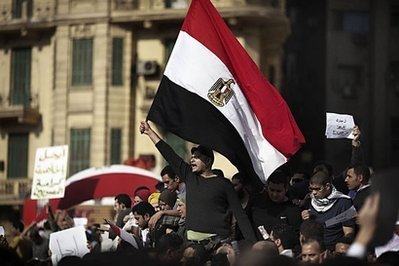
Cairo protesters

History has a strange way of playing itself out in the lives of individuals, nations and peoples. I wish that I was wrong bit as I look at the situation in Egypt today I see a situation which is as fluid as the shifting sands of the desert and as dangerous as the legendary Biblical plagues of the time of Moses.

When the dictatorship of Hosni Mubarak was overthrow by the military in 2011 it was hoped by many that Egypt would defy he odds of history, not Islamic or Egyptian history, but human history in that a revolution of a people without their own history of freedom and representative democracy seldom in its initial stages produces freedom and representative democracy.
images-49

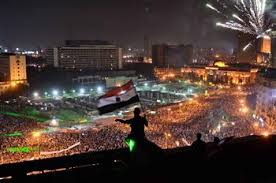
In Europe alone Britain, France, Spain, Germany and Russia have endured bloody civil wars following the overthrow of autocratic regimes. Likewise the same is true of the history of South America, Africa, Asia and the Middle East the history of most successful oppressed peoples who do not have practical experience in democratic government tend to fight things out and even endure more oppressive governments before eventually, often at great cost to themselves and their neighbors achieve peaceful, stable and representative democratic rule.
egypt-coup-morsi-3_2609447b

Egypt has great potential, many of its people have exactly in temperament, education and wisdom what is needed to become a leading democracy in the region. That being said there are many obstacles to this. First is the longstanding tension between the radical Islamists of the Moslem Brotherhood, secularist military leaders, Social Democrats and others. Second the underlying religious and social tensions between rival Islamic denominations as well as Coptic Christians with generations of internecine bloodshed being played against one another by outside powers, the Ottoman Turks, the French, the British and even to a lesser extent the Soviets and Americans.
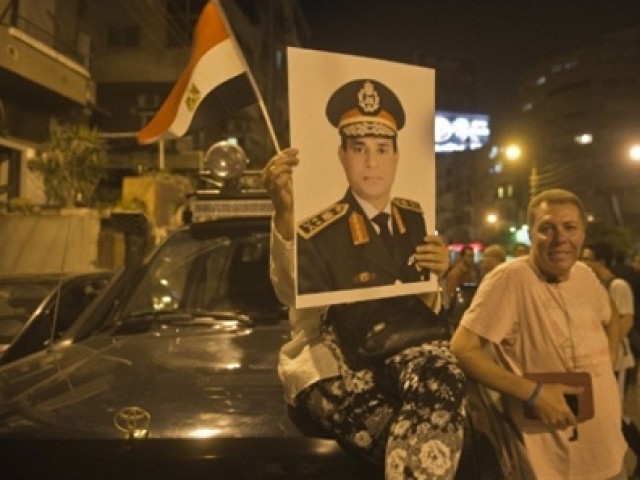
571825-Abdel_Fattah_alSisiAFP-1372840335-993-640x480

The fact is that Egypt as much as I do not want it to admit is that I believe that there is little that can save Egypt from a bloody civil war with unknown outcomes. The only thing that is sure is that thousands, possibly hundreds of thousands of Egyptians will die before the end of it and that Egypt’s instability will exponentially increase the violence and instability of the region.

egypt-morsi_2608190b

I think the best outcome is that a coalition of Social Democrats and militarists will cobble together enough of a government to stabilize the situation, but it will not be without much bloodshed. It will likely be like the early days of Weimar Germany when an unlikely coalition of military leaders and Social Democrats fought a Civil War against the extreme Soviet style Communists and then resisted Right wing extremist putsch attempts. Unfortunately that democracy died as the economies of the world melted down and the cost of reparations levied by Allied Powers at Versailles and radicals of the extreme Right and Left eventually leaving Hitler in power. It took another World War to eventually end that tyranny.
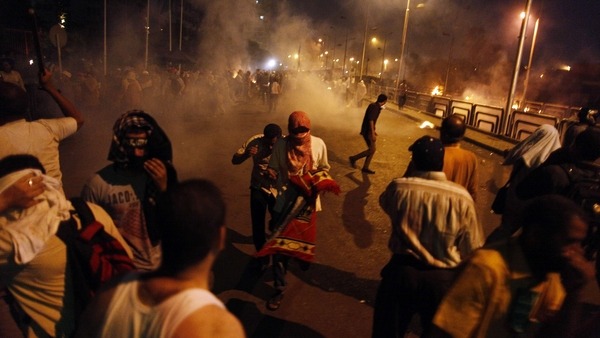
Muslim-Brotherhood-Clash-Getty

I guess that a best prospect is pretty much as bad as the worst prospect.

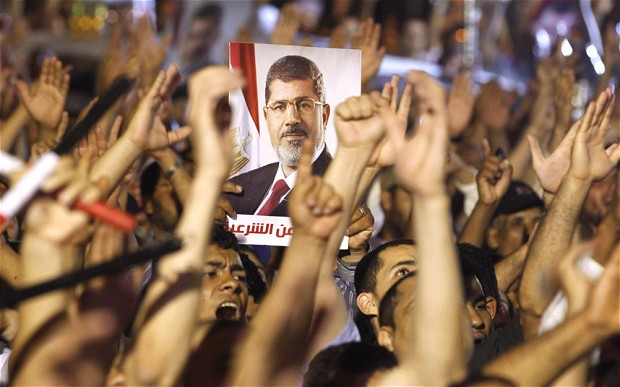
The ouster of the Moslem Brotherhood’s elected President Mohammed Morsi by the Egyptian military follow the protests of the vast majority of the Egyptian electorate is as much of a bad thing as it is a good thing. Morsi was to be sure democratically elected but he governed as an autocrat with increasing dictatorial tendencies. The reaction of the people and the Army was a natural reaction, as one Egyptian boy put it we did not overthrow a dictatorship to replace it with a dictatorial theocracy.  In effect both sides killed the democratic process, Morsi and the Moslem Brotherhood for the sake of Islamic religious power, the military for the sake of their place in society, stability and control and the protestors and democrats the sake of democracy and freedom.

EGYPT-POLITICS-UNREST-ARMY

The situation is much like the days following the the Army High Command’s forced abdication of Kaiser Wilhelm II, when in the face of a Communist revolution the German military establishment represented by Field Marshal Paul Von Hindenburg wrote to the new Socialist Chancellor Friedrich Ebert:

“I am convinced that only the following measures can help us overcome the present difficulties: 

  1. Summoning of the National Assembly in the course of December.
  2. Until then, or until the decision of the National Assembly can be carried out, conduct of the administration solely by the government and legitimate administrative organs. 
  3. So as to fulfill the justified wishes of the working class… qualified people of working class origin should be attached to the administrative authorities in an advisory capacity….
  4. The security service must be solely in the hands of the legal police organs and of the armed forces.
  5. Safeguarding of the orders of government by a reliable police force and, after the restoration of discipline, by the army.   

   In your hands lies the fate of the German nation. It will depend on your decision whether the German nation will rise once more. I am persuaded, and with me the whole army, to support you without any reservation…” (Letter from Field Marshal Hindenburg, likely written by General Groener to Chancellor Ebert December 8th 1918. In The Reichswehr and Politics 1918-1933 by F.L. Carsten, Oxford University Press, London 1966 pp.13-14)

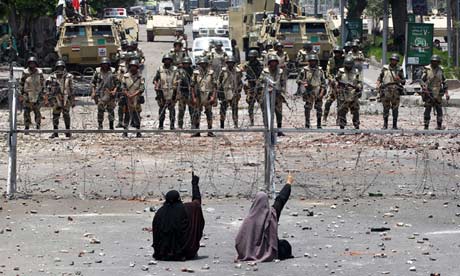
The unfortunate thing is that no one will be happy until they achieve their goals and that will probably not only mean bloodshed, but a full scale civil war. No matter what the talking heads and experts say this has little chance of ending well. Centuries of injustice, dictatorship, colonialism, religious intolerance and economic inequities argue against other eventualities.

n_50238_4

The fact of the matter is that whether or not advocates of democracy like it at the present time no elected government in Egypt can survive without the support of the military. Like Weimar Germany, the fate of Egypt’s democracy will in large part lie in the hands of a military that at its heart is not democratic. It is a conundrum that we would rather not see, but it is reality.

All that being said there is always hope that things can turn out differently and we had better hope, for the people of Egypt, the region and the world that it does, because an Egyptian Civil War now will be disastrous.

Peace

Padre Steve+
1 Comment

Filed under Foreign Policy, History, middle east, national security

Egypt: As Mysterious as the Sphinx and as Dangerous as a Cobra….What Next?

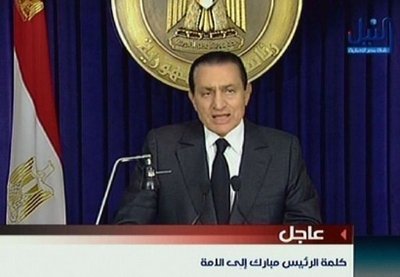
Hosni Mubarak delivers his speech (AFP Photo via Yahoo News)

Today after hours of speculation fueled by senior Egyptian Army officers demonstrators in Tahrir Square believed that Hosni Mubarak was about to leave office. The Army High command convened without Mubarak present and issued statement which said:

“In the name of God, Statement No 1, issued by the Higher Council of the Armed Forces, stemming from the armed forces’ responsibility and committing to the protection of the people, safeguarding their interest and security, and keen on the safety of the homeland, the citizens and the achievements of the great Egyptian people, and asserting the legitimate rights of the people, the Higher Council of the Armed Forces convened today, Thursday 10 February 2011, to deliberate on the latest developments of the situation and decided to remain in continuous session to discuss what measures and arrangements could be taken to safeguard the homeland and its achievements, and the aspirations of the great Egyptian people. Peace, mercy and the blessings of God.”

The Army with the Protesters in Tahrir Square (Reuters Photo via Yahoo News)

It appeared that the Army was forcing Mubarak’s hand as earlier in the day General Hassan al-Roweni, an Egyptian army commander went to Tahrir Square and told protesters in the square that “everything you want will be realized.”

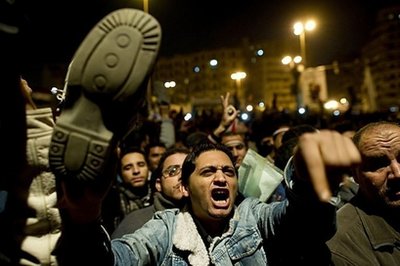
It was announced that Mubarak would address the nation in the evening and other reports indicated that he would step down.  Mubarak announced his intention to remain as President while handing over the some responsibilities to Vice President Omar Sulleimen.  His tone was defiant although he said that he is “totally committed to fulfilling all the promises” that he has earlier made regarding constitutional and political reform. Both Mubarak and Sulleiman addressed the crowd saying that they understood them and promised justice for those martyred.  After the initial shock wore off the demonstrators began to shake their shoes a sign of disrespect and some broke away from the main demonstration heading in the direction of the Presidential Palace. The Egyptian Ambassador to the United States Sameh Shoukry said “The vice president is the de facto president.”

Protesters wave their shoes at Mubarak (AFP Photo via Yahoo News)

None of this has swayed the demonstrators and the expectation is that even larger demonstrations will occur tomorrow.  Some believe that Mubarak is baiting the protestors hoping that they will become violent so he has reason to use massive force against them. The Vice President is also in charge of the Interior Ministry which controls the Police, the Secret Police and a vast network of paid informants with an estimated one million men at his disposal. Mohammed El Baradei tweeted “Egypt will explode. Army must save the country now.”  Despite their chants for Mubarak to “go” the other chant was “peace.” It does not appear that the protesters will resort to violence with the mood still upbeat.

The question mark is still the Army which appears to have been blindsided by Mubarak’s announcement. Unlike those under Sulleiman’s command the Army contains large numbers of young people who likely have very similar sentiments to the protestors. I am sure that the Army High Command understands that fact.  It is very possible that the Army is at loggerheads with Mubarak and Sulleiman.

Tomorrow will be critical.  We do not know what will happen. As mysterious as the Sphinx itself the situation in Egypt remains a mystery to many observers.  Will the Army take control? Will it stand by and do nothing? Will the Police take action? Will a civil war break out between the Army and the Interior Ministry forces?

We don’t know. However one thing can be certain if there is a crackdown on the demonstrators, which decapitates the movement the only benefits the Moslem Brotherhood which has been conspicuously absent from the demonstration and would be poised to take over leadership of the revolution should the Mubarak-Sulleiman government fall quickly.  I do not expect the Army to lead any such crackdown but it is conceivable that the same thugs who attacked last week could do so again.

This was a very dangerous situation. I pray that the end will be peaceful.

Peace

Padre Steve+


4 Comments

Filed under Foreign Policy, national security

The Beginning of Chaos in Egypt: Watching and Waiting as the Situation Deteriorates

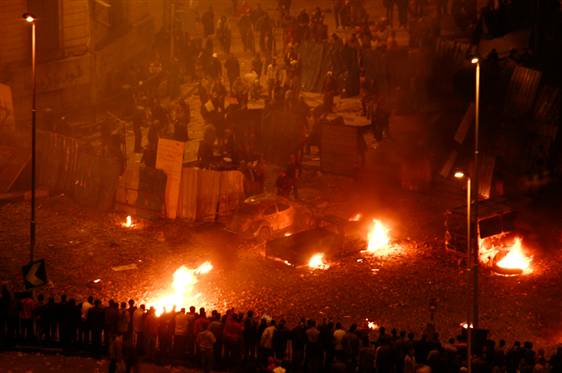
Battle Lines in Tahrir Square (Yanis Behrakis -Reuters via MSNBC)

Today violent street clashes broke out in Cairo’s Tahrir Square. Following President Hosni Mubarak’s pledge not to run for the Presidency again but remain in office until September and the opposition’s denunciation of that move as too little too late Tuesday night pro-Mubarak groups entered the fray. Men on camels and horses swept into the square during the afternoon whipping and clubbing anti-Mubarak protesters as they stormed through the crowd.  Reporters were attacked and as evening came the clashes became more violent as the pro-Mubarak supports began to throw Molotov Cocktails at the demonstrators. The Army did appear to attempt to make some efforts to separate the groups and fired tear gas to disperse the crowds but did little else. The scene was remarkably different from Tuesday when the protesters calling for Mubarak to step down did so in a peaceful manner unmolested by the Army units in the square.  The Egyptian military has aired television spots asking all of the protesters to “go home for the love of Egypt.”

Although the images shown on our television sets conjure the worst and appear to the country devolving into chaotic violence with unpredictable consequences. The fact is mystery shrouds developments outside the view of the cameras surrounding Tahrir Square. We are unaware of what is transpiring inside the government or the military. We are unsure about the extent of Egypt’s government or ruling party’s involvement in today’s counter demonstrations, some reports are that some at least were ordered in from government jobs.  The only thing that we can safely assume is that unless some kind of resolution acceptable to both sides arises the situation could get dramatically worse and imperil the success of any government that replaces the Mubarak regime whether he steps down in the next few weeks or holds on until September.

Regardless of the outcome Egypt and possibly much of the Arab World is at a turning point. Authoritarian regimes as different as that of Muammar Ghadaffi and Saudi Arabian King Abdullah have condemned the Egyptian uprisings as well as that which overthrew Ben Ali in Tunisia.  They know that the dynamics at work in Egypt, unemployment, poverty and political repression are shared to one degree or another in much of the Arab World, the common factor repressive authoritarian regimes which to many lack legitimacy.  Rulers in Jordan and Yemen have already seen demonstrations and Jordan’s king has fired his government apparently to get ahead of the protests and Yemen’s ruler has pledged to step down at the end of his term in 2014.  Leaders of other Arab nations cast a wary eye on Egypt and their own opposition groups.

The Egyptian revolution will more than likely not result in fundamentalist Islam dominated state due to the unpopularity of such regimes as the Taliban and Iran in the Arab World. At the same time while Islamists are not leading the revolution in Egypt they are an important part of the Egyptian political landscape and must be taken into account.  I would think that if the violence subsides and a peaceful orderly transition takes place that a government similar to Turkey, probably not led by a religious party could be the best result. Such a government would likely not be as close to the United States as Mubarak but probably remain an ally and not an active enemy of Israel as it seeks its own economic growth and stability to reinforce its pivotal role in the Arab World.  However there is no guarantee of this outcome.

The worst outcome would be continued violence that leads to a radicalized country led by more extreme members of the Muslim Brotherhood, some of whom have called the Egyptian people to prepare for war against Israel.  Unfortunately unlike the older generation of Egyptians the new generation has not experienced war and war’s desolation. The older generation was at war with Israel for nearly 40 years suffering defeat after defeat.  In 1967 they lost control of the Suez Canal and the income derived from it in the 6 Day War and in 1973 after successfully crossing the canal and inflicting heavy casualties on the previously invincible Israelis had the tables turned on them. An Israeli Army after driving off the Syrians in a desperate battle on the Golan Heights and advancing deep into that country crossed the Suez Canal, surrounded an Egyptian Army on the far side of the canal, lay siege to Suez and were poised to drive to Cairo saved only by a cease fire brokered by Henry Kissinger and the United Nations. The war nearly brought the Soviet Union and the United States into nuclear conflict when the Soviets marshaled Airborne divisions to intervene and President Nixon raised the DEFCOM from 4 to 3. I remember talking to Egyptian officers, veterans of the wars with Israel when I was a student at an Army school in 1983, they talked of sacrifice and the brutality of war and the effects of the war on their country.  One simply said “I do not like Israel but I am tired of war and I do not want it for my children.”  Since Camp David Egypt has had all of its territory in the Sinai returned was able to reopen the Suez Canal.  Another war between Egypt and Israel would devastate both countries and for that matter not be contained.  A radicalized government set on such a course would be an unmitigated disaster for Egypt, Israel and the world.

While we watch Egypt protests are about to begin in Yemen with a “day of rage” scheduled for Thursday with demonstrations planned in Syria and Jordan Friday and Saturday and even Bahrain on February 14th. Expect such demonstrations as the old guard of the Arab World experiences the long suppressed rage of their people which is now spread in seconds through the power of the social media.  Meanwhile radicals in Iran, Al Qaeda and as well as other radicals and terrorist groups wait to take advantage. Yemen which has a strongly entrenched Al Qaeda organization and sits astride the strategically important Bab-el-Mendeb passage at the south end of the Red Sea is a country that is a prime target of these radicals and terrorists.  All the other countries for different reasons are important to the stability of the Middle East.

Today’s protests in Tahrir Square killed three and wounded over 600.

We can only watch and wait….and pray as these events develop.

Peace

Padre Steve+


2 Comments

Filed under Foreign Policy, History, national security, Political Commentary

Walk Like an Egyptian: The Egyptian Revolution and the Radicalization of the Middle East

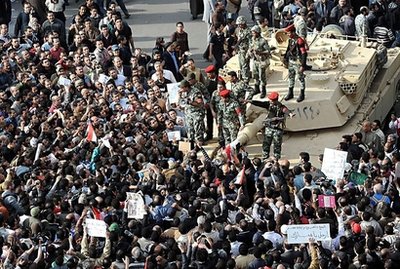
Egyptian Protesters with Army Soldiers (AFP Photo)

As Egypt goes so goes the Arab World. Egypt is the leader of the Arab World, the largest country and the country with the most powerful military, a developing educated class and one of the most strategically located countries in the world. Much of the world’s shipping passes the Suez Canal and the Egyptian peace treaty with Israel and cooperation with Israel on security issues has resulted in the most secure parts of the Middle East for decades.  The United States and the West count Egypt is their key ally in the Arab World but now the world trembles at the revolution going on in Egypt because of the uncertain and potentially destabilizing potential in the Middle East and the world.

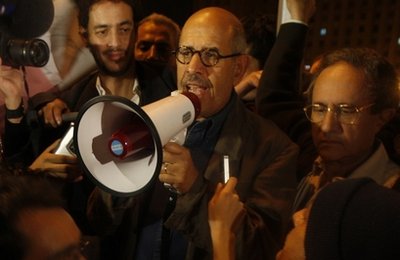
Mohamed El Baradei (AFP Photo)

Egyptian President Hosni Mubarak had ruled Egypt under emergency conditions since the assassination of President Anwar Sadat in 1981 by military members loyal to the Muslim Brotherhood.  Mubarak has continued Sadat’s policies and been a strong ally of the United States and frequently has mediated for Israel in the Arab World.  He has been a stabilizing influence in the Middle East but has ruled as a dictator for all practical purposes since.  Mubarak dissolved his government and appointed a Vice President for the first time during his rule. He has steadfastly refused to step down.

Protesters (AFP Photo)

Conditions in Egypt include extremely high unemployment, poverty and social services which are insufficient at best and in many locations non-existent. Discontent has been simmering for years with Egyptian Police and internal security forces keeping a tight lid on dissent. The military however is the most trusted and respected institution in Egypt as it has kept a distance between it and internal security matters. The Police on the other hand are viewed as corrupt and brutal.

Matters have blown up in ways that few anticipated in the past week and it all began in Tunisia, a country on the fringe of the Arab World. Within a week of a popular overthrow of their President the flames of change were rolling across the Arab World, Yemen, Jordan and Egypt. Popular uprisings in key Arab countries led in many cases by educated pro-Western moderate professionals using social media such as Facebook and Twitter.

As of now we are unsure of exactly what will happen. However Egypt is the key. The protests now have an internationally respected leader, the Nobel Laureate former head of the United Nations Nuclear Inspection agency Mohamed El Baradei.  El Baradei has called on the United States to support the Egyptian people and says that he has the mandate to form a national unity government and reached out to the Egyptian military which is important for the stability and security of any new government.

The demonstrations have grown in intensity and the Army had taken the place of the police on the streets to the cheers of demonstrators.  While this is happening there is a surge of looting and vandalism and individuals as well as communities are taking their security on themselves with no police on the streets to do so.

With the situation on the ground continuing to get worse the United States will have to act in support of the protestors or see its influence in whatever kind of government and with the Egyptian people dissipate.  The best outcome would be an orderly transition of power to some kind of national unity government headed by pro-Western leaders such as El Baradei.  Unless such a transition takes place the chances of the uprising to become radicalized under the domination of the long suppressed Muslim Brotherhood is a real possibility.  The key right now is the Egyptian military, respected at home and trusted it is closely linked to the United States in many ways.

We do not know how this will end and chances of it ending badly are as great as or greater than in 1979 when the Islamic Revolution overthrew the Shah of Iran and the subsequent moderate government. At least there is no Khomeini like figure ready to seize the moment and lead the country into an Iranian style revolution.  The Muslim Brotherhood has been under wraps for many years and though a fundamentalist movement is populated with professional people and not clerics and it publically renounced violence years ago. One can only hope that El Baradei and the military can lead the Egypt on a democratic and peaceful course and that Hosni Mubarak will ensure that the transition is peaceful.

Lord help us all.

Peace,

Padre Steve+


1 Comment

Filed under Foreign Policy, national security