Tag Archives: invasion of iraq

You Can’t go Back: The Aftermath of 9-11-2001

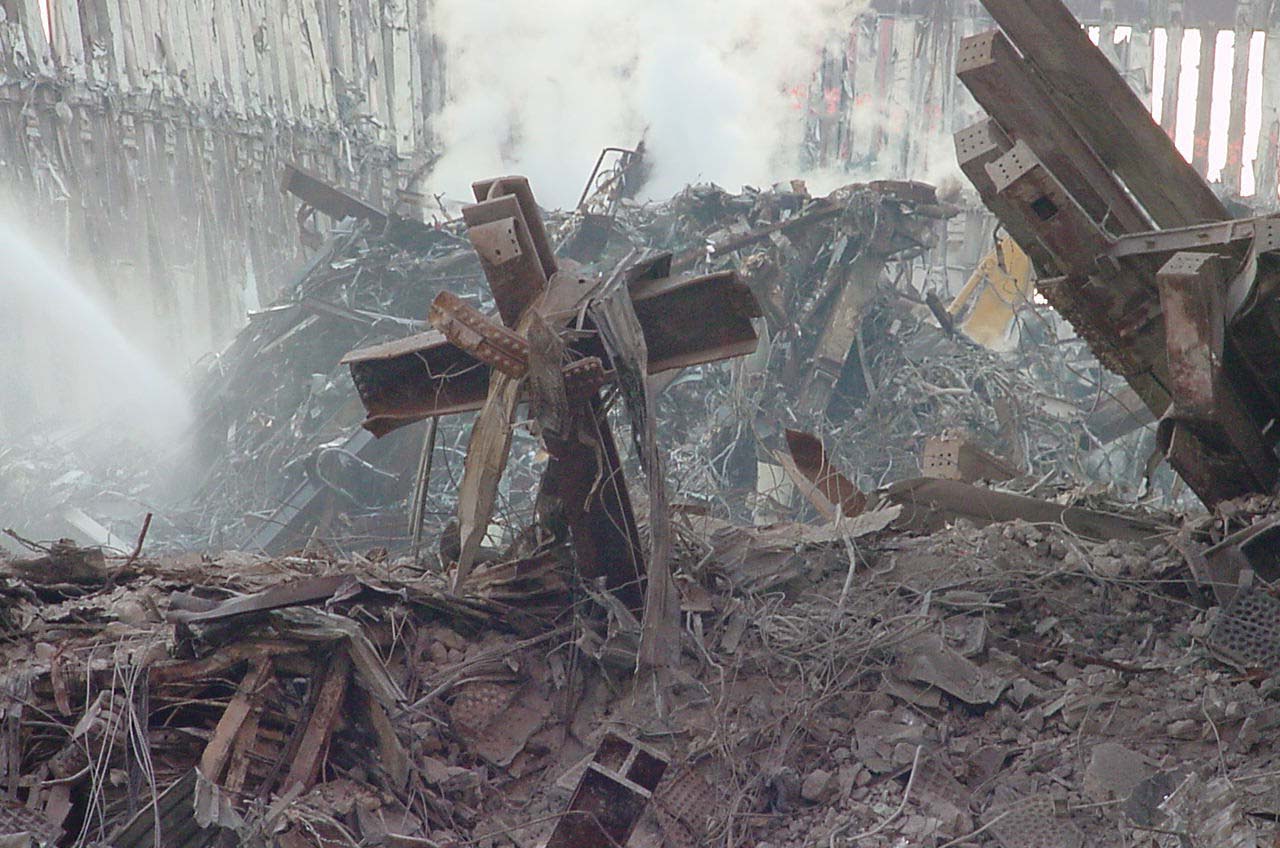
World-Trade-Center-9-11-cross-1

Friends of Padre Steve’s World

I wrote a reflection yesterday on some of my reflections on the 9-11-2001 attacks on the World Trade Center and the Pentagon, today a continuation of those thoughts.

I can still remember the day like it was yesterday. I was getting out of my office at Camp LeJeune after an early morning counseling case and some administrative duties I was getting ready to head to the French Creek gym.  I was about to close out my browser when I saw a little note on the Yahoo.com homepage: “Airplane crashes into World Trade Center.” It was about 0900 that tragic morning.  I thought to myself, “Some dumb ass just crashed his Cessna into the building.

The day was clear and absolutely gorgeous, a slight north wind and low humidity, a well-deserved break from what had been a hot and humid summer.  Not that I had seen much of the Carolina summer having returned from a deployment to Okinawa, Mainland Japan and Korea in late July. When I got to my car the local talk radio station was broadcasting a second or third tier national talk radio host and he was screaming “oh my God another plane just flew into the towers!”

I drove over to the gym where I joined a large crowd of Marines and Sailors transfixed as we watched the towers burn.  I went back to my office showered and went over to my battalion headquarters and was there when the South Tower went down at 0959.

Since then a lot has changed.  I have made two deployments and traveled to the Middle East many more times.  I came back from my deployment to Iraq with a serious case of PTSD and a health distrust of the media, politicians, preachers and especially the talk radio hosts that I used to listen to as often as I could.  I remember being in Iraq in between missions to the far reaches of Al Anbar Province and watching the news on the televisions at the dining facility and wondering just what war that they were covering.

Before Iraq I could be considered a pretty solid “conservative” but eight years after going to war I am decidedly liberal.  However, despite many allegedly conservative  talk pundits, politicians  and right wing preachers say just because a person is “liberal” does not mean that they are unpatriotic or do not care about our country or freedom.  After serving in Iraq and seeing how certain people have equated patriotism with adherence to their political agenda I wholeheartedly believe that a person’s patriotism has nothing to do with their politics or their religious beliefs.

Before Iraq I was jaded by what happened to my dad’s generation after Vietnam when liberals called returning Veterans “baby killers” or “Nazis.”  In fact I had a Sunday school teacher tell me that my dad was a “baby killer” in 1972 and in 1981 had some ass at UCLA call me a “ROTC Nazi.”  As a result I had little love for the Left.  After September 11th I followed the “conservative” talk radio crowd and Fox News more than I had ever before.  The emotions that they stirred up were primal.  But experience and reflection caused me to get beyond the pain of my past and the emotion of the present.  Just as I detest those that characterized my dad’s service or my service as being criminal I also detest those that say one cannot be critical of those that advocate for war regardless of the human and economic cost or actual strategic benefit.

I rejoiced when our SEALS killed Osama Bin Laden and every Al Qaeda leader that we have ushered into the arms of Allah.  They have caused unmitigated suffering around the world, not just to us but to their own Islamic neighbors and deserve no pity and since they refuse to give quarter should be shown none. I feel the same way about ISIS and ISIL who are killing the Iraqis that I served alongside and their families, and if that sounds harsh I can’t help it. The attacks of 9-11 and the wars that have followed are all too personal.

At the same time I question the strategic purpose and value of the campaign in we conducted in Iraq which seems to me has opened the gates of hell. I still think that the words that T.E. Lawrence wrote in 1920 about the British in Iraq are as applicable today as when he penned them; only the empires are different:

“The people of England have been led in Mesopotamia into a trap from which it will be hard to escape with dignity and honour. They have been tricked into it by a steady withholding of information. The Bagdad communiqués are belated, insincere, incomplete. Things have been far worse than we have been told, our administration more bloody and inefficient than the public knows. It is a disgrace to our imperial record, and may soon be too inflamed for any ordinary cure. We are to-day not far from a disaster.”

The British who Lawrence wrote about, gave their people reasons for going into Mesopotamia which were similar to those of the Bush administration over 80 years later. They cloaked their intentions in the words of liberation and protection, the British from the Turks, and the Americans from Saddam. Lawrence noted in words that are hauntingly familiar to those that paid attention to the American war in Iraq:

“Yet our published policy has not changed, and does not need changing. It is that there has been a deplorable contrast between our profession and our practice. We said we went to Mesopotamia to defeat Turkey. We said we stayed to deliver the Arabs from the oppression of the Turkish Government, and to make available for the world its resources of corn and oil. We spent nearly a million men and nearly a thousand million of money to these ends. This year we are spending ninety-two thousand men and fifty millions of money on the same objects.”

At the fourteen year mark I grieve for those that have lost their lives as well as loved ones in the attacks or in the wars that have followed.  On September 11th 2001 2977 people were killed at the World Trade Center, the Pentagon or on United Flight 93 which went down in Pennsylvania.  One of those killed at the Pentagon was Lieutenant Colonel Karen Wagner who I had served with at the Academy of Health Sciences Brigade in 1987-1988.

Since then 4492 American military personnel have given their lives in Iraq and 2363 in Afghanistan.  NATO or coalition allies, excluding the Iraqi and Afghani military or police forces have lost another 1270 military personnel. Another 45,170 Americans have been wounded.  I know a decent number of those wounded and some of those that have died.  The losses are intensely personal and to think that we have lost well over twice the number killed on September 11th 2001 in two wars; many of whom were children aged 8-12 years old on that tragic September day. Of course the numbers do not count those that died by their own hand after they returned from the war, a number that grows daily. I have known too many of them as well, heroes who could not make the adjustment coming home. Likewise I cannot forget the devastation that I saw in Iraq, the deaths of so many, some estimates of over a million civilian casualties, not county what has happening during the current ISIS/ISIL era.

I have been changed by that tragic event. I still shudder when I see the video of United Air Lines Flight 175 crashing into the South Tower or see the videos of the towers crashing down.  They are hard to watch and while I will observe the anniversary with prayers and a lot of reflection as I do not know how much of the continuous media coverage of the anniversary that I will be able to watch.

The events of that tragic day changed me, and changed countless numbers of other Americans as well as others around the world.  While we yearn to return to the day’s before9-11-2001 that is impossible, there is too much water and too much blood that has passed under the bridge.   I know I can’t go back, but I wish that I could, so as I have for the last fourteen years I will continue to learn to live with it.

Peace

Padre Steve+

2 Comments

Filed under afghanistan, Foreign Policy, History, iraq, iraq,afghanistan, middle east, Military, News and current events, Political Commentary

Heroes or Villains? Snipers and Moral Ambiguity

734631_053

I saw the movie American Sniper when it came out two weeks ago, I have not read the book, though I have read excerpts of it, and both seen and read many of Chris Kyle’s responses to questions in various interviews after he retired from the Navy.  I have seen the shit storm that has developed in response to the movie as well as supporters lift Kyle up to near sainthood, a true hero; while detractors present him as a war criminal, a sociopath and something as close to demonic as a human being can be.

I think that both are right and both are wrong, and that the uncomfortable truth about Kyle lies somewhere in between those extremes.

I find that curious because I do not remember any visceral reaction to the actions of the scripture quoting American sniper, Private Jackson in Saving Private Ryan or the Soviet or German snipers in Enemy at the Gates.

Because of that I think in large part this visceral reaction to either lift Kyle up or tear him down comes from the context of the Iraq War itself. It was horribly divisive, in large part because the invasion of Iraq launched by the Bush Administration was no doubt a major war crime by any standard of international law.

I have written about this before. If the leaders of the Bush Administration had been put on trial for their actions at Nuremberg as were the Nazis, Justice Robert Jackson would have had them all on the gallows. Jackson said during the trial:

“If certain acts of violation of treaties are crimes, they are crimes whether the United States does them or whether Germany does them, and we are not prepared to lay down a rule of criminal conduct against others which we would not be willing to have invoked against us.”

Most, including the former President, Vice President, and Secretary of Defense, not to mention other key players and decision makers would have easily been convicted of all except the charge of genocide. The three major counts that they would have hanged for were:

Count One: Conspiracy to Wage Aggressive War: This count addressed crimes committed before the war began, showing a plan by leaders to commit crimes during the war.

Count Two: Waging Aggressive War, or “Crimes Against Peace” which included “the planning, preparation, initiation, and waging of wars of aggression, which were also wars in violation of international treaties, agreements, and assurances.”

Count Three: War Crimes. This count encompassed the more traditional violations of the law of war already codified in the Geneva and Hague Conventions including treatment of prisoners of war, slave labor, and use of outlawed weapons.

The decision of the Bush Administration to invade Iraq was not only criminal, but the consequences of that decision and the later disastrous post-invasion policies of the administration ensured that the suffering of the Iraqis and the suffering of the American military personnel and their families who shouldered the burden on that war, while 99.3% of the nation sat it out, would continue, even today.

I served in Iraq, supporting small teams of advisors working with the Iraqi military and security services in Al Anbar Province. I know that I hoped, as did the Marines, Soldiers and our Iraqi friends wanted to see peace come to Iraq and see that country rise from the ashes. Instead we have seen our efforts blow away like the sands of the desert. T.E. Lawrence I think wrote words that are all to symbolic of what we tried to do:

“We had been hopelessly labouring to plough waste lands; to make nationality grow in a place full of the certainty of God… Among the tribes our creed could be only like the desert grass – a beautiful swift seeming of spring; which, after a day’s heat, fell dusty.”

So my Iraq war was different. I saw things in a different light from many because I worked with the Iraqis and got to know them, their hopes and their dreams. I also saw it differently because I could place it in a larger historical context. The Iraqis I knew, were not savages, they were human beings with the same kind of hopes and dreams for their families and country at any one of as has as Americans. That being said, none of us, American or Iraqi, felt any sympathy for the terrorists, foreign fighters, and Al Qaeda Iraq operatives who made a habit of killing and brutalizing Iraqi citizens, or those outside the country, who supported the terrorist efforts.

The part where ambiguity comes in is when we look at the men and women who serve in such wars, what they go through and the moral ambiguity that often comes with such service. It is an ambiguity which some need to justify by convincing themselves the all that they did was done in the name of a greater good, and against people who were less than human. That is something that those who serve as snipers in any army must convince themselves.

If you have ever read anything about snipers and how soldiers felt about them in various wars, I would encourage you to do so.

When I read that Michael Moore called Kyle, and all snipers cowards, I cringed. Not to say that Moore’s comments, which he attributed to how he lost a relative to a German sniper in the Second World War were completely unfair, they are actually similar to the views held by many against snipers. British historian and writer Max Hastings sums that up in his book Armageddon which is about the final months of World War Two in Europe:

“Almost every soldier on both sides shared a hatred of snipers, which frequently caused them to be shot out of hand if captured. There was no logic or provision of the Geneva Convention to justify such action. Sniping merely represented the highest refinement of the infantry soldier’s art. Its exercise required courage and skill. Yet, sniping made the random business of killing, in which they were all engaged. become somehow personal and thus unacceptable to ordinary footsoldiers.”

Snipers have a unique place in war and especially in the types of infantry intensive urban operations which Kyle was involved. Their trade is not in contravention of the Geneva Convention or any international military criminal code. So long as they are engaged in combat and are in the uniform of their country, and not engaging in acts that are forbidden by those codes their actions are legal. So to call Kyle a “war criminal” as some have is to misunderstand the law.

To call Kyle and other snipers “cowards” is also to misunderstand the nature of war, especially as it applies to snipers. Snipers have a lonely existence, they can be celebrated but some, but the nature of their war is different. The character Private Jackson in Saving Private Ryan perhaps summed it up what it takes to be a sniper, when he said: “Well, it seems to me, sir, that God gave me a special gift, made me a fine instrument of warfare.” The nature of the sniper’s war dictates that they believe something like this that enables them to survive.

Unlike those who can drop bombs, pilot drones, shoot artillery from afar or even engage in infantry combat with large numbers of others, the sniper has a lonely, yet intimate war.

Snipers usually serve alone, they set up, they wait, they seldom have back up. They are as much the hunted as they are the hunter. They know if captured that their enemy will have no mercy upon them. Unlike others, they have an intimacy with those that they kill, they see them, and in the kinds of wars where the “enemy” is not a uniformed soldier, but an insurgent blending in among civilians, they task of the sniper is incomprehensible. To do that job, combat tour after combat tour, has to do something to the human soul. Those that survive and come home have to try to justify their actions, as Kyle did, asserting that he knew that all of the people he killed were “bad guys.” It is probably the only way that one can keep his sanity when he returns to a world that doesn’t understand what he did.

But the justifications are as corrosive to the soul as anything else. They force people like Kyle, to push under the things that they saw or did which were wrong with a certitude that causes them to make assertions and claims that are either patently false, exaggerated, or which paint them in an even worse light than the truth would. Such would be the case in Kyle’s book where he claims killing thirty Americans in post Hurricane Katrina New Orleans. If he did that he was a criminal, but he is dead, and we will probably never know the truth.

A veteran of the U.S. Marine campaigns against the Japanese in the Pacific, Eugene Sledge wrote in his book With the Old Breed: At Peleliu and Okinawa: 

“To the non-combatants and those on the periphery of action, the war meant only boredom or occasional excitement, but to those who entered the meat grinder itself the war was a netherworld of horror from which escape seemed less and less likely as casualties mounted and the fighting dragged on and on. Time had no meaning, life had no meaning. The fierce struggle for survival in the abyss of Peleliu had eroded the veneer of civilization and made savages of us all.”

That kind of war my friends has a corrosive and toxic effect on the human soul. Sledge noted: “I am the harvest of man’s stupidity. I am the fruit of the holocaust. I prayed like you to survive, but look at me now. It is over for us who are dead, but you must struggle, and will carry the memories all your life. People back home will wonder why you can’t forget.”

War changes those who serve in it, the kind of change is in large part due to the kind of wars that we serve in and what we do in it. When I watched the movie with my former assistant and body guard during our tour in Iraq, Nelson Lebron I was bombarded with memories, of both my time there and my return home, and the hell I have put my wife Judy through at times as I have struggled with PTSD, what I saw in Iraq and my reaction to coming home to a country that knew not war. I didn’t sleep for several days afterward and the shit storm surrounding the movie has brought a lot of anxiety to me, I guess because it seems that few people really understand what war does to people.

I think for me, the part of the movie that had the most effect was the homecoming, and it reminded me of a movie that came out in 1978 about the home front in the Vietnam War, Coming Home staring Jon Voigt, Jane Fonda and Bruce Dern. Both movies dealt with the pain of families affected by war.

I’m certainly not going to sit in judgment of Chris Kyle or his critics, he is dead and unable to defend or even take bak anything that he might have written or said, likewise his critics, in many cases do not know what war can do to a person. I don’t know how much of Chris Kyle’s story is true, or how much is some sort of fiction, or even if what he wrote was filtered through what he saw and did in Iraq. Killing that many people, seeing their faces and to watch the life flowing out of them has to mess up a mind. Though I have been to combat, I have not walked in the shoes of Chris Kyle or any sniper. I have never had to kill anyone, even in self defense.

I would hope that people see the movie. Not so much because I believe in its historical truth, it seems to me to be a composite representation of Kyle, Navy SEALs, Marines and Iraqis that has as much Hollywood myth as it does truth.

But rather I believe people should see it to see how war tears the souls out of people. I would rather have my fellow citizens look at the ugliness of war, and to hold politicians accountable for any decision to go to war. I would rather see my countrymen look upon the pain that war causes, even long after those who fought come home.

Two time Medal of Honor winner Smedley Butler wrote:

What is the cost of war? what is the bill? Major General Smedley Butler wrote: “This bill renders a horrible accounting. Newly placed gravestones. Mangled bodies. Shattered minds. Broken hearts and homes. Economic instability. Depression and all of its attendant miseries. Back -breaking taxation for generations and generations. For a great many years as a soldier I had a suspicion that war was a racket; not only until I retired to civilian life did I fully realize it….”

The effects of war are terrible and had George Bush not made the decision to go to Iraq, Chris Kyle might still be alive, like so many others.

I don’t know if this makes any sense to you but I had to try to put some words and thoughts around what I have been feeling for the past couple of weeks.

Have a great evening,

Peace

Padre Steve+


2 Comments

Filed under film, History, Military, movies, News and current events, PTSD
