Tag Archives: islamic state of iraq and the levant

9-11-2014 War Without End…

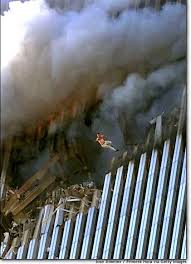
9-11 jumpers

“We have not reached the limit of our military commitments…” T.E. Lawrence (Mesopotamia 22 August 1920 in the Sunday Times)

Thirteen years after the Al Qaeda attacks on the World Trade Center and Pentagon in which nearly 3000 Americans were killed and the American response against Al Qaeda and its Taliban hosts in Afghanistan a month later we enter a new phase of war against old and familiar as well as new and frighteningly brutal enemies.

Of course the war was extended to Iraq by the Bush Administration, pursuing the goal of toppling Saddam Hussein and his non-existent weapons of mass destruction. That extension of the war, which so reminds me of what T.E. Lawrence wrote about the British adventure in Mesopotamia in 1920 has led to the creation of a much more ruthless and capable enemy than Al Qaeda ever was and strengthened our old adversary Iran in ways that it could not have done itself. Lawrence wrote of the British effort:

“The people of England have been led in Mesopotamia into a trap from which it will be hard to escape with dignity and honour. They have been tricked into it by a steady withholding of information. The Bagdad communiqués are belated, insincere, incomplete. Things have been far worse than we have been told, our administration more bloody and inefficient than the public knows. It is a disgrace to our imperial record, and may soon be too inflamed for any ordinary cure. We are to-day not far from a disaster.”

Like the Bush administration the British reasons for going into Mesopotamia were cloaked in the words of liberation and protection, only from the Turks, not Saddam. Lawrence noted in words that are hauntingly familiar to those that paid attention to the American war in Iraq:

“Yet our published policy has not changed, and does not need changing. It is that there has been a deplorable contrast between our profession and our practice. We said we went to Mesopotamia to defeat Turkey. We said we stayed to deliver the Arabs from the oppression of the Turkish Government, and to make available for the world its resources of corn and oil. We spent nearly a million men and nearly a thousand million of money to these ends. This year we are spending ninety-two thousand men and fifty millions of money on the same objects.”

Perhaps the most poignant and relevant note on the ill thought out Bush decision to invade Iraq in 2003 was by Thucydides who wrote:

“Think, too, of the great part that is played by the unpredictable in war: think of it now, before you are actually committed to war. The longer a war lasts, the more things tend to depend on accidents. Neither you nor we can see into them: we have to abide their outcome in the dark. And when people are entering upon a war they do things the wrong way round. Action comes first, and it is only when they have already suffered that they begin to think.”

Last night President Obama announced his intention to fight the brutal and extreme fighters of the Islamic State, or ISIL by building a broad coalition spearheaded by American airpower and intelligence agencies. Of course the President’s announcement was met with cries of not being enough by some on the political right, and with equal vehemence by opponents on the political left who feel that he has displayed cowardice in the face of “9/11 fear mongering” and the implementation of a policy of “perpetual war.” Of course the answer is more complex than anyone wants to admit, the critics on both sides are right in some things and wrong in some things, and the fact is there are no good answers.

Sadly because of what we and the British and others have done in Iraq and Syria the President is left with few options, mainly those that are bad, and those that are worse. So now, as the President, with a fair amount of judiciousness and caution commits the country to continue and maybe even expand the war that began thirteen years ago, it is time to remember those burning towers, the flailing bodies of our fellow Americans and others falling to their deaths to escape the surety of death in those flames and those who have perished in Iraq and Afghanistan; not just Americans, but coalition partners and the people of those lands who had no say in what Osama Bin Laden and Al Qaeda did or what Saddam did or didn’t do; and who went from the oppression of Saddam or the Taliban, to unending civil, tribal and religious wars, in which they were caught in the middle, the Iraqis in a war that was devised by President Bush and his advisors.

There are always results and today we are dealing with the results of at least a century of incredibly short sighted decisions of Western as well as Arab leaders which have blighted the Middle East and caused immense suffering to the peoples of the region. Now because of those decisions there exists a terrorist organization which is rapidly becoming a state in the areas of Iraq and Syria that it occupies. Islamic scholar Reza Aslan described the Islamic State on CNN Monday:

“Number one, you do have to respond militarily to ISIS soldiers and fighters. These guys are fighting a war of the imagination, a war that they think is happening between the forces of good and evil. There is no negotiation. There’s no diplomacy. There’s nothing to talk about with these guys. They have to be destroyed.”

Sadly, Aslan is right in his analysis of the Islamic State. Because of that fact, on this thirteenth anniversary of the 9-11-2001 attacks we and the already suffering people of the region will see war continue without end. One wonders how many generations it will last and what the cost on lives and treasure will be.

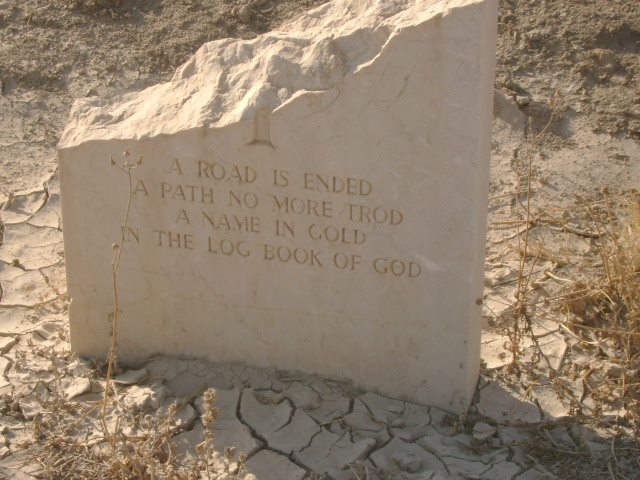
481801_10151367001287059_1003164983_n

Peace

Padre Steve+

1 Comment

Filed under History, iraq,afghanistan, middle east, national security, News and current events

The Islamic State and the New, Old Nature of War

bilad ash shaam

I am a realist when it comes to human nature and the reality of the evil that human beings can do. I have been to war, and personally I can think of nothing worse than more war. For me war is part of the reality that I live with, and which I am reminded of every time I try to sleep. That being said, a new war is gaining in intensity and threatening to blow away what is left of the old world order.

For most modern Americans and others living in the West, war is an often abstract concept regulated to small bodies of professionals fighting actions far away, of which we only catch occasional glimpses of on television or the internet. For most Americans and others in the West, modern war has become a spectator sport, and one far less interesting to most than either American or European football matches.

We in the West have been protected from the savage nature of war for the better part of six decades, with the sole possible exception being Vietnam, when the press had nearly unfettered access to the battlefields and the troops fighting the war. That war was a staple of the six o’clock news on a daily basis for a decade, bringing the war home in almost real time, and that coverage as well as the large numbers of Americans killed and wounded coming home from the war triggered a public backlash against it that helped bring the American involvement to an end.

The government and the military changed the way that war has been covered since, now reporters are vetted and closely supervised, even when they are imbedded with the troops. When the war in Iraq began to go bad, even the return of those killed in action was largely off limits. During the Iraq War many news programs took on the character of cheerleaders as Saddam was toppled. The media only slowly adjusted to the reverses brought about by the failed strategy of the Bush administration in Iraq as the falsehoods that brought about the invasion were revealed and the Iraq Civil War and insurgency spread like wildfire.

As such most people, including political, business, media elites, and even military theorists fail to understand the essential and unchanging, character, nature and complexity of war. As British theorist Colon S. Gray so bluntly points out: “Some confused theorists would have us believe that war can change its nature. Let us stamp on such nonsense immediately. War is organized violence threatened or waged for political purposes.” 1 If we fail to understand that we cannot understand the ongoing wars, to include that being waged by the Islamic State, or Caliphate in Iraq and Syria.

This war that the Islamic State is waging is bigger than most of us understand or want to believe. It is not simply about toppling the Assad regime, nor even taking Baghdad, or even about gaining control of the oil of the Middle East, though each is a goal for the Islamic State.

The larger and much more ambitious goal of the ISIS leadership; that of toppling the Saudi monarchy, which ISIS feels is corrupt and heretical, and the occupation of Mecca, Medina and ultimately Jerusalem, the three most holy sites in Islam. The Puritanical and violent Wahhabi Islam practiced by ISIS rightly understands as so many other Wahhabi fundamentalists have throughout the years; that the possession of these sites, especially Mecca and Medina, give them both legitimacy and standing as the preeminent Islamic government in the World.

The House of Saud allied itself with the founder of Wahhabi Islam in the 1700s, but it was not until the 1920s when the British Indian Office backed the Saudi against the other tribes of the Arabian Peninsula that Wahhabi Islam had a stable base to reach out and touch the rest of the world. As the Saudis became more affluent and connected to the world through oil and the global economy some leading Saudis have tried to moderate their Wahhabi beliefs, modernize the Kingdom, even allowing women a few rights, and to accommodate more progressive beliefs. In the 1970s this brought about the assassination of King Faisal in March 1975 and the seizure of the holy sites of Mecca by extremists in November of 1979. That, coupled with their military alliance with the United States after the Gulf War brought about more opposition from the more radical Wahhabi including Osama Bin Laden whose Al Qaeda network spawned ISIS.

ISIS has found its greatest success in exploiting failures of many of the despotic and totalitarian leaders of Arab states, divisions in Islam, foreign influences and the seemingly hopeless plight of Arabs to overcome poverty and oppression in those countries to advance their cause and promote their ideology. Their brand of Islam which teaches that almost anything is an idol enables them to destroy historical sites, cemeteries, houses of worship and archeological treasures belonging to Christians, Jews, Buddhists and even to other Moslems.

Terrorism and terrorist groups have not generally been non-state actors in the world wide political drama, however, that being said, even non-state actors have strategic, ideological and political goals to which their violence is directed. The unique nature of ISIS is that what most of us assumed to be yet another non-state terrorist group is becoming an embryonic state with its own economic assets, media arm coupled with defined military and political-religious goals, both against other Moslems and the West. Is is morphing before our very eyes from a non-state entity to a hybrid entity with character traits of a non-state and a state actor, especially as it takes control of more and more territory in the Tigris-Euphrates basin of Syria and Iraq.

The message of ISIS to all, including other Moslems, is to convert to their understanding of Islam or die. It is the same kind of message that other religious extremists at the helm of governments have used for millennia, sadly including many Christians.

The fact that the Islamic State is aspiring to become not just a non-state actor, but to place itself as a dominant power on the world stage makes it different. It has the capability of operating in the open where it physically controls cities or regions, as well as in the shadows in countries viewed by them as the enemy. It will most likely adapt its tactics as the situation dictates. Against weaker, or politically unstable neighbors, it will use more conventional means and asymmetrical warfare. However, against enemies who have the power to strike them from afar such as the United States, they will use the asymmetrical means of various types of terrorism; traditional bombings, kidnappings, hijackings and assassinations, the use of any kind of WMD that they can obtain and even cyber-terrorism to attack financial institutions or critical infrastructure.

The war that the Islamic State is preparing for is a throwback to the heady days of Moslem conquest from the 7th to the 15th Centuries. But unlike those days where early Moslems were interested in such things as classical Greek learning, the preservation of historic sites or advances scientific or mathematical learning, the Islamic State is bent on destroying all vestiges of other peoples, groups or religions. Because their absolutist and apocalyptic beliefs allow no compromise, they can and will ruthlessly pursue their religious, ideological and political goals using terror as a tool.

We in the West have not faced something like this in a very long time. War is not just a military and political endeavor, “it is social and cultural… and must reflect the characteristics f the communities that wage it.” 2 The leaders of the Islamic State understand this fact all too well, that is a major reason why they are attracting new Jihadists around the world. However, we in the United States in Europe are on the whole, so detached from such matters that we do not understand the savage nature of war, or the motivations groups like the Islamic State. To us they are barbarous and a throwback to times where our ancestors waged wars of religion and ideology to conquer, convert and enslave unbelievers.

There are many politicians that seem to believe that the Islamic State can be crushed quickly by US and allied forces. However, history shows that such religious-political-ideological movements do not die easily, even when mercilessly attacked by superior military forces.

Those that think a series of surgical strikes by aircraft, cruise missiles or drones; or attacks by Special Forces will eliminate ISIS as a threat do not understand the nature of that beast. We have become enamored of the technology that we use to make war, and we often forget the preeminence of the human dimension. Technology changes rapidly, the nature of the people that employ it seldom changes.

The West must, for human rights and freedom and not for imperialist, economic or even the mission of spreading democracy, we must be prepared for a long and difficult war that will be waged in the most brutal of manners by all sides. We must realize that there will be a terrible cost such a war, economic and human to be sure, people will die and economies will suffer, but worse there will be a cost to our individual and corporate psyche.  This war will eventually have a profound effect on all  us.

We must realize as Helmuth Von Molkte told Kaiser Wilhelm II in 1906 that the next war “will be a national war which will not be settled by a decisive battle but by a long wearisome struggle with a country that will not be overcome until its whole national force is broken, and a war which will utterly exhaust our own people, even if we are victorious.” Von Molkte’s tragic mistake was that he did nothing to “follow through the logic of his prophecy” 3 and allowed his country to enter a war that it was not prepared to wage, and which caused its collapse.

Ultimately, despite our protestations this war, which has already started will become a war without mercy to use the words of John Dower. The West will be slow to move, and half measures will provoke more attacks and a further spread of the Islamic State. Alliances will have to be made with nations that we may despise, but who are also threatened by the Islamic State. Such is nothing new, the United States and Great Britain allied themselves with the Soviet Union to defeat Hitler.

However, when ISIS successfully attacks a major European or American city causing great loss of life, which they very probably will do, the gloves will finally come off. Then the only words to describe how the West will wage the war will be those of William Tecumseh Sherman who said: “You cannot qualify war in harsher terms than than I will. War is cruelty, and you cannot refine it and those who brought war into our country deserve all the curses and maledictions a people can pour out….” 4 The Islamic State is sowing the wind, and they will reap the whirlwind.

We must look to history, our own as well as Islamic and Arab to understand the new era we are entering, for in truth, despite all the technological advances and changes in strategy and tactics, the fact is that as Colin Gray writes “what changes about war and warfare, although it can be very obvious and can even seem dramatic, is actually overmatched by the eternal features of war’s nature.” 5

T.E. Lawrence wrote a memorandum to the British Foreign Office warning of what we are seeing today: “A Wahabi-like Moslem edition of Bolshevism is possible, and would harm us almost as much in Mesopotamia as in Persia…” T.E. Lawrence, Memorandum to Foreign Office 15 September 1919

Well, that vision is upon us, and with that I will close for today.

Peace

Padre Steve+

4 Comments

Filed under History, history, iraq,afghanistan, middle east, national security, News and current events, philosophy

Iraq 2014: A Disaster Long in the Making

bilad ash shaam

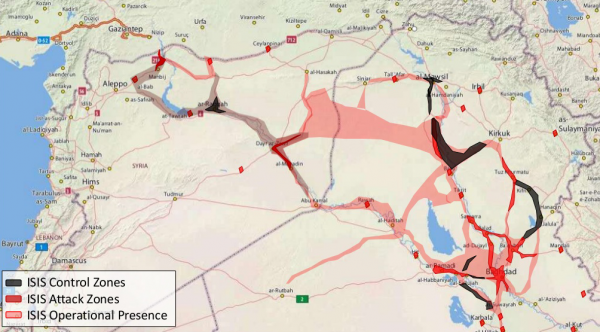
Map of the ISIL/ISIS Vision

“A Wahabi-like Moslem edition of Bolshevism is possible, and would harm us almost as much in Mesopotamia as in Persia…” T.E. Lawrence, Memorandum to Foreign Office 15 September 1919

As the British and French divided up the Middle East following the collapse of the Ottoman Empire, the young Lieutenant Colonel, T.E. Lawrence wrote a warning to the British Foreign Office. He was quite concerned about what was happening and saw the dangers to the region inherent in the British and French division of it. Lawrence understood the religious and ethnic divisions of the region and saw the lack of wisdom in how both the British and French policies, which in order to prop up their gains used those divisions to establish ruling elites in Syria and Iraq, in each case pitting Sunni against Shia, Christian against Moslem and Kurd against Arab.
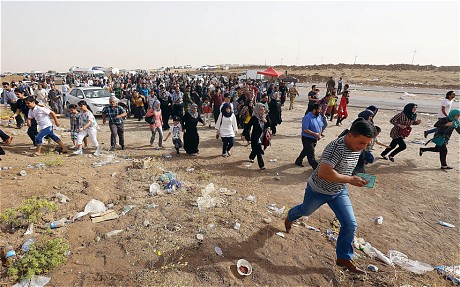
Iraq_mosul_refugee_2939832c

Mosul Refugees

In spite of the efforts of the Europeans and later the Americans to prop up strongmen in the region, or in the case of Saddam Hussein, destroy his regime opening a Pandora’s Box of chaos that was only contained by a massive amount of U.S. Military power and an alliance with Iraqi Sunni tribesmen and their sheikhs during the “Anbar Awakening.” The Sunnis expected after they had helped the U.S. and the Iraqi Shia led Central Government to destroy the forces of Al Qaida Iraq, to be brought back into the government and given a reasonable amount of autonomy. Instead, when the U.S. departed in 2011 at the behest of the Shia government those Sunnis became persecuted and alienated. Now many of them are actively aiding, supporting or acquiescing to the forces of the Islamic State of Iraq and the Levant (ISIL) which also known by the name Islamic State of Iraq and the Shaams (ISIS). We forget the lesson that Lawrence learned about the Arabs who fought against the Turks in the First World War: “The Arabs rebelled against the Turks during the war not because the Turk Government was notably bad, but because they wanted independence. They did not risk their lives in battle to change masters, to become British subjects or French citizens, but to win a show of their own.” The Iraqi Sunni who allied themselves with the U.S. military in Anabar in 2007 did so for the same reason, they wanted independence.

The American administration of Iraq was even more disastrous than that of the British following the First World War. Lawrence wrote of that occupation in words that could have well described the American efforts in 2003-2006.

“The people of England have been led in Mesopotamia into a trap from which it will be hard to escape with dignity and honour. They have been tricked into it by a steady withholding of information. The Bagdad communiqués are belated, insincere, incomplete. Things have been far worse than we have been told, our administration more bloody and inefficient than the public knows. It is a disgrace to our imperial record, and may soon be too inflamed for any ordinary cure. We are to-day not far from a disaster.” T. E. Lawrence, ‘Mesopotamia’ By ex.-Lieut.-Col. T. E. Lawrence (Fellow of All Souls College, Oxford) Sunday Times, 22 August 1920

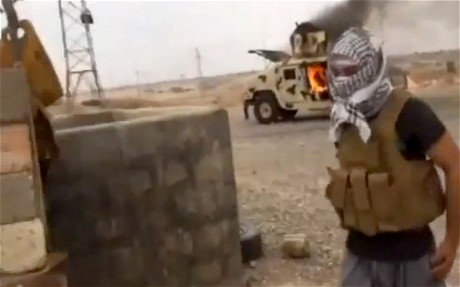
iraq-isis-thursday_2939167c

ISIL Fighter in Tikrit

Unlike the loosely organized insurgents and militants of AQI and its allies, many of whom were foreign fighters; while there are still good numbers of foreign fighters, most of the ISIS forces are Syrian or Iraqi Sunni, connected by tribe, religion and culture to the land that they are fighting on. These units are well trained, organized as proper military units and have fought both savagely and effectively in Syria and Iraq. Many are led by former professional officers of the old Iraqi Army who when Saddam fell, were thrown out of the military and not even provided for with the smallest of pensions. To demonstrate how close some of these are one only has to read the reports out of Al Jazeera and Al Arabiya, one of which quoted a tribal leader near Tikrit who said of the ISIL forces: “They came in hundreds to my town and said they are not here for blood or revenge but they seek reforms and to impose justice. They picked a retired general to run the town.”

The ISIL or ISIS fighters are strict Islamists and have been issuing decrees in Mosul regarding what citizens can and can’t do. Women are ordered to be completely veiled and covered if they go outside, which they are told that they should not do. People are being ordered to go to Mosques 5 times a day, sheikhs are being ordered not to cooperate with the government and the only people allowed to be armed are the militants. There are videos of ISIL fighters executing captured government officials.

Many of the Sunni Iraqi Nationalists, professional military officers who returned to the Army following the disastrous performance of it prior to 2007 also expected better treatment for their service. They too were not rewarded and it is possible that the collapse of Iraqi security forces could be in part due to the fact that these men hold grievances against the Baghdad regime of Maliki, which many view as a puppet to Iran, or as they call it “Persia.” Maliki claims that there was a conspiracy in the wholesale collapse of Iraqi forces in the north, and he may be right, but it is a problem that he created and made worse by his divisive policies and politics.
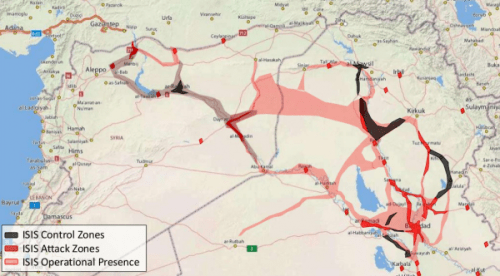
20140610_IRAQ1_0

The ISIL forces, though small are effective and efficient. In a sense they are a throwback, albeit a more hardened and ideological one to the Arabs that Lawrence advised and helped direct as they routed the Turkish Army in the Hajaz, Transjordan and Syria in 1917-1918. Lawrence wrote of that army:

“The Arab army, created in the field, grew from a mob of Bedouins into an organised and well-equipped body of troops. They captured thirty-five thousand Turks, disabled as many more, took a hundred and fifty guns, and a hundred thousand square miles of Ottoman territory.” From T. E. Lawrence, ‘France, Britain, and the Arabs’ by Col. T. E. Lawrence The Observer, 8 August 1920

What happens next I do not know. The ISIL forces have stated that: “Our final destination will be Baghdad; the decisive battle will be there…” I do not know if they have the ability to take and hold it, but they should be able to maintain their gains in Mosul and Tikrit. They have captured large numbers of armored HUMMVs as well as Iraqi military helicopters, including U.S. supplied UH-60 Blackhawk and MH-58 Kiowa at the Mosul airbase. To further complicate the situation the semi-autonomous Kurdish region seized the city of Kirkuk, which it considers its ancestral capitol. Those troops however are reportedly reading for a counter-attack on the ISIL forces absent any presence of regular Iraqi units.

iraq-Peshmerga-for_2939387c

Kurdish Forces outside Kirkuk

The loss of all of these areas is a disaster to a unified Iraq and shows the incredible short-sightedness of the Bush administration to overthrow Saddam and leave a power vacuum in his place after disbanding the Iraqi military, police and civil service, the only institutions that had kept Iraq together.

If Maliki has any sense he will welcome moderate Iraqi Sunni nationalists back and actually give them the autonomy within Iraq that they were promised while the U.S. was still there, a policy that now Vice President Joseph Biden articulated as early as 2007. A policy that unfortunately was ignored by Maliki as he consolidated power as the U.S. withdrew from Iraq. However, it may be too late for this. The more probable thing that Maliki will do is to rely on Shi’ite militias or even the Iranians to buttress his regime. There are reports that Iranian Al Quds commandos may have been deployed to Iraq, something that may in the vacuum of outside support from other Arab states, the U.S, U.N. Or the international community widen the conflict significantly.
This will likely lead to a bloody stalemate and civil war, similar to what has been happening in Syria, that could last for years throwing the entire region into chaos.
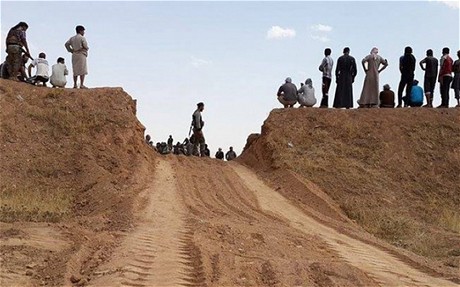
iraq-border_2939075c

A Border no More… the berm between Iraq and Syria

ISIL has removed the border between the areas that it controls in Iraq and Syria. They have controlled most of the Euphrates valley in Anbar since last year, and now with the seizure of Mosul and Tikrit are in control of much of the Tigris river valley. Lawrence wrote in his essay The Changing East in 1920 that:

“The cultivated districts, Mesopotamia and Syria, have, however, language, race, and interests in common. Till to-day they have always been too vast to form a single country: they are divided, except for a narrow gangway in the north, by an irredeemable waste of flint and gravel: but petrol makes light of deserts, and space is shrinking to-day, when we travel one hundred miles an hour instead of five. The effect of roads, railways, air-ways and telegraph will be to draw these two provinces together, and teach them how like they are…”

In effect the ISIL forces are creating that Sunni dominated and quite possibly radicalized Wahabi state that Lawrence warned of in 1919. This could well be the end of the duplicitous and disastrous Sykes-Picot agreement which divided the Middle East irrespective of into its current form. Those who implemented that agreement sowed the wind, and now the region and the world are reaping the whirlwind.

It is interesting to recount Lawrence’s observations of the Arab peoples in the Changing East essay published in 1920 which I quoted above. Lawrence wrote:

“The fate of the Arabs is more difficult to prophesy… they have been a government twenty times since the dawn of history, and as often after achievement they have grown tired, and let it fall: but there is no record of any force except success capable of breaking them. The history of their waves of feeling is significant in that the reservoir of all ideas, the birth of all prophecies are shown in the deserts. These empty spaces irresistibly drive their inhabitants to a belief in the oneness and omnipotence of God, by the very contrast of the barrenness of nature, the lack of every distraction and superfluity in life. Arab movements begin in the desert, and usually travel up the shortest way into Syria – for it is remarkable that whereas all prophets go to the desert, yet none of them are ever desert-born. It is the Semitic townsman or villager who receives the revelation. For this reason, for what seemed to be the immemorial finger-sign of history, this present Arab movement, the craving for national independence and self-government, was started in the desert. It, too, took the traditional road to Damascus, the traditional first centre of new movements, and with the successful establishment of Feisal there the second phase was finished. This is not, however, the proper end of the Arab movement: the weight and importance of the Semitic states have always lain in Bagdad, for very sound reasons of economics and population. Syria is a poor country, small and mountainous, dry, lacking in minerals and in arable land. There is no probability that her native population will ever be very dense. Mesopotamia has big rivers, and a huge area of irrigable land. Her wealth in grain and cotton will be very great, and nature may have bestowed on her abundance of cheap fuel. Should that be the case, she will inevitably take the headship of the Arab world in the future, as so often in the past. Damascus may hold an interim pre-eminence: Bagdad must be the ultimate regent, with perhaps five times the population of Syria, and many times its wealth. Mesopotamia will be the master of the Middle East, and the power controlling its destinies will dominate all its neighbours.”

If the politicians, diplomats, businessmen and bankers or the West fail to comprehend this we will never understand or successfully deal with the Arabs of Syria and Mesopotamia. This is not going to get better anytime soon and poses a danger to the region and also the world economy as oil prices are already going up as the oil markets anticipate losing access to Iraq’s oil reserves. In a sense what happens in Iraq will likely make the situation in Syria look like child’s play and will have far more long lasting effects, not only for the region, but the world.

Actions have consequences, and the failure of people, leaders and governments to understand the complex nature of Iraq and Syria have brought the world to a crisis. Barbara Tuchman said it well: “Confronted by menace, or what is perceived as menace, governments will usually attempt to smash it, rarely examine it, understand it, define it.”

Peace

Padre Steve+

1 Comment

Filed under Foreign Policy, History, iraq,afghanistan, News and current events