
“An antique saying has it that a man’s life is incomplete unless or until he has tasted love, poverty, and war.” Christopher Hitchens
“You have not done Christian Theology until you have dealt with suffering and death” Yandall Woodfin
I deal with life in the intersection where theology has to deal with uncomfortable and often troubling questions. When I first heard my Philosophy of Religion Professor at Southwestern Baptist make the statement that “you have not done Christian Theology until you have dealt with suffering and death” I was somewhat offended. This was back in 1989 when I was still somewhat idealistic and believed what really popular preachers on radio and mega-churches said. Now I can never say that I was completely in agreement with the “name it claim it, grab it stab it, God owes me and will bless me because I did…” pop-theology of the theological lightweights masquerading as teachers, preachers and prophets. While I did not espouse it the view was prevalent in the churches that I was part of, in fact I choose Southwestern Baptist as a school because it did not tow that party line. I just never expected my professors across the board in the School of Theology to be as nuanced and balanced as Dr. Woodfin and the others who helped give me my theological formation.
In seminary I developed a very good theological understanding and life hermeneutic that was far closer to Anglicanism or the reformers of the Second Vatican Council. In fact it was theologians like Hans Kung, Yves Congar and Alistair McGrath as well as Jurgen Moltmann and Wolfhart Pannenberg who helped me in that. Additionally the writings of Dietrich Bonheoffer, Emil Brunner and Henri Nouwen were influential as I developed my theological and spiritual life. I was also thrust into the world of the Ante-Nicene Fathers of the Church, spending a semester of Systematic Theology studying and writing about Polycarp of Smyrna. It was studying these contemporary theologians as well as the Church Fathers that I discovered Christian Theology at the intersection and it was Dr. Woodfin’s remark that caused me to really question the modern “theologians of glory.” It is plainly obvious that this was in the day before the Baptist Taliban under Mullah Paige Patterson took the place over. That was the time when it was a world class seminary and not just a pretty good Bible school.
It was the fact that even though I was in seminary life was really sucky. Nothing went right. Instead of the obvious “blessing of God” it seemed that we were cursed. We had lost our home, cars, and were destitute. I was working two and three jobs while Judy was sick and unable to work. We lived in a hell hole on the east side of Fort Worth Texas, frequently featured on the TV show COPS. One night in desperation I called the Terrible Blonde Network (TBN) for prayer. For my trouble I was told that it was obvious that God was not calling me to ministry otherwise he would be blessing us. That was a watershed experience and I rejected that idea on the spot. It made me mad as hell that a well meaning but ignorant volunteer prayer partner would judge me in such a way. When I went to work later at a TV ministry doing counseling, especially to broken pastors I never forgot that experience. I realized that what the lady said and what many people that I knew espoused was God-babble bullshit. The pastors that I talked to every week were suffering, often at the hands of the alleged people of God and even other ministers. It was obscene.
So anyway, back to the subject of this article…yes I chased a rabbit there and it was intentional. I had a New Testament Professor whose “rabbits” were often pastoral and theological gems. That may not be a gem but it was a rabbit worth chasing.
Hitchens, a pretty strident atheist has some pretty good observations about how some religious people including modern Christian icons have been pretty poor examples. Now he can be biased but his bias is balanced by the Orthodoxy espoused by his brother Peter. Hitchens’ comment based on the writings of antiquity is quite true. Until a man or for that matter a woman has experience love, poverty and war their life experience is incomplete. As a personal testimony, I can say “AMEN!” I know this to be true. I am married to the love of my life and our marriage has endured suffering, sickness, death, poverty and war. We have in baseball terminology “hit for the cycle.” While I have understood this I had never seen it in writing until I saw Hitchens’ book. The theme of love, poverty and war is rich in ancient writings including the Bible. It is also thematic in many cultural rituals around the world. The warrior who loves his family endures poverty; usually famine or plague induced and then goes out to fight invaders. If they win they come home to their loved ones victors who have protected home and hearth. It is much like the movie Braveheart where William Wallace leads a campaign against the English who have invaded Scotland. If they lose, there is the strong possibility that they will be slaughtered and their families enslaved. The annals of the Punic Wars are rich in this theme as is the life of King David who knows love, poverty based on being a fugitive on more than one occasion and his life as a warrior.
I think this is true in the modern era as well. Western culture based on consumerism and material wealth has been insulated from the depths of abject poverty, one only need place a poverty and famine stricken resident of almost any third world country who is deposited in a poor American city or town and ask him if he sees poverty. If he does it will not be material poverty but one where love and community are missing. If he goes up the street to the well off part of town he may be dazzled by the opulence but appalled by the loneliness of many people. Western nations following the end of the Second World War and the recovery from it have not known the depths of poverty. This may be changing now unless we can pull our economy out of the abyss that it seems perched upon, but even still at least so far the last couple of generations in the west have not known poverty as a whole.
Likewise the question of the experience of war for the modern person is one that is not experiential. War in the west is now fought largely by military professionals while most of the nation’s population lives in the shadow and protection of their military prowess. At one time with the draft war was experienced by all parts of the population in the west. Today it is not and with that lack of experience there is a void, men and women have not discovered either how to live for something or die for something bigger than themselves. One of the things that chafes my hide is when I hear ministers who have never served a day in uniform don a set of BDUs or Dessert Camouflage and preach a sermon on spiritual warfare. Sorry, that is a sham and the big TV guys who have done this should apologize to men and women who have been in combat and in harm’s way. I once had a bishop in my church, who is no longer in his communion do an article about spiritual warfare trying to apply “principles” of Carl Von Clausewitz about war without ever really reading or understanding Clausewitz. The treasure of Clausewitz is in his “principles” but in his understanding of the human condition brought about by his Lutheran faith, the Enlightenment and his experience of Prussia’s defeat and occupation by Napoleon followed by her recovery. I was appalled by what my ex-bishop wrote and embarrassed for the church should any real soldier or military leader pick it up and read it. Things like these show how little many religious leaders, or for that matter political leaders understand the human condition, life, love and war.
Dr. Woodfin was more right right than about anyone I have ever heard when he that we have not done Christian Theology until we have dealt with suffering and death. When you see innocents killed, children suffering from famine, war and disease. When you have seen the bodies of young men and women who have died senseless deaths and when you have looked at a mother who has lost a child you begin to understand. You begin to see the Cross. An innocent man executed, a guilty man go free. When you see friends and companions abandon their teacher and friend, a governor who knows a man is innocent be put to a brutal and agonizing death, and a mother looking up at a cross where her son hangs and cries “My God my God, why have you forsaken me?” When you see these things you have to deal with the reality of where the Christian faith intersects the cold reality of our world. It is as Alistair McGrath calls it, “life under the cross.”
I dare any of our modern digital era “theologians of glory” to enter this world, but most will not. In fact they will continue to sell the sad sack of theological excrement that they call the Gospel to adoring crowds who will eventually discover that they have been sold a lie. Many leave the faith while others take their place looking for “their” promised miracle, “their” blessing and their health, wealth and fortune. Like the Catholic indulgence sellers of Martin Luther’s era, such “ministers” are blight on the Christian faith and for all of their “success” power and popularity have done more harm to the faith than benefit. John Tetzel, Luther’s protagonist would tell people when collecting indulgences “A penny in the coffer rings, a soul from Purgatory springs.” Today’s modern peddlers of pious poop promise “your prosperity grows when into our ministry you sow” or a “vow you make today God is bound to repay.”
Having seen this in real life when people buy the lie and end up devastated when “God” doesn’t come through for them, or when a well meaning but ignorant person tells them some horse shit about how God is not blessing them because….I want to scream. I once had a pastor in a large evangelical and charismatic church which believed in “signs and wonders” tell the congregation about a conversation that he had with a parishioner who had been in the hospital and not been visited by him or the staff. The parishioner, who gave a sizable amount of money to the church asked” “How sick do I have to be to get a hospital visit from you?” The pastor, a nice guy laughed as he recounted his response. “You don’t want to be that sick.” The congregation laughed and I about cried as I was immersed in daily tragedy and trauma and Parkland Memorial Hospital in Dallas. I knew too many people be abandoned by their pastors in a city consumed with powerful pastors as churches to believe that they were a priority for those suffering.
The truth is that many pastors and for that matter many people want to avoid dealing with suffering and death at any cost. Whole industries are built around the worship of youth and beauty and a culture, including the churches lift their heads to the sky for God’s blessing while avoiding the suffering around them. There are pastors and parishioners who by the boatload have been thrown from the “Barque of the Church” because they either failed or did not have enough “faith”
Such is not the Gospel nor is it Christian in any way shape or form. It is no wonder that so many have abandoned the faith when all they see on TV are the modern digital theologians of glory who bask in fame and fortune while adding to the rejection, alienation and despair of those who believed them to actually be telling the truth.
Love, poverty and war, suffering and death, where the Christian faith meets these in the intersection is where new life can begin for it is only through the agony of the Cross that we know the resurrection.
Peace, Steve+
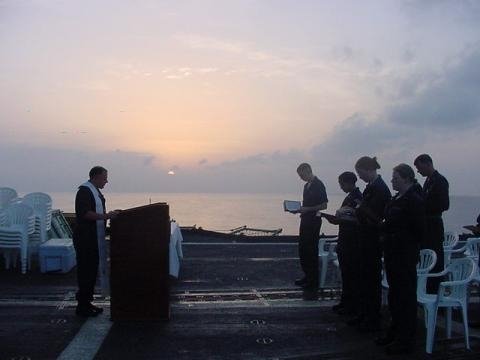 Easter aboard USS Hue City CG-66 off the Horn of Africa 2002
 The Inglorius Padre Steve's World