
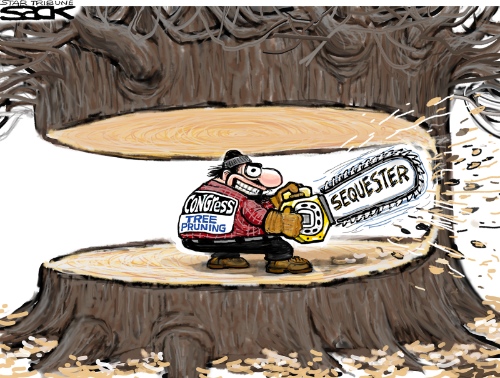
 Well the effects of the great sequester foisted on us by Congress in 2011 are finally starting to be felt. In my little part of the world they are impacting the health care needs of Marines and Sailors and their families. In fact our hospital will be having to cut over 800 mental health appointments in the next 11 weeks. Many other services will be impacted. The probability is that should this continue that the effects will be even more severe on the current active duty force as well as veterans being care for in military or VA facilities, this my friends is just the beginning.
So much for supporting the troops who are dealing with PTSD, Traumatic Brain Injury, crippling wounds that leave them dependent on pain killers, narcotics which in previous wars they would not have survived. Let’s not forget the suicide epidemic and sexual assault crisis, as well as collapsing families due to to the repeated stress of deployments and a system that is already struggling to cope with all of this. But that doesn’t really matter as long as corporate profits from war remain high and political contributions come rolling in. Thank you Congress, while you continue to get the best health care imaginable, take no cuts to your salary, and get more vacation days than anyone else employed by the government, even deciding when to not do business so you can take a paid holiday at taxpayer expense while the people that you have sent to war for the last 12 years pay the price, but I digress…
The K Street Lobbyists that advocate for all of the big defense industries whose programs and profits are getting relief from sequestration at every turn because their Congressional lackeys ensure it happens aren’t suffering. Their stocks and profits are going through the roof, even as they still sell things to the military that quite often we neither do not want or do not need. However, because the contractors and lobbyists have made sure that they located their programs in every Congressional district it takes an act of Congress that you can’t get to cut them. 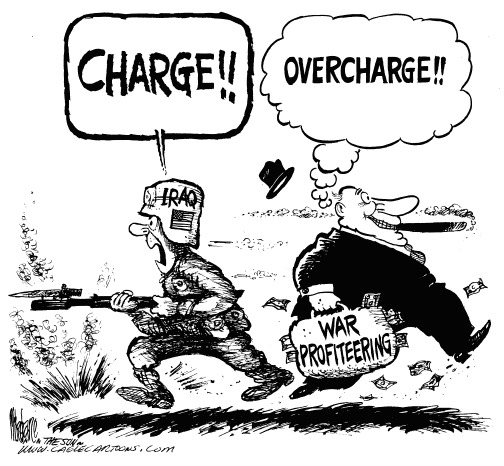 Meanwhile, those poor districts that only service the people of the military get hammered. Yes, all of those troop laden bases that don’t require big aerospace or shipyard investments in those southern Red States that take the hardest hits. You know, the really patriotic ones North Carolina, Texas, Georgia, Louisiana, Missouri, Kentucky and South Carolina where such bases as Fort Hood, Fort Bragg, Fort Bliss, Fort Polk, Fort Benning, Fort Knox, Fort Campbell, Fort Jackson and Camp LeJeune are located. It is they who take the biggest cuts to personnel and programs both the active duty military as well as our DOD civilian workers and personnel working for us employed by contractors. Of course these cuts affect other areas in Blue States or Swing States but I find the irony that those pushing hardest for sequester affecting military personnel and operations tend to be from those same Red States and those fighting hardest for the benefits to troops and veterans over weapons programs and industry are those that are traditionally called anti-military liberal Democrats.
 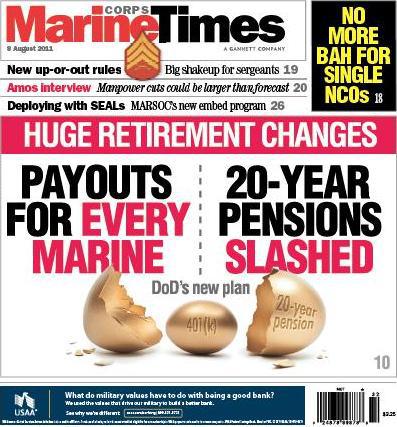 Likewise those pushing for the most severe cuts in personnel and benefits are mostly men appointed to their advisory positions by Donald Rumsfeld. Men who have a decided interest in pushing for the profits of corporations that they are connected. The sad thing is that some of these men are former senior officers. (See my article The Disdain of American Business for Military Personnel and their Benefits and Follow the Money: The Real Motives behind those Seeking to Radically Change the Military Retirement System). There is more irony. Back in the early days of the Bush administration even after we went to war in Afghanistan and Iraq Defense Secretary Rumsfeld worked hard to civilianize military positions, especially medical billets. Those medical personnel billets were downsized and replaced by civilians or contractors. Of course the Federal civilians are now sequestered meaning that military personnel including wounded warriors will face even more hurdles to obtain needed medical care. Throw in the fact that even without the sequester the Veteran’s Administration system is broken and that many “conservative” politicians and their business allies want to reduce the Tricare health insurance coverage for service members, retirees and their families and it all adds up to betrayal.
But the sad thing is that none of this is new. The irony is that Marine Corps icon and two time Medal of Honor winner Major General Smedley Butler wrote about the very same thing when he retired from the Marine Corps in 1932. He wrote a little book that I highly recommend called War is a Racket. It is a damning indictment of American politics and business. It shows just how callous, brutal and truly traitorous political and business interests can be when it comes to the trust of the nation and those that serve it in time of war. I quote the entirety of Chapter Two of Butler’s Book because rings so true today.
Who Makes the Profits
The World War, rather our brief participation in it, has cost the United States some $52,000,000,000. Figure it out. That means $400 to every American man, woman, and child. And we haven’t paid the debt yet. We are paying it, our children will pay it, and our children’s children probably still will be paying the cost of that war. The normal profits of a business concern in the United States are six, eight, ten, and sometimes twelve percent. But war-time profits — ah! that is another matter — twenty, sixty, one hundred, three hundred, and even eighteen hundred per cent — the sky is the limit. All that traffic will bear. Uncle Sam has the money. Let’s get it.
Of course, it isn’t put that crudely in war time. It is dressed into speeches about patriotism, love of country, and “we must all put our shoulders to the wheel,” but the profits jump and leap and skyrocket — and are safely pocketed. Let’s just take a few examples.
Take our friends the du Ponts, the powder people — didn’t one of them testify before a Senate committee recently that their powder won the war? Or saved the world for democracy? Or something? How did they do in the war? They were a patriotic corporation. Well, the average earnings of the du Ponts for the period 1910 to 1914 were $6,000,000 a year. It wasn’t much, but the du Ponts managed to get along on it. Now let’s look at their average yearly profit during the war years, 1914 to 1918. Fifty-eight million dollars a year profit we find! Nearly ten times that of normal times, and the profits of normal times were pretty good. An increase in profits of more than 950 per cent.
Take one of our little steel companies that patriotically shunted aside the making of rails and girders and bridges to manufacture war materials. Well, their 1910-1914 yearly earnings averaged $6,000,000. Then came the war. And, like loyal citizens, Bethlehem Steel promptly turned to munitions making. Did their profits jump — or did they let Uncle Sam in for a bargain? Well, their 1914-1918 average was $49,000,000 a year!
Or, let’s take United States Steel. The normal earnings during the five-year period prior to the war were $105,000,000 a year. Not bad. Then along came the war and up went the profits. The average yearly profit for the period 1914-1918 was $240,000,000. Not bad. There you have some of the steel and powder earnings. Let’s look at something else. A little copper, perhaps. That always does well in war times.
Anaconda Copper for instance. Average yearly earnings during the pre-war years 1910-1914 of $10,000,000. During the war years 1914-1918 profits leaped to $34,000,000 per year. (One should read their history of strip mining massive pollution, ARCO bought them in the 1970s but was stuck with massive environmental problems, such that the company is only on the books to show the losses)
Or Utah Copper. Average of $5,000,000 per year during the 1910-1914 period. Jumped to an average of $21,000,000 yearly profits for the war period.
Let’s group these five, with three smaller companies. The total yearly average profits of the pre-war period 1910-1914 were $137,480,000. Then along came the war. The average yearly profits for this group skyrocketed to $408,300,000. A little increase in profits of approximately 200 per cent.
Does war pay? It paid them. But they aren’t the only ones. There are still others. Let’s take leather. For the three-year period before the war the total profits of Central Leather Company were $3,500,000. That was approximately $1,167,000 a year. Well, in 1916 Central Leather returned a profit of $15,000,000, a small increase of 1,100 per cent. That’s all.
The General Chemical Company (now part of Honeywell) averaged a profit for the three years before the war of a little over $800,000 a year. Came the war, and the profits jumped to $12,000,000. a leap of 1,400 per cent.
International Nickel Company — and you can’t have a war without nickel — showed an increase in profits from a mere average of $4,000,000 a year to $73,000,000 yearly. Not bad? An increase of more than 1,700 per cent.
American Sugar Refining Company (largest Sugar refining company in the world, name brand Domino Sugar) averaged $2,000,000 a year for the three years before the war. In 1916 a profit of $6,000,000 was recorded.
Listen to Senate Document No. 259. The Sixty-Fifth Congress, reporting on corporate earnings and government revenues. Considering the profits of 122 meat packers, 153 cotton manufacturers, 299 garment makers, 49 steel plants, and 340 coal producers during the war. Profits under 25 per cent were exceptional. For instance the coal companies made between 100 per cent and 7,856 per cent on their capital stock during the war. The Chicago packers doubled and tripled their earnings.
And let us not forget the bankers who financed the great war. If anyone had the cream of the profits it was the bankers. Being partnerships rather than incorporated organizations, they do not have to report to stockholders. And their profits were as secret as they were immense. How the bankers made their millions and their billions I do not know, because those little secrets never become public — even before a Senate investigatory body.
But here’s how some of the other patriotic industrialists and speculators chiseled their way into war profits.
Take the shoe people. They like war. It brings business with abnormal profits. They made huge profits on sales abroad to our allies. Perhaps, like the munitions manufacturers and armament makers, they also sold to the enemy. For a dollar is a dollar whether it comes from Germany or from France. But they did well by Uncle Sam too. For instance, they sold Uncle Sam 35,000,000 pairs of hobnailed service shoes. There were 4,000,000 soldiers. Eight pairs, and more, to a soldier. My regiment during the war had only one pair to a soldier. Some of these shoes probably are still in existence. They were good shoes. But when the war was over Uncle Sam has a matter of 25,000,000 pairs left over. Bought — and paid for. Profits recorded and pocketed.
There was still lots of leather left. So the leather people sold your Uncle Sam hundreds of thousands of McClellan saddles for the cavalry. But there wasn’t any American cavalry overseas! Somebody had to get rid of this leather, however. Somebody had to make a profit in it — so we had a lot of McClellan saddles. And we probably have those yet.
Also somebody had a lot of mosquito netting. They sold your Uncle Sam 20,000,000 mosquito nets for the use of the soldiers overseas. I suppose the boys were expected to put it over them as they tried to sleep in muddy trenches — one hand scratching cooties on their backs and the other making passes at scurrying rats. Well, not one of these mosquito nets ever got to France!
Anyhow, these thoughtful manufacturers wanted to make sure that no soldier would be without his mosquito net, so 40,000,000 additional yards of mosquito netting were sold to Uncle Sam.
There were pretty good profits in mosquito netting in those days, even if there were no mosquitoes in France. I suppose, if the war had lasted just a little longer, the enterprising mosquito netting manufacturers would have sold your Uncle Sam a couple of consignments of mosquitoes to plant in France so that more mosquito netting would be in order.
Airplane and engine manufacturers felt they, too, should get their just profits out of this war. Why not? Everybody else was getting theirs. So $1,000,000,000 — count them if you live long enough — was spent by Uncle Sam in building airplane engines that never left the ground! Not one plane, or motor, out of the billion dollars worth ordered, ever got into a battle in France. Just the same the manufacturers made their little profit of 30, 100, or perhaps 300 per cent.
Undershirts for soldiers cost 14¢ [cents] to make and uncle Sam paid 30¢ to 40¢ each for them — a nice little profit for the undershirt manufacturer. And the stocking manufacturer and the uniform manufacturers and the cap manufacturers and the steel helmet manufacturers — all got theirs.
Why, when the war was over some 4,000,000 sets of equipment — knapsacks and the things that go to fill them — crammed warehouses on this side. Now they are being scrapped because the regulations have changed the contents. But the manufacturers collected their wartime profits on them — and they will do it all over again the next time.
There were lots of brilliant ideas for profit making during the war.
One very versatile patriot sold Uncle Sam twelve dozen 48-inch wrenches. Oh, they were very nice wrenches. The only trouble was that there was only one nut ever made that was large enough for these wrenches. That is the one that holds the turbines at Niagara Falls. Well, after Uncle Sam had bought them and the manufacturer had pocketed the profit, the wrenches were put on freight cars and shunted all around the United States in an effort to find a use for them. When the Armistice was signed it was indeed a sad blow to the wrench manufacturer. He was just about to make some nuts to fit the wrenches. Then he planned to sell these, too, to your Uncle Sam.
Still another had the brilliant idea that colonels shouldn’t ride in automobiles, nor should they even ride on horseback. One has probably seen a picture of Andy Jackson riding in a buckboard. Well, some 6,000 buckboards were sold to Uncle Sam for the use of colonels! Not one of them was used. But the buckboard manufacturer got his war profit.
The shipbuilders felt they should come in on some of it, too. They built a lot of ships that made a lot of profit. More than $3,000,000,000 worth. Some of the ships were all right. But $635,000,000 worth of them were made of wood and wouldn’t float! The seams opened up — and they sank. We paid for them, though. And somebody pocketed the profits.
It has been estimated by statisticians and economists and researchers that the war cost your Uncle Sam $52,000,000,000. Of this sum, $39,000,000,000 was expended in the actual war itself. This expenditure yielded $16,000,000,000 in profits. That is how the 21,000 billionaires and millionaires got that way. This $16,000,000,000 profits is not to be sneezed at. It is quite a tidy sum. And it went to a very few.
The Senate (Nye) committee probe of the munitions industry and its wartime profits, despite its sensational disclosures, hardly has scratched the surface.
Even so, it has had some effect. The State Department has been studying “for some time” methods of keeping out of war. The War Department suddenly decides it has a wonderful plan to spring. The Administration names a committee — with the War and Navy Departments ably represented under the chairmanship of a Wall Street speculator — to limit profits in war time. To what extent isn’t suggested. Hmmm. Possibly the profits of 300 and 600 and 1,600 per cent of those who turned blood into gold in the World War would be limited to some smaller figure.
Apparently, however, the plan does not call for any limitation of losses — that is, the losses of those who fight the war. As far as I have been able to ascertain there is nothing in the scheme to limit a soldier to the loss of but one eye, or one arm, or to limit his wounds to one or two or three. Or to limit the loss of life. There is nothing in this scheme, apparently, that says not more than 12 per cent of a regiment shall be wounded in battle, or that not more than 7 per cent in a division shall be killed.
Of course, the committee cannot be bothered with such trifling matters.
But still even so the real costs of the actions of the vultures of business and their political lackeys in both major parties impact military personnel and their families and devastate the nation as a whole. Butler wrote: “What is the cost of war? what is the bill? Major General Smedley Butler wrote: “This bill renders a horrible accounting. Newly placed gravestones. Mangled bodies. Shattered minds. Broken hearts and homes. Economic instability. Depression and all of its attendant miseries. Back -breaking taxation for generations and generations. For a great many years as a soldier I had a suspicion that war was a racket; not only until I retired to civilian life did I fully realize it….”  The sad thing is that the “racket” that Butler wrote about hasn’t changed an iota. In fact it has gotten worse because the profiteers and politicians have shuffed off the actual war fighting on a tiny part of the population, barely half a percent. They don’t even need to draft people to serve in war anymore and risk a political blowback.
It’s really quite a system, the profiteers get the profits and political support and have almost no risk because it is other people’s money, you know, the taxpayers money and when the cuts come they still make a profit while the military personnel get thrown under the bus. It is wonderful business but really quite immoral even if they have the blessing of the political preachers.
Butler talked about those guys too. Butler wrote: “So vicious was this war propaganda that even God was brought into it. With few exceptions our clergymen joined in the clamor to kill, kill, kill. To kill Germans. God is on our side…it is his will that the Germans be killed.”
Substitute “Islamists” for “Germans” and the message from the Right Wing Preachers is the same. Not very Jesus like, but hey, the peace and love stuff doesn’t rake in the big bucks for the big politically driven “ministries.” Get people angry, sow fear and distrust, convince people that they are threatened and even civilized “Christian” people will commit genocide, all in the name of Jesus.
Enough for tonight.
Peace Padre Steve+

 The Inglorius Padre Steve's World