
“Do you exist? I think not. I have never seen you or touched you or felt you. Well, sometimes I think you’re presen t but that may be wish fulfillment. Intellectually, I have no reason to believe. Yet much of the time I act like I do believe …. Only when I have time to reflect do I feel doubts, and then after the doubts certainty that the universe is cold and lonely. I know that I am a hypocrite and a fool. Then I preside over the Eucharist in my unsteady bumbling way and I know that you are. I don’t believe but I know.” Andrew Greeley in The Beggar Girl of St Germain
Eighteen years ago, on a warm and sultry night in Libertytown Maryland I was ordained as a Priest. I had been graduated from seminary in 1992 and been ordained as a minister in an Evangelical Protestant church in 1991 and served as a chaplain in the Army National Guard and Reserve as well as civilian hospital ministry, but in the course of my studies and subsequent study I came to a more Anglican and Catholic understanding of life and ministry.
Since that time the world has changed and I have changed. Back then I lived my life with a fair amount of certitude, hubris and arrogance, a trait that many, maybe even most young ministers regardless of their denomination or religion often fall into, and unfortunately many who seek to climb the ecclesiastical ladder to power, influence and sometimes fortune never forsake. At one time I believed that church and church leaders should not be questioned, until I found that they like many others were just as prone to cruelty, injustice and desire for power and authority as anyone I knew in the secular world.
After encountering this lack of care, cruelty and and injustice, both in the church and among some senior military chaplains my eyes were opened. I should have known better because just before I left the active duty Army to go to seminary I was told by my brigade executive officer “Steve, you think that the Medical department is too political, cutthroat and vicious, we can’t hold a candle to the Chaplain Corps.”
Unfortunately he was right, not only the Chaplain Corps, but many churches and denominations. I know far too many ministers and other ordained clergy who have been crushed by the burdens placed on them by their faith groups as well as various chaplain ministries, military and civilian. When I was in seminary I was shocked by the number of “former ministers” that I encountered, many who had real, earned academic theological degrees, as well as a wealth of pastoral experience, but the common thing that must shared was being abused, abandoned and sometimes even persecuted by their faith communities, often for the most trivial of reasons.
While I do not have any regrets about following the call to ministry and the priestly vocation, and would do it again, I do not recommend it to most people, it is an incredibly difficult life .
Since that night in 1996 my life has experienced twists and turns that I could never have imagined. Like Jerry Garcia of the Grateful Dead wrote in his song “Truckin’” “what a long strange trip it’s been.” That being said most of my time as a priest has been spent serving in some capacity on active duty as a military chaplain, first in the Army, but since 1999 in the Navy.
After Iraq, my life changed, afflicted with severe PTSD and what also might be considered “moral injury” I collapsed, psychologically, physically and spiritually. For all practical purposes I was an agnostic, praying that God just might still exist. When faith, seemingly miraculously returned it ended the hubris and certitude. I became much more willing to ask questions, express my doubts and publicly disagree with the church that I was first ordained as a priest. That got me thrown out of that church, as my bishop accused me of being “too liberal,” and thankfully I am now in a faith community where I am a good fit.
Faith has returned, at least part of the time and to be honest I still doubt, and that is not a bad thing. Andrew Greeley, speaking as Bishop Blackie Ryan in the novel The Bishop and the Beggar Girl of St Germain wrote: “Most priests, if they have any sense or any imagination, wonder if they truly believe all the things they preach. Like Jean-Claude they both believe and not believe at the same time.”
I still serve as a priest and Navy Chaplain. I am happy and like Father Jean-Claude in Andrew Greeley’s novel I believe and do not believe at the same time. I have the honor of serving a small chapel for our students at the Joint Forces Staff College as well as teaching ethics, military history and leading the Gettysburg Staff Ride. I also find a great deal of meaning in writing on this website, something that was begun out of the anguish of what I was going through after Iraq. In this website I serve people that I may never meet, and when they write, share their own stories and seek and encourage me it renews my faith and hope. As Andrew Greeley said: “I wouldn’t say the world is my parish, but my readers are my parish. And especially the readers that write to me. They’re my parish. And it’s a responsibility that I enjoy.”
My politics and views on many social issues have changed significantly since I was ordained, they are significantly more liberal and I think better grounded in the grace and love of God than they were before. As far as the people I encounter, both in the chapel setting, at the Staff College and among people I meet in town I find that I am much more comfortable listening to and being there for others, especially struggling clergy and others who find church not a place of solace, but a place of fear where they are neither cared for or accepted, the outcasts. Thus I feel strongly that eery encounter, especially sacramental ones are times to show care for others. As Andrew Greeley wrote in his final Bishop Blackie novel The Archbishop Goes to Andalusia:
“Every sacramental encounter is an evangelical occasion. A smile warm and happy is sufficient. If people return to the pews with a smile, it’s been a good day for them. If the priest smiles after the exchanges of grace, it may be the only good experience of the week.”
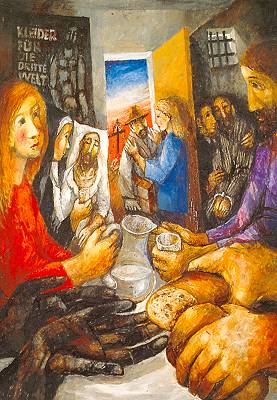
That was something that I experienced this weekend with a visitor to my chapel. That makes it all worth it, despite that I believe and do not believe at the same time and I will live with this tension and trust that the Jesus the Christ, God who took on the fullness of humanity for the life of the world will somehow understand.
Peace
Padre Steve+

 The Inglorius Padre Steve's World