Tag Archives: tunisia

Danger in the Arabian Gulf: The Fires of Protest Spread to Bahrain

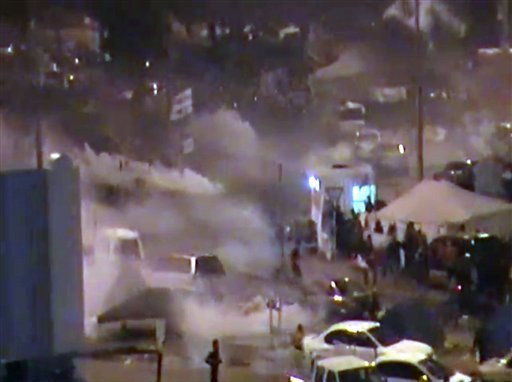
Protesters attacked in Bahrain (AP Photo)

It is weird when you see a place that you have been many times explode into massive protests, violence and potential revolution. That I have been to Bahrain many times and it is strange to see what is going on there. My first couple of times I was assigned to a ship, the cruiser USS HUE CITY on port calls while deployed in the Arabian Gulf. Later I would make frequent trips there as chaplain for the Marine Security Forces.

In the days following the downfall of Tunisia’s President Ben Ali and Egypt’s Hosni Mubarak the flames of revolution have spread across the Middle East. Protests have taken place in Yemen, Libya, Jordan and Bahrain and the situations have become violent as security forces attempted to put down the protests. Even Iran is beginning to boil over as protestors who feel cheated by the results of the contested 2009 elections rise up against the Iranian regime. However, the situation in Bahrain is the most troubling if one looks at the potential impact on US strategy in the Arabian Gulf and always tense situation with Iran.
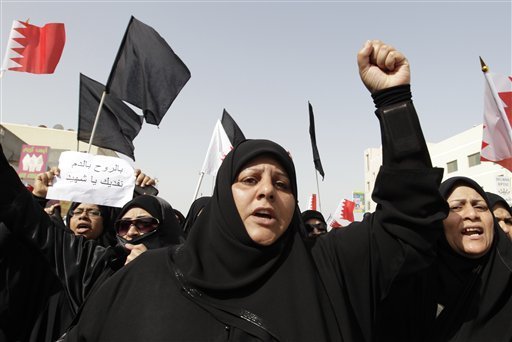
Bahraini Shia women with black flags. The Black flag is commonly flown in Shia neighborhoods and villages in Bahrain (AP Photo)

As I said before I have been to Bahrain many times. It is one of the most socially progressive countries in the Middle East and unlike most other Arab nation’s alcohol can be purchased in stores and not just upscale hotels that cater to foreigners, businessmen, military personnel and diplomats. It is a wealthy nation which though not prosperous as Qatar or the United Arab Emirates, Bahrain has managed to diversify its economy with a per capita income of $25,420.  It is a frequent vacation destination of many well off Saudis and has over 230,000 expats from other countries who call Bahrain home. According to a United Nations report Bahrain has 807,000 residents including the expats.

One thing that I remember about Bahrain is that the wealth is not very evenly divided. For the most part the Shia population is incredibly poor and their villages stand in stark contrast to the wealth of the Sunni. This is one of the biggest causes of the tensions which have brought about the protest movement which was ignited by the success of the revolts in Tunisia and Egypt.
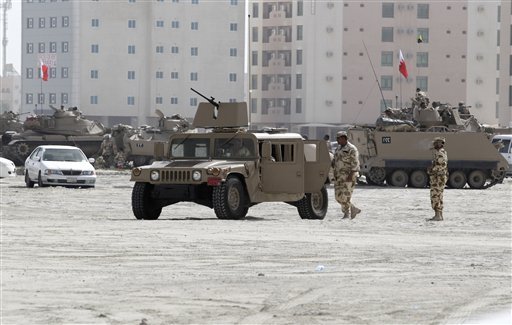
Bahrain Army units deployed in Manama (AP Photo)

The population of Bahrain is divided between the Sunni ruling class which comprises approximately 30% of the population and a less well off Shia population. The Khalifah family has ruled the country since driving out the Persians in 1783. It became a British protectorate in 1861 and the Kingdom attained its independence in 1971 and became a constitutional Monarchy in 2002 with some elected representatives.  The current King Sheikh Hamad bin Isa Al Khalifah is a graduate of Cambridge University and the U.S. Army Command and Staff College. He has reigned since March of 1999 when his father died.

Iran considers Bahrain a rebel province and is viewed as a threat by Bahrain has sought over the years to foment dissent in Shia community which believes that it is discriminated against by the Sunni rulers.
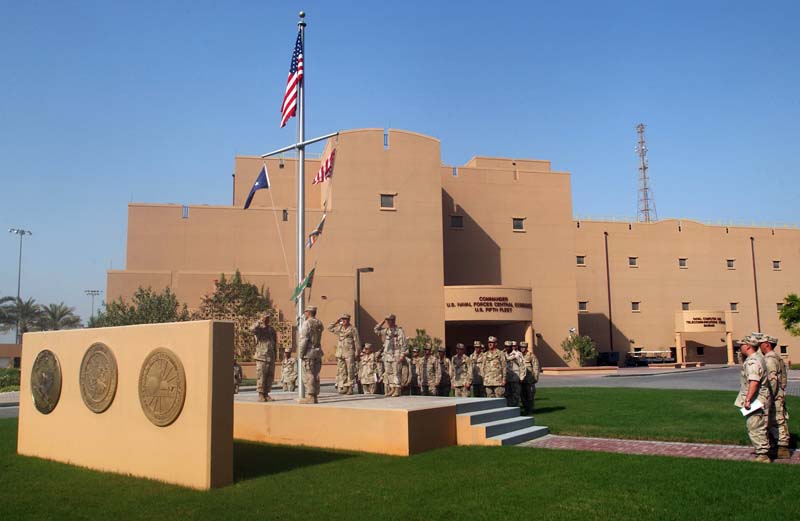
NAVCENT Headquarters in Bahrain (Navy Times Photo)

Bahrain is a vital part of the U.S. strategic presence in the region as a counter to the Iranian threat. It hosts the headquarters of the U.S. 5th Fleet, Naval Forces Central Command (NAVCENT) and Marine Forces Central Command (MARCENT). It is a frequent port of call for U.S. and Allied Navy ships that operate in the Arabian Gulf.  As such the current instability and violence is a matter of grave concern for the United States and its Allies in the Gulf.

As I said I have been to Bahrain numerous times in 2002, 2003, 2004, 2005 and 2006. I would stay in hotels with the best security which happened to be the 5 Star locations and dine at various Irish, British or Arab restaurants mostly with fellow Marine or Navy Officers or expats.  The difference between that world and the Shia villages and neighborhoods is amazing the contrast between the vast wealth of some and the absolute poverty of the other troubled me because I could see that it was a ticking time bomb. The Shia population also has limited political rights and is often targeted by the police.  They are certainly infiltrated by Iranian agents who I would guess are helping to stir things up.

The violence that has overtaken Bahrain does not surprise me. The Bahraini military is primarily composed of Sunnis from other Arab countries and has little love for the Shia. They are basically a mercenary force absolutely loyal to the government. There will be no Egyptian style coup in Bahrain. Since the population is small and the Army, police and other security forces wedded to the government I expect that the protests will be put down and that the regime will survive.  It will not be pretty and could well have an impact on U.S. Forces in Bahrain.

Back after 9/11 military dependents were sent home and force protection increased. A couple of years ago dependants were allowed back in but I think that we will see them extracted again. The security forces at the base are robust and work closely with the Bahraini security forces. I would expect that whatever Marine Expeditionary Unit is in theater will be on alert and that additional Fleet Anti-Terrorism Security Teams could be flown in to reinforce the base.

The broader ramifications of a continued violent crackdown on the protestors will be felt throughout the region. With the success of the Tunisian and Egyptian revolts people in many parts of the Arab World are now boiling over as protests and revolts against the old authoritarian regimes spread. As the situation continues to build I expect the probability of more regimes being overthrown with very unpredictable consequences. What may be true for Egypt may not be true anywhere else. What is for sure is that the Middle East that existed in December will look far different by the end of this year and that could be a good thing or a bad thing depending on just how it all shakes out and the possible impact on American and NATO operations in the region as well as impact on American overseas counter-terrorism operations especially in Yemen.

We can only wait and see and hopefully influence peaceful and democratic change in the area, but revolutions in countries that repress their populations tend not to be peaceful.  Egypt so far is an exception to that. If you believe in prayer I recommend that we pray hard my friends.

Peace

Padre Steve+
 

11 Comments

Filed under Foreign Policy, History, Military, national security

The Beginning of Chaos in Egypt: Watching and Waiting as the Situation Deteriorates

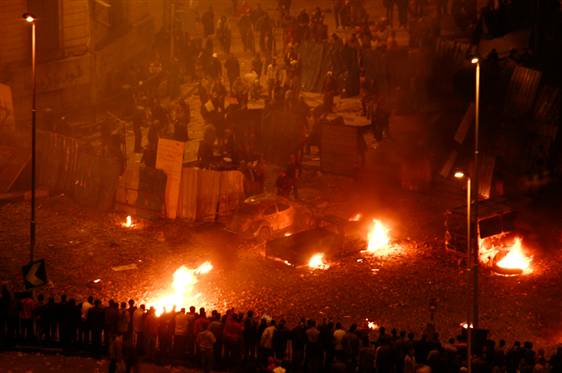
Battle Lines in Tahrir Square (Yanis Behrakis -Reuters via MSNBC)

Today violent street clashes broke out in Cairo’s Tahrir Square. Following President Hosni Mubarak’s pledge not to run for the Presidency again but remain in office until September and the opposition’s denunciation of that move as too little too late Tuesday night pro-Mubarak groups entered the fray. Men on camels and horses swept into the square during the afternoon whipping and clubbing anti-Mubarak protesters as they stormed through the crowd.  Reporters were attacked and as evening came the clashes became more violent as the pro-Mubarak supports began to throw Molotov Cocktails at the demonstrators. The Army did appear to attempt to make some efforts to separate the groups and fired tear gas to disperse the crowds but did little else. The scene was remarkably different from Tuesday when the protesters calling for Mubarak to step down did so in a peaceful manner unmolested by the Army units in the square.  The Egyptian military has aired television spots asking all of the protesters to “go home for the love of Egypt.”

Although the images shown on our television sets conjure the worst and appear to the country devolving into chaotic violence with unpredictable consequences. The fact is mystery shrouds developments outside the view of the cameras surrounding Tahrir Square. We are unaware of what is transpiring inside the government or the military. We are unsure about the extent of Egypt’s government or ruling party’s involvement in today’s counter demonstrations, some reports are that some at least were ordered in from government jobs.  The only thing that we can safely assume is that unless some kind of resolution acceptable to both sides arises the situation could get dramatically worse and imperil the success of any government that replaces the Mubarak regime whether he steps down in the next few weeks or holds on until September.

Regardless of the outcome Egypt and possibly much of the Arab World is at a turning point. Authoritarian regimes as different as that of Muammar Ghadaffi and Saudi Arabian King Abdullah have condemned the Egyptian uprisings as well as that which overthrew Ben Ali in Tunisia.  They know that the dynamics at work in Egypt, unemployment, poverty and political repression are shared to one degree or another in much of the Arab World, the common factor repressive authoritarian regimes which to many lack legitimacy.  Rulers in Jordan and Yemen have already seen demonstrations and Jordan’s king has fired his government apparently to get ahead of the protests and Yemen’s ruler has pledged to step down at the end of his term in 2014.  Leaders of other Arab nations cast a wary eye on Egypt and their own opposition groups.

The Egyptian revolution will more than likely not result in fundamentalist Islam dominated state due to the unpopularity of such regimes as the Taliban and Iran in the Arab World. At the same time while Islamists are not leading the revolution in Egypt they are an important part of the Egyptian political landscape and must be taken into account.  I would think that if the violence subsides and a peaceful orderly transition takes place that a government similar to Turkey, probably not led by a religious party could be the best result. Such a government would likely not be as close to the United States as Mubarak but probably remain an ally and not an active enemy of Israel as it seeks its own economic growth and stability to reinforce its pivotal role in the Arab World.  However there is no guarantee of this outcome.

The worst outcome would be continued violence that leads to a radicalized country led by more extreme members of the Muslim Brotherhood, some of whom have called the Egyptian people to prepare for war against Israel.  Unfortunately unlike the older generation of Egyptians the new generation has not experienced war and war’s desolation. The older generation was at war with Israel for nearly 40 years suffering defeat after defeat.  In 1967 they lost control of the Suez Canal and the income derived from it in the 6 Day War and in 1973 after successfully crossing the canal and inflicting heavy casualties on the previously invincible Israelis had the tables turned on them. An Israeli Army after driving off the Syrians in a desperate battle on the Golan Heights and advancing deep into that country crossed the Suez Canal, surrounded an Egyptian Army on the far side of the canal, lay siege to Suez and were poised to drive to Cairo saved only by a cease fire brokered by Henry Kissinger and the United Nations. The war nearly brought the Soviet Union and the United States into nuclear conflict when the Soviets marshaled Airborne divisions to intervene and President Nixon raised the DEFCOM from 4 to 3. I remember talking to Egyptian officers, veterans of the wars with Israel when I was a student at an Army school in 1983, they talked of sacrifice and the brutality of war and the effects of the war on their country.  One simply said “I do not like Israel but I am tired of war and I do not want it for my children.”  Since Camp David Egypt has had all of its territory in the Sinai returned was able to reopen the Suez Canal.  Another war between Egypt and Israel would devastate both countries and for that matter not be contained.  A radicalized government set on such a course would be an unmitigated disaster for Egypt, Israel and the world.

While we watch Egypt protests are about to begin in Yemen with a “day of rage” scheduled for Thursday with demonstrations planned in Syria and Jordan Friday and Saturday and even Bahrain on February 14th. Expect such demonstrations as the old guard of the Arab World experiences the long suppressed rage of their people which is now spread in seconds through the power of the social media.  Meanwhile radicals in Iran, Al Qaeda and as well as other radicals and terrorist groups wait to take advantage. Yemen which has a strongly entrenched Al Qaeda organization and sits astride the strategically important Bab-el-Mendeb passage at the south end of the Red Sea is a country that is a prime target of these radicals and terrorists.  All the other countries for different reasons are important to the stability of the Middle East.

Today’s protests in Tahrir Square killed three and wounded over 600.

We can only watch and wait….and pray as these events develop.

Peace

Padre Steve+


2 Comments

Filed under Foreign Policy, History, national security, Political Commentary

Walk Like an Egyptian: The Egyptian Revolution and the Radicalization of the Middle East

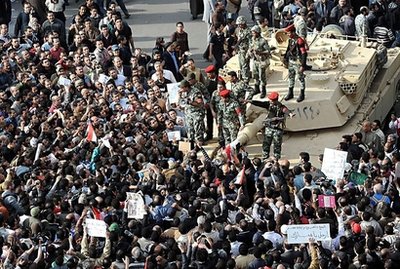
Egyptian Protesters with Army Soldiers (AFP Photo)

As Egypt goes so goes the Arab World. Egypt is the leader of the Arab World, the largest country and the country with the most powerful military, a developing educated class and one of the most strategically located countries in the world. Much of the world’s shipping passes the Suez Canal and the Egyptian peace treaty with Israel and cooperation with Israel on security issues has resulted in the most secure parts of the Middle East for decades.  The United States and the West count Egypt is their key ally in the Arab World but now the world trembles at the revolution going on in Egypt because of the uncertain and potentially destabilizing potential in the Middle East and the world.

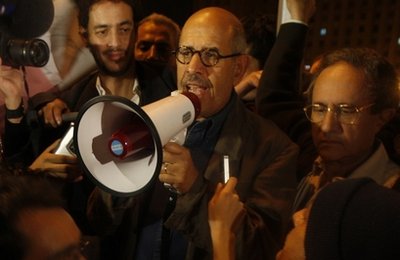
Mohamed El Baradei (AFP Photo)

Egyptian President Hosni Mubarak had ruled Egypt under emergency conditions since the assassination of President Anwar Sadat in 1981 by military members loyal to the Muslim Brotherhood.  Mubarak has continued Sadat’s policies and been a strong ally of the United States and frequently has mediated for Israel in the Arab World.  He has been a stabilizing influence in the Middle East but has ruled as a dictator for all practical purposes since.  Mubarak dissolved his government and appointed a Vice President for the first time during his rule. He has steadfastly refused to step down.

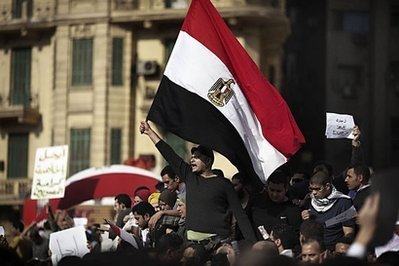
Protesters (AFP Photo)

Conditions in Egypt include extremely high unemployment, poverty and social services which are insufficient at best and in many locations non-existent. Discontent has been simmering for years with Egyptian Police and internal security forces keeping a tight lid on dissent. The military however is the most trusted and respected institution in Egypt as it has kept a distance between it and internal security matters. The Police on the other hand are viewed as corrupt and brutal.

Matters have blown up in ways that few anticipated in the past week and it all began in Tunisia, a country on the fringe of the Arab World. Within a week of a popular overthrow of their President the flames of change were rolling across the Arab World, Yemen, Jordan and Egypt. Popular uprisings in key Arab countries led in many cases by educated pro-Western moderate professionals using social media such as Facebook and Twitter.

As of now we are unsure of exactly what will happen. However Egypt is the key. The protests now have an internationally respected leader, the Nobel Laureate former head of the United Nations Nuclear Inspection agency Mohamed El Baradei.  El Baradei has called on the United States to support the Egyptian people and says that he has the mandate to form a national unity government and reached out to the Egyptian military which is important for the stability and security of any new government.

The demonstrations have grown in intensity and the Army had taken the place of the police on the streets to the cheers of demonstrators.  While this is happening there is a surge of looting and vandalism and individuals as well as communities are taking their security on themselves with no police on the streets to do so.

With the situation on the ground continuing to get worse the United States will have to act in support of the protestors or see its influence in whatever kind of government and with the Egyptian people dissipate.  The best outcome would be an orderly transition of power to some kind of national unity government headed by pro-Western leaders such as El Baradei.  Unless such a transition takes place the chances of the uprising to become radicalized under the domination of the long suppressed Muslim Brotherhood is a real possibility.  The key right now is the Egyptian military, respected at home and trusted it is closely linked to the United States in many ways.

We do not know how this will end and chances of it ending badly are as great as or greater than in 1979 when the Islamic Revolution overthrew the Shah of Iran and the subsequent moderate government. At least there is no Khomeini like figure ready to seize the moment and lead the country into an Iranian style revolution.  The Muslim Brotherhood has been under wraps for many years and though a fundamentalist movement is populated with professional people and not clerics and it publically renounced violence years ago. One can only hope that El Baradei and the military can lead the Egypt on a democratic and peaceful course and that Hosni Mubarak will ensure that the transition is peaceful.

Lord help us all.

Peace,

Padre Steve+


1 Comment

Filed under Foreign Policy, national security