Tag Archives: zealots

Trouble in River City the Centurion’s Easter: An Empty Tomb, Duplicitous Politicians and a Lingering Question

What springs from earth dissolves to earth again, and heaven-born things fly to their native seat.
Marcus Aurelius 

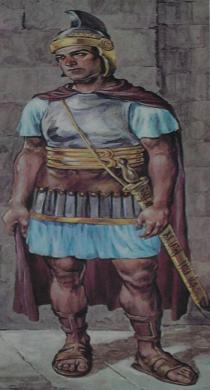
The pounding on his door awakened Longinus before he expected on this day after the Jewish Passover. He was hoping perhaps beyond hope that the worst was over and that in a few days he could take his soldiers back to the confines of Caesarea and away from the troubled city of Jerusalem. He was tired of this duty and longed for service with a real Legion with real Roman soldiers. He wiped the sleep from his eyes and went to the door of his quarters in Fortress Antonia.  He opened the door to find his Adjutant Marcus with a look of near panic on his face.

He asked the young officer to come into his quarters and take a seat at his table. He took a wineskin and poured the contents into two cups. He asked Marcus what was so urgent and frightening that he had to be at his quarters well before the duty day began. The young man took off his helmet to reveal a crop of blondish brown hair common to the Tyrol in the northern part of Italy and told an almost unbelievable story. He explained that there was trouble at the tomb of the itinerant preacher named Jesus. The two guards from their unit who had relieved the previous watch at the tomb had evidently fallen asleep and there had been a break in.  They claimed that they had been overcome when some kind of angelic being who had descended in front of them and some of the women who had been at the execution site previously.  The story seemed preposterous but Longinus could not believe that they had fallen asleep on duty either as such could be punished by a death sentence.  Adding to the confusion was a report that two of the preacher’s “disciples” had reportedly entered the tomb and claimed that the body was gone as had some of the women that had been there at the crucifixion.  It was unbelievable but yet in light of the strangeness of the man and his execution.  Longinus had the Adjutant bring the two soldiers to him along with the Sergeant of the Guard to explain what had happened.

The two soldiers, one a Samaritan and the other a Greek had good reputations in the unit. Neither had given him cause for concern and the terrified expression on their faces as they explained what happened gave Longinus reason to believe them. Yes it was possible that they were lying but Longinus believed their story. I found that not to believe them and their story that they heard the angel or whatever it was tell the women that the preacher had been raised from the dead. Longinus was not much of a believer in miracles angels or any sort of magic hocus pocus purveyed by seers, magicians or fortune tellers but here he was believing this outlandish story because to disbelieve would mean that there was a serious breakdown of discipline by two outstanding soldiers. He had some soldiers that he wouldn’t believe for an Athenian minute if they told him such a tale but he believed these men and he again thought of his words as the preacher hung dying on the cross on that evil hill.

Longinus went to Pilate’s headquarters when he and the other Centurions were participants in a meeting with the High Priest and his representatives and two of Herod’s people.  The meeting reminded him of a meeting of criminals.  The High Priest and his representatives were livid and Herod’s henchmen voiced their displeasure regarding the lapse of the Roman soldiers that allowed this to happen. Longinus spoke for his men and said that as improbable as it was that he believed their story. That only made the non-Romans angrier; he almost thought that they were engaging Pilate in some histrionic episode in order to force Pilate to do their bidding. They insisted that Longinus’ soldiers had to have fallen asleep and or that they had conspired with the preacher’s followers to remove the body from the tomb. This angered Longinus to the point that he interrupted their ranting to defend his men’s honor. Pilate finally ordered Longinus and the High Priest to be silent.  He asked the non-Romans to step outside while he conferred with Longinus and the other Centurions.

Pilate explained his dilemma. He was afraid that if he sent the High Priest away by supporting his soldiers that there would be a revolt in the streets. He had seen the tumult on the streets by the supporters of the High Priest when he tried to release the “King of the Jews” and felt that this would be worse for security. He advised the Centurions that while he had no reason to doubt them or their men that he had to placate the High Priest and Herod in order to avoid chaos, chaos that could lose him his job if he wasn’t careful. Likewise he did not feel that he had the manpower in the city to handle a full-fledged revolt and that he would have to call for reinforcements from the Legions based in Syria, something that he was loathe to do as this would get back to the Emperor.

Longinus thought back to the day of the execution.  Pilate had agreed to place a guard at the tomb at the urging of the High Council. Longinus had argued against placing any soldiers at the tomb as he felt that since the “King of the Jews” them man that he had called the “son of God” was dead that Rome’s obligation was over. The whole thing reeked of politics, Longinus was overruled by Pilate who explained that Roman soldiers needed to guard the tomb because the High Priest who Longinus detested as much as Pilate insisted that Jesus’ followers would attempt to steal the body and claim that he had been raised from the dead to lead a revolt against the Council and eventually Rome itself.  Added to the Judean witches’ cauldron was Herod, the corpulent and corrupt “King” of Judea.  If Longinus detested Pilate and Caiaphas he hated Herod and all that he stood for, it made him wonder why Roman lives and treasure were spent to solve the problems of this God-forsaken land which he believed would still be trouble two millennia from now if the world lasted that long. Longinus believed that as long as Rome allowed the High Council and Herod to rule the region by proxy that the troubles would never end. He believed that it was only a matter of time before these people, led by the Zealots would revolt as they had against the Seleucids nearly 200 years before. He knew if that happened that Rome would crush the revolt and not leave as much as a house standing.  He hated this occupation and all that it stood for, especially when he saw a good man, an innocent man killed for no good reason other than the politics of it all. It sickened him.

When he was done explaining his decision to Longinus and the other Centurions he called the now quite irate non-Romans back into the proceedings.  He told the High Priest and Herod’s men that he would disciple the soldiers involved and he would assist them in finding just what parties removed the body from the tomb.  In the mean time he would suppress any stories coming from the soldiers about this supposed “resurrection.”  The High Priest and Herod’s men agreed that this would suffice and thanked Pilate for his time and effort. Longinus and the other Centurions quietly seethed as this took place. When the non-Roman parties had left Pilate ensured the officers that no action would be taken against the men and that he would not actively assist the Jews in trying to find the perpetrators of the event. He then let the officer know that they would remain in Jerusalem for another week to allow the multitude of pilgrims to leave the city and then they would return to Caesarea.

Longinus left with the others and met his Adjutant and stepped into the court of the fortress. He was very unhappy with the deal that Pilate made with the High Priest and Herod.  He felt that he had dishonored his soldiers and the unit for the sake of political expediency. He felt ashamed of the Empire for what Pilate had done in cooperating with these people from beginning to end during this affair. He would not forget.

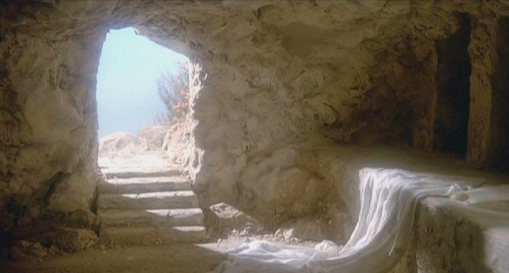
That night he felt compelled to walk to the empty tomb.  In the darkness he looked into the sepulcher aided by a lantern. He saw the grave cloths where they remained; the large stone was rolled away and the seal that had been placed on it was broken.  He looked for any evidence to suggest that his soldiers had fallen asleep but could not find any.  Nor did he see how anyone could have stolen the body and gotten very far without being seen by anyone. Convinced by what he saw he set down in the tomb and thought about this man.  He looked at ground where the body had been placed.  In the dim light he noticed what appeared to be some thorns.  He reached down He would have to find out more about him if he truly was the son of God.
He walked back to the fortress when he went to the Officer’s Mess and had the steward pour him some wine. He drank quite a few before the evening was out and then went to his quarters where he lay down exhausted and perplexed by the events of the past few days.

Peace

Padre Steve+
1 Comment

Filed under faith, History, Religion

Star Trek God and Me: Ecclesiastical Tyranny Today, the Drumhead Revisited

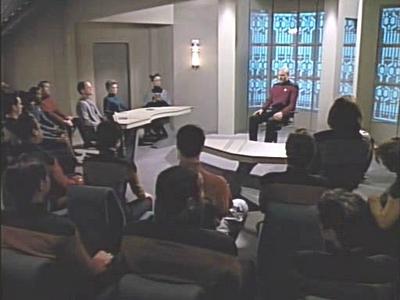
Picard being interrogated by Satie and her assistants (Paramount Pictures)

We think we’ve come so far. Torture of heretics, burning of witches it’s all ancient history. Then – before you can blink an eye – suddenly it threatens to start all over again. Captain Lean Luc Picard (Patrick Stewart) Star Trek the Next Generation “The Drumhead”

Back in May of 2009 when still struggling with faith, belief and God as I wrestled with PTSD and a number of other life issues I wrote an article entitled Star Trek, God and Me 1966 to 2009 . At the time I was pretty much a mess but as I wrote it I realized that all of life is connected and my Christian faith does not occur in a void that has no connection with the rest of life. It is this rediscovery of the reality of faith that helps guide me now. I make no claims to be correct on everything and I am much more apt to err on the side of grace, although I have a lot of difficulty with those that use the Christian faith as a weapon to subjugate others and to deny civil and religious rights and human dignity to those that believe differently than they do.  This is why I write today.

I remember as a teenager going to a pretty conservative church which in many ways was basically an evangelical Christian subculture that looked out at the world as if it were the enemy and “non-Christians” as if they were lesser people because they were not “saved.”  In fact if you mentioned that you knew someone that was not a member of the church people almost invariably would ask if the person was “saved.”  This subcultural attitude which is actually quite prejudicial even if it is well intentioned pervades much of contemporary Evangelicalism and when some Evangelical leaders suggest dialogue and relationships with the “unsaved” which are respectful to non-Christians they are often labeled as “liberals” or “heretics.”

This has happened to me in the past couple of years since returning from Iraq and having to leave the Church that I served for 14 years as a Priest and Canon.  I wrote an article called Faith Journey’s: Why I am Still a Christian in September of 2010 which detailed the journey that I have been on. When I left the church I wrote another article that was picked up on another blog which was entitled The Church Maintained in Love: Maintaining Integrity and Preserving Relationships When Asked to Leave a Church.  A number of people made comments on that article either positive or handled with grace and love but one anonymous person posted a comment which showed the extreme ugliness of some “Christian” conservatives who are quite willing to use character assassination, sound bites and absolute lies to smear another Christian brother who happens to disagree with them.  The moderator of that blog took down the comment because it was so off base and offered his apologies to me having been a target of people in our former church when he left years ago. Though the post was anonymous it had to be someone that knew me because it was very personal couched in “religious piety” but filled with lies and distortions. So much for Christian love….

But back to the Star Trek theme which believe it or not weaves its way through this saga. It seems to me that a lot of Christians talk big but act like they are afraid of the big bad world and if criticized fall into the litany of how bad things are, how the world hates Christians and hunker down into a fortress mentality.  Others keep the fortress but decide that it is high time that they as Christians “kick some liberal ass” and declare “war” on those not like them.  Some couch this in more moderate terms but others like the bomb-throwing activist Randall Terry show the dark side of this mentality:

“Let a wave of intolerance wash over you. I want you to let a wave of hatred wash over you. Yes, hate is good…. If a Christian voted for Clinton, he sinned against God. It’s that simple…. Our goal is a Christian Nation… we have a biblical duty, we are called by God to conquer this country. We don’t want equal time. We don’t want Pluralism. We want theocracy. Theocracy means God rules. I’ve got a hot flash. God rules.”  [Randall Terry, Head of Operation Rescue, from The News Sentinel, Fort Wayne, Indiana, Aug 15, 1993]

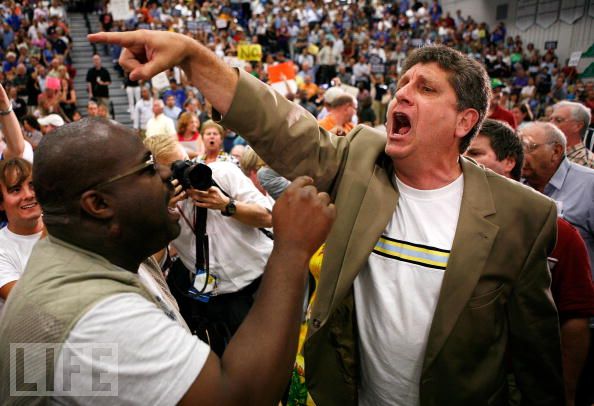
“Let a wave of intolerance wash over you. I want you to let a wave of hatred wash over you. Yes, hate is good…” The continued twisted “Christian”  message of Randall Terry (Life Magazine)


The quote is nearly 18 years old but the attitude is quite common today as “Christians” gird themselves for war.  If you ask me the attitude is not Christian at all, but something out of the Middle Eastern mindset of the Old Testament which found its way into some parts of the Christian faith especially the Calvinism espoused by the Puritans who initially settled New England which is used as a pattern by Christian “Reconstructionists” and others of similar thinking. It seems to me to represent all that Jesus condemned many of his religious contemporaries for doing.  Jesus preached the Kingdom of God was at hand and for people to repent, however his harshest warnings and condemnations came not on the people that the religious considered the “unsaved” the Gentiles, prostitutes, tax collectors and other sinners but at the smug religious people that ruled that ruled their countrymen with a religious law often more draconian than that of the oppressive Romans especially in the way that it treated others outside the fold.

The attitude is actually quite poisonous when you look at it in light of history and the effect that such an approach to life and others.  I can go to historic examples galore since we as Christians often have a sordid record when it comes to treating those that Christ gave his life for with any kind of love, charity or compassion often engaging in wars, pogroms, persecution, the Inquisition and state/church sanctioned mass murder even against fellow Christians that don’t agree with are particular line of thought.  But if I do that it strikes some as if I am trying to be unfair, so I will go to a Star Trek example which I used a while back in another post on a different subject but it fits.

The example comes from the Star Trek TNG episode called “The Drumhead” The episode involves a suspected case of sabotage and spying on the Enterprise and a retired Admiral is sent to investigate. Though evidence leads away from this conclusion the Admiral and her aid drive home the point and widen the investigation for any suspicious acts. Soon the loyalty of anyone that raises a voice to question the premise of the investigation is suspect to include the Captain, Jean Luc Picard.

The Admiral is a true believer in the Federation, actually a Zealot who describes a life that is quite similar to modern Zealots of religious and non-religious varieties in conservative and liberal thought in this and other countries. Zealots tend to surround themselves with others like them and often live lonely isolated existences in which they are on a mission to make sure that the edicts of their faith are obeyed and enforced by whatever religious or governmental structures will accommodate them.  Admiral Satie, the investigator details her life to Picard: “Captain, may I tell you how I spent the past four years? From planet to starbase to planet. I have no home. I live on starships and shuttlecraft. I haven’t seen a family member in years. I have no friends. But I have a purpose. My father taught me from the time I was a little girl still clutching a blanket, that the United Federation of Planets is the most remarkable institution ever conceived. And it is my cause to make sure that this… extraordinary union be preserved.” Simply substitute the “United States of America” or “Christianity” for the United Federation of Planets and the picture paints a picture of us today.

After a lengthy opening the Admiral throws this at Picard: “I question your actions, Captain; I question your choices, I question your loyalty!”

Picard dares to reply with a quote from the Admiral’s father, a noted jurist: “You know, there are some words I’ve known since I was a schoolboy: “With the first link, the chain is forged. The first speech censured, the first thought forbidden, the first freedom denied, chains us all irrevocably.” Those words were uttered by Judge Aaron Satie, as wisdom and warning. The first time any man’s freedom is trodden on, we’re all damaged. I fear that today…”

The Admiral becomes furious and turns her wrath against Picard: “How dare you! You who consort with Romulans, invoke my father’s name to support your traitorous arguments! It is an offense to everything I hold dear! And to hear those words used to subvert the United Federation of Planets. My father was a great man! His name stands for integrity and principle. You dirty his name when you speak it! He loved the Federation. But you, Captain, corrupt it. You undermine our very way of life. I will expose you for what you are. I’ve brought down bigger men than you, Picard!”

One only has to look at other Zealots of the Reconstructionist theology to see where this is going: Gary North one of the long time leaders of this movement said: “So let us be blunt about it: We must use the doctrine of religious liberty to gain independence for Christian schools until we train up a generation of people who know that there is no religious neutrality, no neutral law, no neutral education, and no neutral civil government. Then they will be get busy in constructing a Bible-based social, political and religious order which finally denies the religious liberty of the enemies of God.” –Gary North, “The Intellectual Schizophrenia of the New Christian Right” in Christianity and Civilization: The Failure of the American Baptist Culture, No. 1 (Spring, 1982), p. 25

Another important leader of the Christian right noted “We are engaged in a social, political, and cultural war. There’s a lot of talk in America about pluralism. But the bottom line is somebody’s values will prevail. And the winner gets the right to teach our children what to believe.” — Gary Bauer, Family Research Council.

Unfortunately the leaders of this particular view of Christianity are not much different than the fictitious Admiral Satie and I do expect that their crusade will not be done anytime soon.  I know the character of such people having been their target.  Based on the words of my critic who totally twisted what I said and believe in this pejorative and frankly distorted screed:

From his writings on his blog, it’s quite clear that he is the one who’s taking a new direction away from Scripture and the ancient faith, which is the basis for his departure. Fr. Steve has changed his beliefs to now accept women priests, gay “saints”, Muslim “saints”, etc. I might call the acceptance of women priests “liberal”, but the other two are really just heresy – though I’m certain many (particularly Catholic and Orthodox) readers would lump women priests into the heresy category as well. Didn’t Jesus really die on the Cross to reconcile us to God teaching us that He is the only way to the Father? Yet Fr. Steve now believes that it was unnecessary for Jesus to atone for our sins as even Muslims can obtain Heaven without the Cross. And hasn’t God repeatedly taught us throughout Scripture that homosexual sex is condemned as an abomination. Yet Fr Steve now believes God didn’t really say that at all and that gay sex is okay with God….I will pray for Fr. Steve, that the Holy Spirit will reveal the Truth to him and bring him back to the true faith whether that’s with the CEC or another communion.”

The person that wrote this was anonymous and posed as an administrator on the other site using the name “admin.” What bothers me is the disingenuousness of the statement and the manner in which my beliefs were twisted to include implying that I had denied the “true faith” were bandied about by this person who as I said had to know me especially since my former church is a very small communion which has been shrinking for years due to its own internal problems. I have my suspicions of who the writer might be but cannot prove it beyond a doubt and the fact that he hid his identity is telling, only cowards that have no honor make such attacks from the shadows rather than speaking to a brother in person as the words of Scripture command.

The sad thing is that everything that I wrote is backed by the teachings of the Catholic Church and the Second Vatican Council and I never denied the Creeds, Councils and my Scriptural hermeneutics (not the way they were twisted) were within the bounds of the Christian faith in belief that the love and grace of God triumph over sin and unbelief and that we cannot earn that grace.  But according to my critic I am an apostate who has left the faith and my words are twisted beyond belief to “prove” his point.  This is the kind of person that uses the Creeds and Scripture not as means to faith and expressions of a living faith based on the mercy grace and love of God but as means of ecclesiastical control, not much different from that of the Medieval Catholic Church which I am sure that he would condemn since he refuses to be reconciled to Rome. It is funny to be criticized as a heretic by someone who would qualify as such if judged he were by Rome or even Orthodoxy.

Randall Terry, Gary Bauer, my anonymous critic and others represent the nature of the Admiral Satie in our universe and time-space continuum as opposed to the hypothetical future of Star Trek.  Just watch their behavior in the coming months and years. The war is afoot and woe betides anyone that stands in their way.  At the end of the Drumhead episode when Satie’s and her investigation are discredited Captain Picard and his Security Chief Lieutenant Worf a Klingon, gives us final word of warning about the Satie’s of this world:

Lieutenant Worf: [referring to Admiral Satie] I think… after yesterday, people will not be so ready to trust her.

Captain Jean-Luc Picard: Maybe. But she, or someone like her, will always be with us, waiting for the right climate in which to flourish, spreading fear in the name of righteousness. Vigilance, Mister Worf – that is the price we have to continually pay.

I guess that is why God still speaks to me through Star Trek; sometimes the words are pretty prophetic and speak to us in ways that those who loudly proclaim themselves to be on God’s side in a social, political and cultural war ever will.

Peace

Padre Steve+

8 Comments

Filed under christian life, faith, philosophy, Political Commentary, Religion, star trek