

The wreck of the giant cruise liner Costa Concordia could be in danger of sinking deeper into the sea off of Giglio Island or even breaking up. As of the moment the Italian authorities are still calling the operation a rescue operation but that could change to a salvage operation in the coming days.
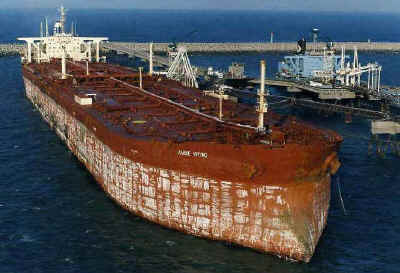
The Salvaged Seawise Giant
Provided that the wreck stays intact and does not sink in deeper water the chance of salvaging the ship will be immense. It will not be an easy task. Only one ship larger than Concordia has been salvaged, the massive oil tanker Seawise Giant which was sunk in very shallow water off of Kharg Island Iran during the Iran-Iraq war. That ship was only salvageable because she was intact and in the placid shallow waters of the Persian Gulf.
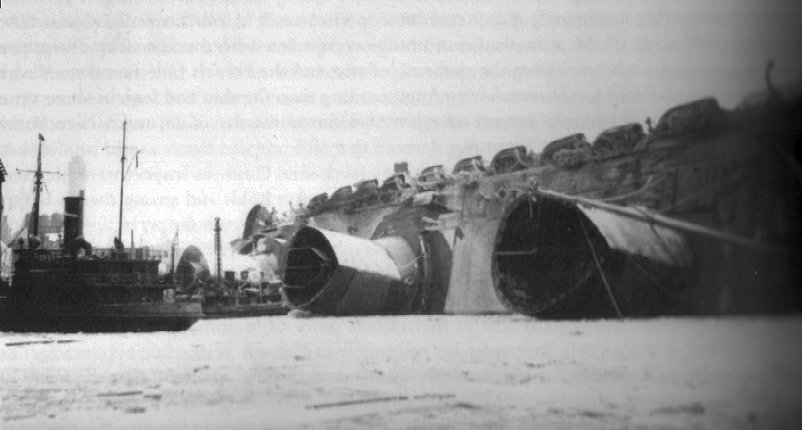
Wreck of the ex SS Normandie
The other ships successfully salvaged and returned to service were the US Navy Battleships USS West Virginia and USS California which were sunk at Pearl Harbor. Both ships had settled upright in the shallow and calm waters of Pearl Harbor. The battleship Oklahoma which capsized was refloated but never returned to service. Other large ships have been salvaged but not returned to service, the great French liner Normandie which burned and sank pier side in New York Harbor was raised but the damage caused by the fire made her not economical to put repair and put back into service. The battleships and battle cruisers of the German High Seas Fleet were salvaged over a period of nearly 20 years following the “Great Scuttle” following the signing of the Treaty of Versailles in a remarkable operation at Scapa Flow. Many were difficult to salvage and although all were scrapped the fact that they were raised was engineering triumph.

Raising the USS Oklahoma
One thing that works against a successful salvage operation is the fact that she is on her side and perched atop a number of rocks fully exposed to wind and waves. Ships, especially merchant ships which are more lightly built than the great battleships do not tend to hold up well when in such a position. They tend to get battered and break up due to the great stress put on their hulls which they were not designed to endure.

Drawings of High Seas Fleet wrecks at Scapa Flow
Those trying to save the Costa Concordia will first need to ensure that she does not sink into deeper water or break up. If they can do that they will then need to remove her fuel and other hazardous materials. Once that is completed the massive gash in the hull will need to be repaired and and the hull checked for other damage. Then she will have to be successfully righted and pumped out. This will not be easy, every step will have to be carefully done to ensure that they salvers do not want her to sink again. Working against them will be the forces of nature, wind, tides and waves. These factors will complicate any salvage efforts and it is entirely possible that the wreck will need to be scrapped in place.
The immediate concern is the search for survivors and next the avoidance of an environmental disaster should the ships diesel fuel leak into the ocean and preventing the ship from sinking into deeper water or breaking up. Only then will it be possible to begin salvage operations. From a technical perspective it is interesting to think about just how the massive ship will be raised.
Peace
Padre Steve+

 The Inglorius Padre Steve's World
A large part of the problem is she is not in a harbour or port. All salvaging gear will need to be brought to her. I think a “salvage in place”, basically stripping her of lightweight valuable items, will be the most likely – once all the fuel has been removed from her. She does have 4 other sisters, so the cruise lines could reuse the fittings as repair/replacement parts. Other than that, I don’t see much chance of righting and reusing her. They might even purposefully sink her after salving what they can, as an artificial reef and draw for sport divers. (And maybe a reminder to other potentially careless captains!)
John
I think you well could be right. I think the chances of successful salvage become less possible every day that she is exposed to the wind, waves and tides. The forces of nature will likely pummel her hull. I think they will salvage whatever possible but the hull may have to be scrapped in place.
Blessings my friend
Steve+
I believe the ship can be salvaged as follows: First, patch the port side hull damage. It appears feasible then to secure the wreck to the island by way of cables and anchors secured to the rock then wrapped around the hull at the normal water line and secured to the port side. This will assist in preventing the hull from moving away from the island and into deeper water and is the axis by which the ship will be rotated. Next run cables through the superstructure at the promenade deck level at three places (where the elevator passages are located. Float then sink three huge separate pontoons under the starboard superstructure and secure them to the cross hull cables. These cross hull cables will eventually be secured to vessels out to sea. Also attach the pontoons together along their length. In addition secure the pontoons to the hull by cables under the hull and secured to the port side. The pontoons will tend to shift upward when pumped full of air so the cables will make sure they remain against the starboard side hull. The ship will then rotate as the pontoons are filled with air. The island cables will make sure the pontoons don’t just push the ship out to sea. The water trapped in the superstructure will spill out through the many openings above the promenade deck as deck after deck rises above the water surface. Finally, as the promenade deck rises to the surface of the water on the starboard side, pumping of the hull can begin. If there is no starboard hull damage (from the grounding maneuver), the hull can be pumped and ship floated. If there is damage, the pontoons can be the way the ship remains almost upright until moved to deeper water and the remaining hull damage repaired.
Dale
It may be possible to refloat her and if she was on a flat bottom and in protected waters I would say that your description would be very doable. It would also be the largest salvage operation ever attempted. It is also very possible that she will either break up or sink further making any attempt at recovery more difficult. the winds and currents will do more damage and every time that she shifts her starboard side will insure damage that will not be easy to repair. I do hope that she can be salvaged and that there will not be an environmental catastrophe to add too an all too tragic outcome. Thanks for your comments and please come back again.
Peace
Padre Steve+
The damage to the ship internally must be staggering. The engineering spaces, propusion, the hundreds of miles of electrical wiring, environmental systems, the wrecked electronics throughout, not to mention the interior passenger ammenities, all ruined. it would seem that LLoyd,s would write it off and salvage what can be salvaged. If made environmentaly safe, the wreck would make a marvelous dive attraction.