Monthly Archives: December 2018

American Dreadnoughts: The Remarkable Battleships of Pearl Harbor

Friends of Padre Steve’s World,

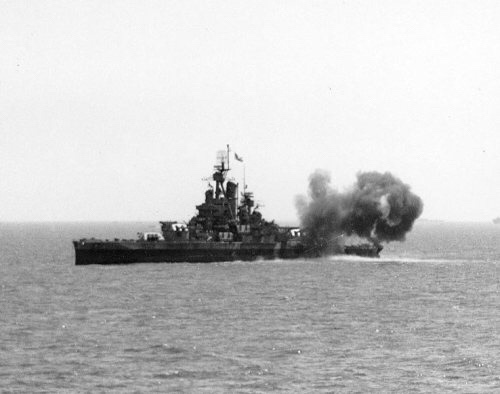
We are coming up on the 77th anniversary of the Japanese attack on Pearl Harbor. It is hard to believe that the attack occurred so long ago. The survivors are aging, and even the youngest are close to ninety years old, the oldest survivor of the USS Arizona, Joe Langdell died in February of 2015. At the time of the attack he was a nearly commissioned Ensign. He and many like him served as the officers and men aboard the eight great battleships moored at Pearl Harbor on that terrible Sunday morning.

The next day President Franklin Roosevelt spoke these immortal words, “Yesterday, Dec. 7, 1941 – a date which will live in infamy – the United States of America was suddenly and deliberately attacked by naval and air forces of the Empire of Japan….

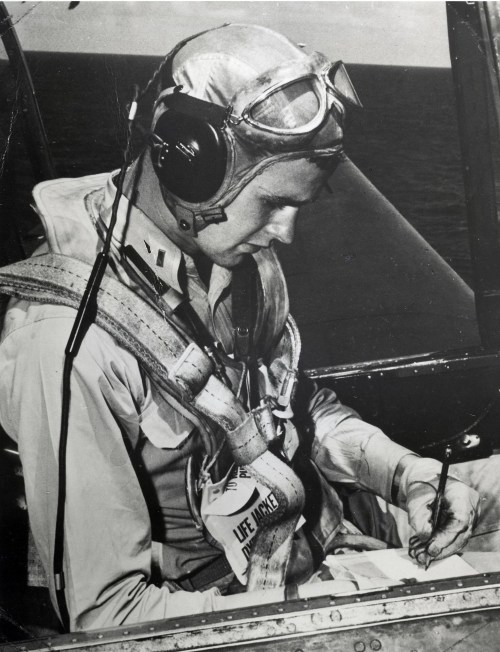
One of the young men who responded to the call to arms after the attack was a future President, 18 year old George H. W. Bush. He was advised to go to college instead of enlisting but he would hear nothing of it. He enlisted as soon as he graduated from high school on his 18th Birthday. He went to flight school and was commissioned just days before his 19th birthday, becoming the youngest Naval aviator. I guess that it is fitting that Bush, who passed away Saturday will be buried on December 6th, the day before the anniversary of the attack.

I remember reading Walter Lord’s classic and very readable book about Pearl Harbor “Day of Infamy” when I was a 7th grade student at Stockton Junior High School back in 1972.  At the time my dad was on his first deployment to Vietnam on the USS Hancock CVA-19.  As a Navy brat I was totally enthralled with all things Navy and there was little that could pull me out of the library.  In fact in my sophomore year of high school I cut over one half of the class meetings of the 4th quarter my geometry class to sit in the library and read history, especially naval and military history.

Over the years I have always found the pre-World War Two battleships to be among the most interesting ships in US Navy history.  No they are not the sleek behemoths like the USS Wisconsin which graces the Norfolk waterfront. They were not long and sleek, but rather squat yet exuded power. They were the backbone of the Navy from the First World War until Pearl Harbor. They were the US Navy answer to the great Dreadnaught race engaged in by the major navies of the world in the years prior to, during and after World War One.

Built over a period of 10 years each class incorporated the rapid advances in technology between the launching of the Dreadnaught and the end of the Great War.  While the United States Navy did not engage in battleship to battleship combat the ships built by the US Navy were equal to or superior to many of the British and German ships of the era.

Through the 1920s and 1930s they were the ambassadors of the nation, training and showing the flag. During those years the older ships underwent significant overhaul and modernization.

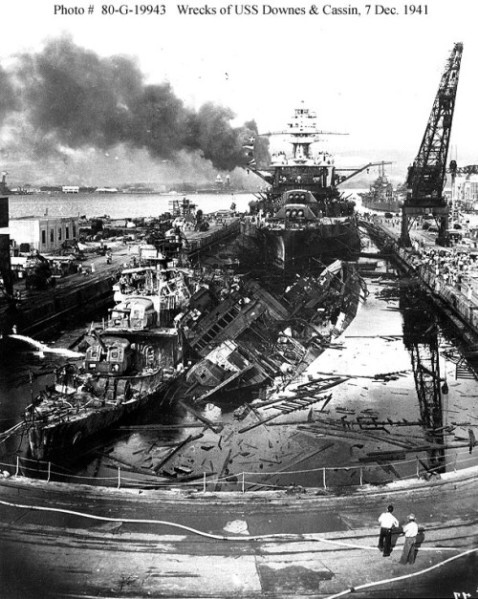
The Battle Force of the Pacific Fleet in 1941 included 9 battleships of which 8 were at Pearl Harbor on the morning of December 7th.  In the event of war the US War Plan, “Orange” called for the Pacific Fleet led by the Battle Force to cross the Pacific, fight a climactic Mahanian battle against the battleships of the Imperial Japanese Navy and after vanquishing the Japanese foe to relieve American Forces in the Philippines.  However this was not to be as by the end of December 7th all eight were out of action, with two, the Arizona and Oklahoma permanently lost to the Navy.

The ships at Pearl Harbor comprised four of the seven classes of battleships in the US inventory at the outbreak of hostilities.  Each class was an improvement on the preceding class in speed, protection and firepower.  The last class of ships, the Maryland class comprised of the Maryland, Colorado and West Virginia, was the pinnacle of US Battleship design until the North Carolina class was commissioned in 1941.  Since the Washington Naval Treaty limited navies to specific tonnage limits as well as the displacement of new classes of ships the United States like Britain and Japan was limited to the ships in the current inventory at the time of the treaty’s ratification.
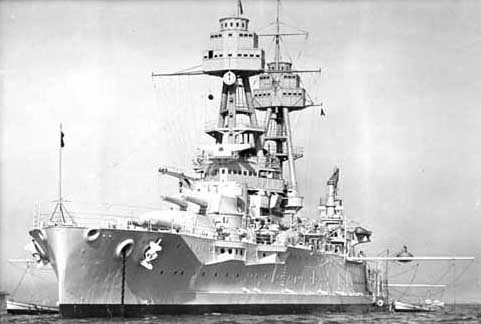
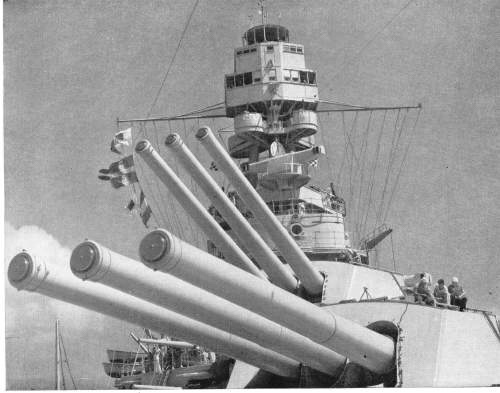
USS Oklahoma (above) and USS Nevada
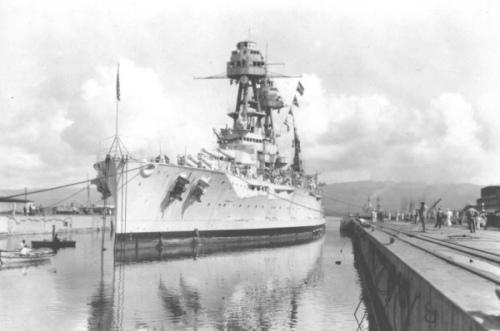
Those present at Pearl Harbor included the two ships of the Nevada class, the Nevada and Oklahoma they were the oldest battleships at Pearl Harbor and the first of what were referred to as the “standard design” battleships. The two ships of the Pennsylvania class, the Pennsylvania and her sister the Arizona served as the flagships of the Pacific Fleet and First Battleship Division respectively and were improved Nevada’s. The California class ships, California and Tennessee and two of the three Maryland’s the Maryland and West Virginia made up the rest of the Battle Force.

The Colorado was undergoing a yard period at Bremerton and the three ships of the New Mexico class, New Mexico, Mississippi and Idaho had been transferred to the Atlantic before Pearl Harbor due to the German threat.  The three oldest battleships in the fleet, those of the New York and Wyoming Classes, the New York, Arkansas and Texas also were in the Atlantic. Two former battleships, the Utah and Wyoming had been stripped of their main armaments and armor belts and served as gunnery training ships for the fleet. The Utah was at Pearl Harbor moored on the far side of Ford Island. The newest battleships in the Navy, the modern USS North Carolina and USS Washington were also serving in the Atlantic as a deterrent to the German battleships and battlecruisers which occasionally sortied into the Atlantic to attack convoys bound for Britain.

The great ships that lay at anchor at 0755 that peaceful Sunday morning on Battleship Row and in the dry dock represented the naval power of a bygone era, something that most did not realize until two hours later. The age of the battleship was passing away, but even the Japanese did not realize that the era had passed building the massive super-battleships Yamato and Musashi mounting nine 18” guns and displacing 72,000 tons, near twice that of the largest battleships in the U.S. inventory.

The Oklahoma and Nevada were the oldest ships in the Battle Force.  Launched in 1914 and commissioned in 1916 the Nevada and Oklahoma mounted ten 14” guns and displaced 27,500 tons and were capable of 20.5 knots. They served in World War One alongside the British Home Fleet and were modernized in the late 1920s. They were part of the US presence in both the Atlantic and Pacific in the inter-war years. Oklahoma took part in the evacuation of American citizens from Spain in 1936 during the Spanish Civil War.

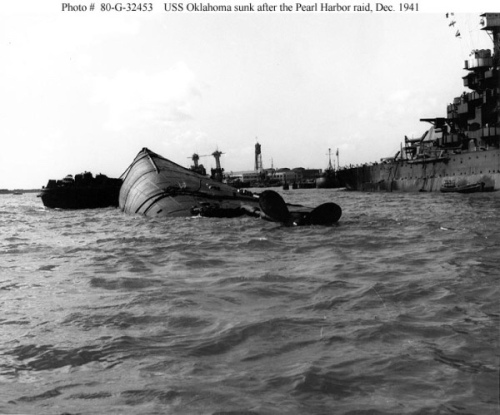
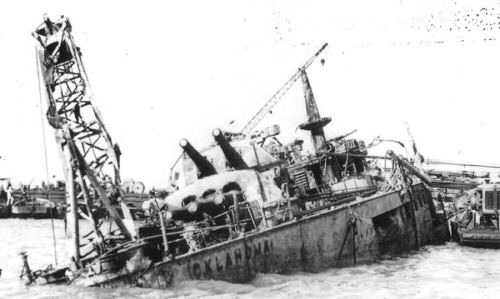
During the Pearl Harbor attack Oklahoma was struck by 5 aerial torpedoes capsized and sank at her mooring with the loss of 415 officers and crew. Recent analysis indicates that she may have been hit by at least on torpedo from a Japanese midget submarine. Her hulk would be raised but she would never again see service and sank on the way to the breakers in 1946.

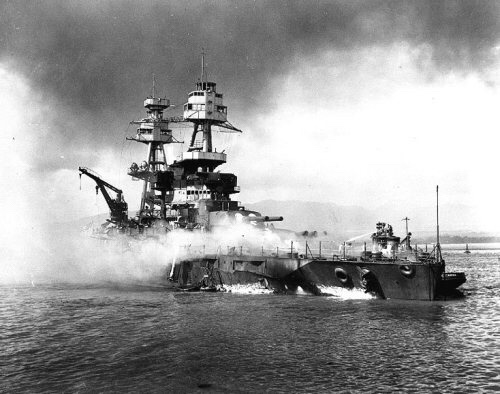
Nevada was the only battleship to get underway during the attack.  Moored alone at the north end of Battleship Row her Officer of the Deck had lit off a second boiler an hour before the attack.  She was hit by an aerial torpedo in the first minutes of the attack but was not seriously damaged. She got underway between the attack waves and as she attempted to escape the harbor she was heavily damaged. To prevent her from sinking in the main channel she was beached off Hospital Point.

Nevada was raised and received a significant modernization before returning to service for the May 1943 assault on Attu.  Nevada returned to the Atlantic where she took part in the Normandy landings off Utah Beach and the invasion of southern France.  She returned to the Pacific and took part in the operations against Iwo Jima and Okinawa where she again provided naval gunfire support.

Following the war the great ship was assigned as a target at the Bikini atoll atomic bomb tests. The tough ship survived these tests and was sunk as a target on 31July 1948.
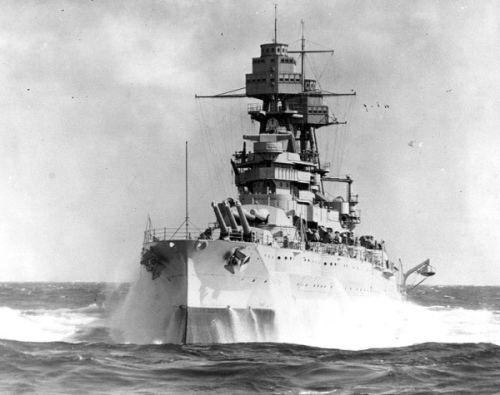
Two views of USS Arizona
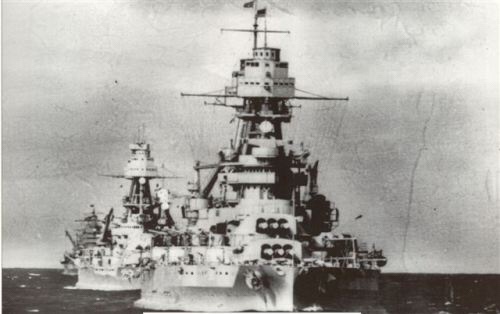
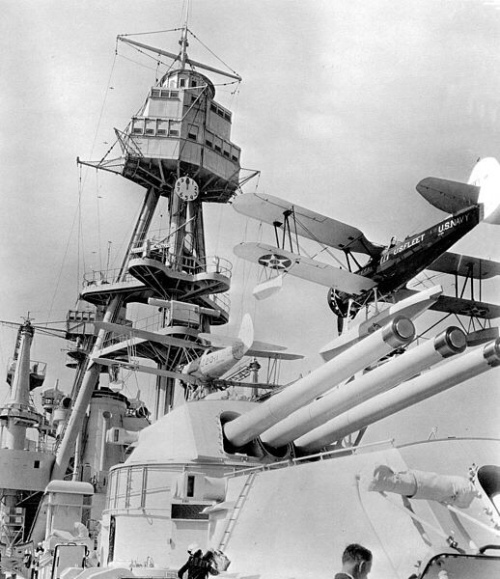
Pennsylvania
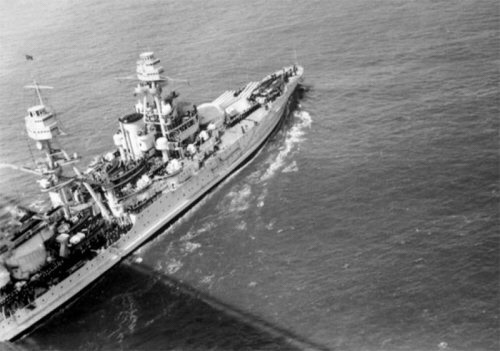
USS Pennsylvania sailing under the Golden Gate Bridge
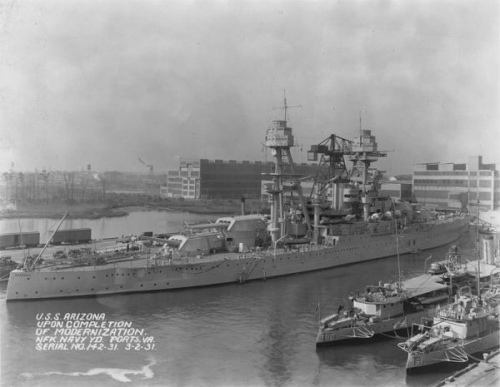
The two ships of the Pennsylvania Class were improved Oklahoma’s.  The Arizona and Pennsylvania mounted twelve 14” guns and displacing 31,400 tons and capable of 21 knots they were both commissioned in 1916. They participated in operations in the Atlantic in the First World War with the British Home Fleet. Both ships were rebuilt and modernized between 1929 and 1931. Though damaged in the attack, Pennsylvania was back in action by early 1942. She underwent minor refits and took part in many amphibious landings in the Pacific and was present at the Battle of Surigao Strait.  She was heavily damaged by an aerial torpedo at Okinawa Pennsylvania and was repaired. Following the war the elderly warrior was used as a target for the atomic bomb tests. She was sunk as a gunnery target in 1948.

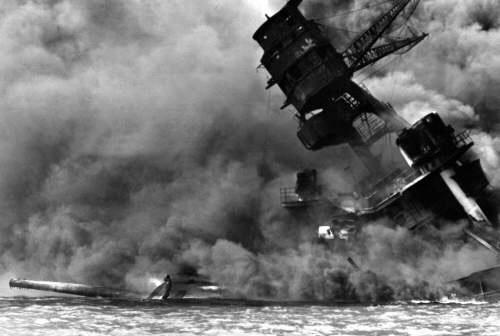
Arizona was destroyed during the attack. As the flagship of Battleship Division One, she was moored next to the repair ship USS Vestal.  She was hit by 8 armor piercing bombs one of which penetrated her forward black powder magazine. The ship was consumed by a cataclysmic explosion which killed 1103 of her 1400 member crew including her Captain and Rear Admiral Isaac Kidd, commander of Battleship Division One.  She was never officially decommissioned and the colors are raised and lowered every day over the Memorial which sits astride her broken hull.
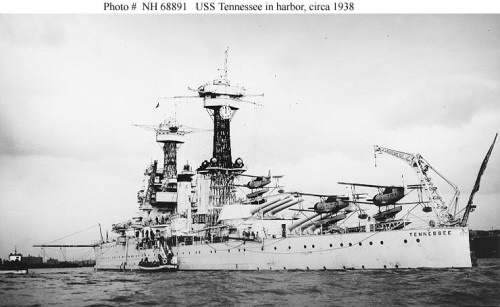
USS Tennessee & USS California
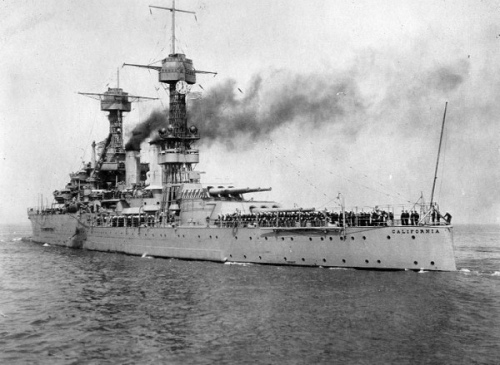
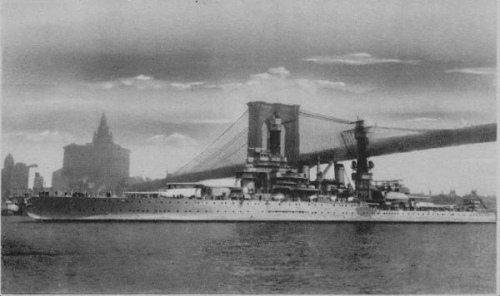
California sailing under the Brooklyn Bridge

The Tennessee class ships the Tennessee and California were the class following the New Mexico class ships which were not present at Pearl Harbor. These ships were laid down in 1917 and commissioned in 1920. Their design incorporated lessons learned at the Battle Jutland. They mounted twelve 14” guns, displaced 32,300 tons and were capable of 21 knots. At Pearl Harbor Tennessee was moored inboard of West Virginia and protected from the aerial torpedoes which did so much damage to other battleships. She was damaged by two bombs.

California was the Flagship of Battleship Division Two. She was moored at the southern end of Battleship Row. She was hit by two torpedoes in the initial attack, but she had the bad luck to have all of her major watertight hatches unhinged in preparation for an inspection. Despite the valiant efforts of her damage control teams she sank at her moorings. She was raised and rebuilt along with Tennessee were completely modernized with the latest in radar, fire control equipment and anti-aircraft armaments. They were widened with the addition of massive anti-torpedo bulges and their superstructure was razed and rebuilt along the lines of the South Dakota class. When the repairs and modernization work was completed the ships looked nothing like they did on December 7th. Both ships were active in the Pacific campaign and be engaged at Surigao Strait where they inflicted heavy damage on the attacking Japanese squadron. Both survived the war and were placed in reserve until 1959 when they were stricken from the Navy list and sold for scrap.
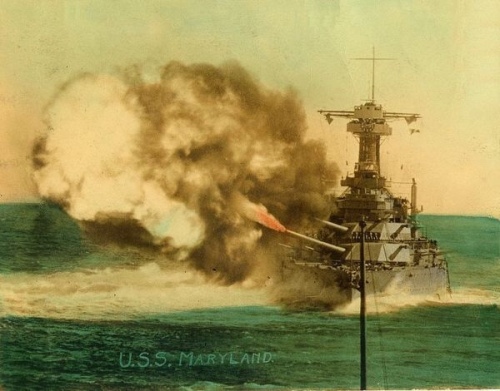
USS Maryland & USS West Virgina
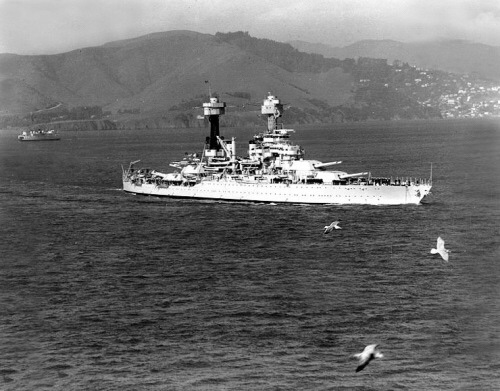
The Maryland and West Virginia were near sisters of the Tennessee class.  They were the last battleships built by the United States before the Washington Naval Treaty. and the first to mount 16” guns. With eight 16” guns they had the largest main battery of any US battleships until the North Carolina class. They displaced 32,600 tons and could steam at 21 knots. Laid down in 1917 and commissioned in 1921 they were modernized in the late 1920s. They were the most modern of the Super-Dreadnoughts built by the United States and included advances in protection and watertight integrity learned from both the British and German experience at Jutland.
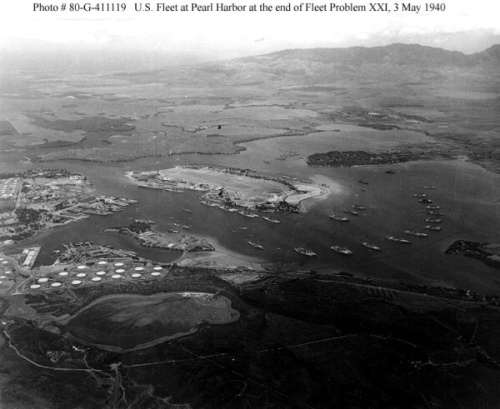
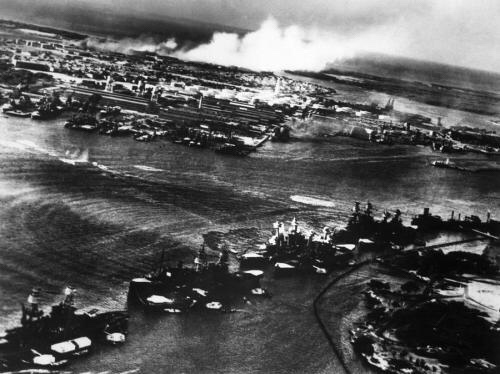
At Pearl Harbor Maryland was moored inboard of Oklahoma and was hit by 2 bombs and her crew helped rescue survivors of that unfortunate ship.  She was quickly repaired and returned to action.  She received minimal modernization during the war. She participated in operations throughout the entirety of the Pacific Campaign mainly conducting Naval Gunfire Support to numerous amphibious operations. She was present at Surigao Strait where despite not having the most modern fire control radars she unleashed six salvos at the Japanese Southern Force.
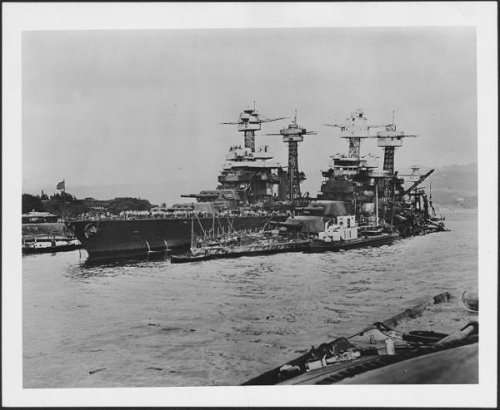
Tennessee & West Virginia after the attack (above) Arizona (below)
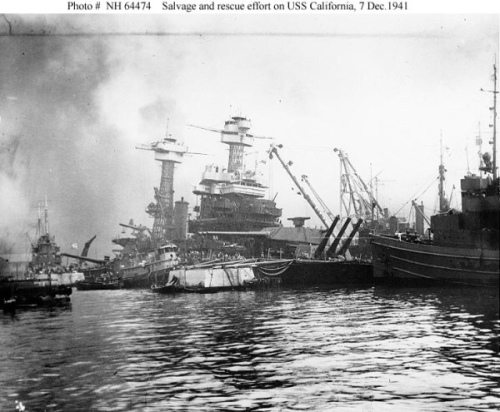
Pennsylvania in Drydock Number One, Nevada beached at Hospital Point
Oklahoma Capsized and after being righted
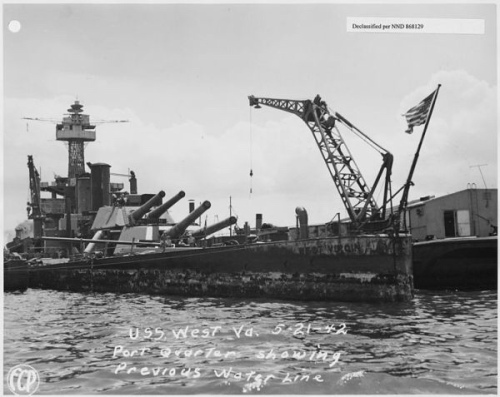
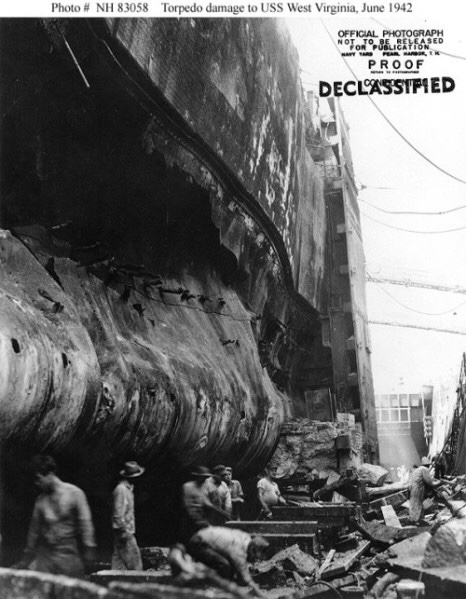
West Virginia suffered some of the worst damage in the attack. She was hit by at least 5 torpedoes and two bombs. One of the torpedoes may have come from one of the Japanese midget submarines that penetrated the harbor. She took a serious list and was threatening to capsize. However she was saved from Oklahoma’s fate by the quick action of her damage control officer who quickly ordered counter-flooding so she would sink on an even keel.  She was raised from the mud of Pearl Harbor and after temporary repairs and sailed to the West Coast for an extensive modernization on the order of the Tennessee and California.
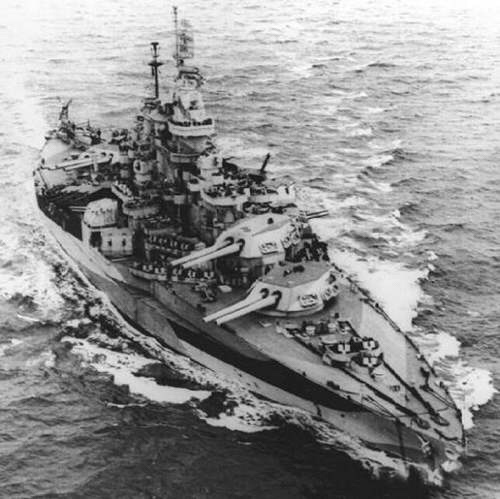
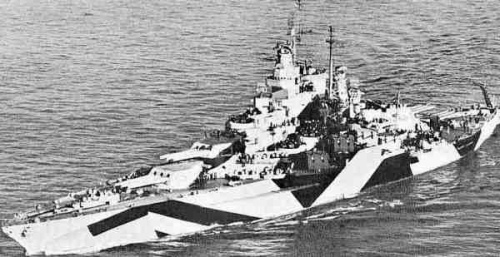
West Virginia was the last Pearl Harbor to re-enter service. However when she returned she made up for lost time.  She led the battle line at Surigao Strait and fired 16 full salvos at the Japanese squadron. Her highly accurate gunfire was instrumental in sinking the Japanese Battleship Yamashiro in the last battleship versus battleship action in history.  West Virginia, Maryland and their sister Colorado survived the war and were placed in reserve until they were stricken from the Naval List and sold for scrap in 1959.

The battleships of Pearl Harbor are gone, save for the wreck of the Arizona and various relics such as masts, and ships bells located at various state capitals and Naval Stations.  Unfortunately no one had the forethought to preserve one of the surviving ships to serve as a living memorial at Pearl Harbor with the Arizona. As I noted at the beginning of this article, the brave Sailors and Marines who manned these fine ships are also passing away.

Thus as we approach the anniversary of the Pearl Harbor attack it is fitting to remember these men and the great ships that they manned.

Peace,

Padre Steve

1 Comment

Filed under History, Loose thoughts and musings, Military, Navy Ships, US Navy, world war two in the pacific

Who Were the Bodies? The Nazi Crimes Against Humanity in Retrospect

Friends of Padre Steve’s World,

In the film Judgement at Nuremberg the American Prosecutor at the Judges Trial played by Richard Widmark asked a question when showing a film of the victims of the Nazis when the Concentration Camps were liberated by American and British troops in the spring of 1945. His question in the face of films of massed piles of bodies being bulldozed into mass graves at Bergen-Belsen, of the cremated remains, shrunken skulls, and lampshades made of human skin at Buchenwald, gas chambers, medical experiments, the emaciated bodies of still living victims; little more than skin and bones, elbows, hips, and knees bulging over the shrunken remains of their bodies, eyes sunken in to the skulls.

Who Were they?

The Nazis specifically targeted the Jews for extermination. According to Hitler, his hnchemen, and other German nationalists, the Jews were less than human, they worked hand in hand with the Bolsheviks, and thus deserved their fate. Likewise, there were those crippled in body or mind who were euthanized, political opponents, religious and racial minorities, populations of conquered nations, who died at the hands of the German military, or who were gunned down in mass graves by the Einsatzgruppen, intentionally starved to death, or who were worked to death as Slave laborers in the Nazi work camps.

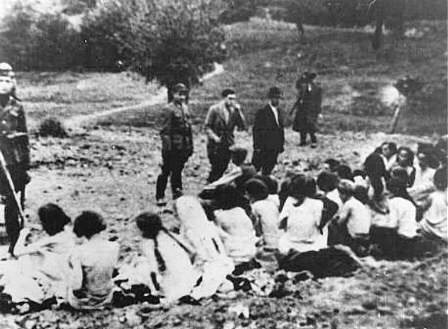
They were men and women, wives and husbands, sons and daughters. They spanned the spectrum from infants to the aged. Too many times multiple generations of families went to death together. Hermann Graebe, a civilian employed to help build roads for the Wehrmacht came across one of the many massacres committed up close and personal by SS Men on October 5th 1943 at Dubno, Ukraine. He testified:

Moennikes and I went direct to the pits. Nobody bothered us. Now I heard rifle shots in quick succession, from behind one of the earth mounds. The people who had got off the trucks—men, women and children of all ages—had to undress upon the orders of an SS-man, who carried a riding or dog whip.

They had to put down their clothes in fixed places, sorted according to shoes, top clothing and underclothing. I saw a heap of shoes of about 800 to 1,000 pairs, great piles of underlinen and clothing. Without screaming or weeping these people undressed, stood around in family groups, kissed each other, said farewells and waited for a sign from another SS-man, who stood near the pit, also with a whip in his hand.

During the 15 minutes that I stood near the pit I heard no complaint or plea for mercy. I watched a family of about 8 persons, a man and woman, both about 50 with their children of about 1, 8 and 10, and two grown up daughters of about 20 to 24. An old woman with snow-white hair was holding the one year old child in her arms and singing to it, and tickling it. The child was cooing with delight. The couple were looking on with tears in their eyes. The father was holding the hand of a boy about 10 years old and speaking to him softly; the boy was fighting his tears. The father pointed toward the sky, stroked his head, and seemed to explain something to him. At that moment the SS-man at the pit shouted something to his comrade.

I looked into the pit and saw that the bodies were twitching or the heads lying already motionless on top of the bodies that lay before them. Blood was running from their necks.

I was surprised that I was not ordered away, but I saw that there were two or three postmen in uniform nearby. The next batch was approaching already.

These victims were not just numbers and statistics. They were living breathing human beings whose lives were snuffed out by the Nazis and their allies. They had been abandoned by most of the world. Anything of value that they possessed was appropriated by the men who exterminated them; their businesses, homes, farms, clothes, shoes, currency, jewelry, wedding rings, artwork, furniture, and even their gold fillings, and yes, their hair, and even their skin.

Whole towns were exterminated, millions of people killed and millions of other people displaced, never to return to their homes. At Babi Yar outside of Kiev 33,771 Jews were exterminated by the members of Sonderkommando 4b of Einsatzgruppen C as well as Police battalions. About 10,000 others, mainly Communist Officials and Gypsies were rounded up and killed in the same operation. The victims were stripped of all of their belongings taken to a ravine and shot. The German Army provided logistic support as well as security for the murder squads.

Fritz Hoefer, a SS man serving as a truck driver with the Sonderkommando said these words at the Einsatzgruppen Trial:

One day I was ordered to drive my truck out of town. I had a Ukrainian with me. It was about 10 a.m. On our way, we passed Jews marching in columns in the same direction, we were going. They were carrying their belongings. There were whole families. The farther we drove away from the town, the more people we saw in the columns. There were piles of clothes in a wide open field. My job was to fetch them.   

I stopped the engine nearby, and the Ukrainians standing around started loading the car with this stuff. From where I was, I saw other Ukrainians meeting the Jews who arrived, men, women and children, and directing them to the place where, one after another, they were supposed to remove their belongings, coats, shoes, outer garments and even their underwear.

They were supposed to put all their belongings together in a pile. Everything happened very quickly, the Ukrainians hurried those who hesitated by kicking and pushing them. I think it took less than a minute from the moment a person took off his coat before he was standing completely naked.

No distinction was made between men, women and children. The Jews who were arriving could have turned back when they saw those who had come earlier taking off their clothes. Even today I cannot understand why they didn’t run.


Columns of Jews march past a corpse in Kiev

Naked Jews were led to a ravine about 150 metres long, 30 metres wide and 15 metres deep. The Jews went down into the ravine through two or three narrow paths. When they got closer to the edge of the ravine, members of the Schutzpolizei (Germans) grabbed them and made them lie down over the corpses of the Jews who had already been shot.

It took no time. The corpses were carefully laid down in rows. As soon as a Jew lay down, a Schutzpolizist came along with a sub-machine gun and shot him in the back of the head.The Jews who descended into the ravine were so frightened by this terrible scene that they completely lost their will. You could even see some of them lying down in the row on their own and waiting for the shot to come.

Only two members of the Schutzpolizei did the shooting. One of them was working at one of the ravine, the other started at the other end. I saw them standing on the bodies and shooting one person after another.

Walking over the corpses toward a new victim who had already laid down, the machine gunner shot him on the spot. It was an extermination machine that made no distinction between men, women and children.Children were kept with their mothers and shot with them. I did not watch for long. When I approached the edge, I was so frightened of what I that I could not look at it for a long time.


German Einsatzgruppen & Police force groups of Jews to hand over their possessions and undress before being shot in the ravine at Babi Yar

I saw dead bodies at the bottom laid across in three rows, each of which was approximately 60 metres long. I could not see how many layers were there. It was beyond my comprehension to see bodies twitching in convulsions and covered with blood, so I could not make sense of the details.Apart from the two machine gunners, there were two other members of the Schutzpolizei standing near each passage into the ravine.

They made each victim lie down on the corpses, so that the machine gunner could shoot while he walked by. When victims descended into the ravine and saw this terrible scene at the last moment, they let out a cry of terror. But they were grabbed by the waiting Schutzpolizei right away and hurled down onto the others.

Those who followed them could not see the terrible scene because it was obstructed by the edge of the ravine. While some people were getting undressed and most of the others were waiting their turn, there was a lot of noise. The Ukrainians paid no attention to the noise and just kept forcing people through the passages into the ravine.

You could not see the ravine from the site where people were taking off their clothes, because it was situated about 150 metres away from the first pile of clothes. Besides, a strong wind was blowing and it was very cold. You couldn’t hear the shooting in the ravine.

Jews at Babi Yar waiting to be murdered

So I concluded that the Jews had no idea what was actually happening. Even today I wonder why the Jews did nothing to challenge what was going on. Masses of people were coming from town and they did not seem to suspect anything.

They thought they were just being relocated.              

The men who were the leaders of the mobile Einsatzgruppen which conducted these up close and personal killings of nearly a million and a half Jews and others were not common thugs. Most were very educated and accomplished men.

General Telford Taylor, an American lawyer who served as a prosecutor at the Einsatzgruppen Trial explained:

“These defendants are not German peasants or artisans drafted into the Wehrmacht. They are not uneducated juveniles. They are lawyers, teachers, artists, and a former clergyman. They are, in short, men of education, who were in full possession of their faculties and who fully understood the grave and sinister significance of the program they embarked upon. They were part of the hard core of the SS. They did not give mere lip service to Himmler’s atrocious racial doctrines; they were chosen for this terrible assignment because they were thought to be men of sufficient ruthlessness to carry them out. They are hand-picked fanatics; every one of them was an officer of the SS … They are not unhappy victims, unwillingly pushed into crime by the tyranny of the Third Reich; these men, above all others, themselves, spread the Nazi doctrine with fire and sword.”

The men who ran the death camps might not have been from the same “elite” stock as the commanders of the Einsatzgruppen but they carried out their duties in calculating and businesslike manner. Rudolf Hoess who commanded Auschwitz gave this statement to the International Military Tribunal:

On 1 December 1943 1 became Chief of Amt 1 in Amt Group D of the WVHA, and in that office was responsible for co-ordinating all matters arising between RSHA and concentration camps under the administration of WVHA. I held this position until the end of the war. Pohl, as Chief of WVHA, and Kaltenbrunner, as Chief of RSHA, often conferred personally and frequently communicated orally and in writing concerning concentration camps. . . .

The ‘final solution’ of the Jewish question meant the complete extermination of all Jews in Europe. I was ordered to establish extermination facilities at Auschwitz in June 1941. At that time, there were already in the General Government three other extermination camps: Belzek, Treblinka, and Wolzek. These camps were under the Einsatzkommando of the Security Police and SD. I visited Treblinka to find out how they carried out their exterminations. The camp commandant at Treblinka told me that he had liquidated 80,000 in the course of one-half year. He was principally concerned with liquidating all the Jews from the Warsaw Ghetto. He used monoxide gas, and I did not think that his methods were very efficient. So when I set up the extermination building at Auschwitz, I used Cyklon B, which was a crystallized prussic acid which we dropped into the death chamber from a small opening. It took from 3 to 15 minutes to kill the people in the death chamber, depending upon climatic conditions. We knew when the people were dead because their screaming stopped. We usually waited about one-half hour before we opened the doors and removed the bodies. After the bodies were removed our special Kommandos took off the rings and extracted the gold from the teeth of the corpses.

When he was asked specifics, Hoess stated: This gold was melted down and brought to the Chief Medical Office of the SS at Berlin.

He continued with some pride during cross examination:

Another improvement we made over Treblinka was that we built our gas chamber to accommodate 2,000 people at one time whereas at Treblinka their 10 gas chambers only accommodated 200 people each. The way we selected our victims was as follows: We had two SS doctors on duty at Auschwitz to examine the incoming transports of prisoners. The prisoners would be marched by one of the doctors who would make spot decisions as they walked by. Those who were fit for work were sent into the camp. Others were sent immediately to the extermination plants. Children of tender years were invariably exterminated since by reason of their youth they were unable to work. Still another improvement we made over Treblinka was that at Treblinka the victims almost always knew that they were to be exterminated and at Auschwitz we endeavored to fool the victims into thinking that they were to go through a delousing process. Of course, frequently they realized our true intentions and we sometimes had riots and difficulties due to that fact. Very frequently women would hide their children under the clothes, but of course when we found them we would send the children in to be exterminated. We were required to carry out these exterminations in secrecy but of course the foul and nauseating stench from the continuous burning of bodies permeated the entire area and all of the people living in the surrounding communities knew that exterminations were going on at Auschwitz.

But the bodies…

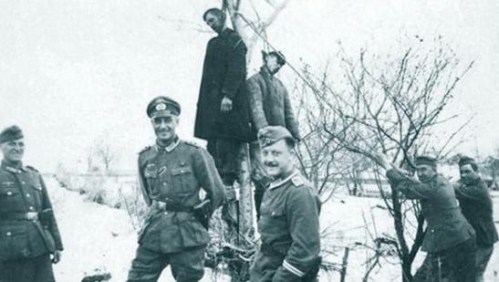
Jews and Gentiles from every nation in Europe as well as the Americas, Africa, and Asia ended up dying at the hands of the Nazis, either in their Death Camps, Concentration/ Labor Camps, or up close and personal at the hands of the Einsatzgruppen, the Waffen SS, or the Wehrmacht.

Every one of those bodies, the cold statistics of the Nazi machine were people like you and me. In April I visited the United States Holocaust Museum while visiting friends in Washington D. C.

I think that the one that hit me the hardest was the pictorial Tower of Faces from the Polish shtetl of Ejszyszki. That town was home to some 4,000 Jews and the pictures had been taken over the preceding decade by local photographers. They were pictures of everyday family and community life; men, women, children at work, at play, at rest. Worshipping, working, studying, the old and the young, the well off and the poor, the religious and those not as religious at all phase of life captured in photos for eternity. For 3500 of them their lives ended on September 21st 1941 when the Nazis rounded up the Jews at their Synagogues on the eve of Yom Kippur and executed them by firing squad in mass graves at the town’s Christian and Jewish cemeteries. Only 29 of those who survived that day lived through the war. That Jewish community had existed for 900 years and was exterminated in a matter of hours.

I looked at those pictures and I could not get over all of those innocent lives cut short. Each face was the picture of an individual or individuals, families, friends, schoolmates. They were not abstract numbers or statistics but real flesh and blood people like you and me. They had hopes and dreams, but because they were Jews they were exterminated, like nearly six million other Jews who also were real people with hopes and dreams that would be destroyed by the Nazi racial war. Of course the Nazis targeted others, but none with the relentless anti-Semitic racial hatred propagated by Nazi ideology. Thus they condoned and executed by people who would have ordinarily have been considered upstanding and moral citizens. The late Christopher Hitchens wrote:

“We should not at all allow ourselves to forget the millions of non-Jewish citizens of Belarus, Russia, Ukraine, and other Slav territories who were also massacred. But for me the salient fact remains that anti-Semitism was the regnant, essential, organizing principle of all the other National Socialist race theories. It is thus not to be thought of as just one prejudice among many.” 

The Jewish-Italian Philosopher and Auschwitz survivor Primo Levi wrote:

Then for the first time we became aware that our language lacks words to express this offence, the demolition of a man. In a moment, with almost prophetic intuition, the reality was revealed to us: we had reached the bottom. It is not possible to sink lower than this; no human condition is more miserable than this, nor could it conceivably be so. Nothing belongs to us any more; they have taken away our clothes, our shoes, even our hair; if we speak, they will not listen to us, and if they listen, they will not understand. They will even take away our name: and if we want to keep it, we ill have to find ourselves the strength to do so, to manage somehow so that behind the name something of us, of us as we were, still remains.

I write because the remaining witnesses to the Nazi Crimes are dying off and deniers are becoming ever more numerous. In researching this article I came across a man, an American of all people, who is denying the mass murder at Babi Yar. I have to shake my head, but the fact is that such people have become emboldened by the Presidency of Donald Trump. They see in him a kindred spirit. Such does not bode well for the future, and the lives who will stand behind the faces and names of the future crimes against humanity.

Until tomorrow,

Peace,

Padre Steve+

4 Comments

Filed under ethics, History, holocaust, Loose thoughts and musings, nazi germany, News and current events

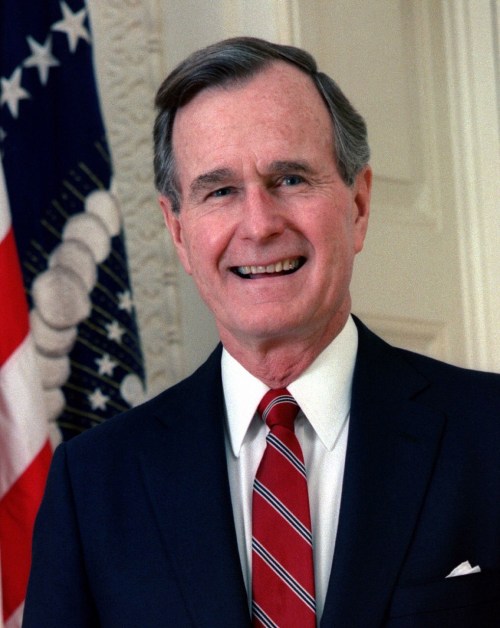
Unassuming, Competent, and Honorable: George H. W. Bush 1924-2018

Friends of Padre Steve’s World,

I was working on another article last night and called it quits because I was tired. I’ll finish and post it tomorrow. But as I was settling in for the night my iPhone and iPad lit up with notifications that former President George H. W. Bush had died.

Many others from across the political spectrum have paid tribute to him far better than Incan ever hope to do. I had a lot of admiration for him. He brought a wealth of experience into the White House which paid huge dividends for the nation and the world as the Cold War ended and the world that we had known for forty years changed overnight.

It was a time fraught with real danger. The collapse of the Soviet Union and the Warsaw Pact brought freedom to much of Eastern Europe, but also unleashed a storm of long suppressed, but ancient ethnic and religious hatreds, especially in the Balkans. Likewise, the system by which the United States and the Soviet Union kept client States in line collapsed. Saddam Hussein’s Iraq was but one of these nations.

Likewise, China responded to calls for democracy by crushing the peaceful demonstrations in Tiananmen Square in June 1989. Some leaders of Warsaw Pact nations whose people began to push for democracy and freedom were tempted to use force to crush their protestors, but none did. Credit has to be given to President Bush for how he used his knowledge, influence, and diplomatic skills to help bring down the Berlin Wall as Communist regimes collapsed all across Eastern Europe.

When Saddam Hussein brazenly invaded Kuwait, it was Bush who worked with the United Nations to build a true international coalition against Hussein and to ensure that Iraq was unable to split that coalition, which included many Arab nations, when it began shooting SCUD missiles at Israel.

At home he wanted a kinder and gentler country, something that we could sure use today. He was despised by Right Wing Republicans and Conservatives for not being “conservative enough.” Of course, the kind of conservatives they wanted in government were the uncompromising, yet morally bankrupt men like Newt Gingrich, and ultimately Donald Trump.

Bush’s political problem was one of hs greatest strengths. He was a decent man who brought humility to his office and did not make the Presidency about himself. He was gracious in defeat and went on work with the man who defeated him in 1992, Bill Clinton, on a number of humanitarian projects.

He was the last member of what has been termed “the Greatest Generation” serve as President. As a nineteen year old he put college on hold and became the second youngest man commissioned as a Naval Aviator. While serving with VT-51 (Torpedo Squadron 51) based on the USS San Jacinto, his TBM Avenger torpedo bomber was shot down over Chuchi Jima. With his aircraft’s engine on fire from hits from Japanese anti aircraft fire, Bush piloted his aircraft away from land to enable his crew to bail out. One went down with the aircraft, the other’s parachute failed to open. Bush landed in the ocean. U.S. fighter aircraft circled overhead and four hours later he was fished from the sea by the crew of the submarine USS Finback. Upon his return to the San Jacinto, Bush rejoined his squadron and flew until the squadron was rotated out of combat. He flew 58 combat missions and was received the Distinguished Flying Cross and three awards of the Air Medal.

Of the Presidents that served in the Second World War, only Bush and John F. Kennedy came so close to death serving in the Pacific. Gerald Ford served in combat operations about the Light Carrier USS Monterrey, a sister ship of San Jacinto for a year and a half. Richard Nixon volunteered for service even though being a Quaker he could have claimed consciousness objector status. He applied for sea duty but was assigned to various logistics and administrative assignments in the Pacific throughout the war. Lyndon Johnson served in the South Pacific, interrupting his congressional term to personally report on the situation to President Franklin Roosevelt. During his tour he got himself aboard an Army Air Force B-26 Marauder which was on a combat mission. There are differences in what happened during the mission, but alone among the crew Johnson, was recommended by Douglas MacArthur for, and awarded the Silver Star. Of course, Ronald Reagan, who had become a Reserve Officer in 1937, never left the Continental United States and was engaged in making training and recruitment films. Jimmy Carter entered the Naval Academy in 1943 but was commissioned too late to see service in the war.

Bush epitomized public service as an elected and appointed official, serving as a Congressman, Ambassador to the United Nations, Envoy to the People’s Republic of China, and Director of the Central Intelligence Agency, before becoming Ronald Reagan’s Vice President.

As President he surrounded himself with competent professionals who were up to the challenges that his Presidency had to deal with. Unlike his predecessor, Ronald Reagan, there was no shady Iran Contra scandal, or Bill Clinton’s descent into extramarital forced fellatio with White House Intern Monica Lewinski and his lies about it. Neither can his response to Saddam Hussein’s Invasion of Kuwait in 1990 be compared to the criminal invasion launched by his son against Iraq in 2003.

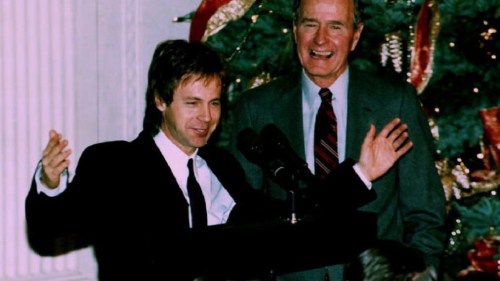
Unlike many of his predecessors and successors he could not only take a jokes and parodies, but became a friend with one of his most successful imitators, Dana Carvey, from Saturday Night Live. Carvey’s parody of the President inspired me to learn to imitate him, Bill Clinton, Ross Perot, Bob Dole and others. Most people who have heard me think that I do Clinton the best, some say that my impersonation of him is scary, but I digress. At his final White House holiday party before he left office, Bush secretly invited Carvey. They became lifelong friends. But that is who George H. W. Bush was, and why I can appreciate him so much.

He was a devoted husband and father. He was preceded in death by his wife Barbara and daughter Robin.

May he Rest In Peace.

Peace,

Padre Steve+

2 Comments

Filed under History, leadership, News and current events, Political Commentary, shipmates and veterans