Author Archives: padresteve

padresteve's avatar

About padresteve

I'm a Navy Chaplain and Old Catholic Priest

The Passing of a Baseball Legend: Bob Feller 1918-2010

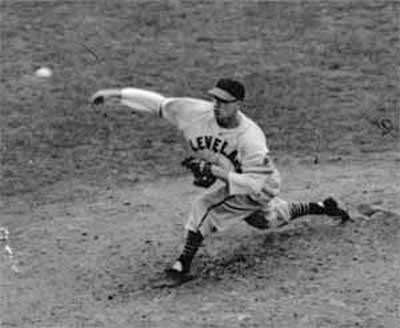
Baseball lost a great yesterday. Bob Feller sometimes known as “Rapid Robert” died of Leukemia at the age of 92.  Feller was born in Van Meter Iowa and was drafted by the Cleveland Indians when he was 16 years old and went directly to the Major Leagues at 17 and won 17 games in his rookie year. He threw the first opening day no-hitter and t

he first by an opposing pitcher at Yankee Stadium.  He struck out 15 batters in his first major league start.

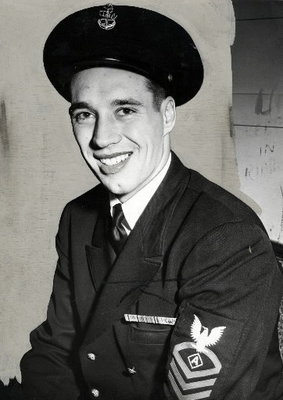
Feller played 18 seasons and missed three and a half seasons after volunteering to serve in the Navy the day after Pearl Harbor. He was 23 years old and had already won 107 games and was the highest paid player then in the game when he left baseball in his prime to serve in the war. He did not take an assignment where he was ashore but he served as a gunner’s mate on the USS Alabama BB-60. He said in 1997 “We were losing a war, a big war, we were losing big in the Pacific … any red-blooded American with a gut in his body would have gotten busy.” The former anti-aircraft gunner screamed again: “We took back the Pacific. I can look anyone in the eye and say, ‘I was there.'”

He rose through the ranks and was promoted to Chief Petty Officer while serving as the gun captain of a quad 40mm anti-aircraft mount on that ship.  He is the only Chief Petty Officer in the Baseball Hall of Fame.  Many baseball historians believe that had Feller not missed those seasons he might have won 350 games as he was winning close to 25 games a year at that point. He didn’t have to enlist as he had a deferment to take care of his ailing father. He was sworn in by Heavyweight Boxing Champ Gene Tunney. He never mourned his lost wins or other statistics. He told ESPN Commentator Tim Kurkjian in 1997 “I’ve never once thought about all the prime years that I missed. I did what I had to do for my country. We won that war. I’m as proud of serving as anything I’ve ever done in my life.”

Feller won 266 games while losing 162, with a 3.25 ERA in 484 starts.  He pitched 279 complete games struck out 2581 batters and won 20 games in a season 6 times, each time leading the league in wins. He was an 8 time all star, seven-time MVP, led AL in wins 6 times. He helped lead the Indians to their last World Series win in 1948 but did not win a game in the series itself.  Feller averaged 247 innings pitched, gave up and average of 211 hits, 89 Earned Runs, 167 Strikeouts and 114 walks a year if his statistics were averaged into a 162 game season. Between seasons he barnstormed often playing against Negro League teams, pitching against his future team mate Satchel Paige several times.

My first encounter with Feller was reading his book as a 10 year old. I believe that he pitched in an Old Timer’s game at Anaheim stadium that I attended.  He was a practical joker and had a tremendous sense of humor. He had a “moo-cow” horn on his car, and once made an “ice cream Sandwich” with a bar of soap which Satchel Paige left his false teeth in. Feller also depending on the account was clocked at pitching a baseball 100, 104 or 107  miles an hour.  When I heard that Feller had been

Feller played all 18 seasons with the Indians and was very loyal both to the organization and the city. In an era where many ballplayers move from city to city with every better offer it is refreshing to remember a man who valued that relationship.  Bob Feller. Baseball Great and Navy Chief dead at 92., may his soul and the souls of all the departed rest in peace.

Peace my friends,

Padre Steve+


3 Comments

Filed under Baseball, US Navy

Why don’t we just call it the Gulf of Whatever we want to call it? Padre Steve Says the Iranians Whine too Much

Warning: Denny Crane over the top alert. Readers with no sense of humor, irony or wit should either turn back now or get a life because I don’t want to hear the whining in the comments section like those infernally serious supporters of Julian Assange.


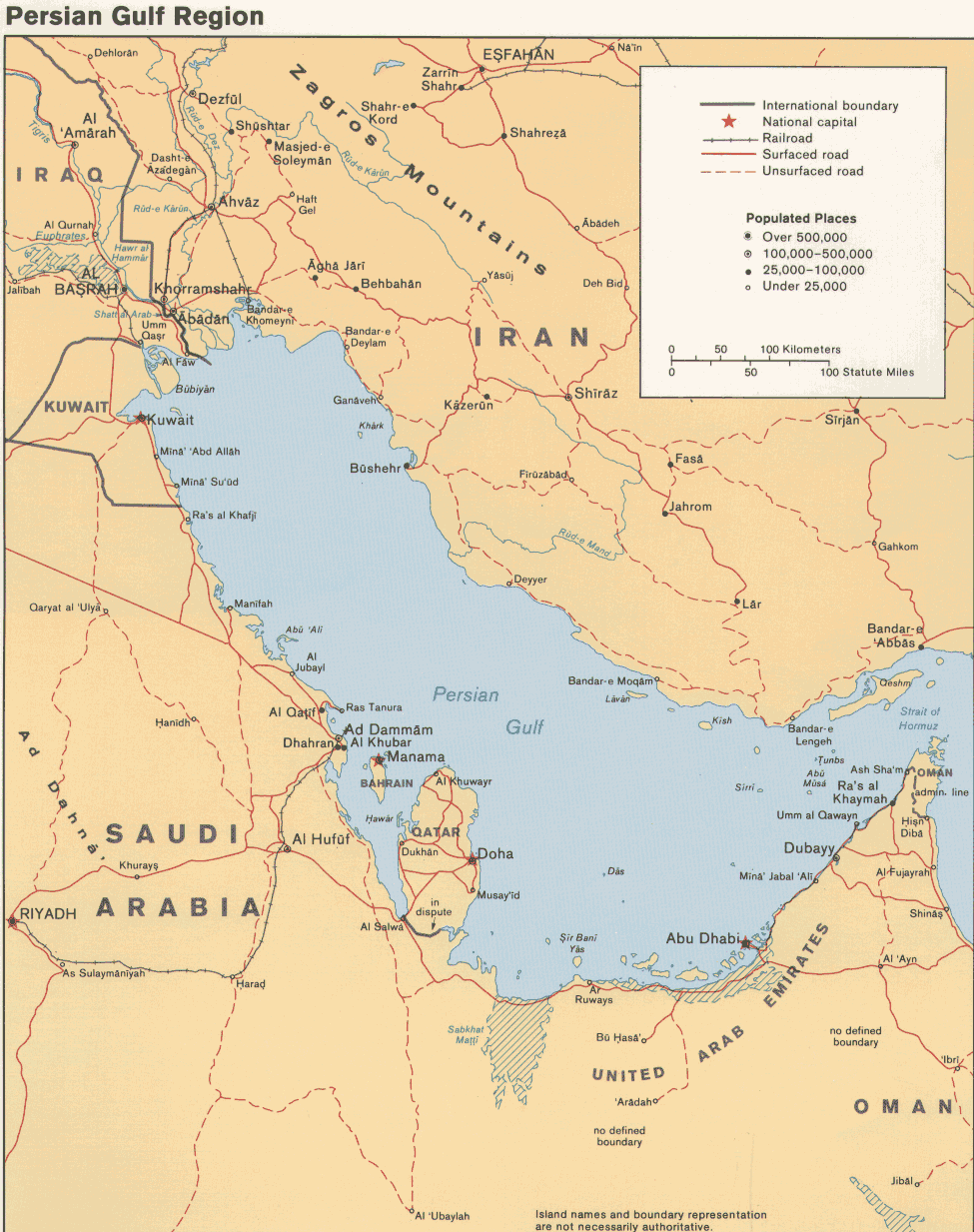
Well. It seems that the Mullahs in Iran have their turbans in a twist about an entry in the Navy Correspondence manual. It seems that they are deeply hurt and offended that the United States Navy has made official what we have been doing for decades.  We have offended these mangy Mullahs by using the nomenclature Arabian Gulf rather than the Persian Gulf for the body of water that lies between the Arabian Peninsula and the land formerly known as Persia.

You see for centuries this body of water was known as the Persian Gulf and everyone but the Arabs thought that it was okay.  But in the 20th century the Persian for some reason relabeled itself Iran for some ungodly reason. I mean they took a great historical brand name and chucked it for something that only the namby pamby do, they ran to I-ran. They even admit that they ran from the great label of Persia. Think of it, the Persians, ruled half the known world till the Greeks kicked their ass. I’m sure that was like the Yankees losing the 2004 ALCS to the Red Sox but the Yankees didn’t change their name to the Spankees did they? No they didn’t.  I’ll tell you what they did; they just went out and kept buying talent until they won another World Series.

Then they compounded their bad marketing by throwing out their King, taking hostages and doing all sorts of other unseemly stuff like not allowing women to wear mini-skirts or men to drink booze in public. I mean it was like they were trying to create Bob Jones University in the sand.  I for one think that one Bob Jones University is enough and by God it’s an American institution and shouldn’t be exported to people that won’t wear suits and power ties.

I’m sorry but these Iranians want us to keep calling the Arabian Gulf by a name they don’t even call their own country anymore. Sounds like whining to me. After all the only reason it was called the Persian Gulf was that they were the Big Kahuna way back when and stomped all over the Arabs whenever they could and the Arabs loathe them for it.  That’s why the Arabs want us to whack them and wouldn’t object to the Israelis doing it to though they wouldn’t say so publicly.  For crying out loud the Arabs have rights too and they have about the same amount of coastline around this body of water as the county that won’t call their own country Persia anymore.  Sounds like sour grapes to me.  I think that if you change your country name then any right you have to the old name goes away.  You don’t see the Washington Nationals putting on Montreal Expos uniforms on old timer’s day, no they use Washington Senators uniforms.

They act like the USA is insanely jealous of them. Like hell we are. We are a self confident bunch that believes that even if things are really sucky that we will find a way to make lemons out of lemonade even if we have to squeeze a lemon grower or two do it. If we were so petty we would be calling the Gulf of Mexico the Gulf of America because we like circle half of it and anytime oil spills it ends up on our shores not Mexico’s.  But we don’t spite our neighbors to the south by doing this because we’re better than that.  However if Mexico was to up and change its name to France or something like that we would be under no obligation to keep calling it the Gulf of Mexico would we? I dare say not. Pleasantries aside we tell them that if they don’t like their name we call the Gulf whatever we want. Of course the Mexicans have enough real pride and self respect not to rename their country unlike the country that used to be called Persia until they renamed it.

So the “proud” Iranians are upset. Perhaps if they start calling themselves Persia again they would have room for this whiney jibber-jabber. Until then my friends they can pound sand, which I understand that they have a great deal of in their country and the United States Navy can go ahead calling it whatever we want.

Two words my friends,

Padre Steve+

11 Comments

Filed under Loose thoughts and musings

Recovering My Spiritual Disciplines during Advent: Celtic Daily Prayer

A few months after I returned from Iraq my spiritual life fell apart. It felt like God was no longer there. It had been that way for a while but in June of 2008 the frustration and despair of the situation coupled with an emotional collapse had gotten the best of me and I stopped doing the various spiritual disciplines that had been an important part of my life as a Christian and Priest for years. I think the last really meaningful times that I had spent with God had been in Iraq and the sense of disorientation, loss and abandonment that I felt when I could no longer pray the Daily Office.

Now for those that don’t know what the Daily Office is, it is a form of prayer that is structured to included Psalms, Prayers and Scripture readings. There are a number of variants within the Anglican, Catholic and Orthodox traditions each with somewhat different emphasis but all similar. I would alternate between those from the Book of Common Prayer and the Catholic Liturgy of the hours. One year I did the Orthodox daily prayers.  I found different things in each that were helpful and version I found a lot that I liked and some things that I didn’t like as much.  The most helpful thing about the Daily Office for me was that it helped build an internal spiritual discipline and order in my life. Contrary to being limiting as some would think it was of great benefit.

However with my internal compass messed up and wondering if God even existed, the mere act of doing what used to bring order and joy to my life became an exercise in futility. I tried different rites to see if it was just me as well as different physical settings to see if something would work. None did and my spiritual crisis continued to grow as I felt estranged from my former church and felt abandoned by God and by some parts of the Navy.  Although I was struggling and people knew it no clergy of any kind asked about my spiritual life, it was my therapist that first asked me “how are you and the Big Guy doing?” I had to admit that I was not doing well with the “Big Guy” and wondered at times if he even existed.

I went through nearly two years of spiritual emptiness with glimmers of hope. Last year in what I describe as my “Christmas Miracle” faith began to return in the midst of the Sacrament of the anointing of the sick in our ER at Portsmouth Naval Medical Center.  In that simple act done on call at the in the final moments of a retired Navy doctor and Episcopal layman who had given himself to his church and the community faith returned.  He died as my hand was upon his head praying the final prayers of commendation. His wife said that he was holding on until I got there and a number of ER staff said that they had never seen anything like what happened.  When I left the next day I knew that something was different, I felt hope again and that maybe just maybe that God might very well exist.

This year has been a continuous yet slow time of spiritual growth. The act of prayer returned as did occasional spiritual reading and reflection. I also began to feel the sense of mystery and awe when celebrating or attending a Eucharist.  Now I was still struggling especially to rebuild my spiritual life, but after 2 years of not even knowing if God existed but it was a quantum improvement over being an agnostic.

Since moving to my new job I have been looking to see how to build structure back into my life using the daily office. I looked at the Roman Catholic Liturgy of the hours which I really like as well as the Book of Common Prayer which I had been using most recently but decided to wait until Advent and the new liturgical year to start. During this time one of my Chaplains shared the “Celtic Daily Prayer” of the Northumbria Community with me. I was hesitant to try something new at first but I respect this Chaplain who as an Evangelical Christian uses the Benedictine Daily Office of the Roman Catholic tradition.  One thing that attracted me to this variant of the Daily Office was its Celtic roots. Celtic Saints have played a part in my spiritual journey St Willibald of Eichstadt a Celtic missionary to Germany has the feast day associated with my ordination, his brother Wunibald an Abbott in Germany that of my Baptism, St Rupert of Salzburg my birthday and St Killian of Wurzburg  the Patron Saint of my first duty station as a Priest. I find great comfort and inspiration in the lives of these saints.

He loaned me his copy and over the weekend I began to explore it. Sunday night before going to bed I prayed the Sunday Night office of Compline.  Since the night is still one of my most difficult times when I struggle with insomnia as well as occasional nightmares, disturbing dreams and even on rare occasion night terrors related to my PTSD.  When I prayed this variant of Compline I felt peace descend and this morning I did the Morning Prayer. Of course I was at work and despite the fact that my door was closed it seemed everyone wanted my time. I was thinking, my God I’m trying to actually pray can’t I catch a break? I finally did and I really liked the order for Morning Prayer.  I am going to begin the Evening Prayer tomorrow and try to finish each night with the Office of Compline.   I am hopeful that the renewal that began last Advent in our ER will continue and become a major part of my spiritual renewal. I do like the basic vow of the Northumbria Community which is to live with Availability and Vulnerability
before God and others as one expression of living faithfully in a fragmented world. I have included the Sunday night Compline below.

Sunday – The Ita Compline

Ita, who died in about 570, was abbess of a women’s community in Killeedy, County Limerick in Ireland. She ran a school for boys where she taught: Faith in God with purity of heart; simplicity of life with religion; generosity with love.  Among those schooled by Ita was Brendan, who honoured her as his foster-mother and adviser. The Compline that follows is named after her because of its emphasis on examination of the heart, and the prayers of care and protection for each soul who crosses our path.

If this Compline is being used in a group setting the * notation indicates a change of reader; words in bold are said all together; words in bold italic are said by each person in turn; and + indicates where you might make the sign of the cross.

+ (silently)

The Sacred Three
to save
to shield
to surround
the hearth
the home
this night
and every night.

* Search me, O God, and know my heart.
Test me and know my thoughts.

* See if there is any wicked way in me
and lead me in the way everlasting.

O Father, O Son, O Holy Spirit,
forgive me my sins.
O only-begotten Son of the heavenly Father,
forgive.
O God who is one,
O God who is true,
O God who is first,
O God who is one substance,
O God only mighty,
in three Persons, truly merciful,
forgive.

* O God of life, this night,
O darken not to me Thy light.

* O God of life, this night,
close not Thy gladness to my sight.

* Keep Your people, Lord,
in the arms of Your embrace.
Shelter them under Your wings.

* Be their light in darkness.
Be their hope in distress.
Be their calm in anxiety.

* Be strength in their weakness.

* Be their comfort in pain.

* Be their song in the night.

In peace will I lie down, for it is You, O Lord,
You alone who makes me to rest secure.

* Be it on Your own beloved arm,
O God of grace, that I in peace shall awake.

Be the peace of the Spirit
mine this night.
Be the peace of the Son
mine this night.
Be the peace of the Father
mine this night.
The peace of all peace
be mine this night
+ in the name of the Father,
and of the Son,
and of the Holy Spirit.
Amen.

Peace

Padre Steve+

P.S. If you desire to find the Celtic Prayer of the Northumbria Community it can be found at their website: http://www.northumbriacommunity.org/pray-the-daily-office

Prayer request. I have been called into the hospital regarding a very sick young man in our ICU. Please pray for him as he is not doing well.

Leave a comment

Filed under christian life, faith, Pastoral Care, PTSD, Religion

New Pages and New Site Design

Today I revamped the site changing to the three column “Pilcrow” theme offered by WordPress which allowed me to get back to the three column format as well as do some things with the layout, header and color scheme. I have also added three new pages which allow the reader to better access articles on various subjects. I will be doing more of this in the coming days because many articles tend to get buried after a while and for all practical purposes disappear.

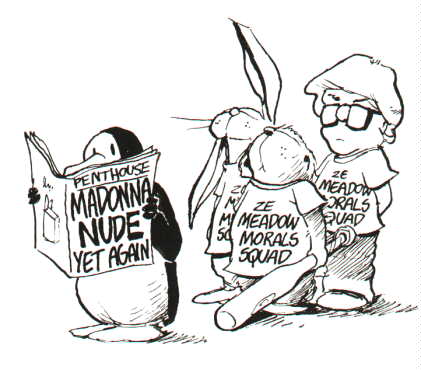
Now I know that my rabid readers from the Neo-Nazis, the wiki-leakers and any number of others would love for me to disappear as might some in the local morals squad that think I might push the envelope a bit, but oh well. Padre Steve’s World continues on better than ever.

Today I added pages for the 2010 MLB Post Season, the Weimar and Nazi Era and Pearl Harbor Articles.

Peace

Padre Steve+


Leave a comment

Filed under Loose thoughts and musings

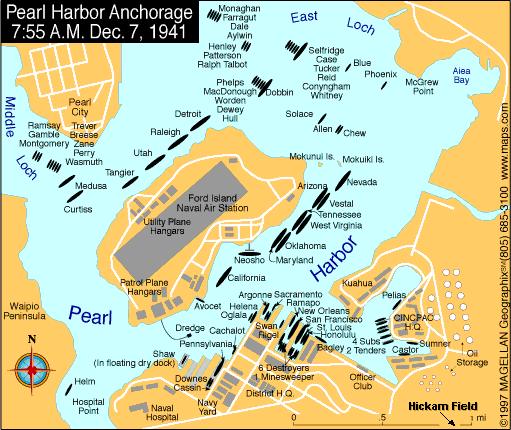
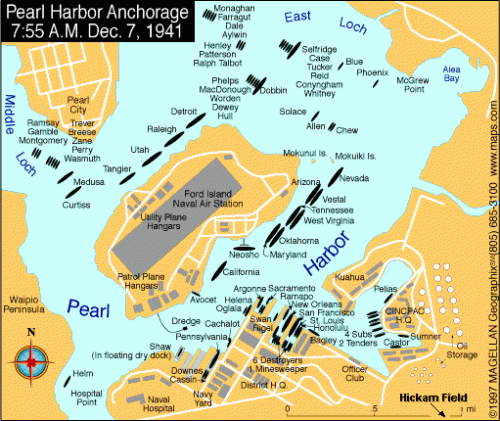
The Ships of Pearl Harbor: A Comprehensive List with Short Histories of Each Ship

Last year I wrote a piece called The Battleships of Pearl Harbor. I followed that with an article this year entitled “Forgotten on the Far Side of Ford Island: The USS Utah, USS Raleigh, USS Detroit and USS Tangier. Of course most anyone that has see either Tora! Tora! Tora! Or Pearl Harbor is acquainted with the attack on “Battleship Row” and the airfields on Oahu.  What are often overlooked in many accounts are the stories of some of the lesser known ships that played key roles or were damaged in the attack.  Since none of the articles that I have seen have discussed all of the U.S. Navy ships at Pearl Harbor on that fateful morning I have taken the time to list all the ships with the exception of yard and patrol craft present at Pearl Harbor on December 7th 1941.  I have also excluded Coast Guard cutters. A brief account of each ship’s war service and final disposition is included.  I believe that this is the only site that has this information in a single article.

During the attack 18 ships were sunk or damaged but only three, Arizona, Oklahoma and Utah never returned to service.  During the war a further 18 ships were sunk or written off as losses during the war. All ships lost in the war are marked with an asterisk. One ship, the USS Castor remained in active service until 1968 serving in the Korean and Vietnam Wars. One ship, the Light Cruiser Phoenix was sunk in the Falklands War while serving as the Argentine ship General Belgrano. No U.S. Navy ships apart from the Yard Tug Hoga (not included in this article) remain today.  It is unfortunate that the Navy or any organization had the foresight to save one of these ships. It would have been fitting for one of the battleships that survived the war to be preserved as a memorial ship near the Arizona Memorial. While the USS Missouri serves this purpose symbolic of the end of the war it is a pity that no ship at Pearl Harbor was preserved so that people could see for themselves what these gallant ships was like.

Battleships


Nevada (BB-36) Nevada was the only Battleship to get underway during the attack.  As she attempted to escape the harbor she was heavily damaged and to prevent her sinking in the main channel she was beached off Hospital Point.  She would be raised and returned to service by the May 1943 assault on Attu.  She would then return to the Atlantic where she would take part in the Normandy landings off Utah Beach and the invasion of southern France in July 1944.  She then returned to the Pacific and took part in the operations against Iwo Jima and Okinawa where she again provided naval gunfire support.  Following the war she would be assigned as a target at the Bikini atoll atomic bomb tests, surviving these she would be sunk as a target on 31 July 1948. She received 7 battle stars for her WWII service.

*Oklahoma (BB-37) During the Pearl Harbor attack Oklahoma was struck by 5 aerial torpedoes capsized and sank at her mooring with the loss of 415 officers and crew. Her hulk would be raised but she would never again see service and sank on the way to the breakers in 1946.  She was awarded one battle star for her service during the attack.

Pennsylvania (BB-38) Pennsylvania was the Pacific Fleet Flagship on December 7th 1941 and was in dry dock undergoing maintenance at the time of the attack. Struck by two bombs she received minor damage and would be in action in early 1942. She underwent minor refits and took part in many amphibious landings in the Pacific and was present at the Battle of Surigo Strait.  Heavily damaged by an aerial torpedo at Okinawa Pennsylvania would be repaired and following the war used as a target for the atomic bomb tests. She was sunk as a gunnery target in 1948.  She received 8 battle stars for her WWII service.

*Arizona (BB-39) Arizona was destroyed during the attack.  Hit by 8 armor piercing bombs one of which penetrated her forward black powder magazine she was consumed in a cataclysmic explosion which killed 1103 of her 1400 member crew.  She was decommissioned as a war loss but her colors are raised and lowered every day over the Memorial which sits astride her broken hull.  She received one battle star for her service at Pearl Harbor.

Tennessee (BB-43) Tennessee was damaged by two bombs and was shield from torpedo hits by West Virginia. After repairs she conducted operations in the Pacific until she reported to Puget Sound Naval Shipyard in August 1942 for a complete rebuild and modernized with the latest in radar, fire control equipment and anti-aircraft armaments. She returned to active service in May 1943. She provided Naval Gunfire support in numerous amphibious operations and was a key ship during the Battle of Surigo Strait firing in six-gun salvos to make careful use of her limited supply of armor-piercing projectiles, Tennessee got off 69 of her big 14-inch bullets before checking fire.  Her gunfire helped sink the Japanese Battleships Fuso and Yamishiro and other ships of Admiral Nishimura’s Southern Force.  She was damaged by a Kamikaze off Okinawa on 18 April 1945 which killed 22 and wounded 107 of her crew but did not put her out of action.  Her final assignment of the war was to cover the landing of occupation troops at Wakayama, Japan.  She was decommissioned in 1947 and remained in reserve until 1959 when she was sold for scrap. Tennessee earned a Navy Unit Commendation and 10 battles stars for World War II service.

California (BB-44) California was hit by two torpedoes but had the bad luck to have all of her major watertight hatches unhinged in preparation for an inspection. Hit by two torpedoes and two bombs she sank at her moorings suffering the loss of 98 killed and 61 wounded. She was refloated and received temporary repairs at Pearl Harbor before sailing to Puget Sound Naval Shipyard to be completely rebuilt and modernized with the latest in radar, fire control equipment and anti-aircraft armaments. She returned to service in January 1944. She saw her first action in the Marianas and was in continuous action to the end of the war. She played an important part in the Battle of Surigo Strait and in the amphibious landings at Guam and Tinian, Leyte, Iwo Jima and Okinawa.  She was decommissioned in 1947 and placed in reserve finally being sold for scrap in 1959. She received 7 battle stars for her WWII service.

Maryland (BB-45) At Pearl Harbor Maryland was moored inboard of Oklahoma and was hit by 2 bombs.  She would be quickly repaired and returned to action and receive minimal modernization during the war. She would participate in operations throughout the entirety of the Pacific Campaign providing naval gunfire support to the landings at Tarawa, Kwajalein, Saipan, where she was damaged by an aerial torpedo, Palau, Leyte where she was damaged by a Kamikaze, Okinawa and the battleship action at Surigo Strait.  Decommissioned in 1947 she was placed in reserve and sold for scrap in 1959. On 2 June 1961 the Honorable J. Millard Tawes, Governor of Maryland, dedicated a lasting monument to the memory of the venerable battleship and her fighting men. Built of granite and bronze and incorporating the bell of “Fighting Mary,” this monument honors a ship and her 258 men who gave their lives while serving aboard her in WWII.  This monument is located on the grounds of the State House, Annapolis, Md. Maryland received seven battle stars for World War II service.

West Virginia (BB-48) West Virginia suffered some of the worst damage in the attack. Hit by at least 5 torpedoes and two bombs she was saved from Oklahoma’s fate by the quick action of her damage control officer to counter flood so she would sink on an even keel.  She would be raised, refloated and taken back to the West Coast for an extensive modernization on the order of the Tennessee and California. The last Pearl Harbor battleship to re-enter service she made up for lost time as she lead the battle line at Surigo Strait firing 16 full salvos at the Japanese squadron helping sink the Japanese Battleship Yamashiro in the last battleship versus battleship action in historyWest Virginia was decommissioned in 1947, placed in reserve and sold for scrap in 1959.

Heavy Cruisers

New Orleans (CA-32) Minor shrapnel damage from near miss. Fought throughout the war in the Pacific; bow blown off by Japanese torpedo at Battle of Trassafaronga in November 1942, repaired. 17 battle stars for WWII service, decommissioned 1947 and sold for scrap in 1957

San Francisco (CA-38 Undamaged at Pearl Harbor, fought through Pacific war, most noted for actions at the Naval Battle of Guadalcanal fighting Japanese Battleship Hiei. Decommissioned 1946 and sold for scrap in 1959. San Francisco earned 17 battle stars during World War II. For her participation in the Naval Battle of Guadalcanal, she was awarded the Presidential Unit Citation. For the same action, three members of her crew were awarded the Medal of Honor: Lieutenant Commander Herbert E. Schonland, Lieutenant Commander Bruce McCandless , and Boatswain’s Mate 1st Class Reinhardt J. Keppler (posthumous). Admiral Daniel Callaghan was also awarded the Medal of Honor (posthumous).  During the November 1942 repair at Mare Island, it was necessary to extensively rebuild the bridge. The bridge wings were removed as part of that repair, and are now mounted on a promontory in Lands End, San Francisco at Golden Gate National Recreation Area overlooking the Pacific Ocean. They are set on the great circle course from San Francisco  to Guadalcanal.  The old ship’s bell is housed at the Marines Memorial Club in San Francisco.

Light Cruisers

Raleigh (CL-7) Heavily damaged by torpedo, repaired served throughout war mainly in North Pacific . Decommissioned 1945 and scrapped 1946

Detroit (CL-8) Undamaged and got underway during attack. Mainly served in North Pacific and on convoy duty earning 6 battle stars for WWII service, decommissioned and sold for scrap 1946

Phoenix (CL-46) Undamaged at Pearl Harbor and served throughout war and at the Battle of Surigo Strait she helped sink the Japanese Battleship Fuso.  She earned 9 battle stars for WWII service. Decommissioned 1946 and transferred to Argentina 1951. Served as General Belgrano and sunk by submarine HMS Conqueror on 2 May 1982 during the Falklands War.

Honolulu (CL-48) Suffered minor hull damage from near miss. Served in Pacific and fought several engagements against Japanese surface forces in the Solomons. At the Battle of Kolombangara on the night of 12-13 July 1943 she was damaged by a torpedo but sank the Japanese Light Cruiser Jintsu. Earned 9 battle stars for WWII service, decommissioned 1947 and sold for scrap 1949

St. Louis (CL-49) St. Louis got underway at 0930 nearly torpedoed by Japanese midget sub. She served throughout war in numerous operations and was damaged at the Battle of Kolombangara. She earned 11 battle stars for WWII service. She decommissioned 1946 and transferred to Brazil where she was renamed Tamandare stricken in 1976 sold for scrap in 1980 but sank while under tow to Taiwan.

*Helena (CL-50) Damaged and repaired. Engaged in many battles around Solomon Islands where at the Battle of Cape Esperance at Guadalcanal she sank the Japanese Heavy Cruiser Furutaka and destroyer Fubiki. She was engaged during the Naval Battle of Guadalcanal and was sunk at Battle of Kula Gulf 6 July 1943.  She was the first ship to be awarded the Naval Unit Commendation and was awarded 7 battle stars for her WWII service.

Destroyers

Allen (DD-66) Undamaged during attack spent war in local operations in Oahu area. Decommissioned 1945 and scrapped 1946

Schley (DD-103) Being overhauled on December 7th was undamaged in attack. Converted into High Speed Transport (APD) in 1942, earned 11 battle stars for WWII service and decommissioned in 1945 and scrapped in 1946

Chew (DD-106) Undamaged during attack and conducted local operations in Oahu operations for remainder or war, decommissioned 1945 and scrapped 1946

*Ward (DD-139) Ward was underway patrolling Channel entrance to Pearl Harbor on December 7th, sank Japanese midget submarine. Converted to APD in 1943 and served in numerous operations prior to being heavily damaged by Japanese bombers at Ormoc Bay off Leyte in December 1944 starting fires that could not be controlled. She was sunk by USS O’Brien (DD-725) after survivors were rescued. By a strange twist of fate the C.O. of O’Brien LCDR Outerbridge who had commanded Ward when she sank the Japanese submarine at Pearl Harbor. Ward earned 10 battle stars for WWII service.

Dewey (DD-349) Being overhauled on December 7th Dewey served throughout the war earning 13 battle stars escorting carriers, convoys and supporting amphibious operations. Decommissioned October 1945 and sold for scrap 1946

Farragut (DD-348) Got underway during attack suffered minor damage from strafing. During the war she operated from the Aleutians to the South Pacific and Central Pacific escorting carriers and supporting amphibious operations. She earned 14 battle stars for WWII service. Decommissioned 1945 and sold for scrap 1947

*Hull (DD-350) Undamaged at Pearl Harbor she operated from the Aleutians to the South Pacific and Central Pacific escorting carriers and supporting amphibious operations. She earned 10 battle stars before sinking in “Halsey’s Typhoon” on 18 December 1944.

MacDonough (DD-351) MacDonough got underway during attack and was undamaged, during war served in North and Central Pacific escorting carriers and supporting amphibious operations. She earned 13 battle stars for her WWII service. Decommissioned October 1945 and sold for scrap 1946

*Worden (DD-352) Worden got underway during attack and went to sea with ships searching for Japanese strike force. Served at Midway and the South Pacific before being transferred to the Aleutians where she grounded on a pinnacle due to winds and currents at Constantine Harbor Amchitka Island on 12 January 193, she broke up in the surf and was written off as a total loss. Worden was awarded 4 battle stars for her WWII service.

Dale (DD-353) Dale got underway immediately under the command of her Command Duty Officer, an Ensign and joined ships searching for Japanese strike force. During war served in North and Central Pacific and took part in the Battle of the Komandorski Islands on 26 March 1943.  Earned 12 battle stars for WWII service, decommissioned October 1945 sold for scrap December 1946.

*Monaghan (DD-354)  Monaghan was the Ready destroyer on December 7th and ordered underway when Ward sank the midget submarine. On way out of harbor rammed, depth charged and sank a Japanese midget submarine that had gotten into Pearl Harbor. She participated in Coral Sea, Midway, Aleutians, the Battle of the Komandorski Islands and Central Pacific operations before sinking with the loss of all but 6 crewmen during the great Typhoon of November 1944 sinking on 17 November. She received 12 battle stars for her WWII service.

Aylwin (DD-355) Got underway within an hour of the beginning of the attack with 50% of her crew and four officers, all Ensigns manning her leaving her Commanding Officer and others behind in a launch as she was under direction not to stop for anything. This was captured in the movie In Harm’s Way. During the war Aylwin saw action at Coral Sea, Midway, Guadalcanal, the Aleutians, and the Central Pacific up to the Okinawa and due to the action of her crew survived the great typhoon of November 1944. She earned 13 battle stars for her WWII service and was decommissioned in October 1945. She was sold for scrap in December 1946.

Selfridge (DD-357) Manned by a crew from 7 different ships Selfridge got underway at 1300 and was undamaged in the attack. Throughout war she served primarily as an escort to carriers and transports. Torpedoed by Japanese destroyer and lost her bow at Battle of Vella Lavella on 6 October 1942. Repaired and finished war. Earned 4 battle stars for WWII service and was decommissioned in October 1945 and sold for scrap in December 1946.

Phelps (DD-360) Undamaged at Pearl Harbor Phelps was credited with shooting down one enemy aircraft. She was in action at Coral Sea, Midway, Guadalcanal, the Aleutians and the Central Pacific picking up 12 battle stars for her WWII service. Decommissioned in October 1945 and scrapped 1947.

Cummings (DD-365) Sustained minor damage from bomb fragments but got underway quickly. During war served on convoy escort, with fast carrier task forces and provided Naval Gunfire Support from the Aleutians to the Indian Ocean where she operated with the Royal Navy. On 12 August 1944, President Roosevelt broadcast a nationwide address from the forecastle of Cummings after a trip the Alaska. Cummings was decommissioned in December 1945 and sold for scrap in 1947.

*Reid (DD-369) Undamaged at Pearl Harbor Reid escorted convoys and amphibious operations throughout the Pacific until she was sunk by Kamikazes at Ormoc Bay in the Philippines on 11 December 1944. On 31 August 1942 she sank by gunfire the Japanese submarine RO-1 off Adak Alaska. She received 7 battle stars for her WWII service.

Case (DD-370) Undamaged at Pearl Harbor Case escorted the fast carrier task forces throughout much of the war as well as conducted Anti-Submarine Warfare operations and Naval Gunfire Support. She sank a Midget submarine outside the fleet anchorage at Ulithi on 20 November 1944 and a Japanese transport off of Iwo Jima on 24 December 1944. She earned 7 battle stars for her WWII service and was decommissioned in December 1945 and sold for scrap in December 1947.

Conyngham (DD-371) Undamaged during attack she was underway that afternoon. Spent most of war on convoy escort, escorting carrier task forces and conducting Naval Gunfire Support missions she was damaged twice by strafing Japanese aircraft she earned 14 battle stars for her WWII service. Used in 1946 Atomic Bomb tests and destroyed by sinking in 1948.

Cassin (DD-372) Destroyed in drydock but salvaged returned to service 1944 escorting convoys and TG 38.1 the Battle Force of the fleet at Leyte Gulf as well as supporting amphibious operations. She earned 6 battle stars for her WWII service.  Decommissioned December 1945 and sold for scrap 1947

Shaw (DD-373) Sustained massive damage due to magazine explosion, salvaged and repaired served throughout war and awarded 11 battle stars. Damaged by Japanese dive bombers off Cape Gloucester on 25 December 1943 with loss of 3 killed and 33 wounded. Decommissioned October 1945 and scrapped 1947

*Tucker (DD-374) Undamaged at Pearl Harbor Tucker conducted convoy escort operations and was sunk when she struck a mine escorting a transport to Espiritu Santo on 1 August 1942 sinking on 4 August. She received one battle star for her WWII service.

Downes (DD-375) Destroyed in drydock and salvaged. Decommissioned June 1942, rebuilt and recommissioned 1943. After she was recommissioned and used to escort convoys and conduct Naval Gunfire Support to amphibious operations. She earned 4 battle stars for her WWII service. Decommissioned 1947 and sold for scrap.

Bagley (DD-386) Undamaged at Pearl Harbor Bagley conducted convoy escort operations and supported amphibious landings throughout the Pacific earning 1 battle stars ended the war on occupation duty at the Sasebo-Nagasaki area until returning to the United States. She earned 12 battle stars for her WWII service and was decommissioned in June 1946 and sold for scrap in October 1947.

*Blue (DD-387) Blue was undamaged and got underway during the attack under the direction of 4 Ensigns.  Served on convoy escort duties, present at Battle of Savo Island on 9 August 192 and was torpedoed off Guadalcanal by Japanese destroyer Kawakaze on 21 August and was scuttled 22 August. She earned five battle stars for her WWII service.

Helm (DD-388) Helm was underway, nearing West Loch at the time of the attack. Helm served in the Solomons and the South Pacific until February 19. She joined the fast carrier task forces of 5th Fleet in May 1944. On 28 October at Leyte Gulf 28 October 1944 Helm and companion destroyer Gridley made sank the Japanese submarine I-46. She was used for a target during Operation Crossroads and scrapped in 1946. She received 11 battle stars for her WWII service.

Mugford (DD-389) Mugford was on standby status and had steam up which allowed her to get to sea during the attack in which she shot down Japanese aircraft. She spent much of 1942 on convoy duty between the U.S. and Australia. She took part in the Guadalcanal invasion and was struck by a bomb which killed 8 men, wounded 17 and left 10 missing in action. She would go on to serve in the Central and South Pacific being damaged by a near miss from a bomb on 25 December off Cape Gloucester and was stuck by a Kamikaze on 5 December 1944 in Surigo Strait. She escorted the fast carriers of TF 8 and 58 and later served on anti-submarine and radar picket duty. She decommissioned 1946 and was used in the Atomic Bomb tests and after use as a test ship for radioactive decontamination was sunk on 22 March 1948 at Kwajalein. She received 7 battle stars for her WWII service.

Ralph Talbot (DD-390) Ralph Talbot got underway by 0900 on the morning of the attack and joined other ships at sea attempting to find the Japanese strike force. She spent much of 1942 engaged in escort duties and took part in the Battle of Savo Island where she engaged the Japanese as part of the Northern Group and was damaged by Japanese shellfire. She spent the war in the South and Central Pacific escorting convoys and supporting amphibious operations and was damaged by a Kamikaze off Okinawa. She remained in service until 1946 when she was assigned to JTF-1 and the Operations Crossroads Atomic Bomb test. She survived the blast and was sunk in 198. She earned 12 battle stars for her WWII service.

*Henley (DD-391) Undamaged at Pearl Harbor Henley was already at General Quarters when the attack began because a new sailor sounded the General Quarters alarm instead of Quarters for Muster. As a result her weapons were manned. She got underway during the attack under the command of a junior Lieutenant and joined other ships patrolling outside of Pearl Harbor. Henley carried out convoy and anti-submarine patrols mainly around Australian continuing those duties through the Guadalcanal campaign. She was torpedoed and sunk by Japanese bombers on 3 October 1943 while conducting a sweep in support of troops ashore near Finshafen New Guinea. Henley earned 4 battle stars for her WWII service.

Patterson (DD-392) Patterson was undamaged during the attack and proceeded to sea conducting anti-submarine warfare patrols. She would spend the bulk of the war as an escort for fast carrier task forces. She was with the Southern Group during the Battle of Savo Island and suffered a hit on her #4 gun mount that killed 10 sailors.  She was awarded 13 battle stars for her WWII service. Decommissioned in November 1945 she was stricken from the Naval Vessel Register in 1947 and sold for scrap.

*Jarvis (DD-393) Jarvis survived Pearl Harbor undamaged and got underway to join other ships in patrols around Oahu.  She served as an escort for carriers and convoys and the invasion of Guadalcanal. She was heavily damaged by an aircraft launched torpedo during the landings but her crew made temporary repairs and restored power. She was ordered to Efate New Hebrides but evidently unaware of the order her Commanding Officer set sail for Sidney Australian and repairs from the Destroyer Tender USS Dobbin. She passed south of Savo Island as the Japanese cruiser force approached and refused assistance for the USS Blue.  She was last seen on the morning of 9 August 1942 by a scout plane from Saratoga. Already heavily damaged and having little speed, no radio communications and few operable guns was attacked by a force of 31 Japanese bombers sinking with all hands at 1300 on 9 August. Jarvis was awarded 3 battle stars for her WWII service.

Submarines

Narwhal (SS-167) Narwhal was one of a class of three large cruiser submarines that was built in the mid 1920s. Narwhal was 14 years old at the time of the attack. She was undamaged at Pearl Harbor and was used primarily to support special missions and special operations forces in raids against Japanese shore installations. Narwhal earned 15 battle stars for her service in the Pacific and was decommissioned in February 1945 and sold for scrap in May. Her 6” guns are enshrined at the Naval Submarine Base Groton.

Dolphin (SS-169) Undamaged in the Pearl Harbor attack Dolphin made 3 war patrols in late 1941 and early 1942 before being withdrawn from combat service and used for training due to her age. She was decommissioned in October 1945 and sold for scrap in 1946. She received 2 battle stars for her service in WWII.

Cachalot (SS-170) Undamaged at Pearl Harbor Cachalot conducted three war patrols damaging an enemy tanker before being withdrawn from combat service in the fall of 1942 being judged too old for arduous combat service. She served as a training ship until June 1945 and was decommissioned in October 1945 and sold for scrap in January 1947. She was awarded 3 battle stars for her WWII service.

Tautog (SS-199) Tautog was undamaged at Pearl Harbor and made the Japanese pay for not sinking her. She helped avenge the Pearl Harbor attack sinking 26 enemy ships of 71,900 tons including the submarines RO-30 and I-28 and destroyers Isoname and Shirakumo in 13 war patrols. She was withdrawn from combat service in April 1945 and served and operated in conjunction with the University of California’s Department of War Research in experimenting with new equipment which it had developed to improve submarine safety. She was decommissioned in December 1945. Spared from the Atomic Bomb tests she served as an immobile reserve training ship in the Great Lakes until 1957 and was scrapped in 1960.  Tautog was awarded 14 battle stars and a Naval Unit Commendation for her service in WWII.

Minelayer

Oglala (CM-4) Sank due to concussion from torpedo hit on Helena. Raised and repaired, converted to internal combustion repair ship. Decommissioned 1946 transferred to Maritime Commission custody and scrapped 1965

Minesweepers

Turkey (AM-13) Undamaged at Pearl Harbor she was redesignated as a Fleet Tug in 1942. She was decommissioned in November 1945 and sold for scrap in 1946. She received one battle star for her service at Pearl Harbor.

Bobolink (AM-20) Undamaged at Pearl Harbor and redesignated as an Ocean Going Tug in 1942. She decommissioned in 1946 and sold through the Maritime Administration. She received one battle star for her service at Pearl Harbor.

Rail (AM-26) Undamaged at Pearl Harbor Rail was redesignated as a Ocean Going Tug in June 1942. She supported operations throughout the Pacific earning 6 battle stars for her WWII service. She was decommissioned in 1946 and transferred to the Maritime Administration for disposal in 1947.

Tern (AM-31) Undamaged in the attack Tern was redesignated as an Ocean Going Tug in June 1942 and supported the fleet for the remainder of the war. She was decommissioned and struck from the Navy List in December 1945. She earned one battle star for her service at Pearl Harbor.

*Grebe (AM-43) Undamaged at Pearl Harbor Grebe was redesignated as an Ocean Going Tug in June 1942.  On 6 December 1942 Grebe grounded while attempting to float SS Thomas A. Edison at Vuanta Vatoa, Fiji Islands. Salvage operations were broken up by a hurricane that destroyed both ships 1-2 January 1943.

Vireo (AM-52) Undamaged at Pearl Harbor Vireo was designated an Ocean Going Tug in May 1942. At the Battle of Midway she was assisting USS Yorktown CV-5 when that ship was torpedoed by a Japanese submarine and sunk.  She was damaged in a Japanese air strike off Guadalcanal on October 15th 1942 abandoned but recovered by U.S. Forces and repaired supporting damaged fleet units. She was decommissioned in 1946 and disposed of by the Maritime Administration in 1947. Her final disposition is unknown. She was awarded 7 battle stars for her WWII service.

Coastal Minesweepers

Cockatoo (AMC-8) Undamaged at Pearl Harbor Cockatoo operated in the 14th Naval District from Pearl Harbor throughout the war. She was transferred to the Maritime Commission 23 September 1946.

Crossbill (AMC-9) Undamaged in the attack she operated in an in-service status attached to the 14th Naval District from 1941 to 1947.

Condor (AMC-14) Undamaged in the attack she operated in the Hawaiian Islands throughout World War II. Placed out of service 17 January 1946, she was transferred to the Maritime Commission for disposal 24 July 1946.

Reedbird (AMC-30) Undamaged during the attack she operated in Hawaiian waters throughout World War II. Then ordered inactivated, Reedbird returned to San Diego where she was stripped and placed out of service 14 January 1946. Her name was struck from the Navy list 7 February 1946 and on 8 November 1946 she was delivered to the Maritime Commission for disposal.

Light Minelayers (Note: All of these ships were WWI era “four piper” destroyers converted to Mine Warfare ships in the 1920s and 1930s)

*Gamble (DM-15) Gamble was undamaged at Pearl Harbor and served throughout the Pacific. On 29 August 1942 she sank Japanese submarine I-123 near Guadalcanal. On 6 May 1943 she mined the Blackett Strait with her sisters USS Preble and USS Breese. On the night of 7-8 May a Japanese destroyer force entered the minefield one of which Kurashio, went down and two others Oyashio and Kagero were sunk by Allied aircraft the next day. The sinking of Kagero provided a measure of revenge as that ship was part of the Japanese Carrier Strike Group that attacked Pearl Harbor. On 18 February 1945 Gamble was damaged by two bombs while operating off of Iwo Jima. Badly damaged she was towed to Saipan but salvage was impossible and she was decommissioned sunk off of Apra Harbor Guam on 16 July 1945. She was awarded 7 battle stars for her WWII service.

Ramsay (DM-16) Ramsey got underway during the attack and dropped depth charges in the vicinity of what was believed to be a midget submarine. She served in the Solomons and Aleutians and was redesignated as a Miscellaneous Auxiliary (AG-98) in 1944 operating around Pearl Harbor. She was decommissioned in October 1945 and scrapped in 1946. She received 3 battle stars for her WWII service.

*Montgomery (DM-17) Undamaged in the attack Montgomery conducted ASW operations in the wake of the attack. She operated throughout the Pacific until she was damaged by a mine while anchored off Ngulu on 17 October 1944. She was decommissioned on 23 April 1945 and sold for scrap in 1946. She was awarded 4 battle stars for her WWII service.

Breese (DM-18) Breese got underway during the attack and assisted in sinking a midget submarine. She was engaged throughout the war in the Pacific and operated with Gamble and Preble to mine the Blackett Strait in May 1943, an operation that resulted in the sinking of 3 Japanese destroyers. She was decommissioned and sold for scrap in 1946. She was awarded 10 battle stars for her WWII service.

Tracy (DM-19) Tracy was being overhauled during the attack and all machinery and armament was dismounted.  After the overhaul she operated around the Pacific and in February 1943 she Tracy, as task group leader, led Montgomery (DM-17) and Preble (DM-20) in laying a field of 300 mines between Doma Reef and Cape Esperance. That night, Japanese destroyer Makigumo struck one of these mines and was damaged so badly that she was scuttled. Tracy was decommissioned and scrapped in 1946. She received 7 battle stars for her WWII service.

Preble (DM-20) Preble was being overhauled on December 7th and took no part in the action. During the war she operated throughout the Pacific and in company with Gamble and Breese laid a minefield on 6 May 1943 which resulted in sinking 3 Japanese destroyers. She was redesignated as a Miscellaneous Auxiliary (AG-99) and she was regulated to convoy escort duties until the end of the war. She was decommissioned in December 1945 and sold for scrap in 1946. She was awarded 8 battle stars for WWII service.

Sicard (DM-21) Sicard was under overhaul at the Naval Shipyard during the attack. During the war she primarily served on convoy escort duty with and in some mine laying operations. She was reclassified a miscellaneous auxiliary, AG-100, effective 5 June 1945, decommissioned in December 1945 and sold for scrap in 1946. She was awarded 2 battle stars for her WWII service.

Pruitt (DM-22) Pruitt was being overhauled during the attack and served throughout the Pacific during the war. She was reclassified a miscellaneous auxiliary, AG-101, effective 5 June 1945, decommissioned November and stricken from the Navy List in December 1945 being scrapped at Philadelphia Naval Shipyard. She was awarded 3 battle stars for her WWII service.

High Speed Minesweepers (Note: All of these ships were WWI era “four piper” destroyers converted to Mine Warfare ships in the 1920s and 1930s)

Zane (DMS-14) Undamaged at Pearl Harbor Zane saw much service in the South and Central Pacific in WWII. She conducted minesweeping, convoy escort and ASW operations from Pearl Harbor to the Marianas campaign. She was damaged in a firefight with Japanese destroyers at Guadalcanal in 1942.  After the invasion of Guam she was reassigned to target towing duties. Reclassified from high-speed minesweeper to a miscellaneous auxiliary, AG-109, on 5 June 1945 she decommissioned in December 1945 and sold for scrap in 1946. She was awarded 6 battle stars and a Naval Unit Commendation for her service in WWII.

*Wasmuth  (DMS-15) Wasmuth was undamaged during the attack and spent 1942  conducting patrol and convoy escort duties in the Aleutians and the West Coast. On 27 December 1942 while escorting a convoy in heavy seas two of her depth charges were ripped off their racks and exploded under her fantail blowing off her stern.  Despite repair attempts her crew was evacuated and she sank on 29 December 1942. She was awarded one battle star for her service at Pearl Harbor.

Trever (DMS-16) Trever got underway during the attack without her Commanding Officer. During the war she saw extensive service. In 1945 she was regulated to training and local operations around Pearl Harbor. On 4 June 1945, she was reclassified as a miscellaneous auxiliary and designated as AG-110 and decommissioned in December 1945 and sold for scrapping in 1946. She received 5 battle stars for her WWII service.

*Perry (DMS-17) Perry got underway during the attack and was undamaged. During the war she engaged in numerous minesweeping and escort duties. She struck a mine during the Peleliu invasion off Florida Island and sank on 6 September 1944. She was awarded 6 battle stars for her WWII service.

Gunboat

Sacramento (PG-19) The elderly Sacramento was undamaged during the attack and participated in rescue and salvage operations after the attack. During the war she served as a tender for PT Boats and an air sea rescue vessel.  Sacramento was decommissioned on 6 February 1946 at Suisun Bay, Calif., and simultaneously transferred to the War Shipping Administration for disposal. She was sold on 23 August 1947 for mercantile service, initially operating under Italian registry as Fermina. She received one battle star for her service at Pearl Harbor.

Destroyer Tenders

Dobbin (AD-3) Dobbin received minor damage from a bomb burst alongside which killed 2 crewmembers.  During the war she would serve in the South Pacific supporting Pacific Fleet Destroyer Squadrons. She was decommissioned and transferred to the Maritime Administration in 1946. She was awarded one battle star for her service at Pearl Harbor.

Whitney (AD-4) Whitney was moored with a nest of destroyers during the attack and helped them prepare for sea during the attack issuing supplies and ammunition to help them get underway. Her sailors helped in repair and salvage operations on several ships during and after the attack.  She would provide vital support to destroyer squadrons during the war and serve until 1946 when she was decommissioned and transferred to the Maritime Administration and scrapped in 1948. She received one battle star for her service at Pearl Harbor.

Seaplane Tenders

Curtiss (AV-4) Damaged by bomb and repaired. She served throughout the war and was damaged by a  Kamikaze in 1945 while operating off Okinawa. Repaired she finished the war and served on active duty until 1956 when she was decommissioned and placed in reserve. She was scrapped 1972. Curtiss received 7 battle stars for her WWII service.

Tangier (AV-8) Moored just past the USS Utah Tangier was undamaged in the attack and contributed her guns to the air defense as well as shooting at a Japanese midget submarine that had penetrated the harbor. She maintained a very active operational carrier in the Pacific. Decommissioned in 1946 Tangier was sold for scrap in 1961. She earned 3 battle stars for her WWII service.

Seaplane Tenders (Small)

Avocet (AVP-4) Undamaged at Pearl Harbor Avocet Avocet served in the Alaskan and Aleutian theatres of operations as a unit of Patrol Wing 4. During the years, she tended patrol squadrons, transported personnel and cargo, and participated in patrol, survey, and salvage duties. She was decommissioned in December 1945 and sold in 1946. She received one battle star for her service at Pearl Harbor.

Swan (AVP-7) Swan was on the Marine Railway drydock during the attack and was undamaged. During the war she was primarily used on target towing duties. She was decommissioned in December 1945 and disposed of by the Maritime Commission in 1946. She received one battle star for her service at Pearl Harbor.

Seaplane Tenders (Destroyer) (Note: All of these ships were WWI era “four piper” destroyers converted to Seaplane Tenders in the 1920s and 1930s)

Hulbert (AVD-6) Hulbert was undamaged during the attack and spent 1942-1943 conducting support missions for flying boats. Reclassified DD-342 she was used as an escort and plane guard for new Escort Carriers at San Diego until the end of the war. She was decommissioned in November 1945 and sold for scrap in 1946. She received 2 battle stars for her WWII service.

*Thornton (AVD-11) Thornton contributed her guns to the defense of Pearl Harbor and served in varying locales in the Pacific supporting the operations of flying boats. She was lost during the Okinawa invasion when collided with Ashtabula (AO-51) and Escalante (AO-70). Her starboard side was severely damaged. She was towed to Kerama Retto. On 29 May 1945 a board of inspection and survey recommended that Thornton be decommissioned, beached stripped of all useful materiel as needed, and then abandoned. She was beached and decommissioned on 2 May 1945. Her name was struck from the Navy list on 13 August 1945. In July 1957, Thornton’s abandoned hulk was donated to the government of the Ryukyu Islands. She received 3 battle stars for her WWII service.

Ammunition Ship

Pyro (AE-1) Pyro was undamaged in the attack and served the war transporting ammunition to naval bases around the Pacific. She was decommissioned in 1946 and scrapped in 1950. She was awarded one battle star for her service at Pearl Harbor.

Oilers

Ramapo (AO-12) Ramapo was not damaged at Pearl Harbor and due to her slow speed was regulated to fuel transport operations between the Aleutians and the Puget Sound. She was decommissioned in 1946 and transferred to the Maritime Administration.

*Neosho (AO-23) Undamaged during the attack her Captain alertly moved her from her berth near Battleship Row to a less exposed part of the harbor.  She operated with the carrier task forces and was heavily damaged at the Battle of Coral Sea by Japanese aircraft. Her crew kept her afloat for 4 days until she was discovered and her crew rescued before she was sunk by gunfire from USS Henley on 11 May 1942. Neosho was awarded 2 battle stars for her WWII service.

Repair Ships

Medusa (AR-1) Medusa was undamaged at Pearl Harbor and spent the war throughout the South Pacific repairing numerous vessels damaged in combat. After the war she served to prepare ships for inactivation before being decommissioned in 1947 and turned over to the Maritime Administration. She was scrapped in 1950. She received one battle star for her service at Pearl Harbor.

Vestal (AR-4) Vestal was damaged while moored adjacent to USS Arizona. Repaired following the attack Vestal served throughout war in the Pacific and was vital during the critical days of 1942 when she and her crew performed valiant service on major fleet units damaged during the Guadalcanal campaign and actions around the Solomon Islands. Carriers Enterprise and Saratoga, battleships South Dakota and North Carolina, cruisers San Francisco, New Orleans, Pensacola and St. Louis were among the 5,603 jobs on 279 ships and 24 shore activities that she completed in a 12 month tour at Espiratu Santo. She would continue to perform this level of service the remainder of the war. During a stint at Ulithi she completed 2,195 jobs for 149 ships including 14 battleships, 9 carriers, 5 cruisers and 5 destroyers.  She continued her vital work even after the war into 1946 when she was finally decommissioned.  She was sold for scrap in 1950. She received 1 battle star for her service at Pearl Harbor.

Rigel (AR-11) Rigel was at Pearl Harbor completing her transformation from Destroyer Tender to Repari Ship. She incurred minor damage and she served throughout the war conducting vital repairs to numerous ships. She was decommissioned and transferred to the Maritime Administration in 1946.  Her ultimate fate is unknown. She was awarded 4 battle stars for her WWII service.

Submarine Tender

Pelias (AS-14) Undamaged during the attack Pelias supported submarine squadrons based in the Pacific throughout the war. She was placed in commission in reserve 6 September 1946, and in service in reserve 1 February 1947. On 21 March 1950 she was placed out of service in reserve but later performed berthing ship duty at Mare Island until she decommissioned 14 June 1970. She was scrapped in 1973.

Submarine Rescue Ship

Widgeon (ASR-1) Widgeon conducted salvage, rescue and fire fighting operations on the sunk and damaged battleships on battleship row. During the war she served as the duty submarine rescue ship at Pearl Harbor and San Diego.  After the war she supported the Operation Crossroads. She was decommissioned and sold for scrap in 1947. She received on battle star for her service at Pearl Harbor.

Hospital Ship

Solace (AH-5) Solace was undamaged in the attack and provided medical care to many of the wounded after the attack. She served throughout the war caring for the wounded and dying in the Gilberts, the Marshalls, Guam, Saipan, Palau, Peleliu, Iwo Jima and Okinawa.  Solace was decommissioned at Norfolk on 27 March, struck from the Navy list on 21 May, and returned to the War Shipping Administration on 18 July 1946. She was sold to the Turkish Maritime Lines on 16 April 1948 and renamed SS Ankara, rebuilt as a passenger liner. SS Ankara was laid up in 1977 and scrapped at Aliaga, Turkey, in 1981. Solace received seven battle stars for World War II service.

Cargo Ship

Vega (AK-17) Vega was at Honolulu offloading ammunition when the attack occurred. She served in the Aleutians and in the Central Pacific during the war. Decommissioned and scrapped in 1946. She received 4 battle stars for her WWII service.

General-Stores-Issue Ships

Castor (AKS-1) Castor was strafed by Japanese aircraft during the attack but suffered little damage. She would go on to an illustrious career in WWII, Korea and Vietnam before being decommissioned 1968 and scrapped in Japan in 1969. She was awarded three battle stars for World War II service, two for Korean War service and six campaign stars for Vietnam War service.

Antares (AKS-3) Antares was at the Pearl Harbor entrance and spotted a midget submarine. She reported the contact to the USS Ward which sank the sub.  During the war Antares made many supply runs in the Pacific and was at Okinawa. Sailing from Saipan to Pearl Harbor she was attacked by the Japanese submarines I-36, whose torpedoes missed their target and the kaiten-carrying I-165. She opened fire on one of the subs forcing it to dive. She was decommissioned in 1946 and sold for scrap in 1947. She was awarded 2 battle stars for her WWII service.

Ocean-going Tugs

Ontario (AT-13) Undamaged at Pearl Harbor Ontario would support operations in the Pacific throughout the war. She was decommissioned in 1946 and sold in 1947. She received one battle star for her service at Pearl Harbor.

Sunnadin (AT-28) Undamaged in the attack she operated at Pearl Harbor for the duration of the war. She was decommissioned in 1946 and transferred to the Maritime Administration. Her final disposition is unknown. She was awarded one battle star for her service during the Pearl Harbor attack.

Keosanqua (AT-38) Keosanqua was at the Pearl Harbor entrance preparing to transfer a tow from the USS Antares. She took the tow to Honolulu during the attack. She operated at Pearl Harbor and in the Central Pacific conducting towing operations. She was decommissioned in 1946   ransferred to the Maritime Commission 11 July for disposal, she was sold the same day to Puget Sound Tug & Barge Co., Seattle, Wash. Resold to a Canadian shipping firm in 1948, she was renamed Edward J. Coyle. In 1960 she was renamed Commodore Straits.

*Navajo (AT-64) Navaho was 12 miles outside Pearl Harbor entrance when the attack occurred. She operated in the South Pacific until 12 December 1942 when she was torpedoed and sunk by the Japanese submarine I-39 while towing gasoline barge YOG-42 150 miles east of Espiritu Santo, 12 December 1943 with the loss of all but 17 of her crew of 80.  She earned 2 battle stars for her WWII service.

Miscellaneous Auxiliaries

*Utah (AG-16 ex-BB-31) Sunk at her moorings and righted 1944 but not raised, wreck is now a memorial at Ford Island.

Argonne (AG-31) Argonne was undamaged during the attack and served in a variety of capacities during the war supporting operations in the Pacific. For a time she was Admiral Halsey’s flagship as Commander Southwest Pacific in 1942 during the Guadalcanal Campaign.  On 10 November 1944, Argonne lay moored to a buoy in berth 14, Seeadler Harbor, when the ammunition ship Mount Hood (AE-11) blew up, 1,100 yards away causing damage to her and other ships which she assisted after the explosion. She was decommissioned in 1946 and transferred to the Maritime Administration. She was scrapped in 1950. Argonne was awarded one battle star for her service at Pearl Harbor.

Sumner (AG-32) Sumner was undamaged during the attack and was redesignated as a Survey Ship AGS-5. She was damaged by a Japanese shell off Iwo Jima on 8 March 1945. She was decommissioned in 1946 and transferred to the Maritime Administration. She was awarded 3 battle stars for her WWII service.

15 Comments

Filed under History, Military, Navy Ships, world war two in the pacific

Let’s Celebrate the Reason for the Season: Materialistic Consumerism

I love Christmas and after a week of relatively serious writing I felt the need to celebrate the reason for the season. That’s right, materialistic consumerism the religion with the most followers of any in the United States. Just look around and you will see that even before Halloween that Christmas paraphernalia is already filling the store shelves and if you go to one of those craft stores you might even see a manger scene complete with Freddy Krueger and the Pilgrims kneeling at the crèche surrounded by the Wise Men, shepherds, vampires and turkeys. I tell you it is a miracle to behold disparate holidays blended together as only marketing professionals can do.

I just find the holiday spirit something to behold don’t you?  I just love the solemnity of Black Friday where countless consumers spend like drunken sailors and fight like them too when they find out that Wal-Mart has run out of everything that was in the Black Friday special advertisement.  It is inspiriting I tell you to excitement and mayhem of the season.  I just love the soothing sounds of non-stop advertisements on television with happy people spending money on lavish gifts to the tune of popular holiday music celebrating Santa the Savior who has come from the North Pole to bring joy to the people showering them with gifts paid for by those little plastic cards that everyone carries in their wallet. Yes my friends it is a wondrous season where for a month following Thanksgiving we exhaust ourselves and spend ourselves into oblivion as the miracle that began on 34th Street gives us all a wonderful life.

Now of course as you might guess, Padre Steve is a Christian and like all Christians he knows that Jesus is the “reason for the season” because all the Christian stores that sell Jesus junk tell him so. Meanwhile hundreds, no verily thousands of Churches endeavor to fill the pews with new and exciting versions of the Christmas story, complete with Angel choirs made up of heavy metal bands, hip hop artists and digitally enhanced manger scenes in Dolby Surround sound and 3-D graphics complete with interactive menus. It is amazing and wondrous to behold especially when the offering plate comes round, joy to the world and pray that the church breaks even, if not take a second offering after all it’s better to receive than go broke.

You see it seems that even in matters of faith rampant consumerism and materialism has distorted the very simple message of the Gospel that “when the fullness of time had come, God sent his Son, born of a woman, born under the law, in order to redeem those who were under the law, so that we might receive adoption as children.” (Gal, 4:4-5)

It is in that fullness of time in a humble stable that most of us would shy away from because of the stench that Jesus was born, born of a virgin. In that humble stable away from their home in Galilee a young couple found themselves with child while obeying the edict of Caesar to register in a census. In the fullness of time a child was born in an era of oppressive paranoid local leaders such as Herod as well as the ever wary and security conscious Romans.   He was born in an era of religious fervor where ordinary people hoped and prayed for a deliverer but where many religious leaders were more interested in keeping their power than in welcoming a Messiah, where religious leaders made money on the gifts and offerings of devout people and where a profit could be made by selling off less than perfect animals for the offering while keeping the best for the religious leaders.

Yes my friends it was a time not very different from our own.  Somehow I think that Jesus would scratch his head in bewilderment in he were to walk the mall, watch a little television and visit a church or two and see just how he is marketed but allegedly Christian people. It’s funny how little things change in 2000 years.  I wonder if Jesus would get one of those WWJD bracelets or perhaps a few copies of The Prayer of Jabez? I wonder if he would turn over the tables in the Jesus junk stores and foyers of churches. I wonder if he would shed tears over the constant bombardment of advertisements telling people who are losing their homes to spend more money and of the rich passing the poor by on the streets.  I wonder if he would bless the practice of usury that undergirds our economy while impoverishing debtors that so many of his people support as being good for the economy.  I wonder about so much more including if Jesus would support the way that we celebrate him.  Somehow I think that he would be more upset about the way that his people treat him than those that are of other religious faiths or those that have left churches because of any number of abuses by both clergy and lay people.

Maybe I just wonder too much, but don’t you?

Padre Steve+


Leave a comment

Filed under christian life, faith, Just for fun, philosophy, Religion

The First World Wide Cyber-Insurgency

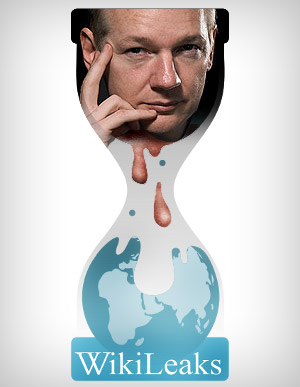
In the past week we have entered the first true cyber-insurgency being waged by the Julian Assange’s WikiLeaks and its various supporters worldwide. Experts have been debating if the actions of WikiLeaks and their confederates constitute a cyber-war or simply a form of protest and demand for openness on the part of governments and corporations.

This is an entirely new twist on the traditional concept of insurgency as it is not limited to an attack on a single nation but numerous nations, businesses and financial institutions as well as individuals.  It is also being conducted by a loosely international organized alliance of individuals and groups with overlapping or identical political goals which have an almost cult like reverence for Julian Assange, who they defend as if he were the Prophet himself.

Those who say that this is not a war rely on a definition of war as something that is conducted between nation states which is now an antiquated concept and not reality based. What is called “conventional” warfare is a misnomer and conventional conflicts are the exception to the rule. Australian counter-insurgency expert David Kilcullen notes that according to the Correlates of War Project that of 464 wars fought in the Modern Era (1816-2000) that on 79 were conventional “interstate” conflicts “fought between the regular armed forces of nation states, while 385 (just under 83%) were civil wars or insurgencies.[i]

One such expert told CNN: “

“Calling the WikiLeaks back-and-forth a cyber war is “completely idiotic,” said Bruce Schneier, chief security technology officer of BT, a communications company.”War. W-A-R. It’s a big word,” Schneier said. “How could this be a cyber war? It’s certainly a cyber attack, right? It’s certainly politically motivated. But this stuff has been going on for a couple of decades now. Do you mean there have been thousands of wars that haven’t been noticed? It doesn’t make any sense at all. If there was a war, you’d know it, and it would probably involve tanks and artillery — as well as cyber weapons.” Only cyber attacks between two warring nation-states count as cyber war….” (author’s emphasis) ”[ii]

Unfortunately such “experts” know nothing of modern war, to paraphrase General George Patton’s speech: “The perfidious experts who wrote that stuff about what modern war is for Time Magazine don’t know anything more about modern war than they do about fornicating.” Quite bluntly Mr. Shneier is as ignorant as they come and while he may be a “cyber security expert” he has no clue about modern war. It is possible that nation states can wage cyber war as part of a broader war, undoubtedly, but to limit one’s definition of war to such encounters when only 17% of modern wars fit the definition is ignorant.

“Insurgency is defined as an insurgency is an organized, protracted politico-military struggle designed to weaken the control and legitimacy of an established government, occupying power, or other political authority while increasing insurgent control.”[iii] While the WikiLeaks is not using traditional arms their tactics which include participating in espionage which is defined in the U.S. Code as:

“The act of obtaining, delivering, transmitting, communicating, or receiving information about the national defense with an intent, or reason to believe, that the information may be used to the injury of the United States or to the advantage of any foreign nation. Espionage is a violation of 18 United States Code 792-798 and Article 106, Uniform Code of Military Justice. See also counterintelligence.”

In addition to this the WikiLeaks confederates in making cyber attacks against governments, corporations and individuals that take a stand against them are using methods which are best described as asymmetrical warfare which stand outside of convention and are designed to destabilize the existing order for the political intent of the actor conducting it.

In today’s world non-state actors to include traditional terrorist organizations as well as organizations such as WikiLeaks which are non-state networked actors.  Martin Van Creveld notes: “In today’s world, the main threat to many states, including specifically the U.S., no longer comes from other states. Instead, it comes from small groups and other organizations, which are not states.”[iv] Such actors in the technological world can develop networks to further their cause.

Major William J. Hartman notes in his article Globalization and Asymmetrical Warfare that:

“Technology and the internet have allowed them to become globally netted players.  The basic function of a network is relatively simple.  A chain network is used when goods or information move along a network or series of hubs until reaching a final destination.  This type of network is normally used by pirates and smugglers where there is no central figure controlling the overall operation.  The hub or star network is what we would normally recognize as a terrorist group, drug cartel or crime syndicate.  In this case nodes operate separately, but must coordinate activities through a central node or leader.  The all-channel network is a shared network of numerous groups loosely connected for a common cause.” [v]

While Assange’s WikiLeaks once was considered a legitimate media source in the “new media” it has crossed a line between internet freedom and freedom of speech to political espionage and it his supports from financial and information support to targeted cyber terrorism against political, governmental, business organizations as well as individuals.  WikiLeaks and Assange still claim the journalistic mantel and they are supported by many in that claim, but their recent actions serve to undermine their credibility and while they will have supporters any sense of journalistic ethics has been lost and probably cannot be recovered.  WikiLeaks began their irresponsible actions with the release of unredacted documents on the Afghanistan War and the released diplomatic cables do not seem to serve any purpose except to embarrass governments.  The threatened release of a massive amount of unredacted documents as an “insurance policy” against being shut down is simply extortion and can rightly be labeled an act of cyber terrorism.

As most people know information is power and those that can harness it for their purposes. The U.S. Army and Marine Corps Counterinsurgency manual states

“Interconnectedness and information technology are new aspects of this contemporary wave of insurgencies. Using the Internet, insurgents can now link virtually with allied groups throughout a state, a region, and even the entire world. Insurgents often join loose organizations with common objectives but different motivations and no central controlling body, which makes identifying leaders difficult.”[vi]

The way that WikiLeaks supporters are organized and the manner in which they have posted the information that they have illegally obtained provides an amazing information pipeline for other non-state actors, especially terrorists groups that will be able to use that information to conduct deadly attacks which will as they always do target directly or indirectly innocent civilians of many nations. The attacks that supporters mount on those that criticize Assange stand a good chance of causing even more financial hardship to the customers of those institutions.

This is an insurgency of a new type, one without borders which though it claims noble goals of justice, freedom and transparency willingly places information in the hands of terrorists who have stated that they will use it. This has and is occurring with the Taliban in Afghanistan and will happen elsewhere as terrorist organizations both national and international use the information to create chaos.

Welcome to warfare in the 21st Century. It’s not your grandfather’s war.

Peace

Padre Steve+


[i] Kilcullen, David. Counterinsurgency Oxford University Press, New York 2010 pp.ix-x

[ii] Sutter, John D. Is WikiLeaks waging a Cyber War?” retrieved from http://www.cnn.com/2010/TECH/innovation/12/09/wikileaks.cyber.attacks/index.html?hpt=T2 9 Dec 2010

[iii] Field Manual No. 3-24 Headquarters Department of the Army Washington, DC p.ix

[iv] Van Creveld, Martin, In Wake Of Terrorism, Modern Armies Prove To Be  Dinosaurs Of Defense, New Perspectives Quarterly, Vol. 13, NO 4, Fall 1996, 58

[v] Air Command and Staff College Air University Globalization and Asymmetrical Warfare by William J. Hartman, Major, US Army, Maxwell Air Force Base, Alabama April 2002 pp. 19-20

[vi] Ibid. FM 3-24. p. 1-4


2 Comments

Filed under Foreign Policy, national security

Wiki-Leaks Minions: A Man’s got to Know His Limitations

“A Man’s got to know his limitations” Harry Callahan

Julian Assange has sparked a cyber insurgency of the highest degree. Over the past few months the brilliant yet arrogant and paranoid head of Wiki-Leaks has acted as if no one can stop him and in a technical sense for the moment it appears that he is correct. Despite the fact that he is sitting in a British jail awaiting extradition hearings regarding charges of rape and sexual assault in Sweden his minions and supporters have launched a cyber war on governments, corporations and individuals that oppose them. They have attacked government sites in a number of nations, major financial sites such as Visa, Mastercard and Pay-Pal as well as individuals.  At the same time they continue to release documents in a shotgun blast manner hitting targets far and wide in a very indiscriminate way while holding back the 256bit encrypted 1.4 gigabyte “insurance file” in case they feel their operation too threatened.  Hundreds of mirror sites have popped up around the world to ensure if the main Wiki-Leaks site is taken down that the leaked information will still be available.

It seems for the moment that Assange and his minions have the upper hand. They claim that in order to stop them the internet would have to be shut down. Many experts say that the encryption on the insurance file is impossible to break.  Their attacks become more widespread by the hour and they appear to be  filled with a confidence that no-one can stop them. It is as if they think that nothing can happen to them and that their actions will somehow by creating chaos bring about some kind of new Utopia.  Their Utopia supposedly puts “openness” among people and nations as the highest ideal. They presume of course that total openness is something that is good. If people were totally good this might be a wonderful proposition. Unfortunately as anyone slightly acquainted with human nature knows, there are very few real saints walking the earth.  That is why most people secure their property, insist on privacy and use things like passwords and pin numbers.  It’s why governments, corporations and individuals have secrets. You see secrets are not simply evil but serve a purpose for law abiding peoples in protecting them from others that wish to do them harm. Anyone that has every had their identity stolen can testify to this.

The mistake that the Wiki-Leakers make is that they don’t realize their limitations.  They believe that their knowledge of the internet and technological savvy will give them an edge against those that they want to punish, governments, corporations or individuals.  While they seem to be unstoppable for the moment they forget that any kind of military operation eventually hits what Clausewitz called its “culminating point.” This is the place and time where its energy of the offense is spent and the attacker becomes vulnerable to counterattack. Despite the fact that this is a cyber-war the principle remains sound.

In this case it is quite probable that it will not be the technology that is the Wiki-Leaker’s Achilles’ heel. What will be their downfall will be their overreach which will lead to a real human backlash from governments whose citizens demand action. The problem for the Wiki-Leakers is that they are human and have friends, families and associates that have human intelligence regarding them. The Wiki-Leakers are arrogant and quite boastful as I have found out and while technologically savvy are not very wise. They forget that as the information that they leak and the attacks that they make will affect regular people, many of whom would support them until their lives and livelihoods are threatened.  Once this happens the leakers will find that they can no longer hide as pressure is put on their loved ones who do not approve of their methods.  It is much like when Al Qaeda’s foreign fighters started attacking important Sunni leaders and turning the population of Al Anbar Province against them.

The Wiki-Leakers are playing with fire and in their smugness they have no earthy idea of the world that they are about to spawn and the terrible consequences that they will bring to the earth. Unfortunately like all revolutionaries they do not care about the effect that their work will have on the world. That is the beauty of being very technologically savvy and arrogant while ignorant at the same time.  They behave as pseudo-religious crusaders convinced of their righteousness and belief that the end justifies the means.

The more gentle nations such as the United States will simply prosecute those that they catch while the brutal nations will hunt them down torture and kill them. They will find that the chaos that they create will turn against them and that they will have to spend more time defending than attacking or leaking. From that moment their days will be numbered.

Unfortunately the chaos that they create will cause people to accept draconian measures which will severely limit liberty and the freedom of speech around the world.  The openness that they desire is illusory and they will find that they should have known their limitations. Those that sow the wind reap the whirlwind.

They should watch more Clint Eastwood movies after all “a man’s got to know his limitations” as they are rapidly approaching the point of no return.

Peace,

Padre Steve+

4 Comments

Filed under Foreign Policy, History, national security

Forgotten on the Far Side of Ford Island: USS Utah, USS Detroit, USS Raleigh and USS Tangier

USS Utah BB-31 in 1920s

When you visit Pearl Harbor most eyes are drawn to the USS Missouri and the USS Arizona Memorial on Battleship Row.  On the mooring quays the names of the Battleships California, Oklahoma, Maryland, West Virginia, Tennessee and Arizona mark the places where the proud Battle Force of the U.S. Pacific fleet was moored on the fateful morning of December 7th 1941.  Movies such as Tora! Tora! Tora!, In Harm’s Way and Pearl Harbor have recorded the attack in varying degrees of accuracy for audiences worldwide in the 1960s, 1970s and 2000s. All record the attack on Battleship row and the attacks on the Army Air Corps at Hickam Field but all overlook the former battleship moored on the west side of Ford Island, the two elderly light cruisers and the Seaplane Tender moored nearby.

USS Utah AG-16 in 1935

Of course these ships hold little interest to most people, they were elderly, Utah had been converted to a gunnery training ship years before and the Omaha Class light cruisers Raleigh and Detroit were obsolescent and after Pearl Harbor would serve in the backwaters of the Pacific war.  The Tangier a new Seaplane Tender occupied the berth aft of Utah.


The USS Utah AG-16, ex-BB-31 was one of the early U.S. Navy Dreadnought battleships of the Florida Class. Utah was 521 feet long, displaced 21,825 tons and mounted 10 12” guns making her comparable to British Dreadnoughts of the Neptune and Colossus class and slightly inferior to the German Helgoland class.  Utah was commissioned on 31 August 1911 and served at the Vera Cruz incident where a Naval “battalion” of 17 officers and 371 her prevented the delivery of arms from Germany to Mexican dictator Victoriano Huerta.  The in the clash with Huerta’s forces the sailors distinguished themselves earning 7 Congressional Medals of Honor.

Utah served as part of the U.S. Battle Squadron sent to operate with the Royal Navy operating out of Ireland conducting convoy protection missions and preparing to engage the German High Seas Fleet if called upon.  Utah served from 1919-1931 as a battleship conducting training and goodwill missions to Europe and South America before being converted to a gunnery training and target ship (AG16) in 1931 per the stipulations of the Washington Naval Conference. In 1941 she was modernized and equipped with weapons being installed on modern destroyers before resuming training duties with the fleet at Pearl Harbor.

On the morning of December 7th Utah was moored on the West side of Ford Island and at colors the ship was struck by a torpedo forward and began to heal to port. With the flooding causing the list to increase the senior officer on the ship, LCDR Isquith the Chief Engineer ordered Utah abandoned and while most of the crew was able to escape some were trapped below including Chief Water Tender Peter Tomich who remained below to ensure that the boilers were secured and his sailors safely out of the boiler rooms.  Tomich was awarded the Congressional Medal of Honor for his sacrifice.  By 0812 the mooring cables had snapped and Utah lay on her beam sinking into the harbor her war over.  6 Officers and 58 crewmen died the majority trapped in the ship.  The ship would be partially righted to clear an adjacent berth in 1944.

The Raleigh and Detroit were Omaha Class Light Cruisers 555 feet long, displacing 7050 tons and mounting 12 6” guns and 10 21” torpedo tubes and were capable of 3 knots. This made them more heavily armed than the contemporary Japanese Nagara Class or the British C, D  or E Class light cruisers and larger than all but the two ship E Class. However by the beginning of the war they were inferior to all newly constructed ships.

USS Raleigh CL-7 fighting to stay afloat

The cruiser Raleigh took a torpedo that caused her to list so sharply that it was feared she would capsize, however the heroic efforts of her crew and service force craft and sailors kept her afloat and allowed her to fight another day. Most of her war would be fought in the Aleutians and following the war she would be decommissioned and scrapped.

USS Detroit CL-8 1945, final configuration

Detroit was able to get underway during the attack and avoid damage to join other ships which had escaped to form an ad hoc task group to find the Japanese strike force.  She would also serve in the Aleutians through 1944 when she became flagship of the Replenishment Group servicing the U.S. Carrier Task Forces of the 3rd and the 5th Fleets. She would be present in Tokyo Bay for the signing of the peace treaty ending the war. She too would be decommissioned and scrapped shortly after the war.

Tangier would serve in many parts of the Pacific as a mobile base for PBY Catalina’s which conducted reconnaissance, anti-submarine and search and rescue operations in support of the fleet for the duration of the war. She was decommissioned in 1947 and sold for scrap in 1961.

USS Utah Memorial (Google Earth)

Today a monument is located on Ford Island near the rusting hulk of the Utah. It replaced a bronze plaque which had been placed on the wreck in the late 1940s. The Memorial was officially dedicated on Memorial Day 1972.  The monument is not listed on most tourist brochures and the memorial attracts few visitors. I was able to visit the memorial in 1978 while on a Navy Junior ROTC Cadet Cruise to Pearl Harbor and back.  The official USS Utah association website is linked here: http://ussutah.org/ and the Historical Naval Ships Association webpage on Utah is here: http://hnsa.org/ships/utah.htm and the Naval History and Heritage Webpage is here: http://www.history.navy.mil/photos/sh-usn/usnsh-u/bb31-y.htm

The Raleigh, Detroit and Tangier have no memorials.  Despite the anonymity of these ships and the men who served on them they all played a role in the war and they should not be forgotten.

Peace

Padre Steve+


33 Comments

Filed under History, Military, Navy Ships, world war two in the pacific

The Dangerous Ignorance of the Wiki-Leakers

The Zimmerman Telegram: Just One Cable with consequences still being felt today

“A prince must imitate the fox and the lion, for the lion cannot protect himself from traps, and the fox cannot defend himself from wolves. One must therefore be a fox to recognize traps, and a lion to frighten wolves. Those that wish to be only lions do not understand this. Therefore, a prudent ruler ought not to keep faith when by so doing it would be against his interest, and when the reasons which made him bind himself no longer exist. If men were all good, this precept would not be a good one; but as they are bad, and would not observe their faith with you, so you are not bound to keep faith with them.” Niccolo Machiavelli

In 1917 the British leaked a telegram from the German Foreign Minister to the President of Mexico. By 1916 the Germans were doing all that they could to keep the United States out of the war while the British looked for ways to assist the Americans into the war. The cat and mouse campaign continued until the Germans being starved by the British blockade realized that they had to resume unrestricted submarine warfare against Britain knowing that such a resumption might well provide the United States a reason to enter the war. The Germans approached the Mexican government with the offer of an alliance and the promise of the restoration of lands lost to the United States.  The Mexican government rejected the offer because as much as they desired the restoration of land that they believed to be rightfully theirs that the Germans could not deliver.  The British knew this but waited and when the moment was right released the decrypted cable to the American Press which much as it had done against the Spanish in 1898 provided the grist for the Congress to declare war in April 1917.  The involvement of the United States in that war made the United States a player on the world stage and was the catalyst for our involvement in  the Second World War and all that has followed.  Just one cable changed history.

Julian Assange, his companions and supporters are some of the most incredibly naïve people in the world.  I do not doubt for one minute that most of them are convinced of the innate righteousness that some ascribe to whistleblowers.  You see there are times that whistleblowers are absolutely necessary.  Unfortunately most self proclaimed “whistleblowers” lack the nuance to know what should be leaked and what shouldn’t, what matters and what doesn’t and the immense dangers inherent in revealing information that potentially could lead to the targeted death of innocents or even inciting whole populations to war.

Diplomacy is a most delicate Machiavellian art.  Diplomats representing the interests of the governments work in a world where there is little that is “black and white” but rather a world of murky grays where truth is mixed with deception, blunt honesty and candor with lies and subterfuge.  It is an art filled with nuance where the slightest misstep could and often has triggered wars of cataclysmic proportions. It is a world where diplomats, military attaches and even dare I say spies work to gain their nations advantages and if they do their job well such advantages are secured without war.

To do this the diplomatic corps of various nations, even nations that are each other’s mortal enemy understand that it is possible to smile, share a drink and converse as colleagues even while seeking an advantage. That advantage might be information regarding trade agreements, military alliances, or countless other subjects.  Diplomacy is a person playing chess game with one hand and a poker game with the other at the same time.  It is a dark world that most people are ignorant of and as Barbara Tuchman said: “Diplomacy means all the wicked devices of the Old World, spheres of influence, balances of power, secret treaties, triple alliances, and, during the interim period, appeasement of Fascism” and Randolph Bourne noted “Diplomacy is a disguised war, in which states seek to gain by barter and intrigue, by the cleverness of arts, the objectives which they would have to gain more clumsily by means of war.”

Diplomacy is truly a Machiavellian enterprise that is not for the faint of heart and good diplomats understand what Machiavelli said “And to be sure, sometimes you need to conceal a fact with words, do it in such a way that it does not become known, or, if it does become known, that you have a ready and quick defense.” Diplomats understand the hard truth that the ally of today may very well be the enemy of tomorrow and that it is unwise to have allies that you are ignorant about. Sun Tzu put it well “One who is not acquainted with the designs of his neighbors should not enter into alliances with them.”

Our Founding Fathers were not fond of alliances and warned against them, unfortunately that horse left the barn years and years ago and like our European ancestors we are now dependant on alliances, even with very unseemly characters nations because for better or worse they suit our security or economic geopolitical needs.  That is the way it is. We are unable to turn back the clock to more genial time.

Thus diplomats and their work matter and what they say and do in public and in secret needs to be guarded because the consequences of “transparency” are often worse than the maintaining of secrets. The latest documents leaked by Assange and Wiki Leaks have nothing to do with revealing anything that is the reason for whistle blowing which by definition is aimed at exposing wrongdoing or illegal activity by an organization or individuals with the hope of stopping it. In some cases Wiki Leaks has done this but the latest round of leaks appear to be more about embarrassing governments and leaders around the world with no real positive gain for society or for that matter world peace. Instead they have endangered many by exposing secrets that might result in brutal civil wars, regional wars or assist terrorist groups to destabilize democracies and kill innocents.  One of the documents listed all sites deemed by the United States vital to its national security as well as those of other nations practically giving terrorists a roadmap to kill and destabilize and even increase the economic crisis engulfing much of the world.  Since many are soft targets terrorists could and likely will use the information in ways that can be unimaginably bad.

When finally confronted by governments around the world Assange threatens to release 100,000 uncensored documents that they refer to as an “insurance policy” against being silenced. The documents are in the hands of thousands of Wiki Leaks supporter who only need the key to unlock them and spill the data with very unpredictable consequences depending on what is in the files. Who knows what if they were leaked to trap Assange and his followers?

Regardless the release of these most recent documents has exposed people in many nations, mostly innocents to grave danger all it seems to feed Assange’s massive ego.  Having had to deal with a decent number of his supporters recently I know that the general attributes of his followers are arrogance, self righteousness and naiveté which when combined together are really dangerous. However they don’t seem to care as I read a post by one of Assange’s followers someone named “sunnydee” who wrote on the “Above Top Secret” website: “Hope you’ll keep us posted. And hope that someone has the guts to open it. It’s best to know the truth, no matter how ugly.” This just shows the naïve and seemingly uncomprehending mentality of many of his supporters. I could be wrong but it doesn’t seem like Assange or his followers care about the lives that could be lost and the devastation that could ensue either due to war, terrorism or greater economic calamity.  Such actions do not promote democracy or open societies they destroy them.

It seems that unless something changes quickly that Assange and his followers could ignite a spark that engulfs whole regions of the world in war and open the door wider for terrorists to destabilize weak governments around the world.  Diplomats are smarter than a lot of people give them credit for and the diplomatic cables needed to be protected and Assange has opened Pandora’s Box.

This is a dangerous gambit that nothing good can come from. God help us.

Peace

Padre Steve+


2 Comments

Filed under Foreign Policy, History, national security