Category Archives: History

Remember those that Came in Peace: BLT 1/8 and the Bombing of the Beirut Barracks

In the early hours of October 23rd 1983 I was awake. I could not sleep. I was a new Army 2nd Lieutenant attending the Junior Officer Maintenance Course at Ft Knox Kentucky following the completion of the Medical Service Corps Officer Basic Course enroute to my first assignment in Germany.


I had gone out with friends earlier in the evening. Since Ft Knox was located in a dry county we made a trip up to a restaurant in Louisville followed by a trip to a bar and dance club for drinks. All of us that went were either newly married or engaged and none of our wives or soon to be wives were there we were on good behavior. After a dinner and a few drinks we went back to Knox, each to our own quarters.
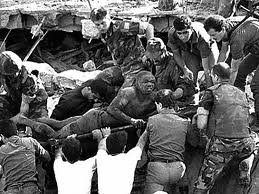


It was late and since I couldn’t get to sleep I turned on CNN, which at the time was a rather new thing in news. I think that it was about 2AM that CNN broke in with the news that the Marine Barracks had been bombed. As the day developed the extent of the catastrophe became apparent, the barracks was destroyed and 241 Marines, Sailors and Soldiers were dead, with another 60 wounded. It was the worst single day loss suffered by the Marines since the Battle of Iwo Jima.

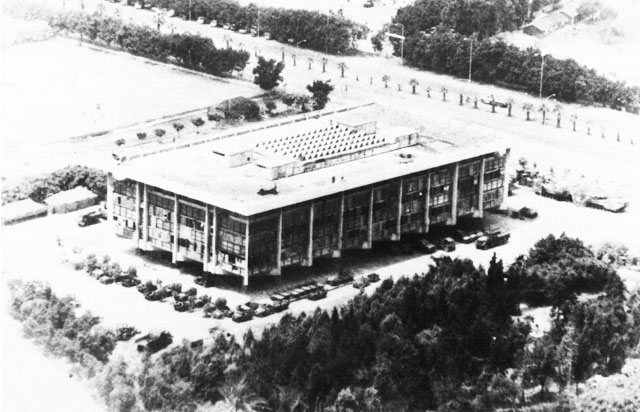
Battalion Landing Team 1/8, built around the 1st Battalion 8th Marines had been assigned as part of the UN Peacekeeping Force following the Israeli invasion of Lebanon. The BLT was billeted at the Beirut International Airport and at 0620 a truck driven by a suicide bomber containing explosives equivalent of over 12,000 lbs of explosives blew it up in the lobby of the building. Rules of Engagement prevented the few sentries on duty from engaging the vehicle until it had already crashed through the barbed wire and was lodged in the building.  The explosion blew out the support structure of the building and caused it to pancake upon itself trapping those inside. About 2 minutes after the attack French Paratroopers of the 1st Parachute Chasseur Regiment were hit by a truck bomb at their barracks about 6 km away. 58 French Paras were killed and many more wounded in an attack that caused more casualties in a single day since the French campaign in Algeria.
In the days and weeks following the attack a series of minor American and French airstrikes and Naval gunfire attacks were launched with little effect. President Reagan withdrew the Marines and the UN and French also withdrew their force. The attacks and the limited response gave the Iranian backed Hezbollah militia new swagger and respect. Hezbollah is now one of the most deadly opponents of the United States, Israel and the West.

Fast forward. In January 2000 I am a relatively new Navy Chaplain and get no notice orders transferring me from the Second Combat Engineer Battalion of 2nd Marine Division at Camp LeJeune NC to the 1st Battalion 8th Marine Regiment as a “relief pitcher” when their chaplain was removed from his duties. On a wall of the HQ building at Camp LeJeune was a mural drawn by Marines which honored their predecessors who died in the bombing. In the 5 months that I was with the battalion before going on to  another battalion as a “relief pitcher” I got to appreciate the sacrifice of the Marines, Navy Hospital Corpsmen and 6 attached Army Soldiers. Today I serve at the Naval Hospital Camp LeJeune. The Marines of the Fleet Marine Force are part of who I am. I am proud to have served with both the 1st Battalion and 3rd Battalion of the 8th Marine Regiment.

At Camp LeJeune there is a memorial every year at the Beirut Memorial. Many veterans , survivors of the attacks and relatives of the fallen attend. I was not able to attend this year but remember attending it in 2001, nit long after the 9-11 attacks. There are 241 trees , one for each of the fallen planted along Carolina Highway 24 outside of Camp LeJeune.

The Beirut expedition showed the limitations of military power as well as the wisdom of President Reagan and Secretary of Defense Casper Weinburger not to get even more involved in another country’s civil war. The decision to withdraw was prudent, especially since the Cold War was reaching its apex and the Soviets were deeply involved in Afghanistan and the Iran of Ayatollah Khomeini was becoming more bellicose. The sad thing is that we did not realize those limits before the bombing nor had given the commanders on the ground rules of engagement that might have prevented the bombing. Instead the military chain of command was blamed for the loss and the politicians that orchestrated the intervention got off scott free.

Let us not forget the sacrifice of those 241 American Marines, Sailors and Soldiers and the 58 French troops who died in those attacks 29 years ago.

Peace

Padre Steve+
4 Comments

Filed under Foreign Policy, History, middle east, Military, national security

A Loss for the Country and the World: A War Hero and Prophet of Peace George McGovern Dead at 90

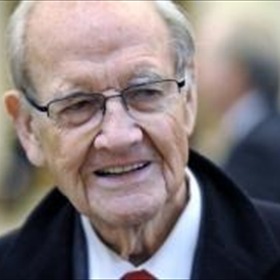
George McGovern in 2012 (AP File Photo)

The United States of America and the world lost a champion of peace and humanity this weekend when former Senator George McGovern died at the age of 90. If you had asked me if I would have written this article 10 or 15 years ago, I probably would not have, but war has a way of changing ones perspective about those that consistently labored for peace and justice.

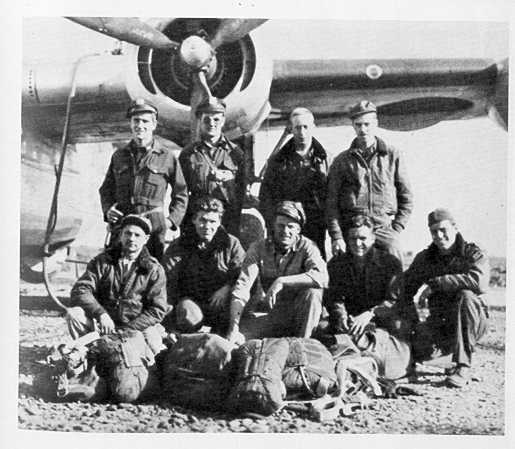
The son of a Wesleyan Methodist Minister McGovern grew up in the South Dakota during the Great Depression and the Dust Bowl. He volunteered in the Second World War and flew 35 combat missions as the pilot of a B-24 Liberator bomber during which his aircraft was heavily damaged on a number of occasions and his skill as a pilot helped save the aircraft and crew.  For his service he was awarded the Distinguished Flying Cross and four awards of the Air Medal and his memories of being under fire from German FLAK and having his plane set afire during a mission caused him nightmares for years after the war.

McGovern and his Aircrew (above) and with his Co-pilot and Navigator (below)

His experiences during the Depression and with the victims of war that he encountered in Italy made him a champion of people that suffer. He spent one year in seminary before switching to graduate studies in American History earning a Masters and Ph.D. in History. He served as a Congressman and Senator and represented the liberal wing of the Democratic Party. He served as the director of President Kennedy’s Food for Peace program. He was the first Senator to openly speak out against U.S. Military involvement in Vietnam when President Kennedy began to expand the mission. As a historian who actually studied what was going on in Vietnam for years he warned the Senate in September 1963 that:

“The current dilemma in Vietnam is a clear demonstration of the limitations of military power … [Current U.S. involvement] is a policy of moral debacle and political defeat … The trap we have fallen into there will haunt us in every corner of this revolutionary world if we do not properly appraise its lessons.”

After lending his vote to the Gulf of Tonkin Resolution which gave President Johnson a blank check to expand military involvement in Vietnam he realized that he had made a mistake. After and on January 15th 1965 as the U.S. forces entered into heavy combat against the North Vietnamese Army and the Viet Cong McGovern warned:

“We are fighting a determined army of guerrillas that seems to enjoy the cooperation of the countryside and that grow[s] stronger in the face of foreign intervention… We are further away from victory over the guerrilla forces in Vietnam today than we were a decade ago.” 

McGovern visiting Vietnam in 1965

He continued his outspoken opposition as the war continued and in November 1965 he spent three weeks in country carefully visiting and studying the situation with US military  and diplomatic officials as well as visiting the wounded. His visits to the hospitals in country made a huge impression on him causing him to become even more anti-war, though he voted for appropriations bills in order not to deprive the troops of what they needed.  In September 1969 with President Nixon looking to expand the war into Cambodia he deliberately offended his fellow Senators when fighting for the passage of the McGovern-Hatfield Amendment which would have forced the Administration to begin to end the war:

“Every Senator in this chamber is partly responsible for sending 50,000 young Americans to an early grave. This chamber reeks of blood. Every Senator here is partly responsible for that human wreckage at Walter Reed and Bethesda Naval and all across our land—young men without legs, or arms, or genitals, or faces or hopes. There are not very many of these blasted and broken boys who think this war is a glorious adventure. Do not talk to them about bugging out, or national honor or courage. It does not take any courage at all for a congressman, or a senator, or a president to wrap himself in the flag and say we are staying in Vietnam, because it is not our blood that is being shed. But we are responsible for those young men and their lives and their hopes. And if we do not end this damnable war those young men will some day curse us for our pitiful willingness to let the Executive carry the burden that the Constitution places on us.” 

He ran for President in 1972 and ran what was probably one of the worst campaigns ever. The Democratic party was deeply divided and in disarray and the Nixon campaign took advantage of both his “dovish” stance on the war as well as more progressive stances to demonize him as a person. The late columnist Robert Novak was a vicious critic working hand in hand with Nixon’s Chief of Staff Chuck Colson.

McGovern lost in the most lopsided defeat in modern American history only winning Massachusetts and losing 49 states and only garnering 38% of the vote. Following the defeat he won on more Senate campaign in 1974 and remained in the Senate until 1980 when he was defeated on the coattails of Ronald Reagan’s defeat of Jimmy Carter. He was demoted in the Democratic Party Senate hierarchy and never regained the power he had in the Senate that he had before the 1972 campaign.

In 1972 his campaign was a disaster and some of his policies not well thought out, Nixon and his cohort used everything against him, including some of the most dishonest campaign tactics, culminating in the Watergate break-in.

He remained an active voice in American politics until this year when age, illness and accidents finally caught up with him. He suffered the loss of his wife and two of his children before he died.

He was a voice for the powerless and for the common military man. He was anti-war but never anti-military or anti-troop. He had a great compassion for those that serve in uniform and was a critic of those that would send men and women into battle without taking the risk themselves. He was guided by his Christian faith in is beliefs especially about peace and the care of the poor. He was a Prophet of Peace.

Back in 1972 I was 12 years old and my dad was in Vietnam. Military personnel were frequently treated shamefully by anti-war activists who could not distinguish in their zealotry the difference between the policies of the government and the Soldiers, Marines, Sailors and Airmen that served in that unpopular war. I had a Sunday School Teacher tell me that my dad was a “baby killer.” For years I harbored much resentment for George McGovern. For years I did not appreciate the depth of his integrity and personal courage. In college I savored his loss of his Senate seat in 1980. When he came out against the invasion of Iraq in 2003 I figured that it was more of the same. However my views about him changed after my tour in Iraq and I now appreciate his honesty and foresight regarding both Vietnam and Iraq.

One does not have to agree with all of his policies to admire his personal courage and integrity as well as foresight about the tragedy that would unfold in Vietnam and Iraq. The man was a hero who served is country and the world and I hope someday that we will really come to appreciate him. I wish I had come to such an appreciation of him earlier in life.

Rest in peace,

Padre Steve+

3 Comments

Filed under History, News and current events, Political Commentary

The Elevation of Capital Over People: William Jennings Bryan and the Cross of Gold

Remember When Conservative Christian Politicians Supported Working People?

I mean really, not just lobbying for tax cuts and extolling the job “creator” over the one that actually produces products.

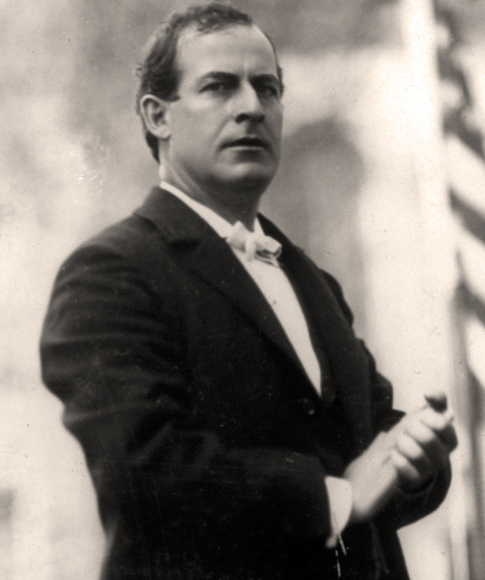
William Jennings Bryan was one of the most influential politicians of his era. He served as Secretary of State under Woodrow Wilson, he was a Senator and three time Presidential Candidate. He was also a very conservative Fundamentalist Christian perhaps most famous, or perhaps infamous now as one of the prosecuting attorneys at the Scopes “Monkey” Trial of 1925. In fact I can find that Bryan’s handling of that case played to the basest religious and social hatred of his day and though “defending” “Biblical” ideas ended up making Christians look but small minded, intolerant and hateful. The movie Inherit the Wind, though a fictional account of that trial show how decent Christians can become consumed with hatred in the name of righteousness, little different than other “sincere believers” that are willing to kill in the name of God.

Whether one agrees on certain points of religious doctrine regarding the creation of the earth or the manner of how God created the earth that he espoused one has to admit that of pre-Great Depression politicians he was quite amazing. Especially in how he saw through the Godlessness of unbridled Capitalism and the devaluation of workers by valued capital over the people that actually produced anything. As an American and a Christian I have to look at the body of work and life of a man. I don’t have to agree with all that they stood for or did and though I find much fault in Bryan and his supporters in the Scopes Trial I do not throw out the good things that he did and got right.

I think the apex of Bryan’s political thought is encapsulated in his speech at the Democratic National Convention of 1896, what is now called the Cross of Gold Speech.

When one looks at it now it really is timeless. Bryan saw through the charade that was being played out by politicians and the big money Wall Street types that they represented with great verve. It was a speech that one might have heard come from a prophet in the Old Testament.

I am just going to quote a couple of pertinent sections from the speech to trigger the thought of anyone reading this article. I think that they could be spoken today in light of the way that many conservative Christians both Evangelical and Fundamentalist Protestants, Roman Catholics and those that preach the so called “Prosperity Gospel” have thrown their support behind ideas that are nothing more than unvarnished, crude materialism of the worst kind. In fact I believe that it is nothing more than the “baptism” of such thought by Christians are among the biggest reasons for the exodus of people from the churches and the rise of the “Nones,” or those with no religious preference.

Bryan said:

“We say to you that you have made the definition of a business man too limited in its application. The man who is employed for wages is as much a business man as his employer; the attorney in a country town is as much a business man as the corporation counsel in a great metropolis; the merchant at the cross-roads store is as much a business man as the merchant of New York; the farmer who goes forth in the morning and toils all day, who begins in spring and toils all summer, and who by the application of brain and muscle to the natural resources of the country creates wealth, is as much a business man as the man who goes upon the Board of Trade and bets upon the price of grain; the miners who go down a thousand feet into the earth, or climb two thousand feet upon the cliffs, and bring forth from their hiding places the precious metals to be poured into the channels of trade are as much business men as the few financial magnates who, in a back room, corner the money of the world. We come to speak of this broader class of business men.” 

His words are striking in their directness and honesty. They are not only Christian but they are deeply American. He called his Party, which had been as bad as the Republicans during the age of the unregulated Robber Barons who used the Gold Standard to manipulate the markets and eliminate silver as currency to their benefit to be different:

“Upon which side will the Democratic Party fight; upon the side of “the idle holders of idle capital” or upon the side of “the struggling masses”? That is the question which the party must answer first, and then it must be answered by each individual hereafter. The sympathies of the Democratic Party, as shown by the platform, are on the side of the struggling masses, who have ever been the foundation of the Democratic Party.”

He talked about two ideas of government and economics:

“There are two ideas of government. There are those who believe that, if you will only legislate to make the well-to-do prosperous, their prosperity will leak through on those below. The Democratic idea, however, has been that if you legislate to make the masses prosperous, their prosperity will find its way up through every class which rests upon them.”

He concluded his speech with this statement.

“Having behind us the producing masses of this nation and the world, supported by the commercial interests, the laboring interests, and the toilers everywhere, we will answer their demand for a gold standard by saying to them: “You shall not press down upon the brow of labor this crown of thorns; you shall not crucify mankind upon a cross of gold.”

When I hear the Unholy Trinity of Politicians, Pundits and Preachers who extol the virtue of Capital over labor and the worship of wealth as the highest good I wish that there would be some that would remember that the people who actually make things, grow things, fix things and maintain things are not just human capital, but people.

That’s enough for the night.

Peace

Padre Steve+

4 Comments

Filed under economics and financial policy, faith, History, Political Commentary, Religion

The Murder of Field Marshal Erwin Rommel

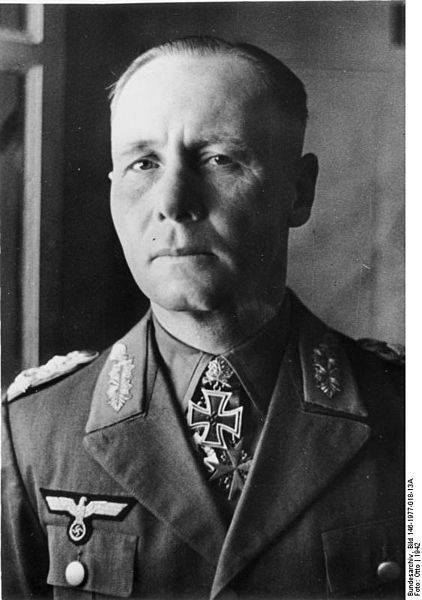
It was 68 years ago in Ulm Germany that a car pulled up to the residence of Field Marshal Erwin Rommel. In the car was the driver and two Generals dispatched by Hitler.  Rommel was recuperating following being severely wounded in an air attack in Normandy on July 17th 1944.

Rommel was never a Nazi but like many Germans he believed Hitler’s promises and propaganda. As a division commander in France and as the commander of the troops sent to bail out Mussolini’s failed African adventure Rommel gained fame, earned rapid promotion and was a poster-child for Goebels’ propaganda machine. His fame also earned the resentment of many fellow officers who since he was not an officer of the General Staff regarded him with jealous envy and distain.

That was until he discovered the reality of Hitler’s promises as the troops of the Afrika Corps found themselves subjected to constant privation from lack of supply, air support and reinforcements. As commander of the Afrika Corps and the Panzer Armee Arfika he and his troops achieved amazing success against an enemy that was always better supplied and equipped and which had air and sea superiority. Battling the British as well as the political machinations of Mussolini and Germany’s Italian Allies as well as opponents in the German government such as Hermann Goering, Rommel saw his troops crushed under the press of the British as well as the Americans who landed in French North Africa. Eventually, sick and worn out he was sent back to Germany.

His honest assessments of the chances of the Germans winning the war which he spoke candidly to Hitler and the High Command made him persona non grata in Berlin and Berchtesgaden. In the time before he was posted to France in late 1943 he became a part of the plot to end the war and overthrow Hitler. Rommel’s Chief of Staff at OB West General Hans Speidel was a key man in the conspiracy and Rommel had contacts with a number of key conspirators. He believed that the war was lost unless his forces could repel the coming Allied invasion on the beaches. His recommendations for the deployment of Panzer Divisions where they could immediately counterattack were not taken. He was given command but not control of many important units which Hitler alone could release.

When the invasion came Rommel was away and sped back to Normandy. He fought a desperate battle against an Allied force. His outnumbered forces under constant assault from the land, sea and air received paltry reinforcements compared to the Allies. German troops inflicted many local defeats and exacted a heavy price in allied blood in Normandy. Many American infantry regiments suffered 100% casualties but remained in action because of a continuous stream of replacements. Rommel urged a withdraw before the allies broke through his front and found that he was now considered a defeatist.

He was wounded just days before the attempt on Hitler’s life which Hitler survived and exacted a terrible revenge on anyone connected with the plot. Show trials and public hangings of officers who had served valiantly at the front were common.Thousands were killed and thousands more imprisoned.

Eventually Rommel was identified with the plotters. He was recommended by the “Court of Military Honor” to be expelled from the military and tried by the “People’s Court” of Judge Roland Freisler. Because of his fame and popularity in Germany Hitler was decided to offer Rommel the choice of being tried by the People’s Court that was busily executing anyone suspected of disloyalty or committing suicide and ensuring his family’s safety. German military heroes were hauled before this court and humiliated by Freisler before they were sent to their deaths.

Rommel suspected that he would be identified and killed and told that to his friends and family leading up to the day that the staff car carrying Generals Wilhelm Burgorf and Ernst Maisel from OKW with the ultimatum. They met with Rommel for a short time before giving him the opportunity to say goodbye to his family. Rommel told them of his choice and left his home for the last time. 15 minutes later the Generals called his wife to say that he had died of a heart attack. Rommel was given a state funeral and the German people were lied to about his cause of his death.

Rommel was 52 when he died, the same age that I am now. I find in the story of Rommel some commonality in my own life. Before Rommel went to Africa he believed that Germany would win the war, during his command there he discovered that what he believed was lies and that Hitler had little regard for him or his troops. Before I went to Iraq in 2007 I believed much of the political propaganda about that war. I have written on this site numerous articles critical of that war and our current war in Afghanistan. Like Rommel I feel that our troops have been and are being sacrificed in a war that we have no chance of winning. We are saddled with an Afghan ally who we put in office, President Karzai who makes Mussolini look like a winner and does nothing to help our war effort, condemning our troops at every opportunity even as his own police and soldiers kill ours. Our troops do valiant and often heroic work and in spite of the terrible situation that could get worse of more war breaks out in Iran or Syria.

Peace

Padre Steve+
4 Comments

Filed under History, iraq,afghanistan, Military, Tour in Iraq, world war two in europe

237 Years of Service: Happy Birthday US Navy!

Raising the Flag Aboard the USS Alfred 

“It follows than as certain as that night succeeds the day, that without a decisive naval force we can do nothing definitive, and with it, everything honorable and glorious.” George Washington 15 November 1781 to the Marquis de Lafayette

On October 13th 1775 the Continental Congress passed legislation to establish a Navy for a country that did not yet exist.  It was the first was the first in a long line of legislative actions taken by it and subsequent Congresses that helped define the future of American sea power.

The Battle of Flamborough Head

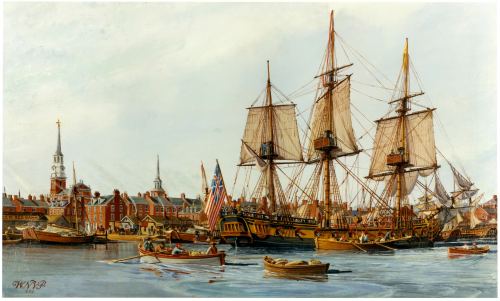
The legislation was the beginning of a proud service that the intrepid founders of our nation could have ever imagined.  Less than two months after it was signed on December 3rd 1775 Lieutenant John Paul Jones raised the Grand Union Flag over the new fleet flagship the Alfred. The fleet set sail and raided the British colony at Nassau in the Bahamas capturing valuable cannon and other military stores.  It was the first amphibious operation ever conducted by the Navy and Marines.

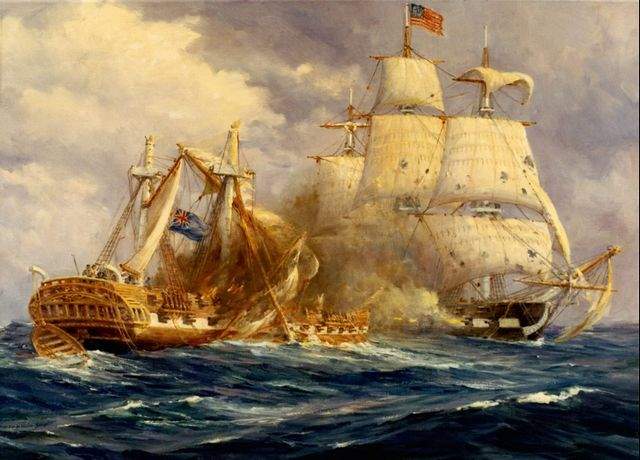
USS Constitution and HMS Guerriere

Jones received the first recognition of the American flag shortly after France recognized the new United States.  In command of the Sloop of War Ranger his ship received a nine-gun salute from the French flagship at Quiberon Bay.

Oliver Hazard Perry at the Battle of Lake Erie

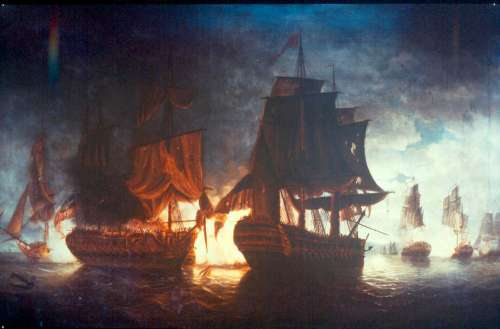
Jones would go on to to greater glory when he in command of the Bonhomme Richard defeated the HMS Serapis at the Battle of Flamborough Head. During the battle when all seemed lost and the colors had been shot away he replied to a British question if he had surrendered replied “I have not yet begun to fight!”

Admiral David Farragut at the Battle of Mobile Bay

When the war ended very few of these ships remained most having been destroyed or captured during the war. But these few ships and the brave Sailors and Marines who manned them blazed a trail which generations of future sailors would build on.  The Navy has served the nation and the world as a “Global Force for Good” for 237 years.

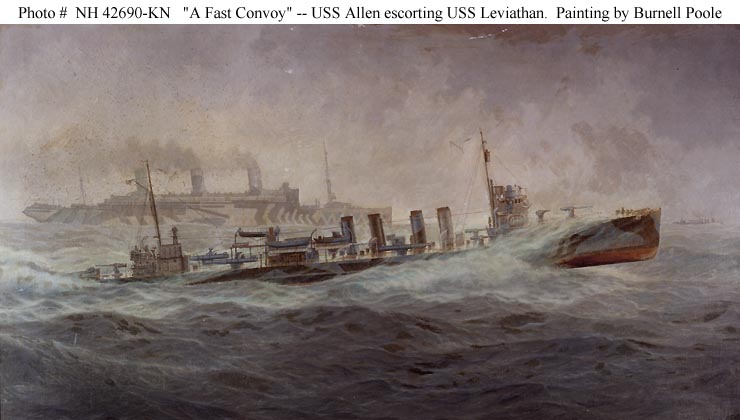
World War One: Convoy Escort USS Allen

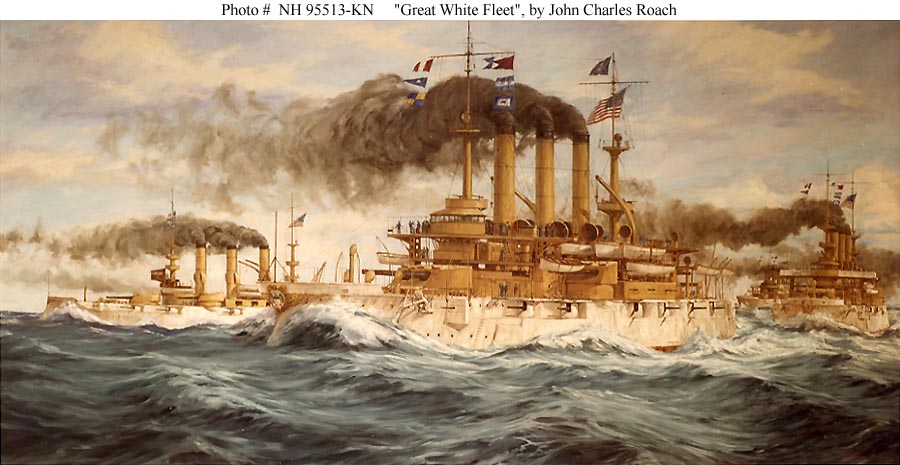
The Great White Fleet

This force for good is on duty today and those that have served over the past 237 years are part of a tradition that is more than honorable. President John F. Kennedy who served as a PT Boat Commander in World War Two remarked:

“I can imagine no more rewarding a career. And any man who may be asked in this century what he did to make his life worthwhile, I think can respond with a good deal of pride and satisfaction: ‘I served in the United States Navy.'”

The Battle of Midway

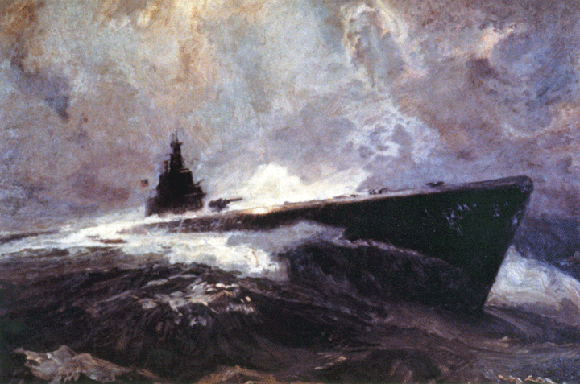
USS Growler

Tonight as you go to bed and sleep soundly after eating well and spending time with family, friends or enjoying some form of entertainment remember those of our Navy who serve at sea at the ready in the Straits of Hormuz, in the mountains and deserts of Afghanistan, the desolation of the Horn of Africa and around the world defending our interests, caring for our military personnel and their families and deploying to serve in harm’s way and in areas of devastation.  They are America’s “Global Force for Good.”  They are my shipmates they are your fellow citizens.  They are the United States Navy.

USS Hue City CG-66

Happy Birthday Shipmates.

Peace

Padre Steve+

1 Comment

Filed under History, Military, Navy Ships, US Navy

The Battle of Cape Esperance: October 11-12 1942

Naval battles between U.S. Navy and Imperial Japanese Navy surface forces around Guadalcanal in 1942 were almost always brief and bloody. The number of ships sunk in the area around Guadalcanal, Tulagi and Savo Island led to the area being nicknamed “Iron Bottom Sound.”

The battles around Guadalcanal occurred in a time of technical transition as radar became better at detecting ships and fire direction systems advanced. By October 1942 the U.S. Marines battling on Guadalcanal were fighting an enemy growing in numbers and felt the effects of the the predatory Japanese surface raiders that routinely bombarded their positions and endangered U.S. resupply efforts.

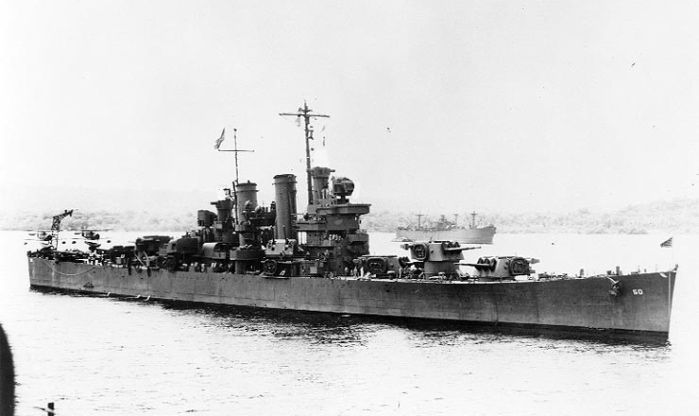
USS Helena

Since the Marine, Navy and Army Air Force Squadrons based on Guadalcanal maintained air superiority in the nearby waters during the day the Japanese were limited to night surface operations against the island, operations involving the reinforcement and resupply of Japanese Forces on the island as well as offensive operations to aid the land forces by attempting to make the U.S. airstrip, Henderson Field inoperable.

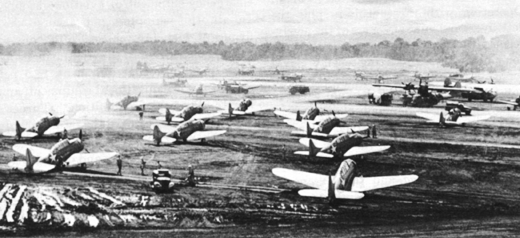
Henderson Field

The first of their major operations was in early August when a Japanese cruiser destroyer force ravaged the U.S. cruiser forces off Savo Island sinking 3 American and one Australian Heavy cruiser while damaging another. The Battle was a disaster for the U.S. forces and led to the early withdraw of ships of the invasion force before many could finish unloading the equipment and supplies that were critical to the operation.

The Tokyo Express Route along the Slot

Japanese resupply and reinforcement operations were so frequent that the Japanese forces were nicknamed the Tokyo Express by the Americans. Knowing that the Marines who had been in bitter combat with the Japanese needed reinforcements the U.S. sent a convoy to land the 164th Infantry Regiment of the Americal Division on October 13th and sent a surface task force TF-64 composed of the Cruisers USS San Francisco, USS Boise, USS Salt Lake City and USS Helena and 5 destroyers under the command of Rear Admiral Norman Scott to protect it from any Japanese surface threats.

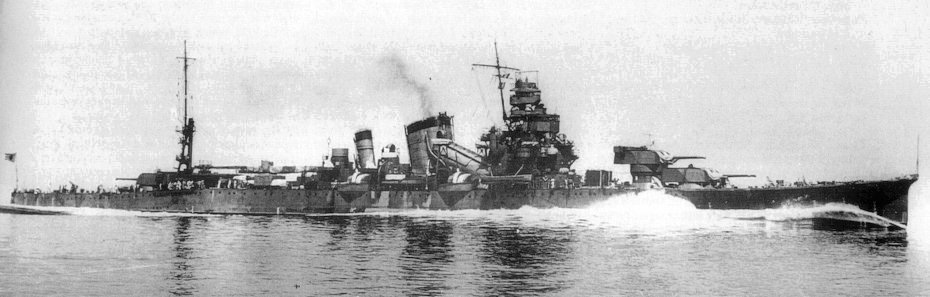
IJN Heavy Cruiser Aoba after the battle

The U.S. moves coincided with a Japanese reinforcement effort which was covered by a force of three heavy cruisers, the Aoba, Furutuka and Kinugasa and two destroyers under the command of Rear Admiral Arimoto Goto. The Japanese cruisers were to bombard Henderson Field as the Japanese were not expecting any American surface forces to oppose their effort.

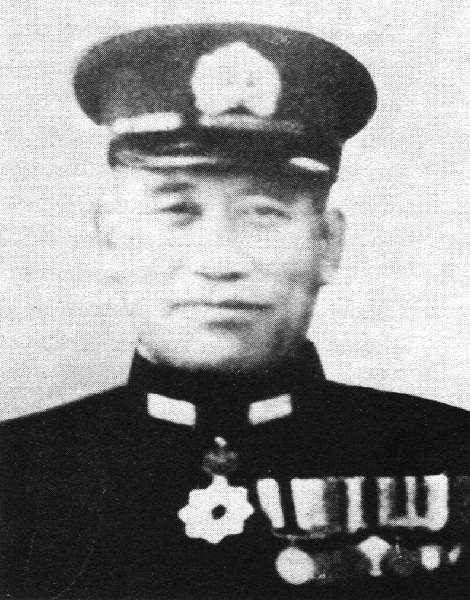
Rear Admiral Arimoto Goto

The Japanese were detected by aerial reconnaissance on the afternoon of the 10th when they were about 200 miles from Guadalcanal. Scott, whose forces lacked experience in night surface combat made a simple plan to “cross the T” of the enemy force in a single line formation with three destroyers in the van, the cruisers in the center and two destroyers in the rear.

Rear Admiral Norman Scott

U.S. floatplanes from the cruisers detected the Japanese at 2300 hours and at 2322 the radar of the USS Helena picked up the Japanese force at a range of about 27,000 yards. However misunderstandings of Scott’s orders broke his formation and put the van destroyers out of position in the poor visibility of the moonless night caused Scott to believe that the radar contacts were his own destroyers.

The Japanese still did not realize that an American force was near them and continued on. At 2345 the ships were only about 5,000 yards apart when Helena radioed asking permission to fire. The message was received by Scott who did not grant permission but acknowledged receipt of the message. Mistaking this as permission Helena, followed by the other cruisers opened a devastating fire on the Japanese force. Goto’s lookouts had sight the Americans at 2343 but assumed that they were friendly. The result was heavy damage to the Japanese flagship Aoba and left Goto mortally wounded.

IJN Heavy Cruiser Furutaka

Scott. taken by surprise ordered ceasefire at 2347 thinking that he was shooting at his own destroyers, but resumed fire at 2351. At 2349 Furutaka was heavily damaged by American fire and at 2358 was hit by a torpedo fired by the destroyer Buchanan. The Japanese destroyer Fubuki was mortally wounded about the same time and began to sink. The U.S. destroyers Duncan and Farenholt were both damaged in the crossfire with Duncan so badly damaged that she would be abandoned and sunk.

USS Duncan

The American cruisers turned on their searchlights which provided the last Japanese cruiser, Kinugasa the opportunity to hit them hard. Kinugasa heavily damaged Boise forcing her out of the battle. As Boise sheared away from the action Kinugasa and Salt Lake City exchanged fire hitting each other before the Japanese cruiser broke off the action.

The commander of the Japanese reinforcement group, his mission completed dispatched destroyers to assist Goto’s force at it withdrew and rescue survivors. However these ships were caught by U.S. aircraft from Henderson Field as the light of the dawn lit the sky. The destroyers Murakumo and Natsugumo were heavily damaged and scuttled.

On the 13th the American reinforcements arrived, as did Japanese reinforcements that night. On the night the 13th Japanese battleships Kongo and Haruna almost destroyed Henderson Field. However the resilient Marines kept the airfield operational and the Marines of the 1st Marine Division and the nearly arrived soldiers of the 164th Regiment held off a major Japanese assault from 23-26 October, known as the Battle of Henderson Field or Bloody Ridge.

Task Force 64 lost one destroyer sunk and two cruisers damaged while the Japanese lost one cruiser and three destroyers sunk and two cruisers damaged, with Aoba taking severe damage from nearly 40 6” and 8” shells that knocked her out of the war for four months. The battle had lasted less than 50 minutes from the time Helena picked up the Japanese force on her radar.

The battle was a tactical victory for the U.S. Navy but the lessons of the battle about the power of Japanese torpedoes and effectiveness in night combat were not learned causing other U.S. task forces to have to learn the hard way in subsequent engagements. Rear Admiral Scott would not long survive his victory being killed in action aboard the USS Atlanta during the Naval Battle of Guadalcanal just a month later.

Peace

Padre Steve+
6 Comments

Filed under History, Military, Navy Ships, US Navy, world war two in the pacific

It’s Not Lies It’s Bullshit: American Politics and Political Campaigns in 2012

“A typical vice of American politics is the avoidance of saying anything real on real issues.” Theodore Roosevelt

“Small wonder that confidence languishes, for it thrives only on honesty, on honor, on the sacredness of obligations, on faithful protection, on unselfish performance; without them it cannot live.” Franklin Roosevelt

There are under 30 days left until the people of the Untied States elect a new President, a new House of Representatives and one third of the US Senate. The one thing that has stuck me about most of the politics of this election season have been the mind numbing smallness, pettiness and lack of transparency shown by candidates across the spectrum. For me the issue is less about political party or even the candidates that are running in this election but a divide in the electorate that has become almost pathological. Neither the partisans of the extreme right or extreme left will budge on their particular agendas and have succeeded in dividing the country as we have not seen in our lifetimes.

I have these times when lost in thought I imagine what it was like to have truly great political leaders in this country and inWestern Europe.  It just seems to me that those that we have entrusted with the reigns of government and those that aspire to the highest office in this country are perhaps the most pathetic, small minded, petty thin skilled and visionless that this country has ever produced.  I do not see a great leader such as Washington, Jefferson, Lincoln, Teddy Roosevelt, Franklin Roosevelt or Ronald Reagan in the lot of them.  As for the women that aspire to lead this country I see no Margaret Thatcher or Golda Meir among them.  In fact I don’t even see any truly skilled politicians like Bill Clinton and Richard Nixon out there.

I guess I say this because the whole lot of them seem to spend a lot more time campaigning for office even while in office than they actually spend working with their allies and political adversaries to do the right thing even if it goes against their ideology.  Lord knows that our political philosophy is important, but ideology, especially when it become sacrosanct is more than a philosophy of how our leaders should govern it is a set of shackles that binds them to one course of action, one set of beliefs and to the masters that they are beholden.

Campaigning is actually a lot easier than leading or governing because now days it has very little to do with substance or personal qualifications or achievement it simple means that suck up to people that have money and power better than others.  When politicians do that either by supporting one special interest or another without qualification they fail to honor the oath that they took when they entered office.  When the pledge their fealty to a certain cause or position regardless of its actual merits such as the Left has done with its pet constituencies and the Right is unabashedly doing as Presidential candidates sign pledges committing them to do what certain interest groups dictate they show that they are willing to prostitute themselves and their office to those interest groups.

Since our political class lives in constant campaign mode why should we expect them to actually take a risk and do something for the benefit of the country once they are elected?  They obviously don’t feel any need to otherwise as they would be taking risks to try to build with what we have at hand to save the country even the risk of not being elected or reelected.  The great Israeli Prime Minister Golda Meir said “I can honestly say that I was never affected by the question of the success of an undertaking. If I felt it was the right thing to do, I was for it regardless of the possible outcome.”  That is what our leaders need to be saying and doing now.

It seems that those campaigning for the highest office in the land are spineless crybabies.  Yogi Berra once said “All pitchers are liars or crybabies” well I think we can say that “All politicians are liars or crybabies” and be right on target.  I was amazed when I watched coverage of the great Iowa Imbecile Debate and Straw Poll this weekend and in the weeks leading up to this.  It was like watching a bunch of spoiled children calling each other names and then getting mad and crying when they got asked questions that they don’t want to answer accusing those that ask of asking “gotcha” questions.  When caught in obvious contradictions in regard to their campaign rhetoric and what they really do they lie or make excuses.  I watched the movie The Blues Brothers Elwood (Dan Aykroyd) tells his brother Jake “It wasn’t a lie it was bullshit” and I thought about our politicians in office and on the campaign trail.

They are a humorless lot who when you come right down to it have their every whim catered to and surround themselves with “yes” men and women.  This has to be true because if they had one person of true character and honesty that would have the unmitigated courage to say “What the fuck? Over” we might actually see them dealing with the real issues of our day; war, massive unemployment, a currency crisis decaying infrastructure and educational standards not to even mention the debt. John F. Kennedy said something that resonates today “A nation which has forgotten the quality of courage which in the past has been brought to public life is not as likely to insist upon or regard that quality in its chosen leaders today – and in fact we have forgotten.”

Somehow it seems that none of our current leaders or those running for their party’s nomination to the highest office in the land has the gravitas to stand by their word or the character to lay aside differences to work with their opponents to actually do something positive for once.  I cannot remember the last time that any of our leaders have done this except when they cobble together massive bills which sometimes have sections of questionable Constitutional legality that none have ever read before the President signs them into law. That’s not leadership, which is not wisdom, that is not foresight and that is not vision. That is cowardice masked in legislative accomplishment.  Theodore Roosevelt said “A typical vice of American politics is the avoidance of saying anything real on real issues.”

Unfortunately most of us are more interested in seeing our interests and agendas advanced no matter what we say.  After all we elect these men and women time after time and in our hyper-polarized body politic we would sacrifice the country to get our guys, whoever they are elected.  Ideology, political preservation and even religious dogma substitute for reason and personal courage in our world and we are paying for it.

Unfortunately I have no answers on how to solve this except that as a nation we need to start thinking big again to start actually believing in this country. We need to work together like we haven’t since John F. Kennedy challenged us to put men on the moon in under a decade.  The challenges are for the taking but our leaders have to be men and women of character and courage to take them up and a population willing to commit to “pay any price, bear any burden, meet any hardship, support any friend, oppose any foe to assure the survival and the success of liberty”

I actually think that John F. Kennedy said what we need to be doing now better than almost anyone I can imagine because what he said cuts to the heart of our present political crisis.  “Let us not seek the Republican answer or the Democratic answer, but the right answer. Let us not seek to fix the blame for the past. Let us accept our own responsibility for the future.”

I think that we can turn things around but we will have to stop the current political fratricide in order to do so.  We have to take responsibility for the future even as we clean up the mess that we have made in the past.  If we don’t we are going to suffer even worse consequences than we are experiencing now.  The stakes are great and the question is will we rise to the occasion?

God help us,

Peace,

Padre Steve+

2 Comments

Filed under History, laws and legislation, News and current events, Political Commentary

Buffalo Soldiers and Racial Prejudice on the Western Front 1918

They were volunteers and many of their veteran soldiers had served full careers on the Great Plains. They were the Buffalo Soldiers. In the First World War they were left on the frontier and a new generation of draftees and volunteers became the nucleus of two infantry Divisions, the 92nd and 93rd. However in the beginning they were regulated to labor service units until the protests of organizations such as the NAACP and men like W.E.B.DuBois and Phillip Randolph forced the War Department to reconsider the second class status of these men and form them into combat units.

Despite this the leadership of the AEF, or the American Expeditionary Force refused to allow these divisions to serve under American command. Instead they were broken up and the regiments of the 93rd Division were attached to French divisions. The 369th “Harlem Hellfighters” were assigned to the French 16th Division and then to the 161st Division. The 370th “Black Devils” to the French 26th Division and the 371st and 372nd to the French 157th (Colonial) Division also known as the Red Hand Division. The 371st was awarded the French Croix de Guerre and Légion d’honneur and Corporal Freddie Stowers of the 1st Battalion 371st was the only African American awarded the Congressional Medal of Honor in the First World War. The 372nd was also awarded the Croix de Guerre and Légion d’honneur for its service with the 157th Division.

The 157th Division had suffered badly during the war and been decimated in the unrelenting assaults in the trench warfare of the Western Front. It was reconstituted in 1918 with one French Regiment and two American regiments, the Negro 371st and 372nd Infantry. On July 4th 1918 the commanding General of the French 157th Division, General Mariano Goybet issued the following statement:

“It is striking demonstration of the long standing and blood-cemented friendship which binds together our two great nations. The sons of the soldiers of Lafayette greet the sons of the soldiers of George Washington who have come over to fight as in 1776, in a new and greater way of independence. The same success which followed the glorious fights for the cause of liberty is sure to crown our common effort now and bring about the final victory of right and justice over barbarity and oppression.”

The citation for Corporal Stowers reads as follows:

Corporal Stowers, distinguished himself by exceptional heroism on September 28, 1918 while serving as a squad leader in Company C, 371st Infantry Regiment, 93d Division. His company was the lead company during the attack on Hill 188, Champagne Marne Sector, France, during World War I. A few minutes after the attack began, the enemy ceased firing and began climbing up onto the parapets of the trenches, holding up their arms as if wishing to surrender. The enemy’s actions caused the American forces to cease fire and to come out into the open. As the company started forward and when within about 100 meters of the trench line, the enemy jumped back into their trenches and greeted Corporal Stowers’ company with interlocking bands of machine gun fire and mortar fire causing well over fifty percent casualties. Faced with incredible enemy resistance, Corporal Stowers took charge, setting such a courageous example of personal bravery and leadership that he inspired his men to follow him in the attack. With extraordinary heroism and complete disregard of personal danger under devastating fire, he crawled forward leading his squad toward an enemy machine gun nest, which was causing heavy casualties to his company. After fierce fighting, the machine gun position was destroyed and the enemy soldiers were killed. Displaying great courage and intrepidity Corporal Stowers continued to press the attack against a determined enemy. While crawling forward and urging his men to continue the attack on a second trench line, he was gravely wounded by machine gun fire. Although Corporal Stowers was mortally wounded, he pressed forward, urging on the members of his squad, until he died. Inspired by the heroism and display of bravery of Corporal Stowers, his company continued the attack against incredible odds, contributing to the capture of Hill 188 and causing heavy enemy casualties. Corporal Stowers’ conspicuous gallantry, extraordinary heroism, and supreme devotion to his men were well above and beyond the call of duty, follow the finest traditions of military service, and reflect the utmost credit on him and the United States Army.

Corporal Stowers is buried at the Meuse-Argonne American Cemetery. The award of the Medal of Honor was not made until 1991 when President George H. W. Bush presented it to Stowers’ two surviving sisters.

The contrast between the American treatment of its own soldiers and that of the French in the First World War is striking. The fact that it took President Harry S. Truman to integrate the U.S. Military in 1948 is also striking. African Americans had served in the Civil War, on the Great Plains, in Cuba and in both the European and Pacific Theaters of Operation in the Second World War and were treated as less than fully human by many Americans.

Men of the 371st and 372nd Infantry Regiments of the French 157th Division Awarded the Croix d’Guerre

Unfortunately racial prejudice is still rampant in the United States. In spite of all the advances that we have made racism still casts an ugly cloud over our country. Despite the sacrifices of the Buffalo Soldiers, the leaders of the Civil Rights movement and others there are some people who like the leaders of the AEF in 1917 and 1918 cannot stomach having blacks as equals or God forbid in actual leadership roles in this country.  A good friend of mine who is a retired military officer, a white man, an evangelical Christian raised in Georgia who graduated from an elite military school in the South, who is a proponent of racial equality has told me that the problem that many white people in the South have with President Obama is that “he doesn’t know his place.” Yes racism is still real and rears its ugly head all too often.

Today is the anniversary of the Meuse-Argonne Offensive where American troops helped break the back of the German Army in World War One. As we remember the brave men who went “over the top” and suffered over 117,000 casualties in that battle let us not forget the intrepid Buffalo Soldiers who blazed a way to an equality that some would still seek to deny those of color.

Peace

Padre Steve+
9 Comments

Filed under History, Military

The Advent of Submarine Warfare: Otto Weddigen the U-9 and the Sinking of the Aboukir, Cressy and Hogue

“There was a fountain of water, a burst of smoke, a flash of fire, and part of the cruiser rose in the air. Then I heard a roar and felt reverberations sent through the water by the detonation.” Otto Weggigen’s account of sinking the HMS Aboukir.

In September 1914 most naval experts held the submarine was not much of a threat. The submarines of the day were limited in range, diving depth, speed, armament and endurance. The U-9 was powered by kerosine engines on the surface which charged batteries which were used when the boats were submerged. Later submarines would be powered by diesel engines.

U-9 was small, displacing only 543 tons on surface and 674 submerged. 188 feet long and just 19.7 feet in beam the conditions for her crew of 4 officers and 25 enlisted men were less than spartan. She was armed with four 17.7 inch torpedo tubes, two forward and two aft and carried six torpedoes, four in the tubes and two reloads for the forward torpedo tubes.

The boat had been commissioned in April 1910 and on the outbreak of the First World War she was commanded by Kapitänleutnant Otto Weddigen.  On September 22nd 1914 with enormous battles raging on the Western Front and the High Seas Fleet in port the soon to be famous submarine was patrolling in the North Sea. The U-9 was about 18 miles off the Dutch Coast near the Hook of Holland when she encountered three ships of the Royal Navy’s 7th Cruiser Squadron.

The squadron was composed of three obsolete Cressy Class Armored Cruisers, the HMS Cressy, HMS, Aboukir and HMS Hogue displacing 12,000 tons and mounting two 9.2” and 12 6” guns. Manned primarily by recently called up reservists the ships were derisively known as the “Live Bait Squadron” and on that September morning they would unfortunately live up to that title.

The ships were steaming in a line ahead formation when Weddigen on the U-9 spotted them about 0600. They were not zig-zagging to lessen the chance of submarine attack and thought they had posted lookouts had no idea that U-9 was stalking them.

Weddigen on worked the boat into what he felt was a better firing position and launched his first torpedo at the center cruiser, the Aboukir at 0620 from a distance of just 550 yards. The torpedo struck her midships and broke her back. She began to sink and within 25 minutes capsize taking 527 of her crew of 760 down with her.

Thinking that Aboukir had struck a mine the Cressy and Hogue moved in to rescue survivors. Weddigen had surfaced to observe the British and then fired two torpedoes into Hogue from a range of just 300 yards and then dived with Hogue opening fire as she did so. Hogue capsized and sank in 15 minutes.

The British now knew that a submarine was responsible for the attack and the last ship and after reloading his forward tubes attacked Cressy at 0720 firing two torpedoes from her stern tubes. Weddigen then surfaced to bring his bow tubes into action and fired another shot, as he dis so the British cruiser opened fire and attempted to ram. Cressy was struck by two torpedoes during the attack capsized and then sank at 0755.

In little more than an hour and a half U-9 had sunk three cruisers with a loss of 1459 British sailors. Only 837 crew members from all three ships survived.

Weddigen then moved off as he knew that the British would be looking for the U-9. When the boat returned to port Weddigen  and his crew were hailed as heroes. Weddigen was awarded the Iron Cross First Class and the boat was one of only two ships of the Imperial Navy awarded the Iron Cross, the other being the Light Cruiser Emden.

The plucky U-9 would survive the war, sinking another cruiser, the HMS Hawke in 1915 and 13 other merchant ships or fishing boats. She was withdrawn from front line service in 1916 and assigned to training duties. Weddigen was killed on March 18th 1915 when his new command the U-29 was sunk.

Future First Sea Lord Dudley Pound then serving on the Battleship St. Vincent wrote: “Much as one regrets the loss of life one cannot help thinking that it is a useful warning to us — we had almost begun to consider the German submarines as no good and our awakening which had to come sooner or later and it might have been accompanied by the loss of some of our Battle Fleet”.

Submarines would go on to be one of the most feared and effective weapons developed for naval warfare. German U-Boats nearly brought Britain to its knees in both World Wars and the submarines of the US Navy’s Pacific Fleet decimated the Japanese merchant fleet and inflicted great losses on the Imperial Japanese Navy. While the US Navy replaced its losses in early 1942 it was the submarine force that according to Admiral Chester Nimitz “held the lines against the enemy.”

Today the most deadly submarines ever built prowl underneath the surface of the world’s oceans. Nuclear powered and advanced diesel electric boats armed with torpedoes and cruise missiles, and giant nuclear powered ballistic missile submarines armed with long range nuclear ballistic missiles provide an invisible deterrent.

Unlike 1914 today all navies take the submarine threat seriously. Should any significant naval war be fought in the Persian Gulf or the Pacific submarines will certainly have an impact not only at sea but in strategic strikes on enemy installations and land based units.

In 1914 no one would have thought that the success of the tiny U-9 would eventually lead to such a dominating weapon.

Peace

Padre Steve+

1 Comment

Filed under History, Military, Navy Ships

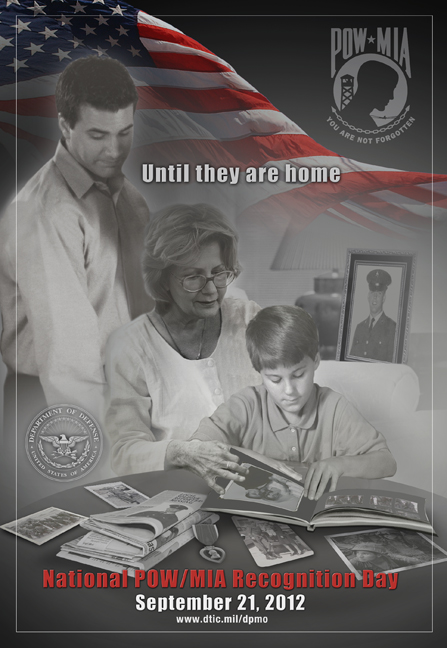
Never Forget: National POW-MIA Recognition Day September 21st 2012

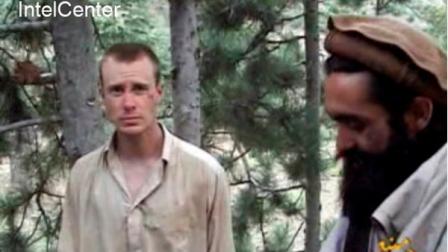
Over 80,000 American Soldiers, Sailors, Marines and Airmen who answered the call to the nation’s colors are still listed as Missing in Action. Currently there is one known Prisoner of War, Sergeant Bowe Bergdahl being held by Taliban Forces in Afghanistan.

Sht Bowe Bergdahl in Taliban captivity

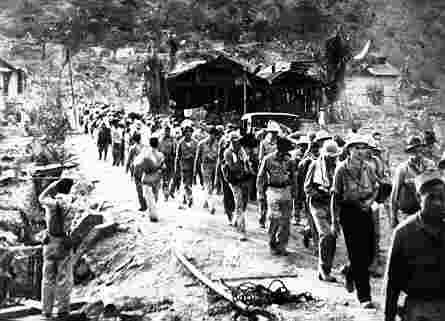
Most of these men and women served in World War II, Korea and Vietnam. They went to war, many as conscripts and never came home. For many Americans they are not even a memory. We are so distanced from the concept of national service or sacrifice and these wars are so far in the past that most people have no concept unless they are closely connected to a military family that still looks at an empty place at a table and has not had the closure of knowing that their relative is alive or dead. They have memories of the day that someone told them that their loved one was missing in action or a prisoner of our enemies.

Bataan Death March

The wait endured by these families is unimaginable to most people. For those known to be POWs the wait is tempered by the knowledge that their loved on is still alive and might return. For the relatives of the missing, there is only hope that their loved one is alive. For most this is not the case, especially as the time between when they went missing and the present day grows ever longer.

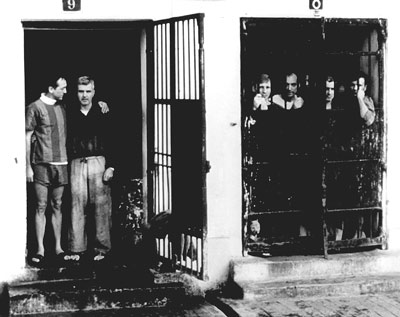
Captain James Stockdale (2nd from left) at the Hoa Lo Prison (Hanoi Hilton)

For those that experienced being a Prisoner of War the wait is one marked by isolation, constant enemy propaganda and the fear that they might not ever their their loved ones or home again. Most have endured those hardships and have survived torture at the hands of their captors. Vice Admiral James Stockdale who was a prisoner of the North Vietnamese for over seven and a half years. After his release he said something that I have always thought both remarkable and inspirational and representative of many of those who endured captivity: “The test of character is not ‘hanging in’ when you expect light at the end of the tunnel, but performance of duty, and persistence of example when you know no light is coming.”

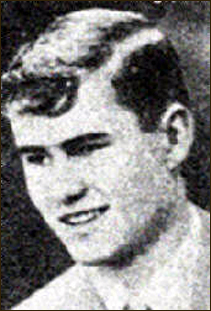
Norman Eidsmoe

When I was a kid and my dad was in the Navy I went to school with the children of a Navy pilot, LCDR Norman Eidsmoe. Eidsmoe went missing on a night bombing mission over North Vietnam on January 26th 1968. Two of his sons would serve as aviators in the Navy or Marine Corps and in 1997 his remains,were recovered. On December 9th 1999 his remains as well as those of his bombardier-navigator LT Michael Dunn were positively identified by the Joint POW/MIA Accounting Command (JPAC).

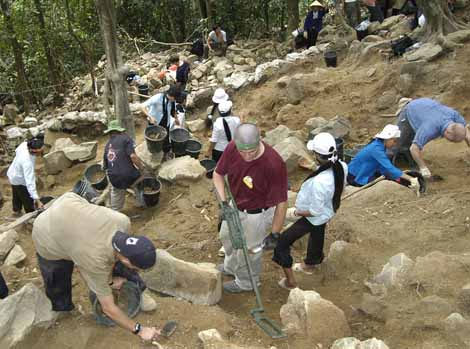
Members of the Joint POW-MIA Accounting Command near Dong Hoi Vietnam in 2006

For the Eidsmoe’s and the Dunn’s their long wait ended, but for tens of thousands of others the wait continues. Each day the men and women of the JPAC work around the world in to track down, recover and identify the missing. Working in the jungles of Southeast Asia, remote Pacific Islands and the battlefields of Europe and North Africa these men and women labor, often with our former enemies to locate, recover and identify our missing heroes. Almost every month the survivors and descendants of a MIA are notified that the remains of their loved one have been identified bringing needed closure to these families.

As this night ends let us not forget those who are still missing or held captive and those that currently serve in harm’s way.

Peace

Padre Steve+


1 Comment

Filed under History, Military, vietnam