Category Archives: History

To the Shores of Tripoli: The Flames of Revolution Spread to Libya as Gaddafi Fights Back

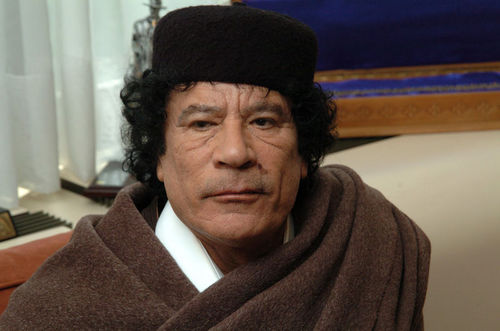
Muammar Gaddafi: A Fight to the Finish

The regime of Colonel Muammar Gaddafi is now in a fight to the death against the Libyan people in the streets of the capitol Tripoli.  In the eastern part of the country it appears that the revolutionaries have gained control of major cities including Libya’s second largest city Benghazi.

Gaddafi has ruled his own country with brutal force and exported terrorism throughout the Middle East and Europe for decades. When I served in Germany during the Cold War it was Libyan agents that attacked American servicemen and women and blew up Pan Am Flight 103 over Lockerbie Scotland.

Saif El Islam Gaddafi: Civil War

The Gaddafi regime has turned to brutal force to attempt to curb demonstrations that began in the wake of the successful Tunisian and Egyptian revolts that overthrew Ben Ali in Tunisia and Hosni Mubarak in Egypt. Gaddafi is a ruthless animal when it comes to his readiness to violently crush any dissent against his regime and has not hesitated to use political assassination on Libyan dissidents abroad.  However he is survivor who knows how to use money and oil to get his way with governments. He has occasionally reached out to appear in a more moderate and reasonable persona such as when he gave up his Weapons of Mass Destruction to the Americans and British in 2004 and when he paid 271 million dollars to the victims of the Lockerbie attack.


Libya is different than Tunisia, Egypt and Bahrain. The rulers of those countries, Ben Ali in Tunisia and Mubarak in Egypt while dictators they were not psychopaths and ceded power peacefully. Likewise the Bahraini leaders have backed down to opt for negotiations over the heavy handed force that they employed last week. Gaddafi has long viewed himself as the leader of the Arab World and Africa although his stock has fallen in recent years. He will not go peacefully.  His son Saif El Islam a Western Educated Ph.D. went on state television last night and predicted thousands would be killed in a prolonged civil war and said that “Libya is at a crossroads. If we do not agree today on reforms, we will not be mourning 84 people, but thousands of deaths, and rivers of blood will run through Libya…” He further said “We will take up arms… we will fight to the last bullet… We will destroy seditious elements. If everybody is armed, it is civil war, we will kill each other.”

Saif’s threats are being taken seriously. Since the protests broke out Gaddafi’s security forces have launched vicious attacks on protests and even the funerals of those killed. Using heavy weapons, aircraft and helicopter gunships Gaddafi has turned dogs of war against his people, reportedly using mercenaries from other nations to do what native Libyan soldiers and airmen will not do.

Protesters are being joined in some places by Libyan soldiers and elsewhere two Libyan Air Force Colonels defected with their fully armed Mirage F-1 fighter aircraft to Malta stating that they refused to fire on their countrymen. Around the world Libyan diplomats are condemning the regime and even in the country the Justice Minister and many judges in Benghazi have joined the protests. Other reports suggest that Libyan Border Guards and Coastguard personnel have left their posts along the Egyptian frontier. Libya’s Deputy Ambassador to the United Nations Ibrahim Dabbashi, Libya’s told reporters on Monday that Libyan leader Moammar Gadhafi has “declared war on the Libyan people and is committing genocide.”
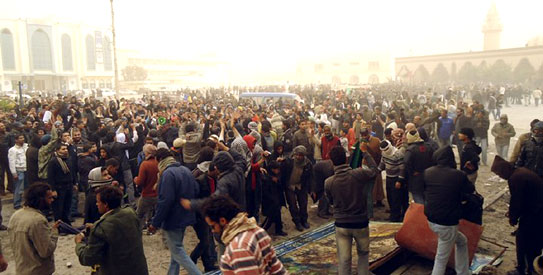
Protests in the city of Tobruk (Reuters Photo)

The situation is escalating. On Tuesday the United Nations Security Council will meet for the first time to discuss the issue. Some have suggested that the Security Council impose a no-fly zone over Libyan airspace to keep Gaddafi from flying in more foreign mercenaries or use his air force against the protesters.

What is certain is that blood will continue to flow and that if Gaddafi goes down he and his sycophants will kill as many of their own people as they can.  The most interesting thing about this whole situation is that if Gaddafi falls it will be the first time an anti-Western or American regime has fallen signifying that the flames of protest and revolution are much more about overthrowing despots and bringing the people some measure of freedom than anything else. The situation is dangerous, fraught with peril and fluid but it could be the start of a change in the Middle East that takes the wind out of the sails of Al Qaeda and other terrorists groups who draw their support from those repressed by dictators.

It shall be interesting to see how this continues to develop. Pray for the people of Libya.

Peace

Padre Steve+
7 Comments

Filed under Foreign Policy, History, middle east, Military, national security

The Iranian Navy in the Mediterranean: Looking for War in all the Right Places

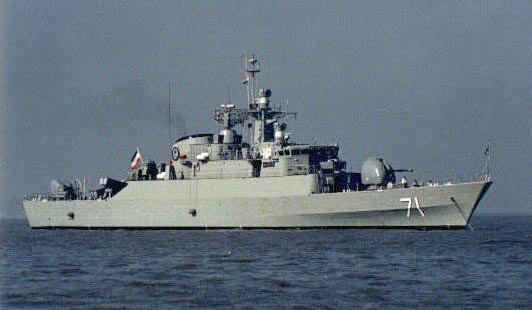
Iranian Frigate Alvand

For the first time since the Iranian Revolution Iranian warships have permission to transit the Suez Canal, an international waterway.  The Frigate Alvand and the supply ship Kharq passed inspection to ensure that no contraband or illegal weapons were aboard and should pass through the canal in the coming days. The Iranians clam that the ships will sail to Syria where they will operate from in the coming months.

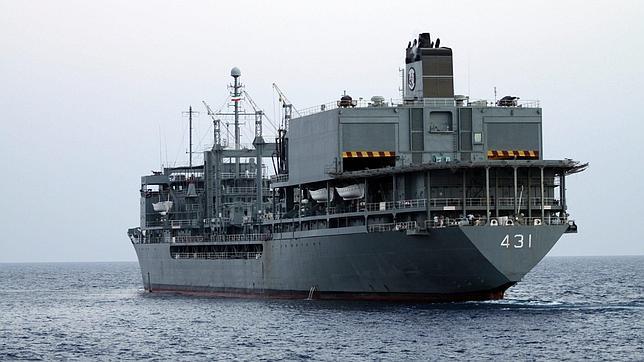
Iranian Supply Ship Kharq

To me the move by Iran appears to be an attempt to provoke Israel into a war. Israel views the move with suspicion and calls it provocative. In that they are right. It is suspicious that the Iranians would send ships to the Mediterranean and one wonders what they are up to. Based in Syria the ships can support pro-Iranian Hezbollah forces in Lebanon and show the Iranian flag in countries that are slipping into the throws of revolution.  As such the two ships are a provocative presence that Israel has a right to be concerned about. At the same time the ships themselves pose no threat to Israel in any way shape or form.

The Frigate Alvand is a Vosper Mark V Frigate commissioned in 1971. It is small (1,540 tons full load) and fast but old and not heavily armed. Alvand and its two sister ships are armed with 4 C-802 Anti-Ship cruise missiles and a 4.5” gun was well as various light anti-aircraft weapons and anti-submarine torpedoes. The electronics suite on Alvand class is not state of the art by any sense and they are of limited combat value despite Iranian claims otherwise.

The 40 year old  Alvand is accompanied by the Supply Ship Kharq which is a 1960s British design which the Iranians commissioned in 1980. It has a light armament and is of negligible combat value. The two ships paid a recent port call at Jeddah Saudi Arabia while conducting operations in the Red Sea.

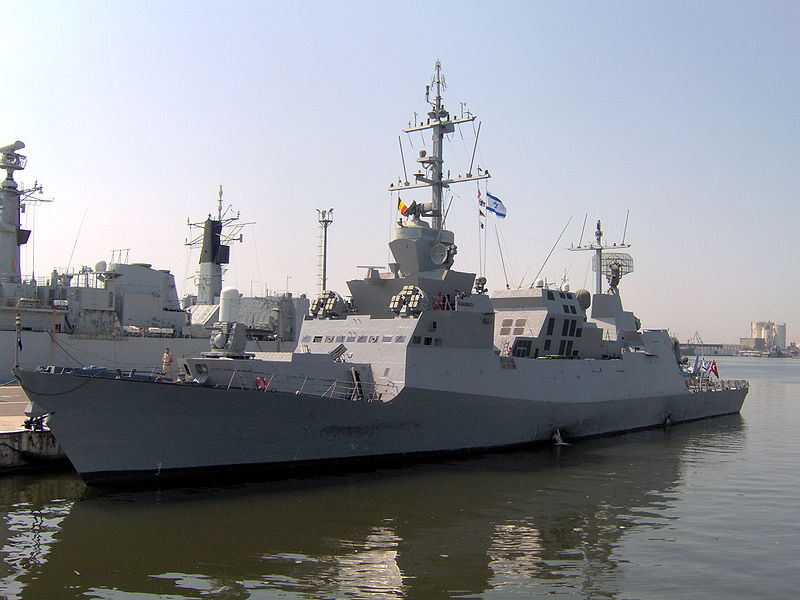
Israeli Navy Corvette Eilat a very modern and deadly SAAR V Class ship

Both the Alvand and the Kharq are totally outclassed by the Israeli Eilat Class (Saar V) Corvettes and have no defense to speak of against Israeli surface units, submarines or air forces.  They are of propaganda value only and if as some suggest they would attempt to escort convoys into Gaza they would probably be sunk by the Israelis before they could get off a shot. The danger of course is that the Iranians are purposely sending the ships to the Mediterranean to provoke an Israeli response and ignite a conflict between the two nations to further destabilize the region.

The Israeli Navy has a first strike capability against Iran itself in its three modern German built Dolphin Class submarines which are believed to be capable of launching nuclear capable cruise missiles and which have been deployed in waters near Iran.

Israel’s Defense Minister Ehud Barak said in an e-mail statement: “Israel is closely following the movements of the Iranian ships and has updated friendly states on the issue. Israel will continue to follow the ships movements.”

While the movement of the two ships through the Suez which is an international waterway is provocative and comes at a time of increasing tensions they pose little threat to Israel. However as part of a broader view taking into account the activities of Hezbollah in Lebanon, instability in Israel’s Arab allies Egypt and Jordan and Iran’s military buildup and nuclear program it is obvious that Iran has a purpose in deploying the two ships to the Mediterranean and that the purpose includes upping the pressure on Israel and perhaps provoking a military response. Whatever the actual purpose we can be sure that Iran’s intentions are not peaceful and the only purpose for the ships to be in the Mediterranean is to provoke a clash with the Israelis or to offer direct support to the actions of Hezbollah and Hamas against the Israelis or in the case of Hezbollah to ensure the complete hegemony of Iran, Syria and Hezbollah in Lebanon.

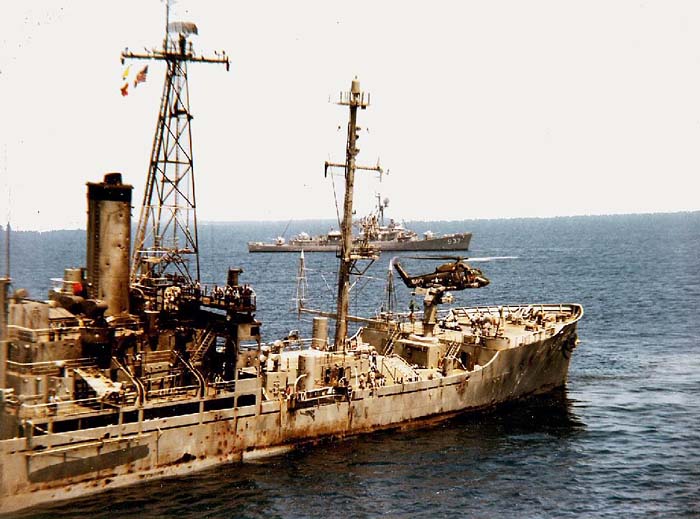
The USS Liberty AGTR-5 after being attacked by Israeli Air and Naval Units on 8 June 1967

Israel’s Navy while the smallest of the Israeli armed forces is quite capable and combat proven over the years. It has shown that it is not afraid to engage in combat with what Israel perceives to be threats, even the United States Navy as it did in the 1967 Six Day War where it launched a devastating prolonged attack on the USS Liberty AGTR-5 killing 34 and wounding 171 of its crew. The Israelis have long contended that the attack was a case of mistaken identity but the preponderance of evidence makes it look like the attack was deliberate.

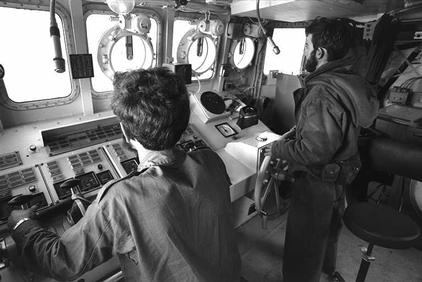
Israeli Sailors during the Battle of Latakia

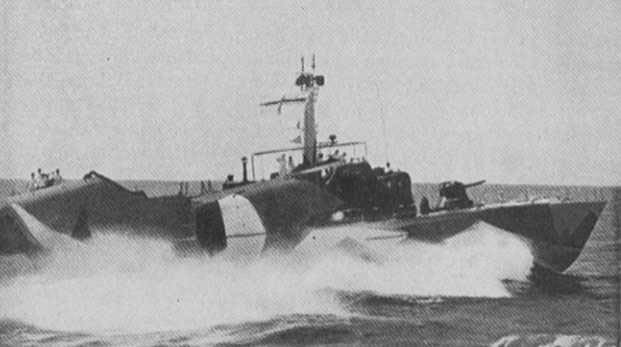
Egyptian Osa Class Missile Boat during 1973 War. The Israeli Navy sank 8 Egyptian and Syrian ships at the Battle of Latakia and Battle of Baltim with no losses to themselves in the first battles between guided missile ships

During the Yom Kippur War of 1973 the Israeli Navy destroyed 5 out of 5 Syrian Komar and Osa Class Missile Boats at the Battle of Latakia and 3 of 4 Egyptian Osa Class Missile Boats at the Battle of Baltim. Should the Iranian ships even look like they are threatening Israel the Israelis will have little patience and the ships will have an incredibly short combat life.  If that happens then expect a regional war to follow as Hezbollah, Iran and possibly Syria respond.

The clip below is from Iran’s English Language Press TV and is an Iranian assessment of their naval capabilities.

http://www.youtube.com/user/PressTVGlobalNews#p/u/13/doiWKWz4ZN8

Peace

Padre Steve+

10 Comments

Filed under Foreign Policy, History, middle east, Military, national security, Navy Ships

Danger in the Arabian Gulf: The Fires of Protest Spread to Bahrain

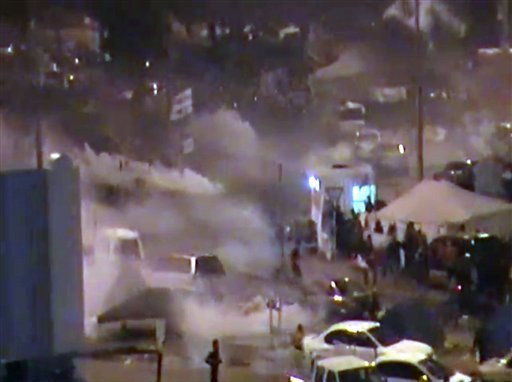
Protesters attacked in Bahrain (AP Photo)

It is weird when you see a place that you have been many times explode into massive protests, violence and potential revolution. That I have been to Bahrain many times and it is strange to see what is going on there. My first couple of times I was assigned to a ship, the cruiser USS HUE CITY on port calls while deployed in the Arabian Gulf. Later I would make frequent trips there as chaplain for the Marine Security Forces.

In the days following the downfall of Tunisia’s President Ben Ali and Egypt’s Hosni Mubarak the flames of revolution have spread across the Middle East. Protests have taken place in Yemen, Libya, Jordan and Bahrain and the situations have become violent as security forces attempted to put down the protests. Even Iran is beginning to boil over as protestors who feel cheated by the results of the contested 2009 elections rise up against the Iranian regime. However, the situation in Bahrain is the most troubling if one looks at the potential impact on US strategy in the Arabian Gulf and always tense situation with Iran.

Bahraini Shia women with black flags. The Black flag is commonly flown in Shia neighborhoods and villages in Bahrain (AP Photo)

As I said before I have been to Bahrain many times. It is one of the most socially progressive countries in the Middle East and unlike most other Arab nation’s alcohol can be purchased in stores and not just upscale hotels that cater to foreigners, businessmen, military personnel and diplomats. It is a wealthy nation which though not prosperous as Qatar or the United Arab Emirates, Bahrain has managed to diversify its economy with a per capita income of $25,420.  It is a frequent vacation destination of many well off Saudis and has over 230,000 expats from other countries who call Bahrain home. According to a United Nations report Bahrain has 807,000 residents including the expats.

One thing that I remember about Bahrain is that the wealth is not very evenly divided. For the most part the Shia population is incredibly poor and their villages stand in stark contrast to the wealth of the Sunni. This is one of the biggest causes of the tensions which have brought about the protest movement which was ignited by the success of the revolts in Tunisia and Egypt.

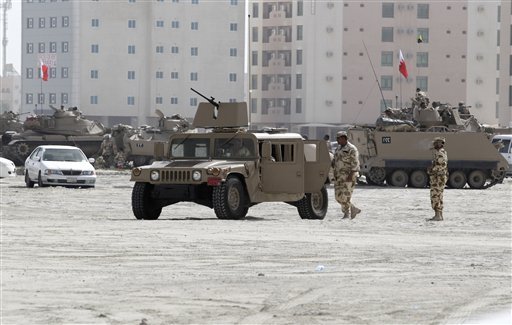
Bahrain Army units deployed in Manama (AP Photo)

The population of Bahrain is divided between the Sunni ruling class which comprises approximately 30% of the population and a less well off Shia population. The Khalifah family has ruled the country since driving out the Persians in 1783. It became a British protectorate in 1861 and the Kingdom attained its independence in 1971 and became a constitutional Monarchy in 2002 with some elected representatives.  The current King Sheikh Hamad bin Isa Al Khalifah is a graduate of Cambridge University and the U.S. Army Command and Staff College. He has reigned since March of 1999 when his father died.

Iran considers Bahrain a rebel province and is viewed as a threat by Bahrain has sought over the years to foment dissent in Shia community which believes that it is discriminated against by the Sunni rulers.

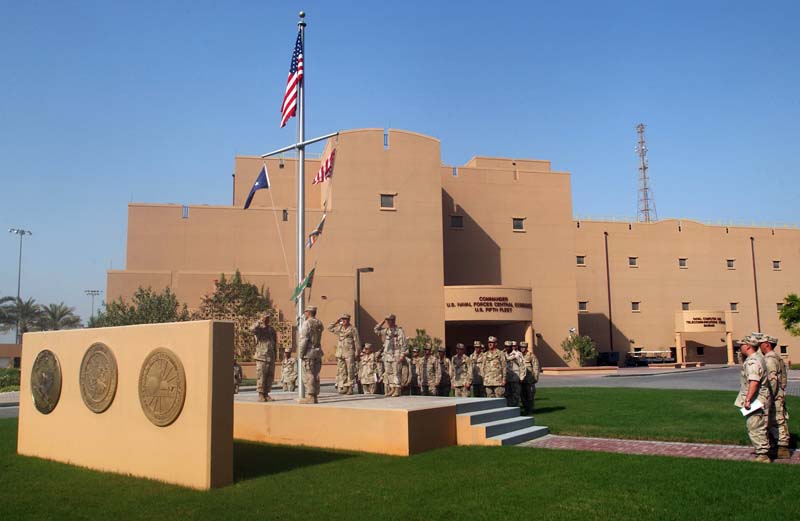
NAVCENT Headquarters in Bahrain (Navy Times Photo)

Bahrain is a vital part of the U.S. strategic presence in the region as a counter to the Iranian threat. It hosts the headquarters of the U.S. 5th Fleet, Naval Forces Central Command (NAVCENT) and Marine Forces Central Command (MARCENT). It is a frequent port of call for U.S. and Allied Navy ships that operate in the Arabian Gulf.  As such the current instability and violence is a matter of grave concern for the United States and its Allies in the Gulf.

As I said I have been to Bahrain numerous times in 2002, 2003, 2004, 2005 and 2006. I would stay in hotels with the best security which happened to be the 5 Star locations and dine at various Irish, British or Arab restaurants mostly with fellow Marine or Navy Officers or expats.  The difference between that world and the Shia villages and neighborhoods is amazing the contrast between the vast wealth of some and the absolute poverty of the other troubled me because I could see that it was a ticking time bomb. The Shia population also has limited political rights and is often targeted by the police.  They are certainly infiltrated by Iranian agents who I would guess are helping to stir things up.

The violence that has overtaken Bahrain does not surprise me. The Bahraini military is primarily composed of Sunnis from other Arab countries and has little love for the Shia. They are basically a mercenary force absolutely loyal to the government. There will be no Egyptian style coup in Bahrain. Since the population is small and the Army, police and other security forces wedded to the government I expect that the protests will be put down and that the regime will survive.  It will not be pretty and could well have an impact on U.S. Forces in Bahrain.

Back after 9/11 military dependents were sent home and force protection increased. A couple of years ago dependants were allowed back in but I think that we will see them extracted again. The security forces at the base are robust and work closely with the Bahraini security forces. I would expect that whatever Marine Expeditionary Unit is in theater will be on alert and that additional Fleet Anti-Terrorism Security Teams could be flown in to reinforce the base.

The broader ramifications of a continued violent crackdown on the protestors will be felt throughout the region. With the success of the Tunisian and Egyptian revolts people in many parts of the Arab World are now boiling over as protests and revolts against the old authoritarian regimes spread. As the situation continues to build I expect the probability of more regimes being overthrown with very unpredictable consequences. What may be true for Egypt may not be true anywhere else. What is for sure is that the Middle East that existed in December will look far different by the end of this year and that could be a good thing or a bad thing depending on just how it all shakes out and the possible impact on American and NATO operations in the region as well as impact on American overseas counter-terrorism operations especially in Yemen.

We can only wait and see and hopefully influence peaceful and democratic change in the area, but revolutions in countries that repress their populations tend not to be peaceful.  Egypt so far is an exception to that. If you believe in prayer I recommend that we pray hard my friends.

Peace

Padre Steve+
 

11 Comments

Filed under Foreign Policy, History, Military, national security

Predators of the High Seas: The Type IX U-Boats

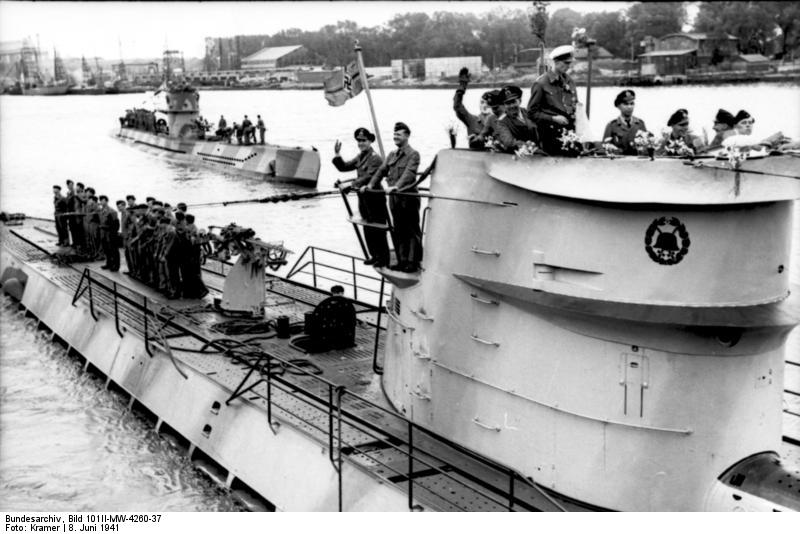
U-123 returning from patrol

As the Kriegsmarine began its expansion in the mid-1930s the new U-Boat arm developed several types of submarines. The Type IX class was designed in 1935-36 as a long range attack boat and was larger had a greater range and were more heavily armed than the more numerous Type VII boats.  The Kreigsmarine designers envisioned a submarine capable of operating far from German bases for extended periods of time.  The design of these boats was derived from the two boat Type 1 class and incorporated lessons learned from that class.  283 boats of the type were constructed between 1937 and 1944 and the Kriegsmarine continuously sought to improve the type which resulted in five distinct models within the class.

Type IXA The first group referred to as the Type IXA or simply the Type IX was comprised of 8 boats built by AG Weser of Bremen.  Ordered in 1936 the group was part of the Kriegsmarine’s Plan Z rearmament plan which began when the Nazi Government announced that it would no longer abide by the Treaty of Versailles.  The initial 8 boats had a 1032 ton standard displacement were 251 feet long and were armed with six 21” torpedo tubes with 22 torpedoes.  They had a 105mm deck gun with 110 rounds as well as a 37mm and 20mm anti-aircraft gun.  They were the first German submarines equipped with a double hull which increased survivability and seaworthiness.  They were powered on the surface by two MAN M9V40/46 supercharged 9-cylinder diesel engines that produced 4,400 shp as well as two SSW GU345/34 double-acting electric motors for underwater operations. As in all diesel-electric boats the diesels were used to recharge the batteries for the electric motors while the boat was operating on the surface. They had a maximum speed of 18.2 knots on the surface and a range of 22,354 miles at 10 knots. Underwater they had a maximum speed of 7.7 knots and range of 166 miles at 4 knots.  The official maximum diving depth was 230 meters or 750 feet.  Of the 8 boats of this type 6 were sunk during combat operations and two scuttled at the end of the war by their crews to prevent their capture by the Allies. The most successful of the Type IXA boats was the U-37 was the most successful boat of the type sinking 53 merchant ships for a total of 200,124 tons as well as two warships, the Sloop HMS Penzance and French Submarine Q-182.

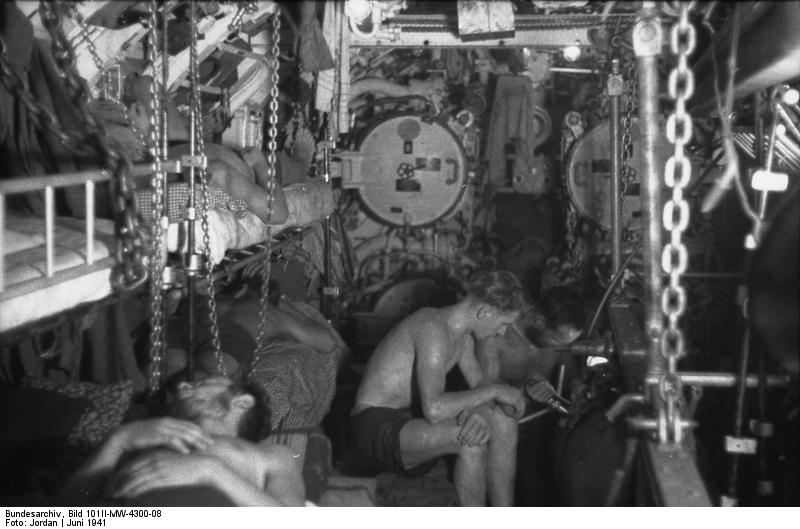
Crew members  of U-107 in Torpedo Room

Type IXB The next group was the IXB of which 14 boats were built by AG Weser Bremen. This was the most successful class of U-boats, or for that matter any class of submarines based on tonnage sunk per boat during the Second World War. Each of these ships sank over 100,000 tons of Allied shipping.  They were slightly larger than the IXA boats and had a significantly longer operational range of 24,600 miles on the surface at 10 knots. The U-107 of this class had the most successful war patrol of any U-Boat in the war sinking nearly 100,000 tons of Allied shipping off Freetown Sierra Leone while U-103 sank over 237,000 tons of Allied shipping during 11 war patrols over the course of 4 years. These boats were involved in Operation Drumbeat off the coast of the United States in early 1942.

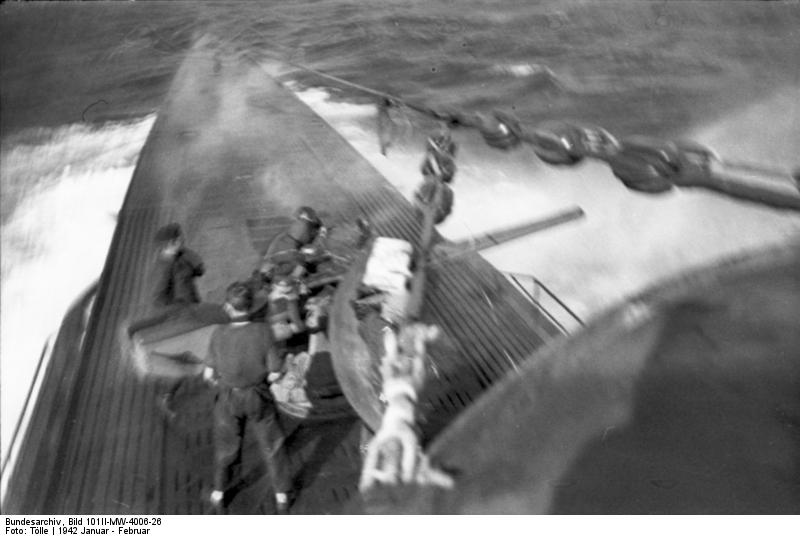
U-123 Gun Crew

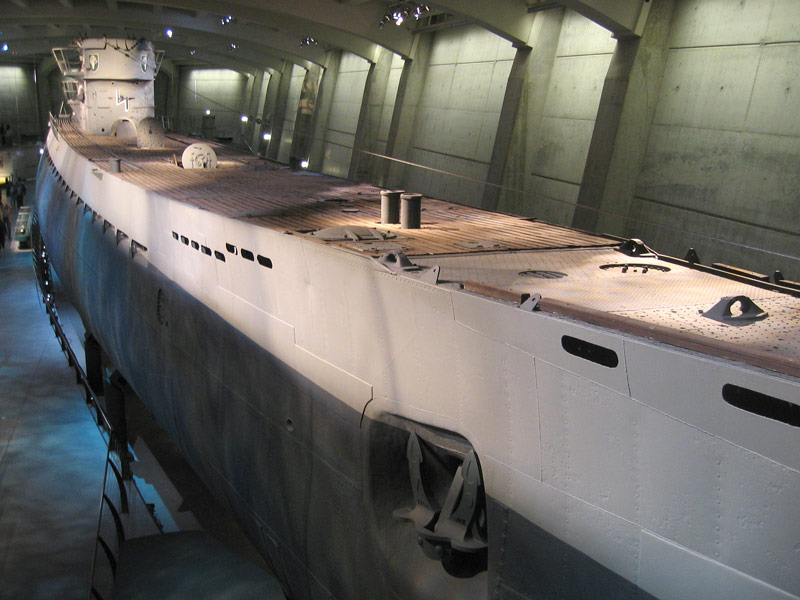
Type IXC The Type IXC was a further improvement of the type with additional fuel capacity and longer range. They displaced 1120 tons and 54 of the boats were commissioned of which 19 were equipped as minelayers with a capacity of 44 TMA or 66 TMB mines. The boats were built by AG Weser Bremen, Seebeckwerft Bremen and Deutsche Werft Hamburg.  The U-505 of this type is the only surviving Type IX and was captured by a boarding team from the Escort Carrier USS Guadalcanal on June 4th 1944. Her capture was kept secret from the Germans and her crew kept as POWs in a separate POW Camp. The story of the crew and their encounter with the game of baseball is recorded in Gary Moore’s book, Playing with the Enemy: A Baseball Prodigy, a World at War, and a Field of Broken Dreams. The book is being turned into a movie entitled Playing with the Enemy which is scheduled to be released in 2011. She is preserved at the Museum of Science and Industry in Chicago.

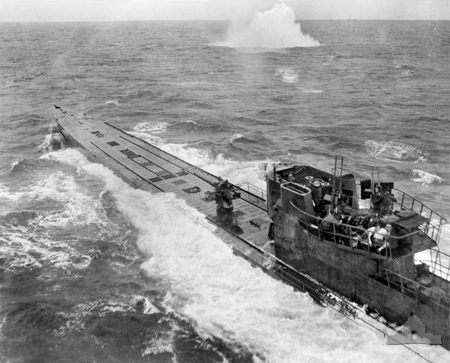
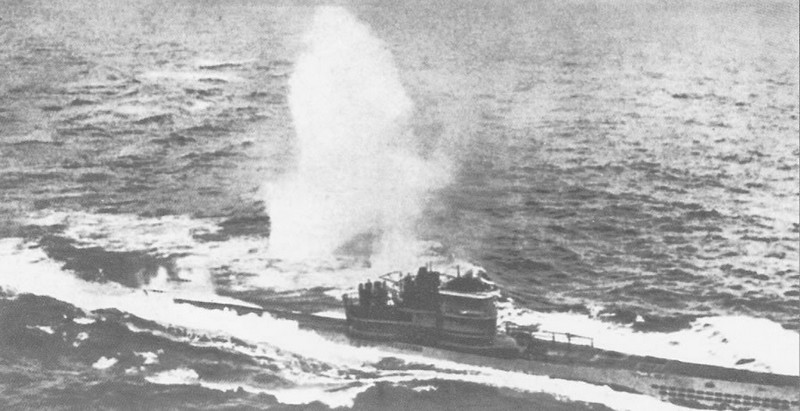
U-848 under attack by USN Aircraft

Type IXC/40 This was a further refinement of the IXC with slightly greater range and surface speed. It was the most numerous type of the class built with 87 being built by AG Weser Bremen, Seebeckwerft Bremen and Deutsche Werft Hamburg.  The remains of the U-534 of the class are displayed at Woodside Ferry Terminal in Birkenhead England after being raised from the North Sea in 1986.

Type IXD The final type in the Type IX Series was the Type IXD.  This was a significantly larger boat than the others in the class 287 feet long with a standard displacement of 1610 tons. They were unique in that they had two sets of diesel engines, one for cruising and the other for high speed runs and battery recharge. There were three variants within the type, the IXD1 which were all converted to transport use due to problems with their engines, the most numerous variant the IXD2 and the IXD42 which had greater horsepower.  Thirty Type IXs were commissioned with a further six Type IXD42s which were ordered with only one commissioned by the end of the war.

U-505 at the Museum of Science and Industry in 2005 (Jerry Atherton)

During the war surviving boats would receive increased anti-aircraft armament, the Schnorkel device which allowed them to operate on diesel power while submerged as well as better electronics and detection devices. Most of the boats which survived the war were scuttled by the Allies in Operation Deadlight.  The U-511 was sold to Japan in 1943 and U-862 taken over by the Japanese after the German Surrender in May 1945. Both survived the war and were scuttled by the Allies. U-1231 was taken over by the Soviet Navy and served as the B-26 after the war.

The sailors of these U-Boats like all submarine sailors endured many hardships and during the war approximately 75% of the 40,000 U-Boat sailors never returned from patrol, forever interred in the deep with their proud boats.

1 Comment

Filed under History, Military, Navy Ships, world war two in europe

The First Modern Destroyers: The Imperial Japanese Navy Fubuki Class

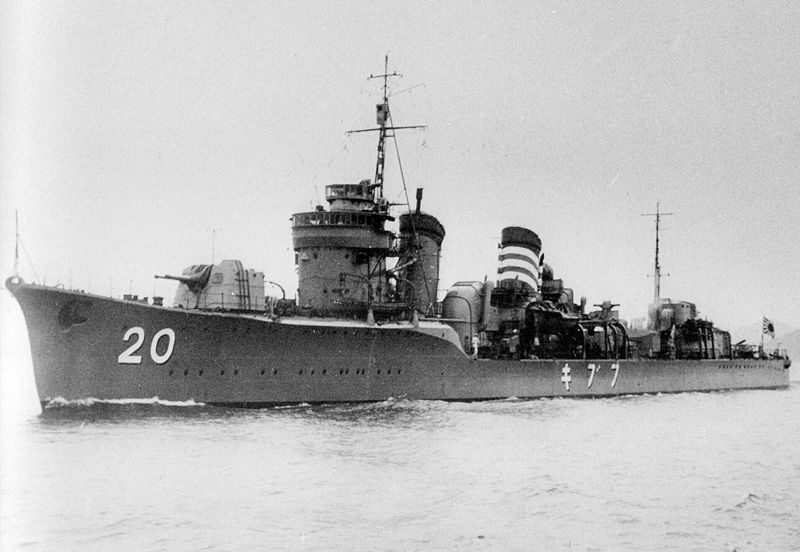
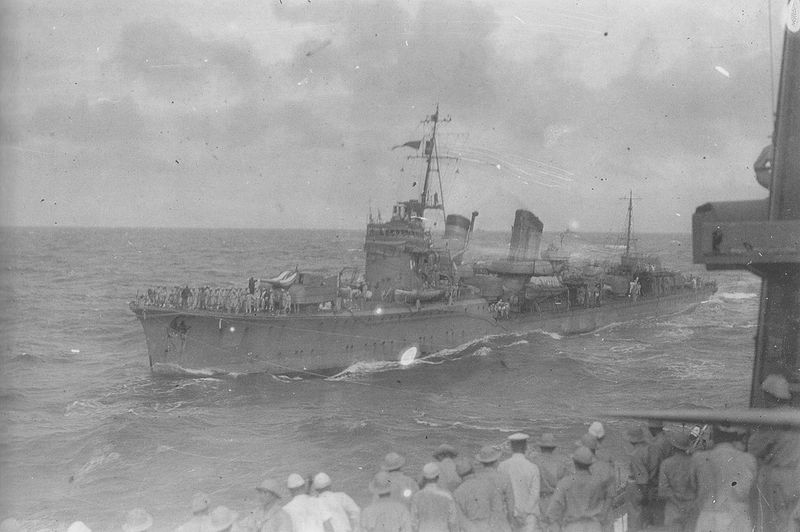
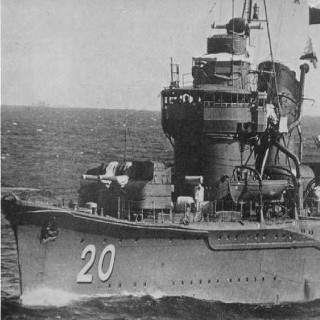
IJNS Fubuki

The Imperial Japanese Navy set the standard for destroyer construction in the 1920. While the United States Navy and British Royal Navy were fully stocked with their First World War design destroyers the Imperial Navy’s General Staff issued a requirement for a class of large destroyers which would complement the new classes of modern cruisers being built for the navy. The requirement called for a 2000 ton ship capable of 39 knots with a 4000 mile range at 14 knots that could carry a large number of torpedoes and a heavy gun armament. The program was designed to give the numerically inferior Imperial Navy a qualitative superiority against any opponent.

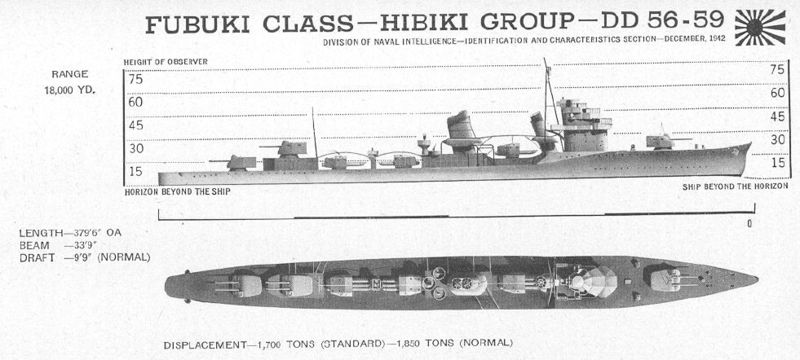
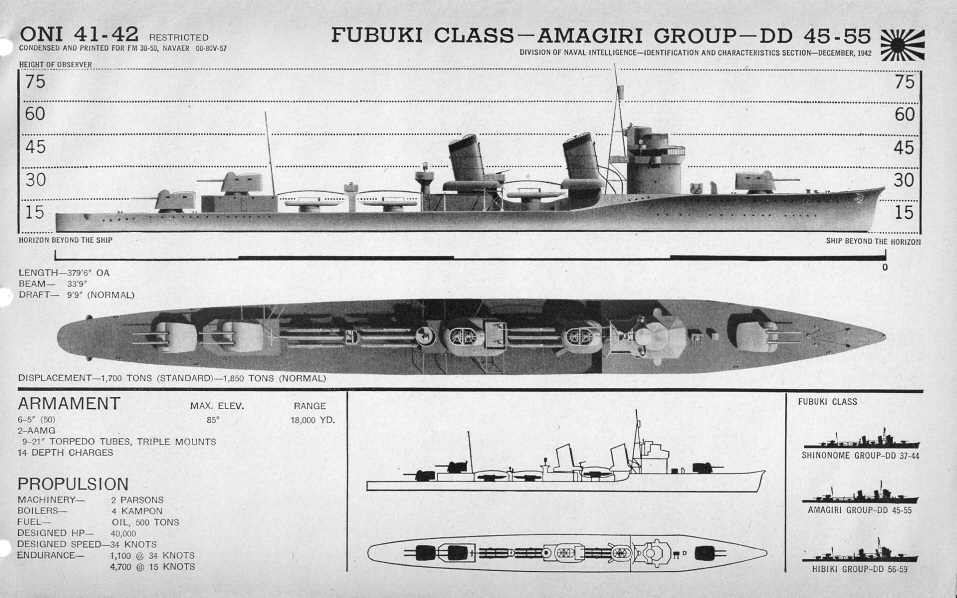
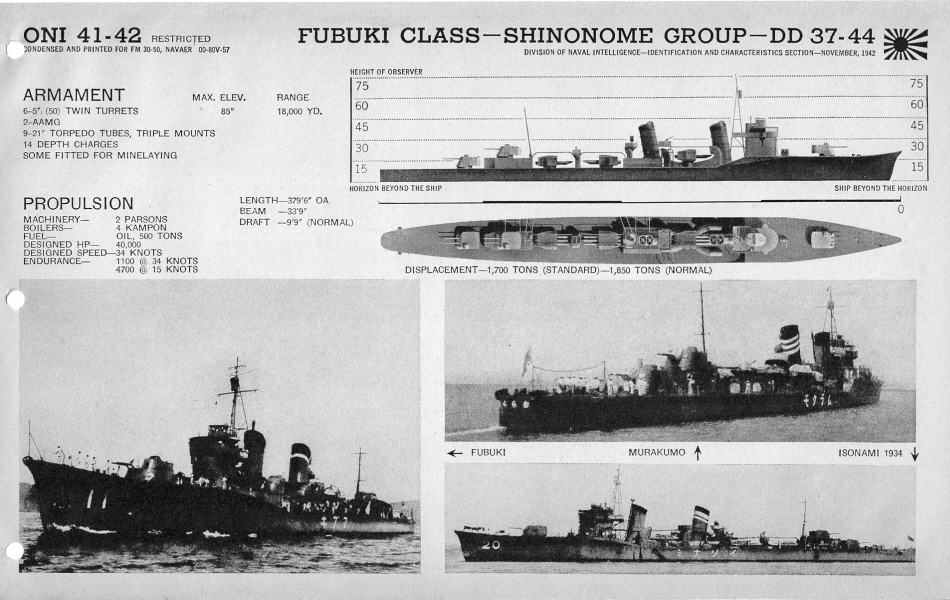
WWII Office of Naval Intelligence images for Fubuki Class variants

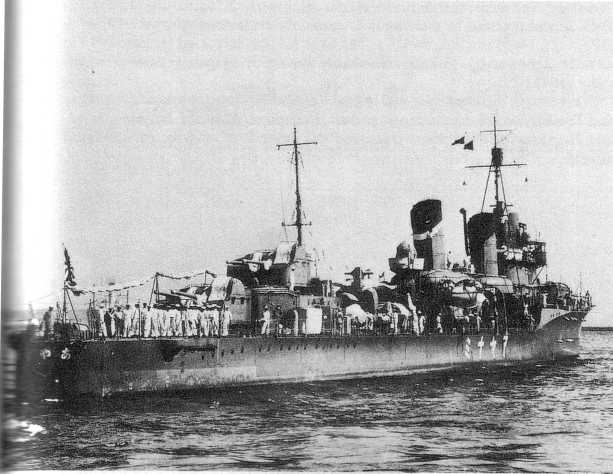
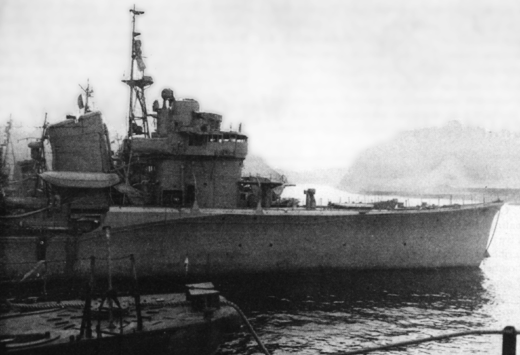
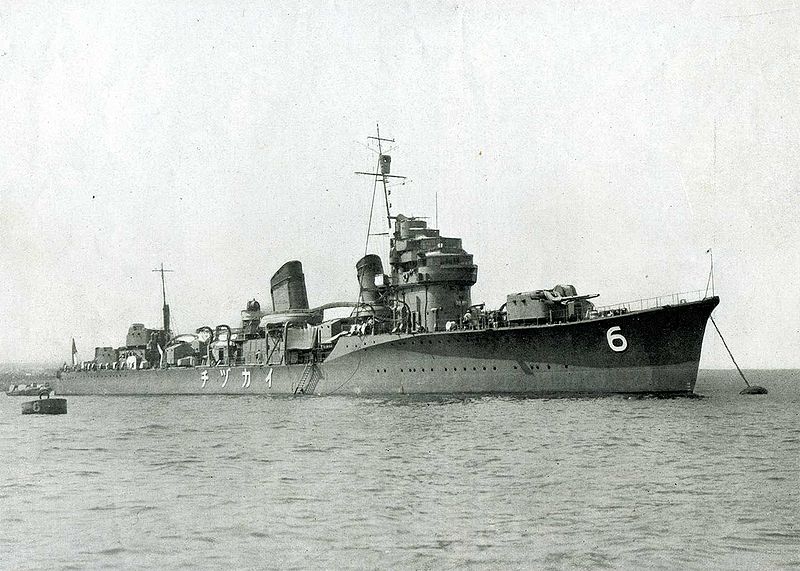
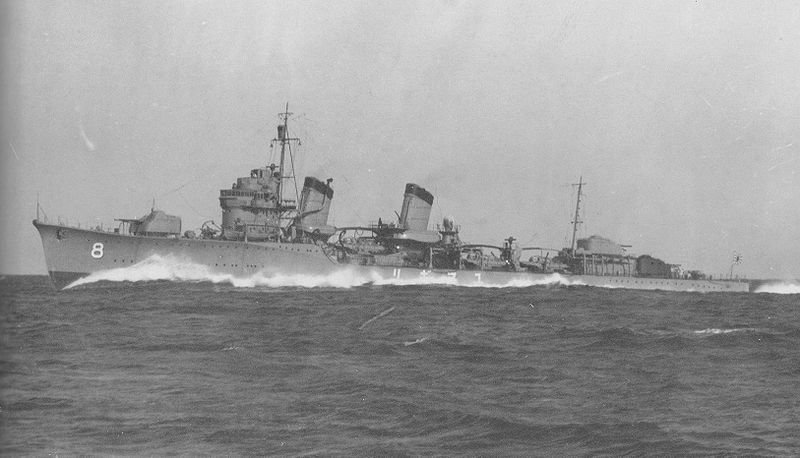
The 24 ship Fubuki Class was such a quantum leap over other contemporary destroyers that the Imperial Navy referred to them as the Special Type. Their large size, heavy armament and high speed made them equal to many of the light cruisers of the time. The design was modified to carry more guns and torpedoes on an increased displacement and the result was a 388 foot long 1750 ton ship armed with six 5” 50 caliber guns in weather proof and splinter proof mounts.  On the initial 10 ships of the class the guns could only be elevated 40 degrees which made them less than effective as anti-aircraft guns but in the succeeding two groups of ships the mounts were an improved type which allowed them to elevate each gun separately to 75 degrees.  The ammunition magazines were below the gun mounts and ammunition was passed to the guns by hoists.  This gave them a decided edge in rate of fire over other destroyers which had open or partially shield mounts dependant on ammunition passers carrying ammunition to them.

Close up of IJNS Sagiri

The light anti-aircraft armament when built was two Type 93 13mm machine guns.  In the years before the war and during the war this was increased in some cases up to twenty-two 25mm anti-aircraft guns and 10 of the Type 93 machine guns. In 1944 surviving ships of the class had their X- 5” gun mount removed to facilitate more of the 25mm guns, radar and additional depth charge capacity.

IJNS Ikazuchi

The nine 24” torpedo tubes in triple mounts were able to be reloaded while in battle a capability not shared by other destroyers.  They carried a total of 18 torpedoes which initially were the Type 8 but these were replaced by the oxygen powered Type 93 “Long Lance” torpedoes before the war. These torpedoes had a higher speed, longer range and heavier warhead than torpedoes produced by other navies.  These torpedoes would become the scourge of Allied navies during the war in the brutal surface engagements of 1942.

IJNS Yugiri

Due to the modifications made to the design which put more armament on a smaller displacement than the original design made them unstable in heavy seas and resulted in longitudinal hull weakness that resulted in the class being rebuilt between 1935 and 1937. The rebuild increased their displacement to 2050 tons standard and over 2400 tons full load and resulted in a slight reduction of their speed.

IJNS Hibiki

The class was built in three groups and each is sometimes referred to as a separate class as each incorporated improvements over the preceding group. The first 10 ships of the class which are sometimes referred to as the Fubuki Class were of less complex design than subsequent ships. They were feet long had a smaller bridge and exposed gunfire control room.  The second group of 10 ships commonly referred to as the Ayanami Class had an enlarged bridge structure which enclosed previous exposed positions to include the gunfire control room, range finders and included a range finder tower.  They also were the first ships to receive the improved Type B gun mounts.  The final subtype of the class, the Akatsuki Class comprised just 4 ships and was distinguished by a smaller forward funnel, larger boilers and unique splinter proof torpedo tube mount housing.

IJNS Ayanami

The ships of the class participated in every major campaign of Japan’s war in the Pacific as well as operations against China in the 1930s. One ship the Miyuki was lost in a collision with another destroyer in August 1934. All remaining ships of the class except the Hibiki and Ushio were lost in action during the war. Four the Fubuki, Ayanami, Yuguri and Ataksuki were sunk in surface actions. Eight ships the Usogumo, Shirakumo, Isonami, Shikinami, Sagiri, Sazanami, Inazuma, and Ikazuchi were lost to Allied submarines.  Seven ships the Shirayuki, Hatsuyuki, Murakumo, Uranami, Asagiri, Oboro and Akebono were sunk by aircraft and two the Shinonome and Amagiri fell victim to mines.

The demilitarized IJNS Ushio after the war

Hibiki was given to the Soviet Union following the war and served in that Navy until either 1953 or 1963 depending on the source. She was scrapped. Ushio surrendered to the Allies was demilitarized and scrapped in 1948.

The Amagiri played a role in the life of future President John F Kennedy when she rammed and sank his PT-109 in the Blackett Strait on August 2nd 1943. Her commanding officer at the time Lieutenant Commander Kohei Hanami attended Kennedy’s inauguration in 1961.

The Fubuki Class destroyers set a standard in destroyer construction that other navies around the world sought to emulate. Fast and powerful they and their crews fought gallantly in the Second World War and though in a losing cause deserve to be remembered.


5 Comments

Filed under History, Military, Navy Ships

The Last Full Measure: The Long Wars with more to Come

Fr Corby gives absolution to the Irish Brigade at Gettysburg as they stood in the breach

I have been watching the events in Egypt as well as other parts of the world with concern. We live in very dangerous times.  I do not want to sound like an alarmist but things are looking like we are heading into some very perilous waters.  For me this is personal because I have friends serving in harm’s way, I serve those wounded in body soul and spirit from their time in combat and I know in my heart that we will but blessed beyond compare if nothing else blows up on us.  But I am not optimistic.

The United States and its Allies have been fighting a war against Moslem extremists and terrorists on multiple fronts.  Some of these have been of necessity because they were where Al Qaeda and its allies were based such as Afghanistan and the Horn of Africa as well as a number of places in the shadows around the world. In 2003 President Bush elected to invade Iraq and another from was opened which drew the bulk of our combat forces into a protracted counter-insurgency campaign which we seem finally have been able to extricate ourselves from.  After years of neglect President Obama ordered a surge of troops into Afghanistan where the situation had deteriorated.  The fight is still raging there with the Taliban and their Al Qaeda allies receiving support from various entities in Pakistan supportive of their cause probably including parts of the Pakistani Intelligence services.

In these wars the all volunteer U.S. Military has performed many remarkable feats but suffered over 5000 deaths and more than 35,000 wounded not counting those with the unseen wounds of the soul and spirit.  Parts of it including the elite Special Operations Forces according to their Commander are stretched and frayed.  The operations tempo of deployment, redeployment, training and deployment is continuing to take a toll on active and reserve forces.

If this was all that we had to be concerned about it would be enough.  Unfortunately it seems as if the Arab world is about to experience a revolution. While we normally cheer the triumph of people over tyrants it is unknown how this will develop. Conceivably it could be a good thing should moderate forces take control of the situation in Egypt should Hosni Mubarak step down.  Unfortunately history shows that the control of revolutions seldom remain under the influence of moderates as extremists are far better organizers and much more likely to use violence to gain control through terror, especially in cultures where there is little experience of freedom or or history of non-despotic rule.  Egypt lies at the heart of the Arab World and what happens there will likely influence events in other Arab nations.

Meanwhile Iran, Syria and their Hezbollah confederates work to destabilize the region and Iran seeks to build weapons capable of carrying WMD which could be used against US Forces, our Allies in the Middle East and Europe in defiance of international organizations.  In light of all of this the outgoing Chief of Staff of the Israeli Defense Forces has told his country that it needs to prepare for “all out war.”

I could go on and talk about all the other simmering cauldrons but the point is that no matter how much we would like not to be involved when the cauldrons boil over we will. It is a very dangerous time.

Our forces, Army, Marines, Navy and Air Force which have fought gallantly for 10 years will be sent into the breach.  The place and time are not yet determined but it will happen.  And unlike Iraq and Afghanistan which are counterinsurgencies this will be a fight like we haven’t seen in many years and it may even come to our shores in the form of terrorism.

While all of us that volunteer to serve have our own motivations ranging from idealism to simply needing a job we all have volunteered. We know that we are at war and it is not going to end anytime soon.  For me the call is to be with my Sailors, Marines and Soldiers wherever I am sent, which for the moment is caring for those injured in mind body and spirit at a Naval Hospital on a Marine major Marine base but I know that I will be involved again somewhere and I am alright with that because this is a sacred calling.  That call for me is call as a Priest and Chaplain to serve our Sailors, Marines, Soldiers and Airmen wherever I am sent. Many others have this as well as the call to the profession of arms and share in the brotherhood of war.  We are a brotherhood knit together by war as Shakespeare said “We few, we happy few, we band of brothers.” This band of brothers will be called into the breach the only question is where and when. May our hearts and spirits be up to the task as just as Henry V prayed:

O God of battles! Steel my soldiers’ hearts.

Possess them not with fear. Take from them now

The sense of reckoning, if the opposed numbers

Pluck their hearts from them. Not today, O Lord,

O, not today, think not upon the fault…

Peace

Padre Steve+
4 Comments

Filed under History, iraq,afghanistan, Military

Flush Decks and Four Pipes: The Wickes and Clemson Class Destroyers

USS Pope DD-225

The destroyers of the Wickes and Clemson classes defined the destroyer force of the U.S. Navy. In 1916 with the advent of the submarine as an effective weapon of war the Navy realized that its pervious classes of destroyers were insufficient to meet the new threat. Likewise the lack of endurance of earlier destroyers kept them from vital scouting missions since the U.S. Navy unlike the Royal Navy or Imperial German Navy maintained few cruisers for such missions.

USS Paul Jones DD-230 late war note 3 stacks and radar

The Naval Appropriation Act of 1916 included the authorization of 50 Wickes Class destroyers to compliment 10 new battleships, 6 battlecruisers and 10 light cruisers with the goal of building a Navy second to none.  The new destroyers were designed for high speed operations and intentionally designed for mass production setting a precedent for the following Clemson class as well as the destroyer classes built during the Second World War.

USS Boggs DMS-3

The Wickes Class had a designed speed of 35 knots in order to be able to operate with the new Omaha Class light cruisers and Lexington Class Battlecruisers in the role of scouting for the fleet. They were flush-decked which provided additional hull strength and their speed was due to the additional horsepower provided by their Parsons turbines which produced 24,610 hp.  They were 314’ long and had a 30 foot beam. Displacing 1247 tons full load they were 100 tons larger than the previous Caldwell class ships.  They were armed with four 4 inch 50 caliber guns, one 3” 23 caliber gun and twelve 21” torpedo tubes.

USS Crosby APD 17

Although they were very fast they proved to be very “wet” ships forward and despite carrying an additional 100 tons of fuel they still lacked range.  Due to the realization the U-Boat war required more escorts the order for Wickes Class ships was increased and 111 wear completed by 1919.

The Wickes Class was followed by the Clemson Class which was an expansion of the Wickes class being more tailored to anti-submarine warfare.  They had a greater displacement due to additional fuel tanks and mounted the same armament had identical dimensions and were capable of 35 knots but had a larger rudder to give them a tighter turning radius. 156 ships of the class were completed.

In the inter-war years a number of each class were scrapped and 7 of the Clemson Class from DESRON 11 were lost in the Honda Point Disaster of September 8th 1943.

Many of the ships never saw combat in either war as numerous ships were scrapped due to the limitations of the London Naval Treaty. Of the 267 ships of the two classes only 165 were still in service in 1936. As new destroyers were added to the navy in the 1930s a number of ships from each class were converted to other uses. Some became High Speed Transports (APD) and carried 4 LCVP landing craft and a small number of troops, usually about a company sized element. Others were converted to High Speed Minelayers (DM) or High Speed Minesweepers (DMS). A few were converted to Light Seaplane Tenders (AVD).  Those converted to other uses had their armament reduced with dual purpose 3” 50 caliber guns replacing the 4” guns and the removal of their torpedoes. Those which remained received 6 of the 3” guns to replace their original gun armament and lost half of their torpedo tubes.  During the war all would have light additional anti-aircraft armament and radar installed.

USS Stewart DD-22after return from Japanese service

In 1940 19 of the Clemson Class and 27 of the Wickes Class were transferred to the British Royal Navy under the Lend Lease program.  Some of these would see later service in the Soviet Navy being transferred by the Royal Navy serving after the war with those ships being scrapped between 1950 and 1952.

The ships of these classes performed admirably during the Second World War despite their age.  The USS Ward DD-139 fired the first shots of the war when it engaged and sank a Japanese midget sub outside of Pearl Harbor.  The 13 ships of the Asiatic Fleet’s DESRON 29 took part in six engagements against far superior Japanese Navy units while operating in the Philippines and then in the Dutch East Indies as part of the ABDA Command including the Battle of Balikpapan where the John D Ford DD-228, Pope DD-225, Paul Jones DD-230 and Parrot DD-218 sank 4 Japanese transports.   During that campaign 4 of these gallant ships were sunk in battle and a 5th the USS Stewart DD-224 was salvaged by the Japanese after being damaged and placed in a floating drydock at Surabaya following the Battle of Badung Strait. She was placed in service as a patrol ship by the Imperial Navy. She was discovered by U.S. Forces after the surrender and returned to the U.S. Navy.

HMS Cambeltown (ex USS Buchanan DD-131) at St Nazaire

Whether in the Atlantic or the Pacific the ships contributed to the Allied victory. The former USS Buchanan DD-131 which had been transferred to the Royal Navy where she was re-named the HMS Campbeltown and used in the Saint-Nazaire Raid. For the raid she was altered in appearance to look like a German Möwe class destroyer was rammed into the only drydock on the Atlantic capable of holding the Battleship Tirpitz. The mission was successful and the drydock was unusable by the Germans for the rest of the war.

During the war they served in every major campaign and when no longer fit for front line service were used in escort roles in rear areas as well as in a variety of training and support roles.  By the end of the war the surviving ships of both classes were worn out and a number were decommissioned and some scrapped even before the end of hostilities. Those that survived the war were all decommissioned by 1946 and most scrapped between 1945 and 1948.

During Second World War 9 of the Wickes Class were sunk in battle, and 7 were sunk or destroyed in other ways. 5 were later sunk as targets and the remaining ships were all scrapped. A total of 20 of the Clemson Class were lost either in battle or to other causes including those lost and Honda Point.

USS Peary Memorial

The brave Sailors that manned these ships in peace and war become fewer in number every day as the Greatest Generation passes. It is a sad testimony that none of these ships were preserved as a memorial; however the Australians have a memorial at Darwin dedicated to the USS Peary DD-226 which was sunk with 80 of her crew during the Japanese raid on that city’s port on 19 February 1942. The memorial has one of her 4” guns pointed in the direction of the wreck of the Peary. A memorial to the USS Ward, her #3 4” gun which sank the Japanese midget sub is located on the Capitol Grounds in St. Paul Minnesota.

10 Comments

Filed under History, Military, Navy Ships, US Navy, world war two in europe, world war two in the pacific

The U-Boat Type VIIC: Workhorse of the Kriegsmarine

U-96

The signature warship of the German Kreigsmarine of the Second World War has to be the U-Boat Type VIIC, the most numerous type of submarine ever produced by any Navy.  568 of these U-Boats would be commissioned between 1940 and 1945 as well as 91 of the Type VIIC/41.  The Type VIIC was developed from the prewar Type I and Type VIIA and VIIB classes.

Compared to contemporary American submarines of the Gato class they were smaller, mounted fewer torpedo tubes and had a shorter range. However the American boats were designed for the vast expanse of the Pacific while the German boats for the most part were operated in the smaller confines of the Atlantic and Mediterranean.

U-1023

They displaced a mere 769 tons on the surface and 871 tons submerged and were 67.1 meters (220.14 feet) long. The boats had a single pressure hull and the VIIC could dive to a maximum depth of 230 meters (754 feet) and had a crush depth of 250-295 meters (820-967 feet).  The VIIC/41 could dive to 250 meters or 820 feet and a crush depth of 275-325 meters (902-1066 feet).  This was deeper than any allied submarines of the period and a testament to their sound construction.

Admiral Dönitz greeting U-94 in 1941

The Type VIICs were armed with a C35 88 mm/L45 gun with 220 rounds for surface actions and various types and numbers of anti-aircraft guns. The standard configuration for torpedo tubes was 4 bow mounted tubes and 1 stern mounted tube although a small number only carried 2 forward and none aft. They carried a maximum of 14 torpedoes and could carry 26 TMA Mines which would be laid at approaches to various ports.

U-966 under air attack

The Type VIIC was powered by two supercharged Germaniawerft, 6 cylinder, 4-stroke M6V 40/46 diesel engines on the surface producing between 2,800 to 3,200 horsepower which gave the boats a 17.7 knot maximum speed on surface. For submerged operations the boats were powered by one of a number of different electric motors whose batteries were charged by the diesels. The electric motors produced 750 horsepower (560 kW) and could drive the boats a maximum of 7.6 knots. In 1944 many of the surviving boats were equipped with the schnorkel apparatus which allowed them to use their diesel engines underwater at shallow depths.  The had a range of 8190 miles at 10 knots surfaced which gave them a decent amount of operational flexibility for their Atlantic operations.

The last Type VII- U-995 (Type VIIC/41) German U-Boat Memorial Laboe Germany

During the war the German U-Boat force suffered grievous losses many of which were Type VIICs. The VIICs performed excellently in combat and many survived engagements that would have sunk less tough boats. The most famous of the Type VIICs of all variants is probably the U-96 which was featured in the epic submarine film Das Boot. A number had post war careers in several navies and the last active VIIC the U-573 which served in the Spanish Navy as the G-7 was decommissioned in 1970 and sold for scrap over the objections of those that wanted to purchase her as a memorial.  The only surviving Type VIIC is the U-995 at Laboe Germany where she is a memorial to all the U-Boat Sailors of the Second World War.  Two full sized mock ups one for exterior scenes and one for interior scenes were constructed for Das Boot and the exterior mock up was also used in Raiders of the Lost Ark.

During the war U-Boats of all types sank nearly 3000 Allied ships including 175 warships among which were the carriers HMS Glorious, HMS Ark Royal and HMS Eagle and the Battleships HMS Barham and HMS Royal Oak. The Germans lost nearly 800 U-Boats of all types and over 28,000 U-Boat Sailors, about 75% of the force.

The films Das Boot and The Enemy Below are excellent reminders of the courage of the men that operated these submarines during the war. Though the Nazi Regime was evil the men of the U-Boat Service often displayed courage and ingenuity in the face of overwhelming odds and they nearly won the war for the Germans.

9 Comments

Filed under History, Military, Navy Ships, world war two in europe

The Beginning of Chaos in Egypt: Watching and Waiting as the Situation Deteriorates

Battle Lines in Tahrir Square (Yanis Behrakis -Reuters via MSNBC)

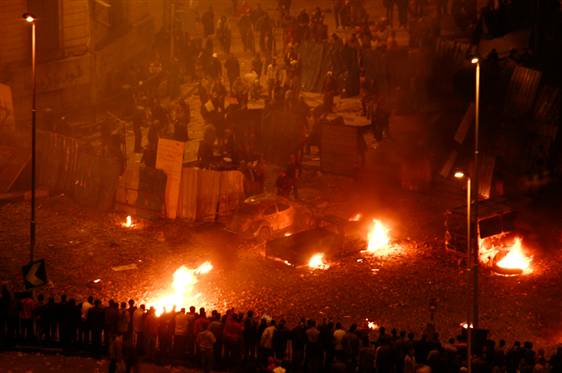
Today violent street clashes broke out in Cairo’s Tahrir Square. Following President Hosni Mubarak’s pledge not to run for the Presidency again but remain in office until September and the opposition’s denunciation of that move as too little too late Tuesday night pro-Mubarak groups entered the fray. Men on camels and horses swept into the square during the afternoon whipping and clubbing anti-Mubarak protesters as they stormed through the crowd.  Reporters were attacked and as evening came the clashes became more violent as the pro-Mubarak supports began to throw Molotov Cocktails at the demonstrators. The Army did appear to attempt to make some efforts to separate the groups and fired tear gas to disperse the crowds but did little else. The scene was remarkably different from Tuesday when the protesters calling for Mubarak to step down did so in a peaceful manner unmolested by the Army units in the square.  The Egyptian military has aired television spots asking all of the protesters to “go home for the love of Egypt.”

Although the images shown on our television sets conjure the worst and appear to the country devolving into chaotic violence with unpredictable consequences. The fact is mystery shrouds developments outside the view of the cameras surrounding Tahrir Square. We are unaware of what is transpiring inside the government or the military. We are unsure about the extent of Egypt’s government or ruling party’s involvement in today’s counter demonstrations, some reports are that some at least were ordered in from government jobs.  The only thing that we can safely assume is that unless some kind of resolution acceptable to both sides arises the situation could get dramatically worse and imperil the success of any government that replaces the Mubarak regime whether he steps down in the next few weeks or holds on until September.

Regardless of the outcome Egypt and possibly much of the Arab World is at a turning point. Authoritarian regimes as different as that of Muammar Ghadaffi and Saudi Arabian King Abdullah have condemned the Egyptian uprisings as well as that which overthrew Ben Ali in Tunisia.  They know that the dynamics at work in Egypt, unemployment, poverty and political repression are shared to one degree or another in much of the Arab World, the common factor repressive authoritarian regimes which to many lack legitimacy.  Rulers in Jordan and Yemen have already seen demonstrations and Jordan’s king has fired his government apparently to get ahead of the protests and Yemen’s ruler has pledged to step down at the end of his term in 2014.  Leaders of other Arab nations cast a wary eye on Egypt and their own opposition groups.

The Egyptian revolution will more than likely not result in fundamentalist Islam dominated state due to the unpopularity of such regimes as the Taliban and Iran in the Arab World. At the same time while Islamists are not leading the revolution in Egypt they are an important part of the Egyptian political landscape and must be taken into account.  I would think that if the violence subsides and a peaceful orderly transition takes place that a government similar to Turkey, probably not led by a religious party could be the best result. Such a government would likely not be as close to the United States as Mubarak but probably remain an ally and not an active enemy of Israel as it seeks its own economic growth and stability to reinforce its pivotal role in the Arab World.  However there is no guarantee of this outcome.

The worst outcome would be continued violence that leads to a radicalized country led by more extreme members of the Muslim Brotherhood, some of whom have called the Egyptian people to prepare for war against Israel.  Unfortunately unlike the older generation of Egyptians the new generation has not experienced war and war’s desolation. The older generation was at war with Israel for nearly 40 years suffering defeat after defeat.  In 1967 they lost control of the Suez Canal and the income derived from it in the 6 Day War and in 1973 after successfully crossing the canal and inflicting heavy casualties on the previously invincible Israelis had the tables turned on them. An Israeli Army after driving off the Syrians in a desperate battle on the Golan Heights and advancing deep into that country crossed the Suez Canal, surrounded an Egyptian Army on the far side of the canal, lay siege to Suez and were poised to drive to Cairo saved only by a cease fire brokered by Henry Kissinger and the United Nations. The war nearly brought the Soviet Union and the United States into nuclear conflict when the Soviets marshaled Airborne divisions to intervene and President Nixon raised the DEFCOM from 4 to 3. I remember talking to Egyptian officers, veterans of the wars with Israel when I was a student at an Army school in 1983, they talked of sacrifice and the brutality of war and the effects of the war on their country.  One simply said “I do not like Israel but I am tired of war and I do not want it for my children.”  Since Camp David Egypt has had all of its territory in the Sinai returned was able to reopen the Suez Canal.  Another war between Egypt and Israel would devastate both countries and for that matter not be contained.  A radicalized government set on such a course would be an unmitigated disaster for Egypt, Israel and the world.

While we watch Egypt protests are about to begin in Yemen with a “day of rage” scheduled for Thursday with demonstrations planned in Syria and Jordan Friday and Saturday and even Bahrain on February 14th. Expect such demonstrations as the old guard of the Arab World experiences the long suppressed rage of their people which is now spread in seconds through the power of the social media.  Meanwhile radicals in Iran, Al Qaeda and as well as other radicals and terrorist groups wait to take advantage. Yemen which has a strongly entrenched Al Qaeda organization and sits astride the strategically important Bab-el-Mendeb passage at the south end of the Red Sea is a country that is a prime target of these radicals and terrorists.  All the other countries for different reasons are important to the stability of the Middle East.

Today’s protests in Tahrir Square killed three and wounded over 600.

We can only watch and wait….and pray as these events develop.

Peace

Padre Steve+
 

2 Comments

Filed under Foreign Policy, History, national security, Political Commentary

Lili Marlene: The Song of Soldiers and Sailors away from their Homes and Lovers

Lili Marleen Statue in Munster Germany

Lili Marleen – Original version

Vor der Kaserne vor dem grossen Tor
Stand eine Laterne, und stebt noch davor,
So wolln wir uns da wiedersehn
Bei der Laterne wolln wir stehn,
Wie einst Lili Marleen, wie einst Lili Marleen.

Unsre beide Schatten sahn wie einer aus.
Dass wir so lieb uns hatten, das sah man gleich daraus
Un alle Leute solln es sehn,
Wenn wir bei der Laterne stehn,
Wie einst Lili Marleen, wie einst Lili Marleen.

Schon rief der Posten: Sie blasen Zapfenstreich
Es kann drei Tage kosten! Kam’rad, ich komm ja gleich.
Da sagten wir auf Wiedersehn.
Wie gerne wollt ich mit dir gehn,
Mit dir Lili Marleen, mit dir Lili Marleen.

Deine Schritte kennt sie, deinen zieren Gang
Alle Abend brennt sie, mich vergass sie lanp
Und sollte mir ein Leids geschehn,
Wer wird bei der Laterne stehn,
Mit dir Lili Marleen, mit dir Lili Marleen?

Aus dem stillen Raume, aus der Erde Grund
Hebt mich wie im Traume dein verliebter Mund.
Wenn sich die spaeten Nebel drehn,
Werd’ ich bei der Laterne stehn
Wie einst Lili Marleen, wie einst Lili Marleen

German Singer Lale Andersen recorded the song that touched the lives of Axis and Allied Soldiers alike

Lili Marleen Original Lale Andersen 1939

http://www.youtube.com/watch?v=vL0KniirXHM&feature=related

Lili Marlene- Marlene Dietrich German version

http://www.youtube.com/watch?v=W7J6OPurrtw&feature=fvwrel

Lili Marlene – English version

Underneath the lantern by the barrack gate,
Darling I remember the way you used to wait;
‘Twas there that you whispered tenderly,
That you lov’d me, you’d always be,
My Lilli of the lamplight,
My own Lilli Marlene.

Time would come for roll call time for us to part
Darling I’d carress you and press you to my heart.
And there ‘neath that far off lantern light
I’d hold you tight we’d kiss goodnight,
My Lillie of the lamplight,
My own Lilli Marlene.

Orders came for sailing somewhere over there,
All confined to barracks was more than I could bear;
I knew you were waiting in the street,
I heard your feet, but could not meet,
My Lillie of the lamplight,
My own Lilli Marlene.

Resting in a billet just behind the line
Even tho’ we’re parted your lips are close to mine,
You wait where that lantern softly gleams
Your sweet face seems to haunt my dreams,
My Lillie of the lamplight,
My own Lilli Marlene.

Lale Andersen English Version (1942)

http://www.youtube.com/watch?v=y0P_m7SZBvQ&feature=related

It is seldom in the history of war that something transcends hatred and touches hearts of soldiers of opposing sides.  In the Second World War a song did just that. Sometimes called the Soldatenlieder it was written as a poem by a World War One soldier of the Imperial German Army named Hans Liep, a school teacher drafted into the Army.  It was recorded in 1939 by Lale Anderson but was not liked by the Nazi Propaganda Minster Josef Goebbels. However it was liked by those in the military and it found its way into the programming of the German Military Radio Service which had taken over Radio Belgrade. A lieutenant working for the station picked up a copy of the recording in a Vienna record store and began to play it. Goebbels ordered it banned but reluctantly changed his mind in response to a barrage of letters sent to the station by German and other Axis soldiers across Europe. Field Marshal Erwin Rommel of the Afrika Korps had a soft spot for the song and requested that it be played nightly and from then on the song was played at 9:55 PM every night by Radio Belgrade.

Field Marshal Erwin Rommel requested that Lili Marleen be played nightly

The song was not just popular among the Axis it was popular among Allied soldiers beginning with the Australians and New Zealanders serving with the British 8th Army in North Africa.  One has to imagine his longing for his own “Dearest Lu” his wife in Germany.  The popularity of the song spread to others including Americans. The British High command did not appreciate soldiers singing it in German and songwriter Tommy Conner wrote an English version which was recorded by Anne Shelton in 1944.

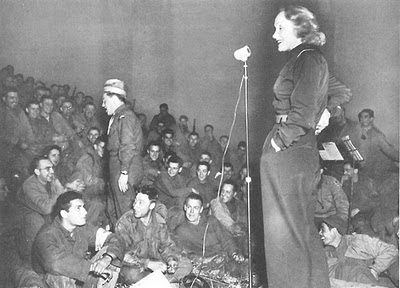
Marlene Dietrich performing in front of American Soldiers in World War II

Marlene Dietrich performed it often in USO shows for US Servicemen during the war. It has been reported translated and performed in 48 languages around the world.  Her recordings of the song are still popular.

The never has been a war where military men, Soldiers, Sailors, Marines and Airmen who have left their loves behind have not dreamed of them. Lili Marlene expressed that dream perhaps more than any song in history.

Today soldiers from many countries serve away from their loved ones in combat or deployed far from home.  I think that many have their Lili Marleen waiting for them and when they close their eyes can see that special person.

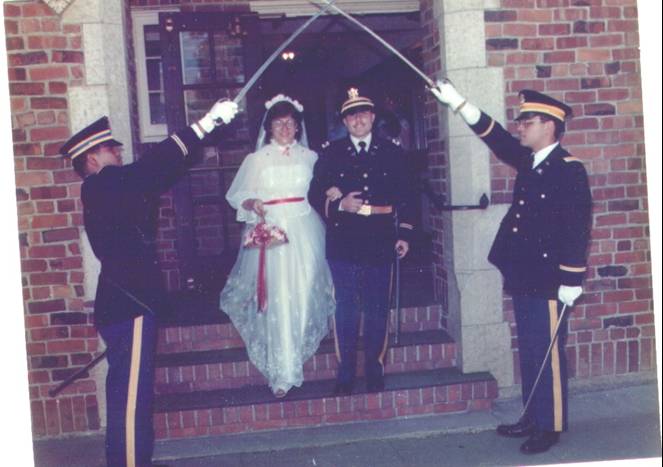
Me with my Bride Judy in 1983

Since I have served away from my wife many times for longer than I can count in the past 27 years I can relate to the feelings expressed in this song for I still remember the first time that served away from her when three weeks after we were married I departed for active duty as a new Army Second Lieutenant back in 1983.  Years later in Iraq I still could see my young bride. Sometimes our loves never change.

Peace

Padre Steve+
 

8 Comments

Filed under History, marriage and relationships, music, world war two in europe