Category Archives: Loose thoughts and musings

A Monument to Murder

Friends of Padre Steve’s World,

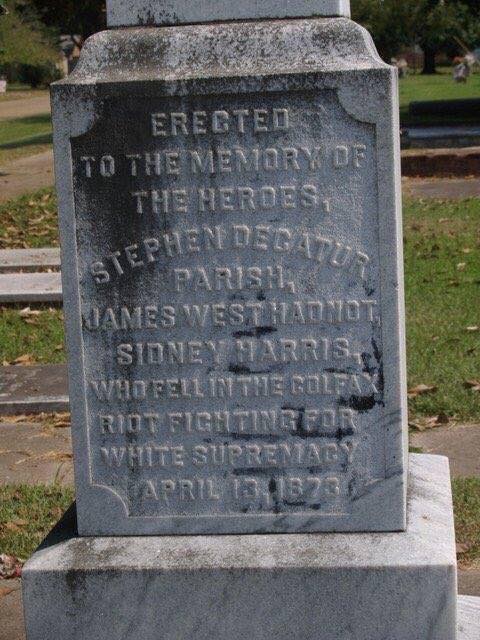
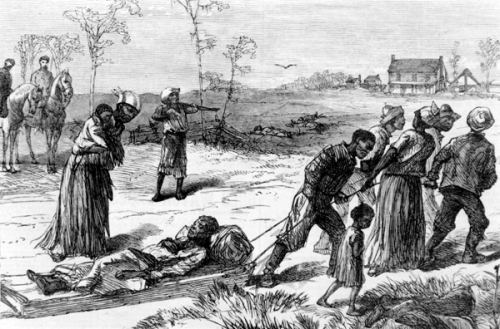
In light of the Confederate Monument controversy I am posting a part of one of my book drafts regarding the Colfax Massacre. This event occurred eight years after the Civil War ended when hundreds of heavily armed men from the White Liners, a White Supremacist movement in Louisiana attacked the town of Colfax on Easter Sunday 1863. There are monuments to the murderers, one which I have included in this article.

When it comes to the monuments everything depends on context. Since the vast majority of the monuments were placed in the aftermath of Plessy v. Ferguson during the height of the Jim Crow Era, and many others as a reaction to the Civil Rights Movement there is no doubt that those that erected them intended them to be symbols which reminded Blacks of their inferior place.

I am in the process of writing a number of articles dealing with the monuments.  This is not because I am trying in any way to denigrate the lives of ordinary Confederate soldiers, many of whom were drafted against their will beginning in 1862 because there were not enough volunteers. Many of those conscripted soldiers died in hopeless battles and others when they attempted to desert from the Army of Northern Virginia to help their families when Sherman’s Army marched through Georgia and the Carolinas, were summarily executed on the orders of General Robert E. Lee.

Likewise this is not an indictment of men who men who were gallant soldiers who in volunteering to serve alongside their friends and fellow townspeople fought for a abhorrent cause, as many of them didn’t see their fight in that manner. If you read their letters and correspondence on can see a number of different reasons that they fought, some were true believers in the Confederacy and Slavery, but others were not. But to be sure their leaders did understand.

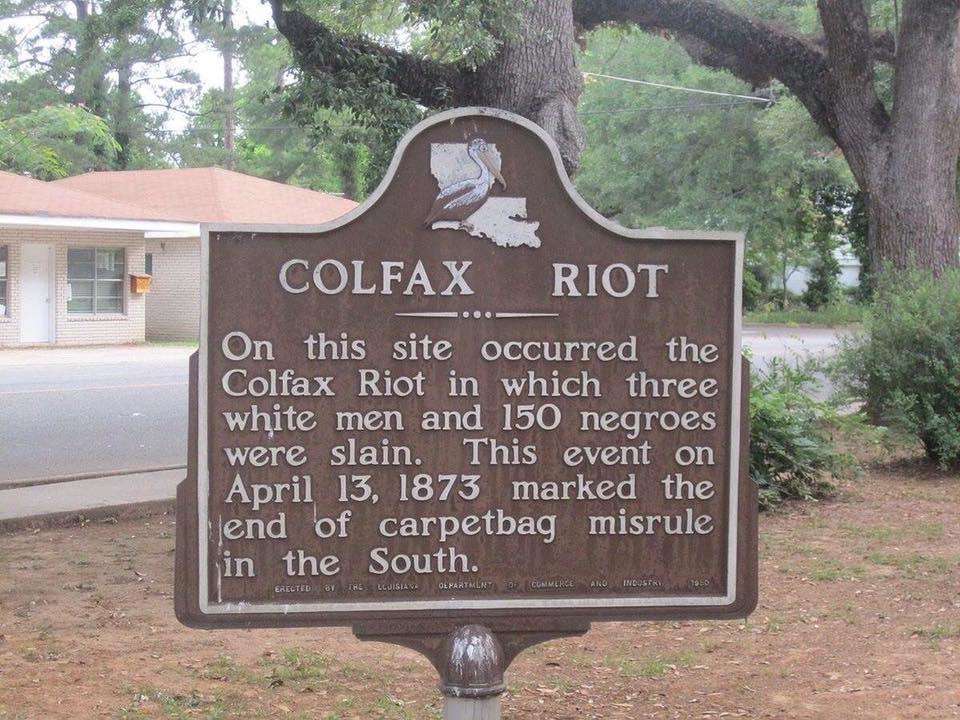
In the case of the Colfax massacre, some of the men involved were former Confederate soldiers, while others either never served or were to young to serve in the war. But at Colfax they were not soldiers, they were terrorists. In this case the heritage is hate. Interestingly the historical marker on the site terms in a “riot” not a massacre or act of terrorism and in blames in on “Carpetbagger misrule.”

So anyway, that is why the context of the various monuments matters. You’ll see more over the next few days, but this is something that matters more than a meme, more than a false comparison of being on a slippery slope to removing the statues of George Washington and other Founding Fathers who owned slaves.

Here is the excerpt from my book.

Peace

Padre Steve+

The violence against Southern blacks escalated in the wake of the passage of the Fourteenth and Fifteenth Amendments and with the increasing number of blacks being elected to office in some Southern states during the elections of 1872. In Louisiana a Federal court ruled in favor of Republican Reconstruction candidates following a Democrat campaign to interfere with the vote, which included attacks on polling sites and the theft of ballot boxes. As a result the Louisiana Democrats “established a shadow government and organized paramilitary unit known as the White League to intimidate and attack black and white Republicans.” [1]

The White League in Louisiana was particularly brutal in its use of violence. The worst massacre committed by the White League occurred Easter Sunday 1873 when it massacred blacks in Colfax, Louisiana. Colfax was an isolated nondescript hamlet about three hundred fifty miles northwest of New Orleans. It sat on the grounds of a former plantation whose owner, William Calhoun, who worked with the former slaves who were now freedmen. The town itself“composed of only a few hundred white and black votes” [2] was located in the newly established Grant Parish. The “parish totaled about 4,500, of whom about 2,400 were Negroes living on the lowlands along the east bank of the Red.” [3] Between 1869 and 1873 the town and the parish were the scene of numerous violent incidents and following the 1872 elections, the whites of the parish were out for blood.

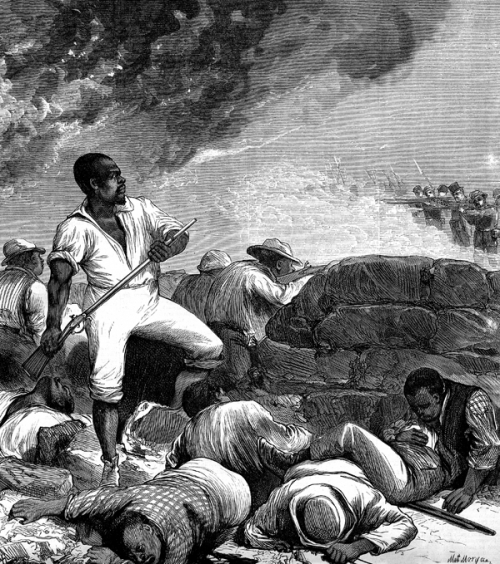
White leaders in Grant Parish “retaliated by unleashing a reign of terror in rural districts, forcing blacks to flee to Colfax for protection.” [4]The blacks of parish fled to the courthouse seeking protection from a violent white mob following the brutal murder of a black farmer and his family on the outskirts of town. The people of Colfax, protected by just a few armed black militiamen and citizens deputized by the sheriff took shelter in the courthouse knowing an attack by the White Supremacists was coming.  As the White League force assembled one of its leaders told his men what the day was about. He said, “Boys, this is a struggle for white supremacy….There are one hundred-sixty-five of us to go into Colfax this morning. God only knows who will come out. Those who do will probably be prosecuted for treason, and the punishment for treason is death.” [5] The attack by over 150 heavily armed men of the White League, most of whom were former Confederate soldiers, killed at least seventy-one and possibly as many as three-hundred blacks. Most of the victims were killed as they tried to surrender. The people, protected by just a few armed men were butchered or burned alive by the armed terrorist marauders. It was “the bloodiest peacetime massacre in nineteenth-century America.” [6]

The instigators of the attack claimed that they acted in self-defense. They claimed that “armed Negroes, stirred up by white Radical Republicans, seized the courthouse, throwing out the rightful officeholders: the white judge and sheriff” and they claimed that the blacks had openly proclaimed “their intention to kill all the white men, they boasted they would use white women to breed a new race.” [7]The claims were completely fabricated, after sending veteran former army officers who were serving in the Secret Service to investigate, the U.S. Attorney for Louisiana, J.R. Beckwith sent an urgent telegram to the Attorney General:

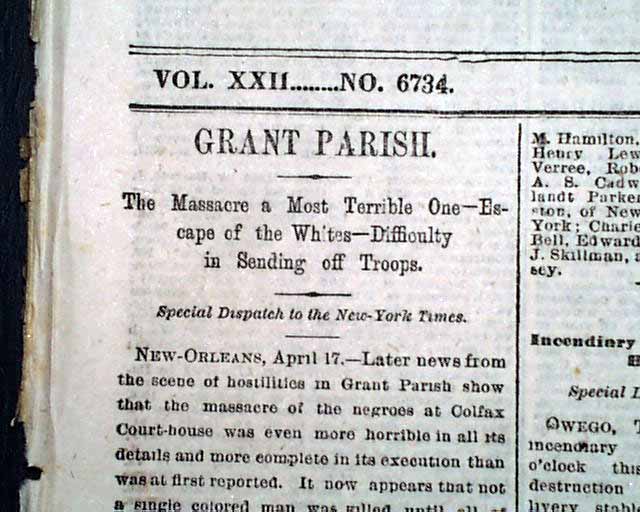
“The Democrats (White) of Grant Parish attempted to oust the incumbent parish officers by force and failed, the sheriff protecting the officers with a colored posse. Several days afterward recruits from other parishes, to the number of 300, came to the assistance of the assailants, when they demanded the surrender of the colored people. This was refused. An attack was made and the Negroes were driven into the courthouse. The courthouse was fired and the Negroes slaughtered as they left the burning building, after resistance ceased. Sixty-five Negroes terribly mutilated were found dead near the ruins of the courthouse. Thirty, known to have been taken prisoners, are said to have been shot after the surrender, and thrown into the river. Two of the assailants were wounded. The slaughter is greater than the riot of 1866 in this city. Will send report by mail.” [8]

Federal authorities arrested nine white men in the wake of the massacre and after two trials in which white majority juries were afraid to go against public opinion, three were “convicted of violating the Enforcement Act of 1871.” [9] None were convicted of murder despite the overwhelming evidence against them and even the lesser convictions enraged the White Supremacists in Louisiana who had employed the best lawyers possible and provided them and the defendants with unlimited financial backing. Assisted by the ruling of Supreme Court Associate Justice Joseph Bradley, who had a long history of neglecting Southern racism, white Democrats appealed the convictions to the Supreme Court.

The attack, and the court cases which followed, notably the judgment of the Supreme Court in United States v. Cruickshank which dealt with the appeal of the men responsible for the Colfax Massacre led to a “narrowing of Federal law enforcement authority” and were “milestones on the road to a “solid” Democratic South.” [10] The decision of the court in United States v. Cruikshank was particularly perverse in its interpretation of constitutional rights and protections. The court ruled in favor of the terrorists and declared that “the right of the black victims at Colfax to assemble hand not been guaranteed because they were neither petitioning Congress nor protesting a federal law. Assembling for any other cause was not protected.” [11] The Cruikshank decision amounted to a Supreme Court endorsement of violence against blacks, and made it “impossible for the federal government to prosecute crimes against blacks unless they were perpetrated by a state and unless it could prove a racial motive unequivocally.” [12] Northern politicians and newspapers, reeling under the effects of the stock market crash of 1873, which had denounced the massacre just a year before now ran from the story and from support of African Americans. A Republican office holder wrote, “The truth is, our people are tired out with this worn cry of ‘Southern outrages…. Hard times and heavy taxes make them wish the ‘nigger,’ the ‘everlasting nigger,’ were in hell or Africa.” [13] Racism and race hatred was not exclusively the parlance of the South.

In the wake of Justice Bradley’s reversal of the Colfax convictions whites in Grant Parish engaged in brutal reprisals against blacks, leading to many murders and lynching’s, crimes which law enforcement, even that favorable to the rights of African Americans were afraid to prosecute for fear of their own lives. Louisiana’s Republican Governor, William Pitt Kellogg wrote Attorney General Williams blaming the violence on Bradley’s ruling, which he wrote, “was regarded as establishing the principle that hereafter no white man could be punished for killing a negro, and as virtually wiping the Ku Klux laws of the statute books.” He added that with the Army leaving the state that his government and other Reconstruction governments would fall, “if Louisiana goes,” Kellogg wrote, “Mississippi will inevitably follow and, that end attained, all the results of the war so far as the colored people are concerned will be neutralized, all the reconstruction acts of Congress will be of no more value than so much waste paper and the colored people, though free in name, will be practically remitted back to servitude.” [14] Governor Kellogg could not have been more correct.

In the years that followed many of the men involved in the massacre and other murders before and after were hailed as heroes, some, including the leader of the attackers, Christopher Columbus Nash were again appointed to office in Colfax and Grant Parish and blacks were reminded every day of just what they had lost. On April 13th 1921 the men who committed the massacre were honored with a memorial in the Colfax cemetery honoring them as “Heroes… who fell in the Colfax Riot fighting for White Supremacy.” In 1951 the State of Louisiana Department of Commerce and Industry dedicated a marker outside the Courthouse which read: “On the site occurred the Colfax Riot in which three White men and 150 Negroes were slain, this event on April 13, 1873 marked the end of Carpetbag misrule in the South.”[15] That marker still stands, there is no marker commemorating the victims.

Other massacres followed across the South, aimed at both blacks and their white Republican allies. In Louisiana the White League had some 14,000 men under arms, in many cases drilling as military units led by former Confederate officers. A White League detachment southwest of Shreveport “forced six white Republicans to resign their office on pain of death – and then brutally murdered them after they had resigned.” [16] This became known as the Coushatta Massacre and it was a watershed because for the first time the White League targeted whites as well as African Americans. The violence, now protected by the courts ensured that neither would last long in the post-Reconstruction South and that the freedom of African Americans in those states would amount to a cruel illusion.

In 1875, President Ulysses S. Grant including comments about the Colfax massacre and the subsequent court decisions in his message to Congress. Grant was angry and wrote: “Fierce denunciations ring through the country about office-holding and election matters in Louisiana…while every one of the Colfax miscreants goes unwhipped of justice, and no way can be found in this boasted land of civilization and Christianity to punish the perpetrators of this bloody and monstrous crime.” [17]President Grant, the man who so wanted to help African Americans attain the full measure of freedom, was unable to do more as the Congress and Courts took sides with the Southern insurgents.

Notes

[1] Ibid. Foner Forever Free p.151

[2] Ibid. Langguth After Lincoln p.312

[3] Ibid. Lane The Day Freedom Died p.42

[4] Ibid. Goldfield America Aflame p.493

[5] Ibid. Lane The Day Freedom Died p.91

[6] Ibid. Goldfield America Aflame p.493

[7] Ibid. Lane The Day Freedom Died p.11

[8] Ibid. Lane The Day Freedom Died p.22

[9] Ibid. Goldfield America Aflame p.494

[10] Ibid. Lane The Day Freedom Died p.251

[11] Ibid. Langguth After Lincoln p.314

[12] Ibid. Goldfield American Aflame p.494

[13] Ibid. Lane The Day Freedom Died p.213

[14] Ibid. Lane The Day Freedom Died p.217

[15] Ibid. Lane The Day Freedom Died pp.261-262

[16] Ibid. McPherson The War that Forged a Nation p. 185

[17] Ibid. Lane The Day Freedom Died p.228


6 Comments

Filed under Loose thoughts and musings

“Read a Lot and Write a Lot” How I Avoid Misery 


Friends of Padre Steve’s World,

British historian Sir Max Hastings, whose book Catastrophe 1914, Europe Goes to War I am re-reading since I just completed another trip through Barbara Tuchman’s The Guns of August, once made the comment: “I would be miserable if I went to bed without having written 1,000 words about something.” I am much the same way and hopefully one day I might be one tenth as good, and as successful writer as him or Tuchman. 

I do most of my writing before I go to bed at night and usually set my articles to post at 6:30 in the morning. I have a hard time going to sleep without writing be it for this website or for one of the books that I am working on. I read voraciously whenever I get the chance sometimes going to a bar just to read a book while enjoying a good craft beer or Germanor Irish import. Likewise once I am done with whatever I am writing I go right back to reading, sometimes keeping whatever Papillon is sleeping with me from getting the sleep that they want. That’s what I will be doing tonight when I finish this article which you will be reading tomorrow when it posts. In a sense my writings are kind of like Schroedinger’s cat, they are written yet unwritten at the same time, but I digress…

Today while on vacation in Huntington, West Virginia, I have been doing a lot of my own reading, as well as keeping up with the latest news about the building crisis regarding North Korea’s nuclear weapons and missiles and President Trump’s unrelenting bellicose tweets and statements. Likewise today I’ve walked about seven and a half miles, much of it around the campus of Marshall University and walking my dogs around the neighborhood that we are staying. As I walk I tend to take in everything I see and because of my PTSD I am still somewhat hyper vigilant which causes me to be a bit more observant about my surroundings than a lot of other people. But I also muse about things going on in the world as well as things that I am writing or plan on writing about. I did a lot of today and over the past few days. The next couple of days won’t be as free because Judy has scheduled us for some social activities, but I will still find a way to in get my reading, writing, and walking. 

But going back to writing and reading I have to say that I don’t know what I would do if I couldn’t do either, I think I would be in some sort of hell if I couldn’t write every night or read. Doing these things helps me keep my perspective and to more fully appreciate the events of the day. Honestly, if I had not consciously immersed myself in history from the time that I was a child, including the many days that I cut 10th grade Geometry class to read the history reference books that I couldn’t check out of the school library I wouldn’t be who I am today. 

I like writing history because I become immersed in the people, the places, and the intricacies and complexity of the events. I like to incorporate the little known back stories of people help understand their actions at a given point. Likewise think that the lives of the individuals involved in the events I write about, both before, and after the event should they have lived through it, give my readers a more human connection to the events, as well as understanding of the people involved. I find that the stories of people allow readers to make those connections, maybe even inspiring in them a bit of sympathy for scoundrels or suspicion of supposed saints. 

I think that the character of people, good, bad, or wherever it falls on the spectrum, and their basic humanity; their strengths, weaknesses, contradictions, and their feet of clay, matter immensely and need to be part a of the story. I hate it when I read a history where a given character’s actions during a given event are examined in detail, but who they are as a person never comes through because the authors didn’t give their readers the courtesy of introducing them as people because they included little or no biographical details to make them interesting. Instead they become one dimensional caricatures of who they were in life, which in my view does them, the story, and the reader a grave injustice. So when I write I try to find interesting parts of a person’s life that is not directly related to the event to paint the picture. Walter Lord, who wrote prolific books on some of the key events of the Twentieth Century including books about the Titanic, Pearl Harbor, Midway, Dunkirk, the desegregation of the University of Mississippi, and many more noted something that I have taken to heart, I look for something that is highly unusual, involving ordinary people caught in extraordinary situations.”

That’s one reason I like the writings of both Tuchman and Hastings, they bring life to to the events they write about, they allow your imagination to run and to want discover more about the people and the events. The late Walter Lord, who I also mentioned was also excellent at doing that, and I think that is how I would like my writings be remembered. But in order to do that I have to read and write, as Stephen King said “If you want to be a writer, you must do two things above all others: read a lot and write a lot.” So back to Hastings’ Catastrophe 1914.

Until tomorrow,

Peace

Padre Steve+

1 Comment

Filed under History, Loose thoughts and musings, philosophy

Bomb Threats and Terror: Flashbacks to the Baader Meinhof Gang


Friends of Padre Steve’s World,

The last week was stressful for me. I am dealing with a contractor who is causing problems, and I had a number of other issues going on at work. Likewise, as you know from my last two articles, I was dealing with people in the neighborhood who were and still may be working to make sure that the kids in our neighborhood don’t have a safe place to play. Of themselves they would have been stressful and time consuming but not anything that would amp up my anxiety level. 

But this week, my base and another one nearby were the targets of a significant number of bomb threats, in fact on Wednesday we had five separate bomb threats on my base and I ended up spending over half of my day in our Emergency Operations Center. Now I know that for most Americans that bomb threats are of little concern, mainly because they have never really experienced actual terror threats in their neighborhoods that impacted their daily lives for months on end. Bigger events like the 9-11 attacks are a different matter. 

Most Americans live in a nice cocoon of comfortable safety were  terrorist bombs are something that blow up in other countries. But my life, and that of my wife have been different from most Americans. For almost three years we lived with the very real threat of being bombed, kidnapped, or killed by members of the Baader-Meinhof Gang, or as it is sometimes known as the Red Army Faction when we were stationed in what was then West Germany during the Cold War. Not only them, but by Muammar Ghadafi’s regime was was sending out terrorists bombers who were bombing places where Americas congregated, clubs, and shopping areas.

Of course I also dealt with the possibility of being blown up by Improvised Explosive Devices during much of my tour in Iraq. So for me, and to some extent Judy, a bomb threat is a source of real anxiety because on two occasions we barely missed being blown up by Baader-Meinhof bombs in 1985, and two years after we returned from Germany the aircraft that we flew home in was blown out of the sky over Lockerbie Scotland by a bomb planted by Libyan terrorists. 

When we lived in Germany in the mid-1980s the threat was real and as I said on two occasions, once at the Frankfurt Post Exchange and once at Frankfurt International Airport, we almost ended up in the middle of bomb blasts that killed and wounded a good number of people. The threat was such that before you got in your car in the morning or started it, that you looked to make sure that there was nothing suspicious. When you entered a base, not only was your identification checked, but your car was inspected. Units on the base had to supply soldiers to patrol the perimeter of the base, and as a young officer I often had to be in charge of the overnight patrols. 

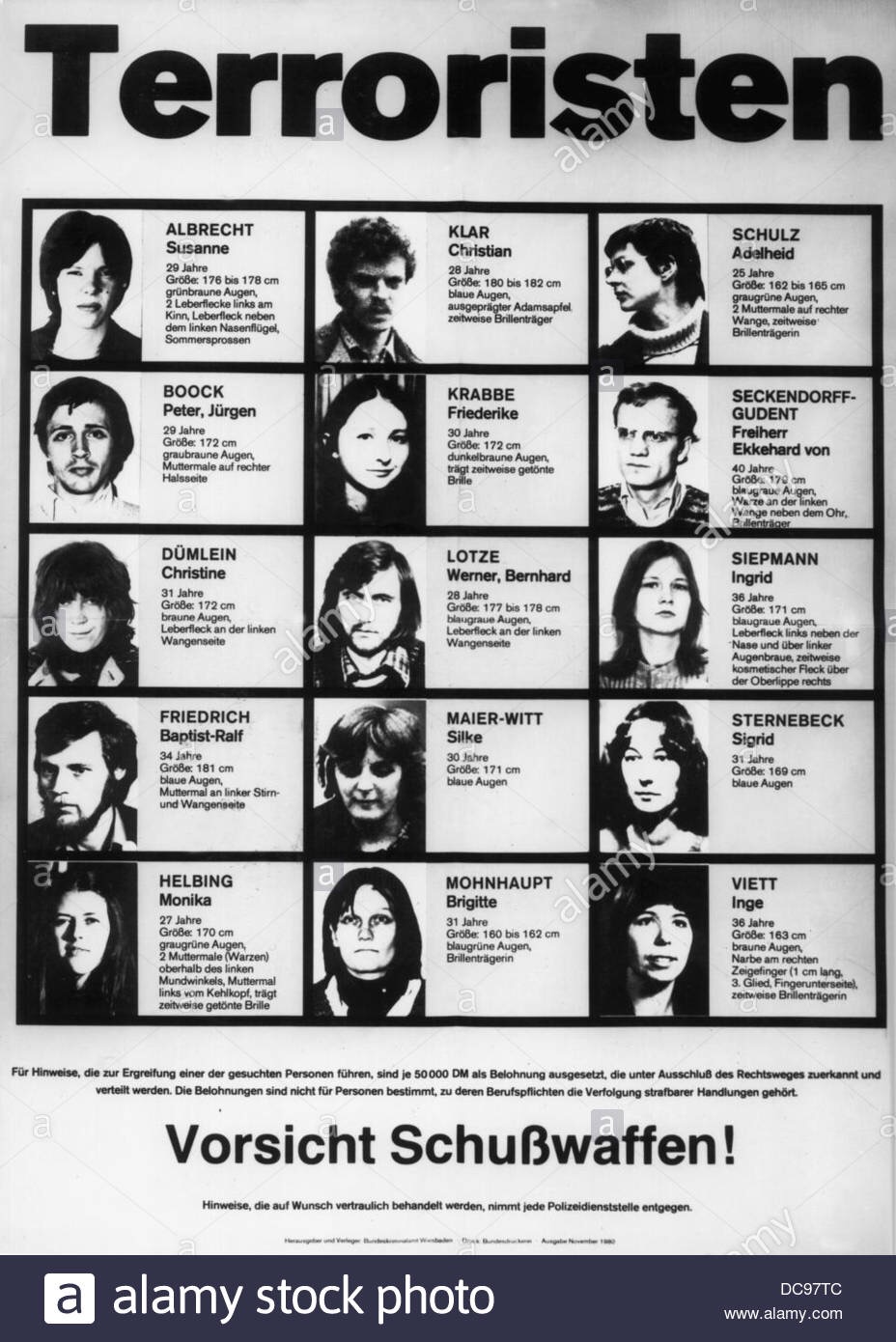
Likewise, because of the threat you remained observant to things around you even when out in town. One Saturday in 1986 while walking through the parking lot at an early version of something like a Wal-Mart in Wiesbaden, a place called Wertkauf we noticed something unusual. As we walked toward the store there was a van that had it back hatch open and a number of people sitting in it. For a moment our eyes locked that the people in the van watched us until we got out of site. Both of us noticed the obvious suspicion and hatred in their eyes. But we went in and did our shopping. When we left they were gone. We mentioned to each other how strange it was but we went home. The next day we went to dinner at a restaurant downtown and as we past the main Police station, we saw a wanted poster for Baader-Meinhof/Red Army Faction members, so we went in and made out report, which the Polizie took seriously and interrogated us for over two hours. Most of these people were arrested and tried for their crimes after they lost sanctuary in East Germany when the wall came down. 

So when these threats occur, especially when they appear to be well coordinated in order to maximize the disruption, I get amped up. My mind goes back to those days in Germany and Iraq. But not only does my mind go back to those places, but it imagines the reality of what could happen if whoever was calling in the threats was also intent on actually killing people. Sadly, it wouldn’t be that hard to kill a lot of military personnel in an attack around our area, there are far too many soft targets, and as a matter of course I pretty much avoid them, even when there are no broadcast terror or bomb threats. When I do go to them I am on high alert looking for things that might be out of place. Hypervigilance is a part of my life with PTSD, and bomb threats only make me more hyper vigilant. 

The threats we had this week were all false alarms. Thankfully no one set off any actual bombs, but at the same time I wonder if the strategy of the callers is to lull people into a sense of complacency, thinking that there is no basis to the threats. If so that would be a good strategy, because people might stop taking them seriously, opening a gateway for a real bomber. 

The Navy has put out a reward for information leading to the arrest and conviction of whoever has been behind this weeks’ threats. Personally, if I ever found out who was doing this I would do my best to have them locked away forever. 

Thankfully my stress level has gone down over the past couple of days, with Wednesday being the worst day this week. I stil might have to deal with fallout from my contractor over the weekend but I am prepared for that. So until tomorrow. 

Peace

Padre Steve+ 

7 Comments

Filed under History, Loose thoughts and musings, PTSD, terrorism

Fighting for Justice in My Neighborhood Update: Let Freedom Ring and I Have not Yet Begun to Fight


Friends of Padre Steve’s World,

Today I made the first step against the racists in our neighborhood who on Wednesday succeeded in convincing the man who put the basketball hopes in our neighborhood to take them down. 

I called the neighborhood association office as soon as it opened this morning to ask what the hell was going on and to express my displeasure in what happened. I’m not going to go into detail today, but according to the lady who works in the office the hoops will come back this weekend. She told me about the alleged complaints and I told her what I had dealt with for a certain older white lady in the neighborhood last week. She knew exactly who I was talking about and she mentioned some of the complaints that were being made against the kids. So I told her about how much worse that I and the kids in the various neighborhoods that I grew up in behaved compared to these kids, and then said but we were white kids in a white neighborhood. She remained silent after that. 

But I was reminded of a story that my late dad told me about a man in his neighborhood in Huntington, West Virginia, who harassed kids for playing in the neighborhood. After being harassed and screamed at by the old man who lived on 18th Street Hill, my dad, his twin brother, and their friends waited until after dark one night when the man went into his outhouse. Once the hatful old geezer was safely in the outhouse they gathered around and pushed it down the hill, with him in it. Then they ran away, and never got caught. To me that was impressive. It wasn’t that they were bad kids, it was just that the old fart was an asshole. Sadly, we have indoor plumbing and no hills in my neighborhood or I would d what my dad and uncle did to the old racist bitch who has caused this situation in my neighborhood. 

But instead of just simply complaining and being a part of the problem I offered a solution. I offered to open and close the gate of the court, and spend time with the kids to make sure things were cleaned up at night and the area was secure. I have other neighbors who are willing to do the same. I also said that the association needs to post the rules about the use of the courts and reiterated my belief that since the developers and city haven’t done anything to give our kids a safe place to play that it was our responsibility to do so. I got no argument. I also announced my intention to run for one of the vacant seats on the homeowners association board of directors. For years people have asked me to do that but I didn’t want to, I just wanted to mind my own business. 

But now it’s different. My wife and I have an investment in this neighborhood. Though I have been deployed, been assigned as a geographic bachelor, and travelled a lot because of my military duties, Judy has lived here for fourteen years and we have been homeowners paying dues to the association for twelve years. We don’t have kids, but the kids of our neighborhood are our kids, and I will be damned if I stand by and let them be treated like crap, as less than human by people who should know better, 

I am hoping that the association will take up my offer and that of my friends to help the kids of our neighborhood. They are good kids, they just need a safe place to play, and if we as homeowners and association members cannot facilitate that then what the hell good are we?

I have become a civil rights activist over the years. I will fight for these kids who are mostly African American, I will fight for women, LGBTQ people, and immigrants. I believe in the proposition of the Declaration of Independence that “all men are created equal, that they are endowed by their Creator with certain unalienable Rights, that among these are Life, Liberty and the pursuit of Happiness.”  To me that means everyone, including the black kids of my neighborhood. They are my neighbors and they are the children of God as much as anyone else. 

That may make me unpopular in some circles but I no longer give a damn, because I share the dream of Dr. Martin Luther King Jr. “I have a dream that one day this nation will rise up and live out the true meaning of its creed: “We hold these truths to be self-evident: that all men are created equal…” 

I re-read Dr. King’s speech last night and as I did tears welled up from my eyes. In fact I had a hard time containing them as I read the majestic cadence of his words: 

I say to you today, my friends, so even though we face the difficulties of today and tomorrow, I still have a dream. It is a dream deeply rooted in the American dream.

I have a dream that one day this nation will rise up and live out the true meaning of its creed: “We hold these truths to be self-evident: that all men are created equal.”

I have a dream that one day on the red hills of Georgia the sons of former slaves and the sons of former slave owners will be able to sit down together at the table of brotherhood…

I have a dream today.

I have a dream that my four little children will one day live in a nation where they will not be judged by the color of their skin but by the content of their character…

I have a dream today.

I have a dream that one day every valley shall be exalted, every hill and mountain shall be made low, the rough places will be made plain, and the crooked places will be made straight, and the glory of the Lord shall be revealed, and all flesh shall see it together.

This is our hope. This is the faith that I go back to the South with. With this faith we will be able to hew out of the mountain of despair a stone of hope. With this faith we will be able to transform the jangling discords of our nation into a beautiful symphony of brotherhood. With this faith we will be able to work together, to pray together, to struggle together, to go to jail together, to stand up for freedom together, knowing that we will be free one day.

This will be the day when all of God’s children will be able to sing with a new meaning, “My country, ‘tis of thee, sweet land of liberty, of thee I sing. Land where my fathers died, land of the pilgrim’s pride, from every mountainside, let freedom ring.”

And if America is to be a great nation this must become true. So let freedom ring from the prodigious hilltops of New Hampshire. Let freedom ring from the mighty mountains of New York. Let freedom ring from the heightening Alleghenies of Pennsylvania!

Let freedom ring from the snowcapped Rockies of Colorado!

Let freedom ring from the curvaceous slopes of California!

But not only that; let freedom ring from Stone Mountain of Georgia!

Let freedom ring from Lookout Mountain of Tennessee!

Let freedom ring from every hill and molehill of Mississippi. From every mountainside, let freedom ring.

And let me add, Let freedom ring in the suburbs of Virginia Beach Virginia and on on a unused tennis court on which kids can safely play basketball. 

And as Doctor King concluded:

And when this happens, when we allow freedom to ring, when we let it ring from every village and every hamlet, from every state and every city, we will be able to speed up that day when all of God’s children, black men and white men, Jews and Gentiles, Protestants and Catholics, will be able to join hands and sing in the words of the old Negro spiritual, “Free at last! free at last! thank God Almighty, we are free at last!”

As of now I don’t need to go to my city council member, I don’t yet need to go to the NAACP, ACLU, or the local media, but if I have to I will. I will run for one of those vacant seats on the board and I will speak out every day until I see the dream of Doctor King realized in my neighborhood. 

I will not stop speaking out and I will work with my neighbors to do the right thing for our kids, the thing that developers, the city, and homeowners associations don’t do around here because honestly they really don’t give a damn about the kids. That is evident in the way the these neighborhoods were designed, with lakes, golf courses, and tennis courts, but no ball fields or basketball courts. Don’t get me wrong, I like the lakes, and the golf course, but why the hell should the kids have to play on the streets while unused tennis courts sit idle instead of being converted into basketball courts and a skateboard park? It wouldn’t be that hard, but some of my neighbors don’t want the kids here, so I am standing up today for the kids. I am not going to stop speaking out and I will be part of the solution, not just a complainer. If I am going to complain then I need to be part of the solution or I am no better than the people who do all that they can to oppress others. Actions speak louder than words. 

Anyway. Thank all of you for your kind and inspirational words on this website, on Facebook, and on Twitter. 

Spread the word my friends because in the words of the American naval hero, John Paul Jones, “I have not yet begun to fight.” 

Until tomorrow,

Peace

Padre Steve+ 

7 Comments

Filed under civil rights, Loose thoughts and musings, Political Commentary

Going to War Against Neighborhood Racists and the Kempsville Lakes Homeowners Association: The Kids are Still Alright


Friends of Padre Steve’s World,

Last week I wrote about the lady who came to my door trying to get me to join her in trying to get recently installed basketball hoops removed in our neighborhood. Yesterday, after the National Night Out  gathering in our neighborhood on Tuesday where at least 30 kids were playing basketball, those hoops were taken down with no notice to anyone. So now, the kids of of neighborhood have no safe place to play. If you want to read the details of the history behind this just go back a week or so on this site. I’m not going to rehash details today. 

I found out about this while talking to a couple of my neighbors after a pretty shitty day at work with multiple bomb threats and a couple of shit bombs left by one of my contractors. It was the whipped cream on my shit sundae for the day. 

My neighbors and I are all going to complain to the association tomorrow since the association office was already closed. But besides complaining to people who a few years ago objected to the idea of basketball courts by telling my wife Judy that they didn’t want “unwanted elements”  and tried to tell her that we have a “gang problem” I plan on doing more. 

The fact of the matter is that our homeowners association board which is composed mainly of older white people does not like the fact that we have a mixed race community and that most of the younger families with kids in the area are minorities, many who are military families. I am career military, having spent 36 years in the Army and Navy and having grown up as a Navy brat, where I was always an outsider. I am white. I am 57 years old. We have lived in this neighborhood for almost 14 years, though I have been deployed or assigned elsewhere much of that time. We like our neighborhood, we like our neighbors. Our town home block has been very stable with good neighbors, quite a few, including Larry, a junior high teacher and coach who has lived here longer than us, are African American. Crime is low and kids are well behaved, the biggest problem is that they have to play in the street because when this area was developed the land that could have been used for parks or playgrounds was turned into lakes. 

Today I am going to war. I will call the association, then I will call my local city councilman, the I will call the local chapters of the NAACP, and the ACLU, the latter which I am a member of at the national level, as well as local media, including television news outlets. What is happening is not right. When I was a kid we were allowed to play in our neighborhood and we were a lot less well behaved than these kids, but then most of us were white, living in predominantly white neighborhoods. Race does have its privileges. 

I am going to protest the overt racism of our homeowners association as well as some of our neighbors, especially the old bitch who showed up at my door last week complaining about the kids. They are going to get a fight from me and as much as I hate doing it I will probably have to run for one of the vacant seats on the homeowners association board. 

I’ll be damned if I let them get away with this. I am going to fight for the kids. I am going to war for them. They deserve better than this. 

Pray for me.

Peace

Padre Steve+ 

6 Comments

Filed under civil rights, Loose thoughts and musings

Books: The Window to My Soul


Friends of Padre Steve’s World,

George R.R. Martin wrote in his book A Dance With Dragons:  “A reader lives a thousand lives before he dies, said Jojen. The man who never reads lives only one.”

I constantly read and because I try to imagine what I am reading so that in a way I live it. I have been to places that have never traveled to before and on entering them I know exactly where everything is and what happened there. I remember leading a group from my Army chapel in Wurzburg Germany to Wittenberg, where Martin Luther began the Protestant Reformation. As I lef d the group through the town a couple of people asked me how many times I had been there. I told them, “physically, never until today, but I have been here a thousand times before because of books. I saw Wittenberg in my minds eye before I ever saw the city.” They were surprised and both said that it seemed like I had been there many times. 

I have had the same thing happen other places that I have visited, and again, it is because I read, and as I read, I imagine and occasionally dream. 

I have a huge number of my books in my office most dealing with the history, especially the American Civil War and Reconstruction, the World Wars, and the insurgencies and counter-insurgency wars of the past seventy or so years. I have a lot of biographies, books on American history, military theory, sociology, philosophy, psychology related to war and PTSD, and a few theological works, though most of my theology books are at home because I don’t have room for them in the office. 

Coupled with mementos of my military career, other militaria, artwork, and baseball memorabilia the sight and smell can be both overwhelming and comforting at the same time. I hear that a lot from my visitors, including those who come in for counseling, consolation, or just to know someone cares. They tell my visitors volumes about me without them ever asking a question or me telling them, and occasionally someone will ask to borrow a book, and most of the time I will lend them the book, or if I have multiple copies even give it to them. 

In a sense my books are kind of a window to my soul, the topics, and even how I have them organized, and they are not for decoration. Many times while I am reflecting on a topic, a conversation, or something that I read in the news I peruse my books and pull one or more out to help me better understand it, or relate it to history. 

Likewise my memorabilia is there to remind me of all the people in my past who I have served with. I don’t have all my medals, honors, and diplomas up for everyone to see, instead I have pictures and collages, many signed by people who made a difference in my life. When I see the signatures and often all too kind words on them I am humbled, and in some cases a tear will come to my eye, but I digress…

I always try to read a decent amount everyday. I in the past couple of weeks I have finished reading a number of very good books dealing with different historical dramas. I read Stephen Sears’s Lincoln’s Lieutenants which deals with the high command of the Army of the Potomac during the American Civil War. Sears is a great historian and I really enjoyed the book even when I had a different evaluation of several of the men that he wrote about, but that is one of the fascinating things about history. Historians can evaluate the same literature and come to different conclusions about people or events. In my case with Sears it was with his evaluation of people, not his conclusions about different battles. 

I love complex characters, people who may be heroes and at the same time scoundrels. I like the contradictions and the feet of clay of people, because I am filled with my own, and truthfully saints are pretty boring. 

I also finished Mark Bowden’s new book about the Battle of Hue, Hue 1968: A Turning Point in America’s War in Vietnam. This was a fascinating read for me because I have read other book about the subject and know a decent number of men who fought in that battle. It too is well worth the read.  Before that I read James Robertson’s After the Civil War: The Heroes, Villans, Soldiers and Civilians Who Changed America. This is a good wavetop biographical history of many of the people whose lives were impacted by the war, and who through their heroism or cowardice on the battlefield or off, moral courage or failure, and contributions they made to science, literature, politics, social justice, industry, technology, military art and science were important in making the country that we know. As with Sears’s work I didn’t always agree with his conclusions about certain people, but it is worth the read for anyone desiring to know a bit about a wide range of characters. 

With this being the anniversary of the beginning of the First World War I have decided to re-read Barbara Tuchman’s The Guns of August and Max Hastings’ Catastrophe 1914: Europe Goes to War. I figure that both are good reads with which to reflect on what is happening in our world today, and wondering if world leaders will allow hubris, arrogance, greed, and pride to drag the world into another catastrophic war. Sadly the American President doesn’t read and doesn’t learn from history and for that matter his ignorance is very much a reflection of our culture. 

But books are important, far more important than anything that is shouted at you from the television. Barbara Tuchman wrote:

“Books are the carriers of civilization. Without books, history is silent, literature dumb, science crippled, thought and speculation at a standstill. Without books, the development of civilization would have been impossible. They are engines of change (as the poet said), windows on the world and lighthouses erected in the sea of time. They are companions, teachers, magicians, bankers of the treasures of the mind. Books are humanity in print.”

But anyway, I was late getting this out. So have a great day and a better tomorrow.
Peace

Padre Steve+

1 Comment

Filed under History, Loose thoughts and musings, philosophy

The Kaleidoscopic Combinations of the Pictured Present


Friends of Padre Steve’s World,

I am trying to place what is going on in the Trump White House, the country, and the world in some frame of reference for some time now. There are many historical parallels to draw from and make analogies, but like all analogies they tend to break down at some point, none are perfect, but some tend to resonate more than others. Mark Twain wrote“History never repeats itself, but the Kaleidoscopic combinations of the pictured present often seem to be constructed out of the broken fragments of antique legends.” 

In the Trump world I see fragments of the worlds of Richard Nixon, of Kaiser Wilhelm II, King Leopold of Belgium, Adolf Hitler, and Pierre Laval; of of the Robber Barons, the owners of the Titanic, and other leaders going back to antiquity. I have written about some of those parallels, even recently; however the past few days of turmoil have caused me to step back a bit as I try to find the right manner in which to write about them. 

Marcus Tillius Cicero wrote something that in the midst of the self-inflicted chaos of the Trump administration that we should try to heed right now. I wish that the President would stop for a brief moment to ponder before he does something incredibly rash that leads him and the nation to disaster. Cicero wrote: “To be ignorant of what occurred before you were born is to remain always a child. For what is the worth of human life, unless it is woven into the life of our ancestors by the records of history?”

So I am reading and researching and trying to make sense of the madness that we are all witnesses to, and if we do not speak out complicit in.  

Until tomorrow,

Peace 

Padre Steve+eee

Leave a comment

Filed under History, Loose thoughts and musings, Political Commentary

Battling Racism at the Local Level: The Kids are Alright 

Friends of Padre Steve’s World,

I had an interesting experience Friday evening. As Judy and I were relaxing and hanging out with our dogs the was pounding on my front storm door. The dogs of course reacted beautifully, the ran to the door and started to defend the manor. Three madly barking and snarling Papillons can be frightening. At the door there was a short woman who lives down the street from me. I’ve said hello when walking but don’t really know her so I was surprised to see her at my front door. 

She asked me if the kids who play basketball at a newly installed temporary court on our development’s mostly unused tennis courts were too loud. Mind you I live about a hundred yards from the courts so her question seemed to be strange, so let me fill you in on a little background before I go into the conversation that ensued.

We live in a middle class, mixed race community. Many people are military families and most of the rest work in fairly decent jobs or are self-employed. I would say about 35-40 percent of the residents are African American.  Our white population includes a lot of older people and retirees who have lived here a long time. There is little crime and people maintain their property pretty well. I have always felt safe in this neighborhood and have never had a problem with any of the kids in it and we have lived in the neighborhood for about 14 years, my wife living here the whole time while I deployed, traveled, or was assigned on geographic bachelor tours out of state. 

A few years ago a suggestion was made that the neighborhood association turn one of the two seldom-used tennis courts into basketball courts so the kids would have a safe place to play. Since we have lakes that occupy areas that otherwise be parks that could have ball fields, or other places for kids to play it was not an unreasonable request, especially because the closest city recreation center is about two miles away. That initial request was turned down because some people objected saying that basketball courts might “attract the wrong kind of people.” My reaction, as wel, as Judy’s when we heard about that was that it was obvious that the “wrong kind of people” happened to be black kids. 

Well it took a few years but finally a couple of months ago the homeowners association agreed to put up a basketball hoop on one of the tennis courts. It’s actually not much but it is something and there are restrictions on its use. Those who play on it have to be family members of the homeowners association, and have to be issued a key and have to lock up at 9 PM. When the court is not in use it is locked up. So  now instead of unused tennis courts we have a basketball court when any night of the week kids are playing. They aren’t causing any trouble, just playing basketball. It is a joy for me to see. The fact that the majority of the kids playing are black doesn’t bother me, they’re good kids who need a safe play to play. 

So anyway, back to my encounter. The woman began to tell me that she had heard that “people were complaining” about the noise, and she said that she wanted the city to force the kids to go to the recreation center. I told her that I had never noticed anything inappropriate or too loud and that I often walked around the clubhouse area where the court is in the evening and was pleased to to see well behaved kids playing on a court that was almost always vacant before. The woman didn’t appear happy with my answer and I realized what the meddlesome bitch was doing, she wanted people to support her in her attempt to kick the kids out of their own neighborhood. 

She then asked me if the kids were ever disrespectful to me and I got upset. I told her that I see the kids playing all the time and that they are always respectful to e and that I had no complaints. I then told her that I would fight any attempt to close down the basketball court. I defended the kids and asked her “what kind of people would demand that kids not to be allowed to play in their own neighborhood?” I asked, “what do we do when we were kids? Did we not play in our neighborhoods? Were we forced to have to play at a recreation center two miles away from home?” I then preached her a sermon about how for years those courts had been almost never used and that as a dues paying member of the homeowners association that I thought that we had the responsibility to provide a safe place for the kids of this neighborhood to play. I told her that because of the lake and the lack of a real park that the kids don’t have a place to play football, baseball, or soccer other than in the streets and that I wouldn’t let her or anyone else try to shut it down. I told her that I would go to the association, the city council, write the local newspaper, and contact the local television news stations if I heard of anyone trying to shut it down. 

I really don’t think that she expected my response, she backed away and apologized for bothering me. But now I am on guard. I’m going to stand up for our neighborhood kids who need that safe place to play. I am not going to let racist people like her take away one of the few safe places that our kids have to play. 

When I was a kid we played in our neighborhoods, and yes, there were people that didn’t want us playing, but we could play, and we did. I dare say that we were probably worse behaved than the kids on the basketball court. My God we had fights, threw rocks and black walnuts at each other, and ran our bikes into each other’s bikes like we were Greek or Roman galleys. Yes, our parents disciplined us, but we still could play in our neighborhoods, and I’ll be damned if some old racist fogeys try to chase these kids off that court. 

I have been asked a few times to serve on the homeowners association council but never wanted to do it because of my schedule. Maybe I need to run for the next vacancy on it to be a voice that speaks for the kids. 

So anyway, until tomorrow.

Peace

Padre Steve+

4 Comments

Filed under civil rights, Loose thoughts and musings

Lazy Saturdays and Puppy Love

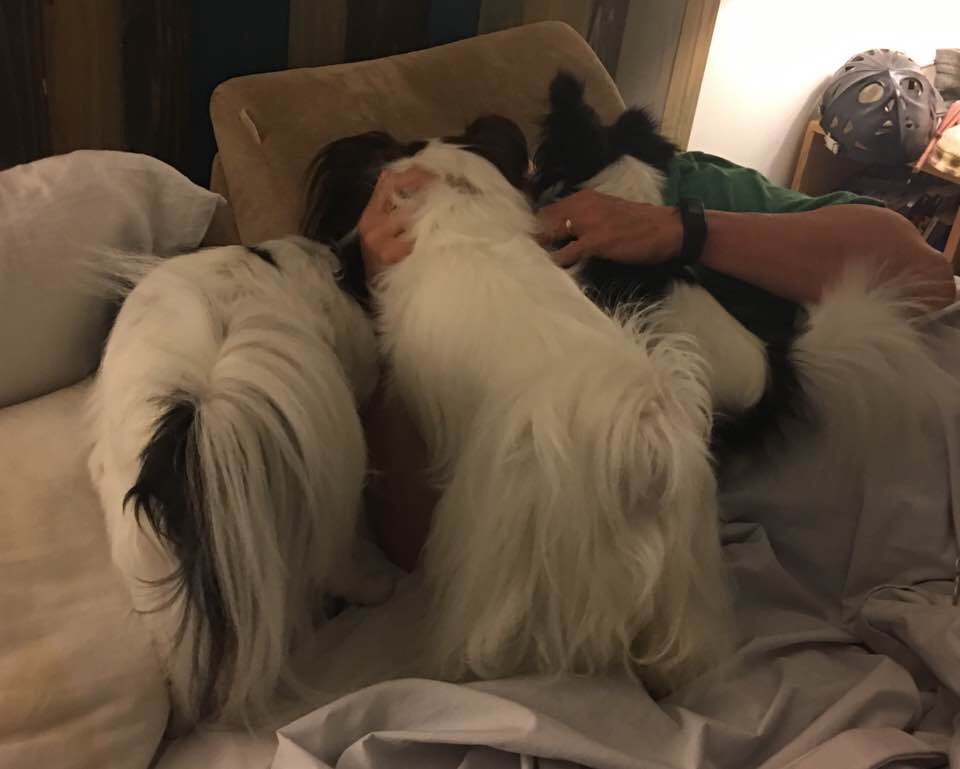
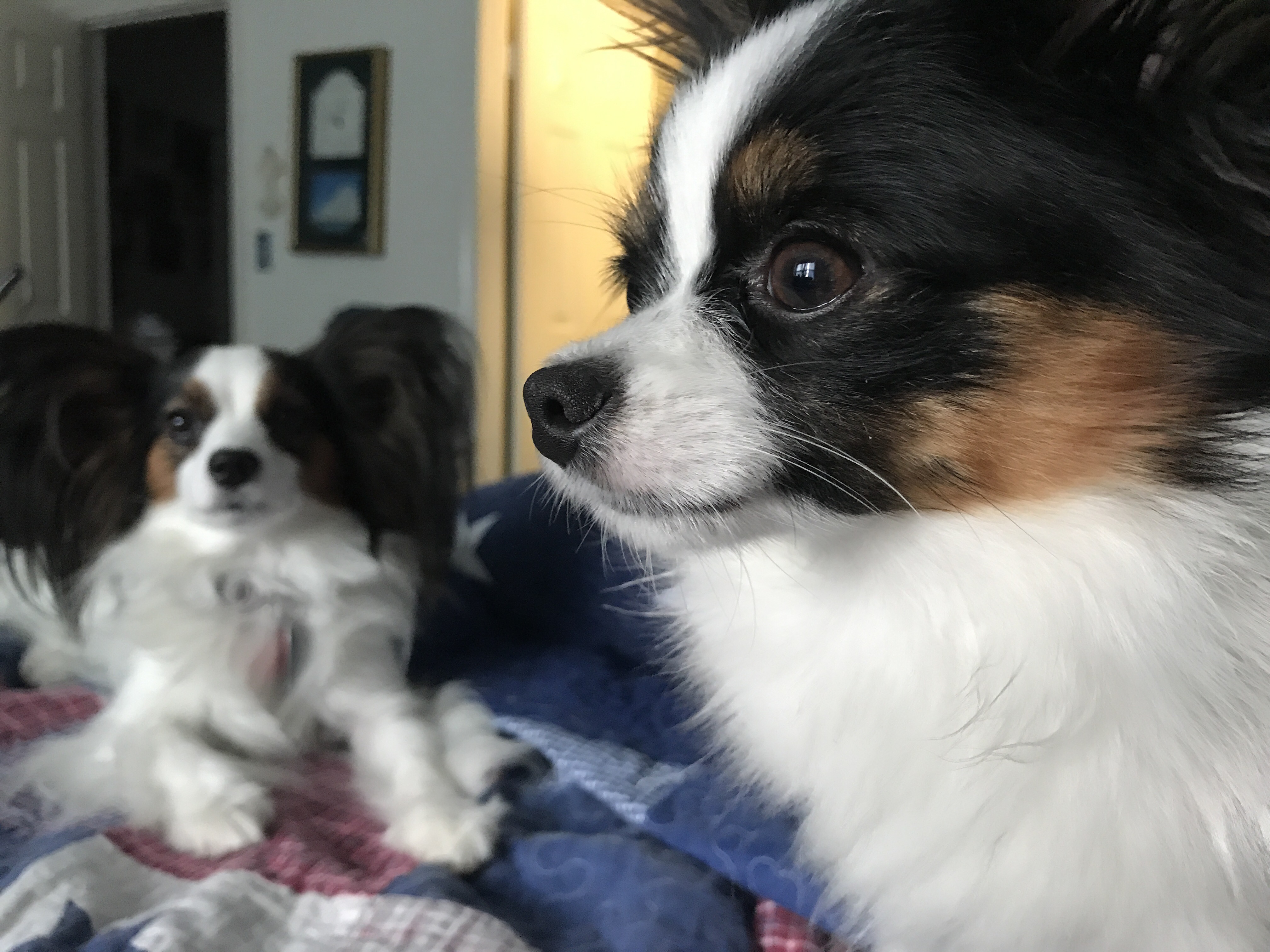
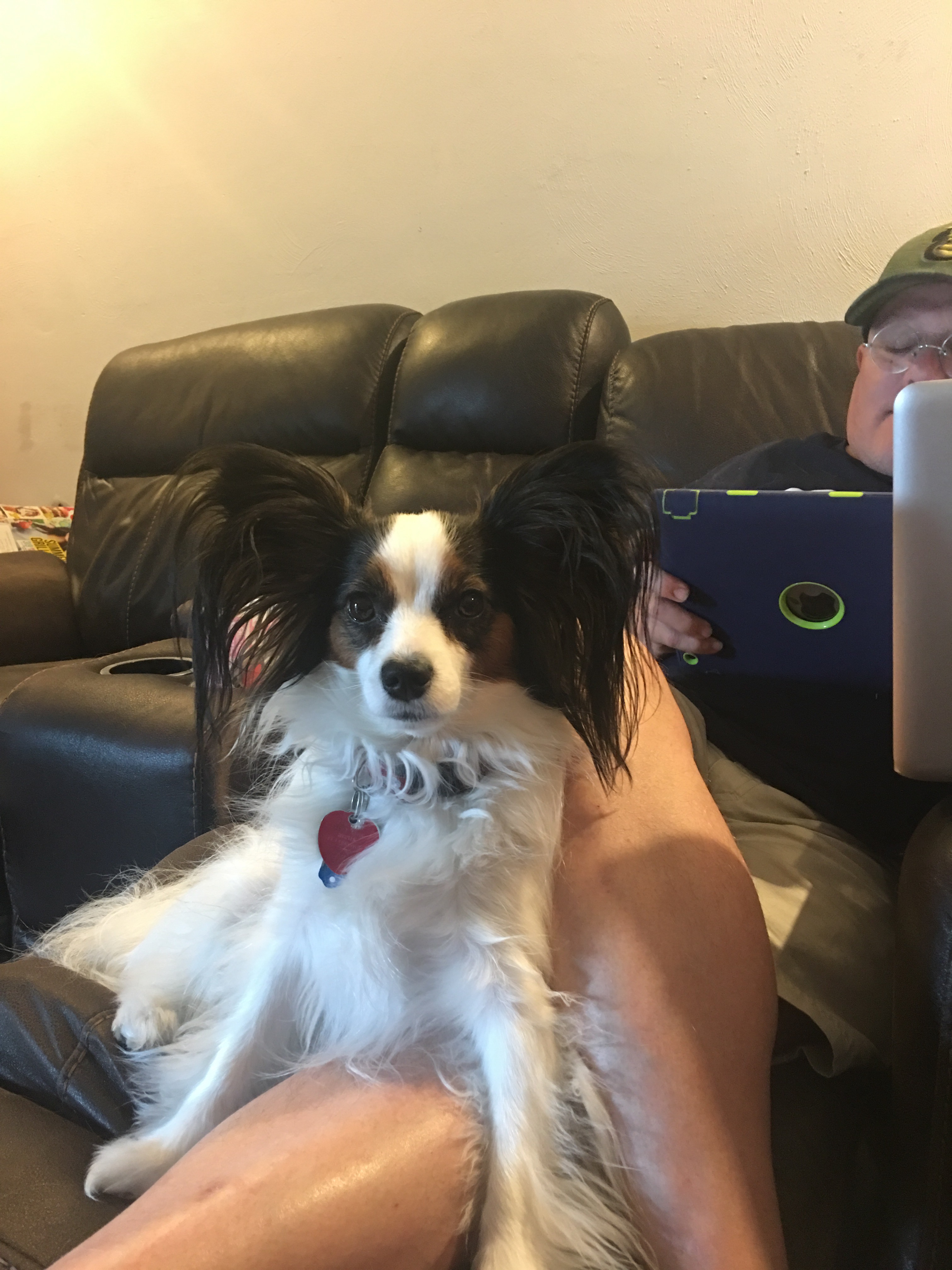
                  Left to right: Minnie, Izzy, and Pierre giving me my Saturday morning wake up call 

Friends of Padre Steve’s World,

I love Saturday mornings. They are the time that I take the time to relax and do nothing except sleep late, enjoy my Minnie, Izzy, and Pierre, not to mention Molly who we lost in 2015. Since I returned from Iraq our dogs have been a source of comfort and joy, they do more for me than almost anything in the world. There is nothing better for dealing with PTSD than puppy love. This morning each of them took individual and group time with me as I lay in bed, and when I got up to drink my coffee and read all of my online news subscriptions at least one was snuggled next to me. I also love watching them play, which is yet another source of joy. 


Saturday’s are also the time when Judy and I catch up on little things. I like to browse the grocery store, and take care of simple chores, nothing big because that would entail real work. When I finish my cup of coffee and get a shower I’ll do the grocery store and run a few other errands before coming home.  Today Judy is making earrings for a silent auction at the Gordon Biersch Christmas in July tapping which will be used to offset medical costs for the mother of one of our servers. She is waiting for a double lung transplant. One thing I do like about Biersch, it is a family affair. For us it is our version of Cheers – place where everybody knows our name. When Judy went through her cancer surgery two years ago it was the people from Biersch, managers, chefs, servers, bartenders, and friends who rallied to help. Church friends simply said they pray, but none bothered to even visit during her hospitalization or prolonged recovery. 


So now it is time to get ready to run those errands and hit the grocery store. Izzy will have to have her snuggle time interrupted, and she is not happy about it, but such is life.

Until tomorrow,

Peace

Padre Steve+ 

Leave a comment

Filed under Loose thoughts and musings, papillons

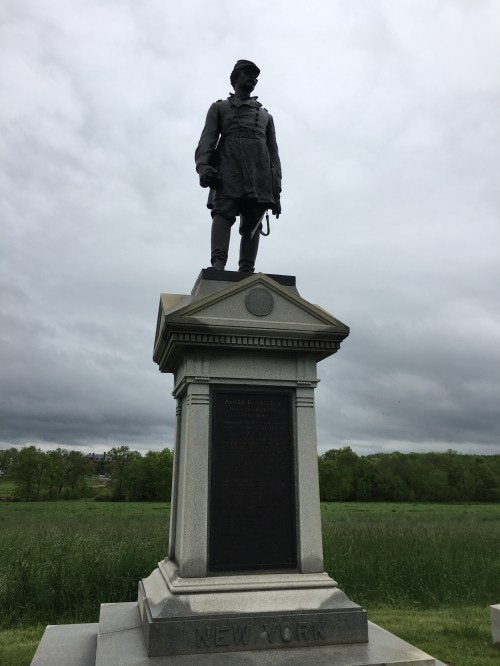
The Forgotten Hero of Seminary Ridge: Abner Doubleday

Friends of Padre Steve’s World,

I am re-posting a number of articles to run this Independence Day weekend so I can work on the article that I place on posting July 4th. These are articles from my Gettysburg text that deal with events of July 1st, 2nd, and 3rd 1863 during the Battle of Gettysburg. They have all appeared on this site before in different forms, but the Battle of Gettysburg still matters, what was done there on the behalf of freedom cannot be allowed to be forgotten. 

Have a great weekend.

Peace

Padre Steve+
Doubleday Takes Command

As the initial Confederate attacks were driven back by the actions of Reynolds, Doubleday and their subordinate commanders, Harry Heth’s battered brigades fell back and regrouped to prepare for another assault. As Heth reorganized his division he was bolstered by the arrival Major General Dorsey Pender’s Division powerful division.

With John Reynolds dead and Oliver Howard moving his Eleventh Corps into position on Cemetery Hill and to the north of Gettysburg, Major General Abner Doubleday had assumed command of First Corps on McPherson and Seminary Ridge and successfully parried Heth’s initial attacks, in the process shattering the brigades of James Archer and Joseph Davis.
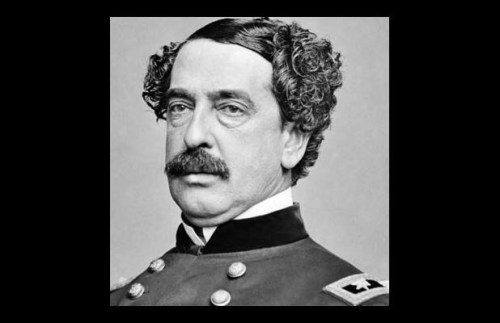
Major General Abner Doubleday, United States Army

Doubleday was an experienced soldier but did not enjoy a stellar reputation in the Army of the Potomac, despite the fact that he was the senior division commander in First Corps. Doubleday came from a prominent New York family; his grandfather had fought in the American Revolution and had fought at Bunker Hill. His father served four years in Congress. By the time he was admitted to West Point Doubleday had worked for two years as a civil engineer. Doubleday graduated 24th in a class of 52 in the West Point Class of 1842 along with future Gettysburg commanders “Longstreet, McLaws, Richard Anderson and John Newton.” [1] After his graduation he served a rather uneventful career as an artillery officer, including service in Mexico and on the frontier. Shortly before the war he was transferred to South Carolina where he was second in command at Fort Sumter when the Confederates opened fire on the fort and began the Civil War.

Doubleday was definitely an unusual character by the standards of the ante-bellum army officer corps. The “mustachioed, barrel-chested Doubleday considered himself a thoroughly modern man, unencumbered by the cheap affections of honor and chivalry with which so many officers bedecked themselves.” [2] He had few real friends in the army. He was a rather vocal abolitionist “which endeared him to few of the army’s socially conservative generals” [3] and he allowed his political opinions to infringe on his relationships with other officers. In the days before the war at Fort Sumter “he relished being hissed in the streets as a “Black Republican” when his official duties took him over the water to downtown Charleston.” [4]

Doubleday fired the first shot on the Union side at Fort Sumter, and with the expansion of the army to meet the rebellion he “expected that his anti-slavery credentials would guarantee a rise to the top of Lincoln’s army.” [5] However, he was to be disappointed. While promotion came to him it was not to the top of the army. Doubleday had the “reputation of being a cautious, deliberate plodder,” [6] and the artillery commander of First Corps, the somewhat curmudgeonly but honest, Colonel Charles Wainwright noted “Doubleday knows enough, but he is entirely impractical, and so slow at getting an idea through his head.” [7] Likewise, the new army commander George Meade had formed an unfavorable opinion of Doubleday’s leadership ability, when both served as division commanders in First Corps. Meade considered Doubleday “slow and pedantic.” [8]

Doubleday was somewhat portly and his physical appearance did little to inspire his soldiers or officers, and some of his troops nicknamed him “Old Forty-Eight Hours” for his deliberate, even slothful style.” [9] His promotion in the wartime army was rather typical for a career officer. He was “promoted to Brigadier General in February 1862 and commanded a brigade at Second Bull Run and a division at South Mountain and in later battles.” [10] As a brigade commander his best work was at Brawner’s Farm on the eve of Second Manassas, where Doubleday on his own initiative threw “two of his regiments into line to bolster Brig. Gen. John Gibbon’s brigade against a larger Confederate force…together the fought a superior force to a standstill.” [11] He was promoted to Major General in November 1862 and received command of the First Division Third Division of First Corps. At Antietam Doubleday led the division “into the carnage of the Cornfield and West Woods, and one colonel described him as a “gallant officer…remarkable cool and at the very front of battle.” [12] He led the division again at Fredericksburg, but the division saw little action. After the reorganization of the army following Fredericksburg he was given command of Third Division of First Corps at Chancellorsville, but again saw no action.

At Gettysburg Doubleday went into battle “stiff and pompous, still wearing his laurels as an “old Sumter hero” [13] and complaining about the Henry Slocum to command Twelfth Corps, even though he was senior to Slocum. That being said, Doubleday’s actions in the wake of Reynolds’s death demonstrated that he was capable of quick thinking and leadership from the front and in the next few hours Doubleday “had his best command hours of the war.” [14]

A Brief Lull

After the initial repulse of the Heth’s division, Doubleday continued to organize his defenses. He could see Heth’s division reforming its lines on Herr’s Ridge and Pender’s division as it arrived and deployed to Heth’s left. Doubleday had no directions from Reynolds as to that General’s defensive plan but be believed was that the ridges could be a redoubt and his instinct was “to hold on to the position until ordered to leave it,” an officer of the 149th Pennsylvania heard Doubleday say that “all he could do was fight until he got sufficient information to form his own plan.” [15] Doubleday wrote in his after action report, “to fall back without orders from the commanding general might have inflicted lasting disgrace upon the corps, and as general Reynolds, who was high in the confidence of General Meade, had formed his lines to resist the entrance of the enemy into Gettysburg, I naturally supposed that it was the intention to defend the place.” [16] Wadsworth’s division, bloodied but unbeaten remained in place in McPherson’s woods and across the Cashtown Road where Cutler’s brigade had fought the Confederates to a standstill at the Railroad Cut. During the lull these brigades had their ammunition replenished by his recently arrived ammunition trains.

To counter the Confederate move to his right he deployed his own small Third Division under the acting command of Brigadier General Thomas Rowley. He placed Rowley’s brigade to the left of the Iron Brigade to extend the line to the south and the brigade of Colonel Roy Stone to occupy the area around the McPherson House and Barn which had been left open when Cutler’s brigade advanced to the railroad cut.

When the Second Division under the command of Brigadier General John Cleveland Robinson arrived Doubleday placed it in reserve around the Lutheran Seminary where they and some of John Buford’s dismounted troopers began to set up a hasty “barricade of fence rails and fieldstone on the seminary’s west side.” [17] Doubleday and Wadsworth deployed every artillery piece of that the Corps had available to support their infantry, sometimes over the objections of the Corps artillery commander Colonel Charles Wainwright. Wainwright “had no confidence in Doubleday, and felt that he would be a weak reed to lean upon,[18] and on his own initiative deployed most of his batteries on Seminary Ridge where he believed that they could affect the battle but not be torn to pieces by Confederate artillery or shredded by close range musket fire. Despite the “pleas from infantry officers along the rise, Wainwright would send guns forward only under peremptory orders to do so.” [19] Wainwright was hesitant to risk his guns in exposed positions along McPherson’s Ridge and deployed most of his available artillery near the seminary in good defensive positions and stationed his limbers not far off so in the event of a retreat that he might have the opportunity to save his guns.

About Two o’clock Major General Oliver Howard, commander of the Eleventh Corps who was now the senior officer on the field made his way to seminary ridge where he met with Doubleday. Howard had already been working to support First Corps by ordering Schurz, who was now in acting command of Eleventh Corps to move north of the town to connect with Doubleday’s flank and securing Cemetery Hill as a natural redoubt and fallback position. While little is known what was said between the two commanders it is certain that Howard notified Doubleday of the locations of his corps headquarters and that of his divisions. Howard asked Doubleday “to continue his work of protecting the left of the Union position, while he would take care of the right…..Before leaving, Howard, repeated the instructions he had given Wadsworth, to hold the position as long as he could and then retire.” [20] Doubleday asked Howard for reinforcements, but there were none available, the best that either man could hope was that Henry Slocum’s Twelfth Corps, now about five miles distant could arrive soon. “If Slocum could make Gettysburg in the next hour and a half, Howard could post the 12th Corps on the right flank of his own corps and firm up the defensive arc that now stretched north and west of Gettysburg.” [21] However, despite the repeated requests of Howard, Slocum never came and did not advance toward Gettysburg until about three-thirty in the afternoon. Howard’s aid Captain Daniel Hall who delivered the messages and briefed Slocum on the situation at Gettysburg later stated that Slocum’s “conduct on that occasion was anything but honorable, soldierly, or patriotic.” [22]

With his troops under heavy artillery fire and Heth and Pender’s divisions advancing, a new threat emerged from the north. Messengers from Gamble’s cavalry scouts of Buford’s division to the north of town reported the arrival of Ewell’s Second Corps. To meet the threat Doubleday was obliged to send Robinson’s division north to occupy the extension of Seminary Ridge known as Oak Ridge. His lead brigade was under the command of Brigadier General Henry Baxter, and it advanced to the end of the ridge near the Mummasburg Road where it was joined by Brigadier General Gabriel Paul’s brigade.

Unlike the relatively small brigades of Third Division whose command structures were disrupted by Reynold’s death and Doubleday’s acting command of the corps, these brigades were comparatively large and powerful units and very well led. Their commander, Robinson “an old regular whose flowing beard lent him the look of a biblical prophet, had seen considerable fighting but was yet to be tested as a division commander.” [23] During this battle he more than met the test of an effective division commander. As the advance regiments of the division moved into position on Oak Ridge and the Mummasburg road they were greeted by a few of Gamble’s cavalrymen who told them “You stand alone between the Rebel army and your homes. Fight like hell!” [24] Upon their arrival Robinson refused the line in order to connect to the advance elements of Eleventh Corps which were arriving to the north of Gettysburg.

Enter Second Corps

On June 30th Rodes’ division marched about twenty miles and bivouacked at Heidlersburg where he met with his corps commander Ewell, fellow division commander Jubal Early and Isaac Trimble who was accompanying Second Corps where they puzzled over Lee’s orders as to the movement of Second Corps the following day, which indicated that Ewell should march to Gettysburg or Cashtown “as circumstances may dictate.” [25] Neither Rodes nor Early gave favorable opinions of the order and Ewell asked the rhetorical question “Why can’t a commanding General have someone on his staff who can write an intelligible order?” [26]

Ewell assumed that Cashtown was the desired junction of the army ordered his to march from on the morning of July 1st 1863 toward Cashtown to join with Hill’s corps. His choice of routes was good as it gave him the opportunity to turn south towards Gettysburg “as circumstances” dictated in compliance with Lee’s rather vague order of the day before.[27]

Rodes’s division was at Middletown (modern Biglerville) when Ewell received A.P. Hill’s message that he was moving on Gettysburg between eight and nine in the morning. Ewell immediately directed Rodes onto the “Middletown-Gettysburg road and instructed Early to march directly toward Gettysburg on the Heidlersburg road.” [28] As he did so he sent a note to Lee informing him of the situation and about noon he received Lee’s response that Lee “did not want a general engagement brought on till the rest of the army came up.” [29] But by the time Ewell received that instruction events were beginning to spiral out of control on his front just as they had on Harry Heth not long before.

Although Ewell was closer to Rodes than Hill was to Heth at the beginning of the battle, Rodes like Heth was also operating somewhat independently as Ewell “preferred to ride near the tail of his column in his buggy.” [30] Like Heth when confronted with the opportunity for battle, he ignored the instruction “to avoid a general engagement, if practicable.” [31] The operation was Rodes’ first as a Major General and he like his fellow division commanders, Jubal Early and Allegheny Johnston, the young and aggressive Rodes was operating independently “as Ewell preferred” until the corps was reunited in the evening. [32] During the early part of the march to Gettysburg he had performed well but July 1st 1863 “would never be remembered as a great day for Robert Rodes.” [33] As he moved his division south he, like Ewell was unaware that a battle was developing to their front and both were surprised when they heard the sound of artillery about four miles north of the town. Rodes later wrote that “to my surprise, the presence of the enemy there in force was announced by the sound of a sharp cannonade, and instant preparations for battle were made.” [34]

Rodes deployed his infantry brigades and “posted Lt.Col. Thomas H. Carter’s battalion of artillery along the nose of the ridge, where it opened with “fine effect” on the Union line stretched across McPherson’s Ridge.” [35] As Rodes set about deploying his troops for his assault on Oak Ridge, Ewell could see Robinson’s division moving up to Oak Ridge and the Mummasburg road facing his troops. He also observed the advance of the two divisions of Eleventh Corps which Carl Schurz was moving into position north of the town. Seeing the developments to his front and right Ewell considered Lee’s order obsolete and noted that “it was already too late to avoid an engagement without abandoning the position already taken up…and I determined to push the attack vigorously.” [36] Likewise he sent an aide to contact Jubal Early and enjoin that General to move to battle.

Robert Rodes was new to commanding a division. The big, blond and charismatic Rodes was one of the most popular leaders in the Army of Northern Virginia. Rodes had a great ability to inspire his subordinates. This was in large part due to his handsome physical appearance which made him look “as if he had stepped from the pages of Beowulf” [37] but also due to his “bluff personality featuring “blunt speech” and a tincture of “blarney.” [38]

Rodes graduated at the age of 19 from the Virginia Military Institute and remained at the school as an assistant professor for three years. He left VMI when Thomas “Stonewall” Jackson received the full professorship he desired and became a successful civil engineer working with railroads in Alabama. He had just been appointed a full professor at VMI as the war was declared. [39]

His career had been remarkable. Rodes was “tough, disciplined and courageous; he was one of those unusual soldiers who quickly grew into each new assignment.” [40] In just two years he had “risen from captaining a company of “Warrior Guards” in Alabama in 1861 to earning the equivalent of a battlefield promotion to major general for the fight he made at Chancellorsville.” [41] As a brigadier he had shown remarkable leadership on the battlefield and off, taking care of the needs of his soldiers and worked to have “at least one company per regiment to drill on a field gun and to keep up that training from time to time, so that his men could service a cannon in a crisis.” [42]

With the coming of war Rodes abandoned his academic endeavors returned to his recent home of Alabama where he was appointed Colonel of the 5th Alabama regiment of infantry. Early in the war Rodes distinguished himself as the commander of that regiment and later as brigade commander of Ewell’s former brigade, a promotion that Ewell recommended. His brigade was one of the spearheads of Jackson’s attack on Eleventh Corps at Chancellorsville, where he “was a brilliant presence on the field, exhorting his men with mustache flying. Jackson personally congratulated him on his gallant performance.” [43] He took acting command of Major General D. H. Hill’s former division during that battle and handled that unit well. Following Chancellorsville, Rodes was recommended for promotion to Major General and permanent command the division by Stonewall Jackson. The act was one of Jackson’s last acts before his untimely death from pneumonia while recovering from his wounds sustained at Chancellorsville. With his appointment Rodes became the first non-West Point graduate to command a division in the Robert E. Lee’s Army of Northern Virginia.

Rodes’s division was the largest in the army with five brigades and approximately 8,000 soldiers present at Gettysburg, almost as many as the First Corps of the Army of the Potomac. His brigade commanders were a mixed bag, ranging from the excellent to the incompetent. Among the former he had George Doles, Stephen Ramseur and Junius Daniel. However, Rodes was saddled with two commanders of dubious quality, Brigadier General Alfred Iverson, who was hated by his men and Colonel Edward O’Neal, a leading secessionist politician “who had absolutely no military experience before the war” [44] and who had been ineffective as an acting brigade commander when he took over for Rodes at Chancellorsville. However, Lee was forced to leave O’Neal at the head of his brigade for lack of other senior leaders over Rodes’ objections. It would be a mistake that would come to haunt him.

However, Rodes was fortunate to have Brigadier Generals Stephen Ramseur and George Doles in command of two of his brigades. Both had led their units well at Chancellorsville under Rodes direction, and would fight well in Gettysburg and subsequent actions. [45] Brigadier General Junius Daniel, though an experienced West Point graduate with a solid record was new to the Army of Northern Virginia, unfamiliar with his commander, while and his brigade was untested in combat.

Brigadier General George Doles commanded a brigade. Doles was not a professional soldier but a former Georgia militia where he commanded a company, “the Baldwin Blues,” one of the oldest and best-trained military units in the state.” [46] As a Colonel he “had shown fiber and vigor” [47] as commander of the 4th Georgia regiment which he commanded at South Mountain and Antietam. Doles was promoted to Brigadier General after Antietam, and commanded the brigade at Chancellorsville. At Chancellorsville his brigade was part of Jackson’s attack against the Federal XI Corps and in the thick the action throughout the battle. Doles was noted for his leadership and valor. By Gettysburg he had a reputation for “being among the Southern army’s most daring, hard fighting brigadiers.” [48]

Stephen Ramseur was the youngest General in the Army of Northern Virginia, he had graduated from West Point in 1861, immediately resigned to join the Confederate cause and within seven months he would be a Brigadier General. He was elected captain of the Ellis Light Artillery of Raleigh North Carolina, and became colonel of the 49th Alabama in 1862. He led the regiment “with distinction during the Seven Days.” [49] While leading his troops at Malvern Hill he was severely wounded. Ramseur was noted for “being a fighter and for his skill in handling troops in battle.” [50]

The young Colonel was promoted to Brigadier General in November 1862 following the Battle of Antietam. He led a North Carolina brigade with great daring at Chancellorsville where he was wounded in the shin by a shell fragment. Along with his division commander Robert Rodes, the still injured Ramseur was “one of the brightest lights in Lee’s army as it approached the field at Gettysburg.” [51]

Junius Daniel was an 1851 graduate of West Point who served seven years before resigning to run his family plantation in 1858. When war came he Daniel volunteered for service and was appointed commander of the 14th North Carolina. He had much brigade command time but little combat experience, as his brigade had been posted in North Carolina and the Virginia Tidewater, thus, not sharing in the Army of Northern Virginia’s year of glory and slaughter. “Daniel’s brigade joined Rodes division in Virginia as a result of the army’s reorganization after Chancellorsville and in time for it to take part in the invasion of Pennsylvania.” [52] Despite his lack of combat experience Junius Daniel was well respected and “had the essential qualities of a true soldier and successful officer, brave, vigilant, honest…gifted as an organizer and disciplinarian, skilled in handling troops.” [53] At Gettysburg he “proved himself a valiant soldier and capable leader….” [54]

This left Rodes with two brigades under questionable leadership, and both would cause him immense grief on the morning of July 1st 1863.

One North Carolina brigade was commanded by Brigadier General Alfred Iverson. Iverson who was considered a “reliable secession enthusiast” was appointed to command the North Carolina troops whose political steadiness and loyalty was questioned by Richmond. [55] Because of this Iverson became “embroiled in bitter turmoil with his North Carolinians.” [56] Iverson had served in the Mexican War and in the army of the 1850s. However, he owed his appointments in both the U.S. Army and that of the Confederacy to political patronage, his father being a prominent U.S. Senator.

Though Iverson was from Georgia he helped raise the 20th North Carolina regiment of infantry and became its first Colonel. However he was constantly at war with his officers and his regiment never bonded with him. As a regimental commander he did see a fair amount of action but his leadership was always a question mark. After he took command of the brigade Iverson “sent an aide to the camp of his former regiment to arrest all twenty-six of its officers.” [57] Those officers responded in kind and “retained a powerful bevy of counsel including…Colonel William Bynum who would later become a member of the Supreme Court.” [58] Iverson then refused promotions to any officer who had opposed him. One of the aggrieved officers of the 20th North Carolina “wrote an outraged letter home insisting that resistance to Iverson was every reasonable man’s duty and asserting that he would oppose him again “with great pleasure” if the occasion offered.” [59] In his previous action at Chancellorsville Iverson “had not distinguished himself.” [60] After Chancellorsville he had “been stigmatized for his conspicuous absence at the height of the fighting.” [61]

Rodes’s old brigade was in the worst hands all. Due to the lack of qualified officers it was commanded at Gettysburg by its senior regimental commander Colonel Edward A. O’Neal. O’Neal was another political animal, who unlike Iverson had no prior military training and nothing he had done before the war “had prepared him for command at any level.” [62] As an Alabama lawyer O’Neal was however well connected politically which gained him rapid rank and seniority over other officers, this eventually led to his command of the 26th Alabama which was a part of Rodes brigade. Rodes had reservations about O’Neal’s ability to command the brigade and recommended two other officers, John Gordon and John T. Morgan who instead were assigned to command other brigades. [63] The Confederate War Department in Richmond forwarded a commission to Lee for O’Neal to be promoted to Brigadier General before Gettysburg, but Lee, who had serious reservations about O’Neal’s capabilities blocked the promotion. [64]

The Confederate Disaster at Oak Ridge

The arrival of Rodes’s division as on the field in the van of the Confederate Second Corps was decisive in turning the tide of the battle toward the Confederates that afternoon. When Rodes arrived with Ewell, the Federal First Corps was facing west against Heth and Pender’s divisions and its line only extended about a quarter mile north of the Railroad Cut.

The Union First Corps and Buford’s cavalry division had fought Heth’s poorly coordinated and led attacks to a standstill, but when Rodes arrived he found “a golden opportunity spread before him.” [65] From his position at Oak Ridge he saw the opportunity to take the Federal troops opposing Hill in the flank though his position did not “provide him as comprehensive view as he thought.” [66] His desire was to advance south along Oak Ridge using it to screen his movements in order to execute an attack on the Federal right flank. But before he could do this “the First Corps Generals had made preparations to oppose him.” [67] Robinson’s two brigades under Baxter and Paul deployed and “hurried in line stone and wood fences approximately at right angles to Rodes proper line of advance.” [68] Rodes could see the deployment but the fences obscured the exact positions of Robinson’s troops from him. Seeing the advance of the First Corps units as well as the emergence of Schurz’s troops from Eleventh Corps advancing out of the town the aggressive Confederate commander decided to launch an immediate attack.

Carter’s artillery, which had deployed in the open and was had “opened an enfilading fire all along the line to the Fairfield road” [69] now drew the fire of Captain Hubert Dilger’s Battery I First Ohio Artillery from Howard’s XI Corps which had just arrived near Oak Ridge. Dilger commanded one of the best artillery units in the army. He was a German immigrant and professional artilleryman who had served in the Grand Duke of Baden’s Horse Artillery. He came to the United States at beginning of the war at the invitation of a distant uncle, to “practice the war-making he had only previously rehearsed.” [70] Dilger was “blunt and a bit arrogant…loved by his men but not by his superiors.” At Chancellorsville he and his battery had helped save the Federal right “when it used a leapfrogging technique to keep the victorious Confederate infantry at bay.” [71] At Gettysburg Dilger again displayed his talent.

Upon its arrival Dilger’s battery opened “a storm of counter-battery fire” [72] on Carter’s battalion as well as the infantry brigade of O’Neal which was near it. The effect of Dilger’s fire on Carter’s artillery disrupted its operation and was successful in blowing up several caissons and guns causing significant numbers of casualties among the men. [73] Seeing the carnage to one battery that he had not placed, Carter “accosted Rodes and asked, “General, what fool put that battery up yonder?” Only to realize after an “awkward pause and a queer expression on the face of all Rodes’ staffers that Rodes himself had placed it there.” [74] In response, the chastised division commander replied “You had better take it away, Carter.” [75] Throughout the rest of the engagement Dilger’s battery would make itself known, shattering Confederate infantry assaults and damaging Southern artillery batteries.

The young division commander was overconfident as he ordered the attack. Thinking he had an adequate grasp of the situation he did not order a reconnaissance before launching the attack, nor did the commanders of the brigades spearheading the attack put out skirmishers, the normal precaution when advancing in the face of the enemy. [76] Rodes deployed his troops over the rough ground of the ridge as quickly as he could and dashed off a note to Jubal Early stating “I can burst through the enemy in an hour.” [77] He was to be badly mistaken, and “like Heth in the south, he paid in disproportionate blood for the ready aggressiveness which in the past had been the hallmark of the army’s greatest victories, but now seemed mere rashness and the hallmark of defeat.” [78]

Rodes deployed George Doles’ excellent brigade to guard his left against the advancing Eleventh Corps units until Early’s division could arrive, something he expected momentarily. Doles and his brigade conducted this task admirably until the arrival of Jubal Early’s division, which enabled it to join the attack on Eleventh Corps divisions north of the town. Initially the movement of the brigade opened a potentially dangerous gap between Doles brigade and O’Neal’s brigade to its right, but this could not be exploited by the Federals. To hold this gap between Doles and O’Neal Rodes pulled one regiment, the 5th Alabama from O’Neal.

To make his main attack Rodes initially deployed his division on a one brigade front as they arrived on the battlefield in line-of-march. As the leading elements of the division neared the Federal positions Rodes, made what appeared to be a simple change of plan to “attack on a two brigade front, sending in O’Neal’s and Iverson’s men simultaneously, then following up with Daniel’s brigade in echelon on the right.” [79] Ramseur’s brigade was held in close reserve. In theory it was a sound plan, but everything is more complicated when bullets start flying. The execution of this change in plan was “bungled right at the start.” [80] None of “the three brigade commanders was sure what the signal for the advance would be” [81] and since Rodes had made no reconnaissance, and none of the brigades put out skirmishers the direction of the attack was faulty, units were mingled and a gap developed between O’Neal and Iverson. [82] The attack “though vigorous, was a disaster” [83] and the plan floundered due to the stout resistance of Robinson’s troops and the “nicely matched incompetence of O’Neal and Iverson” [84] neither of who advanced with their assaulting troops.

O’Neal’s brigade became disoriented and “went in with only three regiments and at an angle different from that indicated by Rodes. Instead of leading his troops in the attack O’Neal remained in the rear with the Fifth Alabama, a reserve regiment,” [85] the regiment Rodes had left behind to guard the gap between O’Neal and Doles’s brigades. The last regiment, the Third Alabama had been aligned on the flank of Doles’s brigade and since Rodes had moved it “evidently concluded…that it was no longer his to direct.” [86] When Rodes discovered this he had to send a staff officer to ensure that the regiment was properly attached to Daniel’s brigade. That regiment was thus left out of the initial advance. The attack stalled almost immediately when O’Neal’s three attacking regiments were fired upon by Union troops of Robinson’s division who had been hidden by a wall which had obscured them from Rodes’s view.

Striking O’Neal’s advancing troops at the oblique, Robinson’s battle hardened Union troops slaughtered the unsuspecting Confederates. Though they were outnumbered the Union men were solid veterans from Baxter’s brigade who were aided by Dilger’s artillery which delivered “effective canister fire at O’Neal’s brigade.” [87] The combined fire of Baxter’s troops as well as Dilger’s artillery “killed or wounded about half of the advancing men with a series of point blank volleys pumped directly into their flank.” [88] O’Neal’s decision to remain back with his reserve regiment rather than “going forward to direct the advancing regiments” [89] caused further problems because there was no officer on the spot to direct the action of the three regiments.

Rodes noted in his after action report that O’Neal’s three attacking regiments “moved with alacrity (but not in accordance with my orders as to direction)” and that when he ordered the 5th Alabama up to support “I found Colonel O’Neal, instead of personally superintending the movements of his brigade, had chosen to remain with his reserve regiment. The result was that the whole brigade was repulsed quickly and with loss….” [90] As O’Neal’s troops fell back in confusion they exposed Iverson’s brigades flank to the Federal fire.

As Rodes’s continued bad luck would have it, Iverson, like O’Neal on his right did not advance simultaneously with O’Neal or on the same axis, but instead waited to see O’Neal’s advance. [91] When it advanced, the brigade “about 1,450 strong, kept on under artillery fire through the open field “as evenly as if on parade.” Then its alignment became faulty, and without Iverson on hand to correct it, the brigade with strange fatality began to bear left toward the stone wall…” [92] As a result the brigade drifted right it’s exposed left was subject to attack from Baxter’s and Paul’s brigades of Robinson’s division still hidden behind the stone wall.

When the Confederates got within fifty yards of Baxter’s troops they were overwhelmed by a fierce resistance from the concealed Federal troops. The commander of the 83rd New York, the Swiss born lieutenant Colonel Joseph A. Moesch, shouted: “Up men, and fire.” Moesch rode behind his line cheering his men on, but they needed no urging. In the words of one of one, “The men are no longer human, they are demons; a curse from the living here, a moan from the dying there. ‘Give them —- shouts one.’ See them run’ roars another.” [93] The well concealed veterans of Baxter regiments slaughtered them as they had O’Neal’s men just minutes before. “One regiment went down in such a neat row that when its survivors waves shirt tails, or any piece of cloth remotely white, Iverson thought that the whole regiment of live men were surrendering.” [94] As the Confederate attack collapsed some “of the regiments in Robinson’s division changed front again, charged, and captured nearly all the men who were left unhurt in three of Iverson’s regiments.” [95] Official Confederate reports list only 308 missing but that number differs from the Union reports, Robinson reporting 1000 prisoners and three flags and Baxter’s brigade nearly 400. [96] As Robinson’s troops smashed the brigades of O’Neal and Iverson, they were joined by the remnants of Cutler’s brigade which changed its face from west to north to deliver more devastating fire into the Confederates.

Iverson was badly shaken by the slaughter and “went to pieces and became unfit for further command,” [97] after being just close enough to the action to observe it. He panicked and notified Rodes that one of his regiments had surrendered in masse though Iverson later retracted that in claim in his official report where he noted “when I found afterward that 500 of my men were left lying dead and wounded on a line as straight as a dress parade, I exonerated …the survivors.” [98] His brigade had lost over two-thirds of its strength in those few minutes, one regiment the 23rd North Carolina lost 89 percent of those it took into battle, and at the end of the day would “count but 34 men in its ranks.” [99] Iverson’s conduct during the battle was highly criticized by fellow officers after it. Accused of cowardice, drunkenness and hiding during the action he was relieved of his command upon the army’s return to Virginia “for misconduct at Gettysburg” [100] and sent back to Georgia. Some complained after the war that Iverson was helped by politicians once he returned to Richmond and instead of facing trial “got off scot free & and had brigade of reserves given to him in Georgia.” [101]

With the center of his attacking forces crushed the brigades of Junius Daniels and Stephen Ramseur entered the fray to the right of Iverson’s smashed brigade. These capable officers achieved a link up with the battered brigades of Harry Heth at the Railroad cut after Daniel’s brigade had fought a fierce battle with Culter’s and Stone’s brigades in the area [102] and allowed the Confederates of A.P. Hill and Dick Ewell’s Corps to form a unified front from which they were able to resume their attack in even greater numbers against the battered remnants of First Corps.

To the east Doles’s brigade advanced with Jubal Early’s division smashed the outnumbered and badly spread out divisions of Oliver Howard’s Eleventh Corps. The timely arrival of that division coupled with the skillful work of Daniel and Ramseur saved Rodes from even more misfortune on that first day of battle, but Rodes’ plan “to burst through the enemy” with his division had evaporated. [103] By the end of the day his division had lost nearly 3000 of the 8000 that it had begun the afternoon.

The battle at Oak Ridge was a series of tactical debacles within a day of what appeared to be a “Confederate strategic bonanza.” [104] Despite the mistakes Rodes never lost his own self-control. He recovered from each mistake and continued to lead his division. He “kept his men on the ridge driving forward until with Hill, and on the flats left joined Early’s right to form a continuous line into Gettysburg.” [105] It was a hard lesson for the young Major General, but one that he learned from. Rodes continued to serve with distinction as a division commander would be killed in action while leading a counterattack by his division against Philip Sheridan’s army at the Third Battle of Winchester on September 19th 1864.

Abner Doubleday’s Best Performance and Disgraceful Treatment

On the other hand Abner Doubleday proved himself as a capable commander who was able to provide effective leadership during a crisis situation. Although he is one of the most underappreciated Union commanders at Gettysburg he “ably rose to the occasion, as did divisional commanders James Wadsworth and John Robinson.” [106] Though his abilities were suspect, especially by George Meade and Colonel Wainwright, the Corps artillery commander Doubleday managed to hold off superior Confederate forces, and even inflicted a significant defeat on the divisions of Harry Heth and Robert Rodes. During the fighting against ever increasing numbers of Confederates, First Corps inflicted massive casualties on their opponents. “Seven of the ten Southern brigades incurred casualties from 35 to 50 percent, and the total for all brigades came to an estimated 6,300 officers and men, or about 40 percent of their strength.” [107] Doubleday’s troops held on long enough to support the left flank of Eleventh Corps as it was being assaulted by Early’s division.

When Winfield Scott Hancock arrived on Meade’s behest to take command at Gettysburg Oliver Howard informed him that First Corps “had given way at first contact” [108] implicitly blaming Doubleday for the collapse of the Federal line. Hancock delivered the report in a note to Meade which said “Howard says that Doubleday’s command gave way” [109] This false report fixed in Meade’s mind that his doubts about Doubleday’s ability were correct. To Doubleday’s amazement Meade then cancelled his order appointing Doubleday to command First Corps and ordered John Newton, a division commander, far junior to Doubleday in Sedgwick’s Sixth Corps to replace Doubleday. A badly disappointed Doubleday resumed command of his division. In large part Meade’s appointment of Newton over Doubleday was also political. Doubleday’s fellow abolitionist division commander in First Corps, James Wadsworth said that “Meade’s “animosity” toward Doubleday rested in a “past political difference.” [110] Doubleday, the abolitionist Republican was not acceptable to Meade, the conservative Unionist Democrat and ally of Gorge McClellan. The fact that Newton “was not regarded as daring or brilliant” [111] and was regarded by many as a “pet” of Meade, did not matter. Meade’s volcanic temper and temptation to allow politics to cloud his military judgement meant that “Newton was the only other major general he could trust politically.” [112] When Doubleday formally protested to Meade he was dismissed from Army of the Potomac.

He left the Army of the Potomac never held a field command during the war, however, he was brevetted in the Regular Army to both brigadier and major general. Doubleday served in administrative capacities in Washington D.C. until the end of the war and testified against Meade during the politically charged hearings of the Committee on the conduct of the War. Doubleday remained bitter toward Meade and he “was never reconciled to Meade’s relieving him as acting commander of First Corps in Favor of Maj. Gene. John Newton, who was his junior in rank and the reproach that it implied.” [113] After the war Doubled reverted to his rank as a Colonel in the Regular Army and was made Colonel of the 35th U.S. Infantry in San Francisco. From 1871 until his retirement in 1873 Doubleday commanded the African American “Buffalo Soldier” 24th Infantry Regiment in Texas. He died in New York on January 25th 1893, and was buried in Arlington National Cemetery. Among the members of the honor guard at his funeral in New York was a man named Abraham Mills who would play a major role in Doubleday’s future fame.


                                                 A Myth and Legend Greater than Gettysburg: Abner Doubleday and Baseball

Interestingly enough Doubleday, who was unappreciated as a general became linked forever to the game known as America’s national pastime and to Cooperstown New York, the home of Baseball’s Hall of Fame. As such he is probably better known to most Americans, particularly baseball fans than any Union general who fought at Gettysburg.


Like the Civil War, Baseball too is filled with myths which connect it to our culture, and one “is the myth that Abner Doubleday invented the sport one fine day in 1839 at the farmer Phinney’s pasture at Cooperstown.” [114] It was early American baseball star Albert G. Spaulding who linked the creation of baseball to the Civil War and in particular to Abner Doubleday by way of an apocryphal story of one of Doubleday’s childhood friends, years after Doubleday’s death. In 1907, Spaulding worked with Abraham G. Mills the fourth President of the National League, the same man who had served in Doubleday’s funeral honor guard to conclude that “that the first scheme for playing it, according to the best evidence obtained to date, was devised at Cooperstown New York, in 1839.” [115] But this is simply myth and the underappreciated hero of the first day of battle at Gettysburg is much better known for something that he did not do.

The ironies of history and myth are fascinating. Interestingly Mills paid homage to Doubleday noting, “in the years to come, in the view of hundreds of thousands of people who are devoted to baseball, Abner Doubleday’s fame will rest evenly, if not quite so much that he was its inventor…as upon his brilliant and distinguished career as an officer in the Federal Army.” [116]

Notes

[1] Pfanz Harry W. Gettysburg: The First Day University of North Carolina Press, Chapel Hill and London 2001 p.121

[2] Goodheart, Adam 1861: The Civil War Awakening Vintage Books a division of Random House, New York 2011 p.5

[3] Wert, Jeffry D. The Sword of Lincoln: The Army of the Potomac Simon and Schuster, New York and London 2005 p.276

[4] Ibid. Goodheart 1861 p.5

[5] Guelzo, Allen C. Gettysburg: The Last Invasion Vintage Books, a Division of Random House, New York 2013 p.30

[6] Sears, Stephen W. Gettysburg. Houghton Mifflin Co. Boston and New York 2003 p.181

[7] Wainwright, Charles S. A Diary of Battle: The Personal Journal of Colonel Charles S. Wainwright 1861-1865 edited by Allan Nevins, Da Capo Press, New York 1998 p.172

[8] Cleaves, Freeman Meade of Gettysburg University of Oklahoma Press, Norman and London 1960 p.143

[9] Tagg, Larry The Generals of Gettysburg: The Leaders of America’s Greatest Battle Da Capo Press Cambridge MA 1998 Amazon Kindle Edition p.25

[10] Ibid. Pfanz Harry Gettysburg: The First Day p.122

[11] Ibid. Tagg The Generals of Gettysburg p.26

[12] Ibid. Tagg The Generals of Gettysburg p.26

[13] Catton, Bruce The Army of the Potomac: Glory Road Doubleday and Company, Garden City New York, 1952 p.273

[14] Ibid. Sears Gettysburg p.181

[15] Ibid. Guelzo Gettysburg: The Last Invasion p.161

[16] Trudeau, Noah Andre. Gettysburg: A Testing of Courage, Harper Collins Publishers, New York 2002 p.206

[17] Ibid. Guelzo Gettysburg: The Last Invasion p.162

[18] Ibid. Wainwright A Diary of Battle p.233

[19] Ibid. Trudeau Gettysburg: A Testing of Courage p.200

[20] Coddington, Edwin B. The Gettysburg Campaign: A Study in Command, A Touchstone Book, Simon and Schuster New York, 1968 p.282

[21] Ibid. Guelzo Gettysburg: The Last Invasion p.162

[22] Melton, Brian C. Sherman’s Forgotten General: Henry W. Slocum University of Missouri Press, Columbia and London 2007 p.121

[23] Ibid. Sears Gettysburg p.34

[24] Ibid. Trudeau Gettysburg: A Testing of Courage p.206

[25] Ibid Pfanz Gettysburg: The First Day p.148

[26] Ibid Pfanz Gettysburg: The First Day p.149

[27] Ibid. Sears Gettysburg p.160

[28] Ibid. Coddington The Gettysburg Campaign: A Study in Command p.281

[29] Gallagher, Gary. Confederate Corps Leadership on the First Day at Gettysburg: A.P. Hill and Richard S. Ewell in a Difficult Debut in The First Day at Gettysburg edited by Gallagher, Gary W. Kent State University Press, Kent Ohio 1992 p.49

[30] Foote, Shelby, The Civil War, A Narrative. Volume Two Fredericksburg to Meridian Random House, New York 1963 p.472

[31] Ibid Freeman, Lee’s Lieutenant’s a Study in Command p.564

[32] Ibid. Foote The Civil War, A Narrative. Volume Twop.472

[33] Ibid. Dowdy Lee and His Men at Gettysburg: The Death of a Nation p.138

[34] Luvaas, Jay and Nelson Harold W editors. The U.S. Army War College Guide to the Battle of Gettysburg South Mountain Press, Carlisle PA 1986 p.35

[35] Pfanz, Donald. Richard S. Ewell: A Soldier’s Life University of North Carolina Press, Chapel Hill and London 1998 p.305 Pfanz credits Ewell for this but nearly every other source lists Rodes as having placed Carter’s artillery battalion on Oak Hill.

[36] Ibid. Pfanz, Donald Richard S. Ewell p.305

[37] Freeman, Douglas Southall, Lee’s Lieutenant’s a Study in Command, One volume abridgement by Stephen W Sears, Scribner, New York 1998 p.39

[38] Krick, Robert K. Three Confederate Disasters on Oak Ridge: Failures of Brigade Leadership on the First Day of Gettysburg in The First Day at Gettysburg edited by Gallagher, Gary W. Kent State University Press, Kent Ohio 1992 p.115

[39] Dowdy, Clifford. Lee and His Men at Gettysburg: The Death of a Nation Skyhorse Publishing, New York 1986, originally published as Death of a Nation Knopf, New York 1958 p.123

[40] Glatthaar, Joseph T. General Lee’s Army from Victory to Collapse The Free Press, Simon and Schuster, New York and London 2008 p.243

[41] Ibid. Sears, Gettysburg p.53

[42] Ibid. Glatthaar General Lee’s Army from Victory to Collapse p.244

[43] Gwynne, Samuel C. Rebel Yell: The Violence, Passion, and Redemption of Stonewall Jackson Scribner, a Division of Simon and Schuster New York 2014 p.537

[44] Ibid. Tagg The Generals of Gettysburg p.299

[45] Ibid. Krick Three Confederate Disasters on Oak Ridge p.117

[46] Ibid. Tagg The Generals of Gettysburg p.287

[47] Ibid. Freeman Lee’s Lieutenants p.386

[48] Ibid. Tagg The Generals of Gettysburg p.288

[49] Ibid. Warner Generals in Gray p.251

[50] Pfanz Harry W. Gettysburg: The First Day University of North Carolina Press, Chapel Hill and London 2001

[51] Ibid. Tagg The Generals of Gettysburg p.290

[52] Ibid. Pfanz Gettysburg: The First Day p.179

[53] Ibid. Tagg The Generals of Gettysburg p.292

[54] Ibid. Coddington The Gettysburg Campaign p.21

[55] Ibid. Guelzo Gettysburg: The Last Invasion p.25

[56] Ibid. Sears Gettysburg p.53

[57] Ibid. Krick Three Confederate Disasters on Oak Ridge p.129

[58] Ibid. Krick Three Confederate Disasters on Oak Ridge p.131

[59] Ibid. Krick Three Confederate Disasters on Oak Ridge p.130-131

[60] Ibid Freeman, Lee’s Lieutenant’s a Study in Command p.564

[61] Ibid. Trudeau, Gettysburg: A Testing of Courage p.145

[62] Ibid. Krick Three Confederate Disasters on Oak Ridge p.120

[63] Ibid. Krick Three Confederate Disasters on Oak Ridge p.123

[64] Ibid. Pfanz Harry Gettysburg: The First Day p.162 Also see Krick pp.123-124 Following Gettysburg Lee continued to block O’Neal’s promotion and that officer went to extraordinary lengths to obtain a General’s commission using every political ally he had in Alabama and in Richmond. Finally Lee settled the matter before the Wilderness campaign writing that he made “more particular inquiries into his capacity to command the brigade and I cannot recommend him to the command.” Krick pp.123-124

[65] Ibid. Foote, Shelby, The Civil War, A Narrative. Volume Two p.472

[66] Ibid. Guelzo Gettysburg: The Last Invasion p.170

[67] Ibid. Coddington The Gettysburg Campaign p.286

[68] Ibid. Krick Three Confederate Disasters on Oak Ridge p.119

[69] Ibid. Coddington The Gettysburg Campaign p.286

[70] Ibid Trudeau, Gettysburg: A Testing of Courage p.208

[71] Gottfried, Bradley The Artillery of Gettysburg Cumberland House Publishing, Nashville TN 2008 pp.59-60 Dilger was awarded the Medal of Honor for his actions at Chancellorsville in 1893, part of the citation stating that Dilger: “fought his guns until the enemy were upon him, then with one gun hauled in the road by hand he formed the rear guard and kept the enemy at bay by the rapidity of his fire and was the last man in the retreat.”

[72] Ibid. Krick Three Confederate Disasters on Oak Ridge p.118

[73] Ibid Trudeau, Gettysburg: A Testing of Courage p.210

[74] Ibid. Guelzo Gettysburg: The Last Invasion p.170

[75] Ibid. Gottfried The Artillery of Gettysburg p.61

[76] Ibid. Guelzo Gettysburg: The Last Invasion p.170

[77] Ibid. Guelzo Gettysburg: The Last Invasion p.170

[78] Ibid. Foote, Shelby, The Civil War, A Narrative. Volume Two p.473

[79] Ibid. Sears Gettysburg p.197

[80] Ibid. Sears Gettysburg p.197

[81] Ibid. Guelzo Gettysburg: The Last Invasion p.170

[82] Ibid Freeman, Lee’s Lieutenant’s a Study in Command p.565

[83] Ibid. Pfanz, Donald Richard S. Ewell p.305

[84] Ibid. Krick Three Confederate Disasters on Oak Ridge p.120

[85] Ibid. Pfanz, Donald Richard S. Ewell p.305

[86] Ibid. Krick Three Confederate Disasters on Oak Ridge p.124

[87] Ibid. Sears Gettysburg p.198

[88] Ibid. Foote, Shelby, The Civil War, A Narrative. Volume Two p.473

[89] Ibid Freeman, Lee’s Lieutenant’s a Study in Command p.565

[90] Ibid Luvaas The U.S. Army War College Guide to the Battle of Gettysburg p.36

[91] Ibid. Krick Three Confederate Disasters on Oak Ridge p.132

[92] Ibid. Coddington The Gettysburg Campaign p.289

[93] Ibid. Pfanz Gettysburg: The First Day p.172

[94] Ibid. Dowdy, Lee and His Men at Gettysburg: The Death of a Nation p.134

[95] Ibid. Coddington The Gettysburg Campaign p.290

[96] Ibid Pfanz Gettysburg: The First Day p.175

[97] Ibid. Coddington The Gettysburg Campaign: A Study in Command p.290

[98] Ibid Luvaas The U.S. Army War College Guide to the Battle of Gettysburg p.37

[99] Ibid. Sears Gettysburg p.201

[100] Ibid. Guelzo Gettysburg: The Last Invasion p.173

[101] Ibid. Krick Three Confederate Disasters on Oak Ridge p.136

[102] Ibid. Coddington, The Gettysburg Campaign: A Study in Command, p.292

[103] Ibid. Guelzo Gettysburg: The Last Invasion p.173

[104] Ibid. Krick Three Confederate Disasters on Oak Ridge p.138

[105] Ibid. Dowdy Lee and His Men at Gettysburg: The Death of a Nation p.138

[106] Ibid. Sears Gettysburg p.245

[107] Ibid. Coddington, The Gettysburg Campaign: A Study in Command, p.307

[108] Ibid. Wert The Sword of Lincoln p.294

[109] Ibid. Guelzo Gettysburg: The Last Invasion p.224

[110] Ibid. Wert The Sword of Lincoln p.294

[111] Ibid. Cleaves Meade of Gettysburg p.143

[112] Ibid. Guelzo Gettysburg: The Last Invasion p.224

[113] Ibid. Pfanz Gettysburg: The First Day p.355

[114] Will, George F Men at Work: The Craft of Baseball Harper Collins Publishers, New York 1990 p.294

[115] Kirsch, George B. Baseball in Blue and Gray: The National Pastime in the Civil War Princeton University Press, Princeton and Oxford, 2003 p.xiii

[116] Ibid.. Kirsch Baseball in Blue and Gray p.xii

1 Comment

Filed under civil war, Gettysburg, History, leadership, Loose thoughts and musings