Category Archives: Military

Vice Admiral Samuel Gravely Jr: Pioneer of Integration and Civil Rights in the U.S. Navy

gravely

“I was sure that I could not afford to fail. I thought that would affect other members of my race if I failed anywhere along the line. I was always conscious of that, particularly in midshipman school and any other schools I went to…I tried to set a record of perfect conduct ashore and at sea.” Vice Admiral Samuel Gravely

Things have changed much since 1942 when following the attack on Pearl Harbor a young black college student from Richmond Virginia enlisted in the Navy. Samuel Gravely Jr. was the son of a postal worker and Pullman porter while his mother worked as a domestic servant for white families in Richmond. His mother died unexpectedly when he was 15 in 1937 and he remained to help care for his siblings as his father continued to work. Balancing the care of his family with his education he enrolled in Virginia Union College, a Baptist school in Richmond.

gravely_young

Fireman Apprentice Samuel Gravely Jr

It is hard to imagine for most of us now to comprehend the world that the young Gravely grew up in. Segregation was the norm. Blacks in the south and many other locations faced personal as well as intrenched institutional racism. Violence against blacks was quite common and the Ku Klux Klan was strong.

The military was still segregated and a great gulf existed between white military personnel and blacks. Though the selective service law of 1940 called for the conscription of people regardless of race, creed or color the services enjoyed much latitude in determining how minorities could serve. The Secretary of the Navy at the time, Frank Knox resisted integration. Knox determined that African Americans would remain segregated and serve only as Mess Stewards to “prevent undermining and disruptive conditions in the Navy.” Knox told President Roosevelt in the presence of black leaders that “because men live in such intimacy aboard ship that we simply can’t enlist Negroes above the rank of messman. “

That sentiment was strong in both the Navy and the Marines the leaders of which resisted attempts to broaden the ability for African Americans to serve and urged that blacks serve in the Army, not the Naval Service.  Marine Corps Commandant Major General Thomas Holcomb agreed with this stance. He commented:

“If we are defeated we must not close our eyes to the fact that once in they [Negroes] will be strengthened in their effort to force themselves into every activity we have. If they are not satisfied to be messmen. they will not be satisfied to go into the constriction or labor battalions. Don’t forger the colleges are turning out a large number of well educated Negroes. I don’t know how long we will be able to keep them out of the V-7 class. I think not very long.”

But Roosevelt was not deterred and by April 1942 changes were announced to allow African Americans to serve in other capacities. Even so African Americans selected for ratings other than messman were to be segregated and commanded by White Officers and Petty Officers.

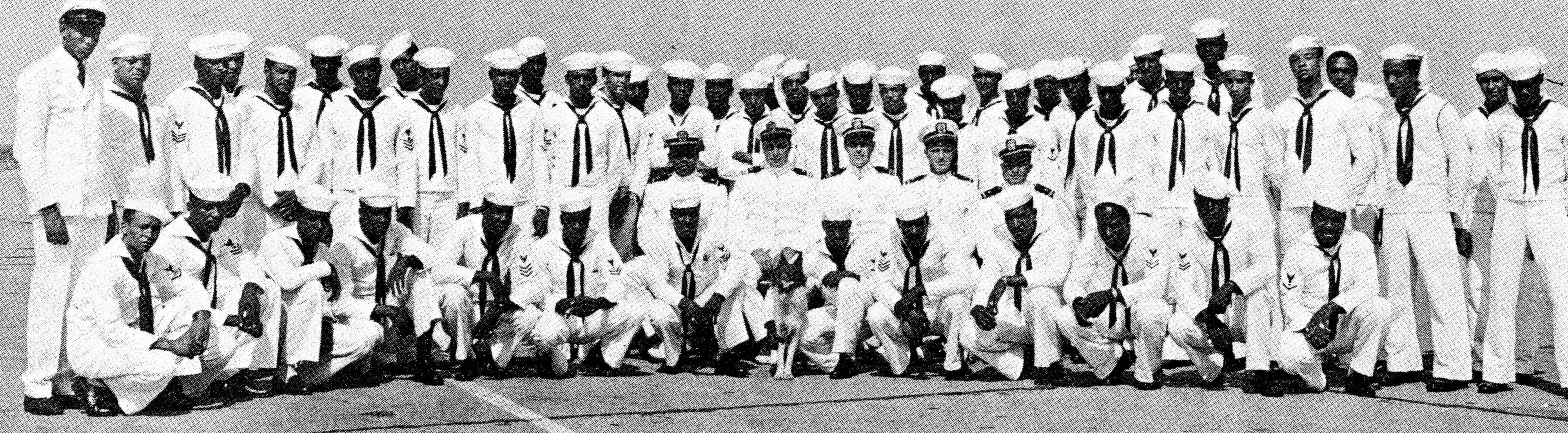
USS_PC-1264_officers_and_crew

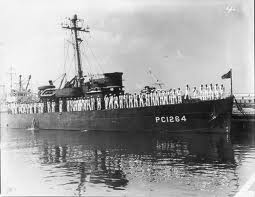
images-18

The USS PC-1264 and its crew, Gravely is the lone black officer

Gravely enlisted in the Navy under these conditions. Serving as a Fireman Apprentice after receiving training as a Motor Machinist in San Diego he worked in menial jobs. In 1943 Gravely was one of only three sailors in his unit to be selected for the V-12 officer training program. He was the only black to make the cut. He was commissioned as an Ensign on December 14th 1944 and assigned to train black recruits at Great Lakes though the vast majority of his class went to sea. The was mainly due to the policy set forth by the General Board in 1942 that prescribed:

“(a) the white man will not accept the negro in a position of authority over him; (b) the white man considers that he is of a superior race and will not admit the negro as an equal; and (c) the white man refuses to admit the negro to intimate family relationships leading to marriage. These concepts may not be truly democratic, but it is doubtful if the most ardent lovers of democracy will dispute them, particularly in regard to inter-marriage.”

Despite this by 1945 the Navy was beginning to change. Gravely was chosen to serve on one of two ships assigned to the “experiment” of seeing how blacks in general ratings could serve at sea. The USS Mason (DE 539) and the USS PC-1264 were assigned black crews with majority white officers, except that Gravely was assigned to PC-1264. Though his commander was pleased with his service Gravely, who had been denied admittance to Officer Clubs and many other “white only” facilities resigned from the Navy in 1946. He believed that the inherent discrimination of the Navy left him no place for advancement. He returned to complete his bachelors degree at Virginia Union.

In 1949, following President Truman’s integration of the military Gravely was asked by the Navy to return to active duty. But the end of the old order was foreshadowed by a Navy pamphlet published in 1944 entitled The Guide to the Command of Negro Personnel. That publication included the statement that ”The Navy accepts no theories of racial differences in inborn ability, but expects that every man wearing its uniform be trained and used in accordance with his maximum individual capacity determined on the basis of individual performance.”

images-17

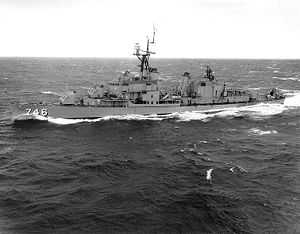
300px-USS_Taussig_(DD-746)_port_side_1965

cg29

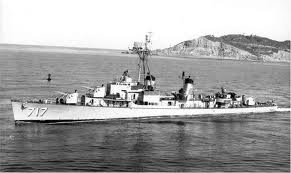
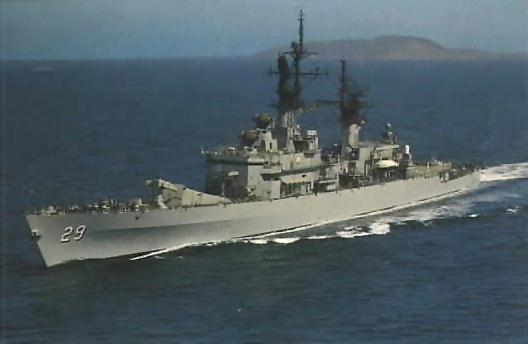
Gravely’s commands (top to bottom) USS Theodore E Chandler, USS Taussig and USS Jouett

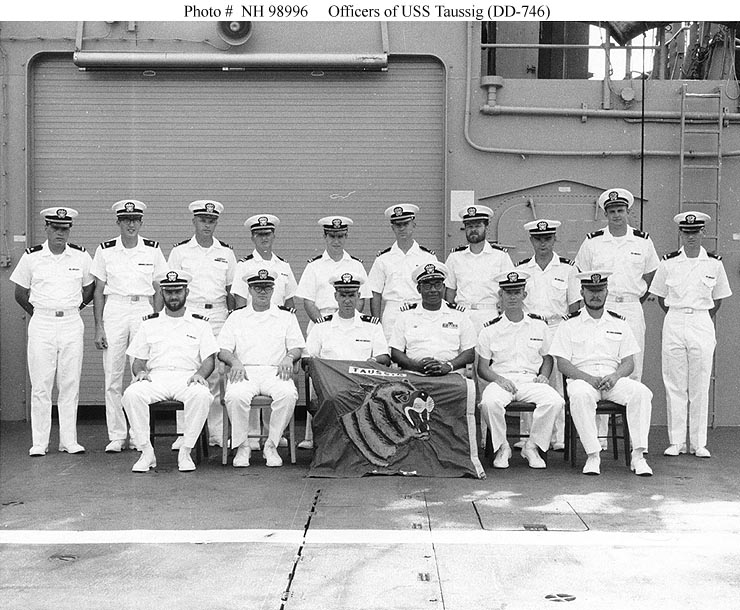
Gravely accepted the offer to return to active duty and never looked back. He worked hard for respect and used his natural talents, personality and size to command respect. He was a man who would blaze the way for other African Americans, and later women and most recently gays to go on to greater things. Gravely would go on to command three ships. He was the first African American Naval Officer to command a Navy warship, the USS Theodore E Chandler (DD 717), the first to command a Navy ship in combat, the USS Taussig (DD 746) and the first to command a major warship, the USS Jouett (CG 29). Promoted to flag rank he eventually became the first to command a Fleet when he took command of 3rd Fleet. He retired in 1980 and passed away in 2004.

h98996

Commander Gravely and his officers on USS Taussig

Gravely gave his parents and conditions of his upbringing much credit for his success. He believed that those conditions which forced him to “capitalize on his strong points, build his weak areas and sustain the positive self-esteem and self-worth that his parents instilled in him as a young child.”

He was a great leader. LCDR Desiree Linson who interviewed him for her Air Command and Staff College project noted that Gravely like many other great military leaders before him learned to manage the image that he presented, be a caretaker for his people, what we would now call a mentor. He said “[If I was CNO] my responsibility would be to make sure enlisted men and families were taken care of. I would do everything in my power to make sure.”

His pursuit of excellence, self confidence and mastery of professional skills empowered him in an institution where he was still an anomaly and where racism still existed. He believed in effective communication, especially verbal communication and in building teams and in being a good follower, listening, learning and proactively anticipating the needs of his superiors. Gravely was also a believer in personal morality and self discipline and preparedness. He said:

“I did everything I could think of to prepare myself. If the opportunity came, I would be prepared for it. [The question would not be] “Why didn’t you prepare for this opportunity.” I would be prepared for whatever opportunity that came. If it came, fine. If it did not, fine, but I would be prepared if it did come.”

USS_Gravely

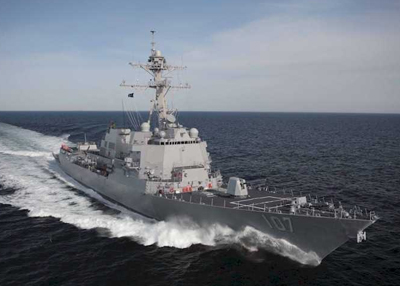
The USS Gravely

Vice Admiral Gravely blazed a trail for those that followed him and set an example for all Naval Officers to follow. He did it under conditions that most of us could not imagine. I am proud to serve in the Navy that he helped to make.  His vision, service and memory are carried on in this navy and in the ship that bears his name, the USS Gravely DDG-107.

Peace

Padre Steve+

3 Comments

Filed under History, laws and legislation, leadership, Military, Navy Ships, US Navy

Irrelevant Incidents and Un-winnable Wars: Thoughts on Returning from War 5 Years Later

6Fi9832

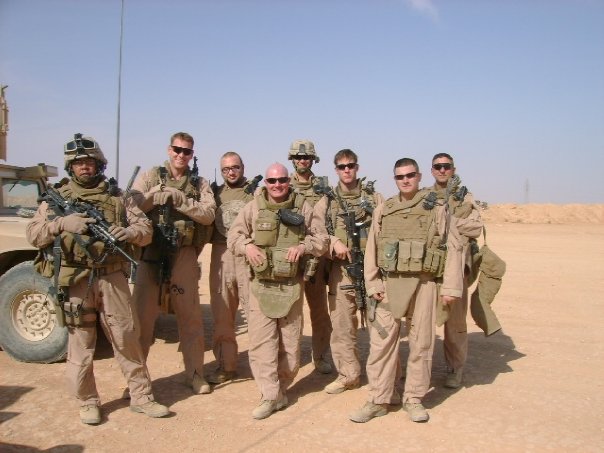
Just shy of five years ago in February 2008 I returned from Iraq after a tour with our advisors to the Iraqi Army and Security forces in the far reaches of Al Anbar Province. I flew back to the United States on a chartered flight with about 200 other men and women, individual augments from the US Navy who had served in Iraq and Afghanistan. We had a few days in Kuwait to “decompress” and then were on our way home. Those that conducted our training in that time had been in Kuwait, at large bases, separated from home but enjoying creature comforts that made it feel that we were in “Little America.”

Our aircraft stopped at Ramstein Air Base in Germany for a crew change and refueling. While there the aircraft was filled to its capacity with servicemen and their families returning from Germany to the United States. Crying babies and screaming kids greeted us as we boarded the aircraft. Most of us had not slept in the 24 hours before we left Kuwait and were exhausted. I was wearing my last serviceable uniform.

The remaining part of the flight from Germany to Philadelphia was difficult. The new arrivals were coming from a peacetime world and we were coming our of combat zones, often isolated even from other Americans. When we landed we went from our aircraft, got our civilian tickets, clad in our desert camouflage and dragging our gear we were made to removed our belts and boots by the TSA agents. It was obvious from we had come but instead of a welcome we we treated as potential hijackers. We each flew back to our respective bases on different flights into the arms of waiting families that loved us but did not understand us and units, who had not shared our experience simply sent us back to work without recognition while those that had not deployed griped about how hard things were.

FrenchForeignLegionaireVtNamDOD

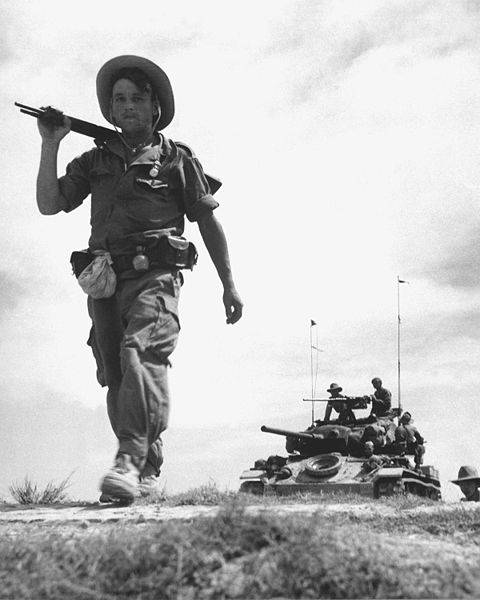
Today I was doing some counseling with a sailor and as we talked about life and the war a passage from Bernard Fall’s classic account of the French war in Indochina, Street Without Joy, came to mind. It reminded me of our experience returning from war, which could be seen as seemingly irrelevant incidents, but which pointed to a larger problem. It was so powerful that I decided to post much of it here.

In October 1953, Fall a journalist was covering the French war in Indochina. In between his stints with various French and allied units fighting the Viet Minh he made a travel stop over in Cambodia. He wrote of it:

“Sometimes, there occurs an almost irrelevant incident which, in the light of later developments, seems to have been a sign of the gods, a dreamlike warning which if heeded, could have changed fate- or so it seems.

One such incident occurred to me in October 1953 in Cambodia, at Siem-Reap, not far from the fabulous temples of Angkor-Wat…

A few French officers were still around, mainly as advisors to the newly-independent Cambodian Army….

When I went to the Transportation Office that afternoon at 1530, the Cambodian orderly told me apologetically that “le Lieutenant est alle au mess jouer au tennis avec le Capitaine” and that they might well stay there all afternoon. Since the convoy which I was expected to catch was supposed to leave at dawn, I decided to stroll over to the mess in order to get my travel documents signed there.

The Siem-Reap officers’ mess was a pleasant and well kept place; with its wide Cambodian-type verandahs, its parasol-shaded tables and the well-manicured lawns and beautifully red-sanded tennis court, it was an exact replica of all the other colonial officers’ messes from Port Said to Singapore, Saigon or even Manila, wherever the white man had set his foot in the course of building his ephemeral empires.

I found the two officers at the tennis court, in gleaming white French square-bottomed shorts…matching Lacoste tennis shirts and knee-long socks…

Since the men were in the midst of a set and I had little else to do, I set down at a neighboring table after a courteous bow to the ladies and watched the game, gladly enjoying the atmosphere of genteel civility and forgetting for a moment the war…

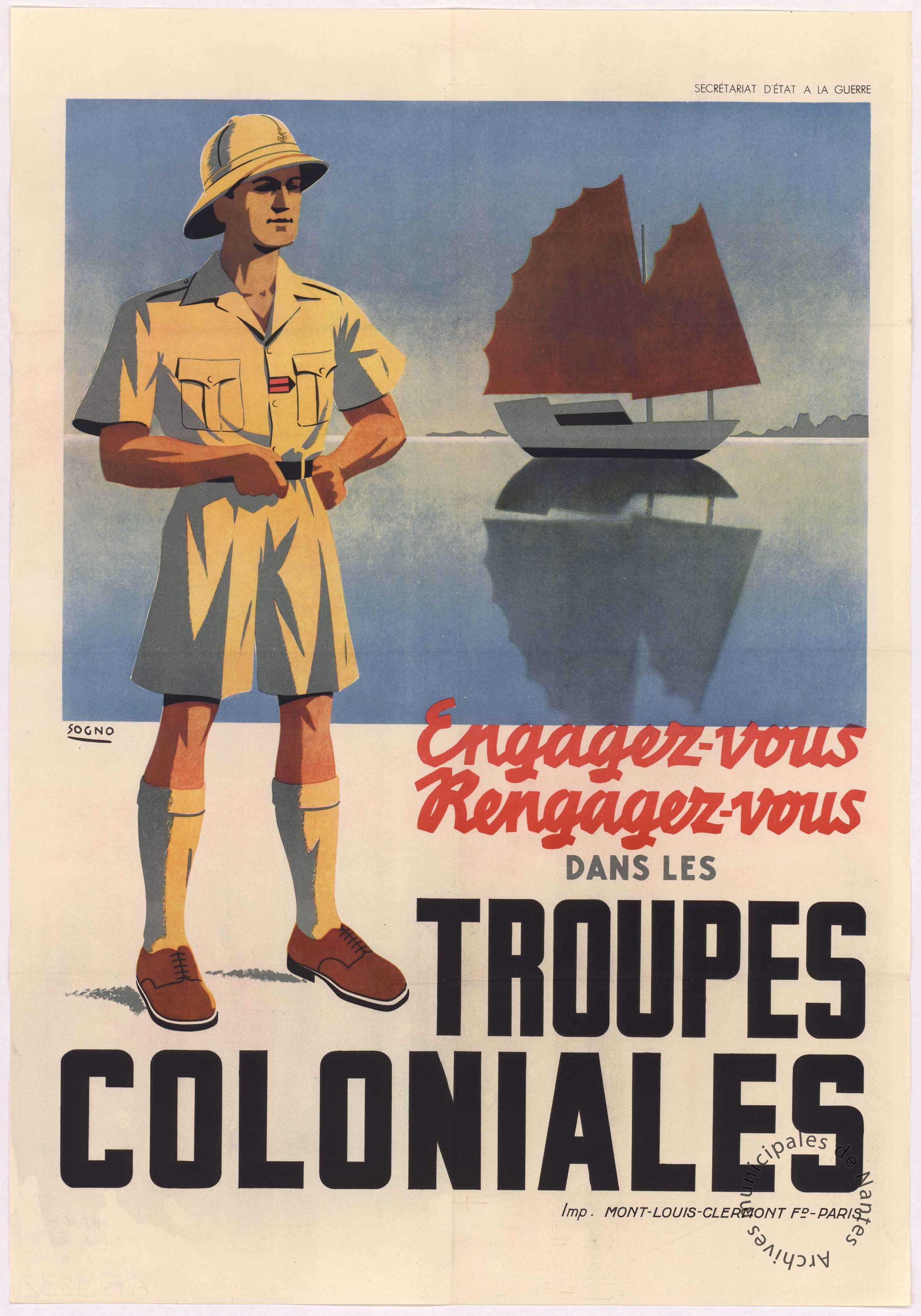
Then emerged from the verandah a soldier in French uniform. His small stature, brown skin and Western-type features showed him to be a Cambodian. He wore the blue field cap with the golden anchor of the Troupes Coloniales- the French “Marines”- and three golden chevrons of a master-sergeant. On his chest above the left breast of his suntan regulation shirt were three rows of multi-colored ribbons: croix de guerre with four citations, campaign ribbons with clasps of France’s every colonial campaign since the Moroccan pacification of 1926; the Italian campaign of 1943 and the drive to the Rhine of 1945. In his left hand, he carried several papers crossed diagonally with a tri-colored ribbon; travel orders, like mine, which also awaited the signature of one of the officers.

He maintained in the shadow of the verandah’s awnings until the officers interrupted their game and had joined the two women with their drinks, then strode over in a measured military step, came stiffly to attention in a military salute, and handed the orders for himself and his squad to the captain. The captain looked up in surprise, still with a half smile on his face from the remark made previously. His eyes opened suddenly as he understood that he was being interrupted. Obviously, he was annoyed but not really furious.

“Sergeant, you can see that I’m busy. Please wait until I have time to deal with your travel orders. Don’t worry. You will have them in time for the convoy.”

The sergeant stood stiffly at attention, some of his almost white hair glistening in the sun where it peeked from under the cap, his wizened face betraying no emotion whatsoever.

“A vous ordres, mon Capitaine.” A sharp salute, a snappy about face. The incident was closed, the officers had their drink and now resumed their game.

The sergeant resumed his watch near where the Cambodian messboys were following the game, but this time squatted down on his haunches, a favorite Cambodian position of repose which would leave most Europeans with partial paralysis for several hours afterwards. Almost without moving his head, he attentively followed the tennis game, his travel orders still tightly gripped in his left hand.

The sun began to set behind the trees of the garden and a slight cooling breeze rose from the nearby Lake Tonle-Sap, Cambodia’s inland sea. It was 1700.

All of a sudden, there rose from behind the trees, from the nearby French camp, the beautiful bell-clear sounds sounds of a bugle playing “lower the flag”- the signal, in which the French Army, marks the end of the working day as the colors are struck.

Nothing changed at the tennis court; the two officers continued to play their set, the women continued their chatter, and the messboys maintained their silent vigil.

Only the old sergeant moved. He was now standing stiffly at attention, his right hand raised to the cap in a flat-palmed salute of the French Army, facing in the direction from which the bugle tones came; saluting, as per regulations, France’s tricolor hidden behind the trees. The rays of the setting sun shone upon the immovable brown figure, catching the gold of the anchor and of the chevrons and one of the tiny metal stars of his ribbons.

Something very warm welled up in me. I felt like running over to the little Cambodian who had spent all of his life fighting for my country, and apologizing to him for my countrymen here who didn’t care about him, and for my countrymen in France who didn’t even care about their countrymen fighting in Indochina…

And in one single blinding flash, I knew that we were going to lose the war.”

Bernard Fall, Street Without Joy, Fourth edition, May 1967, Stackpole Books Harrisburg PA, pp. 291-294

481801_10151367001287059_1003164983_n

I hadn’t thought about the passage in a long time, until it came to me today. When I read it I began to understand the feelings that I had in 2008 but could not comprehend. The fact is that a very few men and women, a small segment of the population, less than one half of one percent of Americans have been fighting the wars in Iraq, Afghanistan while the rest of the country, even parts of the military have been on the sidelines.

I realized when I came home that those that crammed the families from Germany onto our plane to save a few dollars, the TSA airport security agents and some of those in the units that we returned to didn’t understand. In fact it was as if they were not at war. I think I began to realize at that point that no matter how ardently that some of us served that our sacrifices would not produce the planned intent of those that sent us to war. I knew at that point, but couldn’t quite put my finger on it that we could not win this war. A war that only a portion of the military, was fighting while the bulk of the population lived in peace without any “skin in the game.”

We are so much like the French, the British and every other colonial or imperial power that it is frightening. We claim not to be an empire but we act like empires have throughout history. We place our footprint large of the globe, creating bastions of American culture in the midst of lands far different than us. Then we send a small percentage of our people to fight the wars that our nation’s leaders as well American and multinational businesses deem to be in our national interest, especially natural resources and commerce.

n671902058_1153793_4043

As the expeditionary forces fight the wars the bulk of the public is shielded from the horror of it. Many people are sympathetic to the war fighters but because they have not served are ignorant of what we face. Beguiled by the slick, high tech media presentations in the news and entertainment industry of war; they do not understand the cost. The representations in the media make war another spectator sport. At least the news no longer shows a nightly “body count” as was done in Vietnam.

Marine Major General Smedley Butler, a man awarded the Congressional Medal of Honor twice wrote shortly after his retirement in 1932:

“What is the cost of war? what is the bill? Major General Smedley Butler wrote: “This bill renders a horrible accounting. Newly placed gravestones. Mangled bodies. Shattered minds. Broken hearts and homes. Economic instability. Depression and all of its attendant miseries. Back -breaking taxation for generations and generations. For a great many years as a soldier I had a suspicion that war was a racket; not only until I retired to civilian life did I fully realize it….”

It is amazing what going to war will do to you. This is especially true when you can recognize what too few people see or even want to even think about. But then why should we expect anything different? There was no national call to arms after 9-11-2001 and our leaders told the people to do what they normally would do, and most importantly to “go shopping.”

Pray for Peace,

Padre Steve+

4 Comments

Filed under iraq,afghanistan, middle east, Military, national security, News and current events, Tour in Iraq

Transitions in the Military: New Assignments

NDU-JFSC-campus

In the Navy, as well as most military branches in the United States the officer community regardless of their specialty have branch, corps or specialty managers. These men and women work with the services and the individual officers to fill assignments. In the Navy these men and women are called “Detailers” and the process of assignments called detailing.

This afternoon I received a call from my detailer. I am coming up on my “projected Rotation Date” or PRD in October and have been negotiating for orders. The process was disrupted by some other changes in the system and I have been waiting a bit longer than normal to find out what I would be doing next.

In my last two assignments I had no choice. In 2006 the assignment that I thought I had was changed and in 2008 I was requested by name for an assignment at Naval Medical Center Portsmouth and in 2010, a year before I expected to rotate and less than a week after I had been selected for promotion to the rank of Commander I was informed that I would be assigned as the Command Chaplain at the Naval Hospital Camp Lejeune North Carolina. I have now completed most of that tour and was awaiting word.

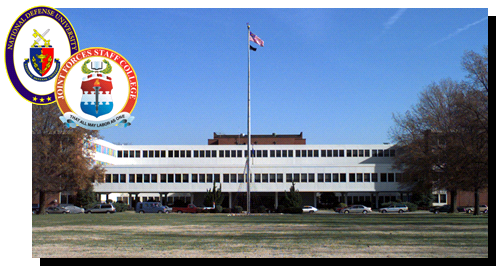
What I wanted to do was to teach and be the Chaplain at the Joint Forces Staff college in Norfolk. It has been an assignment that I have wanted for a number of years. It combines being an instructor in Ethics for students from the Army, Navy, Marines, Air Force, Coast Guard and foreign officers attending the courses at the college, as well as having chapel responsibilities. However I was told a couple of months ago that the assignment was going to another chaplain. I was disappointed because it was a billet that I thought that I was uniquely qualified.

I had spent 17 1/2 years in the Army, been a company commander as well as battalion, group and brigade staff officer before becoming a chaplain. Additionally my military and civilian education which include the Marine Corps Command and Staff College and a Masters Degree in military history and some rather unusual assignments including a joint tour in Iraq as chaplain to American advisors in Al Anbar province as a member of the Iraq Assistance Group, made me, at least in my opinion an ideal choice.

However as of a couple of months ago the billet was already filled. Thus I had no idea what assignment that I would get and since there were very few assignments available in my detailing “window.”

I was expecting a call in the next week or so, but I did not expect the detailer to tell me that I would get the Joint Forces Staff College job. I am happy to get it. It will mean that I will return to the Norfolk area in the September-October time frame. The position will allow me to teach in a very interesting setting as well as pastor the chapel congregation.   It will also allow me to continue my academic education and writing. It will also allow me to be at home after a three year tour away from my wife Judy. For that I am most grateful.

Since it is a non-deploying billet it probably will not help my chances too much to make Captain in a view years, but that is not my goal. My goal is to be at the place where I can do the most good, take advantage of my skills and experience and which will challenge me to continue to grow as a human being, priest, chaplain and Naval officer.

It is good news and I am happy that the detailers and senior leadership honored my request for the assignment. The timing allows me to finish well where I currently serve and contribute the the continuing mission of healing the minds, bodies and spirits of Marines and Sailors, including those wounded, ill or injured in war at Camp LeJeune.

It is a good day.

Peace

Padre Steve+

4 Comments

Filed under Military, US Navy

349: Active Duty Military Suicides Hit New High in 2012

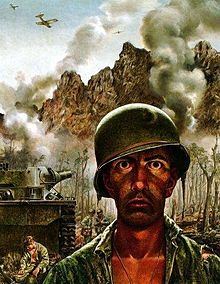
220px-Tom_Lea_-_2000_Yard_Stare

The 2000 Yard Stare by Thomas Lea

The Defense Department released the numbers for what Secretary of Defense Leon Panetta has described as “epidemic” of military suicides. The total of 349 active duty personnel includes 182 Soldiers, 48 Marines, 59 Airmen and 60 Sailors. It does not include Coast Guard personnel. The last statistics for that service showed 5 active duty suicides for 2012 as of mid-August, the service had only seen 6 in 2011.

As of November there were 124 Army Reserve and National Guard suicides not on active duty, 6 Naval Reservists. I have not been able to find the data for Air Force Reserve and National Guard or the Marine Corps Reserve.  The reserve figures are of drilling reservists not of those in the Individual Ready Reserve (inactive reserve) who do not attend drill but have served their obligated active time and can be recalled to active duty until the end of their service obligation.

The Veterans Administration estimates that nearly 6,500 veterans take their lives yearly. The numbers include veterans of all wars not just those of Iraq and Afghanistan nor are they complete because sometimes death certificates do not record a veteran’s service.

It is growing problem that unfortunately will not get any better anytime soon. Part of the issue is that despite service attempts to change the culture there is still a stigma attached to those that seek mental health care. There are other reasons that factor into the equation, deployments, high operational tempo, lack of enough mental health care providers to meet the demands as well as the effects of combat stress injuries, PTSD,

Traumatic Brain Injury as well as what is now called “moral injury. One definition of Moral Injury “the lasting psychological, biological, spiritual, behavioral, and social impact of perpetrating, failing to prevent, or bearing witness to acts that transgress deeply held moral beliefs and expectations.” 

Marine Corps Major General Smedley Butler who was awarded the Congressional Medal of Honor twice wrote a moving of those afflicted with what we now call Moral Injury after World War One:  “Boys with a normal viewpoint were taken out of the fields and offices and factories and classrooms and put into the ranks. They were remolded; they were made over; they were made to “about face”; to regard murder as the order of the day. They were put shoulder to shoulder and through mass psychology, they were entirely changed. We used them for a couple of years and trained them to think of nothing but killing and being killed.

The effects are as chilling now as they were in Butler’s day when he wrote:

“These have already been mentally destroyed. These boys don’t even look like human beings. Oh, the looks on their faces! Physically they are in good shape but mentally they are gone….There are thousands and thousands of these cases and more and more are coming in all the time…”

I know. I see it every day but I see it in a number of ways. I see it in the faces of the Marines and Sailors going back and forth between Afghanistan, Iraq and now North Africa and also among those in the medical, mental health and chaplain services that care for these men and women.

Provider burnout, including suicide is a problem. Just recently a former Army Psychologist who had served in Iraq during the surge and had been treating veterans in the VA committed suicide. Less than two years ago, this man was the lead author of a article that dealt with burnout and suicide of caregivers. Peter Linnerooth who was awarded the Bronze Star in Iraq committed suicide on January 2nd 2013. His widow, also a mental health professional commented:

“He was really, really suffering…And it didn’t matter that he was a mental health professional, and it didn’t matter that I was a mental health professional. I couldn’t help him, and he couldn’t help himself.”

Linnerooth’s faculty advisor commented: “When he went in and when he came out, it was shockingly different…”

That was a problem then and it is a problem now. The thing is that these active duty 349 men and women, as well as the others I have mentioned where the numbers are not well defined are not just numbers. They are people. Real men and women, sons and daughters, husbands and wives, fathers and mothers. Their deaths at their own hand are more than the combat deaths in Afghanistan this year.

Dr Larry Shellito the Commissioner for Veterans Affairs in Minnesota said something that is dead on:

“Oftentimes, you have to look at the people that surround the people with (PTSD) to make sure they are also OK, because it’s got a multiple impact…It’s not just the individual who suffers, it’s the people who care for him.”

I see it all the time. Butler’s description of the men who served in the trenches that were in veterans hospitals and facilities nearly 20 years after the war ended are as true today as they were then. Ask any caregiver in the service or in the VA system and they will tell you how overwhelming this epidemic is.

It cannot be wished away and assuaged by people simply doing the bumper sticker “I support the troops” thing without looking deeply at what is causing this and investing in the lives of these men and women before their lives are completely destroyed. It also means that politicians and their think tank and media advisors who constantly beat the drums of war, without fully funding it and without caring for those that are sent to fight them must be held accountable by voters.

I know how this is on a real live up close personal basis as a chaplain. I went to Iraq and came back changed. The PTSD, depression, anxiety and hopelessness that I felt were overwhelming. Thankfully I am doing a lot better and I did get the therapy and assistance needed, but it took a while to get it and thankfully at my present command I had people that I worked with help me get the help that I needed. But I have been back almost five years. A lot of that time was spent in the wilderness wondering if there was hope, if I would ever get better and sometimes wondering if God even existed and if he did, did he care. During the whole time I continued to work with and care for others like me. Their injury also impacted me in ways that I could not imagine before I was afflicted.

I care about this issue, because it affects those that I serve as well as their families, communities and those that serve with them. 349 active duty suicides. Think about it. One is too many. 349 is inexcusable and that does not count all those that we cannot count because we don’t know the numbers or the full story.

349: Keep that number in your mind and do something about it.

Peace

Padre Steve+

4 Comments

Filed under healthcare, Military, Pastoral Care, PTSD

The Loss of an Icon: General Norman Schwarzkopf dies at 79

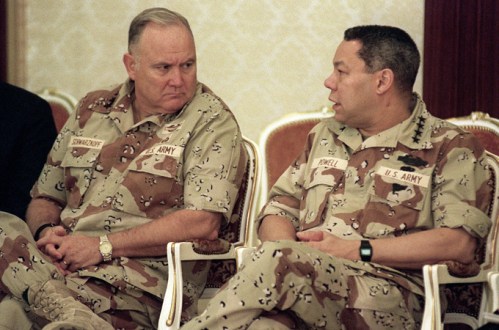
201212281047938734_20

Schwarzkopf and Powell, the Eisenhower and Marshall of their Era

“Do what is right, not what you think the high headquarters wants or what you think will make you look good.” 

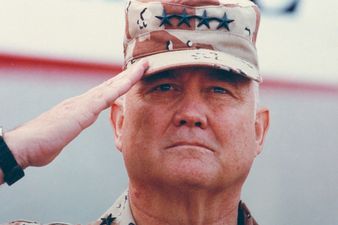
Americans lost a military hero and an icon yesterday. General Norman Schwarzkopf died in Tampa at the age of 79 due to complications of pneumonia.

Schwarzkopf was one of the most brilliant commanders of his era, a multi-dimensional character who was to many of us bigger than life.

Schwarzkopf was the quintessential Army Brat, growing up on military bases in the United States as well as in diplomatic posts overseas. The son of General he graduated from West Point, was commissioned as an infantry officer, became a paratrooper at Fort Campbell Kentucky before being assigned to the Berlin Brigade, a post he left just prior to the erection of the Berlin Wall by the Soviets and the East Germans. He completed a Masters degree in Mechanical Engineering from USC and was assigned as an instructor at West Point.

sch0-008a

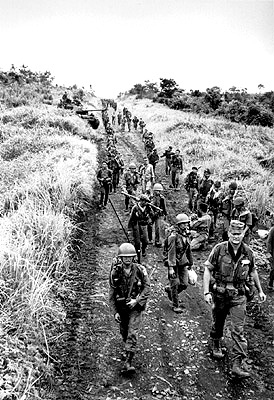
Schwarzkopf helping to carry a wounded South Vietnamese Paratrooper 

During that tour he volunteered to serve as an advisor with South Vietnamese paratroopers.  After that tour and the completion of his tour at West Point he was promote to Lieutenant Colonel and commanded the 1st Battalion 6th Infantry, 198th Brigade and was wounded while with his troops and who in the crisis kept his head and helped lead his troops, though seriously wounded out of the trap. He was known with affection by many soldiers as “the Bear,” a moniker that he appreciated much more than Desert Storm media nickname of “Stormin’ Norman.”

sch0-017

Schwarzkopf with ARVN Paratroops

It was during his time in Vietnam that Schwarzkopf came to a realization about men at war and his own personality. “I prided myself on being unflappable even in the most chaotic of circumstances,…That guise lasted until Vietnam, where I realized that I was dealing with human lives and if one were lost, it could never be replaced. I quickly learned that there was nothing wrong with being emotional.”

sch0-007a

Following his time in Vietnam he remained in the Army to help be a part of its rebuilding as an All Volunteer force. By the late 1970s he had served as a Brigade commander in the 9th Infantry Division and Assistant Division Commander in the 8th Infantry Division before taking command of the 24th Infantry Division in late 1982. He was appointed the Deputy Commander for the Joint Task Force that invaded Grenada in 1983 and in 1988 was appointed Commander for the US Central Command.

1general122812

It was in this capacity that he took command of US and coalition troops gathering to respond to Saddam Hussain’s invasion of Kuwait in August 1981. His leaders and planning cells helped engineer a military campaign in conjunction with the admirable skill of President George H.W. Bush and his diplomats the successful expulsion and destruction of Saddam’s forces. While some criticize the decision not to continue the war and go on to Baghdad Schwarzkopf made a comment that those that invaded Iraq in 2003 might well have better heeded: had “we taken all of Iraq, we would have been like a dinosaur in the tar pit — we would still be there, and we, not the United Nations, would be bearing the costs of that occupation.”

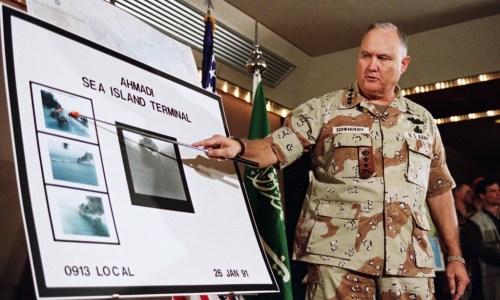
20436634_BG1

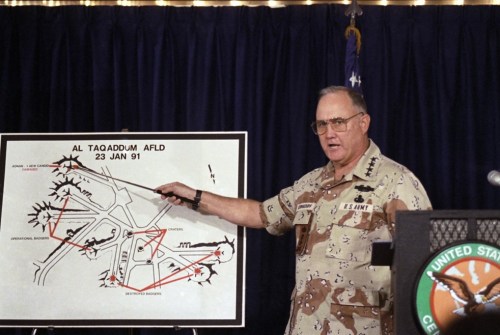
Schwarzkopf’s Briefings

After his retirement he was active in supporting cancer research programs, efforts to save the Grizzly Bear and was a military commentator and analyst for NBC. Although he supported the invasion of Iraq in 2003 he asked questions that few were asking. In early 2003 he told the Washington Post: “What is postwar Iraq going to look like, with the Kurds and the Sunnis and the Shiites? That’s a huge question, to my mind. It really should be part of the overall campaign plan.”  Following the invasion and the beginning of the insurgency he became a critic of the operation. He was particularly critical of Defense Secretary Donald Rumsfeld for not anticipating the consequences of the invasion and for Rumsfeld’s criticism of the Army and the deployment of reserve component troops into urban combat who did not have the correct training or equipment for the job. He also made another observation that few noted about Rumsfeld and much of the Pentagon staff and the Bush Administration appointees in Iraq, in that they “showed a total lack of understanding of the culture that we were dealing with.” 

Schwarzkopf was an original and though he was loathe to admit it a hero. He also knew that life was bigger than the military and that one has to be more than the sum of their career. He once told the Associated Press: “I may have made my reputation as a general in the Army and I’m very proud of that… “But I’ve always felt that I was more than one-dimensional. I’d like to think I’m a caring human being. … It’s nice to feel that you have a purpose.”

ip8CXZqG.OL8

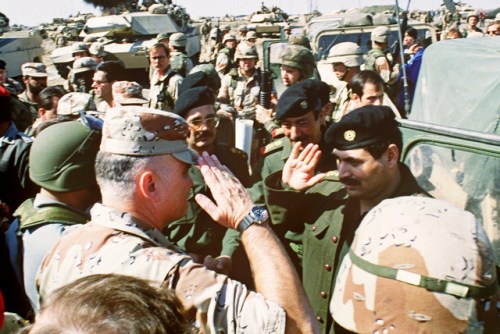
Schwarzkopf with Iraqi Generals at Cease Fire

Though I never served under his command while in the Army I knew many friends that did and my early career was shaped and molded by men life him.  He was not a perfect commander, analysis of his command in the Gulf show that he did make some mistakes, the greatest and most long lasting being the concession to allow the defeated Iraqi forces the use of helicopters which they used with great effect against the Shi’a tribes near Basra that sought independence.

However, in my mind it was Schwarzkopf’s public leadership that helped inspire his troops and encourage the nation which until that point had not recovered from all of the effects of the Vietnam War.  His briefings inspired confidence in America and with our Allies. He was as much of a diplomat in figuring out how to employ over 700,000 troops, military forces of 32 nation coalition, including numerous large Arab countries in a successful war.

Schwarzkopf also understood the full gravity of war and its effects on nations and people. He said: “I hate war. Absolutely, I hate war…Good generalship is a realization that … you’ve got to try and figure out how to accomplish your mission with a minimum loss of human life.”

He is remembered well. General Colin Powell who served as the Chairman of the Joint Chiefs during Desert Storm remarked after Schwarzkopf’s death “His leadership not only inspired his troops, but also inspired the nation. He was a good friend of mine, a close buddy. I will miss him.” From his hospital bed former President George H W Bush issued a statement saying that Schwarzkopf: “epitomized the ‘duty, service, country’ creed that has defended our freedom and seen this great nation through our most trying international crises….More than that, he was a good and decent man — and a dear friend.”  President Barak Obama praised him saying that “He was an American original” and “From his decorated service in Vietnam to the historic liberation of Kuwait and his leadership of United States Central Command, General Schwarzkopf stood tall for the country and Army he loved…”

Norman+Schwarzkopf+

Rest in Peace General, Rest in Peace,

Peace

Padre Steve+

2 Comments

Filed under History, iraq,afghanistan, leadership, middle east, Military, News and current events, vietnam

Remembering the Battle of the Bulge and the Campaign in France

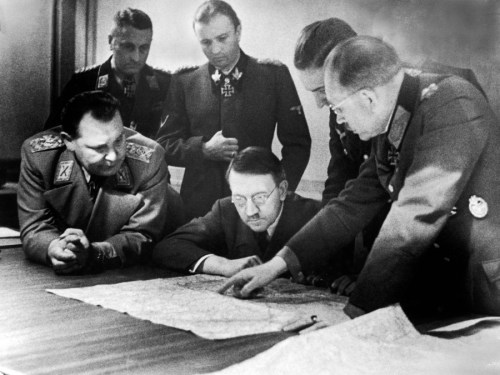
Hitler's General Staff Reviews Plans

Adolf Hitler gathered with the Chiefs of Oberkommando des Wehrmachton September 16th 1944 at his “Wolf’s Lair” headquarters in East Prussia.  The situation was critical; he had recently survived an assassination attempt by Army officers led by Colonel Klaus Von Staufenberg at his Wolf’s Lair headquarters in East Prussia.  When the assassination attempt took place the German situation in Normandy was critical. The Americans broke out of the Bocage at St. Lo and spread out across Brittany and the interior of France with Patton’s 3rd Army leading the way.  Even as his commanders in the West pleaded for permission to withdraw to the Seine Hitler forbade withdraw and ordered a counter attack at Mortain to try to close the gap in the German line and isolate American forces. When the German offensive failed the German front collapsed. 40,000 troops, hundreds of tanks and thousands of vehicles were eliminated when the Americans and Canadians closed the Falaise pocket. Despite this cadres of decimated divisions including SS Panzer, Army Panzer and elite Paratroops made their way out of Normandy.  With the Germans in full retreat the Allies advanced to the border of the Reich itself. On the Eastern Front as well disaster threatened when the Red Army launched an offensive which annihilated Army Group Center and advanced to the border of Poland before outrunning supply lines and stalling on the Vistula.

tiger2_in_action-bulge

Tiger II

  Since Normandy Hitler had wanted to counter attack but had neither the forces nor the opportunity to strike the Allied armies. As the Allied offensive ground to a halt due to combat losses, lack of supplies and stiffening German resistance Hitler maintained a close eye on the situation in the West.  He believed that despite their success that the Americans and British alliance was weak and that a decisive blow could cause one or both to drop out of the war. During a briefing an officer noted the events of the day on the Western Front including a minor counterattack by kampfgrüppen of the 2nd SS Panzer and the 2nd Panzer Divisions which had made minor gains in the Ardennes, Hitler rose from his seat ““Stop!” He exclaimed. “I have come to a momentous decision. I shall go over to the counterattack….Out of the Ardennes, with the objective Antwerp.””[i]
indexb_10a

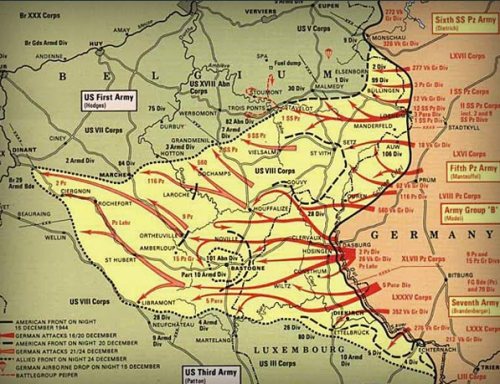
            Thus began the planning for the last great German offensive of WWII.  Hitler “believed that sufficient damage could be inflicted to fracture the Anglo-American alliance, buy time to strike anew against the Soviets, and allow his swelling arsenal of V-weapons to change the course of the war.”[ii]  It was a course of born of desperation, even admitted by Hitler in his briefings to assembled commanders in the week prior to the offensive, one officer noted his remarks: “Gentlemen, if our breakthrough via Liege to Antwerp is not successful, we will be approaching an end to the war which will be extremely bloody. Time is not working for us, but against us. This is really the last opportunity to turn the war in our favor.”[iii]

us-at-gun-bulge

US 57mm Anti-Tank Gun and Crew

             Despite shortages of men and equipment, continuous Allied assaults and over the objections of General Guderian who argued to reinforce the Eastern Front[iv], the OKW staff secretly developed detailed plans. The planning was so secretive that the “Commander in Chief West and the other senior commanders destined to carry out the attack were not informed.”[v] The plans were submitted to Hitler on October 9th [vi] and presented to Field Marshalls Von Rundstedt and Model at the End of October. General Hasso Von Manteuffel, commander of 5th Panzer Army commented that: “The plan for the Ardennes offensive…drawn up completely by O.K.W. and sent to us as a cut and dried “Führer order.”[vii]
24-1

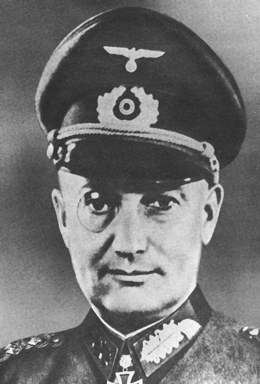
Field Marshal Walter Model Commander Army Group B

          Model and Von Rundstedt also objected to the scope of the attack. Von Rundstedt stated: “I was staggered…It was obvious to me that the available forces were way too small for such an extremely ambitious plan. Model took the same view of it as I did….”[viii]  Model reportedly said to General Hans Krebs: “This plan hasn’t got a damned leg to stand on.”[ix] And “you can tell your Führer from me, that Model won’t have any part of it.”[x] Sepp Dietrich, the old SS fighter and commander of 6th Panzer Army expressed similar sentiments.[xi]  Despite the objections by so many senior commanders Hitler scorned Model’s attempt to float a less ambitious plan to reduce the Allied salient at Aachen. Likewise Von Rundstedt’s desire to remain of the defense and wait for the Allies to attack using the armored forces to launch against any breakthrough was rejected.[xii] Hitler’s mind was set and the preparations moved forward.  The plan was complete down to the timing of the artillery bombardment and axes of advance, and “endorsed in the Führer’s own handwriting “not to be altered.””[xiii] Such a plan flew in the face of the well established doctrine of theAuftragstaktik which gave commanders at all levels the freedom of action to develop the battle as the situation allowed and opportunities arose.

sepp20dietrich

SS General Sepp Dietrich, Commander of 6th Panzer Army 

              The Germans who the Allies presumed to be at the brink of collapse made a miraculous  recovery following their ghastly losses in Normandy. Kampfgrüppenand remnants of divisions bled the Americans White at the Huertgen Forrest and blunted the British attempt to leapfrog the Northern Rhine at Arnhem decimating the British First Airborne division and causing heavy casualties among other British and American units. The German 15th Army avoided disaster when the British failed to close their escape route from Walchern island allowing 60,000 troops and much equipment to escape.   

ManteuffelGeneral Hasso von Manteuffel Commander 5th Panzer Army

         The Germans also re-formed and reorganized the front.  They pulled back many units of the 5th and 6th Panzer Armies for re-fitting and diverted nearly all tank, armored fighting vehicle and artillery production to the West at the expense of the Eastern Front.  The Germans called up 17 year olds and transferred young fit personnel from the Navy and Luftwaffe to the Army and Waffen SS.  Here they were trained by experienced NCOs and officers and brought into veteran units alongside hardened veterans who showed taught them the lessons of 5 years of war.[xiv]  However the rapid influx of new personnel meant that they could not be assimilated as quickly as needed and thus many were not as well trained as they might have been with more time.[xv] Many infantry and Parachute units had received inexperienced officers, taken from garrison duty to fill key positions a problem that would show up during the offensive.[xvi]

pzkw-iv-bulge

Panzer IV Ausf H of an SS Panzer Divsion in the Bulge

The Germans were aided by the caution displayed by the Allies throughout the campaign in France which allowed the Germans to reconstitute formations around veteran headquarters staffs.[xvii]  The Germans built up the 5th and 6thPanzer Armies as the Schwerpunkt of the offensive giving them the lion’s share of reinforcements and pulling them out of the line during the fall battles along the Seigfried line and in the Alsace and Lorraine.  The plan was for the two Panzer armies and 7th Army to punch through the Ardennes, cross the Meuse, drive across Belgium, capture Antwerp and severe the link between the British and the Americans.

The spearhead of the German assault was 6th Panzer Army Commanded by SS General Sepp Dietrich. It was composed of 1st and 2nd SS Panzer Corps and Army’s LXVII Corps.  The 6th SS Panzer Army included some of the best formations available to the German Army at this late stage of the war including the 1st  SS Panzer Division, the Leibstandarte Adolf Hitler, the 2nd  SS Panzer Division Das Reich, the 9th SS Panzer Division Hohenstaufen and the12th  SS Panzer Division Hitler Jügend. It’s ranks were filled out by the 3rd Parachute Division, the 501st SS Heavy Tank Battalion (attached to 1st SS), the 3rd Panzer Grenadier Division and the 12th, 246th, 272nd, 277th and 326th Volksgrenadier or Infantry divisions. The 6th Panzer Army would be the northern thrust of the offensive and its ultimate objective was Antwerp.  The 6th Panzer Army would be aided by a hastily organized parachute battalion under Colonel Von Der Heydte[xviii] and the 150thPanzer Brigade under SS Colonel Otto Skorzeny which included teams of American dialect speaking soldiers in American uniforms and equipment that were to spread confusion and panic in American rear areas.[xix]

bradleyeisenhowerpatton20a20bastogne

Bradley, Eisenhower and Patton at Bastogne

          To the south was the 5th Panzer Army commanded by General Hasso Von Manteuffel.  The 5th Panzer Army was to advance alongside of the 6th Panzer Army with Brussels as its objective.  Composed of the XLVII and LVIII Panzer Corps and LXVI Corps the major subordinate commands included the best of the Army Panzer divisions including the 2nd Panzer, Panzer Lehr, 9th and the16thPanzer division. It also had the elite Führer Begleit Brigade composed of troops from Panzer Corps Grossdeutschland and commanded by Otto Remer who had help crush the coup against Hitler in July.  The 5th Panzer Army also included the 18th, 26th, 62nd, 560th and later the 167th Volksgrenadier divisions.
bulge1

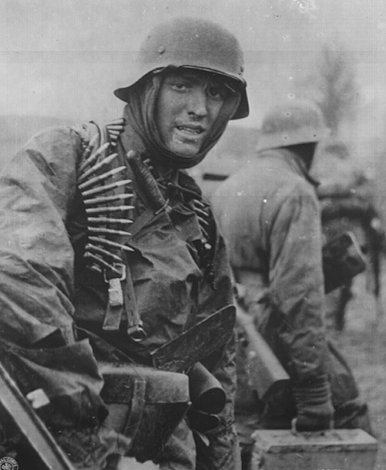
German Panzer Grenadier 

The south flank was guarded by 7th Army commanded by General Erich Brandenburger composed of LIII, LXXX and LXXXV Corps.  It included theFührer Grenadier Brigade and later the 15th Panzergrenadier division.  It was the weakest of the three armies but eventually included 6Volksgrenadier divisions of varying quality and strength[xx] and the veteran 5th Parachute division.[xxi]  However with only 4 divisions at the start of the offensive the 7th Army was the equivalent of a reinforced corps.

bulge-jeep

While this force seemed formidable it had a number of weaknesses beginning with tank strength.  The 1st and 12th SS Panzer divisions were only at approximately half their established tank strengths and faced severe shortages in other vehicles.[xxii]  2nd SS and 9th SS of II SS Panzer Corps reported similar shortages.[xxiii]The shortage of other motorized vehicles, even in Panzer divisions was acute.  “Even the best equipped divisions had no more than 80 percent of the vehicles called for under their tables of equipment, and one Panzergrenadier division had sixty different types of motor vehicles, a logistician’s nightmare.[xxiv] Panzer Lehr was so short in armored half tracks that only one battalion of its Panzer Grenadiers could be transported in them while others had to use “trucks or bicycles.”[xxv]

Limitations on equipment as well as fuel were not the only challenges that the Germans faced. The US V Corps launched an attack on the Roer River Dams just before the offensive making it necessary for the Germans to divert 6th SS Panzer Army infantry divisions and Jagdpanzer units to be used by 6th SS Panzer Army.  One regiment of 3rd Parachute Division and over half of a second division could not take part in the initial 6th Panzer Army attack. Likewise some Jagdpanzer andSturmgeschutzen units did not arrive until three days after the offensive began.[xxvi]

The Allies Before the Battle

            While the German commanders sought to implement Hitler’s plan Allied commanders looked only to completing the destruction of Germany not believing the Germans capable of any major operation.  The Allied commanders with the exception of Patton did not believe the Germans capable of any more than local counter attacks.  Patton’s 3rd Army G-2 Colonel Koch was the only intelligence officer to credit the Germans with the ability to attack.[xxvii]  Most allied commanders and intelligence officers discounted the German ability to recover from disastrous losses, something that they should have learned in Holland or learned from the Soviet experiences on the Eastern front.  Bradley noted in his memoirs hat “I had greatly underestimated the enemy’s offensive capabilities.”[xxviii]  Carlo D’Este noted that “there was another basic reason why the Allies were about to be caught with their pants down: “Everyone at SHAEF was thinking offensively, about what they could do to the enemy, and never about what the enemy might do to them.””[xxix]   This mindset was amazing due to the amount of intelligence from Ultra and reports from frontline units that major German forces were no longer in the line.[xxx] Additionally nearly all commentators note that American units in the Ardennes did not conduct aggressive patrols to keep the enemy off balance and obtain intelligence.[xxxi]  One describes the efforts of 106th Division as “lackadaisical” and notes that enemy before the offensive was not the Germans but the cold.[xxxii] Max Hastings noted that: “the Allies’ failure to anticipate Hitler’s assault was the most notorious intelligence disaster of the war.”[xxxiii]

408

Tanks of US 7th Armored Division near St Vith

            The Allies also were in the midst of a manpower crisis. Eisenhower did not have enough divisions to establish a clear manpower advantage as “there were not enough Anglo-American divisions, or enough replacements for casualties in the existing divisions.”[xxxiv]  No more American Infantry divisions were available as the Army had been capped at 90 divisions and infantry replacements were in short supply.  This shortage meant that Eisenhower could not pull divisions out of line to rest and refit. He could only transfer divisions such as the 4th and 28thInfantry divisions to the relative quiet of the Ardennes. He had no ability to “create a strategic reserve unless he abandoned the broad front strategy.”[xxxv]The Germans knew of the allied weakness and believed that they could achieve local superiority even if they did not believe they could reach Antwerp. Model believed that “he was sure that he would reach the Meuse in strength before the Americans could move sufficient reserves to halt his armies or even head them off.”[xxxvi]

American Response: The Breakthrough

            The German assault began on December 16th. Some breakthroughs were made especially in the vicinity of the Losheim Gap and the Schnee Eifel by the southern elements of 6th Panzer Army and Manteuffel’s 5th Panzer Army. However the Germans could not break through around Monschau and Elsenborn Ridge held by the inexperienced but well trained 99th Infantry division and elements of the veteran 2nd “Indianhead” Division.  In the far south near Diekirch the 4th Infantry Division held stubbornly against the attacks of 7th Army’sVolksgrenadiers. The Germans achieved their greatest success at Losheim where SS Colonel Josef Peiper and his 1st SS Panzer Regiment had driven off the US 14thCavalry Group and penetrated 6 miles into the American front.  5th Panzer Army made several breakthroughs and isolated two regiments of newly arrived 106thInfantry Division in the Schnee Eifel. Manteufel also pressed the 28th Division hard along the Clerf River, Skyline Ridge and Clairvaux.  Yet at ‘no point on that first day did the Germans gain all of their objectives.”[xxxvii]  The credit goes to US units that stubbornly held on, but also to the poor performance of many German infantry units.  German commanders were frustrated by their infantry’s failure even as the panzers broke through the American lines.  Manteuffel noted his infantry was “incapable of carrying out the attack with the necessary violence.”[xxxviii]
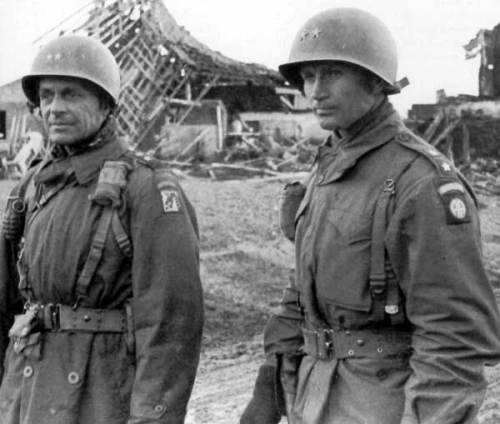
gavin-and-ridgeway

US Airborne Commanders James Gavin (R) and Matthew Ridgeway (L)

            The initial Allied command response to the attack by senior commanders varied.  Bradley believed it was a spoiling attack “to try and force a shift of Patton’s troops from the Saar offensive back to the Ardennes.”[xxxix] Courtney Hodges of 1st Army agreed with Bradley and refused to allow General Gerow, commander of V Corps to call off 2nd Infantry Division’s attack against the Roer dams on the 16th in order to face the German offensive.[xl]  Gerow was one of the first American commanders to recognize the scope of the German attack but Hodges, perhaps the least competent senior American commander in Europe failed to heed Gerow’s advice.

Battle of the Bulge - US prisoners on December 22nd 1944


        Soldiers of the 106th Infantry Division as POWs

         Soon after making this decision Hodges “panicked” and evacuated his headquarters at Spa fearing that it would be overrun by the advancing Germans.[xli] Eisenhower when informed of the news realized that something major was occurring and ordered the 7th Armored Division from the 9th Army and 10th Armored Division from 3rd Army into the Ardennes. On the 17thhe made other dispositions and released the 82nd and 101st Airborne Divisions from SHAEF reserve at Rheims to the Ardennes under the command of XVIII Airborne Corps.[xlii]  However during this short amount of time Mantueffel’s panzers had advanced 20 miles.

peiper-in-schwimwagen

SS Panzer Troops of Kampfgruppe Knittel on the advance.  Photo has often been identified for decades in books and other publications as Waffen-SS Colonel Joachim Peiper the commanding officer of the 1st SS Panzer Regiment and Kampfgruppe Peiper. This has been refuted by recent study.  Peiper is pictured below.

peiper

               At the command level Eisenhower made a controversial, but correct decsion to divide the command of the Bulge placing on a temporary basis all forces in the northern sector under Montgomery and leaving those to the south under Bradley.  Montgomery according to one commentary initially “had been astonishingly tactful in handing his American subordinates.”[xliii] However he quickly made himself obnoxious to many American commanders.[xliv] Following the battle Montgomery made the situation worse by claiming to have saved the Americans and giving credit to British units which scarcely engaged during the battle.[xlv]  Eisenhower also ordered Patton to launch a counter-attack along the southern flank of the German advance.  However Patton was already working on such an eventuality and promised to be able to launch a counterattack with three divisions by the 22nd.[xlvi]  Bradley praised Patton highly in his memoirs noting: “Patton’s brilliant shift of 3rd Army from its bridgehead in the Saar to the snow-covered Ardennes front became one of the most astonishing feats of generalship of our campaign in the West.”[xlvii]

American Response: the Shoulder’s Hold

bulge07             Malmedy Massacre 

          The 99th Division’s position was precarious, its right flank was subject to being turned and it was suffering severely at the hands of 12 SS Panzer and several Volksgrenadier divisions.  Gerow reinforced the 99th with elements of the 2nd Infantry division even before he had the final authorization to end its attack.  The two divisions stubbornly held Elsenborn Ridge and the villages of Rockerath, Krinkelt and Büllingen. By the 20th the 9th and 1st Infantry divisions arrived to strengthen the defense and lengthen the line to prevent it from being rolled up by the Germans.  The stubborn resistance of the Americans and arrival of reinforcements meant line was proof “against anything Sepp Dietrich might hurl against it”[xlviii]  By the 23rd Dietrich and 6th SS Panzer Army conceded defeat at Elsenborn and “turned its offensive attentions to other sectors.”[xlix]  German commanders like General Priess the commander of 1st SS Panzer Corps believed that terrain and road network in this sector was unfavorable to the German offensive and had proposed moving the attack further south.[l]  The Panzers could not deploy properly and the German infantry was not up to the task of driving the Americans out of their positions before the reinforcements arrived.
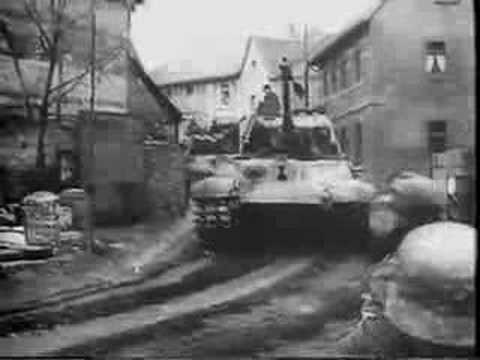
0-5

In the south the 4th Infantry Division held the line though heavily pressed by Brandenburger’s 7th Army.  The division was reinforced by elements of both 9thand 10th Armored divisions on the 17th and generally held its line along the Sauer River around Echternach “largely because the left flank of the enemy assault lacked the power-and particularly the armor-of the thrust farther north.”[li]

Turning Point: The Destruction of Kampfgruppe Peiper
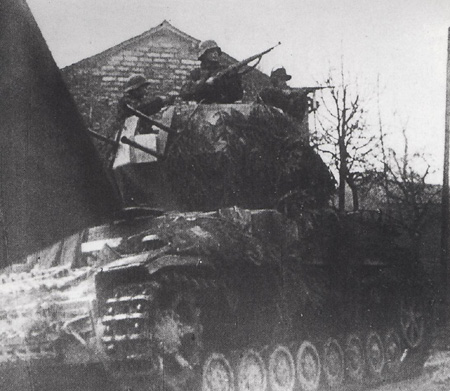
panzeri00265om

            While V Corps fought the 6th Panzer Army to a standstill, to the south 1st SS Panzer Division led by Kampfgrüppe Peiper split the seam between V Corps and VIII Corps. The Kampfgrüppe moved west leaving a brutal path of destruction in its wake, including massacres of American POWs and Belgian civilians.[lii]  However its advance was marked with difficulty. On the night of the 17th it failed to take Stavelot. After clearing the American defenders from the town after a hard fight on the 19th it failed to capture a major American fuel dump a few miles beyond the town.  When the Germans approached the American commander ordered his troops to pour 124,000 gallons down the road leading to the dump and set it on fire, depriving the Germans of badly needed fuel.[liii]  Combat Engineers from the 291st Engineer Battalion blew a key bridge across the Ambleve at Trois Ponts and another bridge across the Lienne Creek which left the Germans bottled up in the Ambleve River valley.  This bought time for the 30th Infantry Division to set up positions barring Peiper from the Meuse.  The 30th would be joined by Combat Command B of 3rd Armored Division and elements of 82nd Airborne. These units eventually forced Peiper to abandon his equipment and extricate some 800 troops by foot by the 23rd after a hard fight with the Americans who had barred his every effort to break through to the Meuse.

Turning Point: The Crossroads: St Vith & Bastogne

            The battle rapidly became focused on key roads and junctions, in particular St. Vith in the north and Bastogne in the south.  At St. Vith the 7th Armored Division under General Hasbrouck, who Chester Wilmont calls one of the “great men of the Ardennes”[liv] completed a fifty mile road march from Aachen to St. Vith.  On his arrival he deployed his combat commands around the town which was the key to the road network in the north and also to the only rail line running west through the Ardennes.[lv]  Hasbrouck gathered in Colonel Hoge’s Combat Command B of 9th Armored Division and the 424th Infantry Regiment of the 106th Division into his defensive scheme as well as the survivors of the 112thInfantry Regiment of the 28th Infantry Division which had escaped the German onslaught after holding as long as possible along the Clerf River and Skyline Drive.[lvi]  With these units Hasbrouck conducted “an eight-day stand that was as critical and courageous, as the defense of Bastogne.”[lvii]  After holding the Germans at St. Vith the units were withdrawn to another defensive position along the Salm and Ourthe Rivers and the village of Viesalm.  This was done at the behest of Montgomery and General Ridgeway of XVII Airborne Corps whose 82nd Airborne had moved into that area on the 19th.  The arrival of the 82ndgreatly assisted Hasbrouck’s force holding St. Vith whose defenders had lost an estimated 5000 casualties.[lviii]

The stand at St. Vith confined the “confined the Sixth Panzer Army’s penetration to a chokingly narrow corridor.”[lix]  It also posed a problem for German command and control which because it was out of the 6th Panzer Army’s area of operations Dietrich was unable to lend his weight into the fight.  “Hitler himself had strictly prohibited deviations from the zonal boundaries”[lx] which left the fight for St. Vith in the hands of 5th Panzer Army who felt the impact of the stand as the Americans “also choked off one of the Fifth Panzer Army’s best routes to Bastogne, almost nullifying the significance of the captured road junction at Houffalize.”[lxi]
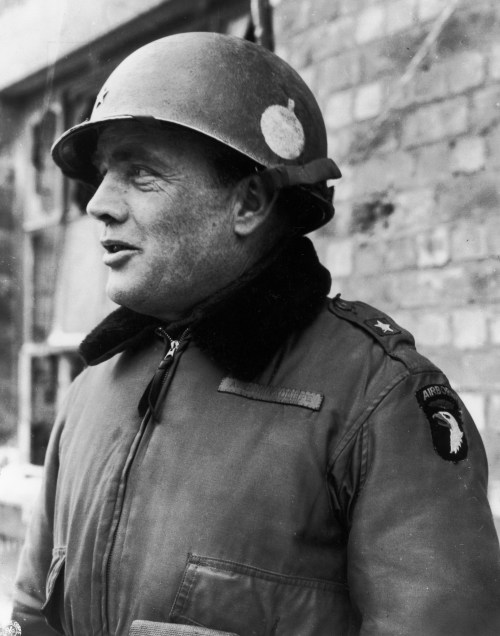
American General Anthony McAuliffe commander of the 101st

Brigadier General Anthony McAuliffe 

        To the south of St. Vith lay Bastogne, another key road junction needed by 5thPanzer Army for its advance.  On the night of the18th Panzer Lehr division came within two miles of the town before being checked by resistance by units of the 10th Armored division, remnants of 28th Division and misdirection by “friendly” Belgian guides onto a muddy path that helped halt their advance.[lxii]  This gave the 101st Airborne just enough time to get to the town and prevent its capture. The siege of Bastogne and its defense by the 101st elements of 9th and 10thArmored Divisions and 28th Division became an epic stand against Manteuffel’s Panzers which had surged around the town.  Wilmont comments that “had the Germans won the race for Bastogne, Manteuffel’s armor would have had a clear run to Dinant and Namur on December 19th and 20th” [lxiii] when there were only scattered American units between them and the Meuse. Manteuffel b bypassed Bastonge after the failure to capture it and masked it with 26th VolksgrenadierDivision and a regiment of Panzer Lehr.  The remainder of Panzer Lehr and the 2nd Panzer Division moved to the west. [lxiv]  The garrison endured numerous attacks and on the 22nd one of the most celebrated incidents of the war took place when Brigadier General Anthony McAuliffe responded to a demand for the surrender of the town with the reply; “Nuts.”  The town would continue to hold until relieved by 3rd Army on the afternoon of December 26th.[lxv]

Allied Response: The Counterattack

sherman-bastogne

            The Allied counterattack began with 3rd Army in the south on 21 December.  Patton’s initially proposed to attack toward the base of the Bulge in order to cut off the largest number of Germans possible.  Eisenhower dictated an attack further west with the goal of relieving Bastogne.  Eisenhower wanted to delay the attack to concentrate combat power while Patton wanted to attack sooner in order to ensure surprise. Patton got his way but attacked on a wide front.  The attack lost its impetus and bogged down into a slugging match with 7thArmy’s infantry and paratroops along the southern flank. [lxvi]  Patton’s failure to concentrate his forces for the advance to the north diminished his combat power.[lxvii] While Patton attacked from the south the 1st Army dealt with the advanced spearhead of 2nd Panzer Division which had reached the town of Celles and ran out of gas just four miles from Dinant and the Meuse. The 84th Infantry Division stopped the 116th Panzer division from being able to effect a relief of the 2nd Panzer the US 2nd Armored Division and allied fighter bombers chopped up the virtually immobile 2nd Panzer division completing that task by the 26th.[lxviii]

To the north Montgomery launched a cautious counterattack which slowly and methodically took back lost ground but allowed many Germans to escape. While Montgomery moved south Patton faced heavy German resistance from elements of 5th Panzer Army, reinforced by 1st SS Panzer Corps and 7th Army.  The rupture in the American front was not repaired until 17 January when the American forces met at Houffalize.[lxix] Bradley took over for Montgomery and the Americans pushed the Germans slowly back across the Clerf River by the 23rd.  The advance was hampered by tough German resistance and terrible weather which forced much of the attack to be made by dismounted troops as the roads had completely frozen over.[lxx]

The Allied counter attack has been criticized for allowing too many Germans to escape what could have been a major encirclement.  Patton recognized the incompleteness of the victory in the Ardennes stating: ““We want to catch as many Germans as possible, but he is pulling out.” The “but” clause, the note of regret, the awareness of the imperfection of his victories typified Patton.””[lxxi]  Patton in his memoirs notes: “In making the attack we were wholly ignorant of what was ahead of us, but we were determined to strike through to Bastogne.”[lxxii] Max Hastings simply said: “the Allies were content with success.”[lxxiii]  Murray and Millett place blame on Bradley and Hodges for choosing “merely to drive the enemy out of the Ardennes rather than destroy him.”[lxxiv]

Analysis: Could Wacht Am Rhein Have Worked?

          Could Wacht am Rhein worked?  If much was different, yes.  If the German had been stronger in tanks and vehicles and had adequate stocks of fuel; if their infantry was better trained, and had the Americans not resisted so stubbornly it might have at least got to the Meuse.  Perhaps if the the bad weather held keeping Allied air forces away from the Germans, or had St. Vith and Bastogne been taken by the 18th or 19th, they might have reached the Meuse.  Had the Germans executed their plan and coordinated their assault better[lxxv] in the 6thPanzer Army sector and had the 7th Army enough strength to conduct offensive operations in depth and secure the left flank the attack might have succeeded.  Because the Americans held the shoulders and road junctions, Manteuffel’s 5thPanzer Army, the only force besides the regimental sized Kampfgrüppe Peiper to actually threaten the Meuse was forced to advance while attempting to take Bastogne and defeat 3rd Army’s counterattack. Whether they could have made Antwerp is another matter.  Nearly all German commanders felt the offensive could not take Antwerp but did believe that they could inflict a defeat on the Allies and destroy a significant amount of allied combat power.

The German offense was a desperate gamble.  Too few divisions, scant supplies of petrol, formations that had recently been rebuilt and not given enough time to train to the standard needed for offensive operations coupled with Hitler’s insistence on an unalterable plan kept them from success.  At the same time the Allies were weak in troops as Eisenhower had no strategic reserve save the two American Airborne Divisions.  All reinforcements to the threatened sector had to come from the flanks and by the middle of the battle the 9th Army was drawn down to two divisions. Russell Weigley notes the constraints imposed by the 90 division Army, and of the limited stocks of artillery ammunition.[lxxvi] If the Germans had more forces they might have inflicted a significant defeat on the Allies had they been able to reinforce their success in depth.  Despite this they still inflicted punishing losses on the Americans though suffering greatly themselves.  Hastings notes that the real beneficiaries of the Ardennes offensive were the Russians.[lxxvii]  It is unlikely that the offensive could have ever achieved Hitler’s goals of taking Antwerp and fracturing the British-American alliance.

A Note About other Parts of the Campaign in France

The Riviera and Rhone

USA-E-Riviera-p193US Soldier Being Greeted as a Liberator 

          The campaign in south France was strategically wise although opposed by the British to the last minute because they felt it would take away from Overlord.[lxxviii] Though delayed the campaign was well executed by 7th Army, particularly Lt. General Lucian Truscott’s VI Corps of 3 American divisions. Truscott believed “destroying the enemy army was the goal”[lxxix] managed the battle well and skillfully maneuvered his small forces against Blaskowitz’s 19thArmy inflicting heavy losses, though some German commanders noted the caution of American infantry in the attack.[lxxx]  Only Blaskowitz’s tactical skills and the weakness of the American force prevented the Germans from disaster. The seizure of Marseilles and Toulon provided the allies with sorely needed ports that were invaluable to sustain the campaign.[lxxxi]

The Lorraine Campaign

            Patton attacked in the Lorraine with the goal of crossing the Moselle and attempting to break into Germany. He doing so he ran into some of the strongest German forces on the front and bogged down in the poor terrain and mud of the region.[lxxxii]  Patton was delayed in making his assault due to his place “at the far end of the logistics queue.”[lxxxiii] German forces skillfully defended the ancient fortress of city Metz forcing the Americans into a protracted campaign to clear the area with the last strongpoint surrendering on 13 December.  Patton is criticized for his failure to concentrate his forces[lxxxiv] but American tactics were less to blame than the weather, German resistance and shortages of infantry.[lxxxv] In some cases American infantry units performed admirably, particularly 80th Division’s assault on the Falkenburg Stellung.[lxxxvi]Liddell Hart criticized the Allies for failing to attack through the then weakly defended Ardennes, commenting: “By taking what appeared to be the easier paths into Germany the Allies met greater difficulties.”[lxxxvii]

The Huertgen Forrest
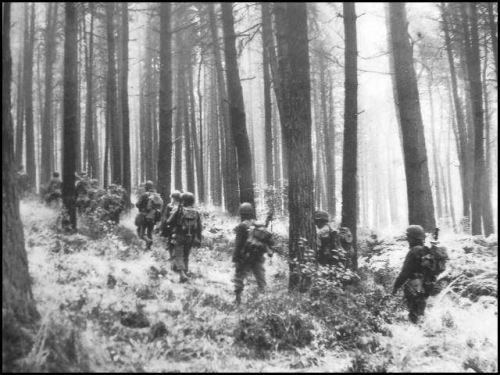
hurtgen-forest-soldiers

The Huertgen Forrest was the worst managed American fight Western European campaign. [lxxxviii] General Courtney Hodges leadership was poor.[lxxxix] In the Huertgen he fed division after division into a battle that made no strategic sense.  American infantry performed poorly and took extremely heavy casualties leaving four divisions shattered.[xc]  Poor American tactics demonstrated by attacking into a forest in poor weather without concentration negated all of Hodges’ advantages in tanks, artillery and airpower. The forest contained no significant German forces capable of threatening any American advance[xci] and its gain offered little advantage.[xcii] Hastings noted that the gains the only saving grace was that it made it easier for the northern shoulder of the Bulge to hold[xciii]   General Model and his subordinates expertly handled their handful of excellent but weary divisions in this battle using terrain, weather and prepared defensive positions to contest nearly every yard of the Forrest.[xciv]

Conclusions

            The lessons of the Bulge and the other campaigns on the German-French border are many and can be gleaned from Allied and German mistakes. On the Allied side the most glaring mistakes were assumptions prior to the German attack that the Germans were incapable of any serious offensive and ignoring the fact that the Germans had attacked through the Ardennes in 1940.  Likewise the self limitation of the American Army to 90 divisions for world-wide service meant that there were no more divisions in the pipeline and that worn out divisions would have to be reinforced with inexperienced troops while in the front line which ensured a lack of cohesiveness in many divisions, especially the infantry.  Allied intelligence failures as well as their reliance of forces much smaller than they should have had for such a campaign ensured that they would suffer heavy losses in the Bulge while poor planning and execution by Hodges wasted many good troops in a senseless battle.  The Germans were hamstrung by Hitler’s fantasy that the Western Allies could be forced out of the war or the Alliance split by a defeat in the Ardennes.  Likewise German forces, even those so quickly reconstituted were often short troops, tanks and vehicles.  German commanders were forced by Hitler’s rigid insistence on not altering the plan to not be as flexible as they might have been in earlier offensives to adjust according to the situation on the ground.


[i] Dupay, Trevor N.  Hitler’s Last Gamble: The Battle of the Bulge December 1944-January 1945Harper Collins Publishers, New York NY 1994 p.2.

[ii] Hastings, Max. Armageddon:  The Battle for Germany 1944-1945 Alfred A Knopf, New York NY 2004 p.197.

[iii] Reynolds, Michael. Sons of the Reich: II SS Panzer Corps; Normandy, Arnhem, Ardennes, and on the Eastern Front.  Casemate Publishing, Havertown PA 2002 p.186

[iv] Ibid. p.198

[v] Warlimont, Walter. Inside Hitler’s Headquarters 1939-1945 translated by R.H. Barry. Presidio Press, San Francisco, CA 1964. p. 480

[vi] Ibid.

[vii] Liddell Hart, B.H. The German Generals Talk. Originally published 1948, Quill Publishers Edition, New York 1979 p.274.

[viii] Liddell Hart, B.H. The History of the Second World War G.P. Putnam’s Sons, New York NY 1970. p.646.

[ix] MacDonald, Charles B. A Time for Trumpets: The Untold Story of the Battle of the Bulge William Morrow and Company, New York, NY 1985 p.35.

[x] [x] Newton, Steven H. Hitler’s Commander: Field Marshal Walter Model, Hitler’s Favorite General.DeCapo Press, Cambridge MA 2005. p.329

[xi] Ibid. Hastings p.198.  Hastings quotes Dietrich: “All Hitler wants me to do is cross a river, capture Brussels, then go on and take Antwerp. And all this at the worst time of year through the Ardennes when the snow is waist-deep and there isn’t enough room to deploy four tanks abreast let alone armored divisions. When it doesn’t get light until eight and it’s dark again by four and with re-formed divisions made up chiefly of kids and sick old men-and at Christmas.”

[xii] Ibid. Liddell-Hart The German Generals Talk p.276

[xiii] Wilmont, Chester. The Struggle for Europe Harper and Brothers Publishers, New York, NY 1952 p.576

[xiv] Ibid. p.557.

[xv] Ibid. Hastings. p.199. Hastings notes that Manteuffel said: “It was not that his soldiers now lacked determination of drive; what they lacked were weapons and equipment of every sort. Von Manteuffel also considered the German infantry ill trained.”

[xvi] Ibid. Dupay.p.47  Dupay notes that in 3rd Parachute Division that most of the regimental commanders had no combat experience.

[xvii] Weigley, Russell  F. Eisenhower’s Lieutenants: The Campaign in France and Germany 1944-1945. Indiana University Press, Bloomington IN 1981 p.432.  Weigley speaks of Allied caution and predictable strategy, caution in logistical planning which did not allow the Allies to provide the fuel needs for a rapid drive into Germany and caution of operational commanders.

[xviii] Liddell Hart discusses the issue of paratroops at length in discussions with Manteuffel and General Kurt Student. At the time of the operation there were very few jump trained paratroops available for the operation as most of the 6 organized Parachute Divisions were committed to battle as infantry during the 1944 battles in the East, Italy and in the West. German Generals Talk pp.282-285.  Although Liddell Hart makes note of the employment of these troops and talked with Model and student about why they were not used to seize bridges and other critical terrain featured ahead of the Panzers instead of the use as a blocking force, I have found no one who questioned why the Germans did not use small glider detachments for the same purpose.  The Germans had demonstrated with Skorzeny when they rescued Mussolini from his mountain prison that they still retained this capability.  The use of the SS Paratroop battalion which could have been assigned to Skorzeny as a glider borne force could have been decisive in capturing the key bridges and terrain ahead of 6th Panzer Army.

[xix] Skorzeny’s operation was Operation Greif designed to sow confusion in the Allied Ranks.  His brigade numbered about 3500 men and had a good number of captured US vehicles including some tanks and tank-destroyers on hand to confuse American units that they came in contact with.

[xx] Ibid. Hastings.  p. 199.  Hastings quotes the Adjutant of 18th Volksgrenadier Division who “felt confident of his unit’s officers, but not of the men “some were very inexperienced and paid the price.”  MacDonald notes that the division had many Navy and Air Force replacements but was at full strength. p.646.

[xxi] See MacDonland pp. 644-655 for a detailed commentary on the German Order of Battle.

[xxii] Reynolds, Michael. Men of Steel: 1st SS Panzer Corps;  The Ardennes and Eastern Front 1944-1945 Sarpendon Publishers, Rockville Center NY, 1999. pp.36-37.  Reynolds notes that the 1st SS Panzer Regiment only had 36 Panthers and 34 Mark IV Panzers to begin the operation (excluding the attached 501st SS Heavy Tank Battalion).  He also notes that many of the tank crew replacements had no more than 6 weeks of military training and some of the tank crews had never been in a tank.  Similar problems were found in all the Panzer Divisions.  Severe shortages of armored half tracks, reconnaissance vehicles and other vehicles meant that Panzer Grenadier and Motorized battalions lacked the lift needed and some went on foot or on bicycles.

[xxiii] Ibid. Reynolds. Sons of the Reich. P.183

[xxiv] Ibid. MacDonald. p.44.

[xxv] Ibid.

[xxvi] Ibid. Dupay pp. 27-28.

[xxvii] Ibid. MacDonald. p.52.  MacDonald notes that Koch warned that the Germans were not finished, that “his withdraw, though continuing has not been a rout or mass collapse.” He calls Koch a “lone voice” in the Allied intelligence world.

[xxviii] Bradley, Omar  N. A Soldier’s Story Henry Holt and Company, New York NY 1951. p.459.  Weigley makes some poignant calling Bradley’s comments  “contradictory” and states that: “his apologia is hardly a model of coherence. (p.461)

[xxix]  D’Este, Carlo. Eisenhower: A Soldier’s Life Owl Books, Henry Holt and Company, New York NY 2002. p.638

[xxx] Dupay and others talk about this in detail. See Dupay pp. 35-44.

[xxxi] Ibid. p.38.

[xxxii] Ibid. Hastings. p.201

[xxxiii] Ibid. Hastings. p.199

[xxxiv] Ibid. Weigley. p.464

[xxxv] Ibid.

[xxxvi] Ibid. Wilmont. P.581.

[xxxvii] Ibid. p.583

[xxxviii] Ibid. Hastings. p.223

[xxxix] Ibid. Weigley. P.457

[xl] Ibid. p.471

[xli] Ibid. Hastings. pp.205-206

[xlii] Ibid. Wilmont. pp.583-584

[xliii] Murray, Williamson and Millett, Allan R. A War to Be Won: Fighting the Second World War The Belknap Press of Harvard University Press, Cambridge Massachusetts and London England, 2000 p.470 The authors must base their conclusion on the fact that Montgomery who mentioned to Eisenhower that Hodges might have to be relieved, did not do so and by the next day told Eisenhower that the action was not needed.  A  few other American commanders in the north were favorable to Montgomery but this appears to be a minority view.

[xliv] Ibid. Weigley. pp.504-506.  Weigley and Wilmont both note the comment of a British Staff Officer the Montgomery “strode into Hodges HQ like Christ come to cleanse the temple.” (Wilmont p.592)

[xlv] Ibid. Hastings. pp.230-232.  Hastings is especially critical of Montgomery.  Weigley, equally critical notes regarding  the January 7th press conference, Montgomery’s “inability to be self critical at any point.” p.566.

[xlvi] Ibid. Weigley. p.500.

[xlvii] Ibid. Bradley. p.472  Other commentators differ in their view of Patton’s movement.  Wilmont notes that Patton had no “equal in the on the Allied side in the rapid deployment of troops. (p.589) Weigley urges readers that “it should be kept in appropriate perspective; it was not a unique stroke of genius.” And he compares it to Guderians disengagement with Panzer Group 4 and 90 degree change of direction and assault against the Kiev pocket in the 1941 Russian campaign (p.500)  Hastings notes that “Patton had shown himself skilled in driving his forces into action and gaining credit for their successes. But he proved less effective in managing a tough, tight battle on the southern flank.” (p.230)  Regardless of the perspective and criticism Patton’s movement was unequaled by any Allied commander in the war and had he not moved so quickly the 101stAirborne might not have held Bastogne. Admittedly his attack north was dispersed along a wide front but part of the blame for this must be assigned to Eisenhower who dictated the attack toward the west vice the base of the Bulge where Patton desired to make it.  A note I would make is that being a cavalryman Patton thought like one and when faced with the tight battles in close quarters was not at his best.  Similar comparisons could be made to J.E.B. Stuart at Chancellorsville when he had to take command of Jackson’s Corps.

[xlviii] Ibid. Weigley. p.475

[xlix] Ibid. p.474

[l] Ibid. Reynolds Men of Steel pp.51-52.

[li] Ibid. Weigley. p.470

[lii] The worst of these took place at the village of Malmedy where Battery B 285th Field Artillery Observation Battalion of 7th Armored Division was captured and about 150 soldiers were rounded up and machined gunned in a field with survivors killed with pistol shots in the head.

[liii] Ibid. Weigley. pp.478-479.

[liv] Ibid. Wilmont. p.584

[lv] Ibid. Weigley. p.487

[lvi] Ibid. Weigley. pp.486-487

[lvii] Ibid. Hastings. p.215. Hastings gives most of the credit to Brigadier General Bruce Clarke of CCB 7th Armored Division for the stand.

[lviii] Ibid. MacDonald. 481-487.  MacDonald notes that following the war that the commanders of the units involved “would be grateful to Field Marshal Montgomery for getting them out of what they saw as a deathtrap for their commands. (p.487)

[lix] Ibid. Weigley. p.487

[lx] Ibid.

[lxi] Ibid.

[lxii] Ibid. Hastings. p.217 Also  MacDonald. p.289 who talks of the confused situation east of Bastogne both for the Americans and Germans.

[lxiii] Ibid. Wilmont. p.598

[lxiv] Ibid. Liddel Hart. The German Generals Talk. p.288

[lxv] The defense of Bastogne would continue until after the 1st of January as Hitler renewed the attempts to secure the town in order to push on to the Meuse. Other German formations including units of 1st SS Panzer Corps shifted south from their original attack would make determined efforts to dislodge the stubborn American defenders.

[lxvi] Ibid. Weigley. pp.500-501.  Bradley gives Patton more credit than later commentators. Wilmont notes that the Germans though “amazed at the speed with which Patton had disengaged from the Saar and wheeled them northward…they received due warning of his movement by monitoring the radio net which controlled American traffic, and they were braced to meet his assault. (p.599).

[lxvii] Ibid. Weigely. Pp.520-521

[lxviii] Ibid.  pp.535-537

[lxix] Ibid. pp. 558-561

[lxx] Ibid. pp.563-564

[lxxi] Ibid. p.566.

[lxxii] Patton, George S. War as I Knew It  Originally published by Houghton Mifflin Company NY 1947, Bantam Paperback Edition,  Bantam Books, New York, NY 1980 p.364

[lxxiii] Ibid. Hastings. p.230

[lxxiv] Ibid. Murray and Millett p.471.

[lxxv] Hastings notes that “Tactically, the Ardennes was one of the worst-conducted German battles of the war, perhaps reflecting that none of the generals giving the orders saw any prospect of success. (p.236)

[lxxvi] Ibid. Weigley. pp.567-572

[lxxvii] Ibid. Hastings. p.236-237.  Hastings believes that the employment of the 5th and 6th Panzer Armies in the East “made the task of Zhukov and his colleagues much harder.”

[lxxviii] Ibid. Weigley. p.236. I find it interesting that neither Hastings nor Liddell Hart mention the Riviera and Rhone campaign.

[lxxix] Ibid. Weigley. p.236

[lxxx] Giziowski, Richard. The Enigma of General Blaskowitz  Hippocrene Books Inc. New York NY, 1997. p.328

[lxxxi] Ibid.  Weigley comments on how much the overall supply situation was aided by the operation and capture of the ports and notes that the pace of the Cobra breakout had created a crisis in supply and “without the southern French ports the crisis would have been insurmountable.” (p.237)

[lxxxii] Ibid. p.397.  Weigley notes: “The immobilizing mud and the enemy’s recalcitrant resistance had fragmented the battle into affairs of squads, platoons, companies and battalions….and Patton’s juniors more than he controlled the course of action, to the extent that control was possible.”

[lxxxiii] Ibid. p.384

[lxxxiv] Ibid. p.390 Weigley states: “The American disinclination to concentrate power was rarely more apparent.” comparing the frontages of 1st, 9th and 3rdArmies and notes that Patton attacked along his entire front.”

[lxxxv] Ibid. Weigley. pp.400-401.  Weigley spends a fair amount of time on American infantry shortages in 3rd Army.

[lxxxvi] Ibid. Weigly. P.400.  Weigley notes a German General Wellm attributed part of that victory to the “prowess of the American infantry.”

[lxxxvii] Ibid. Liddell Hart. The History of the Second World War p.560

[lxxxviii] Hastings and Weigley both note how many American division and regimental commanders were relieved of command for their failures in the Huertgen.

[lxxxix] Ibid. Hastings. p.179.  Hastings notes that “instead of recognizing the folly of attacking on terrain that suited the Germans so well, Courtney Hodges reinforced failure.”

[xc] Ibid. Weigley. p.420.  Weigley notes the high numbers of ballet and non battle casualties in the 4th, 8th, 9th and 28th Divisions as well as CCR of 5thArmored and 2nd Ranger Battalion.

[xci] Ibid. Hastings. p.275.  Hastings notes that defending 275th Division “were poor grade troops who-like the garrison of Aachen posed no plausible threat to the flanks of an American advance to the Roer.”

[xcii] Weigley compares the battle in its effect on the American army to Grants “destruction of the Confederate army in the Wilderness-Spotsylvania-Cold Harbor campaign expended many proud old Union army formations…” (p.438)

[xciii] Ibid. Hastings. p.215

[xciv] Ibid. Newton. p.324

3 Comments

Filed under History, Military, nazi germany, world war two in europe

NATO Patriots to Turkey as Syria Teeters on the Abyss

p01-120828-p2r

M-104 D Patriot Missile (Patriot PAC-3)

There are times when wars and conflicts grind on day after day seemingly without end and without any kind of resolution. There are other times that in the midst of such conflicts events occur that are not routine. In the case of the Syrian revolt and civil war this was such a week.

For months, actually nearing two years the conflict in Syria has simmered. With each passing week the rebels have gained ground and support while the regime of Bashir Al Assad has engaged in ever more repressive and violent measures to stay in power.

patriot-system

German Luftwaffe Patriot System

This was a significant week in the Syrian crisis as three NATO member nations, Germany, the Netherlands and the United States announced the deployment of the latest version of the Patriot Surface to Air Missile to Turkey in response to Turkey’s request for NATO assistance. Additionally it was announced that the United States has confirmed that Syria has fired its SCUD missiles against its own people even as the Russian Foreign Minister announced that it was possible that the Assad regime would not survive the revolt. In addition it has been reported that the Syrian regime is readying its chemical weapons for possible use.

The Patriot units being sent to Turkey are six full batteries manned of advanced Patriot PAC-3 missiles manned by close to 1200 troops. The PAC-3 missile is currently only in service with the United States, Germany and the Netherlands. Other NATO forces use the PAC-2 or PAC-2/GEM versions.

scud-b_ss-1c_r-17_srbm_short_range_ballistic_missile_syrian_armed_forces_03

Syrian SCUD Missile and Launcher

The events of the past week point to possible escalation of the Syrian conflict which has for some time threatened to involve Syria’s ancestral rival Turkey. There is little love between the Turk and the Syrian Arab dating back to the times of the Ottoman Empire. Turkey has done a remarkable job in giving sanctuary to Syrians fleeing the violence and has had to deal with Syrian artillery attacks as well as the shoot down of a Turkish Air Force reconnaissance aircraft over the Mediterranean.

With American and other NATO troops on the ground in Turkey the chances that a Syrian attack on Turkey could directly involve the US and NATO in another war grows.

Praying for Peace

Padre Steve+

2 Comments

Filed under middle east, Military, News and current events

The Illusion of Peace: Remembering the Day Before Pearl Harbor

h97398

“A nation brought up on peace was going to war and didn’t know how.” Walter Lord 

For most Americans and Western Europeans this is time of peace. Well, at least the illusion of peace.

Tens of thousands of American, NATO and European Union troops operating in a number of mandates are in harm’s way. In some places like Afghanistan they are at war, in others attempting to keep the peace. Around the world regional conflicts, civil wars, insurgencies  and revolutions threaten not only regional peace but the world peace and economy. Traditional national rivalries and ethnic and religious tensions especially in Asia and the broader Middle East have great potential to escalate into wars that should they actually break will involve the US, NATO and the EU, if not militarily economically and diplomatically.

But, we live in a dream world an illusory world of peace. as W.H. Auden said in his poem September 1st 1939:

Defenseless under the night
Our world in stupor lies…

On December 6th 1941 the world was already at war and the United States was edging into the war. The blood of Americans has already been shed but for the vast majority of Americans the events in Europe and Asia were far away and not our problem. Though President Roosevelt had began the expansion of the military there were those in Congress seeking to demobilize troops and who fought all attempts at to intervene.

maltese-falcon-by-content-artofmanlinessdotcomw499h371

Most people went about their business that last furtive day of peace. People went about doing their Christmas shopping, going to movies like The Maltese Falcon staring Humphrey Bogart or the new short Tom and Jerry cartoon, The Night Before Christmas.

Tom And Jerry

Others went to football games. UCLA and USC had played their annual rivalry game to a 7-7 tie, Texas crushed Oregon in Austin by a score of 71-7 while Texas A&M defeated Washington State in the Evergreen Bowl in Tacoma by a score of 7-0.

0-3

In Europe a Soviet counter-offensive was hammering a freezing and exhausted German Wehrmacht at the gates of Moscow. U-Boats were taking a distressing toll of ships bound for Britain including neutral US merchant ships and warships, including the USS Reuben James. American Airmen were flying as the volunteer Flying Tigers for the Nationalist Chinese against the Japanese invaders.

decwarp1

War was everywhere but there was still the illusion of peace. When the messages came out of Pearl Harbor the next morning it was already early afternoon on the East Coast. The Japanese Ambassador had been delayed in delivering the declaration of war, people across the country going about their Sunday business, going to church, relaxing or listening to the radio. Thus when war came, despite all the precursors and warnings war came. When it happened it took the nation by surprise. Walter Lord wrote in his classic account of the Pearl Harbor attack Day of Infamy: “A nation brought up on peace was going to war and didn’t know how.”

By the end of the day over 2400 Americans were dead and over 1200 more wounded. The battleships of the Pacific Fleet were shattered. 4 sunk, one grounded and 3 more damaged. 10 other ships were sunk or damaged in the attack. 188 aircraft were destroyed and 159 damaged.

cn3992

The next day President Franklin D. Roosevelt called the nation to action requesting that Congress declare war on Japan. http://www.youtube.com/watch?v=ufoUtoQLGQY

Mr. Vice President, and Mr. Speaker, and Members of the Senate and House of Representatives:

Yesterday, December 7, 1941 — a date which will live in infamy — the United States of America was suddenly and deliberately attacked by naval and air forces of the Empire of Japan.

The United States was at peace with that Nation and, at the solicitation of Japan, was still in conversation with its Government and its Emperor looking toward the maintenance of peace in the Pacific. Indeed, one hour after Japanese air squadrons had commenced bombing in the American Island of Oahu, the Japanese Ambassador to the United States and his colleague delivered to our Secretary of State a formal reply to a recent American message. And while this reply stated that it seemed useless to continue the existing diplomatic negotiations, it contained no threat or hint of war or of armed attack.

It will be recorded that the distance of Hawaii from Japan makes it obvious that the attack was deliberately planned many days or even weeks ago. During the intervening time the Japanese Government has deliberately sought to deceive the United States by false statements and expressions of hope for continued peace.

The attack yesterday on the Hawaiian Islands has caused severe damage to American naval and military forces. I regret to tell you that very many American lives have been lost. In addition American ships have been reported torpedoed on the high seas between San Francisco and Honolulu.

Yesterday the Japanese Government also launched an attack against Malaya.
Last night Japanese forces attacked Hong Kong.
Last night Japanese forces attacked Guam.
Last night Japanese forces attacked the Philippine Islands.
Last night the Japanese attacked Wake Island. And this morning the Japanese attacked Midway Island.

Japan has, therefore, undertaken a surprise offensive extending throughout the Pacific area. The facts of yesterday and today speak for themselves. The people of the United States have already formed their opinions and well understand the implications to the very life and safety of our Nation.

As Commander in Chief of the Army and Navy I have directed that all measures be taken for our defense.

But always will our whole Nation remember the character of the onslaught against us.

No matter how long it may take us to overcome this premeditated invasion, the American people in their righteous might will win through to absolute victory. I believe that I interpret the will of the Congress and of the people when I assert that we will not only defend ourselves to the uttermost but will make it very certain that this form of treachery shall never again endanger us.

Hostilities exist. There is no blinking at the fact that our people, our territory, and our interests are in grave danger.

With confidence in our armed forces- with the unbounding determination of our people- we will gain the inevitable triumph- so help us God.

I ask that the Congress declare that since the unprovoked and dastardly attack by Japan on Sunday, December 7, 1941, a state of war has existed between the United States and the Japanese Empire.

171-0417042317-pearlharbor_paper

Today tens of thousands of US and NATO troops are deployed in Afghanistan. Some of them are dying that people that most of us do not care about in the least might have a chance at peace and a better life. Eleanor Roosevelt reflected:

“Lest I keep my complacent way I must remember somewhere out there a person died for me today. As long as there must be war, I ask and I must answer was I worth dying for?”

Wars, revolutions and other tensions in other parts of the world threaten on every side, but most Americans and Europeans live in the illusion of peace.  A very few professi0onals are given the task of preparing for and fighting wars that our politicians, business leaders, Armageddon seeking preachers and the talking heads of the media sow the seeds. As such many have no idea of the human, material and spiritual cost of war and when it comes again in all of its awful splendor few will be prepared.

We do not know what tomorrow will bring and unfortunately for the vast bulk of Americans and Western Europeans the comments of Walter Lord are as applicable today as they were on December 7th 1941.

Peace

Padre Steve+

6 Comments

Filed under History, Military, national security, world war two in the pacific

An older post of mine about Pearl Harbor as we approach the 71st anniversary of that “Day of Infamy.”

padresteve's avatarThe Inglorius Padre Steve's World

Arizona Leading the Battle Line

“Yesterday, Dec. 7, 1941 – a date which will live in infamy – the United States of America was suddenly and deliberately attacked by naval and air forces of the Empire of Japan…. The attack yesterday on the Hawaiian Islands has caused severe damage to American naval and military forces. Very many American lives have been lost.” Except of President Franklin D Roosevelt’s Pearl Harbor Speech December 8th 1941

Today is the 68th anniversary of the Japanese attack on Pearl Harbor and as we were then we are at war.

A Date that Will Live in Infamy: USS Arizona Burning

I remember reading Walter Lord’s “Day of Infamy” when I was a 7th grade student at Stockton Junior High School back in 1972.  At the time my dad was on his first deployment to Vietnam on the USS Hancock CVA-19.  As…

View original post 1,837 more words

1 Comment

Filed under History, Military, Navy Ships, traumatic national events, US Navy, world war two in the pacific

The Fallacy of “Complete” Victory and the Seeds of Perpetual War and the Way to Peace

“We learn from history that complete victory has never been completed by the result that the victors always anticipate—a good and lasting peace. For victory has always sown the seeds of a fresh war, because victory breeds among the vanquished a desire for vindication and vengeance and because victory raises fresh rivals.” B H Liddell Hart

The current conflict between Israel and Hamas in Gaza has brought into light the fallacy of the belief that military victories alone can bring peace. One would think that leaders would know this and understand the basic truth of this key aspect of the human condition but it seems that we are doomed in every generation for leaders to ignore this basic fact of human life and civilization.

While one can easily criticize the Israelis and Palestinian Arabs for their unremitting hostility and desire for revenge they are not unique. Europe bears the scars of over 1500 years of Christendom’s own tribal and religious hatreds, many which still simmer underneath the surface of “free and democratic society.” Asia is rife with ethnic hatred and desire for revenge for actions committed by people long dead. Africa, the same except for the most part those in the “First World” be they Americans, Europeans or Asians only care about Africa for its natural resources, otherwise we would have acted to stop the various genocides on that rich, beautiful and diverse but seemingly cursed continent. The inter-Islamic and other Middle Eastern and Central Asian Moslems likewise have their hatreds, try as they might Arabs and Persians despite a common allegiance to Islam are mortal enemies with animosities that pre-date their conversion to Islam. Even we Americans are not immune to such hostility in our own country and against those that we label as our enemies overseas.

Despite this there are those that first and always resort to military force or terrorist violence to attempt to fight the “war to end all wars.”

The current episode of violence in Gaza is simple another chapter in what has been an unending series of wars since the establishment of the State of Israel. The time since has been marked by major wars in 1948, 1956, 1967, 1973 and 1981 the Palestinian Infatada as well as border conflicts between Israel, Fatah, Hamas and Hezbollah that have occurred since. These wars forced exodus of Palestinian Arabs from their ancestral homes, as well as the practical end of substantial Jewish and Christian communities in Moslem dominated nations.

The Israelis have in many cases lived under threat of invasion and destruction by neighboring Arab states for much of their history even while maintaining control of territories that they occupy by brutal force in the name of their own security. In some sense the Israeli position is understandable. They occupy but a small portion of land and threats of extermination, real and propagandistic by Arab and nations and the Iranians cause them to see these threats as existential threats.

The Arabs on the other hand deal with centuries of humiliation at the hand of foreigners, many Christian and European, but also that of the Turk and Persian. The constant drumbeat of military defeats endured by them at the hands of the Israelis and the support of Israel by western nations, some of whom ran the brutal colonial administrations which divided their lands, appointed despots as surrogates and exploited their natural resources has ingrained in them a deep seated need for revenge and respect.

I know from my time in Iraq and other Middle Eastern countries that the key to friendship and mutual respect is the simple act of taking time to know and appreciate the culture, history, faith and traditions of other people. I frequently in my dealings with Iraqi officers in Al Anbar Province opened doors by taking the time to learn their history, which goes back several millennia as the cradle of civilization and to be both polite and respectful in dealing with them. Iraqi officers were surprised that I knew the positive contributions of Iraqi military officers to Iraq, including the abolition of child labor, public education, the expansion of universities, universal suffrage and public works that benefited all Iraqis before the takeover of the country by Saddam Hussein and his Ba’ath Party. Likewise the fact that I could name the victories of Iraq forces against the British at Al Kut in the First World War, the largest surrender of British forces during the war as well as other victories gained me their respect and friendship as the “American” or “Christian Imam.”

However most Americans have not learned this despite over a decade of war in Afghanistan and Iraq. I was listening to a friend today who was upset that the government of Iraq was urging that Arabs use oil as a weapon against the United States to force the United States to change its policy in regard to the Palestinians. The argument presented on Fox News and echoed around much of the country is that the statement of the Iraqis is an act of ingratitude by a country that we “liberated.”

But that is our fiction that we create to absolve ourselves from the fact that over a period of 20 years American and other Western nations destroyed Iraq and humiliated its people. Yes we overthrew Saddam Hussein, a brutal dictator, a man that we supported for years as an ally until he crossed a line that we determined that he should not cross when he invaded Kuwait in 1990. To Shi’te Iraqis the overthrow of Saddam in 2003 was liberation, but it was “liberation” that followed the betrayal of them in 1991 where after encouraging them to revolt against Saddam we allowed them to be slaughtered by his Republican Guard.

To the Sunni of Anbar Province who after realizing that the radicals of Al Qaeda who were bringing more destruction to them than the Americans and allied themselves with the United States military in 2007, the Anbar Awakening the withdraw of American forces was an abandonment. They made our exit from Iraq possible and helped break the back of Al Qaeda, and for their trouble they believe that they have been abandoned to a corrupt Shi’te led government in Baghdad.

In light of all of this who can blame the Iraqis for making those statements. How would be we feel if that were to happen to us in the United States, or in Western Europe? Actually we know from history how we would feel. The answer is obvious in our history as well as our current actions and attitudes. We would not rest until those that brought destruction on our country and betrayed our people were defeated.

It is no wonder that Sun Tzu said that “To win one hundred victories in one hundred battles is not the acme of skill. To subdue the enemy without fighting is the acme of skill.”

Likewise Abraham Lincoln asked a question that those consumed by the need to destroy their enemies by military force should ask before ever mobilizing an army for war: “Am I not destroying my enemies when I make friends of them?”

Peace

Padre Steve+

2 Comments

Filed under History, iraq,afghanistan, middle east, Military, Tour in Iraq