Category Archives: Pastoral Care

Going to War: Interlude in Fallujah Reunions, Redirection and a Stay at the Ramadan Inn

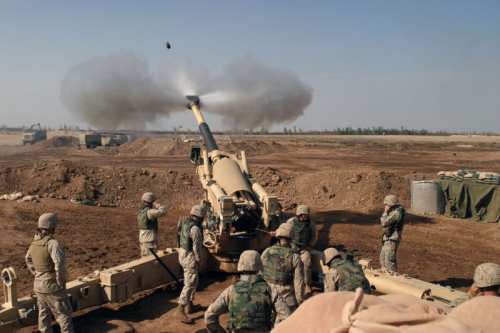
marine 155s in fallujahUSMC 155mm Howitzer firing on Insurgents at Fallujah in 2007

Note: This is the latest installment of my “Going to War” Series.  Other postings in this series are located in the Subjects section under “Tour In Iraq.” The series chronicles the tour of Religious Support Team-2 of the Iraq Assistance Group in MNF-West from July 2007-February 2008. We were the first Navy Chaplain and Assistant to work supporting advisers since the Vietnam War.

We woke up to the sound of more outgoing artillery fire.  The sun was shining outside as I look out my window at the sky above the California Barrier that protected our “suite” in the south wing of the Ramadan Inn.  Climbing out of the decrepit Iraqi bed with the fresh sheets I stumbled over my two tons of gear to look at the time while Nelson slept like a baby in his equally decrepit Iraqi bed.   My ever trusty alarm clock showed that it was about 0830, which meant we had gotten maybe 5 hours sleep and missed breakfast. Thankfully I had stockpiled a few pop-tarts and granola bars from the Camp Victory chow-hall the day before.   Opening the door and peering out into the hallway I saw it empty and walked across the hall to the head, shower and laundry room to do my morning business.   Despite being a Baath Party playground the suites at the Ramadan Inn were not furnished with their own toilet or shower, just a small sink and mirror.
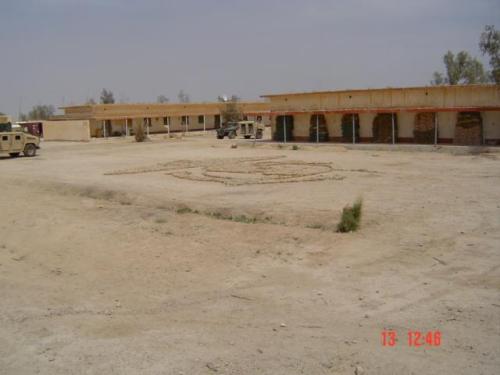
ramadan innRamadan Inn

Though the Ramadan Inn had seen better days it was certainly, despite being the playground of Uday and Qusay Hussein it was not exactly a palace like those of their father Saddam.  It was somewhat reminiscent of an old and run down motel along Route 666.  The floor was a marble type tile and the sand painted concrete building with a flat roof.  I strolled over to the head in my PT-sleep clothes and was relieved to be able to relieve myself in a facility that had actual porcelain shitters which flushed using real water.  If you have been to Iraq or Afghanistan you know that this is not always the case.  The showers were passable being a more European design and the water was hot.  I guess even the cold water was hot in Fallujah with temps in the 120s.  Once I had gotten up I awakened Nelson, the sleeping beauty. He then went through his morning ritual to make himself presentable to the world.  Those who know nelson know that if he can he will take care of his personal hygiene.  I ate one of my Strawberry Filled frosted Pop Tarts washed done with water and when Nelson was ready we walked over to the Chaplain office.  It was like a maze to get there. We walked across the way a bit, took a right, made a left and went through the normal transient quarters area, took a right went up a block or two, took a left, made another left, wound our way past a decorative lake, took a right, went past a number of buildings before passing a final bank of green porta-johns finding the MEF- Forward Chaplain Office to our right.  The sun shone brightly and though not a long walk was relatively warm and by the time we got to the Chaplain Office I was sweating.

fallujah pondPond at Fallujah

The Chaplain office was like every other facility and was protected by California Barriers or Hesco’s. We were met by RP1 Roland and the Deputy MEF-FWD Chaplain CDR J.P. Hedges.  They were most hospitable and offered us water as well as coffee, which my caffeine deprived brain needed badly.  After introductions Nelson got together with RP1 Roland and I met with Chaplain Hedges doing the usual butt-sniffing that military professionals engage in when meeting someone for the first time.  This ritual usually consists of learning who our mutual friends are, where and with whom we had served in the Navy, where we went to school, something about our families and for Chaplains our faith tradition or denominational affiliation.  This is a customary act for chaplains as it is for other communities and specialties in the Navy.  On the positive side it is a way of making connection with each other and building relationships.  It is also a way or self preservation within the system as sometime there are people that do not have your best interests at heart. However for J.P. and I the meeting was very friendly. We d a lot of shared experiences in the types of duties we had done and we had mutual friends.  While we enjoyed conversation he began to introduce me to some of the things that had been going on in country the last few months.  After about 30 minutes Chaplain Mike Langston came in.  It was Mike who had worked with Peter Dissmore and the Corps Chaplain to bring us out to the west to cover the Marine and Army advisors in Al Anbar Province.

Mike had a couple of orders of business to take care of before he brought Nelson and I into his office and had our reunion. Nelson and I had both worked with Chaplain Langston.  It was good to see him again.  Nelson had worked for him in Afghanistan and I had been with him at 2nd Marine Division in 2000-2001.  He and Chaplain John Kaul arranged for me to take over Headquarters Battalion upon my return to work in a quasi-regimental billet with oversight of the independent battalions Religious Ministry Teams, though not the actual supervision of them. In addition to my regular duties counseling Marines, doing suicide interventions, conducting classes and supporting field exercises they used me, because of my experience to assist and evaluate chaplains who had been fired or relieved of their duties.  I got each one for 30-60 days to see if they could be recovered for further service or not.  In a sense this transformed me from a relief pitcher to a pitching coach.  Chaplain Langston was at a school when 9-11 occurred and during this time I was used as the Deputy Division Chaplain looking at readiness, training and potential deployment of our religious ministry teams with their units.  Both Nelson and I had experienced Chaplain Langston as a tough but fair chaplain.  What he did expect was that we would be out doing our job and keeping him or his office in the loop on our operations and issues facing us.  He did not attempt to micro-manage us.
bunkers_everywhere.jpg.w300h225Bunkers to Protect Against Indirect Fire at Camp Fallujah

Mike Langston is a prior Marine Corps Infantry Officer who had been a been a Company Commander and battalion staff officer as well as instructor at “The Basic Course” which is the leveling field for all Marine Corps officers regardless of their commissioning source.  He played football in college and still has the physique of a defensive lineman.  He left active duty and went to seminary and when he was ordained and graduated from seminary entered the Navy Chaplain Corps. He had since risen to the pinnacle of a career for most chaplains having been promoted to Captain, the same as a Colonel for the other services and assigned as the 2nd Marine Division Chaplain.  He is a no-nonsense kind of guy and kind with a high level of energy and emotion.  He explained the current situation in the Province was, the locations of the various Marine Regimental Combat Teams (RCT-2 and RCT-6) as well as the one Army Brigade Combat Team, 3rd Brigade, 4th Infantry Division as well as the 1st Light Armor Reconnaissance Battalion and the MEF Aviation and logistics assets were located.  He then got down to the specifics of our mission which were pretty simple and suited to our personality as a ministry team. Basically he expected us to manage our own operations in the MEF area of operations. He expected that we coordinate our operations with the teams that we would support and keep his office informed of where we were going and what our general plan of operation was.  Since he had worked with both of us and we were both known and trusted quantities he gave us a tremendous amount of operational freedom to do our job.  His expectation was that we would be active and get out to the remotest places that we had training and assistance teams of advisors.  He told us about an Army team that had been based in Ramadi to do the job with the advisors.  He confirmed what Peter Dissmore had told us about this team.   They had never left the base in 4 months and basically hung out at the Ramadi main chapel. They managed to get their orders curtailed and left theater never once having contacted or visited any advisory teams.

ega fallujahMonument in the Traffic Circle at Camp Fallujah

We were also told of a change to our projected base of operations.  Our original plan of operations had us working out of the former British and Iraqi base at Habbinyah the location of the headquarters of the 1st Iraqi Division and the Advisors assigned to it.  Instead the Colonel in charge of those teams made the call that he could not support the operations of a Chaplain from his location. He held firm on this and the plan was changed so that we would operate from Ta’Qaddum a large air and logistic  hub about equidistant between Fallujah and Ramadi.  Ta’Qaddum is adjacent to Habbinyah on the south side of the Euphrates. It sits atop an escarpment overlooking the town to the north and Lake Habbinyah in the South.  In 1941 it was the site of a siege when the Iraqi military launched a revolt against the British who occupied the country despite it being given independence at the end of World War One.  The British we besieged in Habbinyah and the Iraq forces had the high ground atop the escarpment.  Unfortunately for the Iraqis and fortunately for the British the British forces had support from the Royal Air Force and the Iraqis had no logistics ability to support their units atop the escarpment.  The Iraqi forces were pounded and eventually a relief force arrived from Jordon to break the siege.  At TQ as it is known by most Americans we would be housed and taken care of by the 2nd Marine Logistics Group Chaplain, Commander Pat McLaughlin and his team.  We were instructed to make coordination to plan work with the teams supporting the 7th Iraqi Division, the 2nd Border Brigade, Iraqi Highway Patrol and the Provincial Police forces while working to build a bridge to the teams of the 1st Iraqi Division. The change was momentarily upsetting but ultimately it opened the door to the entire province where if we had been co-located with the 1st Division we may not have gotten out of its operational area.

Following the briefing, he, J.P, RP1 Roland, Nelson and I went to lunch at one of the two major chow halls on the camp where I met up with an old friend.  The friend was Captain Luke Fabiunke with whom I had served for 2 years at Marine Security Forces Battalion.  Luke was our S-6 and the Communications officer at Security Forces.  He was always fun to hang out with and was very supportive of my work as a chaplain there.  Luke was in the G-3 Operations shop t the MEF and specifically was working with the section that dealt with the training and advisory teams in the province.  It was good to see him and he immediately upon learning our mission asked how he could help.  This hook up was one that paid off in spades in the next 6 months.  It is a lesson that Chaplains need to build relationships with other staff officers in order to be successful, not just in their current assignment but in many cases later in their careers when they need assistance the most.  For me it helped meet my mission of finding and making contact with advisory teams of all types as soon as we hit the ground rather than operating blindly trying to figure our way around the labyrinth that was the operational setting for these teams.  I think that I owe Luke a beer or two for his assistance.

Following lunch we got to work.  Helped by Chaplain Hedges and RP1 Roland we were issued flight suits and Nelson a couple of sets of Marine Pattern Camouflage uniforms and I was issued two elderly Panasonic Tough Book laptops. One was set up for regular unclassified traffic and the other for classified work dealing with intelligence reports, weather and planning and submitting air movement requests.  Despite being a highly technological military when one gets into a combat zone technology assets for oddball teams like ours are sometimes scarce.  In fact I understood from Peter back at IAG that most of the Army teams had to share assets with others just to communicate.  Chaplain Langston and his staff ensured that we had freedom to be able to do our job without having to inconvenience others to do it.  They laptops may have been elderly but they worked.  Chaplain Hedges taught me the ins and outs of planning and coordinating the air support from Marine, Army and Air Force aviation assets and helped get us set up to do this.  Once again we got what we needed to do our mission.

We spent another three days in Fallujah preparing for the mission and making coordination with staff sections and others that we might have to call upon.  We also had a number of reunions with others that both of us had served with. I met Major Andy Niebel and Lieutenant Colonel Dave Ottignon who I had served with a Second Combat Engineer Battalion. They were good friends then and are men for whom I have a tremendous amount of respect.  I also met a number of Chaplain with whom I had previously served or knew from other duty stations. One of these was LT Joe Buenviaje, who had been my RP at 1st Battalion 8th Marines when I had done my relief pitching job there.  Joe had cross-rated from being a Boiler Technician to the RP rating not long before I had met him.  We had qualified for the old FMF qualification together and I was able to help him begin his journey to be a Navy Chaplain.  I was also blessed and honored to baptize his children at Camp LeJuene.  Joe has a heart of gold and did well in Iraq.  He got out with his Marines a lot, once almost getting blown up by an explosive device which blew up a highway overpass where they had just been conducting services. With them was a Catholic priest who had likewise just celebrated Mass.  They were leaving the site when the explosion hit and following the attack helped to take care of the wounded.

Having a cross on your uniform in a chow hall can lead to interesting situations as well as ministry.  Some people will automatically avoid you when they see the cross as if faith and religion was some sort of communicable disease.  I admit that there are some religious people and groups across the faith continuum that I think are toxic so I understand this.  Likewise there are people have been used, abused or burned by religious leaders or groups and thus want nothing to do with organized or even disorganized religion.   There are other people who are afraid that if they say something wrong that the chaplain might come down on them.  There are still others who when they see that you are a chaplain ensure that they get together with you and some will even pray for you. Regardless of the situation I always try to be friendly to those around me in a chow hall despite my preference for my introversion.  In fact I will attempt to start up conversations with anyone around me if nothing else to let them know that I know that they are there and that they can talk with me.

Some of the people that we supped or dined with were Religious Programs specialists like Nelson….well actually not so much like Nelson.  Nelson is one of those one of a kind animals that the Deity Herself cracked the mold when he was out of the oven.  These young men and women had been in country various lengths of time and were having as happens in almost every case good or bad experiences working with their chaplain.  There are unfortunately a few bad apples that mistreat their RPs and give the rest of us a bad name. Likewise there are bad RPs in the force.  Some actually set new lows for military conduct and discipline and give a bad name to the good sailors in the rating.  I had one that stole from the offering in Okinawa, forged offering forms, leave papers and burned up a new pickup truck to try to get the insurance money. I had another who tested positive for cocaine upon arriving to my ship and yet another who pretty much stayed one step ahead of the law.  I guess it is human nature that we get such folks and unfortunately because there are people like this who serve as Chaplains and RPs there is kind of a guilt by association.  As such RPs question the RPs that they know  as to how their chaplains treat them and are often wary of a chaplain that they do not know.  Nelson assured them that I was “cool” and we had a couple of interesting meals together.

There were a number of times in Fallujah where young sailors or Marines approached me about spiritual issues, family problems or prayer requests. There were even some young men and women who were interesting in becoming chaplains.  It was neat to be able to be there in those moments where our lives intersected, maybe for the one and only time.

We spent our last day in Fallujah getting ready for our flight, another really late flight.  During the day we heard that an Army CH-47 Chinook had crashed at TQ killing the crew and that the cause was undetermined as to whether it was due to hostile fire or a mechanical problem.  Such incidents raise your pucker factor especially when you will be flying into the same place that they crashed.  With this in mind we picked up our laundry had some chow, made some final coordination, called and e-mailed our families, did some PT and settled in for the evening waiting for RP1 Roland to pick us up. While outgoing artillery boomed in the distance we sat back in our room at the Ramadan Inn and discussed our plans, as well as wondered out loud what was in store for us.
3 Comments

Filed under History, iraq,afghanistan, Military, Pastoral Care, Tour in Iraq

Scouts Out: My Neighbors in Section 100

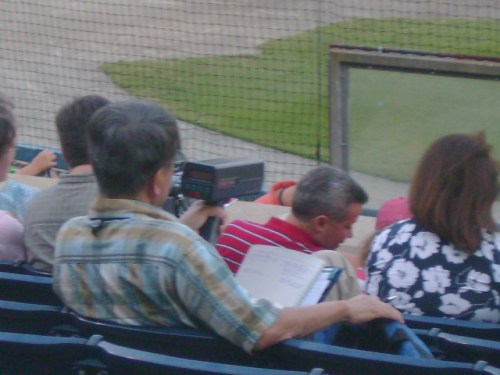
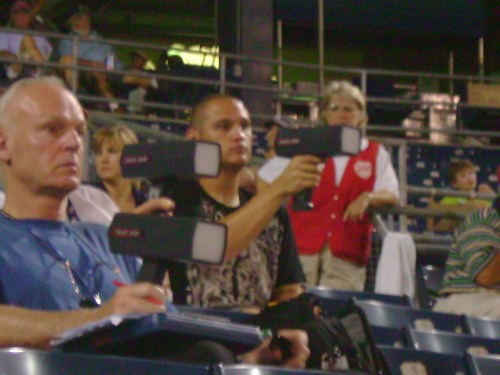
ScoutsGuns up: Scouts and Players with Radar Guns at Harbor Park
“If you don’t find high-caliber marble … you can’t create classic statues” John Schuerholz

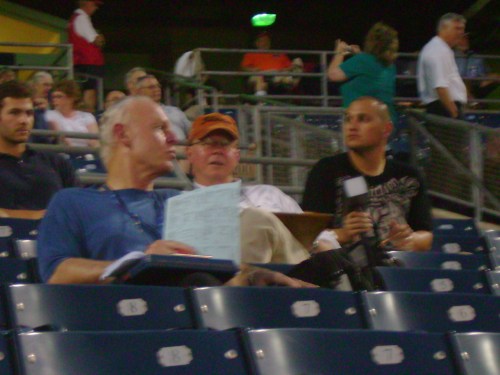
One of the interesting views from my pew in the Church of Baseball, Harbor Park section 102, Row B seat 2 is that of the scouts.  I often talk with my friend Elliott the Usher about the nuances of the game including the realm of the scouts, that often unsung group of men who find the raw talent that helps build the team.

Scouts are an interesting breed.  They work for a Major League club, but dwell in obscurity, as any true scout would do.  The seek talent, both raw and developed that will in their analysis help their club.  The scouts travel throughout the minors, colleges, high schools and independent leagues to see what talent might be available.  Sometimes they are former pro-ball players such as Bob Kison who works for the Orioles and Bill Singer who works for the Nationals, both of whom I have met this year at Harbor Park.  In addition to the team scouting organizations the Major League Baseball Scouting Bureau provides teams centralized scouting organizations which all have access to.  Currently the Major League Baseball Scouting Bureau employs 34 full time and 13 part times scouts in the USA, Canada and Puerto Rico.

I encounter a good number of scouts at Harbor Park.  They as well as player’s wives, families or friends and VIPs sit in section 100 to my left.  In addition to the scouts the Tides and the opposing teams frequently have at least one of their own players charting the game from that section.  I have had a number of interesting conversations about the game with scouts from the Orioles, Nationals, Pirates, Cubs, Mets, White Sox, Yankees and Braves as well as a scout from the Japanese Major League team the Yokohama Bays Stars.  There have been scouts from a good number of teams, including the Korean Baseball League that I have not chatted with prior to games.  One is very careful not to bother them during the game itself as they are looking closely at what is going on.  This is their bread and butter and they need to be respected while they work.

scouts 2Mets and Rays Scouts

Of course the job of the scout is directly impacted by both the current and projected needs of their teams, including the minor league system as well as how the teams are doing at the moment.  Thus from day to day scouts may be scouting individual players, or looking more in general for players that might of help to their team and its associated minor league system.  Once in a while I get to look at the sheets that scouts use in evaluating talent.  Since pitching is always a needed commodity they are seldom without their radar gun to measure the speed of pitches as well as charting pitch type, placement and what happened to the pitch.  It is a very detailed job collecting data on players as well as making first hand observations that could be as important as the numbers in determining whether a play is right for the organization.

The key to the success of any Major League organization is how well its scouting system identifies prospects for the big team.  Teams that are forward thinking spend the time and money to scout players either through the traditional methods or through the Sabremetrics system popularized in the book Moneyball about the Oakland Athletics methods under Billy Beane.  Some teams use a combination of both traditional methods and the more data oriented Sabremetrics. Some teams which are accused of simple “buying” their major league team through free agency like the Yankees actually have a very talented scouting department and minor league system.  The Yankees have built their own middle relief corps from their own system this year.  The bullpen with the exception of closer Mariano Rivera has been a weak spot over the past 8 years for the Yankees and they have remedied this on their own.  Likewise the Red Sox, Rays and Orioles maintain excellent scouting and minor league systems.  The Orioles are the newcomers in this building their team from scratch over the past few years.  In the West both the Angels and the A’s have strong minor league systems as do the Cardinals and Dodgers.

japanese scoutYokohama Bay Stars Scout

Unfortunately many organizations outside baseball, especially churches do not scout or develop talent.  Sometimes it is a organizational approach or prejudice that either seeks outsiders versus home grown talent, mega-churches are particularly bad about this often looking at outsiders to fill the their staffs.  On the other hand older main line denominations often are suspicious of outsiders even those with good track records.  Some Churches such as the Roman Catholic Church intentionally limit those who can serve as clergy to the ranks of unmarried celibate men, with a few exceptions made for married clergy from other churches.  Those men are taken through a process that often discounts any prior ministry they have as of little value and very few make it through the process of being ordained.  On the other side of the spectrum are churches which have no rhyme or reason as to how they choose develop or assign clergy with often very arbitrary means to choose pastors.  Clergy development from identifying young men and women who believe that they have a call to serve;  the nurture and care of these men and women, their education, formation and eventual ordination and assignment are particularly important if the Church is to fulfill its mandate of bearing witness of Christ in the world and caring for the people of God.

One can make application in many other fields.  In the military we typically recruit for most specialties but we look harder for specialties that require a more selective process such as Special Operations personnel.  In the medical field the military employs a very rigorous process of evaluating prospective physicians through medical school, internship and residency.  In specialties which a lot of personnel are required and in which there is a good amount of turnover and attrition many personnel are recruited but at certain career points a good number are weeded out.

Good scouting needs to be part of recruiting.  Talent must not simply be recruited based on test scores, but the whole person.  Organizations that seek excellence will use people to scout for and evaluate talent within their own organization or outside of it.  The goal of course is not to find one person that can play now, but to develop many people to deepen the organization and make it more resilient when it experiences personnel losses or has to make organizational moves. Without good scouting much recruiting effort will be spent and often wasted on people who do not fit what the organization needs at the present or in the future.

Peace, Steve+

Leave a comment

Filed under Baseball, leadership, Military, Pastoral Care, philosophy

Yet another Unexpected Death of a Shipmate and Probable Rough Seas Ahead

SCPO3DIn Memorium Senior Chief Hospital Corpsman D’Juana Hayes-Jones

This has been another difficult week at Portsmouth Naval Medical Center.  Once again we experienced the unexpected and unsettling death of a beloved Shipmate. HMCS D’juna Hayes-Jones, the Senior Enlisted Advisor for the Director of Nursing Services passed away early Wednesday morning of a massive Heart attack or another sudden catastrophic event.

I was just coming off of duty and conducting the duty turnover when the pager went off.  The chaplain relieving me took the page and came back saying that he had just been informed that we had lost yet another Shipmate and said that he had to go get more information.  I looked at our Deputy Department director and said: “I pray someone that I don’t know; I’m really tired of losing people that I know.”  A few minutes later my friend came back and gave us Senior Chief’s name.  I was pretty tired having come off a night with little sleep.  Initially I looked at him and the deputy and said; “I’m sure I know her but am trying to picture her face.”  We finished the turnover and I started to walk back up to the ICU when I clearly saw and remembered her face, which always had a friendly and caring expression.  I had just seen her and said hello the day before in one of the main hallways.  When this registered I simply said “shit, not another one, damn.”  This was the 5th active duty death that we have had since December.  I had met all five and had a decent number of interactions with three of the five.  Senior Chief was one that I had met a lot in the hallways, had frequent small conversations with and was involved quite heavily with when Senior Chief Pam Branum passed away on June 2nd of this year.  Additionally we had a civilian RN pass away and several civilians in our clinics.  The active duty deaths were all unexpected and tragic.  We have come close to losing a number of other shipmates who were very close to death but have since recovered.  With all the deployments added in we are all showing some strain with the loss of our friends and shipmates, so it is important to take care of each other because we don’t know what tomorrow brings.  With more deployments coming, a flu season that never ended and H1N1 looming on the horizon I fear that this will not be the last shipmate we lose this year.  I pray that I am wrong but my intuition tells me something different.  In the midst of this I am reminded that we must live to the fullest and not waste the life that God has given us. As Marcus Aurelius said “Execute every act of thy life as though it were thy last.”

Losing good people, who care for others, strive for excellence and serve faithfully who are younger than me, is getting old.  Senior Chief from what I had seen and heard was a great leader who really cared for her corpsmen and the nursing Staff.  She could always be found out among her corpsmen on the nursing units and clinics.  She was kind, fair and a caring teacher, coach and mentor to many corpsmen and nurses.  Her loss was met with stunned disbelief by those who knew her and who really have not yet fully recovered from the loss of Chief Branum.  Her death has shaken all of us who knew her, from the most senior officers and Chiefs, to the most junior corpsmen as well civilian staff.  I and most of our other chaplains have spent significant time with our shipmates since this happened.

Senior Chief Hayes-Jones would have had her retirement ceremony on August 28th.  She leaves behind two children, her husband and her shipmates.  We will have a memorial service for her next week; the date is still to be announced as of this post.

God bless you all and take care of each other as we once again walk through the valley of the shadow of death.

Peace, Steve+

3 Comments

Filed under healthcare, Military, Pastoral Care

I Think I Feel a Sermon coming on…How Some Churches Stopped Caring and the Neglect of Pastoral Care

“When they had finished breakfast, Jesus said to Simon Peter, ‘Simon son of John, do you love me more than these?’ He said to him, ‘Yes, Lord; you know that I love you.’ Jesus said to him, ‘Feed my lambs.’ A second time he said to him, ‘Simon son of John, do you love me?’ He said to him, ‘Yes, Lord; you know that I love you.’ Jesus said to him, ‘Tend my sheep.’7He said to him the third time, ‘Simon son of John, do you love me?’ Peter felt hurt because he said to him the third time, ‘Do you love me?’ And he said to him, ‘Lord, you know everything; you know that I love you.’ Jesus said to him, ‘Feed my sheep.” John 21: 15-17

“Take care that you do not despise one of these little ones; for, I tell you, in heaven their angels continually see the face of my Father in heaven.” Matthew 18.10

Back when I was doing my Clinical Pastoral Education Residency at Parkland Memorial Hospital I was astounded to hear my pastor make a comment which I think was one of the most heartless that I have ever heard said from a pulpit.  The church was a large and trendy Evangelical-Charismatic Church which I had attended throughout seminary and had ordained my in October 1991.  The Pastor was recounting an incident where one of our members had been critically ill in hospital and had not been visited by him.  After the parishioner was released from hospital he asked the pastor: “How sick do I have to be for you to visit me in the hospital?”  The pastor told us his response: “Sir, you don’t want to b e that sick.”  The congregation laughed at the pastor’s story and he went on to talk about how he and other senior pastors should not be doing that kind of work because it “distracted them from bigger Kingdom tasks.”  You see according to the pastor the care of sick parishioners did not contribute to the “growth” of the church and thus was a “distraction and better left to others.”  The comment struck a raw nerve now that I was dealing with the suffering and death every day of people who had been abandoned by the churches and pastors.  I lost all respect for him as a man and pastor during that sermon.  The words of my Philosophy of Religion Professor at Southwestern Baptist Seminary Dr. Yandall Woodfin said: “You have not done Christian Theology until you have dealt with suffering and death.”  This pastor had stopped doing Christian Theology in order to be an “Apostle” and CEO.  He was “growing” the church and managing programs, but had for the most part stopped caring as in being a pastoral care giver.

Now this pastor is not alone and nor is the issue confined to Evangelical or Charismatic churches. The trend has has found its way across the denominational spectrum.  Sometimes this is by design as is the case of the Mega-churches.  Pastors of mega-churches are for all practical purposes CEOs of large organizations and have a multiplicity of specialized staff, but often which do little for pastoral care. Sometimes it is by default in cases such as the Roman Catholic Church.  Here the ever worsening shortage of Priests is forcing the closure of smaller parishes and the increase of large parishes with a corresponding decrease in what Priests can do for their people.   Even very good Priests cannot keep pace with the demand of both Sacramental needs as well as pastoral care.  No matter if it is by design or default the result is similar.  The least, the lost and the lonely those “lambs” that Jesus talks about who need care and feeding are shunted aside.  In one case, that of the Catholic Church it is simply a lack of Priests, Deacons and Sisters to provide this care.  The other is more troubling as the focus of the church is growth, sustaining numbers, programs and buildings.  This requires that pastors spend their time with members who can supply the vast financial need that those plans require.  I have seen this in numerous congregations across the spectrum, which sometimes as was the case at a church that I attended in Florida results in a financial meltdown and collapse of the congregation, many of whom gave up and went elsewhere when the extent of the scandal became known.  Likewise the ripple effects that this caused in the denomination were like a Tsunami, it was disastrous and the church is still in recovery mode.  Going back to my pastor back when I was in residency I got the feeling that had he been the shepherd in the Parable of the lost sheep (Luke 15) that he would have let it go as hunting for it might have distracted him from the others.

When I was in seminary there were quite a number of my fellow students who chafed about having to take courses on pastoral care.  I remember friends and fellow students complaining that what they needed were more “practical courses” such as “church growth, evangelism and Sunday School program management.”  Course such as Pastoral Care were seen as a bother and distraction.  Not to mention academic courses such as Systematic Theology, Philosophy of Religion and Church History.  One friend talked about his Master of Divinity only having a “shelf-life of 5 years” because what he learned would be outdated.

Well in a way he was right.  His focus was on classes that dealt with programs and methods of church growth, programs and management.   From that perspective his degree would rapidly be obsolescent as soon as the next trend in church growth came along and everyone jettisoned the last method in favor of the new.  With the ubiquity of the Mega-church which unlike the Leisure Suit is not going away anytime soon.  The rise of the “Superstar” Pastors such as Bill Hybels, Joel Osteen and Rick Warren and the proliferation of massive “Ministry Media” conglomerates and stand-alone television ministries are actually dangerous to the vitality and health of the Christian Church in the United States.  They propagate methods which have the sole intent of getting people into church or giving to a ministry and keeping them there, doctrine, worship, sacraments or ordinances, and pastoral care of the least, lost and lonely be damned.  The methods are pragmatic and impersonal.   Numbers and crowds define expertise, credibility and worth. The bigger the church the better the church, it’s that simple.

Unlike others who pick these ministers apart for their theology or business practices my problem with what is happening is what happens to regular people in these large and often very impersonal churches.  It is easy for people to get lost, forgotten and when they are going through difficulty abandoned when the church stops making a conscious effort to do real pastoral care and focus purely on the programs which lend to growth.  Often the substitute for pastoral care is found in the home cell group, or care group or whatever cute name a church can pin on a meeting at a member’s house.  The cell groups have a noble intention.  They attempt to build community in an otherwise very impersonal organization.  There are some really good things that can come out of healthy home groups as well as long lasting friendships.  We have a couple from our time in San Antonio that is still a very real part of our lives, they showed us genuine love and care and we remain friends.  Of course this couple had an advantage over most home group leaders; he was a Clinical Social Worker by trade who was heading off to seminary.  Most home groups are not that fortunate.  At the same time there are unhealthy groups which are led by people who are poorly trained and equipped to deal with broken people.  The good group leaders recognize their limitations and try to get help for those who are really hurting.  Others who do not know their limitations end up abusing these dear lambs of God. Often this is because sick, depressed or lonely people take too much time, are too needy, or that their problems don’t match up with their church theology.  We know this from personal experience as my wife suffered from a number of ailments throughout seminary and we were going through tremendous health and financial difficulties and in some places we felt cast aside and like we did not matter.  We were fortunate that some people did care and we did make it through, however it was not something that I would ever want to repeat.  I have heard similar stories from hundreds of people that I have come across in my life and work over the years.  Another thing some churches do is to either add a “Christian Counseling” program or refer members to “Christian Counseling” services instead of doing pastoral care.  In a sense it is the outsourcing of one of the most vital missions entrusted to a church, the pastoral care of the flock of God.

I don’t care what you call it, but any church which has multiple services of several thousand or a major service of close to 20,000 as occurs at Osteen’s Lakewood Church is no longer focused on caring for people but sustaining their growth and market share.  I remember reading Charisma Magazine back in the mid-1990s when I still read it regularly about a church in North Dallas that has a period of incredible church growth in which it grew from 1,200 members to well over 7,000.  In the article the pastor touted the church programs which drew people to the church.  What the dirty little secret which was not mentioned was that two exits south of this church a Mega-church of some 10,000 members imploded when the Pastor, one Bob Tilton got caught doing some pretty bad stuff.  This church despite its claims of great programs simple picked up about 6,000 of these people because they were close by and a similar type of church.

All of this is dangerous as to its impact on people.  One only has to look at the latest Barna Polls about what is going on in churches to see that these large churches are alienating people even as they grow.  People come, but others either burn out trying to keep pace with the manic pace of programs proliferated by these churches or they get lost in the crowd and forgotten.  I meet a least a person every day who is a displaced Christian, often hurt, lonely and broken, not only by what they have experienced in life, but by the cold emptiness that they feel when a church surrounded by thousands of people who don’t even know their name.  Some churches do recognize that people have issues that need to be addressed and have in-house “Christian Counseling” programs or refer members to “Christian Counseling” services.   I think that there certainly is a place for clinically trained therapists in the life of a church; however this is not really pastoral care, even when they use “Biblical” methods.   In a sense it is the outsourcing by pastors of one of the most vital missions entrusted to a church, the pastoral care of the flock of God to others, in a sense, “hirelings.”  Again my issue is not with the therapists or Christian counselors, but rather pastors who refuse to do pastoral care as part of their ministry.

Ultimately it is people that are important, even those who are not rich, powerful and who have problems that don’t fit nicely into theological boxes or paradigms promoted by church growth experts. It is high time that churches start reclaiming one of the most vital missions given by Jesus to his Disciples, to care for the least, the lost and the lonely. The onus for this falls on pastors who cannot simply outsource one of their primary missions as given by Jesus himself to others.  If pastors do not set the example of being caring pastoral care givers, it will not matter that they are supposedly “empowering” laypeople to do ministry.  Instead it sends another more ominous message, that if it is not important for the pastor, why should it be important to me?  Every member of the church at some time goes through a crisis when their faith, family, health or vocation.  Sometimes these are not isolated events but rather prolonged periods of anguish, as what Saint John of the Cross described as “the Dark Night of the Soul” where it seems that God has even abandoned the person.  Unfortunately people in this situation are often abandoned by their church as things fail to improve.  Despairing they become the lost sheep whose shepherd has abandoned.  This is the hardest time for pastoral care, the times where we as pastors are called to stand with someone as Mary the Mother of Jesus did at the Cross, just simply being there though nothing else can be done.

Now do I understand that the demands of running a large church can be sometimes become such that pastors have difficulty making time for pastoral care?  Of course I understand this, at the same time pastors, even those who function primarily as pastor-teacher/CEOs still have the responsibility of caring for people, not simply administering programs and preaching.  Pastors need to set the example of care for people, real people, the regular Joes and Jane’s who populate their pews, by their books and give to their ministry, even if it is only in small ways, not just the super-givers or the wealthy and powerful.  James’s “right strawly epistle” (Martin Luther’s words) has much to say about favoring the rich and powerful and neglecting the poor and seemingly insignificant people hanging about the peanut galleries of their large “Worship Centers.”  Even if the pastor has limited time he or she must be about the flock, or they will forget what the needs of the flock really are and instead of the People of God, the lambs who Jesus says to care for they will simply be the consumers of a religious message who we have to keep coming back to keep the operation going.

My sermon is over and I do hope that there will be more “amen’s” than calls for burning me as a heretic.

Peace, Steve+

3 Comments

Filed under Pastoral Care, philosophy, Religion