Category Archives: Pastoral Care

HD Dreams and Stranger Things Part Two: Sleep Medications and Dreams, the PTSD Conundrum

270107_10151361199622059_1286921284_n-1

Ever since Iraq I have had terrible times with insomnia as well as very vivid dreams and nightmares. I have written about it in a previous article HD Dreams and Stranger Things: PTSD and Sleep.

Over the past four years or so I have been on various sleep medications, none of which has done much of anything to help my sleep. Most have left me drowsy on awakening the next day as if I was hung over, without the fulfillment of getting shit-faced the night before surrounded by friends. Believe me a good craft beer, or a lot of good craft beer does me a lot more good than various sleeping pills.

At the same time they have done strange things with my dreams. At times they are most vivid and terrifying and at other times for whatever reason they have been practically suppressed depending on the medication.

I found that because of the amount of the anxiety and insomnia that I had that my doctors prescribed high doses of the various medications used. Most had little effect, sleep was still at a premium and in the morning I would wake up groggy. That was my life the past for the past five years if you count the time before I started taking sleep medications.

In the past week that has changed. I mentioned in that previous article that I was beginning a course of therapy that would involve some different techniques to help me deal with the symptoms of my PTSD. That therapy was incredibly helpful and helped me to put my experiences into a perspective that before was not possible. Likewise my therapist dealt with my frequent sleep disruptions and made recommendations concerning how to manage my sleep.

We experimented. Since I was on a fairly heavy dose of Lunesta and still had to maintain a duty pager adjustments had to be made. On the nights when I had no duty I took no medication with the effect of getting no sleep at all and feeling like crap the next day. On days I took my medicine I would get some sleep, frequently interrupted and always with the consequence of a drug induced hang-over in the morning. Finally we tried a couple of more things. First was the use of a over the counter sleep aid used by many physicians that have to work odd on call hours called Insomitrol. It is a mix of Melatonin and Gaba extract. On the plus side I did not feel hung over in the morning. One the minus side my HD dreams went to 3D Luscasfilm HD and were the most memorable, surreal and occasionally frightening dreams I have ever experienced. We ended that experiment and went to over the counter Melatonin. It has worked well. My sleep is no worse, my dreams are quite fascinating and I do not feel hung over in the morning. I have discontinued the use of the Lunesta.

I still take an anti-anxiety medication to help bring me down at night and I will be obtaining either on my own or through the military a bio-feedback program to use on my computer before I go to sleep.

Since starting the Melatonin my sleep has gotten better. The HD dreams are still there and memorable enough that I can remember them and hope to find some meaning and interpretation in them, even the nightmares.

Those of us that deal with the aftereffects of PTSD and trauma have much to deal with. Sleep or the lack of it, dreams and nightmares, medications and the use of other drugs or alcohol are rampant among veterans with PTSD. There is no “silver bullet” or “cookie cutter” that works for all of us. But for me this seems to be a means of freedom and healing. I hope that my experience helps others and encourages them to work with their physicians, therapists and spiritual advisors on their journey to healing.

I don’t understand all the scientific aspects of sleep. I am beginning to learn about them though and as I learn it takes away some of the fear of closing my eyes, which for me opens a world more vivid, surreal and sometimes terrifying than keeping them open. But it is an unexplored world for me, one that I hope and pray helps me continue to integrate my life, faith and spirituality in ways that I never could have imagined before.

To me that is absolutely fascinating and something that I look forward to experiencing.

Peace

Padre Steve+

1 Comment

Filed under healthcare, Pastoral Care, PTSD

Advent and Life: God Loves the Real World

2004weihnachtsbrief

O come, thou Dayspring, come and cheer
our spirits by thine advent here;
disperse the gloomy clouds of night,
and death’s dark shadows put to flight.

(From O Come O Come Emmanuel) 

Today is the fist Sunday of what we in the liturgical Christian world know as the season of Advent.

Advent is the beginning of the liturgical year, in a sense the opening day of a new season of faith, as much as the Opening Day is in Baseball. It is a season of new beginnings, of hope looking forward and looking back. It is a season of intense realism. It is a season where the people of God look forward to their deliverance even as they remember the time when God entered into humanity.  It was not simply entering the human condition as a divine and powerful being inflicting his will upon people but deciding to become subject to the same conditions know by humanity. As Paul the Apostle, wrote about him: “though he was in the form of God, did not regard equality with God as something to be exploited,  but emptied himself, taking the form of a slave, being born in human likeness. And being found in human form, he humbled himself and became obedient to the point of death– even death on a cross.” (Philippians 2:5b-8) 

In the incarnation Jesus Christ shows his love and solidarity with people, humanity, the creation, reality. Dietrich Bonhoeffer wrote:

“God loves human beings. God loves the world. Not an ideal human, but human beings as they are; not an ideal world, but the real world. What we find repulsive in their opposition to God, what we shrink back from with pain and hostility, namely, real human beings, the real world, this is for God the ground of unfathomable love.” 

That simple fact is why Christ came.

He didn’t come to found a government. He did not come to exemplify “Christian” virtues or to condemn people that religious people condemned as sinners.

The meaning of the incarnation, and the hope of the season of Advent is that God loves people, even those that some that presume to be his spokesmen and women despise.

In the next few week there will be much written and said about Jesus. Much of it will not actually deal with Jesus or the people that he came to save but instead about the worldly power and influence of those who seek the profits of being “prophets.” Some of them will talk fervently about the “war on Christmas” as if somehow God and Christ are so small that they need government sponsored displays in the public square in order to be real, relevant or or for that matter important. What a small God they must have.

Somehow the message of Advent, the coming of Jesus is contradictory to the message of the for profit prophets. Certainly the early Christians had no government backing of any kind. They simply lived the life and showed God’s love to their neighbors, often at the cost of their lives and paradoxically the message was not crushed, but spread and overcame an empire. It was only when they became co-executors of government power that the message of reconciliation became a bludgeon to be used against those who did not agree with the theology of the clerics beholden to the Empire.

The Christ of the Season of Advent, the one who came and who promises to come again is not captive to the capricious message of the for profit prophets and their political and media allies. I would dare say that God is much bigger than them or those that they believe will somehow end the Christian faith as we know it. But then maybe the Christian faith “as we know it” is more a reflection of us and our need for temporal physical power over others than it is of Jesus.

All I know is that the simplicity of the message that “for God so loved the world that he gave his only begotten Son” is more powerful than any political-religious alliance. Likewise the two things that Jesus said to do in order to “inherit the Kingdom of God” were to “Love God with all your heart and love our neighbors as ourselves,” and similarly the words of the old Testament minor prophet Micah, who asked “what does the Lord require of thee? To love show justice, to love mercy and to walk humbly with thy God.” But then there is not much money or political power in that is there?

But despite the inconvenience of a direct temporal profit or power which is so central to most churches, I do think that the message that God loves the real world is worth repeating. In fact I think that because the message of God’s great love for those deemed “repulsive” is so distasteful to the “for profit prophets” of our time that it is not only worth repeating, but actually believing.

It is a good reason for me to during this season of Advent to look forward to our celebration of the mystery of the Incarnation, the coming of the God who “emptied himself” and took “the form of a slave” in order to save his people.

Peace

Padre Steve+

2 Comments

Filed under christian life, faith, Pastoral Care, Religion

Talking Without Listening or Understanding: American Christianity 2012

“Christians, especially ministers, so often think they must always contribute something when they are in the company of others, that this is the one service they have to render. They forget that listening can be a greater service than speaking.” Dietrich Bonhoeffer

I think that “Christian” television, radio and entertainment is perhaps the among the most destructive forces in our society. In them a complete insulated subculture of demigods living in their own self made cloud-coo-coo land of make believe attempt to give answers for society’s ills, protect the faithful from the evil of non-Christian thought and for that matter of non-Christian people and to influence politics in ways that Jesus would never countenance.

I know this. I actually worked for a ministry of one of the current leading “Pastors” of the Christian political right back in the 1990s. The mindset inside the television and radio ministries of Evangelical Christianity is almost as insular, make believe, paranoid and power hungry as was the Papal Curia in 1517. Actually for someone who is a historian with a pretty in depth knowledge of the Reformation, particularly that of Martin Luther in Germany it is a frightening thing to see.

It seems today that preachers, in particular those in high profile mega-churches and ministries want to say something about everything under the sun and then throw in a “In Jesus Name” here and there to make their opinion sound Christian. Now that is not a problem limited to big name evangelists or even Evangelical Christianity. It exists in mainline churches, the Catholic Church and even other religions, can I get a Fatwah on that?

But because the leaders of the multi-billion corporate empires of the modern Evangelical movement have a vested interest in keeping the money flowing into their tax exempt institutions they must be relevant. Thus even if they no nothing about a subject they must write books and preach sermons on what God thinks of well you name the topic, everything from economics to foreign policy and even who God says you should vote for or against certainly not for the black guy in the White House, but I digress.

While beating their gums into a fervor and frothing at the mouth at evils real and imagined to keep their followers money coming they to use the Old Testament example of Esau “sell their birthright for a cup of soup.”

Bonhoeffer saw preachers of his era do the same thing and he was a critic of them with good reason. In their fear and hatred of the change that occurred when Imperial Germany went under and “Jews and Bolsheviks” threatened their position they ended up helping to create a climate where Hitler not only came to power but had the open support of many Christians and the tacit approval of the vast majority of German Christians of all denominations.

In the midst of crisis and uncertainty they gin up fear against “the non-Christian other.” The big problem for the German Christians of the 1920s and 1930s as well as our current crop of American church leaders is that they stopped listening and instead decided that they had the answers to all of society’s problems. In Germany after the Nazis were crushed by the Allies the Churches suffered major losses of credibility. Young people who had experienced the war, or who grew up in the desolation of post-war Europe left the churches in droves because of the terrible witness of supposedly Christian leaders and churches.

I would dare say that the vast majority of Evangelical leaders have simply stopped listening to anyone that would disagree with them. The evidence is manifold in our current political crisis in the United States where Christian leaders often are the most base and vile of all political pundits and politicians.

It is no wonder that the fastest growing religious preference in the country is called “the Nones.” In other words those with no-religious preference who have dissociated themselves from any Christian church. It is not because they have a problem with God or Jesus per say, it is because of the pompous asses that only care about them for the market share. Chuck Colson once noted that the Pastor of a large mega-Church told him that he was “paid to keep them coming in the door” not to preach any real truth, but to keep the empire afloat. Believe me the mega-churches and media empires of Evangelicalism require vast amounts of money just to keep their mortgages, air time and pastors well paid.

Moral lapses and corruption in these empires is rampant. Time after time the leaders of these “ministries” are exposed as money grubbing hypocrites who lash out at whatever group that they need in order to create straw men to keep their ministries alive.

Basically the leaders of Evangelicalism have stopped listening and even worse stopped caring about people. The empires must be maintained by “tithing units” as the son of a Bishop once called parishioners. It is the ultimate devaluing of people that Jesus died to save. Think about it. People only matter for the capital that they contribute to maintain the institution. I cannot think of anything more blasphemous and it will be the cause of the fall of contemporary American Evangelical Christianity.

Peace

Padre Steve+

2 Comments

Filed under christian life, faith, Pastoral Care, philosophy, Political Commentary, Religion

Persistence: My Motto

Persistence by Calvin Coolidge

“Nothing in the world can take the place of Persistence. 

Talent will not;  Nothing is more common than unsuccessful men with talent. 

Genius will not;  Unrewarded genius is almost a proverb. 

Education will not; The world is full of educated derelicts. 

Persistence and determination alone are omnipotent. 

The slogan ‘Press On’ has solved  and always will solve the problems of the human race.”

If there is anything that I find is true about me it is that I am a persistent person. The motto on the family crest is the French word Esseyez, or in English, “try.” Somehow I can see the chieftain of the clan lining everyone up behind William Wallace, who by the way was executed on this day in 1300 inspiring his troops saying, “just try for once.” My parents used to say “quitters never win and winners never quit.”  I have been inspired by great naval Captains like John Paul Jones who when asked if he had surrendered replied “I have not yet begun to fight” and James Lawrence who when mortally wounded gave his crew the order “Don’t give up the ship.” I am inspired by the words of the legendary manager of the Baltimore Orioles Earl Weaver who said “It’s what you learn after you know it all that counts.”

I love this poem by Calvin Coolidge. In fact I have a small framed copy of it presented by my residency director at Parkland Memorial Hospital in 1994 on my desk today.

I have never been the smartest, fastest, strongest, talented or educated dog in the pack.    I just work hard and don’t quit. I love the journeyman that one finds in baseball. I admire the utility player who can play a lot of different positions, plug holes and fit in well on the team. The same for the pitchers pitchers that pitch in middle relief or are the 5th starter in the rotation. I like the guys that gut it out and hang around long after others have written them off.

I have been having to go through and recount the really significant parts of my life as I get ready for the EMDR and Biofeedback therapy for my PTSD. It has been really amazing to see a couple of threads that are prominent in the tapestry of my life and without which I would not be me. The things that keep coming up again and again are a dogged persistence to succeed and unwillingness to quit and profound dislike of bullies.

My Clinical Pastoral Education residency which followed a brutal seminary process was one of the most pivotal parts of my life. My CPE Supervisor was a man named Steve Ivy. CPE is one of the best training in that anyone working with people in churches, hospitals or the military can have. For me it helped me see areas that I was blind to in my life. It helped me become a better listener and more accepting of others. But even more it helped me, and still helps me integrate me theology and philosophy into life.  Dr Ivy made a comment that was one of the most instrumental in my life since I heard it. That is that I can write my future that I do not have to be condemned to perpetually repeating the past or being stuck in place or being a victim of circumstances or others. It was a revelation of a positive humanity and the grace of God.

But even before that I was a fighter. In seminary when everything that one could imagine to go wrong did and pastors, and people at ministries told me that I should reconsider my call or quit. In the fall of 1989 when everything had gone to complete shit in our lives, Judy was sick, we had lost our home, cars and were living in a horrible house in a horrible neighborhood of Fort Worth, I was working two jobs and was in the National Guard, was a full time student and it looked like my time in seminary was over and that I had failed I called a TV ministry prayer line. I told my story to the prayer partner who told me that I couldn’t be called to ministry because if I was “God would be blessing me.” Somehow that hit me wrong. I just couldn’t imagine Jesus telling anyone that, nor could I reconcile it with Scripture or Church History.

I got mad and kept working despite everything going to hell managed to hang in long enough for things to work out. I didn’t do it all myself because a lot of people came alongside when they saw that I was in this for the long haul and would not quit. I graduated from seminary in 1992 with a 3.5 or 3.7 GPA, I can’t remember which and am not looking at a transcript while working more than full time and being in the National Guard. I worked my ass off and between good people and the grace of God made it through.

That continued after seminary when I was a late addition to the residency program at Parkland, when I got my first hospital chaplain job and when I was rebuffed by a senior chaplain in the Army Chief of Chaplains to return to active duty as a very young Army Reserve Major in 1997. He told me that I wasn’t good enough to bring back.

But despite that things continued to work out. I was helped along the way by great people. I had opportunities that opened up which gave me great experience and provided for my family. This culminated when I was selected for active duty in the Navy and resigned my Army commission to go in the Navy Chaplain Corps at a lower rank in February 1999.

There have been hard times in the Navy especially after my return from Iraq. I went through an emotional and spiritual crisis that I never imagined was possible, but I  I didn’t quit. I am an average guy who worked hard and got a lot of help along the way. But had I quit at any point I wouldn’t be where I am now and there were plenty of opportunities when I was ready to give up but held on just long enough to make it through.

Calvin Coolidge was so right. I am not the most talented person that I know in my field. I am not a genius and though I have a good education there are plenty of other people that know a lot more than me. However, I am persistent. I gain inspiration every day when I look on my desk and read that poem. I am thankful for grace of God and the people that God put in my life and who helped me during the tough times. I hope that I can always be the kind of person that helps people through their tough times and inspires them to keep trying, to keep working and never to quit and then pass that along to others.

The past few weeks have been a blessing because I have had to look back at my life and remember what got me to this point. Some of the memories have been difficult to think about because they were so difficult but at the end of the day I can count myself blessed.

Have a great night and don’t give up your dreams and always stay in the fight.

Peace and Blessings!

Padre Steve+


2 Comments

Filed under christian life, faith, leadership, Pastoral Care, philosophy

Sweet 16: Celebrating 16 Years Since My Ordination as a Priest

“Practically speaking, your religion is the story you tell about your life.” Andrew Greeley

It was a quiet celebration of Eucharist with Judy this afternoon at my dinner table. I was wearing a stole that Judy made which has been with me around the world and which I wore throughout my time in Iraq. The chalice was a very simple one that I got in Germany when I was stationed there in 1996-1997. The other elements that I used, the paten and crucifix were those that I used in Iraq, as was the lectionary that the readings came from, which has a cover that Judy made for my travels.

Our dog Molly was at my feet and our Papillon puppy Minnie decided that she needed to stay in Judy’s arms for the duration of the liturgy. This is nothing new, our dogs have pretty much been there any time that we have had a home Eucharist. Frieda, our Wire Hair Dachshund I’m sure was a lapsed Bavarian Catholic who if she attended was passed out. Greta our red smooth hair Dachshund would always be with us, but usually would be asleep next to Judy. Molly just likes to be with daddy and this was Minnie’s first Mass. Minnie made us laugh when she tried to get into the chalice as I gave it to Judy, but thankfully she did not succeed.

My service as a priest has been exclusively as a military Chaplain, first in the Army and since 1999 in the Navy. I have not yet had to opportunity to serve in a civilian parish though I have on occasion assisted fellow priests at their parishes. My current assignment is a hospital and most of my duties are related to patient care or staff support. Thus when I am home in Virginia I attend St. James Episcopal Church in Portsmouth where I first started attending while serving at the Naval Medical Center in the midst of my crisis of faith. I love that little parish which has its roots in the former slaves and freedmen of the city.  Down here at the Island Hermitage I have not found that place where I feel at home so on weekends that I am here I typically will do the daily office and Eucharist at home.

So my parish is wherever I serve as a chaplain but in a sense my readers are an extended part of my parish. Father Andrew Greeley wrote:

“I wouldn’t say the world is my parish, but my readers are my parish. And especially the readers that write to me. They’re my parish. And it’s a responsibility that I enjoy.”

I get notes from people on this site quite often who have experienced the pain of spiritual abuse, trauma from various sources and who have experienced a crisis in faith or lost their faith. I hear from others that have been ostracized by their churches for various reasons. They write in response to articles that I have written about my own crisis of faith following my time in Iraq and struggle with the demons of PTSD. It was a time where I felt abandoned by God and the church. I found that churches can be painful places as often as they become places of healing. Having been asked to leave the denomination that ordained me in September 2010 as I began to recover faith after spending nearly two years struggling I understand that pain. But I agree with Jurgen Moltmann who said of his experiences in World War II and its aftermath “Christ’s own ‘God-forsaken-ness’ on the cross showed me where God is present where God had been present in those nights of deaths in the fire storms in Hamburg and where God would be present in my future whatever may come.”

Today was nice. We spent time together and after the scripture readings and before the Eucharist we simply talked about the journey and how different things are now than when I was ordained. The world has changed and so have we. War does that.

I have been thinking a lot this week about this and how blessed I am to be a priest and chaplain. I am blessed by people who taught me, mentored me and cared for me throughout my journey. I am blessed to still be able to serve God’s people and my church even as I serve those that serve this country in the military.  I try to remember as Andrew Greeley wrote in one of his Bishop Blackie Ryan mysteries that:

“Every sacramental encounter is an evangelical occasion. A smile warm and happy is sufficient. If people return to the pews with a smile, it’s been a good day for them. If the priest smiles after the exchanges of grace, it may be the only good experience of the week.”  (The Archbishop in Andalusia p.77)

This week I was humbled when one of my old shipmates from my time on the USS Hue City posted a comment on my Facebook page about the impact that I had made in his life about 10 years ago.  The week was supposed to be a bit relaxing but I spent a good amount of it dealing with the tragic suicide of one of our Corpsmen who worked at one of our hospital clinics.  I will continue to be working with that situation this week and would appreciate your prayers.

We also had our tankless water heating system go out and have been shuttling in to the base to take showers at the hospital locker room. Hopefully the maintenance man has the new component tomorrow. As it is I will be going in to work very early to PT and shower before my first meeting and what promises to be a very busy day as we prepare a memorial service and care for our shipmates.

Judy came to North Carolina this week and leaves tomorrow. Molly as usual will remain with me and Minnie after a wonderful week of growing up is going back to Virginia with Judy.  It has been, excepting the oppressive heat, humidity and lack of hot water for showers been an enjoyable time together. We were able to have dinner last night with our friends from Kinston, Jerry, Toni and Cara in New Bern.

Since tomorrow will be a very early start I will close.

Anyway, grace and peace,

Padre Steve+

1 Comment

Filed under christian life, faith, Pastoral Care, Religion

The Uncomfortable Truth about the Rise in Military Suicides

The truth can be uncomfortable and truthfully most people don’t like to deal with uncomfortable things.  Suicide is one of those things that tend to make us uncomfortable.  Occasionally someone will demand the truth and when they finally get, the truth becomes a very uncomfortable thing and frankly many people cannot handle the truth. It reminds me of the exchange in the movie A Few Good Men where Colonel Jessup played by Jack Nicholson tells Lieutenant Dan Caffey played by the Tom Cruise: “You want the truth, you can’t handle the truth!”

The United States Military has been struggling with an upsurge of suicides and suicide attempts among its personnel since 2005.  Before that point military suicide rates were comparable or lower than comparable civilian populations. That is no longer the case, the military suicide rate is now higher than the civilian rate by a statistically significant percent.

The Associated Press reported a Defense Department report noting that in the first 155 days of 2012 that 154 active duty service members had killed themselves. That number is going up, I know of at least two at my base that have occurred since this report was released including a murder suicide committed by a Staff Sergeant who had recently returned from Afghanistan.

The military has tried to stem the tide. It has bolstered its mental health services and suicide prevention programs but the numbers despite leveling out in 2010 and 2011 have been rising. These numbers are reaching staggering proportions in the active duty, reserve and discharged veteran ranks.

A Veteran’s Administration Crisis line reported that in in 2011 it had received over 164,000 calls last year. It reported 6760 rescues and noted that 2300 self reported Active Duty personnel had called their hotline as well as over 12000 calls from family members or friends of veterans regarding their loved ones.

The rise in suicides particularly as the mission in Iraq has ended and Afghanistan is beginning to draw down has surprised many both inside and outside the military. While many of the men and women who committed or   attempted suicide even more have done so who have not deployed. People are speculating about the reasons for this and we know a lot of the answers and underlying causes.

First and foremost is the stress put on the force by 10 years of non-stop deployments to combat zones and fighting two major insurgencies at the same time and the resultant effects: Soldiers, Sailors, Marines and Airmen killed and wounded, combat stress injuries, PTSD, TBI, moral injury, family issues, divorce, infidelity, financial problems, domestic violence, sexual assault, alcoholism and drug abuse. As a Chaplain I know many young men and women who grew up in Christian homes and had what they described as a deep faith who after war have lost their faith. I see an increasing number of these young men and women.

An additional factor is the fact that we are entering a period of time where Soldiers and Marines and to a lesser degree Sailors and Airmen are being threatened with a massive drawdown in numbers.  This will force many to leave the military in the midst of a long term economic downturn that could get worse based on the precarious economy of the Eurozone which threatens the US economy.

There is the perception on the part of many in the military that they fight the war alone. There is a real lack of understanding in the civilian population as a whole about what is involved in going to war. Since only about one half of one percent of the American population is in the military at any given time this should not be a surprise. Finally there is a widely held belief among those that fight the war, no matter what sacrifices they make in Afghanistan that it will not matter in the end, that the war cannot be won. No one wants to admit this but the fact of the matter is that it is true because neither political reads history.

However as important as all of those factors are they are now joined by another factor that was not a factor in the early part of the war. The bond of unit cohesion which was a positive factor is eroding. Prior to the war and during the first few years of it unit cohesion was strengthened by seasoned and mature Staff NCOs, Petty Officers. These men and women had risen through the ranks and were seasoned by years of training, well rounded careers, combat experience and deployments. Many had some amount of college education. They dealt with their own stress well and were excellent leaders and mentors to junior personnel and the young officers that they helped to train.

I was at a training conference in March attended by a couple of hundred Chaplains and Mental Health Professionals. One of the seminars dealt with a program to train the young NCOs and Petty Officers to be first responders who could care for their Marines and Sailors. During the question and answer portion I decided to bring this up. I said that “the program would be great if we had the same force that we started the war with and that the men and women that we were depending on to do this job were themselves among the injured.” I said that the force was “hardened but brittle.” A number of people including the Subject Matter Expert agreed with me, others, mostly those who were relatively new to the military looked at me like I had gone off the reservation. I brought this up at another conference this month with a similar response.

That seasoned core is gone. In their place are younger, combat hardened veterans. Unfortunately many of these young men and women, charged with leading and training the new Soldiers, Marines, Sailors and Airmen are damaged goods themselves. They have been back and forth to war so many times that they bear unspeakable burdens. Many suffer from unreported PTSD, struggle with alcoholism and have pressing personal or family problems. Some of them take out these issues on the new troops, something that I think is directly related to the suicide epidemic and other problems. The attitudes of some have become poisonous to good order and discipline and actually compromise the trust of of service members to the chain of command. That trust was essential and helped get the military through the first part of this war but I see it being eroded on a daily basis.

A glaring example of this comes not from a NCO but a Army General, the Commander of the 1st Armored Division at Fort Bliss Texas, Major General Dana Pittard at Fort Bliss Texas. General Pittard wrote on his blog: “I am personally fed up with soldiers who are choosing to take their own lives so that others can clean up their mess. Be an adult, act like an adult, and deal with your real-life problems like the rest of us.”  His attitude serves as a reminder that for many that some leaders see those suffering from PTSD, TBI or other psychological conditions as ‘broken.” Ask any Marine, Soldier, Sailor or Airmen what what it is to be labeled as “broken.” There is still a stigma attached to mental illness, depression, PTSD, suicide and being “broken” that is not helped by statements of leaders like General Pittard.

As a result the resiliency of the force is at stake. Anyone who served in the years following the Vietnam War and the beginning of the all volunteer military can see similarities then and now.  We have not reached the point where the force is broken but the situation will not show much improvement until some point of stability is reached.

I cannot state with certainty the actual proportions of this factor, just my own observations that come from counseling and listening to Marines and Sailors every day. I’m sure that the same is true in the Army where judging by what I read it seems to be worse. The Army suicide rates are the highest in the military.

What has to be done is bigger than the military itself can do. There has to be a national commitment to both finding a way to lessen the stress on the force and to do more than offer platitudes about “supporting the troops.” The truth is that as a nation we refused to pay the cost of these wars and tried to fight them on the cheap. Political leaders after September 11th 2001 told people to “go back to normal” or “go shopping” and did not call the nation to war. The nation was untouched, no one paid a dime in extra taxes and no one was forced to join the military. The burden was placed squarely on those who volunteered. That burden has not been removed and unless the American people and Congress do more than telling the military to “do more with less” while lining the pockets of defense contractors who cannot seem to produce weapons systems without major production problems, cost overruns that are never produced in the promised numbers as well as the war profiteers of the military industrial complex, the lobbyists and Wall Street.

Of course that is just my opinion. It is an opinion formed by serving over 30 years in the military and having gone to war myself. It is an opinion of someone that has been involved with suicide prevention in the military for close to 20 years. It is an opinion based on conversations that I have every day with the young Marines and Sailors that I encounter. It is quietly shared by many leaders.

I have seen what has happened first hand and if anyone actually wants to do something to change the suicide epidemic they need to look at the whole problem. It is a national problem that needs a national solution. As a nation we have burdened a comparatively small part of or population with fighting our wars without a true national commitment to either winning the wars or supporting them.

Military Medicine, Mental Health Services and Chaplains are performing heroic work to care for our troops. Many leaders “get it” and are trying to build a culture where those suffering can get help without suffering the stigma and pain of alienation that comes from being “broken.” Yet despite increases in funding, numbers and emphasis the problem continues to escalate. That is the truth and it will not significantly change until the causes that I have listed are addressed, not simply by the military but the nation.

God help us.

Peace

Padre Steve+

2 Comments

Filed under History, iraq,afghanistan, Military, national security, News and current events, Pastoral Care

On the Anniversary of my 16th Year of Ordination to the Diaconate

“So Jesus called them and said to them, “You know that among the Gentiles those whom they recognize as their rulers lord it over them, and their great ones are tyrants over them.  But it is not so among you; but whoever wishes to become great among you must be your servant, and whoever wishes to be first among you must be slave of all. For the Son of Man came not to be served but to serve, and to give his life a ransom for many.” Mark 10:42-45

“My brother, every Christian is called to follow Jesus Christ, serving God the Father, through the power of the Holy Spirit. God now calls you to a special ministry of servanthood directly under your bishop. In the name of Jesus Christ, you are to serve all people, particularly the poor, the weak, the sick, and the lonely…” From the Ordination of a Deacon, 1979 Book of Common Prayer

In the more liturgical churches, Catholic, Anglican and Orthodox the first major order of ordination is to the Diaconate, or to be a Deacon. In other denomination men and women are appointed as deacons but not ordained. In the non-Catholic/Orthodox/Anglican there is a wide variety of service done by deacons and deaconesses everything from being the ruling board of a local church to serving in various ministries of service within the church.

I was ordained as a Deacon 16 years ago tonight on hot, humid and stormy night in Maryland. I was one of six men ordained that night as Deacons, all of who were bound for the Priesthood. I was already an ordained minister in an Evangelical Protestant Church and was serving as a civilian hospital chaplain and as a Major in the Army Reserve Chaplain Corps. I had began a spiritual pilgrimage to an Anglo-Catholic way of life in seminary while attending Southwestern Baptist Theological Seminary in Fort Worth Texas.

The office of Deacon or Deaconess in the Orthodox, Anglican and Old Catholic traditions is different from the other major orders, the Presbyter (Priest) and Episcopate (Bishop). It is and always has been about the ministry to service, assisting the Bishop and Priests with the care of the poor, sick, weak and lonely as well as preaching the Gospel. It was established in the 6th Chapter of the Book of Acts when the Apostles, harried by the widows of non-Jewish members of the church who felt that they were being ignored. The Apostles laid hands on 7 men, Stephen, Philip, Prochorus, Nicanor, Timon, Paraemus and Nicholas. Paul in 1 Timothy 3 gives criteria for the kind of person to be ordained as deacons and Pliny the Younger in his Letter to Trajan specifically mentions women serving as deacon who he calls deaconesses.

In the west the office of deacon languished for nearly a millennia being used only as a stop on the way to a man being ordained as a Priest. It remained very active in the Christian East and some Orthodox Churches retained the office of Deaconess. The office experienced a revival in the West during the 20th Century with both the Roman Catholic and Anglican Churches revitalized the office and returned to early tradition in appointing men to be permanent as well as transitional Deacons. The Second Vatican Council noted that Deacons should be “Dedicated to works of charity and functions of administration deacons should recall the admonition of St. Polycarp: ‘Let them be merciful, and zealous, and let them walk according to the truth of the Lord, who became the servant of all'” Lumen gentium, n. 29 cf. Ad Phil., 5,2, ed. Funk, I, p. 300)

Deacons can preach, baptize assist at celebration of the Eucharist, give communion and in the Catholic and Anglican traditions celebrate a marriage. Deacons are allowed to marry, unless they are transitional Deacons in the Roman Catholic church who are being prepared for ordination to the Priesthood.

For those ordained as transitional Deacons, those who eventually are ordained as Priests, and in some cases those who later are consecrated as Bishops, they are not to lose that call to be servants of God’s people. This sadly is not always the case.  It is all too easy for a cleric to become more concerned with his or her position in the hierarchy and the place of the Church in society over serving those that come to the Church broken, wounded and needy, especially in need of care and love, those rejected by the affluent and abused by supposed Christians.

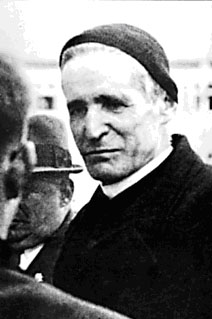
Fr Rupert Mayer SJ

For me the ordination to the Diaconate was important. It stressed to me that ordination was not simply about preaching or ruling in the Church. Of course I knew that but the fact that charge committed to Deacons is first service of the weak, the poor, the sick and the lonely. It has been a while since I re-read the Ordination Liturgy. It is a compelling reminder in a world where the poor, the sick, the weak and the lonely are continually abused and ignored by the rich, the entitled, the powerful and the criminal elements or even governments, that the Christian, particularly those men and women ordained to the Diaconate must be servants first, not rulers or worldly power brokers. Father Rupert Mayer SJ of Munich who was imprisoned for speaking out against the Nazis through much of the Hitlerite rule was a leading champion of Munich’s poor during the Weimar Hyper-Inflation and during the Great Depression. A former Army Chaplain in the First World War who was wounded at the front losing a leg he said: “If out of the ten who ask for alms there are nine who are not in need of them, and if through fear of that happening, I refuse my help to one really needy person, this would cause me immense suffering. I would rather give to all ten and thus avoid the danger of being lacking in charity.”

When I was in High School and College there was a song that was popular in contemporary Christian music. It was called Make Me a Servant by a lady named Kelly Willard who sang with Maranatha! Music.  The words are fitting for all Christians who are called by Jesus to be “servants of all” but especially for all who are ordained or have ever been ordained as Deacons.

Make me a servant, Humble and meek

Lord let me lift up those who are weak, And may the prayers of my heart always be

Make me a servant, Make me a servant, Make me a servant today…

I certainly don’t always live up to this high calling, but it is something that I try to do. It is simple, but so hard, but of all things what the followers of Jesus are called to do. Today has been a day of reflection even as I cared for some people going through terrible times. I do pray that my life will be more reflective of God’s grace in my dealings with all people.

Peace

Padre Steve+

1 Comment

Filed under christian life, faith, Pastoral Care, Religion

Holy Week and the Outcasts

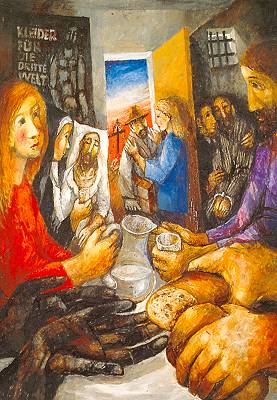
Sieger Köder
“Barmherzigkeit”

“Let us not underestimate how hard it is to be compassionate. Compassion is hard because it requires the inner disposition to go with others to place where they are weak, vulnerable, lonely, and broken. But this is not our spontaneous response to suffering. What we desire most is to do away with suffering by fleeing from it or finding a quick cure for it.” Henri Nouwen

Holy Week is here and on my way home from work and a visit with my shrink I was doing some thinking about Christians that have suffered a crisis in faith or loss of faith. I meet them all the time and read their stories on blogs, books and social media.  Of course I run across more now because I have gone through such a crisis and have written about it and through that had my story publicized. As a result I am contacted by people who have suffered trauma, especially related to PTSD as well as those that care for such people.

For many of the people Holy Week and Easter can be particularly painful. Having known plenty of these people I can say that this phenomena is one of the more tragic aspects of the season.  People who at one time felt the presence of God in their life only sense emptiness and aloneness which sometimes becomes a feeling of hopelessness where even death appears more comforting than life in the present.

I say this because people suffering through this often go unnoticed or are ignored in church. Their loss could be that of a spouse or child, the loss of something else significant or the experience of trauma that devastates them but no matter the cause of the suffering many people discover that they are now outcasts in the place where they should be cared about more than anywhere else.

Likewise there are many pastors and priests who are either unaware of them, uncomfortable around them or irritated by them because they don’t respond like “normal” people do to the message of Easter.  I have found from my own experience returning from Iraq that Easter despite the message of resurrection and hope often triggers a despair of life itself when one no longer senses the presence of God and feels alone against the world, especially in church.

Years ago I believed that if someone was in the midst of a crisis in faith if they read the Bible more, prayed more and made sure that they were in church that things would work out.  I believed then that somehow with a bit of counseling, the right concept of God and involvement in church activities that God would “heal” them.  Call me a heretic but that line of thinking is nice for people experiencing a minor bump in their life but absolutely stupid advice for people who are severely traumatized or clinically depressed and suicidal who no longer perceive the presence of God in their lives.  For those abused by parents or clergy this is I think an even deeper wound one in which the very concept and understanding of God becomes skewed in the minds and hearts of the victims.

I cannot condemn those who have lost their faith or are wavering in their faith due to trauma, abuse or other psychological reason. The numbers of people have been victimized by family, teachers, clergy other authority figures or physical trauma related to accidents, near death experiences or combat is mind numbing. They are all over the place and many go unnoticed in the church.

Sometimes the damage wrought on people makes it nearly impossible for them to comprehend a God who both cares about them and who is safe to approach.  My experience came from Iraq and the trauma of my return and were absolutely frightening so much so that I left a Christmas Eve Mass in 2008 and walked through the dark wondering if God even existed.  My isolation from Christian community and sense of despair during that time showed me that such a loss of faith is not to be trifled with or papered over with the pretty wallpaper or neat sets of “principles” drawn up in the ivory theological towers by theologians and “pastors” who refuse to deal with the reality of the consequences of a fallen world and their impact on real people.

Those that I have talked to and read about who have suffered a crisis or loss of faith almost always mention to me is that that feel cut off and even abandoned by God.  It is not simply depression that they are dealing with but despair of life itself when death or just going to sleep is preferable to living. This overwhelming despair impacts almost all of life.  It is if they never are able to leave the “God forsakenness” of Good Friday and cannot climb out of the tomb.   For some the pain is so much that suicide becomes an option and the belief that their family, friends and loved ones would be better off without them. I have seen this too many times to count.

It is hard to reach out to people in this situation.  I have to admit in my case that it was only people who chose to remain with me and walk with me through the ordeal in spite of my frequent crashes, depression, anger and even rage that helped get me through the worst of this.  However I’m sure that my condition burned some people out.  There were some that would not walk with me as I first began to go down this road and the sad thing is that many were ministers and fellow chaplains.  In some ways I don’t blame them.  However it is telling that the first person that asked me about my spiritual life “or how I was with the Big Guy” was my first therapist.

The topic of a loss of faith or the reality of feeling God forsaken is had to deal with but is something that we need to face especially during Holy Week. The Cross necessitates this, Jesus was considered “God-Forsaken” and that is what is so perplexing about Good Friday.

Yet scripture plainly teaches that we are to “bear one another’s burdens, and in this way you will fulfill the law of Christ.”  As Dietrich Bonhoeffer said  We must learn to regard people less in light of what they do or omit to do, and more in the light of what they suffer.”  It is our willingness to be with people in their suffering that is one of the true marks of the Christian.  Being with someone in triumph is far easier than with those who suffer the absence of God.  It is presence and love not sermons that people who have lost their faith need as Bonhoeffer so eloquently said “Where God tears great gaps we should not try to fill them with human words.”

I do pray that as we walk with Jesus this Holy Week that we will not forget those who despair of live and feel as if they are “God-forsaken.”

Peace

Padre Steve+

2 Comments

Filed under christian life, faith, Pastoral Care, PTSD, Religion

Faith and Doubt: A Reflection on Christmas

“God weeps with us so that we may one day laugh with him.” Jürgen Moltmann

There was a time in my life that faith in God, for me the Christian God, Father, Son and Holy Spirit was something that I pretty much took for granted until I had my own crisis of faith when I returned from Iraq in 2008.  It was that crisis where for all practical purposes I was an agnostic trying to believe while feeling abandoned by God and many of his people.  That crisis has etched a permanent scar in my soul which has led to some fairly major changes in my life but even more so forced me to actually enter what Saint John of the Cross called the “Dark Night of the Soul.”  Not that that is in any way a bad thing as difficult as it is.

I will not tell of how my great spiritual disciplines helped me get through this as they did not. I found it hard to pray or believe in anything for nearly two years as I struggled with abandonment. I felt that God, the Church and the Navy had abandoned me.  I was losing my battle with PTSD during that time, depressed, anxious and despairing I threw myself into my work among the critically ill ICU patients and those that cared for them.  Christmas Eve of 2008 was spent in despair as I wandered through the darkness on a cold night after leaving Mass because I could not get through it.

Though I found a community and camaraderie among those that I worked with and tried to provide spiritual care for my own condition grew worse, so much so that my clinical duties had to be curtailed in September of 2009.  I still stood the overnight duty and filled in for others as needed but for a number of months I had no ward assignments.  On one of the on call nights not long before Christmas I received a call to the ER where I was called to give the last rites to a retired Navy Medical Doctor who was a true Saint, faithful to God, his Church and the community where for years he had dedicated much of his practice to the poorest members of the community to include prisoners in the Portsmouth City Jail. He breathed his last as I prayed this prayer following the anointing of the sick:

Depart, O Christian soul, out of this world;

In the Name of God the Father Almighty who created you;

In the Name of Jesus Christ who redeemed you;

In the Name of the Holy Spirit who sanctifies you.

May your rest be this day in peace,

and your dwelling place in the Paradise of God.

Something happened that night and by Christmas Eve I realized that something was happening to me. As I wrote in Padre Steve’s Christmas Miracle on Christmas Eve of 2009 following an incredibly busy day full of life and death situations and ministry which amazed me:

“Mid afternoon I was walking down the hall and I experienced a wave of emotion flood over me, and unlike the majority of emotions that I have felt in the past couple of years this was different.  It was a feeling of grace and I guess the presence of God.  I went up and talked with Elmer the shrink about what I was feeling and the experience was awesome, I was in tears as I shared, not the tears of sadness, but of grace.  I am beginning to re-experience the grace of God, something that has been so long absent that I did not expect it, at least right now.  I didn’t do anything differently; I certainly was not working extra hard to pray more, get more spiritual or pack my brain full of Bible verses.  I was too far gone to do those things.  It was all I could do many mornings just to get out of bed and come to work.”

Since that time I have continued to recover faith and belief. I cannot say that it is the same kind of faith that I had before Iraq. No this was different, it was faith born of the terrible emptiness and pain of abandonment and despair, a faith that is not content with easy answers and not afraid to ask questions.  It is a faith in Jesus Christ, the crucified one who’s image we see hanging from the crucifix and adorning icons of the Crucifixion. It is as Jürgen Moltmann wrote in The Crucified God:

“The Symbol of the Crucifix in church points to the God who was crucified not between two candles on an altar, but between two thieves in the place of the skull, where the outcasts belong, outside the gates of the city. It is a symbol which therefore leads out of the church and out of religious longing in to the fellowship of the oppressed and abandoned. On the other hand, it is a symbol which calls the oppressed and godless into the church and through the church into the fellowship of the crucified God”

My Philosophy of Religion Professor in seminary, Dr. Yandall Woodfin told us in class that until we had “dealt with the reality of suffering and death we were not doing Christian theology.” At the time the words were offensive to me, but by the time I had graduated and also done a year of Clinical Pastoral Education they became a part of my experience, but even then that did not prepare me for the darkness that I lived in from February of 2008 until that Christmas Eve of 2009.  I would say that in addition to grappling with suffering and death that one has to add the abandonment of the outcast to the equation.

It is from this perspective that I will look at an ancient document that for many Christians is their Baptismal statement of faith or Creed.  ‘Credo in unum Deum’ “I Believe in God” is no longer for me simply a theological proposition which I both ascent to and defend, but rather an experience of God born out of pain, despair, anxiety, doubt, unbelief and abandonment finding almost no Christians willing to walk through the darkness with me, including clergy. It was if I was radioactive, many people had “answers” but none understood the questions and until my therapist Dr. Elmer Maggard asked me “how I was with the big guy?” and Commodore Tom Sitsch asked me “Where does a Chaplain go for help?”

When I finally collapsed in the summer of 2008 and met with Dr. Maggard I made a conscious decision that I would not hide what I was going through because I felt that if someone didn’t speak out then others like me wouldn’t seek help. In the nearly three years since I returned from Iraq I have encountered many people, men and women, current and former military personnel and families of veterans who came to me either in person or through this website.  Included were military chaplains also experiencing life and faith crisis. Most said that I was the first Chaplain or minister that they had met or read who said that he struggled with faith, belief and didn’t know if God existed.  In each of those encounters there was a glimmer of hope for me and I think for them, for the first time we had people that we could be open with.  Co-workers and others said that I was “real” and I certainly do not boast of that because it was painful to try to be transparent with people while in the depths of doubt and despair while hoping that somehow God would touch them with some measure of grace when I found it hard to believe.  I guess it was the fact that I was willing to walk, sometimes in unusual circumstances and locations with them even if it meant facing my own pain and doubt. I was learning something about being what Henri Nouwen called a wounded healer.  Nouwen wrote:

“Nobody escapes being wounded. We all are wounded people, whether physically, emotionally, mentally, or spiritually. The main question is not “How can we hide our wounds?” so we don’t have to be embarrassed, but “How can we put our woundedness in the service of others?” When our wounds cease to be a source of shame, and become a source of healing, we have become wounded healers.”

In the past year I have still had my times of struggle but have also found others that have gone through similar times.  People like me that have experienced the terrible effects of a crisis of faith that leads a person into despair of even to the point of life itself and all that is good. I am fortunate. I was talking with my Bishop recently in regard to the struggle that I have had in recovering the disciplines of the spiritual life. Thankfully she does understand and was encouraging. I guess that is why now when I have more compassion for someone when they tell me that they “lost their faith” especially those that have been changed by their experience of war or other trauma. I don’t necessarily have all the answers for them because I am quite obviously still figuring it out myself. However as I found sometimes it is not the person with the answers but simply the person that takes time to listen and care that is more important to a person when they struggle, especially for those that before the traumatic event had been strong believers.

I’ll write a bit more about Christmas and faith but not tonight.

Peace

Padre Steve+

3 Comments

Filed under christian life, faith, Pastoral Care, Religion

“Tommy Atkins” and “Just a Common Soldier” an Ode to Veterans Yesterday and Today

There has been much talk by our purloined and pampered politicians, pundits, preachers and their backs on Wall Street about the need for all of us to sacrifice. They seem to pushing harder and harder for the men and women that have served in thankless wars for the last 10 years and our families to again take a bullet for the country as they and their supporters refuse to sacrifice anything for the country.  You see the volunteers that have sacrificed to serve in time of war and on deployment after deployment have answered the call are expendable when push comes to shove.  We’re entitled you see, and our benefits much too generous.  They must be cut because no one else wants to sacrifice and they are so few that their votes really don’t matter.

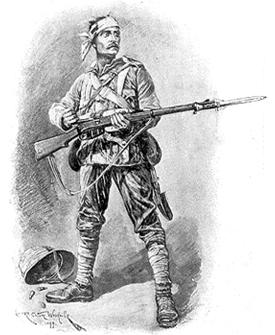
Back inBritain’s colonial days the Soldiers, Sailors and Marines of the Royal Army, Royal Navy and Royal Marine Corps, and later the Royal Air Force served around the world but went without thanks at home. The American “Doughboys” took to the streets ofWashingtonDCin the midst of the depression seeking their bonus from the war because of they had lost their jobs in the Great Depression. They were driven from the streets and brutalized by troops under the command of General Douglas Macarthur who had commanded many of them in the Great War.

In many towns near bases in our fair land once stood signs in lawns that said “Dogs and Soldiers (or Sailors) keep off the grass.”  My late father told me of seeing these signs in Jacksonville Florida in the 1959s. The great poet Rudyard Kipling wrote the Poem “Tommy Atkins” which was dedicated to the soldiers that at the beginning of war were cheered and in peace jeered.  A. Lawrence “Larry” Vaincourt penned “Just a Common Soldier” in 1987.  Both speak volumes to the situation that exists in theUnited States as well as our alliesBritain,Australia, France andGermany as each government and their financial backers cast their veterans aside.

They say it better than I so I leave you tonight with these two great poems.  Something to think about the next time some Senator, Congressman, pundit, other political hack or Wall Street corporate raider says that veterans have it too good.

Peace,

Padre Steve+


TOMMY by Rudyard Kipling (1865-1936)


I went into a public-‘ouse to get a pint o’ beer,
The publican ‘e up an’ sez, “We serve no red-coats here.”
The girls be’ind the bar they laughed an’ giggled fit to die,
I outs into the street again an’ to myself sez I:

O it’s Tommy this, an’ Tommy that, an’ “Tommy, go away”;
But it’s “Thank you, Mister Atkins”, when the band begins to play,
The band begins to play, my boys, the band begins to play,
O it’s “Thank you, Mister Atkins”, when the band begins to play.

I went into a theatre as sober as could be,
They gave a drunk civilian room, but ‘adn’t none for me;
They sent me to the gallery or round the music-‘alls,
But when it comes to fightin’, Lord! they’ll shove me in the stalls!

For it’s Tommy this, an’ Tommy that, an’ “Tommy, wait outside”;
But it’s “Special train for Atkins” when the trooper’s on the tide,
The troopship’s on the tide, my boys, the troopship’s on the tide,
O it’s “Special train for Atkins” when the trooper’s on the tide.

Yes, makin’ mock o’ uniforms that guard you while you sleep
Is cheaper than them uniforms, an’ they’re starvation cheap;
An’ hustlin’ drunken soldiers when they’re goin’ large a bit
Is five times better business than paradin’ in full kit.

Then it’s Tommy this, an’ Tommy that, an’ “Tommy, ‘ow’s yer soul?”
But it’s “Thin red line of ‘eroes” when the drums begin to roll,
The drums begin to roll, my boys, the drums begin to roll,
O it’s “Thin red line of ‘eroes” when the drums begin to roll.

We aren’t no thin red ‘eroes, nor we aren’t no blackguards too,
But single men in barricks, most remarkable like you;
An’ if sometimes our conduck isn’t all your fancy paints,
Why, single men in barricks don’t grow into plaster saints;

While it’s Tommy this, an’ Tommy that, an’ “Tommy, fall be’ind”,
But it’s “Please to walk in front, sir”, when there’s trouble in the wind,
There’s trouble in the wind, my boys, there’s trouble in the wind,
O it’s “Please to walk in front, sir”, when there’s trouble in the wind.

You talk o’ better food for us, an’ schools, an’ fires, an’ all:
We’ll wait for extry rations if you treat us rational.
Don’t mess about the cook-room slops, but prove it to our face
The Widow’s Uniform is not the soldier-man’s disgrace.

For it’s Tommy this, an’ Tommy that, an’ “Chuck him out, the brute!”
But it’s “Saviour of ‘is country” when the guns begin to shoot;
An’ it’s Tommy this, an’ Tommy that, an’ anything you please;
An’ Tommy ain’t a bloomin’ fool — you bet that Tommy sees!

Just a Common Soldier by A. Lawrence Vaincourt (1987)

He was getting old and paunchy and his hair was falling fast, and he sat around the Legion, telling stories of the past. Of a war that he had fought in, and the deeds that he had done, in his exploits with his mates; they were heroes, every one. And tho’ sometimes, to his neighbours, his tales became a joke, all his Legion buddies listened, for they knew whereof he spoke. But we’ll hear his tales no longer for old Bill has passed away, and the world’s a little poorer, for a soldier died today.


He will not be mourned by many, just his children and his wife, for he lived an ordinary and quite uneventful life. Held a job and raised a family, quietly going his own way, and the world won’t note his passing, though a soldier died today. When politicians leave this earth, their bodies lie in state, while thousands note their passing and proclaim that they were great. Papers tell their whole life stories, from the time that they were young, but the passing of a soldier goes unnoticed and unsung.

Is the greatest contribution to the welfare of our land a man who breaks his promises and cons his fellow man? Or the ordinary fellow who, in times of war and strife, go`s off to serve his Country and offers up his life? A politician’s stipend and the style in which he lives are sometimes disproportionate to the service that he gives. While the ordinary soldier, who offered up his all, is paid off with a medal and perhaps, a pension small.


It’s so easy to forget them for it was so long ago, that the old Bills of our Country went to battle, but we know it was not the politicians, with their compromise and ploys, Who won for us the freedom that our Country now enjoys. Should you find yourself in danger, with your enemies at hand, would you want a politician with his ever-shifting stand?

Or would you prefer a soldier, who has sworn to defend his home, his kin and Country and would fight until the end?


He was just a common soldier and his ranks are growing thin, but his presence should remind us we may need his like again. For when countries are in conflict, then we find the soldier’s part is to clean up all the troubles that the politicians start.  If we cannot do him honour while he’s here to hear the praise, then at least let’s give him homage at the ending of his days. Perhaps just a simple headline in a paper that would say, Our Country is in mourning, for a soldier died today.


3 Comments

Filed under History, iraq,afghanistan, Military, Pastoral Care