Category Archives: philosophy

Anti Semite? You Have to Be Kidding

jPeOJ

I don’t like having to feel the need to respond to personal attacks on social media on this page.

However, yesterday I experienced a first. I was accused by an American gentile of being an “anti-Semite.” Over the years I have been called a “Jew lover” “Nigger lover” and other racist names by White Supremacists and Neo-Nazis, but I have never been called an anti-Semite. Actually that was kind of shocking to me. It took me aback. But then in today’s political climate maybe it shouldn’t have.

But the reason I was called this was because I dared to challenge this gentleman’s personal attacks on me on Twitter.  It was in an exchange where I was advocating giving diplomacy a chance in regard to the Iranian nuclear threat. It was something that was not at odds with the other people in the conversation, including nationally and internationally known diplomats.

However, the attacker, a financial and political adviser from New York to “conservatives” was a Twitter troll. He jumped me in the conversation which did not involve him. When I responded to his attacks he got personal. When I refuted his personal attacks on me he called me an “anti-Semite.”  I guess that is the new fall-back position  when when you have nothing else to say.

What really offended me about this man was that he was a total chicken-hawk. He has never served in the military, never been to war and never intends to. He then then dares to presume that he should be able to send other people and their children to fight wars that he is unwilling to fight, or for that matter fund because tax cuts for him matter more than actual national security. In comparison  I have served in the military for 32 years, done multiple combat tours and deployments and more advance military and national security education than this man ever will do, but somehow I am his enemy.

That astounded me, so I decided to do some internet searches. In the process I found out who he was, where he worked as well as some of his writings. In the man’s biography on his business website he referred to himself as a “brilliant debater” something that after sparring with him was a bit of an over estimate of his abilities. Good debaters actually use facts before they level an accusation so vile. But then the tendency to make such accusations is so common today, especially among those who live and die by conservative talk radio and Fox News it is scary.

My attacker was not a good debater. He is a rich and entitled bully, and I will not tolerate bullies. In fact if I was in a bar with this man and he said the things that he said about me I would have kicked his ass, no questions asked. I would them pick him up and buy him a beer.

Of course any reader of this website would know that such is not the case and I am not an anti-Semite. Simply take a look at my writings on the Holocaust, the Nazi persecution of the Jews in Europe and current Neo-Nazis and White Supremacists in the United States. Some of my harshest critics on this site have been White Supremacists and Neo-Nazis, some who have actually made threats on my life. So for me to be called an “anti-Semite” was a vile insult.

It seems to me that my critic wanted to use the term “anti-Semite” as a term to smear me because I did not agree with him and refused to role over to his personal attacks. Actually that is a great strategy. It really doesn’t matter what the facts are if you are losing call the person you disagree with an “anti-Semite” or something else, maybe a “racist,” or “socialist,” “anti-Christian” or whatever term. I may have had some bad experiences with dentists as a kid which could make me an “anti-dentite” (note Seinfeld reference) but I am not an anti-Semite.

When I read the man’s tweet I decided to do a web search and found out all I needed to know. The guy was a know it all who didn’t like being challenged especially when a military veteran of the Cold War, the Bosnia campaign and Operations Enduring Freedom and Iraqi Freedom called him on his bullshit.

The fact was that the man objected to someone having a different military and political view of the current situation regarding Iraq and had to cheapen the debate by calling me an “anti-Semite” despite not ever having read any of my writings or having any sort of relationship with me. In doing so he demeaned the Jews killed buy the Nazis and their other persecutors all to make a political point.

But then that has become a norm of some who oppose any kind of real negotiations with Iran or any other Islamic Country by some, mostly Evangelical Christians in the United States. The irony is that most of the Evangelicals that support Israel only do because in their millennial theology sacrifices almost all the living Jews to preserve a few when Jesus returns. Of course those surviving Jews all end up “accepting Jesus” after Armageddon. Personally I don’t see how that is not considered “anti-Semitic” but hey what do I know?

Since the man was a complete ass I simply decided to block him on Twitter. I could put his business website, Twitter and personal information up but I won’t. I don’t desire to ruin the man’s life.

That being said, it is funny to see how some people who troll about the internet thinking they are being anonymous by not identifying themselves leave enough information out there to track them down, read their writings, web-posts and find their business information. It is a mark of arrogance. That is why I am not anonymous on this site or any social media.

My personal feeling about men like this are that they are human slime. They make their money off of others, presume that they know all there is to foreign policy or national security issues and have never served a day in the Military or Foreign Service in harm’s way. They are hacks and warmongers willing to sacrifice thousands or even millions of lives to satisfy their lust for power and wealth. They are willing to slander people like me by calling us “anti-Semites” a term so loaded that the accusation alone is is enough to destroy careers and reputations.

However I won’t take that lying down. If He decides to push the issue, which because I presume that he will move along to a more easily intimidated target, I will sue him for defamation and win. A little bit of knowledge linked to a vast amount of ignorance is a dangerous thing. Likewise those that call others ‘anti-Semites’ simply because they disagree with their opinions on what foreign policy should be pursued in regards to Israel and the Middle East show just how shallow their thinking is. Personally I find that to be a greater tragedy. because people like this when entrusted with political power become despots.

Anyway. That is enough for tonight.

Peace

Padre Steve+
4 Comments

Filed under philosophy

Switch Hitting and Life as a Lefty forced to the Right

1929_55558957058_1558_n

“He hits from both sides of the plate. He’s amphibious.” Yogi Berra

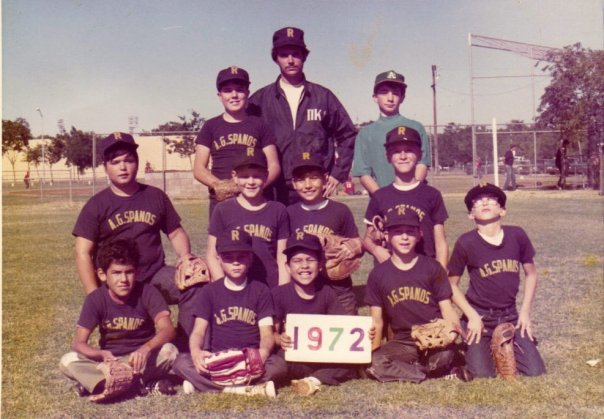
Back in 1966 my late father made one of the few mistakes that he made in raising me. He turned me around in the batter’s box and turned me into a right handed hitter.

For years I wondered about this because my first grade teacher Mrs Brandenburg took the pencil out of my left hand and put it in my right hand. A few short years later my 4th grade teacher Mrs Gates whacked my hand with a ruler because of my poor penmanship. That didn’t help my penmanship and truthfully if forced to take notes on paper I  cannot read half of what I wrote.

During my first tour in Germany in the 1980s I started using my left hand to eat, and occasionally would just for shits and giggles write left handed. The sad thing is that I now eat left and that my writing when done with my left hand is nearly as legible as when I write with my right hand. But I digress…

Now ever since dad switched me at the plate I have not been a good hitter. We talked about this before he died, not that he turned me around at the plate but the fact that I was a crappy hitter. My life has been spent on the edge of the Mendoza line. (For those that don’t know what this is just google Mendoza Line or Mario Mendoza.) I haven’t hit for power but my dream is to start hitting balls over the fence, that way I can trot around the bases versus having to dig hard to get on base.

In the years since I have wondered what it would feel like to bat left-handed. However I was always too afraid to try it in a practice or game with real people. However today since for the first time in a long time I am playing somewhat organized ball I went to a batting cage after I did my circuit training around the lake in my neighborhood.

My first 40 swings were from the right side. But then I decided to go to the left side. It was amazing. My swing felt natural and not only did I make contact but it felt natural. I realized then that everything that I thought was right was really left.

Come to think of it for years of my life  tried for whatever reason to stay to the political and religious right side of the house. Of course that was before Iraq, PTSD and a major faith crisis. After that I ended up somewhat on the left. I moderate but somehow more to the left than the right. Maybe that makes me a switch hitter too.

That reminds me of an exchange in the TV series 30 Rock. 

Jack: When I was at Princeton I played baseball AND football. And back then football players went both ways.

Dotcom: Really? So you went both ways?

Jack: Yeah! We all did. It was the 70s.

In between as well as later tonight and tomorrow I will be doing some more studying and reading for my class and getting ready for my second exam at the Joint and Combined Warfighting School. Tomorrow after I celebrate Eucharist at my chapel I will do my PT, I think I  might run and then head over to the batting cage again. In the afternoon I will be meeting Pulitzer Prize winning author David Wood to talk about PTSD and suicide in the military. David is a war correspondent and Military Editor for the Huffington Post.

Tuesday, Lord willing and the shutdown not sending half of my team home I will be playing in my first game. By the way I do intend on hitting from the left side. I’ll let you know how it goes.

Pray for me a sinner and have a great night.

Peace

Padre Steve+
4 Comments

Filed under Baseball, Loose thoughts and musings, philosophy

Social Justice from the Prophet Amos and Pope Francis

holy-saturday

Hear this, you who trample upon the needy and destroy the poor of the land!

“When will the new moon be over,” you ask, “that we may sell our grain,

and the sabbath, that we may display the wheat? We will diminish the ephah,

add to the shekel, and fix our scales for cheating! We will buy the lowly for silver,

and the poor for a pair of sandals; even the refuse of the wheat we will sell!”

The LORD has sworn by the pride of Jacob: Never will I forget a thing they have done! Amos 8:4-

There is a certain joy and challenge to having to preach every week, especially when one follows the lectionary instead of making things up as we go based on our favorite theological biases or interests.

Thus coming back to a place where I am having to preach each week it is a challenge. It is interesting for me to see what the Bible has to say on issues that Christians including me like to ignore. The funny, but not so funny thing is that those parts of the Bible that many conservative American Christians of all denominations, but especially Evangelicals like to ignore are the kinds of passages that are more the norm than the exception. Thus we tend to ignore the really challenging things and focus on what tickles people’s ears. Now I have never been a fan of having my ears tickled but evidently some do or the Apostle Paul wouldn’t have not warned Timothy about it.

In the United States Christians have it good. As rich and fashionably well to do entitled Christians we love to cite verses that talk about prosperity.  Those more theologically adept love to misuse the writings and theology of John Calvin to show who our material success somehow equals God blessing us. The sad thing is in order to do that many of us will totally ignore most of Jesus’ teachings about the misuse of wealth and the abuse of the poor as well as those of Paul, James, and the vast majority of the prophets of the Old Testament in such matters. But then what do they know? They didn’t study Ayn Rand did they?

I can only imagine what Amos, a prophet from Judah whose ministry was primarily directed at the Kingdom of Israel in about 750 BC would be if he walked among American Christians today. I mean really, think about it. Amos almost sounds like he is talking about the Prosperity Preachers and those in the church who for the sake of partisan political power are willing to ignore or even worse to sacrifice the most vulnerable people in society for their own place at the seat of power.

How Constantinian of them. Yet Amos and most of the other prophets seem to have a most egregious disregard for the issues that contemporary Christians have sacrificed on the altar of political power and expediency. Yes “Christian Right” I and they are talking about you.

Pope Francis is nailing the issue. For too long the Christian Church in the United States and western Europe have been engaging in the so called “culture wars.” While some of the issues are legitimate including some of the pro-life related issues, they are actually subordinated to a broader and much more insidious agenda which is neither Christian or for that matter American, at least in the sense understood by the religiously tolerant and pluralistic founders of the country understood.

Ever since Nazi apologist Pat Buchanan (See his book Hitler Churchill and the Unnecessary War) declared the beginning of the “Culture Wars” in 1992 and long after the foundations were laid by others on the Christian Right the Church, Evangelical Protestant and Roman Catholic decided on the Christian version of Jihad to achieve political goals. In fact men like Catholic theologian Peter Kreeft actually wrote books like Ecumenical Jihad to define their strategy and goals. Clothed in the veneer of Constantinian virtue these people helped lead the church into an abyss that from which may not be able to extricate itself in our lifetimes.

Unfortunately the problem is that the culture wars are more often fought with the goal of maintaining the political power and influence of Christians while ignoring the very tenants of what writer after writer, prophet after prophet and even Jesus made foundational issues of their day. We Christians have sold out the Gospel in order to be co-opted by the very people and interests who hate the kind of justice that Jesus and  the prophets preached about.

When Pope Francis talked this week about those “culture wars” this week in a number of ways. He decried the manner in which some bishops were more at war with the culture than caring for the people of their own dioceses and how in terms of caring for and loving people “The church sometimes has locked itself up in small things, in small-minded rules…” He said that in regard to the focus that many Catholics have had on abortion and homosexuality. Pope Francis said: “The most important thing is the first proclamation: Jesus Christ has saved you. And the ministers of the church must be ministers of mercy above all.” To finish the week, or rather to start this week on a high note Francis attacked the culture of greed which many in the church have blessed and furthered.

I am all in with Pope Francis on this because he is speaking the truth. The fact is that he is saying things that most of us do not want to hear. Francis is talking about redemption, the fact as the Apostle Paul wrote in 2nd Corinthians that “God was in Christ reconciling the world to himself counting men’s sins not against them.”

Yes these are tough words, but the proof of their validity is in the pudding. Non-believers want nothing to do with the church, even if they happen to like what Jesus says and many believers are fleeing the church and not coming back. And yes this is different than the days when young people would leave the church for a few years and then come back. The folks leaving now for the most part have no desire to return. The reasons are self evident. It is not Jesus, nor is it even doctrine. It is how Christians and the Church treat the world. Something that Pope Francis seems to understand while many of his Bishops as well as leaders of Evangelical Christian Churches in the United States seem oblivious.

George Barna, an Evangelical Christian who runs one of the most respected polling agencies around has done a number of polls on this very subject. Sad to say his polls, which are scientific in the way they are conducted line up with what I am saying here and what Pope Francis is speaking about.

One Barna poll asked the words which most describe Christianity. The results: Hypocritical, anti-homosexual, insincere, sheltered and too political. Another Barna study dealing with why young people are leaving the church included that nearly 25% of young people said “Christians demonize everything outside of the church” while 20% said that “God seems missing from my experience of church” while 22% said that “church is like a country club, only for insiders” and 36% said that they were unable “to ask my most pressing life questions in church.”  That survey was of young people of Christian backgrounds, people for the most part raised in the church.

Frank Schaeffer, son of the late Dr Francis Schaeffer noted in his book Crazy for God: “I personally came to believe that a lot of the issues that were being latched onto by the Christian Right, whether it was the gay issue or abortion or other things, were actually being used for negative political purposes. They were used to structure a power base for people who then threw their weight around.” Schaeffer should know, in the 1970s and 1980s he was a key player in the growth of the political Christian Right.

But I digress…. Soren Kierkegaard noted “The Bible is very easy to understand. But we Christians are a bunch of scheming swindlers. We pretend to be unable to understand it because we know very well that the minute we understand, we are obliged to act accordingly.”

The fact is that if we actually decide to look at the way we do life, faith, politics and ethics in light of the writings of men like Amos, James and even Paul to some extent not to mention Jesus we might have to actually repent. But then, when all that matters is maintaining our political and social power who needs repentance?

But I digress, after all, repentance in our American Christian culture is never having to say your sorry. It is no wonder that Mark Twain noted: “If Christ were here there is one thing he would not be—a Christian.” 

I think that old Amos might just be talking to us as much as he was talking to the people and leaders of Israel. But hey, I could be wrong.

Peace

Padre Steve+

PS. I do plan on doing some articles over the next few weeks about how people of all religions attempt to use the political and police power of the state to advance their beliefs and to demonize dissenters.

Leave a comment

Filed under christian life, faith, History, philosophy, Political Commentary

Padre Steve’s First Shout Out Sunday

20130825-202532.jpg

As anyone who reads this site on a regular basis knows I am a fan of other writers and bloggers. Most like me are pretty provocative and even I do not always agree with them I appreciate their writing, thoughts and ideas enough to comment on their posts on on their blogs, Facebook or re-tweet their Twitter posts. Likewise I have included links to their websites or blogs on this site.

So tonight instead of discussing any actual topics or even talking about me I agave decided to talk about them.

If you take a look to slightly to the left of this article you will see a list of links to websites that I like or frequent. Some are so heavily used that they don’t get a shout out but some not only deserve the shout out but tonight I want to mention several that I find to be outstanding. They span the spectrum of thought and are about different subjects.

I want to start on the faith, religion and life side of the house. There are a number to mention here. There is no particular order except that they kind of go from top to bottom on the links section. The first I want to mention is Michelle Sommerville’s New York Poet “Syllabifactor” blog. Michelle is a poet and also has some very astute writings on faith, religion and public life.

In the same category I need to mention Joel Watts’ Unsettled Christianity. Joel is a former Independent Baptist now United Methodist who is a very sharp theologian and thinker with a good sense of humor. Likewise I want to mention Rachel Held Evanswhose blog is simply outstanding. Red Letter Christians- What if Jesus Meant What He Actually Saidis a site hosted by Tony Campolo and features a number of great authors.

Frank Schafer is the son of the late Francis Schafer and with his father was a leader of the religious right in its early days. However he abandoned what would have been a lucrative career on the religious political right media complex. His writings including his book Crazy For God are prolific and his blog The Official Frank Schafer Website is outstanding. Many of his posts end up on other websites including The Huffington Post.

San Francisco Giants relief pitcher Jeremy Affeldt is an Evangelical Christian as well as social activist. His blog To Stir a Movement is a site that is solid in its theology as well as practical applications of living the Christian life.

Warren Throckmorton is a,leading debunker of men like David Barton, the pseudo historian and compulsive liar. Throckmorton, a college Psychology professor’s site Warren Throckmorton is one of the best sites when it comes to unmasking frauds who claim to be something that they are not like Barton, and in setting the record straight. As a historian I appreciate his attention to detail and the accuracy of what he writes and as a Christian I appreciate his integrity and courage in exposing Barton and others who make their living deceiving Conservative Christians while raking in tons of cash from people like Glenn Beck.

Miguel Rosada is a friend, medical doctor and now Episcopal Priest. Both of us served in the Charismatic Episcopal Church. He left that denomination of his own volition about a year before I was asked to leave. While I don’t always agree with him I find his blog Seraph Saysto be an outstanding place for great ideas, thoughts and Christian decency.

There are others that I have not yet added to my links section and when I do I will give the a Sunday Shout Out. I expect to do more of this because after all it’s really not all about me, despite my name being on the title page on this site and the fact that so much is about me. Scary, kind of like Denny Crane, “name on the door” scary, but then that might be the Mad Cow talking.

That being said take a look at these great websites and writers.

Peace

Padre Steve+

1 Comment

Filed under faith, History, Loose thoughts and musings, Military, philosophy

Home

tom-clancy-look

“Where we love is home,
Home that our feet may leave, but not our hearts.”
~Oliver Wendell Holmes, Sr., Homesick in Heaven

A couple of months shy of three years away I am finally home. With my assignment at Naval Hospital Camp LeJeune complete I have a few weeks to be with Judy and our dogs before going back to work at my new assignment at the ethics faculty and Chaplain at the Joint Forces Staff College. In that time I will also be helping Judy take care of a lot of things around the house that we have had to put off simply because she couldn’t do them alone. Of course that will take more time than the 3 weeks, but such is the cost of serving and being away from home for years.

I came home whenever possible over the past three years and Judy was able to come down the Carolina sometimes too. However those visits were just that, they were visits and even on the trip home the trip back was already planned. So even with the visits on the whole it was a very long and trying experience for us. You see in the past 17 years or so I figure we have been apart due to deployments, mobilizations, training exercises, schools, official travel and assignments like the one at LeJeune for about 10 years. 10 of 17 years apart and that doesn’t count all the time apart since we were married. I figure that in 30 years of marriage close to 14-15 have been spent apart. This doesn’t count the times where I was doing on call work or standing duty in the local area.

We have missed a lot of time together and it has been difficult. However this not unique to us but is something that really is a unique aspect of military life. I know that I am not alone in this, there are many like me, men and women who have spent the majority of their marriages away from their spouses. The amazing thing is that not that so many of our marriages fail, but rather how many survive. This is not new. Homer wrote in the Odyssey:

“There is nothing more admirable than when two people who see eye to eye keep house as man and wife, confounding their enemies and delighting their friends.”

6095_128718107058_2713239_n

It really is amazing that our marriage has survived the years of separation, the deployments, war and return. It is amazing that we survived despite the many times that I volunteered myself for deployments because of my own need to prove myself worthy of the uniform that I wear and the oath that I took.

My need to serve I think was rooted in the same primal need that motivated men before me to leave their homes to serve their country. Joshua Lawrence Chamberlain, the professor of Rhetoric and Revealed Religion at Bowdoin College who volunteered to serve in the Civil War and won immortality at Little Round Top felt it and wrote about it. Chamberlain, as much a philosopher, theologian and academic wrote about this need that is so much a part of the human condition: “It is something great and greatening to cherish an ideal; to act in the light of truth that is far-away and far above; to set aside the near advantage, the momentary pleasure; the snatching of seeming good to self; and to act for remoter ends, for higher good, and for interests other than our own.”

I have spent too much time away, seeking to serve and act for what Chamberlain called “remoter ends, for higher good.” I am sure, that knowing me that there is the chance that I will answer that primal call again. There is something in my heart that always calls me to the sound of battle, but as a peacemaker, reconciler and proclaimer of the love of God in places that God seems to have abandoned.

295_26912057058_2651_n

However, today I am just glad to be home. To be able to wake up and go to sleep again in the same bed as Judy, hold her, to be with her and to experience life together again. Since coming home yesterday we have spent time together, celebrated my return with friends, rested, relaxed and even went out and saw a movie together. Molly and Minnie our dogs are happy and for the first time in three years I am not spending a Saturday preparing to leave.

Last night I was exhausted. I slept but my dreams were vivid, as they tend to be. However, for once they hey were not nightmares, but they were very real and dealt with me trying to come home. In them I was stuck in a European airport, missing flights, drinking beer and trying to get home. People that I knew from different parts of my military experience showed up in the dream, though they didn’t seem to recognize me. I guess this was because probably they were not the people that I was that close to or send a great deal of time with, but rather people who even when I knew them seemed more concerned about their career advancement than with other people. All were comparatively minor players and acquaintances of my life and career. They were odd dreams because I hadn’t thought thought about most of them for many years. Strange, perhaps it is the “Mad Cow” of PTSD that brought them back, perhaps something different. I don’t know.

I finally awoke late in the morning as the dream ended. Judy was already up, Molly I am told had spent an hour trying to wake me up by barking outside the bedroom door. But I didn’t wake up until the dream had ended with me finally arriving home.

When at last I awoke from the dream I was home.

Peace

Padre Steve+

Leave a comment

Filed under faith, Military, philosophy, PTSD

Letter to a New Military Chaplain: Part Two The Minefields of the Heart

295_27076892058_2637_n-1

This is second part of a response to a question I had from a new Navy Chaplain. I have decided to post it here without any identification of the chaplain because I know that many men and women who are new to the military chaplaincy or who are exploring the possibilities of becoming a chaplain have the same questions. I was fortunate to have had a number of chaplains who at various points in my decision process and formation as a minister, Priest and Chaplain in both the Army and the Navy help me with many of these questions. Likewise I learned far too much the hard way and blew myself up on some of the “land mines” that almost all who serve as chaplains experience in their careers. This is the second of several parts to the letter and is my attempt to systematically explain my understanding of what it is to be a Chaplain serving in the military and in particularly the Navy. The first part is linked here:

Letter to a New Military Chaplain: Part One

“There is a twilight zone in our hearts that we ourselves cannot see. Even when we know quite a lot about ourselves-our gifts and weaknesses, our ambitions and aspirations, our motives and our drives-large parts of ourselves remain in the shadow of consciousness. This is a very good thing. We will always remain partially hidden to ourselves. Other people, especially those who love us, can often see our twilight zones better than we ourselves can. The way we are seen and understood by others is different from the way we see and understand ourselves. We will never fully know the significance of our presence in the lives of our friends. That’s a grace, a grace that calls us not only to humility, but to a deep trust in those who love us. It is the twilight zones of our hearts where true friendships are born.”Henri J. M. Nouwen

Dear Chaplain

The next section of our discussion is about the “minefields” that we so often encounter as Chaplains and to some degree as Ministers, Priests or Rabbis or other religious leaders. As I noted in the first section I am dividing these “minefields” into three major areas; the personal, the behavioral and the professional.

This section is about the “personal” minefields which I call the “Minefields of the Heart.” I call it this because it seems from the Christian and Jewish Scriptures the heart is the figurative locus of what we are, good and bad alike as human beings.

Of course there is always some spillage between the areas personal, behavior and professional areas and our behaviors and professional relationships are certainly influenced by the things that we hide deep in our hearts. As human beings we may try to compartmentalize our life to keep things apart such as keeping our personal life separate from our professional life, or hide behaviors from our friends, families, peers or co-workers; but the cold hard fact is whether we are aware of it or not each area impacts the other. If we are not aware of this fact, if we have little self awareness, if we have self awareness but try to live our lives with the illusion that we can separate our lives into neat little boxes we will most undoubtedly hurt ourselves, and as spiritual leaders harm those that come to us.

q_who

There is a scene of the last episode of Star Trek the Next Generation entitled “All Good Things” that comes to mind.  In it the being known simply as “Q” helps Captain Picard discover how his actions influence human history.

Q: You just don’t get it, do you, Jean-Luc? The trial never ends. We wanted to see if you had the ability to expand your mind and your horizons. And for one brief moment, you did.

Capt. Picard: When I realized the paradox.

Q: Exactly. For that one fraction of a second, you were open to options you had never considered. That is the exploration that awaits you. Not mapping stars and studying nebulae, but charting the unknown possibilities of existence.

You may wonder where I am going with this but it has to do with the personal minefields, those that exist inside of us, those that lurk beneath the surface which if we are unaware wreak havoc on everything else that we do. In the episode of Star Trek that I am referring to Captain Picard is allowed by Q to see the effects of his actions and to see how limited his thinking was.  The challenge for us is chaplains are to be aware of what Nouwen calls “the twilight zone in our hearts” and how what is at the depth of our heart impacts everything else that we do.

Too often though, mostly because of our own personal limitations and serious lack of real theological and pastoral formation involving self reflection and exploration we fail to see them. Like an uncharted minefield we are unaware of them until we either discover their existence through accident and “blow ourselves and others up” or until we listen to those that can see those twilight zones, those minefields better than we ourselves. Of course the latter, especially when it comes from those who love us, care for us and have our best at heart is the preferable method to learn about these things.

943043_10151694525692059_632653331_n

However, that being said part of this can be done through reading. A lot of us simply read “how to” type books when it comes to ministry. We seek direct easy answers in how to run our programs be it in the church, in a para-church ministry or in the chaplaincy. Believe me there are plenty of those kinds of books out there, not only that but a plethora of “self help” books that tell us the “three things we must know” the “five whatever’s to success” or the Seven Habits of Highly Defective People.” The sad thing is, even when these books contain nuggets of truth, they serve it like fast food and reduce it to the lowest common denominator. In a sense, even the most well intentioned of these “how to” or “self help” books promote a reductionist view of faith, spirituality, psychology and in some cases ethics and doctrine.

Reading is important, especially the hard stuff, philosophy, history, moral theology, but also things that you might not expect science fiction for example. In addition classic literature from antiquity and from non-western traditions also sheds light on those personal minefields. Heck we can even find truth in television and film, note my continued references to Star Trek. I find that God can speak to us in many ways.

As Christians we may also find lessons, insights and inspiration from the Bible that can be quite helpful. Unfortunately most of us have so many theological filters in place that we often miss the very things that would be most helpful to us. They can serve as blinders that keep us from sensing what the Spirit of God is trying to teach us. Our church, denominational or theological traditions as well as our hermeneutical methods often cloud our minds to what God is trying so hard to say. It was a problem that the religious establishment of his time had with Jesus, and often with the various prophets that preceded him whose stories we read about in the Old Testament.

1905_50393137058_7454_n

I am sure that others who are not Christians can say similar things about their faith, traditions and holy books. I remember an Iraqi General who I met who took the time to show me his well worn and read Arabic-English Bible. He was a Moslem, but he said that he learned so much from it because it was different than what was in the Koran and he meant no disrespect of his own faith by saying that. He had opened his mind to truth that others turn a blind eye to.

Some of the personal issues that prove to be deadly include what we don’t know about ourselves, usually dating back to childhood, how were raised, how we see God, if we perceive ourselves to be worthy of God’s love or worthy of the love and respect of others.  Those attitudes, especially those created as a result of negative relationships or even physical, emotional or sexual abuse, abandonment and rejection are powerful. Many of us like to pretend that we have gotten past those things but few of us actually do. Unfortunately there is a tendency for those issues to raise their heads in often very ugly ways as we minister as Chaplains.

For example: Let us say that we are distrustful of authority because of having an abuse parent, that we fear that no matter how well we do that there is always someone waiting to take us down. Let us say that we had previous experiences in the church, at work or maybe in prior military service where we were mistreated by those in authority.

I have found that if that condition is not dealt with that in a hierarchical organization such as the Chaplain Corps and the military that it is almost always fatal to the ability of the chaplain to minister in the organization. That is because the military is based on trust, our lives and mission depend on it. We have to trust the chain of command, we have to trust those that serve alongside of us and we have to trust our subordinates. There may be times when the chain of command fails and things don’t go right. There are toxic leaders and there are also toxic chaplains, one has to be aware that they are out there, know how to deal with them or survive under their command but one cannot presume that everyone is like that, trust is essential.

father

I find it interesting that Jesus commended the faith of the Roman Centurion when instead of asking Jesus to come to his house and heal his servant simply said “But just say the word, and my servant will be healed. For I myself am a man under authority, with soldiers under me. I tell this one, ‘Go,’ and he goes; and that one, ‘Come,’ and he comes. I say to my servant, ‘Do this,’ and he does it.”Matthew 8: 8b-9 Jesus told the people around that “he had not seen such faith in all of Israel.” Jesus saw the virtue of the Centurion, a virtue that many of his own people were lacking.

That is just one of a myriad of personal issues that can trip up a Chaplain in the military. The fact is that issues of the heart those things that we don’t like to admit are true about us, things that we are unaware about or in outright denial about in our lives are the things that go to the “heart” of who we are.

As fa as the minefields of my heart, they too are many. However the one that gets me time and time again is my passion for justice and my visceral reaction to those that I believe are bullies. That comes from my childhood. As a Navy brat I was always the new kid in town, and being that I was kind of the short, shy and introverted kid I was also kind of a nerd, or geek. I was not gifted with speed or great athletic abilities and it took me a while to find my academic prowess. That meant that I often didn’t fit in and though I was generally well liked that I would on occasion be bullied and I learned to defend myself, not very well at times but well enough to as the Klingons say “to die an honorable death.”

Jeremiah the prophet, who admittedly was most certainly clinically depressed if you look at his writings did note that “The heart is deceitful above all things and beyond cure. Who can understand it?” Jeremiah 17:9 Depressed or not Jeremiah did seem to understand that what he and many writers of scripture call “the heart” is hard to understand, especially when it is our own.

Thus I go back to Nouwen’s comment about the “twilight zone of the heart” that we cannot see. That it is why as Chaplains we have to develop relationships with people who can help us see what is in the twilight zone of our hearts and lovingly come alongside of us, not just as colleagues but as friends.

Those people may be clergy or other chaplains, but then they may not be. Perhaps they are senior enlisted personnel, long time friends, teachers, spiritual directors, counselors or our God forbid our spouses, I jest about the latter because my wife can see things about things about me that I cannot see, she is incredibly wise.

The minefields that exist in our hearts are so varied, so diverse and so treacherous. They have the potential to affect so many other parts of our lives. Thus for us as chaplains if we are not careful they can be destructive not only to us, but to those that we serve as well as those that we presume to love.

295_26912097058_4309_n

When I look back at my career and I am honest about it, I can say without a doubt that most of the things that hurt me were a direct reflection of the minefields that were already present in my heart. When things that happened that I felt were unjust or threatening I reacted and quite often my reactions caused problems greater than what I was reacting to. All they needed was something to set them off. What I have come to understand is even though I have had a very successful and that I am now a Senior Officer that what lies in my heart can still blow me up and that I need to always be careful of those minefields that exist in the twilight zone of my heart.

Lao Tzu said: “Watch your thoughts; they become words. Watch your words; they become actions. Watch your actions; they become habit. Watch your habits; they become character. Watch your character; it becomes your destiny.”

That is the key, those things that emanate from the deepest recesses of our hearts are full of minefields and we need to guard our hearts and minds in this ministry that we are privileged to have as military chaplains.

Peace

Padre Steve+


4 Comments

Filed under christian life, faith, Military, ministry, Pastoral Care, philosophy, Tour in Iraq, US Navy

Letter to a New Military Chaplain: Part One

185615_1857288397412_3950321_n

Note: This is a response to a question I had from a new Navy Chaplain. I have decided to post it here without any identification of the chaplain because I know that many men and women who are new to the military chaplaincy or who are exploring the possibilities of becoming a chaplain have the same questions. I was fortunate to have had a number of chaplains who at various points in my decision process and formation as a minister, Priest and Chaplain in  both the Army and the Navy help me with many of these questions. Likewise I learned far too much the hard way and blew myself up on some of the “land mines” that almost all who serve as chaplains experience in their careers. It will be the first of several parts to the letter and is my attempt to systematically explain my understanding of what it is to be a Chaplain serving in the military and in particularly the Navy.

Dear Chaplain,

“Preach the Gospel at all times, use words when necessary.” Francis of Assisi 

I thank you for writing me about the questions that you have concerning ministry as a Navy Chaplain. They are incredibly good questions and I since you first asked me two days ago I have given them much thought before responding. I find that if I take the time to mull over such questions it is much more beneficial than simply spitting out whatever comes to mind first because if I don’t get the questions right my advice however good might be wrong. Of course even well thought out advice can be wrong in a given circumstance so you must contextualize the advice and adapt it to your own circumstances at any given time.

As a prologue to the actual questions that you ask I want to point you back to the words of St Francis. I think that they are they key to success in any ministry, but especially the chaplaincy.

As chaplains we are called by our churches or religious bodies to serve in an organization that is essentially secular. Our ordinations come from our churches or religious bodies and we are to be faithful to them. However our commissions as officers come from the President and this creates a dialectical tension that is hard to resolve for some. You will hear people talk about managing the “right and left side of our collars.” That of course is the fact that we wear our military rank on the right collar and the Cross that we wear as Christians or in the case of our Jewish, Islamic or Buddhist colleagues the Tablets of David, the Crescent or the Wheel of Life on the left.

Some attempt to seek a balance between the rank and the religious symbol. That is a bad model because but what typically happens is that chaplains become fall to one side or the other. By that I mean that they either place the military side higher and forget their call or minimize the military side and find that they have no voice in the system. I have seen many chaplains who have in their attempt to fit in with the military forgotten their call as ministers. On the other hand I have seen a number place such an emphasis on their own religious traditions and their perceived rights as ministers that they neglect the vast majority of the people that they are assigned to care for as chaplains. Both options are bad because ultimately we fail to serve those that we are called and given the privilege to serve.

A few years back I saw the travesty of trying to “balance” the two sides of the collar. From my observation those who tried this always end up becoming so military that they end up losing their faith distinctions or they never adapt to the military and even if they do “good ministry” they end up frustrated, are seen as an outsiders and have relatively short careers.

295_27076762058_7573_n-1

As such I went back to Christian theology to find a model of ministry and that is in the hypostatic union of Jesus the Christ. By our understanding as Christians Jesus is both fully God and fully Human, not half and half, or any other percentage, but 100% God and 100% human. The fact is that as Navy Chaplains we are 100% ministers of our own faith group and 100% Naval Officer. As such we need to be the best we can at both and cannot allow ourselves to settle for anything less. If we attempt to “balance” we will fail in being ministers or being officers.

The military is not the church, as such  In the United States our service in such a capacity is not a right, it is a privilege. The right is not ours, it is right of the people that we serve to have the Constitutional right under the First Amendment to their “Free Exercise” of religion. As chaplains we facilitate the religious rights and freedoms of those who wear the same uniform that we wear, whether they of our faith, another faith or even of no faith. This is not about being “politically correct” but rather being faithful to two callings, both of which must be valid and respected in order for us to do what we are called to do as Navy Chaplains and there is always a tension in this. If you take a look at the chaplains that have trouble it is most often because believe that their right to free exercise is greater than the people that they are called to serve or that they lack a sufficient understanding of their call as Ministers, Priests, Rabbis or Imams. That is why Francis’ words are so important.

I think that many ministers, not just chaplains have a terrible understanding of our calling and vocation. To many the ministry is simply a job, their ordination and theological education the necessary prerequisites to perform the task. It is an attitude that I noted in seminary back in the late 1980s and early 1990s and have continued to observe over time. In seminary I had fellow students tell me that they were just thier to get a more advanced degree to help them get a bigger and better paying church. I had others friends disparage their theological education. I had one friend tell me that our degree was “only good for 5 years.” Obviously he was only thinking about the “how too classes” and not the courses that are really important to theological and pastroral formation.

But such is the state of theological education in this country. The fact is that most churches, seminaries or religious bodies do a pretty bad job at pastoral formation. We do a great job on teaching people how to manage churches, direct programs, teach doctrine, evangelize, run media empires or even become social and political activists, but a terrible job at actual pastoral formation and the latter is actually the most important task. Formation is primarily about relationships and relationships are what the Gospel is all about, beginning with the relationship of God to humanity and all of creation.

That may sound like I chased the proverbial rabbit but the attitude has a decided impact on the chaplain ministry. What happens is that this simply becomes a job and “skill sets” take priority over our calling and our service to those who were are called to serve during the time that we are allowed to serve in the Navy. We must never lose sight of who we are called to be as ministers, including the vows the we took when we were ordained as well as the oath that we swore as Naval Officers.

All that being said back to your questions. You asked first about the minefields that you might encounter as a chaplain. In a sense I have described some of them, they are very often related to who we are on the inside. It is as Lao Tzu said: “He who knows others is wise; he who knows himself is enlightened.”

The minefields that you asked are varied but most are related to what I have already described. They are often directly related to our own understanding of ourselves, our calling and our relationship to those that we are called to serve.

But to get into some detail on real, perceived and potential “minefields” you might encounter let me break them into several categories.

The first is the personal. As I stated before we have to know ourselves. This takes time and many people remain oblivious to who they are and what they are about, sometimes for most of their lives. Where this comes into play as a chaplain is that if we do not understand who we are and what we are about we will fail either in regard to our ministerial calling, our military vocation or our familial or ecclesiastical relationships.

The second is behavior. This is directly related to our personal behaviors and as we were told back during my early times as a new Army Chaplain. Most chaplains who self destruct tend to do so through SAM. Sex, alcohol or money. At any given time there are anywhere between half a dozen and dozen chaplains of all services serving time in Leavenworth or a regional Brig most having been convicted of charges involving SAM.

The third is professional. This is the nuts and bolts of what you will face as a Navy Chaplain. This includes your service to your crew, relationships with the chain of command and your fellow chaplains, your peers, your superiors and eventually those that you supervise as well as your Religious Programs Specialists or Chaplain Assistants. Likewise it includes your continuing relationships with your endorser and church that ordained you.

n671902058_1153804_6925

I will continue the discussion of these three areas in the next couple of days. After those topics are address I will discuss the particularities of promotion and assignments in the Chaplain Corps. Since my experience includes 17 1/2 years  in the Army and 14 1/2 years in the Navy including service as a junior chaplain in both as well as service as a Field Grade Officer in the Army and now as a Senior Officer in the Navy Chaplain Corps my perspectives will be quite unique.

Thank you for your patience in reading through this as well as for asking your questions.  They have forced me to think about this subject in new ways and write in down my thoughts down ways that I never have before. Yes I have set down with and discussed these ideas and concepts with various chaplains but have never written them down in a systematic format until now. I do appreciate you giving me the chance to do this. It means a lot.

Until tomorrow,

Peace

Padre Steve+

5 Comments

Filed under faith, leadership, Military, ministry, Pastoral Care, philosophy

Dreamers and the Obligation of Ideas

Lawrence_1519699c

“All men dream: but not equally. Those who dream by night in the dusty recesses of their minds wake up in the day to find it was vanity, but the dreamers of the day are dangerous men, for they may act their dreams with open eyes, to make it possible.” T E Lawrence

I am an out of the box thinker and when I am allowed to pursue my ideas I do my best. When I feel constrained or force myself to “stay between” the lines in order to fit in I get frustrated. When I was younger this lead to instances where I got in trouble for too aggressively pushing my ideas.

However as I have matured I have become more patient. When my ideas are shunned or pushed aside I will stay within the lines of the system but work through back channels, finding people who will listen and hope that they will take up the ideas, even if I do not get credit. This is often frustrating in its own right but it allows me to continue to develop the ideas and to propagate them among people who will listen and possibly will in their own way help see those dreams to fruition.

Many times I have been order to stand down and stay in my lane and been taken to task on more than one occasion for pushing too hard. This has actually happened a number of times in my military career dating back to my time as an Army Lieutenant serving in Germany, even to the point of having that noted as a point of criticism in an Officer Evaluation Report.

So over the years I have learned that the direct approach to trying to propagate ideas that are considered out of the mainstream, or even dare I say radical when compared with conventional doctrines is not always the best case. The truth is that many people consider dreamers and outside the box thinkers to be arrogant and dangerous. It took me many years to discover this fact.

Thus I have taken to being more patient and using indirect approaches to get ideas across. Part of this is in taking the time to get to know myself. Lao Tzu said “He who knows others is wise; he who knows himself is enlightened.” When I was younger I often acted on impulse thinking that my ideas needed to be implemented and fought for right then and there. Now I am willing to take more time, allow them to germinate and take form and if necessary allow other people to take credit as long as the ideas find a home.

I am a dreamer, one who dreams with my eyes open. Admiral James Stavridis said: “ overall, I think that’s an obligation to share your ideas. It’s how we move forward with innovation.”

I think both Lawrence and Admiral Stavridis are right. Innovation and dreams are the key to the future. Those trapped in outdated orthodoxies be they military, scientific, philosophical or religious will find that they will be left behind in history. One once said that the seven last words of the church were “We’ve never done it that way before.” That being said, those words are the last words of any organization or culture that refuses to dream or think outside the box. Eric Hoffer wrote “In a time of drastic change it is the learners who inherit the future. The learned usually find themselves equipped to live in a world that no longer exists.”

In an age of decreasing resources, rapid social and technological change and ever increasing challenges we must heed the words of Admiral Stavridis who said: “Because we’re in an era of declining resources, and I think we need to be unafraid of and embrace change. That means listening to more junior people, who often have the best ideas, trying new things…”

It also means listening to people from different disciplines or even cultures than our own, military from civilian, civilian from military, science from religion, religion from science and so on. It may be necessary to look to times than our own, delving into history to find answers to current challenges. Likewise it may prove wise to look to the dreamers who write science fiction for answers. It is important for the dreamers as well allow themselves and ideas to be questioned or challenged and to keep an open mind. Ideas developed in the vacuum of self seldom hold up over the course of time and stubbornness and intolerance of contradiction of one’s ideas and dreams come from a type of ego that is often as destructive to the self as it is to others.

Military historian and theorist B. H. Liddell-Hart wrote about using the indirect approach in the realm of though and ideas and not just military strategy or tactics:

“Opposition to the truth is inevitable, especially if it takes the form of a new idea, but the degree of resistance can be diminished- by giving thought not only to the aim but to the method of approach. Avoid a frontal attack on a long established position; instead, seek to turn it by flank movement, so that a more penetrable side is exposed to the thrust of truth. But, in any such indirect approach, take care not to diverge from the truth- for nothing is more fatal to its real advancement than to lapse into untruth.”

But like Lawrence said, the dreamers must be the ones who dream with their eyes open in order to make those dreams possible. However, the dreamers need to know that their ideas may not be welcome and that patience the use of the the indirect approach and willingness to let others receive credit in order to see see those dreams fulfilled is essential. Truth matters over individual success or recognition and in a sense it alone is eternal while our lives on this earth are fleeting.

Peace

Padre Steve+

Leave a comment

Filed under faith, leadership, ministry, philosophy

Wondering

400236_10151328400862059_541742014_n

‘You wonder what I am doing’? Well, so do I, in truth. Days seem to dawn, suns to shine, evenings to follow, and then I sleep. What I have done, what I am doing, what I am going to do, puzzle me and bewilder me. Have you ever been a leaf and fallen from your tree in autumn and been really puzzled about it? That’s the feeling.” T. E. Lawrence Letter to Eric Kennington 6 May 1935

I always am a bit morose and introspective when I transfer from one duty assignment to another. Since I have done this many times in the course of my 32 year career in the Army and the Navy it is something that I have come to expect. Since my return from Iraq this condition has become more pronounced and my thoughts much deeper and often darker.

Like T. E. Lawrence I wonder what I have done, what I am doing and what I am going to do as day folds into night and each new dawn breaks forth. So many things trigger thoughts that make me wonder.

In a week the I will be done with my current assignment and on to a new one as the Ethics faculty at the Joint Forces Staff College. I believe that I may also get to teach some military history and theory too. That excites me. It is the first assignment that I have really looked forward to since I found out I was going to Iraq. It will be a place where I will be able to do what I do best.

My current assignment at Naval Hospital Camp LeJeune has been good for me in some ways and frustrating in others. But that being said it is part of the tapestry that makes the current me who I am. It is part of my past, still a part of my present and I will carry the experiences, relationships and memories into my future.

But that is normal I think, as William Shakespeare wrote “What’s past is prologue.”

Peace

Padre Steve+

1 Comment

Filed under Loose thoughts and musings, Military, philosophy

Mementos and Memories: The Symbols of the Tapestry of Life

550094_10151467282032059_222295451_n-1

“Abruptly the poker of memory stirs the ashes of recollection and uncovers a forgotten ember, still smoldering down there, still hot, still glowing, still red as red.” William Manchester

One thing about military life is that when you serve a long time you collect mementos of your service. Some are earned, some are things you got just for showing up and some are items given to you by those that served with you. I have collected many in my 32 years and four decades of service. In those years I have come to cherish the the most the mementos that were given to me by the people that I served alongside, especially the ones with personal messages inscribed on them.

I have been moving things out of my office in preparation for my move back to Virginia for about a week now. Most of the things that I took back to my apartment before today were books, papers and articles of clothing and a few small mementos.

Today though I was different. Today I took down the mementos, my pictures, going away gifts, plaques and a few other articles. Among them were items inscribed by former Navy shipmates, Marines and Soldiers who I have served alongside dating back to 1985.

With the passage of years and assignments what I display in my office has changed. In my younger days my office was cluttered with citations for various awards, certificates, qualifications and academic degrees. In a sense it was the quintessential “I love me” wall.

When I came to Camp LeJeune three years ago that changed. I packaged up every award except for the citation to the Defense Meritorious Service Medal signed by General Raymond Odierno that I earned in Iraq. It has a great deal of meaning to me because of how much impact Iraq and my service there made on me. It changed my life and made me a different man with a new understanding of life. But unlike a dozen other personal awards I do not have it framed, it is still in the simple blue award folder that it was presented to me in Iraq.

I do not have any of my commissioning certificates, or ordination papers displayed. Of my academic degrees only my Masters Degree in Military History is displayed, like the DMSM it too is in the folder that it was presented. Of my military education I only display my certificate from the Marine Corps Command and Staff College the Army Medical Service Corps Officer Basic Course and the Army Junior Officer Maintenance Course. Both of the latter is certificates are battered and in a very ramshackle frames.

Most of what I display now are things that were given to me by the people that I served something to do with baseball, Cold War era East German or Soviet militaria or pictures of family and my dogs. I have a couple of pictures and religious symbols, I have a copy of the picture “Madonna of Stalingrad” painted by a German Army doctor who was also a pastor, a small San Damiano crucifix and a bronze St Rupert Cross from Salzburg Austria.

Each item represents part of my life, career and things that I hold dear or which provide special memories, even if some come from times that were not always pleasant. But even the painful memories are part of the tapestry of my life. Haruki Murakami wrote:

“Most things are forgotten over time. Even the war itself, the life-and-death struggle people went through is now like something from the distant past. We’re so caught up in our everyday lives that events of the past are no longer in orbit around our minds. There are just too many things we have to think about everyday, too many new things we have to learn. But still, no matter how much time passes, no matter what takes place in the interim, there are some things we can never assign to oblivion, memories we can never rub away. They remain with us forever, like a touchstone.” 

However in general what I now display has a lot less to do with me than the people, places and experiences that are important to me. They are my touchstones. Thus what I experienced today was different than other times that I took down my “mementos.”

As I took each one down various emotions flowed through me, happiness, joy, sadness and even in some cases pain. I read the various well wishes inscribed by various people on the mattes of various pictures, from junior enlisted personnel, Chiefs and non-commissioned officers, officers former commanders to people like General Peter Pace and former Secretary of State Madeline Albright as well as German officers that I have served alongside.  It is amazing the feelings

It is hard to put a finger on but it is almost like there is a metaphysical connection when I read, look at or touch some of those items. It is like I have gone back in time. In a sense maybe I have. That is the symbolic power of mementos. They are more than trinkets, more than awards or accomplishments they symbolize the ongoing power of relationships past, present and future. They are links to a past existing in the present and pointing to the future.

None of them are worth much money and to most other people they would mean nothing. But to me they are worth a great deal. They are reminders of my past and in a sense part of the tapestry that is me and hopefully on someone’s wall, on a card or a note what little I contributed will be remembered by others. As William Faulkner said:

“What matters is at the end of life, when you’re about to pass into oblivion, that you’ve at least scratched ‘Kilroy was here,’ on the last wall of the universe.”

Peace

Padre Steve+

Leave a comment

Filed under philosophy