Category Archives: world war two in the pacific

Forgotten on the Far Side of Ford Island: USS Utah, USS Detroit, USS Raleigh and USS Tangier

USS Utah BB-31 in 1920s

When you visit Pearl Harbor most eyes are drawn to the USS Missouri and the USS Arizona Memorial on Battleship Row.  On the mooring quays the names of the Battleships California, Oklahoma, Maryland, West Virginia, Tennessee and Arizona mark the places where the proud Battle Force of the U.S. Pacific fleet was moored on the fateful morning of December 7th 1941.  Movies such as Tora! Tora! Tora!, In Harm’s Way and Pearl Harbor have recorded the attack in varying degrees of accuracy for audiences worldwide in the 1960s, 1970s and 2000s. All record the attack on Battleship row and the attacks on the Army Air Corps at Hickam Field but all overlook the former battleship moored on the west side of Ford Island, the two elderly light cruisers and the Seaplane Tender moored nearby.

USS Utah AG-16 in 1935

Of course these ships hold little interest to most people, they were elderly, Utah had been converted to a gunnery training ship years before and the Omaha Class light cruisers Raleigh and Detroit were obsolescent and after Pearl Harbor would serve in the backwaters of the Pacific war.  The Tangier a new Seaplane Tender occupied the berth aft of Utah.


The USS Utah AG-16, ex-BB-31 was one of the early U.S. Navy Dreadnought battleships of the Florida Class. Utah was 521 feet long, displaced 21,825 tons and mounted 10 12” guns making her comparable to British Dreadnoughts of the Neptune and Colossus class and slightly inferior to the German Helgoland class.  Utah was commissioned on 31 August 1911 and served at the Vera Cruz incident where a Naval “battalion” of 17 officers and 371 her prevented the delivery of arms from Germany to Mexican dictator Victoriano Huerta.  The in the clash with Huerta’s forces the sailors distinguished themselves earning 7 Congressional Medals of Honor.

Utah served as part of the U.S. Battle Squadron sent to operate with the Royal Navy operating out of Ireland conducting convoy protection missions and preparing to engage the German High Seas Fleet if called upon.  Utah served from 1919-1931 as a battleship conducting training and goodwill missions to Europe and South America before being converted to a gunnery training and target ship (AG16) in 1931 per the stipulations of the Washington Naval Conference. In 1941 she was modernized and equipped with weapons being installed on modern destroyers before resuming training duties with the fleet at Pearl Harbor.

On the morning of December 7th Utah was moored on the West side of Ford Island and at colors the ship was struck by a torpedo forward and began to heal to port. With the flooding causing the list to increase the senior officer on the ship, LCDR Isquith the Chief Engineer ordered Utah abandoned and while most of the crew was able to escape some were trapped below including Chief Water Tender Peter Tomich who remained below to ensure that the boilers were secured and his sailors safely out of the boiler rooms.  Tomich was awarded the Congressional Medal of Honor for his sacrifice.  By 0812 the mooring cables had snapped and Utah lay on her beam sinking into the harbor her war over.  6 Officers and 58 crewmen died the majority trapped in the ship.  The ship would be partially righted to clear an adjacent berth in 1944.

The Raleigh and Detroit were Omaha Class Light Cruisers 555 feet long, displacing 7050 tons and mounting 12 6” guns and 10 21” torpedo tubes and were capable of 3 knots. This made them more heavily armed than the contemporary Japanese Nagara Class or the British C, D  or E Class light cruisers and larger than all but the two ship E Class. However by the beginning of the war they were inferior to all newly constructed ships.

USS Raleigh CL-7 fighting to stay afloat

The cruiser Raleigh took a torpedo that caused her to list so sharply that it was feared she would capsize, however the heroic efforts of her crew and service force craft and sailors kept her afloat and allowed her to fight another day. Most of her war would be fought in the Aleutians and following the war she would be decommissioned and scrapped.

USS Detroit CL-8 1945, final configuration

Detroit was able to get underway during the attack and avoid damage to join other ships which had escaped to form an ad hoc task group to find the Japanese strike force.  She would also serve in the Aleutians through 1944 when she became flagship of the Replenishment Group servicing the U.S. Carrier Task Forces of the 3rd and the 5th Fleets. She would be present in Tokyo Bay for the signing of the peace treaty ending the war. She too would be decommissioned and scrapped shortly after the war.

Tangier would serve in many parts of the Pacific as a mobile base for PBY Catalina’s which conducted reconnaissance, anti-submarine and search and rescue operations in support of the fleet for the duration of the war. She was decommissioned in 1947 and sold for scrap in 1961.

USS Utah Memorial (Google Earth)

Today a monument is located on Ford Island near the rusting hulk of the Utah. It replaced a bronze plaque which had been placed on the wreck in the late 1940s. The Memorial was officially dedicated on Memorial Day 1972.  The monument is not listed on most tourist brochures and the memorial attracts few visitors. I was able to visit the memorial in 1978 while on a Navy Junior ROTC Cadet Cruise to Pearl Harbor and back.  The official USS Utah association website is linked here: http://ussutah.org/ and the Historical Naval Ships Association webpage on Utah is here: http://hnsa.org/ships/utah.htm and the Naval History and Heritage Webpage is here: http://www.history.navy.mil/photos/sh-usn/usnsh-u/bb31-y.htm

The Raleigh, Detroit and Tangier have no memorials.  Despite the anonymity of these ships and the men who served on them they all played a role in the war and they should not be forgotten.

Peace

Padre Steve+


33 Comments

Filed under History, Military, Navy Ships, world war two in the pacific

Wings of Gold: U. S. Navy Carrier Aircraft 1935-1941

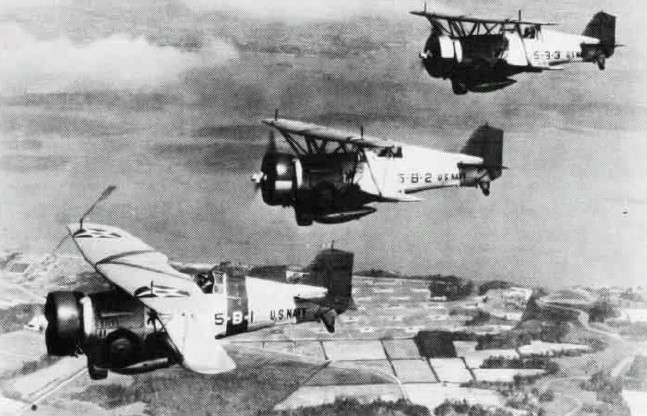
Curtiss BF2C Goshawks (US Navy Photo)

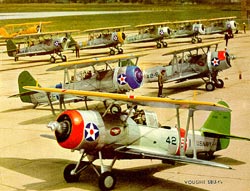
As the United States Navy built up its Carrier Force in the mid to late 1930s it continued to develop aircraft specifically designed to operate from aircraft carriers.  It continued its development of fighter, dive bomber and torpedo bomber aircraft.  In 1935 the Navy was operating the Grumman FF-1 biplane fighter which it had began using in 1933 and the Curtiss F11C and BF2C Goshawk. The Curtiss aircraft were built in fighter and bomber variants and while initial aircraft had an open cockpit and fixed landing gear later aircraft had an enclosed cockpit and retractable landing gear. They had top speed of 157 miles an hour and due to limited success and were retired from service by 1939.  The Goshawk was operated against the Japanese by Nationalist China and also served in a number of air forces including Thailand where they were used against the French and Japanese.

Grumman FF-1 (US Navy Photo)

The Grumman FF-1 was a two-seater that had a enclosed cockpit with retractable landing gear and a top speed of 201 miles an hour.  The FF-1 was faster than any naval aircraft of its era, a follow-on variant designated the SF-1 followed and 120 aircraft were built. Most of the operational aircraft served aboard the USS Lexington CV-2 in a fighter and scouting role. The FF-1 and SF-1 were withdrawn from first line service and placed with the reserve as well as being used in aviation training commands. The aircraft was manufactured under license by the Canadian Car and Foundry Company and served in the Canadian Air Force until 1942 as the Goblin and 40 of the Canadian aircraft were used by the Spanish Republican forces in the Spanish Civil War.

Grumman F2F-1 (US Navy Photo)

The FF-1/SF-1 was followed by the Grumman F2F a single-seat model with improved speed and maneuverability over is predecessors.  54 F2F’s were ordered in 1934 with the production models being delivered between April and August 1935.  The aircraft were armed with 2 .30 machine guns mounted above the cowl and had a top speed of 231 miles an hour and maximum range of 985 miles.  The aircraft would remain in service until they were replaced in 1939 with the Grumman F3F. However they remained in service as utility and training aircraft until retired from service toward the end of 1940.

Grumman F3F (US Navy Photo)

The Grumman F3F followed the F2F with 157 production models. It was more aerodynamic and had a more powerful engine that the F2F which enabled it to achieve a top speed of 264 miles an hour.  It was operated by seven Navy and Marine Corps Squadrons and entered service in 1936 and would serve aboard carriers until replaced in late 1941. It continued with 117 aircraft being stationed at naval air stations and used for training until 1943.

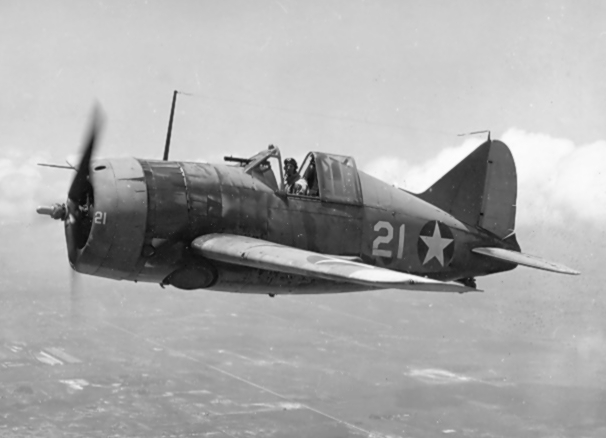
F2A Brewster Buffalo (U.S. Navy Photo)

The first monoplane fighter developed and placed in service by the Navy was the F2A Brewster Buffalo. The Buffalo served with Navy and Marine Corps squadrons and was purchased by Great Britain for service in the Royal Australian and Royal New Zealand Air Forces which received 202 Buffalos. They would also serve with the Royal Navy. The Royal Netherlands Air Force received 144 most of which served in the East Indies. The final nation to receive the Buffalo was Finland which received 44 aircraft.  Buffalo was underpowered and the addition of armor and added fuel capacity further diminished the speed and performance of the aircraft.  The Navy placed its Buffalo’s in advanced training squadrons in early 1942 and one of the two Marine Corps squadrons (VMF-221) operated it at the Battle of Midway where they endured fearful losses at the hands of Japanese Zero fighters.

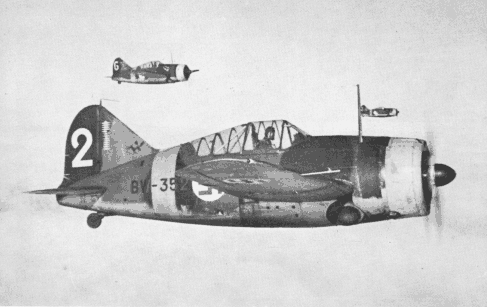
Brewster Buffalo 239s of the Finnish Air Force

Despite the lack of success in U. S. service the Buffalo performed in a heroic manner for the Finns destroying over 500 Soviet and German aircraft and producing 36 Buffalo Aces.  The highest scorer was Captain Hans W. Wind with 39 of 75 victories flying a Buffalo.  British Commonwealth and Dutch aircraft did not fare as well as the Finns as the tropical climate degraded the aircraft considerably.

Martin T4M over Lexington or Saratoga (US Navy Photo)

The Navy also developed aircraft for bombing missions as well as that could launch aerial torpedoes. The first aircraft built were dual purpose in that they could be used in level bombing and torpedo missions. In 1935 the primary aircraft of this type was the Martin T4M which had entered service in 1928 and replaced the Douglas DT and Martin T4M aircraft.  The T4M was a biplane with a crew of three that had a maximum speed of 114 miles an hour (I have driven much fast than this on the German Autobahn but I digress) and it could carry a torpedo or bombs.  155 were purchased by the Navy and the Marine Corps between 1928 and 1931.  They were operated from the Lexington and Saratoga until 1938 as no replacement aircraft offered enough improvements for the Navy to purchase and were instrumental in the development and demonstration of the capabilities of naval air power.  They were finally replaced by the Douglas TBD Devastator.

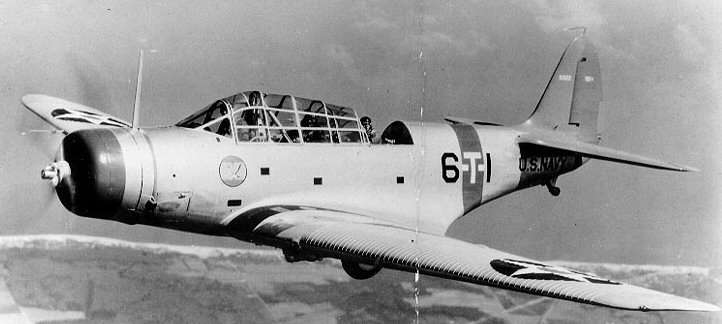
TBD Devastator (US Navy Photo)

The TBD which first flew in 1935 entered service in 1937 and at the time was possibly the most modern naval aircraft in the world and was a revolutionary aircraft. It was the first monoplane widely used on carriers and was first all-metal naval aircraft.  It was the first naval aircraft with a totally enclosed cockpit, the first with hydraulic powered folding wings.  The TBD had crew of three and had a maximum speed of 206 miles an hour and carried a torpedo or up to 1500 pounds of bombs (3 x 500) or a 1000 pound bomb.  129 were built and served in all pre-war torpedo bombing squadrons based aboard the Lexington, Saratoga, Ranger, Yorktown, Enterprise and Hornet with a limited number embarked aboard Wasp.  The Devastator saw extensive service prior to the war which pushed many airframes to the end of their useful service life and by 1940 only about 100 were operational.  They were still in service in 1942 as their replacement the TBF Avenger was not ready for service.  They performed adequately against minor opposition at Coral Sea and in strikes against the Marshalls but the squadrons embarked on Yorktown (VT3), Enterprise (VT-6) and Hornet (VT-8) were annihilated at Midway with only 6 of 41 surviving their uncoordinated attacks against the Japanese Carrier Strike Force.  They were too slow, had poor maneuverability, insufficient armor and defensive armament.  Only a few were able to launch their torpedoes as the Japanese Combat Air Patrol tore through them. Their sacrifice was not in vain as the Dive Bombers arrived facing no opposition and sank three of the four Japanese carriers getting the fourth later in the day. After Midway the remaining aircraft were withdrawn from active service in the Pacific. The Ranger’s VT-4 operated them until September 1942and Wasp’s VT-7 operated them in the Atlantic until she was transferred to the Pacific in July 1942.   By 1944 all remaining aircraft had been scrapped.

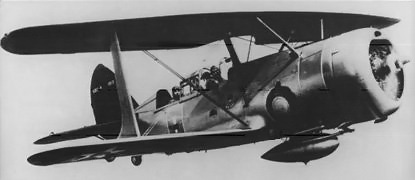
Vought SBU Corsair

In the mid 1930s the Navy began to develop Scout and Dive Bombers for use in carrier scouting (VS) and bombing (VT) squadrons.  The first of these aircraft types were biplanes.  The Grumman SF-1 was used in a scouting and bombing role and was joined by the Vought SBU Corsair in 1935 and by 1937 both were being replaced by the Curtiss SBC Helldiver, a biplane with a 234 mile an hour maximum speed, retractable landing gear, enclosed cockpit which could carry a 1000 bomb.

Curtis SBC Helldiver

However the era of the biplane was drawing to a close and the Helldiver would be relegated to training squadrons based in Florida.  Although they had a brief service career they were instrumental in develop dive bombing tactics at which the U.S. Navy excelled and which were copied by the German Luftwaffe with the Junkers JU-87 Stuka and the Japanese with the Aichi 99 Val naval dive bomber.  50 aircraft were transferred to the French and served aboard the carrier Bearn but due to the French surrender in June of 1940 saw no action and spent the war rotting in Martinique.

Vought SB2U Vindicator

The Helldiver’s were joined by the first monoplane dive bomber in U.S. service the Vought SBU2 Vindicator in 1937. The Vindicator was used by the Navy and the Marine Corps serving aboard the Lexington, Saratoga, Ranger and Wasp. They would remain in service until September 1942. The Marine aircraft equipped two squadrons VMSB 131 and VMSB-241, VMSB 241 suffered heavy casualties at Midway as the aircraft were underpowered and were limited to glide bombing missions.  After they were taken out of the operational squadrons the Vindicator served as a training aircraft until retired in 1945.   A French Naval Air Squadron was equipped with the Vindicator but they served ashore against the German invasion.  Most were lost to enemy action.  The Douglas SBD Dauntless was introduced in 1940 and 1941 but I will cover that aircraft in the World War II aircraft article that will follow this in a week or two.

These aircraft helped pave the way to aircraft that would be the mainstays of the Navy in the Second World War, aircraft with names such as Dauntless, Helldiver, Avenger, Hellcat and Corsair.  Naval aviation earned its “wings of gold” in these early years wings that continue to shine in the 21st Century.

Peace

Padre Steve+

9 Comments

Filed under aircraft, Military, US Navy, world war two in the pacific

Iconic and Heroic: The Fletcher Class Destroyers

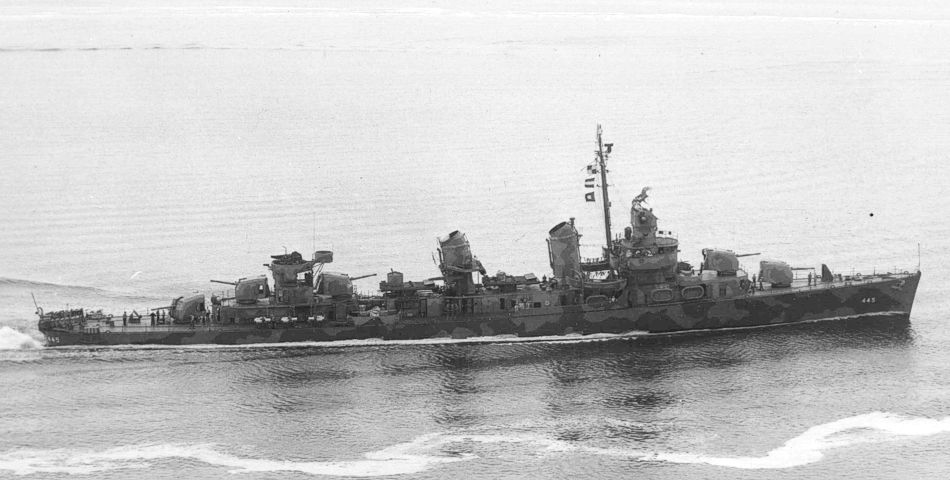
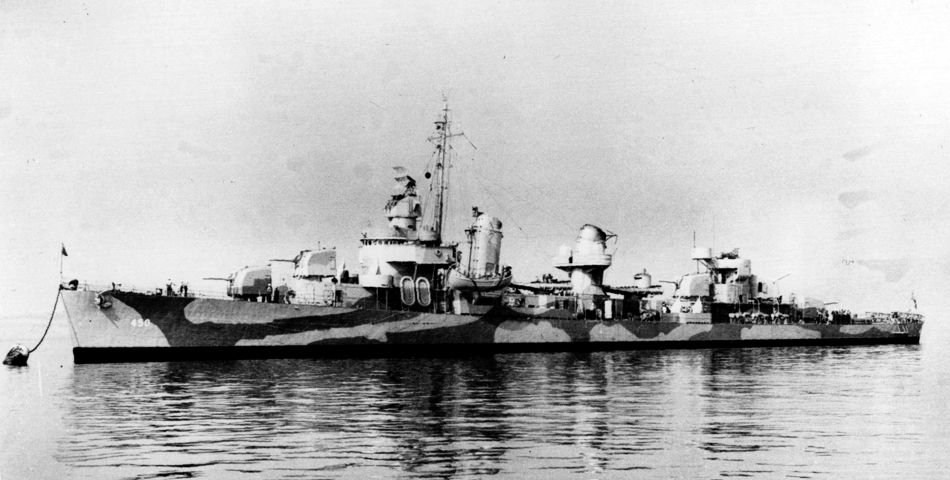
The USS Fletcher DD-445

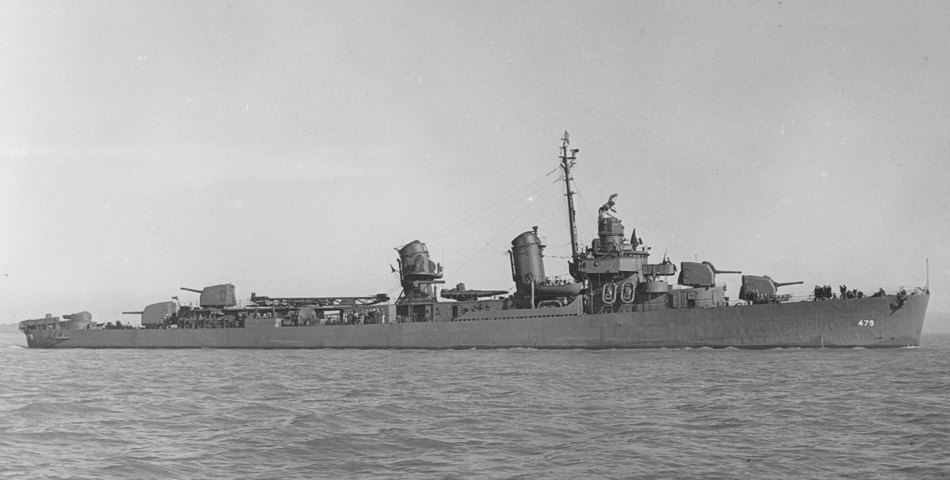
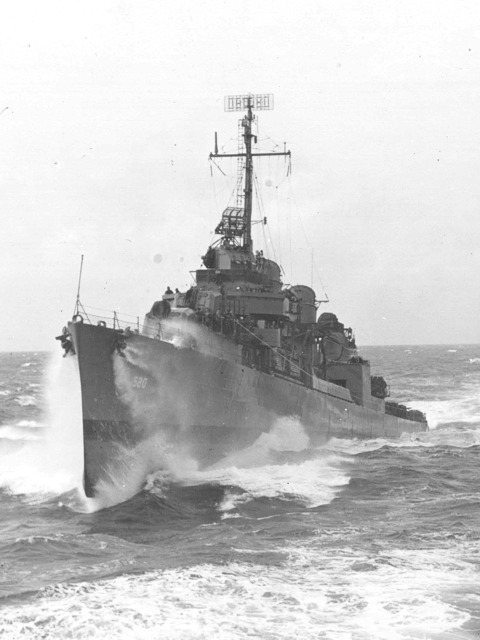
If ever a class of warships can define a ship type the destroyers of the Fletcher Class were that. The most numerous of all United States Navy destroyer classes the Navy commissioned 175 of these ships between June 1942 and February 1945.  There were two groupings of ships the 58 round or “high bridge” ships and the 117 square or “low bridged” ships. It was a sound design that would be modified for use in the later Allen M. Sumner and Gearing Class destroyers.  Eleven shipyards produced the ships fast, heavily armed and tough the ships would serve in every theater of the war at sea but would find their greatest fame in the Pacific where many became synonymous with the courage and devotion of their officers and crews.

USS Stevens one of the 6 Fletchers equipped with an aircraft catapult

The ships were a major improvement on previous classes of destroyers and were equal or superior to the destroyers of our allies and our enemies in the war.  At 2050 tons displacement and 2900 tons full load the ships were significantly larger than preceding classes and were designed to mount a superior anti-aircraft armament to compliment their main battery of five 5” 38 caliber dual purpose guns and ten 21” torpedo tubes. 376 feet long and flush decked they were an exceptionally tough class of ships which was demonstrated often in the brutal surface battles in the South Pacific, Leyte Gulf and in the battles with Kamikazes off the Philippines, Iwo Jima, Okinawa and the Japanese mainland.  They were the first destroyers of the US Navy which were built with radar as part of the initial design.

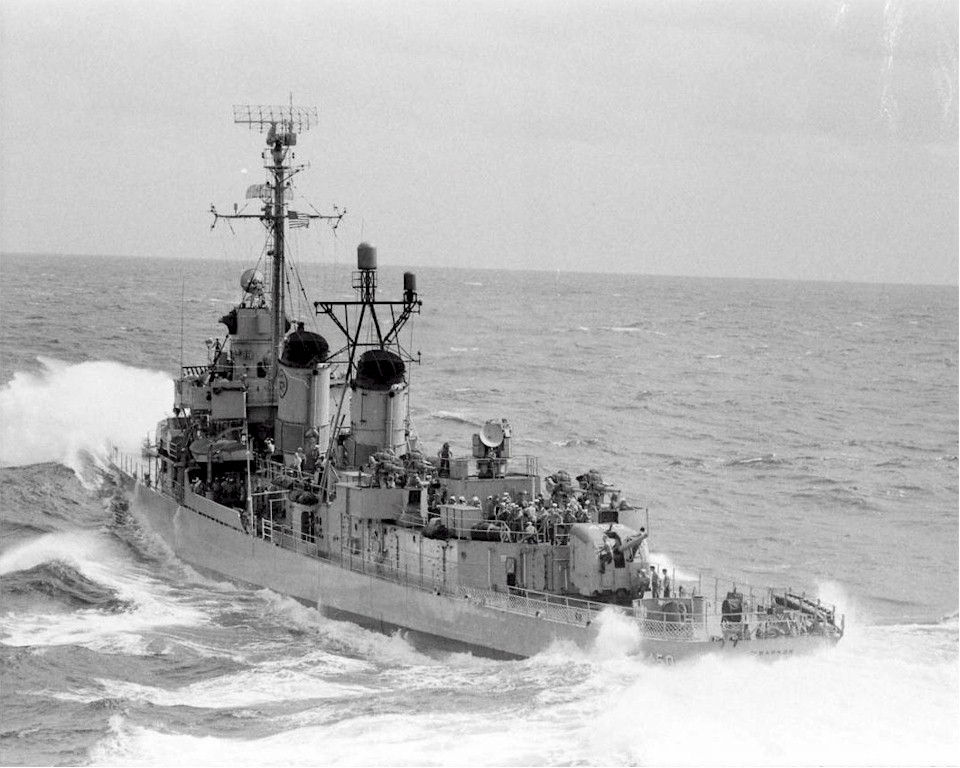
USS O’Bannon DD-450 in 1961

The anti aircraft armament was increased throughout the war. Initially this was composed of: 4 x 40mm Bofors in two twin-mounts and 6 to 13 x 20mm Oerlikon in single-mounts. By June of 1943 new ships of the class mounted 10 x 40mm Bofors in five twin-mounts 7 x 20mm Oerlikon in single-mounts. As the Kamikaze threat became dire ships returning to the United States for refit lost one of their torpedo tube mounts and had their AA armament increased to 14 x 40mm Bofors in three twin and two quad mounts and 12 x 20mm Oerlikon in six twin mounts.  One of the more unusual experiments was to equip six ships with a catapult for a float plane. This eliminated some of their AA guns and one torpedo tube mounting. It was not successful and the mounts were removed before the end of the war.

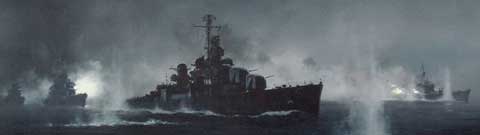
USS Nicholas in action at Kula Gulf

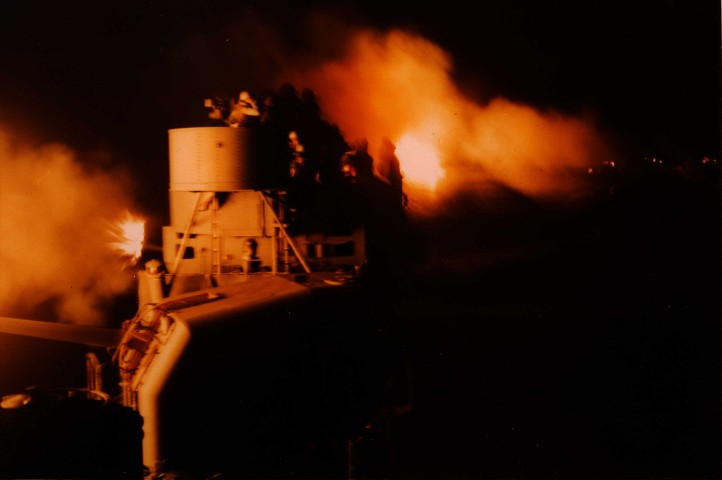
The first ships of the class saw action in the Solomons during the Guadalcanal campaign.  Fletcher and O’Bannon took part in the Naval Battle of Guadalcanal where O’Bannon was one of several destroyers that ganged up on the Japanese Battleship Hiei at ranges as low as 500 yards causing heavy damage to the Battleship which was sunk by naval aircraft the following day.  The O’Bannon would be awarded the Presidential Unit Citation for her actions around Guadalcanal which read:

O’Bannon

“For outstanding performance in combat against enemy Japanese forces in the South Pacific from October 7, 1942, to October 7, 1943. An aggressive veteran after a year of continuous and intensive operations in this area, the U.S.S. O’BANNON has taken a tremendous toll of vital Japanese warships, surface vessels and aircraft. Launching a close range attack on hostile combatant ships off Guadalcanal on the night of November 13, 1942, the O’BANNON scored three torpedo hits on a Japanese battleship, boldly engaged two other men o’ war with gunfire and retired safely in spite of damage sustained. During three days of incessant hostilities in July 1943, she gallantly stood down Kula Gulf to bombard enemy shore positions in coverage of our assault groups, later taking a valiant part in the rescue of survivors from the torpedoed U.S.S STRONG while under fierce coastal battery fire and aerial bombing attack and adding her fire power toward the destruction of a large Japanese naval force. In company with two destroyers, the O’BANNON boldly intercepted and repulsed nine hostile warships off Vella Lavella on October 7, 1943, destroying two enemy ships and damaging others. Although severely damaged, she stood by to take aboard and care for survivors of a friendly torpedoed destroyer and retired to base under her own power. The O’BANNON’s splendid acheivements and the gallant fighting spirit of her officers and men reflect great credit upon the United States Naval Service.

DESRON 23

Fletcher’s composed DESON 23 the Little Beavers” commanded by Commodore Arleigh “31 knot” Burke. The squadron which covered the initial landings at Bougainville in November 1943 fought in 22 separate engagements during the next four months. During this time the squadron was credited with destroying one Japanese cruiser, nine destroyers, one submarine, several smaller ships, and approximately 30 aircraft.  Under Burke the squadron was composed of USS Foote (DD-511), USS Charles Ausburne (DD-570), USS Spence (DD-512), USS Claxton (DD-571), USS Dyson (DD-572), USS Converse (DD-509) and USS Thatcher (DD-514).  At the Battle of Cape St. George the squadron intercepted a Japanese force of 5 destroyers sinking 3.  At the Battle of Empress Augusta Bay the ships were in action as part of Task Force 39 based around Cruiser Division 12 comprised of the Cleveland Class Light Cruisers Montpelier, Cleveland, Columbia and Denver the took part in the sinking of the Japanese Light Cruiser Sendai and a destroyer.  For their efforts DESRON 23 would be awarded the Presidential Unit Citation which stated:

“For extrordinary heroism in action against enemy Japanese forces during the Solomon Islands Campaign, from November 1, 1943, to February 23, 1944. Boldly penetrating submarine-infested waters during a period when Japanese naval and air power was at its height, Destroyer Squadron TWENTY THREE operated in daring defiance of repeated attacks by hostile air groups, closing the enemy’s strongly fortified shores to carry out sustained bombardments against Japanese coastal defenses and render effective cover and fire support for the major invasion operations in this area. Commanded by forceful leaders and manned by aggressive, fearless crews the ships of Squadron TWENTY THREE coordinated as a superb fighting team; they countered the enemy’s fierce aerial bombing attacks and destroyed or routed his planes; they intercepted his surface task forces, sank or damaged his warships by torpedo fire and prevented interference with our transports. The brilliant and heroic record achieved by Destroyer Squadron TWENTY THREE is a distinctive tribute to the valiant fighting spirit of the individual units in this indomitable combat group and of each skilled and courageous ship’s company.”

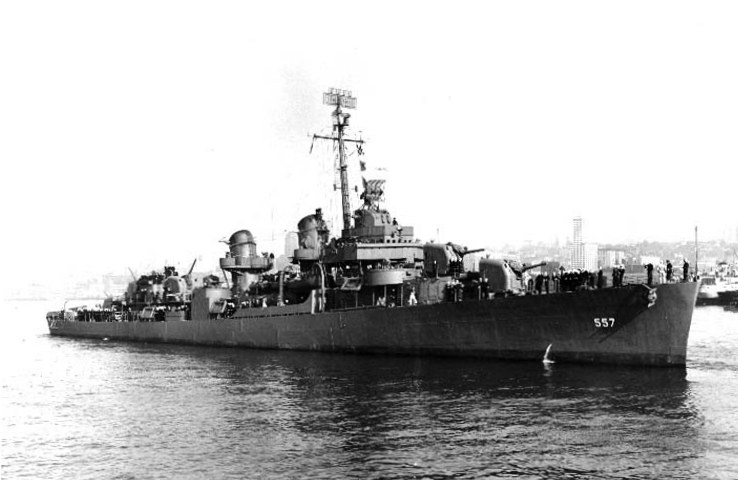
USS Johnston DD-557

Fletcher’s served heroically with “Taffy-3” in the Battle of Samar at the Battle of Leyte Gulf.  Taffy-3 which was composed of 6 escort carriers, the Fletcher Class destroyers Hoel, Johnston and Heermann and 4 destroyer escorts was assigned the task of providing close air support for troops ashore and anti-submarine protection for transports.  On the morning of October 25th Admiral Halsey took Third Fleet north to engage a Japanese carrier force believing a Japanese surface force of battleships and cruisers to have withdrawn after being heavily hurt by submarine and air attacks.  The carrier force had few aircraft and was considered a decoy by the Japanese. This left the San Bernardino Strait unguarded and the Japanese surface force which by now was comprised of 4 battleships including the Yamato as well as 6 heavy and 2 light cruisers and 11 destroyers doubled back going through the strait during the early morning hours of the 25th.  Just before dawn a patrol aircraft spotted the Japanese force and at 0659 Yamato opened fire on the task group.

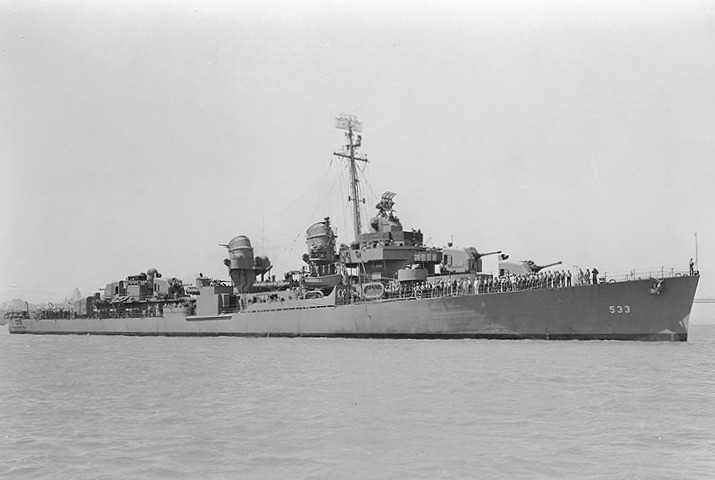
USS Hoel DD-533

The three Fletcher’s and the Destroyer escort Samuel B Roberts were launched into a suicidal counter-attack against the Japanese force. Led by Johnston under the command of Ernest E. Evans the little ships engaged their vastly superior foe as the escort carriers edged away as they launched and recovered their aircraft to keep a continuous air assault on the Japanese force.  Johnston scored numerous hits with her 5” guns on the Heavy Cruiser Kumano and when she reached torpedo range launched her 10 “fish” one of which blew off Kumano’s bow and another of which crippled Kumano’s sister Suzuya before she was hit in quick succession by a 14” shell from the Battleship Kongo which hit her engine room and three 6” shells from Yamato which struck her bridge.  Evans kept the crippled ship in the fight drawing fire away from other attacking destroyers and fending off a Japanese destroyer squadron that was trying to flank the carriers. Johnston continued to be hit and was abandon at 0945 sinking 25 minutes later with 186 of her crew.  Evans did not survive and was awarded the Medal of Honor.

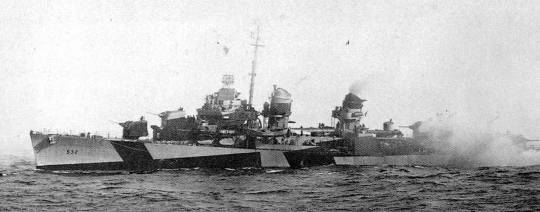
USS Heermann DD-532 in action at Samar

Hoel under the command of Commander Leon S. Kintberger took on the Battleship Kongo and a column of cruisers lead by the Heavy Cruiser HaguroHoel’s torpedo attack on Kongo forced that ship to turn away and torpedo hits were claimed on the Haguro, although that ship remained in action and the Japanese denied any torpedo damage from the attack. The Japanese concentrated on Hoel sinking her at 0855 taking all but 86 of her crew to a watery grave.

Heermann under Commander Amos Hathaway threw herself into the fight engaging Japanese battleships and cruisers. Heermann engaged Heavy Cruiser Chikuma with her guns while mounting a torpedo attack on Haguro. She then attacked the Japanese battleships directly engaging Haruna and forcing Yamato to head away from the action for 10 minutes as she was bracketed by two of Heermann’s torpedoes running on a parallel course.  She engaged the other battleships at such close range that they could not hit her and broke off to intercept a column of cruisers.  Once again she engaged Chikuma in a bloody duel with both ships taking heavy damage. Crippled by a series of 8” shell hits from the heavy cruisers Heermann was down heavily at the bow, so much so that her anchors dragged the water. Carrier aircraft joined the battle and Chikuma withdrew from the fight and sank during her withdraw. Heermann then engaged Heavy Cruiser Tone before that ship, also damaged by air attack withdrew from the fight.  Though she was heavily damaged the Heermann was the only destroyer to survive the action.  Despite their terrible losses the ships and aircraft of Taffy-3 sank 3 heavy cruisers and a destroyer and heavily damaged 3 battleships and 3 heavy cruisers.

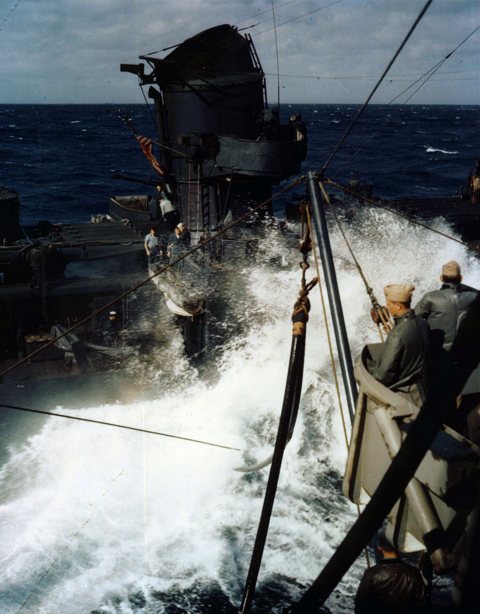
Just a bit wet, USS Halsey Powell unrep with USS Wisconsin

For their heroic actions which kept the Japanese from getting to the vulnerable transports Taffy-3 including the valiant destroyers Johnston, Hoel, Heerman and Destroyer Escort Samuel B Roberts was awarded the Presidential Unit Citation which read:

“For extraordinary heroism in action against powerful units of the Japanese Fleet during the Battle off Samar, Philippines, October 25, 1944. Silhouetted against the dawn as the Central Japanese Force steamed through San Bernardino Strait towards Leyte Gulf, Task Unit 77.4.3 was suddenly taken under attack by hostile cruisers on its port hand, destroyers on the starboard and battleships from the rear. Quickly laying down a heavy smoke screen, the gallant ships of the Task Unit waged battle fiercely against the superior speed and fire power of the advancing enemy, swiftly launching and rearming aircraft and violently zigzagging in protection of vessels stricken by hostile armor-piercing shells, anti-personnel projectiles and suicide bombers. With one carrier of the group sunk, others badly damaged and squadron aircraft courageously coordinating in the attacks by making dry runs over the enemy Fleet as the Japanese relentlessly closed in for the kill, two of the Unit’s valiant destroyers and one destroyer escort charged the battleships point-blank and, expending their last torpedoes in desperate defense of the entire group, went down under the enemy’s heavy shells as a climax to two and one half hours of sustained and furious combat. The courageous determination and the superb teamwork of the officers and men who fought the embarked planes and who manned the ships of Task Unit 77.4.3 were instrumental in effecting the retirement of a hostile force threatening our Leyte invasion operations and were in keeping with the highest traditions of the United States Naval Service.”

USS Isherwood (DD-520) underway in heavy weather as she comes alongside the heavy cruiser USS Tuscaloosa (CA-37) in August 1943. National Archives and Records Administration. Photo # 80-G-79429. [Navsource]

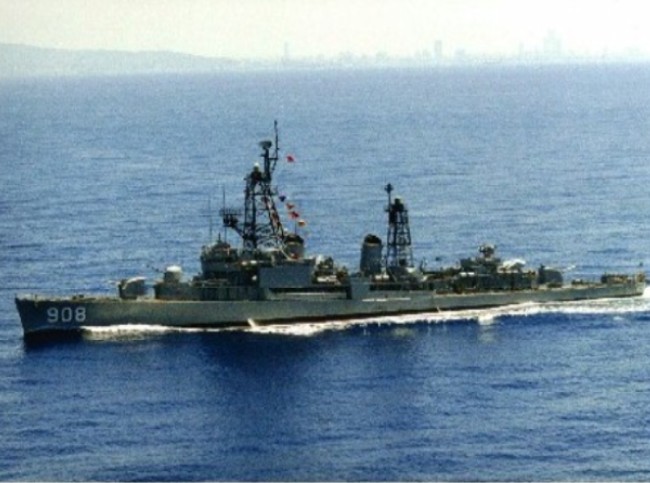
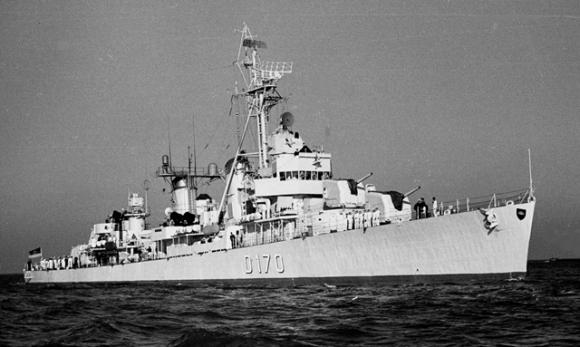
During the war 19 of the class were lost and 6 damaged so badly that they were not repaired. 44 of the ships were awarded 10 battle stars or more while 19 were awarded Naval Unit Commendations and 16 Presidential Unit Citations.  Following the war all were decommissioned and placed in reserve. Many were re-commissioned during the Korean War and served through Vietnam. Some of these ships were modernized with newer ASW weapons and re-designated Escort Destroyers (DDE) while others had their air search radar modernized and were re-classified as Radar Picket Destroyers or (DDR). The last Fletcher in US Service decommissioned in 1971.  52 were sold or transferred under military assistance programs to other navies in the 1950s.  The ships served well and the last one in active service the Mexican Navy Destroyer Cuitlahuac the former USS John C Rodgers DD-874 was decommissioned in 2001.

Ex USS Twinning in Republic of China Navy Service, note weapon modifcations

Zerstörer Z-1 Rommel

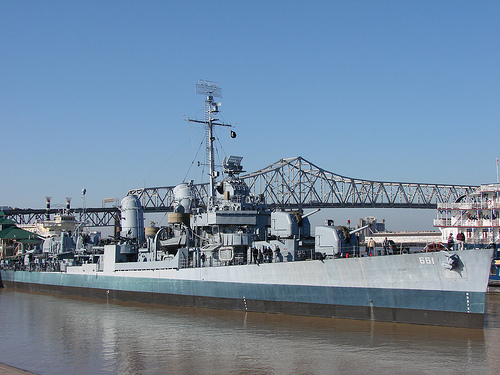
USS Kidd as Museum and Memorial

Four are currently open as memorial ships the USS Cassin Young DD-793 at Buffalo NY, the USS The Sullivans DD-537 at Boston MA and USS Kidd DD-661 at Baton Rouge LA can be seen in the United States. The Cassin Young is berthed at the old Charlestown Naval Yard in Boston across the pier from the Frigate USS Constitution.  The former the Greek destroyer Velos the ex-USS Charette DD-581 is located in Athens.  The John Rodgers has been purchased by a group in the US but is currently laid up in Mexico and her fate is undecided. I hope that she too will be saved for future generations.

The Fletcher Class really symbolizes more than any class of destroyer the classic look of what a destroyer should be. Their clean lines and classic design are iconic not just in this country but in the 15 other countries that they would serve in during the following years.  Their amazing record and service in World War Two and in the following years in both the US Navy and the navies of our Allies is one that will probably never be surpassed.

I have visited the Cassin Young in Boston; it is well worth the time to see. I hope that I might see The Sullivans and Kidd in the coming years.

The Zerstörer Z-4 ex USS Dyson in heavy seas

I salute the ships of the class and the officers and sailors that served on them in peace and war.

Peace

Padre Steve+

5 Comments

Filed under History, Navy Ships, US Navy, world war two in the pacific

Workhorses: The Brooklyn Class Light Cruisers

The Brooklyn Class Light Cruisers were the most modern cruisers in the US inventory when war broke out in on December 7th 1941.  The ships were built under the provisions of the Washington Naval Treaty of 1922.  Displacing 9700 tons to remain within treaty limitations they mounted a powerful armament of fifteen 6” guns mounted in 5 turrets, three forward and two aft.  Their design, especially their armament was designed in response to the large Mogami Class light cruisers of the Imperial Japanese Navy which initially mounted the same main battery before being converted to Heavy Cruisers.  The layout of the main battery in both classes of cruisers was identical.

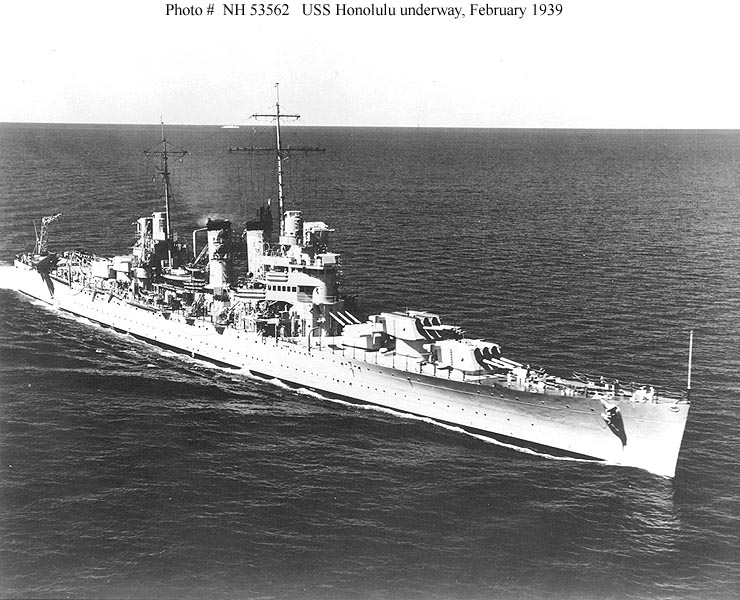
Pre-war shot of Honolulu, typical of Brooklyn Class

Authorized in by Congress in 1933 the ships were designed with a large transom which housed the aircraft hangar with twin catapults and crane. This was a departure from previous US cruisers which housed the aircraft and their volatile fuels midships which would prove a liability in combat against the Japanese in the Solomons campaign.  The new hangar design was carried forth on all new cruisers and battleships built by the US subsequent to the Brooklyn Class.

There were 9 ships in the class, one of which the Wichita was completed as a Heavy Cruiser mounting nine 8” guns in triple turrets and is considered a separate one ship class.  In addition to their main battery they mounted eight 5” 25 caliber dual purpose guns and a light AA battery which was continuously increased throughout the war. Their steam turbines produced 100,000 shaft horsepower to give the ships an official speed of 32.5 knots which was exceeded by some of the ships.

The ships Brooklyn CL-40, Philadelphia CL-41, Savannah CL-42, Nashville CL-43, Phoenix CL-46, Boise CL-47, Honolulu CL-48, St. Louis CL-49 and Helena CL-50 were involved in some of the most intense combat of the war serving in both the Atlantic and the Pacific.  Of the ships one, the Helena was lost in surface combat and several others taking severe damage without sinking.  Half of the surviving ships of the class would serve in foreign navies for many years following the war a testament to their toughness and utility.

The lead ship of the class the Brooklyn served exclusively in the Atlantic and Mediterranean where she engaged Vichy warships during the invasion of North Africa and took part in the landings at Sicily, Salerno, Anzio and Southern France where she provided naval gunfire support to troops ashore. Following the war she was decommissioned in January 1947 and transferred to the Chilean Navy in 1951 under the Mutual Defense Assistance Program. She was renamed O’Higgins and served until decommissioned in January 1992 and sold for scrap. She sank while being towed to India for scrapping in November 1992.

Philadelphia had a similar career to Brooklyn. Launched in 1936 and commissioned in 1937 she too served in the Atlantic and Mediterranean supporting the invasions of North Africa, Sicily, Salerno, Anzio and Southern France.  She was decommissioned in February 1947 and transferred to Brazil in 1951. Renamed Barroso she served until 1973 and sold for scrap.

Late war view of St Louis

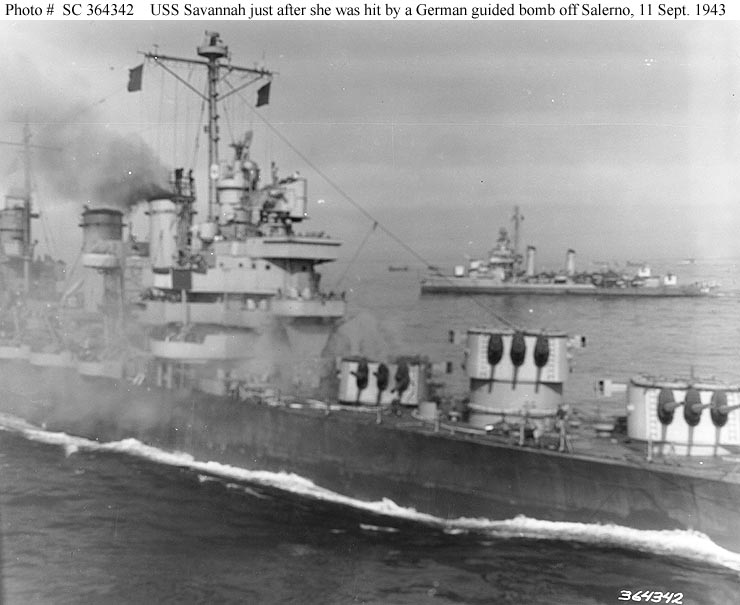
Savannah was launched in May 1937 and commissioned in March 1938 and like Brooklyn and Philadelphia served exclusively in the Atlantic and Mediterranean supporting amphibious landings, searching for German commerce raiders and blockade runners and supporting various escort missions. At Salerno she was struck and severely damaged by a German FX-1400 radio guided bomb which struck her number 3 gun turret penetrating to the lower handling room where it exploded tearing a large hole in the ship’s bottom and opening a seam in the ship’s side.  Her crew performed heroically to control the damage and get the ship to Malta but she lost 197 sailors in the attack. Following temporary repairs she returned to the United States for repairs and modernization which were complete in September 1944. She served in a number of capacities in the Atlantic and was decommissioned in February 1947, stricken from the Navy List in March 1959 and sold for scrapping in January 1966.

Nashville was launched in October 1937 and commissioned in June 1938 initially serving in the Atlantic until her transfer to the Pacific Fleet in February 1942.  While in the Atlantic she took part in the Neutrality Patrols and following the commencement of hostilities continued convoy escort duties.  Her first mission in the Pacific was to escort the Carrier Hornet CV-8 on her mission to launch Colonel Jimmy Doolittle’s Army Air Force B-25s on the Tokyo raid.  Nashville sank a scout vessel which had discovered the task force.  On return from the mission she was assigned to the defense of the Aleutians until November 1942.  She then was transferred to the South Pacific where she participated in raids and bombardments of Japanese shore installations until while shelling Vila Airfield on Kolombangara on the night of 12 May 1943, she had an explosion of powder charges in one of her forward turrets, killing 18 and injuring 17.  The damage required her to be sent to Bremerton for repair and modernization and she would return to duty in August to join carrier task forces in raids in the Central Pacific before again moving to the South Pacific where she participated in the New Guinea campaign and as well as other missions until May of 1944.  She took part in the invasion of Leyte and the Battle of Leyte Gulf guarding beachheads and transports and fending off Kamikazes while providing naval gunfire support to troops ashore. While conducting similar operations off Negros Island she was struck by a Kamikaze with two bombs aboard. Nashville was struck on one of her port 5” mounts the bombs exploding above her deck. The blazing aviation fuel and explosions killed 139 crew members and wounded 190.  Following repairs at Bremerton she went back to the Southwest Pacific lending her battery to landings at Brunei Bay, Borneo, and protecting carriers in the Makassar Straits.  She was decommissioned in June of 1946 and sold to Chile in January 1951 where she was renamed Captain Prat where she served until she was decommissioned in May 1982 and sold for scrap in April 1983.

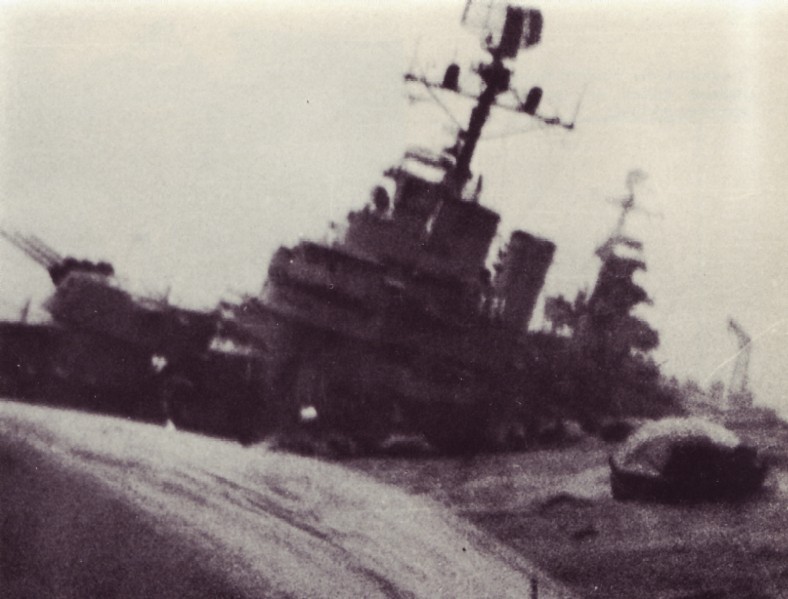
Phoenix was launched in March of 1938 and commissioned in October of the same year. She became part of the growing Pacific Fleet and was the first modern light cruiser assigned in the Pacific. She was at Pearl Harbor on December 7th 1941 and would serve throughout the war in the Indian Ocean and the South Pacific and was engaged in heavy operations around New Guinea and other islands in the area frequently involved in shore bombardment, amphibious assaults and raids and having to engage attacking Japanese aircraft.  In September 1944 she was assigned to the covering force of old battleships assigned to 7th Fleet for the invasion of the Philippines.  As part of this force under Rear Admiral Jesse Oldendorf she took part in the destruction of the Japanese Southern Force at the Battle of Surigo Strait where her gunners aided in the sinking of the Japanese battleship Fuso. Phoenix continued operations with 7th Fleet in the Southwest Pacific supporting shore operations and fighting off swarms of Kamikazes without damage to herself. Following the war she was decommissioned in July 1946 and transferred to the Argentinean Navy in April 1951 where she was renamed 17 de Octubre and later General Belgrano. She received a number of modifications while in Argentine service including ASW helicopters and the Sea Cat Air Defense missile system.  Still in active service at the time of the Argentinean invasion of the Falkland Islands in 1982 she was sent to sea with two destroyers.  She was discovered by the British attack submarine HMS Conqueror torpedoed and sunk on May 3rd 1982 with the loss of 323 men, ending a 44 year career of service to the United States and Argentinean Navies.

Boise was launched in December 1936 and commissioned in August 1938. Following her shakedown cruise she was assigned to the Pacific Fleet. On December 7th 1941 she was in the Philippines after having completed a convoy escort mission.  She was sent south to join the rest of the Asiatic Squadron and our Australian, British and Dutch Allies to for the ABDA (American, British, Dutch, and Australia) task force opposing the southern advance of the Japanese aimed at Java and the Dutch East Indies.  She struck an uncharted shoal on January 29th while conducting operations in the Sape Strait forcing her to return to the United States for repairs. This probably prevented Boise from sharing the fate of most of the rest of the squadron including the HMS Exeter, USS Houston, HMAS Perth and Dutch light cruisers DeRuyter and Java, most of which were sunk in the Battle of the Java Sea in February. After repairs she returned to the South Pacific where she took part in a number of actions including the Battle of Cape Esperance where she helped sink the Japanese Heavy Cruiser Furutaka and destroyer Fubiki. She was damaged in this action and returned to Philadelphia for repairs.  Following her repairs she was dispatched to support the landings on Sicily before returning to the Pacific where she served from January 1944 to June of 1945 conducting almost non-stop operations around New Guinea, Borneo and the Philippines. She returned to San Pedro for overhaul and was there when the war ended. She decommissioned in July 1946 and sold to Argentina in January 1951 and commissioned as Nuevo de Julio in 1952.  She served until 1978 when she was decommissioned and was sold for scrap in August 1981.

Honolulu had one of the most active careers while engaged in operations against Japanese Naval units with far less time devoted to gunfire support missions.  She was at Pearl Harbor on December 7th 1941 and following that took part in convoy escort missions until she went north to screen Alaska from Japanese attack in May 1942 a task that she engaged in until November.  She then reported to the South Pacific and was part of operations against the Japanese Fleet in the Solomons. She took part in the Battle of Tassafaronga, the Battle of Kula Gulf where she helped sink a destroyer and the Battle of Kolombangara where she was instrumental in sinking the Sendai class light cruiser Jintsu and a destroyer. She then supported amphibious operations in the Central Pacific including Saipan and Guam and the Leyte Gulf landings in the Philippines.  While operating off Manus Island she was stuck by an aerial torpedo receiving heavy damage which required her withdraw to the United States for major repairs which were still being completed when the war ended. She decommissioned in February 1947, stricken from the Naval Register in November 1959 and sold for scrap.

St. Louis was launched in April 1938 and commissioned in May 1939. After time conducting neutrality patrols at the onset of the war in the Atlantic she was transferred to the Pacific Fleet in November 1940. She was at Pearl Harbor on December 7th 1941 and was one of the few major fleet units to get underway and out to sea during the attack.  She supported carrier operations and convoy escort missions until she was sent north to that Aleutians where she operated until October when she returned to the States for a brief overhaul before being assigned to operations in the Solomons. Operating on a nearly nonstop basis against the Tokyo Express she took part in the Battle of Kula Gulf and the Battle of Kolombangara where she received partial credit for the sinking of the Japanese light cruiser Jinstu. During the battle she was torpedoed in the bow and after temporary repairs returned to the Mare Island. Following repairs St. Louis returned to the Solomons in November 1943. She was struck by a bomb which killed 20 crew members on January 14th requiring her to return to Purvis Bay for repairs. The repairs complete she returned to the Solomons until June when she took part in the invasion of the Marshalls at Guam and Saipan. She damaged her number three propeller and had to return to the States for repair following the Guam bombardment.  Upon her return she served at Leyte Gulf until she was hit by two Kamikazes in a short span receiving heavy damage and resulted in the loss of 15 sailors killed, 1 missing and 43 wounded.  She again sailed for repairs and returned to action against the Japanese home islands and Okinawa. Following this she supported operations against Japanese installations on the Asian mainland.  Following the war she took part in the Yangtze River patrol force and then returned to the United States in January 1946.  She was decommissioned in June 1946 and transferred to Brazil in January 1951 being commissioned as Tamandare. She was decommissioned in June 1976 and sold for scrapping in 1980. While being towed to Taiwan for scrapping she sank on August 24th 1980.

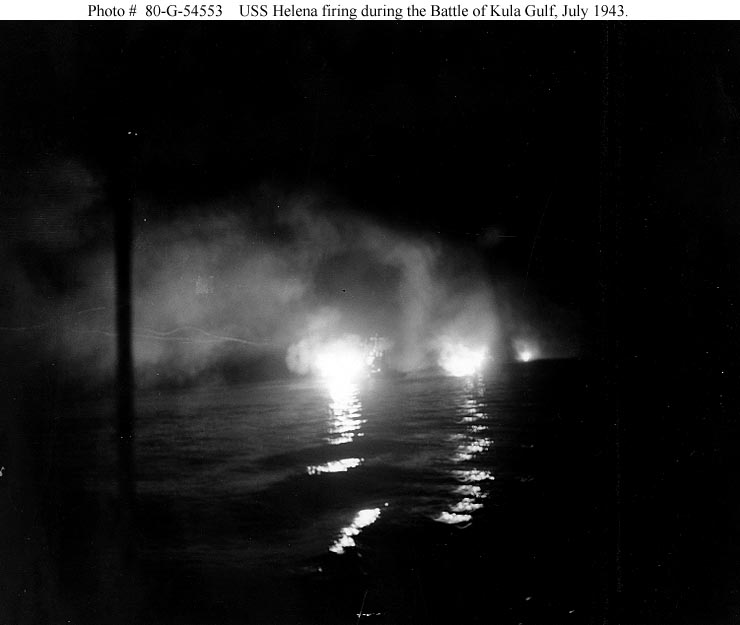
Helena firing at Kula Gulf just before being torpedoed and sunk

The Final ship in the class, Helena was launched in August 1939 and commissioned in the following month.  She was at Pearl Harbor and mooed at the 1010 Dock where she was hit by a torpedo and damaged. After repairs she reported to the South Pacific and the Guadalcanal campaign.  She escorted carriers. Helena had the most modern surface search radars and at Battle of Cape Esperance in Iron Bottom Sound, Helena had sunk cruiser Furutaka and destroyer Fubiki.  She then took part in the Naval Battle of Guadalcanal in which a weaker American force turned back a Japanese force with heavy losses on both sides including the Japanese Battleship Hiei and the American cruisers Atlanta, Juneau and 4 destroyers. Helena continued operations in the Solomons and at the Battle of Kula Gulf was sank by Japanese torpedoes fired by destroyers on July 5th 1943.  168 of her sailors were lost in the action. Helena was the first US Navy ship to be awarded the Naval Unit Commendation.

The General Belgrano ex-USS Phoenix sinking after being torpedoed by HMS Conqueror at the Battle of Falkland Islands

The class found its niche in the war primarily in shore bombardment and Naval Gunfire Support as well as in the sharp surface actions in the South Pacific. Only one, Helena was lost.  Six were transferred to South American Navies making and served for many years in those navies. None survive today but the ships were instrumental in the success of many operations.

3 Comments

Filed under History, Military, Navy Ships, US Navy, world war two in europe, world war two in the pacific

Five Minutes that Changed History: The Battle of Midway 1022-1027 hours June 4th 1942

Instruments of Death SBD Dauntless Dive Bombers at Midway

Six months after Pearl Harbor the United States Navy met the Imperial Japanese Navy in battle on the seas and in the airspace around Midway Island. It was a battle between a fleet that had known nothing but victory in the months after Pearl Harbor, sweeping across the Pacific and the Indian Oceans and decimating Allied Naval forces that stood in their way, the HMS Prince of Wales and HMS Repulse off of Singapore, a force of Royal Navy cruisers and the Aircraft Carrier HMS Hermes in the Indian Ocean, the bulk of the US Asiatic Fleet in the waters around the Philippines and the Dutch East Indies culminating in the Battle of the Java Sea where the bulk of the American, British, Dutch and Australian naval forces engaged were annihilated.  In only one place had a Japanese Naval task force been prevented from its goal and that was at the Battle of the Coral Sea where Task Force 11 and Task Force 17 centered on the Carriers USS Lexington and USS Yorktown prevented a Japanese invasion force from taking Port Moresby sinking the light carrier Shoho, damaging the modern carrier Shokaku and decimating the air groups of the Japanese task force.

In May US Navy code breakers discovered the next move of the Imperial Navy an attack on Midway Island and the Aleutian islands.   Since the occupation of Midway by Japanese forces would give them an operational base less than 1000 miles from Pearl Harbor Admiral Chester Nimitz committed the bulk of his naval power, the carriers USS Enterprise CV-6, USS Yorktown CV-5 and USS Hornet CV-8 and their 8 escorting cruisers and 15 destroyers, a total of 26 ships with 233 aircraft embarked to defend Midway along with a force of 5 cruisers and 4 destroyers to cover the Aleutians.  Midway had a mixed Marine, Navy and Army air group of 115 aircraft which included many obsolete aircraft, 32 PBY Catalina Flying Boats, of which the 83 fighters, dive bombers, torpedo planes and Army Air Force bombers piloted by a host of inexperienced pilots.

The Japanese Flagship Akagi

The Japanese sent a force of 7 battleships, 7 carriers including the elite First Carrier Striking Group composed of the Pearl Harbor attackers Akagi, Kaga, Soryu and Hiryu and their highly trained and combat experienced air groups composed of 273 aircraft along with 14 cruisers and 39 destroyers assigned to take Midway and destroy the US Navy when it came out to fight as well as a force of 4 battleships, 12 destroyers assigned screen to the Aleutian invasion force which was accompanied by 2 carriers 6 cruisers and 10 destroyers.   The other carriers embarked a further 114 aircraft.  A factor which aided the Americans was the distance between the Japanese Task forces which were scattered over thousands of square miles of the Northern Pacific Ocean from which they could not rapidly come to the assistance of any other group.

With the foreknowledge provided by the code breakers the US forces hurried to an intercept position northeast of Midway eluding the Japanese submarine scout line which the Japanese Commander Admiral Yamamoto presumed would find them when they sailed to respond to the Japanese attack on Midway.  Task Force 16 with the Enterprise and Hornet sailed first under the command of Rear Admiral Raymond A Spruance and Task Force 17 under Rear Admiral Frank “Jack” Fletcher with the Yorktown which had been miraculously brought into fighting condition after suffering heavy damage at Coral Sea. Fletcher assumed overall command by virtue of seniority and Admiral Nimitz instructed his commanders to apply the principle of calculated risk when engaging the Japanese as the loss of the US carriers would place the entire Pacific at the mercy of the Japanese Navy.

On June 3rd a PBY Catalina discovered the Japanese invasion force and US long range bombers launched attacks against it causing no damage.  The morning of the 4th the Americans adjusted their search patterns in and the Japanese came into range of Midway and commenced their first strike against the island.  In response land based aircraft from Midway attacked the Japanese carrier force taking heavy casualties and failing to damage the Japanese task force.  The American Carrier task forces launched their strike groups at the Japanese fleet leaving enough aircraft behind of the Combat Air Patrol and Anti-submarine patrol.  As the Americans winged toward the Japanese fleet the Japanese were in confused.  A scouting report by an aircraft that had been delayed at launch discovered US ships but did not identify a carrier until later into the patrol.  This was the Yorktown and TF 17. The Japanese attempted to recover their strike aircraft and prepare for a second strike on the island and then on discovery of the carrier embarked on the task of unloading ground attack ordnance in favor of aerial torpedoes and armor piercing bombs.  The hard working Japanese aircrew did not have time to stow the ordnance removed from the aircraft but by 1020 they had the Japanese strike group ready to launch against the US carriers.

AM6-2 Zeros Mauled the US Torpedo Bombers

As the Japanese crews worked the Japanese carriers were engaged in fending off attacks by the US torpedo bomber squadrons, VT-6 from Enterprise, VT-8 from Hornet and VT-3 from Yorktown.  The Japanese Combat Air Patrol ripped into the slow, cumbersome and under armed TBD Devastators as they came in low to launch their torpedoes.  Torpedo Eight from Hornet under the command of LCDR John C Waldron pressed the attack hard but all 15 of the Devastators were shot down.  Only Ensign George Gay’s aircraft was able to launch its torpedo before being shot down and Gay would be the sole survivor of the squadron.

Hopelessly obsolete 40 of 44  TBD Devastators were lost in action

Torpedo 6 under the command of LCDR Eugene Lindsey suffered heavy casualties losing 10 of 14 aircraft with Lindsey being one of the casualties.  The last group of Devastators to attack was Torpedo 3 under the command of LCDR Lem Massey from the Yorktown.  These aircraft were also decimated and Massey killed but they had drawn the Japanese Combat Air Patrol down to the deck leaving the task force exposed to the Dive Bombers of the Enterprise and Yorktown.

TBD Devastator attacking Akagi

There had been confusion among the Americans as to the exact location of the Japanese Carriers, the Bombing 8 and Scouting 8 of Hornet did not find the carriers and had to return for lack of fuel with a number of bombers and their fighter escort having to ditch inn the ocean and wait for rescue.  The Enterprise group under LCDR Wade McClusky was perilously low on fuel when the wake of a Japanese destroyer was spotted.  McClusky followed it to the Japanese Task Force.  The Yorktown’s group under LCDR Max Leslie arrived about the same time.  The found the skies empty of Japanese aircraft. Aboard the Japanese ships there was a sense of exhilaration as each succeeding group of attackers was brought down and with their own aircraft ready to launch and deal a fatal blow to the American carrier wondered how big their victory would be.

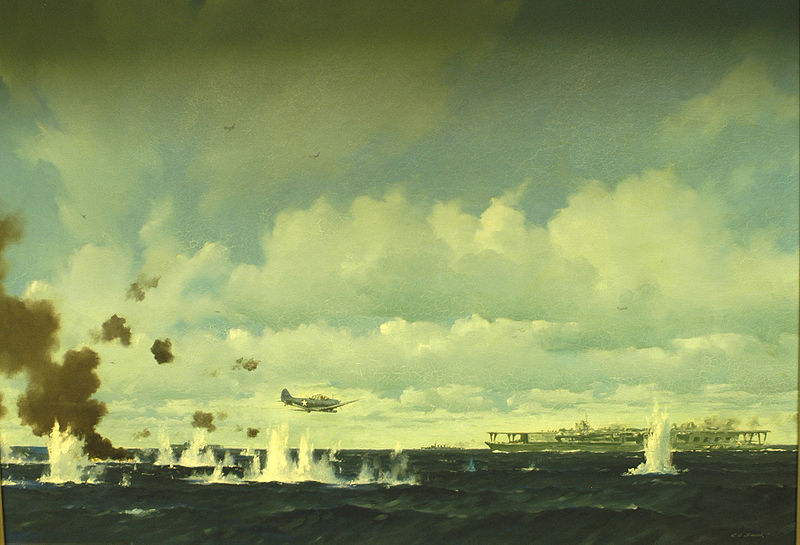
At 1020 the first Zero of the Japanese attack group began rolling down the flight deck of the flagship Akagi, aboard Kaga aircraft were warming up as they were on the Soryu.  The unsuspecting Japanese were finally alerted when lookouts screamed “helldivers.” Wade McClusky’s aircraft lined up over the Akagi and Kaga pushing into their dives at 1022. There was a bit of confusion when the bulk of Scouting 6 joined the attack of Bombing 6 on the Kaga.  The unprepared carrier was struck by four 1000 pound bombs which exploded on her flight deck and hangar deck igniting the fully fueled and armed aircraft of her strike group and the ordnance littered about the hangar deck.  Massive fires and explosions wracked the ship and in minutes the proud ship was reduced to an infernal hell with fires burning uncontrollably. She was abandoned and would sink at 1925 taking 800 of her crew with her.     LT Dick Best of Scouting 6 peeled off from the attack on Kaga and shifted to the Japanese flagship Akagi. On board Akagi were two of Japans legendary pilots CDR Mitsuo Fuchida leader of and CDR Minoru Genda the architect of the Pearl Harbor attack and subsequent string of Japanese victories.  Both officers were on the sick list and had come up from sick bay to watch as the fleet was attacked.  Seeing Kaga burst into flames they stood mesmerized until Akagi’s lookouts screamed out the warning “helldivers” at 1026.  Best’s aircraft hit with deadly precision landing tow of their bombs on Akagi’s flight deck creating havoc among the loaded aircraft and starting fires and igniting secondary explosions which turned the ship into a witch’s cauldron.  By 1046 Admiral Nagumo and his staff were forced to transfer the flag to the cruiser Nagara as Akagi’s crew tried to bring the flames under control. They would do so into the night until nothing more could be done and abandoned ship at 2000.  Admiral Yamamoto ordered her scuttled and at 0500 on June 5th the pride of the Japanese carrier force was scuttled.

Scouting 6 gets the Akagi

VB-3 under LCDR Max Leslie from the Yorktown stuck the Soryu with 17 aircraft, only 13 of which had bombs due to an electronic arming device malfunction on 4 of the aircraft including the squadron leader Leslie.  Despite this they dove on the Soryu at 1025 hitting that ship with 3 and maybe as many as 5 bombs. Soryu like her companions burst into flames as the ready aircraft and ordnance exploded about her deck. She was ordered abandoned at 1055 and would sink at 1915 taking 718 of her crew with her.

The remaining Japanese flattop the Hiryu attained the same fate later in the day after engaging in an epic duel with the Yorktown which her aircraft heavily damaged.

It was quite miraculous what happened at Midway in those five pivotal minutes.  Authors have entitled books about Midway Incredible Victory and Miracle at Midway and the titles reflect the essence of the battle.  A distinctly smaller force defeated a vastly superior fleet in terms of experience, training and equipment and when it appeared that the Japanese Fleet would advance to victory in a span of less than 5 minutes turn what looked like certain defeat into one of the most incredible and even miraculous victories in the history of Naval warfare.  In those 5 minutes history was changed in a breathtaking way.  While the war would drag on and the Japanese still inflict painful losses and defeats on the US Navy in the waters around Guadalcanal the tide had turned and the Japanese lost the initiative in the Pacific never to regain it.   The Japanese government hid the defeat from the Japanese people instead proclaiming a great victory while the American government could not fully publicize the information that led to the ability of the US Navy to be at the right place at the right time and defeat the Imperial Navy.

When one looks at implications of the victory it did a number of things. First it changed the course of the war in the Pacific probably shortening it by a great deal.  Secondly it established the aircraft carrier and the fast carrier task force as the dominant force in naval warfare which some would argue it still remains.  Finally those five minutes ushered in an era of US Navy dominance of the high seas which at least as of yet has not ended as the successors to the Enterprise, Hornet and Yorktown ply the oceans of the world and the descendants of those valiant carrier air groups ensure air superiority over battlefields around the world.

Peace

Padre Steve+

7 Comments

Filed under History, Military, US Navy, world war two in the pacific

June 1944 and June 2010: Fog Friction and the Unexpected Events that Influence History

The Normandy Invasion

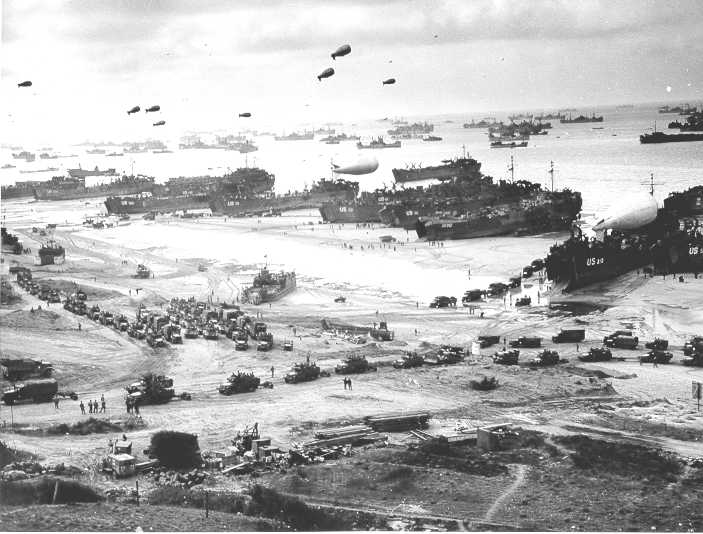
There are few months in history when the courses of events change in a global sense, however the month of June 1944 was one of them. In June 1944 the Allies were on the offensive. The initiative had shifted to their favor in every theater of the war. On June first 1st 1944 the United States and Britain were preparing to cross the English Channel and invade France at Normandy.  In Italy Allied Forces were moving forward after a long series of battles at Salerno, Monte Casino, the Rapido River and Anzio the US 5th Army was closing in on Rome.  In Russia the Red Army was preparing for its summer offensive aimed at the destruction of the German Army Group Center.  In Central Pacific US Navy and Marine Forces with some attached Army units were sailing to invade the Marinas islands and into a confrontation with the bulk of the Imperial Japanese Navy which was planning to attempt the destruction of the US Fleet and invasion forces.  In offices and headquarters around Germany and occupied Europe senior military officers, politicians, police officials and members of the intelligentsia and clergy were plotting a coup to kill Hitler and drive the Nazis from power.  In the United States President Roosevelt was running for re-election for the 3rd time, it was a time when the world hung in the balance and while each adversary had a desired outcome none was sure.

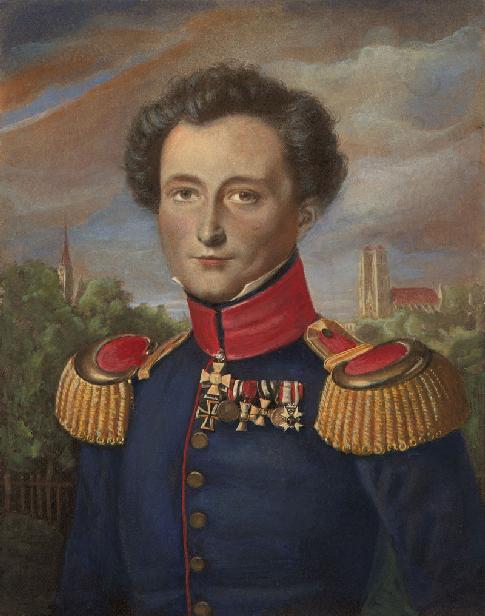
In fact D-Day was a very near run thing and Rome was surrendered by the Germans without a fight that might have bled the Allies in Italy dry, the Germans were quite adept at defense in built up areas and the Soviets benefited greatly from the withholding of vital reinforcements from the front by the Command of the German Replacement Army which was deeply involved in the plot to overthrow Hitler and keeping large numbers of divisions in Germany to assist them to take over when Hitler was killed.  In the Pacific the Admiral Nimitz and his subordinates commanded a fleet like none before yet still faced many unknowns that could derail the campaign if they were not careful.  The lives of millions of Soldiers, Sailors, Marines and Airmen from a host of nations as well as noncombatants in almost every theater of the war depended on decisions made in carious capitals, military and naval headquarters and such annoying things as weather, logistics and the “fog of war” as Clausewitz so aptly put it.  In fact once the die was cast and the battle joined on all of these fields of battle decisions of junior commanders and even small units would play major roles in the outcomes and the plans of the various nations would have to be adjusted as no plan survives contact with the enemy.

Carl Von Clausewitz in his book “On War” developed the understanding of “the fog of war”

That is the way that history tends to develop.  The participants see the events around them, make plans and make assumptions. They do this in the hopes of achieving an outcome that favors them and their cause yet at the end of the day no matter how well they plan, whatever advantages or disadvantages they or their opponents have are subject to chance once the die is cast, unexpected circumstances events and seemingly innocuous choices lay waste to the most carefully crafted plans.  Add to this the mistakes and actions of even the most modest and unassuming people, failures of equipment, the introduction of new or unexpected weaponry, tactics or operational concepts and the fog becomes thicker and friction greater.   Finally there is the success or failure of the boring aspects of war such as logistics, economics, industrial production and the respective national will of each nation all affect the outcome of conflict as the failure of a simple part of a system can have catastrophic results.

Iranian Missile Boat and UH-1 Helicopter…What will happen in June 2010?

One has to ask what ifs when dealing with events in times of war, conflict and economic chaos and this is exactly the world that we live in today.  I do not need to recite the numerous areas of war and conflict around the globe but in each case the participants all have desired outcomes which whether grounded in reality or not influence their actions and their responses to competitors in given situations. The United States is trying to withdraw US combat forces from Iraq and at the same time launch a major offensive at the spiritual heart of the Taliban movement in Afghanistan. Additionally the US is working with Allies to prevent Iran from developing or obtaining a nuclear weapon and attempt to garner a settlement in the continuing Israeli-Palestinian conflict and conflict with Hezbollah.  Any of this missions would be difficult enough on its own but the United States like all major powers has other concerns and when North Korea sinks a South Korean ship, a clash erupts between Israel and groups attempting to breach the Israeli blockade of the Palestinian Authority all the while natural and commercial disasters impact the US, our economy and the environment.  At home the country faces continued terrorist threats from radical Moslem extremist groups as well as a crisis at its southern border. To cap everything off the political division in the country adds yet another complication to an already muddled mess.

All of this as well as things that I have not mentioned or that we don’t expect to happen impact military plans and operations around the world just as unexpected and unplanned for events impacted what happened in that fateful month of June 1944.  What will happen in June of 2010?  God only knows, the best laid plans of mice and men are often rudely disrupted by the uncertainty of the fog of war as well as the unexpected events that seem to occur when they are the least convenient for us.  It will be interesting to see what the world likes like by the end of the summer.  God have mercy on us.

Peace

Padre Steve+

Leave a comment

Filed under History, Military, national security, world war two in europe, world war two in the pacific

Background to “The Pacific” Part V: Okinawa

This is the next to last installment of my series “Background to “The Pacific” which deals with certain subjects themes and battles dealt with in the HBO series by that name. This article deals with the Okinawa campaign which is covered in part nine of the series. Like all battles in the Pacific which pitted Americans against Japanese Army and Naval Infantry forces this battle was fought often to the death and unlike other battles fought with a large civilian population in the battle area.

Plans and Preparations


The United States decided to invade Okinawa in the fall of 1944 following the seizure of Peleliu and the Philippine landings.  The planned invasion of Formosa was cancelled after General Simon Bolivar Buckner objected.[i] Buckner argued that the Japanese army on it was “much too strong to be attacked by the forces by American Forces then available in the Pacific.”[ii] The strategic rationale behind the decision to invade Okinawa included Okinawa’s proximity to Japan as a staging base for a future invasion of the Japanese mainland.  Likewise taking the island would severe Japan’s lines of communication and commerce with Southeast Asia and to serve as base for strategic bombers.[iii] Planning began in October 1944 and the detailed plan for OPERATION ICEBERG was issued 9 February 1945.[iv] The campaign was not planned in isolation but “was bound up strategically with the operations against Luzon and Iwo Jima; they were all calculated to maintain unremitting pressure against Japan and to effect the attrition of its military forces.”[v]
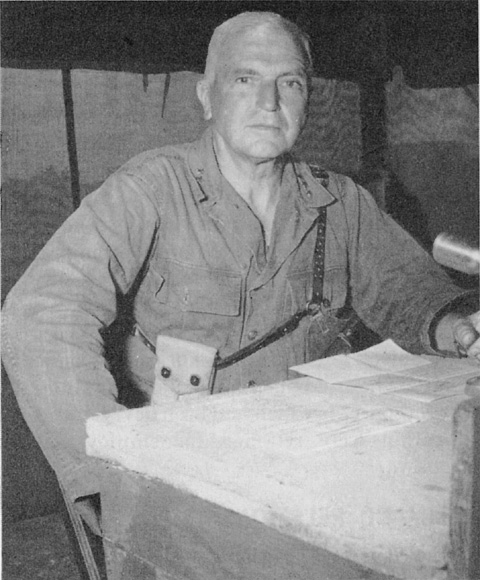
The Unfit American Commander Lt Gen Simon Bolivar Buckner chosen over veteran Marine Commander Lt Gen H M “Howling Mad” Smith

The War Department insisted that Lieutenant General Simon Bolivar Buckner command the newly formed 10th US Army.[vi] .  Buckner was chosen to command based on his taking of the Aleutians, displacing the veteran Marine Holland M. Smith. One critical history noted that “compared to his subordinates, Buckner was hardly fit to command a corps, let alone a field army.”[vii]

The 10th Army consisted of the 3rd Amphibious Corps (1st, 2nd and 6th Marine Divisions) under Major General Roy Geiger and the XXIV Army Corps (7th, 27th, 77th and 96th Divisions) under Major General John Hodge.[viii] 2nd Marine Division was designated as a diversionary force, and the 77th Division was assigned to take the nearby island of Kerama Retto prior to the landings to provide the Navy a safe anchorage and as an artillery platform to shell Okinawa. The 27th Division was in corps reserve.  All were veteran units and had it was believed they would be “more than enough to overwhelm the estimated 70,000 Japanese on Okinawa.”[ix] However, much of XXIV Corps had only been engaged in hard combat on Leyte and was not relieved of their duties on Leyte on 1 March 1945.  This provided these units with no time to rest and refit.[x] More importantly badly needed troop replacements had been diverted to Europe due to the crisis in infantry strength there during the battle of the Bulge.[xi] The operation was very large and “mounted on a scale that matched the previous year’s Allied landing in Normandy.”[xii]

The Japanese Preparations
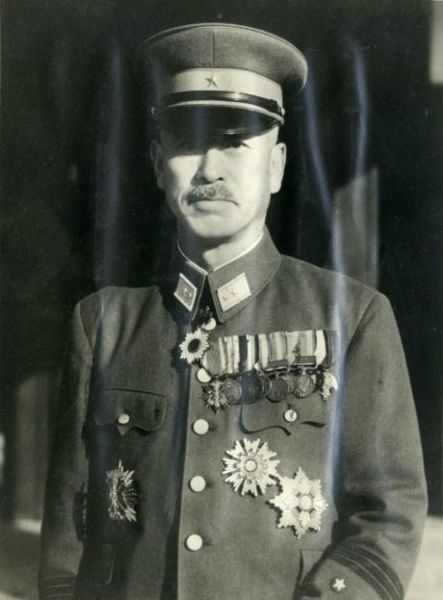

Japanese Commander Lt General Ushijima

American intelligence underestimated the number of Japanese on the island, with an estimate of 55,000 with the expectation of 66,000 by 1 April.[xiii] However by the time of the invasion the Japanese defenders numbered over 100,000.[xiv] The defense of Okinawa was entrusted to the 32nd Army was activated in 1 April 1944 commanded by Lieutenant General Ushijima.  In addition to Okinawa the 32nd Army was responsible for the entire Ryukyu chain.[xv] General Ushijima had commanded an infantry group in Burma and was commander of the military academy when appointed to command 32nd Army and ordered to Okinawa.  His Chief of Staff, General Cho was a firebrand.  Cho had served in China and had participated in a number of attempted military coups in the 1930s as a member of the “Cherry Group.”[xvi] Another key officer though relatively junior was Colonel Yahara the Operations Officer. He had served as an exchange officer in the United States and was intellectual and a modern soldier. He viewed war as a science, won by “superior tactics adjusted to terrain, weapons and troops…not Banzai charges.”[xvii] He was “widely recognized as an expert in his field,”[xviii] and devised the Japanese defensive plan for Okinawa.
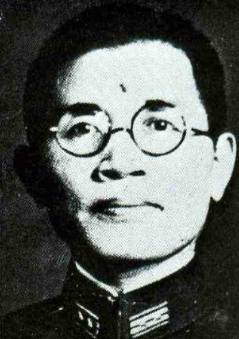
Colonel Yahara Architect of the Japanese Defensive Plan

Until 32nd Army was activated Okinawa was garrisoned by a mere 600 troops,[xix] and until major units arrived these soldiers concentrated on airfield construction.[xx] Eventually the 9th, 24th and 62nd Infantry Divisions, the 44th Mixed Brigade along with a light tank regiment and significant artillery came to Okinawa. Additional forces were alloted to outlying islands.  The 24th Division was a triangular division of 3 infantry regiments of 3 battalions each and supporting arms. The 62nd Division was a “brigaded” division activated in 1943 was formed from the veteran 63rd and 64th brigades each with 4 infantry battalions and supporting arms. It had no organic artillery.  Both of the brigades of this division received an additional infantry battalion in January 1945 giving the division ten maneuver battalions.[xxi] Okinawa’s defenses were significantly weakened when 9th Division was transferred to Formosa by the 10th Area Army in late 1944. To compensate General Ushijima converted Naval and service troops on the island into front line troops. Additionally he called the Okinawan Boeitai volunteers and conscripts into service.[xxii] The Boeitai numbered 20,000 and burned “with ardor to serve their emperor.”[xxiii] Seven sea raiding units were converted into infantry battalions.[xxiv] The major units, with the exception of 24th Division which had been transferred from Manchuria had combat experience.[xxv]
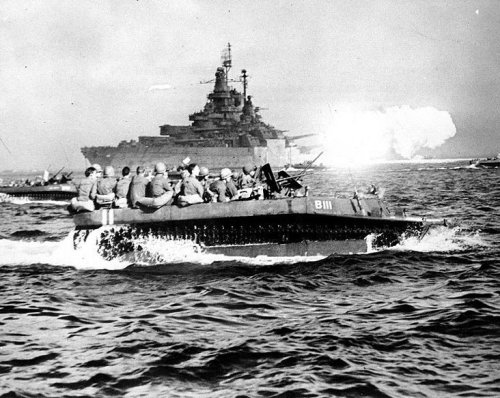
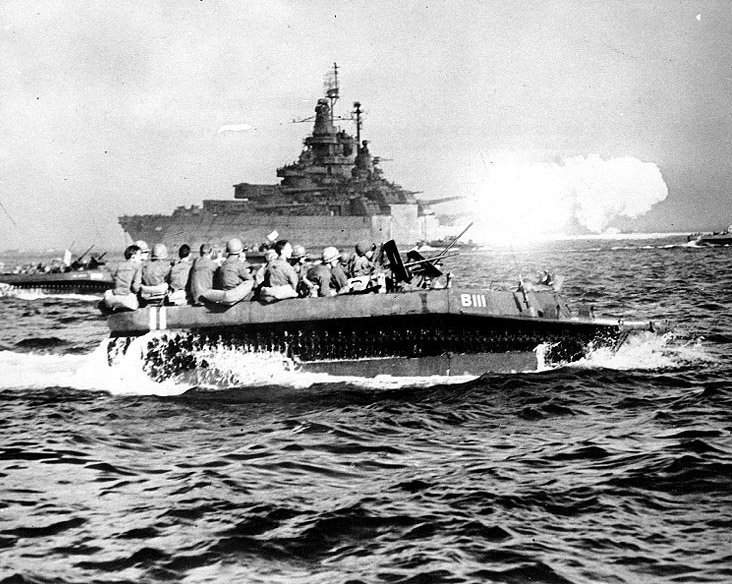
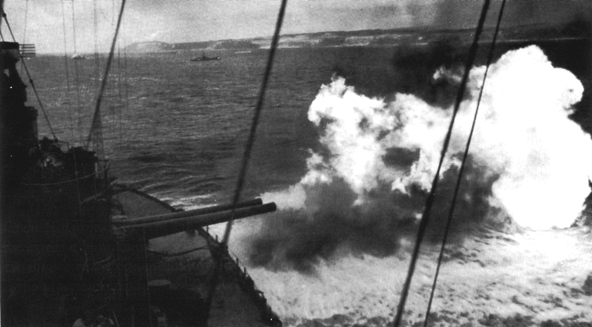
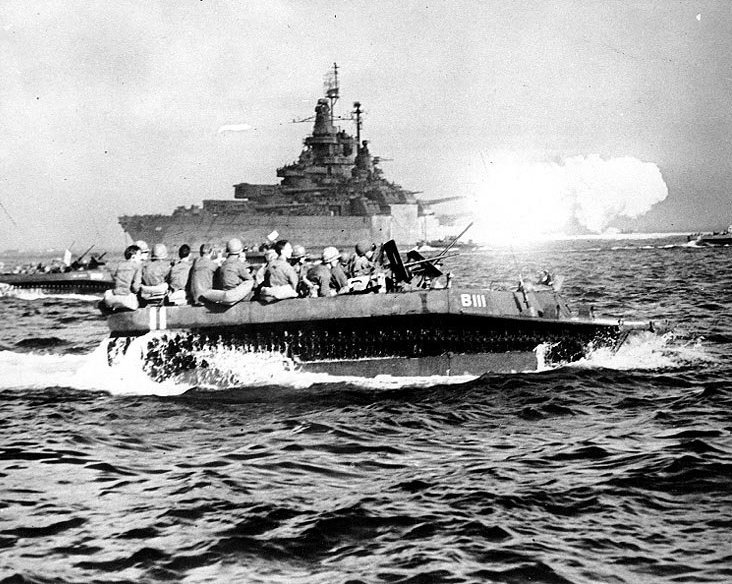
USS Tennessee Provides Naval Gunfire Support while LVTs Advance toward the Beaches

Ushijima’s plans to concentrate his forces in the south were delayed by Tokyo.[xxvi] Likewise the number and disposition of troops in the Ryukyu’s were decided by Imperial Headquarters.[xxvii] Colonel Yahara wrote that had Imperial Headquarters “been able to give us an overall plan with specific unit names and arrival dates, we would have been able to follow a consistent policy, disposing units in an efficient manner rather than moving them left and right.”[xxviii] He noted how the 44th Mixed Brigade had to change location and thus its defensive preparations “seven times during the ten months before the actual battle….”[xxix]
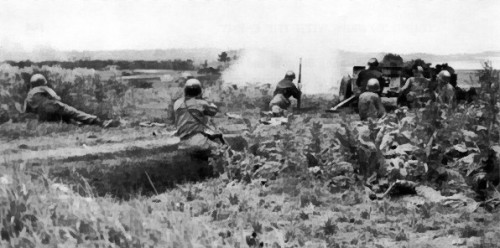
XXIV Corps Advancing South

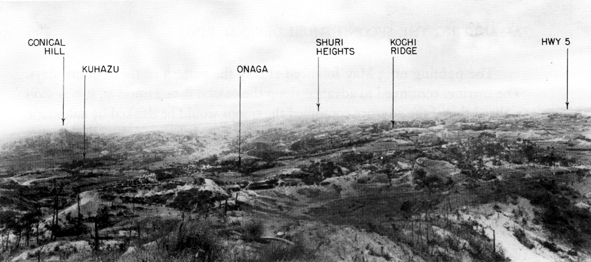
The loss of the 9th Division and its 25,000 soldiers forced Ushijima to change his initial plan to defend the beaches and then launch a major counterattack to drive the Americans into the sea.[xxx] Ushijima decided to defend the south end of the island. This was the most defensible area, with a network of fortifications and underground caves centered on the ancient citadel of Shuri Castle. “Troop disposition would conform to local terrain; troop strength would be concentrated; and an extensive system of subterranean fortifications constructed.”[xxxi] The defenses were “anchored in natural and artificial caves which dotted the mountainous regions around Shuri.”[xxxii] “Terrain features were incorporated into the defense and weapons were well sited with excellent fields of fire.”[xxxiii] General Ushijima left Colonel Udo’s 2nd Infantry Unit to fight a delaying action in the north,[xxxiv] having decided that the area was of “little military value.”[xxxv] Likewise Ushijima decided not to contest the landings or to defend the airfields at Kadena and Yontan.[xxxvi] He planned to use Boeitai units to demolish the airfields when the Americans approached.[xxxvii]
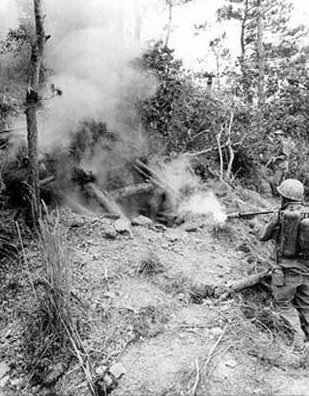
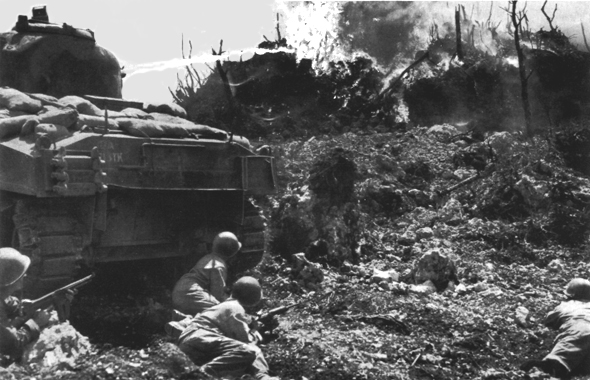
Flamethrowers were Widely Employed their Operators were Targeted by the Japanese

Ushijima’s defensive scheme laid out by Yahara involved concentric defensive lines, tunnels and bunker systems and even the Chinese tombs which dotted the island were converted to pillboxes over the objections of Okinawan elders.[xxxviii] Yahara and Ushijima planned a battle of attrition with all artillery in the army concentrated on the southern end of Okinawa.  Yahara believed the battle would be a “bitter yard-by-yard” defense of the island,[xxxix] with a focus on defense in depth with preparations for anti-tank warfare.
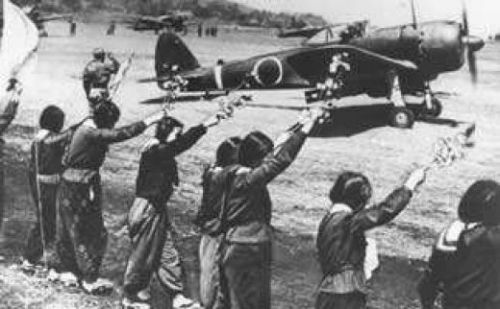
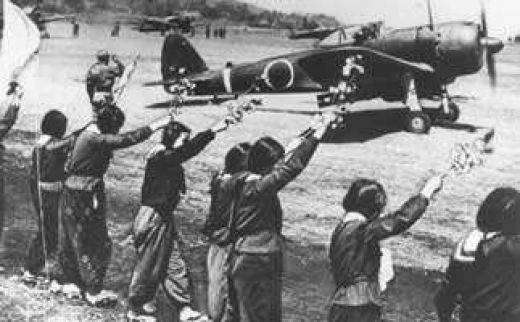
Kamikaze taking off

There were to be no Banzai charges.[xl] Ushijima turned Bushido “inside out” and urged his soldiers to “Devise combat method [sic] based on mathematical precision, then think about displaying your spiritual power.”[xli] The defenders would be assisted by suicide boat squadrons based on Okinawa and Kerama Retto and over 4000 aircraft, conventional and Kamikaze and a naval force built around the super battleship Yamato.[xlii]

The Landings
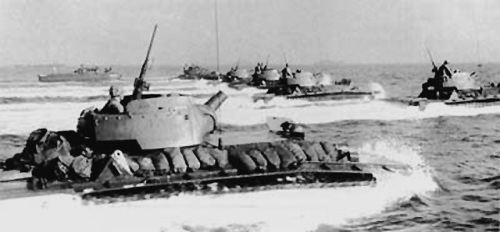
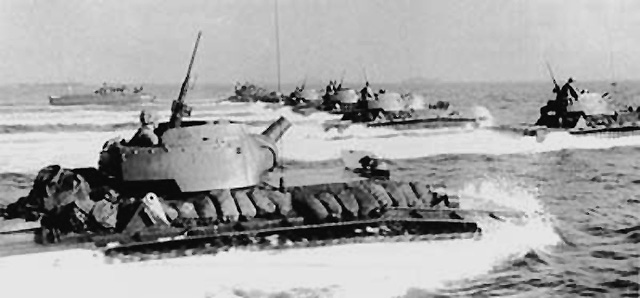
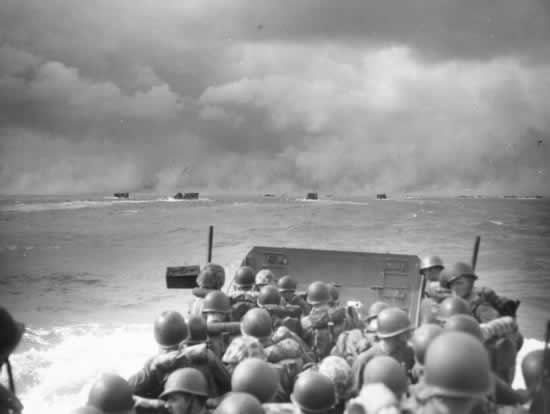
LVT’s going ashore at Okinawa

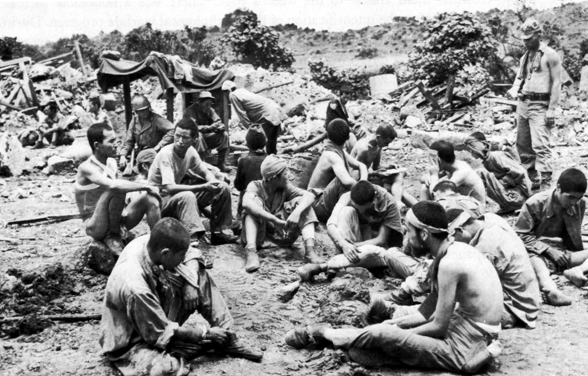
The assault on Okinawa began with landings by 77th Division on Kerama Retto on 26 March.   The landings were met with little opposition as most of the combat troops on the islands had been moved to Okinawa leaving only base and service troops and members of a Sea Raiding Unit and Korean laborers to defend the small island.[xliii] By the 29th of March the islands were taken, along with numerous prisoners.  Over 350 of the fast “Suicide Boats” that were to attack US transports and landing craft were destroyed at Kerama Retto and long range artillery was emplaced were it could support the Okinawa landings.[xliv] More importantly Kerama Retto provided the Navy a safe anchorage, and Service Squadron 10 arrived on 27 March to support naval forces around the island.[xlv] The naval bombardment was led by Admiral Deyo’s battleships and Admiral Blandy’s escort carriers[xlvi] and culminated on 1 April when 10th Army went ashore. By the time of the landing 10 battleships and 11 cruisers would join the attack.[xlvii] Over 13,000 large caliber shells were fired and a total of 5,162 tons of ammunition were expended on ground targets and 3,095 air sorties were flown by L Day.[xlviii] Fortunately for the Japanese Ushijima had listened to Colonel Yahara and elected not to defend the beach, and thus most of the shells fell on empty positions and terrain.[xlix]
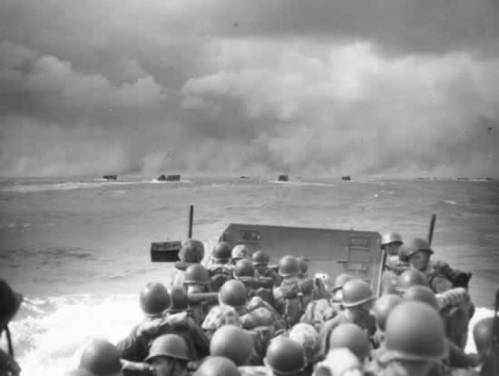
Marines in LCVP going ashore

The Americans landed on the Hagushi beaches adjacent to Kadena and Yontan air bases.  No organized resistance was encountered and in the first hour 16,000 troops landed.[l] There was little disorganization and all units landed on time on the planned beaches.[li] The beaches were bisected by the Bishi River which served as the Corps boundary.  The 1st and 6th Marine Divisions landed north of it and the 7th and 96th to the south.
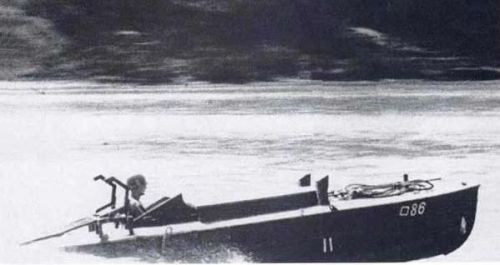
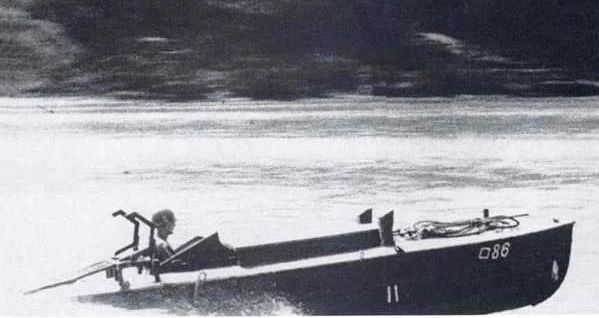
Japanese Suicide Boat of which many were stationed on Okinawa and the surrounding islands

The Marines chopped up the “Bimbo Butai” in their area many of whom melted back into the civilian population.[lii] The Americans moved rapidly inland and by nightfall over 60,000 Marines and Soldiers were ashore.[liii] As the landings were made the 2nd Marine Division conducted a demonstration off Minatoga on the east side of the Okinawa actually launching several waves of landing craft.[liv] On 2 April the operation was repeated which helped divert some Japanese attention off of the actual landings. Ushijima reported that the attempt “was complete foiled, with heavy losses to the enemy.”[lv] Some Marine veterans of Peleliu were jubilant at not having to land and some wondered what the Japanese were up to.[lvi]
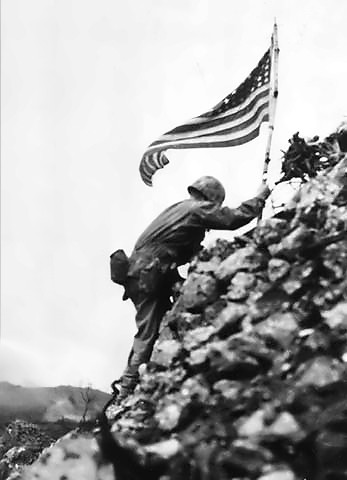
Marine Battalion Commander Raising Flag over Shuri Castle

In the following days the two Marine divisions would race north and east while Army troops advanced cautiously to the south first encountering light opposition.[lvii] The 1st Marine Division cut the island in two on April 3rd and was allowed to clear the Katchin Peninsula which it took without opposition.[lviii] The 6th Marine Division moved north and by the 7th it had had taken Nago.  Colonel Udo’s troops of the 2nd infantry Unit defended the Motubu with great skill[lix] but the Marines took the center of resistance on April 18th.[lx] They then cleared the remainder of the peninsula and the rest of the northern end of the island by the 20th.[lxi] The Marines had advanced 84 miles and killed 2,500 Japanese at the cost of 261 killed and 1,061 wounded. The Japanese survivors according to the plan of Colonel Udo afterward retreated into the hills and engaged in guerilla warfare.[lxii]

The Ordeal Begins
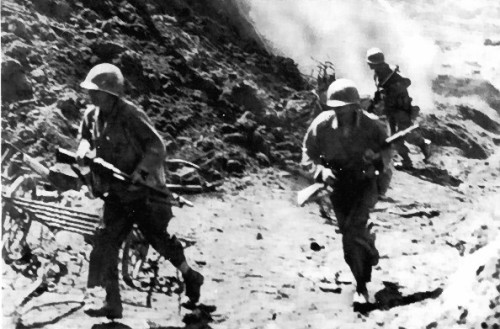

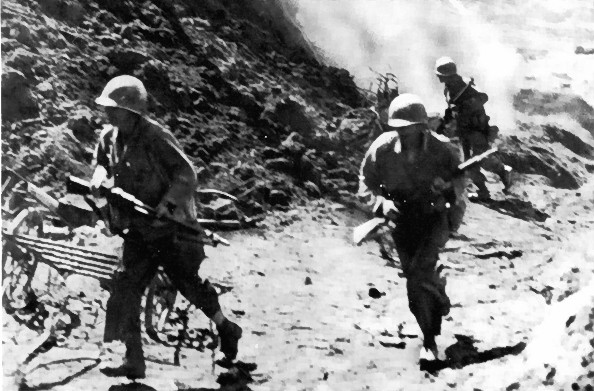
Demolition Team Advancing

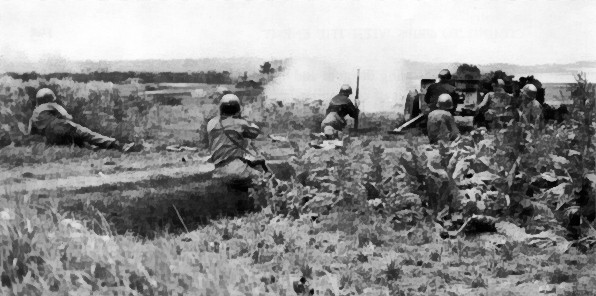
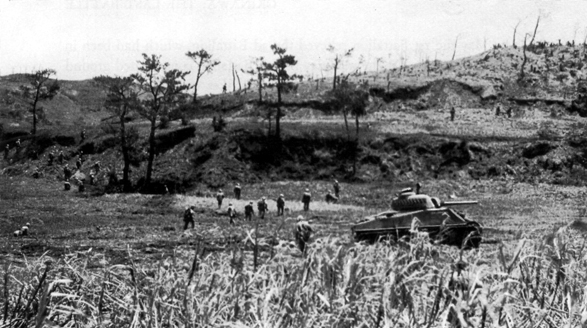
As the Soldiers of the 7th and 96th Infantry Divisions felt their way south, they began to encounter resistance from Japanese outposts.  On 4 April 96th Division’s advanced elements including the 96th Recon Troop and 763rd Tank Battalion encountered the first Japanese anti-tank defenses, losing 3 tanks to well concealed 47mm anti-tank guns.[lxiii] The following day both the 7th and 96th divisions encountered more resistance and were held to minimal gains as they drove the Japanese out of their outpost positions.
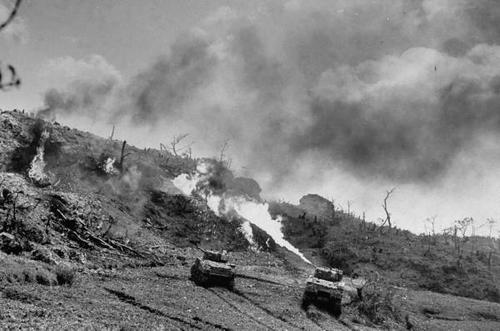
Flamethrower tanks engaging Japanese positions

On the 6th and 7th they captured “the Pinnacle” and “Cactus ridge” from elements of 3 independent infantry battalions which put up stiff resistance.[lxiv] By the end of 8 April against strong opposition XXIV Corps had suffered 1,510 battle casualties and was virtually halted.[lxv] Savage hand to hand fighting took place as the defenders worked to separate the American tanks from their infantry. They held the Americans outside the Shuri zone for 8 days.[lxvi]
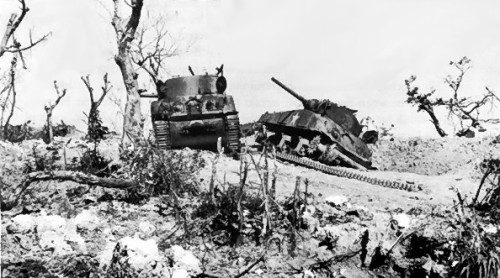
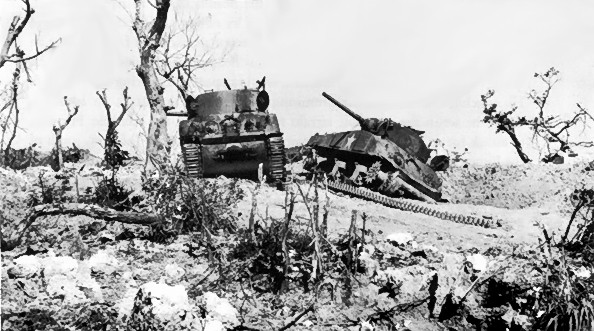
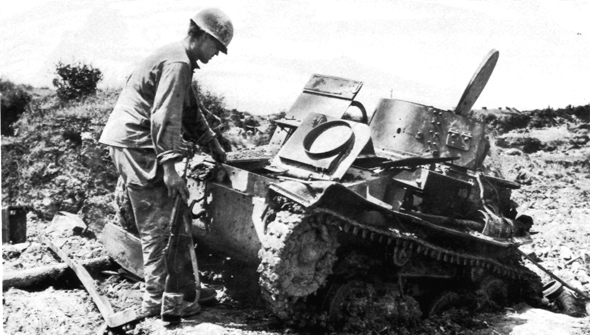
Wrecked Tanks on Skyline Ridge

The 96th Division attacked the heavily defended Kakazu Ridge and Tombstone Ridge and was repulsed.  The 7th Division was halted at Hill 178.  The Japanese fought at close quarters and desperate hand to hand fighting “would characterize the Okinawa land battle.” While the Japanese infantry contested every yard “carefully concealed anti-tank guns seemed anchored into the terrain.”[lxvii] The deployment and concealment of the anti-tank guns helped nullify the American advantages in armor. The Japanese also employed 320mm spigot mortars[lxviii] and well sited machine guns and artillery sited on reverse slopes took a heavy toll of the attacking Americans. Of one company of 89 men which attacked Kakazu on 9 April “only three returned unwounded.”[lxix] Assisted by monsoon rains, “the Japanese turned every hill, every ridge into a bloody deathtrap.[lxx]
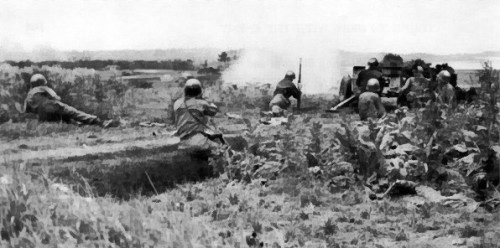
XXIV Corps Advancing South

On the 10th two regiments of 96th Division attempted a power drive with battalions advancing on line and were thrown back.[lxxi] The two divisions suffered 2.890 casualties in their abortive attacks while the Japanese lost close to 4,000, mainly to artillery fire.[lxxii] Ushijima’s defense planned by Yahara was “chillingly professional and efficient. Within a week the Japanese had stopped two very good Army divisions in their tracks.”[lxxiii] General Buckner paused sent for the 1st and 6th Marine Divisions and brought the 27th and 77th Divisions ashore to strengthen XXIV Corps.[lxxiv]

Counterattack
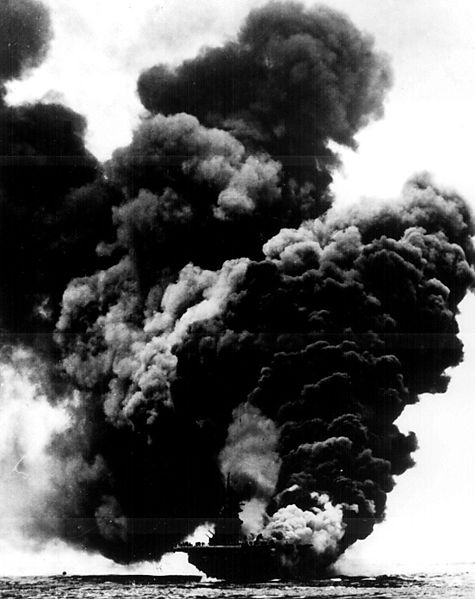

The War at Sea: Kamikaze Attack on USS Bunker Hill

It was at this point when “Yahara’s war of attrition was working well” that a division arose in the 32nd Army Staff, when General Cho; Ushijima’s Chief of Staff had “his first outburst of samurai offensive fever.”[lxxv] Cho noted the failure of the American attacks and believed reports that the American Navy had been heavily damaged by Japanese air power and by the reported success of Operation Ten-Go, the sortie of the Yamato and her escorts on their suicide mission.  He based his optimism on a telegraph from Imperial Navy headquarters “claiming that Ten-go had been “very successful”[lxxvi] when in fact the Yamato and her escorts had been dispatched in hours by carrier aircraft with few American losses.
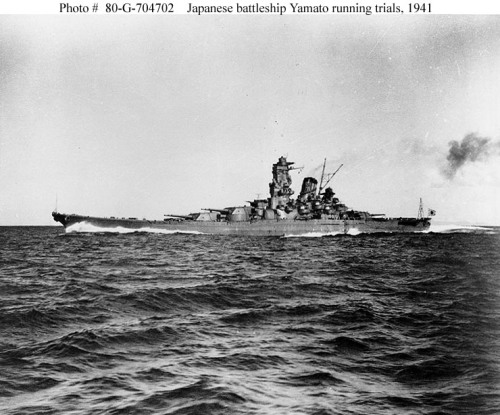
The Battleship Yamato Lead a 10 ship Suicide Task Force to Okinawa and was Sunk with Most of Her Crew

Below

USS Aaron Ward Damaged heavily damaged by Kamikaze Attack over 10,000 sailors were casualties including nearly 5000 dead due to Kamikaze attacks
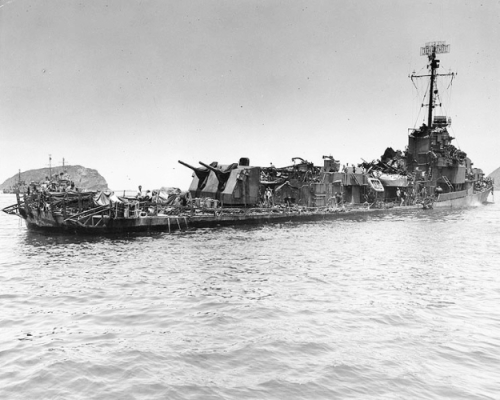

Cho also assumed a reduction in the number of ships in the Hagushi anchorage and in the number of air sorties as signs of American weakness.[lxxvii] Cho persuaded Ushijima to launch a counterattack over the protestations of Yahara who argued that “it would waste men.”[lxxviii] The attack by four battalions of the 62nd and 24th Divisions began the night of 12-13 April. Based on infiltration tactics and supported by artillery the attack was badly planned and coordinated. One attack almost overran American positions on the draw on Kakazu Ridge, but the Japanese return to “bamboo spear tactics” exposing them to the “overwhelmingly superior America artillery fire….”[lxxix] The attack was a “total failure.”[lxxx]The Japanese lost nearly 1,600 men, half their force in an “operation ill conceived, understrength, misdirected, haphazard and uncoordinated.”[lxxxi]

Cracking the Outer Line

Reinforced by the 27th Division XXIV Corps prepared for another attack against the outlying Shuri defenses. In the interval between the Japanese attack and the new offensive the 77th Division landed on Ie Shima on 16 April and secured it on the 24th amid very heavy fighting killing over 4,700 Japanese, many armed civilians against the loss of 172 killed and 902 wounded Americans.[lxxxii] Among the American dead was legendary reporter Ernie Pyle.
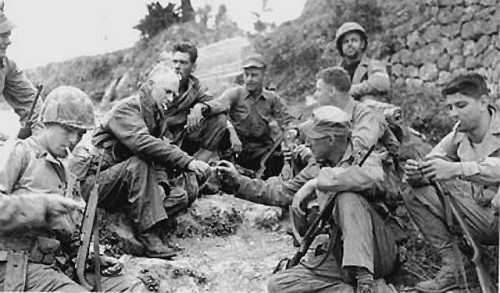
Legendary Reporter Ernie Pyle with Marines. He would be killed on neighboring Ie Shima with the Army 77th Divison

The Americans aimed to penetrate the defenses and “seize the low valley linking Yonabaru on the east coast with the capital of Naha on the west.”[lxxxiii] The attack was supported by 27 battalions of artillery[lxxxiv] including 9 Marine artillery battalions.[lxxxv] Additional Naval gunfire support in the form of 6 battleships, 6 cruisers and 9 destroyers added to the rain of steel unleashed on the Japanese.[lxxxvi] Morison notes that Army historians stated that “Naval gunfire…was employed in greater quantities in the battle for Okinawa than in any other in history.”[lxxxvii]
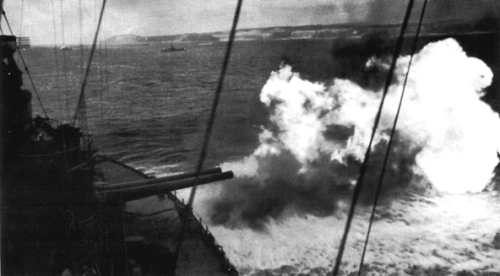
USS Maryland contributes her firepower to support ground forces

The 7th Division was to take Hill 178 and drive south to the Naha Yonabaru road. 96th Division minus the 383rd Infantry was to “drive straight through the heart of the Shuri defenses seizing the town of Shuri and the highway beyond.”  27th Division attacking 50 minutes later to take advantage of artillery was to take Kakazu ridge and the coast plain north of Naha.[lxxxviii]
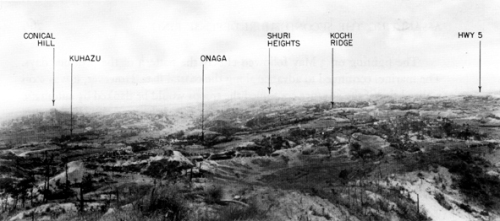
The attack began on April 19th and was preceded by a 19,000 shell bombardment.[lxxxix] Ushijima wisely ordered his men to remain in their caves.  The Corps Artillery commander “doubted as many as 190 Japanese…had been killed in the bombardment.”[xc] The attack was immediately halted all along the line, gains, where there were any were measured in yards. Over 750 casualties were inflicted by the Japanese on the corps and 27th Division’s tank battalion lost 22 of 30 tanks to well positioned 47mm anti-tank guns.[xci] Buckner rejected the requests of the Corps commander Hodge and the Marine divisional commanders,[xcii] to launch a flanking amphibious operation at Minatoga with the 2nd Marine Division, and continued the frontal attacks.  John Toland writing of the rejection of the amphibious operation noted that Ushijima “feared such a maneuver (“It would bring a prompt end to the fighting”) and had already been forced to move his “rear guard division north to beef up the Shuri line.”[xciii] Thus the three divisions continued to press their attacks, suffering heavy casualties.  Eventually the Americans forced the Japanese off Skyline ridge[xciv] though the Japanese still held Kakazu.[xcv] When the 27th Division attacked again it found Kakazu abandoned by the Japanese.[xcvi] By the 24th Ushijima’s line was “pierced in so many places that it was in danger of collapsing….So General Ushijima withdrew to his next chain of defenses.”[xcvii] On April 30th the 1st Marine Division relieved the battered 27th Division which had suffered 2,661 casualties in less than two weeks.”[xcviii] The 1st Marine Regiment launched an attack on 1 May and was driven back with heavy causalities.[xcix]

General Cho’s Final Offensive
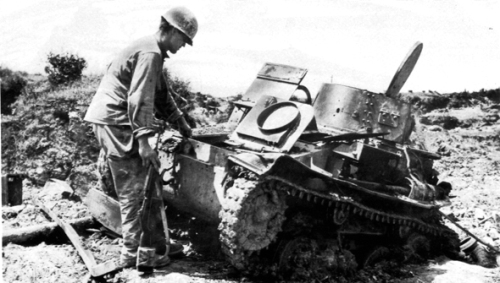
Knocked out Japanese tank from General Cho’s failed counter attack

General Cho supported by 62nd Division’s commander, General Fujioka persuaded Ushijima over the strenuous objections of Yahara to launch a counter-offensive with the intention of isolating and annihilating the 1st Marine Division and “rolling up” XXIV Corps.[c] The attack was to occur along the entire line and include an amphibious landing behind American lines.[ci] The 62nd Division would take the lead as it had been less heavily engaged than 24th Division.[cii] Yahara argued his case strongly and warned the Ushijima that to attack “is reckless and will lead to an early defeat.”[ciii] The attack began on the night of 3 May and the forces making the amphibious landing were annihilated by the Marines.[civ] The Japanese made little headway during the main attack; one battalion achieved a small penetration of American lines at Tanabaru but was eliminated the next day.[cv] The Japanese 27th Tank Regiment lost most of its tanks and those remaining were used as “stationary artillery and pillboxes.”[cvi] The Japanese lost about 5,000 troops in the offensive.[cvii] Ushijima halted it and told Yahara “as you predicted this offensive has been a total failure.  Your judgment was correct….”  He ordered Yahara “to do whatever you feel is necessary.”[cviii] Cho saw “no hope at all”[cix] and asked Yahara jokingly “when will it be okay for me to commit hari-kari?” [cx]

Göttdammerung
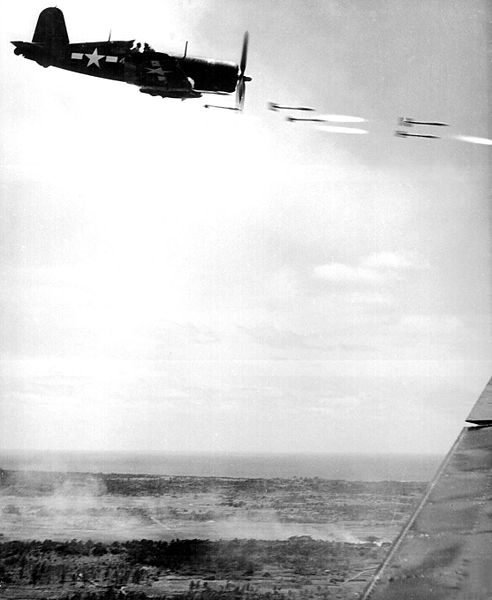
Marine F4FU Corsair providing close air support on Okinawa

The American offensive resumed on 11 May and amid stubborn Japanese defense and heavy rains which hindered movement. The 1st and 6th Marine Divisions[cxi] and the 77th and the 96th infantry divisions attacked along the line but the primary objective was Shuri.[cxii] The Americans continued to apply pressure and make small gains against strong Japanese resistance put up by the 44th Mixed Brigade.  The defense was particularly strong on Sugar Loaf Hill[cxiii] which cost 6th Marine Division nearly 4,000 total casualties before it was cleared out on 21 May.[cxiv] The 96th Division turned the Japanese east flank at Conical Hill on the 13th  [cxv] while the First Marine Division cracked through the Japanese lines at Dakeshi Ridge.
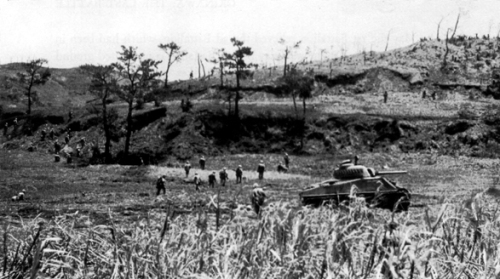
Marines attacking Dakeshi Ridge

It fought through Wana Ridge[cxvi] and engaged the Japanese in a costly battle in the Wana Draw. The 2nd Battalion 5th Marines supported by 30 tanks blasted their way through the draw, again against brutal Japanese resistance.[cxvii] On the 22nd Yahara persuaded Ushijima to withdraw from Shuri to the Kiyan Peninsula.[cxviii] The 1st Battalion 5th Marines crossed the divisional boundary of 77th Division to capture Shuri Castle on 24 May.[cxix] The Company commander, from South Carolina who took it did not have an American flag so he “substituted the flag of the Confederacy, a banner that he…carried in his helmet.” [cxx] Two days later the American flag was raised along with the standard of the 1st Marine Division in full view of the Japanese.[cxxi]
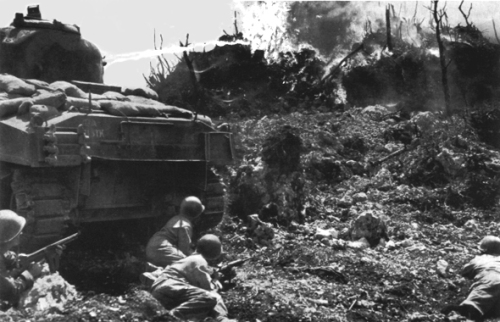
Tank infantry attack

Following the Japanese withdraw from Shuri the battle continued with heavy rains hampering both sides, especially the more vehicle dependant Americans.[cxxii] The 6th Marine Division cleared the Oruku Peninsula south of Naha the first two weeks of June[cxxiii] killing 5,000 of the Japanese Navy defenders at a cost of 1,608 Marines. The Japanese resistance crumbled when Admiral Ota committed suicide and many defenders fled while others surrendered.[cxxiv] 7th Division pushed onto the Chinen Peninsula and 1st Marine and both 77th and 96th Infantry Divisions pushed steadily south against Japanese rear-guards.[cxxv] The 8th Marines from 2nd Marine Division were brought to the island to reinforce the depleted 3rd Amphibious Corps[cxxvi] A hard fight was fought along the Kunishi-Yuza-Yaeju escarpment where the Japanese conducted their last organized defense.[cxxvii] By the 17th the “32nd Army was dazed and shattered. Discipline had evaporated.”[cxxviii] The 32nd Army’s discipline and morale collapsed, and it “degenerated into a mob.”[cxxix] Yahara noted that “naturally, morale is low at the end of a battle, but we had never experienced anything like this.”[cxxx]
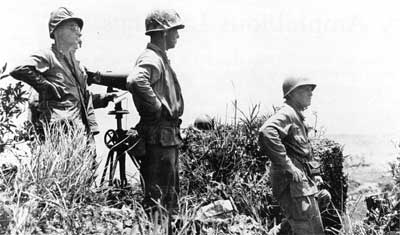
Lt General Buckner (Right) Observing 8th Marines Assault minutes before Being Killed

General Buckner was killed while observing 8th Marines attack Kunishi on the 18th and was succeeded by General Geiger of the Marine amphibious corps.[cxxxi] A final message from Tokyo congratulated 32nd Army on its achievements on the 20th.[cxxxii] General Ushijima and General Cho committed Hari-Kari early on the 23rd after ordering Yahara not to do so. Cho told Yahara “to bear witness as to how I died.”[cxxxiii]
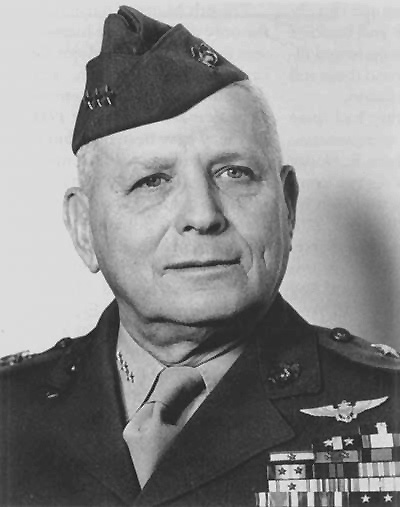
Lt Gen Roy Geiger would take command of 10th Army becoming the first Marine ever to command a US Army field Army

American battle casualties totaled 49,151 including 12,520 dead.[cxxxiv] The Japanese lost over 110,000 killed and 7,400 taken prisoner by the Americans.[cxxxv] About 75,000 Okinawan civilians were killed.[cxxxvi] Small numbers of Japanese renegades and Okinawan rebels conducted low-level guerilla operations until 1947.[cxxxvii]

Analysis
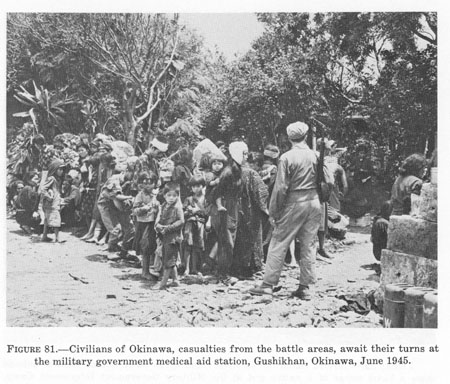
Civilian casualties (above) and prisoners (below) the prisoners chose capture over throwing themselves down “Suicide Cliff”
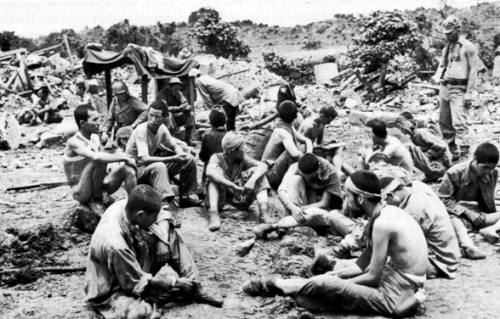

The key Japanese mistake occurred at the strategic level when 9th Division was transferred off the island[cxxxviii] and no further reinforcements were sent.  With these forces Ushijima might have been able to hold out until the end of hostilities. Yahara criticized Imperial Headquarters which panicked when the landings occurred and ordered a counterattack which “left our army in utter confusion.”[cxxxix] General Ushijima’s major mistakes during the battle were the two costly offensives urged by General Cho against the protest of Colonel Yahara. These attacks sacrificed of some of his best troops for no effect and significantly weakened the 32nd Army’s defensive posture.  Yahara objected to both of these offensives. According to the American intelligence debriefing Yahara considered the May 4th offensive “as the decisive action of the campaign.”[cxl] Gordon Rottman simply called that attack a “blunder.”[cxli]

On the American side Buckner fought an unimaginative and uninspired battle, much like Mark Clark’s Italian campaign or Courtney Hodges at the Huertgen Forrest.  Murray and Millett, note that Buckner’s “flawed generalship contributed to the slaughter.”[cxlii] Buckner’s decision not to land the 2nd Marine Division or the 77th Division at Minatoga surrendered his one opportunity to maneuver against the Japanese to force them out of their prepared positions.[cxliii] Ronald Spector notes that “in retrospect Buckner ought to have given more consideration to an amphibious attack[cxliv] while Murray and Millett state that Buckner “did not have the experience to make such a critical decision.”[cxlv] Nimitz wondered if “the Army was using slow, methodical tactics to save the lives of soldiers at the expense of the Navy”[cxlvi] which was exposed to Kamikaze attacks as they had to continue to provide the close in support to 10th Army. Buckner’s rejection of this opportunity left him with the straight ahead attack.   Another option which was available to Buckner was to seal off the Japanese and let them wither on the vine. Such an action in effect would have bypasses the Japanese defenders and force them to make Banzai attacks against dug in Americans.[cxlvii] The Americans had the airfields on day one and most of the key facilities needed for future operations and there was little to gain by continuing offensive operations in the south.  Sealing off the Japanese would have certainly caused the Americans fewer casualties than the strategy which Buckner employed.[cxlviii]
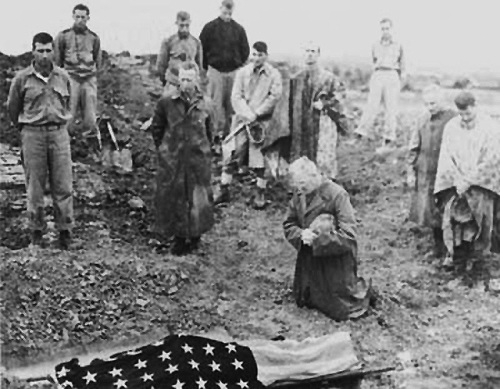
The Human Cost of War: Marine Colonel Fenton prays for his Fallen Son

Buckner’s leadership was poor his strategy and tactics both unimaginative and foolish bordering on incompetent.  In a time when American infantry replacements were tapped out and no new Infantry divisions were available for action he decimated good formations by throwing them into frontal attacks against well prepared fortified positions manned by experienced troops.  Had Ushijima not followed General Cho’s advice squandering is own troops the battle would have cost even more American lives with the invasion of Japan looming.  The War Department in its attempt to wrest control of an operation that should have remained under the control of the Navy and Marine Corps put the wrong man in the job when other more competent corps commanders such as General “Lighting Joe” Collins who had finished off the Japanese at Guadalcanal were available with European hostilities winding down.  Why Buckner was chosen despite his incredibly limited command experience serving in the relatively inactive Aleutians and not even commanding a company in World War One had to be due to Army politics and in the end it cost nearly 50,000 American casualties on the land alone, not counting Navy casualties which totaled almost 10,000 including over 4,900 dead. The capture of Okinawa provided the Americans with valuable anchorages and airfields close to Japan had there been an invasion of the home islands, but they were obtained at great cost.

Notes

[i] Appleman, Roy, E., Burns, James M., Gugeler, Russell A., and Stevens, John. The United States Army in World War II, The War In the Pacific. Okinawa: The Last Battle, Center of Military History, United States Army. Washington DC. 1948.  p.4

[ii] Leckie, Robert. Okinawa: the Last Battle in the Pacific Penguin Books, New York NY 1996. p.2.  Although not mentioned by Leckie this shortage of forces was due to the American decision to limit the Army to 90 Divisions with dire consequences in Europe and Asia especially in the number of infantry available.  For a good account of the impact of this see Russell Weigley’s Eisenhower’s Lieutenants.

[iii] Willmont, H.P. The Second World War in the Far East. John Keegan General Editor. Cassell Books, London, 1999. p.186.

[iv] Morison, Samuel Eliot. The Two Ocean War: A Short History of the United States Navy in the Second World War. An Atlantic Monthly Press Book, Boston MA 1963. p.525

[v] Ibid. Appleman. p.4

[vi] Costello, John. The Pacific War: 1941-1945 Quill Publishers, New York, NY 1981. p.554.

[vii] Murray, Williamson and Millett, Allan R. A War to Be Won: Fighting the Second World War.  The Belknap Press of Harvard University, Cambridge, MA. 2000. p.515

[viii] Ibid. Leckie. pp. 53-54.  Note Costello misidentifies both of these corps calling them 3rd Marine Corps and XIV Army Corps.   He also does not count the 77th Division in his figures.

[ix] Ibid. Costello. pp. 554-555.  Costello’s figures are slightly above the official estimates listed below.

[x] Ibid. Leckie. p.56

[xi] Ibid. Leckie. p.57 An important point to note is that the Army had reached a critical point in its ability to conduct the war.  The steady drain on infantry strength that began in Normandy was heightened in the Huertgen Forrest and the Bulge.

[xii] Ibid. Costello. p.556

[xiii] Ibid. Appleman. p.15

[xiv] Ibid. Costello. p.555

[xv] Yahara, Hiromichi. The Battle for Okinawa. Introduction and Forward by Frank Gibney. Translated by Frank Pineau and Masatoshi Uehara. John Wiley and Sons, New York, NY. 1995. p.3

[xvi] Rottman, Gordon R. Okinawa 1945: The Last Battle. Osprey Publishing, Oxford, United Kingdom, 2002. p.35

[xvii] Ibid. Leckie. pp.31-32

[xviii] Ibid. Rottman. p.37

[xix] Toland, John. The Rising Sun: The Decline and Fall of the Japanese Empire 1936-1945. Random House, New York, NY 1970. p.683.

[xx] Ibid. Yahara. p.7

[xxi] Ibid. Rottman. Pp.47-48

[xxii] Ibid. Toland. pp.683-684.  Yahara also notes the arrival of the 15th Mixed Brigade and the fact that the Japanese considered the 44th Mixed Brigade “one of our Army’s prized units.” (p.12)

[xxiii] Ibid. Toland. p.683.  Leckie comments on the low opinion of many Japanese soldiers about the Boeitai calling them Bimbo Butai (Poor Detachment), as the most of the Japanese had come to loathe Okinawa and all things Okinawan. A comment from my own service in Okinawa in 2000-2001 is that this loathing of Okinawa by Japanese is still common, Japanese tend to look down on Okinawans and the Okinawans now tend to resent the Japanese.

[xxiv] Ibid. Appleman. p.87

[xxv] Ibid. Yahara. p.31 All sources note that the 24th was a “well trained” division.

[xxvi] Ibid. Costello. p.555

[xxvii] Ibid. Yahara. p.15

[xxviii] Ibid. Yahara. pp. 14-15

[xxix] Ibid. Yahara. p.15

[xxx] Ibid. Yahara. pp. 20-22 and 32.  Yahara details the initial plan and the changes necessitated by the departure of 9th Division.  Rottman gives 9th Division a strength of 17,000. (Rottman p.46)

[xxxi] Ibid. Yahara. p.20

[xxxii] Spector, Ronald H. Eagle Against the Sun: The American War With Japan. The Free Press and Division of MacMillan, Inc. New York, NY 1985. p.533

[xxxiii] Ibid. Rottman. p.25

[xxxiv] Ibid. Leckie p.32 and Costello. p.555. The unit was between 3000 and 3500 strong. Leckie simply identifies the force as the 2nd Infantry Unit while Costello identifies them as a Special Naval Landing Force. Appleman identifies Colonel Udo and the approximate number of troops but does not identify the unit. There appears to be confusion about the Japanese units, Appleman says that the 2nd Infantry Unit was constituted from survivors of 44th Mixed Brigade (which had lost most of its troops when their ship was sunk by an American submarine) and 15th Independent Mixed Regiment which was brought in to bolster it, but Yahara consistently places the reconstituted 44th in the south as part of the main defense. (see Appleman p.87) I will relay on Yahara as he was the 32nd Army Operations Officer and in a position to have first hand knowledge.

[xxxv] Ibid. Yahara. pp.22-23

[xxxvi] Ibid. Leckie. p.32

[xxxvii] Ibid. Leckie. pp.32-33

[xxxviii] Ibid. Toland. p.684

[xxxix] Ibid. Yahara. p.32

[xl] Ibid. Yahara. p.25

[xli] Ibid. Leckie. p.35

[xlii] Ibid. Leckie. p.19

[xliii] Ibid. Appleman. pp.52-58

[xliv] Ibid. Appleman. p.60

[xlv] Potter, E.B. Nimitz. Naval Institute Press. Annapolis, MD. 1976. p.369

[xlvi] Ibid. Costello. p. 556 and Morison p.530.

[xlvii] Ibid. Appleman. p.64. Leckie (pp. 67-68) names only 9 battleships: Arkansas, New York, Texas, Nevada, Idaho, New Mexico, Colorado, Tennessee and West Virginia. Of these ships all were built before the war and four were in commission before the US entered the First World War.  Three had been at Pearl Harbor and with the exception of their engines the Tennessee and West Virginia had been completely rebuilt and modernized to the standards of the fast new battleships of the South Dakota class.

[xlviii] Ibid. Appleman. p.64

[xlix] Ibid. Leckie. p.69.

[l] Ibid. Leckie. p.72

[li] Ibid. Appleman. p.74

[lii] Ibid. Leckie. p.73

[liii] Ibid. Appleman. p.75

[liv] Ibid. Appleman. p.74

[lv] Ibid. Leckie. p.72  A point to note is that the “Demonstration” is still one of the Amphibious Operations in the USMC Amphibious doctrine.

[lvi] Sledge, E.B. With the Old Breed at Peleliu and Okinawa. Presidio Press. Novato, CA. 1981. Oxford University Press Paperback, New York, NY 1990. pp. 187-188  William Manchester in Goodbye Darkness talks about the first few days as his 6th Marine Division moved up North.  He talks of the minimal resistance and the beauty of the island. Manchester, William, Goodbye Darkness: A Memoir of the Pacific War Little Brown and Company, New York NY, 1979.pp.356-357

[lvii] Ibid. Potter. pp.370-371

[lviii] Ibid. Leckie. p.78

[lix] Ibid. Manchester. p.357.  Manchester notes that the fight in the north was like “French and Indian Warfare.”

[lx] Ibid. Appleman. p.148

[lxi] Ibid. Leckie. p.83

[lxii] Ibid. Appleman. p.148

[lxiii] Ibid. Appleman. p.104

[lxiv] Ibid. Appleman. pp.107-110

[lxv] Ibid. Appleman. pp.112-113.

[lxvi] Ibid. Appleman. p.112.

[lxvii] Ibid Yahara. p.35

[lxviii] Ibid. Leckie. p.104

[lxix] Ibid. Spector. p.534

[lxx] Ibid. Murray and Millet. p.514

[lxxi] Ibid. Appleman. pp. 126-127

[lxxii] Ibid. Leckie. pp.104-105

[lxxiii] Ibid. Murray and Millett. p.514

[lxxiv] Ibid. Murray and Millett. p.514

[lxxv] Ibid. Yahara. p.36

[lxxvi] Ibid. Leckie. p.108

[lxxvii] Ibid. Leckie. p.108

[lxxviii] Ibid. Yahara. p.36  The battle for a counter-offensive began on 6 April but was rejected. (Appleman. p.130)  Yahara actually went to the commanders of the 24th and 62nd divisions and persuaded them not to use 3 battalions each but only two. (Leckie. pp.107-108)

[lxxix] Ibid. Leckie. p.113

[lxxx] Ibid. Appleman. p.137

[lxxxi] Ibid. Leckie. p.113.

[lxxxii] Ibid. Appleman. p.182. Leckie gives the total of 258 killed and 879 wounded. (Leckie. p.125) and estimates that most might have been uniformed civilians.  Appleman citing Army figures estimates about 1,500 civilians.  Even adding the American MIA totals the differences between Appleman and Leckie’s count of US casualties is puzzling.

[lxxxiii] Ibid. Leckie. p.126

[lxxxiv] Ibid. Leckie. p.127

[lxxxv] Ibid. Appleman. p.185

[lxxxvi] Ibid. Leckie. p.127

[lxxxvii] Ibid. Morison. p.553

[lxxxviii] Ibid. Appleman. pp.184-185

[lxxxix] Ibid. Leckie. p.128

[xc] Ibid. Leckie. p.128

[xci] Ibid. Leckie. p.131 It is interesting to note the vulnerability of the Sherman tanks to the obsolescent 47mm anti-tank guns used by the Japanese.  By this stage of the war comparable German and Russian tanks would not be stopped by such weapons, baring a luck shot.

[xcii] Ibid. Murray and Millett. p.515

[xciii] Ibid. Toland. p.706

[xciv] Ibid. Toland. pp.708-709

[xcv] Ibid. Leckie. p.138

[xcvi] Ibid. Appleman. pp. 243 and 247

[xcvii] Ibid. Leckie. p.139

[xcviii] Ibid. Toland. p.709

[xcix] McMillan, George. The Old Breed: A History of the First Marine Division in World War Two. The Infantry Journal Inc., Washington DC. 1949. p.375

[c] Ibid. Leckie. pp.148-149

[ci] Ibid. McMillan. p.377

[cii] Ibid. Yahara. p.37

[ciii] Ibid. Toland. p.710

[civ] Ibid. Toland. p.710

[cv] Ibid. Appleman. p.299

[cvi] Ibid. Appleman. p.302

[cvii] Ibid. Appleman. p.302.  Rottman states 7,000 and Leckie 6,000.

[cviii] Ibid. Yahara. p.41

[cix] Ibid. Toland. p.712

[cx] Ibid. Yahara. p.42

[cxi] Ibid. Manchester. pp. 358-359. Manchester notes the distain that the Marines felt toward 27th Division which both they and 1st Marine Division had relieved in the south.  Manchester comments that they felt that “the dogfaces lacked our spirit.”

[cxii] Ibid. Rottman. p.80

[cxiii] See Manchester pp.363-378 for a chilling description of the battle for Sugar Loaf.

[cxiv] Ibid. Leckie. pp.172-173

[cxv] Ibid. Appleman. pp.355-356

[cxvi] Ibid. McMillan. pp.385-395. 7th Marine Regiment suffered 1,249 casualties in this fight.

[cxvii] Ibid. Sledge. p.243

[cxviii] Ibid. Yahara. pp.67-73.  Yahara has an interesting account both listing the military options available and the interaction between him and the other officers leading tom the withdraw.  Among those he had to persuade were the divisional commanders of 24th and 62nd Divisions.

[cxix] Ibid. McMillan. p.401

[cxx] Ibid. McMillan. p.401

[cxxi] Ibid. Leckie. p.186

[cxxii] Ibid. Rottman. p.81

[cxxiii] Ibid. Rottman. p. 82  This included an amphibious landing by two regiments to flank the position which was the last opposed amphibious landing in the war.

[cxxiv] Ibid. Leckie. pp.199-200

[cxxv] Ibid. Rottman. p.83

[cxxvi] Ibid. Leckie. p.197  Leckie notes that the 2nd Marine Division had been transported back to Saipan rather than remain at sea as a target for Kamikazes.  As a result the Marines had no reserve on the island.

[cxxvii] Ibid. Sledge. p.301

[cxxviii] Ibid. Toland p.721

[cxxix] Ibid. Appleman. p.456

[cxxx] Ibid. Yahara. p.133

[cxxxi] Ibid. Rottman. p.83

[cxxxii] Ibid. Yahara. p.144

[cxxxiii] Ibid. Yahara. pp.154-156.  Yahara would hide among refugees hoping that he might escape to Japan but was discovered by an interrogation panel and identified on 26 July. (Yahara pp.189-191)

[cxxxiv] Ibid. Appleman. p. 473 This includes Navy losses of 4,907 killed and 4,824 wounded, mostly to Kamikaze strikes on ships supporting the operation. 10th Army lost 7,613 killed and 31,800 wounded. (Morison. p.556)

[cxxxv] Ibid. Appleman. pp473-474.  Other sources report Japanese losses at 65,000 to 70,000.  This may be from listing military civilians like those in the Naval Force and Okinawan militia as civilian casualties and only counting actually Japanese Army and Navy troops in this tally.  Costello gives a count of 10,755 prisoners; this could again be a tally including these civilians and auxiliaries. (Costello. p.578)  Rottman spends some time analyzing the discrepancies in the Japanese casualty numbers and comes to the same conclusion. (Rottman pp.84-85)

[cxxxvi] Ibid. Toland. p.726

[cxxxvii] Ibid. Rottman. p.85

[cxxxviii] Ibid. Yahara. p.31

[cxxxix] Ibid. Yahara. p.196.

[cxl] Ibid. Yahara. p.214

[cxli] Ibid. Rottman. p.73

[cxlii] Ibid. Murray and Millett. p.514

[cxliii] Ibid. Leckie. p.162

[cxliv] Ibid. Spector. p.535

[cxlv] Ibid. Murray and Millett. p.515

[cxlvi] Ibid. Potter. p.373

[cxlvii] Ibid. Leckie. p.162  Leckie does not know if this was considered by Buckner though the tactic was used throughout the “island hopping” campaign where Japanese strong points were bypassed and isolated to whither on the vine.

[cxlviii] Ibid. Leckie. p.162

Bibliography

Appleman, Roy, E., Burns, James M., Gugeler, Russell A., and Stevens, John. The United States Army in World War II, The War In the Pacific. Okinawa: The Last Battle, Center of Military History, United States Army. Washington DC. 1948

Costello, John. The Pacific War: 1941-1945 Quill Publishers, New York, NY 1981

Leckie, Robert. Okinawa: the Last Battle in the Pacific Penguin Books, New York NY 1996.

McMillan, George. The Old Breed: A History of the First Marine Division in World War Two. The Infantry Journal Inc., Washington DC. 1949.

Manchester, William, Goodbye Darkness: A Memoir of the Pacific War Little Brown and Company, New York NY, 1979

Morison, Samuel Eliot. The Two Ocean War: A Short History of the United States Navy in the Second World War. An Atlantic Monthly Press Book, Boston MA 1963

Murray, Williamson and Millett, Allan R. A War to Be Won: Fighting the Second World War.  The Belknap Press of Harvard University, Cambridge, MA. 2000.

Potter, E.B. Nimitz. Naval Institute Press. Annapolis, MD. 1976.

Rottman, Gordon R. Okinawa 1945: The Last Battle. Osprey Publishing, Oxford, United Kingdom, 2002.

Sledge, E.B. With the Old Breed at Peleliu and Okinawa. Presidio Press. Novato, CA. 1981. Oxford University Press Paperback, New York, NY 1990.

Spector, Ronald H. Eagle Against the Sun: The American War With Japan. The Free Press and Division of MacMillan, Inc. New York, NY 1985.

Toland, John. The Rising Sun: The Decline and Fall of the Japanese Empire 1936-1945. Random House, New York, NY 1970.

Willmont, H.P. The Second World War in the Far East. John Keegan General Editor. Cassell Books, London, 1999.

Yahara, Hiromichi. The Battle for Okinawa. Introduction and Forward by Frank Gibney. Translated by Frank Pineau and Masatoshi Uehara. John Wiley and Sons, New York, NY. 1995.

3 Comments

Filed under History, Military, world war two in the pacific

The Pacific Part Three: Tarawa Paving the Way to Peleliu, Iwo Jima and Okinawa

Introduction to Part Three

While the First Marine Division slogged its way through the hell of the New Britain campaign the battle for the Pacific’s primary focus became the Central Pacific which was a far different sort of war than had been fought in  the South Pacific including the Guadalcanal and New Britain campaigns.  Instead of the steaming nearly impenetrable jungles and muck of the Solomons battles shifted to small heavily fortified and defended atolls and islands garrisoned by elite Imperial Naval infantry or veteran Imperial Army units.  The battle of Tarawa in the Gilbert islands was the first step in pushing across the Central Pacific and eventually on to the Japanese home islands.

Tarawa was the combat test bed of many of the weapons and tactics that would be featured in the key battles of the drive across the Central Pacific.  Weapons and tactics that would be applied by the First Marine Division at Peleliu and Okinawa.  Tarawa was a battle that shocked the American public. On this island which was  barely one square mile of coral and sand the Marines of the Second Marine Division suffered over 1000 dead and 2300 wounded while annihilating the Japanese garrison of over 4000 troops.  The carnage of Tarawa would be seen again at Peleliu where the First Marine Division as depicted in the series “The Pacific” fought a no-quarter battle against a determined and well prepared enemy.

This is the story of that battle.

The Decision: Operation Galvanic

The Target: Betio Island at Tarawa Atoll

Following Guadalcanal and the shift of significant naval forces from the Solomons the focus of the US shifted to the thrust across the Central Pacific.  Unlike the Solomons which were initially a Navy and Marine Corps Operation and shifted to the Army under MacArthur as the campaign shifted to Borneo, despite the participation of the 1st Marine Division in the New Britain campaign the operations here would be an almost total Navy and Marine Corps operation.Operation Galvanic, the first offensive operation in the Central Pacific, came about as a result of the Joint U.S. Strategic Committee decision in April 1943 to favor an advance in the Central Pacific while maintaining the offensive in the South Pacific.[i] The driving force behind this strategy was Admiral King who fought for the plan and “insisted that any campaign should focus on the destruction of Japan’s overseas resources, which meant an offensive directed only toward the Western Pacific sea lanes.”[ii] The Joint Chiefs believed that a simultaneous attack by Nimitz in the Central Pacific and MacArthur in the South Pacific would “keep the Japanese guessing.”[iii] The decision was presented to the British at the TRIDENT meetings in May 1943 and though the British resisted the American plans a compromise was reached allowing the Americans to “simultaneously…maintain and extend unremitting pressure against Japan….”[iv]

The decision to begin operations in the Central Pacific meant that MacArthur’s priority in logistics and personnel would be reduced in order to launch the Central Pacific operation.  MacArthur protested, to no avail and the Joint Chief’s stood firm in their decision that the Central Pacific operation “would make it easier to isolate Japan from her domain in the south.”[v] MacArthur was allowed to continue OPERATION CARTWHEEL while Nimitz seized the Marshall and Caroline islands.[vi] Nimitz’s staff began preparations and decided on a conservative course to capture the Gilberts first before taking the more heavily defended Marshalls.[vii] This was in part due to the “need to minimize the risks to his untried amphibious forces against such heavily fortified enemy bases out of reach of air cover.”[viii]

Several factors were considered by Nimitz and his planners considerations in this choice.  Nimitz did not have enough troops to capture all of the vital heavily defended locations in the Marshalls without dividing his forces.[ix] Additionally the Gilbert operation could be supported by land based bombers.[x] A final consideration was the Joint Chief’s decision to allow MacArthur to retain control of 1st Marine Division which Nimitz had hoped would be available for operations in the Central Pacific.[xi] CINCPAC did a thorough photo reconnaissance of the Gilbert’s convinced the Joint Chiefs that Tarawa and Makin needed to be taken to provide air bases for the assault on the Marshalls.  Finally the order forGalvanic was issued on 20 July 1943 with its execution planned for November 1943.[xii]

Japanese Preparations

Japanese emplacing 8″ Naval Gun on Tarawa

The Japanese did little to prepare against potential American offensive operations against the Gilbert’s until Makin Island was raided by elements of 2ndRaider Battalion in August 1942.  The Makin raid shook the Japanese and at which time they reinforced Makin and occupied Betio.[xiii] The Japanese occupied Betio with the Yokosuka 6th Special Landing Force, essentially Naval Infantry or Marines[xiv] and the 111th Construction Battalion on 15 September 1942, over nine months after they attacked Pearl Harbor.[xv] These forces were commanded by Admiral Tomanari, who at once began to fortify Betio. Recognizing his need for more troops  Tomanari asked Tokyo for reinforcements.  The reinforcements came in the form of Commander Sugai’s 7th Sasebo Special Naval Landing Force, which landed on 14 March.[xvi]Commander Sugai’s troops were the Rikusentai, the best of the Japanese Navy’s land forces.

Japanese Naval Infantry conducting live fire exercise on Tarawa

The fortification of Betio proceeded slowly until the arrival of Rear Admiral Shibasaki, who relieved Tomanari who returned to Japan.[xvii] Shibasaki, a tough veteran of service at sea and ashore including 19 months as aRikusentai[xviii] officer in China was chosen by Admiral Koga to instill a better fighting spirit on the island.  The Imperial General Headquarters “New Operations Plan” ordered the outer defensive islands, such as Tarawa, to “hold up any American advance while an inner line of fortresses was constructed….”[xix]

Fortified 8″ gun position on Tarawa

Shibasaki drove the garrison hard, inspiring them to “extraordinary heights of labor that resulted in Betio’s superb defenses.”[xx]Betio mounted four 8” Naval guns[xxi], four 14 cm guns, four dual mount 5.5” dual purpose guns[xxii] six 80 mm anti-boat guns, eight 75 mm dual purpose guns, ten 75 mm mountain guns, six 70 mm guns and nine 37 mm anti-tank guns, numerous machine guns and light AA guns and 14 light tanks.[xxiii] These weapons were mounted in well camouflaged armored or reinforced pillboxes.[xxiv] In accordance with the directives of the high command Shibasaki ordered his troops “to defend to the last man all vital areas and destroy the enemy at the waters’ edge.”[xxv]

Admiral Shibasaki boasted that it would take a million men a thousand years to take Betio

The Japanese records note that Shibasaki “immediately began to strengthen morale and carried out advanced training, and as a result…the garrison remarkably enhanced its fighting capability and they were full of confidence.”[xxvi] Even the service troops were thoroughly trained to fight from their superb defensive positions.[xxvii]Shibasaki reportedly told his men that it would take a million men a thousand years to take Betio.

Japanese conducting gunnery exercise prior to the invasion

American Preparations

The LVT- Landing Vehicle Tracked or the Amtrack

Nimitz organized his forces into three major commands, the 5th Fleet, commanded by Admiral Raymond Spruance, the 5th Amphibious Force under Admiral Richmond “Kelly” Turner and the V Amphibious Corps under Major General Holland “Howlin’ Mad” Smith, USMC.[xxviii] The 2nd Marine Division which would make the assault at Tarawa was commanded by Major General Julian Smith. The force that sustained in this operation and subsequent amphibious operations was the Service Force Pacific Fleet.[xxix] This was a collection of ships whose mission it was to sustain the fleet in mobile operations,[xxx] which greatly “increased the range and power of the Navy in amphibious operations.”[xxxi] The planned assault called for the Army’s 27thDivision take Makin and the veteran 2nd Marine Division which had been blooded at Guadalcanal to take Tarawa supported by the carriers and battleships of 5th Fleet.

Tarawa marked the first use of dedicated amphibious ships such as theUSS Ashland LSD-1

This was the first application of new amphibious tactics developed for the Pacific war.[xxxii] Air and sea bombardment would precede the actual assault. The Marines would be transported ashore in a new vehicle called an LVT (Landing Vehicle Tracked) and other amphibious ships and craft including the LSD (Landing Ship Dock), LCM (Landing Craft Mechanized) and LCVP (Landing Craft Vehicle Personnel).  The LVTs were absolutely vital, nicknamed “Amtracks” or “Amphtracks” they were essentially a tracked amphibious personnel carrier. They were developed from a commercial vehicle used by U.S. Forrest Service Rangers in the Florida Everglades and were capable of crossing coral reefs that would cause other craft to go aground.  The early LVTs had retrofitted armor and mounted a .50 cal. machine gun.  At Tarawa the Marines deployed 75 LVT-1s[xxxiii] and 50 LVT-2s. 93 LVTs would be part of the first wave of the Marine assault.[xxxiv] The LVTs were transported to Tarawa aboard LSTs (Landing Ship Tanks.)  Other innovations included the assignment of Naval Gunfire Support teams to the Marine Regiments and some battalions,[xxxv] and the first use of the M4 Sherman tank by the Marines.[xxxvi] Tarawa was a proving ground for the tactics and equipment which would be improved on and used in every subsequent amphibious operation in the Pacific.  Tarawa would also mark the last major use of rubber landing craft by the Marine Corps in an opposed landing.[xxxvii]
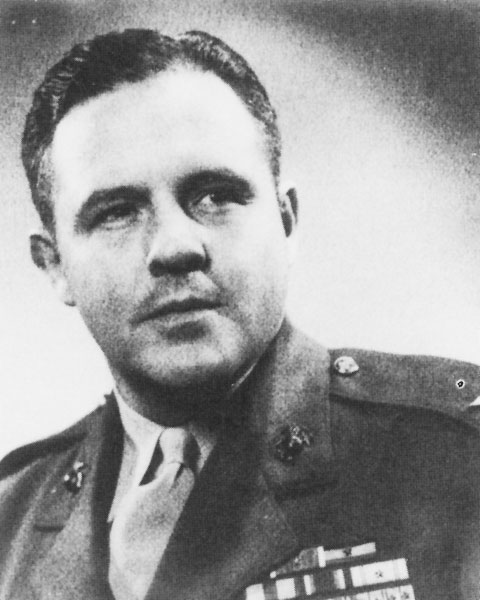
Shipboard Briefing

There were limitations to American preparations. First the size of the force meant that it could not be assembled in one place for rehearsals or to train as a team.[xxxviii] A second problem for the Americans was the assumption that high and low tides would be sufficient to get their landing craft across the reef in spite of warnings to the contrary.[xxxix] Likewise the Americans failed to completely anticipate the scope to which the Japanese had fortified the island. This was despite good intelligence that they had done so. In particular aerial photos taken by the air force and ULTRA intercepts provided good information on the Japanese units on the island and the layout of the defenses.[xl]Additionally some equipment shortages were not remedied. The Marine Bazooka’s did not arrive, and neither the 6th or 8th Marines had made an actual amphibious assault.  At Guadalcanal they made an administrative landing and few field-grade officers remained from the 2nd Marine Regiment who had landed at Tulagi.[xli] They were far from “amphibious experts” that they would become.[xlii] However, they made up for their lack of experience by their cohesiveness, high morale and esprit, being well armed and equipped, in top physical condition and knowing the basic tools of their trade: “weapons proficiency and field firing, close combat techniques, fire and maneuver, tactical leadership, fire discipline.”[xliii]

The most critical aspect of the operation was to get across the reef onto the island.  There were few good landing sites and it was decided to make the landings from inside the atoll’s lagoon onto the Betio’s north shore.  This decision meant that transports embarking the Marines would unload outside of the lagoon and that the landing craft would have to make a 10 mile trip.[xliv]There was only one entrance into the lagoon and it was not deep enough for heavy ships to enter.[xlv]This meant that heavy ships such as battleships and cruisers would not be able to have direct fire on the Japanese positions best situated to disrupt the Marines.

The execution of the plan involved land based bomber strikes beginning on D minus 7. Carrier aircraft would begin their operations on D minus 2.  Cruisers and destroyers joined the cacophony of destruction on D minus 1 and the battleships on D Day itself.[xlvi] On D-Day itself Navy planned to bombard the island with 3,000 tons of shells in 2 ½ hours.[xlvii] The Navy was confident in the bombardment plans. Rear Admiral Kingman commanding the fire support group declared “We will not neutralize; we will not destroy; we will obliterate the defenses on Betio!”[xlviii] Four battalions of Marines would land in the first wave, the three battalions of the 2nd Marines and 2nd Battalion 8th Marines all commanded by Colonel David Shoup. Colonel Shoup who would win the Medal of Honor on Betio and later became the Commandant of the Marine Corps assumed command of 2nd Marines when its Regimental commander fell ill on the journey to Efate.[xlix] The division reserve was the remaining 8th Marine Regiment battalions. The 6th Marine Regiment served as the corps reserve.[l]The assault units would be reinforced by tanks and the 1st and 2nd Battalions 18th Marine Regiment, the division’s combat engineers.

Invasion: Day One

Landing craft going ashore at Tarawa

The naval gunfire bombardment commenced at 0542 on 20 November, and the assault waves began their trek to the beaches.  The transports were out of range of Japanese guns but ththat ensured boats would have to make a 10 mile trip.[li]At this point things began to go wrong.

USS Colorado at Tarawa

The Navy had “badly miscalculated the amount of softening-up that could be done in two and a half daylight hours bombardment.” Although major coast defense guns were silenced not enough damage was done to the Japanese defenses.[lii] The Japanese helped the Marines by firing their larger guns at warships, identifying their positions to Navy gunners.[liii] The bombardment lifted to allow an attack by carrier based aircraft. However the aircraft were late to arrive and the ships did not resume fire, allowing the Japanese to emerge and re-train their weapons.[liv] Likewise the destroyers Ringgold and Dashiell inside the lagoon had to cease fire, knowing the Japanese gunners along the shore were still active.[lv] Some believe that an extra half hour of direct fire from the destroyers would have saved many lives.[lvi] The LVTs in the first three waves were delayed by heavy chop and did not make landfall until 0913 throwing off the landing schedule.[lvii] The expect and planned for rise in tides did not materialize and they remained unpredictably low for the first 48 hours. No landing boats could cross the reef and the Marines were forced to wade ashore from 600 to 1000 yards.[lviii]

LCM sinking at Tarawa

Shoup’s Marines landed on three beaches.  Red one and two lay to the west of a 500 yard long pier and Red three lay to the east.  3/2 landed on Red-1, 2/2 on Red-2, 2/8 on Red-3, elements of 1/18 and the scout snipers on the pier, with 1/2 in reserve to land behind the battalion making the best progress.[lix] As soon as the Amtracks hit the reef the Japanese began firing.  Every “working weapon along the north and west shorelines….blazed forth in fierce, interlocking fields of fire.”[lx] As they watched the Amtracks craw over the reef that Japanese knew they were in for a tough fight, one of Warrant Officer Ota’s men exclaimed “Heavens! The God of Death has come!”[lxi] The Marines of 3/2 on Red-1 received enfilade fire from Japanese guns emplaced in a U around the beach.  Before the Marines landed they began to take causalities, Amtracks were hit in the lagoon and most that were not sunk or destroyed were unfit for further use.[lxii] The 2000 Marines who landed in the first hour were badly disorganized, the commanding officer’s of 2/2 and the Amtracks were killed, 3/2’s commander was isolated on the reef and only 2/8’s commander was with his troops. 2/8 was the only battalion being to reach the shore relatively intact.[lxiii] 3/2 was down to 65% of its strength and K/3/2 had taken over 50% casualties.[lxiv] The Marines in the fourth to sixth waves were struggling to wade ashore from the reef. Landing craft “ran aground or milled about helplessly outside the reef, which was swept by crossfire from behind the beaches and from a grounded hulk northwest of the pier.”[lxv] Most of the tanks were put out of action either through accurate fire by Japanese guns or by sinking in deep areas of the lagoon, the Tank battalion commander was blown out of his Amtrack, wounded and survived 24 hours by clinging to a pile of dead bodies to keep from drowning.[lxvi]

Marines wading ashore at Tarawa, since many landing craft could not cross the reef many waded hundreds of yards under constant Japanese fire

Shoup himself landed at Red-2 and began directing operations on the beach.  He knew that he had to get more troops ashore to exploit the minimal gains his Marines had made.  The news from Red-1 and Two was bad; he decided to bring 1/2 in at Red-2 thought that 3/8 should go in at Red-3.[lxvii]

Marines attempting to advance from behind sea wall

At 1018 General Julian Smith ordered the 8th Marines to dispatch 3/8 to Red-3.[lxviii] 3/8 had to make their way across 700 yards through the water to get to the beach.  It was a slaughter, only 30 percent of the first wave got ashore, in the second less and the third “were practically wiped out.”[lxix]

Aerial view of Tarawa on D-Day

As his Marines struggled ashore those who had gotten ashore engaged the Japanese at point blank range.  Lt. Hawkins of the 2nd Marine Scout and Sniper platoon and 5 of his men engaged the Japanese on the pier in vicious hand to hand fighting,[lxx] Sergeant Bordelon of the Engineers on Red-2 though grievously wounded knocked out four gun positions, some by lobbing dynamite charges into them and galvanizing survivors into action, finally being killed while taking on a Japanese position alone.  He would be awarded the Medal of Honor.[lxxi]

SSGT William Bordelon a Combat Engineer won the Medal of honor posthumously at Tarawa

By afternoon Julian Smith realized that he needed more troops, his last battalion, 1/8 waited to go ashore.[lxxii] Smith asked for the 6th Marines and had Admiral Hill send a message to Admiral Turner stating “Issue in doubt. I concur.” This sent a chill through the listening Naval Staff.[lxxiii] Ashore Shoup brought howitzers from 1st Battalion 10th Marines on surviving Amtracks to the eastern edge of Red-2 near the pier,[lxxiv] which landed in the early evening.[lxxv] He sent Lieutenant Colonel Carlson to make a personal report to General Smith that he would hold his beachhead no matter what happened. Shoup ordered his Catholic Chaplain to lay out a cemetery and begin burying the dead who were already decomposing in the tropical heat.[lxxvi] As this transpired 2/8 got two 37mm anti-tank guns into position to drive off Japanese tanks approaching the beachhead.[lxxvii] The Division Band assisted corpsmen in bringing back wounded Marines.[lxxviii]

Close Combat on Tarawa

The rest of the day the Marines continued to eke out a beachhead; Shoup’s Marines on Red-2 and Red-3 managed to advance about halfway across the island, 3/2 and elements 1/2 and 2/2 was isolated and Major Ryan of Lima Company pulled them back to meet an expected Japanese counter-attack.[lxxix] The Marines had taken over 1500 casualties of 5000 men landed the first day.[lxxx] There is no evidence that Shoup considered withdraw that night.[lxxxi] No counterattack occurred due to Japanese command and control problems, Admiral Shibasaki and his staff were killed while shifting headquarters during the afternoon,[lxxxii] and their communications were in shambles.

Admiral Shibasaki’s HQ and a knocked out light tank

A counterattack would have been disastrous in their condition,[lxxxiii] yet they assembled over 1000 men to oppose the Marines on day two.[lxxxiv] Had Shibasaki lived and communications survived a counterattack might have had ramifications far beyond Tarawa.[lxxxv]

Day Two: D+1

Wounded Marines at Tarawa being moved on rubber raft

The second day began with 1/8 landing on Red-2 and the 6th Marines began to land on Green Beach at the far western tip of Betio.  1/8’s landing turned into a bloodbath, the tide fell even lower than the previous day and as they hit the reef and waded ashore drifted into some of the heaviest Japanese defenses. Japanese guns, including the dual 5.5” guns took direct aim at the boats, and Marines ashore watched helplessly, and correspondent Robert Sherrod noted: “This is worse, far worse than it was yesterday.”[lxxxvi] Only half of 1/8 reached the beach with none of their heavy weapons or equipment.  Shoup ordered the remnants of the battalion into line on his western flank in preparation for an advance inland.[lxxxvii] During five hours of landings on day two, the “Marine casualties reached a higher rate than that sustained on the first morning.”[lxxxviii]

Marines advancing

Meanwhile, Shoup ordered Ryan’s “orphans” to make an attack down the right flank of the Japanese positions on Green beach and the “ultimate American victory at Betio evolved from the attack during one intense hour the second morning.”[lxxxix] Taking every available Marine, two surviving Shermans and some mortars, Ryan gathered his force and coordinated Naval Gunfire support.  The area contained a number of heavy guns including two of the 8” mounts.  A destroyer blanked the Japanese positions with 5” shells and fire from her light AA guns.[xc] Attacking behind the beach, Ryan’s Marines isolated and destroyed everyone and everything that looked hostile.[xci] Against minimal opposition Ryan’s Marines quickly seized the gun positions and the western end of the airfield.  Within an hour his Marines occupied the entire western side of Betio up to a 200 yard depth by 1200 and he radioed to let Shoup know the good news and that he intended to advance east against the airfield.[xcii] The attack allowed the Marines to be able to land intact battalions with supporting arms for the first time battle.[xciii]

Marines in action at Tarawa

To the east behind Red-2 and Red-3 The 8th Marines and survivors of 1/2 and 2/2 attacked against fierce Japanese opposition near Shibasaki’s former command bunker and two other large bunkers which were mutually supporting.  The attack by the 2nd Marine survivors eventually succeeded in getting completely across the south side of the island.[xciv] During the attack Lt. Hawkins of the Scout Snipers was mortally wounded.  He too would win the Medal of Honor.  The attack cut the island in two but the Japanese launched a counterattack on the Marine positions which was beaten back.[xcv]

Marines moving inland against tough resistance

The 8thMarines faced a more difficult task going against what was now the heart of the Japanese defense, as its defenders had been reinforced by Lt. Minami and his third company of the 7th Special Naval Landing Force.  Vicious fighting ensued and by nightfall “the Marines had little to show for their heavy losses,[xcvi] but they did make significant inroads against the Japanese to warrant optimism for D+2.[xcvii] By evening the Marines on Red-1 and Red-2 had consolidated their beachhead so that reinforcements were landing, including jeeps, artillery and heavy equipment, and other Marines noted that Japanese defenders were beginning to commit suicide and they began to feel that Japanese morale had broken.  By late afternoon Shoup transmitted the message: “Casualties many. Percentage of dead unknown. Combat efficiency-We are winning.”[xcviii] By late afternoon Major Jones’ 1/6 landed on Green beach in their rubber boats, reinforcing Ryan’s orphans, it was the first of the 7 battalions landed to get ashore intact and the two officers coordinated their units for a night defense and an early attack the next morning.[xcix] 2/6 cleared the nearby island of Bairiki allowing 2/10 to land its howitzers on the island.  This in effect cut off any line of retreat for the defenders of Betio.[c] Colonel Edson came ashore during the evening to relieve Shoup[ci], who remained ashore to help coordinate the next day’s attack.  Again there were no coordinated Japanese counterattacks, the only senior officer, Sugai was isolated in the pocket between the Red and Green beaches and no senior officer could coordinate any attacks.[cii]

Day Three and Four: D+2 and D+3

Wrecked LVTs and dead bodies

Day three began with attacks against Japanese strong points and the arrival of more reinforcements including 3/6 which landed on Green beach and three light tank platoons which landed on Red-2.[ciii] The Marines attacked off of Green beach sweeping east to join the 2nd Marines who had cut the island in two the day before.  The 8th Marines continued to attack the heavily fortified bunker complex eventually taking these heavily fortified and defended positions.  During the assault Lt Sandy Bonnyman of 1/18 won the Medal of Honor for leading the assault on these positions.[civ] Fighting remained fierce throughout the day and General Smith arrived to take command on shore.  The Marines attacked supported by tanks, artillery and naval gunfire.

Tarawa beach after the fight

By the evening they were established at the east end of the airfield.  The Japanese launched a series of Banzai charges which beginning about 1930 hours and ending about 0400 when the Marines annihilated the last attack with the assistance of artillery.[cv]The attack, which could have succeeded the first or early the second day, now aided the Marines by sacrificing strength that might have been used to exact a higher price for the tail of the island.[cvi] The next morning the Marines pushed forward and eliminated the last Japanese defenders and by 1200 Betio was secured.  Of about 5000 defenders only 17 Japanese and some Korean laborers were taken prisoner.[cvii] The Marines lost over 1000 killed and 2300 wounded.[cviii]

One of the few Japanese prisoners being interrogated

Epilogue

The Marines paid a heavy price for Betio, but it was not to be a useless sacrifice, though it was a source of great controversy especially among politicians.[cix]Spector wonders if waiting for better tides or a full moon would have saved lives.[cx] Holland Smith later argued that Tarawa should have been bypassed, but Nimitz’s biographer Potter notes “if the lessons of the amphibious assault had not been learned at Tarawa, they would have to be learned elsewhere, probably at greater cost.”[cxi]The lessons learned alone aided all future amphibious operations in the Central Pacific and elsewhere.  Timing and coordination of naval gunfire support, air strikes and combat loading of transports were all refined in future operations. Large numbers of armored and up-gunned Amtracks would be part of every future operation.[cxii] Intelligence was emphasized and replicas of the Japanese fortifications were built and tested to determine the best way of destroying them.[cxiii] The Marines shocked the public by releasing photos and films of the carnage on Tarawa to awaken them to the challenges ahead.[cxiv]

Today the battle is remembered annually by the 2nd Marine Division at Camp LeJeune, an ever shrinking number of veterans of the battle attend the ceremonies.  Samuel Eliot Morison put it best: “All honor, then, to the fighting heart of the United States Marine. Let the battle for that small stretch of coral sand called Betio of Tarawa be remembered as terrible indeed, but glorious, and the seedbed for victory in 1945.”[cxv]

Appendix: Leaders on Tarawa

General H.M. Smith and General Julian Smith at Tarawa

General Holland M. “Howling Mad” Smith USMC: (1882-1967) Lieutenant General Holland M. Smith command V Amphibious Corps during the Gilberts operation.  Prior to the war he had worked extensively on amphibious warfare doctrine for both the Marine Corps and Navy. Unlike many senior officers Smith was not a Academy graduate having matriculated from the Alabama Polytechnic Institute (now Auburn University) in 1903 and law school in 1903.  Smith served as Adjutant of the 4th Marine Brigade in the First World War and served in Panama and the Dominican Republic in addition to other Marine tours afloat and ashore.  He served well and had many key assignments between the wars culminating in as the Assistant Commandant of the Marine Corps.  Subsequent to the Gilbert campaign he served as Commanding General of the Fleet Marine Force, Pacific and later commanded the Marines at Iwo Jima.  He retired in 1946.

Major General Julian Smith USMC: (1885-1975) Major General Julian Smith served as Commanding General 2nd Marine Division at Tarawa.  He graduated from the University of Delaware and was commissioned as a Second Lieutenant in 1909.  He served in Haiti, Santo Domingo and the Vera Cruz expedition. During the First World War he served as an instructor in the Marine Officer training camps at Quantico. After the war he served in Cuba, Nicaragua and various command and staff posts including the Army Command and General Staff College.  He commanded 5th Marines in 1938 and in 1942 was promoted the Major General serving as director of Fleet Marine Force Schools, New River, NC.  He took command of 2nd Marine Division in May 1943 and served there until April 1944 when he became Commanding General, Expeditionary Troops, Third Fleet and in December 1944 took command of the Military Department of the Pacific.  He retired in 1946.

Colonel David Shoup of the 6th Marines won the Medal of Honor at Tarawa and would rise to become the Commandant of the Marine Corps

Colonel David Shoup USMC: (1904-1983) Colonel David Shoup commanded the 2nd Marines at Tarawa, being appointed as commander when its commander fell ill.  Shoup won the Congressional Medal of Honor for his actions on Tarawa.  A 1926 graduate of DePauw University, Shoup was commissioned a Second Lieutenant through the ROTC program that year.  He served in various assignments to include service in China, at sea on the battleship Maryland and Marine Barracks Puget Sound Navy Yard. He joined the staff of 6th Marines in October 1940 and assumed command of 2/6 in February 1942.  He was assigned as the Assistant Operations Officer for 2nd Marine Division in July 1942 and promoted the Lieutenant Colonel.   He went with the Division to New Zealand where he became the G-3 and from which he was fleeted up to command 2ndMarines at Tarawa.  After Tarawa he served as the Division Chief of Staff at Saipan and Tinian.  After the war Shoup continued to be assigned in key billets at the Pentagon and as commanding General, 1st Marine Division and then the Third Marine Division.  He became Chief of Staff, HQMC in 1958 and was appointed as the 22nd Commandant of the Marine Corps by President Eisenhower, a post that he retained until his retirement in 1963.

Admiral Tomanari Sachiro IJN: (1887-?) Commander of Tarawa garrison until relieved by Rear Admiral Shibasaki.   Graduate Naval Academy 1910, initially a communications officer he held various commands including Heavy Cruiser Haguro and Battleship Kirishima and two smaller ships.  Assigned to Tarawa in February 1943 he helped design and supervised the initial construction of Tarawa Defenses until relieved by Admiral Shibasaki on 20 July1943.  He returned to Japan and served the remainder of the war on Navy Division of Imperial General Headquarters.  Tomonari survived the war though nothing is mentioned as to his postwar fate.

Rear Admiral Shibasaki Keiji IJN: (1894-1943) Commanded Tarawa Garrison until his death during the battle.  He graduated from the Naval Academy in 1915 and he was a skilled navigator and instructor.  Prior to the war he had served afloat and ashore and ashore and had commanded a ship and naval station and served as a naval attaché to a member of the Imperial Family.  Among his assignments was 19 month combat tour with the special Naval Landing Forces in China, where he served as Chief of Staff of Shanghai Special Naval Landing Force.  Shibasaki’s leadership helped the garrison improve their defensive capabilities and combat skills as he inspired them to great heights and executed an intense training program. He was killed in the battle.

A Personal Note

I have not been to Tarawa but feel that I know it well.  I served in Second Marine Division from April 1999 through December 2001.  Due to my prior service experience I was used to fill gaps where chaplains were needed and ended up serving in four different battalions.  I served in 2nd Combat Engineer Battalion, the descendant of 1/18, the combat engineers.  We had a WWII Bulldozer outside our command post named after Sergeant Bordelon, the Medal of Honor Citations for Bordelon and Boonyman were prominently displayed.  I also served in 1/8 and 3/8.  I knew the accounts of the slaughter of these Marines as they attempted to land but as I re-read the accounts I was moved by their courage under fire.  The CPs of these battalions are also adorned with citations of their heroes lost at Tarawa.  Veterans would visit our units during Tarawa Days at Camp LeJeune, worn by the battle and the years they always made an impression. There is almost a mystical connection between the Second Marine Division and the Marines of Tarawa; it was a crucible that defined the division, whose motto is the same as the Army Infantry School. “Follow Me!”

Semper Fidelis,

Padre Steve

[i] Spector, Ronald H. Eagle Against the Sun: The American War with Japan.  The Free Press, New York, NY 1985. p.253

[ii] Murray, Williamson and Millett, Allan R. A War to Be Won: Fighting the Second World War, The Belknap Press of Harvard University Press, Cambridge, MA 2000. p.338

[iii] Ibid. Spector. p.253

[iv] Ibid. p.255 The conference also set a date for the invasion of France.

[v] Toland, John. The Rising Sun: The Decline and Fall of the Japanese Empire, 1936-1945. Random House, Inc. New York, NY 1970. p.468

[vi] Ibid. Spector. p.255

[vii] Costello, John. The Pacific War 1941-1945. Quill Publishing, New York, NY 1982. p.430

[viii] Ibid.

[ix] Potter, E.B. Nimitz. Naval Institute Press, Annapolis, MD, 1976, Third Printing with Revisions 1979. p.243. Nimitz’s forces would have had to seize 5 major Japanese bases and his staff was not sure that the Pacific carrier force would be strong or experienced enough to provide the necessary air cover for the operation.

[x] Ibid.

[xi] Ibid. pp.243-245

[xii] Morison, Samuel Elliott. The Two Ocean War: A Short History of the United States Navy in the Second World War. Little Brown and Company, Boston and Toronto, 1963. p.296.

[xiii] Hammell, Eric and Lane, John E. Bloody Tarawa: The 2nd Marine Division, November 20-23, 1943. The Zenith Press, St. Paul MN 2006.  Text copyright 1998 Eric Hammell and John E. Lane. p.4

[xiv] See Alexander, Joseph H. Utmost Savagery: The Three Days of Tarawa.Ivy Books, published by Ballantine Books, New York, NY. 1995. pp. 39-40.  This unit became the Third Special Base Unit on its deployment and was joined by the 111th Construction Battalion.

[xv] Ibid. Hammell. p.4

[xvi] See Alexander pp.39-40. This unit was basically a reinforced infantry battalion with 3 rifle companies, a weapons battery, anti-aircraft battery, a light tank company and support units numbering about1600 men.

[xvii] Ibid. Alexander. p.43

[xviii] Alexander p.27 The Rikusentai was the Japanese equivalent of Marines, who numbered about 50,000 men.  The officers attended Army schools and qualified enlisted men attended additional Army specialist training.

[xix] Ibid. Costello. p.431

[xx] Ibid. Hammell. p.22

[xxi] See Alexander p.77. While most writers say that these guns were brought from Singapore, Alexander notes that British writer William H Bartsch submitted proof (serial numbers) that the guns were sold by Vickers to Japan in 1905 as a legitimate business transaction.

[xxii] These are the same guns (127mm) mounted as the secondary armament of Nachi and Takao Class Heavy Cruisers and later mounted on light cruisers to replace the main battery with a more effective anti-aircraft armament.

[xxiii] Ibid. Hammell. p.22

[xxiv] Hammell notes that many of these bunkers and pillboxes were so well concealed that they could not be seen.

[xxv] Ibid. Toland. p.469.

[xxvi] Ibid. Alexander. p.43.

[xxvii] Ibid. Hammell. p.28

[xxviii] Ibid. Morison. p.297

[xxix] Ibid. Costello. p.429

[xxx] At this point the force could provide everything except major permanent repairs to warships.

[xxxi] Liddell-Hart, B.H.  History of the Second World War. G.P. Putnam’s Sons, New York, NY 1970. p.511

[xxxii] Ibid. Costello. p.431

[xxxiii] The older LVT-1s had boiler plate armor added as a field modification and were given a heavy machine gun. Prior to this they were unarmored and had two light machine guns.

[xxxiv] Ibid. Morison. p.303

[xxxv] Hammell includes a by name list of these officers in Appendix B.  Of note for today, each MEUSOC (Marine Expeditionary Unit, Special Operations Capable) has an assigned Naval Gunfire Support Team.

[xxxvi] Ibid. Alexander. pp. 61-62.  The Shermans had to be transported aboard pre-loaded LCM-3s carried in the well decks of the LSDs.

[xxxvii] Ibid. Alexander. pp.58-59

[xxxviii] Ibid. Morison. p.297.  As a sidebar discussion it should be noted that Galvanic helped provide the model for the organization of all further Marine Corps amphibious doctrine now known by the acronym PERMA; Planning, Embarkation, Rehearsal, Movement and Assault, which describes the 5 phases of a amphibious assault.

[xxxix] Ibid. Hammell details the intricacies of the particular tides seen at Tarawa and the knowledge that the Marines had from the former Resident Commissioner of the Island, Major Frank Holland who warned the division staff that he knew that there would not be enough water over the reef to get landing craft across it. (pp.18-20)

[xl] Ibid. Alexander. pp.75-77

[xli] Ibid. Alexander. pp.67-68.

[xlii] Ibid. p.70

[xliii] Ibid. p.71

[xliv] Ibid. Morison. p.302

[xlv] Ibid. Hammell. p.16

[xlvi] Johnston, Richard W. Follow Me! The Story of the Second Marine Division in world War II.  Copyright 1948 by the Second Marine Division History Board and published by Random House Publishers, New York, NY 1948. p.106

[xlvii] Ibid. Liddell-Hart. p.511  Johnson says 2,700 tons. (p.106)

[xlviii] Ibid. Johnston. p.106

[xlix] Ibid. Hammell. p.17

[l] Ibid.

[li] Ibid.. Hammell. 46-47

[lii] Ibid. Morison. p.303

[liii] Ibid. Alexander. p.113.  Alexander notes that the Japanese would have been better served by using these guns on the stalled out landing craft.

[liv] Ibid. Hammell. p.47.

[lv] Ibid. Hammell. p.58

[lvi] Ibid.

[lvii] Ibid. Morison. p.303

[lviii] Ibid. Alexander. p.79

[lix] Ibid. Hammell. p.17

[lx] Ibid. Alexander. p.121

[lxi] Wukovits, John. One Square Mile of Hell: The Battle for Tarawa. NAL Caliber, published by New American Library, a division of Penguin Group USA, New York NY, 2006. p.112

[lxii] Ibid. Johnston. p.116

[lxiii] Ibid.

[lxiv] Ibid. Wukovits. P.119  Other companies suffered as grievously, K/3/2 was not alone in its suffering.

[lxv] Ibid. Spector. pp.263-264

[lxvi] Ibid. Alexander. pp.136-138

[lxvii] Ibid. Hammell. p.90

[lxviii] Ibid. p.95

[lxix] Ibid. Spector. p.264

[lxx] Ibid. Wukovits. p.114

[lxxi] Ibid. Alexander. pp.139-140

[lxxii] 1/8 did not arrive on the beach due to botched communications until D plus 1.

[lxxiii] Ibid. p.150  The last time this signal had been sent it was by Major Devereaux at Wake Isalnd

[lxxiv] Ibid. p.151

[lxxv] Ibid. Johnston. p.132

[lxxvi] Ibid. Hammell. p.112

[lxxvii] Ibid. p.130

[lxxviii] Ibid. Johnston. p.122

[lxxix] Ibid. Johnston. p.122

[lxxx] Ibid. Costello. p.436

[lxxxi] Ibid. Alexander. p.163

[lxxxii] Ibid. Alexander. pp.157-158  Hammell notes that Shibasaski was most likely killed by fire from Ringgold or Dashiell.

[lxxxiii] Ibid. Hammell.pp.139-140

[lxxxiv] Ibid. Alexander. p.162

[lxxxv] Ibid.  Wukovits. p.176. Wukovits notes how this could have affected the planning for the Normandy invasion.

[lxxxvi] Ibid. Alexander. p.173

[lxxxvii] Ibid. Hammell. p.160

[lxxxviii] Ibid. Costello. p.437

[lxxxix] Ibid. Alexander. p.170

[xc] Ibid. Hammell. p.163

[xci] Ibid. Hammell. p.166

[xcii] Ibid. Wukovits. p.178

[xciii] Ibid. Alexander. p.170 Ryan would be awarded the Navy Cross for his efforts.

[xciv] Ibid. Hammell. p.172

[xcv] Ibid. Alexander. p.179

[xcvi] Ibid. Alexander. p.181

[xcvii] Ibid. Hammell. p.178

[xcviii] Ibid.. Wukovits. p.194

[xcix] Ibid. Hammell. p.202

[c] Ibid. Hammell. p.212

[ci] Shoup would be awarded the Medal of Honor and eventually go on to be the Commandant of the Marine Corps.

[cii] Ibid. Alexander. pp.191-192

[ciii] Ibid. Johnston. p.134  2 platoons landed on Red-2 and one on Green Beach.

[civ] Ibid. Alexander. pp.202-205

[cv] Ibid. Johnston. pp.145-146

[cvi] Ibid. Johnston. p.147

[cvii] Ibid. Toland. p.470

[cviii] Ibid. Murray and Millett. p.345

[cix] Ibid. Liddell-Hart. p.511

[cx] Ibid. Spector. p.266

[cxi] Ibid. Potter. P.264

[cxii] Ibid. Murray and Millett. p.347  The Amtrack in improved forms has been part of the Marines ever since. The current model serves in a traditional amphibious role as well as a Armored Personnel Carrier for Marines involved in ground combat operations ashore.

[cxiii] Ibid. Costello. p.439. The method found to work best was long range plunging fire by heavy guns found on battleships and heavy cruisers.

[cxiv] Ibid. Murray and Millett. p.346

[cxv] Ibid. Morison. p.306

Bibilography

Alexander, Joseph H. Utmost Savagery: The Three Days of Tarawa. Ivy Books, published by Ballantine Books, New York, NY. 1995.

Costello, John. The Pacific War 1941-1945. Quill Publishing, New York, NY 1982

Morison, Samuel Elliott. The Two Ocean War: A Short History of the United States Navy in the Second World War. Little Brown and Company, Boston and Toronto, 1963

Hammell, Eric and Lane, John E. Bloody Tarawa: The 2nd Marine Division, November 20-23, 1943. The Zenith Press, St. Paul MN 2006.

Johnston, Richard W. Follow Me! The Story of the Second Marine Division in world War II.  Copyright 1948 by the Second Marine Division History Board and published by Random House Publishers, New York, NY 1948

Murray, Williamson and Millett, Allan R. A War to Be Won: Fighting the Second World War, The Belknap Press of Harvard University Press, Cambridge, MA 2000

Potter, E.B. Nimitz. Naval Institute Press, Annapolis, MD, 1976, Third Printing with Revisions 1979

Spector, Ronald H. Eagle Against the Sun: The American War with Japan.  The Free Press, New York, NY 1985 Toland, John. The Rising Sun: The Decline and Fall of the Japanese Empire, 1936-1945. Random House, Inc. New York, NY 1970

4 Comments

Filed under History, Military, world war two in the pacific

Adjusting Strategy to Reality: The Pacific War- Why the Japanese Lost

Lead aircraft ready to take off of IJN Carrier Akagi to attack Pearl Harbor beginning a 6 month chain of Japanese victories in the Pacific

The outcome of the Pacific war was directly related to the ability of the Americans to adjust strategy to the realities of the Pacific war, a unity of effort directed by the National Command Authority and superior industrial, technological and logistical capabilities. The Japanese after initial success did little to adapt and were hamstrung by inter-service rivalries and inadequate industrial capacity and limited natural resources.

US Destroyer USS Pope being blasted out of the water by Japanese Cruisers at the Battle of Java Sea

The Japanese and the Americans each had war plans in place for the Pacific campaign.  The American plans, Plan Orange had been developed since the early part of the 20th Century after the Spanish-American War and Russo-Japanese War.  Predicated on holding the Philippines until relief could arrive Orange assumed that the US Pacific Fleet would sail across the Pacific and fight the Japanese Navy in a manner written about by Alfred Thayer Mahan; see Weigley in The American Way of War and Ronald Spector in “Eagle Against the Sun: The American War Against Japan.”

IJN Carrier Hiryu heavily damaged and abandoned at Midway. Hiryu, Akagi, Kaga and Soryu the creme of the Japanese carrier fleet were lost at Midway, the Japanese found it hard to replace them or their decimated air crews

The Japanese were conflicted.  The Navy desired a campaign that would destroy the American Navy and expand the Empire to the East and to Southeast Asia and the Indian Ocean. The Army was fixated on the China strategy having been embroiled on the Asian continent since the early 1930s. John Toland discusses this in good detail in his book “Rising Sun: The Decline and Fall of the Japanese Empire 1936-1945” In addition other Japanese Army leaders had designs on Siberia and fought a brief campaign against the Soviets which ended in a defeat.

Japanese destroyer shown sinking after being torpedoed by a US submarine

When the Japanese attacked Pearl Harbor as well as the Philippines and Southeast Asia defeating American and Allied forces in detail, crippling the American Navy and dooming the Philippines the Americans were able to adjust strategy to first a defensive one supplemented by raids against the Japanese perimeter by carrier forces and the beginnings of a nascent submarine campaign against Japanese merchant shipping.  The Americans were able to parry the Japanese thrust at the Coral Sea and inflict a major defeat on the Japanese Carrier Forces at Midway prior to launching the first limited offensive by the Navy and the Marines at Guadalcanal.

Aircraft like the F6F Hellcat drove Japanese aircraft such as the A6M2 Zero from the skies in the Pacific


The Japanese remained mired in their conflicting strategies with the Navy primarily fighting the Pacific campaign aided by limited Army and Army Air Forces on the islands Japan had occupied or fortified while the bulk of the Army was engaged in China, Southeast Asia or sitting on the Manchurian-Soviet border.

Heavily fortified Japanese islands were either bypassed or taken in bloody assaults, here a 8″ gun on Tarawa

Once the Americans shifted to the offensive a campaign of island hopping coordinated between the Southwest Pacific Area under General MacArthur and the Central Pacific Area under Admiral Nimitz focused on gaining control of islands which contained airbases and anchorages capable of sustaining the American advance while bypassing islands not necessary for this along with their Army garrisons. Both American advances in the South Pacific and Central Pacific focused on retaking the Philippines and cutting the Japanese lines of communication and supply with Southeast Asia. From late 1942 on the Japanese strategy was focused on individual areas of danger versus a overall coordinated defensive effort.

Japanese war industries were woefully ill equipped to match US war production. Here a factory producing Oscar fighter planes

The Japanese were hamstrung from the beginning of the war by limited natural resources, especially oil and oil refining capacities, limited industrial capacity, especially in the realm of the manufacture of steel and machining tools.  All of these were supplied in large part by their opponents and were cut off once the war began.

The Carrier Taiho was the equivalent of the Essex Class but the Japanese could only produce one unit

Michael Barnhart in his book Japan Prepares for Total War” has an excellent account of the limitations of Japanese economic, industrial and natural resource capacities, as well as the continual struggle by the Army and the Navy for priority in access to them and the inability of Japanese planners, both civilian and military to resolve this conflict. The Americans had a different situation; although American industrial capacity was enormous it had to be split between to Theaters of Operations and support the needs of American Allies, Britain, the Soviet Union, Canada and China.

An Armada of US Essex Class Carriers in 1944 the Japanese could not keep pace with US Naval production

Despite this the Americans in a relatively short time were able to amass forces equal to or great than the Japanese who were unable to replace losses in ships, aircraft or the highly trained personnel needed to man them.  At the beginning of the war Japanese Air and Naval forces in the Pacific outmatched everything the Allies could offer, however once they began to experience significant losses at Midway and during the Guadalcanal Campaign their air and naval capabilities diminished to the point that they had to conserve ships and aircraft hoping to be able to gain local advantage in critical defensive areas.

The US Amphibious warfare capacity was a key factor in the ability of the United States to take the war to Japan

New American ships and aircraft introduced during the war were superior to Japanese designs, many of which had reached their apex by 1942.  American advantages in radar, communications equipment added to American advantages throughout the war.  Japanese ground forces in the Pacific were dependant on the Navy and merchant marine for supply and reinforcements. As the American submarine campaign became better organized this became more difficult as the American submarines copying German Wolf pack tactics decimated the Japanese merchant Marine. I particularly like Samuel Elliott Morrison’s account of this in “The Two Ocean War” and “The History of US Navy Operations in World War II” which has a volume devoted to this subject.

US Navy Submarines cut off Japan from its vital natural resources in Southeast Asia. A Sub Squadron above and USS Barb below

Japanese forces would always fight determined battles but they often expended great amounts of manpower in senseless Banzai charges rather than make the Americans force them out of well prepared positions.  Where the Japanese maintained excellent defense such as at Tarawa and Iwo Jima they made the Americans pay greatly for their gains.  American Marines were apart from the 82nd and 101st Airborne Divisions were the best infantry in the US Military and their skill at amphibious operations and integrated air-ground and naval warfare increased as the war went on.  The Americans were well equipped with modern weapons while the Japanese operated antiquated tanks and often substandard artillery.

Japanese leadership at the strategic and political level was inept throughout the war. They failed to coordinate any strategy with the Germans and failed to enunciate any sort of Grand Strategy.  On the operational and tactical levels the Japanese forces, especially the surface navy performed well, however as the American numeric and technologic advantage increased the Navy became less effective.  After the death of Admiral Yamamoto in 1943 Japanese Naval Leadership became far less effective. The Americans as mentioned before were able to devise a Grand Strategy which not only dealt with Japan but also Germany and coordinated the efforts of forces, war production, planning and logistics to advance their war aims.  At the operational and tactical level American forces, especially the Navy and Marines and later the Army Air Forces and Army became more skilled and than their Japanese counterparts with the possible exception of General Simon Bolívar Buckner at Okinawa. See Spector and Thomas Costello “The Pacific War.” In the air the Americans continued to increase their combat capabilities at the tactical and strategic level and used massed fire bombing raids to devastate the Japanese homeland.  The Japanese in contrast due to inexperienced pilots and fewer competitive aircraft were forced into suicide or Kamikaze missions as the war neared Japan.

B-29 Super-fortresses leveled Japanese cities and even excellent fighters like the Mitsubishi J2M Raiden could not stop them


The outcome of the Pacific war was directly related to the ability of the Americans to adjust strategy to the realities of the Pacific war as well as the unity of effort which enabled the American superiority in industrial, technological and logistical capabilities to overwhelm the Japanese. The Japanese after initial success did little to adapt and were hamstrung by inter-service rivalries and inadequate industrial capacity and limited natural resources, fell behind in technology and were unable to replace losses among the ships, men and aircraft that they needed to fight an effective war.  Japanese leaders at many levels failed to adapt strategy, tactics or methods to match the reality of the war and the places that they did do so were done by local commanders and never instituted throughout the Japanese military.

2 Comments

Filed under History, Military, world war two in the pacific

Tom Hanks on the Pacific War and the Impact of Race in the Pacific War

Anti US Japanese Propaganda

This is my third installment of my series background for the new HBO series “The Pacific.” The producer of this series is actor and producer Tom Hanks. Hanks has also acted in “Saving Private Ryan” and produced “Band of Brothers” both of which have been critically acclaimed. Hanks recently ran afoul of his most loyal audience for these productions when he made a very inaccurate comment about the role of racism in the American-Japanese war in the Pacific which he repeated.  Hanks is a great film maker and his work on “Saving Private Ryan” and “Band of Brothers” helped show a new generation the courage and sacrifice of the generation that fought World War Two.

Hanks comments had a bit of truth in them, as racism did play a role in the propaganda of both sides during the war and the manner in which some leaders and soldiers fought it.  However Hanks demonstrated a true lack of objective historical balance as he skewed this into an overall condemnation of the way that the United States prosecuted the War against Japan. Hanks ignored Japanese conduct and responsibility in the conduct of the war and drew a straw man analogy to the current wars in Iraq and Afghanistan. Yes there was racism at work in the Pacific war; it did influence the conduct of the war and the actions of individual leaders and soldiers, but both the American and Japanese were both part of it, this was not a one way street as Hanks seems to indicate.

But what did Hanks say?  Hanks first comment came in an interview with Time magazine:

“Back in World War II, we viewed the Japanese as ‘yellow, slant-eyed dogs’ that believed in different gods,” he told the magazine. “They were out to kill us because our way of living was different. We, in turn, wanted to annihilate them because they were different. Does that sound familiar, by any chance, to what’s going on today?”

Hanks then followed this on MSNBC’s “Moring Joe” with Joe Scarborough where he said:

“‘The Pacific’ is coming out now, where it represents a war that was of racism and terror. And where it seemed as though the only way to complete one of these battles on one of these small specks of rock in the middle of nowhere was to – I’m sorry – kill them all. And, um, does that sound familiar to what we might be going through today? So it’s– is there anything new under the sun? It seems as if history keeps repeating itself.”

To be fair there was a significant amount of racism but involved but it was rampant on both sides and Japan’s racism not only included American and British but most of the rest of Asia and in many places they waged a war of extermination against the Chinese and others who resisted them.  Much of the American attitude was based upon the widespread publicity of Japan’s brutal campaign against the Chinese, a people that many Americans harbored an affinity for at that time.  Likewise the attack on Pearl Harbor influenced the way that Americans thought of Japan. The Japanese frequently appealed to anti-colonial feelings of territories that the conquered ignoring their own subjugation of local populations.

Since the subject of race has been broached I have re-posted a review of John Dower’s book “War without Mercy: Race and Power in the Pacific War.” The book shows how much racism played a role in the conduct of the war on both sides. However it was not in the manner in which Hanks portrayed it in his interviews as it was a two way street. The war in the Pacific was one of the most brutal “no-quarter” conflicts ever fought and much of this was directly related to the Japanese concept of honor which considered personal surrender cowardly and a loss of face, or believing that showing mercy or treating defeated enemies who surrendered with honor was undeserved.

The comparison of this war by Hanks to the current wars in undeserved. With few exceptions the American military has conducted itself with tremendous restraint often risking its own to ensure that non-combatants are not killed even during firefights and battles.  There are some in the United States who advocate the type of war that we had with the Japanese against Moslems extremist or otherwise and they are among the loudest critics of the military’s prosecution of these wars. Depending on what happens racism has the potential to reemerge as a major factor in this conflict, but at the present Hanks remark can only be called ill-informed and prejudiced in its own right. By doing this Hanks sullies his reputation among the surviving veterans of the “Great Generation” who had to battle a tenacious and proud foe on the “little specks of sand and rock” in the Pacific.

Anti-Japanese propaganda sometimes encouraged “wiping out” every “murdering Jap”

This is a review of John Dower’s “War without Mercy” which I published on this site last year.  It is a book that raises troubling questions about the Pacific war but one that is not one sided.

Peace,

Padre Steve+

Dower, John W. War without Mercy: Race and Power in the Pacific War.” Pantheon Books, a Division of Random House, New York, NY 1986.

Even Dr Seuss was used to paint the picture of Japanese Americans as traitors

The study of war cannot simply be confined to the study of battles, weapons and leaders. While all of these are important one must as Clausewitz understood examine the human element of policy, ideology and the motivations of nations as they wage war. Clausewitz understood that war could not be reduced to formulas and templates but involved what he called the “remarkable trinity” which he described in on war as (1) primordial violence, hatred, and enmity; (2) the play of chance and probability; and (3) war’s element of subordination to rational policy. Clausewitz connects this with the people being connected to the primordial forces of war, the military with the non-rational elements of friction, chance and probability and the government.

Anti-British Japanese Propaganda leaflet

The Clausewitzian understanding of war is rooted in the Enlightenment and classic German Liberalism, born out of his experience in the Napoleonic Wars, which forever changed the face of warfare.  From the defeat of Prussia and its liberation from Napoleonic rule under Scharnhorst and Gneisenau Clausewitz developed the understanding that war was more than simply tactics and weapons.  Thus when we examine war today we deprive ourselves of properly understanding the dynamic of war if we fail to appreciate the human factor which is frequently not rational.  Such is especially the case when one fights an enemy who wages war on religious, racial or ideological grounds as is the case in the current war against Al Qaida and other extremist Moslem groups. Such groups would like to turn this war into such a conflict as do certain figures in the American political milieu who repeatedly label all of Islam as the enemy.  In such a climate it is imperative to look at history to show us the results of such primal passions.


The Japanese made a conscious but unsuccessful attempt to incite African Americans to rise against white America

It is in such conflict as we are engaged in today it is good to look at previous wars from the human experiential component and not simply military operations.  If one wants to look at how inflamed passion driven by racial prejudice and hatred took war to a level of barbarity and totality that defy our comprehension we only need to look back to the Pacific war between Japan and the United States.  In another post I dealt with the how racial ideology influenced Nazi Germany’s conduct of the war against Poland and the Soviet Union.  https://padresteve.wordpress.com/2009/09/14/the-ideological-war-how-hitlers-racial-theories-influenced-german-operations-in-poland-and-russia/

To do this I will look at John Dower’s “War Without Mercy.” In this book Dower examines World War Two in the Pacific from the cultural and ideological viewpoints of the opposing sides.  He looks at the war as a race war, which he says “remains one of the great neglected subjects of World War Two.”[i] Dower examines race hated and its influence on both the Japanese and the Allies, particularly in the way that each side viewed one another and conducted the war.  He examines the nature of racial prejudice and hate in each society, including its religious, psychological, ideological, scientific and mythological components.  He also examines the use of media and propaganda, and how racial attitudes not only influenced national and individual attitudes, but also the military and intelligence operations of both sides.  This book is not about military campaigns, thus it is much more like “In the Name of War” by Jill Lepore[ii] than any history of the Pacific war.

Dower uses sources such as songs, movies, cartoons and various writings of the times to demonstrate the totality of the war.  Dower admits many of these are difficult to handle and “not respectable sources in some academic sources.”[iii] Despite this he puts together a work that is sometimes chilling, especially when one looks at the current war that our country is engaged in. He also endeavors to explain how after a war where “extraordinarily fierce and Manichean”[iv] race hate predominated, it could “have dissipated so easily”[v] after the war was over.

Dower divides his work into three major sections.  The first which examines how the aspect of race effected the fighting of the war, the second, the war through Western eyes and the third the war through Japanese eyes.  The first section begins with how racial attitudes in Western and Japanese societies helped fuel the war and compares similar attitudes and concepts in Western and Japanese thought, including how “prejudice and racial stereotypes frequently distorted both Japanese and Allied evaluations of the enemy’s intentions and capabilities.”[vi] He looks at the language of the conflict; at how war words and race words came together “in a manner which did not reflect the savagery of the war, but truly contributed to it….”[vii] the result being “an obsession with extermination on both sides.”[viii] He comes back to this theme throughout the book comparing the two sides and occasionally contrasting these attitudes with corresponding attitudes of the Allies to their German and Italian foes in Europe.[ix]

In the first chapter Dower examines the role played by the propaganda used by both sides.  In particular he explains how the “Know Your Enemy: Japan” movies commissioned by the War Department and directed by Frank Capra, and the Japanese works “Read this and the War is Won” and “The Way of the Subject” helped shape the view of each side. Propaganda developed the idea of the war in terms of good versus evil and the mortal threat posed to their respective cultures by the enemy.

From this he looks at the visceral emotions that the war engendered and how those emotions spilled over into the conduct of the war especially in regard to its ferocity and the war crimes that were spawned by the unbridled hatred of both sides.  He notes the targeted terror bombings of civilians by both sides and how those actions were portrayed as “barbaric” by the other side when they were the victim.[x] He notes the viciousness of the war and how for the Americans the war brought forth “emotions forgotten since our most savage Indian wars.”[xi] He contrasts this with European war in particular how the Japanese and their actions were portrayed in Western media, and how similar actions by the Germans, such as the Holocaust, were ignored by Western media until the war was over.[xii] He traces some of this to the understanding of the psychological effects of the defeats and humiliations of the Allies at the hands of the Japanese, and the corresponding brutality toward Allied prisoners by the Japanese as compared to that of the Germans.[xiii] He uses this section to also examine the prevailing attitudes of the Japanese toward the Allies as being weak and “psychologically incapable of recovery” from blows such as the Pearl Harbor attack, and the Allied view of the Japanese as “treacherous.”[xiv]

Dower’s second major section describes the attitudes and actions of the Americans and British toward their Japanese enemy.  He looks at the view that the Japanese were less than human and often portrayed as apes or other primates such as monkeys.  To do this he examines cartoons and illustrations in popular magazines and military publications, and includes those cartoons in the book.   The sheer vulgarity of these cartoons is easily contrasted with those promoted and published by Nazis such as Julius Streicher in Der Stürmer, something often overlooked or ignored in other histories.[xv] The early Western views of Japan as sub-human continued throughout the war, while at the same time, especially after the rapid series of Allied defeats and Japanese victories they were viewed as almost “super-human.”  Paradoxically some allied leaders turned the Japanese from “the one time “little man” into a Goliath.”[xvi] They were now “tough, disciplined and well equipped.”[xvii] Ambassador Joseph Grew, reported on his return from Japan, that the Japanese were; “”sturdy,” “Spartan,” “clever and dangerous,” and that “his will to conquer was “utterly ruthless, utterly cruel and utterly blind to the values that make up our civilization….””[xviii] The juxtaposition of such conflicting attitudes is curious, although understandable, especially in light of other Western wars against Asians or Arabs.[xix]

Dower then examines how some Americans and British explained the Japanese “National Character,” their approach to war, and actions during the war from Freudian psychiatry as well as Anthropology and other social and behavioral sciences.   Beginning with the widespread Allied understanding that the Japanese were “dressed-up primitives-or “savages” in modern garb…”[xx] he notes that these interpretations of the Japanese national character stemmed from “child-rearing practices and early childhood experiences,”[xxi] including toilet training and Freudian interpretations that saw an arrested psychic development at the “infantile (anal or genital) stage of development.”[xxii] Dower deduces that it was not hard to see how “Japanese overseas aggression became explicable in terms of penis envy or a castration complex….”[xxiii] The views were widespread and emphasized  that the “Japanese were collectively unstable.”[xxiv] Dower notes that the “very notion of “national character”-was the application to whole nations and cultures of an analytical language that had been developed through personal case studies…”[xxv] which he is rightly critical in suggesting that this premise “was itself questionable.”[xxvi] In addition to this was the understanding of Margaret Mead and others of the Japanese as “adolescents” and “bullies,”[xxvii] and notes that from “the diagnosis of the Japanese as problem children and juvenile delinquents, it was but a small step to see them as emotionally maladjusted adolescents and, finally as a deranged race in general.”[xxviii] Dower cites numerous other “experts” of the time and their interpretations of the Japanese national character, but the overwhelming message is that the application of these theories, regardless of their validity had a major impact on the Allied war against Japan.

He follows this chapter with one with much importance in explaining the similarities in how Americans and Westerners in general viewed the Japanese in relationship to other races that they had dealt with including Blacks, Chinese, Filipinos, and American Indians.  Common themes include the views of each as primitives, children and madmen and the view of the Japanese as part of the “Yellow Peril.”  Of particular note is his analysis of the work of Homer Lea’s 1909 book The Valor of Ignorance and the vision of Japanese supermen which enjoyed a revival after Pearl Harbor.[xxix] Dower examines depictions of Asians in general in the Fu Manchu and Charlie Chan series of films and other racial aspects hearkening back to the “specter of Genghis Khan and the prospect that the white races “may be liquidated.”[xxx] He notes how Japanese propagandists attempted to use Allied prejudice to influence the Chinese and other Asians against the Allies[xxxi] and American blacks against whites,[xxxii] while attempting to maintain their own racial superiority which is the subject of the next section.

The chapters dealing with the Japanese view of themselves and their opponents tie together neatly.  These deal with the Japanese view of themselves as the leading race in Asia and the world.  Dower talks about symbols and the understanding of racial purity that motivated the Japanese from the 1800s to the rejection of Japan’s request for a declaration of “racial equity” at the League of Nations.[xxxiii] He notes the “propagation of an elaborate mythohistory in Japan and the time spent “wrestling with the question of what it really meant to be “Japanese” and how the “Yamato race” was unique among races….”[xxxiv] He notes the relationship of Shinto with whiteness and purity and connotations of how the Japanese indulged in “Caucasianization” of themselves vis-à-vis other Asians during World War Two,”[xxxv] and their emphasis on a Japanese racial worldview.[xxxvi] He also tackles the way in which the Japanese wrestled with evolution and its relationship to other racial theories contrasting books such as A History of Changing Theories about the Japanese Race and Evolution of Life with Cardinal Principles of the National Polity published by the Thought Bureau of the Ministry of Education in1937.  These declared that the Japanese were “intrinsically different from the so-called citizens of Occidental countries.”[xxxvii] He also deals with the Kyoto school and the Taiwa concept.[xxxviii] In Chapter Nine Dower looks at how the Japanese viewed themselves and outsiders, in particular the characterization of Westerners as nanbanjin or  barbarians and how this eventually train of thought carried through the war led to the “Anglo-American foe emerged full blown as the demonic other.”[xxxix] Dowers final chapter deals with how quickly the race hatred dissipated and genuine goodwill that developed between the Japanese and Americans after the war.[xl]

This book holds a unique place in the literature of the Pacific war.  It is not a comfortable book, it is challenging. No other deals with these matters in any systemic way.  If there is a weakness in Dower is that he does not, like Lepore in “In the Name of War” deal with the attitudes of soldiers and those who actually fought the war.  His examples are good and go a long way in explaining the savagery with which the war was conducted, but could have been enhanced with reflections and accounts of those who fought the war and survived as well as the writings of those who did not, and the way those attitudes were reflected in different services, times and theaters during the war, including adjustments that commanders made during the war.[xli] His description of how Japanese “reluctance to surrender had meshed horrifically with Allied disinterest …in contemplating anything short of Japan’s “thoroughgoing defeat.”[xlii]

The lessons of the book are also contemporary in light of the cultural and religious differences between the West and its Moslem opponents in the current war. Possibly even more so than the war between the United States and Japan which was fought by nation states that still were signatories to international conventions, not nation states against terrorists unbound by any Western code or law or indigenous forces engaged in revolutionary war against the west such as the Taliban.[xliii] The temptation is for both sides to demonize one’s opponent while exalting one’s own way of life through official propaganda and popular media, with a result of increased viciousness and inhumanity in pursuit of ultimate victory.   In today’s world with the exponential rise in the radicalization of whole people groups and the availability of weapons of mass destruction, it is possibility that the war could develop into one that is a racial as well as religious and ideological war that would make the War in the Pacific look like a schoolyard brawl.

Bibliography

Alexander, Joseph H. Utmost Savagery: The Three Days of Tarawa. Ivy Books, Published by Ballantine Books, New York, NY 1995

Dower, John W. War without Mercy: Race and Power in the Pacific War.” Pantheon Books, A Division  of Random House, New York, NY 1986.

Leckie, Robert. Okinawa. Penguin Books USA, New York NY, 1996

Lepore, Jill  The Name of War Vintage Books a Division of Random House, New York, NY 1998

Tregaskis, Richard Guadalcanal Diary Random House, New York NY 1943, Modern Library Edition, 2000.

Notes


[i] Dower, John W. War without Mercy: Race and Power in the Pacific War.” Pantheon Books, A Division  of Random House, New York, NY 1986. p.4

[ii] Lepore, Jill  The Name of War Vintage Books a Division of Random House, New York, NY 1998.  Lepore’s book deals with King Phillip’s War and how that war shaped the future of American war and how it shaped the views of Indians and the English Colonists and their later American descendants both in the language used to describe it, the histories written of it and the viciousness of the war.

[iii] Ibid. p.x

[iv] Ibid. p.ix

[v] Ibid. p.x

[vi] Ibid. p.11

[vii] Ibid.

[viii] Ibid.   Also see Alexander, Joseph H. Utmost Savagery: The Three Days of Tarawa. Ivy Books, Published by Ballantine Books, New York, NY 1995 Alexander notes an incident that shows a practical application of the Japanese views and the ruthlessness inflicted on their enemies, in this case prisoners in response to an American bombing raid. In 1942 the commander of the Japanese Garrison of Makin Island ordered 22 prisoners beheaded after one cheered following a bombing raid. (p.32)

[ix] An interesting point which Dower does not mention but is interesting for this study is how the Germans referred to the British and Americans as “Die gegener” (opponents) and the Soviets as “Die Feinde” (the enemy), the implication being that one die gegener was a common foe, much like an opposing team in a sport, and the other a mortal enemy, the implication of Feinde being evil, or demonic.

[x] In particular he makes note of the Japanese actions during the “Rape of Nanking,” and the 1945 sack of Manila, as well as the fire bombing of Japanese cities by the US Army Air Corps in 1945.

[xi] Ibid. Dower. p.33

[xii] Ibid. p.35

[xiii] Ibid.  This is important in the fact that the Allies tended not to make much of German brutality to the Jews, Russians and other Eastern Europeans.

[xiv] Ibid. p.36.

[xv] Dower does not make this implicit comparison, but having seen both and studied the Nazi propaganda directed toward the Jews, Russians and other Slavic peoples considered to be Untermenschen (sub-humans) by the Nazis the similarities are striking.

[xvi] Ibid. pp.112-113.

[xvii] Ibid. p.113

[xviii] Ibid.

[xix] In the 2006 Israeli invasion of Lebanon, Israeli soldiers who previously showed no respect to any Arab fighter described their Hezbollah opponents as “soldiers and warriors.”  Similar attitudes were voiced by American soldiers in Vietnam when they fought NVA regulars.

[xx] Ibid. p.123

[xxi] Ibid.

[xxii] Ibid.

[xxiii] Ibid.

[xxiv] Ibid. p.124

[xxv] Ibid.

[xxvi] Ibid.

[xxvii] Ibid. p.129

[xxviii] Ibid. p.143

[xxix] Ibid. P.157.  Lea is interesting because he predicts a decline in the stature of the British Empire and softness of both the Americans and British as peoples.  Also see John Costello in The Pacific War 1941-1945 Quill Books, New York, NY 1982 pp.31-32 notes Lea’s concerns and how they drove the American Pacific strategy until the outbreak of World War Two.

[xxx] Ibid. p.161

[xxxi] Ibid. p.169

[xxxii] Ibid. pp.174-180.  This is an interesting section.  One of the most interesting topics being the reaction of the NAACP’s Walter White’s book A Rising Wind published which “suggested a sense of kinship with other colored-and also oppressed-peoples of the world….he senses that the struggle of the Negro in the United States is part and parcel of the struggle against imperialism and exploitation in India, China, Burma….” (p.177-178)

[xxxiii] Ibid. p.204

[xxxiv] Ibid. p.205

[xxxv] Ibid. p.209  This is interesting when one compares the Japanese emphasis on “Pan-Asianism” and the inherent contradiction between the two.

[xxxvi] Ibid. p.211  Dower notes that the article Establishing a Japanese Racial Worldview in the monthly Bungei Shunju “clarified the Japanese character, whose basic traits were brightness, strength and uprightness.  These qualities made the Japanese “the most superior race in the world.”

[xxxvii] Ibid. p.221

[xxxviii] Ibid. p.227 This was the theory of Zen Buddhism’s Suzuki Daisetsu (D.T. Suzuki) in his teaching of the struggle for the Great Harmony “Taiwa” which attempted to identify “an intuitive sense of harmony and oneness that he declared to be characteristic of Oriental thought.”

[xxxix] Ibid. p.247.  Descriptions of the Allies as Barbarians, Gangsters and Demons permeated Japanese propaganda.

[xl] Ibid. Dower makes a number of observations relating to how the Japanese were able to use their own self concept to adapt to their defeat.  He also notes that the Japanese were able to transfer their self concept to a peaceful orientation.

[xli] See Leckie, Robert. Okinawa. Penguin Books USA, New York NY, 1996 p.35.  Leckie quotes General Ushijima “You cannot regard the enemy as on par with you,” he told his men. “You must realize that material power usually overcomes spiritual power in the present war. The enemy is clearly our superior in machines. Do not depend on your spirits overcoming this enemy. Devise combat method [sic] based on mathematical precision-then think about displaying your spiritual power.”  Leckie comments: “Ushijima’s order was perhaps the most honest issued by a Japanese commander during the war. It was Bushido revised, turned upside down and inside out-but the revision had been made too late.”

[xlii] Ibid. Dower. p.37

[xliii] See Tregaskis, Richard Guadalcanal Diary Random House, New York NY 1943, Modern Library Edition, 2000. p.95.  Tregaskis notes when commenting on Japanese POWs on Guadalcanal “We stared at them and they stared back at us. There was no doubt what we or they would have liked to do at that moment-if we had not remembered our code of civilization or if they had not been unarmed.”

2 Comments

Filed under History, world war two in the pacific