Tag Archives: barry mccafferty

The War that Cannot Be Won: Afghanistan 2012

“There is no single piece of land in Afghanistan that has not been occupied by a Soviet soldier . . . no single military problem that has arisen and not been solved, and yet there is still no result.”  Sergei Akhromeyev, Soviet General Staff Chief 1986

Sometimes one wonders if anyone actually reads history and if they do whether they actually want to learn from it. Back in 1979 the Soviet Union had advisors in Afghanistan. A lot of them. A local and indigenous Communist Party had some measure of political power and this was before the Soviets invaded.

However in March 1979 a major unit of the Afghan National Army in the city of Herat mutinied against the Soviets and the Afghan government. Before the mutiny was put down 50 Soviet advisors as well as 300 of their dependents were brutally murdered by Afghan Army personnel. A further 5000 Afghans died in the revolt.

Since 2009 the trend of Blue on Green killings, that is Afghan Soldiers or Security Force members killing US or NATO personnel has been increasing at a troubling rate. We should not be surprised, the one thing that the Afghan loathes above all is the foreign soldier on Afghan soil.  While some Afghans may desire a more modern society and something more akin to the Western democratic political model to include women’s suffrage they are in a distinct minority.  The fact is that as General Barry McCafferty recently noted regarding the murder of two US military advisors in the supposedly secure Afghan Interior Ministry “we may be seeing a watershed event after billions of dollars and 16,000 u.s. casualties. we see how shallow the impact we have on this primitive society is.” 

Approximately 130,000 US and NATO troops including a number of my friends are deployed in penny-packets across Afghanistan and are increasingly isolated and in danger.  The “inadvertent” burning of copies of the Koran in a garbage dump by US personnel has resulted in the deaths of at least 4 US military personnel and the wounding of 8 more and put our bases on lockdown as thousands of Afghans protest and attack them.  More than two dozen Afghans have died in the recent violence.

As deployed they are able to achieve local success but unable to secure the country. Dependent on supplies delivered by air or along tenuous supply lines hundreds of miles long these forces though numerous are dispersed and deployed in areas where their inherent technological and operational superiority is negated by weather, terrain and restrictive rules of engagement as well as a counterinsurgency strategy in which these advantages matter little and that they do not have enough troops to accomplish.

US and NATO forces are embedded with the Afghan Army, Police and Border forces, many of whom are either incompetent, corrupt or allied with Taliban or Al Qaeda. Most Afghans feel that any foreign occupier is a mortal enemy and mistakes such as the recent Koran burning only add fuel to the fire of hatred no matter how many times our leaders apologize. Formerly unclassified but now classified reports easily available on the internet including at US Government websites paint a picture of mutual distrust and animosity that can only be described as toxic between the Afghans and NATO personnel, especially Americans.

To make matters worse the US and NATO forces in Afghanistan are surrounded to the west by an ever more bellicose Iran, to the south and east by an unstable and often adversarial “ally” Pakistan through which 30-40 percent of their supplies transit.  To the north the United States and NATO are dependent on agreements with the former Soviet Central Asian Republics Uzbekistan, Kazakhstan, Kyrgyzstan and Tajikistan with most having had to transit Russia.  In the 1980s the Soviets only had make a withdraw across the border into their own country.
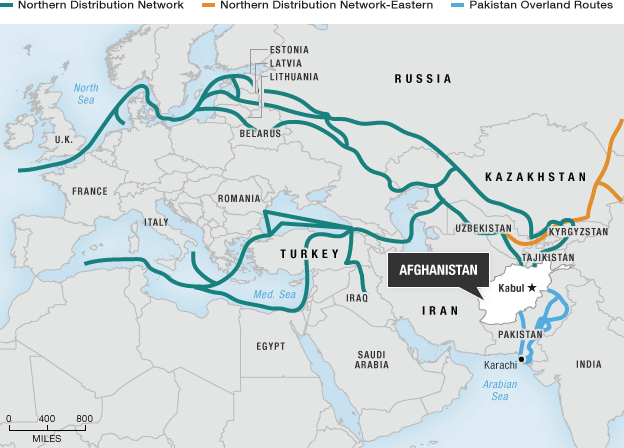
Another potentially disastrous situation would be for a war to break out between Iran and Israel or with the United States and our allies. The way our troops are deployed means that they cannot be easily concentrated to parry any threats and their isolation prevents them from being used as an offensive asset should a war break out against Iran.

The fact is that US and NATO forces are now in a very similar position to the Soviets in the mid to late 1980s.  We are engaged in a war where military success is not going to win the war. No matter what any politician says there is nothing that can change that unless they would be willing to commit to greatly increasing the number of ground forces in Afghanistan with the costs and logistical problems that would entail.

President Obama is in a “damned if he does and damned if he doesn’t” position.  If he keeps the status quo the danger persists and maybe increases. If he were to begin a more precipitous withdraw there would be the same dangers and possibly more during the withdraw. But mitigating against a faster withdraw is the 2012 election in which his Republican challengers would accuse him of “losing the war and betraying our troops.” However the chance to end the Afghan War from a position of strength was lost in 2003 when we diverted our efforts to the invasion of Iraq. That action gave Al Qaeda and the Taliban the breathing space that they needed to make a comeback and that was not on President Obama’s watch.

Geopolitically the presence of 130,000 US and NATO forces does nothing for regional or US national security and prevents those forces and the attendant resources needed to support them unavailable for any other dangers in the region. The goal of “creating a stabile and secure Afghanistan” is a myth. Afghanistan is not Iraq and will for generations remain a backward, tribal and religiously intolerant society that will never embrace western ideals that conflict with their culture.

The question now is how do we get out of this place, seal it off to keep terrorist threats from emanating from it and endangering US, NATO and Allied interests in the region.  The reality is also that no matter what we do that any defeat or withdraw will be grist for Al Qaeda, Iran and other Islamist propaganda.  The inability of the Soviets to “win” in Afghanistan was of the factors that brought down the Soviet Empire and ended the myth that Soviet Communism was invincible. The same could happen to the United States.

When presented with a cataclysmic strategic situation on the Western Front in 1944 Field Marshall Gerd Von Rundstedt was asked what should be done. His simple response was “End the war you fools.” http://www.youtube.com/watch?v=ch56NAL1C-I

We are not yet in a cataclysmic situation but the time to make decisions is now not later because there is nothing that can change the strategic or operational conditions in or outside of Afghanistan. Facts are facts and politicians from both the Republican and Democrat parties should stop trying to turn this into short term political advantage and look at the actual strategic interests of our country as well as our broader security and economic interests in the region.

Peace

Padre Steve+
3 Comments

Filed under iraq,afghanistan, middle east, Military, national security, Political Commentary

The Anomaly of Operation Desert Storm and Its Consequences Today

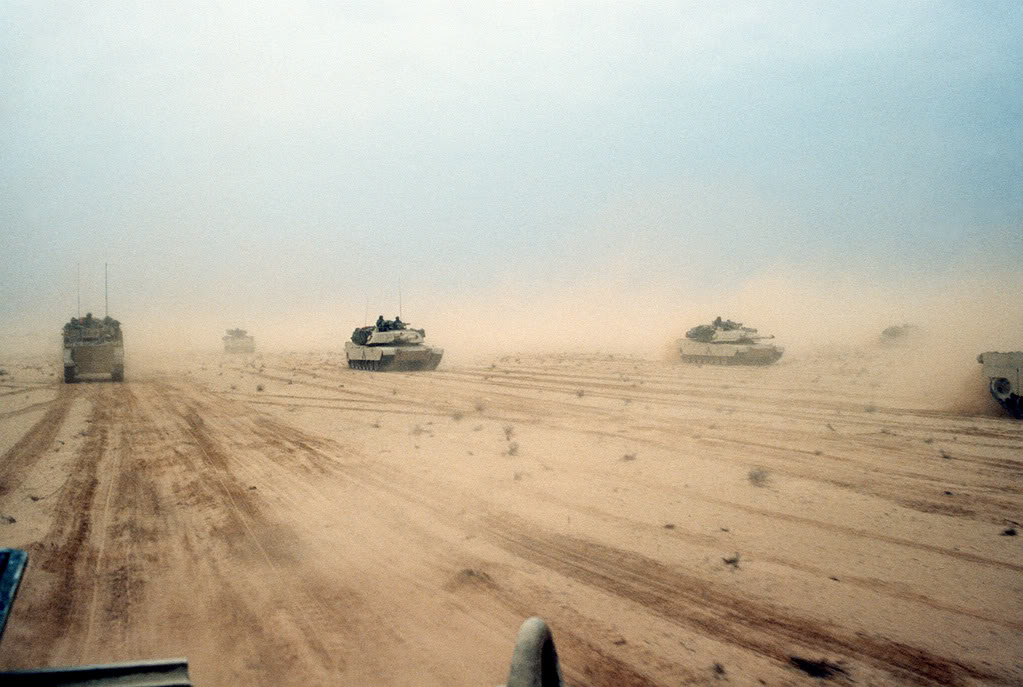
Armor Advancing During Operation Desert Storm

There are few occasions in history where an army is given exactly the scenario to which its organization, training and doctrine coalesce against an opponent that uses the template of organization and training that it has been designed to defeat.  Operation Desert Storm, the liberation of Kuwait by the United States and its coalition from Saddam Hussein’s Iraqi Army and Republican Guard was such a war. The operation was built up in the popular media to the extent that it created a false image of the cost of war and belief that wars can be won “one the cheap” because of superior technology and organization.  That belief was shattered during the Iraq insurgency which began in earnest following the occupation of Iraq following the defeat of Saddam in 2003 by a significantly smaller US force than was used to liberate Kuwait twelve years before.

Architects of Desert Storm

The superior performance of the Army in the Gulf War did not turn out to be the template of how future wars would be fought.  In the following years the US military has become embroiled in conflicts where opponents use inexpensive and often crude off the shelf technology to counter conventional US superiority in firepower and organization.

During the First Gulf War the Army was aided in that the doctrine that it developed to fight a war in Europe against the Warsaw Pact, the Airland Battle was “perhaps best suited to armored warfare in the open desert.”[i] Of course during Desert Storm this was exactly the setting that the Army would be called on to fight.  Unlike Vietnam where the Army attempted to fight an unconventional war with conventional tactics the Army had the chance to fight exactly the battle that it had trained for, against an enemy trained in the tactics and using the equipment of its former Soviet adversary.

The Army enjoyed the advantages of having “reached a high level of training and technological proficiency”[ii] against the Soviet threat. The fact that the Soviet Union and Warsaw Pact had melted down unexpectedly in 1989 and 1990 and removed any conventional threat in Europe which allowed the Army to concentrate massive amount of forces including the VII Corps from Germany to the Middle East was nothing short of incredible.  Additionally the Army had the advantages of superior weaponry and the fortuitous timing of the war before the effects of the post-Cold War drawdown were realized.

For the Army the “1980s were a golden age of military thought and debate,”[iii] and the Airland Battle concept “was greeted with enthusiasm throughout the Army.” Terms such as initiative, agility, synchronization and depth….soon became part of every officer’s vernacular.”[iv] Colonel Harry Summers who had written a critical history of the Vietnam War noted that FM 100-5, the Army’s primary manual of operations, was the “operational blueprint for Operation Desert Storm.”[v] That blueprint had a well trained and disciplined force schooled in the conduct of the Airland Battle concept enunciated in FM-100-5. David Halberstam noted that Operation Desert Storm was fought by a “professional army-a very professional army.”[vi] Seldom in the history of warfare was any army trained and equipped to fight the exact battle for which it found itself.

The Highway of Death

The foundation of doctrine, training, technology and organization laid in the 1980s was solid.  The Army was not only effective in the Gulf War, it was overwhelming.  This is not to say that the Army did not encounter problems.  It did, some which against a better trained and equipped force might have negatively impacts its operations. However the problems encountered did not keep it from dominating the battlefield.

The US rapidly deployed a blocking force of paratroops and Marines following the Iraqi invasion of Kuwait at the end of August.  While few in number they served as a deterrent that Saddam did not test. There was great concern that had Saddam pushed into Saudi Arabia when forces were small and lightly equipped that he might have succeeded in capturing the northeaster Saudi oil fields and production facilities.  The military leadership continually reinforced these forces first to a substantial defensive force and then with the addition of more forces a significant offensive force.  Thus when the decision was made to liberate Kuwait under the United Nations resolution the forces were there and ready.

When the war began advances in Joint warfare and C3 was evident in the effectiveness of the operations.[vii] Particular successes included the movement of VII and XVIII Airborne Corps into the desert to outflank the Iraqis in Kuwait[viii] and every actual engagement between Iraqi and American forces.  Of note was the performance of Major General Barry McCafferey’s 24th Mechanized Division,[ix] and the 2nd Armored Cavalry Regiment at 73 Easting against the Republican Guard’s Talwahkana Division.[x] Likewise the action of 2nd Brigade 1st Armored Division against the Guard’s Adnan Division at Madinah Ridge[xi] displayed the effectiveness and lethality of the Airland Battle and joint warfare concepts developed in the 1980s.

There were weaknesses and these included various aspects of command and control and fratricide[xii] brought about by the fast pace of operations and the fog of war. Likewise conflicts between General Schwartzkopf and some of his Army commanders, notably Generals Franks[xiii] and Yeosock hindered operations.  This occurred most notably in the failure to destroy the Republican Guard prior to the cessation of hostilities. This was partially was due to political considerations and faulty intelligence but was operational decision of Schwartzkopf to halt McCafferty’s  24th Mechanized Division before it could finish off Republican Guard units facing it or letting Franks complete his double encirclement of the Guard or encircle the key southern Iraqi city of  Basrah.[xiv]

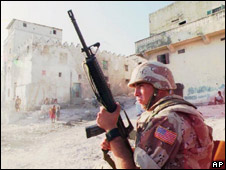
The New Face of War Somalia

Iraq

Rwanda Genocide

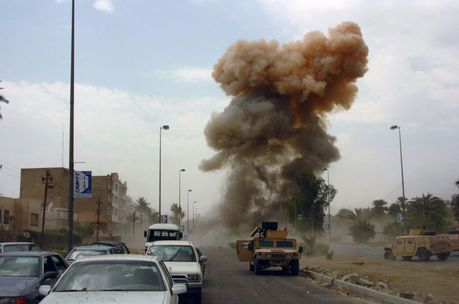
Deadly Large Shaped Charge IED

Afghanistan: Brits in Action Against Taliban Fighters

Despite the successes of Operation Desert Storm the planners failed to anticipate the end state of what would happen when hostilities had ceased.  The conditions of the cessation of hostilities were the chief contention of many against the end to the ground war at the 100 hour point. Some argue that the early end of hostilities allowed the victory to be less than it could have been.  Some even today argue that the offensive should have gone forward with the goal of overthrowing Saddam, however despite its success the Army was not prepared for an occupation nor would have the coalition supporting the US have survived an invasion and occupation of Iraq.  The actual mistakes were not in the stopping of the war, but rather the faulty conditions of the cease fire which enabled Saddam to recover the internal control of Iraq and put down attempts to revolt especially around Basra in the Shia south.  Rick Atkinson in his book Crusade notes that there were “errors would be made in establishing conditions of the ceasefire…but stopping the war was no mistake.”[xv]

While the debate about Operation Desert Storm still persists nearly 20 years after the fact the more important lesson was not learned.  That lesson was that Operation Desert Storm was not the new face of war, but rather an anomaly.  It was a war that was the swan song of the Cold War where the doctrine, technology, organization and trained to and practiced were inflicted on a less well trained and equipped version of the force that they were designed to defeat, forces which were badly deployed and already isolated by airpower even prior to the ground war. Once the ground war started the Iraqi forces in Kuwait and southern Iraq had little chance against the massive US and coalition force arrayed against it short of preemptively using the chemical and biological weapons of which Iraq had an ample supply.  It did not employ these weapons for a number of reasons, but without them Iraqi forces exposed in the open desert with no air support and cut off from much of their supply by constant air attacks were easily defeated.

In the past 20 years the United States and the west have only once been able to reprise the type of war displayed during Operation Desert Storm.  That was in the initial 2003 invasion of Iraq.  While the forces deployed were successful in defeating the Iraqi military and overthrowing Saddam Hussein they were insufficient to secure the country especially after the decision to disestablish all Iraqi police and military forces which might have assisted US forces in securing the country.  Perhaps planners forgot that German military police, police and civil servants were employed by the western allies in the period immediately after the war even during the period of “de-Nazification.”

Instead of a litany of Desert Storm like scenarios US forces as well as those of NATO and UN allies have had to deal with terrorism, insurgencies, revolutionary wars, tribal wars of genocide and wars waged by religious extremists. Despite more than a decade in dealing with these types of war, many in the military and political establishment as well as the media and public opinion believed that Desert Storm was the model for future wars. As such after the brief period of euphoria which occurred after the initial phase of Operation Iraqi Freedom the grim reality of war has stared Americans and others in the west in the face.  While the military has performed well, it has had to adjust and learn lessons about war that it wanted to avoid during and after Vietnam.  Those were the lessons of counterinsurgency, unglamorous and unexciting they were the lessons buried after Vietnam which were ignored until it was nearly too late in Iraq and possibly now too late in Afghanistan.  Desert Storm was an anomaly and one does not base the future of war on the swan song of the last war.


[i] Atkinson, Rick. Crusade: The Untold Story of the Persian Gulf War, Houghton Mifflin Company, Boston and New York 1993. p.253

[ii] Gordon, Michael R. and Trainor, Bernard E. The Generals’ War, Back Bay Books, Little Brown and Company, Boston and New York 1995. p.467

[iii] Peters, Ralph. Fighting for the Future: Will America Triumph. Stackpole Books, Mechanicsburg , PA p.xi

[iv] Ibid. Atkinson.

[v] Summers Harry G. On Strategy II: A Critical Analysis of the Gulf War, Dell Publishing a Division of Bantam Doubleday Dell Publishing Group, New York NY 1992. p.159

[vi] Halberstam, David. War in a Time of Peace: Bush, Clinton and the Generals, A Touchstone Book published by Simon and Schuster, New York 2001. p.153.  Gordon and Trainor note that the “never in the history of the Republic has a more competent and more professional military been fielded.

[vii] See Summers pp. 243-245.  Summers is very complimentary of the advances in the Joint aspects of command and control that impacted the campaign.  He notes several points at the strategic and operational levels which are complimentary of individuals including comparing General Colin Powell to General George Marshall. Gordon and Trainor writing a few years later are more critical of the “jointness” of the Americans including valid criticism of the air campaign, fire support coordination, and differences in doctrine between Marines and Army and the way the VII Corps and XVIII Corps operated based on the way that they trained and organized. Pp.471-473

[viii] Atkinson pp.309-310.  Atkinson discusses the fact that American commanders involved had seldom maneuvered units of battalion or brigade size prior to this operation.

[ix] The 24th made a great advance to the Euphrates but as Atkinson notes that it had “encountered no enemy resistance at all.” p.406

[x] See Atkinson pp. 441-448

[xi] See Atkinson pp.466-467.  In a 40minute fight the M1A1s destroyed 60 T-72s and dozens of APCs at a cost of one American KIA.  Atkinson notes that this battle like the action at 73 Easting “was waged with tactical acumen and devastating firepower….”

[xii] Ibid Atkinson pp.315-316.  Atkinson notes that there were 28 incidents with 35 killed and 72 wounded.

[xiii] Ibid. pp.405-407.  Schwartzkopf felt that Franks was not aggressive enough and that VII Corps was “sluggish” and “ceding the initiative to the Republican Guard.”  Schwatzkopf even threatened Yeosock that he would fire Franks.

[xiv] Ibid. Atkinson p.476

[xv] Ibid. p.477

Bibliography

Atkinson, Rick. Crusade: The Untold Story of the Persian Gulf War, Houghton Mifflin Company, Boston and New York 1993

Gordon, Michael R. and Trainor, Bernard E. The Generals’ War, Back Bay Books, Little Brown and Company, Boston and New York 1995

Halberstam, David. War in a Time of Peace: Bush, Clinton and the Generals, A Touchstone Book published by Simon and Schuster, New York 2001

Ralph. Fighting for the Future: Will America Triumph. Stackpole Books, Mechanicsburg , PA

Summers Harry G. On Strategy II: A Critical Analysis of the Gulf War, Dell Publishing a Division of Bantam Doubleday Dell Publishing Group, New York NY 1992.

8 Comments

Filed under Foreign Policy, History, iraq,afghanistan, Military, national security