Tag Archives: battle of leyte gulf

100 Years of Navy Aviation: Part One the Aircraft Carriers

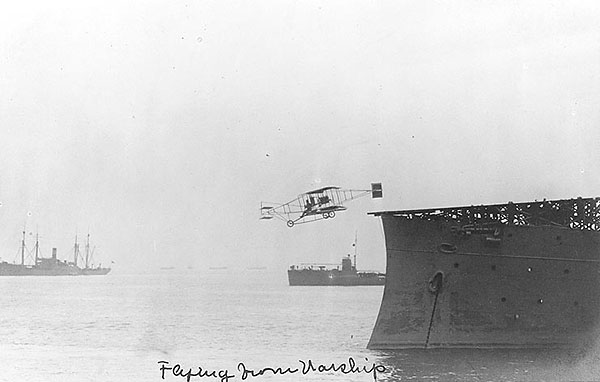
Eugene Ely makes the first takeoff from USS Birmingham on November 14th 1910

On a blustery November 14th in the year 1910 a young civilian pilot hailing from Williamsburg Iowa became the first man to fly an aircraft off the deck of a ship.  At the age of 24 and having taught himself to fly barely 7 months before Eugene Ely readied himself and his Curtis biplane aboard the Cruiser USS Birmingham anchored just south of Fort Monroe in Hampton Roads.  Ely was there because he was discovered by Navy Captain Washington Irving Chambers who had been tasked with exploring how aircraft might become part of Naval Operations. Chambers had no budget or authority for his seemingly thankless task but hearing that a German steamship might launch and aircraft from a ship hustled to find a way to stake a claim for the U.S. Navy to be the first in flight. Weather was bad that day as is so typical for Hampton Roads in November and between rain squalls Ely decided to launch even though Birmingham did not have steam up to get underway to assist the launch.  Ely gunned the engine and his biplane rumbled down the 57 foot ramp and as he left the deck the aircraft nosed down and actually make contact with the water splintering the propeller and forcing him to cut the flight short and land on Willoughby Spit about 2 ½ miles away not far from the southern entrance to the modern Hampton Roads Bridge Tunnel is.  Chambers would talk Ely into making the first landing on a Navy ship the Armored Cruiser USS Pennsylvania in San Francisco Bay on January 18th 1911.  Ely died in a crash at the Georgia State Fairgrounds on October 11th 1911.
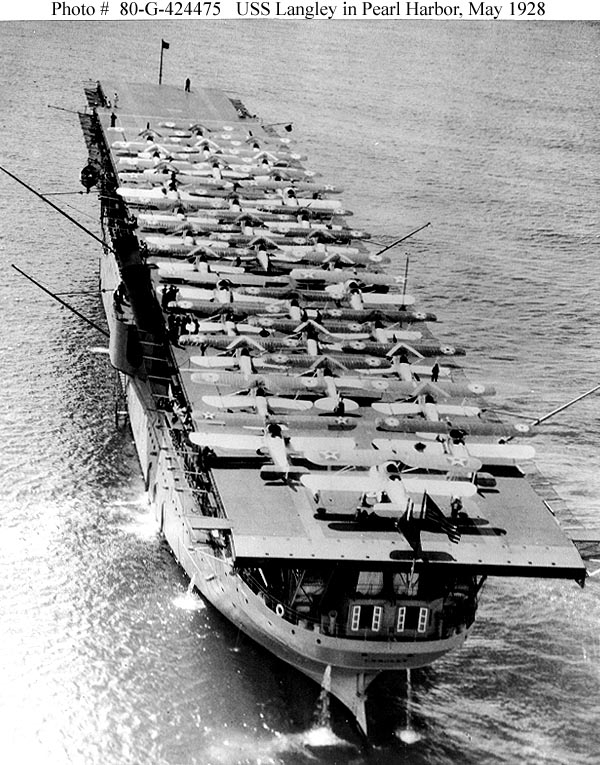
USS Langley CV-1

The Naval was slow to build upon the early achievements and the British and France would commission Aircraft Carriers well before the USS Langley CV-1 a converted Collier was commissioned.  After Langley the Navy commissioned the converted Battlecruisers USS Lexington CV-2 and USS Saratoga CV-3 in the mid 1920s.

USS Lexington CV-2 October 1941

The three ships formed the nucleus of the Navy’s embrace of aviation and the pilots that they trained and the experience gained would be the foundation of the Navy’s success in the Second World War.  They would be joined by the USS Ranger CV-4 the first U. S. Navy Carrier designed as such from the keel up in 1934.
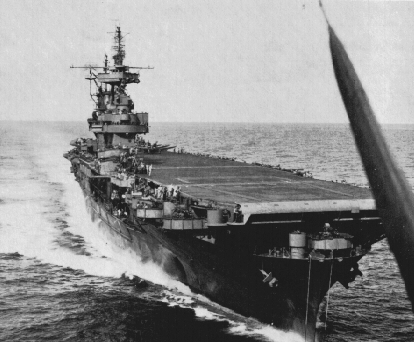
USS Enterprise CV-6

In 1937 the Navy commissioned the first of its true Fleet Carriers the USS Yorktown CV-5 which was followed by the USS Enterprise CV-6 in 1938, the USS Wasp CV-7 an improved version of Ranger in was commissioned in 1940 and the USS Hornet CV-8 in 1941.   These ships would bear the brunt of US Navy operations in the first year of the war following the disaster at Pearl Harbor. Of these ships only the Enterprise and Saratoga would survive the first year of the war in the Pacific.  Langley now a Seaplane Carrier was sunk during the Battle of the Java Sea in February 1942. Lexington would go down at Coral Sea in May 1942.  Hornet would launch the Doolittle Raid against Japan on April 18th 1942.  Yorktown, Enterprise and Hornet would take on and defeat the Japanese Carrier Strike force and sink the Akagi, Kaga, Soryu and Hiryu at Midway to avenge Pearl Harbor. Yorktown was sunk in the battle but Midway stopped the Japanese advance in the Pacific.

The U. S. went on the offensive in August invading Guadalcanal in the Solomons Islands. The Guadalcanal campaign and the numerous sea battles in the adjacent waterways would claim many American and Japanese ships. Wasp was sunk by a Japanese submarine on September 15th 1942 and Hornet was sunk at the Battle of Santa Cruz on 27 October 27th 1942.  Saratoga spent much of 1942 in the yards having been torpedoed twice leaving the often battered Enterprise as the sole U. S. Navy Carrier facing the Japanese until Saratoga was repaired and the first of the Essex Class Fleet Carriers and Independence Class Light Fleet Carriers entered service and arrived in the Pacific.
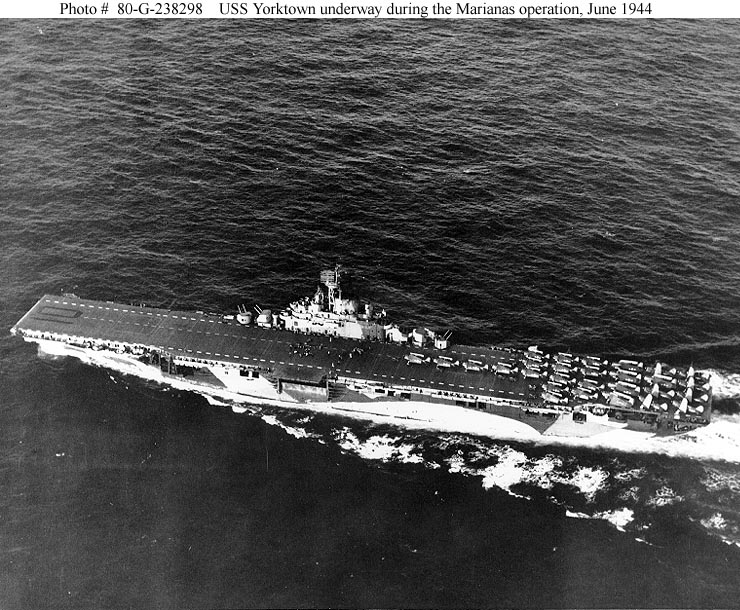
USS Yorktown CV-10 1944 a good example of the wartime Essex class ships  below USS Cabot CVL-28 an Independence Class Light Fleet Carrier
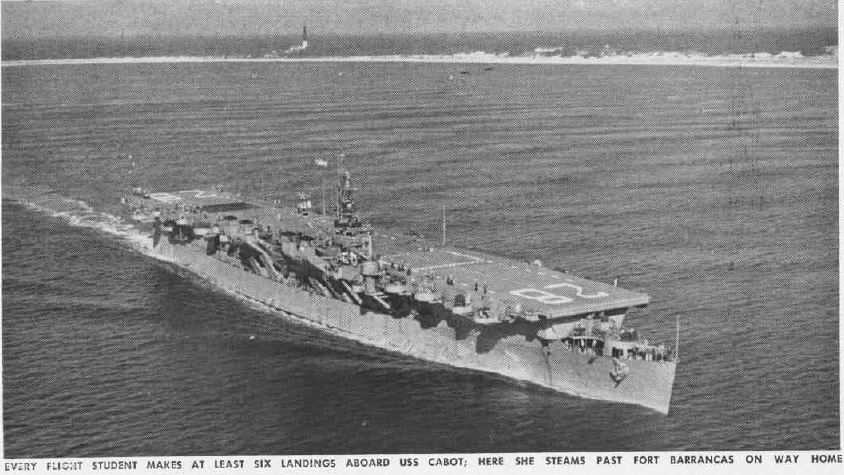

The Essex Class ships became the nucleus of the Fast Carrier Task Forces in the Pacific and with their smaller consorts of the Independence Class would dominate operations at sea from 1943 on.  The Essex class would eventually number 24 ships with several more canceled before completion becoming the most numerous of any class of Fleet Carriers produced by the U. S. Navy.  The Essex class would figure prominently in all offensive operations including the Battle of the Philippine Sea, Battle of Leyte Gulf, the campaigns at Iwo Jima and Okinawa and raids on the Japanese home islands.  In the process they and their air groups would be instrumental in sinking hundreds of Japanese ships including the Battleships Yamato and Musashi and destroying thousands of aircraft.  A number were heavily damaged by Kamikazes but none were lost with the epic story of the USS Franklin CV-13 and her survival after being hit by two bombs from a Japanese plane that slipped through the Combat Air Patrol. The resultant explosions and fires amongst her fueled and armed aircraft nearly sank her but for the heroic efforts of her crew including Chaplain Joseph O’Callahan who won the Medal of Honor caring for the wounded and dying and directing damage control teams. The ship lost 724 men killed and 265 wounded in the attack but survived though without power and dead in the water 50 miles off the Japanese coast.
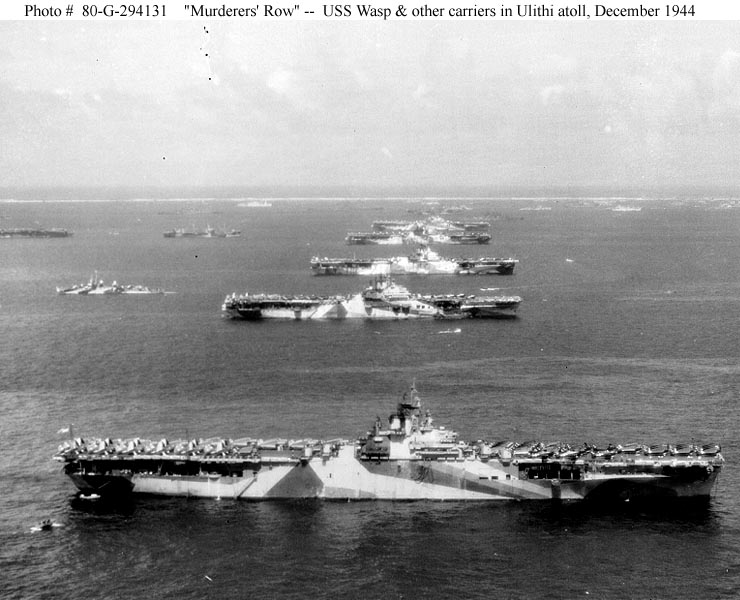
Murderers’ Row

The Essex class were iconic and the ships etched their names in naval history. The Essex, Yorktown, Hornet, Wasp, Hancock, Ticonderoga, Franklin, Bunker Hill, Intrepid, Lexington and the other ships of the class had legendary careers. These ships became known as “Murderers’ Row” for their expertise in killing off Japanese ships and aircraft.  Fittingly four of the ships, the Hornet, Yorktown, Lexington and Intrepid have found a second life as museum ships and Oriskany was sunk as an artificial reef off the coast of Florida where she is a favorite of recreational divers.
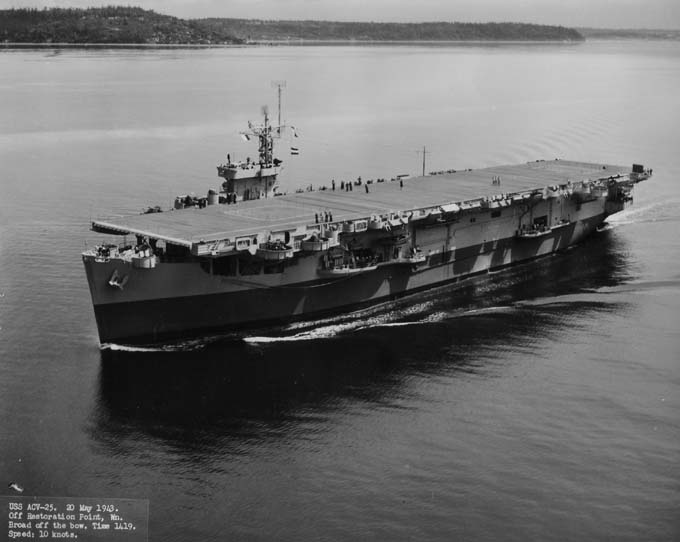
USS Croatan CVE-25 a Bogue Class Escort Carrier

During the war the Navy also built 118 Escort Carriers converted from merchant ships for use as convoy escorts, anti-submarine warfare and close air support for amphibious operations. 38 of these ships saw service in the British Royal Navy during the war.

USS Hancock CVA-19 in 1969 showing the extent of the modernizations that brought the Essex Class into the jet age

In the post World War II drawdown many carriers were decommissioned and the oldest, the Saratoga and Ranger disposed of.  The three ship Midway class entered service after the war and incorporated design improvements learned from combat operations in the war. As the Navy entered the jet era it was found that the existing carriers would need significant modernization to handle the new aircraft. Among the improvements made to the Midway and Essex class ships was the angled flight deck, steam catapults, hurricane bows and improved landing systems.  These improvements allowed these World War II era ships to remain front line carriers into Vietnam and in the case of the USS Midway and USS Coral Sea into the 1990s.
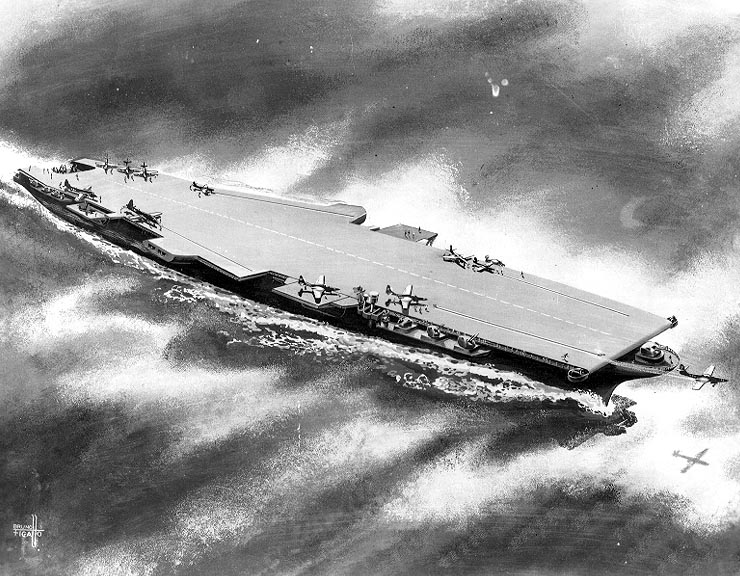
Artists’ conception of USS United States CVA-58 a victim of Truman Era Air Force politics

The Navy began its first super-carrier the USS United States in 1949 but the ship and class was cancelled by Secretary of Defense Louis A. Johnson, not a fan of the Navy or Marine Corps due to opposition by the Army and the newly founded Air Force.  The ship would have carried 12-18 nuclear capable bombers as well as 45-50 jet fighters and attack aircraft and been 1090 feet long and displaced 65,000 tons.  It would not be until after the Korean War that the Navy would begin construction of its first super-carriers.
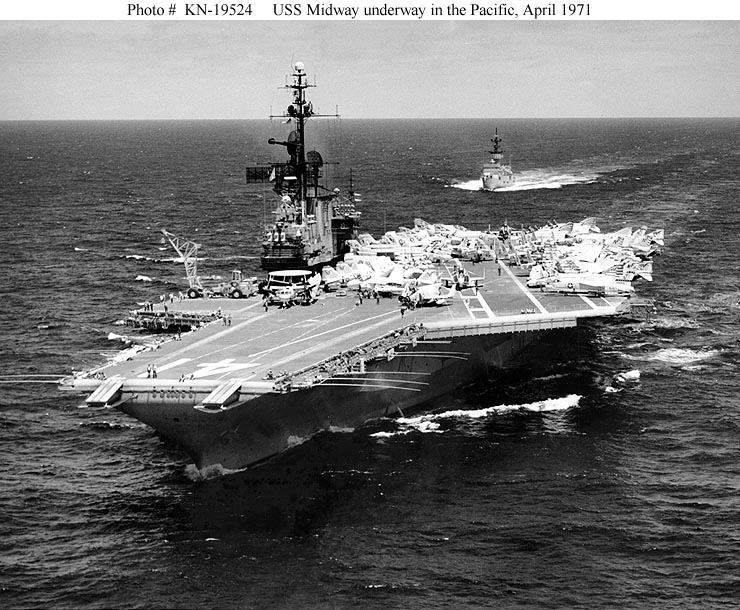
USS Midway CVA-41 in 1971

During the Korean War most of the Essex class ships were called back into service with 15 modified to conduct jet operations while others were converted to serve as ASW Carriers and Helicopter Carriers (LPH) to support Marine amphibious forces. Likewise the Midway’s were modernized as the Navy began to construct the four-ship Forrestal Class which were 1036 feet long and displaced 56,000 tons and designed to carry 100 aircraft. The four ships, Forrestal CVA-59, Saratoga CVA-60, Ranger CVA-61, and Independence CVA-62 would all serve into the early 1990s before being decommissioned. In the past few months Forrestal and Saratoga have begun the journey to be scrapped, sold for a penny each to scrapyards in Brownsville, Texas.

USS Ranger CVA-61

They were all heavily involved in the Vietnam War on Yankee and Dixie Station and both the Atlantic and Pacific during the Cold War. All four have been stricken from the Navy List and are awaiting disposal.  Forrestal was programmed as an artificial reef but she, like Saratoga which had been on donation hold was approved for scrapping. Ranger is still on donation hold and the USS Ranger Foundation is attempting to raise the money to save her. Independence which had been programmed as an artificial reef project was approved for scrapping in 2008.In the past few months Forrestal and Saratoga began the journey to be scrapped in 2014, sold for a penny each to scrapyards in Brownsville, Texas.
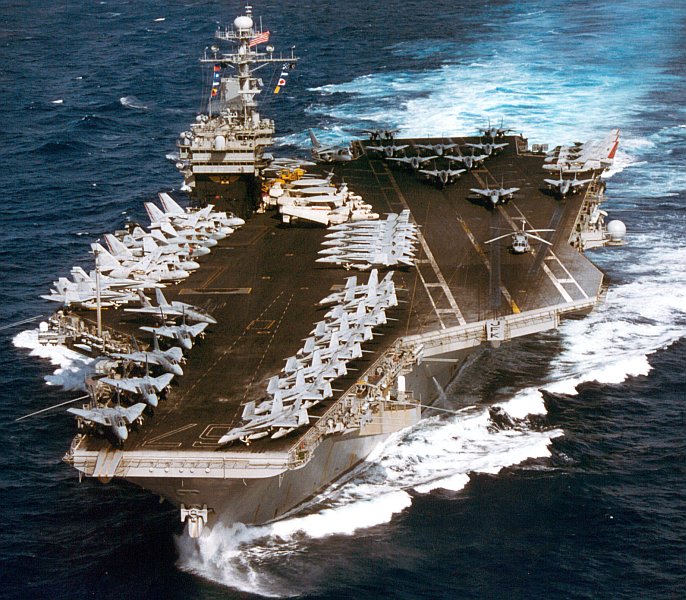
USS John F Kennedy CV-67 a modified Kitty Hawk class ship

These ships were followed by the Kitty Hawk class consisting of Kitty Hawk CVA-63, Constellation CVA-64, America CVA-66 and John F. Kennedy CVA-67 which were improved versions of the Forrestal Class with a 60,100 ton displacement and 1047 foot length with the ability to carry 100 aircraft. Kitty Hawk had the distinction of being the last fossil fuel carrier in active U. S. Navy service being decommissioned and placed in reserve in 2009. Her sister the Constellation CV was decommissioned in December 2003 and in 2008 was programmed to be scrapped in the next five years.  America was decommissioned in 1996 after not being given a Service Life Extension Program (SLEP) refit in the 1990s due to budget cuts.  America was involved in much of the Cold War, Gulf War and Vietnam including responding to the Israeli attack on the USS Liberty in 1967, the Intervention in Lebanon in 1983 and the conflict with Libya in the Gulf of Sidra in 1985.  She was sunk as a test bed to see how modern carriers would be affected by battle damage and to incorporate those lessons into future carrier design in May of 2005.  John F. Kennedy was originally planned to be a nuclear ship equipped with 4 A3W reactors.  This plan was shelved and she was completed as a fossil fuel ship. “Big John” served in Vietnam as well as throughout the Cold War and Gulf War and also engaged the Libyans in 1985.  She was placed in the Reserve Force in the 1990s to save money and also served as a training carrier.  Like America she did not receive the necessary maintenance and by 2002 she needed emergency repairs in order to deploy in support of Operation Enduring Freedom. Kennedy made three deployments in support of the War on Terror and decommissioned in 2007.  She was placed in donation hold and currently two groups are making progress to acquire her as a Museum ship. Like the Forrestal’s the Constellation’s served in Vietnam, the Cold War, Operation Desert Shield and Desert Storm and three continued their service into Operation Iraqi Freedom. Constellation began her journey to the scrapyard in August 2014.

USS Enterprise CVN-65

As the Navy continued to develop the capabilities of the aircraft carrier it commissioned the nuclear powered USS Enterprise CVAN-65.  The added capability of nuclear power enabled her to operate without dependence on fossil fuel which in addition to her range and speed allowed her to carry more aviation fuel and munitions than the fossil fuel ships.  Unique among the Nuclear Carriers she produces 280,000 SHP and is powered by 8 Westinghouse (A2W) Reactors driving geared turbines, 4 screws with a classified top speed in excess of 35 Knots and is the quickest carrier going from all stop to full speed. At 1101 feet long and 75,700 ton (93,000 Full Load) displacement she was larger than any other carrier. She served in Vietnam, the Cold War, the Gulf War and Operation Enduring and Operation Iraqi Freedom. She was and was decommissioned in 2013.

USS Theodore Roosevelt CVN-71 of the Nimitz class

The Nimitz Class of nuclear powered carriers is the most numerous class of capital ship in the U.S. Navy since the Essex Class.  Slightly smaller than Enterprise with a 1088 overall length and 91,000 full load displacement the Nimitz CVN-68 and her sister ships are the mainstay of the U. S. Navy carrier force.  These ships have been the symbols of American naval power for three decades and will continue to be for the foreseeable future.  Each of the ships has embodied successive improvements gained from the previous ships and the latest ships of the class the USS Ronald Reagan CVN-76 and USS George H. W. Bush CVN-77 incorporate technologies that were not known when Nimitz was on the drawing board. Thus whenever a ship is taken in for their Refueling and Complex Overhaul (RCOH) it is upgraded to the capabilities of the newest ship.  The class consists of the Nimitz, the USS Dwight D. Eisenhower CVN-69, USS Carl Vinson CVN-70, USS Theodore Roosevelt CVN-71, USS George Washington CVN-72, USS Abraham Lincoln CVN-73, USS John C. Stennis CVN-74, USS Harry Truman CVN-75 as well as the previously mentioned Reagan and Bush. They can carry 90% more fuel and 50% more ordnance than the Forrestal class. Carrying 90 or more aircraft they pack a mobile offensive punch that is not matched by any other surface ship.  The have served in every major military and many humanitarian missions since Nimitz was commissioned in 1974.
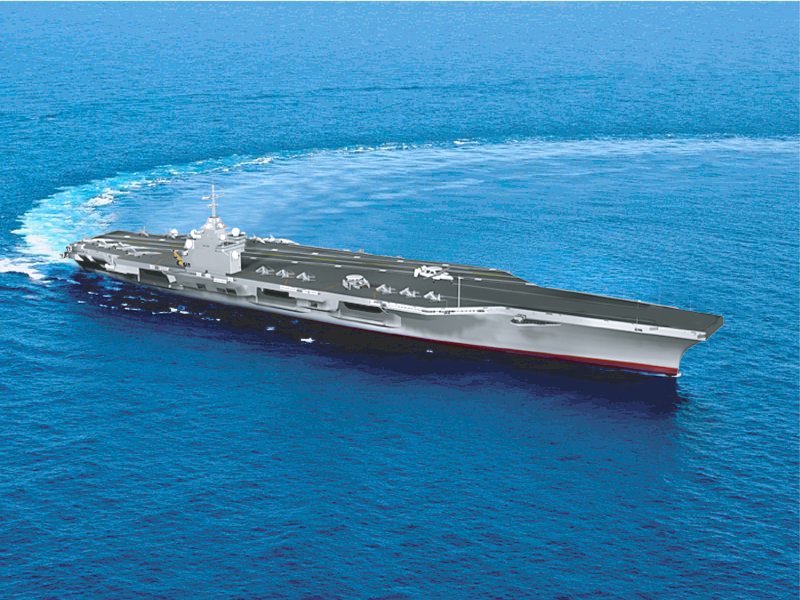
Artist conception of USS Gerald R Ford CVN-78

The Nimitz class will be joined by the USS Gerald R. Ford CVN-78.  The Ford is the first ship of an entirely new class. While approximately the same size as the Nimitz class at 1092 feet long and approximately 100,000 tons full load displacement the Ford class of which three are currently authorized and one under construction will feature many improvements over their predecessors. Among improvements are an advanced arresting gear, automation, which reduces crew requirements by several hundred from the Nimitz class carrier, the updated RIM-162 Evolved Sea Sparrow missile system, the AN/SPY-3 dual-band radar (DBR), as developed for Zumwalt class destroyers an Electromagnetic Aircraft Launch System (EMALS) in place of traditional steam catapults for launching aircraft, a new nuclear reactor design (the A1B reactor) for greater power generation, advanced stealth features to help reduce radar profile and the ability to operate the new F-35C Lightning II. If the class is built as programmed on a one ship every five year rate with the Ford commissioning in 2015 then 6 ships of the class will be in commission by 2040. The next two ships have been named, the John F Kennedy and Enterprise. 

Of course as with any military technology the future never is certain. In 1918 no one would have thought that the all-big gun Dreadnought Battleships would be eclipsed by the Aircraft Carrier in less than 25 years. While the Carriers have ruled the waves since Midway there are threats to them both military and financial.  Countries such as China while building their own carriers have are developing weapons such as guided ballistic missiles designed to destroy carriers.  As of now there is no defense against such a weapon if a carrier is within range. While China has not yet deployed the weapon it could be a game changer in the Western Pacific. Likewise there is the ever present threat posed by new and advanced submarines even those deployed by 2nd and 3rd world nations.  Finally there is the financial cost which could derail the procurement of more carriers in an era of austerity. The cost of the Ford is currently estimated to be $9 Billion Dollars which if stretched end to end would probably reach Vulcan where the Vulcans would come up with an answer to our current problems.

At the same time the carriers have defied those who predicted their demise since the Truman administration.  Currently no sea based platform has the multitude of capabilities of a carrier and its associated air wing and battle group and thus they should remain the Queens of the Sea for some time to come and the United States Navy which has led the world in their development and operation should continue to lead the way.

The next installment which will appear later this week will discuss the aircraft employed by the United States Navy not only those from carriers, but seaplanes, rotor-wing aircraft and lighter than air ships.

Peace

Padre Steve+
6 Comments

Filed under History, Military, Navy Ships

Iconic and Heroic: The Fletcher Class Destroyers

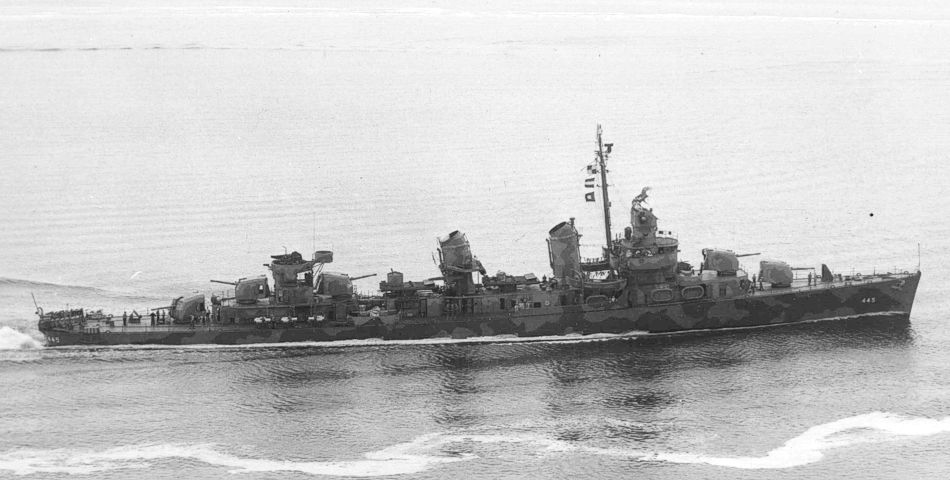
The USS Fletcher DD-445

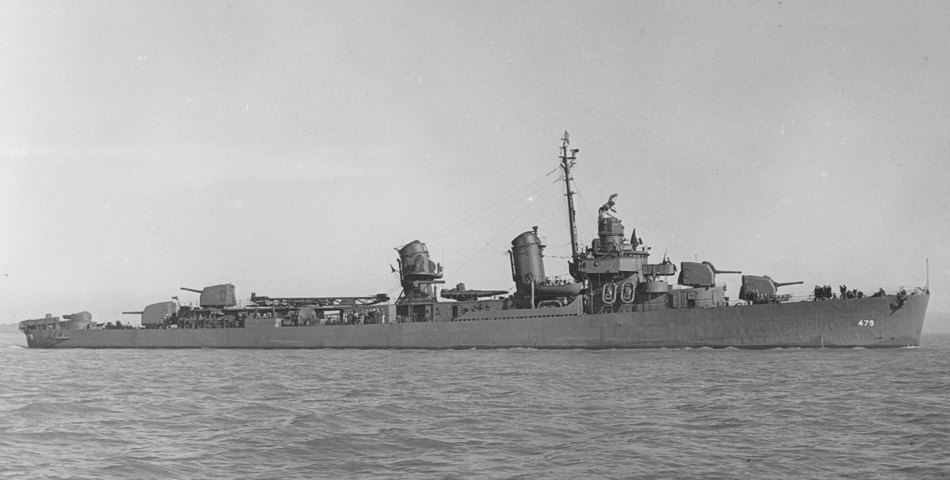
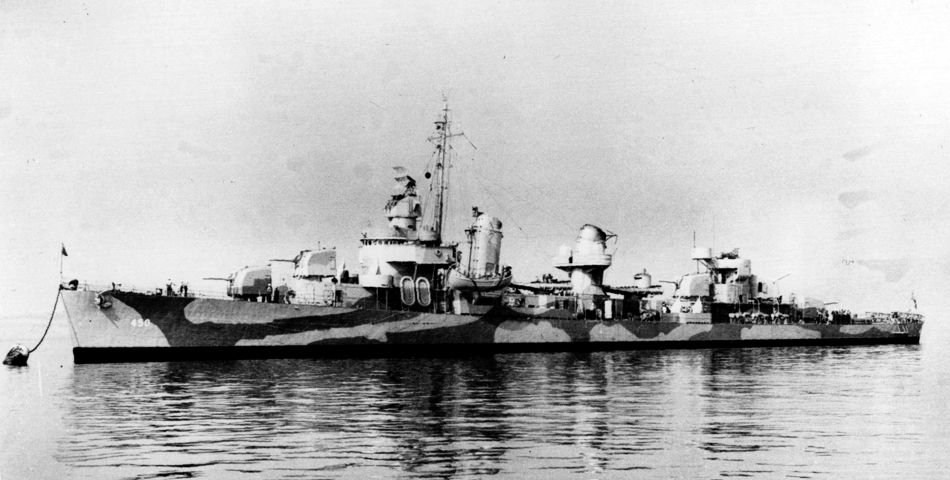
If ever a class of warships can define a ship type the destroyers of the Fletcher Class were that. The most numerous of all United States Navy destroyer classes the Navy commissioned 175 of these ships between June 1942 and February 1945.  There were two groupings of ships the 58 round or “high bridge” ships and the 117 square or “low bridged” ships. It was a sound design that would be modified for use in the later Allen M. Sumner and Gearing Class destroyers.  Eleven shipyards produced the ships fast, heavily armed and tough the ships would serve in every theater of the war at sea but would find their greatest fame in the Pacific where many became synonymous with the courage and devotion of their officers and crews.

USS Stevens one of the 6 Fletchers equipped with an aircraft catapult

The ships were a major improvement on previous classes of destroyers and were equal or superior to the destroyers of our allies and our enemies in the war.  At 2050 tons displacement and 2900 tons full load the ships were significantly larger than preceding classes and were designed to mount a superior anti-aircraft armament to compliment their main battery of five 5” 38 caliber dual purpose guns and ten 21” torpedo tubes. 376 feet long and flush decked they were an exceptionally tough class of ships which was demonstrated often in the brutal surface battles in the South Pacific, Leyte Gulf and in the battles with Kamikazes off the Philippines, Iwo Jima, Okinawa and the Japanese mainland.  They were the first destroyers of the US Navy which were built with radar as part of the initial design.

USS O’Bannon DD-450 in 1961

The anti aircraft armament was increased throughout the war. Initially this was composed of: 4 x 40mm Bofors in two twin-mounts and 6 to 13 x 20mm Oerlikon in single-mounts. By June of 1943 new ships of the class mounted 10 x 40mm Bofors in five twin-mounts 7 x 20mm Oerlikon in single-mounts. As the Kamikaze threat became dire ships returning to the United States for refit lost one of their torpedo tube mounts and had their AA armament increased to 14 x 40mm Bofors in three twin and two quad mounts and 12 x 20mm Oerlikon in six twin mounts.  One of the more unusual experiments was to equip six ships with a catapult for a float plane. This eliminated some of their AA guns and one torpedo tube mounting. It was not successful and the mounts were removed before the end of the war.

USS Nicholas in action at Kula Gulf

The first ships of the class saw action in the Solomons during the Guadalcanal campaign.  Fletcher and O’Bannon took part in the Naval Battle of Guadalcanal where O’Bannon was one of several destroyers that ganged up on the Japanese Battleship Hiei at ranges as low as 500 yards causing heavy damage to the Battleship which was sunk by naval aircraft the following day.  The O’Bannon would be awarded the Presidential Unit Citation for her actions around Guadalcanal which read:

O’Bannon

“For outstanding performance in combat against enemy Japanese forces in the South Pacific from October 7, 1942, to October 7, 1943. An aggressive veteran after a year of continuous and intensive operations in this area, the U.S.S. O’BANNON has taken a tremendous toll of vital Japanese warships, surface vessels and aircraft. Launching a close range attack on hostile combatant ships off Guadalcanal on the night of November 13, 1942, the O’BANNON scored three torpedo hits on a Japanese battleship, boldly engaged two other men o’ war with gunfire and retired safely in spite of damage sustained. During three days of incessant hostilities in July 1943, she gallantly stood down Kula Gulf to bombard enemy shore positions in coverage of our assault groups, later taking a valiant part in the rescue of survivors from the torpedoed U.S.S STRONG while under fierce coastal battery fire and aerial bombing attack and adding her fire power toward the destruction of a large Japanese naval force. In company with two destroyers, the O’BANNON boldly intercepted and repulsed nine hostile warships off Vella Lavella on October 7, 1943, destroying two enemy ships and damaging others. Although severely damaged, she stood by to take aboard and care for survivors of a friendly torpedoed destroyer and retired to base under her own power. The O’BANNON’s splendid acheivements and the gallant fighting spirit of her officers and men reflect great credit upon the United States Naval Service.

DESRON 23

Fletcher’s composed DESON 23 the Little Beavers” commanded by Commodore Arleigh “31 knot” Burke. The squadron which covered the initial landings at Bougainville in November 1943 fought in 22 separate engagements during the next four months. During this time the squadron was credited with destroying one Japanese cruiser, nine destroyers, one submarine, several smaller ships, and approximately 30 aircraft.  Under Burke the squadron was composed of USS Foote (DD-511), USS Charles Ausburne (DD-570), USS Spence (DD-512), USS Claxton (DD-571), USS Dyson (DD-572), USS Converse (DD-509) and USS Thatcher (DD-514).  At the Battle of Cape St. George the squadron intercepted a Japanese force of 5 destroyers sinking 3.  At the Battle of Empress Augusta Bay the ships were in action as part of Task Force 39 based around Cruiser Division 12 comprised of the Cleveland Class Light Cruisers Montpelier, Cleveland, Columbia and Denver the took part in the sinking of the Japanese Light Cruiser Sendai and a destroyer.  For their efforts DESRON 23 would be awarded the Presidential Unit Citation which stated:

“For extrordinary heroism in action against enemy Japanese forces during the Solomon Islands Campaign, from November 1, 1943, to February 23, 1944. Boldly penetrating submarine-infested waters during a period when Japanese naval and air power was at its height, Destroyer Squadron TWENTY THREE operated in daring defiance of repeated attacks by hostile air groups, closing the enemy’s strongly fortified shores to carry out sustained bombardments against Japanese coastal defenses and render effective cover and fire support for the major invasion operations in this area. Commanded by forceful leaders and manned by aggressive, fearless crews the ships of Squadron TWENTY THREE coordinated as a superb fighting team; they countered the enemy’s fierce aerial bombing attacks and destroyed or routed his planes; they intercepted his surface task forces, sank or damaged his warships by torpedo fire and prevented interference with our transports. The brilliant and heroic record achieved by Destroyer Squadron TWENTY THREE is a distinctive tribute to the valiant fighting spirit of the individual units in this indomitable combat group and of each skilled and courageous ship’s company.”

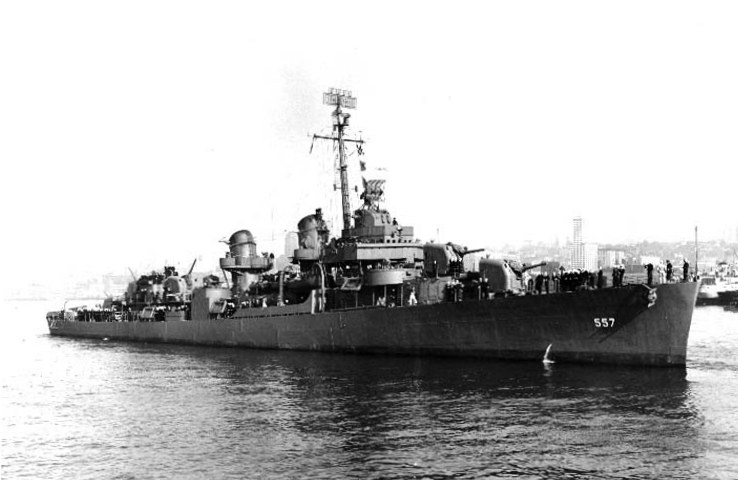
USS Johnston DD-557

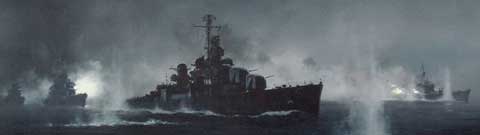
Fletcher’s served heroically with “Taffy-3” in the Battle of Samar at the Battle of Leyte Gulf.  Taffy-3 which was composed of 6 escort carriers, the Fletcher Class destroyers Hoel, Johnston and Heermann and 4 destroyer escorts was assigned the task of providing close air support for troops ashore and anti-submarine protection for transports.  On the morning of October 25th Admiral Halsey took Third Fleet north to engage a Japanese carrier force believing a Japanese surface force of battleships and cruisers to have withdrawn after being heavily hurt by submarine and air attacks.  The carrier force had few aircraft and was considered a decoy by the Japanese. This left the San Bernardino Strait unguarded and the Japanese surface force which by now was comprised of 4 battleships including the Yamato as well as 6 heavy and 2 light cruisers and 11 destroyers doubled back going through the strait during the early morning hours of the 25th.  Just before dawn a patrol aircraft spotted the Japanese force and at 0659 Yamato opened fire on the task group.

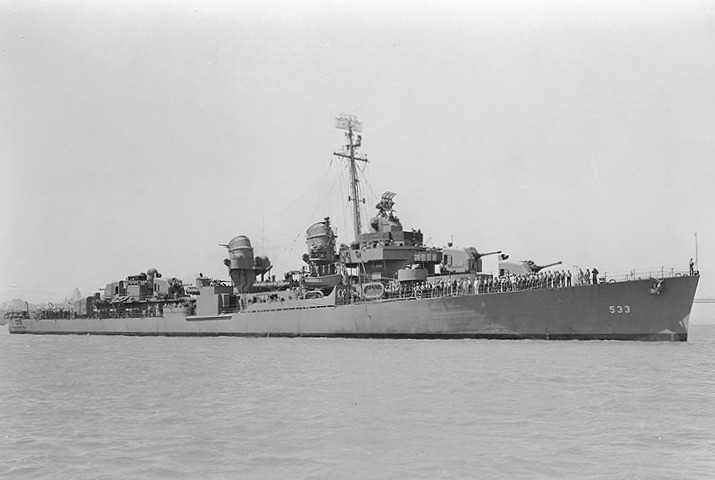
USS Hoel DD-533

The three Fletcher’s and the Destroyer escort Samuel B Roberts were launched into a suicidal counter-attack against the Japanese force. Led by Johnston under the command of Ernest E. Evans the little ships engaged their vastly superior foe as the escort carriers edged away as they launched and recovered their aircraft to keep a continuous air assault on the Japanese force.  Johnston scored numerous hits with her 5” guns on the Heavy Cruiser Kumano and when she reached torpedo range launched her 10 “fish” one of which blew off Kumano’s bow and another of which crippled Kumano’s sister Suzuya before she was hit in quick succession by a 14” shell from the Battleship Kongo which hit her engine room and three 6” shells from Yamato which struck her bridge.  Evans kept the crippled ship in the fight drawing fire away from other attacking destroyers and fending off a Japanese destroyer squadron that was trying to flank the carriers. Johnston continued to be hit and was abandon at 0945 sinking 25 minutes later with 186 of her crew.  Evans did not survive and was awarded the Medal of Honor.

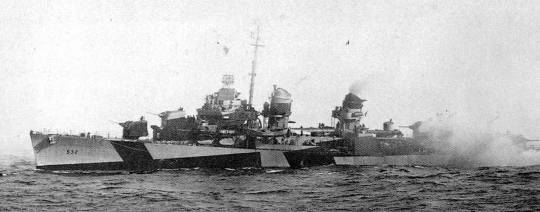
USS Heermann DD-532 in action at Samar

Hoel under the command of Commander Leon S. Kintberger took on the Battleship Kongo and a column of cruisers lead by the Heavy Cruiser HaguroHoel’s torpedo attack on Kongo forced that ship to turn away and torpedo hits were claimed on the Haguro, although that ship remained in action and the Japanese denied any torpedo damage from the attack. The Japanese concentrated on Hoel sinking her at 0855 taking all but 86 of her crew to a watery grave.

Heermann under Commander Amos Hathaway threw herself into the fight engaging Japanese battleships and cruisers. Heermann engaged Heavy Cruiser Chikuma with her guns while mounting a torpedo attack on Haguro. She then attacked the Japanese battleships directly engaging Haruna and forcing Yamato to head away from the action for 10 minutes as she was bracketed by two of Heermann’s torpedoes running on a parallel course.  She engaged the other battleships at such close range that they could not hit her and broke off to intercept a column of cruisers.  Once again she engaged Chikuma in a bloody duel with both ships taking heavy damage. Crippled by a series of 8” shell hits from the heavy cruisers Heermann was down heavily at the bow, so much so that her anchors dragged the water. Carrier aircraft joined the battle and Chikuma withdrew from the fight and sank during her withdraw. Heermann then engaged Heavy Cruiser Tone before that ship, also damaged by air attack withdrew from the fight.  Though she was heavily damaged the Heermann was the only destroyer to survive the action.  Despite their terrible losses the ships and aircraft of Taffy-3 sank 3 heavy cruisers and a destroyer and heavily damaged 3 battleships and 3 heavy cruisers.

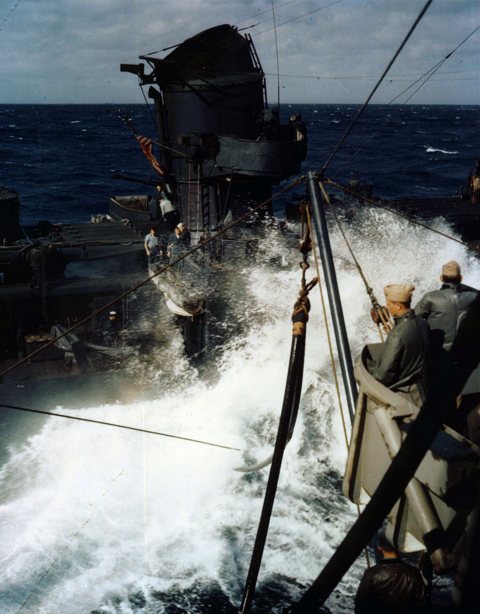
Just a bit wet, USS Halsey Powell unrep with USS Wisconsin

For their heroic actions which kept the Japanese from getting to the vulnerable transports Taffy-3 including the valiant destroyers Johnston, Hoel, Heerman and Destroyer Escort Samuel B Roberts was awarded the Presidential Unit Citation which read:

“For extraordinary heroism in action against powerful units of the Japanese Fleet during the Battle off Samar, Philippines, October 25, 1944. Silhouetted against the dawn as the Central Japanese Force steamed through San Bernardino Strait towards Leyte Gulf, Task Unit 77.4.3 was suddenly taken under attack by hostile cruisers on its port hand, destroyers on the starboard and battleships from the rear. Quickly laying down a heavy smoke screen, the gallant ships of the Task Unit waged battle fiercely against the superior speed and fire power of the advancing enemy, swiftly launching and rearming aircraft and violently zigzagging in protection of vessels stricken by hostile armor-piercing shells, anti-personnel projectiles and suicide bombers. With one carrier of the group sunk, others badly damaged and squadron aircraft courageously coordinating in the attacks by making dry runs over the enemy Fleet as the Japanese relentlessly closed in for the kill, two of the Unit’s valiant destroyers and one destroyer escort charged the battleships point-blank and, expending their last torpedoes in desperate defense of the entire group, went down under the enemy’s heavy shells as a climax to two and one half hours of sustained and furious combat. The courageous determination and the superb teamwork of the officers and men who fought the embarked planes and who manned the ships of Task Unit 77.4.3 were instrumental in effecting the retirement of a hostile force threatening our Leyte invasion operations and were in keeping with the highest traditions of the United States Naval Service.”

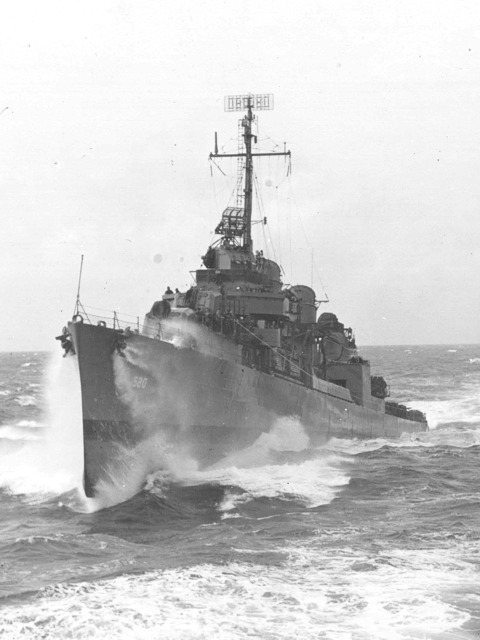
USS Isherwood (DD-520) underway in heavy weather as she comes alongside the heavy cruiser USS Tuscaloosa (CA-37) in August 1943. National Archives and Records Administration. Photo # 80-G-79429. [Navsource]

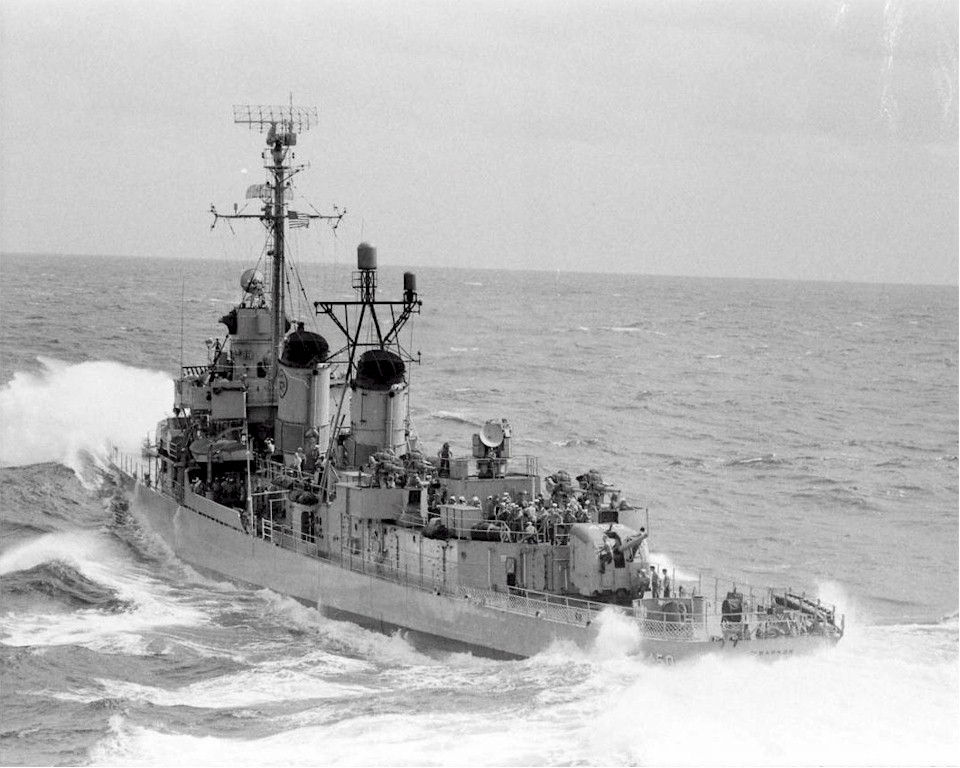
During the war 19 of the class were lost and 6 damaged so badly that they were not repaired. 44 of the ships were awarded 10 battle stars or more while 19 were awarded Naval Unit Commendations and 16 Presidential Unit Citations.  Following the war all were decommissioned and placed in reserve. Many were re-commissioned during the Korean War and served through Vietnam. Some of these ships were modernized with newer ASW weapons and re-designated Escort Destroyers (DDE) while others had their air search radar modernized and were re-classified as Radar Picket Destroyers or (DDR). The last Fletcher in US Service decommissioned in 1971.  52 were sold or transferred under military assistance programs to other navies in the 1950s.  The ships served well and the last one in active service the Mexican Navy Destroyer Cuitlahuac the former USS John C Rodgers DD-874 was decommissioned in 2001.

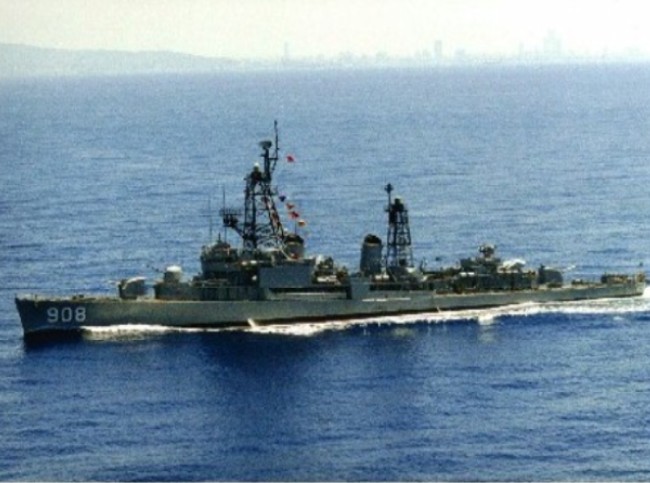
Ex USS Twinning in Republic of China Navy Service, note weapon modifcations

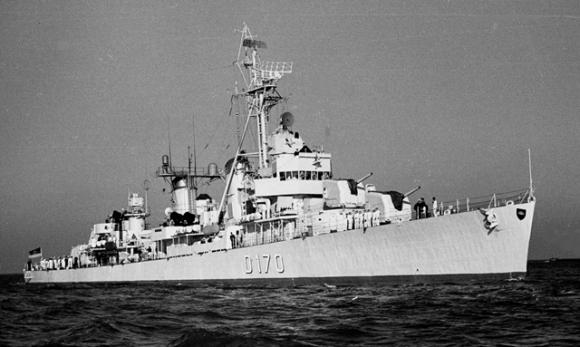
Zerstörer Z-1 Rommel

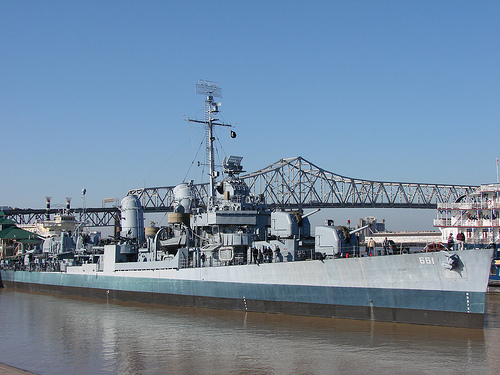
USS Kidd as Museum and Memorial

Four are currently open as memorial ships the USS Cassin Young DD-793 at Buffalo NY, the USS The Sullivans DD-537 at Boston MA and USS Kidd DD-661 at Baton Rouge LA can be seen in the United States. The Cassin Young is berthed at the old Charlestown Naval Yard in Boston across the pier from the Frigate USS Constitution.  The former the Greek destroyer Velos the ex-USS Charette DD-581 is located in Athens.  The John Rodgers has been purchased by a group in the US but is currently laid up in Mexico and her fate is undecided. I hope that she too will be saved for future generations.

The Fletcher Class really symbolizes more than any class of destroyer the classic look of what a destroyer should be. Their clean lines and classic design are iconic not just in this country but in the 15 other countries that they would serve in during the following years.  Their amazing record and service in World War Two and in the following years in both the US Navy and the navies of our Allies is one that will probably never be surpassed.

I have visited the Cassin Young in Boston; it is well worth the time to see. I hope that I might see The Sullivans and Kidd in the coming years.

The Zerstörer Z-4 ex USS Dyson in heavy seas

I salute the ships of the class and the officers and sailors that served on them in peace and war.

Peace

Padre Steve+
5 Comments

Filed under History, Navy Ships, US Navy, world war two in the pacific

Workhorses: The Brooklyn Class Light Cruisers

The Brooklyn Class Light Cruisers were the most modern cruisers in the US inventory when war broke out in on December 7th 1941.  The ships were built under the provisions of the Washington Naval Treaty of 1922.  Displacing 9700 tons to remain within treaty limitations they mounted a powerful armament of fifteen 6” guns mounted in 5 turrets, three forward and two aft.  Their design, especially their armament was designed in response to the large Mogami Class light cruisers of the Imperial Japanese Navy which initially mounted the same main battery before being converted to Heavy Cruisers.  The layout of the main battery in both classes of cruisers was identical.

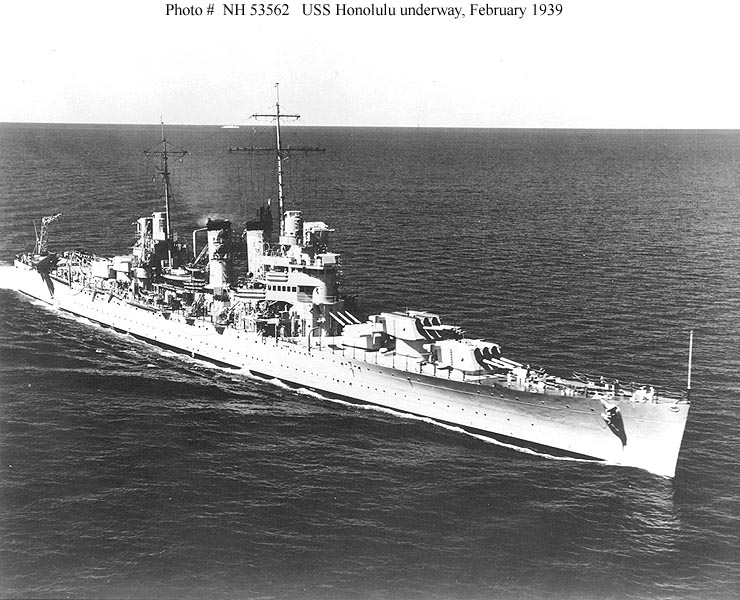
Pre-war shot of Honolulu, typical of Brooklyn Class

Authorized in by Congress in 1933 the ships were designed with a large transom which housed the aircraft hangar with twin catapults and crane. This was a departure from previous US cruisers which housed the aircraft and their volatile fuels midships which would prove a liability in combat against the Japanese in the Solomons campaign.  The new hangar design was carried forth on all new cruisers and battleships built by the US subsequent to the Brooklyn Class.

There were 9 ships in the class, one of which the Wichita was completed as a Heavy Cruiser mounting nine 8” guns in triple turrets and is considered a separate one ship class.  In addition to their main battery they mounted eight 5” 25 caliber dual purpose guns and a light AA battery which was continuously increased throughout the war. Their steam turbines produced 100,000 shaft horsepower to give the ships an official speed of 32.5 knots which was exceeded by some of the ships.

The ships Brooklyn CL-40, Philadelphia CL-41, Savannah CL-42, Nashville CL-43, Phoenix CL-46, Boise CL-47, Honolulu CL-48, St. Louis CL-49 and Helena CL-50 were involved in some of the most intense combat of the war serving in both the Atlantic and the Pacific.  Of the ships one, the Helena was lost in surface combat and several others taking severe damage without sinking.  Half of the surviving ships of the class would serve in foreign navies for many years following the war a testament to their toughness and utility.

The lead ship of the class the Brooklyn served exclusively in the Atlantic and Mediterranean where she engaged Vichy warships during the invasion of North Africa and took part in the landings at Sicily, Salerno, Anzio and Southern France where she provided naval gunfire support to troops ashore. Following the war she was decommissioned in January 1947 and transferred to the Chilean Navy in 1951 under the Mutual Defense Assistance Program. She was renamed O’Higgins and served until decommissioned in January 1992 and sold for scrap. She sank while being towed to India for scrapping in November 1992.

Philadelphia had a similar career to Brooklyn. Launched in 1936 and commissioned in 1937 she too served in the Atlantic and Mediterranean supporting the invasions of North Africa, Sicily, Salerno, Anzio and Southern France.  She was decommissioned in February 1947 and transferred to Brazil in 1951. Renamed Barroso she served until 1973 and sold for scrap.

Late war view of St Louis

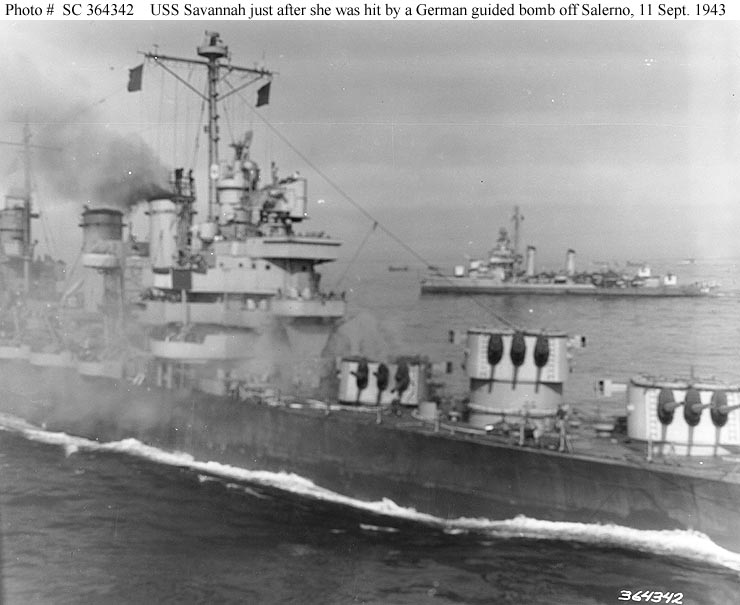
Savannah was launched in May 1937 and commissioned in March 1938 and like Brooklyn and Philadelphia served exclusively in the Atlantic and Mediterranean supporting amphibious landings, searching for German commerce raiders and blockade runners and supporting various escort missions. At Salerno she was struck and severely damaged by a German FX-1400 radio guided bomb which struck her number 3 gun turret penetrating to the lower handling room where it exploded tearing a large hole in the ship’s bottom and opening a seam in the ship’s side.  Her crew performed heroically to control the damage and get the ship to Malta but she lost 197 sailors in the attack. Following temporary repairs she returned to the United States for repairs and modernization which were complete in September 1944. She served in a number of capacities in the Atlantic and was decommissioned in February 1947, stricken from the Navy List in March 1959 and sold for scrapping in January 1966.

Nashville was launched in October 1937 and commissioned in June 1938 initially serving in the Atlantic until her transfer to the Pacific Fleet in February 1942.  While in the Atlantic she took part in the Neutrality Patrols and following the commencement of hostilities continued convoy escort duties.  Her first mission in the Pacific was to escort the Carrier Hornet CV-8 on her mission to launch Colonel Jimmy Doolittle’s Army Air Force B-25s on the Tokyo raid.  Nashville sank a scout vessel which had discovered the task force.  On return from the mission she was assigned to the defense of the Aleutians until November 1942.  She then was transferred to the South Pacific where she participated in raids and bombardments of Japanese shore installations until while shelling Vila Airfield on Kolombangara on the night of 12 May 1943, she had an explosion of powder charges in one of her forward turrets, killing 18 and injuring 17.  The damage required her to be sent to Bremerton for repair and modernization and she would return to duty in August to join carrier task forces in raids in the Central Pacific before again moving to the South Pacific where she participated in the New Guinea campaign and as well as other missions until May of 1944.  She took part in the invasion of Leyte and the Battle of Leyte Gulf guarding beachheads and transports and fending off Kamikazes while providing naval gunfire support to troops ashore. While conducting similar operations off Negros Island she was struck by a Kamikaze with two bombs aboard. Nashville was struck on one of her port 5” mounts the bombs exploding above her deck. The blazing aviation fuel and explosions killed 139 crew members and wounded 190.  Following repairs at Bremerton she went back to the Southwest Pacific lending her battery to landings at Brunei Bay, Borneo, and protecting carriers in the Makassar Straits.  She was decommissioned in June of 1946 and sold to Chile in January 1951 where she was renamed Captain Prat where she served until she was decommissioned in May 1982 and sold for scrap in April 1983.

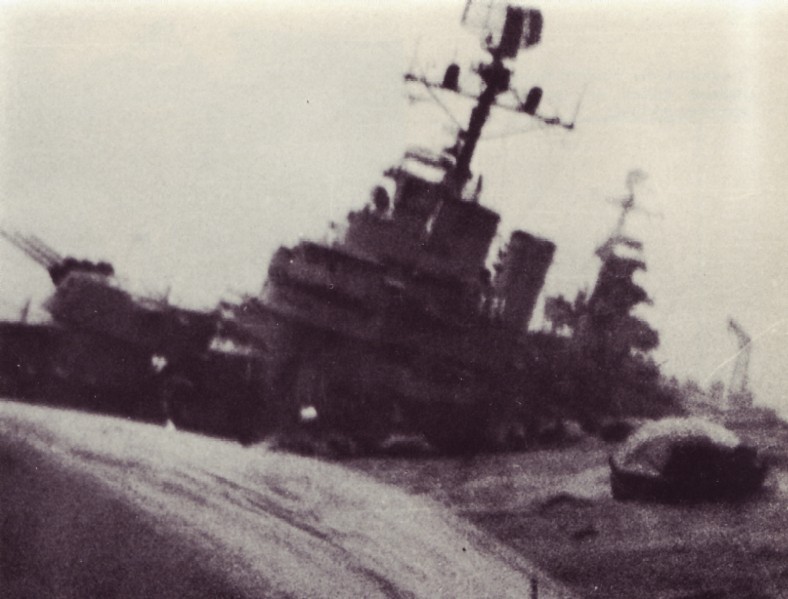
Phoenix was launched in March of 1938 and commissioned in October of the same year. She became part of the growing Pacific Fleet and was the first modern light cruiser assigned in the Pacific. She was at Pearl Harbor on December 7th 1941 and would serve throughout the war in the Indian Ocean and the South Pacific and was engaged in heavy operations around New Guinea and other islands in the area frequently involved in shore bombardment, amphibious assaults and raids and having to engage attacking Japanese aircraft.  In September 1944 she was assigned to the covering force of old battleships assigned to 7th Fleet for the invasion of the Philippines.  As part of this force under Rear Admiral Jesse Oldendorf she took part in the destruction of the Japanese Southern Force at the Battle of Surigo Strait where her gunners aided in the sinking of the Japanese battleship Fuso. Phoenix continued operations with 7th Fleet in the Southwest Pacific supporting shore operations and fighting off swarms of Kamikazes without damage to herself. Following the war she was decommissioned in July 1946 and transferred to the Argentinean Navy in April 1951 where she was renamed 17 de Octubre and later General Belgrano. She received a number of modifications while in Argentine service including ASW helicopters and the Sea Cat Air Defense missile system.  Still in active service at the time of the Argentinean invasion of the Falkland Islands in 1982 she was sent to sea with two destroyers.  She was discovered by the British attack submarine HMS Conqueror torpedoed and sunk on May 3rd 1982 with the loss of 323 men, ending a 44 year career of service to the United States and Argentinean Navies.

Boise was launched in December 1936 and commissioned in August 1938. Following her shakedown cruise she was assigned to the Pacific Fleet. On December 7th 1941 she was in the Philippines after having completed a convoy escort mission.  She was sent south to join the rest of the Asiatic Squadron and our Australian, British and Dutch Allies to for the ABDA (American, British, Dutch, and Australia) task force opposing the southern advance of the Japanese aimed at Java and the Dutch East Indies.  She struck an uncharted shoal on January 29th while conducting operations in the Sape Strait forcing her to return to the United States for repairs. This probably prevented Boise from sharing the fate of most of the rest of the squadron including the HMS Exeter, USS Houston, HMAS Perth and Dutch light cruisers DeRuyter and Java, most of which were sunk in the Battle of the Java Sea in February. After repairs she returned to the South Pacific where she took part in a number of actions including the Battle of Cape Esperance where she helped sink the Japanese Heavy Cruiser Furutaka and destroyer Fubiki. She was damaged in this action and returned to Philadelphia for repairs.  Following her repairs she was dispatched to support the landings on Sicily before returning to the Pacific where she served from January 1944 to June of 1945 conducting almost non-stop operations around New Guinea, Borneo and the Philippines. She returned to San Pedro for overhaul and was there when the war ended. She decommissioned in July 1946 and sold to Argentina in January 1951 and commissioned as Nuevo de Julio in 1952.  She served until 1978 when she was decommissioned and was sold for scrap in August 1981.

Honolulu had one of the most active careers while engaged in operations against Japanese Naval units with far less time devoted to gunfire support missions.  She was at Pearl Harbor on December 7th 1941 and following that took part in convoy escort missions until she went north to screen Alaska from Japanese attack in May 1942 a task that she engaged in until November.  She then reported to the South Pacific and was part of operations against the Japanese Fleet in the Solomons. She took part in the Battle of Tassafaronga, the Battle of Kula Gulf where she helped sink a destroyer and the Battle of Kolombangara where she was instrumental in sinking the Sendai class light cruiser Jintsu and a destroyer. She then supported amphibious operations in the Central Pacific including Saipan and Guam and the Leyte Gulf landings in the Philippines.  While operating off Manus Island she was stuck by an aerial torpedo receiving heavy damage which required her withdraw to the United States for major repairs which were still being completed when the war ended. She decommissioned in February 1947, stricken from the Naval Register in November 1959 and sold for scrap.

St. Louis was launched in April 1938 and commissioned in May 1939. After time conducting neutrality patrols at the onset of the war in the Atlantic she was transferred to the Pacific Fleet in November 1940. She was at Pearl Harbor on December 7th 1941 and was one of the few major fleet units to get underway and out to sea during the attack.  She supported carrier operations and convoy escort missions until she was sent north to that Aleutians where she operated until October when she returned to the States for a brief overhaul before being assigned to operations in the Solomons. Operating on a nearly nonstop basis against the Tokyo Express she took part in the Battle of Kula Gulf and the Battle of Kolombangara where she received partial credit for the sinking of the Japanese light cruiser Jinstu. During the battle she was torpedoed in the bow and after temporary repairs returned to the Mare Island. Following repairs St. Louis returned to the Solomons in November 1943. She was struck by a bomb which killed 20 crew members on January 14th requiring her to return to Purvis Bay for repairs. The repairs complete she returned to the Solomons until June when she took part in the invasion of the Marshalls at Guam and Saipan. She damaged her number three propeller and had to return to the States for repair following the Guam bombardment.  Upon her return she served at Leyte Gulf until she was hit by two Kamikazes in a short span receiving heavy damage and resulted in the loss of 15 sailors killed, 1 missing and 43 wounded.  She again sailed for repairs and returned to action against the Japanese home islands and Okinawa. Following this she supported operations against Japanese installations on the Asian mainland.  Following the war she took part in the Yangtze River patrol force and then returned to the United States in January 1946.  She was decommissioned in June 1946 and transferred to Brazil in January 1951 being commissioned as Tamandare. She was decommissioned in June 1976 and sold for scrapping in 1980. While being towed to Taiwan for scrapping she sank on August 24th 1980.

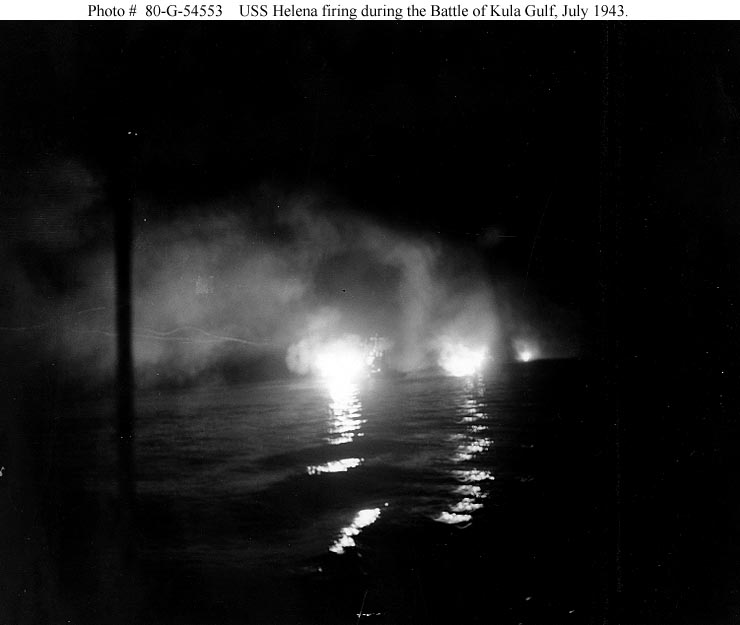
Helena firing at Kula Gulf just before being torpedoed and sunk

The Final ship in the class, Helena was launched in August 1939 and commissioned in the following month.  She was at Pearl Harbor and mooed at the 1010 Dock where she was hit by a torpedo and damaged. After repairs she reported to the South Pacific and the Guadalcanal campaign.  She escorted carriers. Helena had the most modern surface search radars and at Battle of Cape Esperance in Iron Bottom Sound, Helena had sunk cruiser Furutaka and destroyer Fubiki.  She then took part in the Naval Battle of Guadalcanal in which a weaker American force turned back a Japanese force with heavy losses on both sides including the Japanese Battleship Hiei and the American cruisers Atlanta, Juneau and 4 destroyers. Helena continued operations in the Solomons and at the Battle of Kula Gulf was sank by Japanese torpedoes fired by destroyers on July 5th 1943.  168 of her sailors were lost in the action. Helena was the first US Navy ship to be awarded the Naval Unit Commendation.

The General Belgrano ex-USS Phoenix sinking after being torpedoed by HMS Conqueror at the Battle of Falkland Islands

The class found its niche in the war primarily in shore bombardment and Naval Gunfire Support as well as in the sharp surface actions in the South Pacific. Only one, Helena was lost.  Six were transferred to South American Navies making and served for many years in those navies. None survive today but the ships were instrumental in the success of many operations.

3 Comments

Filed under History, Military, Navy Ships, US Navy, world war two in europe, world war two in the pacific

Forerunners of the Next Generation: The New Mexico Class, USS New Mexico, USS Idaho and USS Mississippi

New Mexico BB-40 in 1930 before moderization

The Battleships of the Nevada and Pennsylvania classes had established American ship design as second to none in 1916.  At the same time the US Navy was planning advances in engineering systems that would change naval engineering forever.

Idaho  BB-42 in 1931 after modernization

The ships of the New Mexico class were improvements on the preceding Nevada and Pennsylvania class half sisters.  Their hull was lengthened and beam increased. Additionally the new class was given a clipper bow to improve sea keeping capabilities.  While they maintained the same main battery layout of four turrets mounting three 14” guns each, however the guns were a higher caliber 14”/50 models that would also be mounted on the California class.  The New Mexico was also the test bed for a new power plant which featured General Electric geared turbines with electric drive which would be standard on succeeding classes of battleships as well as carriers, cruisers and destroyers.  The Mississippi and Idaho retained the older geared turbine design. The practical effect was that the New Mexico required less horsepower to attain the same speeds as the earlier design turbines.

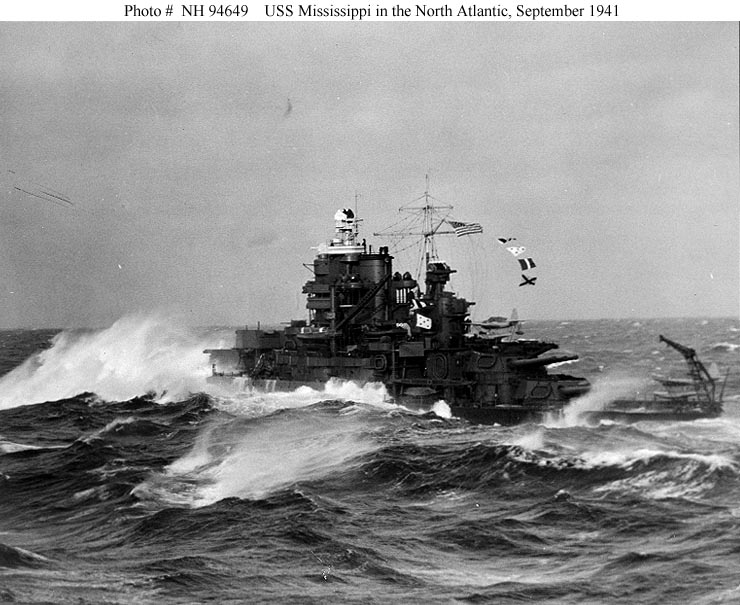
USS Mississippi BB-41 in the North Atlantic September 1941

Displacing 32,000 tons the ships were slightly larger than their predecessors.  New Mexico was launched on 23 April 1917 and commissioned on May 18th 1918.  Her sisters Mississippi and Idaho were actually launched and commissioned sooner being launched on January 25th 1917 and commissioned on December 18th 1917.  None of the ships saw action in the First World War and in 1919 the three would become the nucleus of the newly formed Pacific Fleet. They would serve in the Pacific but conduct exercises with the Atlantic Fleet in the Pacific as well as the Atlantic and Caribbean.  All three were modernized in the early 1930s receiving improvements in armor protection, anti-torpedo blisters, a modernized bridge structure to replace their cage masts, improvements to machinery and their secondary armament.

The Three Sister Moored Together, Late 1943

They would return to the Pacific but with the outbreak of war in Europe the three ships were transferred to the Atlantic Fleet where they took part in the Neutrality Patrol. When Pearl Harbor was attacked the three sisters went back to the Pacific where they spent much of 1942 escorting convoys and being prepared to repel any Japanese assault on the US Mainland.  In April 1943 they took part in the Aleutian campaign and the assaults on Attu and Kiska.  They would then sail to the Central Pacific where the provided support to the invasions of the Gilberts, Marshalls and Marianas islands by protecting the transports and providing naval gunfire support to Marines ashore.

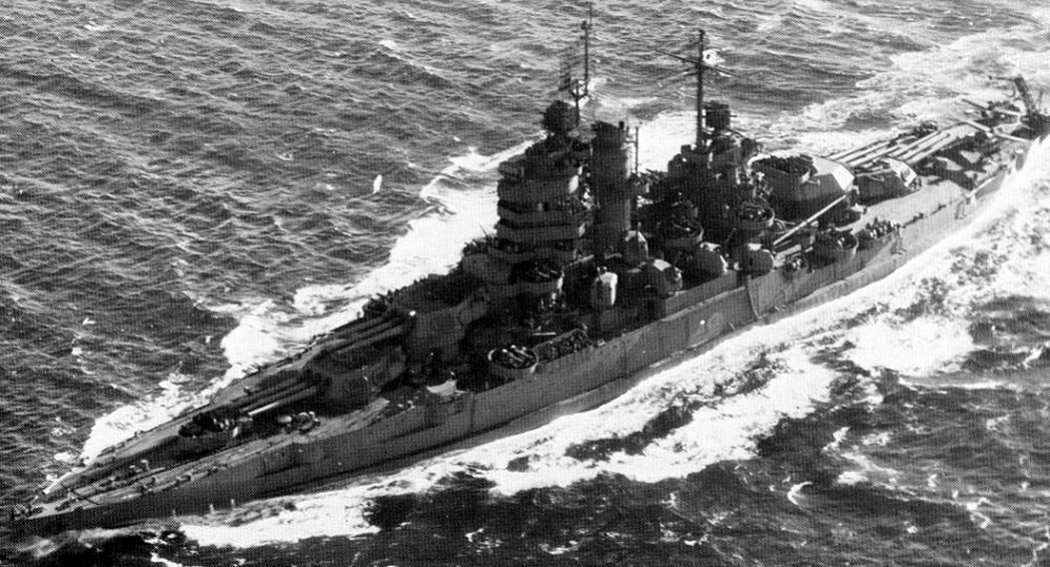
Idaho in her final 1945 configuration. Note the 5″/38 DP Guns in single enclosed mounts used by US Fletcher Class DDs. The Idaho was the only Battleship to have this type of 5″ mount

The three would again operate together during the invasion of the Philippines where the Mississippi served with other battleships of the 7th Fleet’s battle line under Rear Admiral Jesse Oldenforf at the Battle of Surigo Strait where they annihilated a Japanese force including the battleships Fuso and Yamisharo.   Both Mississippi and New Mexico were damaged by Kamikaze hits in Philippine waters, the New Mexico taking a hit on her bridge which killed her Captain and 27 crewmembers.  Both would require repairs and both would miss the invasion of Iwo Jima which Idaho took part in.  The three joined forces again at Okinawa where they provided fire support to Marines and Soldiers ashore.  They would serve until the end of the war in the Pacific and take part in Operation Magic Carpet to return military personnel from the Pacific to the United States.

Idaho at Okinawa

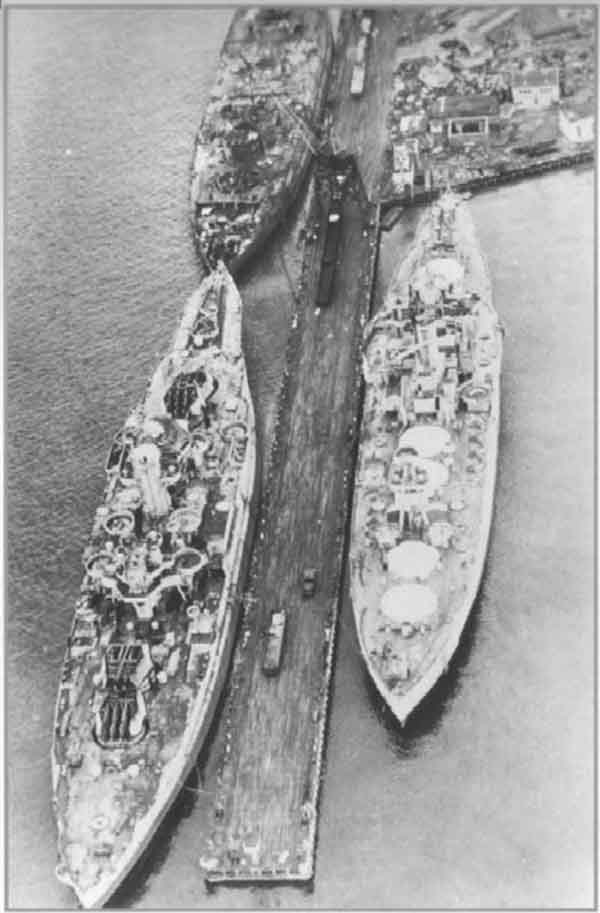
Following the war the New Mexico and Idaho were decommissioned and sold for scrap in 1948.  Mississippi however was converted into a gunnery training ship and reclassified as AG-128.

Idaho (lower left) New Mexico (top left) and Wyoming being scrapped at Newark NJ 1948

In this capacity she served as a test bed for new weapons including the Terrier guided missile systems which would be mounted on the first generation of US Navy Guided Missile Cruisers.   She was decommissioned in 1956 and sold for scrap after an abortive attempt by the state of Mississippi to acquire her as a memorial ship.

USS Mississippi AG-128 firing Terrier Missiles

The ships provided valuable service during the Second World War and the technical innovations in propulsion and protection would become standard in subsequent classes of US Navy battleships.  Additionally the post war service of the Mississippi helped propel the Navy into the missile era helping to build a foundation that is in evidence today in the Ticonderoga Class Guided Missile Cruisers and Arleigh Burke class Guided Missile Destroyers and their Aegis air defense and ballistic missile defense systems.  The ships of the New Mexico class and their stalwart crews should not be forgotten.

7 Comments

Filed under History, Military, Navy Ships, world war two in the pacific

They Held the Line: The USS Yorktown CV-5, USS Enterprise CV-6 and USS Hornet CV-8, Part Three the Enterprise

Enterprise CV-6 circa 1940

This is the last of a three part series about the USS Yorktown Class Aircraft Carriers. It is the story of the USS Enterprise CV-6, the legendary “Big E” and possibly the most celebrated American warship of the Second World War.

The USS Enterprise CV-6, the second ship of the Yorktown class was ordered by the Navy on 3 August 1933 as authorized under the National Industrial Recovery Act of 16 June 1933.  She was laid down just under a year later and launched on 3 October 1936 at Newport News Shipbuilding and Drydock Company, Newport News Virginia.  She was commissioned on May 12th 1938 to begin one of the most celebrated careers of any US Navy ship in history.  Displacing 25,500 tons full load Enterprise like her sister ships were designed for fast carrier operation working in conjunction with other carriers not tied to the battle line.  With good protection and speed the Enterprise incorporated the lessons learned in the preceding carriers.

Pre-War photo of Enterprise

After her shakedown cruise she operated in the Atlantic and Caribbean until April 1939 when she was transferred to the Pacific Fleet and based a Pearl Harbor. As the flagship of Task Force 16 under Rear Admiral Bill “Bull” Halsey Enterprise conducted training operations and shuttled aircraft to various US island bases in the Central Pacific one such mission to Wake Island which had her out of Pearl Harbor when the Japanese attacked on December 7th 1941.  Following the attack Enterprise and Task Force 16 would cover the Hawaiian Islands and then be used to conduct raids against Japanese bases in the Marshalls and protect convoys bound for Samoa.

Rare photo of the Enterprise at Midway

In April she escorted the newly arrived USS Hornet CV-8 to conduct the famed “Doolittle Raid” on Tokyo.  Five days after returning to Pearl Harbor Enterprise was dispatched to the Coral Sea but could not arrive before that historic carrier battle.  She returned to Pearl Harbor on May 26th and with Halsey sick departed two days later as flagship of TF-16 under the command of Rear Admiral Raymond A Spruance in company with Hornet, 6 cruisers and 10 destroyers with orders “to hold Midway and inflict maximum damage on the enemy by strong attrition tactics.”

TBD Devastator landign on Enterprise May 1942

They would be joined 2 days later by the hastily repaired USS Yorktown flagship of Rear Admiral Frank “Jack” Fletcher and TF-17 escorted by 2 cruisers and 6 destroyers.  Fletcher the senior officer assumed tactical command of this comparatively small force which represented the bulk of US naval power in the Pacific.

This tiny force would face 4 fleet (CV) and 2 light fleet (CVL) carriers, 7 battleships, 10 heavy (CA) and 2 light (CL) cruisers and 42 destroyers.  Additionally the Japanese had an additional 2 carriers, 4 battleships, 3heavy cruisers 4 light cruisers and 23 destroyers involved in some way the simultaneous invasion of the Aleutian Islands which could be called into the fight if Admiral Yamamoto desired.

SBD Dauntless Dive Bombers over Enterprise

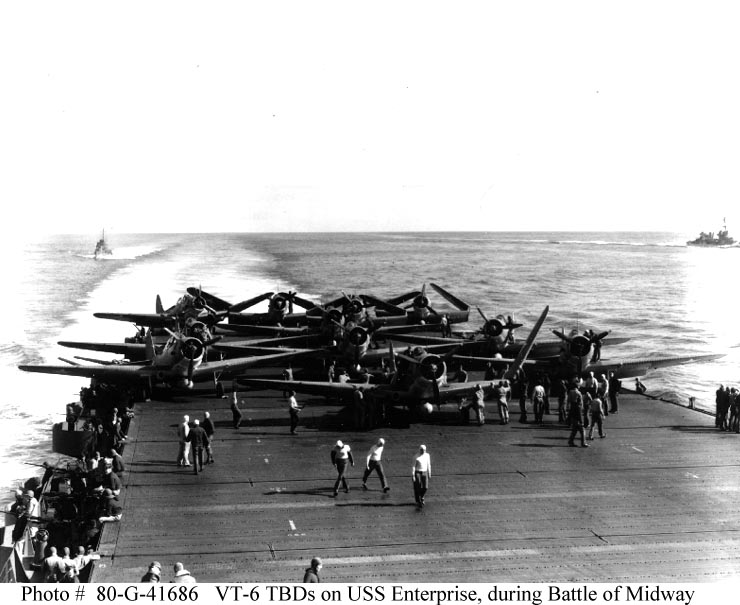
The Battle of Midway was an epic of warfare and Enterprise and her Air Group 6 would play a pivotal role. Torpedo Six under LCDR Max Leslie in its obsolete, underpowered and under armored TBD Devastators was chopped to pieces as they attempted torpedo attacks on the First Carrier Strike Force of Admiral Nagumo losing 10 of 14 aircraft.  As the gallant air crews of Torpedo Six along with Yorktown’s Torpedo 3 and Hornet’s ill-fated Torpedo Eight made their attacks Bombing Six under the command of CDR Wade McCloskie and Scouting Six under the command of  LT Dick Best attacked and mortally wounded the Japanese Flagship Akagi and the Soryu.  Later in the day aircraft from Enterprise would help sink the Hiryu and the following day helped mortally wound the Heavy Cruiser Mikuma. The Enterprise was not damaged by the Japanese at Midway.

Flight Operations on Enterprise

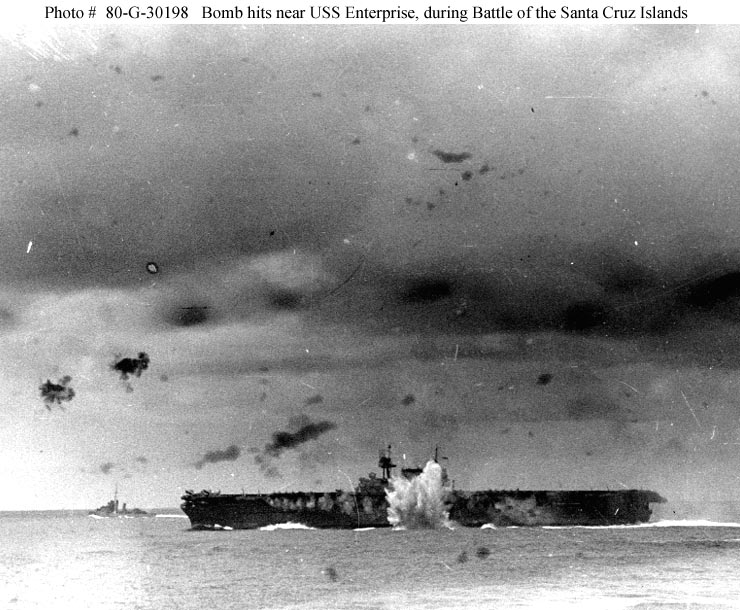
Following the Miracle at Midway the Enterprise took part in the Guadalcanal campaign participating in the invasion as well as the Battles of Santa Cruz and the Eastern Solomons.  In each of these actions she was seriously damaged but her air group was instrumental in the campaign at sea and ashore.   Following the sinking of the Wasp, Hornet and damage to Saratoga Enterprise was the only US carrier in action in the fall of 1942.

Enterprise under attack at the Battle of Santa Cruz Islands

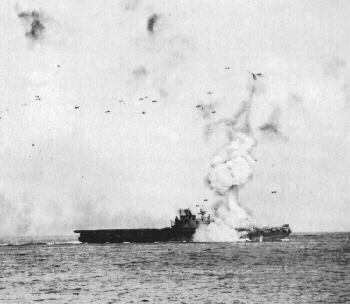
Bomb Explosion on Enterprise at the Battle of Eastern Solomons

In November she took part in the Naval Battle of Guadalcanal where her aircraft helped to finish off the Japanese battleship Hiei and participated in the sinking of 16 Japanese ships including transports which carried troops, equipment and supplies to the Japanese defenders of Guadalcanal. After another 6 months of action in the Solomons supporting the US advance Enterprise returned first to Pearl Harbor at which time she was awarded the Presidential Unit Citation by Admiral Chester Nimitz, the first carrier awarded the citation in the Second World War and then to Bremerton for a badly needed overhaul.

Emterprise struck by Kamikaze

Enterprise was back in action by November 1943 and participated in the US offensives in the Gilberts, Marshalls and the Marianas taking part in numerous raids, support to Marines ashore and in the Battle of the Philippine Sea, the Marianas Turkey Shoot.  After a month long refit at Pearl Harbor she participated in the attacks on the Volcano, Bonin and Palau including strikes on Yap and Ulithi followed by the fast carrier raids on Japanese facilities on Okinawa, Formosa and the Philippines which culminated in her participation in the Battle of Leyte Gulf, the largest naval battle in history.  Her aircraft would participate in strikes on each of the Japanese surface forces hitting battleships, cruisers and other Imperial Navy units in the epic naval battle.

Enterprise made a short return trip to Pearl Harbor in December 1944 where she embarked an air group trained in night operations. Rejoining the fleet she took part in sweeps against Japanese bases, ships and facilities in Indochina, the Philippines, Formosa and Okinawa prior to the invasion of Iwo Jima.

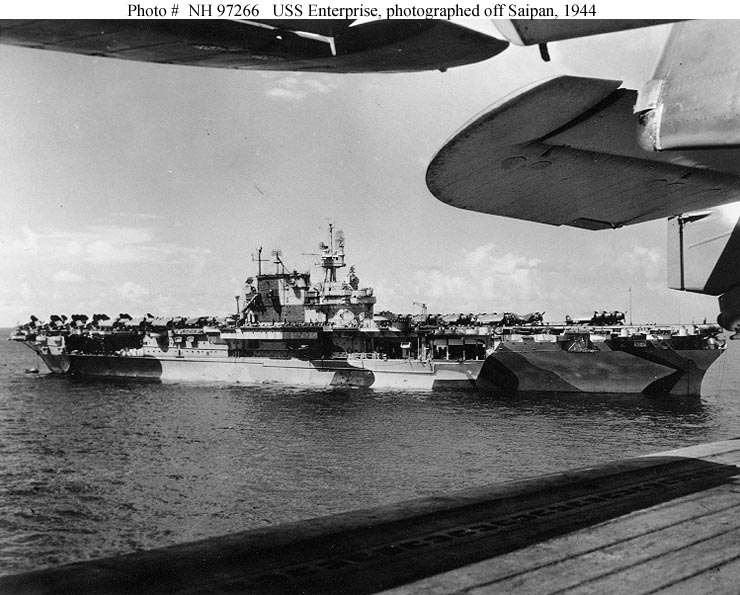
Enterprise at Saipan

During this operation her aircraft worked night and day to provide air strikes and air defense to the fleet.  She then joined the raids against Honshu, Kyushu and the Inland Sea where her aircraft provided night strikes against Japanese targets ashore as well as air defense to fleet units. She was damaged by a Japanese bomb on the 18th of March and on 11 April damaged by Kamikazes off Okinawa and again on 5 May prior to her last wound of the war on 14 May when a Kamikaze struck forward elevator necessitating repairs at Bremerton.

Kamikaze Damage or forward elevator

Returning to the fleet to late for the final actions of the war Enterprise took part in Operation Magic Carpet returning US troops to the United States at the end of hostilities.  She was decommissioned on February 17th 1947.  While she was in reserve the Enterprise was redesignated first as an Attack Aircraft Carrier (CVA), and then as Anti-submarine Carrier (CVS).

Enterprise Fleet Week New York 1945

As the super-carrier entered the scene and the Essex and Midway Classes were modernized to accommodate jet aircraft the Enterprise was determined to be in excess of Navy needs.  Despite attempts by some to save her as a Naval Museum the money could not be raised, even with the support of the dying Fleet Admiral Bill Halsey.  Enterprise which Secretary of the Navy Forrestal said was “the one vessel that most nearly symbolizes the history of the Navy in this war” was sold for scrap on 1 July 1958 and scrapped at Kearney New Jersey from September 1958 to March 1960.  Like so many ships which serve their country so well she was casually disposed of by a nation which had forgotten its past.

Enterprise alongside new CVA 1958

Enterprise on the way to the breakers

Enterprise was the only ship to receive both the Presidential and Naval Unit Citations for her service in World War Two and she was awarded the Asiatic-Pacific Campaign Medal with 20 battle stars.  Her place in the carrier force would be taken by a new Enterprise, CVN-65, the First Nuclear carrier which after nearly 50 years of service is still in commission. The Enterprise is so significant that her legacy continues in Hollywood Science fiction in the various Star Trek series as the Federation Starship Enterprise NCC-1701, 1701-A, 1701-B, 1701-D and 1701-E, so much so that NASA named the first experimental Space Shuttle Enterprise.

Never Forgotten USS Enterprise NCC-1701-B

2 Comments

Filed under History, Navy Ships, world war two in the pacific

The Treaty Cruisers: A Warship Review

Note: Since childhood I have loved naval history and the study of various types of warship design throughout history. My favorite period is really from the Spanish-American War through the mid 1970’s.  I find the leaps in Naval design and architecture, weapons and fire control systems and the diversity of the types of ships built absolutely fascinating.  Not only initial designs but the various modifications and modernizations of various ships or classes of ships went through during their service careers. The cruisers of the inter-war period were some of the most ascetically pleasing warships to ever grace the high seas. They were well proportioned, and graceful while still looking every part the warship.  This is something that many ships in our modern era lack, despite the fact that their armament despite limited gun power is formidable. With VLS launchers and Harpoon Missile tubes they pack a punch, but unlike the old cruisers, their offensive teeth are hidden. I had the privilege of serving aboard the USS HUE CITY CG-66 which is about the same size and displacement of the Chester Class

I think I actually began reading Naval history back in 2nd or 3rd grade, and it was not uncommon for me to spend hours at the public library going through reference stacks to read old issues of “Jane’s Fighting Ships” and the main collection to check out every book on Naval Warfare and warships that I could find. One of the most interesting types of ship to me was the Heavy Cruisers built under the restrictions of the Washington Naval Treaty. The treaty had several major provisions but today I only deal with the restrictions on Heavy Cruisers, the response of treaty nations to the limitations and the combat summary of each class.  This is all pretty much out of the deep recesses of my sometimes dark mind and tonight I didn’t have to crack a book to write this.  It’s thanks to having one of those phonographic memories that just keeps going around and around. This is another one of the things that I am passionate about.  Anchor’s Away! Peace, Steve+

atago

IJN Atago

The Washington Naval Conference of 1921-1922 set a number of limits on warship construction and fleet composition.  One of the ship types limited by the treaties was cruisers, notably heavy cruisers.  These ships, descended from the Armored Cruisers developed by the navies of the great powers prior to the First World War were considered a major part of each of the navies of the signatory nations.  The armored cruisers had 8-10 inch guns and a relatively substantial armored belt.  The type was not particularly successful as with few exceptions they were used in fleet actions where they were under-gunned and under-armored.  They were most successfully used in overseas service against raiders or commerce.  The most famous of the type were the German Scharnhorst and Gneisenau of the German Far East Squadron.  Smaller and faster than a battleship, the type had developed by the 1920s into a ship that could be used for fleet screening and scouting as well as showing the flag in foreign waters where many were found.  The Washington treaty did not limit numbers of these ships as it did Battleships and Aircraft Carriers, but it did place maximums on the gun size and displacement of individual ships.   A heavy cruiser could be armed with 8 inch guns and were limited to 10,000 tons displacement.  Of course this led to compromises in the designs of the ships which frequently gave up protection for speed.

uss pensacolaUSS Pensacola

The Americans were the leaders in the development of the treaty cruisers.  The Japanese only built one class of cruiser, the Kako class which complied with the terms of the treaty.  They mounted 6- 8” guns and displaced about 8,600 tons.  They were fast but because of their light displacement were top-heavy.  Subsequent classes, the Nachi and Atago classes violated the tonnage limits by as much as 4,000 tons while the Japanese reported them as 10,000 tons. They were armed with 10-8”guns in five turrets, had good protection and also mounted 12 24” “Long Lance” torpedo tubes.  Two subsequent cruisers of the Kumano and Tone classes were built in the 1930s. The Kumano class of about 13,000 tons were initially classed as “light cruisers” mounting 15- 6” guns prior to being re-armed with 10-8” guns.  The Tone’s mounted 8- 8”guns in 4 turrets all mounted forward leaving the entire aft section for use as a seaplane launching area; the Tone class carried 8 float planes for fleet scouting.

hms exeterHMS Exeter

The British treaty cruisers abided by the limits included the York and Exeter, of the same displacement and armament as the Kako class except they were slower, a common feature of British ships which were generally slower than their American and Japanese counterparts.  The later County class ships were armed with 8- 8” guns and were distinctive looking having three funnels. The County class included such famous ships as the Norfolk, Suffolk and Dorsetshire which played critical roles in the chase and sinking of the German Battleship Bismarck. Australia had two Counties, the Australia and Canberra which did most of their service in the Pacific. The Counties were armed with 8- 8” guns and were distinctive with their three funnels.  They were slower than their Japanese or American counterparts.

uss houstonUSS Houston with President Roosevelt Aboard

The first American treaty cruisers the Pensacola and Salt Lake City of about 9,500 tons with an unusual arrangement of 10- 8” guns mounted in 4 turrets.  However it was the Chester class which was the quintessential U.S. Treaty Cruiser design.  These ships, and the later Astoria class, also displaced 9,500-10,000 tons and mounted 9- 8” guns in three turrets.  A further “treaty” cruiser was Wichita, converted from a St. Louis class light cruiser. All were fast but were lacking in armored protection and none mounted the torpedoes found in Japanese or British ships.  Some of the more notable ships in the U.S. treaty classes included the Houston which served as the Flagship of the Asiatic Fleet which was sunk at the Battle of the Java Sea. The Augusta which took Franklin D Roosevelt to Argentia for the signing of the Atlantic Charter in 1941; The San Francisco which helped stop the Japanese fleet in a point blank encounter in the Naval Battle of Guadalcanal and Indianapolis which with just weeks left in the war having completed the secret mission to deliver the Atomic bomb was sunk by a Japanese submarine.

PrinzEugen-2Prinz Eugen

The Germans did not build true “heavy cruisers” until the late 1930’s and their ships, the Hipper, Blucher and Prinz Eugen mounted 8- 8” guns and displaced about 19,000 tons.  The German “Pocket Battleships” Deutschland, Graf Spee and Admiral Scheer, mounted 6-11” guns on a hull of about 11,000 tons (officially 10,000) in compliance with the Treaty of Versailles restrictions on German battleships.  They were designed to outgun and be more heavily armored than the heavy cruisers and be faster than battleships, much more in the Armored Cruiser tradition.  During the war the German Navy reclassified them as Heavy Cruisers. None of these ships were built under the treaty limits for cruisers.

hms suffolkHMS Suffolk

These ships saw distinguished service throughout the war.  The British ships remained their only heavy cruiser design throughout the war. The ships took part in the sinking of the Graf Spee and Bismarck. They also suffered heavily; York was sunk at Crete and Exeter in the Java Sea. Cumberland and Dorsetshire were sunk by Admiral Nagumo’s carriers which had attacked Pearl Harbor, in the Indian Ocean. Canberra was sunk at the Battle of Savo Island off Guadalcanal.  Some of the British Ships remained in service until the 1950s and all eventually we paid off and sent to the breakers.

The Japanese ships were involved in almost every major action of the Pacific war.  Fast, heavily armed and manned by well trained crews they dominated almost every surface action of the early war in the Pacific.  The were key at the Battle of Java Sea and Savo Island where they annihilated Allied or American cruiser and destroyer squadrons. In action so often they were destroyed leaving only two marginally operational at the end of the war. Three of the four Kako class were lost in the Solomon’s.  They were all involved at Savo Island, and the last survivor, Aoba was lost at in harbor to U.S. air strikes at Yokosuka at the close of the war.  The Nachi class saw considerable service and were the workhorses of the Japanese cruiser force. They were the principle executioners of the ABDA fleet in the Java Sea battles and continued their service until late 1944 and the end of the war. Nachi and Ashigara were sunk in the aftermath of Leyte Gulf while Haguro fought the last surface action of a major Japanese combatant in a surface action of the war against a British force in 1945 and was sunk. and Myoko survived the war in a damaged condition being surrendered in Singapore.  The Chokai class also served throughout the war and three of the four were lost at Leyte Gulf. The Atago and Maya were lost to the U.S. Submarines Darter and Dace, Chokai in the action at Samar to combined U.S. destroyer and air attacks from TAFFY-3. Takao survived the war in a damaged condition having been torpedoed at Leyte Gulf but making port.  Of the later cruisers Mikuma was sunk at Midway and Mogami survived almost unimaginable damage in that battle.  Mogami was sunk by the resurrected Pearl Harbor Battleships at the Battle of Surigo Strait while Kumano and Suzaya were lost off Samar.  Chikuma and Tone also served in many battles, it was Tone’s float plane which was delayed in launching and discovered the U.S. carriers at Midway too late. Chikuma too was lost at Samar; Tone was sunk at anchor at Yokosuka in 1945.  Leyte Gulf in a sense could be described as the “Death Ride” of the Japanese Cruiser force.

The U.S. cruisers fought valiantly in nearly every engagement of the Pacific war and a few in the Atlantic.  Houston was immortalized by her actions with ABDA in the Java Sea against hopeless odds.  Astoria, Vincennes and Quincy were sunk in the Savo Island debacle.  Northampton and Chicago lost also in later actions in the Solomon’s.  San Francisco and Portland fought toe to toe with the Japanese Battleships Hiei and Kirishima in the epic Naval Battle of Guadalcanal, inflicting so much damage on Hiei that she was later sunk by American Aircraft the following day.  Indianapolis met an unlikely fate at the close of the war being sunk by a Japanese submarine after returning from a secret mission delivering the Atomic bomb.  A series of unfortunate events led to her loss not being noted with the result that most of the survivors of the sinking being lost to the elements and shark attacks while waiting days for rescue.   Others survived horrific damage from “Long Lance” torpedoes and Kamikaze attacks.  Following the war the Pensacola’s were expended as targets and the remaining ships placed in “mothballs” until the late 1950s when all were scrapped.  Some artifacts of San Francisco including her mast are at “Land’s End” park in that city.

uss san franciscoUSS San Fransisco Returning After the  Naval Battle of Guadalcanal

Of all the navies involved only the United States Navy and German Kriegsmarine built or attempted to build new classes of heavy cruisers during the war.  The US Navy brought out the Baltimore Class which was highly successful and built upon lessons learned from the Treaty Cruisers and the follow on Oregon City class which incorporated design improvements based on experience with the Baltimore Class.  Some of these ships would be converted into the first US Guided Missile Cruisers. The later Des Moines Class the largest class of all gun cruisers ever built with fully automated 8″ gun systems.  Of these ships only Salem survives in Quincy MA as a museum ship, sadly the Des Moines which had been slated to become a Museum ship in Milwaukee was scrapped in 2007 .

No treaty cruiser survives today.  Their service, heroic, unceasing and tireless service is remembered only by their surviving crews and a few naval historians and buffs.  The epic damage control actions of the San Francisco are still taught at the Naval Surface Warfare School.  They have passed into history, of those sunk some have been rediscovered, the Ballard expedition discovered and photographed the wrecks of Astoria and Quincy and their Australian consort Canberra in the waters of “Iron Bottom Sound” off Guadalcanal.  The German “Prinz Eugen” though not a treaty cruiser survived the war and was expended as a target in the Atomic bomb tests.  Her wreck lies capsized and submerged at Bikini Atoll.  An attempt to salvage her by a German group was abandoned and one of her screws was brought back and placed on display near Kiel, Germany.

Though all had design drawbacks due to the treaties, the American and British ships performed magnificently and without their service, especially in the early days of the war history today might be different.  Here’s to gallant ships and steadfast crews. May they never be forgotten.

Peace,

Steve+
13 Comments

Filed under Loose thoughts and musings