Tag Archives: brooklyn dodgers

Roy Halladay No-Hits the Cincinnati Hitting Machine

Roy Halladay- Scary Good…just look at the face (NY Daily News)

“The only thing that matters is what happens on the little hump out in the middle of the field.” Earl Weaver

Roy Halladay continues to do what the Philadelphia Phillies acquired him to do. Halladay who went 21-10 with a 2.44 ERA striking out 219 and only walking 30 in 250.2 innings of work has been the man in an outstanding starting rotation. Halladay is what I would call scary good and is one of the most dominant pitchers in baseball. On Wednesday evening he did what no one has done in 54 years; pitch a no-hitter in the playoff. The last time this happened was when journeyman pitcher Don Larsen threw a perfect game in Game 5 of the 1956 World Series against the Brooklyn Dodgers on October 8, 1956.

Halladay faced the Cincinnati Reds a team that hit led the NL in average (.272), runs (790), hits (1515), home runs (188), slugging percentage (.436) and second in on base percentage (.338).  The Reds offense has been explosive but a lot of their success has been against their divisional opponents, although they were dominated by their rival the St. Louis Cardinals and they had a losing record against every other playoff team in the league.

Halladay shut the Reds down in a big way only walking one batter while pitching 104 pitches striking out 8 on the way to the victory.  His fastball dominated the Reds with good movement and velocity the entire game averaging 92 miles an hour with 79 of his 104 pitches being strikes.

This is nothing new as in his last 10 appearances Halladay went 8-2 pitching 75 innings giving up 25 runs during that run only walking 8 batters and striking out 61. If by some chance the Reds get by Oswalt and Hamels they have to face Halladay yet again.  Things do not look good for the Big Red Machine.

Peace

Padre Steve+

1 Comment

Filed under Baseball

Bobby Thomson and the Shot Heard Round the World

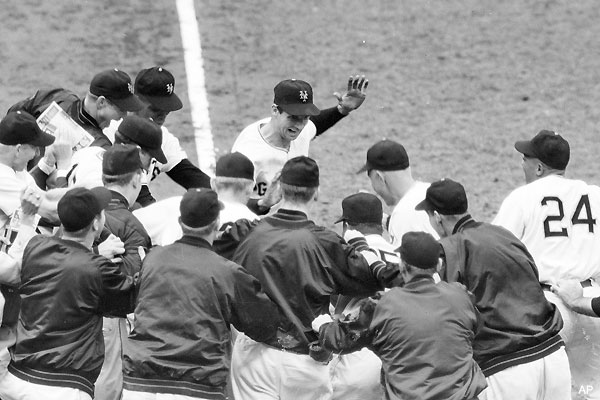
Baseball great Bobby Thomson died yesterday at the age of 86 at his home in Savannah Georgia after a long illness.  Thomson was immortalized when he hit the “Shot heard round the World” for the New York Giants against the Brooklyn Dodgers on October 3rd 1951 to cap an epic comeback in the final game of a playoff to see which team would face the New York Yankees in the 1951 World Series.

http://www.youtube.com/watch?v=lrI7dVj90zs&feature=player_embedded

Baseball has many memorable moments but few are more memorable than the home run hit by Bobby Thomson to clinch the 1951 National League Pennant for the New York Giants, before they were the San Francisco Giants over the Brooklyn Dodgers on October 3rd 1951.

As anyone who reads this site knows Padre Steve is a Giants fan and believes that the Dodgers and about everything associated with them are evil.  I cannot call myself a “Dodger hater” for in spite of all I admire the history of the franchise and many of the players that played for or managed the team that I call the “Evil Dodgers.”  Given a choice if the Dodgers were in the World’s series against anyone other than the A’s, Angels or possible the Yankees, Rangers or Rays I would probably hope that they won. I must add the caveat that this would be condition if I felt that the Dodgers had won the National League Pennant by some underhanded means or that the Giants really deserved to be in the series. It would be as painful for me to cheer them on as it would for me as a UCLA Bruin (ROTC) alum to root for Troy Tech (USC) when they against the Ohio State University Buckeyes in the Rose Bowl. It would be painful but there are exceptions to every rule.

For a baseball fan, any baseball fan what the Giants did in 1951 and Thomson’s roll in that final game of a 3 game playoff after a dramatic end to the regular season that left the teams tied was and is an epic story.  It is considered the most famous home run ever hit and is called “the shot heard ‘round the world.”  The Giants trailed the Dodgers in the pennant race by 13 ½ games on August 11th but went 37-7 to force a playoff against their blood rivals from Brooklyn.  In the final game of the series the Dodgers were up 4-1 in the 9th inning and things looked bleak for the Giants who had not generated much offense against Dodger’s pitchers during the game. Thomson’s 3 run homer off reliever Ralph Branca with 1 out in the bottom of the 9th to left field just above the 315’ marker at the Polo Grounds capped a 4 run rally to give the Giants one of the most fabled victories in all of sports history.

The rally was in keeping with the season for the Giants.  The rally started with a single by Alvin Dark who was followed by Don Mueller who singled to send Dark to third.  Monte Ervin who had led the league with 121 RBIs popped out.  Whitely Lockman doubled to score Dark and put runners on second and third with 1 out.  Dodgers’ starting pitcher Don Newcombe who was showing signs of overuse in the closing days of the season was pulled from the game obviously spent.  He was replaced by Ralph Branca who had given up a game winning home run to Thomson in game one of the series and surrendered several others to him in the regular season.  Branca was picked because Dodgers’ bullpen coach Clyde Sukeforth saw Carl Erskine bouncing his curveball in front of the plate and instructed manager Charlie Dressen to send in Branca.  The move would cost Sukeforth his job shortly after the season ended.

Branca’s first pitch was a fastball down the middle that Thomson took for a strike.  Branca came back with another fastball up and in and Thomson ripped a line drive that cleared the wall just above the 315’ marker in left. Andy Pafko chase the ball to the wall hoping that it would not clear it and as Thomson hopped and skipped around the bases with only Jackie Robinson remaining on the field for the Dodgers making sure that Thomson touched all the bases.  Waiting on deck was another legendary Giant named Willie Mays who with the rest of the team mobbed Thomson as he touched home plate.

Giants’ radio Broadcaster Russ Hodges calling the game on WMCA-AM radio immortalized the hit:

“Bobby Thomson… up there swingin’… He’s had two out of three, a single and a double, and Billy Cox is playing him right on the third-base line… One out, last of the ninth… Branca pitches… Bobby Thomson takes a strike called on the inside corner… Bobby hitting at .292… He’s had a single and a double and he drove in the Giants’ first run with a long fly to center… Brooklyn leads it 4-2…Hartung down the line at third not taking any chances… Lockman  with not too big of a lead at second, but he’ll be runnin’ like the wind if Thomson hits one… Branca throws… [audible sound of bat meeting ball]

There’s a long drive… it’s gonna be, I believe…THE GIANTS WIN THE PENNANT!! THE GIANTS WIN THE PENNANT! THE GIANTS WIN THE PENNANT! THE GIANTS WIN THE PENNANT! Bobby Thomson hits into the lower deck of the left-field stands! The Giants win the pennant and they’re goin’ crazy, they’re goin’ crazy! HEEEY-OH!!!” [ten-second pause for crowd noise]

I don’t believe it! I don’t believe it! I do not believe it! Bobby Thomson… hit a line drive… into the lower deck… of the left-field stands… and this blame place is goin’ crazy! The Giants! Horace Stoneham has got a winner! The Giants won it… by a score of 5 to 4… and they’re pickin’ Bobby Thomson up… and carryin’ him off the field!”

Legendary broadcaster Ernie Harwell called the game and the shot on WPIX-TV which was being telecast nationally.  It has been immortalized in various cultural and entertainment venues, I remember it in the TV series M*A*S*H episode “A War for All Seasons” where Corporal Klinger (Jamie Farr) persuades the non-baseball fan Major Charles Emerson Winchester III (David Ogden Stiers)to bet heavily on the Dodgers winning the pennant and with the unit watching the game film with Hodges’ recorded commentary Winchester cut his way through the screen shouting “Where is that Lebanese Mongoose?”

The Giants would go on the World Series against the Yankees losing in 6 games to the Bronx Bombers but that series has been overshadowed in history by the “Shot heard round the world.”

In 2001 Wall Street Journal reporter Joshua Prager reported that the Giants had been stealing signs enabling batters to know what pitch was coming. While this was confirmed by a number of Giant’s players Thomson himself said that he had no foreknowledge of the pitch. Sign stealing was a common practice by many teams since the inception of the sport and has never been outlawed by Major League Baseball. The ball itself has never been found with one writer determining that a Franciscan nun recovered the ball and kept it in a shoebox until her death bequeathing it to her sister who deposited the box in a landfill.  Obviously the sister was a Dodgers’ fan.

Thomson was born in Glasgow Scotland and immigrated to the US with his parents when he was 2 years old growing up in Staten Island and served in the Army Air Force in the Second World War. He played 14 years in the Major Leagues and after retirement worked for a paper company.  He would remain a lifelong friend of Ralph Branca appearing at card shows and other baseball events.  Thomson retired in 1960 finishing his final season in Major League Baseball with the Baltimore Orioles but would play one last season in 1963 with the Yomiuri Giants in Japan. He hit .270 for his career with 264 home runs and 1026 RBIs and was elected to 3 All-Star teams.  A Scottish baseball team the Edinburgh Diamond Devils named their field “Bobby Thomson Field” in 2003 when he was inducted into the Scottish Sports Hall of Fame.

As for Branca he remembered the shot as well and the long walk to his car where his wife waited. “I remember going out to the parking lot. Ann was in the car with a friend of ours, Father Paul Rowley from Fordham. And I said to Father Rowley, ‘Why me? Why did this have to happen to me?’ And Father Rowley said, ‘God gave you this cross to bear because you’re strong enough to bear it.'”

For me the timeless memorial of this event, besides the Giants defeating the Evil Dodgers is the testament to friendship and the understanding that things are never over until they are over. Ask the 1951 Giants.

Peace

Padre Steve+

Leave a comment

Filed under Loose thoughts and musings

Jackie Robinson and Dr. Martin Luther King they Changed America

“He led America by example. He reminded our people of what was right and he reminded them of what was wrong. I think it can be safely said today that Jackie Robinson made the United States a better nation.” – American League President Gene Budig

“He knew he had to do well. He knew that the future of blacks in baseball depended on it. The pressure was enormous, overwhelming, and unbearable at times. I don’t know how he held up. I know I never could have.”Duke Snider

“Life is not a spectator sport. If you’re going to spend your whole life in the grandstand just watching what goes on, in my opinion you’re wasting your life.”  Jackie Robinson

“There’s not an American in this country free until every one of us is free.” Jackie Robinson

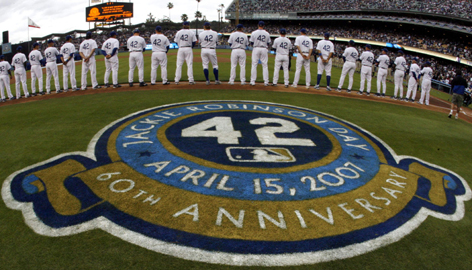
Today is a day that we rightfully remembered the life, message, martyrdom and legacy of Dr. Martin Luther King Jr. However as much as Dr. King matters, there were a long line of African American heroes who in their own way helped bring about racial equality in this country.  While many toiled in obscurity one, a baseball player named Jackie Robinson would forever alter the playing field of racial relations and how African Americans were perceived and received in the United States.  April 15th 2010 will be the 63rd anniversary of Jackie Robinson’s first game in the Major Leagues with the Brooklyn.  Robinson is not remembered with a National holiday but then again that takes noting away from this giant of American history. When Robinson stepped onto Ebbett’s Field in April 15th 1947 it was a watershed moment and while racial discrimination and prejudice remained they would be fighting a losing battle from that time on. Dr King in life and in death would be the one who drove the stake into the heart of the evil of racism and discrimination it was Jackie Robinson who helped place that stake above the heart of this evil.
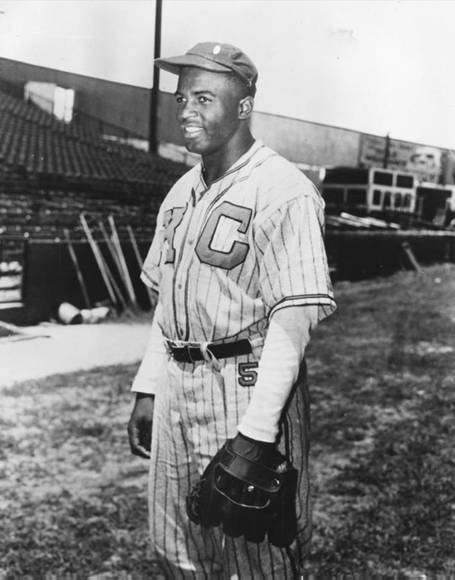
The Negro Leagues: Jackie in his Kansas City Monarch Uniform

We celebrate Dr King’s legacy today. However, without Jackie Robinson and the other African American baseball players who broke into the big leagues in the late 1940s and early 1950s it is conceivable that Dr, King would never have had the opportunity not only to be heard by African Americans, but to have his message heard and taken to heart by white America.

By the time Dr. King arrived on the scene much had already been done, and much due to Robinson and the owner of the Brooklyn Dodgers, Branch Rickey. Robinson’s first game with the Dodgers came a full year before President Truman integrated the military and a full seven years before the Supreme Court ruled school segregation unconstitutional.  It was not until 1964 that the Voters Rights act passed in Congress.  Jackie Robinson paved the way for a change in American society that has continued for 62 years since his debut at Ebbett’s Field on April 15th 1947.

Even before he stepped onto the field Jackie Robinson was a pioneer in equal rights where at UCLA he was the first student to letter in four varsity sports and in the Second World War where in an action that was a precursor to later civil rights battles the young Lieutenant Jackie Robinson was arrested and tried for not moving to the back of a bus at Fort Hood Texas.  He would be acquitted and given an honorable discharge before beginning his professional baseball career with the Kansas City Monarchs of the Negro League prior to Rickey signing him to a minor league contract with the Montreal Royals of the International League. Although he was met with scorn my many white baseball fans and some players and had to endure the ignominy of hostility from white fans and media, having to live in separate hotels and eat at separate restaurants Robinson developed a loyal fan base in Montreal and over a million people saw him play in his year in the International League.
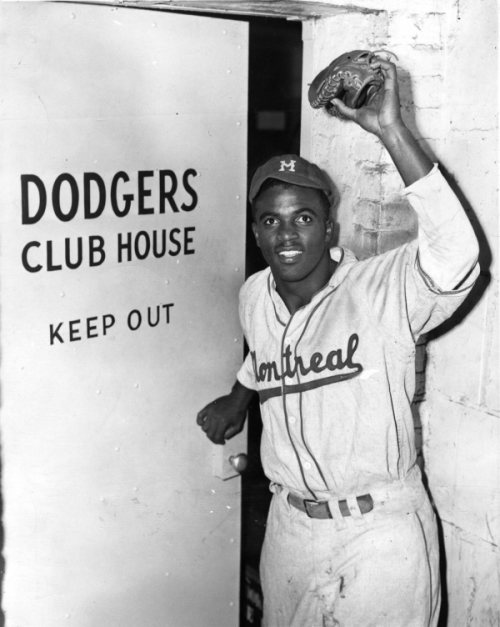
Jackie in his Montreal Royals Uniform outside the Dodger’s Clubhouse

When Branch Rickey talked with Robinson before the season he said: “Jackie (Robinson), we’ve got no army. There’s virtually nobody on our side. No owners, no umpires, very few newspapermen. And I’m afraid that many fans will be hostile. We’ll be in a tough position. We can win only if we can convince the world that I’m doing this because you’re a great ballplayer, a fine gentleman.”
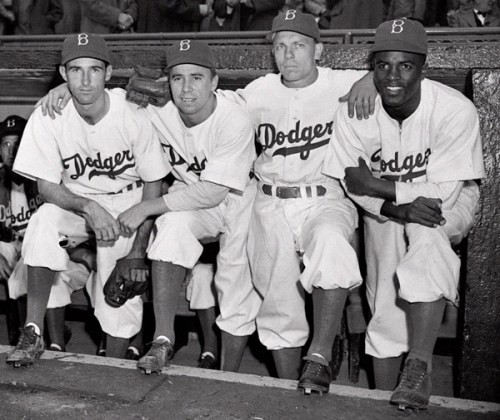
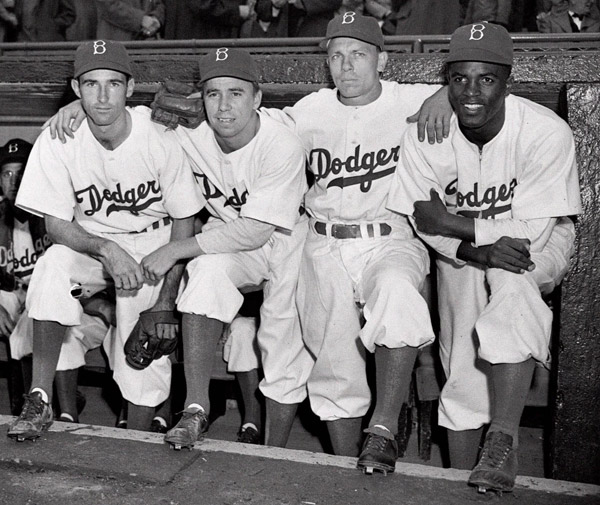
John Jorgensen, Pee Wee Reese, Ed Stanky and Jackie Robinson on opening day 1947

Jackie’s feat was a watershed moment in the history of our country.  Blacks had struggled for years against Jim Crow laws, discrimination in voting rights, and even simple human decencies such as where they could use a rest room, what hotels they could stay in or what part of the bus that they could sit.  In baseball many white fans were upset that blacks would be coming to see Robinson in stadiums that they would not have been allowed in before.  Players from other teams heckled Robinson, he received hate mail, people sent made death threats, and he was spiked and spit on.  But Jackie Robinson kept his pledge to Dodgers owner Branch Rickey not to lash out at his tormentors, as Rickey told him that he needed a man “with enough guts not to strike back.” In doing so his on field performance and poise under pressure won him the National League Rookie of the Year honor in 1947.
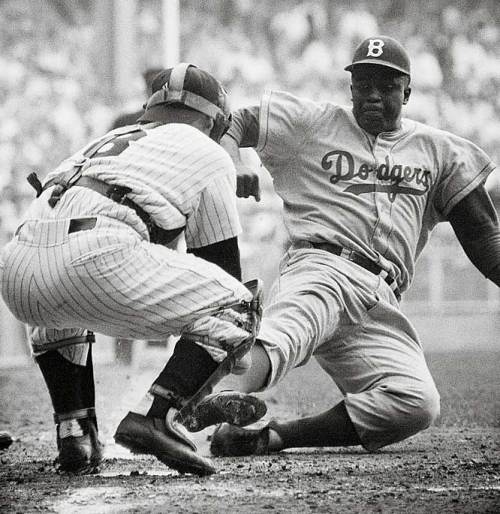
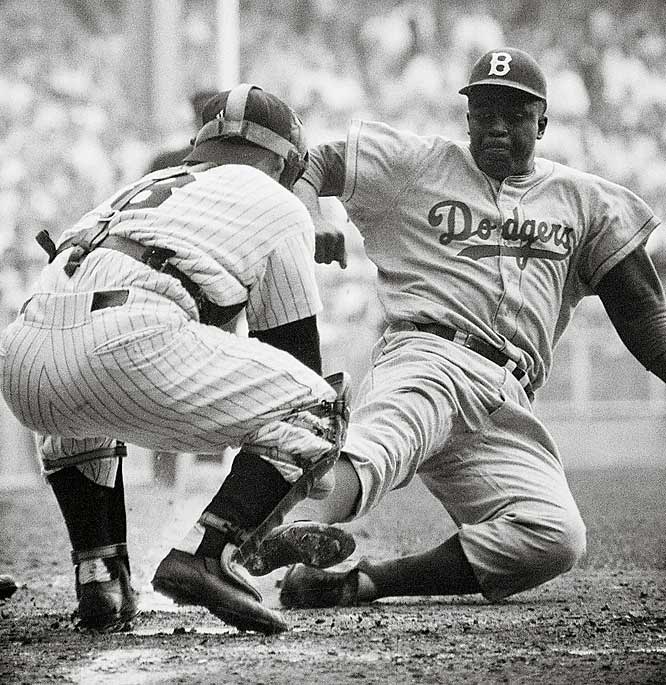
Jackie Stealing Home against the Yankees, the catcher is Yogi Berra

Jackie Robinson played the game with passion and even anger.  He took the advice of Hank Greenberg who as a Jew suffered continual racial epithets throughout his career “the best ways to combat slurs from the opposing dugout is to beat them on the field.” He would be honored as Rookie of the Year, was MVP, played in six World Series and six All Star Games.  He had a career .311 batting average, .409 on base percentage and a .474 Slugging percentage. He was elected to Baseball’s Hall of Fame in 1962. His teammate Pee Wee Reese would say: “Thinking about the things that happened, I don’t know any other ball player who could have done what he did. To be able to hit with everybody yelling at him. He had to block all that out, block out everything but this ball that is coming in at a hundred miles an hour. To do what he did has got to be the most tremendous thing I’ve ever seen in sports.”

Today Jackie Robinson’s feat is history, but it should not be forgotten.  He was a pioneer who made it possible for others to move forward.  He would be followed by players like Roy Campinella, Satchel Paige, Don Larson, Larry Dobie and Willie Mays.  His breakthrough had an effect not just on baseball but on society and helped make possible the later civil rights movement.  Dr. King would say of Jackie that he was “a legend and a symbol in his own time”, and that he “challenged the dark skies of intolerance and frustration.”  Historian Doris Kearns Godwin noted that Jackie’s “efforts were a monumental step in the civil-rights revolution in America” and that his “accomplishments allowed black and white Americans to be more respectful and open to one another and more appreciative of everyone’s abilities.” Time Magazine named him as one of the 100 most influential people of the 20th Century.
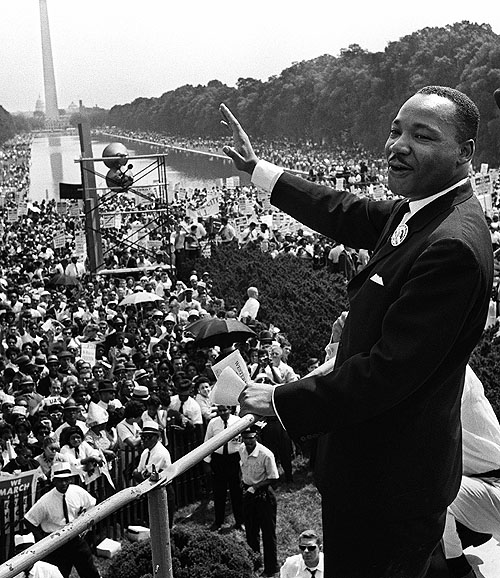
Dr Martin Luther King Jr “I have a dream”

We honor Dr King today and rightly so, but one can never forget those who paved the way so that we could all have the blessing of seeing Dr King’s dream come one step closer to fruition the dream that:

“one day this nation will rise up and live out the true meaning of its creed: ‘We hold these truths to be self-evident, that all men are created equal, that “children will one day live in a nation where they will not be judged by the color of their skin, but by the content of their character,” and that “one day on the red hills of Georgia the sons of former slaves and the sons of former slave owners will be able to sit down together at a table of brotherhood.”

Dr King would die by an assassin’s bullet in Memphis on the night of April 4th 1968 the day after finishing his final speech with these immortal remarks:

“And then I got to Memphis. And some began to say the threats, or talk about the threats that were out. What would happen to me from some of our sick white brothers? Well, I don’t know what will happen now. We’ve got some difficult days ahead. But it doesn’t matter with me now. Because I’ve been to the mountaintop. And I don’t mind. Like anybody, I would like to live a long life. Longevity has its place. But I’m not concerned about that now. I just want to do God’s will. And He’s allowed me to go up to the mountain. And I’ve looked over. And I’ve seen the Promised Land. I may not get there with you. But I want you to know tonight, that we, as a people, will get to the Promised Land. And I’m happy, tonight. I’m not worried about anything. I’m not fearing any man. Mine eyes have seen the glory of the coming of the Lord.”

Let us never forget Dr King nor those like Jackie Robinson who helped pave the way for Dr King.

Peace,

Padre Steve+

6 Comments

Filed under Baseball, History, Political Commentary