Tag Archives: chaplain g r gleig

The Afghanistan Quagmire and the Escalation of “Green on Blue” Attacks

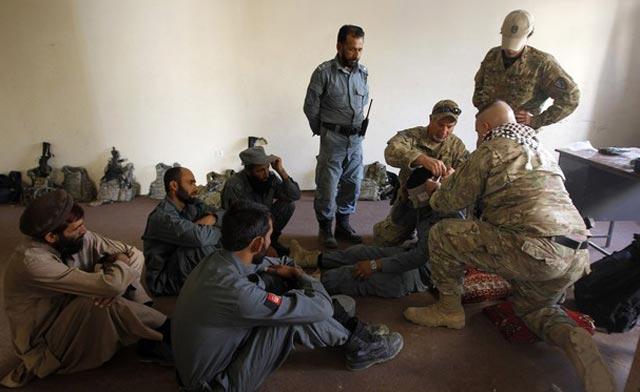
US Army Advisors training Afghan Police

We have forgotten what it is to be wise when it comes to foreign policy and have over the past ten years failed to learn from history when it comes to fighting in Afghanistan. A survivor of the horrific disaster that befell the British in the First Anglo-Afghan War, Chaplain G.R. Gleig wrote after that war:

“a war begun for no wise purpose, carried on with a strange mixture of rashness and timidity, brought to a close after suffering and disaster, without much glory attached either to the government which directed, or the great body of troops which waged it. Not one benefit, political or military, was acquired with this war. Our eventual evacuation of the country resembled the retreat of an army defeated.” 

This week has been another particularly horrific week for American troops in Afghanistan with our Afghan “partners” killing more Americans and NATO troops than our Taliban enemies. This week the command element of a combat brigade was attacked by a suicide bomber while going to a meeting with tribal leaders in Kunar province killing the Brigade Command Sergeant Major and two Majors from the Brigade staff. In a separate incident in Helmand Province three Marines were killed by a man described by an unnamed source to Reuters News as a Afghan National Police commander in charge of local police in Sangin district. They were at dinner with the Afghan when attacked. In a third attack a Afghan worker on an American base in Helmand killed three more Marines.

So far this year there have been at least 22 attacks by Afghan soldiers or police on US or NATO troops killing 33. In 2011 there were just 11 such attacks and 20 deaths. Any student of history should know that a foreign occupation force will never be accepted by most Afghans, especially tribal chieftains or elders. For them alliances with occupiers are only temporary measures to advance their own standing and power in Afghanistan. The British and Soviets both learned this the hard way and we seem to have forgotten the maxim that it is better to learn from the mistakes of others than make them yourself.

If there ever was a purpose to the Afghanistan campaign we seem to have forgotten it. We are in the process of withdraw. There is a danger inherent in any withdraw, especially in a geographically isolated place like Afghanistan. As we decrease in number and have fewer forces available to conduct operations our “partners” will make new alliances and turn against the forces that remain.

However we do not have the strategic or operational flexibility to send the number of troops needed to succeed in completely pacifying the country so we are in a double bind. The war saps our military strength, degrades our ground forces and pours money into an operation that we neither have, but need in order to modernize and strengthen forces for the wars that will certainly follow Afghanistan.

Soviet Advisors and Afghan Officers

The British met with debacle in the First Anglo-Afghan War and the Soviets were saved from disaster by a smartly executed withdraw that did not leave many forces exposed to Afghan treachery. British leaders were especially deceived by their Afghan partners. Shortly before his murder at the hands of Afghan tribal elders who had supposedly agreed to protect withdrawing British forces and their camp followers, British envoy Sir William MacNaghten wrote: “We shall part with the Afghans as friends, and I feel satisfied that any government which may be established hereafter will always be disposed to cultivate a good understanding with us.” 

The Soviets had no such illusions after their advisers in Herat were attacked with great loss before the 1979 invasion. They had their “green on blue” incidents but exacted painful and brutal retaliation. They also kept Afghan security forces at arms distance neither trusting them or allowing them much access to their bases. Unlike Iraq where green on blue incidents were isolated the situation in Afghanistan is little changed from when the Soviets or the British occupied the country.

“The latter [Soviet military advisors] served in particularly daunting conditions. They faced difference of language and tradition as well as mujahadeen infiltration in the ranks of supposedly loyal Afghan troops….” (Kalinovsky, Artemy: The Blind Leading the Blind: Soviet Advisors, Counter-Insurgency and Nation-Building in Afghanistan, p.6)

American and NATO political leaders are deceiving themselves if they believe that whatever Afghan government that comes after we withdraw will be friendly. It will not be and when we leave the unfortunate thing is that the Afghans will return to doing what they always do best, fight with one another. Nothing good can now come from our involvement in Afghanistan. The often heroic and noble sacrifices of so many brave men and women will be wasted and for what gain?

Otto Von Bismarck warned to “Beware of sentimental alliances where the consciousness of good deeds is the only compensation for noble sacrifices.” The situation in Afghanistan grows more precarious with each passing day. Our “alliance” with Pakistan is problematic and all supplies going into the Afghanistan must pass through either it or Russia. Our Afghan “partners” do not deserve the title of “Allies” we have made a Faustian bargain with the notorious Karzai government that has not helped our interests or those of the Afghan people an iota.

The situation in Afghanistan grows more precarious with each passing day.With the situation in Syria deteriorating and threatening to spill over into neighboring countries, with Iran and Israel blustering as we build up forces in the Arabian Gulf we do not have the luxury of simply keeping the status quo. We have to seriously ask why we are in Afghanistan and what we hope to accomplish for the great amount of blood and treasure that we are spending there.

That question must be asked of an answered by current political leaders in this country as well as those seeking to lead the country.

Peace

Padre Steve+
5 Comments

Filed under Foreign Policy, History, iraq,afghanistan, Military, national security

Failing to Learn from History: The Lesson of the First Anglo-Afghan War and Questions about the US-NATO Campaign

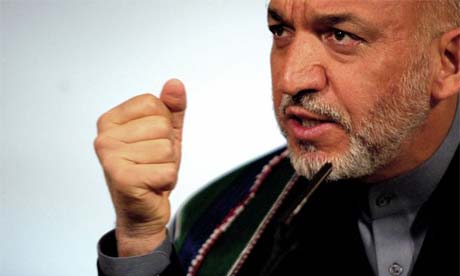
“The Americans in Afghanistan are Demons. They claim they burned Korans by mistake, but really those were “Satanic acts that will never be forgiven by apologies.” Afghanistan President Hamid Karzai

It seems that we in the West seldom learn from history nor do certain Afghan leaders like Hamid Karzai. The situation in Afghanistan has taken on a more ominous tone as the situation continues to spiral downward with Afghan President Hamid Karzai’s demand for the US and NATO to redeploy their troops to large bases and leave the countryside to Afghan control. Even more ominously he said that the Afghan-NATO relationship was “at the end of the rope.”  Karzai alluded that he did not believe that US and NATO account of the killing of 16 Afghan villagers near Kandahar.

This should come as no surprise to any observer of Afghanistan or anyone familiar with the relationship of Afghan leaders with western occupiers.  Karzai knows that the US-NATO era is coming to an end and even though he rules only because he is buttressed by western military power he is now trying to ensure his political and literal survival when we leave be it in 2013 or 2014.  The one thing that Karzai needs to keep in mind is that like his predecessors who turned on their western supporters be they British or Soviet he will be dangling from the end of the rope when we leave. He and his corrupt band of thieves who have alienated and plundered their own people will not survive their wrath once the protective cordon of American and NATO troops is withdrawn.

Karzai’s anti-American stance is further reinforced by the growing number of killings of US and NATO troops by Afghan police, soldiers and other personnel. Even this week an attack was made by an interpreter who drove a stolen pickup truck at a Marine Corps General and his British Brigadier assistant commander at Kandahar while awaiting the arrival of Secretary of Defense Panetta. Likewise the death of a Marine in February was officially announced as being at the hand of an Afghan soldier. The death occurred before the Afghan reaction to the burning of the Koran and was the 7th NATO service member who died at the hands of Afghan forces in February.

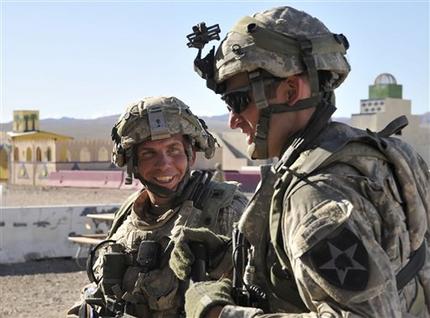
Staff Sergeant Robert Bales at the National Training Center in 2011 (US Army/DoD Photo)

The final nail in the coffin for the campaign occurred last week when Staff Sergeant Robert Bales for unknown reasons went on a shooting rampage killing 16 Afghan civilians including 9 children when they were asleep in their homes.  Bales actions whether attributable to a psychological breakdown, being drunk or if he was simply a cold blooded killer have effectively destroyed any chance of the United States and NATO recovering the situation in Afghanistan. It is already said that Bales attorney plans to use the case to also put the US war effort on trial. Since Bales reportedly has a Traumatic Brain Injury or TBI and possibly PTSD who allegedly was told that he would not be deployed again expect that the Army Medical Department and Madigan Army Medical Center will be raked over the coals. Those institutions and the Commanders of Joint-Base Lewis McChord are already being investigated for downgrading PTSD diagnosis to other mental illnesses that do not qualify for medical disability payments.

Staff Sergeant Bales appears to be a man who appeared until this incident to be an honorable and professional soldier with a distinguished combat record. However he had a number of potentially troubling legal and personal situations occur over the past number of years and had not been selected for promotion. How those events play into this and what may have happened to push him over the edge or to unleash an evil in him that no one knew was there will be the subject of much debate in the coming weeks.  None of it will be good for the United States.

At the same time the question will have to be asked how and why a soldier with injuries of PTSD and TBI was deployed as part of a small team supporting Special Forces troops instead of with his own unit even after allegedly being told that he would not redeploy.  That is a question that must be answered.  Why would the Army deploy a soldier with known PTSD and TBI as an Individual Augment with different unit than which he was assigned? In this environment he would not be in a place to have the same camaraderie of being part of his own unit probably suffer much more isolation with the inherent dangers of such a situation. Having served on small bases in Iraq with the small teams of advisors and having worked with Sailors, Soldiers, Marines and Airmen assigned to commands as Individual Augments (IAs) and having been one myself I can say that these assignments are often much more dangerous for those with preexisting trauma.

The result of this latest incident coming on the heels of the burning of the Koran and other religious texts at Bagram Air Base, the release of a You Tube video of a US Marine Scout Sniper team urinating on the corpses of Taliban fighters and the revelation of the “Kill team” in 2010 has for all practical purposes ended any chance of making a successful transition in Afghanistan.

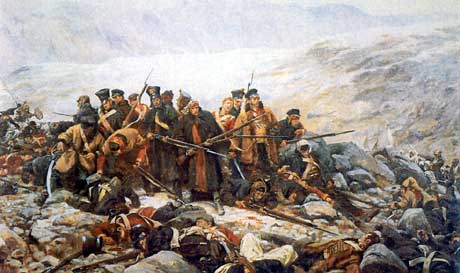
Last Stand of the 44th Regiment of Foot 1842

Afghanistan was supposed to be the “good war” and for a couple of years that is what it was. US forces had taken down the Taliban regime with minimal effort in 2001 and appeared to be well on their way to finishing off Al Qaeda and banishing the Taliban from Afghanistan. However in 2003 the US took its focus off of Afghanistan by invading Iraq. We also had placed our trust in Hamid Karzai to guide Afghanistan into a new and democratic era. Karzai has proven to be much like Sujah Shah Durrani who the British imposed on Afghanistan in 1838 when they could not get Emir Dost Mohammed Khan to do their bidding in trying to keep Russia and Persia from dominating Afghanistan. That was a mistake of epic proportions that led to one of the greatest British military, diplomatic and political disasters of the Empire.

A survivor to the First Anglo-Afghan War Chaplain G.R. Gleig wrote about that war something that may be said about our campaign there in years to come:

“a war begun for no wise purpose, carried on with a strange mixture of rashness and timidity, brought to a close after suffering and disaster, without much glory attached either to the government which directed, or the great body of troops which waged it. Not one benefit, political or military, was acquired with this war. Our eventual evacuation of the country resembled the retreat of an army defeated.” 

We can pray that it doesn’t happen that way. What started as an attempt to find and kill Osama Bin Laden and his Al Qaeda leadership in Afghanistan in October of 2001 has turned into a long term occupation that serves no strategic interest of the United States.  Nearly 100,000 US troops are tied down in a country where they can do little conduct local operations against an intractable enemy to support a corrupt government that the people of Afghanistan loathe.  It is so similar to the British experience that it makes one wonder if anyone has ever read a book about the country before invading it.

Bin Laden is dead and Al Qaeda is still reeling from continued strikes on its leadership. The goal of the war was achieved. Afghanistan is Afghanistan. It will not change and any threats brought by terrorists that may try to use it as a base can be defended so long as we are able and willing to whack a mole whenever they raise their head up, just as we are in the Horn of Africa, Yemen and even Pakistan. That does not require 100,000 tied down in Afghanistan where they are exposed to local threats as well as the possibility of being cut off from supplies should Pakistan or the Russian Federation cut supply lines or should hostilities break out with Iran.

Peace

Padre Steve+

4 Comments

Filed under counterinsurency in afghanistan, Foreign Policy, iraq,afghanistan, Military, national security, News and current events