Tag Archives: colonialism

Who Are the Real Savages? A Review of “The Lost Tribe of Coney Island by Claire Prentice

IMG_0501

Mark Twain once wrote that “There are many humorous things in the world; among them the white man’s notion that he is less savage than other savages.”

Throughout the history many races, peoples and civilizations have labored under the belief that they are superior to races that they have conquered or “liberated” and then placed on display for their own amusement. The Persians, Greeks, Egyptians, Romans, Chinese, Japanese and a host of European powers have done such things, as have we Americans. Sadly, in many cases the motives are evil, but sometimes there are shades of gray where one civilization, or certain representatives of it act in a manner of benevolent paternalism, while at the same time seeking to profit off of their superior place in life, whether they believe it is a mandate from God or the right of being biologically superior through the evolutionary process, and sometime a bit of both.

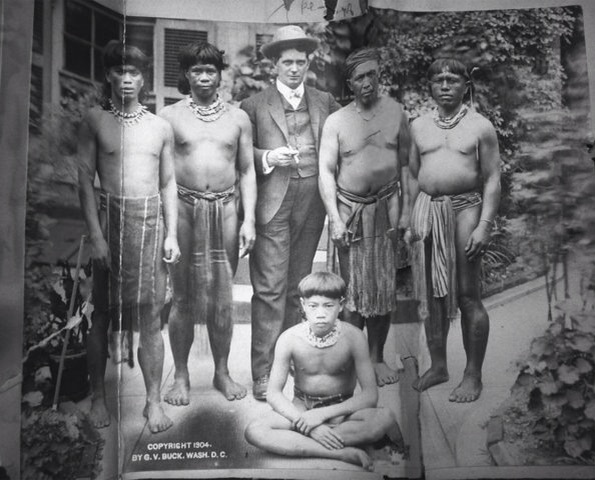
Award winning journalist Claire Prentice writes in her new book The Lost Tribe of Coney Island: Headhunters, Luna Park, and the Man Who Pulled Off the Spectacle of the Century (New Harvest, Houghton Mifflin Company, Boston and New York October 2014) of the story of American physician, soldier, treasure seeker, colonial administrator and showman Dr. Truman Knight Hunt and his exploitation of a group of forty-nine members of the Igorrote tribe who it brought to the United States in 1905.

Prentice’s telling of this story is a highly readable yet sobering account of the morality, economics, racism, colonialism and belief in the superiority of the white man above the “non-Christian savage” of that time. Her ability to weave the complex humanity of Hunt, a man who went to the Philippines out of a sense of patriotism, stayed in search of fortune, put his life on the line for the healthcare of the Igorrote, gained their trust, became a colonial administrator and then, seeking profit attempted to use the people who trusted him for his own gain after seeing another American reap the spoils of creating a human zoo of Igorrote and other Filipino tribesmen at the 1904 World’s Fair in St. Louis.

The story of how Hunt initially pulled this off amid the controversy evoked by the American war and occupation of the Philippines following the expulsion of the Spanish in 1898 is well told by Prentice. She is able to weave a story of complex motives, competing business interests to exploit people for the profit and entertainment of others into a highly readable tale.

The little known fact is that after evicting the Spanish from the Philippines the United States turned on the Filipino people and leaders who had helped us during the military campaign against the Spanish. The result was the 1899-1902 Philippine War, a brutal counter-insurgency campaign that was successfully concluded in a military sense, unlike most of the other counter-insurgency campaigns of he twentieth century, including Iraq and Afghanistan. The aftermath was a colonial administration of the new American Philippine Territory which only ended when the Japanese invaded the Philippines in 1941, after the liberation of the Philippines and following the Second World War, that country was finally granted its independence.

Hunt brought these forty-nine people to Luna Park on Coney Island, Hunt’s Igorrotes were basically, as other supposedly “savage” peoples had been before housed in what was little more than human zoo, for the amusement of Americans and the profit of Hunt and his partners. Prentice traces the roots of Hunt’s quest, the culture and history of the Igorrotes, and the greed, duplicity and the government quest that eventually brought Hunt to Justice and ended this spectacle.
 

IMG_0502.JPG


If Hunt had abided by his deal with the Igorrote to allow them to be paid and to keep money they made from the sale of various items, the situation might have gone on without incident, but Hunt lied to his charges, he kept them in padlocked cages or “villages,” sometimes going days without food, Hunt attempted to keep their money from them claiming that he was “ordered by the government to do so.” Eventually, the man hired by Hunt as his interpreter turned evidence against him, and the charade fell apart. Confronted by a government agent, Hunt’s Igorrote contradicted Hunt’s claim that the were happy and wanted to remain a part of his show, which he moved from Coney Island, to Chicago and on to Milwaukee.

Hunt was finally arrested for embezzlement in 1906, his faithful Igorrote interpreter Julio had filed the complaint with federal authorities. Hunt had without over ten-thousand dollars from his Igorrote tribesmen. A judge allowed most of the Igorrote to return to be released from their “contract” with Hunt while some remained to testify against him. Despite the overwhelming evidence against him a judge in Memphis declared a mistrial and despite attempts by the investigator to bring Hunt to justice, Hunt eluded it and with the great cost of the investigation, trial, the care of the Igorrote, and the massive and controversial costs of administering the Philippines, the government eventually dropped the case. Hunt lived what seemed to be an accursed life, continuing his less than honest living selling sham cures to diseases and leading a bigamous life after his release from jail.  Misfortune followed misfortune and Hunt died, ten years later and was buried in an unmarked grave in Cedar Rapids Iowa.

Despite the end of the relationship with Truman Hunt, other Igorrote remained on display and toured the United States and world for a number of years, though they appear to have fared better than those who Hunt defrauded and mistreated.

The story told by Prentice is remarkable because it shows us that despite the mythology of supposedly beneficent American masters, that American colonialism and profiting by what we would now call human trafficking was not as benevolent. It makes one wonder just who the real savages are, but then it appears that Mark Twain was right.

IMG_0508

This is an outstanding and well written account by Prentice that humanizes a forgotten and shameful part of our American colonial past.

Peace

Padre Steve+



3 Comments

Filed under books and literature, History, Loose thoughts and musings

Japan’s Self Defeating Attempts to Become Economically Self Sufficient in the 1930s

This is the first of a two part series that explores the similarities of the United States in 2009 to Japan of the early 1930s.  It explores the topic of economic self sufficiency or “autarky” and how nations can put the proverbial cart before the horse in terms of seeking ways to become self sufficient.  The Japanese chose the path of military conquest seeming to forget the fact that they were dependent on natural resources and manufactured equipment to wage such a war by the nations that they were attacking.

In the early 1930’s Japan’s desired to emulate the economic self-sufficiency of the United States or to achieve autarky controlling its own economic destiny by securing sufficient natural resources.  Japanese industrial and military leaders felt that such was needed for economic expansion as well as military preparation and expansion.  Key resources such as oil, specialized steels and alloys, iron ore, coking coal, machining tools and even cotton were not readily available in Japan proper.

Japans’ goal was unrealistic based on the differences of the two countries. In the early part of the 20th century the United States was self-sufficient in most critical natural resources and was a key supplier to the world of oil, iron, coal and grain.  Additionally most of the United States’ resources were contained within its borders or provided to it in trade with nations that needed what the United States had to offer in manufactured goods.  Japan did not have this.  As a nation it had few natural resources on the home islands and even suffered food shortages that resulted in famine at times.  It was dependant on other nations for basic natural resources to power its economy and to feed its population. As a result some of its political, economic and military leaders looked to achieve autarky through conquest.

Unfortunately for the Japanese they were surrounded by numerous powers that stood in their way.  To the north was Russia, which they vanquished in the 1905 war, but in doing so ended up nearly bankrupt, though they gained the Korean peninsula. However, the Japanese now faced the Soviet Union with its immense military on the Manchurian border and subterfuge in the politics of China by their support of Mao Tse Tung’s Red Chinese forces.  The Japanese were able to gain some possessions by participating on the Allied side in WWI at the expense of Germany and China, though they did not achieve all they wanted and felt cheated by the Allies at the Versailles peace conference. The first step was to invade Manchuria and seize its natural resources in 1931.  However to gain more than what they could garner in Manchuria the Japanese would have to do so at the expense of China and the Western Colonial powers, France, Britain, the Netherlands and United States. Japan’s quandary was how to achieve autarky without resorting to war with multiple enemies.

The Japanese faced a sort of “chicken or the egg scenario” as to what came first. In order to wage war Japan needed iron ore, coking coal and industrial salt from North China, oil from Borneo and Southeast Asia, cotton from America to make finished products for the American market. Likewise it needed special steels and alloys from the US to supply the war effort. The US was also the primary source of Japan for machine tools and other sophisticated industrial equipment needed for Japanese industry.  To go to war the Japanese required the imports of the very nations who stood in their way.

Yet to go to war entailed great risk, Japan did not have the resources, especially oil and metals with which to sustain their war effort without maintaining foreign trade with the very countries that they would have to engage in war.  All of these factors together made autarky in the style of the United States unreasonable through military means alone. It is likely that the Japanese could have achieved more by using more skillful diplomacy during the 1930s.  Had they built a mutually beneficial alliance with China, did more to exploit the natural resources of Manchuria and negotiated favorable trade deals with the United States they probably would have accomplished more than they did through using military force.  Some Japanese reformers attempted to make some of these reforms but were unsuccessful as the military particularly the Imperial Army, the government and industrial concerns became locked into the military option.

By contrast during its growth period the United States did not have to deal with significant military powers as it moved west across North America, only Native American Tribal groups.  The only power capable of stopping the United States was Great Britain.  While there were tensions between the United States and Great Britain along the Canadian border and Pacific Northwest during the 1850s, the United States never faced a significant external threat.  Thus the United States using very little military power gobbled up the continent and established its status as the Hegemon of the Western Hemisphere.  Japan could not do what it needed to do unless it negotiated with or conquered the powers that had significant military power to confront the Japanese and economic ability to strangle the Japanese economy.

This period should interest to any student of history, foreign policy and economics.  The study of the period of Japanese history needs to be considered by policy makers when considering war to obtain natural resources or critical supplies not indigenous to their country or for which they are dependent on potential hostile suppliers.  Like Japan in the 1930s the United States is not currently self sufficient in many natural resources especially oil and is dependent on other nations, especially China for critical items in its economy.  Having surrendered much of its industrial capacity and having failed to exploit alternatives to fossil based fuels, especially oil the United States faces a conundrum similar to the Japanese in the early 1930s.  The United States is militarily strong yet deeply politically divided and possibly unstable.  The United States is dependent on many nations, some who outwardly hostile to us for the very lifeblood of its economy.  Like the Japanese the military is singularly incapable of securing all of these resources and engaged in multiple wars that are tying up close to half our ground forces when one considers troops in theater and those unavailable because they slated to go or having just returned from combat deployments.  Additionally like the Japanese who were in the midst of the Great Depression the United States is going through what appears to be the worst economic times since that period.  Policy makers need to be careful when dealing with situations where economic factors are diminished and natural resources have to be imported to sustain the economy. Autarky is fine if you can do it but the United States has more in common economically with Japan of the 1930s than the we would like to admit.  Something to think about.

The second concluding section of this will be published in the next few days, the Deity Herself permitting…

Peace,

Steve+

5 Comments

Filed under History, Military