Tag Archives: donald rumsfeld

A Memorial Service as Tragedy Strikes Camp Lejeune on the 10th Anniversary of the Beginning of the Iraq War

9-11b

“God didn’t put us here for that pat on the back. He created us so he could be here himself. So he could exist in the lives of those he created, in his image.” Chaplain (Captain) Fr Francis Mulcahy M*A*S*H 

The past week has been difficult at Camp LeJeune. We lost a sailor, a hospital corpsman who died by his own hand last Monday. He was a veteran of Afghanistan and his death came as a surprise to his friends, family and shipmates. Today we conducted his memorial service. It was a full house. His family travelled to be here and his friends, those that served with him while he was assigned to the Marines as well as his current shipmates were there in abundance.

It was a time to grieve. The young man was beloved by his friends, respected and cared for. However something that none of us will ever know or understand overwhelmed him. It may have been the trauma of war, maybe something else, but he maintained a facade that kept his friends, family and shipmates away from whatever despair drove him to take his life.

It was a time for all of us to grieve. It was as William Shakespeare wrote in McBeth a time to “Give sorrow words; the grief that does not speak knits up the o’er wrought heart and bids it break.”

But even as we grieved the news filtered to the base that 7 Marines assigned to the Second Marine Division were killed, and a number of others injured when a mishap occurred where they were training in Nevada. Evidently either a mortar round either exploded in the tube or as it was being handled during a live fire exercise. They join the thousands of men and women who have died or been wounded in preparation for, the conduct of or the aftermath of their service in Iraq or Afghanistan. The death of each one leaves a void in the heart of a loved one, friend or shipmate.

Ergin-Osman1

Staff Sergeant Ergin Osman KIA Afghanistan

I have lost friends and shipmates in all phases of both wars and their aftermath. Some have died in combat, others while supporting combat operations of natural causes or accidents, some have committed suicide, including a Priest and Chaplain who served in both Vietnam and Iraq. Still countless others endure injuries or illnesses that will eventually kill them.

Likewise there are far too many more who have sustained terrible injuries to their minds, bodies and spirits that time will never heal. The young men and women that I see every day, those with the physical wounds of war and those with the unseen but sometimes even more disabling injuries such as PTSD, Traumatic Brain Injury or Moral Injury remain in the fight, sometimes with the sole mission of recover or remaining alive.

saddam0978

Ten years after the war in Iraq began and twelve and a half years after 9-11 and the invasion of Afghanistan the costs continue to build in lives and treasure. In Iraq almost 4500 American and over 300 other coalition casualties, more than 500 contractors and nearly 10,000 Iraqi Soldiers and Police and countless thousands of Iraqi civilians have died. US wounded alone number almost 35,000 in Iraq. In Afghanistan there are over 2100 US dead and about 1100 NATO and Coalition dead, hundreds of contractors, and thousands of Afghans with over 17,000 more American military wounded. Every day nearly 20 veterans take their lives while thousands of others struggle with physical, psychological and spiritual wounds of war, wounds that don’t heal even as they find that they no longer fit in the country that went shopping when they went to war. The costs of both wars now are building into trillions of dollars, costs that will continue to grow even after the wars wind down.

Butler-medals

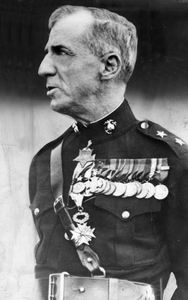
Two time Congressional Medal of Honor Winner Major General Smedley Butler, US Marine Corps wrote:

“What is the cost of war? what is the bill? Major General Smedley Butler wrote: “This bill renders a horrible accounting. Newly placed gravestones. Mangled bodies. Shattered minds. Broken hearts and homes. Economic instability. Depression and all of its attendant miseries. Back -breaking taxation for generations and generations. For a great many years as a soldier I had a suspicion that war was a racket; not only until I retired to civilian life did I fully realize it….” (See War is a Racket: Remembering Major General Smedley Butler USMC and Why He Matters

23_QU_18_d_HM_012ps

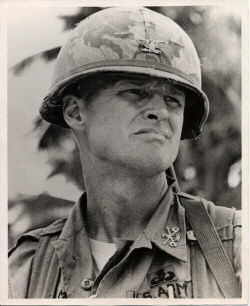
Likewise Lieutenant General (US Army Retired) Hal Moore, who is immortalized in the film We Were Soldiers and book We Were Soldiers Once…and Young told West Point Cadets in 2005:

The war in Iraq, I said, is not worth the life of even one American soldier. As for Secretary Rumsfeld, I told them, I never thought I would live long enough to see someone chosen to preside over the Pentagon who made Vietnam-era Defense Secretary Robert McNamara look good by comparison. The cadets sat in stunned silence; their professors were astonished. Some of these cadets would be leading young soldiers in combat in a matter of a few months. They deserved a straight answer.

The expensive lessons learned in Vietnam have been forgotten and a new generation of young American soldiers and Marines are paying the price today, following the orders of civilian political leaders as they are sworn to do. The soldiers and those who lead them will never fail to do their duty. They never have in our history. This is their burden. But there is another duty, another burden, that rests squarely on the shoulders of the American people. They should, by their vote, always choose a commander in chief who is wise, well read in history, thoughtful, and slow-exceedingly slow-to draw the sword and send young men and women out to fight and die for their country. We should not choose for so powerful an office someone who merely looks good on a television screen, speaks and thinks in sixty-second sound bites, and is adept at raising money for a campaign.

If we can’t get that part right then there will never be an end to the insanity that is war and the unending suffering that follows in war’s wake-and we must get it right if we are to survive and prosper as free Americans in this land a million Americans gave their lives to protect and defend.”

Needless to say, Moore, a West Point graduate has not been asked back.

n671902058_1153828_4309

Thousands of young Americans, as well as NATO or other Allied nation soldiers, including Iraqi soldiers that I knew and Afghans that I have not worked with have died or been mangled by these wars. Yet too many Americans, Europeans and others that have sent young men and women to these wars have no stake in the game.  Most people continue with the mundane aspects of peacetime life while their political, religious and business leaders plot even more war. Syria, Mali, North Korea, Iran…where will it end?

Today we mourned a shipmate and friend at Camp LeJeune even as we wait to see who else that we know have been killed or injured in this latest training accident. I was honored to be a part of the memorial and happy to be of help to the families and friends of my sailor. At the same time I too grieve and wonder just how many more will have to die before the madness ends.

I left the base after the ceremony, and saw the massed trucks of the local and national news networks parked outside the gate like vultures. When I got home I hugged my dog Molly, I love that little dog, she has helped save my life after my time in Iraq. I then went for a four mile run on the beach and then had a couple of beers with my dinner while at the bar with my friends at my local watering hole.

father

The old regulars there have nicknamed me “Father Mulcahy” a name that some people at the hospital have also given me. Maybe it is that I ear round steel rimmed glasses. Maybe it is because I will join in the occasional poker game , football, basketball or NASCAR pool, which by the way I won the NASCAR pool this week. Or maybe it is just because they didn’t know I was a Chaplain or Priest until a mutual friend and co-worker told one of them. Until then I was just Steve, the guy that wore the Orioles and Giants baseball gear. Now I have become their Priest and Chaplain, funny how that works. Regardless, it is a nickname that I cherish, because when I was growing up Fr Mulcahy symbolized so much of what I thought was good in a Priest and Chaplain. The writers of M*A*S*H made him very human. But I digress…

As we mourned today I was reminded of something that Helen Keller said, something that I think no matter what any of us grieve is true. “We bereaved are not alone. We belong to the largest company in all the world–the company of those who have known suffering.”

Pray for me a sinner.

Peace

Padre Steve+

Leave a comment

Filed under faith, iraq,afghanistan, Military, Pastoral Care, philosophy, PTSD

The Loss of an Icon: General Norman Schwarzkopf dies at 79

201212281047938734_20

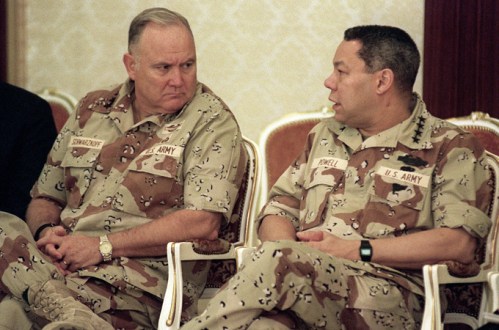
Schwarzkopf and Powell, the Eisenhower and Marshall of their Era

“Do what is right, not what you think the high headquarters wants or what you think will make you look good.” 

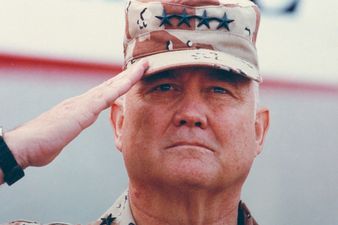
Americans lost a military hero and an icon yesterday. General Norman Schwarzkopf died in Tampa at the age of 79 due to complications of pneumonia.

Schwarzkopf was one of the most brilliant commanders of his era, a multi-dimensional character who was to many of us bigger than life.

Schwarzkopf was the quintessential Army Brat, growing up on military bases in the United States as well as in diplomatic posts overseas. The son of General he graduated from West Point, was commissioned as an infantry officer, became a paratrooper at Fort Campbell Kentucky before being assigned to the Berlin Brigade, a post he left just prior to the erection of the Berlin Wall by the Soviets and the East Germans. He completed a Masters degree in Mechanical Engineering from USC and was assigned as an instructor at West Point.

sch0-008a

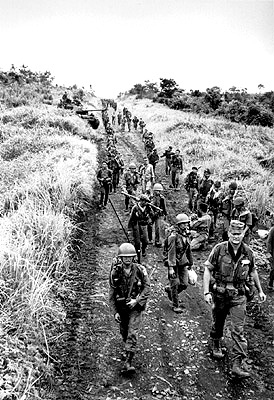
Schwarzkopf helping to carry a wounded South Vietnamese Paratrooper 

During that tour he volunteered to serve as an advisor with South Vietnamese paratroopers.  After that tour and the completion of his tour at West Point he was promote to Lieutenant Colonel and commanded the 1st Battalion 6th Infantry, 198th Brigade and was wounded while with his troops and who in the crisis kept his head and helped lead his troops, though seriously wounded out of the trap. He was known with affection by many soldiers as “the Bear,” a moniker that he appreciated much more than Desert Storm media nickname of “Stormin’ Norman.”

sch0-017

Schwarzkopf with ARVN Paratroops

It was during his time in Vietnam that Schwarzkopf came to a realization about men at war and his own personality. “I prided myself on being unflappable even in the most chaotic of circumstances,…That guise lasted until Vietnam, where I realized that I was dealing with human lives and if one were lost, it could never be replaced. I quickly learned that there was nothing wrong with being emotional.”

sch0-007a

Following his time in Vietnam he remained in the Army to help be a part of its rebuilding as an All Volunteer force. By the late 1970s he had served as a Brigade commander in the 9th Infantry Division and Assistant Division Commander in the 8th Infantry Division before taking command of the 24th Infantry Division in late 1982. He was appointed the Deputy Commander for the Joint Task Force that invaded Grenada in 1983 and in 1988 was appointed Commander for the US Central Command.

1general122812

It was in this capacity that he took command of US and coalition troops gathering to respond to Saddam Hussain’s invasion of Kuwait in August 1981. His leaders and planning cells helped engineer a military campaign in conjunction with the admirable skill of President George H.W. Bush and his diplomats the successful expulsion and destruction of Saddam’s forces. While some criticize the decision not to continue the war and go on to Baghdad Schwarzkopf made a comment that those that invaded Iraq in 2003 might well have better heeded: had “we taken all of Iraq, we would have been like a dinosaur in the tar pit — we would still be there, and we, not the United Nations, would be bearing the costs of that occupation.”

20436634_BG1

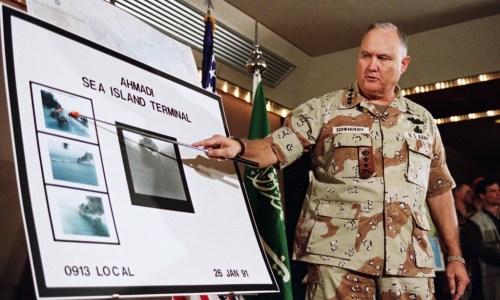
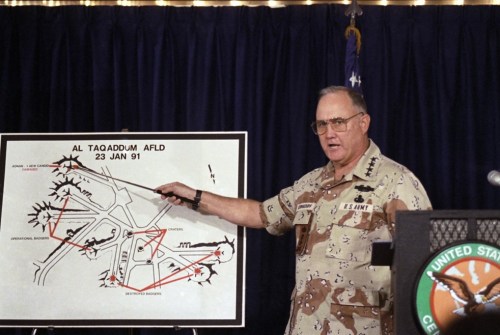
Schwarzkopf’s Briefings

After his retirement he was active in supporting cancer research programs, efforts to save the Grizzly Bear and was a military commentator and analyst for NBC. Although he supported the invasion of Iraq in 2003 he asked questions that few were asking. In early 2003 he told the Washington Post: “What is postwar Iraq going to look like, with the Kurds and the Sunnis and the Shiites? That’s a huge question, to my mind. It really should be part of the overall campaign plan.”  Following the invasion and the beginning of the insurgency he became a critic of the operation. He was particularly critical of Defense Secretary Donald Rumsfeld for not anticipating the consequences of the invasion and for Rumsfeld’s criticism of the Army and the deployment of reserve component troops into urban combat who did not have the correct training or equipment for the job. He also made another observation that few noted about Rumsfeld and much of the Pentagon staff and the Bush Administration appointees in Iraq, in that they “showed a total lack of understanding of the culture that we were dealing with.” 

Schwarzkopf was an original and though he was loathe to admit it a hero. He also knew that life was bigger than the military and that one has to be more than the sum of their career. He once told the Associated Press: “I may have made my reputation as a general in the Army and I’m very proud of that… “But I’ve always felt that I was more than one-dimensional. I’d like to think I’m a caring human being. … It’s nice to feel that you have a purpose.”

ip8CXZqG.OL8

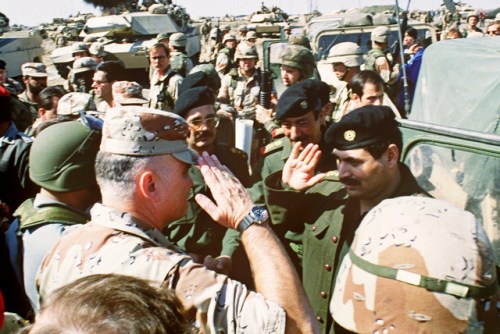
Schwarzkopf with Iraqi Generals at Cease Fire

Though I never served under his command while in the Army I knew many friends that did and my early career was shaped and molded by men life him.  He was not a perfect commander, analysis of his command in the Gulf show that he did make some mistakes, the greatest and most long lasting being the concession to allow the defeated Iraqi forces the use of helicopters which they used with great effect against the Shi’a tribes near Basra that sought independence.

However, in my mind it was Schwarzkopf’s public leadership that helped inspire his troops and encourage the nation which until that point had not recovered from all of the effects of the Vietnam War.  His briefings inspired confidence in America and with our Allies. He was as much of a diplomat in figuring out how to employ over 700,000 troops, military forces of 32 nation coalition, including numerous large Arab countries in a successful war.

Schwarzkopf also understood the full gravity of war and its effects on nations and people. He said: “I hate war. Absolutely, I hate war…Good generalship is a realization that … you’ve got to try and figure out how to accomplish your mission with a minimum loss of human life.”

He is remembered well. General Colin Powell who served as the Chairman of the Joint Chiefs during Desert Storm remarked after Schwarzkopf’s death “His leadership not only inspired his troops, but also inspired the nation. He was a good friend of mine, a close buddy. I will miss him.” From his hospital bed former President George H W Bush issued a statement saying that Schwarzkopf: “epitomized the ‘duty, service, country’ creed that has defended our freedom and seen this great nation through our most trying international crises….More than that, he was a good and decent man — and a dear friend.”  President Barak Obama praised him saying that “He was an American original” and “From his decorated service in Vietnam to the historic liberation of Kuwait and his leadership of United States Central Command, General Schwarzkopf stood tall for the country and Army he loved…”

Norman+Schwarzkopf+

Rest in Peace General, Rest in Peace,

Peace

Padre Steve+

2 Comments

Filed under History, iraq,afghanistan, leadership, middle east, Military, News and current events, vietnam

Thoughts on Choosing a President and the Results of Not Getting it Right: Lieutenant General Harold Moore at West Point

Lt.Gen. Harold (Hal) Moore is a legitimate American hero. Moore was commissioned as an infantry officer in the closing months of the Second World War, served in Korea and later in 1965 ed the 1st Battalion 7th Cavalry, 1st Cavalry Division into combat at the Battle of Ia Drang in Vietnam. In that battle, the first major engagement of US forces against North Vietnamese Army Regulars Moore’s outnumbered battalion held off elements of two NVA regiments. Moore’s book We Were Soldiers Once, and Young was adapted and released as the film We Were Soldiers where Moore was portrayed by Mel Gibson. His second book, We are Soldiers Still: A Journey back to the Battlefields of Vietnam are must reads for anyone who wants an honest assessment of going to war and the costs involved.

In 2005 Lt. Gen. Moore was invited to speak at West Point. It was during some of the worst times of the Iraq insurgency and Moore had been a critic of the war and Defense Secretary Donald Rumsfeld. He recounted the question and answer session in We are Soldiers Still:

“In a long question-and-answer session following my speech I was asked about Iraq and then Defense Secretary Rumsfeld. In this place-where cadets live by a code that says they never lie, cheat, steal, or quibble-I was bound to speak the truth as I knew it.

The war in Iraq, I said, is not worth the life of even one American soldier. As for Secretary Rumsfeld, I told them, I never thought I would live long enough to see someone chosen to preside over the Pentagon who made Vietnam-era Defense Secretary Robert McNamara look good by comparison. The cadets sat in stunned silence; their professors were astonished. Some of these cadets would be leading young soldiers in combat in a matter of a few months. They deserved a straight answer.

The expensive lessons learned in Vietnam have been forgotten and a new generation of young American soldiers and Marines are paying the price today, following the orders of civilian political leaders as they are sworn to do. The soldiers and those who lead them will never fail to do their duty. They never have in our history. This is their burden. But there is another duty, another burden, that rests squarely on the shoulders of the American people. They should, by their vote, always choose a commander in chief who is wise, well read in history, thoughtful, and slow-exceedingly slow-to draw the sword and send young men and women out to fight and die for their country. We should not choose for so powerful an office someone who merely looks good on a television screen, speaks and thinks in sixty-second sound bites, and is adept at raising money for a campaign.

If we can’t get that part right then there will never be an end to the insanity that is war and the unending suffering that follows in war’s wake-and we must get it right if we are to survive and prosper as free Americans in this land a million Americans gave their lives to protect and defend.” (Lt. Gen. Harold Moore at West Point Spring 2005) http://www.dailypaul.com/81039/inspiring-quote-from-lt-gen-harold-hal-moore-usa-ret

I make many comments about politics on this site. I am a critic of both parties and and their Presidential candidates. I find much to be desired in the leadership being displayed by many in political office and those running for office. However no matter which party a candidate belongs to I expect, like Lt. Gen. Moore that they are “wise, well read in history, thoughtful, and slow-exceedingly slow-to draw the sword and send young men and women out to fight and die for their country.”

I completely agree with Moore that We should not choose “someone who merely looks good on a television screen, speaks and thinks in sixty-second sound bites, and is adept at raising money for a campaign.”  

We should know better by now. We have experienced the tragedy of leaders who failed their soldiers and this nation in Vietnam, Somalia, Iraq and Afghanistan. However it is the responsibility of the American people to elect well qualified men and women to office. It is not to simply for people vote for their special interests and vote for those that can play the electoral game the best regardless of their actual qualifications or for that matter their wisdom.

I have served as an officer for 29 years in the Army and the Navy. I have served under five Presidents all of whom I found reason to agree with and disagree with on matters of policy. But they were the President and I was and still am not. It is possible that I will serve a sixth President before I retire from the military. Regardless of who that is or which party they represent I will be faithful to my oath and to the Constitution and be respectful of Office of the President and the man, or woman who holds it and I will pray for them. Likewise I pray that the men, or women that they chose as the civilian leaders of the military are both wise and morally courageous, unlike Robert McNamara or Donald Rumsfeld. The same is true for senior officers that set policy and lead troops in combat. We do not need what David Hackworth called the “perfumed princes” as leaders.

That being said I do pray that whoever is elected this November will be more than a good campaigner and be wise and thoughtful before committing the nation, and especially those that serve in the military to war. Our men and women serving in harms’ way deserve as much. Too many American Soldiers, Marines, Sailors and Airmen have died or come back horribly maimed from Vietnam, Iraq and Afghanistan for us not to expect as much from those that seek to lead the nation regardless of their political party.

Moore’s co-author, journalist Joe Galloway, a critic of both President Bush and President Obama wrote concerning Afghanistan in 2010:

“For God’s sake, don’t ratchet up slowly, buying time with the bodies of dead and wounded American soldiers, while you try to sell the wrong war in the wrong place against the wrong enemy to the American people.

For eight years, we’ve heard presidents and other politicians talk about setting conditions for a democratic central government in a country — really a bunch of tribes and clans — that’s never had such a thing in 2,000 years and seemingly doesn’t want one now.” http://www.mcclatchydc.com/2009/09/03/74876/commentary-afghanistan-isnt-worth.html#storylink=cpy   

We should listen more to men like Lt. Gen. Moore and Joe Galloway than to those that use the military for their political or economic gain spouting sound bite foreign policy to mask their ignorance.

Peace

Padre Steve+

4 Comments

Filed under History, iraq,afghanistan, leadership, News and current events, Political Commentary

Follow the Money: The Real Motives behind those Seeking to Radically Change the Military Retirement System

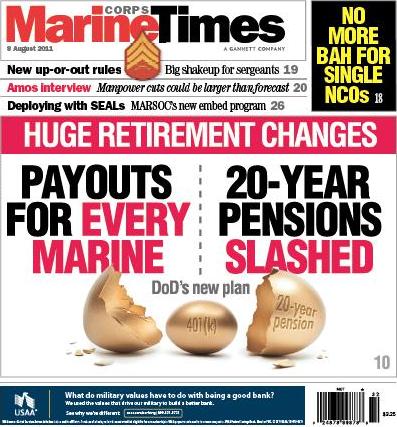
The Military Times put it on the Front Page last Week: Wednesday Secretary of Defense Leon Panetta announced at the National Defense University that no changes were coming soon. Despite that Military personnel should be on guard as the Defense Business Board continues to push for retirement changes that are bad for the service member, bad for keeping the best people in the military but that are great for Wall Street and Defense Contractors

There is much talk amid the current debate on the National Debt and the budget crisis of changing the military retirement system.  Of course the argument now being used by the most fervent advocates of change is that military retirement is a “rich entitlement program” which is draining the Defense Budget and keeping us from buying weapons, to quote Defense Business Board member Richard Spencer “What are you going to trade off — a rich entitlements program, or boots and bullets for the troops?”

Now on the surface that seems logical but in truth it is simply a way for American business and financial corporations to gain control of military retirement for their own gain.  The way they propose is to eliminate the current program and institute a 401K based system as used in many businesses.  However they fail to mention that military service in time of war, which if anyone hasn’t noticed we have been at for 10 years is quite different than working in the civilian world, the little things like long deployments, family separation and need I say getting shot at by bad guys and watching your friends and comrades be killed our maimed do tend to make military service more arduous than 99% of those that work in the civilian world.

The ideas put out by the Defense Business Board gut the military retirement system.  These plans are not in any sense of the word an “overhaul” of the system but a complete scrapping of a system that has worked.  The members of the board seem to believe that the problem with the military budget is that military personnel make too much money and that their retirement if they get to 20 years is breaking the budget.  The members of the board blame cutbacks in weapons systems on the personnel budget ignoring that most of the weapons systems cancelled or cut back were due to the massive cost overruns charged by defense contractors and the failure of those contractors to deliver the systems that they promised on time on budget or for that matter operational.

That list includes the grounded F-22 Raptor of the Air Force, the mechanically challenged LPD-17 San Antonio class amphibious ships, the under armed, undermanned and corrosion prone Littoral Combat ships which are actually two distinctly different classes of ship increasing the cost of the project.  Then there is the FA-35 Joint Strike Fighter which is way over budget and far behind schedule and despite all efforts none are in operational units yet and those in test units were grounded last week.  The Marine Corps lost the much touted but never produced Expeditionary Fighting Vehicle, the planned replacement for its Assault Amphibian Vehicle when the troubled and expensive program was cancelled by former Secretary of Defense Robert Gates.  The Army had to cancel their Future Combat Systems Manned Vehicle project in 2009.  The list can go on and on and on all the while the contractors that were involved made a mint off of the military.  Much was due to the fact that all of these systems were over budget, behind schedule and often under performing what they were designed to do.

Something else that the Defense Business Board ignores is the massive cost of the wars in Iraq and Afghanistan and the money being paid to civilian defense contractors such as Halliburton, Kellogg Brown and Root, the former Blackwater and hundreds of other players in the dash for Defense Department cash. They also fail to mention that the financial industry which a number of heavy hitters on the board represent ran our and the world economy onto the rocks back in 2008.

The Defense Business Board was established by former Defense Secretary Donald Rumsfeld in 2001.  All of the members are appointed by the Secretary of Defense and all of the current board members were appointed by Rumsfeld or Robert Gates.

So who are the members of this board and who do they work for?

John B. Goodman, Chairman: Serves as managing director of the U.S. Defense portfolio for Accenture, a global management consulting, technology services and outsourcing company.

Mark H. Ronald, Vice Chairman: As senior advisor to Veritas Capital Management is a private equity fund that invests in a broad range of middle market companies through buyouts, growth capital investments, and leveraged recapitalizations. Veritas Capital invests in companies that provide outsourced services to the government – primarily in the areas of defense and aerospace, security, and infrastructure. It has also earned a reputation as a niche defense investor and for turning around troubled defense contractors.

Fernando Amandi: The former Chief Operating Officer for Citibank Consumer Bank International inLatin America, President of Motorola International Network Ventures based in London, England and Senior Vice President and General Manager of the American Express Consumer Financial Services Division in Latin America.  At present, he is the President of Fanta Real Estate Investments, LLC.  He served for 6 years as an enlisted member of the Florida Army National Guard.

Owsley Brown II: Retired chairman and CEO of Brown-Forman Corporation. He served from 1966 to 1968 as an Army intelligence officer at the Pentagon.

Pierre A. Chao: Managing Partner and co-founder of Renaissance Strategic Advisors. The company website gives this description “Renaissance Strategic Advisors is focused on the global defense, space, government services, homeland security and commercial aerospace market. Our clients are typically senior decision makers at the Board of Directors, CEO, CFO, sector president or investment partner level. We work with firms up and down the value chain, from component manufacturers to prime contractors to private equity/venture capital firms. Our clients span the full life cycle from early stage startup firms to industry leaders.”

Patrick W. Gross: Chairman of  the Lovell Group, a private investment and advisory firm, where he works with a portfolio of venture capital backed private technology and internet commerce companies. He is currently a director of four public companies: Capital One Financial Corporation, Career Education Corporation, Liquidity Services, Inc., and Mobius Management Systems, Inc. In the 1960’s he worked in the Pentagon as one of “McNamara’s Whiz Kids.”

Lon Levin: President of Sky Seven Ventures, which works with, helps manage, and invests in new technology companies, particularly space-based businesses, including Sentinel Satellite (CEO), Transformational Space (Chief Strategic Officer), Slacker Radio (Senior Advisor to CEO and Board), Integral Systems, Terrestar Networks, and Near Earth LLC.

Bonnie Cohen: A consultant specializing in management and financial issues.  Ms. Cohen serves on the Board of Cohen & Steers Mutual Funds, a $20 billion dollar family of mutual funds. Ms. Cohen is a member of the Cosmos Club and on the Endowment Investment Committee.

Mel M. Immergut: Chairman of Milbank, Tweed, Hadley & McCloy LLP “a global law firm, with approximately 550 lawyers who provide a full range of financial and business legal services to many of the world’s leading financial, industrial and commercial enterprises, as well as governments, institutions and individuals.”

Edward A. Powell Jr.: President and CEO of the USO World Headquarters.

David H. Langstaff: President & Chief Executive Officer TASC, Inc. A technology and intelligence services a subsidiary of Northrop Grumman and Litton industries, both major Defense contractors.

Phil Odeen: Non-executive Chairman of AES, an international energy company and Convergys, a leading outsourcing company.  Convergys is one of the leading firms that help companies in the United States and  Western Europe outsource jobs overseas.

Arnold Punaro: Chief executive officer of the Punaro Group, LLC, a Washington-based firm offering government relations, strategic planning, federal budget and market analysis, communications, crisis and emergency management, business development and sensitive operations consulting.  Punaro retired from the Marine Corps Reserve as a Major General and unlike the rest of the board served in combat as a Rifle Company Platoon Commander where he was awarded the Bronze Star for Valor and the Purple Heart Medal.  He was mobilized for the Gulf War, the Bosnia operations and again at the beginning of Operation Enduring Freedom.  Since his retirement he has been a consistent critic of the military retirement system.

Richard Spencer: Managing Director of Fall Creek Management LLC a privately held management consulting company. He was the former Vice Chairman and Chief Financial Officer of Intercontinental Exchange, Inc. (NYSE-ICE) which according to its website “operates leading regulated exchanges, trading platforms and clearing houses serving global markets for agricultural, credit, currency, emissions, energy and equity index markets. ICE operates three futures exchanges including London-based ICE Futures Europe, which hosts trading in half of the world’s crude and refined oil futures contracts traded each day. ICE Futures U.S. and ICE Futures Canada list agricultural, currency and Russell Index futures and options markets. ICE also provides trade execution, processing and clearing services for the over-the-counter (OTC) energy and credit derivatives markets.”  Spencer served as a Marine Corps Aviator from 1976-1981.

Bobby Stein: President of the Regency Group, a family holding company located in Jacksonville,Florida. The Regency Group has invested in many businesses including the water, sewer and waste, real estate, mortgage service, and fast food industries.

Robert I. Toll: is Chairman and Chief Executive Officer of Toll Brothers, Inc., the leading builder of luxury homes

Atul Vashistha: Founder & Chairman, neoIT Founder & Chairman, NEOGROUP. According to the Defense Business Board website he is “a leading proponent and practitioner of globalization and futurizing enterprises. He is recognized globally as one of the leading advisors on globalization and outsourcing. He founded Neo Group (Formerly neoIT) in 1999 with the mission of helping enterprises grow their business and improve operations by leveraging outsourcing and globalization. Neo also advises government and trade bodies on how to be better destinations for outsourcing. Neo also help enterprises manage and monitor supply relationships, risks and governance.”

Kevin Walker: Chief Operating Officer of Iberdrola USA a public utility company and subsidiary company of the Spanish Electric Company Iberdrola. Walker is a 1985 graduate of theUnited States Military Academy and served as a Field Artillery Officer from 1985-1991 including a tour during Operation Desert Shield and Desert Storm.

Joe Wright: Senior Advisor to the Chart Group, L.P. which is a merchant banking firm investing in both venture and growth capital companies that also provides senior level advice and capital access to corporate clients. According to the company website it “is a merchant banking firm organized in 1994 to sponsor alternative investments and provide discreet, senior level advice and capital access to corporate clients.”

Jack Zoeller: Chairman and CEO of Bank of Virginia, a subsidiary of  which he co-founded in 2009 to bring new capital and management to troubled community banks in the Eastern U.S. He has also served as CEO of Cordia Bancorp, Capital Risk Management Corporation, ComFed Bancorp Incorporated, North American Company Health and Life Insurance Company, and AtlantiCare Risk Management Corporation.  Zoeller is a Military Academy graduate and former Infantry Officer who served with the 82nd Airborne Division.

John Hamre Chairman of the Defense Advisory Board and Chairman of the Defense Science Board serve in an ex-officio status.

Senior Fellows:

Neil F. Albert: President and CEO of MCR, LLC, a company specializing in management consulting, business analysis and forecasting, and information systems.

Barbara Barrett: Former Ambassador to Finland until 2009.  She is an international business and aviation attorney. CEO of Triple Creek Guest Ranch, a Montana Hideaway resort.

Denis Bovin: Co-Chairman and Co-CEO of Stone Key Partners LLC, a strategic and financial advisory investment bank which “offers mergers and acquisitions advisory services.” Prior to forming Stone Key Partners, Mr. Bovin was Vice Chairman –Investment Banking, Senior Managing Director and Chairman of the Global Technology, Media and Telecom Group at Bear Stearns & Co. He was a member of the team that directed Bear Stearns’ Investment Banking activities and had direct responsibility for a wide variety of the Firm’s key domestic and international investment banking clients.

Frederic W. Cook: Founding Director of Frederic W. Cook & Co., an independent consulting firm providing advice to corporate boards and compensation committees on executive compensation matters.  The company website says that they provide “consulting assistance to corporations in order to develop compensation programs for senior executives, key employees, and board of directors.” Prior to forming the firm in 1973, Fred was a principal in Towers, Perrin, Forster & Crosby, a firm which he joined in 1966 following four years of service as an infantry officer in the U.S. Marine Corps.

Madelyn Jennings: A Founder of the Cabot Advisory Group, President of the McGregor Links Foundation, and Co-Chair of the Executive Committee of the Freedom Forum. She is the retired Senior Vice President of Personnel at the Gannett Co., the largest newspaper company in the U.S., publisher of USA TODAY. Previously she was Vice President of Human Resources at Standard Brands Inc.

Jim Kimsey: Created America Online, Inc. He currently serves as Chairman Emeritus. He attended theUnited StatesMilitaryAcademy atWest Point.  He served three combat tours as an airborne ranger, two in Vietnam, earning various awards for service and valor.


William R. Phillips: Principal in Charge of KPMG’s Federal Advisory unit, located inMcLean,Virginia. In this role he is responsible for the development and execution of the unit’s business strategy, client services and business operations. His team supports clients across the Federal Government, representing most all agencies, including the Departments of Treasury, Energy, Defense, and Homeland Security, in addition to the intelligence community. Services include financial management improvement, strategy, IT security and internal controls, and supply chain management. Prior to joining KPMG, Mr. Phillips was a Vice President at IBM responsible for their services to the global defense community.  While Mr. Phillips was not involved his company KPMG has been the focus of several major criminal and civil investigations. In early 2005, theUnited States member firm, KPMG LLP, was accused by the United States Department of Justice of fraud in marketing abusive tax shelters. KPMG LLP admitted criminal wrongdoing in creating fraudulent tax shelters to help wealthy clients avoid $2.5 billion in taxes and agreed to pay $456 million in penalties in exchange for a deferred prosecution agreement. KPMG LLP would not face criminal prosecution if it complied with the terms of its agreement with the government. On January 3, 2007, the criminal conspiracy charges against KPMG were dropped.

Dov S. Zakheim: Senior Adviser at the Center for Strategic and International Studies at the CNA Corporation a non-profit research organization that operates the Center for Naval Analyses and the Institute for Public Research. Previously he was Senior Vice President of Booz Allen Hamilton, where he was a leader in the Firm’s global defense practice. During the 2000 presidential campaign, he served as a senior foreign policy advisor to then-Governor Bush. From 2001 to April 2004 he was Under Secretary of Defense (Comptroller) and Chief Financial Officer for the Department of Defense.  He chairs the National Intelligence Council’s International Business Practices Advisory Panel, and is a member of the Commission on Wartime Contracting in Iraq and Afghanistan; the Defense Business Board, which he helped establish.

Consultants:

John M. B. O’Connor: Chairman of J.H. Whitney Investment Management, LLC, which according to its website “pursues high absolute risk adjusted returns in a limited number of highly specialized investment strategies in the public markets. Our specific areas of excellence are Asian markets, Global Commodity and Macro markets, the US Equity Volatility complex and US Small Capitalization deep value equities.”

Leigh Warner: Senior Advisor to business leaders and government officials.  Her biography on the DBB website is very vague as to what corporations that she worked for or managed except that she did at one time serve as Director for Marketing of Kraft Foods.

Admiral Vernon Clark USN Retired: Former Chief of Naval Operations sacrificed 30,000 Navy personnel and decommissioned dozens of ships early in order to “recapitalize” the fleet, something that never occurred. Current CEO of SRI International  “an independent, nonprofit research institute conducting client-sponsored research and development for government agencies, commercial businesses, foundations, and other organizations. SRI also brings its innovations to the marketplace by licensing its intellectual property and creating new ventures.” On Board of Directors of Raytheon Company, Rolls Royce North America, Horizon Lines, and the World Board of Governors of the USO. He is a Distinguished Professor atRegentUniversity and serves as a Trustee at RegentUniversity,Vanguard University and Air University. He is a senior advisor with Booz Allen Hamilton, and is on advisory boards with the Defense Policy Board, Fleishman-Hillard, Northrop Grumman, Robertson Fuel Systems LLC, Cubic Defense Applications, Inc., and the Executive Committee of Military Ministry.

General Michael Carns USAF Retired: Served as Vice Chief of Staff of the Air Force from 1991-1994. In 1995 he withdrew his nomination to become director of the CIA when it was revealed that he had failed to properly compensate a young Filipino who legally accompanied his family to the United States, an act he said that was an “innocent mistake.” He currently serves as the Vice Chairman of Priva Source, Inc., a small software firm specializing in the security and de-identification of large, sensitive databases, in Weston, Massachusetts and serves on the Board of Directors for Virtual Agility, Inc.

Putting it all Together

Everyone knows that our country needs to put its financial house in order.  However let us put a few things in perspective.

The 50% of Pay Retirement Myth: The 50% myth is widely circulated and most people wrongly assume that a military member that retires at 20 years gets 50% of their pay when they retire.  First the 50% is actually the average of their highest three years of base pay, usually amounting to about 47% rather than 50%.  A lot of people talk about the 38 year old retiree getting 50% of his or her pay for life.  First only a fraction of enlisted members can retire that early and most of those are in the pay grades of E6 and E7.  Many more especially officers, warrant officers and those that reach the E8 to E9 level stay longer meaning that they enter civilian life at a point where their age becomes a factor against them.  Additionally all lose special pays and things like the Basic Allowance for Housing, combat pay and other benefits. This means that the average service member is only receiving about 35% of their active duty pay and allowances when they retire.  Add to this the fact that many have incurred injuries including combat related injuries that follow them well past retirement.  The board is also recommending cutting medical benefits with General Punaro calling them a “GM type benefit” that cannot be sustained.

Reserve Retirement: Reservists that qualify for retirement receive that pay at the age of 60 and only receive a fraction of what they would if they had 20 active years. Reserve retirement is calculated on actual days of active duty, points for inactive duty training (drills) and points for being in a drilling status.  To have a “good year” for retirement a reservist has to accumulate 50 retirement points which can be any of the above plus points for correspondence or online courses offered by the military.  Most reservists spend many more hours and days in unpaid status in order to maintain their qualifications and ensure that their units are able to do their mission.

Many Military job specialties do not have a civilian equivalent: Here is another fact that the Board and other civilian critics of the military compensation like to ignore.  The way they market their proposal is to basically say that military retirement puts one on easy street and that veterans walk right into great jobs when they leave the military.  The unemployment rate for veterans is far higher than the national average as are medical and psychological problems related to their service.

What would replace the current system? A mandated program similar to a 401K which invests the service member’s contributions estimated at about 16% a year into mutual funds and the stock market.  The Board’s plan reduces retired pay 5% for each year before age 57 (17 years x 5% = 85% reduction), yielding only $3,600 a year at age 40 for an E7 at current pay rates.  At age 60, the retiree would begin drawing money from the 401(K)-type plan. Using their assumptions that project a 7% return on the investment, the retiree would draw $13,600 more per year until age 85. If the member wanted to withdraw money after age 85, the annual withdrawal amount would be reduced.  Now the plan would provide a limited benefit to those that leave the service before the 20 year mark and that is a plus for those service members.

Retaining Qualified People: The retirement system is a huge part of our military’s success.  It encourages well qualified people who could be making more money in the civilian world to stay in the military.  Back in the 1980s Congress passed a retirement reform plan that reduced the 20 year retirement benefit to 40% of the high three years. Secretary of Defense Weinberger said that it would make it hard to retain qualified people. Congress passed it and during the Clinton administration had to return to the 50% high-three plan because we were losing too many of our best people.  To use a rather quaint term “you get what you pay for.”

Follow the Money:

The crux of the Defense Business Board’s proposal is to make military retirement like civilian retirement.  The only problem is that civilian firms generally don’t have a “retirement plan” anymore.  Instead they make minimal investments in 401K programs which leave their “retirees” at the mercy of the economy and the markets.  I know many people in their 60s and 70s that have seen their nest eggs blow away in the latest market turmoil.  This is not exactly a secure investment especially when these same retirees will certainly face the reduction or elimination of their Social Security benefits that they like all people (except the miniscule number that can opt-out of it) contribute.

So it really isn’t the service member that benefits from this plan. Likewise if you admit that like in the 1980s and 1990s we will lose a lot of our best people if the retirement benefit is removed or substantially reduced with the resultant loss in experience and expertise and the effect on combat power.

So who benefits? Follow the Money: The reason that I put all the board member names and who they work for and what their connections are is so you can follow the money.  I have not seen any other articles or blogs that really trace this to the source.  Almost every single member, fellow or advisor has significant ties and relationships with major defense contractors or Wall Street forms that deal in mutual fund management, investment and businesses that focus on outsourcing. All were appointed by either Secretary of Defense Rumsfeld or Gates and represent institutions that are closely allied with the business interests of the Republican Party. Those that say that “Obama is threatening to cut military retirement” either are ignorant or lying.

Since none of the Board members are employees of the government and only are reimbursed for their per diem they are not fair arbiters.  They represent the very firms on Wall Street and the Defense Industry that will gain the most from this plan.  Almost all are so deeply enmeshed in what Dwight D. Eisenhower called the Military Industrial Complex that their ultimate loyalty is to those that they work for, those very firms that have swindled and cheated the government by their mismanagement and inefficiency in building weapons systems that are over budget, behind schedule and often cannot be fielded, have to be cancelled or truncated or are failures that cannot perform the mission that they were designed to do.  Likewise they represent the major financial interests that were hat in hand responsible for the financial meltdown of 2008, our record unemployment and possible double dip recession.  The firms that these men and women represent would receive a cash infusion of major proportions coming from the forced contributions by a million and a half active and reserve military members.

To his credit the new Secretary of Defense Leon Panetta said on Wednesday that there would be no changes coming soon and any changes will have to be passed by Congress.

Conclusion: We have been at war for 10 years and in various states of war or peace making operations for 20 years.  During that time only about one half of one percent of the American population served in the military at any given time.  To insinuate that the military personnel who have borne the brunt of these wars are greedy, overpaid or self serving is obscene and to imply that they veteran’s organizations that go to bat for the serviceman or women are working against our national security by fighting for military personnel is unconscionable. For the members of this board to suggest that somehow what military personnel receive in compensation is too much and the benefits too generous should look in the mirror.  The retired military members of the Board have not given up their retirement and are all connected with the major defense contractors and financial institutions that would benefit the most from this plan.  Many of the corporate members have been living off of other people’s money and government contracts almost all of their professional lives.  They are the people that pay lobbyists to ensure that they get tax breaks even as they collect every government contract and service that they can take.

I do not know any of the people on the board and many are philanthropists and some donate time and money to organizations that honor the military.  I am not saying that these are bad people. I simply am saying that they represent their interests and those of the corporations that they run or that employ them.  It is what is called “crony capitalism.”

Follow the money my friends follow the money.

Peace

Padre Steve+

Note: All information in this article regarding the members of the committee comes from the Defense Business Board website, the corporate websites of the various organizations that employ them and various business periodicals and publications on the web.  

6 Comments

Filed under Military, national security, Political Commentary

Adjusting Strategy to Reality

Taliban Fighters

“The core goal of the U.S. strategy in the Afghanistan and Pakistan theater remains to disrupt, dismantle, and eventually defeat al-Qa’ida in the region and to prevent its return to either country…” US Strategy in Afghanistan for 2011

“The aim of war should be the defeat of the enemy.  But what constitutes defeat?  The conquest of his whole territory is not always necessary, and total occupation of his territory may not be enough.” Carl Von Clausewitz

Strategic goals cannot remain fixed on geographic objectives which have lost their strategic importance because it is no longer the enemy’s center of gravity. On September 11th 2011 the Taliban ruled Afghanistan which harbored Osama Bin Laden’s Al Qaeda terrorist organization became the central front in the new “War on Terrorism.”  For about a year Afghanistan remained the central focus of United States efforts against Al Qaeda until President Bush and his administration changed the primary effort to the invasion of Iraq and the overthrow of the Saddam Hussein regime.

The effect of switching the American strategic focus from Afghanistan where we were making headway despite the limited resources provided to Iraq was a mistake of epic proportions that only became evident when Iraq did not go the way that the Bush administration led by Vice President Dick Cheney. Secretary of Defense Donald Rumsfeld and Paul Bremer the head of the Coalition Provision Authority planned.  Instead of a quick withdraw a series of mistakes and miscalculations turned the majority of the Iraqi people who had welcomed US Forces with open arms against us and an insurgency which claimed over 4000 American military personnel deaths and over 30,000 wounded became our primary focus.  We are still trying to figure out how to end our involvement in that country hoping that Iraq will not sink into another civil war.

Contrary to expectations Iraq became a front which consumed U.S. Forces and limited strategic flexibility in other regions of the world including Afghanistan.  In that country the indigenous Taliban which had been driven from power in 2001 began a gradual and deliberate return to political and military viability which was finally noticed by the United States in 2008 and 2009.  The Taliban were supported by the Pakistani Taliban, elements of the Bin Laden organization and in many cases duplicitous elements within the Pakistani military and intelligence services which were using the situation to support their own strategic goals of gaining influence in Afghanistan while strengthening their position against their perceived mortal enemy India.  Throughout the war the Pakistanis acted in their own interest while placating American demands to do more against the Taliban and Al Qaeda operating in Pakistan proper.

The Obama administration attempted to regain the initiative with a “surge” of 30,000 additional troops which raised the overall commitment of the United States to a force of over 100,000 troops assisted by NATO Allies and the corrupt, ill-trained and often Taliban Afghan Army and Police.  The surge was controversial and marked with controversy was the US Commander General Stanley McCrystal was relieved of command after an article in the Rolling Stone magazine which made it appear that he held the Obama administration in contempt. Since McCrystal recently returned to the Administration in a civilian capacity one wonders if the administration discovered that the article was meant to discredit McCrystal. McCrystal was relieved by his superior CENTCOM Commander General David Petreaus who had helped devise the strategy which in conjunction with the Anbar Awakening turned the tide against Al Qaeda and indigenous Iraqi insurgents in 2007-2008.  It achieved some success but even the United States recognizes that whatever success has been wrought is fragile and could easily be erased.

Unfortunately while the United States and its Allies continue to reinforce the campaign in Afghanistan their efforts are often undercut by the corrupt and duplicitous regime of Mohammed Karzai as well as our supposed Pakistani allies.  The Karzai regime hunkered down in Kabul has little influence outside the Presidential Palace except in its dealing in the Opium trade which helps finance the Taliban. The Pakistanis have over the 10 year duration of the war failed to maintain the security on their side of the border and often have clandestinely supported the Taliban and according to some may have given sanctuary to Al Qaeda.  The most recent setback came today when the Pakistani Chief of the General Staff General Ashfaq Parvez Kayani and Chief of Intelligence Ahmed Shuja Pasha issued a demand for the US to stop Predator Drone strikes in the border regions, cut Special Forces and CIA Staff and give the Pakistani Intelligence Service, the ISI visibility on CIA operations.  This has been long in the works but came to a head with the arrest of a CIA contractor under the suspicion of murdering two Pakistanis.  The incident created quite a rift in US and Pakistani relations in part brought about by internal Pakistani politics.  Of course the ISI has long been a source of aid to the Taliban so the United States has good reason not to trust the ISI with information that could endanger American lives.

Protests in Bahrain: The Arabian Peninsula as the new Center of Gravity

The fact is without full Pakistani cooperation and substantial Afghani political reform to end corruption and provide real security to Afghani people there is no way to set conditions for a US withdraw that would leave Afghanistan a less dangerous place for its own people and for US and Western security interests. After all no one wants another 9-11 attack.  The US plans to begin withdrawing forces this year but the mission has been extended to at least 2014 at a cost of 119.4 billion dollars per year at the estimated 2011 rate and has increased exponentially since the US involvement began in 2001. The cost of the Afghanistan war in human, material and economic terms has imperiled other strategic priorities and limits the flexibility of the United States in other more vital regions.

Afghanistan is now an expensive sideshow in a larger war where the strategic center of gravity has shifted decisively to the Arabian Peninsula, North Africa and the Eastern Mediterranean where Al Qaeda seeks to use democratic revolts against autocratic despots to further its own ends. The key countries are Yemen, Saudi Arabia, Bahrain and Egypt with Lebanon, Syria, Jordan and the Israeli-Palestinian conflict boiling over.  While all of these crises grow on what seem to be a daily basis the United States and its Allies are mired in Afghanistan reinforcing failure.  Our troops on the ground have not lost a battle but like our brothers in Vietnam could “lose” the war.

This is the point where political and military leaders have to count the cost of the operation and weigh them against our actual strategic interests. The fact is if we withdrew the bulk of our ground combat forces and shifted to a lower footprint special operations and CIA campaign with a goal of ensuring that Al Qaeda cannot operate in Afghanistan with impunity as they did before 9-11 that we would likely be no worse off than we are now and have a greater amount of strategic flexibility to deal with other crises, political, military and humanitarian around the world.

The real crux of the issue is that Afghanistan is much like Stalingrad to the Germans in 1942. It has become a psychological more than a military campaign. We have invested so much in it that we do not believe that we can withdraw even though a scaled back presence would do much to improve our overall strategic situation.  Hitler denuded more important areas to attempt to capture Stalingrad and lost everything. Yes Al Qaeda used Afghanistan as its base to attack us in 2001 but they have moved on and Al Qaeda in Yemen and the Arabian Peninsula is a far greater strategic danger simply because of the oil supplies and strategic waterways in the area.

We simply need to look at all components of national strategy and decide where to concentrate.  Sometimes a strategic withdraw is necessary and actually vital to recover the initiative and set the stage for long term success. In Afghanistan this is not an admission of defeat but rather an acknowledgement that the central focus of the war and our strategic interests are elsewhere.  Our enemies would love to have us continue the campaign in Afghanistan in its current form, they know that our commitment drains our military, imperils our overall strategy and bleeds us dry economically all the while providing propaganda grist for them in their war against us.

However despite the cost the political situation in the United States keeps President Obama invested in Afghanistan. If he withdraws his opponents will say that he lost the war. Unfortunately the war in Afghanistan was ceded to the Taliban in 2003 when we decided that Iraq was more important. Now we reap the terrible consequences of that decision.  Now we have to decide how to make something positive out of this unenviable strategic position. But as Napoleon Bonaparte said “In order to govern, the question is not to follow out a more or less valid theory but to build with whatever materials are at hand. The inevitable must be accepted and turned to advantage.”

Peace

Padre Steve+


2 Comments

Filed under Loose thoughts and musings