
Friends of Padre Steve’s World
Tomorrow is the holiday where we remember the birth of Dr. Martin Luther King Jr. So I felt it appropriate to put out a revised section of my Civil War and Gettysburg text dealing with Emancipation and beginnings of African Americans being allowed to take their place in serving their country. Sadly, a country that so often, both before, and after emancipation, treated them as either something less than human, or as second class citizens. But the sacrifice of these pioneers helped pave the way for the civil rights of others: women, other ethnic minorities, and most recently the LGBT community. Without blacks, who certainly endured the most odious treatment under slavery than any other group in this country, the long and slow progress others have made would not have been possible. This is certainly not to say that our system, nor our treatment of minorities, immigrants, women and gays is completely fair and equitable. It is not, there are many flaws, and still much discrimination, prejudice and fear mongering which demonizes certain groups as well as seeks to roll back the gains that individuals belonging to these groups have made to be accepted into American society. Thus we continue to strive for “a more perfect Union.”
Peace
Padre Steve+
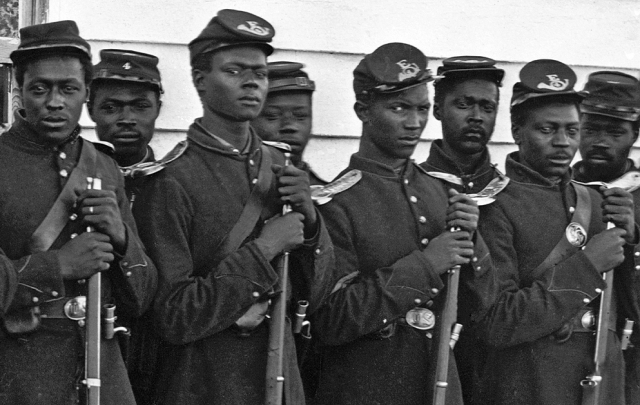
The war brought about another change to warfare in America. This was a societal and political change that has shaped American military history, culture and life ever since. The Emancipation Proclamation gave African Americans, both Freedmen and recently freed slaves the opportunity to serve in the Union Army. The change of policy instituted by Lincoln was revolutionary as well as controversial and it had strategic implications for the war effort. There were many doubters in the north whose attitudes towards African Americans were not much different than Southerners, especially among the Copperheads.
Prior to the Emancipation some Union commanders in occupied Confederate territory “had unofficially recruited black soldiers in Kansas and in occupied portions of South Carolina and Louisiana in 1862. But the administration had not sanctioned these activities.” [1] But as the war continued on, consuming vast numbers of lives the attitude of Lincoln and the administration began to change.
Lincoln and the closest members of his cabinet were beginning to understand that the “North could not win the war without mobilizing all of its resources and striking against Southern resources used to sustain the Confederate war effort.” [2]
Lincoln’s Secretary of War, Edwin Stanton; who was a passionate believer in the justice of emancipation “Instantly grasped the military value of the proclamation. Having spent more time than any of his colleagues contemplating the logistical problems facing the army, he understood the tremendous advantage to be gained if the massive workforce of slaves could be transferred from the Confederacy to the Union.” [3]
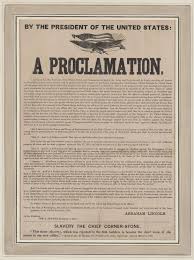
Lincoln emphasized the “military necessity” of emancipation and “justified the step as a “fit and necessary war measure for suppressing the rebellion.” [4] The process of emancipation now became not only a moral crusade, but now became a key part of national strategy. Lincoln wrote to his future Vice President, Andrew Johnson, then the military governor of occupied Tennessee that “The colored population is the great available and yet unavailed of, force for restoration of the Union.” [5] The idea of simply mollifying the border states was dropped and policy changed that of “depriving the Confederacy of slave labor. Mobilizing that manpower for the Union- as soldiers as well as laborers- was a natural corollary.” [6] Reflecting President Lincoln’s and Stanton’s argument for the military necessity of emancipation, General Henry Halleck wrote to Ulysses Grant that:
“the character of the war has very much changed within the past year. There is now no possibility of reconciliation with the rebels… We must conquer the rebels or be conquered by them….Every slave withdrawn from the enemy is the equivalent of a white man put hors de combat.” [7]
Grant concurred with the decision. Grant wrote to in a letter to Lincoln after the assault on Battery Wagner “by arming the negro we have added a powerful ally. They will make good soldiers and taking them from the enemy weakens him in the same proportion as it strengthens us.” [8] Lincoln wrote after the Emancipation Proclamation that “the emancipation policy, and the use of colored troops, constitute the heaviest blow yet dealt to the rebellion.” [9] The change was a watershed in both American history as well as the future of the U.S. Military services.
Emancipation allowed for the formation of regiments of United States Colored Troops (USCT), mustered directly into Federal service, which in numbers soon dwarfed the few state raised Black Regiments. However, it was the inspiration provided by those first state raised regiments as well as the violence directed against Blacks in the draft riots helped to provoke “many northerners into a backlash against the consequences of violent racism.” [10] The valor of the state regiments, as well as the USCT units that managed to get into action was remarkable, especially in regard to the amount of discrimination levied at them by some northerners, and the very real threat of death that they faced of captured by Confederates.
In May of 1863 Major General Nathaniel Banks dared to send the First and Third Regiments of “Louisiana Native Home Guard regiments on a series of attacks on Confederate positions at Port Hudson, Louisiana” [11] where they received their baptism of fire. They suffered heavy losses and “of the 1080 men in the ranks, 271 were hit, or one out of every four.” [12] Banks said of them in his after action report: “They answered every expectation…In many respects their conduct was heroic…The severe test to which they were subjected, and the determined manner in which they encountered the enemy, leave upon my mind no doubt of their ultimate success.” [13]
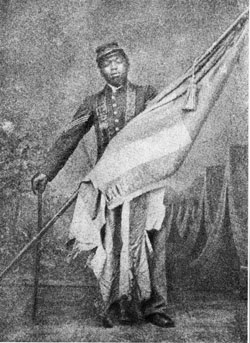
Sergeant William H. Carney of the 54th Massachusetts, Medal of Honor
But the most famous African American volunteer regiment was the 54th Massachusetts, commanded by Colonel Robert Gould Shaw, the “North’s showcase black regiment.” [14] Raised in Boston and officered by many men who were the sons of Boston’s blue blood abolitionist elite, the regiment was authorized in March 1863. Since there was still opposition to the formation of units made up of African Americans, Massachusetts Governor John Andrew authorized the formation of the 54th under the command of white officers, a practice that with few exceptions, became standard in the U.S. military until President Truman desegregated the armed forces in 1948. Governor Andrew was determined to ensure that the officers of the 54th were men of “firm antislavery principles…superior to a vulgar contempt for color.” [15]
The 54th saw action first in early June and at Gould’s urging sent into battle against the Confederate positions at Fort Wagner on July 18th 1863. Leading the attack the 54th lost nearly half its men, “including Colonel Shaw with a bullet through his heart. Black soldiers gained Wagner’s parapet and held it for an hour before falling back.” [16] Though they tried to hold on they were pushed back after a stubborn fight to secure a breach in the fort’s defenses. “Sergeant William H Carney staggered back from the fort with wounds in his chest and right arm, but with the regiment’s Stars and Stripes securely in his grasp. “The old flag never touched the ground, boys,” Carney gasped as he collapsed at the first field hospital he could find.” [17] Shaw was buried with his men by the Confederates and when Union commanders asked for the return of his body were told “We have buried him with his niggers,” Shaw’s father quelled a northern effort to recover his son’s body with these words: We hold that a soldier’s most appropriate burial-place is on the field where he has fallen.” [18] As with so many frontal attacks on prepared positions throughout the war, valor alone could not overcome a well dug in enemy. “Negro troops proved that they could stop bullets and shell fragments as good as white men, but that was about all.” [19]
Despite the setback, the regiment went on to further actions where it continued to distinguish itself. The Northern press, particularly abolitionists papers brought about a change in the way that many Americans in the North, civilians as well as soldiers, saw blacks. The Atlantic Monthly noted “Through the cannon smoke of that dark night, the manhood of the colored race shines before many eyes that would not see.” [20]
Frederick Douglass, who had two sons serving in the 54th Massachusetts, understood the importance of African Americans taking up arms against those that had enslaved them in order to win their freedom:
“Once let a black man get upon his person the brass letters U.S… let him get an eagle on his button, and a musket on his shoulder and bullets in his pockets, and there is no power on earth which can deny he has won the right to citizenship in the United States.” [21]
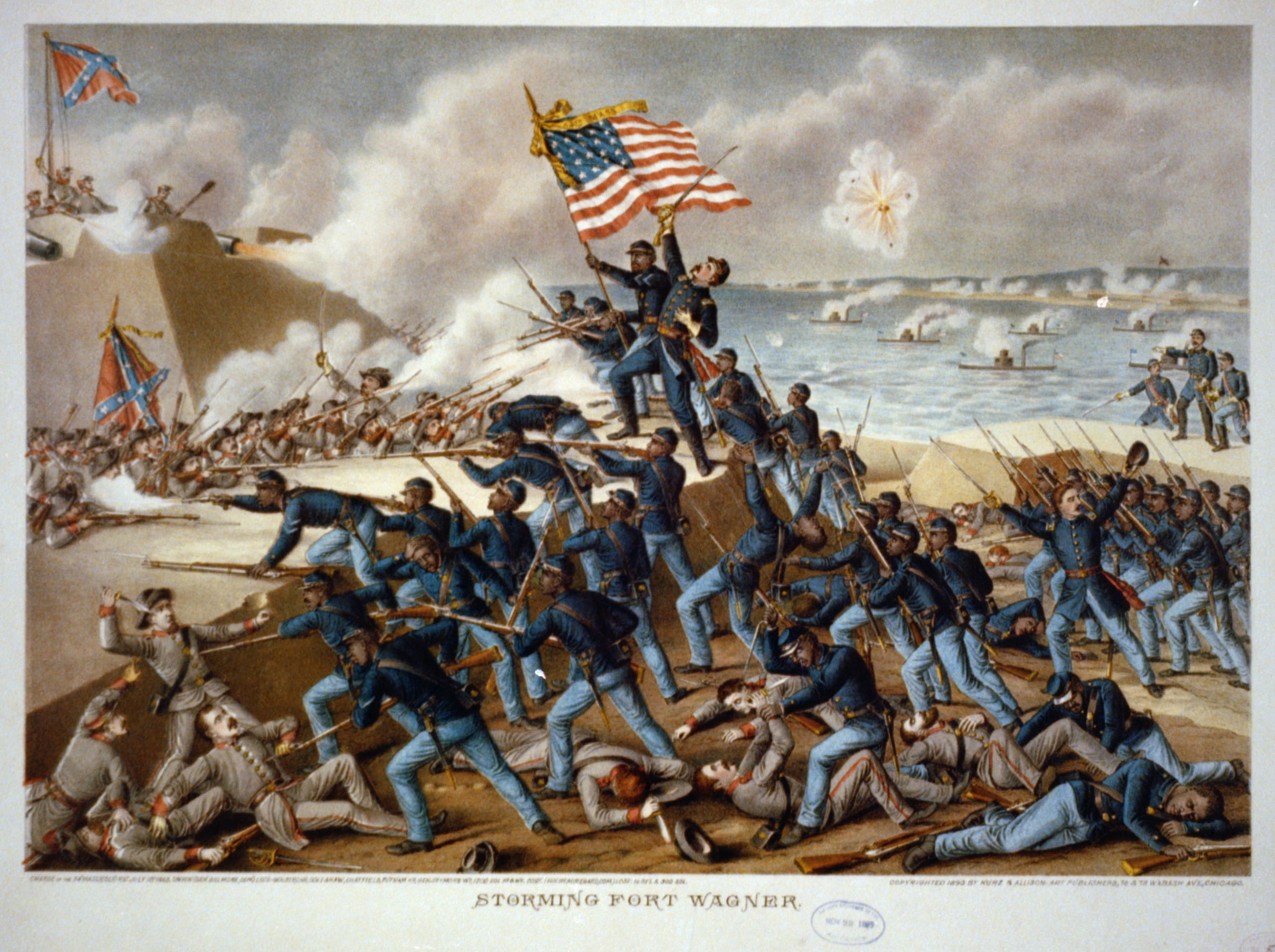
Other African American units less famous than the illustrious 54th Massachusetts distinguished themselves in action against Confederate forces. Two regiments of newly recruited blacks were encamped at Milliken’s Bend Louisiana when they were attacked by a Confederate brigade attempting to relieve the Vicksburg Garrison. The troops were untrained and ill-armed but held on against a determined enemy:
“Untrained and armed with old muskets, most of the black troops nevertheless fought desperately. With the aid of two gunboats they finally drove off the enemy. For raw troops, wrote Grant, the freedmen “behaved well.” Assistant Secretary of War Dana, still with Grant’s army, spoke with more enthusiasm. “The bravery of the blacks,” he declared, “completely revolutionized the sentiment in the army with regard to the employment of negro troops. I heard prominent officers who had formerly in private had sneered at the idea of negroes fighting express after that as heartily in favor of it.” [22]
By the end of the war 179,000 African American Soldiers, commanded by 7,000 white officers served in the Union armies. For a number of reasons most of these units were confined to rear area duties or working with logistics and transportation operations. The policies to regulate USCT regiments to supporting tasks in non-combat roles “frustrated many African American soldiers who wanted a chance to prove themselves in battle.” [23] Many of the soldiers and their white officers argued to be let into the fight as they felt that “only by proving themselves in combat could blacks overcome stereotypes of inferiority and prove their “manhood.” [24] Even so in many places in the army the USCT and state regiments made up of blacks were scorned:
“A young officer who left his place in a white regiment to become colonel of a colored regiment was frankly told by a staff officer that “we don’t want any nigger soldiers in the Army of the Potomac,” and his general took him aside to say: “I’m sorry to have you leave my command, and am still more sorry that you are going to serve with Negroes. I think that it is a disgrace to the army to make soldiers of them.” The general added that he felt this way because he was sure that colored soldiers just would not fight.” [25]
The general of course, was wrong. In the engagements where USCT units were allowed to fight, they did so with varying success most often attributable to the direction of their senior officers. When given the chance they almost always fought well, even when badly commanded. This was true as well when they were thrown into hopeless situations. One such instance was when Ferrero’s Division, comprised of colored troops were thrown into the Battle of the Crater at Petersburg when “that battle lost beyond all recall.” [26] The troops advanced in good order singing as they went, while their commander, General Ferrero took cover in a dugout and started drinking; but the Confederate defenders had been reinforced and “Unsupported, subjected to a galling fire from batteries on the flanks, and from infantry fire in front and partly on the flank,” a witness write, “they broke up in disorder and fell back into the crater.” [27] Pressed into the carnage of the crater where white troops from the three divisions already savaged by the fighting had taken cover, the “black troops fought with desperation, uncertain of their fate if captured.” [28] In the battle the division lost 1327 of just under 4000 men. [29]
When captured by Confederates, black soldiers and their white officers received no quarter from many Confederate opponents. General Edmund Kirby Smith who held overall command of Confederate forces west of the Mississippi instructed General Richard Taylor to simply execute black soldiers and their white officers: “I hope…that your subordinates who may have been in command of capturing parties may have recognized the propriety of giving no quarter to armed negroes and their officers. In this way we may be relieved from a disagreeable dilemma.” [30] This was not only a local policy, but echoed at the highest levels of the Confederate government. In 1862 the Confederate government issued an order that threatened white officers commanding blacks: “any commissioned officer employed in the drilling, organizing or instructing slaves with their view to armed service in this war…as outlaws” would be “held in close confinement for execution as a felon.” [31]
On April 12th 1864 at Fort Pillow, troops under the command of General Nathan Bedford Forrest massacred the bulk of over 231 Union most of them black as they tried to surrender. While it is fairly clear that Forrest did not order the massacre and even attempted to stop it, it was clear that he had lost control of his troops. His soldiers fought with the fury of men possessed by hatred of an enemy that they considered ‘a lesser race’ slaughtered the Union troops as they either tried to surrender or flee; but he was not displeased with the result. Ulysses Grant wrote that:
“These troops fought bravely, but were overpowered I will leave Forrest in his dispatches to tell what he did with them.
“The river was dyed,” he says, “with the blood of the slaughtered for up to 200 years. The approximate loss was upward of five hundred killed; but few of the officers escaped. My loss was about twenty killed. It is hoped that these facts will demonstrate to the Northern people that negro soldiers cannot cope with Southerners.” Subsequently Forrest made a report in which he left out the part that shocks humanity to read.” [32]
”The bulk of the killing was directed at the black soldiers of the 6th U.S. Colored Heavy Artillery, which composed over a third of the garrison. “Of the 262 Negro members of the garrison, only 58- just over 20 percent- were marched away as prisoners; while of the 295 whites, 168- just under sixty percent were taken.” [33] A white survivor of the 13th West Tennessee Cavalry, a Union unit at the fort wrote: “We all threw down our arms and gave tokens of surrender, asking for quarter…but no quarter was given….I saw 4 white men and at least 25 negroes shot while begging for mercy….These were all soldiers. There were also 2 negro women and 3 little children standing within 25 steps of me, when a rebel stepped up to them and said, “Yes, God damn you, you thought you were free, did you?” and shot them all. They all fell but one child, when he knocked it in the head with the breech of his gun.” [34]A Confederate Sergeant wrote home a week after the massacre: “the poor deluded negroes would run up to our men, fall upon their knees and with uplifted hands scream for mercy, but were ordered to their feet and shot down.” [35]
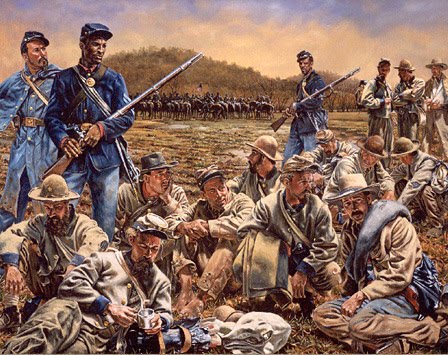
African American soldiers proved themselves during the war and their efforts paved the way for Lincoln and others to begin considering the full equality of blacks as citizens. If they could fight and die for the country, how could they be denied the right to votes, be elected to office, serve on juries or go to public schools? Under political pressure to end the war during the stalemate before Petersburg and Atlanta in the summer of 1864, Lincoln reacted angrily to Copperheads as well as wavering Republicans on the issue of emancipation:
“But no human power can subdue this rebellion without using the Emancipation lever as I have done.” More than 100,000 black soldiers were fighting for the Union and their efforts were crucial to northern victory. They would not continue fighting if they thought the North intended to betray them….If they stake their lives for us they must be prompted by the strongest motive…the promise of freedom. And the promise being made, must be kept…There have been men who proposed to me to return to slavery the black warriors. “I should be damned in time & in eternity for so doing. The world shall know that I will keep my faith to friends & enemies, come what will.” [36]
Despite this, even in the North during and after the war, blacks, including former soldiers would be discriminated against, sometimes by the white men that they served alongside. Those rights would be fought for another century and what began in 1863 with the brave service and sacrifice of these African American soldiers began a process of increased civil rights that is still going on today. It would not be until after the war that some blacks were commissioned as officers in the Army. When Governor John Andrew, the man who had raised the 54th Massachusetts attempted to:
“issue a state commission to Sergeant Stephen Swails of the 54th…the Bureau of Colored Troops obstinately refused to issue Swails a discharge from his sergeant’s rank, and Swails promotion was held up until after the end of the war. “How can we hope for success to our arms or God’s blessing,” raged the white colonel of the 54th, Edward Hallowell, “while we as a people are so blind to justice?” [37]
The Southern Debate about Emancipation and Black Soldiers
In the South, politicians and many senior Confederate Officers fought against any allowance for blacks to serve, for they knew if they allowed this, that slavery itself must be swept away. Despite this, a few such as General Patrick Cleburne, an Irish immigrant and a division commander in the Army of Tennessee demonstrated the capacity for forward thinking in terms of race: Cleburne advocated that blacks serve as soldiers should be emancipated.
Cleburne, known as “the Stonewall Jackson of the West” was a bold fighter who put together a comprehensive plan. He noted that the Confederacy was losing the war because it did not have soldiers, the supplies or resources; and most significantly that “slavery, from being one of our chief sources of strength at the beginning of the war, has now become in a military point of view, one of our chief sources of weakness.” [38] Cleburne recommended that “we immediately commence training a large reserve of the most courageous of our slaves, and further that we guarantee freedom within a reasonable time to every slave in the South who shall remain to the confederacy in this war.” [39]
His proposal was radical. He was asking more from his fellow Southerners than they could risk. He was “asking them to surrender the cornerstone of white racism to preserve their nation” [40] and he presented it in stark terms that few could stomach “As between the loss of independence and the loss of slavery, we can assume that every patriot will freely give up the latter- give up the Negro slave rather than be a slave himself.” [41]
In January 1864 General W.H.T Walker obtained a copy of Cleburne’s proposal and sent it to Davis. Walker opposed it and expressed his outrage over it. Cleburne’s proposal went from being a military matter to a political matter and Davis intervened to quash the proposal. “Convinced that the “propagation of such opinions” would cause “discouragements, distraction, and dissension” in the army, Jefferson Davis ordered the Generals to stop discussing the matter…The only consequence of Cleburne’s action seemed to be the denial of promotion to this ablest of the army’s division commanders, who was killed ten months later at the Battle of Franklin.” [42] In fact Cleburne was “passed over for command of an army corps and promotion to lieutenant general” three times in the next eight months, and in “each care less distinguished, less controversial men received the honors.” [43] All copies of Cleburne’s proposal were destroyed by the order of Davis.
Cleburne was not the only military man to advocate the formation of Negro units or even emancipation. Robert E. Lee was one of the chief proponents of this. Lee said after the war that he had told Davis “often and early in the war that the slaves should be emancipated, that it was the only way to remove a weakness at home and to get sympathy abroad, and divide our enemies, but Davis would not hear of it.” [44]
Ten months later Davis raised the issue of arming slaves as he now believed that military necessity left him little choice. He was opposed by some of his closest political allies including Howell Cobb who warned “The day that you make soldiers of them is the beginning of the end of the revolution. If slaves will make good soldiers our whole theory of slavery is wrong.” [45] Lee wrote to a member of Virginia’s legislature “we must decide whether slavery shall be extinguished by our enemies and the slaves used against us, or use them ourselves at the risk of the effects which may be produced on our social institutions…” and he pointed out that “any act for the enrolling of slaves as soldiers must contain a “well digested plan of gradual and general emancipation”: the slaves could not be expected to fight well if their service was not rewarded with freedom.” [46]
The debate began in earnest in the fall of 1864 and revealed a sharp divide in the Confederacy between those who supported the measure and those against it. Cabinet members such as Judah Benjamin and a few governors “generally supported arming the slaves.” [47] They were opposed by the powerful governors of Georgia and North Carolina, Joe Brown and Zebulon Vance as well as President pro-tem of the Confederate Senate R.M.T. Hunter, who forcibly opposed the measure. Led by Governor “Extra Billy” Smith, Virginia’s General Assembly voted “to permit the arming of slaves but included no provision for emancipation, either before or after military service.” [48]
Finally in March of 1865 the Confederate Congress passed by one vote a watered down measure to allow for the recruitment of slaves. It stipulated that “the recruits must all be volunteers” [49] and those who volunteered must also have “the approbation of his master by a written instrument conferring, as far as he may, the rights of a freed man.” [50] While this in itself was a radical proposition for a nation which had went to war to maintain slavery, the fact was that the slave’s service and freedom were granted not by the government, but by his owner, and even at this stage of the war, few owners were willing to part with their property. It was understood by many that giving freedom to a few was a means of saving the “particular institution.” The Richmond Sentinel noted during the November debate: “If the emancipation of a part is the means of saving the rest, this partial emancipation is eminently a pro-slavery measure.” [51] Thus the law made “no mention of emancipation as a reward of military service” [52] and in deference to “state’s rights, the bill did not mandate freedom for slave soldiers.” [53]
But even the watered down measure was opposed by diehards. Robert Kean, who headed the Bureau of War and should have understood the stark reality of the Confederacy’s strategic situation, note in his diary, that the law:
“was passed by a panic in the Congress and the Virginia Legislature, under all the pressure the President indirectly, and General Lee directly, could bring to bear. My own judgment of the whole thing is that it is a colossal blunder, a dislocation of the foundations of society from which no practical results will be reaped by us.” [54]
It was Lee’s prestige alone that allowed the measure to pass, but even that caused some to question Lee’s patriotism. The Richmond Examiner dared to express a doubt whether Lee was “a ‘good Southerner’: that is, whether he is thoroughly satisfied of the justice and beneficence of negro slavery.” [55] Robert Toombs of Georgia stated that “the worst calamity that could befall us would be to gain our independence by the valor of our slaves” [56] and a Mississippi congressman stated that “Victory itself would be robbed of its glory if shared with slaves.” [57] On March 23rd 1865 the War Office issued General Order Number 14, which authorized the call up and recruitment of slaves to the Confederate cause and on March 25th two companies were formed for drill in Richmond’s Capitol Square and as they did so to the sounds of fifes and drums, “Small boys jeered and threw rocks” [58] at them. None of those few volunteers would see action as within a week the Confederate government had fled Richmond.
But some would see that history was moving, and attitudes were beginning to change. It took time, and the process is still ongoing. As imperfect as emancipation was and though discrimination and racism remained, African Americans had reached “levels that none had ever dreamed possible before the war.” [59] In April 1865 as Jefferson Davis and his government fled Richmond, with Davis proclaiming “again and again we shall return, until the baffled and exhausted enemy shall abandon in despair his endless and impossible task of making slaves of a people resolved to be free.” [60]
The irony in Davis’s empty vow was stunning. Within a week Lee had surrendered and in a month Davis himself would be in a Federal prison. The Federal troops who led the army into Richmond came from General Godfrey Weitzel’s Twenty-fifth Corps, of Ord’s Army of the James. The Every black regiment in the Army of the James was consolidated in Weitzel’s Corps, along with Ferrero’s former division which had suffered so badly at the Battle of the Crater. “Two years earlier in New Orleans, Weitzel had protested that he did not believe in colored troops and did not want to command them, and now he sat at the gates of Richmond in command of many thousands of them, and when the citadel fell he would lead them in and share with them the glory of occupying the Rebel capital.” [61] were regiments of black “cavalrymen and infantrymen. Many were former slaves; their presence showed their resolve to be free.” [62]
The Post War Experience of Blacks in the U.S. Army
Some of those early African American soldiers went on to distinguish themselves on the prairie as the immortal Buffalo Soldiers. Other Blacks would fight in Cuba and the Philippines during the Spanish American War. In the First World War, despite there being some instances of racial harmony, blacks, including officers faced discrimination and met with violent acts. “Refusals to arrest white soldiers who physically assaulted black soldiers accompanied by the tendency to rescind unpopular racial orders and to discourage black officers from demanding salutes from white soldiers” [63] was common.
Most of the Regular Army “Buffalo Soldier” units were not allowed to fight in the First World War. Instead they were left on the frontier and a new generation of draftees and volunteers became the nucleus of two infantry divisions, the 92nd and 93rd. However, at the beginning they were regulated to labor service units. The protests of organizations such as the NAACP and men like W.E.B. DuBois, and Phillip Randolph forced the War Department to reconsider the second class status of these men and to form them into combat units.
Despite this, the leadership of the AEF, or the American Expeditionary Force, refused to allow these divisions to serve under American command. Instead they were broken up and the regiments of the 93rd Division were attached to French divisions. The 369th “Harlem Hellfighters” were assigned to the French 16th Division and then to the 161st Division. The 370th “Black Devils” were attached to the French 26th Division, while the 371st and 372nd were assigned to the French 157th (Colonial) Division, which was also known as the Red Hand Division. The 157th Division had suffered badly during the war and been decimated in the unrelenting assaults in the trench warfare of the Western Front. It was reconstituted in 1918 with one French Regiment and the two African American regiments. Both fought exceptionally well and were cited by the French government for their efforts. The 371st was awarded the French Croix de Guerre and Légion d’honeur. Corporal Freddie Stowers of the 1st Battalion 371st was the only African American awarded the Congressional Medal of Honor in the First World War. The 372nd was also awarded the Croix de Guerre and Légion d’honeur for its service with the 157th Division.
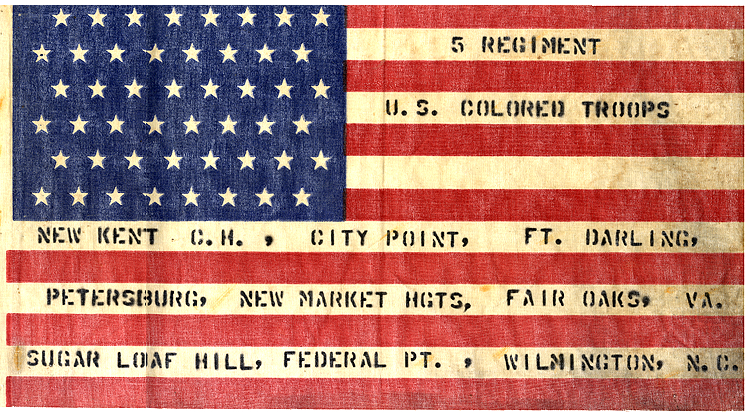
While many white American soldiers depreciated their French hosts and attempted to sow the seeds of their own racial prejudice against the black soldiers among the French, Southerners in particular warned the French of “black rapist beasts.” However the French experience of American blacks was far different than the often scornful treatment that they received from white American soldiers.
“Soldiers from the four regiments that served directly with the French Army attested to the willingness of the French to let men fight and to honor them for their achievements. Social interactions with French civilians- and white southern soldiers’ reactions to them- also highlighted crucial differences between the two societies. Unlike white soldiers, African Americans did not complain about high prices in French stores. Instead they focused on the fact that “they were welcomed” by every shopkeeper that they encountered.” [64]
Official and unofficial efforts by those in the Army command and individual soldiers to stigmatize them and to try to force the French into applying Jim Crow to laws and attitudes backfired. Villages now expressed a preference for black over white American troops. “Take back these soldiers and send us some real Americans, black Americans,” wrote one village mayor after a group of rowdy white Americans disrupted the town.” [65]
Even after President Truman desegregated the armed forces in 1948, African Americans, as well as other racial minorities, women and gays have faced very real discrimination. The military continues to make great strides, and while overt racist acts and other types of discrimination are outlawed, racism still remains a part of American life.
Today things have changed, and that in large part is due to the unselfish sacrifice in the face of hatred and discrimination of the men of the USCT and the State Black Regiments like the 54th Massachusetts and the Louisiana Home Guards who blazed a way to freedom for so many. Those who followed them as Buffalo Soldiers and volunteers during the World Wars continued to be trail blazers in the struggle for equal rights. A white soldier who served with the 49th Massachusetts wrote “all honor to our negro soldiers. They deserve citizenship. They will secure it! There would be much suffering in what he termed “the transition state” but a “nation is not born without pangs.” [66]
Those birth pangs helped to bring about a new birth of freedom for the United States.
Notes
[1] McPherson, James M. Tried by War: Abraham Lincoln as Commander in Chief Penguin Books, New York and London 2008
[2] McPherson, James M. Drawn With the Sword: Reflections on the American Civil War Oxford University Press, Oxford and New York 1996 p.101
[3] Godwin, Doris Kearns Team of Rivals: The Political Genius of Abraham Lincoln Simon and Shuster, New York and London 2005
[4] Egnal, Marc Clash of Extremes: The Economic Origins of the Civil War Hill and Wang a division of Farrar, Straus and Giroux New York 2009 p.318
[5] Ibid. McPherson Tried by War p.159
[6] Ibid. McPherson Drawn With the Sword p.159
[7] McPherson, James M. Abraham Lincoln and the Second American Revolution Oxford University Press, New York and Oxford 1991 p.35
[8] Ibid. Guelzo Fateful Lighteningp.381
[9] Ibid. McPherson Abraham Lincoln and the Second American Revolution p.35
[10] Ibid. McPherson. The Battle Cry of Freedom p.686
[11] Ibid. Guelzo Fateful Lightening p.379
[12] Ibid. Foote , The Civil War, A Narrative. Volume Two p.398
[13] Ibid. Guelzo Fateful Lightening p.379
[14] Ibid. McPherson. The Battle Cry of Freedom p.686
[15] Ibid. McPherson Drawn With the Sword p.101
[16] Ibid. McPherson. The Battle Cry of Freedom p.686
[17] Ibid. Guelzo Fateful Lightening pp. 380-381
[18] Ibid. McPherson. The Battle Cry of Freedom pp.686-687
[19] Ibid. Foote , The Civil War, A Narrative. Volume Two p.697
[20] Ibid. McPherson. The Battle Cry of Freedom p.686
[21] Ibid. Guelzo Fateful Lightening p. 381
[22] Ibid. McPherson. The Battle Cry of Freedom p.634
[23] Gallagher, Gary W. The Union War Harvard University Press, Cambridge MA and London 2011
[24] Ibid. McPherson Drawn With the Sword p.89
[25] Catton, Bruce. A Stillness at Appomattox Doubleday and Company Garden City, New York 1953 p.227
[26] Ibid. Catton A Stillness at Appomattox p.249
[27] Foote, Shelby, The Civil War, A Narrative. Volume Three Red River to Appomattox Random House, New York 1974 p.537
[28] Wert, Jeffry D. The Sword of Lincoln: The Army of the Potomac Simon and Schuster, New York and London 2005 pp.384-385
[29] Ibid. Foote The Civil War, A Narrative. Volume Three p.537
[30] Ibid. Guelzo Fateful Lightening p. 377
[31] Ibid. Guelzo Fateful Lightening p. 377
[32] Grant, Ulysses S. Preparing for the Campaigns of ’64 in Battles and Leaders of the Civil War Volume IV, Retreat With Honor Edited by Robert Underwood Johnson and Clarence Clough Buel Castle, Secaucus NJ pp.107-108
[33] Ibid. Foote The Civil War, A Narrative. Volume Three p.111
[34] Ibid. Guelzo Fateful Lightening p. 378
[35] Ibid. Foote The Civil War, A Narrative. Volume Three p.112
[36] Ibid. McPherson Abraham Lincoln and the Second American Revolution p.89
[37] Ibid. Guelzo Fateful Lightening p. 376
[38] Ibid. Thomas, The Confederate Nation p.262
[39] Ibid. Thomas, The Confederate Nation p.262
[40] Ibid. Guelzo Fateful Lightening p. 370
[41] Ibid. Thomas, The Confederate Nation p.262
[42] Ibid. McPherson. The Battle Cry of Freedom p.833
[43] Ibid. Thomas, The Confederate Nation p.262
[44] Ibid. Gallagher The Confederate War p.47.
[45] Ibid. Guelzo Fateful Lightening p. 370
[46] Korda, Michael. Clouds of Glory: The Life and Legend of Robert E. Lee Harper Collins Publishers, New York 2014 p.643
[47] Ibid. Thomas, The Confederate Nation p.293
[48] Ibid. Foote. The Civil War, A Narrative. Volume Three pp.754-755
[49] Ibid. Foote. The Civil War, A Narrative. Volume Three p. 755
[50] Ibid. Thomas, The Confederate Nation p.296
[51] Ibid. McPherson. The Battle Cry of Freedom p.836
[52] Ibid. Foote. The Civil War, A Narrative. Volume Three p.755
[53] Ibid. McPherson. The Battle Cry of Freedom p.837
[54] Ibid. Foote. The Civil War, A Narrative. Volume Three p.860
[55] Ibid. McPherson. The Battle Cry of Freedom p.837
[56] Ibid. Foote. The Civil War, A Narrative. Volume Three p.860
[57] Ibid. McPherson. The Battle Cry of Freedom p.835
[58] Ibid. Foote. The Civil War, A Narrative. Volume Three p.860
[59] Ibid. Guelzo Fateful Lightening p. 386
[60] Levine, Bruce Half Slave and Half Free: The Roots of the Civil War Revised Edition, Hill and Wang, a division of Farrar, Strauss and Giroux, New York 1992 and 1995 p.241
[61] Catton, Bruce Grant Takes Command Little, Brown and Company Boston, Toronto and London 1968 p.411
[62] Ibid. Levine Half Slave and Half Free pp.241-242
[63] Keene, Jennifer D. Doughboys, the Great War, and the Remaking of America The Johns Hopkins University Press, Baltimore and London 2001 p.88
[64] Ibid. Keane Doughboys, the Great War, and the Remaking of America p.128
[65] Ibid. Keane Doughboys, the Great War, and the Remaking of America p.129
[66] Ibid Gallagher The Union War p.113



 The Inglorius Padre Steve's World