Tag Archives: harrison the spy gettysburg

The Road to Gettysburg: An Army Confident But Blind

on-to-gettysburg-900L

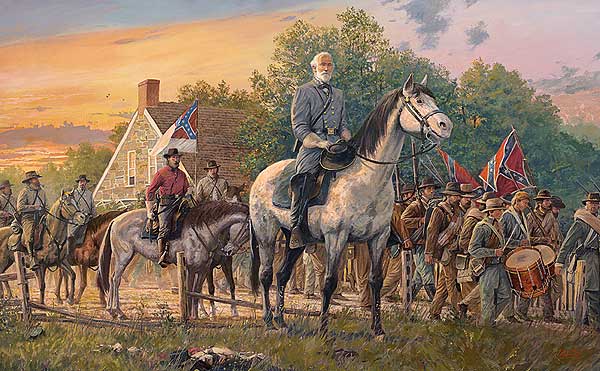
Lee Confers with his Commanders en-route to Gettysburg 

Friends of Padre Steve’s World

For those that have followed my writing for some time you know that I teach military history and ethics at the Joint Forces Staff College. One of the great joys that I have is leading the Gettysburg Staff Ride, which is an optional event for students that want to participate. When I took the position here I took some of my older writings on Gettysburg and put them into a student study guide and text. That was two years ago. Then the text was about 70 pages long. It is now about 870 pages long and eventually I hope to get it published. When and if that happens I expect it to become two, and possibly three books.

Over the next few days I will be posting potions of a chapter that I have rewritten about the surprises that various commanders experienced on June 28th 1863. The lessons for today are that war, any war, is the realm of chance, as such, surprises always happen. It is said that no plan survives first contact with the enemy, but some plans don’t survive that long. As you read this don’t just look at the events, but look at the people, and their reaction to the surprises that they encountered, for that is where we come to understand history.

So even if you are not a Civil War buff, or even a history buff, take the time to look at the people, their actions, and the things that made them who they were, and influenced what they did. History is about people.

So please enjoy,

Peace

Padre Steve+

If you were an ordinary soldier in either the Army of the Potomac or Army of Northern Virginia June 28th 1863 would not have been much different than any of the previous days. In fact the day was relatively “uneventful for men in the ranks.” [1] By now, both armies had been on the march for over three weeks, the soldiers enduring blazing summer heat, as well as torrential rains as the moved north. While there had been cavalry clashes at Brandy Station and along the Blue Ridge, and Ewell had successfully overrun and Milroy’s command at Winchester, the vast bulk of the men in either army had yet to engage in combat.

By the evening of June 27th both the Confederate and Union armies were across the Potomac. Robert E. Lee’s Army of Northern Virginia was now mostly in Pennsylvania. Dick Ewell’s Second Corps was preparing to attack Harrisburg, A.P. Hill’s Third Corps was near Cashtown and James Longstreet’s First Corps was gathering in the vicinity of Chambersburg.

As the Confederate troops advanced into Pennsylvania morale was high, one soldier wrote “Never did soldiers appear more buoyant and cheerful than Lee’s army.” [2] Dorsey Pender commanding a division in Hill’s Third Corps wrote his wife “I never saw troops march as ours do; they will go 15 or 20 miles a day without leaving a straggler and hoop and yell on occasions.” [3]

Unit Quartermasters, acting under Lee’s orders to forage “scoured the countryside in search of foodstuffs, livestock and anything usable.” [4] That bounty was considerable, and “included twenty-six thousand cattle and twenty-thousand sheep” [5] which were promptly driven back to Virginia. In addition to “officially” sanctioned foraging soldiers and officers did some of their own. Some of Dick Ewell’s staff took the opportunity to purchase items hard to come by in the South for their families, one bought “china buttons, calico dress patterns, soaps, and spices for his mother and sister.” [6] In spite of Lee’s prohibition of looting many soldiers took the opportunity to plunder, one soldier wrote “We press every thing that we think that will be beneficial to our cause and cuntry.” [7]

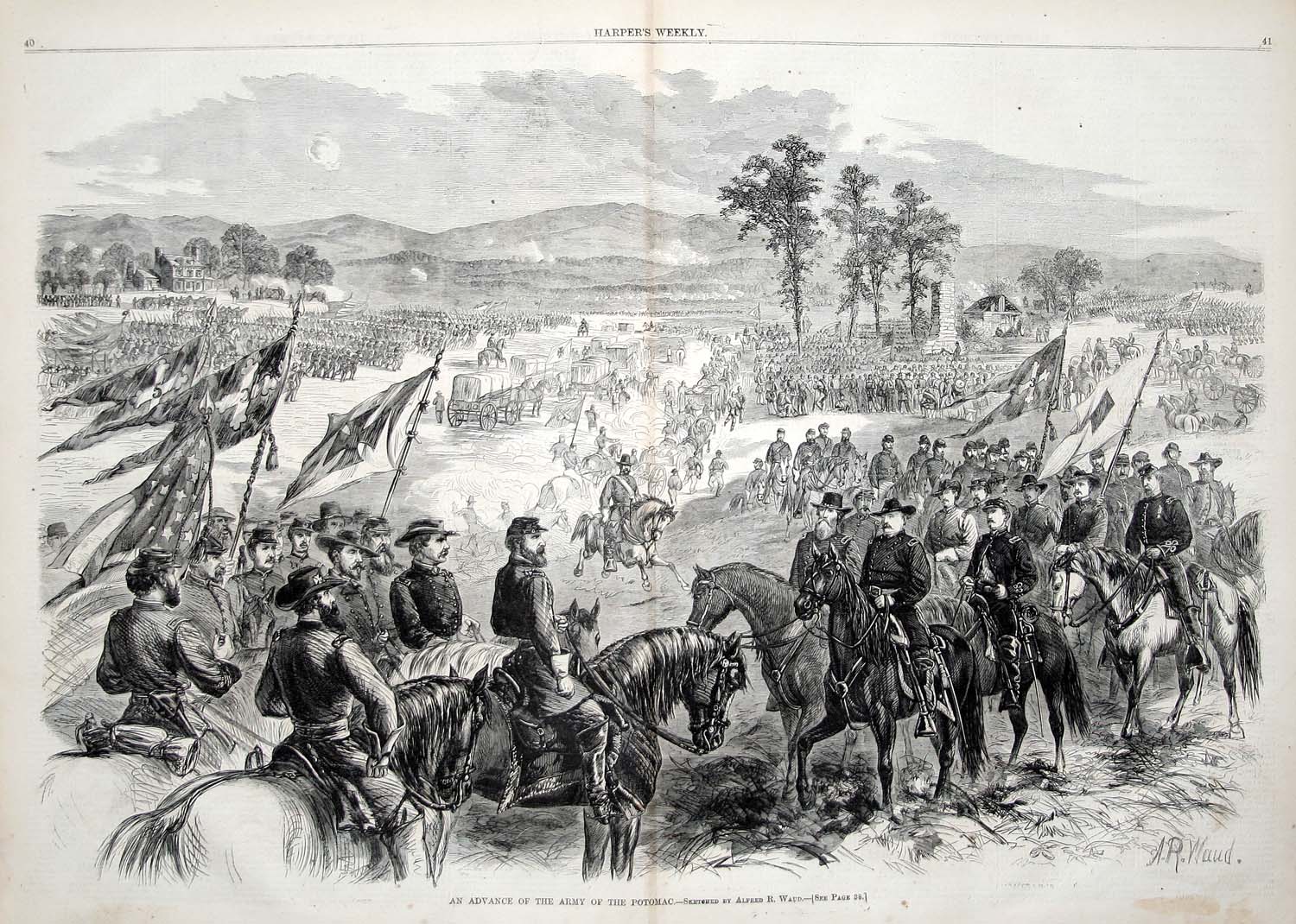
With Lee in Pennsylvania the bulk of the Army of the Potomac, still under the command of Joe Hooker was concentrated in the vicinity of Frederick, Maryland. Despite a slow start and his disagreement with Lincoln and Halleck regarding an attack across the Rappahannock into Lee’s rear, Hooker had handled the army skillfully in its pursuit of Lee. One decision that he made early, based on the recommendation of Major General Henry Slocum, commander of XII Corps, was to pre-stage pontoon bridges near the Potomac in case he had to cross that river. So swift was his movement and he had “completed its crossing only twenty-four hours after the last of Lee’s infantry had crossed, and the whole of it was in Maryland before either Stuart or Lee knew that the crossing had even begun.” [8]

The morale of the soldiers of the Army of Northern Virginia was high, and reflected Lee’s own attitude toward the campaign. One officer recalled that “Lee’s army was never in better spirits than in the days leading up to Gettysburg.” [9] Colonel Eppa Hunton of the 8th Virginia recalled that Lee told him that “the invasion of Pennsylvania would be a great success, and if so, it would end the war, or we would have rest for some time to come.” Hunton added, “General Lee was so enthusiastic about the movement that I threw away my doubts and became as enthusiastic as he was.” [10]

Like its commander the Army of Northern Virginia was superbly confident as it marched north. A Virginian observing the army as it marched through Maryland recalled: “The health of the troops was never better and above all the morale of the army was never more favorable for offensive or defensive operations….Victory will inevitably attend our arms in any collision with the enemy.” [11] Another soldier later recalled “no one ever admitted the possibility of defeat across the Potomac.” [12]

Lee was uneasy regarding his lack of knowledge of the location of the Army of the Potomac or Hooker’s intentions, but he was not overly concerned. Though he had not heard anything from J.E.B. Stuart since June 23rd, when Stuart had begun his ride, Lee was still confident in the success of his operation and the prospects of battle. John Bell Hood, Lee’s companion from his days in Texas visited Lee at Chambersburg and “found the commanding general in “buoyant spirits.” Lee told his former Lieutenant “Ah! General, the enemy is a long time in finding us; if he does not succeed soon, we must go in search of him.” [13] On the night of June 27th Lee “still assumed that the mounted forces were doing their full duty and that all was well; but there was uneasiness, almost exasperation, over the failure of the cavalry to send in any information of the enemy’s movements.” [14]

Not knowing the location of the Federal army Lee met with Major General Isaac Trimble on the evening of June 27th at his headquarters near Chambersburg. Though Trimble had been slated to command to division now commanded by Allegheny Johnson, he had been slow to recover from a leg wound incurred in 1862 and could not take command. A supernumerary Major General without a command, Trimble had caught up with the army as it moved north into Maryland. Trimble told Lee that he “could recruit a division of troops from the ranks of his native Marylanders.” [15] as Lee did not want to lose “the services of so hard a fighter as this veteran of all the Second Corps victories from First through Second Manassas.” [16] That being said Trimble soon became a nuisance to Lee and “after just two days Lee sent him on to Ewell.” [17]

However, Trimble recorded the atmosphere in Lee’s headquarters and just how confident Lee appeared in spite of not knowing the location or the intent of the Army of the Potomac:

“Our army is in good spirits, not overly fatigued, and can be concentrated on any point in twenty-four hours or less. I have not yet heard that the enemy have crossed the Potomac, and I am waiting to hear from General Stuart….They will come up, probably through Frederick, broken down with hunger and hard marching….I shall throw up an overwhelming force on their advance, crush it, follow up the success, [and] drive one corps back on another…create a panic and virtually destroy the enemy.” [18]

Trimble noted that he was “stirred” by Lee’s words and that told Lee that he did “not doubt of the outcome of such a confrontation, especially because the moral of the Army of Northern Virginia had never been higher than it was now.” [19] Lee agreed and “as Trimble rose to go, Lee laid his hand on the map and pointed to a little town east of the mountains, Gettysburg by name, from which roads radiated like so many spikes. “Hereabout,” he said, “we shall probably meet the army and fight a great battle, and if God gives us the victory, the war will be over and we shall achieve the recognition of our independence.” [20]

Notes

[1] Coddington, Edwin B. The Gettysburg Campaign, A Study in Command A Touchstone Book, Simon and Shuster New York 1968 p. 180

[2] Wert, Jeffry D. A Glorious Army: Robert E. Lee’s Triumph 1862-1863 Simon and Schuster, New York and London 2011 p.229

[3] Robertson, James I. Jr. General A.P. Hill: The Story of a Confederate Warrior Random House, New York 1987 p.204

[4] Glatthaar, Joseph T. General Lee’s Army from Victory to Collapse The Free Press, Simon and Schuster, New York and London 2008 p.271

[5] Goldfield, David. America Aflame: How the Civil War Created a Nation Bloomsbury Press, New York 2011 p.284

[6] Pfanz, Donald. Richard S. Ewell: A Soldier’s Life University of North Carolina Press, Chapel Hill and London 1998 p.298

[7] Ibid. Glatthaar General Lee’s Army from Victory to Collapse p.272

[8] Catton, Bruce The Army of the Potomac: Glory Road Doubleday and Company, Garden City New York, 1952 p.255

[9] Taylor, John M. Duty Faithfully Performed: Robert E Lee and His Critics Brassey’s, Dulles VA 1999 p.139

[10] Ibid. Wert A Glorious Army p.226

[11] Guelzo, Allen C. Gettysburg: The Last Invasion Vintage Books a Division of Random House, New York 2013 p.67

[12] Foote, Shelby, The Civil War, A Narrative. Volume Two Fredericksburg to Meridian Random House, New York 1963 p.455

[13] Ibid. Wert A Glorious Army p.230

[14] Freeman, Douglas Southall, Lee’s Lieutenant’s a Study in Command, One volume abridgement by Stephen W Sears, Scribner, New York 1998 p.551

[15] Ibid. Pfanz Richard S. Ewell p.300

[16] Ibid. Foote The Civil War, A Narrative. Volume Two p.445

[17] Ibid. Pfanz Richard S. Ewell pp.300-301

[18] Taylor, John M. Duty Faithfully Performed: Robert E Lee and His Critics Brassey’s, Dulles VA 1999 p.140

[19] Ibid. Foote The Civil War, A Narrative. Volume Two p.446

[20] Freeman, Douglas Southall, Lee an abridgment by Richard Harwell, Touchstone Books, New York 1997 p.320
Leave a comment

Filed under civil war, Gettysburg, History

Gettysburg: June 28th the Day of Surprises

army-potomac-1500Army of the Potomac on the March


If you were an ordinary soldier in either the Army of the Potomac or Army of Northern Virginia June 28th 1863 would not have been much different than any of the previous days. Both armies had been on the march, both were moving north and with the exception of a few minor cavalry engagements no troops had yet engaged in battle.

However it is almost never good when a commander gets surprised. On June 28th 1863, three men, General Robert E Lee, Lieutenant General J.E.B. Stuart and Major General George G Meade all were surprised by unexpected, and in the case of Lee and Stuart truly disturbing news. The manner in which each responded was critical to how the Battle of Gettysburg unfolded and indicative of each mans’ ability as a commander.

Harrison-1-

Harrison

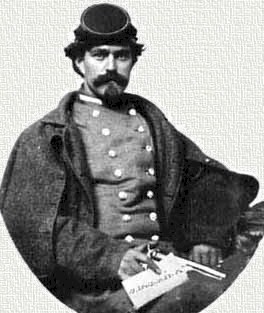
On the morning of June 28th Lieutenant General James Longstreet was alerted to the presence of a man claiming to have information on the movement and location of the Army of the Potomac. The man’s name was Harrison and that he was an actor. Harrison is one of those mysterious figures that occasionally show up in the context of a historical event and make it even more interesting. He reported the location of Federal Cavalry as well as the location of five of the Army of the Potomac’s seven army corps, all too close for comfort. Questioned about the location and activities of Stuart, Harrison could give no information.

gettysburg-general-lee

Any commander that embarks on a high risk offensive operation in enemy territory must do so with great care, especially in regard to command and control of his forces. This is especially true regarding reconnaissance. Lee had been operating blind for well over a week and this was his fault. Because Lee had issued such vague orders Stuart was well to the east conducting his ride around the Federal army and completely useless to Lee.

longstreet

Longstreet

Though Lee still had three brigades of Stuart’s Cavalry Division available, none were in a position to assist his reconnaissance needs. Again blame for this has to be laid at the feet of Lee. Robertson’s and Jones’ brigades were still deep in Virginia guarding Snicker’s and Ashby’s Gap. Iboden’s Brigade was to the west at Hancock Maryland. Jenkins’ brigade, which was not a part of Stuart’s division, was far to the front with Ewell’s Corps.

In the case of the selection of Jones’ and Robertson’s brigades for the mission of screening Lee, Stuart made a critical mistake. Jones and Robertson both had serious deficiencies as leaders and proved that they had Lee’s “confidence or understood his expectations…and Stuart badly misread the amount of personal connection his superior required.”[i] Longstreet had recommended that Stuart assign the excellent Wade Hampton and his brigade to the mission of screening the Army, but Stuart ignored his counsel.

CWP015

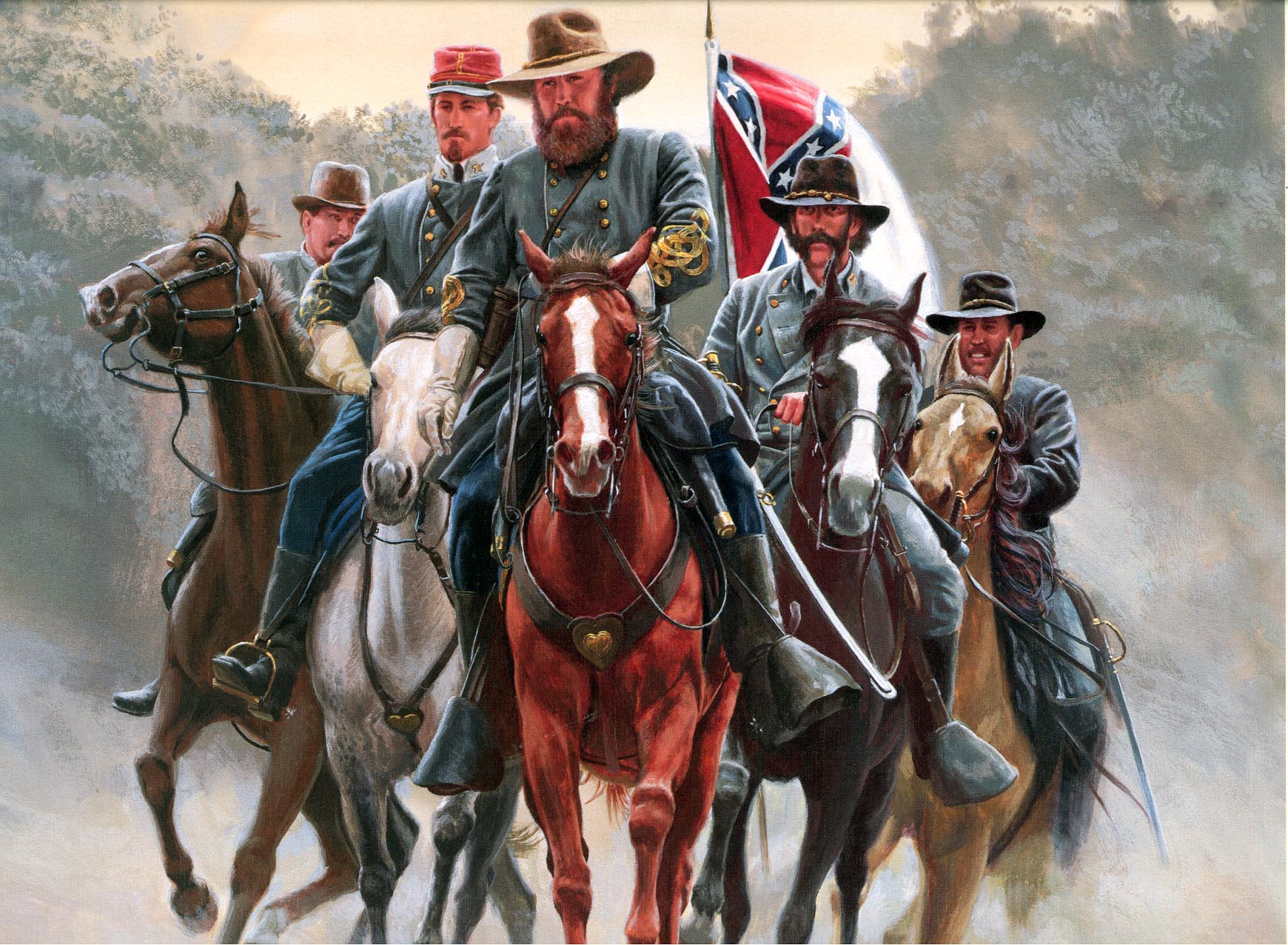
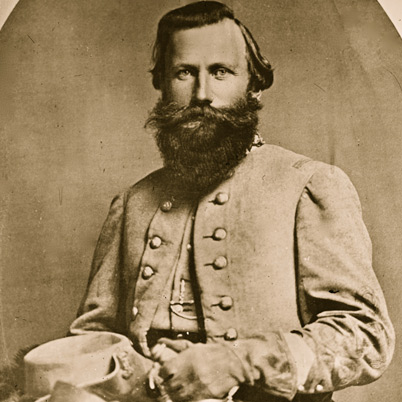
Stuart

While Lee’s orders to Stuart allowed Stuart to go off on his mission Lee had plenty of cavalry available but employed it in a woeful manner and did not take the steps necessary to ensure that the commanders assigned understood his expectations. This was another critical mistake made by Lee and as Alan.T. Nolan wrote: “There seems to be no excuse for Lee’s finding himself at Chambersburg on the 28th without a single regiment of cavalry”[ii] The tragic thing for the Confederacy was that Lee would make this same mistake in failing to communicate his intent with other subordinates throughout the campaign.

Lee assumed quite wrongly that the reason he had not heard from Stuart was that Hooker’s army had not moved. This was a bad miscalculation on Lee’s part and Longstreet trusted Harrison and promptly reported the information to Lee. Lee refused to see Harrison as he had little appreciation for or confidence in the words of “spies.” That being said Lee reacted with alacrity and issued orders to concentrate his army near Cashtown.

The surprise of the Union Army being concentrated so near him took away Lee’s ability to retain the initiative of a campaign of maneuver. Likewise, because his army was so scattered he was now in danger of being hit and defeated in detail by the Federal army. It was a dangerous position for him to be in and he knew it. In a sense he was fortunate that on the 28th the Army of the Potomac was changing command and unable to strike while he was so vulnerable.

Seventy miles away J.E.B. Stuart was at Rockville Maryland where despite learning that the Army of the Potomac was moving did not hasten to re-join the main army. Instead, he and his troopers became distracted and captured a large Federal wagon train, 125 brand new wagons carrying supplies north. Instead of burning them and leaving his prisoners he decided to advance into Pennsylvania with his treasure. The effect was to radically slow down his march and keep him out of the battle when Lee most needed his presence.

While Lee and Stuart reacted to surprises that were largely of their own making another officer received a surprise of his own. On the night of June 27th George Meade was simply one of seven Corps Commanders in the Army of the Potomac. That changed suddenly when he was awoken at 3 Am on the 28th by Halleck’s messenger and Deputy Adjutant General Colonel James Hardie. In his hand Hardie had a letter of instruction from Halleck which began: “You will receive with this the order of the President placing you in command of the Army of the Potomac.” [iii]

meade2

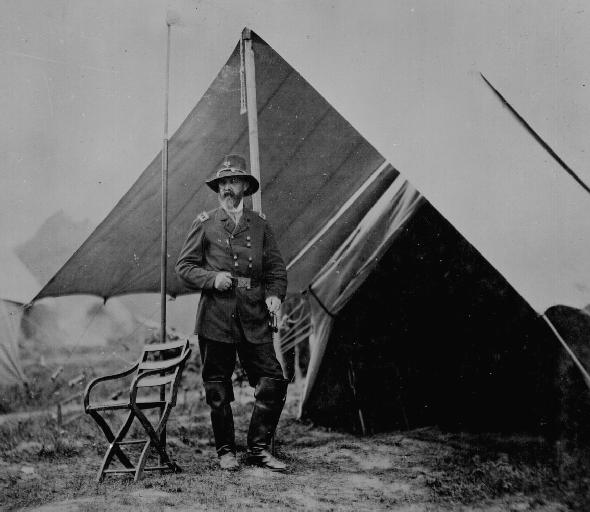
Meade

Meade, though he desired the appointment as commander of the Army did not expect it.  He believed that if Hooker was relieved of command that John Reynolds of First Corps or another would receive it. He was outranked by two Corps commanders including Reynolds. Meade wrote to his wife the reasons he would not get command a few days before: “because I have no friends, political or others, who press or advance my claims or pretentions.”[iv] The latter was not because of he did not have friends, but because unlike Hooker, Sickles and so many others he stayed out of the various political cabals in the army and their constant intrigues.

The order gave Meade command of the troops at Harper’s Ferry which had been denied to Hooker just days before. It also gave him freedom of command. It read: “You will not be hampered by any minute instructions from these headquarters” and “you are free to act as you deem proper under the circumstances as they arise.”[v] Likewise he was authorized to command General Couch’s forces along the Susquehanna. A further power given to Meade which had not been given to previous commanders of the Army of the Potomac was the authority to relieve from command and dismiss officers from the army, or appoint to command officers regardless of seniority as he saw fit. It was a power that during the tumult of battle that he would use well.

The appointment of Meade was met with relief by most of his fellow Corps commanders. He was respected, despite having a temper which would occasionally erupt and send him into busts of rage. He was viewed as a truthful, honest and caring commander who after a blow up would do what he could to reconcile. He was passionate about the lives of his troops and whenever possible avoided battles that he believed their sacrifice would be in vain. He knew his trade, paid close attention to detail and knew and understood his troops and commanders. He had earned respect throughout his career and during the battles on the Peninsula, Antietam, Fredericksburg and Chancellorsville proved that he was an excellent leader and commander of troops.

Meade had an immense task to accomplish. When he went to bed on the night of the 27th he was unaware of the locations of the bulk of the Federal Army and knew that Lee was already deep in Pennsylvania. Meade was determined to bring Lee to battle was cautious as he did not want to take a chance of his forces being split up and defeated in detail. He knew that if he was to defeat Lee he had to concentrate his combat power. He wired Halleck that he would “move toward the Susquehanna keeping Baltimore and Washington well covered, and if the enemy is checked in his attempt to cross the Susquehanna or if he turns toward Baltimore, to give him battle.”[vi] He prepared a fallback position along Pipe Creek and gave his Corps commanders permission to withdraw back to the Pipe Creek line outside Taneytown Maryland if they felt threatened by a larger Confederate force.

He kept General Daniel Butterfield as his Chief of Staff despite Butterfield’s close association with Hooker and his political cabal and appointed Major General George Sykes to command his old V Corps. He also wired Halleck with an “unheard of request: to promote in one jump three brilliant young officers from the rank of captain to that of brigadier general. They were Elon J. Farnsworth of the 8th Illinois Cavalry, George A Custer of the 5th United States Cavalry and Wesley Merritt of the 2nd United States Cavalry.”[vii] Each was appointed to command brigades in Pleasanton’s Cavalry Corps which was being reorganized that day.

buford-on-mcphersons-ridge

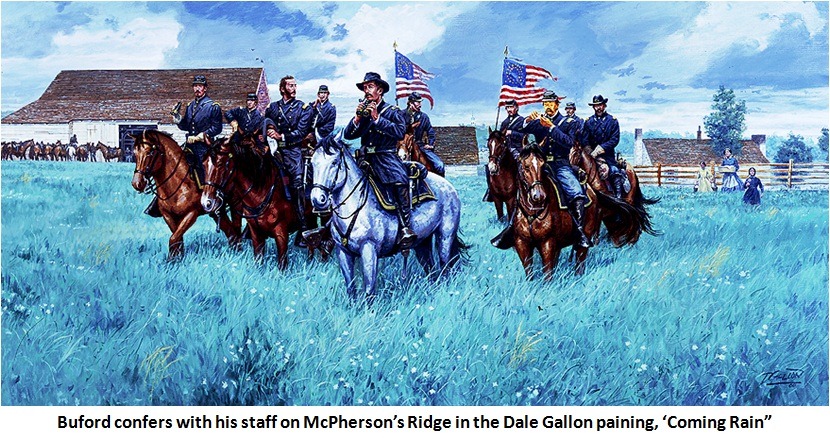
Meade recognized the importance of Gettysburg and began to move his forces toward the town even as Lee gathered his army. By the evening of the 30th Meade’s 1st Cavalry Division under the command of Brigadier General John Buford detected Confederate infantry to the west of the town. Buford with a keen eye for terrain instantly recognized that it was favorable ground. He knew that the battle was to be there and sent word back to John Reynolds, commander of I Corps:

“Have Occupied Gettysburg. Contacted large force of Reb infantry. I think they are coming this way. Expect they will be here in force in the morning.”[viii]

Until tomorrow,

Peace

Padre Steve+


[i] Trudeau, Noah Andre. Gettysburg, A Testing of Courage Harper Collins, New York, 2003. p.69

[ii] Nolan, Alan T. R.E. Lee and July 1 at Gettysburgin The First Day at Gettysburg, Gallagher, Gary W. Editor, Kent State University Press, Kent Ohio 1992 p. 20

[iii] Foote, Shelby, The Civil War, A Narrative. Volume Two Fredericksburg to Meridian Random House, New York 1963 p.451

[iv] Ibid.

[v] Ibid.

[vi] Coddinton, Edwin B. The Gettysburg Campaign, A Study in Command A Touchstone Book, Simon and Shuster New York 1968 pp. 219-220

[vii] Ibid. p.220

[viii] Shaara, Michael. The Killer Angels. Ballantine Books, New York. 1974 p.40


Leave a comment

Filed under civil war, History, leadership, Military