Tag Archives: harry truman

Spring Training and the Integration of the Major Leagues

Jackie Robinson

In April 1947 Branch Rickey of the Brooklyn Dodgers had one African-American ballplayer at the Dodgers’ Spring Training site in Daytona Beach Florida. The Dodgers had been coming to Florida for years but had moved from Jacksonville to Daytona Beach in 1947 after Jacksonville had refused to alter its segregation laws to allow an exhibition game between the Dodgers International League affiliate the Montreal Royals.  Dodgers’ Club President and General Manager Branch Rickey had signed Jackie Robinson to a minor league contract with the Royals.  When Rickey called up Robinson 6 days prior to the 1947 season Robinson broke the color barrier for the Dodgers and Major League Baseball.  However it would take another 12 years before all Major League teams had a black player on their roster.

It is hard to imagine now that even after Jackie Robinson had broken the color barrier that other teams did not immediately sign black players. However Rickey and Robinson broke the color barrier a year before Harry Truman had integrated the Armed Forces and seven years before the Supreme Court ruled the segregation of public schools illegal.

Larry Doby

The Cleveland Indians under the legendary owner Bill Veeck were not far behind the Dodgers signing Larry Doby on July 5th 1947.  Doby would go on to the Hall of Fame and was a key player on the 1948 Indian team which won the 1948 World Series. The St. Louis Browns signed Third Baseman Hank Thompson 12 days later. Robinson and Doby would be joined by others in 1948 including Roy Campenella and Satchel Paige.
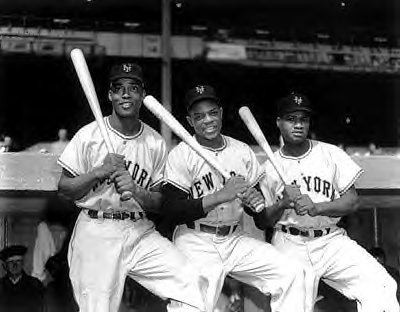
Irvin,  Mays and Thompson

It was not until 1949 when the New York Giants became the next team to integrate bringing up Monte Irvin and Hank Thompson who they had acquired from the Browns.  In 1951 they would be joined by rookie Willie Mays to become the first all African-American outfield in the Major Leagues. Both Mays and Irvin would enter the Hall of Fame and both are still a key part of the Giants’ story and despite their age have continued to be active in with the Giants and Major League Baseball.

The Boston Braves were the next to desegregate calling up Samuel “the Jet” Jethroe to play Center Field. Jethroe was named the National League Rookie of the Year in 1950.

In 1951 the Chicago White Sox signed Cuban born Minnie Minoso who had played for Cleveland in 1949 and 1951 before signing with the White Sox. Minoso would be elected to 9 All-Star teams and win 3 Golden Gloves.

Ernie Banks

The Chicago Cubs and Philadelphia Athletics integrated at the end of the 1953 season. The Cubs signed Shortstop Ernie Banks who would go on to be a 14 time All-Star, 2 time National League MVP and be elected to the Hall of Fame in 1977 on the first ballot. The Athletics called up pitcher Bob Trice from their Ottawa Farm team where he had won 21 games. Trice only pitched in 27 Major League games over the course of three seasons with the Athletics.

Four teams integrated in 1954. The Pittsburgh Pirates acquired Second Baseman Curt Roberts from Denver of the Western League as part of a minor league deal. He would play 171 games in the Majors.  He was sent to the Columbus Jets of the International League in 1956 and though he played in both the Athletics and Yankees farm systems but never again reached the Majors. The St. Louis Cardinals who had threatened to not play against the Dodgers and Jackie Robinson in 1947 traded for First Baseman Tom Alston of the Pacific Coast League San Diego Padres. Alston would only play in 91 Major League games with his career hindered by depression and anxiety.  The Cincinnati Reds brought up Puerto Rican born First Baseman Nino Escalera and Third Baseman Chuck Harmon who had played in the Negro Leagues and had been a Professional Basketball player in the American Basketball League. Harmon who was almost 30 when called up played just 4 years in the Majors. Both he and Escalera would go on to be Major League scouts, Escalera is considered one of the best First Baseman from Puerto Rico and was elected to the Puerto Rican Hall of Fame. Harmon’s first game was recognized by the Reds in 2004 and a plaque hangs in his honor. The Washington Senators called up Cuban born Center Fielder Carlos Paula from their Charlotte Hornets’ farm team in September 1954.  He played through the 1956 season with the Senators and his contract was sold to the Sacramento Salons of the Pacific Coast League. He hit .271 in 157 plate appearances with 9 home runs and 60 RBIs. He died at the age of 55 in Miami.
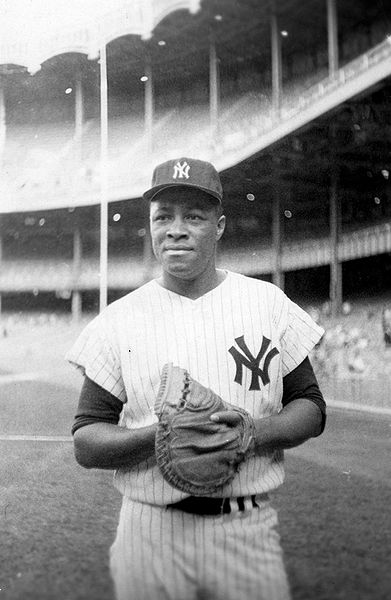
Elston Howard

In April 1955 the New York Yankees finally integrated 8 years after the Dodgers and 6 years after the Giants. They signed Catcher/Left Fielder Elston Howard from their International League affiliate where he had been the League MVP in 1954. Howard would play 13 years in the Majors with the Yankees and later the Red Sox retiring in 1968. He would be a 12-time All Star and 6-time World Series Champion as a player and later as a coach for the Yankees. He died of heart disease in 1980.  His number #32 was retired by the Yankees in 1984.

The Philadelphia Phillies purchased the contract of Shortstop John Kennedy from the Kansas City Monarchs of the Negro League at the end of the 1956 season. Kennedy played in just 5 games in April and May of 1957.

In 1958 the Detroit Tigers obtained Dominican born Utility Player Ozzie Virgil Sr. who had played with the Giants in 1955 and 1956. Virgil would play 9 seasons in the Majors with the Giants, Tigers, Athletics and Pirates and retire from the Giants in 1969. He later coached for 19 years in the Majors with the Giants, Expos, Padres and Mariners.

The last team to integrate was the Boston Red Sox who signed Infielder Pumpsie Green. Green made his debut on 21 July 1959 during his three years with the Red Sox was primarily used as a pinch runner. He played his final season with the New York Mets in 1963. He was honored by the Red Sox in 2009 on the 50th anniversary of breaking the Red Sox color barrier.

It took 12 years for all the teams of the Major Leagues to integrate, part of the long struggle of African Americans to achieve equality not just in baseball but in all areas of public life.  These men, few in number paved the way for African Americans in baseball and were part of the inspiration of the Civil Rights Movement itself.  They should be remembered by baseball fans everywhere.

Peace

Padre Steve+

3 Comments

Filed under Baseball

Jackie Robinson and Dr. Martin Luther King they Changed America

“He led America by example. He reminded our people of what was right and he reminded them of what was wrong. I think it can be safely said today that Jackie Robinson made the United States a better nation.” – American League President Gene Budig

“He knew he had to do well. He knew that the future of blacks in baseball depended on it. The pressure was enormous, overwhelming, and unbearable at times. I don’t know how he held up. I know I never could have.”Duke Snider

“Life is not a spectator sport. If you’re going to spend your whole life in the grandstand just watching what goes on, in my opinion you’re wasting your life.”  Jackie Robinson

“There’s not an American in this country free until every one of us is free.” Jackie Robinson

Today is a day that we rightfully remembered the life, message, martyrdom and legacy of Dr. Martin Luther King Jr. However as much as Dr. King matters, there were a long line of African American heroes who in their own way helped bring about racial equality in this country.  While many toiled in obscurity one, a baseball player named Jackie Robinson would forever alter the playing field of racial relations and how African Americans were perceived and received in the United States.  April 15th 2010 will be the 63rd anniversary of Jackie Robinson’s first game in the Major Leagues with the Brooklyn.  Robinson is not remembered with a National holiday but then again that takes noting away from this giant of American history. When Robinson stepped onto Ebbett’s Field in April 15th 1947 it was a watershed moment and while racial discrimination and prejudice remained they would be fighting a losing battle from that time on. Dr King in life and in death would be the one who drove the stake into the heart of the evil of racism and discrimination it was Jackie Robinson who helped place that stake above the heart of this evil.

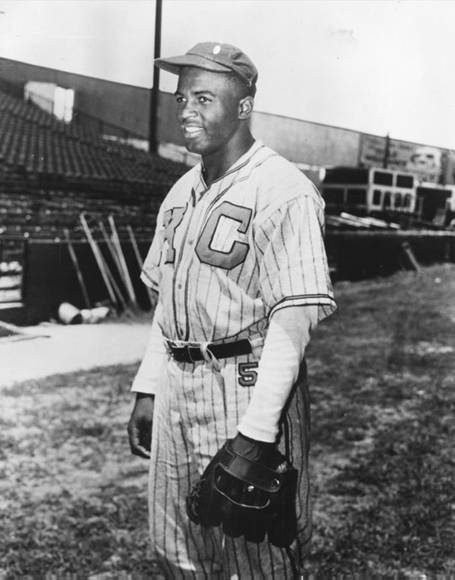
The Negro Leagues: Jackie in his Kansas City Monarch Uniform

We celebrate Dr King’s legacy today. However, without Jackie Robinson and the other African American baseball players who broke into the big leagues in the late 1940s and early 1950s it is conceivable that Dr, King would never have had the opportunity not only to be heard by African Americans, but to have his message heard and taken to heart by white America.

By the time Dr. King arrived on the scene much had already been done, and much due to Robinson and the owner of the Brooklyn Dodgers, Branch Rickey. Robinson’s first game with the Dodgers came a full year before President Truman integrated the military and a full seven years before the Supreme Court ruled school segregation unconstitutional.  It was not until 1964 that the Voters Rights act passed in Congress.  Jackie Robinson paved the way for a change in American society that has continued for 62 years since his debut at Ebbett’s Field on April 15th 1947.

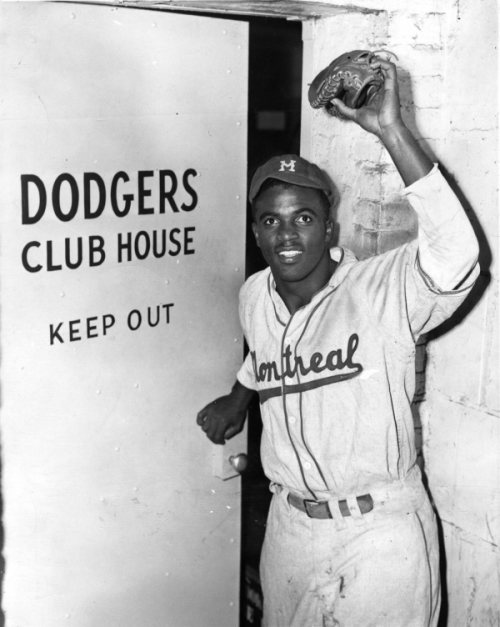
Even before he stepped onto the field Jackie Robinson was a pioneer in equal rights where at UCLA he was the first student to letter in four varsity sports and in the Second World War where in an action that was a precursor to later civil rights battles the young Lieutenant Jackie Robinson was arrested and tried for not moving to the back of a bus at Fort Hood Texas.  He would be acquitted and given an honorable discharge before beginning his professional baseball career with the Kansas City Monarchs of the Negro League prior to Rickey signing him to a minor league contract with the Montreal Royals of the International League. Although he was met with scorn my many white baseball fans and some players and had to endure the ignominy of hostility from white fans and media, having to live in separate hotels and eat at separate restaurants Robinson developed a loyal fan base in Montreal and over a million people saw him play in his year in the International League.

Jackie in his Montreal Royals Uniform outside the Dodger’s Clubhouse

When Branch Rickey talked with Robinson before the season he said: “Jackie (Robinson), we’ve got no army. There’s virtually nobody on our side. No owners, no umpires, very few newspapermen. And I’m afraid that many fans will be hostile. We’ll be in a tough position. We can win only if we can convince the world that I’m doing this because you’re a great ballplayer, a fine gentleman.”

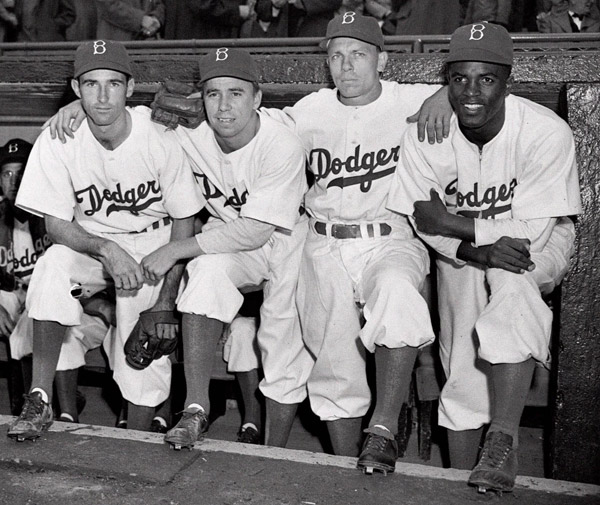
John Jorgensen, Pee Wee Reese, Ed Stanky and Jackie Robinson on opening day 1947

Jackie’s feat was a watershed moment in the history of our country.  Blacks had struggled for years against Jim Crow laws, discrimination in voting rights, and even simple human decencies such as where they could use a rest room, what hotels they could stay in or what part of the bus that they could sit.  In baseball many white fans were upset that blacks would be coming to see Robinson in stadiums that they would not have been allowed in before.  Players from other teams heckled Robinson, he received hate mail, people sent made death threats, and he was spiked and spit on.  But Jackie Robinson kept his pledge to Dodgers owner Branch Rickey not to lash out at his tormentors, as Rickey told him that he needed a man “with enough guts not to strike back.” In doing so his on field performance and poise under pressure won him the National League Rookie of the Year honor in 1947.

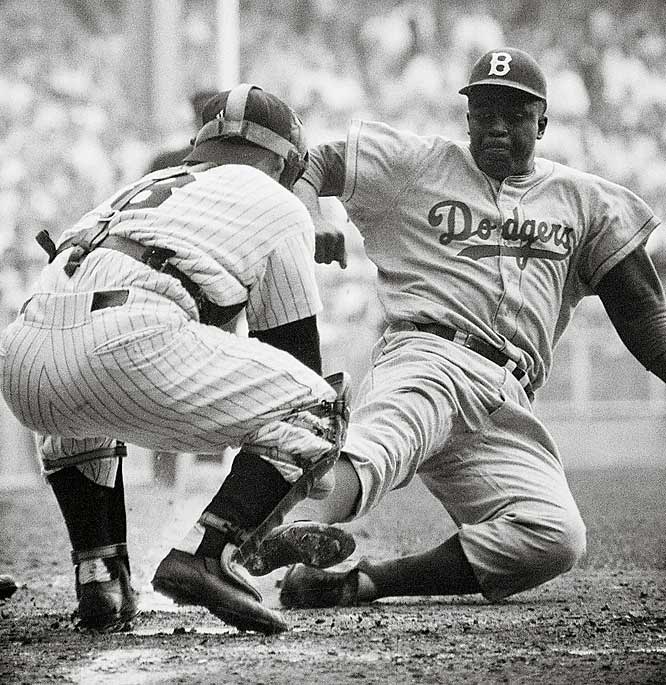
Jackie Stealing Home against the Yankees, the catcher is Yogi Berra

Jackie Robinson played the game with passion and even anger.  He took the advice of Hank Greenberg who as a Jew suffered continual racial epithets throughout his career “the best ways to combat slurs from the opposing dugout is to beat them on the field.” He would be honored as Rookie of the Year, was MVP, played in six World Series and six All Star Games.  He had a career .311 batting average, .409 on base percentage and a .474 Slugging percentage. He was elected to Baseball’s Hall of Fame in 1962. His teammate Pee Wee Reese would say: “Thinking about the things that happened, I don’t know any other ball player who could have done what he did. To be able to hit with everybody yelling at him. He had to block all that out, block out everything but this ball that is coming in at a hundred miles an hour. To do what he did has got to be the most tremendous thing I’ve ever seen in sports.”

Today Jackie Robinson’s feat is history, but it should not be forgotten.  He was a pioneer who made it possible for others to move forward.  He would be followed by players like Roy Campinella, Satchel Paige, Don Larson, Larry Dobie and Willie Mays.  His breakthrough had an effect not just on baseball but on society and helped make possible the later civil rights movement.  Dr. King would say of Jackie that he was “a legend and a symbol in his own time”, and that he “challenged the dark skies of intolerance and frustration.”  Historian Doris Kearns Godwin noted that Jackie’s “efforts were a monumental step in the civil-rights revolution in America” and that his “accomplishments allowed black and white Americans to be more respectful and open to one another and more appreciative of everyone’s abilities.” Time Magazine named him as one of the 100 most influential people of the 20th Century.

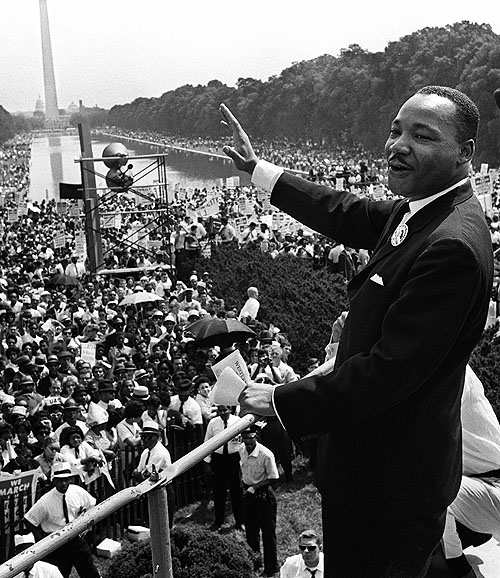
Dr Martin Luther King Jr “I have a dream”

We honor Dr King today and rightly so, but one can never forget those who paved the way so that we could all have the blessing of seeing Dr King’s dream come one step closer to fruition the dream that:

“one day this nation will rise up and live out the true meaning of its creed: ‘We hold these truths to be self-evident, that all men are created equal, that “children will one day live in a nation where they will not be judged by the color of their skin, but by the content of their character,” and that “one day on the red hills of Georgia the sons of former slaves and the sons of former slave owners will be able to sit down together at a table of brotherhood.”

Dr King would die by an assassin’s bullet in Memphis on the night of April 4th 1968 the day after finishing his final speech with these immortal remarks:

“And then I got to Memphis. And some began to say the threats, or talk about the threats that were out. What would happen to me from some of our sick white brothers? Well, I don’t know what will happen now. We’ve got some difficult days ahead. But it doesn’t matter with me now. Because I’ve been to the mountaintop. And I don’t mind. Like anybody, I would like to live a long life. Longevity has its place. But I’m not concerned about that now. I just want to do God’s will. And He’s allowed me to go up to the mountain. And I’ve looked over. And I’ve seen the Promised Land. I may not get there with you. But I want you to know tonight, that we, as a people, will get to the Promised Land. And I’m happy, tonight. I’m not worried about anything. I’m not fearing any man. Mine eyes have seen the glory of the coming of the Lord.”

Let us never forget Dr King nor those like Jackie Robinson who helped pave the way for Dr King.

Peace,

Padre Steve+

6 Comments

Filed under Baseball, History, Political Commentary