Tag Archives: helmand province

Atrocity in War: The Afghanistan Video

“Our men can’t make this change from normal civilians into warriors and remain the same people … the abnormal world they have been plunged into, the new philosophies they have had to assume or perish inwardly, the horrors and delights … they are bound to be different people from those you sent away. They are rougher than when you knew them. Killing is a rough business.”  Ernie Pyle

Ernie Pyle was one of the most prolific wartime journalists that ever lived, in fact he was killed by Japanese machine gun fire on the island of Ie Jima while with the Army during the Okinawa campaign. Ernie Pyle understood war and the men that fight it. If he was alive today I imagine that his comments about what happens to men in combat would be no different now than it was then.

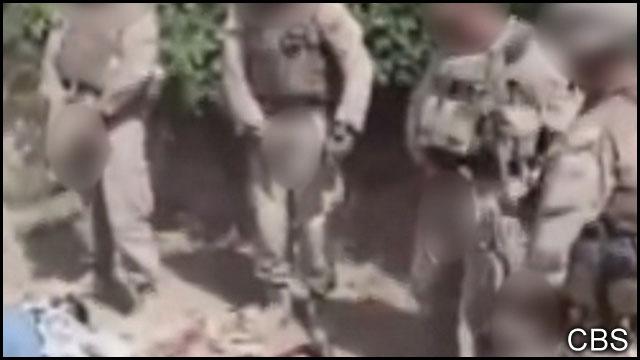
In the past two days we have heard much and seen a distressing video of four U.S. Marines from a Scout-Sniper Team of 3rd Battalion 2nd Marine Regiment urinating on dead Taliban fighters. The images are disturbing and because they are raw and offensive they have created a furor that could define the NATO campaign in Afghanistan as much as the Abu Ghraib torture photos harmed U.S. efforts in Iraq and the broader Middle East.  When I was in Iraq I heard Marine leaders talking about the Abu Ghraib incident with distain and saying that those few soldiers that recorded their torture of prisoners were costing us the war.

3/2 was deployed in the northern area of Helmand Province and lost 6 Marines and a Navy Corpsman during their deployment. According to the Marine Corps Times Battle Rattle Blog author Dan Lamothe, Major General John Toolan said that the Scout Snipers of 3/2 may have killed up to 100 insurgents each during their tour, which would mean that they were engaged in many dangerous combat engagements.  This in no way condones or excuses their actions but it does provide some context to view what happened.

However wrong the actions may be and how stupid it was for the Marines in this unit to record them and allow them onto the internet the truth is that war changes people. Ordinary men do things that they would not have contemplated before it including breaking the codes of honor that they pledge to uphold when volunteering to serve. Ernie Pyle understood this far better than most journalists before or since. In fact he understood it far better than the minuscule percentage of Americans who have ever served in the military much less in combat.  Pyle wrote:

“Their life consisted wholly and solely of war, for they were and always had been front-line infantrymen. They survived because the fates were kind to them, certainly — but also because they had become hard and immensely wise in animal-like ways of self-preservation.”

E.B Sledge who served throughout the Pacific War as a Marine infantryman and whose writings are dramatized in the HBO Series The Pacific wrote about fellow Marines that harvested gold teeth from dead Japanese soldiers, urinated in the mouths of the corpses of the Japanese and shot civilians.  He was patriotic, religious and after the war wrote in his book With the Old Breed: At Peleliu and Okinawa:

“The fierce struggle for survival in the abyss of Peleliu had eroded the veneer of civilization and made savages of us all. We existed in an environment totally incomprehensible to men behind the lines-service troops and civilians.” 

Mind you this is not an excuse for what these Marines did but it does offer an explanation for the act that they committed to video that we view without any context as to what led up to the incident or what they had been through.  It seems that people are rushing to judgement and that this will be compared to Abu Ghraib as a defining image of the Afghanistan as much as Abu Ghraib became symbolic of Iraq.  This is despite the fact that apart from being committed to video they are different. The Marines were infantrymen in one of the most desolate and dangerous combat zones of Afghanistan and the Abu Ghraib soldiers were jailers that had complete control of the prisoners.  There is a major difference between the actions as deplorable as both are.

I see the American wounded every day, Marines and Sailors whose lives have been radically changed by service in Iraq and Afghanistan.  They have seen horrors committed by Taliban, Al Qaida and other insurgents against their comrades as well as against Iraqi and Afghan civilians.  The war is every bit as brutal as was waged in the Pacific and they fight a brutal and unforgiving enemy that is intent on driving the infidels out of Afghanistan.

The uncomfortable fact is that an incredibly small number of Americans are fighting a war that at best will be a draw and quite probably a strategic and political defeat despite our troops not losing any battles.  The fact is that the action of these Marines will be used to not only prosecute them but to demonize them just as the actions of Lieutenant William Calley and his platoon at My Lai were used to demonize the Americans that fought in Vietnam.  The sad truth is that most of those that will engage in such demonization have never served in harm’s way or even known military service. Sledge wrote of critics of the Marines following the Second World War:

“In the post-war years, the U.S. Marine Corps came in for a great deal of undeserved criticism in my opinion, from well-meaning persons who did not comprehend the magnitude of stress and horror that combat can be. The technology that developed the rifle barrel, the machine gun and high explosive shells has turned war into prolonged, subhuman slaughter.”

I know that a thorough investigation will be conducted and that we will find out what happened in this unit that caused this obvious breakdown in discipline. Right now we don’t know who even posted the video on the internet and why they did so. Hopefully this is an isolated incident otherwise the incident will only grow in significance. During the investigation as well as news reports and interviews we will learn about the individual Marines involved in this action as well as their leaders. It will likely be uncomfortable and sad to watch.  It could well damage the reputation of the Marine Corps in the eyes of many even if it is an isolated incident.  What happened has already and will continue to reverberate here and in Afghanistan for a long time to come.  I just wish that we our media and politicians were as wise as Ernie Pyle and Eugene Sledge in judging these men as individuals before we know the whole story.

As someone that has served with Marines in harm’s way and know something of the stress that small teams of Marines can experience I have mixed feelings on this. I cannot approve of desecrating the remains of any human being at the same time I wonder what happened before this that might have contributed to the incident.  Of course we will hear more details than we want.

Peace

Padre Steve+

P.S. I have written a number of articles about the political, ideological strategic and moral aspects of war which I have listed here:

War Without Mercy: Race, Religion, Ideology and Total War

Why History Matters: The Disastrous Effects of Long Insurgency Campaigns on the Nations that Wage them and the Armies that Fight Them 

The Ideological War: How Hitler’s Racial Theories Influenced German Operations in Poland and Russia

1 Comment

Filed under iraq,afghanistan, Military, national security, News and current events

A Quiet Remembrance: The Fall of Dien Bien Phu May 7th 1954

French Prisoners

On May 7th in Hanoi a small remembrance was held to mark the fall of Dien Bien Phu and honor the victor, 101 year old General Vo Nguyen Giap at his home.  It was one of the few remembrances held anywhere marking that battle which was one of the watersheds of the 20th Century. A half a world away in Houston Texas a small group of French veterans, expatriates and historians laid a wreath at the Vietnam War Memorial.  In Paris an ever shrinking number of French survivors gather each year on May 7th at 1815 hours for a religious service at the Church of Saint Louis des Invalides to remember the dead and missing of the French Expeditionary Corps lost in Indochina.  This battle is nearly forgotten by time even though it and the war that it symbolized is probably the one that we need to learn from before Afghanistan becomes our Indochina.

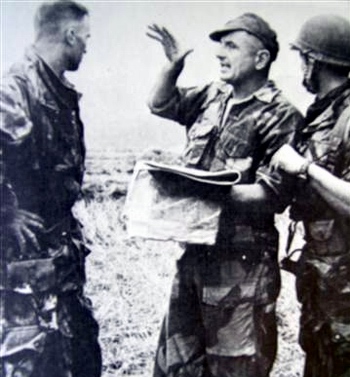
French Major Marcel Bigeard at Dien Bien Phu. A revered leader he died in 2010

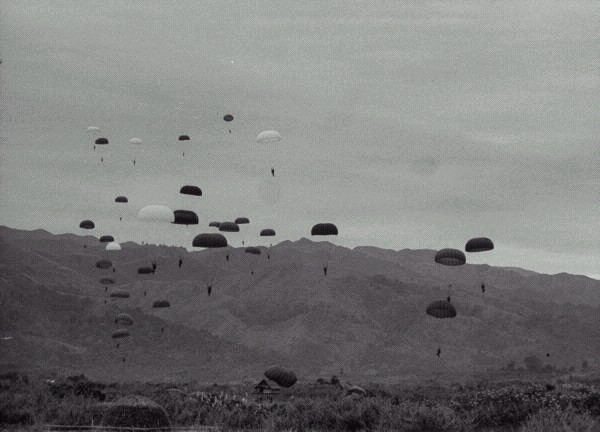
On May 8th 1954 the last of the French garrison of Dien Bien Phu surrendered to the Viet Minh following the surrender of the main garrison the previous day.  It was the end of the ill-fated Operation Castor in which the French had planned to lure the Viet Minh Regulars into open battle and use superior firepower to decimate them.  The strategy which had been used once on a smaller scale the previous year at Na Son would prove to be the Göttdammerung of French colonial rule in Indochina.

French Paras landing at Dien Bien Phu

The French had thought they had come up with a template based on Na Son in how to engage and destroy the Viet Minh which had in the years between 1945 and 1954 had turned an insurgent force into a strong Army capable of taking on large French forces.  As a result the French decided that they would attempt to draw Giap’s Army into open combat where their superiority in heavy weaponry and in the air could be used to destroy the Viet Minh. The plan was called the “Air-land base.”  It involved having strong forces in a defensible position deep behind enemy lines supplied by air.  At Na Son the plan worked as the French were on high ground and had superiority in artillery and air forces.  They were also were blessed by General Giap using human wave assaults which made the Viet Minh troops fodder for the French defenders.  Even still Na Son was a near run thing for the French and had almost no effect on Viet Minh operations elsewhere in Indochina while tying down a almost a full division of troops and a large portion of French air power. They inflicted heavy losses on the Viet Minh but did not destroy them.

The French command assumed that they had found a way to defeat the Viet Minh.  They decided to repeat the strategy used at Na-Son at the remote the remote town of Dien Bien Phu near the Laotian border.  The French desired to use Dien Bien Phu as a base from which they could conduct offensive operations against the Viet Minh and to draw Giap’s forces into a conventional fight that they thought they could win.  Unfortunately the French chose badly. Dien Bien Phu lay in a marshy valley surrounded by mountains which were covered in dense nearly impassible jungle.  It was a poor location to conduct offensive operations from and a worse place to defend.

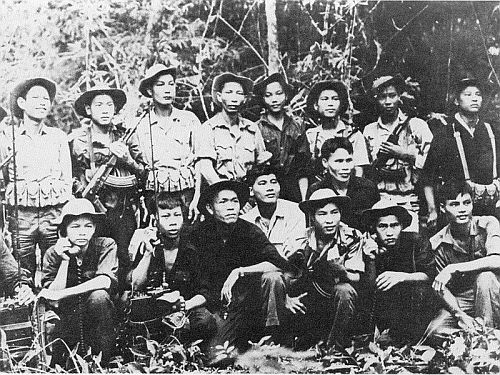
Viet Minh Main Force Regulars

The French elected to go light on artillery and due to the terrain it had to be deployed in nearly open conditions with neither cover not concealment.  Unlike Na Son the Dien Bien Phu air head was at the far end of the range of French aircraft, especially relatively weak tactical air assets.  French logistics needs were far greater than the French Air Force and American contractors could supply.  The French strong points in the valley were exposed and not mutually supporting and as such Giap and the Viet Minh were able to close with and attack each strong point in time overwhelming each after valiant French resistance.  The terrain was so poor that French units were incapable of any meaningful offensive operations against the Viet Minh.  As such they could only dig in and wait for battle.  Even so many positions were not adequately fortified and the artillery was exposed. The French garrison was a good force.  It was comprised of airborne units, the Foreign Legion, Colonial Paratroops (Marines), North Africans from Tunisia and Algeria as well as Vietnamese troops.  Many of the officers including Lieutenant Colonel Langlais and Major Bigeard commander of the 6th Colonial Parachute Battalion were among the best leaders in the French Army. Others who served in Indo-China including David Galula and Jacques Trinquier would write books which would help Americans in Iraq.  Unfortunately the French High Command badly underestimated the capabilities and wherewithal of the Giap and his divisions.

Giap rapidly concentrated his forces and built excellent logistics support.  He placed his artillery in well concealed and fortified positions which could use direct fire on French positions. Giap also had more and heavier artillery than the French believed him to have.  Additionally he brought in a large number of anti-aircraft batteries whose positions enabled the Viet Minh to take a heavy toll among French Aircraft.  Giap also did not throw his men away in human assaults.  Instead he used his Sappers (combat engineers) to build protective trenches leading up to the very wire of French defensive positions.  In time these trenches came to resemble a spider web.

Without belaboring this post the French fought hard as did the Viet Minh.  Many French positions were overwhelmed by accurate artillery and well planned attacks.  The French hoped for U.S. air intervention, even the possibility of using nuclear weapons against the Viet Minh.  They were turned down.  Relief forces were unable to get through.  The garrison died, despite the bravery of the Paratroops and Legionaries.  The French garrison was let down by their high command and their government and lost the battle due to inadequate logistics and air power.  The survivors endured a forced march of nearly 400 miles by foot to POW camps in which many died.  Many were subjected to torture and group discipline.  Few French caved to the Viet Minh interrogations but some would come away with the belief that one had to use such means to fight the revolutionaries.  French and their Algerian comrades would apply these lessons against each other within a year of their release.  French soldiers and officers were shipped from Indo-China to Algeria to wage another protracted counterinsurgency.  Militarily they had all but won the war when their government pulled out. French troops, especially the Legionaries and Paratroops felt betrayed by their nation, much like many Vietnam Vets felt about the United States government after that war.  I find today that both our government and people are caring for our returning troops in a far better manner than the past.  Even still the veterans of Iraq and Afghanistan share almost a spiritual link to our American and French brothers in arms who fought at Dien Bien Phu, the Street Without Joy and places like Khe Sanh, Hue City, the Ia Drang and the Mekong.

The lessons of the French at Dien Bien Phu and in Indo-China were not learned by the United States as it entered Vietnam.  In fact the US Army made a conscious effort to ignore the advice of those that they called “losers.”  It was an arrogance for which we paid dearly in that war.

Despite our efforts in Afghanistan and the valiant sacrifices of our Marines and Soldiers we seem to have difficulty learning the lessons of the Vietnam Wars.  Old habits die hard, counterinsurgency done right isn’t sexy and there are no easy formulas to make it work.  What works in one country may not work in another as we are found when we tried to emulate our counterinsurgency success in Iraq in Afghanistan.  Despite a lot of institutional resistance from traditionally minded Army officers we were able to apply the lessons of counterinsurgency in Iraq and work with Iraqis to make that country more secure than it was before we took this type of warfare seriously.  Despite its continued problems Iraq is doing better and will likely do well in the long run as it recovers from the damage caused by the war.  They have known civilization since antiquity and are a proud people.  Someday I hope to take up the invitation of Iraqi friends to go back as they say as a tourist.

I am concerned about Afghanistan, despite the killing of Osama Bin Laden in neighboring Pakistan because it seems that the Taliban spring offensive is off to a good start.  U.S. and NATO Forces in Khandehar and Helmand Province have been placed on a higher alert and confined to their bases following a major assault on the Afghan provincial government installations in Khandehar.  The Taliban and other Afghan insurgents are only concerned with Afghanistan and even though Bin Laden is dead the deepening rift between the United States and Pakistan will likely ensure that they will enjoy military, personnel, financial support from many in Pakistan including the Intelligence agency in the remote and ungovernable northwest territories of that country which are a safe haven much like Communist China was for the Viet Minh.

Will there be a situation where an isolated NATO garrison is overrun by Taliban forces as French forces were in Indochina?  An isolated outpost was nearly overrun at Wanat in July of 2008 and at two isolated outposts near the Pakistani border in October 2009.  One would hope not, but we cannot underestimate the Afghans and their ability to adapt to NATO tactics and weapons.   Their predecessors successfully drove out the Soviets, the British, the Persians and the Greeks.  Dien Bien Phu is a warning from history not to leave troops in places where their exposure leaves them vulnerable.

But even more Dien Bien Phu serves to remind us that in such wars it is not always the highly trained and organized Western forces that win.  These are local wars and once the momentum shifts to the insurgent they are difficult to turn around.  In a sense the French were trying to do what we are trying to do now in taking the fight to the enemy.  It turned out badly for them and it could turn out badly for us.  I hope that we don’t forget.

Peace

Padre Steve+

2 Comments

Filed under History, iraq,afghanistan, Military, vietnam