Tag Archives: holy week

Duplicity, Politics and Betrayal: A Centurion’s Thursday Evening in Jerusalem

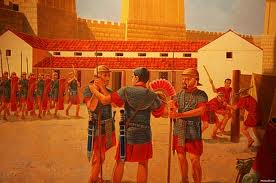
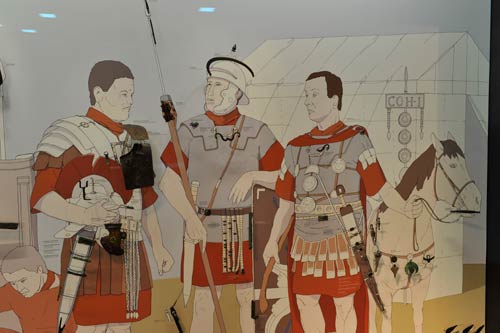
HA_Roman_Soldiers_by_HistoriaAntiqua

This is the final part of my Holy Week prequel for my series on Longinus the Centurion. I should have published it last night but forgot.

Longinus continued to think about the various intrigues that he saw in Jerusalem but he could not imagine what he was soon to learn about. The morning had started normally until the corpulent and corrupt Herod Antipas, the appointed “Jewish” ruler of Galilee and son of Herod the Great arrived in Jerusalem with his entourage.

Longinus knew that there was no love lost between Pilate and Herod, nor between the Pharisees and Herod. Herod chafed knowing that he only ruled a portion of the land his father had ruled especially that he did not rule in Jerusalem. His father had rebuilt and restored the Temple after it was desecrated by the Seleucids, something that the Pharisees and the Priestly class in the city seemed to not give his father enough credit for doing. The fact that Herod was coming to observe the Passover in the city could only add to the tensions that were simmering.

Pilate called Longinus and the other senior officers, including the Centurion Flavius to his headquarters to be part of his official greeting party. Pilate may have despised Herod, but he was the representative of the Empire and Herod, like any proxy ruler needed Pilate’s support.

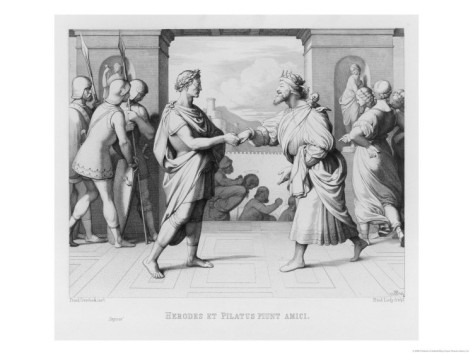
friedrich-overbeck-pilate-and-herod-resolve-their-differences-and-pilate-hands-jesus-over-to-herod-s-jurisdiction

The meeting at the court referred to as “the Pavement” was filled with ceremonial pleasantries as Pilate, Herod and their staff members and court followers conducted the business of the day. Nothing of much importance was discussed, Pilate decided not to bring up anything about the Galilean preacher despite the uproar of Sunday that accompanied his arrival. Pilate thought it amusing that a poor preach from Herod’s own province would be greeted as a king while the population hardly acknowledged Herod, apart from the rathe sullen looks that greeted his arrival.

After Herod departed Longinus, Flavius and the other officers were dismissed, yet another morning that they would never get back. But again that was part of life as an officer in a Godforsaken backwater like Judea. Such meetings of course were a necessary evil for them to attend and sometimes one could find out information that could be useful. Though nothing important was shared in the meeting Longinus noted that no Jewish religious leaders were in attendance. He thought that odd until he arrived back in his quarters where he was doffing his more ceremonial dress uniform items for the more practical daily kit.

After Herod departed Longinus, Flavius and the other officers were dismissed, yet another morning that they would never get back. But again that was part of life as an officer in a Godforsaken backwater like Judea. Such meetings of course were a necessary evil for them to attend and sometimes one could find out information that could be useful. Though nothing important was shared in the meeting Longinus noted that no Jewish religious leaders were in attendance. He thought that odd until he arrived back in his quarters where he was doffing his more ceremonial dress uniform items for the more practical daily kit.

As he changed his second in command, Decius knocked on the door.

“Come.” Longinus said and his subordinate entered. Decius came to attention and saluted.

“Be at ease my friend, what news do you bring?”

“Centurion I have some rather interesting news from our Jewish spy regarding this Jesus fellow.”

“Is that so?” Longinus inquired.

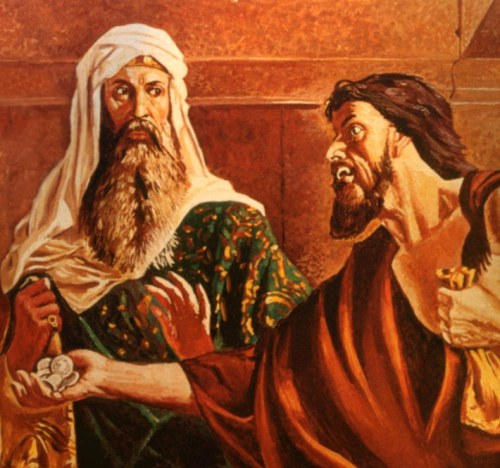
“Yes sir. He said that one of Jesus’s own men, one of his 12 closest followers went to the ruling elders this morning and offered to betray him.” The words coming from his subordinate were stunning.

“Tell me more.” Longinus said, his voice now full of curiosity.

“Sir, our man said that a man named Judas Iscariot, who is trusted by Jesus enough that he carries the money bag and pays whatever expenses that Jesus and his men incur.” Decius paused while Longinus pondered this unexpected turn of events.

After a few moments of silence Longinus asked his Tesserarius, Quentin to fetch Flavius and asked Decius to sit at his desk. Flavius arrived within a couple of minutes and joined Longinus and Decius at the desk.”

Longinus began the discussion.

“Flavius, we have news about your friend the Galilean preacher, it seems that one of his merry band is a traitor.”

If Longinus’s reaction to the news was surprise and maybe even amusement with the duplicity of these Jews the reaction of Flavius was one of stunned disbelief and horror.

“You can’t be serious?” He stammered.

“Well that is what Decius says my Jewish insider at the Sanhedrin has reported just a little while ago.” He looked at Flavius as Flavius asked “do you know which one of his men has done this.”

judas-30-pieces-of-silver

“A certain Judas Iscariot. That is the correct name isn’t it Decius.”

“Yes Centurion, Judas Iscariot.”

Flavius looked at Decius and Longinus and said “Iscariot.”

“You know of him.” Inquired Longinus.

“Yes I do know of him. Before he joined with Jesus he was reported to be linked to a group of assassins called the sicarii.”

“The sicarii?” Longinus asked , hardly believing what Flavius said. The sicarii were a particularly violent group, known to kill Romans and people that they suspected of being collaborators. They armed themselves with a particularly nasty dagger that they carried beneath their tunics. If this was true it could be a particularly disturbing turn of events.

“Yes my friend. You see many people followed this Jesus not because of his goodness or any thought of benevolence, but because they believed that he would overthrow the Jewish regime and drive us out of this land.”

“I had no idea. I thought they were all a bunch of do gooders. In fact until Jesus took a whip to all the merchants in the Temple the other day I didn’t think that he had a violent bone in his body.”

He looked at Decius and asked “What does our spy say about this Judas fellows motive?”

The younger officer replied “our man said that He overheard Judas talking before he went into the chambers of the Sanhedrin with some Priests sympathetic with the Zealot party of the Jews.”

“Continue.”

“What he said is that evidently Judas told these men that he was disappointed by the fact that Jesus did not appear to be seeking to overthrow us.”

“That would not be surprising for a member of the sicarii.” Added Flavius, his expression changing from disbelief to anger and after a moment’s reflection he slammed his fist down on the table and added “I could kill that miserable bugger myself…the man Jesus has done nothing wrong.” As Flavius spoke his voice rose in intensity. Longinus knew his friend was upset.

“Flavius, I can understand, this seems a vile thing but there are even larger issues than your friendship with this man and what he did for your servant.” Longinus hoped that his outward calm and acknowledgment of his friend’s feelings would help calm the anger.

“Longinus my friend, I know how you feel about these people and I hoped for better, I wanted to believe that they were a cut above us with their One God, but I see that even a people as devout as the Jews are as capable of evil as the worst Greek, Egyptian, Cretin or Arab.” He paused. “Do you have wine? I could use a drink about now.”

“Of course, my friend. Decius, please pour each of us each a cup of wine.”

As the younger officer got the wine Longinus looked at his angry and downcast friend. He felt a certain amount of sympathy for Flavius, but he had long ago learned not to let the sufferings of occupied people touch him deeply. He had built a fortress at impregnable as Fortress Antonia around his own heart years ago. It was the only way to survive. The being said he recognized a certain amount of humanity in his friend that was absent from so many of his comrades. In a way he envied Flavius. As he thought these things he realized that he needed to move the subject from Flavius’s emotional response to this situation to the practical consequences of this development. About that time Decius brought the wine and placing three cups on the table poured the wine.

“Thank you my friend.” Flavius said as he lifted the cup to his lips.

Both men raised their cups and took a drink. As he set his cup down Longinus continued. “I know that you hoped for better from these people, but you know I have found that some of the most religious people are also the most violent and intolerant.”

Flavius looked at his friend who continued “it seems to me that when someone, you know true believers, know that they have any deity at their disposal they are inclined to be less tolerant of others.” He paused and took a sip of wine. “I think that it is a testament to the Empire that we have so many religions and that in the name of law and order that violent ones are suppressed. That is why throughout most of the Empire we have peace.”

Flavius interrupted his friend. “But we enforce the religion of Caesar, a man, who we claim as God on our citizens.”

“True, but none of us really believe he is a real God anyway, it is a way to keep order. The state makes a religion of itself, it keeps the really dangerous types at bay. So long as people put Caesar first, even if it means burning a bit of incense to a man that they do not believe is God it serves a purpose doesn’t it?”

Flavius looked at his friend and quietly replied “I guess until I met this Jesus fellow I would have agreed completely, but now I don’t know.”

Longinus listened to his friend and could see the sincerity in his face. He continued saying softly “I really believe my friend that the second that any religion that proclaims something different arises and gains control of the Empire you can be assured that the peace that we know will be gone.”

“But that is no substitute for belief in a real God.” Answered Flavius.

“That may be so my friend but it helps keep the peace and is why we don’t have problems throughout the Empire like those that beset us here.”
A curious silence descended in the room as the two friends pondered the situation. Finally Flavius broke the silence. “I just hope that what this man has done stays a Jewish problem for their leaders. I would hate for us Romans to have to become involved in it.”

“As do I my friend, I can drink to that.”

The three men sat silently continuing to drink their wine as they pondered the position that they found themselves…. It was nearly sunset.

Peace

Padre Steve+

Leave a comment

Filed under faith, History, Religion

Easter and the Outcasts: For Many the Season is Painful

barmherzigkeit

Sieger Köder
“Barmherzigkeit” (Mercy)

“Let us not underestimate how hard it is to be compassionate. Compassion is hard because it requires the inner disposition to go with others to place where they are weak, vulnerable, lonely, and broken. But this is not our spontaneous response to suffering. What we desire most is to do away with suffering by fleeing from it or finding a quick cure for it.” Henri Nouwen

It is now Holy or Maundy Thursday, the beginning of the Easter Triduum. Mid-way through Holy Week and I am doing some thinking about Christians that have suffered a crisis in faith or loss of faith. I meet them all the time and read their stories on blogs, books and social media. Of course I run across more now because I have gone through such a crisis and have written about it and through that had my story publicized. As a result I am contacted by people who have suffered trauma, especially related to PTSD as well as those that care for such people.

For many Christians Holy Week and Easter can be particularly painful. Having known plenty of these people I can say that this phenomenon is one of the more tragic aspects of the season. People who at one time felt the presence of God in their life only sense emptiness and loneliness. For some this loneliness can transition to a feeling of hopelessness where even death appears more comforting than life in the present.

I say this because so many people suffering people often go unnoticed or are ignored in church. Their loss could be that of a spouse or child, the loss of something else significant or another type of trauma that devastates them. Others find that they are rejected by the communities of faith that they had been part of all of their lives because of divorce or because of their sexual preference. However, no matter the cause of the suffering many people discover that they are outcasts in the place where they should be cared about more than anywhere else.

Many pastors and priests are either unaware of them, uncomfortable around them or irritated by them because they don’t respond like “normal” people to the message of Easter. I have found from my own experience returning from Iraq that Easter despite the message of resurrection and hope often triggers a despair of life itself. It is not so bad this year for me but I can remember coming home from Iraq and going through an extended period of time where I felt absolutely alone and no longer sensed the presence of God. I have to say that as a Priest and Chaplain that experience was one of the most frightening of my life.

Years ago I believed that if someone was in the midst of a crisis in faith if they read the Bible more, prayed more and made sure that they were in church that things would work out. I believed then that somehow with a bit of counseling, the right concept of God and involvement in church activities that God would “heal” them.

Call me a heretic but I do not believe that now. That line of thinking is nice for people experiencing a minor bump in their life. However it is absolutely stupid advice to give people who are severely traumatized, clinically depressed, and suicidal or who no longer perceive the presence of God in their lives. This is especially true for those abused by parents or clergy. That kind of wound does damage to the victim’s very concept and understanding of God which can last a lifetime, and in some churches leads to continued re-victimization as the victims are blamed for their plight.

Thus I cannot condemn those who have lost their faith or are wavering in their faith due to trauma, abuse or any other psychological reason. The numbers of people victimized by family, teachers, clergy other authority figures is mind numbing. Likewise we don’t even bother to count the vast numbers of people in our churches who have lost children or other loved ones, experienced some kind of physical trauma related to accidents, had near death experiences or combat deal with the wounds of war. They are all over the place and many go unnoticed in the church.

Sometimes the damage makes it nearly impossible for people to comprehend a God who both cares about them and who is safe to approach. To some God is at best a detached and uncaring being who allowed them to be hurt, and those that serve him in positions of authority are willing accomplices and are no safe.

My experience of coming home from Iraq and the trauma of my return and were absolutely frightening. I was in such bad shape that I left Christmas Eve Mass in 2008 before it started and walked through the dark wondering if God even existed. My isolation from other Christians and the church community and despair that I experienced showed me that such a loss of faith is not to be trifled with by care givers. Nor is it to be papered over with the pretty wallpaper or neat sets of “principles” drawn up by “pastors” who refuse to deal with the reality of the consequences of a fallen world and their impact on real people.

Those that I have talked to and read about who have suffered a crisis or loss of faith almost always express how they feel cut off and even abandoned by God. It is also something that I experienced, thus for me it is not an academic exercise. It is not simply depression that people are dealing with, but despair of life itself. Sometimes it seems that death or just going to sleep is preferable to living. This overwhelming despair impacts almost all of life. It is if they never are able to leave the “God-forsakenness” of Good Friday and cannot climb out of the tomb. For some the pain is so much that suicide becomes an option and the belief that their family, friends and loved ones would be better off without them. I have seen this too many times to count.

It is hard to reach for the person experiencing this pain to reach out but it is also difficult for those who care enough to reach out to them. I can say that I was not easy to deal with and because of my distrust it was hard to believe that anyone cared, even when they did. However the people who chose to remain with me and walk with me through the ordeal in spite of my frequent crashes, depression, anger and even rage helped get me through the worst of this. I’m sure that some who had to deal with me in that condition got burned out as I was not easy to deal with. Some chose not walk with me as I began to go down this road in early 2008 and the sad thing is that many were ministers and fellow chaplains. In some ways I don’t blame them. However it is telling that the first person that asked me about my spiritual life “or how I was with the Big Guy” was my first therapist.

The topic of a loss of faith or the reality of feeling God forsaken is had to deal with but is something that we need to face especially during Holy Week. The Cross necessitates this, Jesus was considered “God-Forsaken” and that is what is so perplexing about Good Friday. He is the battered and abandoned victim on that day, a day when all hope appears to be gone. German theologian Jurgen Moltmann wrote something quite profound:

“When God becomes man in Jesus of Nazareth, he not only enters into the finitude of man, but in his death on the cross also enters into the situation of man’s godforsakenness. In Jesus he does not die the natural death of a finite being, but the violent death of the criminal on the cross, the death of complete abandonment by God. The suffering in the passion of Jesus is abandonment, rejection by God, his Father. God does not become a religion, so that man participates in him by corresponding religious thoughts and feelings. God does not become a law, so that man participates in him through obedience to a law. God does not become an ideal, so that man achieves community with him through constant striving. He humbles himself and takes upon himself the eternal death of the godless and the godforsaken, so that all the godless and the godforsaken can experience communion with him.” 

Scripture plainly teaches that we are to “bear one another’s burdens, and in this way you will fulfill the law of Christ.” But this can be hard to do, we don’t like dealing with suffering. But as Dietrich Bonhoeffer said “We must learn to regard people less in light of what they do or omit to do, and more in the light of what they suffer.” It is our willingness to be with people in their suffering that is one of the true marks of the Christian. Being with someone in triumph is far easier than with walking with and holding on to those who suffer the absence of God. It is presence and love not sermons that people who have lost their faith need as Bonhoeffer so eloquently said “Where God tears great gaps we should not try to fill them with human words.”

I do pray that as we walk with Jesus this Holy Week that we will not forget those who despair of live and feel as if they are “God-forsaken.”

Peace

Padre Steve+

1 Comment

Filed under christian life, faith, Pastoral Care, PTSD, Religion

Looking into the Face of Evil: A Centurion Meets the Terrorist Barrabas

centurioncross_1

This is the third chapter of a prequel to my series on Longinus the Centurion, who according to tradition was the Centurion in charge of the execution of Jesus. Today is how I imagine that the Centurion would deal with receiving orders to prepare for the execution of a condemned terrorist.

The next morning a messenger knocked on the door to Longinus’s quarters in Fortress Antonia. He told Longinus that Pilate wanted to speak to him and to report as soon as possible to Pilate’s headquarters in the fortress.

Longinus, who had been discussing the day with Decius in order to ensure his soldiers were ready for any contingency but also conduct some training was bothered by the request. He had discussed the situation in the city and about Jesus in particular the previous afternoon with Pilate and figured that unless there was some sort of incident that he would meet again later in the day to discuss the latest events.

Instead Longinus, was being ordered to report to Pilate again and it was interfering with his conduct of military business. Longinus hated dealing with politicians and diplomats and though he respected Pilate who he felt to be as decent of man as any politically appointed diplomat as any Pilate was still not a military man. He did not always understand military matters.

Longinus looked at the messenger and asked: “Tell me. what would the Governor need of me at this hour?”

“Centurion,” the messenger replied. I was only told to have you report as soon as possible.”

Bothered by the lack of detail Longinus told the messenger to go and tell Pilate that he would be there shortly. He then looked at Decius, and shook his head. “My friend, I am afraid that I will be delayed. Take care to conduct today’s training and be ready in case any trouble arises.” With that he put on his armored breastplate and cape and left the room.

pontius-pilate1

When he arrived at Pilate’s headquarters the Governor greeted him cheerfully. “Centurion, it is good to see you.”

“Likewise sir…” Pilate stopped him before he could continue.

“I don’t suppose that you know why I called you here do you?” Pilate asked, irritating Longinus who feeling even more irritated by Pilate’s levity kept his feelings to his self and simple replied: “No my Lord, your messenger only told me to report here, he did not give me a reason.”

Pilate smiled. “It was with good reason, had he done so I am sure that you, like any other Centurion in the province would have found some “pressing military duty,” isn’t that what you call it? to avoid coming here.”  He paused for just a moment and before Longinus could respond continued: “Of course I know the answer, you need not say anything and I suppose if I was in your position that I would feel the same way.”

Longinus knew this was the case and had no answer to Pilate who continued.

“Centurion, this week will unfortunately be a week where we must conduct some rather unpleasant business, less than soldierly business but necessary.” Pilate paused again and motioned for Longinus to take a seat at his desk and Longinus did so, looking about the room and noticing Pilate’s civilian staff and several soldiers assigned as his personal bodyguard.

Longinus, decided to hasten the length of the visit and asked: “My Lord, may I ask why I am here? After all I do have pressing military business to attend to.”

Pilate immediately caught the sarcasm in Longinus’s words and smiled. “Centurion, you amuse me, because I know how you military types think. You see I may not have served with a Legion, but I have served with enough officers to know that you would rather be fighting the enemies of the Empire than doing police work, but we are in Palestine, not the Teutonic Forrest.”

Longinus stared back at Pilate and said nothing.

“Centurion, this week we will dispense justice to three Jewish prisoners. Men of your unit will conduct the crucifixions this Friday.”

“Yes my Lord.” Longinus’s muted response spoke more than any protest could.

Pilate continued. “Centurion, I want you to see the prisoners and in doing so know in your heart why this must be done. These men are violent criminals, and one of them is the infamous Bar-Abbas.”  Longinus looked at Pilate, and asked “the insurgent who has attacked and killed our soldiers and officials?”

Pilate nodded and replied “so you know why this is important, in an environment as volatile as Judea we cannot let a man like this remain unpunished, it would only encourage more men to rise up like him.” Pilate smiled and continued. “We cannot forget how the Jews rose up and overthrew the Seleucid rulers underestimated these Jews when that Judas Maccabee fellow led that bloody revolt.”

Longinus replied “No we could not let that happen on our watch.”

Pilate nodded in agreement and continued. “So you understand Centurion, it is an unpleasant duty, but mind you history will thank us for it, as will any God that you believe in.” Pilate finished by telling Longinus to visit the prison for himself and begin to choose his soldiers for the crucifixion detail with care.

Longinus rose and saluted Pilate, turned and left the room without another word. He was not happy but proceeded to the dungeon where he met the Jailer of the Fortress, a rather obese and dirty looking man named Alexander, a Roman citizen of Greek origin hailing from Antioch.

When Longinus reached the dungeon he immediately noticed the stench and again realized why he was a Legionnaire and not a policeman. The prison was dark, and by Palestinian standards dank and moist smelling of human excrement and body odor.

“Well Centurion, welcome to my kingdom” said Alexander, a smile pressing through his grimy face.

“Thank you Alexander, where are the condemned?” asked Longinus icily.

They are in the cells to your left. Bar-Abbas is in the first and the other two, neither as notorious as he are in the next cell.”

“What are their names?”

“Dismas and Gestas, they are violent criminals of their own accord, but they were only out for personal gain. I think that one feels some remorse, but the other seems to be a rather hardened and unrepentant man.” The words came effortlessly to the unkempt jailer

“Thank you warden, I will see them now” said Longinus as he turned to look over these men as quickly as possible so he could return to his unit.

He walked past Bar-Abbas without making eye contact and went to the second cell. The two prisoners could not appear more different. One, seemed to accept his fate while the other looked at Longinus without remorse. After about a minute Longinus asked their names. The remorseful looking one answered, “I am Dismas, I stand condemned for robbery and murder. I accept my fate Centurion.” The other prisoner glared at his mate and with hatred in his voice and eyes said to Longinus “I am Gestas, and I am not sorry for anything that I did you Roman swine.”

barabbas

Longinus stared back saying nothing, his continued lack of respect for such people seemed vindicated. He turned to the other cell and looked at the burly prisoner in it. “So you are Bar-Abbas?”

The prisoner snarled “So what is it to you Roman?”

Longinus began to feel better about his mission. “Well, Bar-Abbas, it seems that you have killed one too many of my comrades and it is I who will get to exact justice on you.”

Bar-Abbas smiled an evil smile and said, “The Roman that can kill me has not been born.” He laughed at Longinus who stood silently for a moment. Then, quietly Longinus replied, “We’ll see about that.” With that Longinus motioned to Alexander the Jailer to let him out. The jailer unlocked the door and Longinus walked up the steps and into the courtyard of the fortress where his unit was practicing battle drills.

Calling Decius to his side, he said. “We have a second mission this week, the mission of executing some dangerous prisoners, including Bar-Abbas the insurgent.”

“Bar-Abbas sir?” replied the junior officer.

“The same, but we have to wait until Friday. It seems that our governor wants to make a show if his generosity to the people here. If it was up to me I would have killed them in the dungeon and been done with it, we could have said that they died of the plague.” Longinus looked at his assistant and then continued “Of course that is not how we Romans do things, they will be executed in public to show these Jews that they cannot engage in such conduct, but it will only build more resentment.”

“Sir, are you saying that our methods are wrong?” asked Decius.

“Young man, look around you. You know the history of these people. They will continue to rise up until they regain their independence or we kill them all.” He paused. “That is their history and they can do no other. After all, if they were occupying our homes, establishing their God in cities and forcing our people to serve them how would we respond?”

Decius nodded his understanding and looked at the Legionnaires practicing close combat tactics that might be necessary in a pitched battle if the city was to erupt in revolt.

Longinus continued “Decius, choose a squad of men as the execution team and another as the escort. The rest of the Century is to be trained to maintain a secure perimeter and ensure that no Jews attempt to interfere with our mission.

“Sir, where is the execution to take place?” asked Decius.

golgotha-36

Longinus motioned to a hill visible just outside the city walls. “Over there, that barren hill. The locals call it Golgotha.” He paused. “Fitting name, the place of the Skull. I perfect place to kill people that don’t want us here wouldn’t you say?” He chuckled and continued, “don’t answer, it is a rhetorical question.”

His assistant nodded and Longinus gave the order “Carry on with training, let me know which men you think should be on the execution team later tonight.”

Longinus turned and walked away wondering what else might happen, after all, the best laid plans of men sometimes don’t work out. He silently cursed under his breath the day that he was assigned to this place, which despite its history and splendor seemed forsaken by the Gods.

Peace

Padre Steve+

Leave a comment

Filed under faith, History, Religion

A Meeting of Centurions in Jerusalem

centurions

This is another part in the historical fiction series that I am wrote about the Centurion Longinus, who according to tradition was the Centurion at the Cross who put his lance in the side of Jesus and who would exclaim “Surely this was the Son of God” as Jesus breathed his last. This chapter takes up where after the Triumphant Entry of Jesus into Jerusalem and is about a meeting between Longinus and another Centurion who I call Flavius. This second character is based on the Centurion that Jesus meets in Capernaum recorded in Matthew Chapter eight. I began the first trilogy in 2012 and the second trilogy which is the prequel to the first last year as part of my Holy Week meditations. Hopefully I will to a concluding trilogy at some point imagining what things were like for these men in the years after that momentous week.  

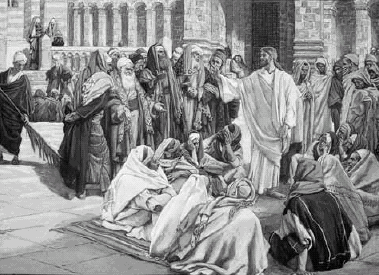
The day after the entry of this Jesus character into Jerusalem was uneventful for Longinus and his fellow Roman officers. Jesus had returned to Bethany after driving out the money changers and other assorted riff-raff out of the Temple but had returned without the tumult of the preceding day, Instead, Jesus with a number of his disciples went to the Temple where he engaged the people and some of the Pharisees in a time of teaching culminating in a series of what Longinus’ Jewish spy said were comments that could be interpreted as threats against the Temple establishment and veiled allusions to Jesus being the Messiah of the Jews.

Jesus left the Temple at the end of the day without incident but Longinus’ spy indicated that the Priests and other religious authorities were discussing ways by which they might rid themselves of this Galilean would be Messiah. Now Longinus and his fellow officers couldn’t care a whit about Jewish religious disputes so long as it did not make their job keeping the peace any more difficult than it already was.

jesus teaching

When his spy reported back Longinus briefed Pilate of the simmering tensions. Pilate was with his wife Bernice when he received the report. Pilate did not like what was going on but had no contact with any of the religious leaders from any faction since his arrival and was troubled. His wife warned him in the presence of Longinus “not to have anything to do with that man” and he told Longinus to continue monitoring the situation, He also dispatched a messenger to the commander of the Legion in Caesarea to send reinforcements to Jerusalem just in case things got out of hand. Until then, Longinus, the Primus Pilus, or senior Centurion of the Legion was to help him maintain a close watch on the situation and hopefully keep the situation from boiling over.

After his meeting with Pilate and Bernice, Longinus sat around the tavern in Fortress Antonia with several others of his officers and Centurions from the Legion currently in Jerusalem. His Optio, or second in command Decius, a Roman from his former unit who had accompanied him to Palestine was there, as were two Decurio officers from the cavalry detachment and his Tesserarius, Quentin, a man who held a position much like a First Sergeant. Late in the evening another Centurion came to the tavern. This Centurion, was accompanied by his young servant was in charge of the Century based in Capernaum in Galilee.

The Centurion, Flavius by name ordered an ale from the barkeeper and walked over to the table where Longinus and the other officers sat. After the exchange of formalities Flavius sat with them. His young servant remained at the bar sitting alone.

Longinus had known Flavius for several years and known him to be an honorable man, though he did not necessarily approve of the very “Greek” arrangement that he had with his Pais,* which was common in the Roman and Greek military units, he respected Flavius’s soldiering abilities, leadership and integrity. Flavius and his Century had arrived in Jerusalem the previous night after Jesus had made his entry into the city. Longinus was glad to see Flavius because he felt that an officer stationed in Galilee might be able to shed more light on this man of mystery who had Jerusalem up in arms and so troubled Pilate.

Flavius asked what Longinus knew about Jesus, and Longinus told him what he had seen the day before as well as the information that he had obtained from his own Jewish spy.

Flavius, nodded and then began to tell Longinus and the other officers of his encounter with Jesus a couple of years before in Capernaum of Galilee.

Flavius began: “Longinus my friend, I met this Jesus in Capernaum and he is no ordinary man.” He paused to take a drink and continued as Longinus nodded for him to continue.

“It was a difficult time my friend. My Pais was very ill, sick to the point of death, He lay in our quarters and I heard that the miracle working Rabbi named Jesus was in town. Now, you know my friends that I care not a thing about what these Jews believe but I was desperate and from what I had heard and seen I believed that the Gods had to be with this man.”

Longinus continued to listen and then asked “Why didn’t you go to our Temple and have our Gods intercede for your Pais?”

“My friend I had already done that but my Pais’ condition had worsened. So I found this Jesus fellow as he was entering the city and sent some Jews that I had befriended to him.” He paused. “Those Jews convinced Jesus that I was a friend of the Jews and had done many good things for their community, and this my friend is true.”

“So the Jews helped you contact this Jesus fellow?” asked Decius. Longinus looked at his subordinate disapprovingly and asked Flavius to continue.

“I tell you my friends, this man is like no one that I have ever met, the Gods are certainly with him, whether our Gods or the Jewish God I know not which but he is not a normal Rabbi.”

The officers looked around the table as Flavius continued.

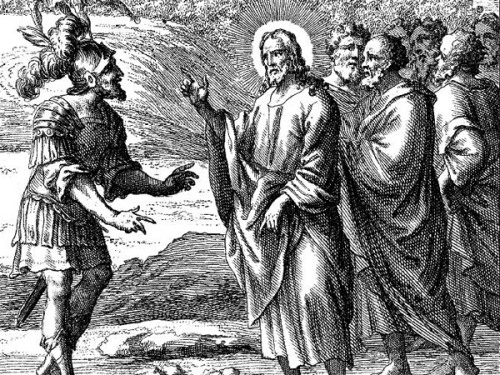
“Gentlemen, when this Jesus came to me I felt something that I have never felt in my life. Jesus asked what he could do for me and I told him of the sickness of my Pais and he asked if he could come to my quarters. I replied that I didn’t need him to come, because I was not worthy for him to come under my roof but to only say the word and my Pais would be healed.”

centurion1

Longinus looked at his fellow Centurion in disbelief. Flavius sensing this continued. “My friend, I could not believe that I uttered those words but Jesus peered into my eyes and I knew that he knew all about me. Then he replied that “your servant is healed” and then exclaimed to all of the Jews around us that he “had not seen such faith in all of Israel.” Then, he put his hand on my shoulder, blessed me with some Hebrew blessing and walked away with his friends. When I returned to my quarters, my Pais, the young man over at the bar was well.”

Longinus saw the deep emotion that Flavius was expressing and raised his mug. “A toast to this Jesus!, whatever and whoever he he is.”

“Here here” replied those at table as Flavius looked on and several laughed. He had not expected such a reaction and said softly.

“My friends I don’t think you understand.” He paused a second and looked Longinus in the eyes. “I do hope that whatever happens in the next few days that no harm will come to this man. I would hate that my spear could bring harm to him.”

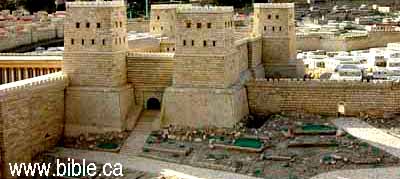
citadel

Longinus responded. “I hope that nothing happens to cause any of us any problems. The city is boiling with emotion and unlike your friend Jesus, most of them hate us and would rather see us dead, and some of their leaders from what I understand wouldn’t mind seeing him dead either.” Longinus paused and emptied his mug, drinking the ale to the last and then continued “My friend, I appreciate what you have to say, but we have to do our duty for the Empire regardless of our personal feelings. We are outnumbered here and this Jesus, as much as we may find him fascinating is the source of much of the current discord.” He looked at Flavius. “You do understand this?”

Flavius looked down at his drink and looked back up at Longinus and then at the officers around the table.

“I do understand my duty my friend, but you have to know what he did for me.”

“We do understand my friend” replied Longinus, “but our honor is loyalty to Caesar, not any other man.”

“I know Longinus, I do know, more than you think, but what if he is more than just a man?”

Longinus and the other officers sat silently pondering Flavius’s words. The silence was deafening and slowly the junior officers individually asked to be excused, begging pressing duties to attend to leaving Flavius and Longinus at the table. The bartender brought each man another ale and the two friends continued to drink in silence.

Note: The Greek word Pais is the word used in many Greek texts to to describe a homosexual relationship. The use by Matthew in his account of the healing of the servant of the Centurion used the word Pais to describe the servant, not the typical Doulos which is used for slave or bond servant as is most common throughout the New Testament. In fact this is the only use of the word Pais in the New Testament. Many Biblical scholars and linguists, though not completely certain do entertain that possibility that the Centurion that I call “Flavius” and his servant were a Gay couple. If so that would add an interesting twist of even more inclusiveness on the part of Jesus to the Gospel narratives.

Peace

Padre Steve+

Leave a comment

Filed under faith, History, Religion

A Centurion’s Remarkable Sunday in Jerusalem: The Story of Longinus

jesustriumphal-entry

This article is the first story in a prequel trilogy to a trilogy that I wrote about Longinus the Centurion who according to tradition commanded the detail in charge of the crucifixion of Jesus. I plan on re-publishing each segment this week as part of Holy Week and I hope that you find them interesting. Story is basically historical fiction and my imagination about what it must have been like to be a Roman officer witnessing the drama of the Passion during what we now call Holy Week.

I find a special affinity to this soldier who while serving his country in a land far from home whose people detested the occupiers of their country by a foreign power that most considered infidels. I don’t think that anyone can really understand the plight of the Roman officers assigned to the occupation of Judea and Samaria in the First Century until they have  done their time in Iraq or Afghanistan. These peoples, though not Jewish have similar divisions,  contradictions and prejudices against foreigners as those that lived in First Century Palestine. Those American, NATO or coalition troops that served in Iraq or Afghanistan, especially those who actually worked alongside or came to know the people in those countries understand the plight of the Roman soldiers assigned to occupation duty throughout the Empire, but especially in the volatile provinces of Judea and Samaria like Longinus.

So enough of the introduction, on to the story…

centurioncross_1

Longinus and his men were tired. Pilate, the Governor had decided that he would travel from his Provincial capital of Caesarea in order to maintain a close watch on the Jews of Jerusalem during the annual celebration of Passover. During such times that city, the largest in the province would see its population expand exponentially as Jews from the diaspora, that is those living around the known world would make pilgrimage to the holy city.

Longinus’s men had helped provide the escort as Pilate travelled the nearly 80 miles moving up from the coastal plain where Caesarea was up to the hill country of Judea. The trip took three days as Pilate wanted to be in the city in plenty of time. The weather was conducive to the march, but though well trained Longinus’ men were not Romans but primarily recruited locally from drafts of Syrian’s and Samaritans.

Longinus never really enjoyed this assignment. He had served in other areas as a young officer and much preferred serving with and commanding Italians, Greeks, Macedonians and others to the men that he now commanded, but his duty was to serve wherever he was sent. He thought at times of his family in Italy near his home in Lanciano in the Abruzzo region near the Adriatic, missing his wife and children.

coin-vespasian-judea-capta-sestertiusThe duty of Longinus and other Romans in the region chiefly consisted of helping police the region and protecting the much despised tax collectors. One of those tax collectors, a Jewish man named Matthew had left the employ of Caesar a few years back and was now a “disciple” of some itinerant Jewish preacher named Jesus. He had heard a story from another Centurion about this preacher that made him chuckle. Evidently some Jews of the sect know as the Pharisees, a particularly strict group tried to trap the Jesus with the question of whether it was lawful to pay taxes to the Romans. They thought that they had trapped him because if he answered in the affirmative he would be rejected by them and discredited among the people, while if he answered that it was not they would have him on record as urging the people to disobey Caesar.

The Centurion who told the story said how with him standing in the background watching and listening that Jesus asked one of the Pharisees to bring him a coin. Looking at the coin he asked the man whose image was on it. The Pharisee, a bit hesitantly replied that it was “Caesar” to which Jesus, who supposedly was an unlearned but charismatic bumpkin from Galilee replied “give to Caesar what is Caesar and to God that which was God’s.” Longinus’ colleague, an outsider looking in at this curious religious dispute was amazed with the acumen of Jesus in dealing with a question that someone less intuitive could have botched with potentially fatal consequences.

romans-35

The march through Samaria was particularly uneventful but as the Legionaries entered Judea, a region seething with hostility toward the Romans he and his men became more guarded, very aware of the hostility that sometimes invited violence.

They arrived about noon on Friday in order not to stir up the Jewish faithful on their sabbath and took up residence in the Fortress Antonia, the symbol of Roman might in this always rebellious city. That evening and the next day were uneventful, but on Sunday, Longinus was told to have his troops stand by in case of violence. The man named Jesus was entering the city and pandemonium was expected. According to rumor this Jesus had raised a many from the dead in Bethany the day before and was being greeted as a potential King and liberator.

The Roman presence was muted, Pilate and senior commanders not wanting to do anything that might provoke an insurrection. The troops remained on alert at the fortress while Longinus and a number of other officers went to observe events at a distance.

Longinus was amazed at what he saw. Thousands of people singing and throwing cloaks and palms along the street as Jesus, mounted on a white donkey accompanied by his disciples as well as numerous people from Bethany where he had been staying paraded down the street.

The procession moved toward the Temple where an understandably nervous delegation of Pharisees and the Priests of the Temple wondered what Jesus might do. If he was the “Messiah” that they preached about it could be a direct threat to their positions of power and provoke a Roman crackdown against them.

Jesus dismounted from the donkey and entered the Temple area, now crowed with thousands of pilgrims coming to offer sacrifice where he began to condemn the moneychangers. The moneychangers were in charge of selling animals for sacrifice to pilgrims, many of whom who could not bring their own animals for sacrifice. They were not according to what Longinus knew from his previous visits to the city at Passover and other Holy days men of good repute. They were believed to make their profit off the poor and widows and even the Romans that knew of the practice considered it less than honorable, and certainly the religious authorities were making money from their efforts.

jesus_templecleanse

As Jesus went into the Temple, Longinus and his fellow officers stayed back. As Gentiles their presence would create a crisis so they remained outside entrusting a Jew who worked with them to make the observation. They could hear commotion in the Temple and as they watched money changers and others came spilling out of the Temple grounds, many surrounded by their animals, lambs, doves and oxen. Longinus wondered what in the name of Jupiter was going on and soon his spy came running out of the Temple to make his report.

Slowing down as he approached Longinus he breathlessly gave his report. Jesus had taken a whip and driven out the moneychangers, condemning their activities and those of the religious leaders. Longinus had never heard of Jesus ever doing anything remotely violent before and this shocked him. He asked what else had happened and the spy reported that the Temple police and authorities did nothing and that Jesus left without further incident.

pontius-pilate1

Longinus knew that the coming days could prove interesting. Going to Pilate that evening he gave his report. Pilate was quite concerned about the situation and considered it volatile. He ordered Longinus and the other officers to maintain an elevated state of readiness in case there was some sort of protest or even civil strife between the followers of Jesus and the Jewish authorities.

Longinus left Pilate and he and his fellow officers discussed the situation, briefed their subordinates and as night fell met in the tavern in the fortress where they quietly drank and wondered what the coming days might bring.

Peace

Padre Steve+

2 Comments

Filed under faith, History, Religion

Musings on Easter Night: Holy Week Happenings, Busted Brackets a Radical Pope and Opening Night

resurrection

The liturgy proclaims “Alleluia! The Lord is Risen. He is risen indeed! Alleluia!” It is the triumph song of life conquering death in the Suffering, death and resurrection of Jesus the Christ.

This week I have done about all that I could to avoid political, legal and even religious controversies. Lord knows there are enough of those that i get involved in but I really wanted to focus more on Jesus, my wife Judy and our friends. So I have stayed away from becoming too deeply involved in the heated debates and topics of the past week limiting myself to skimming the news, reading as little commentary as possible and making almost no editorial comments of my own. That was hard but I digress…

IMG_0643-726257

Instead I have spent most of my time reading to the Gospel accounts of the Passion narrative and historical accounts and descriptions of the time, culture and political conditions that Jesus was crucified in Jerusalem. I began Holy Week hoping to complete the first two parts of a historical fiction trilogy built around the Roman Centurion that tradition calls Longinus. According to tradition was the man who placed his spear in the side of Jesus and who exclaimed “surely this man was the son of God” as Jesus died on the cross. You can find the links to the first two parts of the Trilogy below.

Part One: A Centurion in Jerusalem 

A Centurion’s Sunday in Jerusalem: The Story of Longinus

The Story of Longinus the Centurion: A Meeting of Friends

The Story of Longinus the Centurion: A Visit to Death Row

Duplicity in Jerusalem: An Official Visit and 30 Pieces of Silver

Part Two: An Unenviable Mission

The Long Good Friday of Longinus the Centurion

The Morning After a Most Unsettling Crucifixion: The Story of Longinus the Centurion

New Troubles: A Missing Body an Empty Tomb and Sleeping Soldiers The Story of Longinus the Centurion

In fact I did not spend time in church this week. Usually i will spend large parts of Holy Week engaged in attending or performing different services, Masses or times of prayer. However, I have been on the road a lot the past couple of years. Judy and I have spent too much time apart. Apart from personal meditations and prayers on Holy Thursday and Good Friday the only thing that we did was to have me celebrate an Easter Sunday Eucharist together at home. We could have spent a lot of the limited time that I was home in church, and as much as I love the people at the small Episcopal parish that I attend when home I needed the time with Judy more. Being stationed over 200 miles from home for the past two and a half years does help help one realize what is important. Next year I will be in charge of a chapel and then I will be fully engaged in Holy Week activities, this year however, we needed to be together. Some might find fault in this but if they do they can pound sand, of course in Christian love.

The week was interesting because Wednesday was my birthday and Judy made arrangements to have friends go with us to a local German restaurant. I really enjoyed being with Judy and our friends and that time was well spent. Once again, something that I have come to be thankful for and to make sure that I spend time to do now is to make time for friends and family.

minute-maid-park-getty

Speaking of baseball I found it fitting and quite symbolic that Opening Night 2013 fell on Easter Sunday. If you ask me this should always be the case but it would involve having all of Christianity having to change their calendars to fit and that will not happen. If Pope Francis hailed from the Dominican Republic there might be a chance, but we need to wait to get a Pope from the Dominican Republic.

gty-164815601-4_3_r536_c534

Speaking of Pope Francis it appears that he is really starting to rattle some guided cages at the Vatican and among Church Traditionalists, and if you ask me not a moment too soon. He turned a lot of heads with his common touch over the first couple of weeks of his Papacy but it was his actions on Holy Thursday that set heads spinning a la Linda Blair in The Exorcist.

For the first time a Pope washed the feet of women, one of them being a Moslem. I do pray for this Pope and I worry about him because some of the most violent people are religious types. Some of the more traditional mindset don’t take change well. Some, even among Christians resort to violence when a church or religious leader is going outside what they believe is “orthodox” even if it has little to do with their actual orthodoxy.

Well now it is the time that I need to get ready for work in the morning. While I am doing this I will continue to watch the Texas Ranger’s play their new American League Central neighbors the Houston Astros.

Until tomorrow,

Peace, Happy Easter and Happy Opening Night after all “the only church that truly feeds the soul day in, day out, is the Church of Baseball.” 

Padre Steve+

Leave a comment

Filed under Baseball, christian life, faith, News and current events

The Long Good Friday of Longinus the Centurion

600px-Gustave_Doré_-_Crucifixion_of_Jesus

This is a re-do of my original “Long Good Friday of Longinus the Centurion., Since I first wrote that piece two years ago I have written a prequel, and like George Lucas feel the need to change and improve the original. Unlike Lucas who simply tweeked Star Wars I have chosen to spend my time completely re-writing the original in light of the prequel series dealing with the events leading up to Good Friday that I did this week. I don’t know about you but I like to imagine events as they might have actually happened. As an Iraq veteran who served with our advisors to the Iraqis I do understand the plight of soldiers from an occupying power serving far away from home where their presence is barely tolerated, much less welcomed. Since I have always felt a special affinity for the soldiers that have interactions with Jesus, who are treated very sympathetically by the writers of the Gospels as well as Luke in the Book of Acts.

The links to the first four chapters of this story are linked in below. I have not linked the three original articles in order to provide a better continuity and personal narrative for the characters in light of the Gospel accounts, non-Biblical accounts, church tradition and my own imagination.

Peace

Padre Steve+

A Centurion’s Sunday in Jerusalem: The Story of Longinus

The Story of Longinus the Centurion: A Meeting of Friends

The Story of Longinus the Centurion: A Visit to Death Row

Duplicity in Jerusalem: An Official Visit and 30 Pieces of Silver


Longinus had finally decided to try to get a bit of rest. After his rather morose meeting with Flavius and Decius he and Decius went back to check on the preparations for the executions scheduled for the next day. Quentin his Tesserarius had been working with the squad chosen to to conduct the actual crucifixions of the prisoners, Bar-Abbas the insurgent as well as the common criminals and murderers Dismas and Gestas who he had met in the hell hole of a jail in the dungeon of Fortress Antonia after Pilate had assigned him the task of conducting the executions.

Longinus was certain of his unit’s ability to carry out the mission, though he would have rather had a unit from Italy than his unit of Syrian and Samaritan troops. There was one positive aspect, his Samaritans and Syrians had no love for the Jews and would have no qualms whatsoever in disposing of the criminals.

He thought for a moment about the prisoners. That Bar-Abbas fellow, he would be glad that he or any other Roman would have to deal with him again once the crucifixion was over. As for the common criminals he felt that everyone would be better off with Gestus dead although he hoped that Pilate might take pity on the repentant thief named Dismas. However, despite his feelings he also knew that the law was the law and repentant or not that Dismas was guilty of the crimes and the sentence was just. As he had realized earlier in the day while talking with Flavius it was important not to become emotionally involved with the locals, especially prisoners. Maintaining an emotional distance ensured that he would not flinch in times when ice rather than blood needed to flow through one’s veins. He was proud that he could do this but envied the humanity that his comrade and friend Flavius still maintained in spite of everything.

He was just about to prepare for bed when a messenger from Pilate knocked on his door. It was late, too late and Longinus wondered just what was going on.

“Come.” He said, the weariness in his voice obvious in the way he answered.

The messenger, a relatively young Italian soldier assigned to Pilate’s bodyguard entered, came to attention and saluted.

Longinus looked at the young man, like him far from home and asked “what am I needed for now?”

“Centurion, the Governor has requested your presence” the soldier replied.

“May I ask what for?” A now increasingly irritated Longinus asked.

“Sir, I do not have the details but it is a pressing matter regarding the Jews and that Galilean preacher.” The young man was obviously uncomfortable in having to request a career officer like Longinus, a veteran of real battles and campaigns appear before Pilate for what was not much more than a religious dispute among an occupied people.

“Pressing matter?” Asked Longinus.

“Yes Centurion. I was told that it was urgent that you come to Governor Pilate now and alert your unit as at least some of your men may be needed if things get out of hand.”

“Can you please tell me just what is going on?” Longinus asked as he pulled his armored breastplate over his shoulders.

“I’m sorry Centurion, I have no more information. You are to report to the Governor within the half hour. The Governor wants your unit ready within the hour.” When he finished he came to attention, saluted and exited the room.

Longinus hated how leaders sent young men to be their messengers and would not give them all of the relevant information.

Longinus sat back down in his chair where he had been sitting and discussing the situation with Flavius and Decius. He wondered to himself what could be so pressing that Pilate needed him now.

After briefing Decius and Quentin, instructing them to wake the men and be ready for action Longinus took a squad and went to Pilate’s headquarters. When he arrived Pilate greeted him.

“Centurion, I hate to have bothered you at this hour in light of how busy you and your men will be in the morning but a situation has arisen.” Longinus looked around the room and then heard some commotion on the area called “the Pavement.”

“What is happening my Lord?”

“Longinus, these Jews have brought that Jesus fellow here and are accusing him of fomenting a rebellion against the Emperor.”

“A rebellion sir?”

“That is what they say Centurion. They claim that one of his closest associates had turned him in and after a trial of their own that they found him guilty of claiming to be a king and God that will overthrow the Emperor.” Pilate could not hide his discomfort.

carrycross

“Do you actually believe them sir? After all we had heard this morning that this Judas Iscariot fellow had betrayed him for 30 pieces of silver.”

“I know Centurion, I know.” Pilate looked at Longinus then back out at the crowd gathered outside in the dark. He was afraid and Longinus could sense that fear, fear that if he made the wrong move that a real rebellion could break out and that Pilate as the Governor would take the blame and bear the punishment and wrath of Caesar.

“Centurion, I tried to placate these people be questioning this Jesus fellow myself.” Pilate paused. “I must say that he is a rather unusual man and truthfully I could not find anything that under Roman law that I could find him guilty of doing. Not a thing Centurion, nothing but their leaders kept pressing me.” Pilate’s gaze seemed to be almost pleading with Longinus to help him escape this decision. Longinus knew at that moment that his day was about to get worse. Pilate continued “It seems to be a religious squabble of some kind so in order to deal with it and to try to keep us out of it I sent Jesus to Herod since Herod is the ruler of Galilee.”

“So Herod will certainly deal with the situation, will he not Governor?”

“Centurion, I thought that that corpulent bastard Herod would deal with it but I just got word that Herod too could find no crime. The Jewish leaders and of their Temple Police are supposedly bringing him back to me to render judgement. They are leaving it to me.”

“Judgement for what?”

“Sedition, treason, blasphemy, proclaiming himself a king.” Pilate paused, his face flushed. “My God I’m surprised that they haven’t accused the man of fathering the High Priest’s daughter.” The sarcasm and bitterness was evident in his voice.

“So what do you intend to do.”

“I intend to try to get us out of this with as little trouble or guilt as possible. When they return him to me I will ask a few more questions and set him free as is my prerogative, certainly they wouldn’t want to release a real murderer like Bar-Abbas back into society, I do give them more credit than to stoop that low.”

“I do hope that you are right governor, but from what I understand it seems that they are intent on ridding themselves of the fellow once and for all. I think that their leaders see the Galilean as more of a threat than a man like Bar-Abbas.”

Pilate said nothing and during the silence Longinus’s troops under the direction of Decius entered the perimeter of the court adding an additional security cordon as the crowd grew and got more boisterous. As they took up position the Temple Police and members of the High Priest’s entourage approached the court with the Galilean in custody. Quentin with four soldiers met them and took custody of the obviously tired and already abused man. They delivered Jesus to Pilate and stood back. Longinus watched as it happened. As he did so Flavius entered the room with his servant. The servant appeared unsteady and full of emotion when he saw the man who had healed him two years before. Flavius stood by his face not betraying any feelings except deep seated rage that was boiling as he saw this travesty of justice take place.

Pilate attempted every trick in the book to garner a way to save the life of the man standing before him. He asked him questions and Jesus clothed in a purple robe that Herod had mockingly placed upon him said nothing. Finally in desperation Pilate asked Jesus if he was a king. The answer both fascinated and terrified Pilate and caused him to wish that he had never come to the city. As he deliberated earlier and debated the members of the Sanhedrin his wife again urged him to “have nothing to do with that innocent man.”

But the answer of Jesus to the question of his kingship troubled Pilate. Had he thought the man insane he would have scourged him, declared him mad and been done with the affair. “My kingdom is not of this world, if it were my followers would be fighting to ensue that you did not hand me over to the Jewish leaders.” Jesus looked into Pilate’s eyes, the look sent a chill through Pilate’s soul and Pilate restated the question “so you are a king?”

Jesus replied solemnly “You say I am a king. I was born for this and it is why I came to this world, to testify to the truth. Everyone who belongs to the truth listens to me.”

Pilate appeared stunned and both Longinus and Flavius knew that he was beaten. They listened as Pilate asked “what is truth?” The question was one of a man who had long ago sold his soul to gain the world, it was the question of a deeply cynical man who had long determined that truth was only in the eye of the beholder and to be used as needed to acquire power. At the same time they could see a touch of genuineness in the question as Pilate, desperate for an answer that would enable him to please everyone and spare the life of the man before him wrestled with the question of truth for the first time in years.

They watched as Pilate attempted to bargain for the life of Jesus only to be shouted down by the increasingly riotous crowd who demanded that Bar-Abbas be released. Again attempting to assuage the mob he had Jesus scourged with a barbed whip. The soldier who did that brutal work was a Syrian, big and burley without a trace of feeling in his eyes or face. The servant of Flavius begged him to intervene but Flavius now knew that the things happening to Jesus could no longer be influenced by sentimentality and stories of the goodness of Jesus. He had seen this type of Justice before, and though he despised it, he earnestly hoped that it would be enough to deliver Jesus.

After the scourging, soldiers assigned to Longinus jammed a crown of thorns down on the blood covered Jesus and placed the purple cloak over him. Jesus’s body trembled. Pilate again approached the mob and tried to decline the odious responsibility thrust into his hands. The mob led by the Chief Priests and joined by man of their rivals, the Pharisees cried out for Jesus to be crucified.

They heard Pilate plead with Jesus, again noting that he had power over the life and death of Jesus to which Jesus replied that Pilate “had no power over him that had not been given by God.” Finally he pleaded with the Jews one more time to take Bar-Abbas for execution and to spare the Galilean. The leaders shouted him down again and cried out that Pilate would be a traitor to Caesar if he let a man who claimed to be a king live.

Defeated By the mob and by his own weakness of character Pilate asked for a ceremonial washing basin full of water. When it came in the hands of a court member he placed his hands in it and proclaimed “I am innocent of this man’s blood.” He then ordered the soldiers to take Jesus to be crucified even as the prisoners Dismas and Gestus were led from the dungeon for execution and a profoundly perplexed Bar-Abbas was released by the jailer.

Longinus looked at Flavius and whispered to him “wash my hands of his blood? My God, he knows that he is as guilty at them.” Flavius looked on and simply said “I know my friend, we all are.”

The detail of soldiers assigned to the crucifixion detail was commanded by Quentin, a man who had fought many battles and like Longinus and Flavius felt that these executions of helpless prisoners were unworthy of soldiers like himself. The soldiers of Flavius’s unit had responsibility for helping to clear a way down the narrow street called by the Romans Via Delarosa. The street of suffering. It was the street that all the condemned travelled to the hill of execution so fittingly called the place of the Skull. Longinus had seen others walk this path but in the past he had been able to shield his person from their suffering, but today was different.

Longinus’s own execution squad led by Quentin led Jesus and the others along, forcing them to carry their crosses. About halfway down the street Jesus collapsed under the weight if his cross and grabbed a bystander, a man from Cyrene to carry the cross while the soldiers prodded the bloody body of Jesus down the street and out of the city to the place of execution. People jeered at the condemned as they did at very execution as for most this was no different than any other crucifixion and most of those present knew little about any of the condemned men and even those that were familiar with Jesus probably did not recognize the bloody man stumbling down the street. Of course there were others present who did know Jesus and watched in horror as their friend, teacher and for one woman her son struggled to the execution site. Longinus wondered about his own elderly mother and thought of her as he saw the mother of Jesus. He quickly tried to chase her image from his mind, he needed to be strong and hard if he was to keep his objectivity and conduct the mission as distasteful as he found it.

When the macabre parade arrived at the hill, the prisoners were stripped, placed on the crosses and nailed to them. Their screams as Quentin hammered the large iron nails home through their already abused flesh echoed for all to hear. Thankfully Quentin knew what he was doing and this part of the execution process happened quickly. Then the crosses were raised, but just before this a messenger from Pilate arrived with the placards that denoted the charges. He handed them to Longinus who noted what was written on the one for Jesus. It said “The King of the Jews.”

The placards were placed and with a thud the crosses were placed in the holes on the hill. The suffering of the prisoners was great, the crowds jeered and mocked them while those that loved them stood at a distance. Soldiers stood guard to ensure that no one interfered with them in any way. There was a bit of banter between the real criminals one of whom, the unpleasant one named Gestus joined in the mocking of Jesus only to be put in his place by the other one named Dismas.

Longinus, Flavius, Decius and a few other officers watched as their soldiers from the crucifixion detail divided the paltry worldly possession of the men between themselves. The men argued over a one piece tunic worn by Jesus, Not wanting to destroy it they cast lots for it. A trooper from Tyre won the tunic. Longinus and Flavius looked at each other and realized how little most of their men earned and neither begrudged the men the few items that they gathered from the men being executed.

The skies which had began the day with bright sunshine now became dark and foreboding. Lightening appeared in the distance and occasionally Jesus would address his mother or one man, Flavius believed him to be a disciple who stood by the cross. Jesus even promised the Dismas character that “he would be with him in paradise” and told others, Longinus thought the soldiers but he wasn’t sure “forgive them they know not what they do.” As it approached the ninth hour Jesus cried out in Aramaic “my God, my God, why have you forsaken me!”

A cold rain began to fall.

Quentin approached him with a sponge on a pole which was soaked in a sour wine. It touched Jesus’s lips and Jesus said “Father into your hands I commit my spirit” and then “it is finished.”

With that last dying remark the head of Jesus fell to his chest and his body, bloody and mangled hung limp. As the men looked on the ground began to tremble and as the ground shook and the officers looked about amid the gloom and confusion as the onlookers took flight Longinus exclaimed “surely this man was the son of God.” Flavius looked at his fellow Centurion in astonishment. Longinus, the man who had closed his heart in a fortress was echoing what he had believed since Jesus had healed his servant, the young man who was more than a servant to him.

As the crowds dispersed Longinus received the message that the executions had to be concluded before the Jews began their Passover. With that he sent Quentin to break the legs of the prisoners to hasten their deaths. When Quentin reached Jesus he called for Longinus.
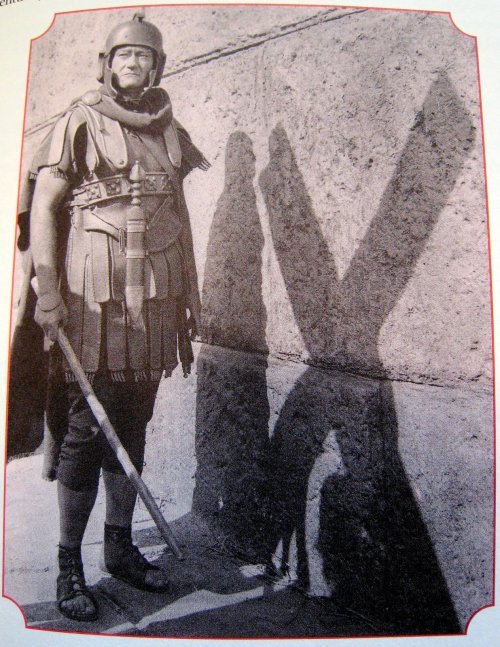
IMG_0643-726257

“Centurion, I believe that this man is already dead. Do you still want me to break his legs?”

Longinus looked at his subordinate and said “no I must do this myself.” He had a soldier bring him his lance, a ceremonial lance that denoted his seniority as the senior Centurion in the Legion. He looked at the lance and plunged it into the side of Jesus into his heart. Jesus did not move but from the wound blood mixed with what looked like water poured out of the wound and down his side.

“Quentin, he is dead, you may take him down.” Other soldiers pulled down the dead bodies of the thieves. As they did this a man approached Longinus and Flavius.

“Gentlemen. I am Joseph, I am a member of the Sanhedrin. I have come to take responsibility for the body of Jesus of Nazareth.”

Longinus replied in a businesslike manner “by whose authority?” He had a hard time believing that a member of the Sanhedrin would claim this body.

With that Joseph produced a letter from Pilate. Longinus looked the letter over and handed it back to Joseph without comment. Joseph then motioned to several men with him to take the body as Longinus, Flavius and the others looked on. Longinus thought to himself that it was good that a man of some means and influence would at least take the time to give this innocent man a decent burial.

As Quentin took charge of the clean up Longinus instructed Decius to prepare the troops to return to Fortress Antonia. Flavius instructed his optimo to do the same. The last thing that any of them wanted to be was on the streets when the Jews began their Passover, as always they decided that it was unwise to stir up any more animosity than was needed. Today w a near run thing with e demonstration outside Pilate’s headquarters and none of them wanted any more excitement this evening.

When the clean up was completed and the bodies removed Longinus and Flavius ordered their soldiers back to Fortress Antonia. When they arrived the Centurions went to Pilate to inform him that the mission was complete. Pilate was glad the ordeal was over but was obviously still disturbed by the events of the day. Longinus, now exhausted was glad to leave Pilate’s presence. He still loathed politicians and wondered if had Pilate been a soldier if he would have had the courage to tell the leaders of the Sanhedrin to “pound sand” and keep Jesus alive. But then he knew that had Pilate done something that only a diplomat could do, he kept the peace. Had he been in charge the man named Jesus might have lived but hundreds maybe even thousands of others might have died.

After he dismissed his soldiers he went to his room, doffed his gear and went to the tavern in the fortress. Flavius joined him about 15 minutes later. They sat at the table as the barkeeper brought them each an ale. They looked at each other and Flavius asked “What did you mean by surely this man was the son of God?”

Longinus shook his head. “My friend I do not really know.” He paused and took a drink from his cup. “Until today I simply figured that he was a good man, but after today, after what I witnessed I just don’t know.”

“If you ask me my friend I think that he must be a God, if not somehow connected to the greatest of Gods, the God of the Jews.”

“Perhaps Flavius you are right. All I know is that I can no longer see the world, the Empire or my life in the same light as I did just a week ago.”

Flavius nodded his understanding as Decius entered the tavern. The younger officer reported to his seniors. They acknowledged his entrance and Longinus asked the younger officer to sit with them.

“What do you know Decius?”

The younger officer spoke. “Sir, I do not know if you heard the latest about the man that betrayed Jesus.”

Longinus said sarcastically “did they elect him High Priest?”

The younger man caught the sarcasm and replied “if only that we’re the case. He was found dead, hanging from a tree in the Potter’s Field.”

Flavius answered “so the traitor couldn’t handle his own act of duplicity?”

Longinus replied, “evidently not.” He took a drink from his cup and motioned for the barkeep to get Decius an ale. The three men continued to drink silently and wondered what else could happen…

1 Comment

Filed under faith, History, Religion

Duplicity in Jerusalem: An Official Visit and 30 Pieces of Silver

images-35

This is the final section of the prequel to my historical fiction series on Longinus the Centurion. The other chapters of the series can be found at the following links. Have a blessed Easter Triduum.

A Centurion’s Sunday in Jerusalem: The Story of Longinus

The Story of Longinus the Centurion: A Meeting of Friends

The Story of Longinus the Centurion: A Visit to Death Row 

Good Friday Special: The Long Good Friday of Longinus the Centurion

Holy Saturday Special: A Centurion Reflects on a Days Work

Easter Special: Trouble in River City the Centurion’s Easter: An Empty Tomb, Duplicitous Politicians and a Lingering Question

Peace,

Padre Steve+

Longinus continued to think about the various intrigues that he saw in Jerusalem but he could not imagine what he was soon to learn about. The morning had started normally until the corpulent and corrupt Herod Antipas, the appointed “Jewish” ruler of Galilee and son of Herod the Great arrived in Jerusalem with his entourage.

Longinus knew that there was no love lost between Pilate and Herod, nor between the Pharisees and Herod. Herod chafed knowing that he only ruled a portion of the land his father had ruled especially that he did not rule in Jerusalem. His father had rebuilt and restored the Temple after it was desecrated by the Seleucids, something that the Pharisees and the Priestly class in the city seemed to not give his father enough credit for doing. The fact that Herod was coming to observe the Passover in the city could only add to the tensions that were simmering.

Pilate called Longinus and the other senior officers, including the Centurion Flavius to his headquarters to be part of his official greeting party. Pilate may have despised Herod, but he was the representative of the Empire and Herod, like any proxy ruler needed Pilate’s support.

friedrich-overbeck-pilate-and-herod-resolve-their-differences-and-pilate-hands-jesus-over-to-herod-s-jurisdiction

The meeting at the court referred to as “the Pavement” was filled with ceremonial pleasantries as Pilate, Herod and their staff members and court followers conducted the business of the day. Nothing of much importance was discussed, Pilate decided not to bring up anything about the Galilean preacher despite the uproar of Sunday that accompanied his arrival. Pilate thought it amusing that a poor preach from Herod’s own province would be greeted as a king while the population hardly acknowledged Herod, apart from the rathe sullen looks that greeted his arrival.

After Herod departed Longinus, Flavius and the other officers were dismissed, yet another morning that they would never get back. But again that was part of life as an officer in a Godforsaken backwater like Judea. Such meetings of course were a necessary evil for them to attend and sometimes one could find out information that could be useful. Though nothing important was shared in the meeting Longinus noted that no Jewish religious leaders were in attendance. He thought that odd until he arrived back in his quarters where he was doffing his more ceremonial dress uniform items for the more practical daily kit.

After Herod departed Longinus, Flavius and the other officers were dismissed, yet another morning that they would never get back. But again that was part of life as an officer in a Godforsaken backwater like Judea. Such meetings of course were a necessary evil for them to attend and sometimes one could find out information that could be useful. Though nothing important was shared in the meeting Longinus noted that no Jewish religious leaders were in attendance. He thought that odd until he arrived back in his quarters where he was doffing his more ceremonial dress uniform items for the more practical daily kit.

As he changed his second in command, Decius knocked on the door.

“Come.” Longinus said and his subordinate entered. Decius came to attention and saluted.

“Be at ease my friend, what news do you bring?”

“Centurion. I have some rather interesting news from our Jewish spy regarding this Jesus fellow.”

“Is that so?” Longinus inquired.

“Yes sir. He said that one of Jesus’s own men, one of his 12 closest followers went to the ruling elders this morning and offered to betray him.” The words coming from his subordinate were stunning.

“Tell me more.” Longinus said, his voice now full of curiosity.

“Sir, our man said that a man named Judas Iscariot, who is trusted by Jesus enough that he carries the money bag and pays whatever expenses that Jesus and his men incur.” Decius paused while Longinus pondered this unexpected turn of events.

After a few moments of silence Longinus asked his Tesserarius, Quentin to fetch Flavius and asked Decius to sit at his desk. Flavius arrived within a couple of minutes and joined Longinus and Decius at the desk.”

Longinus began the discussion.

Judas' 30 pieces of silver

“Flavius, we have news about your friend the Galilean preacher, it seems that one of his merry band is a traitor.”

If Longinus’s reaction to the news was surprise and maybe even amusement with the duplicity of these Jews the reaction of Flavius was one of stunned disbelief and horror.

“You can’t be serious?” He stammered.

“Well that is what Decius says my Jewish insider at the Sanhedrin has reported just a little while ago.” He looked at Flavius as Flavius asked “do you know which one of his men has done this.”

“A certain Judas Iscariot. That is the correct name isn’t it Decius.”

“Yes Centurion, Judas Iscariot.”

Flavius looked at Decius and Longinus and said “Iscariot.”

“You know of him.” Inquired Longinus.

“Yes I do know of him. Before he joined with Jesus he was reported to be linked to a group of assassins called the sicarii.”

“The sicarii?” Longinus asked , hardly believing what Flavius said. The sicarii were a particularly violent group, known to kill Romans and people that they suspected of being collaborators. They armed themselves with a particularly nasty dagger that they carried beneath their tunics. If this was true it could be a particularly disturbing turn of events.

“Yes my friend. You see many people followed this Jesus not because of his goodness or any thought of benevolence, but because they believed that he would overthrow the Jewish regime and drive us out of this land.”

“I had no idea. I thought they were all a bunch of do gooders. In fact until Jesus took a whip to all the merchants in the Temple the other day I didn’t think that he had a violent bone in his body.”

He looked at Decius and asked “What does our spy say about this Judas fellows motive?”

The younger officer replied “our man said that He overheard Judas talking before he went into the chambers of the Sanhedrin with some Priests sympathetic with the Zealot party of the Jews.”

“Continue.”

“What he said is that evidently Judas told these men that he was disappointed by the fact that Jesus did not appear to be seeking to overthrow us.”

“That would not be surprising for a member of the sicarii.” Added Flavius, his expression changing from disbelief to anger and after a moment’s reflection he slammed his fist down on the table and added “I could kill that miserable bugger myself…the man Jesus has done nothing wrong.” As Flavius spoke his voice rose in intensity. Longinus knew his friend was upset.

“Flavius, I can understand, this seems a vile thing but there are even larger issues than your friendship with this man and what he did for your servant.” Longinus hoped that his outward calm and acknowledgment of his friend’s feelings would help calm the anger.

“Longinus my friend, I know how you feel about these people and I hoped for better, I wanted to believe that they were a cut above us with their One God, but I see that even a people as devout as the Jews are as capable of evil as the worst Greek, Egyptian, Cretin or Arab.” He paused. “Do you have wine? I could use a drink about now.”

“Of course, my friend. Decius pour us each a cup of wine.”

As the younger officer got the wine Longinus looked at his angry and downcast friend. He felt a certain amount of sympathy for Flavius, but he had long ago learned not to let the sufferings of occupied people touch him deeply. He had built a fortress at impregnable as Fortress Antonia around his own heart years ago. It was the only way to survive. The being said he recognized a certain amount of humanity in his friend that was absent from so many of his comrades. In a way he envied Flavius. As he thought these things he realized that he needed to move the subject from Flavius’s emotional response to this situation to the practical consequences of this development. About that time Decius brought the wine and placing three cups on the table poured the wine.

“Thank you my friend.” Flavius said as he lifted the cup to his lips.

Both men raised their cups and took a drink. As he set his cup down Longinus continued. “I know that you hoped for better from these people, but you know I have found that some of the most religious people are also the most violent and intolerant.”

Flavius looked at his friend who continued “it seems to me that when someone, you know true believers, know that they have any deity at their disposal they are inclined to be less tolerant of others.” He paused and took a sip of wine. “I think that it is a testament to the Empire that we have so many religions and that in the name of law and order that violent ones are suppressed. That is why throughout most of the Empire we have peace.”

Flavius interrupted his friend. “But we enforce the religion of Caesar, a man, who we claim as God on our citizens.”

“True, but none of us really believe he is a real God anyway, it is a way to keep order. The state makes a religion of itself, it keeps the really dangerous types at bay. So long as people put Caesar first, even if it means burning a bit of incense to a man that they do not believe is God it serves a purpose doesn’t it?”

Flavius looked at his friend and quietly replied “I guess until I met this Jesus fellow I would have agreed completely, but now I don’t know.”

Longinus listened to his friend and could see the sincerity in his face. He continued saying softly  “I really believe my friend that the second that any religion that proclaims something different arises and gains control of the Empire you can be assured that the peace that we know will be gone.”

“But that is no substitute for belief in a real God.” Answered Flavius.

“That may be so my friend but it helps keep the peace and is why we don’t have problems throughout the Empire like those that beset us here.”

A curious silence descended in the room as the two friends pondered the situation. Finally Flavius broke the silence. “I just hope that what this man has done stays a Jewish problem for their leaders. I would hate for us Romans to have to become involved in it.”

“As do I my friend, I can drink to that.”

The three men sat silently continuing to drink their wine as they pondered the position that they found themselves…. It was nearly sunset.

2 Comments

Filed under faith, History, Religion

The Story of Longinus the Centurion: A Visit to Death Row

MLPPT_CenturionCross_1

This is the third chapter of a prequel to my series on Longinus the Centurion, who according to tradition was the Centurion in charge of the execution of Jesus. The Previous chapters as well as the original series can be found at the links supplied below. 

A Centurion’s Sunday in Jerusalem: The Story of Longinus

The Story of Longinus the Centurion: A Meeting of Friends

Good Friday Special: The Long Good Friday of Longinus the Centurion

Holy Saturday Special: A Centurion Reflects on a Days Work

Easter Special: Trouble in River City the Centurion’s Easter: An Empty Tomb, Duplicitous Politicians and a Lingering Question

The next morning a messenger knocked on the door to Longinus’s quarters in Fortress Antonia. He told Longinus that Pilate wanted to speak to him and to report as soon as possible to Pilate’s headquarters in the fortress.

bible-archeology-jerusalem-temple-mount-antonia-fortress

Longinus, who had been discussing the day with Decius in order to ensure his soldiers were ready for any contingency but also conduct some training was bothered by the request. He had discussed the situation in the city and about Jesus in particular the previous afternoon with Pilate and figured that unless there was some sort of incident that he would meet again later in the day to discuss the latest events.

Instead Longinus, was being ordered to report to Pilate again and it was interfering with his conduct of military business. Longinus hated dealing with politicians and diplomats and though he respected Pilate who he felt to be as decent of man as any politically appointed diplomat as any Pilate was still not a military man. He did not always understand military matters.

Longinus looked at the messenger and asked: “Tell me. what would the Governor need of me at this hour?”

“Centurion,” the messenger replied. I was only told to have you report as soon as possible.”

Bothered by the lack of detail Longinus told the messenger to go and tell Pilate that he would be there shortly. He then looked at Decius, and shook his head. “My friend, I am afraid that I will be delayed. Take care to conduct today’s training and be ready in case any trouble arises.” With that he put on his armored breastplate and cape and left the room.

When he arrived at Pilate’s headquarters the Governor greeted him cheerfully. “Centurion, it is good to see you.”

“Likewise sir…” Pilate stopped him before he could continue.

“I don’t suppose that you know why I called you here do you?” Pilate asked, irritating Longinus who feeling even more irritated by Pilate’s levity kept his feelings to his self and simple replied: “No my Lord, your messenger only told me to report here, he did not give me a reason.”

Pilate smiled. “It was with good reason, had he done so I am sure that you, like any other Centurion in the province would have found some “pressing military duty,” isn’t that what you call it? to avoid coming here.”  He paused for just a moment and before Longinus could respond continued: “Of course I know the answer, you need not say anything and I suppose if I was in your position that I would feel the same way.”

Longinus knew this was the case and had no answer to Pilate who continued.

“Centurion, this week will unfortunately be a week where we must conduct some rather unpleasant business, less than soldierly business but necessary.” Pilate paused again and motioned for Longinus to take a seat at his desk and Longinus did so, looking about the room and noticing Pilate’s civilian staff and several soldiers assigned as his personal bodyguard.

Longinus, decided to hasten the length of the visit and asked: “My Lord, may I ask why I am here? After all I do have pressing military business to attend to.”

Pilate immediately caught the sarcasm in Longinus’s words and smiled. “Centurion, you amuse me, because I know how you military types think. You see I may not have served with a Legion, but I have served with enough officers to know that you would rather be fighting the enemies of the Empire than doing police work, but we are in Palestine, not the Teutonic Forrest.”

Longinus stared back at Pilate and said nothing.

“Centurion, this week we will dispense justice to three Jewish prisoners. Men of your unit will conduct the crucifixions this Friday.”

“Yes my Lord.” Longinus’s muted response spoke more than any protest could.

Pilate continued. “Centurion, I want you to see the prisoners and in doing so know in your heart why this must be done. These men are violent criminals, and one of them is the infamous Bar-Abbas.”  Longinus looked at Pilate, and asked “the insurgent who has attacked and killed our soldiers and officials?”

Pilate nodded and replied “so you know why this is important, in an environment as volatile as Judea we cannot let a man like this remain unpunished, it would only encourage more men to rise up like him.” Pilate smiled and continued. “We cannot forget how the Jews rose up and overthrew the Seleucid rulers underestimated these Jews when that Judas Maccabee fellow led that bloody revolt.”

Longinus replied “No we could not let that happen on our watch.”

Pilate nodded in agreement and continued. “So you understand Centurion, it is an unpleasant duty, but mind you history will thank us for it, as will any God that you believe in.” Pilate finished by telling Longinus to visit the prison for himself and begin to choose his soldiers for the crucifixion detail with care.

Longinus rose and saluted Pilate, turned and left the room without another word. He was not happy but proceeded to the dungeon where he met the Jailer of the Fortress, a rather obese and dirty looking man named Alexander, a Roman citizen of Greek origin hailing from Antioch.

When Longinus reached the dungeon he immediately noticed the stench and again realized why he was a Legionnaire and not a policeman. The prison was dark, and by Palestinian standards dank and moist smelling of human excrement and body odor.

“Well Centurion, welcome to my kingdom” said Alexander, a smile pressing through his grimy face.

“Thank you Alexander, where are the condemned?” asked Longinus icily.

They are in the cells to your left. Bar-Abbas is in the first and the other two, neither as notorious as he are in the next cell.”

“What are their names?”

“Dismas and Gestas, they are violent criminals of their own accord, but they were only out for personal gain. I think that one feels some remorse, but the other seems to be a rather hardened and unrepentant man.” The words came effortlessly to the unkempt jailer

“Thank you warden, I will see them now” said Longinus as he turned to look over these men as quickly as possible so he could return to his unit.

He walked past Bar-Abbas without making eye contact and went to the second cell. The two prisoners could not appear more different. One, seemed to accept his fate while the other looked at Longinus without remorse. After about a minute Longinus asked their names. The remorseful looking one answered, “I am Dismas, I stand condemned for robbery and murder. I accept my fate Centurion.” The other prisoner glared at his mate and with hatred in his voice and eyes said to Longinus “I am Gestas, and I am not sorry for anything that I did you Roman swine.”

Longinus stared back saying nothing, his continued lack of respect for such people seemed vindicated. He turned to the other cell and looked at the burley prisoner in it. “So you are Bar-Abbas?”

barabbas

The prisoner snarled “So what is it to you Roman?”

Longinus began to feel better about his mission. “Well, Bar-Abbas, it seems that you have killed one too many of my comrades and it is I who will get to exact justice on you.”

Bar-Abbas smiled an evil smile and said, “The Roman that can kill me has not been born.” He laughed at Longinus who stood silently for a moment. Then, quietly Longinus replied, “We’ll see about that.” With that Longinus motioned to Alexander the Jailer to let him out. The jailer unlocked the door and Longinus walked up the steps and into the courtyard of the fortress where his unit was practicing battle drills.

Calling Decius to his side, he said. “We have a second mission this week, the mission of executing some dangerous prisoners, including Bar-Abbas the insurgent.”

“Bar-Abbas sir?” replied the junior officer.

“The same, but we have to wait until Friday. It seems that our governor wants to make a show if his generosity to the people here. If it was up to me I would have killed them in the dungeon and been done with it, we could have said that they died of the plague.” Longinus looked at his assistant and then continued “Of course that is not how we Romans do things, they will be executed in public to show these Jews that they cannot engage in such conduct, but it will only build more resentment.”

“Sir, are you saying that our methods are wrong?” asked Decius.

“Young man, look around you. You know the history of these people. They will continue to rise up until they regain their independence or we kill them all.” He paused. “That is their history and they can do no other. After all, if they were occupying our homes, establishing their God in cities and forcing our people to serve them how would we respond?”

Decius nodded his understanding and looked at the Legionnaires practicing close combat tactics that might be necessary in a pitched battle if the city was to erupt in revolt.

Longinus continued “Decius, choose a squad of men as the execution team and another as the escort. The rest of the Century is to be trained to maintain a secure perimeter and ensure that no Jews attempt to interfere with our mission.

“Sir, where is the execution to take place?” asked Decius.

images-36

Longinus motioned to a hill visible just outside the city walls. “Over there, that barren hill. The locals call it Golgotha.” He paused. “Fitting name, the place of the Skull. I perfect place to kill people that don’t want us here wouldn’t you say?” He chuckled and continued, “don’t answer, it is a rhetorical question.”

His assistant nodded and Longinus gave the order “Carry on with training, let me know which men you think should be on the execution team later tonight.”

Longinus turned and walked away wondering what else might happen, after all, the best laid plans of men sometimes don’t work out. He silently cursed under his breath the day that he was assigned to this place, which despite its history and splendor seemed forsaken by the Gods

4 Comments

Filed under faith, History, Military, Religion

The Story of Longinus the Centurion: A Meeting of Friends

14_2009_da_02_int

This is another in the historical fiction series that I am writing with the Centurion Longinus, who according to tradition was the Centurion at the Cross who put his lance in the side of Jesus and who would exclaim “Surely this was the Son of God” as Jesus breathed his last.

That series began with a prequel that I published last night as well as three that I published over the last couple of years. Those chapters can be found at the links below:

This chapter takes up where after the Triumphant Entry of Jesus into Jerusalem.

A Centurion’s Sunday in Jerusalem: The Story of Longinus

Good Friday Special: The Long Good Friday of Longinus the Centurion

Holy Saturday Special: A Centurion Reflects on a Days Work

Easter Special: Trouble in River City the Centurion’s Easter: An Empty Tomb, Duplicitous Politicians and a Lingering Question

The day after the entry of this Jesus character into Jerusalem was uneventful for Longinus and his fellow Roman officers. Jesus had returned to Bethany after driving out the money changers and other assorted riff-raff out of the Temple but had returned without the tumult of the preceding day, Instead, Jesus with a number of his disciples went to the Temple where he engaged the people and some of the Pharisees in a time of teaching culminating in a series of what Longinus’ Jewish spy said were comments that could be interpreted as threats against the Temple establishment and veiled allusions to Jesus being the Messiah of the Jews.

Jesus left the Temple at the end of the day without incident but Longinus’ spy indicated that the Priests and other religious authorities were discussing ways by which they might rid themselves of this Galilean would be Messiah. Now Longinus and his fellow officers couldn’t care a whit about Jewish religious disputes so long as it did not make their job keeping the peace any more difficult than it already was.

p-063-1

When his spy reported back Longinus briefed Pilate of the simmering tensions. Pilate was with his wife Bernice when he received the report. Pilate did not like what was going on but had no contact with any of the religious leaders from any faction since his arrival and was troubled. His wife warned him in the presence of Longinus “not to have anything to do with that man” and he told Longinus to continue monitoring the situation, He also dispatched a messenger to the commander of the Legion in Caesarea to send reinforcements to Jerusalem just in case things got out of hand. Until then, Longinus, the Primus Pilus, or senior Centurion of the Legion was to help him maintain a close watch on the situation and hopefully keep the situation from boiling over.

After his meeting with Pilate and Bernice, Longinus sat around the tavern in Fortress Antonia with several others of his officers and Centurions from the Legion currently in Jerusalem. His Optio, or second in command Decius, a Roman from his former unit who had accompanied him to Palestine was there, as were two Decurio officers from the cavalry detachment and his Tesserarius, Quentin, a man who held a position much like a First Sergeant. Late in the evening another Centurion came to the tavern. This Centurion, was accompanied by his young servant was in charge of the Century based in Capernaum in Galilee.

The Centurion, Flavius by name ordered an ale from the barkeeper and walked over to the table where Longinus and the other officers sat. After the exchange of formalities Flavius sat with them. His young servant remained at the bar sitting alone.

Longinus had known Flavius for several years and known him to be an honorable man, though he did not necessarily approve of the very “Greek” arrangement that he had with his Pais,* which was common in the Roman and Greek military units, he respected Flavius’s soldiering abilities, leadership and integrity. Flavius and his Century had arrived in Jerusalem the previous night after Jesus had made his entry into the city. Longinus was glad to see Flavius because he felt that an officer stationed in Galilee might be able to shed more light on this man of mystery who had Jerusalem up in arms and so troubled Pilate.

Flavius asked what Longinus knew about Jesus, and Longinus told him what he had seen the day before as well as the information that he had obtained from his own Jewish spy.

Flavius, nodded and then began to tell Longinus and the other officers of his encounter with Jesus a couple of years before in Capernaum of Galilee.

Flavius began: “Longinus my friend, I met this Jesus in Capernaum and he is no ordinary man.” He paused to take a drink and continued as Longinus nodded for him to continue.

“It was a difficult time my friend. My Pais was very ill, sick to the point of death, He lay in our quarters and I heard that the miracle working Rabbi named Jesus was in town. Now, you know my friends that I care not a thing about what these Jews believe but I was desperate and from what I had heard and seen I believed that the Gods had to be with this man.”

Longinus continued to listen and then asked “Why didn’t you go to our Temple and have our Gods intercede for your Pais?”

“My friend I had already done that but my Pais’ condition had worsened. So I found this Jesus fellow as he was entering the city and sent some Jews that I had befriended to him.” He paused. “Those Jews convinced Jesus that I was a friend of the Jews and had done many good things for their community, and this my friend is true.”

“So the Jews helped you contact this Jesus fellow?” asked Decius. Longinus looked at his subordinate disapprovingly and asked Flavius to continue.

“I tell you my friends, this man is like no one that I have ever met, the Gods are certainly with him, whether our Gods or the Jewish God I know not which but he is not a normal Rabbi.”

The officers looked around the table as Flavius continued.

centurion1

“Gentlemen, when this Jesus came to me I felt something that I have never felt in my life. Jesus asked what he could do for me and I told him of the sickness of my Pais and he asked if he could come to my quarters. I replied that I didn’t need him to come, because I was not worthy for him to come under my roof but to only say the word and my Pais would be healed.”

Longinus looked at his fellow Centurion in disbelief. Flavius sensing this continued. “My friend, I could not believe that I uttered those words but Jesus peered into my eyes and I knew that he knew all about me. Then he replied that “your servant is healed” and then exclaimed to all of the Jews around us that he “had not seen such faith in all of Israel.” Then, he put his hand on my shoulder, blessed me with some Hebrew blessing and walked away with his friends. When I returned to my quarters, my Pais, the young man over at the bar was well.”

Longinus saw the deep emotion that Flavius was expressing and raised his mug. “A toast to this Jesus!, whatever and whoever he he is.”

“Here here” replied those at table as Flavius looked on and several laughed. He had not expected such a reaction and said softly.

“My friends I don’t think you understand.” He paused a second and looked Longinus in the eyes. “I do hope that whatever happens in the next few days that no harm will come to this man. I would hate that my spear could bring harm to him.”

Longinus responded. “I hope that nothing happens to cause any of us any problems. The city is boiling with emotion and unlike your friend Jesus, most of them hate us and would rather see us dead, and some of their leaders from what I understand wouldn’t mind seeing him dead either.” Longinus paused and emptied his mug, drinking the ale to the last and then continued “My friend, I appreciate what you have to say, but we have to do our duty for the Empire regardless of our personal feelings. We are outnumbered here and this Jesus, as much as we may find him fascinating is the source of much of the current discord.” He looked at Flavius. “You do understand this?”

Flavius looked down at his drink and looked back up at Longinus and then at the officers around the table.

“I do understand my duty my friend, but you have to know what he did for me.”

“We do understand my friend” replied Longinus, “but our honor is loyalty to Caesar, not any other man.”

“I know Longinus, I do know, more than you think, but what if he is more than just a man?”

Longinus and the other officers sat silently pondering Flavius’s words. The silence was deafening and slowly the junior officers individually asked to be excused, begging pressing duties to attend to leaving Flavius and Longinus at the table. The bartender brought each man another ale and they continued to drink silently.

The Greek word Pais is the word used in many Greek texts to to describe a homosexual relationship. The use by Matthew in his account of the healing of the servant of the Centurion used the word Pais to describe the servant, not the typical Doulos which is used for slave or bond servant as is most common throughout the New Testament. In fact this is the only use of the word in the New Testament. Many Biblical scholars and linguists, though not completely certain do entertain that possibility that the Centurion that I call “Flavius” and his servant were a Gay couple.

4 Comments

Filed under faith, History, Loose thoughts and musings, Religion