
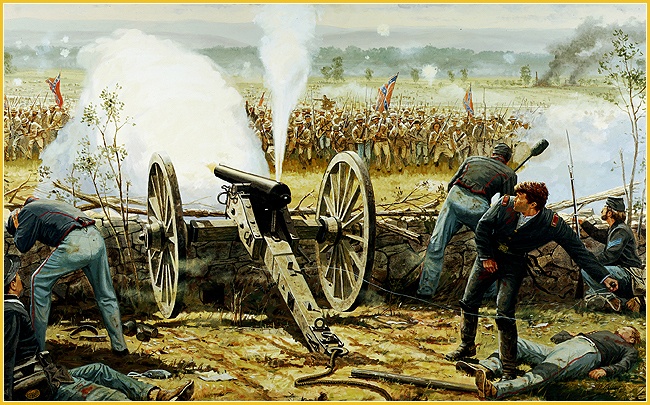
Cushing at the Angle: Dale Gallon
“No. I stay right here and fight it out or die in the attempt.” First Lieutenant Alonzo Cushing
I have a framed print of the picture above by artist Dale Gallon, of Lieutenant Alonzo Cushing in my office. 151 years ago First Lieutenant Alonzo Cushing, United States Army was a 22 year old combat veteran. Just a few hours after he emplaced his battery, Battery A, 4th US Artillery behind a stone wall at the center of Cemetery Ridge on the night of July 2nd 1863, the name of this obscure Lieutenant would be etched in the history of his country.
Cushing was part of a family of young men from Wisconsin who stood tall and served during the Civil War. His brothers William Cushing, was a Navy Lieutenant, who launched a daring raid to sink a powerful Confederate ironclad, the CSS Albemarle on October 27th 1864 and Howard Cushing who volunteered and was commissioned after Alonzo’s death becoming a distinguished soldier and Indian fighter after the war. Howard was so effective at fighting the Apache that the legendary Apache Chief, Cochise, put a bounty on his head, and Howard was killed in action fighting them in 1871. William died after the war having been promoted to the rank of commander. Several ships were named after him; the USS Cushing Torpedo Boat 1 (TB1) USS Cushing DD 55, USS Cushing DD 376 which sacrificed herself fighting at point blank range against the Japanese Battleship Hiei at the Naval Battle of Guadalcanal, USS Cushing DD 797 a Fletcher Class Destroyer, and USS Cushing DD 985 a Spruance Class destroyer.
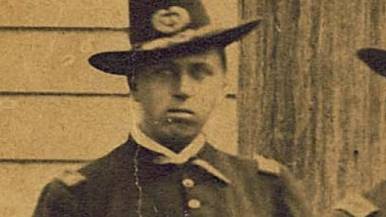
Alonzo Cushing graduated from the United States Military Academy in 1861 and without ceremony reported for duty as an artillery officer in the Army of the Potomac. At Gettysburg the young Cushing commanded Battery A, 4th United States Field Artillery, which though part of the Artillery Reserve was attached to the Union II Corps and deployed in the center of the Union line at a place now known as “the Angle.” During the Confederate artillery barrage Cushing was twice wounded, in the groin and shoulder. Cushing, seeing the mass of Confederate infantry advancing on his position refused to go to the rear and told one of his sergeants who attempted to have him leave the field and seek treatment for his wounds “No. I stay right here and fight it out or die in the attempt.”
Since I lead a staff ride to Gettysburg about once a quarter, and because the site of Cushing sacrifice is at one of the most important stops of the staff ride, I have come to know and appreciate Alonzo Cushing, as well as his famous Navy brother William, and nearly forgotten elder brother Howard, the Indian fighter.
Today, November 6th 2014, 151 years after Cushing’s death fighting off the remnants of Major General George Pickett’s division, Cushing was awarded the Medal of Honor.
The citation reads:
First Lieutenant Alonzo H. Cushing distinguished himself by acts of bravery above and beyond the call of duty while serving as an artillery commander in Battery A, 4th U.S. Artillery, Army of the Potomac at Gettysburg, Pennsylvania on July 3rd, 1863 during the American Civil War.
That morning, Confederate forces led by General Robert E. Lee began cannonading First Lieutenant Cushing’s position on Cemetery Ridge. Using field glasses, First Lieutenant Cushing directed fire for his own artillery battery. He refused to leave the battlefield after being struck in the shoulder by a shell fragment. As he continued to direct fire, he was struck again — this time suffering grievous damage to his abdomen.
Still refusing to abandon his command, he boldly stood tall in the face of Major General George E. Pickett’s charge and continued to direct devastating fire into oncoming forces. As the Confederate forces closed in, First Lieutenant Cushing was struck in the mouth by an enemy bullet and fell dead beside his gun.
His gallant stand and fearless leadership inflicted severe casualties upon Confederate forces and opened wide gaps in their lines, directly impacting the Union force’s ability to repel Pickett’s charge. First Lieutenant Cushing’s extraordinary heroism and selflessness above and beyond the call of duty at the cost of his own life are in keeping with the highest traditions of military service and reflect great credit upon himself, Battery A, 4th U.S. Artillery, Army of the Potomac, and the United States Army.
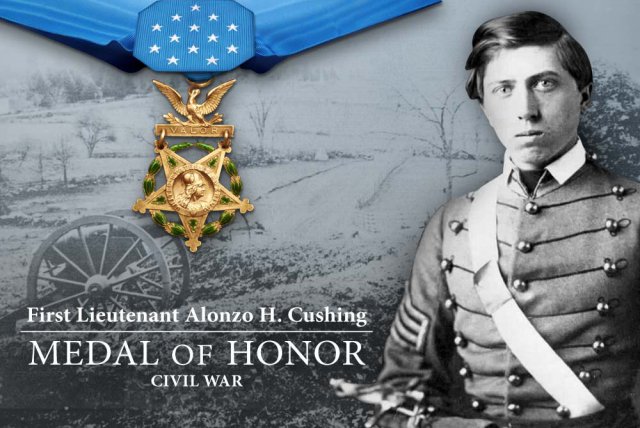
President Obama remarked honored Cushing today and reminded all of us about what such dedication, courage, commitment and sacrifice mean. No matter what one’s political point of view, his comments are sincere and poignant :
“Yet this medal is about more than one soldier or one family. It reflects our obligations as a country to the men and women in our armed services — obligations that continue long after they return home, after they’ve removed their uniforms, and even — perhaps especially — after they’ve laid down their lives. And so this medal is a reminder that no matter how long it takes, it is never too late to do the right thing.
Alonzo, or “Lon,” Cushing was raised by his widowed mother in Fredonia, NY with his siblings, including three brothers who also fought for the Union. As the congressman who recommended Lon to West Point wrote, “His mother is poor, but highly committed and her son will do honor to the position.” After graduating from West Point, Lon was assigned to Battery A, 4th United States Artillery. From Bull Run to Antietam, from Chancellorsville to Fredericksburg, Lon fought bravely and developed a reputation for his cool, his competence, and his courage under fire.
But it was at Gettysburg, what one newspaper later called “emphatically a soldiers’ battle,” where Lon would be immortalized. It was July 3rd, 1863, the final day of a grueling three-day fight. Lon commanded his battery along the wall on Cemetery Ridge, fending off punishing fire from General Lee’s Confederate troops in advance of what we now know as Pickett’s Charge. In the chaos and smoke, Lon and his men could barely see ahead of them. One colonel later described the “terrible grandeur of that rain of missiles and that chaos of strange and terror-spreading sounds.”
Lon was hit and badly wounded. His first sergeant — a soldier by the name of Frederick Fuger — urged him to go to the rear. But Lon refused and said he’d “fight it out, or die in the attempt.” Bleeding and weak, he moved his remaining guns closer to the front. Over 10,000 Confederate infantrymen advanced, elbow to elbow, in rows over a mile wide. Peering through field glasses, Lon ordered his men to continue firing at the advancing columns. He used his own thumb to stop his gun’s vent, burning his fingers to the bone. When he was hit the final time, as a poet later wrote, “His gun spoke out for him once more before he fell to the ground.” And Alonzo Cushing was just 22 years old.
In a letter to Lon’s sister, Fuger wrote that the bravery of their men that day “was entirely due to your brother’s training and example set on numerous battlefields.” Etched on Lon’s tombstone at West Point is the simple epitaph, “Faithful unto death.”
Today there are many young men and women who serve this country in the spirit of Alonzo Cushing and his brothers in very uniformed branch of the Armed services. As we approach Veterans’s Day it is right that wee do not forget them. In the ceremony where Alonzo Cushing was presented his nation’s highest award for heroism, may none of us forget that freedom is not free, and that the ideology, motivation and spirit of the leaders of the Confederacy who Cushing gave his life to defeat are still working to destroy what Abraham Lincoln called The New Birth of Freedom and which President Obama so correctly noted:
And here today, we know that Lon and the others who fell that day could not — we know — we know what they could not — that Gettysburg was a turning point in the Civil War. It’s also proof, if any was needed, that it was thousands of unknown young soldiers, committing unsung acts of heroism, who saved our union, and freed a people, and reaffirmed our nation as “one Nation, under God, indivisible, with Liberty and Justice for all.” I’m mindful that I might not be standing here today, as President, had it not been for the ultimate sacrifices of those courageous Americans.
Today we honor just one of those men, Lieutenant Alonzo Cushing, who, as Lincoln said, gave their “last full measure of devotion.” His story is part of our larger American story — one that continues today. The spirit, the courage, the determination that he demonstrated lives on in our brave men and women in uniform who this very day are serving and making sure that they are defending the freedoms that Alonzo helped to preserve. And it’s incumbent on all of us as Americans to uphold the values that they fight for, and to continue to honor their service long after they leave the battlefield — for decades, even centuries to come.
Last weekend, I met another Medal of Honor Winner, Colonel Walter Marm, US Army Retired, who at while serving as a 1st Lieutenant and company commander at the Battle of the Ia Drang valley in November 1965, won the Medal of Honor, in a battle now immortalized in the movie We Were Soldiers.
As you go to bed tonight and who do whatever you do this Veterans’ Day, do not forget the sacrifices of those who through their sacrifice and service continue to bring about the new birth of freedom that Abraham Lincoln referred in the Gettysburg Address.
Peace,
Padre Steve+

 The Inglorius Padre Steve's World