Tag Archives: ied

Going to War: Life at TQ, Chuck Norris Visits and Mass Casualties

While we prepared for our first mission we adjusted to what life was like on a large airbase and logistics hub. Ta Qaddum is one of the larger Iraq Air Force bases from Saddam’s time but has a history going back to the old Royal Air Force base at Habbinyah which is just down the hill.  In 1941 the Iraqi Army laid siege to the British forces in Habbinyah from the escarpment that overlooks the town from what is now the northern edge of TQ.  One only has to imagine the feelings of the Iraqi soldiers short on supply and exposed to air attack on the escarpment while waiting for German intervention only to be driven off by the British when their relief force arrived from Jordan.
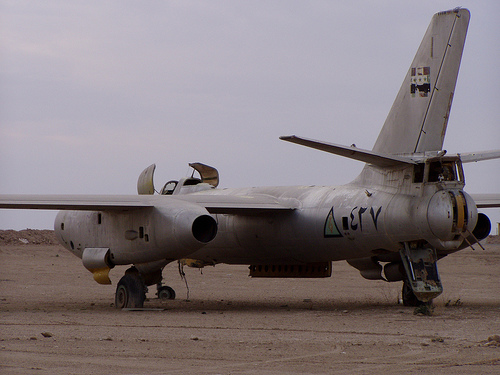
iraqi bomber at tqWrecked Iraqi Bomber at TQ

The Iraqi legacy on the base looms in some of the infrastructure as well as the hulks of Soviet made Iraqi Air Force bomber and fighter aircraft near the edge of the airfield.  When I was there in 2007-2008 the base was under the command of the 2nd Marine Logistics Group or 2nd MLG.  The MLG is a command and control headquarters for logistics support units of the 2nd Marine Expeditionary Force.  It is tailored to support the Ground Combat Element, the 2nd Marine Division and the Air Combat Element, the 2nd Marine Air Wing and attached units.  Its function is similar to an Army Corps Support Command or whatever the Army calls them now.  TQ was also the home of several helicopter squadrons Marine and Army as well as a local defense force at the time made up of the 1st Battalion 11th Marines from Camp Pendleton. 1/11 was an artillery battalion but was being primarily used as a security and convoy protection force.  Other units including Navy Seabees and Army logistics units operated from TQ.  A Marine Infantry Battalion was stationed in Habbinyah while elements of a Marine Expeditionary Unit (MEU) were operating in the area as part of the surge.

The base is about mid-range on the amenity scale for troop comfort. At the time we were there the only non-DFAC/ Chow Hall was the Green Beans Coffee trailer as opposed to places like Al Asad and Camp Victory which had a multiplicity of fast food places for the troops.  The Marines are tougher on communication security than the Army and many websites which troops could use on other bases were unavailable unless one went to the Iraqi internet café or the MWR computer and phone center.  The Iraqi run shop had the fastest internet on the base but you had to contend with huge amounts of second hand smoke and pay a nominal charge to use it.  The MWR facility often had broken machines, had a waiting list to use them and the connections were very poor with pages slower to load that the old dial up days.  On the plus side TQ did have a relatively decent Marine Corps exchange, not as big as Al Asad or Camp Victory, but one of the larger exchanges in Iraq and second only to Al Asad in the West.  Most places including Ramadi had pretty small and not well stocked exchanges.  TQ had nice fitness center facilities which I used a lot being coached by Nelson.

060Chaplains and RPs with Chuck Norris

The base MWR worked with the USO and other agencies to bring sports stars or celebrities to the base.  Just before we left on our first mission Chuck Norris came through.  Chuck was made an “Honorary Marine” a few years back and has made it his task to try to meet every Marine deployed in Iraq and Afghanistan, shaking the hand of each one he met.  The chapel was the host facility for the visit which last about 2 hours in which Chuck pressed the flesh and had his picture taken with probably close to 5000 Marines and other personnel, maybe more.  The Chaplains were drafted to be the photographers and I lost count of how many different types of digital cameras that I took pictures with.  Chuck enjoyed the heck out of Nelson and was impressed with his fighting resume.  I think that Nelson got more face time with Chuck than anyone on the base and he deserved it.  Chuck was accompanied by Chaplain Langston and RP1 Roland our friend from Fallujah.  After they were done he had to get on the waiting helo and fly out to his next stop.
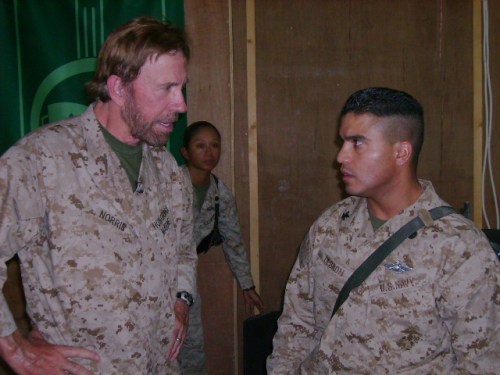
058Chuck and Nelson

The chow halls, of which there were two, were large and usually had a pretty good menu.  I especially came to like the Indian nights where Indian specialties were served.  Since many of the cooks employed by Gulf Catering who had the contract were Indian, Pakistani, Bangladeshi or from Ceylon so it generally was pretty good unless they had to scrounge for suitable ingredients.  I like the curry chicken, but occasionally it was made with chicken nuggets when the real chicken was in short supply.  It almost reminded me of the Spam Lamb in the TV series M*A*S*H or the great quote out of the movie Meatballs: “Attention. Here’s an update on tonight’s dinner. It was veal. I repeat, veal. The winner of tonight’s mystery meat contest is Jeffrey Corbin who guessed “some kind of beef.”   I think that there were a number of times when I really wondered what the meat was.  They usually had a pretty good salad bar unless resupply convoys were interrupted and fresh vegetables had run out.  There were a number of times where the pickins were slim and Nelson and I had to get creative.  Breakfast was usually good with a good choice of food choices, some even healthy.  The workers were great, always friendly despite working 12 hour days 6 days a week for $300 a month.  Many had signed up through agencies which cost them $4000 so the first year that many worked was for nothing.  It was in my opinion a case of a KBR/ Halliburton subcontractor using them in effect as indentured servants and pretty well damned close to slaves, all legal by the US Government.  I thought that it was pretty immoral and certainly a case of a company contracted by the government reducing labor costs on the back of some of the poorest people in the world. Back at the end of the Cold War the military downsized and eliminated most of the Army and Marine mess specialists which paved the way for the contracting industry, led by the former Secretary of Defense and his Halliburton team to begin their massive contracting operations with the Bosnia deployments back in 1995.  They were limited to their own compound far away from anything and were always the last to eat.  They were polite and really tried to accommodate sometimes rude and condescending Americans, the local management did the best they could to give them good accommodations but were limited by their parent company.  Many of the workers were Roman Catholic or Anglican Christians  and Fr Jose had a great ministry that he took on to support them by going to their camp a couple of times a week to celebrate Mass.  His masses were packed and what a source of life and the love of God he was to so many people at TQ, Americans and non-Americans alike.
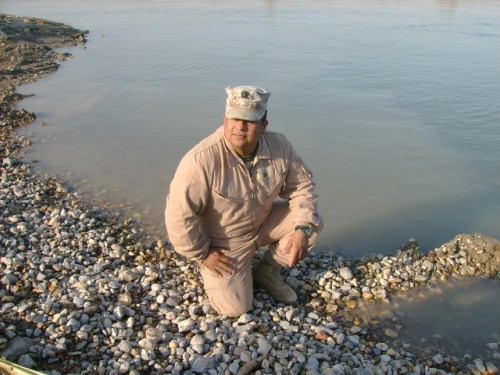
988Fr Jose on the bank of the Euphrates at Habbinyah

About a week after we got to TQ Marines from the battalion in Habbinyah were hit in an IED complex ambush while on patrol.  A couple of vehicles were hit, Jose was across the base celebrating Mass and Pat was in Fallujah.  A chaplain was needed in the Shock Surgical Trauma Unit or SSTP.  Wounded were being brought in, the platoon had been hit hard, 14 wounded and a couple killed.  I figured that since I was a pretty experienced trauma and critical care chaplain who had dealt with over 500 deaths, many traumatic with bullet wounds, burns and the host of other types of trauma, and tended to probably twice that many who did not die that I could handle this.  When I got to the SSTP I was greeted by a couple of nurses and docs and briefed as to what was going on.  Within a few minutes the casualties were beginning to roll in as the UH-60 Dust-off MEDIVAC helicopters landed and teams went out to meet them.  Some were ambulatory, or walking wounded bandaged with lacerations and burns on their faces and upper bodies, other were brought in on stretchers and ushered into the treatment beds in the area outside the OR.  It was like a scene out of M*A*S*H as the well honed surgical teams, surgeons, anesthetists, nurses and corpsmen went to work.  I now work with a number of these fine people. I was able to make my way about to the wounded Marines, praying with some, holding hands as and with a couple performing the sacrament of healing, or the anointing of the sick.  As I listen to Marines, prayed with them or anointed them there was a tremendous sense that this was different than what I did at Parkland or Cabell-Huntington.  These young men wore the same uniform that I wore, served the same country that I served and travelled the same roads that I would soon be on.  As each was assessed and moved off to surgery, prepared for further evacuation or treated and sent to a ward I noticed the little things about each of them.  The wounds, the torn uniforms, the burns and even the tattoos, these were our guys, they weren’t gang bangers or criminals but young Americans fighting a brutal war against a enemy that had terrorized Iraqis and found devastating ways to kill Americans.  Some of the Marines asked if they would be okay, others asked about friends and in those moments I learned what it was to care and be with men traumatized by the violence and brutality of war against an enemy that would not fight by our rules, much as the North Vietnamese and Viet Cong refused to fight our war.  The enemy was clever and determined and his weapons were deadly.

Stars and Stripes sstpTQ Surgical During Mass Casualty Event (Stars and Stripes Photo)

The teams did their work quickly and soon the event in the ER was done as the Marines were moved off to OR, the ward or further evacuation. I spent some time talking with unit Corpsmen and less wounded Marines and learned about the attack. They were in a convoy heading back to Habbinyah when the there was an enemy contact ahead of them.  As they moved forward to engage a primary and secondary IED hit the convoy heavily damaging two trucks with an ensuing firefight.  The Marines fought off their attackers, the wounded were treated and security set up as Dust-off came in to evacuate the wounded.  I thought back to my days as a Medical Service Corps Officer in the Army and remembered my friends who had elected to apply for flight school to become Dust-off pilots.  I remembered learning to call in MEDIVAC missions and some of the Army MSC aviators that I knew; some had flown in Vietnam, being a Dustoff pilot can be a sporty occupation.  They fly an unarmed bird into hot landing zones and get badly wounded troops to medical facilities in 100 degree plus weather without killing them enroute, those guys are good. As the crowd dissipated I spend so time with some of the staff.  Eventually with night having fallen I began the walk back to my office in the Chapel.  I looked up at the night sky, in the darkness a another UH-60 sat down to pick up others being evacuated on to Baghdad or Balad.  I looked up at the sky and saw more stars than I had seen at any time since I was at sea on the USS HUE CITY.  It was amazing; it looked like you could almost walk across them from horizon to horizon. When I got to my office I checked on my our mission status, I had submitted our first Air Support Request earlier in the day, of course it had not moved yet, but at least it gave me something to do.  I checked my unclassified e-mail and knew that there was nothing that I could share with anyone so I looked at baseball scores, checked a couple of news sites and headed off to my “can.”
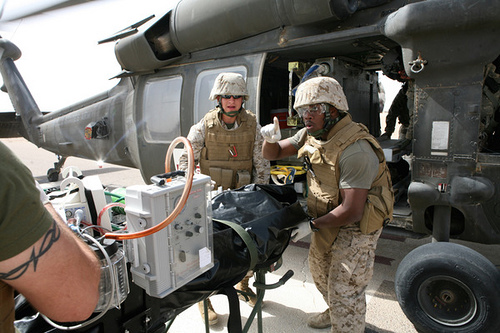
medivacPackaging a Casualty for Further Evacuation on the TQ Surgical Pad

That night I did not sleep well, the images of the wounded Marines were burned into my mind; I could see their faces, their wounds and their tattoos.  I prayed the office of Compline from the Book of Common Prayer using Psalm 91 and the prayer “Be our light in the darkness, O Lord, and in your great mercy defend us from all perils and dangers of this night; for the love of your only Son, our Savior Jesus Christ.  Amen.” I took some comfort in this, walked out again into the night to see illumination rounds in the vicinity of Habbinyah and the distant sound of automatic weapons fire.   For once my insomnia was not related to jet lag or exhausting night flights, it was instead a realization that what happened to these Marines could well happen to me as I we launched later in the week.

The next morning another eight or ten Marines from the same company came in, this time I went to the SSTP with Jose and we did a tag team match, we tried to determine religious affiliation of the wounded Marines with him taking the Roman Catholics to provide sacramental needs and me taking the rest.  Once again the images were vivid; these Marines were on a mission to recover the damaged vehicles and were hit by IEDs on their way back to base.  This time one Marine was killed.  I walked to the graves registration and mortuary affairs team with the battalion surgeon and a corpsman who were to identify the body.  I listened to their frustration and heartache as they described what they had been through the past two days.  The company had taken over 20 casualties including 3 dead.  A high percentage of casualties for a unit that probably numbered about 120 men.  Once again I walked back, this time in the hot mid-morning sun with Jose to the Chapel.  We talked for a while about the past two days, he knew the battalion that had been hit well as he supported them as well.  The surgeon was one of his parishioners.  After we went our separate ways I did my morning prayer and settled in to study more about where we were going.  Nelson and I got PT later in the evening and I spent a restless night in my “can” playing computer Maj-Jong and Chess on my laptop deep into the morning.  Once again I spent time walking in the dark looking at the vast sea of stars above me.
3 Comments

Filed under iraq,afghanistan, Military, Tour in Iraq

Going to War: A Bus Ride to the Carolina Countryside

This is part four in my “Going to War” series. Previous parts are noted here:

Part One:Going to War: Reflections on My Journey to Iraq and Back- Part One

Past Two: Going to War: Interlude July 4th 2007

Part Three: Going to War: Wills, Living Wills, Immunizations Gone Bad and Christmas in July

Part Four: Going to War: Last Night together and a Kiss Goodbye

Nelson and I staged our gear as we waited for the buses to arrive to take us to Fort Jackson South Carolina where we were to receive our training for the deployment.  As we talked other sailors arrived and gear was stacked in rows of sea bags just off of the sidewalk.  Nelson’s parents, brother and sister were on hand to see him off.  His brother is a First Class Petty Officer and his dad a former Vietnam era Marine Recon NCO who made several deployments “in the shit” as many Vietnam vets call tours in that combat zone.  They were really nice folks.  Over the years I had heard much about them.  They are close to each other and all are supportive of Nelson.

Nelson is a career amateur boxer; kick boxer, martial artist and more recently MMA fighter.  He is active in children’s martial arts instruction and has been on Team USA and fought internationally.  During his Afghanistan deployment before he and I hooked up again he helped coach the fledgling Afghan National Boxing Team.  His last major title was just this year when he won the Arnold Schwarzenegger Classic.  The guy has more titles than you can imagine, his title belt collect could fill a room.  However, he was raised by a boxer, his dad.  His dad taught him and coached him growing up and helped Nelson win multiple New York State Golden Gloves titles.  His dad is a congenial man and who was very friendly, speaking English with a heavy Puerto Rican accent.  Nelson’s mom speaks some English.  Nelson tells a great story of the only time he was knocked out in a fight.  This happened at the Fort Apache Gym in the Bronx after Nelson had gone picking on his little sister when Nellie was about seventeen.  Nelson’s dad found out, told him to put on his gloves and get in the ring.  Nelson proceeded to talk trash to his dad as he got ready to fight and the first round got quite a few hits in on his dad.  In between rounds according to Nelson’s account he told his dad to quit, that he was too old to be in the same ring with him.  Nelson said that his dad simply commented “I was just letting you taste the water.”  The second round began and Nelson was hit by a combination from his dad, which he says “rung his bell” and made him “see stars.”  He remembers trying to get up and not being able to while his dad was talking trash to him.  I cannot do the story justice but meeting Nelson’s family was a joy.

So we waited while the other sailors gathered, some individually and some with family.  Some stood alone as couples while others mingled with each other.  For most this was a new way to see their sailor deploy.  No pier side goodbyes, no banners, no manning the rails by the crew as the ship was nudged away from the pier by tugs.  When you have a “normal” deployment of a ship or something like a Marine battalion it is a big deal.  Media is there, sometimes there are speeches, but most of all there is the understanding that we are all in this together.  The families say goodbye to their Sailors, Marines or Soldiers who are going to war together and leaving some kind of familiar support system for the families.  This is not so when you deploy individually.  We may have been going off to train together, but few would stay together on the deployment.  Normally as a chaplain you are a known quantity to the people that you go to war with.  I was going to war with Nelson but we would not remain with any sailors who were going through this process with us.  I know that was the case for others who would serve in isolated posts, often without any other Navy personnel, mostly working with the Army in support roles, and specialized roles such as the Electronic Warfare Officers detailed to work on defeating IEDs and roadside bombs.  As others said their goodbyes and hugged each other I thought of Judy and knew that she was going to be down for some time but I felt that for once that she had an adequate support network.

I looked at our gear as opposed to the others.  Our gear was in different deployment bags, ours were large and rectangular and more of a coyote or sand color while most everyone else had traditional green sea bags, or what are known in the Army as “duffle bags.”  We had all of our personal protective equipment or the EOD/Special Warfare type while others would receive some variation of Army issue at Fort Jackson.  There are pros and cons to such a arrangement.  The pro is that we had great gear certainly some of the best in theater.  The con was that we had to lug the great gear everywhere we went going to and coming back from war.  This would get old, but the benefits do outweigh the advantages when you are actually in a combat zone.

Finally an officer came out and began calling role and giving us our signed “official” orders.  After we were accounted for we were told to load our gear on the buses that would take us to Fort Jackson. I think there were four or five of these chartered tour buses  which as it turned out would be the first of many tour buses, roll calls and gear loads in the coming months, especially as we entered and exited theater.  Nelson and I got on the same bus which was not full and took seats near the front.  I got a seat alone because I was the senior officer on the bus and a chaplain to boot. This was not because I asked for it or hogged the seat.  It is actually fairly typical in such a setting where young enlisted guys don’t want to sit next to an officer and some are afraid of chaplains because of experiences that they have had in civilian churches.  Some of the young folks have never darkened the door of a church and many of those that have been in church have been burned in relationships with pastors or really over the top religious people.  I have found in my career that until they get to know a Chaplain a lot of them will be very careful in how they approach a chaplain, even those with a vibrant faith.  Some are afraid that the chaplain might try to convert them or disapprove of the manner in which they live their lives. So as a chaplain I need to be cognizant of this fact and be friendly and caring without scaring them away.  Of course I did build relationships with a quite a number of these sailors during the next few weeks but on this bus I was still an unknown quantity to them.  Sitting alone however was good for me since I general despise bus travel regardless of the company I keep.  For some reason my height works against me, I can never get my feet comfortably on the ground on these new tour buses and I have a terrible time getting comfortable.  Since bus travel takes forever to get anywhere the discomfort is palpable.  Now I did a three month tour on buses in 1979 while touring as a spotlight tech for the Continental Singers and Orchestra across the US and in Europe.  Somehow the old Greyhound buses were more comfortable than the new tour buses.  Maybe I’m just nostalgic but they somehow fit people like me better than the fancy new buses.

When you travel by bus with a bunch of sailors, the majority of whom are at least 20 years younger than you, the experience can be entertaining to say the least.   Part of course is a generational thing.  I am from the 60’s 70’s and 80’s.  These guys and gals are from the 90’s and 2000’s.  Music is different, culture is different, and the internet, cell phones, i-phones and Blackberries have revolutionized communications and life.  The trip was a chance for me to observe a lot about these sailors just by watching.  Some had their portable i-pods and MP-3 players going, others spent time talking on cell phones, a few read or talked among themselves, but the sailors near me gravitated to the DVD movie which was 300 the comic book style account of the Spartan’s defense of Thermopylae against the Persians.  As the Spartans made their stand I could see the young sailors who were going to war taking inspiration from King Leonditis of Sparta.   Since we were going into a place where 50-100 Americans a month were being killed and many others wounded and maimed I could understand the need for inspiration along with entertainment.

The bus ride itself was a lot like what I imagine that Minor League teams take in the Carolinas like in the movie Bull Durham, the coaches and older players mixed in with a lot of young guys.  The older guys staying pretty quiet and to themselves and the young guys having fun, playing games and joking around with each other,  We made a couple of stops, one at some little Interstate town with a fair amount of gas stations and a few fast food places.  About half the folks went to the McDonalds where we pulled in while the rest ran down the street to the Burger King and Taco Bell.  Once everyone had their fill the buses pulled back out onto the interstate.  When we finally got near Columbia the buses got of the Interstate highway and onto some small two lane state highway.  We drove down this road about twenty to thirty minutes and pulled into what appeared to be a tiny out of the way base.  I wondered where the hell we were.  Fort Jackson is a fairly large training base where thousands of recruits are trained every year.  Where we were certainly was not the Fort Jackson that I had imagined.

Instead of the main post we were at the South Carolina National Guard training facility called Camp McCready.  It is here that the Naval Expeditionary Combat Command has a training center set up with the Army to train sailors in basic combat tasks.

Our welcome that first night was simple.  We formed up, checked in, got our linens for our standard issue military beds and were marched to dinner at the chow hall or in the Army vernacular the DFAC by our newest and bestest buddies, our Army Drill Sergeants.  In the chow hall or DFAC we were met by a civilian running the line.  I can’t remember his name but this guy was really nice and put the RED in “Redneck.”  He made jokes with everyone that came through the line, asked where people were from and what they did.  When he found out that I was a chaplain he began to ask me for a joke every meal thereafter.  As Nelson and I sat down for chow with a couple of other sailors we looked at each other.  He said: “Boss I don’t think some of these guys know what is coming.”  I said “I think that your right partner, hopefully they adjust and do well.”  The other sailors, both more senior petty officers nodded in agreement.

Going back to the barracks I met some of the other officers enjoying their first night at Camp McCready.  More sailors to fill out the class were due later coming in from San Diego.  I introduced myself to a number of the officers near me and when lights out was called lay down on the same type of bed that I had first encountered some twenty five years before at Camp Roberts California and Fort Lewis Washington.  I swear the sheets, blankets and pillowcases were of the same vintage.  Despite that I fell asleep fairly quickly.

Leave a comment

Filed under iraq,afghanistan, Military, Tour in Iraq

Going to War: Last Night together and a Kiss Goodbye

This is part four in my “Going to War” series. Previous parts are noted here:

Part One:Going to War: Reflections on My Journey to Iraq and Back- Part One

Past Two: Going to War: Interlude July 4th 2007

Part Three: Going to War: Wills, Living Wills, Immunizations Gone Bad and Christmas in July

Now the time has come to leave you
One more time Let me kiss you
And close your eyes and I’ll be on my way
Dream about the days to come, When I won’t have to leave alone
About the times, That I won’t have to say

Oh, kiss me and smile for me
Tell me that you’ll wait for me
Hold me like you’ll never let me go
Cause Im leavin’ on a jet plane
Don’t know when I’ll be back again
Oh babe, I hate to go

From “I’m Leaving on a Jet Plane” by John Denver

The night before leaving on deployment and the actual day of departure are some of the hardest that any military couples or families experience.  This has certainly been the case with us and this was no different.  This time I was not merely going on a ship and being part of a boarding team, the latter which Judy did not know until about halfway through the deployment, but this time going boots on ground into the most bitterly of Iraq’s contested provinces, Al Anbar.  The last night together was rather somber to put it mildly.  Judy and I went out to dinner on Friday night.  Since I knew that I would not be having a good beer for quite some time we went to Gordon Biersch.  For us Gordon Biersch is generally a good time kind of place. That last Friday it was not a festive occasion, it was almost like a wake.  Judy and I were both quite subdued.  In between the silence Judy talked about her fears about the deployment while I tried to reassure her that everything would be fine. My reasoning was that since I had taken out the extra life insurance that I would be okay.  For me such logic makes sense.  If I don’t get it I will need it and if I do get it I won’t.  It’s kind of like Yogi Berra who said “You should always go to other people’s funerals; otherwise, they won’t come to yours.”

After dinner and for me three half liter glasses of Märzen we went back home where I finalized my packing. I ensured that all my field gear, uniforms and clothing were packed and rechecked my EOD issue protective gear. I then packed my Mass kit, Bible, Prayer Book and my Marine Pattern camouflage reversible desert/woodland stole.  The stole was special as Judy had made me a few years back from woodland and desert pattern shirts which were way too big for me.  My final check were my books on counterinsurgency, a few DVD movies and music CDs and my hygiene items.  I wrestled the big bags down the stairs and put them in the back of my Honda CR-V so I wouldn’t have to fight them in the morning.  That accomplished Judy and I just sat together, she was feeling pretty low. On the other hand I was a mix of conflicting emotions.  I was excited by knowing that I was going to get to do what I had trained all of my life to do, but very cognizant of the reality that it would be tough on Judy.  The last couple of deployments had been very tough on her. When I deployed to support the Bosnia mission as a mobilized Army Reservist and newly ordained Priest we had three of my relatives in Huntington West Virginia die.  One was my maternal grandmother “Ma Maw” who Judy had become very close to over the past couple of years.  They had become buddies and Ma Maw had taken Judy in not as my wife, but as “her” granddaughter.  Ma Maw’s death hit Judy very hard and my mom and uncle in the midst of their grief over the loss of their mom understood the depth of the relationship between Judy and Ma Maw and as a result pretty much treated Judy as an unwanted outsider.  In the week before Ma Maw’s death Judy tried repeatedly to get Ma Maw to go to the doctor only to be ignored.  The morning of Ma Maw’s death Judy called me in Germany to call Ma Maw and insist that she go to the doctor.   I called and insisted that she go to the Emergency Room but she refused and said she would call her doctor.  That night she died. I had lost my grandmother and could not go back to help and Judy had lost a woman who had become closer to her than her own grandmothers ever had been.  In 2001 during my deployment with 3rd Battalion 8th Marines to Okinawa, Japan and Korea we lost our 16 ½ year old Wire Haired Dachshund Frieda.  Judy did her nest to keep Frieda alive for me, but there was nothing that could be done and finally with Judy being worn down to nothing herself, she was persuaded to have Frieda put down.  My 2002 deployment on USS HUE CITY to the Middle East and Horn of Africa came less than six months after my return from Okinawa and was also very difficult on her.

With all of this in the background we spent our last night together.  I barely slept as did she.  I had a light breakfast and then accompanied by a friend from choir we drove to the base.   Saturday morning traffic is generally not too bad so our trip was uneventful, but really tense.  You could cut the tension between us by now with a knife.  It was about the time that we were nearing the base Judy said something that I took really wrong and sarcastically snapped back “Well I’ll just get blown up by an IED then.”  That really hit her hard and I knew immediately that I had blown myself up with the comment.  I should have known better, after all I’d deployed a lot and taught pre-deployment classes talking about the emotional cycle of deployments.  But the stress on both of us the preceding weeks had taken its toll and both of us were on edge.  For two months we had ach in our own way imagined the deployment  wondering just what I would face when I got to Iraq, the unanswerable questions of what might happen over there and Judy’s great fear that something might happen to me.

We got to the base pretty quick, though the tension made me feel that the trip was three times as long as it was.  As we pulled up in a parking spot near the baggage drop off area we sat there for a few minutes.  I got out of the car as did Judy.  I asked if she wanted to wait a while with me and with tears in her eyes said that she couldn’t handle the wait.  After I unloaded my gear with the help of Nelson who was already there with his gear stacked.  He looked at Judy and said, “Don’t you worry ma’am we’ll do good and I’ll keep him safe.”  Judy gave a soft “thanks” and gave him a hug.  With my gear now next to Nelson’s I went back to Judy.  We looked at each other, embraced and kissed each other.  We parted and then she went back to the car, handed her friend the keys and they drove off.  As she left I said a prayer under my breath and asked God to keep her safe while I was gone.  Then I turned to Nelson and said, “Okay partner, let’s get this done.”

1 Comment

Filed under iraq,afghanistan, Tour in Iraq

Brothers to the End…the Bond between those Who Serve Together in Unpopular Wars

This story shall the good man teach his son;
And Crispin Crispian shall ne’er go by,
From this day to the ending of the world,
But we in it shall be remembered-
We few, we happy few, we band of brothers;
For he to-day that sheds his blood with me
Shall be my brother; be he ne’er so vile,
This day shall gentle his condition;
And gentlemen in England now-a-bed
Shall think themselves accurs’d they were not here,
And hold their manhoods cheap whiles any speaks
That fought with us upon Saint Crispin’s day.

From the Speech of King Henry V at Agincourt in Shakespeare’s “Henry V” 1599

We have a new Greatest Generation whose accomplishments will likely go unheralded by history and unlike the “Greatest Generation” of World War Two not receive the full honors and accolades due them.  The brothers, and for that matter sisters as well who have served in the current War on Terror, Iraq and Afghanistan campaigns have now been serving in a war that is now twice as long as the American involvement in World War Two.  Many, like me have been in this since the beginning and many have made multiple deployments to the combat zones.  And many of us, if not most of us would go again; I know that I would because part of me is still in Iraq; for me this war is still un-won and un-finished.

With MTT near SyriaAdvisers out on the Badlands of Al Anbar
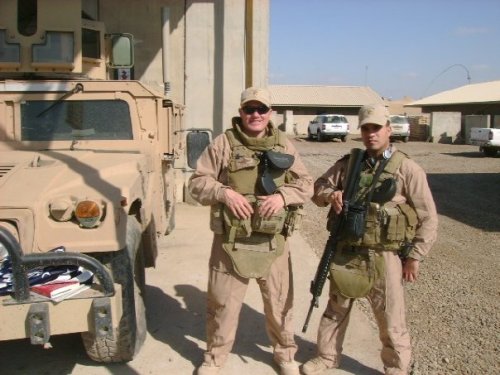
With no disrespect to the Greatest Generation of World War Two, all of the current Soldiers, Sailors, Marines, Airmen and Coast Guardsmen are volunteers, as are the members of the Reserves and National Guard.  Likewise this generation has for the most part fought the war alone as the vast bulk of the country has lived in peace untouched by any inconvenience to daily life such as gas and food rationing, requirements to work in war industries and the draft as were citizens in World War Two.  In the Second World War there was a sharing of the burden which in large part has not occurred in this war.  While many have pitched in to help and volunteered to help veterans and their families the vast majority of people in this country are untouched by the war, not that there is anything wrong with that.  This is simply a comparison of the situation that those who served in World War Two and the present conflicts faced.  So I have to say that our “Greatest Generation” is only a small part of the generation, as the line in Henry V “we few, we happy few who fought together….”

Dynamic DuoBrothers

These Soldiers, Sailors, Marines and Airmen from the United States as well as our Allies who serve alongside of us are my brothers and sisters.  I am friends with military personnel from the UK, Canada and Germany who have served in the various combat zones or at sea and met quite a few others from France, the Netherlands and Australia. Of course my Iraqi friends who I served with while with our advisers in Al Anbar province who are not only trying to bring peace and stability back to their country but have to worry about their families being targeted by terrorists.

There are a number of things that unite us in this relatively small brotherhood.  However, I think that this brotherhood could also be extended to our brothers who fought in Vietnam, French, Vietnamese, Australian, South Korean and American, the French who served in Algeria and the Americans and others that served in Korea.  All of these wars were unpopular, had little support on the home front and often left returning veterans found themselves isolated and their sacrifices either ignored or disrespected.  For those Americans who serve in the current wars I can say that at least to this point the public has been much more supportive than they were to our Vietnam brothers, many of who were even disrespected by World War Two vets who had fought in “a real war.”  I cannot count the Gulf War in this list as it was hugely successful and the returning vets were hailed as conquering heroes with ticker tape parades.

advisers convoy prepGetting Ready for A Mission

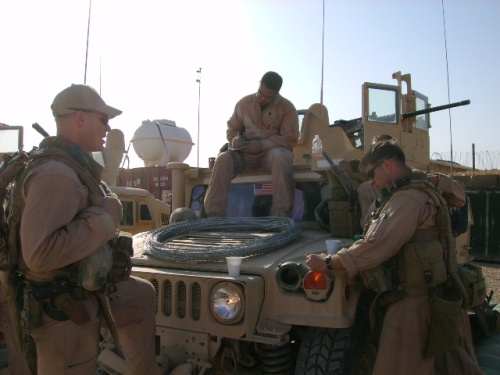
Our shared brotherhood includes our scars, physical, psychological, neurological and spiritual.  Those who served on the ground in Iraq and Afghanistan as well as those who served in Vietnam, French Indo-China and Algeria have the common shared experience of fighting people who don’t necessarily like foreigners no matter how noble our intentions and who have a long history of outlasting people that they believe to be invaders or occupiers.  We have had to fight wars with no front lines, no major units arrayed against us, but rather asymmetrical threats propagated by creatively devious foes who use low tech easily available technology and a willingness to sacrifice themselves and others to force attempt to kill us.  Thus we have cleverly designed and often quite powerful IEDs or Improvised Explosive Devices which can obliterate a HUMMV.

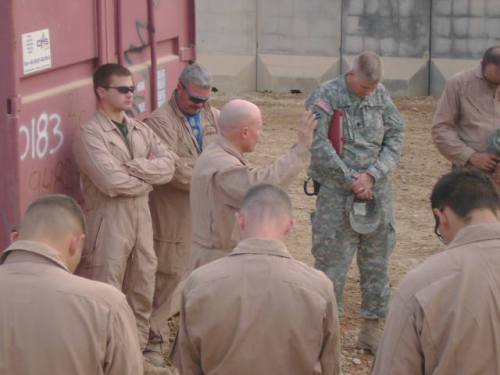
374Prayer Before a Mission

These threats create a situation where there is no front line and thus where every excursion outside of a FOB (Forward Operating Base) or COP (Coalition Outpost) is automatically a trip into a potential danger zone.  Enemies can infiltrate bases posing as local nationals in either military uniform or as workers, rockets and mortars can be lobbed onto even the largest and most secure bases at any time and any vehicle driving by you on the road could be loaded with explosives and just waiting to blow you up while insurgents with automatic weapons and Anti-Tank Rocket Propelled Grenades (RPGs) have taken down helicopters.  When you have taken fire on the road, in the air and had rockets whiz by you this becomes a reality that you never forget.

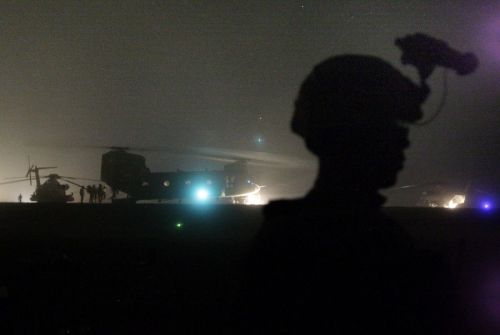
helos at nightA Familiar Sight to Me, Flying at Night AP Photo/David Guttenfelder
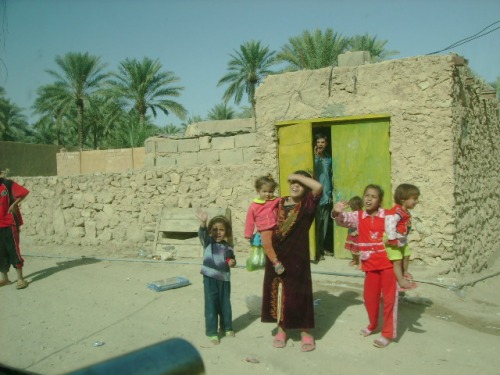
As a result we do not only have men and women with physical wounds, but wounds that have damaged the psyche or the soul.  PTSD is very common either from a direct encounter or the continual wear and tear of being in a danger zone wondering if you were to get hit that day every day of a tour.  I have lost count now of people that I know who have mild to severe symptoms of PTSD.  Traumatic Brain injury is another condition men and women attacked by IEDs, mortars and rockets experience. Likewise there are the injuries that shatter the soul.  These are the images of ruined buildings, burned out vehicles, wounded bodies, injured children, refugees and wars desolation that can leave a person’s faith in God, or ideals that he or she believes in weakened or even destroyed.  There are many idealistic and patriotic military personnel who because of what they have seen question God, their National Leadership and even themselves.  I cannot get the image of a refugee camp on the Iraqi Syrian border full of Palestinian refugees who have nowhere to go; they had been invited to Iraq under Sadaam and have been sitting on the border trying to get home for years now.  The Palestinian authority wants nothing to do with them.

237Iraqi Kids in War Torn Village on the Euphrates

These men and women are my brothers and sisters.   I have seen quite a few of my ICU staff deployed this year with more getting ready to go.  These are my friends and I do get concerned for them and pray earnestly for their safe return.  I wish that I could go with them because I know them and have already walked with them through the dark valley of the shadow of death in our ICU.  We already have a bond that will not be broken.

It is now two years since I was in the process of leaving for Iraq and a year since my PTSD crash.  However, I still would do it again in a heartbeat.  There is something about doing the job that you were both trained to do and called to do that makes it so.  Likewise the bonds of friendship and brotherhood with those who you serve are greater than almost any known in the human experience.  Shared danger, suffering and trauma bind soldiers together, even soldiers of different countries and sometimes with enemies.  I remember the conversation that I had with an Iraqi Merchant Marine Captain on a ship that we had apprehended for smuggling oil violating the United Nations sanctions.  The man was a bit older than me, in his early 60s.  He had been educated in Britain and traveled to the US in the 1960s and 1970s. He had the same concerns as any husband and father for his family and had lost his livelihood after Sadaam invaded Kuwait in 1990.   He was a gentleman who provided for his crew and went out of his way to cooperate with us.  In our last meeting he said to me: “Someday I hope that like the Americans, British and the German soldiers at the end of the Second World War can meet after the war is over, share a meal and a drink in a bar and be friends.”  That is my hope as well.

In the final episode of the series Band of Brothers there is a scene where one of the American soldiers, Joseph Liebgott who came from a German Jewish family interprets the words of a German General to his men in the prisoner compound.  The words sum up what the Americans had felt about themselves and likewise the bond that all soldiers who serve together in war have in common, if you have seen the episode you know how powerful it is, I ended up crying when I heard it the first time and cannot help but do so now that I have been to the badlands of Al Anbar Province.

“Men, it’s been a long war, it’s been a tough war. You’ve fought bravely, proudly for your country. You’re a special group. You’ve found in one another a bond that exists only in combat, among brothers. You’ve shared foxholes, held each other in dire moments. You’ve seen death and suffered together. I’m proud to have served with each and every one of you. You all deserve long and happy lives in peace.”

136A Chance Meeting with our EOD Mobile Uniit 2 Brothers

May God bless all of especially my brothers who served in with me in Iraq or have served or are serving in Afghanistan; as well as my brothers who fought in Vietnam, Indochina and Algeria.  We may never get a victory parade, but we have each other.

Peace, Steve+

5 Comments

Filed under History, iraq,afghanistan, Military, PTSD, vietnam