Tag Archives: in the fullness of time

An Easter People Living in a Good Friday World

Barbara Johnson wrote that Christians are an “Easter People Living in a Good Friday World.”

In the memorial acclamation which is part of many Eucharistic liturgies we proclaim “Christ has died, Christ is risen, Christ will come again” or possibly this variant “Dying you destroyed our death, rising you restored your life, Lord Jesus come in glory.  It has been part of the proclamation of the Gospels and various books of the New Testament and is the faith and prayer of those that call themselves Christians almost regardless of denomination from the very beginning.

Around the world many Christians understand this as they are persecuted for their faith sometimes to the point of death. The reality of Christians and others who are persecuted for their faith in many countries is quite unlike many American Christians who seem to believe that if someone disagrees with them they are being persecuted, despite enjoying tremendous political power and being the majority religion of the land.  Yet even in this country we live in a Good Friday world, maybe not like those that are dying for their faith but certainly in a place where suffering and violence abound, where innocent people are brutally murdered and where natural disasters bring destruction on the just and the unjust alike. In fact our country is experiencing a crisis of an order that it has not seen in many decades even while war, economic collapse and natural disasters and deep political division have left many people in deep despondency as well as in a very angry mood.

Our technology enables us to gather information and to receive news often faster than we can absorb it, thus when deluged by bad news it is easy to lose sight of the things that matter in life, especially relationships with those that we love as well as those that become part of our lives and of the Crucified God.

It is during Lent, Holy Week and in the Easter Triduum of Holy or Maundy Thursday, Good Friday and Easter that the reality of God participating in our world, the real world of pain, suffering, injustice and death becomes something that keeps us, or rather those who profess the Christian faith from simply becoming exponents of what Luther termed the “theology of glory.”  The Cross is that scandal or stumbling block that according to Jürgen Moltmann, the knowledge of which “brings a conflict of interest between God who has become man and man who wishes to become God.” It is the Cross which forces us to deal with the present realities even while we remain fixed upon the hope of Easter.

Unfortunately for many American Christians our focus tends to be less on the Crucified and Risen God than on our attempts to use the raw power of the political process and unsavory compromises with those that would co-opt and compromise the faithful for the advancement of their political, social and economic agendas.  This is nothing new; it has been an unfortunate and painful series of chapters in the history of the Christian Church since the time that Christianity became legal and the State religion during the reign of Constantine.  The sad truth is that in Western Christianity beginning with the Catholic Church and extending out to those that have been the theological heirs of Saint Augustine Catholic and Protestant alike have more often than not allowed their faith to be subordinated to their political, economic and social agendas and thereby becoming captive to things that are often antithetical to the Gospel.

Yet in the midst of this there is the constant call of the Gospel, that “God was reconciling the world to himself counting men’s sins not against them.”  Moltmann puts this paradox well when he says:

“When God becomes man in Jesus of Nazareth, he not only enters into the finitude of man, but in his death on the cross also enters into the situation of man’s godforsakenness. In Jesus he does not die the natural death of a finite being, but the violent death of the criminal on the cross, the death of complete abandonment by God. The suffering in the passion of Jesus is abandonment, rejection by God, his Father. God does not become a religion, so that man participates in him by corresponding religious thoughts and feelings. God does not become a law, so that man participates in him through obedience to a law. God does not become an ideal, so that man achieves community with him through constant striving. He humbles himself and takes upon himself the eternal death of the godless and the godforsaken, so that all the godless and the godforsaken can experience communion with him.” 

It is in this that Christians can fully be Easter People who live in a Good Friday world.  It is in living the paradox of Good Friday and Easter that we find just how God humbled himself for all people. In suffering the wrath of some incredibly religious people Jesus in the eloquent words of Paul the Apostle “though he was in the form of God, did not regard equality with God as something to be exploited, 7but emptied himself, taking the form of a slave, being born in human likeness. And being found in human form, he humbled himself and became obedient to the point of death— even death on a cross.” (Phil 4:7-8) and in that God, “who reconciled us to himself through Christ, and has given us the ministry of reconciliation; that is, in Christ God was reconciling the world to himself, not counting their trespasses against them, and entrusting the message of reconciliation to us.” (2 Cor 5:18-19)

Yes this is what it means to be an Easter people living in a Good Friday World.

Peace

Padre Steve+
2 Comments

Filed under christian life, faith, philosophy, Religion

Advent 2010: Looking Back, Looking Forward

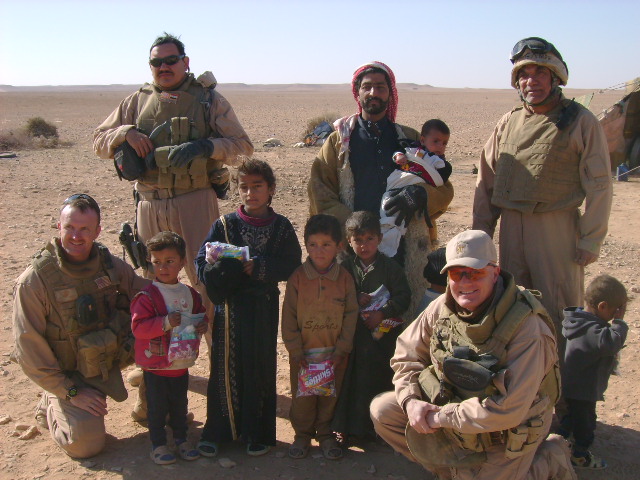
Christmas Eve 2007 with Border Team and Bedouin family on Syrian Border

The Season of Advent and the celebration of the Incarnation of Jesus on Christmas and during the Christmas Octave is my favorite season of the Church year. I have always even as a child been mesmerized by the aspect of hope that is intrinsic to the celebration, the twofold emphasis on the time leading to the Incarnation of Jesus Christ, born of the Virgin Mary in the manger of Bethlehem and the personalities involved to the promise of the Second Coming which was considered the “Blessed Hope” by the early Church which believed that the event would occur during their time as has the Church in times ever since.

I think the most meaningful season of Advent and Christmas that I have known was my time in Iraq in 2007.  At the time I was travelling about the remote western regions of Al Anbar province with my trusty assistant RP2 Nelson Lebron.  We had been doing this kind of work at a steady pace travelling thousands of miles by air and ground to be with the Military Training Teams that were assigned to the 1st and 7th Iraqi Divisions and those of the Border Training Teams assigned to the 2nd Border Brigade as well as Army advisors assigned to the Iraqi Police and Marines working with the Iraqi Highway Patrol.  By the time we made our far west Christmas expedition which lasted almost two weeks.  The immediate days around Christmas were spent on the Syrian Border with the teams assigned to the 1st and 3rd Battalions, 3rd Brigade 7th Division and Border forces at COP South and COP North.

As we traveled the area with our teams, especially Captain Josh Chartier’s Military Training Team and Major Stan Horton’s Border team out of COP South I was taken in by the Bedouin camps that dotted the desert because in so many ways they lived a life so similar to the shepherds that received the angelic visitation recorded in the Gospel according to Saint Luke.  The Bedouin are nomads and travel where they can tend flocks or fields according to the season.  On December 23rd we traveled with Major Horton’s team visiting both the Bedouin in the area and the Iraqi Border Forces in a number of border forts along the Syrian border which at the time was a major conduit for money and arms being smuggled to Al Qaeda Iraq and indigenous Iraqi insurgents.  The Iraqi troops were most hospitable as were the Bedouin who hosted us in their tents or homes.  We delivered toys, candy and school supplies to the Bedouin kids and were treated to food and Ch’ai tea. Had it not been late and we had not had more sites to visit we would have taken the invitation of the head of one Bedouin family to have dinner with him.

That night we celebrated a Christmas Eve Eucharist a day early for the teams at COP South.  Since we were the only Religious Ministry team that spent any real time with the isolated teams like these it was a special occasion for all, one man in particular, one of the Iraqi interpreters, a Christian who had not been able to attend a Mass of any kind for over two years.  The next day we would travel 50 miles of often very rough roads and trails to the even more isolated COP North where we did the same for the members of those teams and had a wonderful Christmas day and eve with these Marines.

That was the most meaningful Advent and Christmas season I had ever seen. It was a season without all the bells and whistles, without all the commercialism and distractions to take away from the simplicity of the message that “when the fullness of time had come, God sent his Son, born of a woman, born under the law, in order to redeem those who were under the law, so that we might receive adoption as children” (Galatians 4:4-5) the simple message of redemption and the grace and mercy of God that has been shown to all people and is the heart of the season.

After my return from Iraq I experienced a major spiritual and emotional collapse related to PTSD which changed me in fairly significant ways.  For nearly two years I struggled desperately to recover faith that was lost after I returned home.  I was overwhelmed with the turbulence of the country, a disastrous series of splits in my old church, feeling abandoned by the Navy and dealing with the long, slow and painful demise of my father due to the ravages of Alzheimer’s disease. I am told that I am not alone in what I went through.  I begin this Advent having made the transition from my old church to the Apostolic Catholic Orthodox Church which is a North American expression of the Old Catholic faith and I am quite at peace with that move.

After nearly two years faith returned during Advent due to an event in the Medical Center that I worked in where I provided the last rights to an Anglican patient as he drew his last breathe in our ER. I call it my “Christmas miracle.”   https://padresteve.wordpress.com/2009/12/24/padre-steve%E2%80%99s-christmas-miracle/

It was ironic and fitting that my spiritual rebirth came in the midst administering the Sacrament of the Anointing of the sick.  Faith has returned and unlike last year when in the midst of my personal gloom and despair I rediscovered faith and the wonder of the season I look forward to the fullness of the season.

I don’t know how much I will write about the season this year, certainly some articles but I do look forward to the continued rediscovery of faith in the Incarnate God.

Peace

Padre Steve+


1 Comment

Filed under christian life, faith, PTSD, Religion, Tour in Iraq
