Tag Archives: isi

Remembering the Killing of Osama Bin Laden While Realistically Looking at Afghanistan and Pakistan

A year ago US Navy SEALs from SEAL Team Six and other Special Operations Forces made a daring night raid into Pakistan to kill Osama Bin Laden.  Bin Laden had orchestrated the Al Qaeda attacks on September 11th 2001 which killed over 3000 Americans, the near sinking of the US Navy Destroyer USS Cole, the Luxor Massacre of 1997 and the bombings of the US Embassies in Dar es Salaam Tanzania and Nairobi Kenya in 1998 and numerous other terror attacks throughout the Middle East. Bin Laden was the sworn enemy of the United States. The killing of Bin Laden was a victory, perhaps the biggest victory that we have achieved in over 10 years of war. In fact Bin Laden was the reason we went to war, the reason that we became embroiled in Afghanistan.

Bin Laden had been the “guest” of the Afghan Taliban government and used Afghanistan as his base of operations to train his fighters and plan his operations. After September 11th the United States attacked Afghanistan, toppled the Taliban and put Bin Laden on the run. Pakistan which had supported the Taliban government following the fall of the former Soviet supported Republic of Afghanistan and subsequent civil war which brought the Taliban to power. Pakistan’s President Musharraf quickly allied his country with the United States.  However over the course of the 10 year war in Afghanistan the government and certain elements of its security and intelligence services gave tacit support to the Taliban as well as Al Qaeda. The most damning was the fact that Bin Laden had resided in the Pakistani military town of Abbottabad with a significant amount of his family for five years.

President Obama gave the order for the SEAL team to kill Bin Laden over the objections of his Vice President and Secretary of Defense. It was a ballsy move. If it had gone wrong which it easily could have many US troops could have been killed, captured and placed on display by the Pakistani government.  The credit to the planning and execution of the operation has to go to the SEALs and Special Operations Command, but credit for the order to do it needs to be given to the President.  If President Bush had succeeded in killing Bin Laden I would feel the same way.

The fact is that President Obama has been successfully waging war against Al Qaeda, not only killing Bin Laden but other top leaders. Even Bin Laden before his death was concerned about the toll being taken on his organization by the reinvigorated US campaign.  The Pakistanis enraged by the United States taking the war against Al Qaeda and its Taliban allies inside Afghanistan, something that it should have been doing but had not despite Jihadist terrorist attacks on it cut the supply lines to US and NATO forces running through it months ago and have not reopened them. Some ally.

But that is not surprising. As far back as November 1979, before the Soviets intervened in Afghanistan the US Embassy was ransacked and burned by Pakistani mobs, an attack which killed a US Marine. The Pakistanis only began to reluctantly cooperate with the United States in supporting some of the Afghan Pashtun Mujahideen fighters.  After the Soviets left Afghanistan it continued to support its Pashtuns against Uzbek and Tajik Afghans, support which eventually allowed the Taliban to take over the country. Despite US protests in the 1990s the Pakistanis did little to nothing to hinder Bin Laden, Al Qaeda or the Taliban regime. While it quickly and officially “supported” the US under former President Musharraf factions within its ISI intelligence service are believed to have continued to support Taliban and Al Qaeda fighters and encouraged attacks on US, Afghan and  NATO troops.

Pakistan itself teeters on the edge of collapse. Its economy is in shambles, it cannot control its borders, its intelligence service is often at odds with the government while extremist groups gain more power every day. It is a rapidly failing state with nuclear weapons. Every day it grows more antagonistic towards the United States which under the Obama Administration had been persistent in using arial drones to attack suspected terrorists in Pakistan. The relationship between the United States and Pakistan is as bad or worse as it was in 1979.

In the mean time our former nemesis the Russian Federation, the former Soviet Union has been stalwart in allowing our troops and supplies to flow through their country and the neighboring Central Asian Republics into Afghanistan. The Russians having experienced the agony of Afghanistan and the reality of Jihadist terrorism emanating from it as well as Chechnya do not want the US and NATO mission to stabilize Afghanistan to fail.  Currently without the support of the Russians we would be unable to supply our troops in Afghanistan.

Today President Obama travelled to Afghanistan and announced the signing of a long term security and cooperation agreement with the Afghan government. The agreement will take effect after the current plan to withdraw most US and NATO troops by 2014. We have no idea how well this will turn out and despite all the good intentions on our part I doubt that the agreement stands the test of time because of the nature of Afghanistan and its competing ethnic, religious, political and tribal divisions. It is my belief that we will be lucky to get out as well as the Soviets did in 1989 because I do not see a truly united Afghanistan coming out of this and it is more than likely that Pakistan will descend into chaos making our presence in Afghanistan even more problematic.

The mission started to get Bin Laden after 9-11. In the process it became something different as we attempted to transform Afghanistan. A year ago we finally succeeded in killing Bin Laden and have significantly degraded Al Qaeda.  That is why we went to war.  That is probably the best it will get.

At some point President Obama or his successor will likely have to decide to withdraw completely from Afghanistan and like former Soviet Premier Gorbachev admit that “We are not going to save the regime. We’ve already transformed it.”

Peace

Padre Steve+

1 Comment

Filed under History, iraq,afghanistan, national security, News and current events

Adjusting Strategy to Reality

Taliban Fighters

“The core goal of the U.S. strategy in the Afghanistan and Pakistan theater remains to disrupt, dismantle, and eventually defeat al-Qa’ida in the region and to prevent its return to either country…” US Strategy in Afghanistan for 2011

“The aim of war should be the defeat of the enemy.  But what constitutes defeat?  The conquest of his whole territory is not always necessary, and total occupation of his territory may not be enough.” Carl Von Clausewitz

Strategic goals cannot remain fixed on geographic objectives which have lost their strategic importance because it is no longer the enemy’s center of gravity. On September 11th 2011 the Taliban ruled Afghanistan which harbored Osama Bin Laden’s Al Qaeda terrorist organization became the central front in the new “War on Terrorism.”  For about a year Afghanistan remained the central focus of United States efforts against Al Qaeda until President Bush and his administration changed the primary effort to the invasion of Iraq and the overthrow of the Saddam Hussein regime.

The effect of switching the American strategic focus from Afghanistan where we were making headway despite the limited resources provided to Iraq was a mistake of epic proportions that only became evident when Iraq did not go the way that the Bush administration led by Vice President Dick Cheney. Secretary of Defense Donald Rumsfeld and Paul Bremer the head of the Coalition Provision Authority planned.  Instead of a quick withdraw a series of mistakes and miscalculations turned the majority of the Iraqi people who had welcomed US Forces with open arms against us and an insurgency which claimed over 4000 American military personnel deaths and over 30,000 wounded became our primary focus.  We are still trying to figure out how to end our involvement in that country hoping that Iraq will not sink into another civil war.

Contrary to expectations Iraq became a front which consumed U.S. Forces and limited strategic flexibility in other regions of the world including Afghanistan.  In that country the indigenous Taliban which had been driven from power in 2001 began a gradual and deliberate return to political and military viability which was finally noticed by the United States in 2008 and 2009.  The Taliban were supported by the Pakistani Taliban, elements of the Bin Laden organization and in many cases duplicitous elements within the Pakistani military and intelligence services which were using the situation to support their own strategic goals of gaining influence in Afghanistan while strengthening their position against their perceived mortal enemy India.  Throughout the war the Pakistanis acted in their own interest while placating American demands to do more against the Taliban and Al Qaeda operating in Pakistan proper.

The Obama administration attempted to regain the initiative with a “surge” of 30,000 additional troops which raised the overall commitment of the United States to a force of over 100,000 troops assisted by NATO Allies and the corrupt, ill-trained and often Taliban Afghan Army and Police.  The surge was controversial and marked with controversy was the US Commander General Stanley McCrystal was relieved of command after an article in the Rolling Stone magazine which made it appear that he held the Obama administration in contempt. Since McCrystal recently returned to the Administration in a civilian capacity one wonders if the administration discovered that the article was meant to discredit McCrystal. McCrystal was relieved by his superior CENTCOM Commander General David Petreaus who had helped devise the strategy which in conjunction with the Anbar Awakening turned the tide against Al Qaeda and indigenous Iraqi insurgents in 2007-2008.  It achieved some success but even the United States recognizes that whatever success has been wrought is fragile and could easily be erased.

Unfortunately while the United States and its Allies continue to reinforce the campaign in Afghanistan their efforts are often undercut by the corrupt and duplicitous regime of Mohammed Karzai as well as our supposed Pakistani allies.  The Karzai regime hunkered down in Kabul has little influence outside the Presidential Palace except in its dealing in the Opium trade which helps finance the Taliban. The Pakistanis have over the 10 year duration of the war failed to maintain the security on their side of the border and often have clandestinely supported the Taliban and according to some may have given sanctuary to Al Qaeda.  The most recent setback came today when the Pakistani Chief of the General Staff General Ashfaq Parvez Kayani and Chief of Intelligence Ahmed Shuja Pasha issued a demand for the US to stop Predator Drone strikes in the border regions, cut Special Forces and CIA Staff and give the Pakistani Intelligence Service, the ISI visibility on CIA operations.  This has been long in the works but came to a head with the arrest of a CIA contractor under the suspicion of murdering two Pakistanis.  The incident created quite a rift in US and Pakistani relations in part brought about by internal Pakistani politics.  Of course the ISI has long been a source of aid to the Taliban so the United States has good reason not to trust the ISI with information that could endanger American lives.

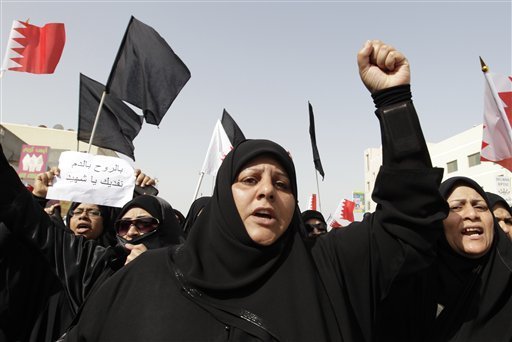
Protests in Bahrain: The Arabian Peninsula as the new Center of Gravity

The fact is without full Pakistani cooperation and substantial Afghani political reform to end corruption and provide real security to Afghani people there is no way to set conditions for a US withdraw that would leave Afghanistan a less dangerous place for its own people and for US and Western security interests. After all no one wants another 9-11 attack.  The US plans to begin withdrawing forces this year but the mission has been extended to at least 2014 at a cost of 119.4 billion dollars per year at the estimated 2011 rate and has increased exponentially since the US involvement began in 2001. The cost of the Afghanistan war in human, material and economic terms has imperiled other strategic priorities and limits the flexibility of the United States in other more vital regions.

Afghanistan is now an expensive sideshow in a larger war where the strategic center of gravity has shifted decisively to the Arabian Peninsula, North Africa and the Eastern Mediterranean where Al Qaeda seeks to use democratic revolts against autocratic despots to further its own ends. The key countries are Yemen, Saudi Arabia, Bahrain and Egypt with Lebanon, Syria, Jordan and the Israeli-Palestinian conflict boiling over.  While all of these crises grow on what seem to be a daily basis the United States and its Allies are mired in Afghanistan reinforcing failure.  Our troops on the ground have not lost a battle but like our brothers in Vietnam could “lose” the war.

This is the point where political and military leaders have to count the cost of the operation and weigh them against our actual strategic interests. The fact is if we withdrew the bulk of our ground combat forces and shifted to a lower footprint special operations and CIA campaign with a goal of ensuring that Al Qaeda cannot operate in Afghanistan with impunity as they did before 9-11 that we would likely be no worse off than we are now and have a greater amount of strategic flexibility to deal with other crises, political, military and humanitarian around the world.

The real crux of the issue is that Afghanistan is much like Stalingrad to the Germans in 1942. It has become a psychological more than a military campaign. We have invested so much in it that we do not believe that we can withdraw even though a scaled back presence would do much to improve our overall strategic situation.  Hitler denuded more important areas to attempt to capture Stalingrad and lost everything. Yes Al Qaeda used Afghanistan as its base to attack us in 2001 but they have moved on and Al Qaeda in Yemen and the Arabian Peninsula is a far greater strategic danger simply because of the oil supplies and strategic waterways in the area.

We simply need to look at all components of national strategy and decide where to concentrate.  Sometimes a strategic withdraw is necessary and actually vital to recover the initiative and set the stage for long term success. In Afghanistan this is not an admission of defeat but rather an acknowledgement that the central focus of the war and our strategic interests are elsewhere.  Our enemies would love to have us continue the campaign in Afghanistan in its current form, they know that our commitment drains our military, imperils our overall strategy and bleeds us dry economically all the while providing propaganda grist for them in their war against us.

However despite the cost the political situation in the United States keeps President Obama invested in Afghanistan. If he withdraws his opponents will say that he lost the war. Unfortunately the war in Afghanistan was ceded to the Taliban in 2003 when we decided that Iraq was more important. Now we reap the terrible consequences of that decision.  Now we have to decide how to make something positive out of this unenviable strategic position. But as Napoleon Bonaparte said “In order to govern, the question is not to follow out a more or less valid theory but to build with whatever materials are at hand. The inevitable must be accepted and turned to advantage.”

Peace

Padre Steve+


2 Comments

Filed under Loose thoughts and musings