Tag Archives: joseph of arimathea

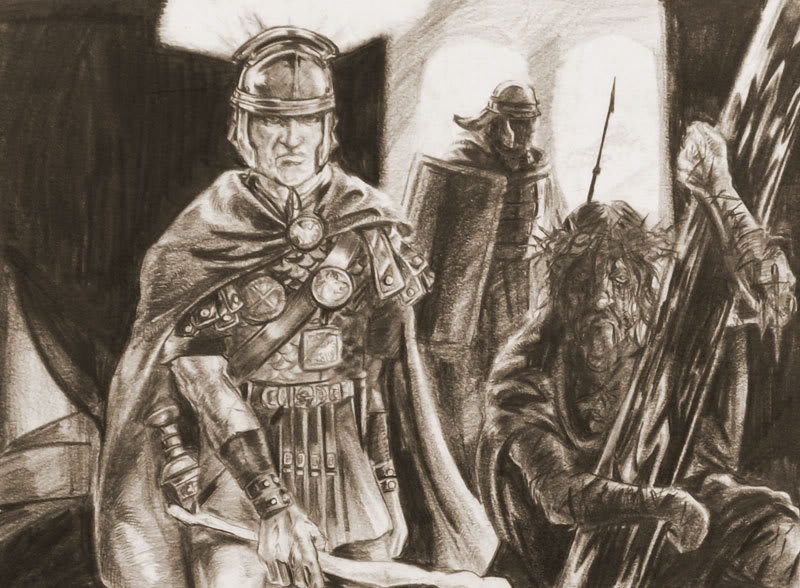
A Centurion’s Long Good Friday

img_0643-726257

This is a re-do of my original “Long Good Friday of Longinus the Centurion.” Since I first wrote that piece three years ago I have wrote a prequel which I published last year and with minor changes again this year. Like George Lucas I felt the need to change and improve the original. Unlike Lucas who simply tweeked Star Wars I have chosen to spend my time completely re-writing the original in light of the prequel series dealing with the events leading up to Good Friday that I did this week. I don’t know about you but I like to imagine events as they might have actually happened. As an Iraq veteran who served with our advisors to the Iraqis I do understand the plight of soldiers from an occupying power serving far away from home where their presence is barely tolerated, much less welcomed. I have always felt a special affinity for the soldiers that have interactions with Jesus, who are treated very sympathetically by the writers of the Gospels as well as Luke in the Book of Acts.

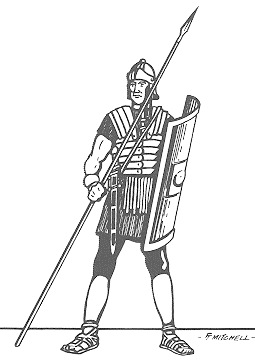
Longinus had finally decided to try to get a bit of rest. After his rather morose meeting with Flavius and Decius he and Decius went back to check on the preparations for the executions scheduled for the next day. Quentin his Tesserarius had been working with the squad chosen to to conduct the actual crucifixions of the prisoners, Bar-Abbas the insurgent as well as the common criminals and murderers Dismas and Gestas who he had met in the hell hole of a jail in the dungeon of Fortress Antonia after Pilate had assigned him the task of conducting the executions.

Longinus was certain of his unit’s ability to carry out the mission, though he would have rather had a unit from Italy than his unit of Syrian and Samaritan troops. There was one positive aspect, his Samaritans and Syrians had no love for the Jews and would have no qualms whatsoever in disposing of the criminals.

He thought for a moment about the prisoners. That Bar-Abbas fellow, he would be glad that he or any other Roman would have to deal with him again once the crucifixion was over. As for the common criminals he felt that everyone would be better off with Gestus dead although he hoped that Pilate might take pity on the repentant thief named Dismas. However, despite his feelings he also knew that the law was the law and repentant or not that Dismas was guilty of the crimes and the sentence was just. As he had realized earlier in the day while talking with Flavius it was important not to become emotionally involved with the locals, especially prisoners. Maintaining an emotional distance ensured that he would not flinch in times when ice rather than blood needed to flow through one’s veins. He was proud that he could do this but envied the humanity that his comrade and friend Flavius still maintained in spite of everything.

He was just about to prepare for bed when a messenger from Pilate knocked on his door. It was late, too late and Longinus wondered just what was going on.
“Come.” He said, the weariness in his voice obvious in the way he answered.

The messenger, a relatively young Italian soldier assigned to Pilate’s bodyguard entered, came to attention and saluted.

Longinus looked at the young man, like him far from home and asked “what am I needed for now?”

“Centurion, the Governor has requested your presence” the soldier replied.

“May I ask what for?” A now increasingly irritated Longinus asked.

“Sir, I do not have the details but it is a pressing matter regarding the Jews and that Galilean preacher.” The young man was obviously uncomfortable in having to request a career officer like Longinus, a veteran of real battles and campaigns appear before Pilate for what was not much more than a religious dispute among an occupied people.

“Pressing matter?” Asked Longinus.

“Yes Centurion. I was told that it was urgent that you come to Governor Pilate now and alert your unit as at least some of your men may be needed if things get out of hand.”
“Can you please tell me just what is going on?” Longinus asked as he pulled his armored breastplate over his shoulders.

“I’m sorry Centurion, I have no more information. You are to report to the Governor within the half hour. The Governor wants your unit ready within the hour.” When he finished he came to attention, saluted and exited the room.

Longinus hated how leaders sent young men to be their messengers and would not give them all of the relevant information.

He then sat back down in his chair where he had been sitting and discussing the situation with Flavius and Decius. He wondered to himself what could be so pressing that Pilate needed him now.

After briefing Decius and Quentin, instructing them to wake the men and be ready for action Longinus took a squad and went to Pilate’s headquarters. When he arrived Pilate greeted him.

“Centurion, I hate to have bothered you at this hour in light of how busy you and your men will be in the morning but a situation has arisen.” Longinus looked around the room and then heard some commotion on the area called “the Pavement.”

“What is happening my Lord?”

“Longinus, these Jews have brought that Jesus fellow here and are accusing him of fomenting a rebellion against the Emperor.”

“A rebellion sir?”

“That is what they say Centurion. They claim that one of his closest associates had turned him in and after a trial of their own that they found him guilty of claiming to be a king and God that will overthrow the Emperor.” Pilate could not hide his discomfort.

“Do you actually believe them sir? After all we had heard this morning that this Judas Iscariot fellow had betrayed him for 30 pieces of silver.”

“I know Centurion, I know.” Pilate looked at Longinus then back out at the crowd gathered outside in the dark. He was afraid and Longinus could sense that fear, fear that if he made the wrong move that a real rebellion could break out and that Pilate as the Governor would take the blame and bear the punishment and wrath of Caesar.

“Centurion, I tried to placate these people be questioning this Jesus fellow myself.” Pilate paused. “I must say that he is a rather unusual man and truthfully I could not find anything that under Roman law that I could find him guilty of doing. Not a thing Centurion, nothing but their leaders kept pressing me.” Pilate’s gaze seemed to be almost pleading with Longinus to help him escape this decision. Longinus knew at that moment that his day was about to get worse. Pilate continued “It seems to be a religious squabble of some kind so in order to deal with it and to try to keep us out of it I sent Jesus to Herod since Herod is the ruler of Galilee.”

“So Herod will certainly deal with the situation, will he not Governor?”

“Centurion, I thought that that corpulent bastard Herod would deal with it but I just got word that Herod too could find no crime. The Jewish leaders and of their Temple Police are supposedly bringing him back to me to render judgment. They are leaving it to me.”

“Judgment for what?”

“Sedition, treason, blasphemy, proclaiming himself a king.” Pilate paused, his face flushed. “My God I’m surprised that they haven’t accused the man of fathering the High Priest’s daughter.” The sarcasm and bitterness was evident in his voice.

“So what do you intend to do.”

“I intend to try to get us out of this with as little trouble or guilt as possible. When they return him to me I will ask a few more questions and set him free as is my prerogative, certainly they wouldn’t want to release a real murderer like Bar-Abbas back into society, I do give them more credit than to stoop that low.”

“I do hope that you are right governor, but from what I understand it seems that they are intent on ridding themselves of the fellow once and for all. I think that their leaders see the Galilean as more of a threat than a man like Bar-Abbas.”

Pilate said nothing and during the silence Longinus’s troops under the direction of Decius entered the perimeter of the court adding an additional security cordon as the crowd grew and got more boisterous. As they took up position the Temple Police and members of the High Priest’s entourage approached the court with the Galilean in custody. Quentin with four soldiers met them and took custody of the obviously tired and already abused man. They delivered Jesus to Pilate and stood back. Longinus watched as it happened. As he did so Flavius entered the room with his servant. The servant appeared unsteady and full of emotion when he saw the man who had healed him two years before. Flavius stood by his face not betraying any feelings except deep seated rage that was boiling as he saw this travesty of justice take place.
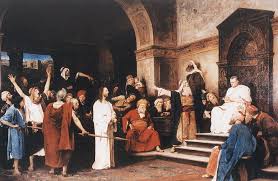
jesus before pilate

Pilate attempted every trick in the book to garner a way to save the life of the man standing before him. He asked him questions and Jesus clothed in a purple robe that Herod had mockingly placed upon him said nothing. Finally in desperation Pilate asked Jesus if he was a king. The answer both fascinated and terrified Pilate and caused him to wish that he had never come to the city. As he deliberated earlier and debated the members of the Sanhedrin his wife again urged him to “have nothing to do with that innocent man.”

But the answer of Jesus to the question of his kingship troubled Pilate. Had he thought the man insane he would have scourged him, declared him mad and been done with the affair.

“My kingdom is not of this world, if it were my followers would be fighting to ensue that you did not hand me over to the Jewish leaders.” Jesus looked into Pilate’s eyes, the look sent a chill through Pilate’s soul and so he restated the question “so you are a king?”

Jesus replied solemnly “You say I am a king. I was born for this and it is why I came to this world, to testify to the truth. Everyone who belongs to the truth listens to me.”

Pilate appeared stunned and both Longinus and Flavius knew that he was beaten. They listened as Pilate asked “what is truth?” The question was one of a man who had long ago sold his soul to gain the world, it was the question of a deeply cynical man who had long determined that truth was only in the eye of the beholder and to be used as needed to acquire power. At the same time they could see a touch of genuineness in the question as Pilate, desperate for an answer that would enable him to please everyone and spare the life of the man before him wrestled with the question of truth for the first time in years.

Scourging-at-the-pilar-pros

They watched as Pilate attempted to bargain for the life of Jesus only to be shouted down by the increasingly riotous crowd who demanded that Bar-Abbas be released. Again attempting to assuage the mob he had Jesus scourged with a barbed whip. The soldier who did that brutal work was a Syrian, big and burley without a trace of feeling in his eyes or face. The servant of Flavius begged him to intervene but Flavius now knew that the things happening to Jesus could no longer be influenced by sentimentality and stories of the goodness of Jesus. He had seen this type of Justice before, and though he despised it, he earnestly hoped that it would be enough to deliver Jesus.

After the scourging, soldiers assigned to Longinus jammed a crown of thorns down on the blood covered Jesus and placed the purple cloak over him. Jesus’s body trembled. Pilate again approached the mob and tried to decline the odious responsibility thrust into his hands. The mob led by the Chief Priests and joined by man of their rivals, the Pharisees cried out for Jesus to be crucified.

They heard Pilate plead with Jesus, again noting that he had power over the life and death of Jesus to which Jesus replied that Pilate “had no power over him that had not been given by God.” Finally he pleaded with the Jews one more time to take Bar-Abbas for execution and to spare the Galilean. The leaders shouted him down again and cried out that Pilate would be “a traitor to Caesar” if he let a man who claimed to be a king live.

Defeated By the mob and by his own weakness of character Pilate asked for a ceremonial washing basin full of water. When it came in the hands of a court member he placed his hands in it and proclaimed “I am innocent of this man’s blood.” He then ordered the soldiers to take Jesus to be crucified even as the prisoners Dismas and Gestus were led from the dungeon for execution and a profoundly perplexed Bar-Abbas was released by the jailer.

Longinus looked at Flavius and whispered to him “wash my hands of his blood? My God, he knows that he is as guilty at them.” Flavius looked on and simply said “I know my friend, we all are.”

The detail of soldiers assigned to the crucifixion detail was commanded by Quentin, a man who had fought many battles and like Longinus and Flavius felt that these executions of helpless prisoners were unworthy of soldiers like himself. The soldiers of Flavius’s unit had responsibility for helping to clear a way down the narrow street called by the Romans Via Delarosa. The street of suffering. It was the street that all the condemned travelled to the hill of execution so fittingly called the place of the Skull. Longinus had seen others walk this path but in the past he had been able to shield his person from their suffering, but today was different.
Anon, contemporary, 8

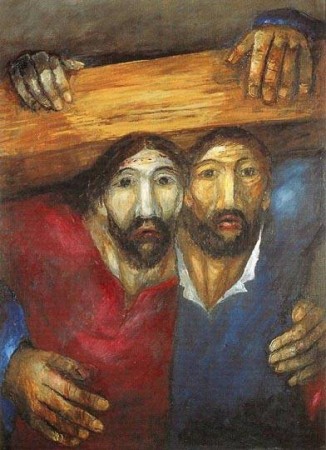
Longinus’s own execution squad led by Quentin led Jesus and the others along, forcing them to carry their crosses. About halfway down the street Jesus collapsed under the weight if his cross and grabbed a bystander, a man from Cyrene to carry the cross while the soldiers prodded the bloody body of Jesus down the street and out of the city to the place of execution. People jeered at the condemned as they did at very execution as for most this was no different than any other crucifixion and most of those present knew little about any of the condemned men and even those that were familiar with Jesus probably did not recognize the bloody man stumbling down the street. Of course there were others present who did know Jesus and watched in horror as their friend, teacher and for one woman her son struggled to the execution site. Longinus wondered about his own elderly mother and thought of her as he saw the mother of Jesus. He quickly tried to chase her image from his mind, he needed to be strong and hard if he was to keep his objectivity and conduct the mission as distasteful as he found it.

When the macabre parade arrived at the hill, the prisoners were stripped, placed on the crosses and nailed to them. Their screams as Quentin hammered the large iron nails home through their already abused flesh echoed for all to hear. Thankfully Quentin knew what he was doing and this part of the execution process happened quickly. Then the crosses were raised, but just before this a messenger from Pilate arrived with the placards that denoted the charges. He handed them to Longinus who noted what was written on the one for Jesus. It said “The King of the Jews.”

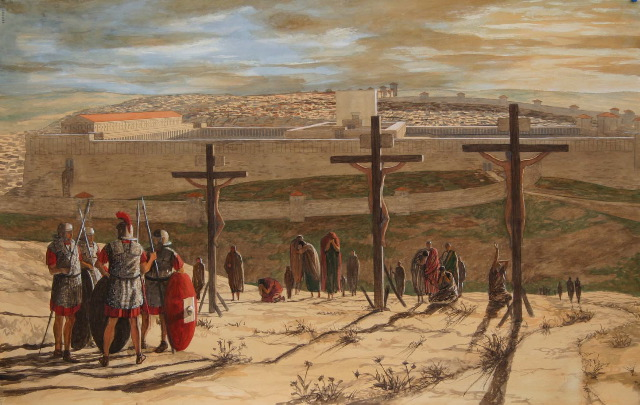
The placards were placed and with a thud the crosses were placed in the holes on the hill. The suffering of the prisoners was great, the crowds jeered and mocked them while those that loved them stood at a distance. Soldiers stood guard to ensure that no one interfered with them in any way. There was a bit of banter between the real criminals one of whom, the unpleasant one named Gestus joined in the mocking of Jesus only to be put in his place by the other one named Dismas.

Longinus, Flavius, Decius and a few other officers watched as their soldiers from the crucifixion detail divided the paltry worldly possession of the men between themselves. The men argued over a one piece tunic worn by Jesus, Not wanting to destroy it they cast lots for it. A trooper from Tyre won the tunic. Longinus and Flavius looked at each other and realized how little most of their men earned and neither begrudged the men the few items that they gathered from the men being executed.

The skies which had began the day with bright sunshine now became dark and foreboding. Lightening appeared in the distance and occasionally Jesus would address his mother or one man, Flavius believed him to be a disciple who stood by the cross. Jesus even promised the Dismas character that “he would be with him in paradise” and told others, Longinus thought the soldiers but he wasn’t sure “forgive them they know not what they do.” As it approached the ninth hour Jesus cried out in Aramaic “my God, my God, why have you forsaken me!”

A cold rain began to fall.

Quentin approached him with a sponge on a pole which was soaked in a sour wine. It touched Jesus’s lips and Jesus said “Father into your hands I commit my spirit” and then “it is finished.”

With that last dying remark the head of Jesus fell to his chest and his body, bloody and mangled hung limp. As the men looked on the ground began to tremble and as the ground shook and the officers looked about amid the gloom and confusion as the onlookers took flight Longinus exclaimed “surely this man was the son of God.” Flavius looked at his fellow Centurion in astonishment. Longinus, the man who had closed his heart in a fortress was echoing what he had believed since Jesus had healed his servant, the young man who was more than a servant to him.

As the crowds dispersed Longinus received the message that the executions had to be concluded before the Jews began their Passover. With that he sent Quentin to break the legs of the prisoners to hasten their deaths. When Quentin reached Jesus he called for Longinus.

“Centurion, I believe that this man is already dead. Do you still want me to break his legs?”
jesus-christ-crucifixion-375

Longinus looked up at the bloody corpse and then at his subordinate and said “no I must do this myself.” He had a soldier bring him his lance, a ceremonial lance that denoted his seniority as the senior Centurion in the Legion. He looked at the lance and plunged it into the side of Jesus into his heart. Jesus did not move but from the wound blood mixed with what looked like water poured out of the wound and down his side.

“Quentin, he is dead, you may take him down.” Other soldiers pulled down the dead bodies of the thieves. As they did this a man approached Longinus and Flavius.

“Gentlemen. I am Joseph, I am a member of the Sanhedrin. I have come to take responsibility for the body of Jesus of Nazareth.”

Longinus replied in a businesslike manner “by whose authority?” He had a hard time believing that a member of the Sanhedrin would claim this body.

With that Joseph produced a letter from Pilate. Longinus looked the letter over and handed it back to Joseph without comment. Joseph then motioned to several men with him to take the body as Longinus, Flavius and the others looked on. Longinus thought to himself that it was good that a man of some means and influence would at least take the time to give this innocent man a decent burial.

old-master-drawing-DELACROIX_Eugene_Christ_on_the_Cross_sketch_2

As Quentin took charge of the cleanup Longinus instructed Decius to prepare the troops to return to Fortress Antonia. Flavius instructed his optimo to do the same. The last thing that any of them wanted to be was on the streets when the Jews began their Passover, as always they decided that it was unwise to stir up any more animosity than was needed. Today was a near run thing with e demonstration outside Pilate’s headquarters and none of them wanted any more excitement this evening.

When the clean up was completed and the bodies removed Longinus and Flavius ordered their soldiers back to Fortress Antonia. When they arrived the Centurions went to Pilate to inform him that the mission was complete. Pilate was glad the ordeal was over but was obviously still disturbed by the events of the day. Longinus, now exhausted was glad to leave Pilate’s presence. He still loathed politicians and wondered if had Pilate been a soldier if he would have had the courage to tell the leaders of the Sanhedrin to “pound sand” and keep Jesus alive. But then he knew that had Pilate done something that only a diplomat could do, he kept the peace. Had he been in charge the man named Jesus might have lived but hundreds maybe even thousands of others might have died.

After he dismissed his soldiers he went to his room, doffed his gear and went to the tavern in the fortress. Flavius joined him about 15 minutes later. They sat at the table as the barkeeper brought them each an ale. They looked at each other and Flavius asked “What did you mean by surely this man was the son of God?”
Longinus shook his head. “My friend I do not really know.” He paused and took a drink from his cup. “Until today I simply figured that he was a good man, but after today, after what I witnessed I just don’t know.”

“If you ask me my friend I think that he must be a God, if not somehow connected to the greatest of Gods, the God of the Jews.”

“Perhaps Flavius you are right. All I know is that I can no longer see the world, the Empire or my life in the same light as I did just a week ago.”
Flavius nodded his understanding as Decius entered the tavern. The younger officer reported to his seniors. They acknowledged his entrance and Longinus asked the younger officer to sit with them.

“What do you know Decius?”

The younger officer spoke. “Sir, I do not know if you heard the latest about the man that betrayed Jesus.”

Longinus asked sarcastically “did they elect him High Priest?”

The younger man caught the sarcasm and replied “if only that we’re the case. He was found dead, hanging from a tree in the Potter’s Field.”

Flavius answered “So the traitor couldn’t handle his own act of duplicity?”

Longinus replied, “evidently not, serves the bastard right.” He took a drink from his cup and motioned for the barkeep to get Decius a cup of ale too. The three men continued to drink silently and wondered what else could happen…

Peace

Padre Steve+

1 Comment

Filed under faith, History, Religion

A Centurion’s Long Good Friday

img_0643-726257

This is a re-do of my original “Long Good Friday of Longinus the Centurion.” Since I first wrote that piece three years ago I have wrote a prequel which I published last year and with minor changes again this year. Like George Lucas I felt the need to change and improve the original. Unlike Lucas who simply tweeked Star Wars I have chosen to spend my time completely re-writing the original in light of the prequel series dealing with the events leading up to Good Friday that I did this week. I don’t know about you but I like to imagine events as they might have actually happened. As an Iraq veteran who served with our advisors to the Iraqis I do understand the plight of soldiers from an occupying power serving far away from home where their presence is barely tolerated, much less welcomed. I have always felt a special affinity for the soldiers that have interactions with Jesus, who are treated very sympathetically by the writers of the Gospels as well as Luke in the Book of Acts.

Longinus had finally decided to try to get a bit of rest. After his rather morose meeting with Flavius and Decius he and Decius went back to check on the preparations for the executions scheduled for the next day. Quentin his Tesserarius had been working with the squad chosen to to conduct the actual crucifixions of the prisoners, Bar-Abbas the insurgent as well as the common criminals and murderers Dismas and Gestas who he had met in the hell hole of a jail in the dungeon of Fortress Antonia after Pilate had assigned him the task of conducting the executions.

Longinus was certain of his unit’s ability to carry out the mission, though he would have rather had a unit from Italy than his unit of Syrian and Samaritan troops. There was one positive aspect, his Samaritans and Syrians had no love for the Jews and would have no qualms whatsoever in disposing of the criminals.

He thought for a moment about the prisoners. That Bar-Abbas fellow, he would be glad that he or any other Roman would have to deal with him again once the crucifixion was over. As for the common criminals he felt that everyone would be better off with Gestus dead although he hoped that Pilate might take pity on the repentant thief named Dismas. However, despite his feelings he also knew that the law was the law and repentant or not that Dismas was guilty of the crimes and the sentence was just. As he had realized earlier in the day while talking with Flavius it was important not to become emotionally involved with the locals, especially prisoners. Maintaining an emotional distance ensured that he would not flinch in times when ice rather than blood needed to flow through one’s veins. He was proud that he could do this but envied the humanity that his comrade and friend Flavius still maintained in spite of everything.

He was just about to prepare for bed when a messenger from Pilate knocked on his door. It was late, too late and Longinus wondered just what was going on.
“Come.” He said, the weariness in his voice obvious in the way he answered.

The messenger, a relatively young Italian soldier assigned to Pilate’s bodyguard entered, came to attention and saluted.

Longinus looked at the young man, like him far from home and asked “what am I needed for now?”

“Centurion, the Governor has requested your presence” the soldier replied.

“May I ask what for?” A now increasingly irritated Longinus asked.

“Sir, I do not have the details but it is a pressing matter regarding the Jews and that Galilean preacher.” The young man was obviously uncomfortable in having to request a career officer like Longinus, a veteran of real battles and campaigns appear before Pilate for what was not much more than a religious dispute among an occupied people.

“Pressing matter?” Asked Longinus.

“Yes Centurion. I was told that it was urgent that you come to Governor Pilate now and alert your unit as at least some of your men may be needed if things get out of hand.”
“Can you please tell me just what is going on?” Longinus asked as he pulled his armored breastplate over his shoulders.

“I’m sorry Centurion, I have no more information. You are to report to the Governor within the half hour. The Governor wants your unit ready within the hour.” When he finished he came to attention, saluted and exited the room.

Longinus hated how leaders sent young men to be their messengers and would not give them all of the relevant information.

He then sat back down in his chair where he had been sitting and discussing the situation with Flavius and Decius. He wondered to himself what could be so pressing that Pilate needed him now.

After briefing Decius and Quentin, instructing them to wake the men and be ready for action Longinus took a squad and went to Pilate’s headquarters. When he arrived Pilate greeted him.

“Centurion, I hate to have bothered you at this hour in light of how busy you and your men will be in the morning but a situation has arisen.” Longinus looked around the room and then heard some commotion on the area called “the Pavement.”

“What is happening my Lord?”

“Longinus, these Jews have brought that Jesus fellow here and are accusing him of fomenting a rebellion against the Emperor.”

“A rebellion sir?”

“That is what they say Centurion. They claim that one of his closest associates had turned him in and after a trial of their own that they found him guilty of claiming to be a king and God that will overthrow the Emperor.” Pilate could not hide his discomfort.

“Do you actually believe them sir? After all we had heard this morning that this Judas Iscariot fellow had betrayed him for 30 pieces of silver.”

“I know Centurion, I know.” Pilate looked at Longinus then back out at the crowd gathered outside in the dark. He was afraid and Longinus could sense that fear, fear that if he made the wrong move that a real rebellion could break out and that Pilate as the Governor would take the blame and bear the punishment and wrath of Caesar.

“Centurion, I tried to placate these people be questioning this Jesus fellow myself.” Pilate paused. “I must say that he is a rather unusual man and truthfully I could not find anything that under Roman law that I could find him guilty of doing. Not a thing Centurion, nothing but their leaders kept pressing me.” Pilate’s gaze seemed to be almost pleading with Longinus to help him escape this decision. Longinus knew at that moment that his day was about to get worse. Pilate continued “It seems to be a religious squabble of some kind so in order to deal with it and to try to keep us out of it I sent Jesus to Herod since Herod is the ruler of Galilee.”

“So Herod will certainly deal with the situation, will he not Governor?”

“Centurion, I thought that that corpulent bastard Herod would deal with it but I just got word that Herod too could find no crime. The Jewish leaders and of their Temple Police are supposedly bringing him back to me to render judgment. They are leaving it to me.”

“Judgment for what?”

“Sedition, treason, blasphemy, proclaiming himself a king.” Pilate paused, his face flushed. “My God I’m surprised that they haven’t accused the man of fathering the High Priest’s daughter.” The sarcasm and bitterness was evident in his voice.

“So what do you intend to do.”

“I intend to try to get us out of this with as little trouble or guilt as possible. When they return him to me I will ask a few more questions and set him free as is my prerogative, certainly they wouldn’t want to release a real murderer like Bar-Abbas back into society, I do give them more credit than to stoop that low.”

“I do hope that you are right governor, but from what I understand it seems that they are intent on ridding themselves of the fellow once and for all. I think that their leaders see the Galilean as more of a threat than a man like Bar-Abbas.”

Pilate said nothing and during the silence Longinus’s troops under the direction of Decius entered the perimeter of the court adding an additional security cordon as the crowd grew and got more boisterous. As they took up position the Temple Police and members of the High Priest’s entourage approached the court with the Galilean in custody. Quentin with four soldiers met them and took custody of the obviously tired and already abused man. They delivered Jesus to Pilate and stood back. Longinus watched as it happened. As he did so Flavius entered the room with his servant. The servant appeared unsteady and full of emotion when he saw the man who had healed him two years before. Flavius stood by his face not betraying any feelings except deep seated rage that was boiling as he saw this travesty of justice take place.

jesus before pilate

Pilate attempted every trick in the book to garner a way to save the life of the man standing before him. He asked him questions and Jesus clothed in a purple robe that Herod had mockingly placed upon him said nothing. Finally in desperation Pilate asked Jesus if he was a king. The answer both fascinated and terrified Pilate and caused him to wish that he had never come to the city. As he deliberated earlier and debated the members of the Sanhedrin his wife again urged him to “have nothing to do with that innocent man.”

But the answer of Jesus to the question of his kingship troubled Pilate. Had he thought the man insane he would have scourged him, declared him mad and been done with the affair.

“My kingdom is not of this world, if it were my followers would be fighting to ensue that you did not hand me over to the Jewish leaders.” Jesus looked into Pilate’s eyes, the look sent a chill through Pilate’s soul and so he restated the question “so you are a king?”

Jesus replied solemnly “You say I am a king. I was born for this and it is why I came to this world, to testify to the truth. Everyone who belongs to the truth listens to me.”

Pilate appeared stunned and both Longinus and Flavius knew that he was beaten. They listened as Pilate asked “what is truth?” The question was one of a man who had long ago sold his soul to gain the world, it was the question of a deeply cynical man who had long determined that truth was only in the eye of the beholder and to be used as needed to acquire power. At the same time they could see a touch of genuineness in the question as Pilate, desperate for an answer that would enable him to please everyone and spare the life of the man before him wrestled with the question of truth for the first time in years.

Scourging-at-the-pilar-pros

They watched as Pilate attempted to bargain for the life of Jesus only to be shouted down by the increasingly riotous crowd who demanded that Bar-Abbas be released. Again attempting to assuage the mob he had Jesus scourged with a barbed whip. The soldier who did that brutal work was a Syrian, big and burley without a trace of feeling in his eyes or face. The servant of Flavius begged him to intervene but Flavius now knew that the things happening to Jesus could no longer be influenced by sentimentality and stories of the goodness of Jesus. He had seen this type of Justice before, and though he despised it, he earnestly hoped that it would be enough to deliver Jesus.

After the scourging, soldiers assigned to Longinus jammed a crown of thorns down on the blood covered Jesus and placed the purple cloak over him. Jesus’s body trembled. Pilate again approached the mob and tried to decline the odious responsibility thrust into his hands. The mob led by the Chief Priests and joined by man of their rivals, the Pharisees cried out for Jesus to be crucified.

They heard Pilate plead with Jesus, again noting that he had power over the life and death of Jesus to which Jesus replied that Pilate “had no power over him that had not been given by God.” Finally he pleaded with the Jews one more time to take Bar-Abbas for execution and to spare the Galilean. The leaders shouted him down again and cried out that Pilate would be “a traitor to Caesar” if he let a man who claimed to be a king live.

William_Hole_Pilate_Washes_His_Hands_400

Defeated By the mob and by his own weakness of character Pilate asked for a ceremonial washing basin full of water. When it came in the hands of a court member he placed his hands in it and proclaimed “I am innocent of this man’s blood.” He then ordered the soldiers to take Jesus to be crucified even as the prisoners Dismas and Gestus were led from the dungeon for execution and a profoundly perplexed Bar-Abbas was released by the jailer.

Longinus looked at Flavius and whispered to him “wash my hands of his blood? My God, he knows that he is as guilty at them.” Flavius looked on and simply said “I know my friend, we all are.”

The detail of soldiers assigned to the crucifixion detail was commanded by Quentin, a man who had fought many battles and like Longinus and Flavius felt that these executions of helpless prisoners were unworthy of soldiers like himself. The soldiers of Flavius’s unit had responsibility for helping to clear a way down the narrow street called by the Romans Via Delarosa. The street of suffering. It was the street that all the condemned travelled to the hill of execution so fittingly called the place of the Skull. Longinus had seen others walk this path but in the past he had been able to shield his person from their suffering, but today was different.

Anon, contemporary, 8

Longinus’s own execution squad led by Quentin led Jesus and the others along, forcing them to carry their crosses. About halfway down the street Jesus collapsed under the weight if his cross and grabbed a bystander, a man from Cyrene to carry the cross while the soldiers prodded the bloody body of Jesus down the street and out of the city to the place of execution. People jeered at the condemned as they did at very execution as for most this was no different than any other crucifixion and most of those present knew little about any of the condemned men and even those that were familiar with Jesus probably did not recognize the bloody man stumbling down the street. Of course there were others present who did know Jesus and watched in horror as their friend, teacher and for one woman her son struggled to the execution site. Longinus wondered about his own elderly mother and thought of her as he saw the mother of Jesus. He quickly tried to chase her image from his mind, he needed to be strong and hard if he was to keep his objectivity and conduct the mission as distasteful as he found it.

When the macabre parade arrived at the hill, the prisoners were stripped, placed on the crosses and nailed to them. Their screams as Quentin hammered the large iron nails home through their already abused flesh echoed for all to hear. Thankfully Quentin knew what he was doing and this part of the execution process happened quickly. Then the crosses were raised, but just before this a messenger from Pilate arrived with the placards that denoted the charges. He handed them to Longinus who noted what was written on the one for Jesus. It said “The King of the Jews.”

The placards were placed and with a thud the crosses were placed in the holes on the hill. The suffering of the prisoners was great, the crowds jeered and mocked them while those that loved them stood at a distance. Soldiers stood guard to ensure that no one interfered with them in any way. There was a bit of banter between the real criminals one of whom, the unpleasant one named Gestus joined in the mocking of Jesus only to be put in his place by the other one named Dismas.

jesus-christ-crucifixion-375

Longinus, Flavius, Decius and a few other officers watched as their soldiers from the crucifixion detail divided the paltry worldly possession of the men between themselves. The men argued over a one piece tunic worn by Jesus, Not wanting to destroy it they cast lots for it. A trooper from Tyre won the tunic. Longinus and Flavius looked at each other and realized how little most of their men earned and neither begrudged the men the few items that they gathered from the men being executed.

The skies which had began the day with bright sunshine now became dark and foreboding. Lightening appeared in the distance and occasionally Jesus would address his mother or one man, Flavius believed him to be a disciple who stood by the cross. Jesus even promised the Dismas character that “he would be with him in paradise” and told others, Longinus thought the soldiers but he wasn’t sure “forgive them they know not what they do.” As it approached the ninth hour Jesus cried out in Aramaic “my God, my God, why have you forsaken me!”

A cold rain began to fall.

Quentin approached him with a sponge on a pole which was soaked in a sour wine. It touched Jesus’s lips and Jesus said “Father into your hands I commit my spirit” and then “it is finished.”

With that last dying remark the head of Jesus fell to his chest and his body, bloody and mangled hung limp. As the men looked on the ground began to tremble and as the ground shook and the officers looked about amid the gloom and confusion as the onlookers took flight Longinus exclaimed “surely this man was the son of God.” Flavius looked at his fellow Centurion in astonishment. Longinus, the man who had closed his heart in a fortress was echoing what he had believed since Jesus had healed his servant, the young man who was more than a servant to him.

As the crowds dispersed Longinus received the message that the executions had to be concluded before the Jews began their Passover. With that he sent Quentin to break the legs of the prisoners to hasten their deaths. When Quentin reached Jesus he called for Longinus.

“Centurion, I believe that this man is already dead. Do you still want me to break his legs?”

old-master-drawing-DELACROIX_Eugene_Christ_on_the_Cross_sketch_2

Longinus looked up at the bloody corpse and then at his subordinate and said “no I must do this myself.” He had a soldier bring him his lance, a ceremonial lance that denoted his seniority as the senior Centurion in the Legion. He looked at the lance and plunged it into the side of Jesus into his heart. Jesus did not move but from the wound blood mixed with what looked like water poured out of the wound and down his side.

“Quentin, he is dead, you may take him down.” Other soldiers pulled down the dead bodies of the thieves. As they did this a man approached Longinus and Flavius.

“Gentlemen. I am Joseph, I am a member of the Sanhedrin. I have come to take responsibility for the body of Jesus of Nazareth.”

Longinus replied in a businesslike manner “by whose authority?” He had a hard time believing that a member of the Sanhedrin would claim this body.

With that Joseph produced a letter from Pilate. Longinus looked the letter over and handed it back to Joseph without comment. Joseph then motioned to several men with him to take the body as Longinus, Flavius and the others looked on. Longinus thought to himself that it was good that a man of some means and influence would at least take the time to give this innocent man a decent burial.

TVC-statn13

As Quentin took charge of the cleanup Longinus instructed Decius to prepare the troops to return to Fortress Antonia. Flavius instructed his optimo to do the same. The last thing that any of them wanted to be was on the streets when the Jews began their Passover, as always they decided that it was unwise to stir up any more animosity than was needed. Today was a near run thing with e demonstration outside Pilate’s headquarters and none of them wanted any more excitement this evening.

When the clean up was completed and the bodies removed Longinus and Flavius ordered their soldiers back to Fortress Antonia. When they arrived the Centurions went to Pilate to inform him that the mission was complete. Pilate was glad the ordeal was over but was obviously still disturbed by the events of the day. Longinus, now exhausted was glad to leave Pilate’s presence. He still loathed politicians and wondered if had Pilate been a soldier if he would have had the courage to tell the leaders of the Sanhedrin to “pound sand” and keep Jesus alive. But then he knew that had Pilate done something that only a diplomat could do, he kept the peace. Had he been in charge the man named Jesus might have lived but hundreds maybe even thousands of others might have died.

After he dismissed his soldiers he went to his room, doffed his gear and went to the tavern in the fortress. Flavius joined him about 15 minutes later. They sat at the table as the barkeeper brought them each an ale. They looked at each other and Flavius asked “What did you mean by surely this man was the son of God?”
Longinus shook his head. “My friend I do not really know.” He paused and took a drink from his cup. “Until today I simply figured that he was a good man, but after today, after what I witnessed I just don’t know.”

“If you ask me my friend I think that he must be a God, if not somehow connected to the greatest of Gods, the God of the Jews.”

“Perhaps Flavius you are right. All I know is that I can no longer see the world, the Empire or my life in the same light as I did just a week ago.”
Flavius nodded his understanding as Decius entered the tavern. The younger officer reported to his seniors. They acknowledged his entrance and Longinus asked the younger officer to sit with them.

“What do you know Decius?”

The younger officer spoke. “Sir, I do not know if you heard the latest about the man that betrayed Jesus.”

Longinus asked sarcastically “did they elect him High Priest?”

The younger man caught the sarcasm and replied “if only that we’re the case. He was found dead, hanging from a tree in the Potter’s Field.”

Flavius answered “So the traitor couldn’t handle his own act of duplicity?”

Longinus replied, “evidently not, serves the bastard right.” He took a drink from his cup and motioned for the barkeep to get Decius a cup of ale too. The three men continued to drink silently and wondered what else could happen…

Peace

Padre Steve+

1 Comment

Filed under faith, History, Religion

The Long Good Friday of Longinus the Centurion

600px-Gustave_Doré_-_Crucifixion_of_Jesus

This is a re-do of my original “Long Good Friday of Longinus the Centurion., Since I first wrote that piece two years ago I have written a prequel, and like George Lucas feel the need to change and improve the original. Unlike Lucas who simply tweeked Star Wars I have chosen to spend my time completely re-writing the original in light of the prequel series dealing with the events leading up to Good Friday that I did this week. I don’t know about you but I like to imagine events as they might have actually happened. As an Iraq veteran who served with our advisors to the Iraqis I do understand the plight of soldiers from an occupying power serving far away from home where their presence is barely tolerated, much less welcomed. Since I have always felt a special affinity for the soldiers that have interactions with Jesus, who are treated very sympathetically by the writers of the Gospels as well as Luke in the Book of Acts.

The links to the first four chapters of this story are linked in below. I have not linked the three original articles in order to provide a better continuity and personal narrative for the characters in light of the Gospel accounts, non-Biblical accounts, church tradition and my own imagination.

Peace

Padre Steve+

A Centurion’s Sunday in Jerusalem: The Story of Longinus

The Story of Longinus the Centurion: A Meeting of Friends

The Story of Longinus the Centurion: A Visit to Death Row

Duplicity in Jerusalem: An Official Visit and 30 Pieces of Silver


Longinus had finally decided to try to get a bit of rest. After his rather morose meeting with Flavius and Decius he and Decius went back to check on the preparations for the executions scheduled for the next day. Quentin his Tesserarius had been working with the squad chosen to to conduct the actual crucifixions of the prisoners, Bar-Abbas the insurgent as well as the common criminals and murderers Dismas and Gestas who he had met in the hell hole of a jail in the dungeon of Fortress Antonia after Pilate had assigned him the task of conducting the executions.

Longinus was certain of his unit’s ability to carry out the mission, though he would have rather had a unit from Italy than his unit of Syrian and Samaritan troops. There was one positive aspect, his Samaritans and Syrians had no love for the Jews and would have no qualms whatsoever in disposing of the criminals.

He thought for a moment about the prisoners. That Bar-Abbas fellow, he would be glad that he or any other Roman would have to deal with him again once the crucifixion was over. As for the common criminals he felt that everyone would be better off with Gestus dead although he hoped that Pilate might take pity on the repentant thief named Dismas. However, despite his feelings he also knew that the law was the law and repentant or not that Dismas was guilty of the crimes and the sentence was just. As he had realized earlier in the day while talking with Flavius it was important not to become emotionally involved with the locals, especially prisoners. Maintaining an emotional distance ensured that he would not flinch in times when ice rather than blood needed to flow through one’s veins. He was proud that he could do this but envied the humanity that his comrade and friend Flavius still maintained in spite of everything.

He was just about to prepare for bed when a messenger from Pilate knocked on his door. It was late, too late and Longinus wondered just what was going on.

“Come.” He said, the weariness in his voice obvious in the way he answered.

The messenger, a relatively young Italian soldier assigned to Pilate’s bodyguard entered, came to attention and saluted.

Longinus looked at the young man, like him far from home and asked “what am I needed for now?”

“Centurion, the Governor has requested your presence” the soldier replied.

“May I ask what for?” A now increasingly irritated Longinus asked.

“Sir, I do not have the details but it is a pressing matter regarding the Jews and that Galilean preacher.” The young man was obviously uncomfortable in having to request a career officer like Longinus, a veteran of real battles and campaigns appear before Pilate for what was not much more than a religious dispute among an occupied people.

“Pressing matter?” Asked Longinus.

“Yes Centurion. I was told that it was urgent that you come to Governor Pilate now and alert your unit as at least some of your men may be needed if things get out of hand.”

“Can you please tell me just what is going on?” Longinus asked as he pulled his armored breastplate over his shoulders.

“I’m sorry Centurion, I have no more information. You are to report to the Governor within the half hour. The Governor wants your unit ready within the hour.” When he finished he came to attention, saluted and exited the room.

Longinus hated how leaders sent young men to be their messengers and would not give them all of the relevant information.

Longinus sat back down in his chair where he had been sitting and discussing the situation with Flavius and Decius. He wondered to himself what could be so pressing that Pilate needed him now.

After briefing Decius and Quentin, instructing them to wake the men and be ready for action Longinus took a squad and went to Pilate’s headquarters. When he arrived Pilate greeted him.

“Centurion, I hate to have bothered you at this hour in light of how busy you and your men will be in the morning but a situation has arisen.” Longinus looked around the room and then heard some commotion on the area called “the Pavement.”

“What is happening my Lord?”

“Longinus, these Jews have brought that Jesus fellow here and are accusing him of fomenting a rebellion against the Emperor.”

“A rebellion sir?”

“That is what they say Centurion. They claim that one of his closest associates had turned him in and after a trial of their own that they found him guilty of claiming to be a king and God that will overthrow the Emperor.” Pilate could not hide his discomfort.

carrycross

“Do you actually believe them sir? After all we had heard this morning that this Judas Iscariot fellow had betrayed him for 30 pieces of silver.”

“I know Centurion, I know.” Pilate looked at Longinus then back out at the crowd gathered outside in the dark. He was afraid and Longinus could sense that fear, fear that if he made the wrong move that a real rebellion could break out and that Pilate as the Governor would take the blame and bear the punishment and wrath of Caesar.

“Centurion, I tried to placate these people be questioning this Jesus fellow myself.” Pilate paused. “I must say that he is a rather unusual man and truthfully I could not find anything that under Roman law that I could find him guilty of doing. Not a thing Centurion, nothing but their leaders kept pressing me.” Pilate’s gaze seemed to be almost pleading with Longinus to help him escape this decision. Longinus knew at that moment that his day was about to get worse. Pilate continued “It seems to be a religious squabble of some kind so in order to deal with it and to try to keep us out of it I sent Jesus to Herod since Herod is the ruler of Galilee.”

“So Herod will certainly deal with the situation, will he not Governor?”

“Centurion, I thought that that corpulent bastard Herod would deal with it but I just got word that Herod too could find no crime. The Jewish leaders and of their Temple Police are supposedly bringing him back to me to render judgement. They are leaving it to me.”

“Judgement for what?”

“Sedition, treason, blasphemy, proclaiming himself a king.” Pilate paused, his face flushed. “My God I’m surprised that they haven’t accused the man of fathering the High Priest’s daughter.” The sarcasm and bitterness was evident in his voice.

“So what do you intend to do.”

“I intend to try to get us out of this with as little trouble or guilt as possible. When they return him to me I will ask a few more questions and set him free as is my prerogative, certainly they wouldn’t want to release a real murderer like Bar-Abbas back into society, I do give them more credit than to stoop that low.”

“I do hope that you are right governor, but from what I understand it seems that they are intent on ridding themselves of the fellow once and for all. I think that their leaders see the Galilean as more of a threat than a man like Bar-Abbas.”

Pilate said nothing and during the silence Longinus’s troops under the direction of Decius entered the perimeter of the court adding an additional security cordon as the crowd grew and got more boisterous. As they took up position the Temple Police and members of the High Priest’s entourage approached the court with the Galilean in custody. Quentin with four soldiers met them and took custody of the obviously tired and already abused man. They delivered Jesus to Pilate and stood back. Longinus watched as it happened. As he did so Flavius entered the room with his servant. The servant appeared unsteady and full of emotion when he saw the man who had healed him two years before. Flavius stood by his face not betraying any feelings except deep seated rage that was boiling as he saw this travesty of justice take place.

Pilate attempted every trick in the book to garner a way to save the life of the man standing before him. He asked him questions and Jesus clothed in a purple robe that Herod had mockingly placed upon him said nothing. Finally in desperation Pilate asked Jesus if he was a king. The answer both fascinated and terrified Pilate and caused him to wish that he had never come to the city. As he deliberated earlier and debated the members of the Sanhedrin his wife again urged him to “have nothing to do with that innocent man.”

But the answer of Jesus to the question of his kingship troubled Pilate. Had he thought the man insane he would have scourged him, declared him mad and been done with the affair. “My kingdom is not of this world, if it were my followers would be fighting to ensue that you did not hand me over to the Jewish leaders.” Jesus looked into Pilate’s eyes, the look sent a chill through Pilate’s soul and Pilate restated the question “so you are a king?”

Jesus replied solemnly “You say I am a king. I was born for this and it is why I came to this world, to testify to the truth. Everyone who belongs to the truth listens to me.”

Pilate appeared stunned and both Longinus and Flavius knew that he was beaten. They listened as Pilate asked “what is truth?” The question was one of a man who had long ago sold his soul to gain the world, it was the question of a deeply cynical man who had long determined that truth was only in the eye of the beholder and to be used as needed to acquire power. At the same time they could see a touch of genuineness in the question as Pilate, desperate for an answer that would enable him to please everyone and spare the life of the man before him wrestled with the question of truth for the first time in years.

They watched as Pilate attempted to bargain for the life of Jesus only to be shouted down by the increasingly riotous crowd who demanded that Bar-Abbas be released. Again attempting to assuage the mob he had Jesus scourged with a barbed whip. The soldier who did that brutal work was a Syrian, big and burley without a trace of feeling in his eyes or face. The servant of Flavius begged him to intervene but Flavius now knew that the things happening to Jesus could no longer be influenced by sentimentality and stories of the goodness of Jesus. He had seen this type of Justice before, and though he despised it, he earnestly hoped that it would be enough to deliver Jesus.

After the scourging, soldiers assigned to Longinus jammed a crown of thorns down on the blood covered Jesus and placed the purple cloak over him. Jesus’s body trembled. Pilate again approached the mob and tried to decline the odious responsibility thrust into his hands. The mob led by the Chief Priests and joined by man of their rivals, the Pharisees cried out for Jesus to be crucified.

They heard Pilate plead with Jesus, again noting that he had power over the life and death of Jesus to which Jesus replied that Pilate “had no power over him that had not been given by God.” Finally he pleaded with the Jews one more time to take Bar-Abbas for execution and to spare the Galilean. The leaders shouted him down again and cried out that Pilate would be a traitor to Caesar if he let a man who claimed to be a king live.

Defeated By the mob and by his own weakness of character Pilate asked for a ceremonial washing basin full of water. When it came in the hands of a court member he placed his hands in it and proclaimed “I am innocent of this man’s blood.” He then ordered the soldiers to take Jesus to be crucified even as the prisoners Dismas and Gestus were led from the dungeon for execution and a profoundly perplexed Bar-Abbas was released by the jailer.

Longinus looked at Flavius and whispered to him “wash my hands of his blood? My God, he knows that he is as guilty at them.” Flavius looked on and simply said “I know my friend, we all are.”

The detail of soldiers assigned to the crucifixion detail was commanded by Quentin, a man who had fought many battles and like Longinus and Flavius felt that these executions of helpless prisoners were unworthy of soldiers like himself. The soldiers of Flavius’s unit had responsibility for helping to clear a way down the narrow street called by the Romans Via Delarosa. The street of suffering. It was the street that all the condemned travelled to the hill of execution so fittingly called the place of the Skull. Longinus had seen others walk this path but in the past he had been able to shield his person from their suffering, but today was different.

Longinus’s own execution squad led by Quentin led Jesus and the others along, forcing them to carry their crosses. About halfway down the street Jesus collapsed under the weight if his cross and grabbed a bystander, a man from Cyrene to carry the cross while the soldiers prodded the bloody body of Jesus down the street and out of the city to the place of execution. People jeered at the condemned as they did at very execution as for most this was no different than any other crucifixion and most of those present knew little about any of the condemned men and even those that were familiar with Jesus probably did not recognize the bloody man stumbling down the street. Of course there were others present who did know Jesus and watched in horror as their friend, teacher and for one woman her son struggled to the execution site. Longinus wondered about his own elderly mother and thought of her as he saw the mother of Jesus. He quickly tried to chase her image from his mind, he needed to be strong and hard if he was to keep his objectivity and conduct the mission as distasteful as he found it.

When the macabre parade arrived at the hill, the prisoners were stripped, placed on the crosses and nailed to them. Their screams as Quentin hammered the large iron nails home through their already abused flesh echoed for all to hear. Thankfully Quentin knew what he was doing and this part of the execution process happened quickly. Then the crosses were raised, but just before this a messenger from Pilate arrived with the placards that denoted the charges. He handed them to Longinus who noted what was written on the one for Jesus. It said “The King of the Jews.”

The placards were placed and with a thud the crosses were placed in the holes on the hill. The suffering of the prisoners was great, the crowds jeered and mocked them while those that loved them stood at a distance. Soldiers stood guard to ensure that no one interfered with them in any way. There was a bit of banter between the real criminals one of whom, the unpleasant one named Gestus joined in the mocking of Jesus only to be put in his place by the other one named Dismas.

Longinus, Flavius, Decius and a few other officers watched as their soldiers from the crucifixion detail divided the paltry worldly possession of the men between themselves. The men argued over a one piece tunic worn by Jesus, Not wanting to destroy it they cast lots for it. A trooper from Tyre won the tunic. Longinus and Flavius looked at each other and realized how little most of their men earned and neither begrudged the men the few items that they gathered from the men being executed.

The skies which had began the day with bright sunshine now became dark and foreboding. Lightening appeared in the distance and occasionally Jesus would address his mother or one man, Flavius believed him to be a disciple who stood by the cross. Jesus even promised the Dismas character that “he would be with him in paradise” and told others, Longinus thought the soldiers but he wasn’t sure “forgive them they know not what they do.” As it approached the ninth hour Jesus cried out in Aramaic “my God, my God, why have you forsaken me!”

A cold rain began to fall.

Quentin approached him with a sponge on a pole which was soaked in a sour wine. It touched Jesus’s lips and Jesus said “Father into your hands I commit my spirit” and then “it is finished.”

With that last dying remark the head of Jesus fell to his chest and his body, bloody and mangled hung limp. As the men looked on the ground began to tremble and as the ground shook and the officers looked about amid the gloom and confusion as the onlookers took flight Longinus exclaimed “surely this man was the son of God.” Flavius looked at his fellow Centurion in astonishment. Longinus, the man who had closed his heart in a fortress was echoing what he had believed since Jesus had healed his servant, the young man who was more than a servant to him.

As the crowds dispersed Longinus received the message that the executions had to be concluded before the Jews began their Passover. With that he sent Quentin to break the legs of the prisoners to hasten their deaths. When Quentin reached Jesus he called for Longinus.

IMG_0643-726257

“Centurion, I believe that this man is already dead. Do you still want me to break his legs?”

Longinus looked at his subordinate and said “no I must do this myself.” He had a soldier bring him his lance, a ceremonial lance that denoted his seniority as the senior Centurion in the Legion. He looked at the lance and plunged it into the side of Jesus into his heart. Jesus did not move but from the wound blood mixed with what looked like water poured out of the wound and down his side.

“Quentin, he is dead, you may take him down.” Other soldiers pulled down the dead bodies of the thieves. As they did this a man approached Longinus and Flavius.

“Gentlemen. I am Joseph, I am a member of the Sanhedrin. I have come to take responsibility for the body of Jesus of Nazareth.”

Longinus replied in a businesslike manner “by whose authority?” He had a hard time believing that a member of the Sanhedrin would claim this body.

With that Joseph produced a letter from Pilate. Longinus looked the letter over and handed it back to Joseph without comment. Joseph then motioned to several men with him to take the body as Longinus, Flavius and the others looked on. Longinus thought to himself that it was good that a man of some means and influence would at least take the time to give this innocent man a decent burial.

As Quentin took charge of the clean up Longinus instructed Decius to prepare the troops to return to Fortress Antonia. Flavius instructed his optimo to do the same. The last thing that any of them wanted to be was on the streets when the Jews began their Passover, as always they decided that it was unwise to stir up any more animosity than was needed. Today w a near run thing with e demonstration outside Pilate’s headquarters and none of them wanted any more excitement this evening.

When the clean up was completed and the bodies removed Longinus and Flavius ordered their soldiers back to Fortress Antonia. When they arrived the Centurions went to Pilate to inform him that the mission was complete. Pilate was glad the ordeal was over but was obviously still disturbed by the events of the day. Longinus, now exhausted was glad to leave Pilate’s presence. He still loathed politicians and wondered if had Pilate been a soldier if he would have had the courage to tell the leaders of the Sanhedrin to “pound sand” and keep Jesus alive. But then he knew that had Pilate done something that only a diplomat could do, he kept the peace. Had he been in charge the man named Jesus might have lived but hundreds maybe even thousands of others might have died.

After he dismissed his soldiers he went to his room, doffed his gear and went to the tavern in the fortress. Flavius joined him about 15 minutes later. They sat at the table as the barkeeper brought them each an ale. They looked at each other and Flavius asked “What did you mean by surely this man was the son of God?”

Longinus shook his head. “My friend I do not really know.” He paused and took a drink from his cup. “Until today I simply figured that he was a good man, but after today, after what I witnessed I just don’t know.”

“If you ask me my friend I think that he must be a God, if not somehow connected to the greatest of Gods, the God of the Jews.”

“Perhaps Flavius you are right. All I know is that I can no longer see the world, the Empire or my life in the same light as I did just a week ago.”

Flavius nodded his understanding as Decius entered the tavern. The younger officer reported to his seniors. They acknowledged his entrance and Longinus asked the younger officer to sit with them.

“What do you know Decius?”

The younger officer spoke. “Sir, I do not know if you heard the latest about the man that betrayed Jesus.”

Longinus said sarcastically “did they elect him High Priest?”

The younger man caught the sarcasm and replied “if only that we’re the case. He was found dead, hanging from a tree in the Potter’s Field.”

Flavius answered “so the traitor couldn’t handle his own act of duplicity?”

Longinus replied, “evidently not.” He took a drink from his cup and motioned for the barkeep to get Decius an ale. The three men continued to drink silently and wondered what else could happen…

1 Comment

Filed under faith, History, Religion

Holy Saturday….Living in the Uncomfortable Middle

“Man no longer lives in the beginning–he has lost the beginning. Now he finds he is in the middle, knowing neither the end nor the beginning, and yet knowing that he is in the middle, coming from the beginning and going towards the end. He sees that his life is determined by these two facets, of which he knows only that he does not know them” Dietrich Bonhoeffer

Holy Saturday reminds us of the fact that we live as Bonhoeffer so eloquently put it “in the middle, knowing neither the end nor the beginning. The Gospel accounts are silent as to what was happening during this interregnum between the crucifixion and the resurrection except that the women prepared the body of Jesus for burial and that the tomb was sealed and a Roman guard detachment detailed to ensure that the tomb remained secure.

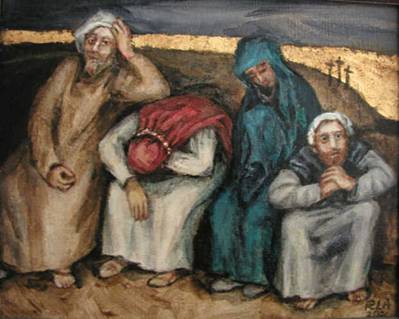
One has to use their imagination as to what was occurring in the lives of the characters in this story. We know that on the day of the crucifixion that after Jesus’ death that Joseph of Arimathea provided a tomb where Jesus’ body was prepared and in which he was laid.  We know that the tomb was sealed and that Roman guards were at it as ordered by Pilate.  We know that the disciples with the exception of John had abandoned Jesus and that following the crucifixion that they had scattered and went underground with the exception of Judas who was last seen hanging around.  Most of Jerusalem was observing Passover between Friday evening and Saturday evening.  Life for many went on without a second thought as Jesus was now yesterday’s news.  The disciples wondered if they would be next, a mother mourned, members of the Sanhedrin likely were relaxing for the first time since Jesus entered Jerusalem as potential Messiah the previous Sunday while Roman soldiers far from home wondered just why they were guarding the tomb of a criminal.

We know from the reactions of the disciples the next day that they really believed that Jesus was not only dead but not coming back. There was a finality that they lived a grief that they bore. Their teacher the one that they had given up all to follow was dead executed as a criminal between common criminals and buried in a borrowed tomb.  One of their friends that they had shared the previous three years had betrayed Jesus.  Their world was upended; the one that they assumed to be the Messiah was mortal.  Their faith was crushed.

The life of faith that we live in the interregnum between life and death creation and consummation is often similar to that the disciples experienced.  We experience situations where faith is hard to come by and since we are in the uncomfortable middle nothing seems certain.  Much of this comes when like the disciples we expect something from God or expect God to do something only to find that our expectations were perhaps just a bit different from those of the Deity.  Disappointment with God I think one has called it and if we are honest it is a part of life because none of really know the will of God or even what will transpire tomorrow something that scripture is rather clear about.

We live in the middle every time we walk with Jesus and his followers through Holy Week just as we walk through life and Holy Saturday is in a sense a metaphor for life when we don’t understand it when we are in the middle wondering what transpired before and not knowing the future.  It is a time to again seek out our faith and with our friends who share this life to maintain hope that things will work out, that in fact resurrection will come.

Until tomorrow we leave the disciples in hiding, the city sleeping and the Roman soldiers cold and bored at a tomb which in reality they care less about.

Peace,

Padre Steve+

Leave a comment

Filed under christian life, faith, Religion