Tag Archives: just war

Can you Live With It? The Moral Costs of the War Against the Islamic State

pale-moonlight

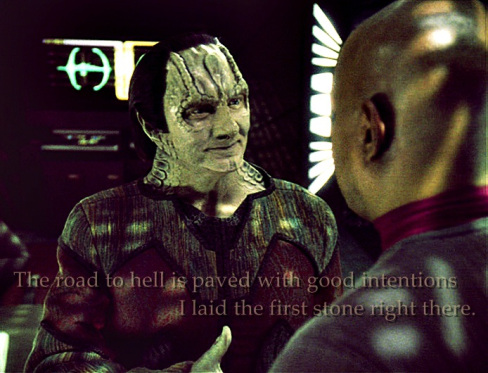
“My father used to say that the road to Hell is paved with good intentions. I laid the first stone right there. I’d committed myself. I’d pay any price, go to any lengths, because my cause was righteous. My… intentions were good. In the beginning, that seemed like enough.” Captain Benjamin Sisko (Avery Brooks) Star Trek Deep Space Nine, In the Pale Moonlight

I think that among the Star Trek series that my favorite is Star Trek Deep Space Nine. Of course all of the series deal with ethics, philosophy and morality to some extent, but Deep Space Nine is perhaps the most interesting to me. Don’t get me wrong I think that the Original Series and Start Trek the Next Generation were and are leap years ahead of most television series when it comes to addressing ethical, moral and existential issues, but somehow living in the post 9-11 “War on Terrorism” world I find Deep Space Nine to be the most compelling. I think that is that the fact that the moral issues get blurred which attracts me to the series, and to this episode in particular.

One of my favorite episodes is from season six and is entitled “In the Pale Moonlight.” The episode deals with the unsavory matter of contriving a reason to get the Romulan Empire to join with the Federation and the Klingons to fight the Dominion-Cardassian alliance that is threatening those entities as well as potentially the entire Alpha Quadrant. I have included a link to the conclusion of that episode here:

http://www.youtube.com/watch?v=dTgGtJ-PisA

The ethics of this episode seem very timely as I look at the new phase of the conflict that the United States has been engaged for the past thirteen years. The fact is that in spite of our appeal to higher ideals we are having to make alliances with powers that are only slightly less unsavory than ISIS, powers whose polices have help ISIS grow. In a sense it is the classic scenario of making a deal with the devil to defeat one’s enemy. Of course this is not new, individuals and nations have made such deals, sometimes with mortal enemies throughout history.

Unfortunately we usually judge such decisions based on their results, rather than wrestle with the ethical issues involved and how we might behave in similar situations. For me the philosophical and ethical issues involved in such alliances have a special interest and as such I tend to notice or recall instances where I saw, read or heard something that makes a connection to an ethical or moral dilemma faced by policy makers and planners today.

Some of the issues involved for policy makers are related to the traditional Just War Theory, and what is called the “Supreme Emergency” exemption. This exemption basically posits that when faced with a supreme and existential emergency a person or state may engage in behaviors that ordinarily would be considered unethical if the situation were not of a supreme emergency.

Of course such decisions in the real world are difficult. Those who have a system of beliefs that help them define right and wrong behaviors, even if they are not codified in law may struggle with with such decisions, while those who act according to what they deem necessary or expedient, unbridled by religious, philosophical or other similar codes may not, instead making their decisions based on what appears to be necessary at the time.

This Deep Space Nine episode is remarkable because we get to see an actor playing a military commander dealing with the morality of the course of action that he is taking. In one of the early scenes Captain Sisko expresses his doubts relating to the morality of a decision that he is making in a war that has already consumed the lives of tens of millions of people.
siskogarak


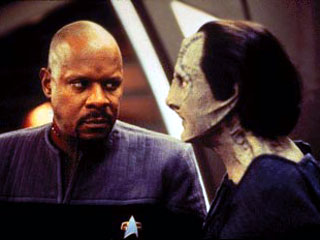
After an incident where a Federation starship was destroyed, Sisko went to Elim Garak (Andrew Robinson), an exiled Cardassian intelligence officer to uncover any evidence about Dominion-Cardassian collusion to attack the Romulans. When none was uncovered and Garak’s sources on Cardassia were compromised he agreed to allow Garak to manufacture evidence in order to get the Romulans into the war on the side of the Federation and Klingons. Sisko compounded the situation by having the Kilingons release a master forger who was on death row to help Garak. Sisko knew it was wrong and confided in his log:

“Why I didn’t listen to the voice in the back of my mind telling me not to believe a word he said, I’ll never know… But it didn’t take long for me to come face to face with the fact that I’d made a mistake.”

When the former prisoner gets drunk and attacks the owner of a tavern on the space station Sisko was in a bind. He wanted no evidence that the man had been on his station and in order to keep Quark, the bar owner quite had to bribe him. Sisko again expressed his doubts in his personal log:

“Maybe I should have put a stop to it right there. Maybe I should have said, “Thank you very much for your input, Mister Garak, I will take your suggestion under advisement,” and then gone back to my office and forgotten the whole thing. But I didn’t. Because in my heart, I knew what he was saying made sense.”

Even so Sisko still had doubts:

“That was my first moment of real doubt, when I started to wonder if the whole thing was a mistake. So I went back to my office. And there was a new casualty list waiting for me. People are dying out there every day! Entire worlds are struggling for their freedom! And here I am still worrying about the finer points of morality! No, I had to keep my eye on the ball! Winning the war, stopping the bloodshed, those were the priorities! So I pushed on. And every time another doubt appeared before me, I just found another way to shove it aside.”

When nations feel they are engaged in a life and death struggle, those who serve as policy makers, planners and military commanders often make uncomfortable compromises with their own religious, ethical or philosophical codes. Sisko continued down the path despite his doubts but justified his actions by the fact that Starfleet had approved them:

“Maybe… I was under more pressure than I realized. Maybe it really was starting to get to me, but I was off the hook. Starfleet Command had given the plan their blessing and I thought that would make things easier. But I was the one who had to make it happen. I was the one who had to look Senator Vreenak in the eye and convince him that a lie… was the truth.”

The forgery was completed and the Romulan Senator secretly arrived on the station to examine the evidence and as he did so all Sisko could do was wait, confiding in his log:

“So all I could do was wait… and see how masterful Tolar’s forgery really was. So I waited… tried to catch up on my paperwork, but I find it very difficult to focus on criminal activity reports, cargo manifests… So I went back to pacing, staring out of the window. I’m not an impatient man, I’m not one to agonize over decisions once they’re made. I got that from my father. He always says, “Worry and doubt are the greatest enemies of a great chef. The soufflé will either rise or it won’t – there’s not a damn thing you can do about it, so you might as well just sit back and wait and see what happens.” But this time the cost of failure was so high, I found it difficult to take his advice. If Vreenak discovered that the data rod was a forgery, if he realized that we were trying to trick them into the war it could push the Romulans even farther into the enemy camp. They could start to openly help the Dominion. If worst came to worst they could actually join the war against us. I had the distinct feeling that victory or defeat would be decided in the next few minutes.”
In-The-Pale-Moonlight

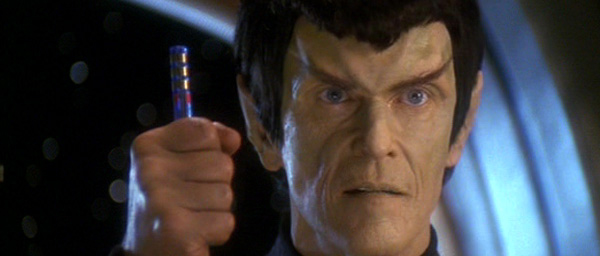
It did not work, Vreenak discovered that the data rod was a forgery and threatened to expose Sisko’s deception and possibly bring the Romulans into alliance with the Dominion. When Sisko’s actions blew up in his face and his deceit was revealed he was not happy and resigned himself to face the consequences:

“So it all blew up in my face. All the lies and the compromises, the inner doubts and the rationalizations – all for nothing. Vreenak was furious. I can’t say I blamed him; I’d have reacted the same way. After telling me in no uncertain terms that he intended to expose this “vile deception” to the entire Alpha Quadrant, he got back in his shuttle and headed home. There didn’t seem to be anything more to do… so I went back to work. Two days later we got the news.”

Sisko learned in a Starfleet communication that Vreenak’s shuttle had blown up and that is was suspected to be the work of the Dominion. When Sisko found that Vreenak was dead he went to Garak and forcefully confronted him, striking him in the process. He accused Garak of sabotaging the senator’s ship and killing him as well as the forger, Tolar. Instead of backing down Garak confronted the results and the ethical issue. The heated exchange between the two men is fascinating:

Garak: If you can allow your anger to subside for a moment, you’ll see that they did not die in vain! The Romulans will enter the war!

Captain Sisko: There’s no guarantee of that!

Garak: Oh, but I think that there is. You see, when the Tal Shiar finishes examining the wreckage of Vreenak’s shuttle, they’ll find the burnt remnants of a Cardassian optolythic data rod which somehow miraculously survived the explosion. After painstaking forensic examination, they’ll discover that the rod contains a recording of a high-level Dominion meeting, at which the invasion of Romulus was being planned.

Captain Sisko: And then they’ll discover that it is a fraud!

Garak: Oh, I don’t think they will! Because any imperfections in the forgery will appear to be a result of the explosion. So – with a seemingly legitimate rod in one hand, and a dead senator in the other, I ask you, Captain – what conclusion would you draw?

As Sisko’s anger subsided Garak continued:

“That’s why you came to me, isn’t it, Captain? Because you knew I could do those things that you weren’t capable of doing? Well, it worked. And you’ll get what you want: a war between the Romulans and the Dominion. And if your conscience is bothering you, you should soothe it with the knowledge that you may have just saved the entire Alpha Quadrant. And all it cost was the life of one Romulan senator, one criminal, and the self-respect of one Starfleet officer. I don’t know about you, but I’d call that a bargain.”

Shortly thereafter Sisko found out that the out that the deception was successful as Garak had said it would be. The Romulans who recovered the damaged data rod believed that it was genuine and declared war on the Dominion-Cardassian alliance and had entered the war on the side of the Federation. He completed his personal log:

“At oh-eight-hundred hours, station time… the Romulan Empire formally declared war against the Dominion. They’ve already struck fifteen bases along the Cardassian border. So, this is a huge victory for the good guys! This may even be the turning point of the entire war! There’s even a “Welcome to the Fight” party tonight in the wardroom!… So… I lied. I cheated. I bribed men to cover up the crimes of other men. I am an accessory to murder. But most damning of all… I think I can live with it… And if I had to do it all over again… I would. Garak was right about one thing – a guilty conscience is a small price to pay for the safety of the Alpha Quadrant. So I will learn to live with it…Because I can live with it…I can live with it. Computer – erase that entire personal log.”

DS9SiskoToast

My guess is that before this war is over, there will be men and women serving in positions of responsibility in our or allied militaries, policy makers and government officials who will make similar deals, violating their own moral codes and even laws in order to defeat the Islamic State and prevent acts of terror against their citizens. Most, like Sisko will not be happy but will live with their decisions. The fact is that long asymmetrical wars in which nation states have to fight non-state terrorist entities get really ugly and the longer and more bloody that they become the more decent and honorable people will make decisions like Sisko and resort to actions that in normal times they would never countenance.

This is nothing new. Those who have fought in such wars throughout history have found ways to “live” with actions that they would not approve of had things been different. Wars such as the one that we are fighting and continue to fight in the years ahead have a corrosive affect on the human spirit. They corrupt and destroy even when they are “successful.”

The question is: Can we live with it? Sadly, as much as I hate to admit it, in a similar situation I think like Sisko, that I could condone or be complicit in something like this. I too could probably convince myself that the end justified the means and that I could live with it.

Peace

Padre Steve+

4 Comments

Filed under ethics, leadership, News and current events, philosophy, Political Commentary, star trek, War on Terrorism

War, Remembrance and Healing: A Chaplain, Officer and Historian Makes His Way Home

The first version of this post was written in the spring of 2008 when I was doing a lot of soul searching and reflecting after Iraq. It was originally run in my church’s online news service.  I post it now with some updates that have been brought about by new ways that I am rediscovering God and because of the current situation in Afghanistan which has become worse in the past year. As I read news releases about casualties and attacks on NATO forces and Afghan civilians, especially those in small outposts or serving as advisers and trainers I am reminded of my time in Iraq.  Please don’t forget those who serve in Iraq and Afghanistan, or those who have served in prior wars. Especially keep in your prayers and help assist those who have returned injured in mind, body or spirit and those who made the supreme sacrifice.

874Leaving a Bedouin Camp 1 mile from Syria
I have been doing a lot of reflecting on ministry and history over the past since returning from Iraq. Since I’ve been back about a year and a half I can say that I have changed as a result of my service there.  Change can be scary but in my case it has been both necessary and probably good.  Ministry, theology and history have been part of my life for many years; they have taken on a new dimension after serving in Iraq. When I first wrote this piece not long after returning I was in pretty bad shape but in the months since I have been attempting to integrate my theological and academic disciplines with my military, life and faith experience since my return. I’m not done yet by any means, but things are getting better, not quite like Chief Inspector Dreyfus in The Pink Panther Strikes Again “Every day in every way I’m getting better and better…Kill Clouseau!” but a slowly getting better with some occasional bumps in the road.

One of the things that I have wrestled with is my faith, and returning from war changes a man.  Before I went to Iraq I thought that I had things pretty much together.  When I came home and fell apart it also affected my faith, doing little things became difficult and the effects were exaggerated by my isolation.  In a sense it was my Saint John of the Cross Dark night of the Soul experience.  I felt that God had abandoned me, people would come to me with their crisis of faith and I had to dig deep to stay with them, but in doing so I became acutely aware of the fact that I shared this with them. I couldn’t hide behind my collar or the cross on my uniform as the crisis was an interruption which drove me out of my comfort zone and forced me to deal with the world that the people I minister among deal with every day.

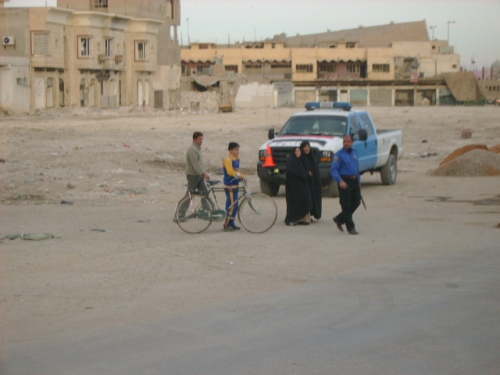
291Iraqi Police in Ramadi Escorting Civilians Across the War Zone of Route Michigan

There are those who believe that all forms of ministry are basically the same and that lessons learned are universally applicable and that somehow all ministries are proclamation oriented.  Unfortunately that is not the case and one of the places that this is true is the Military Chaplain ministry.  This mibnistry is much different than parish or para-church ministries and even different than other institutional ministries such as Police, Fire, Industrial or civilian health care chaplaincy.   It is different in that it is more incarnation versus proclamation. We not only minster to our people but we live among them.  We live the experience of those that we serve, especially in the uncertainly of war and deployments.  Chaplains live in a world where we are fully military officers and fully ministers of our own church or faith tradition. As a chaplain I never lose my calling of being a priest, but I am a priest in uniform, a military professional and go where our nations send me to serve the Sailors, Marines, Soldiers and Airmen who I live among be that overseas, or in the States.

142Always a Priest Eucharist with Advisers in the Far West of Al Anbar

There is always a tension in the military chaplain ministry. This is  especially true when the wars that we are sent to are unpopular at home and seem to drag on without the benefit of a nice clear victory such as VE or VJ Day in World War II or the homecoming after Desert Shield and Desert Storm. There are those that oppose the military chaplaincy on theological or philosophic grounds, usually some manner of absolutist understanding of ministry, church-state relations or social justice considerations.  My purpose is here not to defend military chaplain institutions against such criticism but rather to share the world and tension that military chaplains live in when our nation is engaged in unpopular which some consider unjust or illegal wars.

training team baseIsolated Base Camp for Advisers in Afghanistan

A lot of people have no “ethical” or “moral” qualms about wars that are easy to pigeonhole as just wars, especially if we win quickly and easily.  It is my belief that when things go well and we have easy victories that it is easy for religious people, especially more conservative Christians to give the credit to the Lord for the “victory.”  Unfortunately such “Credit” is given without them ever understanding or sometimes even caring about the human cost of war.   Likewise it is easy for others to give the credit to superior strategy, weaponry or tactics to the point of denying the possibility that God’s involvement.  Conversely and maybe even perversely I have heard some say that God has blessed the use of weapons or tactics that violate principles of fighting a “just war” especially that of proportionality. Such is the case in almost every war and Americans since World War Two have loved the technology of war seeing it as a way to easy and “bloodless” victory. In such an environment ministry can take on an almost “cheer-leading” dimension. It is hard to get around it, because it is a heady experience to be on a winning Army in a popular cause but I do think that many chaplains have a less “cheerleading” approach than many in conservative churches. The challenge for chaplains in such an environment is to keep our ministry of reconciliation in focus. To do so we must care for the least, the lost and the lonely and never forget the victims of war, especially the innocent and the vanquished, as well as our own wounded, killed and their families.

237Iraqi Kids in Al Anbar Province, a couple of months before they could not venture outside because of insurgent attacks, children are never winners in war

We are now seeing the conflict in Iraq winding down and what until this year had been “the good war” in Afghanistan go bad and support for it decline.  Strategy is being debated as how to best “win” the war in Afghanistan even as the United States withdraws from Iraq. The task of chaplains in the current war, and similar wars fought by other nations is different and really doesn’t allow for them to indulge themselves in “cheerleading.” In fact chaplains can themselves through isolation, lack of experience and fear can become more reflective and less “cheerleader” oriented the longer the war goes on without sign of appreciable progress, much less victory.  They feel the onslaught of their soldiers doubts, fears as well as the loss of friends and the chapel congregation through being killed or wounded in action. This  can take a terrible toll even for the most resilient of chaplain. In these wars, sometimes called counter-insurgency operations, revolutionary wars, guerilla wars or peace keeping operations, there is no easily discernible victory. These types of wars can drag on and on, sometimes with no end in sight. Since they are fought by volunteers and professionals, much of the population acts as if there is no war since it does often not affect them, while others oppose the war, all of which can affect the chaplain.

dien_bien_phu paras landingFrench Paratroops Landing at Dien Bien Phu

Chaplains volunteer to go with and place themselves in harms way to care for God’s people in the combat zone or far away from home. While they do this there are supporters of war as well as detractors who have no earthly clue about war or life in the military other then what they see in the media or experienced in peacetime or the cold war. Some supporters often seem more interested in political points of victory for their particular political party than for the welfare of those that are sent to fight the wars. This has been the case in about every war fought by the US since World War II. It is not a new phenomenon. Only the cast members change with the particular war.

legion indo-chinaForeign Legion Troops in Indochina

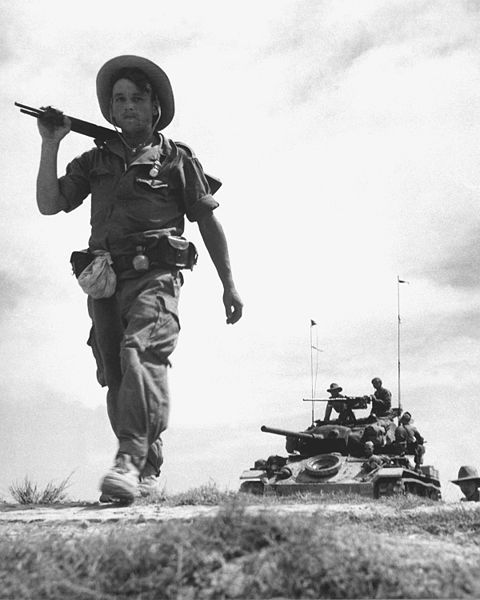
In order to somehow make sense of going on we cannot simply think of what is politically expedient for either those who support or want to expand the war, or others who want it ended now, both of which have consequences many of which are bad.  I think that we have to look at history and not just to American history to find answers, not simply answers to how to win or end the war but answers to the consequences that either course of action posits. Thus I think that we can find parallels in other militaries. I think particularly of the French professional soldiers, the paratroops, Colonials (Marines) and Foreign Legion who bore the brunt of the fighting in Indo-China. These men, not all of who were French were placed in a difficult situation by their government and alienated from their own people. In particular I think of the Chaplains, all Catholic priests save one Protestant, at the Battle of Dien Bien Phu, the epic defeat of the French forces that sealed the end of their rule in Vietnam. The Chaplains there went in with the Legion and Paras. They endured all that their soldiers went through while ministering the Sacraments and helping to alleviate the suffering of the wounded and dying. Their service is mentioned in nearly every account of the battle. During the campaign which lasted 6 months from November 1953 to May 1954 these men observed most of the major feasts from Advent through the first few weeks of Easter with their soldiers in what one author called “Hell in a Very Small Place.”

french troops indochinaFrench Troops on the March in Indochina

One author describes Easter 1954: “In all Christendom, in Hanoi Cathedral as in the churches of Europe the first hallelujahs were being sung. At Dienbeinphu, where the men went to confession and communion in little groups, Chaplain Trinquant, who was celebrating Mass in a shelter near the hospital, uttered that cry of liturgical joy with a heart steeped in sadness; it was not victory that was approaching but death.” A battalion commander went to another priest and told him “we are heading toward disaster.” (The Battle of Dienbeinphu, Jules Roy, Carroll and Graf Publishers, New York, 1984 p.239) This can be a terrible burden for the Padre who cares for such men.  Ministry in such places is truly an incarnational experience because there is no place to hide and the chaplain is as vulnerable as his flock.  It is the ministry that places us “in the valley of the shadow of death” where as the Psalmist says we are “to fear no evil for you are with us.” It is the ministry of Good Friday where to all appearances seems that God has abandoned the field and evil has won.

VIETNAM DIEN BIEN PHUFrench Surrender at Dien Bien Phu

Of course one can find examples in American military history such as Bataan, Corregidor, and certain battles of the Korean War to understand that our ministry can bear fruit even in tragic defeat. At Khe Sahn in our Vietnam War we almost experienced a defeat on the order of Dien Bien Phu. It was the tenacity of the Marines and tremendous air-support that kept our forces from being overrun.

legion algeriaLegionaries in Algeria, many French Troops Went from one War in Indochina to another in Algeria only to have the De Gaulle Government throw the Military Victory Away and Cause a Crisis
You probably wonder where I am going with this, back when I first drafted this year and a half ago I wondered too. But here is where I think I am going. We live in difficult of times at home and in Afghanistan.  It home we are mired in an economic crisis clouded by deep political division.  In Afghanistan we are engaged in a hard fight where units we are taking casualties and the mission is being debated.  Sometimes to those deployed and those who returned that their sacrifice is not fully appreciated by a nation absorbed with its own issues.  This of course is not universally true as there a people of all political viewpoints who care for the welfare and attempt to ensure that those who serve are not abandoned as those men who served in Vietnam.  I think that part of the feeling comes from the presentation of the war by the media which tends to focus only on the negative outcomes and not positive things that our soldiers accomplish. That can be discouraging to the men and women on the ground.  One of the most difficult things for me upon my return was to see the bitterness a division in the American people and political establishments and becoming quite depressed about it.   I stopped watching the perpetual news cycle and listening to talk radio.  The hatred, ignorance and crassness of it all was disheartening and I refuse to take any part in something that is so hate filled, power driven and unredemptive.

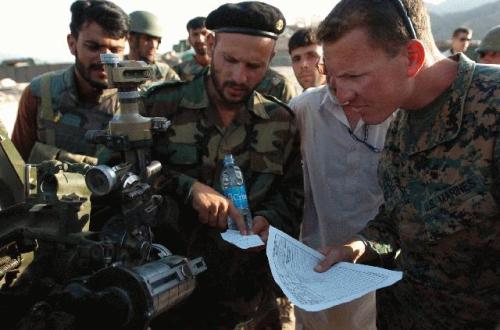
traiining team with afghan armyUSMC Training Team With Afghan Troops

For the French the events and sacrifices of their soldiers during Easter 1954 was page five news in a nation that was more focused on the coming summer. This is very similar to our circumstances today because it often seems that own people are more concerned about economic considerations and the latest in entertainment news than what is going on in Iraq or Afghanistan. The French soldiers in Indo-china were professionals and volunteers, much like our own troops today. Their institutional culture and experience of war was not truly appreciated by their own people.  Nor was it fully appreciated by their government which sent them into a war against an opponent that would sacrifice anything and take as many years as needed to secure their aim.  At the same time their own countrymen were unwilling to make the sacrifices needed to win and in fact had already given up their cause as lost. The sacrifice of French soldiers would be lost on their own people and their experience ignored by the United States when we sent major combat formations to Vietnam in the 1960s. In a way the French professional soldiers of that era have as well as British colonial troops before them have more in common with our force than the citizen soldier heroes of the “Greatest Generation.” Most of the “Greatest Generation” was citizen soldiers who did their service in an epic war and then went home to build a better country as civilians. We are now a professional military fighting unpopular wars and that makes our service just a bit different than those who went before us.  I related to the French troops who fought in Indochina and Algeria as well as our own Vietnam Vets than I do to others.  These is a kinship among us that goes beyond nationality, politics or age.

This is the world in which military chaplains’ minister.  It is a world of volunteers who serve with the highest ideals, men and women who enlist knowing that they will be deployed and quite likely end up in a combat zone. We go where we are sent, even when it is unpopular. It is here that we make our mark; it is here that we serve our Soldiers, Sailors, Marines and Airmen. Our duty is to bring God’s grace, mercy and reconciliation to men and women, and their families who may not see it anywhere else. It is a ministry of reconciliation by the means of incarnation. Many times those outside the military do not understand this. It is a different world full of contradictions and ambiguity.  Such situations even impact the families of those who serve.

When my dad was serving in Vietnam in 1972 I had a Sunday school teacher tell me that he was a “Baby Killer.” It was a Catholic Priest and Navy Chaplain who showed me and my family the love of God when others didn’t. As the country builds to the 2010 mid-term Congressional elections I anticipate that people from all parts of the political spectrum will offer criticism or support to our troops or the war in order to bolster their election chances which do not always coincide with what is in the best interest of the troops or the mission. Chaplains cannot be concerned about the politics nor even the policy as our duty is to be there as Priests, Ministers, Rabbis and Imams for those that we serve. We cannot afford to allow ourselves to be discouraged in caring for our men and women and their families because of all the strife in the body politic.  In addition we must continue on because most churches and other religious communities, even those supportive of our troops really don’t understand the nature of our service or the culture that we represent. We live in a culture where the military professional is in a distinct minority group upholding values of honor, courage, sacrifice and duty which may be foreign or archaic to many Americans, or for those countries with troops and chaplains in Afghanistan or Iraq. We are called to that ministry in victory and if it happens someday, defeat. In such circumstances we must always remain faithful to God as well as to those that we serve.

For those interested in the French campaign in Indo-China it has much to teach us. Good books on the subject include The Last Valley by Martin Windrow, Hell in a Very Small Place by Bernard Fall; The Battle of Dienbeinphu by Jules Roy; and The Battle of Dien Bien Phu- The Battle America Forgot by Howard Simpson. For a history of the whole campaign, read Street Without Joy by Bernard Fall. I always find Fall’s work poignant, he served as a member of the French Resistance in the Second World War and soldier later and then became a journalist covering the Nurnberg Trials and both the French and American wars in Vietnam and was killed by what was then known as a “booby-trap” while covering a platoon of U.S. Marines.

There is a picture that has become quite meaningful to me called the Madonna of Stalingrad. It was drawn by a German chaplain-physician named Kurt Reuber at Stalingrad at Christmas 1942 during that siege. He drew it for the wounded in his field aid station, for most of whom it would be their last Christmas. The priest would die in Soviet captivity and the picture was given to one of the last officers to be evacuated from the doomed garrison. It was drawn on the back of a Soviet map and now hangs in the Kaiser Wilhelm Memorial Church in Berlin where it is displayed with the Cross of Nails from Coventry Cathedral as a symbol of reconciliation. I have had it with me since before I went to Iraq. The words around it say: “Christmas in the Cauldron 1942, Fortress Stalingrad, Light, Life, Love.” I am always touched by it, and it is symbolic of God’s care even in the midst of the worst of war’s suffering and tragedy.

Madonna of StalingradMadonna of Stalingrad

So as you can see I have done a lot of reflecting over the past year and a half. It has been a spiritual journey, an intellectual and academic journey and a personal journey of slowly healing and recovery.  I have gone through some changes in the process which have not been easy, but certainly have deepened my faith even as I struggled and made me much more appreciative of life, love and peace.

I write in order to wrestle with what I have mentioned here, and I try to write something every night. I can full agree with Father Henri Nouwen in his book Beyond the Mirror as to the purpose that writing serves me in my journey.

“These many interruptions calling me ‘beyond’ compelled me to write. First of all, simply because writing seemed to be the only way for me not to lose heart to in the frightening and often devastating interruptions and to hold onto my innermost self while moving from known to unknown places. Writing helped me to remain somewhat focused amid the turmoil and discern the small guiding voice of God’s Spirit in the midst of the cacophony of distracting voices.  But there is a second motivation. Somehow I believed that writing was the one way tom let something of lasting value emerge from the pains and fears of my little, quickly passing life.  Each time life required me to take a new step into unknown spiritual territory, I felt a deep, inner urge to tell my story to others- perhaps as a need for companionship but maybe, too, out of an awareness that my deepest vocation is to be a witness of the glimpses of God I have been allowed to catch.”

pub2Slowly Getting Better

I am healing though it has been at times painful, but faith is returning and I can say that though it has not been easy it has been worth it.  I do hope that what little I do in my work and in my writing will be of help to those who struggle and those who recognize their own need for reconciliation, healing who need to hope again no matter who they are and what their circumstance.

Peace,

Padre Steve+

2 Comments

Filed under Loose thoughts and musings