Tag Archives: Paul Tillich

I Want to Believe this Easter

themiddle

“Religion carries two sorts of people in two entirely opposite directions: the mild and gentle people it carries towards mercy and justice; the persecuting people it carries into fiendish sadistic cruelty…” Alfred North Whitehead 

Sometimes Holy Week can be a downer and I can understand why people who doubt, or who have been abused by Christians, either in the church or as outsiders find this to be so. I am a Christian, a priest, a Navy Chaplain. By all estimates I should be on the “inside” so to speak, but in the current religious and political climate I am an outsider. My crime to the “true believers” is that I question their certitude, and I reject the hateful ideas of an American Christian theocracy preached by the politicians, pundits and preachers of the Christian Right.

As for me, this year, Holy Week has been a bit of a downer. I believe, but I don’t. For a while I wondered if it was my post-Iraq agnosticism returning, but after spending some time meditating and thinking on it I realized that was not the case. I do still believe, or at least I want to, but my doubt and unbelief now mainly comes from of my experience with Christians, not so much God.

Truthfully I wonder. I wonder if God is the God whose Son reconciled the world to himself, how those that claim to be his most devout followers seem more intent preaching a message of alienation and rejection rather than reconciliation. I wonder how people who claim to be the disciples of the Prince of Peace seem far more intent on conducting a jihad like culture war than the message of peace and reconciliation. I wonder how such people who claim to be God’s elect and anointed can so maltreat the very people who Jesus would have gone out of his way to care for, and in fact died and rose again in order to save. But I am not alone in this.

Rachel Held Evans wrote in a CNN religion blog yesterday:

“This is the tragic irony of the culture wars: The casualties tend to be the very people Jesus went out of his way to serve: the poor, the sick, the marginalized, the outcasts, the people ostracized and deemed “sinners” by the religious elite. And when the world sees Christians hurting rather than helping such people in the name of political gain, our testimony is profoundly diminished.” 

I fully understand what she is saying. Personally I am tired of the abuse of people who in the name of their culture warrior political Christian elite must resort to the most loathsome methods to demonize people who do not agree with them, including me. Sadly, in addition to people who don’t know me from Adam who do this I have experienced it from so called “Christian” friends. If it wan’t for people, including conservative Christians who have stood by me through thick and thin, even when they disagree with me, I probably would just chuck Christianity and the church.

But I cannot do that if I believe in the message of Jesus. I cannot do that if I actually even somewhat believe message of Jesus. A message that reaches out even to the same people who seem to loath me and others like me with a hate stronger than life itself.

When when a person like me struggles to believe in the first place, and at the same time is rejected by those who loudly proclaim to be the disciples of Jesus it does get old. Way too old.

Since it is Holy Week and I am struggling I have decided to not get involved with any discussions this week with the supposed followers of Jesus on any social media that denigrate those who Jesus died to save. If I am to preserve any sort of faith I have to do this.

Sadly, that can and does include things not even connected with the actual Christian faith, mostly the politics of the supposedly “Christian Right.”  A couple of days ago I dared to state the truth that a certain Republican Presidential candidate espoused the same theocratic views as his Christian Dominionist preacher father. That got me attacked by a number of so called Christians including one whose Facebook avatar picture was a soldier wearing a death’s head mask with a pistol pointed directly at me. That man called me a “wolf in sheep’s clothing.” I told that man that I had a feeling that I knew what he would do if he actually met me. I picture is worth a thousand words, especially when it comes to revealing attitudes of the heart.

Personally, between the rejection and abuse I have experienced from Christians that I thought were friends, as well as those who are no better than hateful trolls on social media I am pretty much done with all things remotely considered Christian by most Americans today. I find it no wonder that people are fleeing the church, and have no doubts as to why why every poll and trend shows that people increasingly want nothing to do with the those that call themselves Christian or the church.

But I stay, and the the only reason I remain now I think is that I believe in the Jesus of Good Friday, the Jesus who is rejected by all the theologians of glory and Christian Dominionists, the crucified God. I believe in the Jesus whose death was considered a scandal to the Jews and foolishness to the Greeks. If I am to believe this is the Jesus that I have to believe in, not the God of the “theologians of glory” or the Dominionists who seek to establish their kingdom on earth with a thin veneer of faith. It as as Jurgen Moltmann wrote:

“The God of freedom, the true God, is… not recognized by his power and glory in the history of the world, but through his helplessness and his death on the scandal of the cross of Jesus”

Theologian Paul Tillich, who served as a U.S. Army Chaplain wrote “Sometimes I think it is my mission to bring faith to the faithless, and doubt to the faithful.”  

In light of my belief in the scandal of the Cross, something that certainly is offensive to those that seek the power and glory of God even if it means trampling those that Jesus most identified, is a mission that I can subscribe.  Most of the people I deal with are those marginalized and rejected by the Christian pharisees, or what I call the “Christian Taliban.”  Personally I am tired of being associated with people who treat the poor, the alien, the different, the sinful and the afflicted as less than human, or less than worthy of God’s love and grace.  I am tired of being associated with people who claim to be pro-life so long as it only applies to life in the womb, who have no problem blessing war without end and the merciless killing of innocents abroad. I am tired of people who scream “let them die” at Presidential debates referring of course to the the poor and uninsured being the voice of Christianity in this county. People who have so discredited themselves and the faith as to make no one want to have anything to do with Jesus.

In the movie Joyeux Noel a priest and chaplain serving with a Scottish regiment during the Christmas truce of 1914 tells the Bishop who is sending him home: “I belong with those who are in pain, and who have lost their faith, I belong here.” Of course the bishop is a man who heartily subscribes to a war without mercy, just as so  many who call themselves Christians do today. When the priest questioned the bishop about being relieved of his duties, the bishop, in a manner similar to what I have experienced tells the priest: “You’re not asking the right question. Think on this: are you really suitable to remain with us in the house of Our Lord?”

I have experienced such comments too much. So regardless of the cost, even the cost to myself I will chose to believe and serve the Crucified God, the God who is not the God of the theocrats of the “Christian” right, but the Crucified God who stands against them. The God who in humility and weakness  proclaimed that his kingdom was not of this world and who stands against those who fraudulent attempt to establish their kingdoms in his name. People that often do so upon the bodies of those that they kill, and the lives of those that they despise. If this means that I am not suitable to “remain in the house of the Lord” than I would rather be an outcast on my own Golgotha this Holy Week than in that house.

Frankly, I don’t know what this Holy Week will bring for me. I am struggling. I want to believe, but sometimes I get so discouraged as one of those wounded by such people that I need to create some safe space if I am to find some solace.

I am opposed to the conservative Christian “Culture Wars” that so many of my friends and others have, and sadly still embrace. I see the “”Culture Wars” as antithetical to the Gospel. I see them as vain attempts to establish a state religion, an American Theocracy that would crush and destroy any that dare oppose it.

That being said I want to remain open to any who seek God. Henri Nouwen wrote:

“Ministry means the ongoing attempt to put one’s own search for God, with all the moments of pain and joy, despair and hope, at the disposal of those who want to join this search but do not know how.”

My journey this Holy Week is one of hope. I do want to believe. Jurgen Moltmann wrote:

“Totally without hope one cannot live. To live without hope is to cease to live. Hell is hopelessness. It is no accident that above the entrance to Dante’s hell is the inscription: “Leave behind all hope, you who enter here.”

That is my journey this week, a journey from my own Golgotha to the Easter Alleluia. To do so I cannot give up hope. I probably won’t do very well at it,this week or any other, but that is my journey.

I don’t know if that makes any sense, but somehow, it does make sense to me.

Peace

Padre Steve+


5 Comments

Filed under christian life, faith, Religion

Heresy, Love, and Faith: My Journey

IMG_1915

I like hard questions and hard cases. My life has been quite interesting and that includes my faith journey as a Christian and human being. It is funny that in my life I have as I have grown older begun to appreciate those that do not believe and to rather distrust those who proclaim their religious faith with absolute certitude, especially when hard questions are asked.  I was reminded of this by an Orthodox Christian internet “troll” this week.

Paul Tillich once said “Sometimes I think it is my mission to bring faith to the faithless, and doubt to the faithful.” 

I find it amusing when trolls come by to condemn my “heresy” and I realize that most have some kind of psychological need to be right, as well as a deep fear, despite their certitude, that they might be wrong, that causes them to do this.

I think that the quote by the late theologian is quite appropriate to me and the ministry that I find myself. I think it is a ministry pattern quite similar to Jesus in his dealings with the people during his earthly incarnate ministry.

Jesus was always hanging out with the outcasts, whether they be Jewish tax collectors collaborating with the Romans, lepers and other “unclean” types, Gentiles including the hated Roman occupiers, Samaritans and most dangerously, scandalous women. He seemed to reach out to these outcasts while often going out of his way to upset the religious establishment and the “true believers” of his day.

There is even one instance where a Centurion whose servant he healed was most likely involved in a homosexual relationship, based on the writer of the Gospel of Matthew’s use of the Greek word “Pais” which connotes a homosexual servant, instead of the more common “Doulos.” That account is the only time in the New Testament where that distinction is made, and Pais is used throughout Greek literature of the time to denote a homosexual slave or “house boy” relationship. Jesus was so successful at offending the profoundly orthodox of his day that his enemies made sure that they had him killed.

I think that what has brought me to this point is a combination of things but most importantly what happened to me in and after my tour in Iraq. Before I went to Iraq I was certain of about everything that I believed and was quite good at what we theologians and pastors call “apologetics.” My old Chaplain Assistant in the Army, who now recently serves as a Lieutenant Colonel in the Army Chaplain Corps called me a “Catholic Rush Limbaugh” back in 1997, and he meant it quite affectionately.

I was so good at it that I was silenced by a former Archbishop in my former church and banned from publishing for about 7 years after writing two articles for a very conservative Roman Catholic journal, the New Oxford Review.

The funny thing is that he, and a number of my closest friends from that denomination are either Roman Catholic priests or priests in the Anglican Ordinariate which came into communion with Rome a couple of years back. Ironically while being “too Catholic” was the reason I was forbidden to write it was because I questioned certain traditions and beliefs of the Church including that I believed that there was a role for women in the ordained ministry, that gays and lesbians could be “saved” and that not all Moslems were bad that got me thrown out in 2010.

However when I returned from Iraq in the midst of a full blown emotional, spiritual and physical collapse from PTSD that certitude disappeared. It took a while before I was able to rediscover faith and life and when I did it wasn’t the same. There was much more mystery to faith as well as reason. I came out of that period with much more empathy for those that either struggle with or reject faith. Thus I tend to hang out at bars and ball games more than church activities or socials, which I find absolutely tedious. I also have little use for clergy than in dysfunctional and broken systems that are rapidly being left behind. I am not speaking about belief here, but rather structure and methodology.

I think that if there is anything that God will judge the American versions of the Christian church is our absolute need for temporal power in the political, economic and social realms and the propagation of religious empires that only enrich the clergy which doing nothing for the least, the lost and the lonely. The fact that the fastest growing religious identification in the United States is is “none” or “no preference” is proof of that and that the vast amounts of money needed to sustain these narcissistic religious empires, the mega-churches and “Christian” television industry will be their undoing.  That along with their lack of care for anyone but themselves. Jesus said that his disciples would be known by their love for one another, not the size of their religious empire or temporal power.

The interesting thing is that today I have friends and colleagues that span the theological spectrum. Many of these men even if they do not agree with what I believe trust me to love and care for them, even when those most like them in terms of belief or doctrine, both religious and political treat them like crap. Likewise I attract a lot of people who at one time were either in ministry or preparing for it who were wounded in the process and gave up, even to the point of doubting God’s love and even existence. It is kind of a nice feeling to be there for people because they do not have to agree with me for me to be there for them.

In my darkest times my only spiritual readings were Father Andrew Greeley’s Bishop Blackie Ryan mysteries which I began reading in Iraq to help me get through the nights in between missions in Iraq and through the nights when I returned from them.  In one of those books, the last of the series entitled “The Archbishop goes to Andalusia” the miscreant Auxiliary Bishop to the Cardinal Archbishop of Chicago goes to Seville Spain.  In the novel Bishop Blackie makes a comment after celebrating Mass in the cathedral at Seville. He said “Every sacramental encounter is an evangelical occasion. A smile warm and happy is sufficient. If people return to the pews with a smile, it’s been a good day for them. If the priest smiles after the exchanges of grace, it may be the only good experience of the week.”  (The Archbishop in Andalusia p.77)

That is something that I try to do now on a regular basis. Sure most of my sacramental encounters as a hospital chaplain do not occur during the liturgy, but often in the life and death moments and times of deep discouragement felt by the wounded, ill and injured. In that ministry I have found that there are many hurting people, people who like me question their faith and even long held beliefs.

I like the old song by Nazareth called Love Hurts. The song always gets me. It is one of those “real” songs from the 1960s and 1970s that nails how life can be sometimes.

Love hurts, love scars
Love wounds and mars
In any heart not tough
Nor strong enough
To take a lot of pain
And love is like a cloud
Holds a lot of rain
Love hurts

I’m young and I know
But even so, I know a thing or two
I have learned from you
I’ve really learned a lot
And love is like a stove
Burns you when it’s hot
Love hurts

Some fools rave of happiness
Of blissfulness, togetherness
Some fools fool themselves, I guess
But they’re not fooling me
I know it isn’t true
Love is just a lie
Made to make you blue
Love hurts

Love does hurt, and well deciding to love can bring a lot of pain, but I do think that it is worth it. Well, that is all for tonight. Until tomorrow.

Blessings and Peace

Padre Steve+

Love Hurts lyrics © Kobalt Music Publishing Ltd., Warner/Chappell Music, Inc., EMI Music Publishing, Sony/ATV Music Publishing LLC, HOUSE OF BRYANT PUBLICATIONS


2 Comments

Filed under christian life, faith, LGBT issues, mental health, Military, ministry, Religion

I Belong Here With Those in Pain and Who Have Lost Their Faith

iraqchristmas

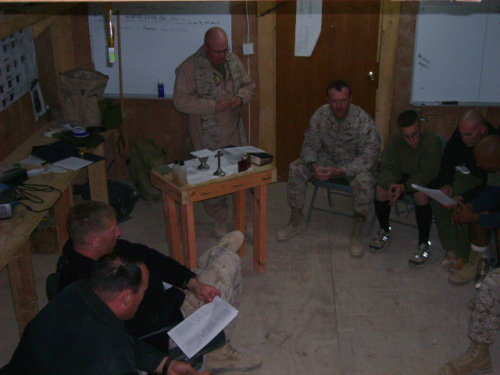
Christmas Eve at COP South 2007, the Most Important Mass of My Life

“I belong with those who are in pain, and who have lost their faith, I belong here.” Father Palmer, the Chaplain in Joyeux Noel (Merry Christmas)

In the next day or two, certainly by Christmas I will again watch the film classic Joyeux Noel (Merry Christmas) which is the story of the amazing and exceptional Christmas Truce of 1914. It is a film that each time I see it that I discover something new, more powerful than the last time I viewed it. I will also be writing about Christmas from my perspective as a combat veteran and giving voice to those who serve now, as well as those who served God’s people in hellish places before me.

As a Chaplain I am drawn to the actions of the British Padre in the film, who during the truce conducts a Mass for all the soldiers, British, French and German in no-man’s land, who goes about caring for the soldiers both the living and the dead.  His actions are contrasted with his Bishop who comes to relieve him of his duties and to urge on the replacement soldiers to better kill the Germans.

palmer

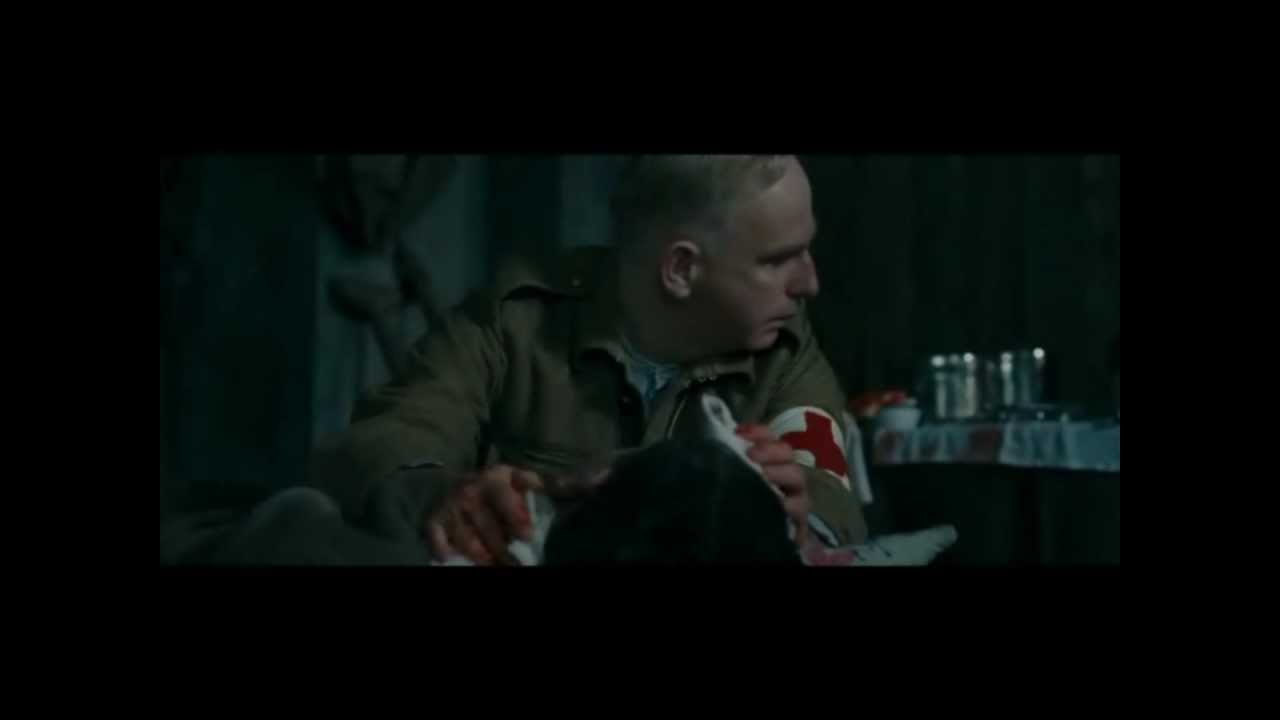
Father Palmer Tending the Wounded

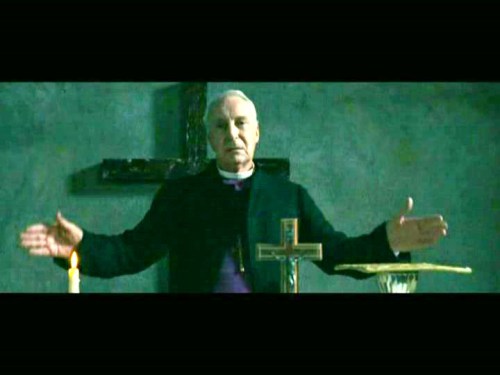
As the Chaplain begins to provide the last Rites to a dying soldier the Bishop walks in, in full purple cassock frock coat and hat and the chaplain looks up and kisses his ring.

As the chaplain looks at his clerical superior there is a silence and the Bishop looks sternly at the priest and addresses him:

“You’re being sent back to your parish in Scotland. I’ve brought you your marching orders.”

Stunned the Priest replies: “I belong with those who are in pain, and who have lost their faith, I belong here.”

The Bishop then sternly lectures the Priest: “I am very disappointed you know. When you requested permission to accompany the recruits from your parish I personally vouched for you. But then when I heard what happened I prayed for you.”

The Priest humbly and respectfully yet with conviction responds to his superior: “I sincerely believe that our Lord Jesus Christ guided me in what was the most important Mass of my life. I tried to be true to his trust and carry his message to all, whoever they may be.”

The Bishop seems a bit taken aback but then blames the Chaplain for what will next happen to the Soldiers that he has served with in the trenches: “Those men who listened to you on Christmas Eve will very soon bitterly regret it; because in a few days time their regiment is to be disbanded by the order of His Majesty the King. Where will those poor boys end up on the front line now? And what will their families think?”

They are interrupted when a soldier walks in to let the Bishop know that the new soldiers are ready for his sermon. After acknowledging the messenger the Bishop continues: “They’re waiting for me to preach a sermon to those who are replacing those who went astray with you.” He gets ready to depart and continues: “May our Lord Jesus Christ guide your steps back to the straight and narrow path.”

The Priest looks at him and asks: “Is that truly the path of our Lord?”

The Bishop looks at the Priest and asks what I think is the most troubling question: “You’re not asking the right question. Think on this: are you really suitable to remain with us in the house of Our Lord?”

With that the Bishop leaves and goes on to preach. The words of the sermon are from a 1915 sermon preached by an Anglican Bishop in Westminster Abbey. They reflect the poisonous aspects of many religious leaders on all sides of the Great War, but also many religious leaders of various faiths even today, sadly I have to say Christian leaders are among the worst when it comes to inciting violence against those that they perceive as enemies of the Church, their nation or in some cases their political faction within a country.

bishop

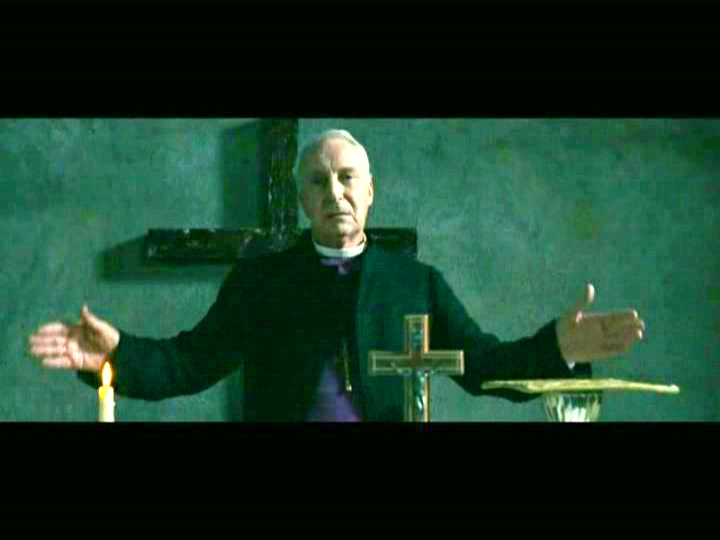
The Bishop Leads His “Service” 

http://www.youtube.com/watch?v=fMPxjUE40iw

“Christ our Lord said, “Think not that I come to bring peace on earth. I come not to bring peace, but a sword.” The Gospel according to St. Matthew. Well, my brethren, the sword of the Lord is in your hands. You are the very defenders of civilization itself. The forces of good against the forces of evil. For this war is indeed a crusade! A holy war to save the freedom of the world. In truth I tell you: the Germans do not act like us, neither do they think like us, for they are not, like us, children of God. Are those who shell cities populated only by civilians the children of God? Are those who advanced armed hiding behind women and children the children of God? With God’s help, you must kill the Germans, good or bad, young or old. Kill every one of them so that it won’t have to be done again.”

The sermon is chilling and had it not been edited by the director would have contained the remark actually said by the real Bishop that the Germans “crucified babies on Christmas.”  Of course that was typical of the propaganda of the time and similar to things that religious leaders of all faiths use to demonize their opponents and stir up violence in the name of their God.

When the Bishop leaves the Priest finishes his ministration to the wounded while listening to the words of the Bishop who is preaching not far away in the trenches. He meditates upon his simple cross, takes it off, kisses it hand hangs it upon a tripod where a container of water hangs.

The scene is chilling for a number of reasons. First is the obvious, the actions of a religious leader to denigrate the efforts of some to bring the Gospel of Peace into the abyss of Hell of earth and then to incite others to violence dehumanizing the enemy forces. The second and possibly even more troubling is to suggest that those who do not support dehumanizing and exterminating the enemy are not suitable to remain in the house of the Lord. Since I have had people, some in person and others on social media say similar things to what the Bishop asks Palmer the scene hits close to home.

iraq-bedouin1

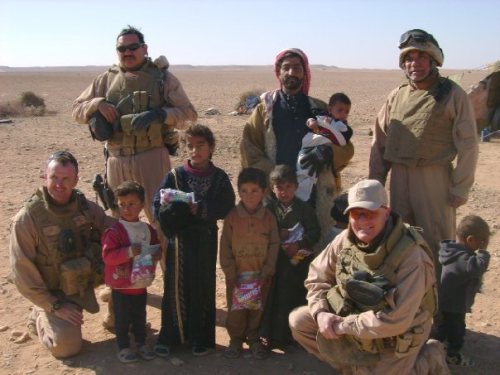
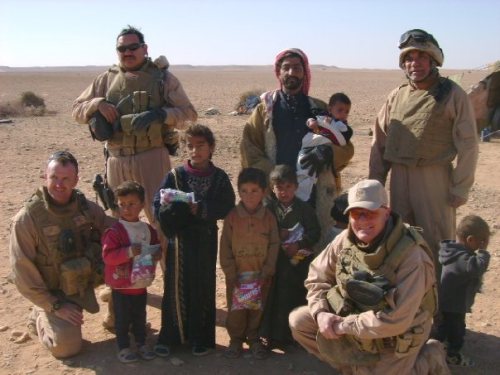
Christmas Eve 2007 with the Bedouin 

When I left Iraq in February 2008 I felt that I was abandoning those committed to my spiritual care, but my time was up. Because of it I missed going with some of my advisors to Basra with the 1st Iraqi Division to retake that city from insurgents. It was only a bit over a month after I had celebrated what I consider to be my most important Masses of my life at COP South and COP North on December 23rd as well as Christmas Eve and Christmas Day. In fact they were really the last masses that I felt the mystery and awe of the love of God that I used to so much feel.

When I left the new incoming senior Chaplain refused to take my replacement leaving our advisors without dedicated support. He then slandered me behind my back because what I was doing was not how he would do things and because I and my relief were under someone else’s operational control. It is funny how word gets back to you when people talk behind your back. Thankfully he is now retired from the Navy and I feel for any ministers of his denomination under his “spiritual” care.  So I cannot forget those days and every time I think about them, especially around Christmas I am somewhat melancholy and why I can relate so much to Father Palmer in the movie.

It has been seven years since those Christmas Masses and they still feel like yesterday. In the intervening years my life has been different. Just a year later I was walking home from church where my wife was to sing in the choir during the Christmas vigil mass. I couldn’t handle the crowds, the noise, and I felt so far away from God. That night I walked home in the dark looking up into the sky asking God if he still was there. If there had been a bar on the way home I would have stopped by and poured myself in.

Since Iraq I have dealt with Severe and Chronic PTSD, depression, anxiety and insomnia were coupled with a two year period where due to my struggles I lost faith, was for all practical purposes an agnostic. I felt abandoned by God, but even more so and maybe more importantly by my former church and most other Chaplains. It was like being radioactive, there was and is a stigma for Chaplains that admits to PTSD and go through a faith crisis, especially from other Chaplains and Clergy.  It was just before Christmas in late 2009 that faith began to return in what I call my Christmas Miracle. But be sure, let no one tell you differently, no Soldier, Sailor, Marine or Airman who has suffered the trauma of war and admitted to PTSD does not feel the stigma that goes with it, and sadly, despite the best efforts of many there is a stigma.

Now that faith is different and I have become much more skeptical of the motivations of religious leaders, especially those that demonize and dehumanize those that do not believe like them or fully support their cause or agenda. Unfortunately there are far too many men and women who will use religion to do that, far too many.

As for me, I thought that I was in a better place a year ago. I had the floor kicked from out from under me this summer and it has been a hard fight and while I am beginning to get back to some sense of normal it is a day to day thing. I still suffer the effects of the PTSD, especially the insomnia, nightmares and the nightmares which came back with a vengeance this summer. I also still have the anxiety in crowded places and bad traffic, but working with my new therapist I am coming up with some effective coping mechanisms. As for faith, I do believe again, though at the same time I doubt. I would have to consider myself a Christian Agnostic who echoes the cry of the man who cried out to Jesus, “Lord I believe, help my unbelief!” 

Like the Priest in Joyeux Noel I know that my place is with those who are “in pain, and who have lost their faith.” For me this may no longer be on the battlefield as I will retire from the Navy out of my current billet teaching at the Joint Forces Staff College in a couple of years. However, that being said I will strive to be there for those that struggle with faith and believe, especially those who struggle because of what they saw and experienced during war and when they returned home.

3670064wxkyb

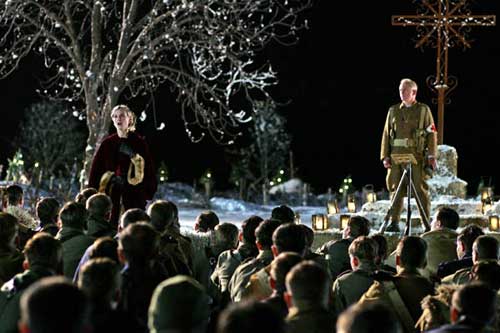
Joyeux Noel Christmas Eve

Likewise I expect that I will do my best to speak truth to those in power and those whose faithfulness is more a product of their comfort with the God that they create in their own mind rather than the Crucified God wise death on the Cross s a scandal. For many Christians the scandal of the cross is too easy to avoid by surrounding ourselves with pet theologies that appeal to our pride, prejudice and power. The kind of malevolent power represented by the bishop in Joyeux Noel. Thus I take a measure of comfort in the words of Simone Weil who said “He who has not God in himself cannot feel His absence.” 

Thus, like Paul Tillich I have come to believe that “Sometimes I think it is my mission to bring faith to the faithless, and doubt to the faithful.”  In other words to become a complete pain in the ass until the day that I die.

Praying for Peace this Christmas,

Padre Steve+

1 Comment

Filed under christian life, faith, film, History, Military, PTSD, Tour in Iraq, world war one

A Good Day to Speak Truth to Power and to be Listened to

IMG_1915

I have been writing about my recent experiences in trying to get help for my own issues dealing with PTSD as well as my frustration with a military mental health system that is, at least in my view, floundering.

That effort over the past month or so has been quite painful, at times humiliating and dehumanizing, and frankly driven me into a depressed and nearly suicidal fog, from which I am slowly emerging.

Today was a good day. Not just for me but maybe for all of those seeking help at our local Naval Medical Center. Instead of being blown off and shunted aside by providers as well as mid and high level administrators I was able to have a long, nearly forty-five minute phone conversation with the Admiral who commands that facility as well as every Naval Medical facility on the East Coast and Europe, with the exception of the Bethesda-Walter Reed complex in Washington DC. Bottom line up front; it was a very good and positive experience for me that I believe will help others get better care.

I have to say up front that I was terrified about asking to talk to him. One of the people on his staff told me that “it would not be a good thing for me to talk to him.” When I heard that comment my heart sank. I didn’t know what to do, I was perplexed because most commanders of Medical facilities in the Navy that I have worked for actually did want to hear about negative experiences of the people that are their customers, most because they care, but if nothing else because they want to make sure that they pass the Joint Commission accreditation that their facilities get every few years. So I wondered if the Admiral actually knew what was going on, at least in regard to the Mental Health Department and the experiences of people like me.

My last Command Master Chief, who read some of my very angry posts on a social media site suggested that I call my former Commanding Officer, a man who helped me a lot, cared about me and who is soon to become an admiral. I finally worked up the courage to call him, not out of fear, but because I felt like I might be bothering him, and would not be worth his time. I left his command a year ago and frankly I thought why should someone moving up in an organization be bothered by the problems of a former subordinate.

However, he was both concerned and helpful. He did not just listen but he took action by contacting the Admiral here. He told him that he knew me and that he knew that it was my desire to make sure that people get the help and care that they need, that I wasn’t just complaining or seeking special treatment.

Yesterday the admiral called me, of course my phone went directly to voice mail so I missed the call, but his message, and the tone of his voice conveyed a sense of care and concern. I called back and got his voice mail. So this morning I called again and was able to share my heart, in a very respectful way with him. He listened and seemed to be attempting to formulate some kind of positive response that would actually help people. He wants to get answers and he told me that he wanted those that come to that facility to be treated as he would want his grandparents treated.

As I said we talked for forty-five minutes and he listened. I have no doubt, within the very real fiscal constraints faced with current budget cuts and the still looming threat of sequester that he will do his best to improve and change the system that is within his control. He also did something that I have never experienced before from a superior officer, he called me “sir” a number of times. I am not used to that and I don’t think that I have ever in all of my reading of military history recall an Admiral or General calling a subordinate “sir.” I was blown away.

That system appears to be undermanned, under-budgeted and overwhelmed. It is struggling and as it struggles, as it reacts to criticism from the media, politicians and advocacy groups, it resorts to protecting itself as any bureaucracy does in such a situation. The Admiral realized this and he encouraged me to call him again on his office number if I see things that he can help. That was very encouraging. I don’t think that I will have to ask him to intervene on my part, but I have an open door to use this relationship to help others.

All that being said, most people do not have the connections that I have in the system, nor are they willing to take the risks to rock the boat. The stigma is great and personal risk can be or at least seem too great to make the effort, so most people just give up. After all the bureaucracy can be unbending and even vindictive in the way that it rebuffs those that try to raise issues. They resist change and try to keep bad news from enquiring superiors. Bureaucracies and those who faithfully serve them do just that. It is part of who and what they are; be they military, other government, business or ecclesiastical organizations. Admiral Alfred Thayer Mahan wrote:

“It [the bureaucracy] tends to overvalue the orderly routine and observance of the system by which it receives information, transmits orders, checks expenditures, files returns, keeps the Service the touch of paper; in short, the organization has been created for facilitating its own labors.”

However, when I first collapsed after Iraq, I decided that I could not be silent and have “sky-lined” myself which probably will not help me get promoted, not that care anymore. I am sure that being so public about my struggles with PTSD, Moral Injury and even my crisis of faith, which left me an agnostic for a couple of years, while serving as a Chaplain in adult and pediatric Intensive Care Units has marginalized me in the Chaplain Corps. I don’t know that for a fact and would hope that it is not the case, but it is the feeling that I get when I deal with most Chaplains.

All of that said, the past few weeks have been some of the most difficult since my return from Iraq. I personally find no pleasure in being anxious, depressed or feeling suicidal and getting even less sleep than my chronic insomnia normally allows.

At least I was listened to, and I really did get the sense that the Admiral that I was able to have such an honest conversation with today, does really care and wants to help improve the system and change the culture.

But that is the thing. This is a systemic and cultural problem, not just in the military or the Veterans Administration, but in society as a whole. In our desire for efficiency, supposed effectiveness  measured by profits and the bottom line; we have forgotten to care about people. Sadly that is statistically verified in poll after poll by people from all parts of the political spectrum. People don’t trust the government, they don’t trust big business, they don’t trust health care systems, they don’t trust the police, they don’t trust the banking and insurance industries and they certainly don’t trust the church or religion in general. Can I get an amen?

Thank you…

But our culture has to change, we have become so materialistic and embrace the most crass forms of predatory Capitalism and Social Darwinism, even in church, that people don’t matter, especially the poor and those with no voice or power, especially those who volunteer to serve the nation and come back broken in body, mind and spirit.

Joshua Chamberlain the hero of Little Round Top at Gettysburg spoke years after the Civil War something that should be a warning to us about how we treat people. Of course Chamberlain was talking about the horror of war, but it can apply to anyone, anywhere:

“But we had with us, to keep and care for, more than five hundred bruised bodies of men–men made in the image of God, marred by the hand of man, and must we say in the name of God? And where is the reckoning for such things? And who is answerable? One might almost shrink from the sound of his own voice, which had launched into the palpitating air words of order–do we call it?–fraught with such ruin. Was it God’s command that we heard, or His forgiveness that we must forever implore?”

His question is as operable today as it was then. There has to be a reckoning somewhere for destroying peoples lives, and further traumatizing them when they seek help, otherwise there is no justice nor anything that resembles a loving God.

We have to start valuing people, regardless of their social status, their race, religion, sexual preference, disability or even their alma mater. If we don’t start caring for people as human beings, then why bother with anything else? It is either about humanity or its not. Those who are comfortable cannot turn a  blind eye thinking that these issues don’t affect them, because they will.

So in spite of being unpopular in some circles I take the personal risk to speak the truth the best and most honest way I can to anyone that will listen. I have to do it, for those that feel that they have no voice, as well as those who I have known who have lost their lives after giving up on the system. I owe it to them. It is now my mission in life and I do that I can both inside the system and outside of it to speak out for those who need it.  I guess I have become something of a liberal social activist, not that there is anything wrong with that.

I can be as persistent and irritating as Mustard Gas; I am doggedly determined to speak out for those that do not feel that they matter or have a voice; and I will stay in the fight until I can’t fight anymore. As Paul Tillich said “It is my mission to comfort the afflicted and to afflict the comfortable.”

I admit that sometimes it is like tilting at windmills, but this week, two men who have the position to influence the system took the time to listen and just maybe at least at some level things will begin to change. I am grateful tonight, maybe I will sleep well…

Peace

Padre Steve+

Leave a comment

Filed under faith, healthcare, mental health, Military, PTSD, suicide, US Navy

Where I Belong: Padre Steve and the Christmas Truce

889

Christmas 2007 COP South, Al Anbar Province Iraq

“I belong with those who are in pain, and who have lost their faith, I belong here.” Father Palmer, the Chaplain in Joyeux Noel (Merry Christmas)

Last night I again watched the film classic Joyeux Noel (Merry Christmas) which is the story of the amazing and exceptional Christmas Truce of 1914. It is a film that each time I see it that I discover something new, more powerful than the last time I viewed it.

As a Chaplain I am drawn to the actions of the British Padre who during the truce conducts a Mass for all the soldiers, British, French and German in no-man’s land, who goes about caring for the soldiers both the living and the dead.  His actions are contrasted with his Bishop who comes to relieve him of his duties and to urge on the replacement soldiers to better kill the Germans.

palmer

Father Palmer Tending the Wounded

As the Chaplain begins to provide the last Rites to a dying soldier the Bishop walks in, in full purple cassock frock coat and hat and the chaplain looks up and kisses his ring.

As the chaplain looks at his clerical superior there is a silence and the Bishop looks sternly at the priest and addresses him:

“You’re being sent back to your parish in Scotland. I’ve brought you your marching orders.”

Stunned the Priest replies: “I belong with those who are in pain, and who have lost their faith, I belong here.”

The Bishop then sternly lectures the Priest: “I am very disappointed you know. When you requested permission to accompany the recruits from your parish I personally vouched for you. But then when I heard what happened I prayed for you.”

The Priest humbly and respectfully yet with conviction responds to his superior: “I sincerely believe that our Lord Jesus Christ guided me in what was the most important Mass of my life. I tried to be true to his trust and carry his message to all, whoever they may be.”

The Bishop seems a bit taken aback but then blames the Chaplain for what will next happen to the Soldiers that he has served with in the trenches: “Those men who listened to you on Christmas Eve will very soon bitterly regret it; because in a few days time their regiment is to be disbanded by the order of His Majesty the King. Where will those poor boys end up on the front line now? And what will their families think?”

They are interrupted when a soldier walks in to let the Bishop know that the new soldiers are ready for his sermon. After acknowledging the messenger the Bishop continues: “They’re waiting for me to preach a sermon to those who are replacing those who went astray with you.” He gets ready to depart and continues: “May our Lord Jesus Christ guide your steps back to the straight and narrow path.”

The Priest looks at him and asks: “Is that truly the path of our Lord?”

The Bishop looks at the Priest and asks what I think is the most troubling question: “You’re not asking the right question. Think on this: are you really suitable to remain with us in the house of Our Lord?”

With that the Bishop leaves and goes on to preach. The words of the sermon are from a 1915 sermon preached by an Anglican Bishop in Westminster Abbey. They reflect the poisonous aspects of many religious leaders on all sides of the Great War, but also many religious leaders of various faiths even today, sadly I have to say Christian leaders are among the worst when it comes to inciting violence against those that they perceive as enemies of the Church, their nation or in some cases their political faction within a country.

bishop

The Bishop Leads His “Service” 

http://www.youtube.com/watch?v=fMPxjUE40iw

“Christ our Lord said, “Think not that I come to bring peace on earth. I come not to bring peace, but a sword.” The Gospel according to St. Matthew. Well, my brethren, the sword of the Lord is in your hands. You are the very defenders of civilization itself. The forces of good against the forces of evil. For this war is indeed a crusade! A holy war to save the freedom of the world. In truth I tell you: the Germans do not act like us, neither do they think like us, for they are not, like us, children of God. Are those who shell cities populated only by civilians the children of God? Are those who advanced armed hiding behind women and children the children of God? With God’s help, you must kill the Germans, good or bad, young or old. Kill every one of them so that it won’t have to be done again.”

The sermon is chilling and had it not been edited by the director would have contained the remark actually said by the real Bishop that the Germans “crucified babies on Christmas.”  Of course that was typical of the propaganda of the time and similar to things that religious leaders of all faiths use to demonize their opponents and stir up violence in the name of their God.

When the Bishop leaves the Priest finishes his ministration to the wounded while listening to the words of the Bishop who is preaching not far away in the trenches. He meditates upon his simple cross, takes it off, kisses it hand hangs it upon a tripod where a container of water hangs.

The scene is chilling for a number of reasons. First is the obvious, the actions of a religious leader to denigrate the efforts of some to bring the Gospel of Peace into the abyss of Hell of earth and then to incite others to violence dehumanizing the enemy forces. The second and possibly even more troubling is to suggest that those who do not support dehumanizing and exterminating the enemy are not suitable to remain in the house of the Lord. Since I have had people, some in person and others on social media say similar things to what the Bishop asks Palmer the scene hits close to home.

iraq bedouin

Christmas Eve 2007 with the Bedouin 

When I left Iraq in February 2008 I felt that I was abandoning those committed to my spiritual care, but my time was up. Because of it I missed going with some of my advisors to Basra with the 1st Iraqi Division to retake that city from insurgents. It was only a bit over a month after I had celebrated what I consider to be my most important Masses of my life at COP South and COP North on December 23rd as well as Christmas Eve and Christmas Day. When I left the new incoming senior Chaplain refused to take my replacement leaving our advisors without dedicated support. He then slandered me behind my back because what I was doing was not how he would do things and because I and my relief were under someone else’s operational control. It is funny how word gets back to you when people talk behind your back. Thankfully he is now retired from the Navy and I feel for any ministers of his denomination under his “spiritual” care.  So I cannot forget those days and every time I think about them, especially around Christmas I am somewhat melancholy and why I can relate so much to Father Palmer in the movie.

It has been six years since those Christmas Masses and they still feel like yesterday. In the intervening years my life has been different. Severe and Chronic PTSD, depression, anxiety and insomnia were coupled with a two year period where due to my struggles I lost faith, was for all practical purposes an agnostic. I felt abandoned by God, my former church and most other Chaplains. It was like being radioactive, there was and is a stigma for Chaplains that admits to PTSD and go through a faith crisis, especially from other Chaplains and Clergy.  It was just before Christmas in late 2009 that faith began to return in what I call my Christmas Miracle. But be sure, let no one tell you differently, no Soldier, Sailor, Marine or Airman who has suffered the trauma of war and admitted to PTSD does not feel the stigma that goes with it, and sadly, despite the best efforts of many there is a stigma.

Now that faith is different and I have become much more skeptical of the motivations of religious leaders, especially those that demonize and dehumanize those that do not believe like them or fully support their cause or agenda. Unfortunately there are far too many men and women who will use religion to do that, far too many.  

As for me I am in a better place now. I still suffer some of the effects of the PTSD, especially the insomnia, nightmares and anxiety in crowded places and bad traffic, but I do believe again. Like the Priest in the movie I know that my place is with those who are “in pain, and who have lost their faith.” Like Paul Tillich I have come to believe that “Sometimes I think it is my mission to bring faith to the faithless, and doubt to the faithful.” 

Praying for Peace this Christmas,

Padre Steve+

6 Comments

Filed under faith, film, History, Military, ministry, Pastoral Care, PTSD, Religion, Tour in Iraq

Bringing Faith to the Faithless and Doubt to the Faithful

400236_10151328400862059_541742014_n

I like hard questions and hard cases. My life has been quite interesting and that includes my faith journey as a Christian and human being. It is funny that in my life I have as I have grown older begun to appreciate those that do not believe and to rather distrust those who proclaim their religious faith with absolute certitude, especially when hard questions are asked.  Paul Tillich once said “Sometimes I think it is my mission to bring faith to the faithless, and doubt to the faithful.” 

I think that the quote by the late theologian is quite appropriate to me and the ministry that I find myself. I think it is a ministry pattern quite similar to Jesus in his dealings with the people during his earthly incarnate ministry. He was always hanging out with the outcasts, whether they be Jewish tax collectors collaborating with the Romans, lepers and other “unclean” types, Gentiles including the hated Roman occupiers, Samaritans and most dangerously and scandalously women. He seemed to reach out to these outcasts while often going out of his way to upset the religious establishment and the “true believers” of his day. He was actually quite successful at this, so successful that his enemies made sure that they had him killed.

I think that what has brought me to this point is a combination of things but most importantly what happened to me in and after my tour in Iraq. Before I went to Iraq I was certain of about everything that I believed and was quite good at what we theologians and pastors call “apologetics.” My old Chaplain Assistant in the Army, who now recently serves as a Chaplain and was recently selected for promotion to Lieutenant Colonel called me a “Catholic Rush Limbaugh” back in 1997 and he meant it quite affectionately.  I was so good at it that I was silenced by a former Archbishop in my former church and banned from publishing for about 7 years. The funny thing is that he, and a number of my closest friends from that denomination are either Roman Catholic priests or priests in the Anglican Ordinariate which came into communion with Rome a couple of years back. Ironically while being “too Catholic” was the reason I was forbidden to write it was because I questioned certain traditions and beliefs of the Church including that I believed that there was a role for women in the ordained ministry, that gays and lesbians could be “saved” and that not all Moslems were bad that got me thrown out in 2010.

However when I returned from Iraq in the midst of a full blown emotional, spiritual and physical collapse from PTSD that certitude disappeared. It took a while before I was able to rediscover faith and life and when I did it wasn’t the same. There was much more mystery to faith as well as reason. I came out of that period with much more empathy for those that either struggle with or reject faith. Thus I tend to hang out at bars and ball games more than church activities or socials, which I find absolutely tedious. I also have little use for clergy than in dysfunctional and broken systems that are rapidly being left behind. I am not speaking about belief here, but rather structure and methodology.

I think that if there is anything that God will judge the American versions of the Christian church is our absolute need for temporal power in the political, economic and social realms and the propagation of religious empires that only enrich the clergy which doing nothing for the least, the lost and the lonely. The fact that the fastest growing religious identification in the United States is is “none” or “no preference” is proof of that and that the vast amounts of money needed to sustain these narcissistic religious empires, the mega-churches and “Christian” television industry will be their undoing.  That along with their lack of care for anyone but themselves. Jesus said that his disciples would be known by their love for one another, not the size of their religious empire or temporal power.

The interesting thing is that today I have friends and colleagues that span the theological spectrum. Many of these men even if they do not agree with what I believe trust me to love and care for them, even when those most like them in terms of belief or doctrine, both religious and political treat them like crap. Likewise I attract a lot of people who at one time were either in ministry or preparing for it who were wounded in the process and gave up, even to the point of doubting God’s love and even existence. It is kind of a nice feeling to be there for people because they do not have to agree with me for me to be there for them.

In my darkest times my only spiritual readings were Father Andrew Greeley’s Bishop Blackie Ryan mysteries which I began reading in Iraq to help me get through the nights in between missions in Iraq and through the nights when I returned from them.  In one of those books, the last of the series entitled “The Archbishop goes to Andalusia” the miscreant Auxiliary Bishop to the Cardinal Archbishop of Chicago goes to Seville Spain.  In the novel Bishop Blackie makes a comment after celebrating Mass in the cathedral at Seville. He said “Every sacramental encounter is an evangelical occasion. A smile warm and happy is sufficient. If people return to the pews with a smile, it’s been a good day for them. If the priest smiles after the exchanges of grace, it may be the only good experience of the week.”  (The Archbishop in Andalusia p.77)

That is something that I try to do now on a regular basis. Sure most of my sacramental encounters as a hospital chaplain do not occur during the liturgy, but often in the life and death moments and times of deep discouragement felt by the wounded, ill and injured. In that ministry I have found that there are many hurting people, people who like me question their faith and even long held beliefs.

On my way home from taking my little dog Molly home from a visit to the vet this afternoon I heard the old song by Nazareth called Love Hurts. The song always gets me. It is one of those “real” songs from the 1960s and 1970s that nails how life can be sometimes.

Love hurts, love scars
Love wounds and mars
In any heart not tough
Nor strong enough
To take a lot of pain
And love is like a cloud
Holds a lot of rain
Love hurts

I’m young and I know
But even so, I know a thing or two
I have learned from you
I’ve really learned a lot
And love is like a stove
Burns you when it’s hot
Love hurts

Some fools rave of happiness
Of blissfulness, togetherness
Some fools fool themselves, I guess
But they’re not fooling me
I know it isn’t true
Love is just a lie
Made to make you blue
Love hurts

In 1977 a Christian singer, Erick Nelson included that song on an album called The Misfit and used it to lead into another song of his called He Gave Me Love. The album which he did as a duet with a lady named Michelle Pillar was always and still is one of my favorite albums. It was and still is one of the few works of “contemporary Christian music” to really deal with the hard questions of faith, including hurt, doubt and betrayal and the cost of following Jesus with any measure of authenticity. The song, the lyrics of which I include here are quite remarkable, because they talk about those themes.

When I was down, they wouldn’t stay
When I was hurt, they turned away
But Jesus called me and I must obey
He gave me love

You see, His friends all let Him down
And when He healed everyone around
All He got was a thorny crown
Because of love

Because of love for you
Because of life and truth
Because of love for you
Come take his love

Sometimes they laugh and are unkind
And others smile and say I’ve lost my mind
But all I know is what I find
And I find, He gave me love…

Love does hurt, and well deciding to love can bring a lot of pain, but I do think that it is worth it. Well, that is all for tonight. Until tomorrow.

Blessings and Peace

Padre Steve+

Love Hurts lyrics © Kobalt Music Publishing Ltd., Warner/Chappell Music, Inc., EMI Music Publishing, Sony/ATV Music Publishing LLC, HOUSE OF BRYANT PUBLICATIONS

HE GAVE ME LOVE Words and Music by Erick Nelson 1977 Maranatha! Music All rights reserved.

3 Comments

Filed under christian life, faith, Pastoral Care, philosophy, PTSD, Religion

The Tsaraev Brothers and the Danger of Faith Without Love

barmherzigkeit

“The separation of faith and love is always a consequence of a deterioration of religion.”  Paul Tillich 

There are many who claim faith of every type, be it religious, political, economic or scientific who have nothing but hatred in their hearts for others.

This was again made manifest this past week in the actions of the brothers Tsaraev in their orgy of violence inflicted on the people of Boston. Their crimes were committed in the name of Islam, as are many like them. However, such actions be they in the name of Allah, Yahweh, Jesus or any other deity show the intrinsic falseness and evil of such “faith” no matter how orthodox it may be.

The Apostle Paul wrote to the Corinthians “If I speak in the tongues of mortals and of angels, but do not have love, I am a noisy gong or a clanging cymbal. And if I have prophetic powers, and understand all mysteries and all knowledge, and if I have all faith, so as to remove mountains, but do not have love, I am nothing.”

Faith can be a powerful thing, for good or for evil. However when that faith is separated from love it is no longer of God, or even human. I do think that the apostle was absolutely right when he noted that if I have all faith, so as to remove mountains, but do not have love, I am nothing.

Love is actually the key and love of God is always connected to love of neighbor, practical, observable and tangible love, not mere words. G.K. Chesterton said it well in this. “To love means loving the unlovable. To forgive means pardoning the unpardonable. Faith means believing the unbelievable. Hope means hoping when everything seems hopeless.”

However to the “true believers” of so many religions, political, social and scientific orthodoxies, the two sometimes seem inexorably linked by the often fanatical actions of their most devout adherents being more concerned with power than love. The sad thing is that I don’t think that any of us are completely immune to such behavior and attitudes and probably all of us have a at least a little potential to be terrorists given the right circumstances.

When I read some blogs and websites written by some people that can be best described as “true believers” I am amazed at the violence of the words as well as the hatred and derision for others that do not believe like them that are contained. The fact that those are not occasional slips, errors of judgement on bad days like all of us are capable of making and do make all the time.

If that was the case it would not be that much of an issue. However, the authors of the majority many of these site are consumed with hatred toward others as a means of “defending” their beliefs. Some advocate violence in doing that, unencumbered by any doubts in their beliefs no matter what “orthodoxy” they believe in. Eric Hoffer wrote “Passionate hatred can give meaning and purpose to an empty life. Thus people haunted by the purposelessness of their lives try to find a new content not only by dedicating themselves to a holy cause but also by nursing a fanatical grievance.”

I think this is exactly what motivates men like the Tsaraev brothers to kill the innocent and which lurks in those that preach hatred in the name of their god or whatever belief system is the functional equivalent of a god for them. The only difference is that most have not crossed the physical boundary from “nursing a fanatical grievance” and advocating violence to actually killing. Somehow I think that once that seed is planted, and cultivated that it sometimes takes on a life of its own.

The apostle was right: “If I have not love….” 

Peace


Padre Steve+

Leave a comment

Filed under christian life, faith, News and current events, philosophy, Religion

Faith and Doubt

270107_10151361199622059_1286921284_n-1

Those who believe that they believe in God, but without passion in their hearts, without anguish in mind, without uncertainty, without an element of despair even in thie consolation, believe only in the God idea, not God himself.” Miguel de Unanumo

The idea of God, any God is a wonderful idea. In fact when I read about the numbers of people in the United States who when polled say they they “believe in God,” or “believe the Bible” or claim to be Christian when answering poll questions I am always amazed. I say this because I am beginning to believe that what is being affirmed is not a belief in God, which presupposes all of the problems inherent in any real relationship.

If we truly believe in a personal God, or to use the Evangelical terminology to have a “personal relationship with Jesus,” such relationship cannot be reduced to mere intellectual assent or even fervent belief in impersonal dogma or fanatical orthodoxy.

Relationships are inherently messy. They involve risk and vulnerability and they evolve over time. That includes the relationship of the believer to God. The Christian and Jewish scriptures are full of the accounts of people, reckoned according to the various authors of scripture to be been found faithful or righteous by God. Doubts, faith, disappointment and anguish are shown to go both ways in the relationship of God to his people, individually and collectively. The Bible is actually quite an earthy book when it comes to these relationships. Abraham, Sarah, Jacob, Joseph, Jeremiah, Job, David, Peter, Paul and so many others and even God himself according to Scripture are shown to deal with disappointment, doubt and anguish in their relationships with one another.

Likewise there are numerous instances in the Old Testament of God’s stated disappointment and anger with his people, and even regret for delivering them from Egypt and other oppressors. The fact that Moses more than once has to talk God out of destroying the Israelites in the wilderness is evidence enough. But add to this the various times of national apostasy where God is claimed to have given Israel over to her enemies as punishment for rejecting him. Then consider the story of the prophet Hosea who is told to marry a harlot as a symbol of how God feels about his people and you get the point. If we as Christians believe our own Scriptures it is apparent that they record an often volatile relationship between God and his people. They record the story of a God who doubts and often regrets his own choices. I don’t think that I have heard anyone preach on that lately. Maybe God is admitting in this that he too makes mistakes and has doubts but in the end his love and grace prevail over his anger and wrath. I think that should give us some hope and consolation.

Some of the great Christian writers and thinkers echo this. Fyodor Dostoyevsky wrote “It is not as a child that I believe and confess Jesus Christ. My hosanna is born of a furnace of doubt.” Paul Tillich correctly noted that “doubt is not the opposite of faith; it is an element of faith.” I think that it is a pity that so many Christians as well as other religious people regard doubt as a sin, weakness or failing, when in fact the entire narrative of God’s people found in the Bible testifies that it is both normal and quite often an element of faith’s triumph.

This has been the case in my own life. I can safely say in my life that when I was a younger Priest and more cocksure about things I would write often fiery polemics mostly condemning the errors of others. I had studied scripture, the Church Fathers, knew the Creeds and Councils, historical and systematic theology, philosophy and was well schooled in history, including Church History. I was even published in a very conservative Roman Catholic journal, the New Oxford Review. I wrote with a bombastic certitude and since the church that I had been ordained in was going through its own theological conflicts, conflicts which eventually tore that church apart, I was willing to turn my guns on others in the church in defense of the institution.

When I eventually went through my own crisis of faith resulting from my time in Iraq and struggle with PTSD I found that the certitude with which I could enunciate my faith was not enough. As I went through that valley of dark despair in which I could safely say that I wasn’t even sure of the existence of God for nearly two years, years where working as a critical care chaplain in ICUs and dealt with death every day I had to re-discover faith. In my sea of doubt I had to be present with other people, all walking through their own “valley of the shadow of death.”

It was in that time that faith returned and when it did it was not the bombastic faith of one who fervently believed the dogmas of the faith but as one who had experienced the grace of God in that dark valley. Looking back I can see the wisdom of God to allow me this experience. I believe that my previous faith, the faith of a man consumed with such certainty that I felt compelled to attack or counterattack those that did not believe correctly was a compensation for my own doubts. I think that Reinhold Niebuhr made an accurate assessment of that kind of faith when he wrote that frantic orthodoxy is never rooted in faith but doubt.”

I have come to believe that faith is incomplete unless there is a corresponding doubt, because absolute faith is not really faith at all because it can only be faith in an idea, not in a relationship. In fact the late American Existential Psychologist Rollo May noted that the “relationship between commitment and doubt is by no means an antagonistic one. Commitment is healthiest when it is not without doubt, but in spite of doubt. Relationships be they with people or the Divine are dynamic or they are dead. There is a give an take in any relationship. The accounts in the Christian and Jewish scriptures attest to this time after time.

As I wrote in my previous essay Belief and Unbeliefthat some people substitute an absolute belief in an ‘orthodoxy’ of some movement…and cling to it with unbridled fanaticism,” as a substitute for their lack of belief in either themselves or the God that they cannot see. While this is seen most often among religious people non-believers as well can become fanatical in their commitment to other “orthodoxies” especially political and economic theories that they believe will usher in a new order. Communism, Fascism, Socialism and Capitalism are examples of such ideologies which when embraced with the fervor and certitude of a religious movement rapidly become intolerant of dissent and persecute those who disagree.

Doubt and faith. Belief and unbelief. Eric Hoffer wrote that it is startling to realize how much unbelief is necessary to make belief possible.” I think that is equally amazing how much doubt is necessary to make real faith possible.

Peace

Padre Steve+

1 Comment

Filed under christian life, faith, philosophy