Friends of Padre Steve’s World
For those that have followed my writing for some time you know that I teach military history and ethics at the Joint Forces Staff College. One of the great joys that I have is leading the Gettysburg Staff Ride, which is an optional event for students that want to participate. When I took the position here I took some of my older writings on Gettysburg and put them into a student study guide and text. That was two years ago. Then the text was about 70 pages long. It is now about 925 pages long and eventually I hope to get it published. When and if that happens I expect it to become two, and possibly three books.
This is the fifth of a series of articles that I will be posting potions of a chapter that I have rewritten about the critical battles on the south side of the battlefield on July 2nd 1863, the battle for Devil’s Den, the Wheatfield, the Peach Orchard, and the final repulse on Cemetery Ridge.
As you read this don’t just look at the events, but look at the people, and their reaction to the what they encountered on the battlefield, for that understanding of people is where we come to understand history.
So even if you are not a Civil War buff, or even a history buff, take the time to look at the people, their actions, and the things that made them who they were, and influenced what they did. History is about people.
So please enjoy,
Peace
Padre Steve+
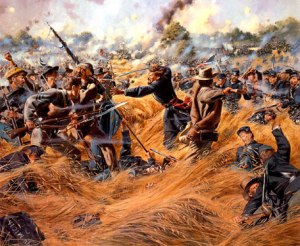
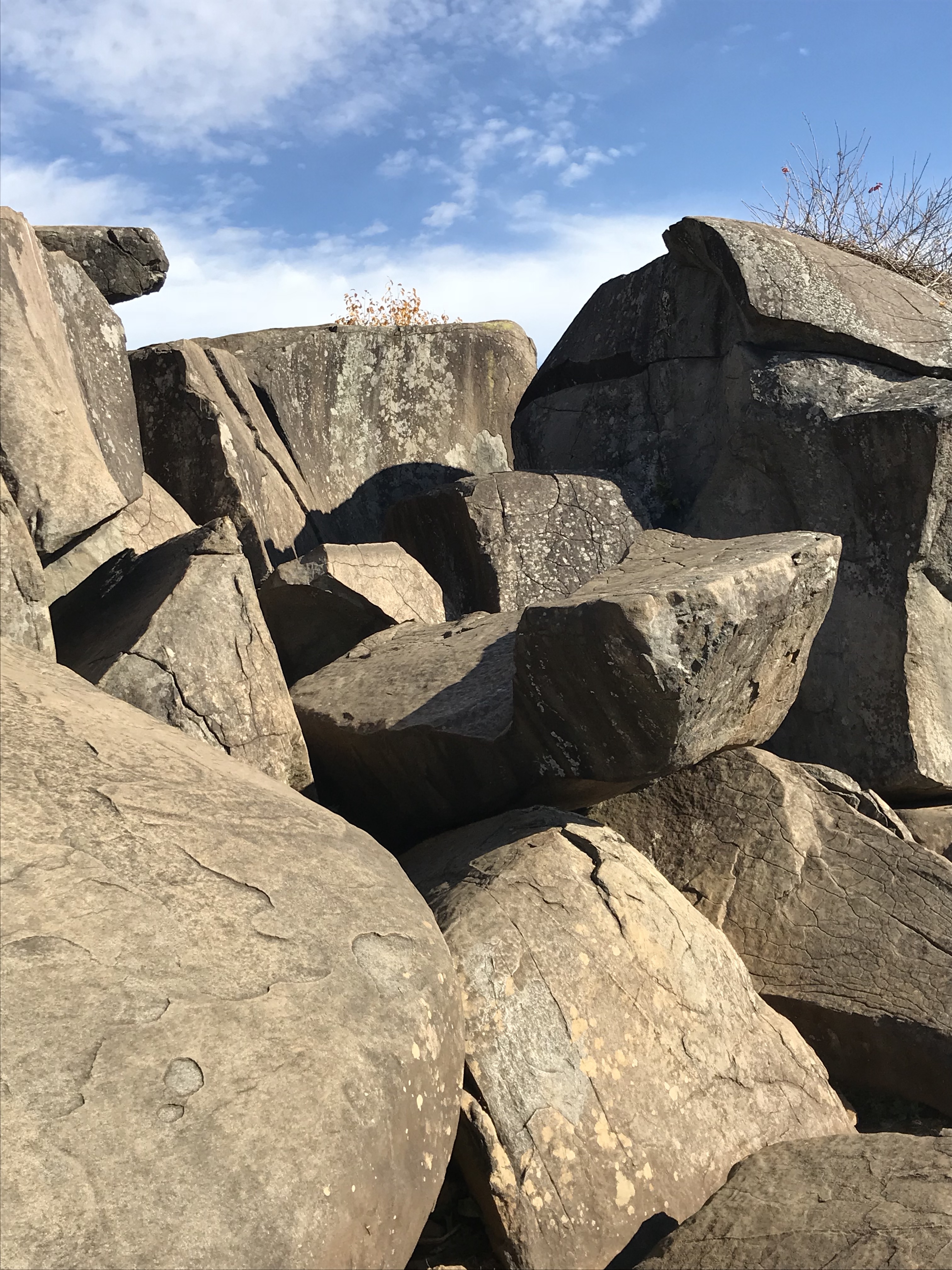
To the left of Benning, “Tige” Anderson’s brigade and two of Robertson’s orphaned regiments assaulted the remaining elements of Hobart Ward’s brigade along the western section of Houck’s Ridge and Rose’s Woods. Ward had been assigned by his division commander, David Birney to defend the left flank of Sickles over-extended line. To do so he had already placed the men of the 124th New York and the 4th Maine on his left, while those remaining took position on Houck’s Ridge and in Rose’s Woods. Like the other units of Third Corps, these troops were all veterans led by veteran officers and they would not give ground without a fight. However, Ward’s troops had not taken the time to erecting any hasty fortifications or breastworks, as one “veteran remembered it, “we had not yet learned the inestimable value of breastworks, and instead of spending time rolling the loose stones into a bullet-proof line, we lounged about on the grass and rocks.” [1] But when the Confederate assault began, these men took advantage of the nature terrain features which made it formidable even without such efforts.
As the Confederates moved against Ward’s troops on the ridge and in Rose’s Woods their left flank made contact with the adjoining brigade of Regis de Trobriand, the leftmost regiment of which, the 17th Maine was posted at the southwest corner of the Wheatfield. As the Union infantry regiments braced for the attack, the Confederate formations were shredded by the shells of the Federal artillery which crashed upon them. “I could hear bones crash like glass in a hail storm,” asserted a Georgian. Colonel Dudley M. DuBose of the 15th Georgia avowed, “I never saw troops move on more steadily & in better order than these did on that occasion.” [2] Despite the carnage the Georgians continued on, and when they got within seventy-five yards of the 17th Maine opened a blistering fire which “slowed Anderson’s brigade’s assault but certainly did not stop it.” [3] Lieutenant Colonel Charles Merrill of the 17th Maine wrote:
“We opened fire on the enemy, then within 100 yards of us. The contest became very severe, the enemy at times being driven back by our line, then by superior numbers compelling us in turn to give way. The ground was hotly contested, but we held our position till, finding the right of my regiment outflanked and exposed to murderous fire from the enemy’s reinforcements, I was obliged to form a new line, changing the right wing of the regiment into position at a right angle to the left. This movement was executed in good order, under a heavy fire from the advancing foe. In this position we continued to fight, checking the enemy till, receiving orders to retire, we fell back across a wheat-field in our rear to the edge of the woods.” [4]
Anderson’s Confederates continued their attack and as they advanced Anderson was wounded and Colonel W.W. White took command, and while the Georgians had succeeded in taking some ground and inflicted heavy casualties on the Federal troops, the brigade was spent. Attesting to the severity of the fight Colonel White wrote, “From the exhausted condition of the men, together with the fact that the enemy were pouring in large re-enforcements on the right, it was deemed impractical to follow him further… The brigade retired in good order across the ravine, and went into bivouac for the night…. The loss of the brigade was heavy…. 105 killed, 512 wounded, and 146 missing.” [5]
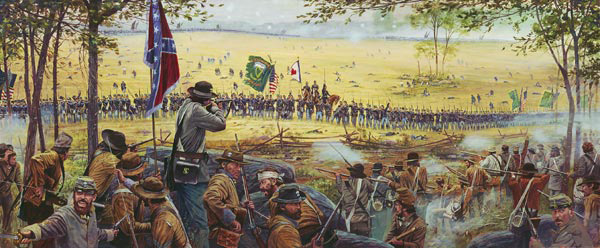
The fight in Rose’s Woods and the Wheatfield between Birney’s division and the men of Benning and Anderson’s brigades drew in other units and McLaws’ division entered the fight and the men of Caldwell’s division of the Federal Fifth Corps entered the battle. Initially, the Union infantry was outnumbered but it had the support of the artillery that Henry Hunt had rushed into the fight. The brigades to the right of the woods on the rocky hill commanded by Tilton and Sweitzer were rapidly becoming isolated as the Confederates advanced to their rear and Kershaw’s South Carolina brigade “appeared through the smoke” like a malevolent fury, “moving with shout, shriek, curse, and yell…loading and firing with deliberation as they advanced, begrimed and dirty-looking fellows in all sorts of garb, some without hats, some without coats, none apparently in the real dress or uniform of a soldier.” [6]
Joseph Kershaw was one of the few Confederate commanders without a legacy to protect to write in detail about the battle in the Wheatfield. Kershaw was a lawyer and politician who had served in the Mexican-American War with the Palmetto Regiment. After the war he went back to civilian life and served as a member of the South Carolina State Senate. When South Carolina seceded from the Union, Kershaw volunteered for service and was made Colonel of the 2nd South Carolina Volunteer Infantry which he commanded at Fort Sumter, Bull Run, and on the Peninsula. “Natural leadership and applied intelligence had advanced him to brigades command, and he was tabbed for future material for division command.” [7] As a brigade commander he distinguished himself during the Seven days, Second Bull, Run, Antietam, and Fredericksburg. Kershaw was an natural leader and displayed an ability for “quick and rational decisions, and he never endangered his men rashly” [8] His division commander, Lafayette McLaws had a tremendous amount of trust and respect for his subordinate. “Pious, intelligent, a clear blond of high bred, clean-cut features, he had the bearing of command and a clear voice that seemed to inspire courage when it was raised in battle.” [9] Kershaw was “probably the most popular brigade commander in the entire Army of Northern Virginia. His South Carolinians – the 2,100 men of the 2nd, 3rd, 7th, 8th, and 15th South Carolina, along with the seven companies that made up the 3rd South Carolina Battalion – adored him as “a very fine man and good officer” who is liked by everyone.” Actually, this forty-one-year-old lawyer from Camden…was a chronic depressive, unhappily married, and “intensely lonely” [10] That did not diminish the love of his men for him, and His brigade had been the lead unit of the First Corps’ disastrous movement to contact that afternoon, and he had watched the contra-temps between Longstreet’s and McLaws during the march and counter-march that morning and afternoon, and upon the discovery of Sickles’ troops in the Peach Orchard. His brigade, a unit of battle-hardened veterans may not have looked like soldiers due to the wear and tear of constant campaigning and the lack of new uniforms or equipment but they were among the toughest and most disciplined brigades on either side.
Kershaw’s brigade as well as the Georgia brigade of Brigadier General Paul Semmes, the brother of Rafael Semmes, the Captain of the raider CSS Alabama, formed the right flank of Lafayette McLaws’ attack on the Peach Orchard and the Wheatfield. Kershaw understood from his discussions with McLaws and Longstreet that his attack was supposed to be coordinated with that of Hood’s division on his right, which was “sweep down the Federal line in a direction perpendicular to our line of battle.” [11] and with Barksdale’s brigade on his left. However, as his troops prepared to jump off to start their attack Kershaw “got his first unpleasant surprise when he observed Hood’s brigades moving “independently against Round Top,” a departure from the plan that meant they would not “directly participate in the joint attack.” [12] Without Hood’s support on his right Kershaw was now completely dependent on Barksdale’s brigade on his left to hit the Peach Orchard to protect his left flank from the massed Federal artillery on that height.
When Kershaw received word to advance his troops moved off followed by Semmes’ brigade while Longstreet accompanied the brigade until it reached the Emmitsburg Road. Kershaw made a tactical decision which made sense but which had a major impact on his attack. “All field and staff officers were dismounted on account of the many obstacles in the way.” [13] Kershaw chose to move with his right regiments and being dismounted this diminished his ability to see what was going on with his left, and limited his ability to provide command and control. This was not a mistake, it was a sound tactical move due to the terrain and the exposure of mounted officers to sharpshooters and artillery directed specifically at them.
As Kershaw’s men advanced he looked for Barksdale’s brigade, and only then “heard Barksdale’s drums beat the assembly, and I knew then that I should have no immediate support on my left, about to be squarely presented to the heavy force of infantry and artillery at and in the rear of the Peach Orchard.” [14] Without Barksdale on his flank Kershaw was forced to improvise, he divided his regiments with “two going straight toward the stony hill, he sent two to their left to take the Union batteries in the back of the peach orchard.” [15] Porter Alexander, commanding Longstreet’s artillery noted that “Barksdale’s delay “ was especially unfortunate in this case, because advancing Kershaw without advancing Barksdale would expose Kershaw to enfilade by troops who Barksdale would easily drive off. Few battlefields can furnish examples of worse tactics.” [16]
Up to the point of crossing the Emmitsburg Road, Kershaw’s regiments had a relatively easy advance, but as Kershaw feared, they were hit from the front and flank by rifle fire, and by artillery fire. “We saw plainly that their artillerists were loading their guns to meet our assault, while their mounted officers went dashing wildly from gun to gun, to be sure that all were ready,” recalled one soldier of the 2nd South Carolina, and when they opened fire, “every Federal cannon let fly at us” with solid shot and canister.” [17] The effect on Kershaw’s troops was devastating. Scores of his troops were cut down as they advanced, even so they continued to move forward. Private William Shumate of the 2nd South Carolina described the effect of the massed Union artillery fire on Kershaw’s troops. “Kershaw’s brigade moved…in perfect order and with the precision of brigade drill, while upon my right and left comrades were stricken down by grape and canister which went crashing through our ranks. It did not seem to me that none could escape.” [18] Kershaw’s left regiments were now approaching the Federal artillery and Kershaw had lost contact with them. As they approached the Union guns, those batteries ceased fire and prepared to withdraw.
Victory seemed assured and then the unthinkable happened, as it so often does in the confusion of battle and the fog of war; an order was issued by an unknown officer to change the direction of the attack. Evidently someone misunderstood “Kershaw’s orders or his intent and with this false order aborted the attack.” [19] The change of direction resulted in those regiments making a right flank and presenting their exposed left to the Federal artillery men, who now remained their guns and opened a devastating and merciless fire into the flank of the South Carolinians. Kershaw was livid and later wrote:
“The Federals returned to their guns and opened on these doomed regiments a raking fire of grape and canister, at short distance, which proved most disastrous, and for a time destroyed their usefulness. Hundreds of the bravest and best men of Carolina fell, victims of this fatal blunder.” [20]
A Massachusetts infantryman walked the field after the charge and noted, “Masses of Kershaw’s and Wofford’s brigades had been swept from the muzzles of the guns, which had been loaded either with double-shotted, or spherical case, with fuses being cut to one second, to explode near the muzzles. They were literally blown to atoms. Corpses strewed the ground at every step. Arms, heads, legs and parts of dismembered bodies were scattered all about, and sticking among the rocks and against the trunks of trees, hair, brains, entrails, and shreds of human flesh still hung, a disgusting, sickening, heart-rending spectacle to our young minds.” [21]
While his left regiments were being manhandled by the Federal artillery due to the errant order, Kershaw’s right regiments continued their attack on troops of De Trobriand, Sweitzer, and Tilton, on the stony hill. This landmark was in the process of being cut off from the rest of the Federal army as Anderson’s troops gained control of the Wheatfield.
On the surface it seems that the three brigades should have been enough to hold the stony hill, although this is not entirely clear from contemporary accounts or from the histories published since. But, there is one overriding opinion that comes through in most of the accounts, which is that there was a problem with Federal command and control on this section of the battlefield. When the Fifth Corps units of Barnes’ division began arriving in the Third Corps section, Sickles and Birney assumed that these troops were subordinated to their command, but Meade had given contrary orders to Sykes who assumed that the changed orders “relieved his troops from “any call from the commander of the Third Corps.” [22] Whether this was Meade’s plan, Sykes’ interpretation of his orders, or Sickles’ seeking to shift some of the blame for the near disaster to someone else depends on which account one reads.
Thus when pressure began to build on the stony hill as Kershaw’s troops advanced from the front and Anderson’s worked their way to the rear, Barnes or Tilton apparently gave orders to Tilton and Sweitzer, whose “brigades had put up a brief but determined fight along their end of the stony ridge” [23] to withdraw from their position. Like the other controversies of this day this too played out in the media long after the battle was over, however, Sweitzer “clearly reported that he did not retreat until after Tilton’s brigade had fallen back, and then fell back by Barnes’ order.” [24] What appeared to have happened was that the renewed advance of Kershaw’s troops had intimidated Barnes and Tilton, and Barnes, watching the advance with anxiety “issued a precautionary order for withdraw. It seems in retrospect that caution had gone beyond prudence to pessimism.” [25] De Trobriand, who had been encouraged by the arrival of the two brigades was stunned when he saw them withdraw and wrote, “I saw these troops rise up and fall back hurriedly at the command of their officers.” [26] He realized that his position was now untenable noting, “I found myself in danger of being surrounded, and fell back out of the woods” and reforming his lines kept “the enemy at bay until the arrival of sufficient reinforcements from the Second Corps allowed us to be relieved when our ammunition was just exhausted.” [27] The end result was that Kershaw’s troops, despite the heavy casualties that they had suffered now gained the summit of the stony hill and joined forces with Anderson’s brigade. “This success, coupled with the eviction of Ward’s brigade from its position at Devil’s Den, meant that the whole left wing of Sickles’s line had been smashed and that its right wing along the Emmitsburg Road was in jeopardy.” [28]
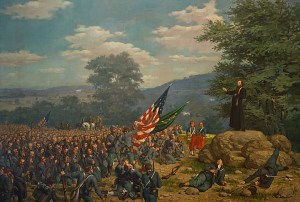
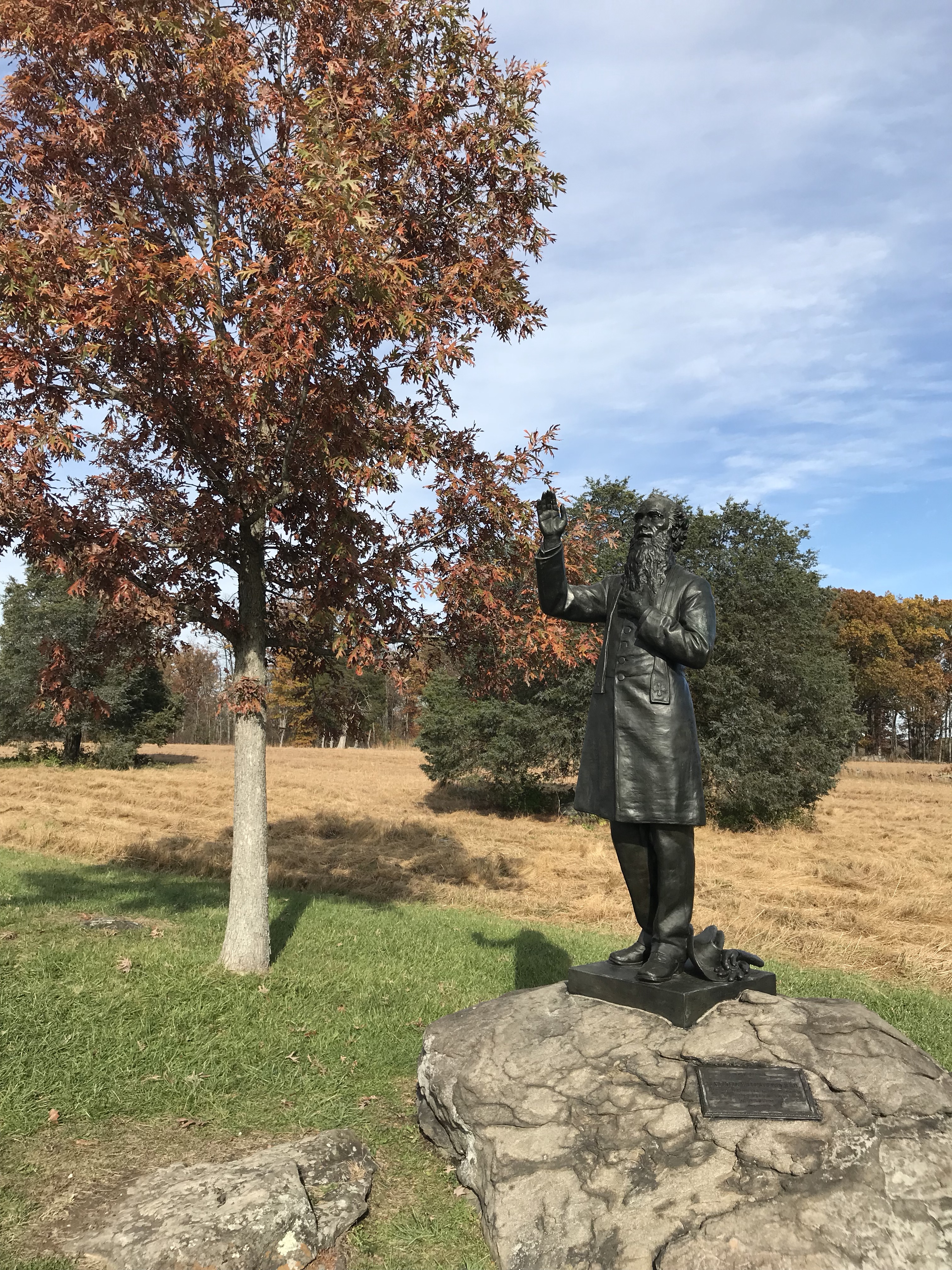
The arrival of the four brigades of John Caldwell’s division of Winfield Scott Hancock’s Second Corps occurred in a nick of time for the men along Sickles’ beleaguered line along the Wheatfield. One of these brigades was the Irish Brigade formerly commanded by Dan Sickles’ friend, and former defense attorney, Thomas Meagher, and now commanded by Colonel Patrick Kelly of the 88th New York. The Irish Brigade had been decimated in fight after fight, “now numbering only about five hundred men. Indeed, as one Irish Brigade officer noted, they “were a brigade in name only.” [29] When it became clear that the brigade was about to go into action, the brigade’s chaplain and after the war, the President of Notre Dame University, Father William Corby, realized that his duties “included the lifting the burden of sin from his flock through the act of conditional absolution.” [30] What followed was one of the most remembered events of the battle. Colonel Kelly:
“called the brigade to attention and commanded it to “Order Arms.” Father Corby stepped up on a boulder about three feet high, explained what he was about to do, and ended his remarks with the observation that the “Catholic church refuses Christian burial to the soldier who turns his back on the foe or deserts his flag.” The men of the brigade knelt, each man on his right knee, head uncovered, hat in left hand, rifle in right, and head bowed, while Chaplain Corby, raised his right hand and pronounced the Latin words of absolution.” [31]
When Father Corby pronounced the words “Dominus nos Jesus Christus vos absolvat” they were made more poignant by the sound of the guns and echoing explosions to their south. The commander of the 116th Pennsylvania noted that even General Hancock, a Protestant noted for his frequent blasphemy, was “watching from his horse, removed his hat and bowed his head. It was, as Corby later declared, an absolution for them all – Catholics and Protestants, northerners and southerners, all “who were susceptible of it who were about to appear before their judge.” [32] An observer wrote “The service was more than impressive, it was awe-inspiring.” [33]
Upon receiving his orders Caldwell moved his division forward crossing Plum Run and moving toward the Wheatfield at the double-quick. Colonel Edward Cross’s brigade was on the right. When Hancock saw him he remarked “Colonel Cross, this day will bring you a star.” Colonel Cross, looking up at Hancock, shook his head and replied gravely, “No General, this is my last battle.” [34] Cross normally wore a red bandana to allow his troops to recognize him in battle, but today he wore a black scarf on his head. As his troops advanced he called out to them, “Boys, you know what’s before you…give ’em hell.” [35] His brigade was followed by Kelly’s Irish Brigade and Brigadier General Samuel Zook’s brigade and that John Brooke. When Caldwell’s division struck it struck with fury, but was met with terrific resistance by Anderson’s men in the Wheatfield and Kershaw’s on the stony hill. Cross’s brigade was stopped before it could break through the Confederate line, with their commander being mortally wounded in the attack. Cross was hit in the abdomen and realizing his wound was mortal said “I hope that peace will be restored to our distressed country. I think that the boys will miss me. Say goodbye to all.” [36]
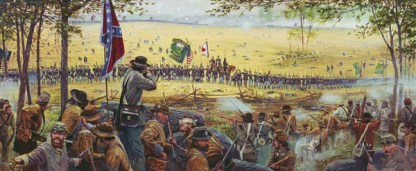
Zook’s brigade came next, taking its direction from Dan Sickles. The brigade “deployed near the Trostle farm, and advanced against Kershaw’s men on the stony hill.” [37] There they were met by withering fire, and Zook leading his men from the front was mortally wounded, his brigade suffering massive casualties even as they continued to advance and many “of the companies…came out commanded by sergeants.” [38] A survivor of the brigade remembered it, “the firing became terrific and the slaughter frightful. We were enveloped in smoke and fire, not only in our front, but on our left, and even at times on our right….Our men fired promiscuously, steadily pressing forward, but the fighting was so mixed, rebel and union lines so close together, and in some places intermingled, that a clear idea of what was going on was not readily obtainable.” [39] These stalwart men were followed by Kelly’s Irish Brigade and Brooke’s brigade, Caldwell’s last available unit, which moved through the Wheatfield and up the slope of the stony hill.
These brigades, as well as Sweitzer’s, which had been commandeered by Caldwell finally wrested control of the Wheatfield from Anderson and the stony hill from Kershaw. As the Irish advanced a South Carolina officer remarked “Isn’t that a magnificent sight.” [40] Kershaw later wrote that “the fighting was general and desperate all along the time and so continued for some time….I feared the brave men around me would be surrounded by the large force of enemy constantly increasing in numbers and all the while enveloping us. In order to avoid such a catastrophe, I ordered a retreat to the buildings at Rose’s.” [41] Major St. Clair Mulholland, commanding the 116th Pennsylvania of the Irish Brigade recalled the fight for the hill:
“Having entered a dense woods, we began to ascend a hill, where large bowlders of rocks impeded our progress, notwithstanding which we advanced in good order. We soon came within sight of the enemy, who occupied the crest of the hill, and who immediately opened fire at our approach. Our brigade returned the fire with good effect. After firing for about ten minutes, the order was given to advance, which the brigade did in excellent style, driving the enemy from their position, which we at once occupied….We found the position which our enemy had occupied but a few moments before thickly strewn with the dead and wounded.” [42]
For a time the mixed units that the Federals had committed to the fight for the Wheatfield and the stony hill, along with Sykes’s division of Regulars which had moved up to their left flank stabilized the Federal line. For a time it “appeared that the Rebel effort to overwhelm the Federal flank had failed, save for Devil’s Den. But the situation was changing quickly…”[43]. But the conduct of the battle, “in large part to Sickles, and with help from Longstreet’s execution of the attack, the situation was proving to be a bloody mess on both sides.” [44] The Federal occupation of the stony hill lasted barely twenty minutes when a new threat arose from the direction of the Peach Orchard, Caldwell’s success had placed the division in an exposed position and he had no reserves left to counter any Confederate move on his right flank.
To be continued…
Notes
[1] Ibid. Hessler Sickles at Gettysburg p.164
[2] Ibid. Wert A Glorious Army p.259
[3] Ibid. Pfanz Gettysburg, the Second Day p.247
[4] Ibid. Luvaas and Nelson Guide to the Battle of Gettysburg p.105
[5] Ibid. Luvaas and Nelson Guide to the Battle of Gettysburg p.108
[6] Ibid. Guelzo Gettysburg, the Last Invasion p.286
[7] Ibid. Dowdy Lee and His Men at Gettysburg p.197
[8] Ibid. Tagg The Generals of Gettysburg p.214
[9] Ibid. Pfanz Gettysburg, The Second Day p.151
[10] Ibid Guelzo Gettysburg, The Last Invasion p.282
[11] Ibid. Kershaw Kershaw’s Brigade at Gettysburg p.333
[12] Ibid. Trudeau Gettysburg, a Testing of Courage p.351
[13] Ibid. Kershaw Kershaw’s Brigade at Gettysburg p.334
[14] Ibid. Kershaw Kershaw’s Brigade at Gettysburg pp.334-335
[15] Ibid. Dowdy Lee and His Men at Gettysburg p.222
[16] Ibid. Hessler Sickles at Gettysburg p.181
[17] Ibid. Guelzo Gettysburg, the Last Invasion p.287
[18] Gottfried, Bradley The Artillery of Gettysburg Cumberland House Publishing, Nashville TN 2008 p.125
[19] Ibid. Sears Gettysburg p.285
[20] Ibid. Kershaw Kershaw’s Brigade at Gettysburg p.335
[21] Ibid. Gottfried The Artillery of Gettysburg p.126
[22] Ibid. Coddington The Gettysburg Campaign a Study in Command p.399
[23] Ibid. Guelzo Gettysburg, the Last Invasion p.286
[24] Ibid. Hessler Sickles at Gettysburg p.187
[25] Ibid. Pfanz Gettysburg, The Second Day p.259
[26] Ibid. Sears Gettysburg p.286
[27] Ibid. Luvaas and Nelson Guide to the Battle of Gettysburg p.114
[28] Ibid. Pfanz Gettysburg, The Second Day pp.264-265
[29] Bruce, Susannah Ural The Harp and the Flag: Irish American Volunteers and the Union Army, 1861-1865 New York University Press, New York and London 2006 p.160
[30] Ibid. Trudeau Gettysburg, a Testing of Courage p.303
[31] Ibid. Pfanz Gettysburg, The Second Day p.268
[32] Ibid. Bruce The Harp and the Flag p.165
[33] Ibid. Trudeau Gettysburg, a Testing of Courage p.303
[34] Ibid. Pfanz Gettysburg, The Second Day p.269
[35] Ibid. Guelzo Gettysburg, the Last Invasion p.291
[36] Ibid. Pfanz Gettysburg, The Second Day p.273
[37] Ibid. Trudeau Gettysburg, a Testing of Courage p.363
[38] Ibid. Guelzo Gettysburg, the Last Invasion p.295
[39] Ibid. Sears Gettysburg p.290
[40] Ibid. Trudeau Gettysburg, a Testing of Courage p.363
[41] Ibid. Kershaw Kershaw’s Brigade at Gettysburg pp.336-337
[42] Ibid. Luvaas and Nelson Guide to the Battle of Gettysburg p.117
[43] Ibid. Trudeau Gettysburg, a Testing of Courage p.367
[44] Ibid. Hessler Sickles at Gettysburg p.192









 The Inglorius Padre Steve's World