Tag Archives: tbf avenger

The Province of Chance: The Battle of Midway, 5 Minutes that Changed the Course of a War

Battle%20of%20Midway%20flat_080817160843

“War is the province of chance. In no other sphere of human activity must such a margin be left for this intruder. It increases the uncertainty of every circumstance and deranges the course of events.” Carl Von Clausewitz 

“Even against the greatest of odds, there is something in the human spirit – a magic blend of skill, faith, and valor – that can lift men from certain defeat to incredible victory.”  Walter Lord

Six months after Pearl Harbor the United States Navy met the Imperial Japanese Navy in battle on the seas and in the airspace around Midway Island. It was a battle between a fleet that had known nothing but victory in the months after Pearl Harbor and one with the exception of a few minor tactical successes was reeling.
images-41

The Japanese had swept across the Pacific and the Indian Oceans and decimated every Allied Naval forces that stood in their way. After Pearl Harbor they had sunk the HMS Prince of Wales and HMS Repulse off of Singapore.  Next in a series of engagements destroyed the bulk of the US Asiatic Fleet in the waters around the Philippines and the Dutch East Indies culminating in the Battle of the Java Sea where the bulk of the American, British, Dutch and Australian (ABDA) naval forces engaged were annihilated attempting to fight superior Japanese forces.

Hermes_sinking

HMS Hermes sinking after Japanese Carrier air attack

In the Indian Ocean Admiral Nagumo’s carriers dispatched a force of Royal Navy cruisers and the Aircraft Carrier HMS Hermes. In only one place had a Japanese Naval task force been prevented from achieving its goal. At the Battle of the Coral Sea where Task Force 11 and Task Force 17 centered on the Carriers USS Lexington and USS Yorktown prevented a Japanese invasion force from taking Port Moresby sinking the light carrier Shoho, damaging the modern carrier Shokaku and decimating the air groups of the Japanese task force.
Hornet_launches

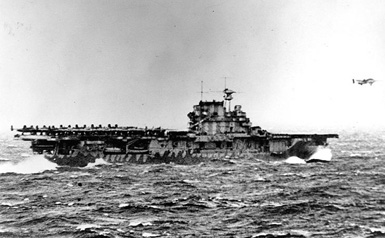
In May US Navy code breakers under the direction of Commander Joe Rochefort at Pearl Harbor discovered the next move of the Imperial Navy an attack on Midway Island and the Aleutian islands. Since the occupation of Midway by Japanese forces would give them an operational base less than 1000 miles from Pearl Harbor Admiral Chester Nimitz committed the bulk of his naval power, the carriers USS Enterprise CV-6, USS Yorktown CV-5 and USS Hornet CV-8 and their 8 escorting cruisers and 15 destroyers, a total of 26 ships with 233 aircraft embarked to defend Midway. Nimitz also sent a force of 5 cruisers and 4 destroyers to cover the Aleutians.
images-42

images-43

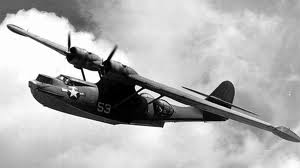
Land based air assets on Midway were composed of a mixed Marine, Navy and Army air group of 115 aircraft, many of which were obsolete. Aboard Midway there were 32 US Navy PBY Catalina Flying Boats, 83 fighters, dive bombers, torpedo planes and Army Air Force bombers piloted by a host of inexperienced pilots.

Nimitz’s instructions to his Task Force Commanders was simple “You will be governed by the principle of calculated risk, which you shall interpret to mean the avoidance of exposure of your force to attack by superior enemy forces without good prospect of inflicting … greater damage on the enemy.”
893594c746

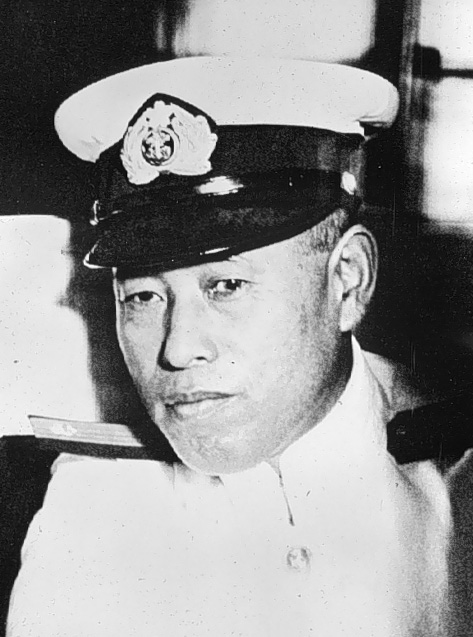
Admiral Isoroku Yamamoto commanded the Combined Fleet. The victor of Pearl Harbor and the triumph’s in the first six months of the Pacific War was determined to end the war with a decisive battle at Midway. His plans were opposed by many in the Imperial General Staff, especially those in the Army but when the US raid on Tokyo, the Doolittle Raid, all opposition to the attack was dropped.
10-japanese-carriers-coral-sea-midway

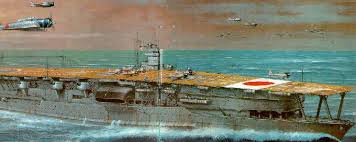
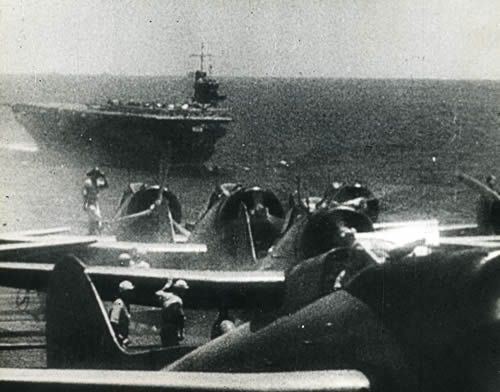
The Japanese sent a force of 7 battleships and 7 carriers against Midway. These included the elite First Carrier Striking Group composed of the Pearl Harbor attackers Akagi, Kaga, Soryu and Hiryu and their highly trained and combat experienced air groups. Among the surface ships was Yamamoto’s flagship, the mighty Battleship Yamato, at 72,000 tons and armed with 9 18” guns, the most powerful and largest battleship ever to see combat.

The strike force included 273 aircraft and was escorted by 14 cruisers and 39 destroyers. They were to take Midway and then destroy the US Navy when it came out to fight. Yamamoto sent a force force of 4 battleships, 12 destroyers assigned screen to the Aleutian invasion force which was accompanied by 2 carriers 6 cruisers and 10 destroyers. The other carriers embarked a further 114 aircraft.

Despite this great preponderance in numbers Yamamoto’s plan was complex and his forces too far apart from each other to offer support should and get into trouble. The powerful Japanese Task forces were scattered over thousands of square miles of the Northern Pacific Ocean where they could not rapidly come to the assistance of any other group.

images-44

With the foreknowledge provided by the code breakers the US forces hurried to an intercept position northeast of Midway eluding the Japanese submarine scout line which the Japanese Commander Admiral Yamamoto presumed would find them when they sailed to respond to the Japanese attack on Midway.  Task Force 16 with the Enterprise and Hornet sailed first under the command of Rear Admiral Raymond A Spruance and Task Force 17 under Rear Admiral Frank “Jack” Fletcher with the Yorktown which had been miraculously brought into fighting condition after suffering heavy damage at Coral Sea. Fletcher assumed overall command by virtue of seniority and Admiral Nimitz instructed his commanders to apply the principle of calculated risk when engaging the Japanese as the loss of the US carriers would place the entire Pacific at the mercy of the Japanese Navy.

On June 3rd a PBY Catalina discovered the Japanese invasion force and US long range bombers launched attacks against it causing no damage. The morning of the 4th the Americans adjusted their search patterns in and the Japanese came into range of Midway and commenced their first strike against the island.

g17056

In response land based aircraft from Midway attacked the Japanese carrier force taking heavy casualties and failing to damage the Japanese task force. The American Carrier task forces launched their strike groups at the Japanese fleet leaving enough aircraft behind of the Combat Air Patrol and Anti-submarine patrol.  As the Americans winged toward the Japanese fleet the Japanese were in a state of confusion. The confusion was caused when a scout plane from the Heavy Cruiser Tone that had been delayed at launch discovered US ships but did not identify a carrier among them until later into the patrol. The carrier  was the Yorktown and TF 17, but for Nagumo who first expected no American naval forces, then received a report of surface ships without a carrier followed by the report of a carrier the reports were unsettling.
a5f7ab19-17c6-4928-90a4-5bb913d156eb

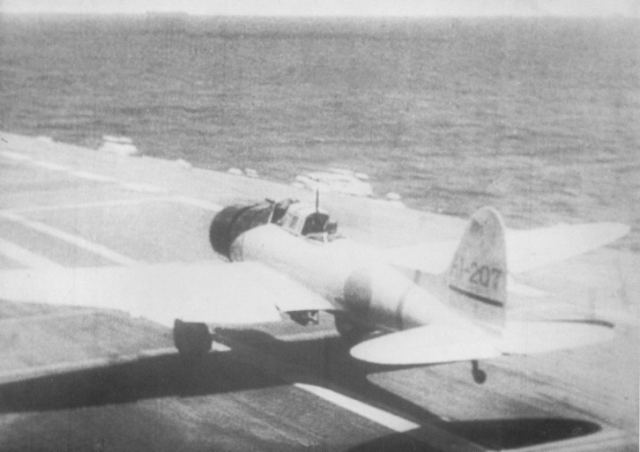
Orders and counter-orders were issued as the Japanese attempted to recover their strike aircraft and prepare for a second strike on the island and then on discovery of the Yorktown task force, orders changed and air crews unloaded ground attack ordnance in favor of aerial torpedoes and armor piercing bombs. The hard working Japanese aircrew did not have time to stow the ordnance removed from the aircraft but by 1020 they had the Japanese strike group ready to launch against the US carriers.
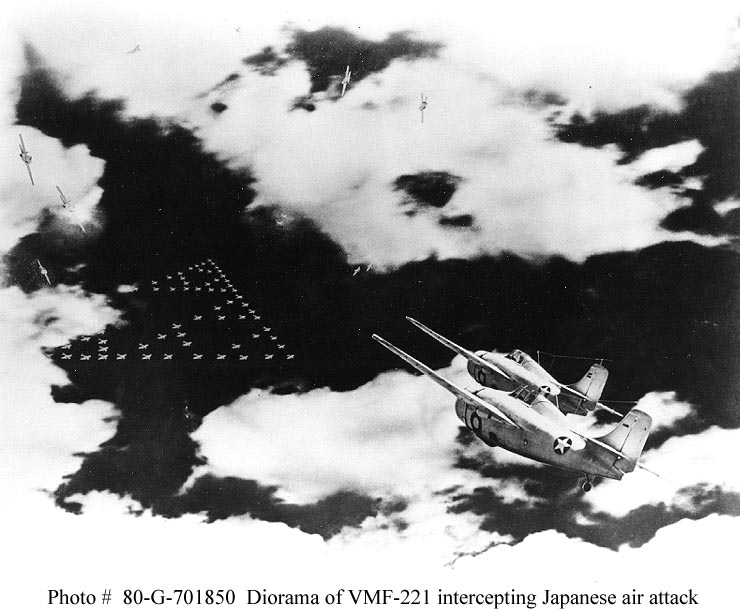
g701850

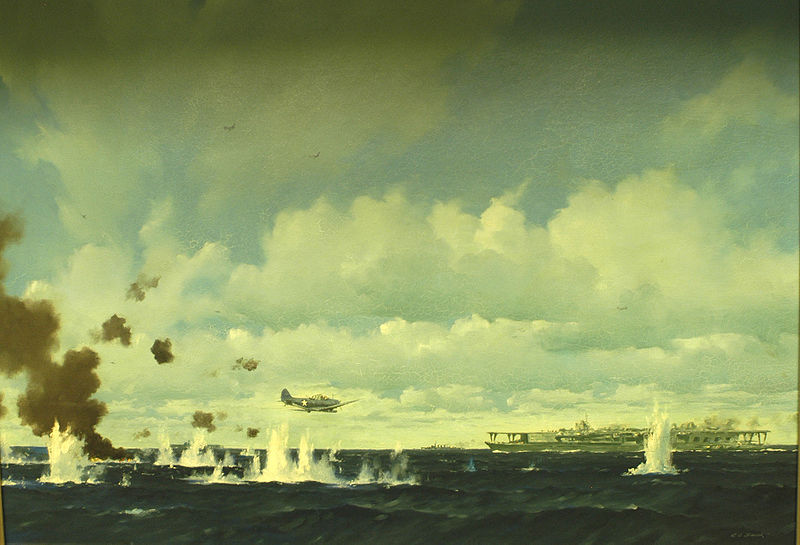
As the Japanese crews worked the Japanese carriers were engaged in fending off attacks by the US torpedo bomber squadrons, VT-6 from Enterprise, VT-8 from Hornet and VT-3 from Yorktown. The Japanese Combat Air Patrol ripped into the slow, cumbersome and under armed TBD Devastators as they came in low to launch their torpedoes.  Torpedo Eight from Hornet under the command of LCDR John C Waldron pressed the attack hard but all 15 of the Devastators were shot down. Only Ensign George Gay’s aircraft was able to launch its torpedo before being shot down and Gay would be the sole survivor of the squadron.
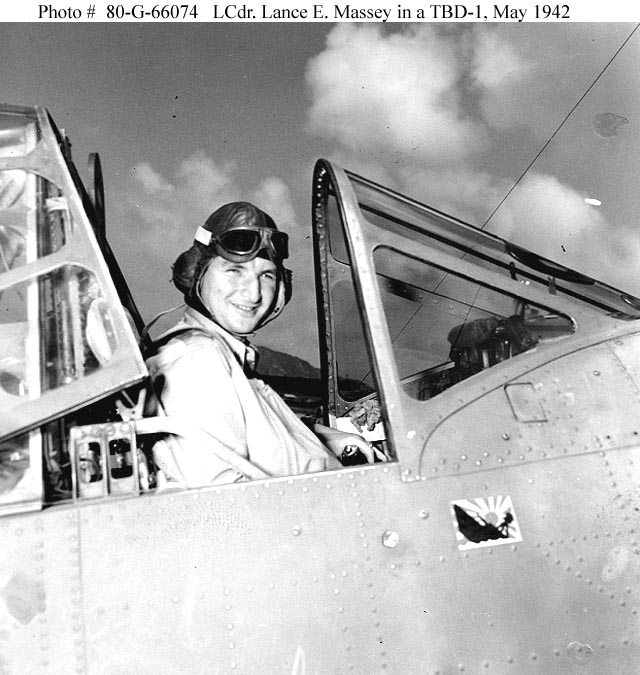
g66074


LCDR Lance Massey CO of VT-3

Page500_163_6

LCDR John Waldron CO of VT-8

220px-Eugene_Lindsey;h84903

LCDR Eugene Lindsey CO of VT-6

Torpedo 6 from Enterprise under the command of LCDR Eugene Lindsey suffered heavy casualties losing 10 of 14 aircraft with Lindsey being one of the casualties.  The last group of Devastators to attack was Torpedo 3 from Yorktown under the command of LCDR Lem Massey from the Yorktown. These aircraft were also decimated and Massey killed but they had drawn the Japanese Combat Air Patrol down to the deck leaving the task force exposed to the Dive Bombers of the Enterprise and Yorktown.
800px-tbd_attacking_at_midway_painting-1

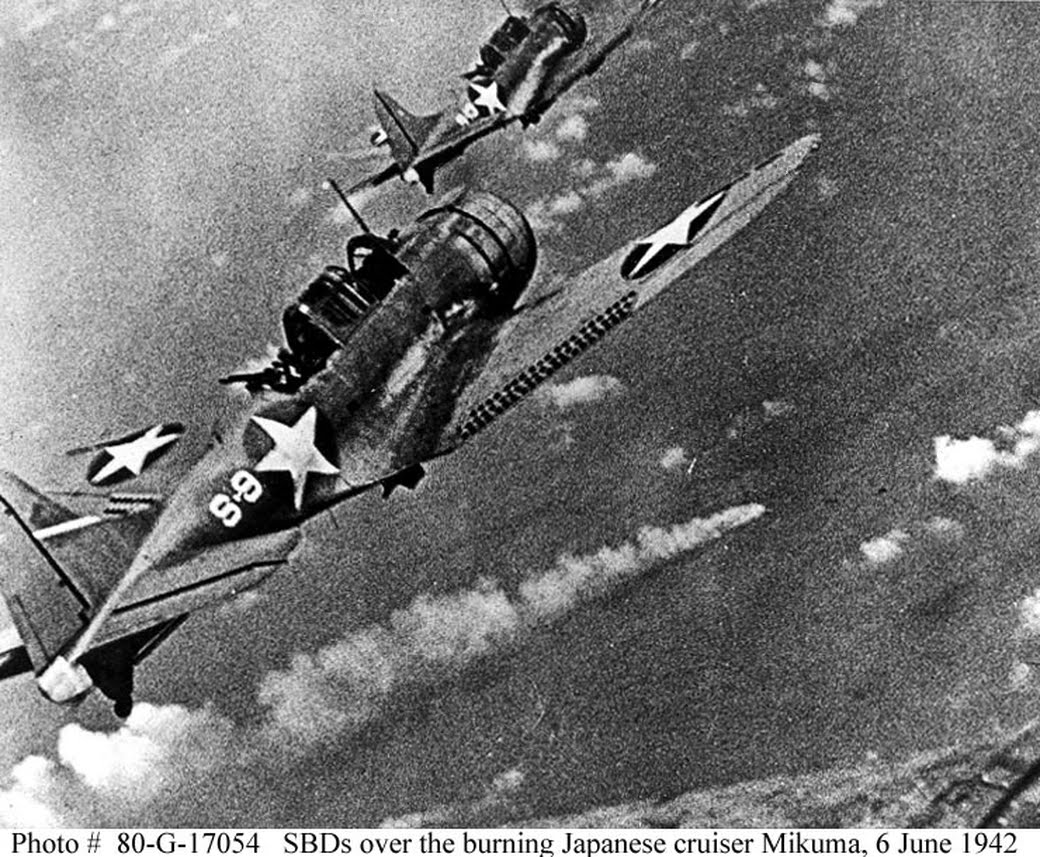
There had been confusion among the Americans as to the exact location of the Japanese Carriers. Bombing 8 and Scouting 8 from Hornet did not find the carriers and had to return for lack of fuel while losing a number of bombers and their fighter escort having to ditch inn the ocean and wait for rescue. The Enterprise group composed of Bombing-6 and Scouting 6 under CDR Wade McClusky was perilously low on fuel when the wake of a Japanese destroyer was spotted.  McClusky followed it to the Japanese Task Force. The Yorktown’s group under LCDR Max Leslie arrived about the same time.
Dauntless_dive_bombers

When the American dive bombers arrived over the Japanese Carrier Strike Force they found the skies empty of Japanese aircraft. Below, aboard the Japanese ships there was a sense of exhilaration as each succeeding group of attackers was brought down and with their own aircraft ready to launch and deal a fatal blow to the American carrier wondered how big their victory would be. The war would soon be decided.

midway4

At 1020 the first Zero of the Japanese attack group began rolling down the flight deck of the flagship Akagi, aboard Kaga aircraft were warming up as they were on the Soryu.  The unsuspecting Japanese were finally alerted when lookouts screamed “helldivers.” Wade McClusky’s aircraft lined up over the Akagi and Kaga pushing into their dives at 1022. There was a bit of confusion when the bulk of Scouting 6 joined the attack of Bombing 6 on the Kaga. That unprepared ship was struck by four 1000 pound bombs which exploded on her flight deck and hangar deck igniting the fully fueled and armed aircraft of her strike group and the ordnance littered about the hangar deck.  Massive fires and explosions wracked the ship and in minutes the proud ship was reduced to an infernal hell with fires burning uncontrollably. She was abandoned and would sink at 1925 taking 800 of her crew with her.
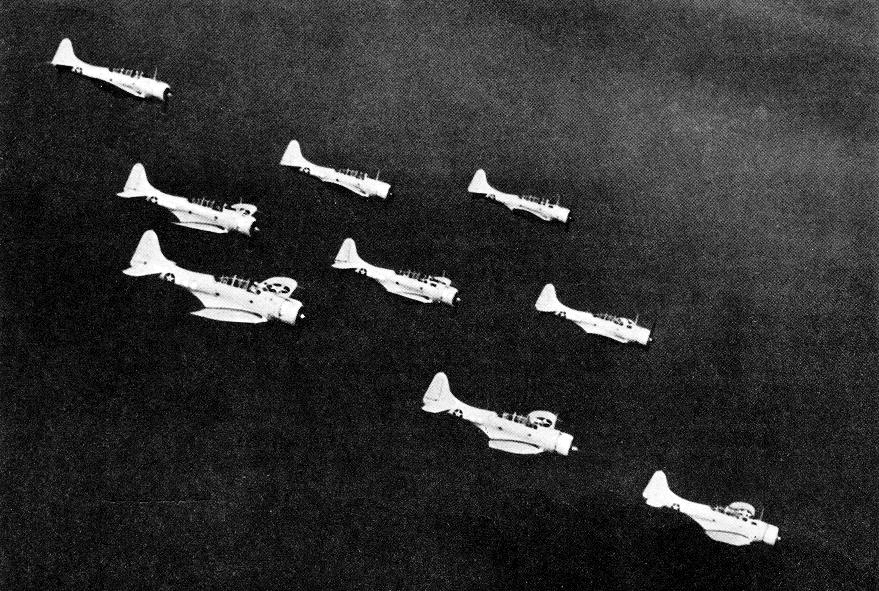
douglas-sbd5-dauntless-dive-bomber-battle-of-midway-01

LT Dick Best of Scouting 6 peeled off from the attack on Kaga and shifted to the Japanese flagship Akagi. On board Akagi were two of Japan’s legendary pilots CDR Mitsuo Fuchida leader of and CDR Minoru Genda the architect of the Pearl Harbor attack and subsequent string of Japanese victories. Both officers were on the sick list and had come up from sick bay to watch as the fleet was attacked. Seeing Kaga burst into flames they stood mesmerized until Akagi’s lookouts screamed out the warning “helldivers” at 1026.  Best’s few aircraft hit with deadly precision landing two of their bombs on Akagi’s flight deck creating havoc among the loaded aircraft and starting fires and igniting secondary explosions which turned the ship into a witch’s cauldron.  By 1046 Admiral Nagumo and his staff were forced to transfer the flag to the cruiser Nagara as Akagi’s crew tried to bring the flames under control. They would do so into the night until nothing more could be done and abandoned ship at 2000.  Admiral Yamamoto ordered her scuttled and at 0500 on June 5th the pride of the Japanese carrier force was scuttled.
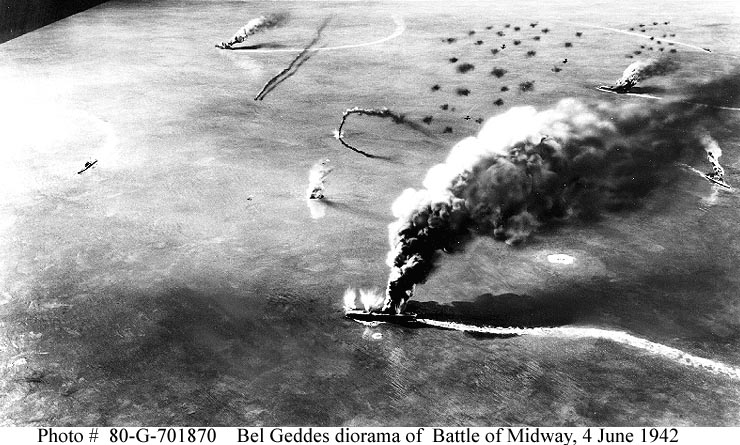
g701870

VB-3 under LCDR Max Leslie from the Yorktown stuck the Soryu with 17 aircraft, however only 13 of the aircraft had bombs due to an electronic arming device malfunction on 4 of the aircraft, including that of Commander Leslie.  Despite this Leslie led the squadron as it dove on the Soryu at 1025 hitting that ship with 3 and maybe as many as 5 bombs. Soryu like her companions burst into flames as the ready aircraft and ordnance exploded about her deck. She was ordered abandoned at 1055 and would sink at 1915 taking 718 of her crew with her.
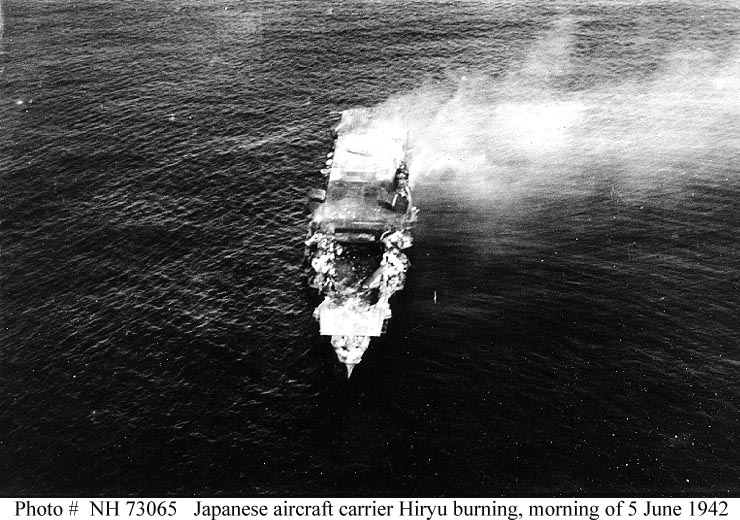
h73065

The remaining Japanese flattop the Hiryu attained the same fate later in the day after engaging in an epic duel with the Yorktown which her aircraft heavily damaged. Yorktown would be sunk by the Japanese submarine I-168 while being towed to safety.

71380-004-B4724C34

USS Yorktown under attack from Kate Torpedo Bombers from Hiryu on June 4th 1942

In five pivotal minutes the course of the war in the Pacific was changed. Authors have entitled books about Midway Incredible Victory by Walter Lord and Miracle at Midway by Gordon Prange and those titles reflect the essence of the battle.

At Midway a distinctly smaller force defeated a vastly superior fleet in terms of experience, training and equipment. At the very moment that it appeared to the Japanese that they would advance to victory their vision disappeared. In a span of less than 5 minutes what looked like the certain defeat of the US Navy became one of the most incredible and even miraculous victories in the history of Naval warfare. In those 5 minutes history was changed in a breathtaking way. While the war would drag on and the Japanese still inflict painful losses and defeats on the US Navy in the waters around Guadalcanal the tide had turned and the Japanese lost the initiative in the Pacific never to regain it.

The Japanese government hid the defeat from the Japanese people instead proclaiming a great victory. The American government could not fully publicize the victory for fear of revealing the intelligence that led to the ability of the US Navy to be at the right place at the right time and defeat the Imperial Navy.
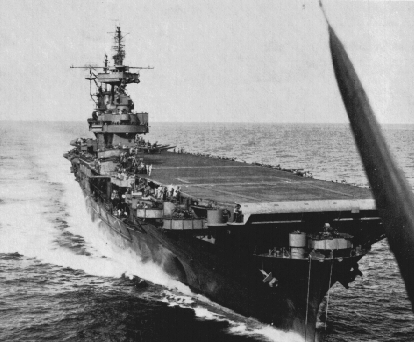
uss-enterprise-cv-6-1

The American victory at Midway changed the course of the war in the Pacific. The Battle of Midway established the aircraft carrier and the fast carrier task force as the dominant force in naval warfare which some would argue it still remains. Finally those five minutes ushered in an era of US Navy dominance of the high seas which at least as of yet has not ended as the successors to the Enterprise, Hornet and Yorktown ply the oceans of the world and the descendants of those valiant carrier air groups ensure air superiority over battlefields around the world.

Peace

Padre Steve+
1 Comment

Filed under History, Military, Navy Ships, US Navy, world war two in the pacific

The Battle of Leyte Gulf: Sinking the Musashi

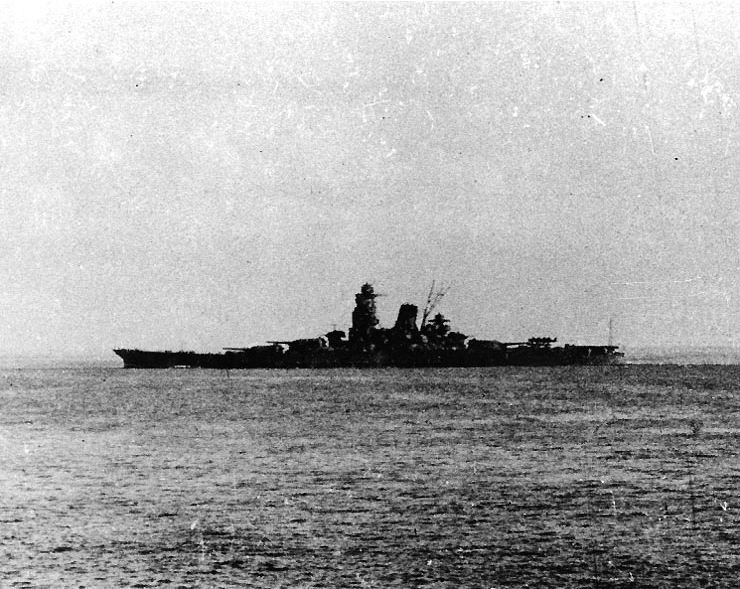
IJNS Musashi

This is the second in a series of articles about the Battle of Leyte Gulf.  The first article in the series is liked here and is entitled

The Battle of Leyte Gulf: Introduction and the Battle of Palawan Passage

Following the loss of Atago, Maya and Takao Vice Admiral Takeo Kurita’s Center Force had an uneventful rest of the day on the 23rd as his ships kept a watchful eye and ear for more US Navy submarines.  At about 0800 on 24 October the Center Force was spotted by 3 B-24 Liberator bombers which promptly reported them.

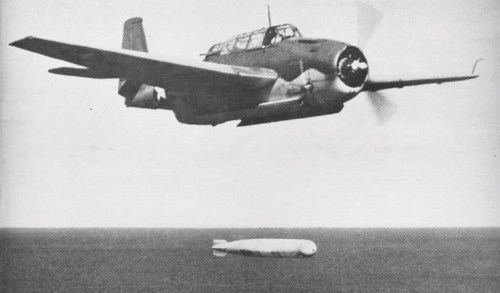
TBF Avenger dropping its “fish” 19 would hit Musashi
One of the ships in the Center Force was the IJNS Musashi, sister ship of the mighty Yamato which was also in the force. The two battlewagons were the largest battleships ever built.  With a full load displacement of 72,800 tons and an armament of nine 18.1 inch guns, the largest battery ever mounted on a warship the two behemoths also had massive anti-aircraft batteries and the Japanese were counting on them leading the Center Force to a miraculous victory during the battle.  Admiral Kurita addressed his commanders prior to the battle:

“I know that many of you are strongly opposed to this assignment.  But the war situation is far more critical than any of you can possibly know.  Would it not be shameful to have the fleet remain intact while our nation perishes?  I believe that the Imperial General Headquarters is giving us a glorious opportunity.  Because I realize how very serious the war situation actually is, I am willing to accept even this ultimate assignment to storm into Leyte Gulf.  You must all remember that there are such things as miracles.”

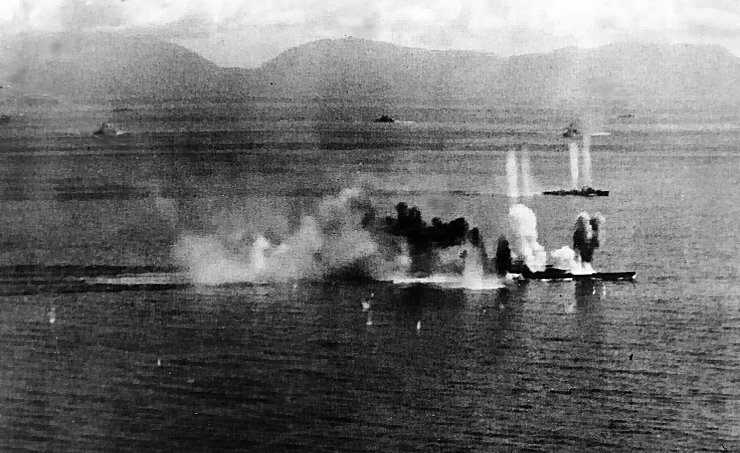
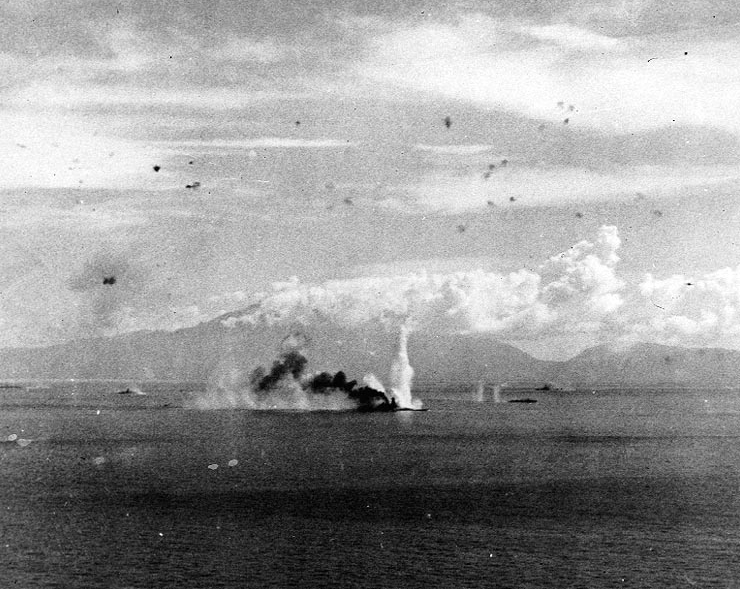
Musashi or Yamato under attack October 24th 1944

At 1000 the Musashi’s radar picked up approaching aircraft.  These were from the USS Intrepid and the USS Cabot which were assigned to Rear Admiral Gerard Bogan’s Task Group 38.4. The anti-aircraft crews and damage control teams prepared as the ship’s bugle sounded the alarm.  As the aircraft came closer the main guns of the Musashi fired but ceased fire as the aircraft drew closer.  Helldiver dive bombers plunged downward at the ships of the Center Force and F6F Hellcat fighters unopposed by enemy fighters conducted strafing runs as TBF Avenger torpedo bombers dropped their deadly loads at the Musashi.  The big ship avoided two of the “fish” but a third struck causing little damage and the first wave few away.  Musashi reported that she had sustained a hit and continued on.  The Japanese sailors knew that this would not be the last attack.  Though Musashi had weathered the first strike the American fliers hit the battleships Nagato, Yamato and severely damaged the heavy cruiser Myōkō.

Musashi hit

At 1140 the Musashi’s radar picked up the next wave of attackers and at 1203.  These were from the Intrepid, Essex and Lexington.  Hitting the Center Force in two waves a half hour apart these aircraft delivered punishing blows on Musashi. She was hit by 3 torpedoes and 2 bombs. The torpedoes caused damage that caused a 5 degree list and was down six feet by the bow. The torpedo damage was concentrated midships and one torpedo flooded her number 4 engine room. One of the bombs hit an engine room and disabled her port inline propeller shaft.  With her speed reduced she proceeded on.

Musashi

Thirty minutes following this attack at about 1330 Musashi was attacked again by Helldivers and Avengers. She is hit by 4 1000 pound bombs and 4 torpedoes.  She was now so badly damage that she could no longer keep up with the fleet and dropped behind to fend for herself.  At 1350 this attack ends with her speed reduced to 20 knots and with her down 13 feet by the bow and nearly all of her trim and void tanks full. There is now little room for any more damage forward.

Separated from the fleet Musashi was now attacked by aircraft from the Enterprise, Cabot, Franklin and Intrepid that score hits with 11 bombs including the deadly 1000 pounders and 8 torpedoes.  During the course of these attacks which ended after 1530 Musashi sustained 19 torpedo and 17 bomb hits and taken 18 near hits close aboard. At 1620 her skipper Rear Admiral Toshihira Inoguchi began desperate damage control measures to control the increasing list which had reached 10 degrees to port.  Dead in the water she continued to list further and when the list reached 12 degrees at 1915 Inoguchi ordered preparations to abandon ship.  The surviving crew assembled on the deck, the battle flag and the Emperor’s portrait were removed.  Admiral Inoguchi gave his personal notebook to his Executive officer Captain Kenkichi Kato and directed then him to abandon ship. Admiral Inoguchi retired to his cabin and was not seen again.  At 1930 with the list now 30 degrees Captain Kato gave the order to abandon ship and soon with the list increasing further men began to slide across the decks being crushed in the process.  Panic broke out among the crew which had been assembled by divisions and Captain Kato ordered “every man for himself.”  At 1936 the ship capsized and port and went down by the bow sinking in 4,430 feet of water in the Visayan Sea at 13-07N, 122-32E.

The destroyers Kiyoshimo, Isokaze and Hamakaze rescued 1,376 survivors including Captain Kato, but 1,023 of Musashi’s 2,399 man crew were lost including her skipper, Rear Admiral Inoguchi who was promoted Vice Admiral, posthumously.

The rest of the Center Force under Kurita turned around to get out of range of the aircraft, passing the crippled Musashi as his force retreated. Kurita’s retreat was temporary and Kurita waited until 17:15 before turning around again to head for the San Bernardino Strait hoping to find it empty of American ships.  His force was still battle worthy because the majority of the 259 sorties were directed on Musashi and the Heavy Cruiser Myōkō which retired heavily damaged. The Southern Force which had also been hit by American carrier air strikes also continued its push toward Surigao Strait.  The Battle of Surigao Strait, the revenge of the Pearl Harbor Battleships will be the next article in this series.

Peace

Padre Steve+

3 Comments

Filed under History, Military, Navy Ships, US Navy, world war two in the pacific

Into the Valley of the Shadow of Death: The Death of the Torpedo Bombers at Midway

Half a league half a league,
Half a league onward,
All in the valley of Death
Rode the six hundred:
‘Forward, the Light Brigade!
Charge for the guns’ he said:
Into the valley of Death
Rode the six hundred.

Alfred, Lord Tennyson: The Charge of the Light Brigade

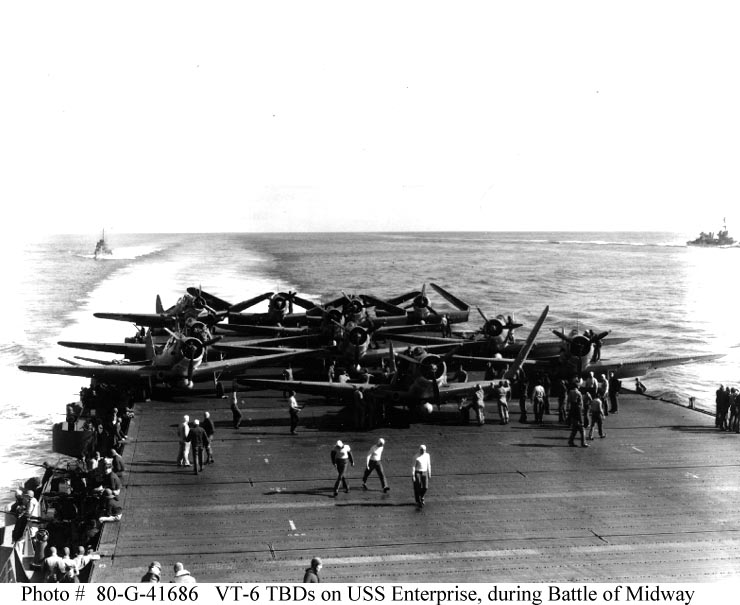
They were not six hundred and they were not mounted on horses but the Naval Aviators of Torpedo Squadrons 3, 6 and 8 and their aerial steeds 42 Douglas TBD Devastators and 6 TBF Avengers wrote a chapter of courage and sacrifice seldom equaled in the history of Naval Aviation. Commanded by veteran Naval Aviators, LCDR Lance “Lem” Massey, LCDR Eugene Lindsey and LCDR John Waldron the squadrons embarked aboard the carriers flew the obsolete TBD Devastators and the young pilots of the Midway based Torpedo 8 detachment under the command of LT Langdon Fieberling flew in the new TBF Avengers.

The TBD which first flew in 1935 entered service in 1937 and was possibly the most modern naval aircraft in the world when it entered service.  It was a revolutionary aircraft. It was the first monoplane widely used on carriers and was first all-metal naval aircraft.  It was the first naval aircraft with a totally enclosed cockpit, the first with hydraulic powered folding wings.  The TBD had crew of three and had a maximum speed of 206 miles an hour and carried a torpedo or up to 1500 pounds of bombs (3 x 500) or a 1000 pound bomb.  129 were built and served in all pre-war torpedo bombing squadrons based aboard the Lexington, Saratoga, Ranger, Yorktown, Enterprise and Hornet with a limited number embarked aboard Wasp.  The Devastator saw extensive service prior to the war which pushed many airframes to the end of their useful service life and by 1940 only about 100 were operational by the beginning of the war.  They were still in service in 1942 as their replacement the TBF Avenger was not available for service in large enough numbers to replace them before Midway.  The TBDs performed adequately against minor opposition at Coral Sea and in strikes against the Marshalls but the squadrons embarked on Yorktown (VT3), Enterprise (VT-6) and Hornet (VT-8) were annihilated at Midway with only 6 of 41 aircraft surviving their uncoordinated attacks against the Japanese Carrier Strike Force.  They were too slow, had poor maneuverability, insufficient armor and defensive armament.

The Torpedo squadrons attacked independently of each other between 0920 and 1030 on June 4th 1942. Only

The Japanese Combat Air Patrol ripped into the slow, cumbersome and under armed TBD Devastators as they came in low to launch their torpedoes.  Torpedo Eight from Hornet under the command of LCDR John C Waldron pressed the attack hard but all 15 of the Devastators were shot down.  Only Ensign George Gay’s aircraft was able to launch its torpedo before being shot down and Gay would be the sole survivor of the squadron to be picked up later by a PBY Catalina patrol plane.

Torpedo Six from the Enterprise under the command of LCDR Eugene Lindsey suffered heavy casualties losing 10 of 14 aircraft with Lindsey being one of the casualties.  The last group of Devastators to attack was Torpedo Three from the Yorktown under the command of LCDR Lem Massey losing 11 of 13 aircraft with Massey a casualty last being seen standing on the wing of his burning aircraft as it went down.  These aircraft were also decimated and Massey killed but they had drawn the Japanese Combat Air Patrol down to the deck leaving the task force exposed to the Dive Bombers of the Enterprise and Yorktown.  The six aircraft of the Torpedo Eight detachment from Midway under the command of LT Fieberling lost 5 of their 6 aircraft while pressing their attacks.  Only Ensign Bert Earnest and his aircraft survived the battle landing in a badly damaged state on Midway.  Four U.S. Army B-26 Marauder Medium Bombers were pressed into service as torpedo bombers of which 2 were lost.  No torpedo bomber scored a hit on the Japanese Task force even those torpedoes launched at close range failed to score and it is believe that this was in large part due to the poor performance of the Mark 13 aircraft torpedoes.

Despite the enormous losses of the torpedo squadrons their sacrifice was not in vain. Their attacks served to confuse the Japanese command and delay the rearmament of aircraft following the Japanese strikes on Midway. They also took the Japanese Combat Air Patrol down to sea level and opened the way for American Dive Bombers to strike the Japanese with impunity fatally damaging the Akagi, Kaga and Soryu in the space of 5 minutes.

After Midway the remaining TBDs were withdrawn from active service and no example survives today. The TBF became the most effective torpedo bomber of the war.

As we remember the brave men that fought at Midway it is imperative that we remember the brave aircrews of the torpedo squadrons that like the Light Brigade rode into the Valley of the Shadow of Death against the First Carrier Strike Force and Midway.

Peace

Padre Steve+

10 Comments

Filed under aircraft, History, Military, world war two in the pacific

Wings of Gold: U. S. Navy Carrier Aircraft 1935-1941

Curtiss BF2C Goshawks (US Navy Photo)

As the United States Navy built up its Carrier Force in the mid to late 1930s it continued to develop aircraft specifically designed to operate from aircraft carriers.  It continued its development of fighter, dive bomber and torpedo bomber aircraft.  In 1935 the Navy was operating the Grumman FF-1 biplane fighter which it had began using in 1933 and the Curtiss F11C and BF2C Goshawk. The Curtiss aircraft were built in fighter and bomber variants and while initial aircraft had an open cockpit and fixed landing gear later aircraft had an enclosed cockpit and retractable landing gear. They had top speed of 157 miles an hour and due to limited success and were retired from service by 1939.  The Goshawk was operated against the Japanese by Nationalist China and also served in a number of air forces including Thailand where they were used against the French and Japanese.

Grumman FF-1 (US Navy Photo)

The Grumman FF-1 was a two-seater that had a enclosed cockpit with retractable landing gear and a top speed of 201 miles an hour.  The FF-1 was faster than any naval aircraft of its era, a follow-on variant designated the SF-1 followed and 120 aircraft were built. Most of the operational aircraft served aboard the USS Lexington CV-2 in a fighter and scouting role. The FF-1 and SF-1 were withdrawn from first line service and placed with the reserve as well as being used in aviation training commands. The aircraft was manufactured under license by the Canadian Car and Foundry Company and served in the Canadian Air Force until 1942 as the Goblin and 40 of the Canadian aircraft were used by the Spanish Republican forces in the Spanish Civil War.

Grumman F2F-1 (US Navy Photo)

The FF-1/SF-1 was followed by the Grumman F2F a single-seat model with improved speed and maneuverability over is predecessors.  54 F2F’s were ordered in 1934 with the production models being delivered between April and August 1935.  The aircraft were armed with 2 .30 machine guns mounted above the cowl and had a top speed of 231 miles an hour and maximum range of 985 miles.  The aircraft would remain in service until they were replaced in 1939 with the Grumman F3F. However they remained in service as utility and training aircraft until retired from service toward the end of 1940.

Grumman F3F (US Navy Photo)

The Grumman F3F followed the F2F with 157 production models. It was more aerodynamic and had a more powerful engine that the F2F which enabled it to achieve a top speed of 264 miles an hour.  It was operated by seven Navy and Marine Corps Squadrons and entered service in 1936 and would serve aboard carriers until replaced in late 1941. It continued with 117 aircraft being stationed at naval air stations and used for training until 1943.

F2A Brewster Buffalo (U.S. Navy Photo)

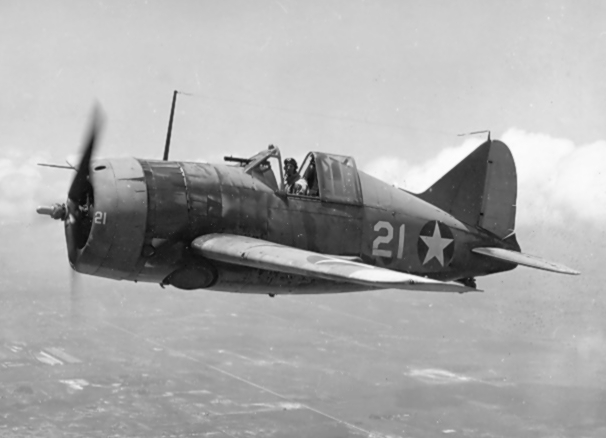
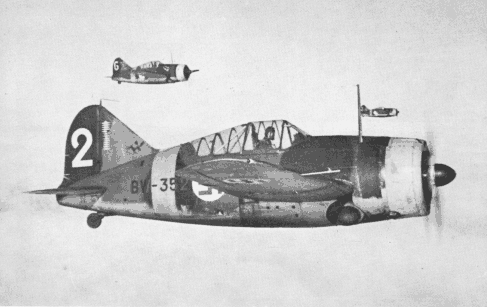
The first monoplane fighter developed and placed in service by the Navy was the F2A Brewster Buffalo. The Buffalo served with Navy and Marine Corps squadrons and was purchased by Great Britain for service in the Royal Australian and Royal New Zealand Air Forces which received 202 Buffalos. They would also serve with the Royal Navy. The Royal Netherlands Air Force received 144 most of which served in the East Indies. The final nation to receive the Buffalo was Finland which received 44 aircraft.  Buffalo was underpowered and the addition of armor and added fuel capacity further diminished the speed and performance of the aircraft.  The Navy placed its Buffalo’s in advanced training squadrons in early 1942 and one of the two Marine Corps squadrons (VMF-221) operated it at the Battle of Midway where they endured fearful losses at the hands of Japanese Zero fighters.

Brewster Buffalo 239s of the Finnish Air Force

Despite the lack of success in U. S. service the Buffalo performed in a heroic manner for the Finns destroying over 500 Soviet and German aircraft and producing 36 Buffalo Aces.  The highest scorer was Captain Hans W. Wind with 39 of 75 victories flying a Buffalo.  British Commonwealth and Dutch aircraft did not fare as well as the Finns as the tropical climate degraded the aircraft considerably.

Martin T4M over Lexington or Saratoga (US Navy Photo)

The Navy also developed aircraft for bombing missions as well as that could launch aerial torpedoes. The first aircraft built were dual purpose in that they could be used in level bombing and torpedo missions. In 1935 the primary aircraft of this type was the Martin T4M which had entered service in 1928 and replaced the Douglas DT and Martin T4M aircraft.  The T4M was a biplane with a crew of three that had a maximum speed of 114 miles an hour (I have driven much fast than this on the German Autobahn but I digress) and it could carry a torpedo or bombs.  155 were purchased by the Navy and the Marine Corps between 1928 and 1931.  They were operated from the Lexington and Saratoga until 1938 as no replacement aircraft offered enough improvements for the Navy to purchase and were instrumental in the development and demonstration of the capabilities of naval air power.  They were finally replaced by the Douglas TBD Devastator.

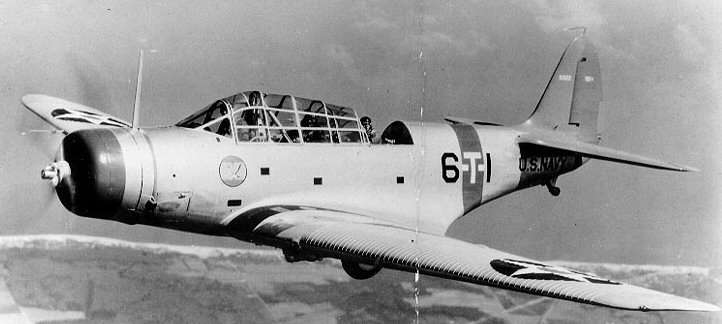
TBD Devastator (US Navy Photo)

The TBD which first flew in 1935 entered service in 1937 and at the time was possibly the most modern naval aircraft in the world and was a revolutionary aircraft. It was the first monoplane widely used on carriers and was first all-metal naval aircraft.  It was the first naval aircraft with a totally enclosed cockpit, the first with hydraulic powered folding wings.  The TBD had crew of three and had a maximum speed of 206 miles an hour and carried a torpedo or up to 1500 pounds of bombs (3 x 500) or a 1000 pound bomb.  129 were built and served in all pre-war torpedo bombing squadrons based aboard the Lexington, Saratoga, Ranger, Yorktown, Enterprise and Hornet with a limited number embarked aboard Wasp.  The Devastator saw extensive service prior to the war which pushed many airframes to the end of their useful service life and by 1940 only about 100 were operational.  They were still in service in 1942 as their replacement the TBF Avenger was not ready for service.  They performed adequately against minor opposition at Coral Sea and in strikes against the Marshalls but the squadrons embarked on Yorktown (VT3), Enterprise (VT-6) and Hornet (VT-8) were annihilated at Midway with only 6 of 41 surviving their uncoordinated attacks against the Japanese Carrier Strike Force.  They were too slow, had poor maneuverability, insufficient armor and defensive armament.  Only a few were able to launch their torpedoes as the Japanese Combat Air Patrol tore through them. Their sacrifice was not in vain as the Dive Bombers arrived facing no opposition and sank three of the four Japanese carriers getting the fourth later in the day. After Midway the remaining aircraft were withdrawn from active service in the Pacific. The Ranger’s VT-4 operated them until September 1942and Wasp’s VT-7 operated them in the Atlantic until she was transferred to the Pacific in July 1942.   By 1944 all remaining aircraft had been scrapped.

Vought SBU Corsair

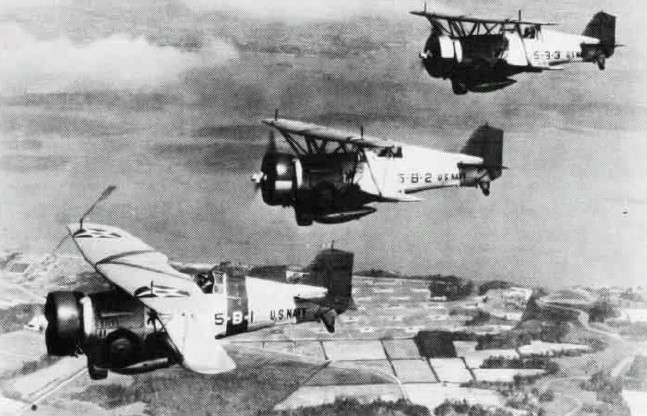
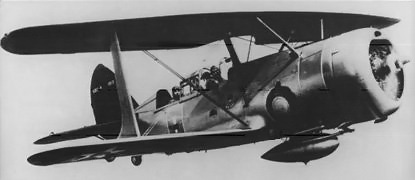
In the mid 1930s the Navy began to develop Scout and Dive Bombers for use in carrier scouting (VS) and bombing (VT) squadrons.  The first of these aircraft types were biplanes.  The Grumman SF-1 was used in a scouting and bombing role and was joined by the Vought SBU Corsair in 1935 and by 1937 both were being replaced by the Curtiss SBC Helldiver, a biplane with a 234 mile an hour maximum speed, retractable landing gear, enclosed cockpit which could carry a 1000 bomb.

Curtis SBC Helldiver

However the era of the biplane was drawing to a close and the Helldiver would be relegated to training squadrons based in Florida.  Although they had a brief service career they were instrumental in develop dive bombing tactics at which the U.S. Navy excelled and which were copied by the German Luftwaffe with the Junkers JU-87 Stuka and the Japanese with the Aichi 99 Val naval dive bomber.  50 aircraft were transferred to the French and served aboard the carrier Bearn but due to the French surrender in June of 1940 saw no action and spent the war rotting in Martinique.

Vought SB2U Vindicator

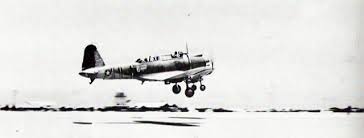
The Helldiver’s were joined by the first monoplane dive bomber in U.S. service the Vought SBU2 Vindicator in 1937. The Vindicator was used by the Navy and the Marine Corps serving aboard the Lexington, Saratoga, Ranger and Wasp. They would remain in service until September 1942. The Marine aircraft equipped two squadrons VMSB 131 and VMSB-241, VMSB 241 suffered heavy casualties at Midway as the aircraft were underpowered and were limited to glide bombing missions.  After they were taken out of the operational squadrons the Vindicator served as a training aircraft until retired in 1945.   A French Naval Air Squadron was equipped with the Vindicator but they served ashore against the German invasion.  Most were lost to enemy action.  The Douglas SBD Dauntless was introduced in 1940 and 1941 but I will cover that aircraft in the World War II aircraft article that will follow this in a week or two.

These aircraft helped pave the way to aircraft that would be the mainstays of the Navy in the Second World War, aircraft with names such as Dauntless, Helldiver, Avenger, Hellcat and Corsair.  Naval aviation earned its “wings of gold” in these early years wings that continue to shine in the 21st Century.

Peace

Padre Steve+

9 Comments

Filed under aircraft, Military, US Navy, world war two in the pacific