Tag Archives: USS Nevada

In Harm’s Way

 6565601_f496

Friends of Padre Steve’s World,

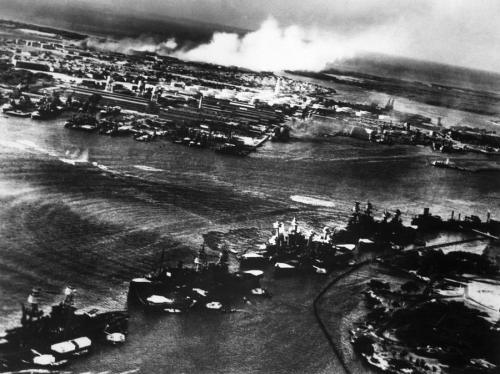
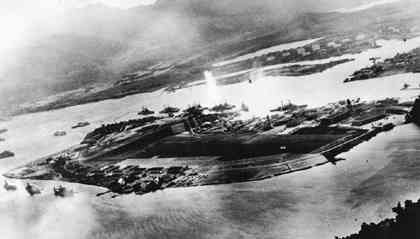
As we go into the anniversary of the attack on Pearl Harbor I am posting a number of older articles about the ships and men who endured that attack. During the attack eighteen ships were sunk or damaged, over 2000 Sailors and Marines aboard the ships along with Army personnel ashore were killed. Of the Sailors and Marines, over half lost their lives when the battleship USS Arizona blew up.

But amid the carnage and chaos a number of ship got underway. They were an odd collection; a battleship, two modern light cruisers, an elderly light cruiser and a collection of destroyers, destroyer minesweepers and destroyer minelayers. Yet in the midst of the din and bloody chaos of the Japanese attack on Pearl Harbor these ships, sometimes with only the most junior of officers in charge got underway and took to sea in order to seek out and engage the Japanese.

Their sortie is dramatized in the Otto Preminger film In Harm’s Way. 

http://www.tcm.com/mediaroom/video/477483/In-Harm-s-Way-Movie-Clip-Twelve-Bat-Blind-Ships.html

For the first forty minutes of the attack only two ships were underway. The USS Ward which had sunk the Japanese midget submarine outside the harbor entrance an hour before the attack began. The USS Helm was in the main channel as the attack began. They were joined over the next two hours by other ships.

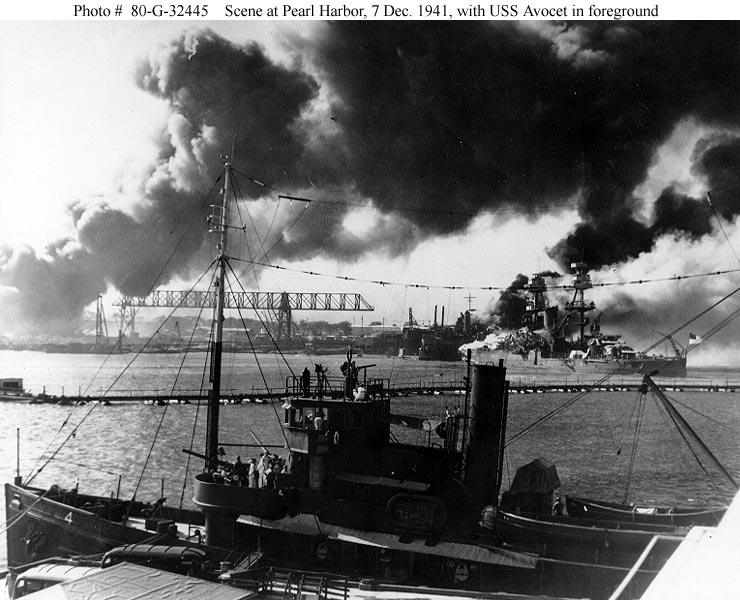
g32445

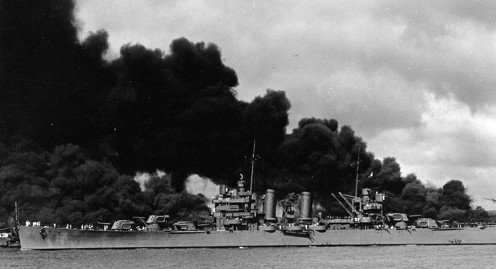
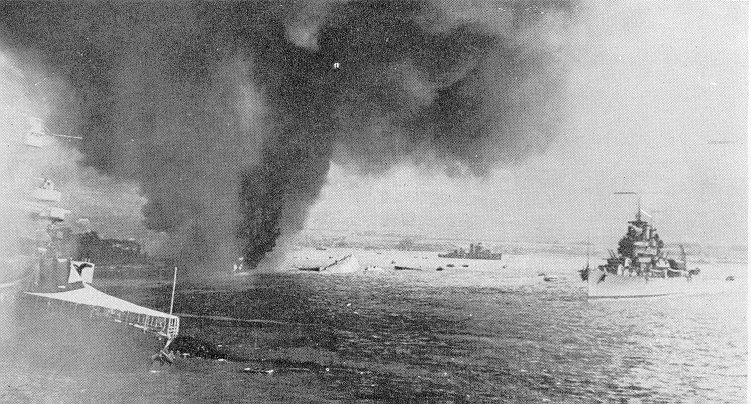
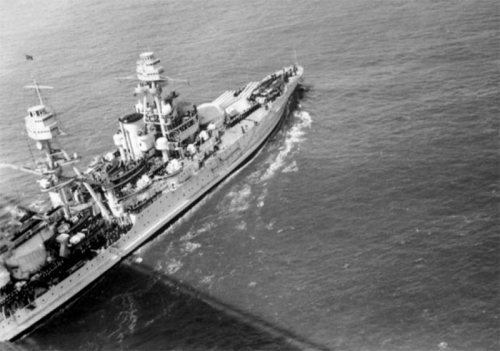
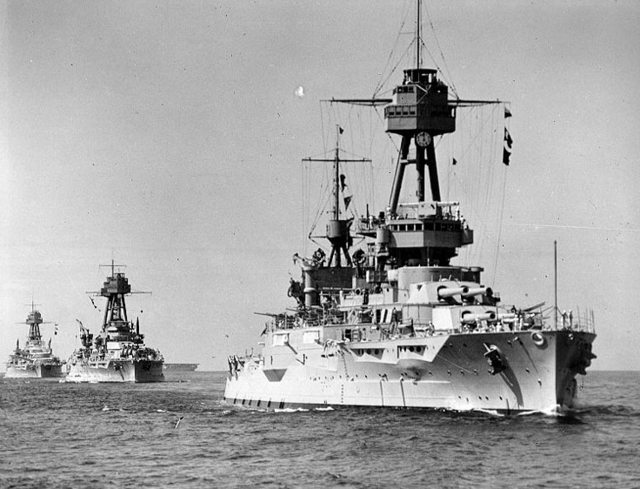
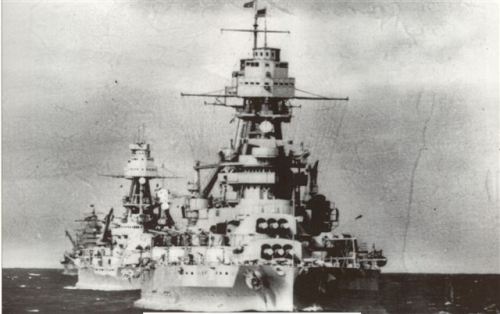
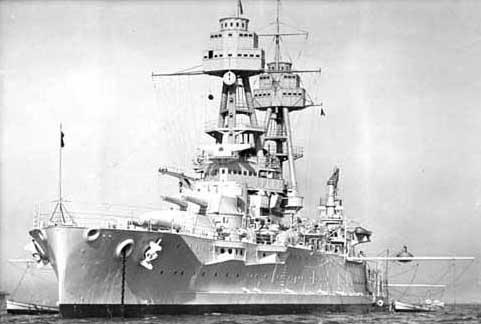
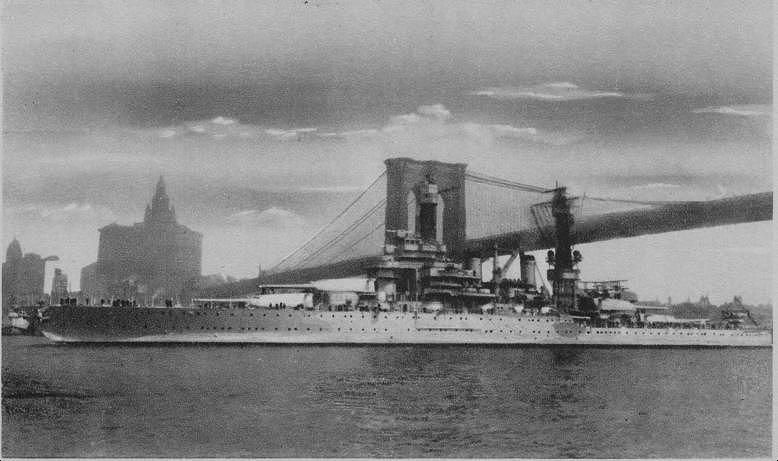
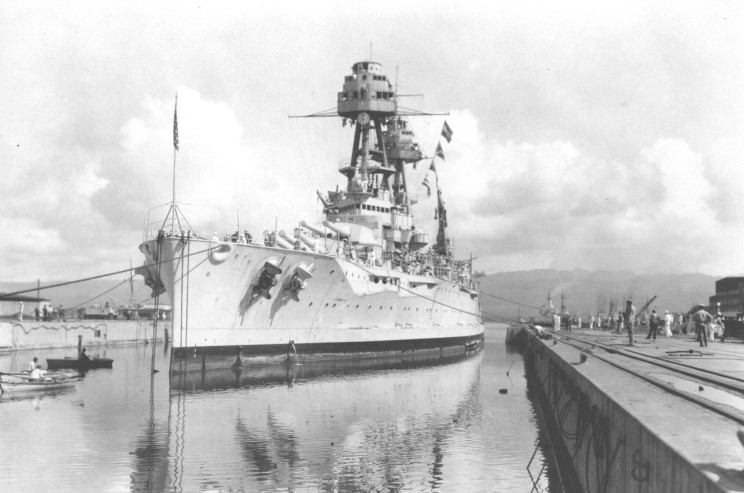
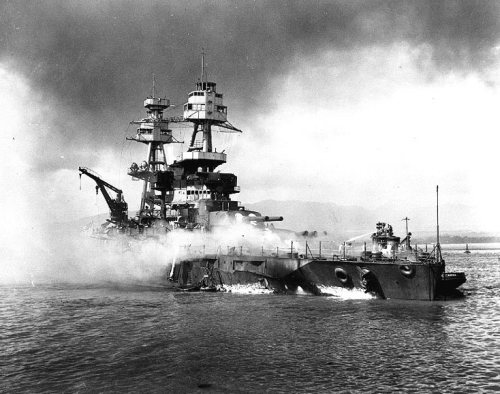
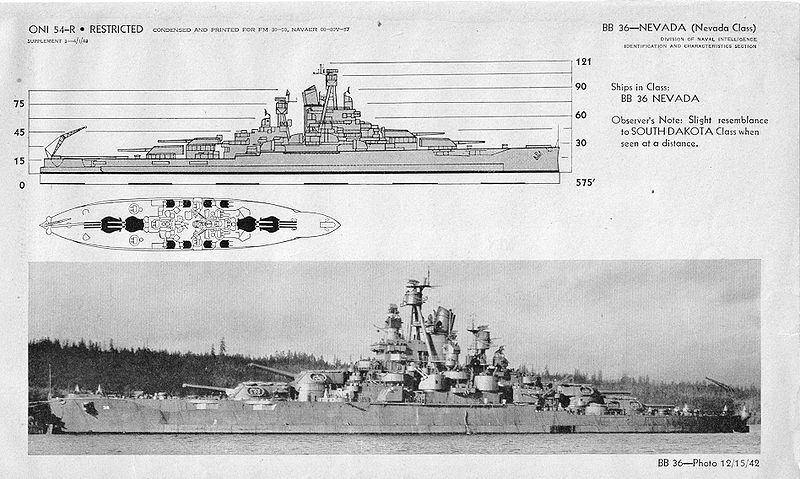
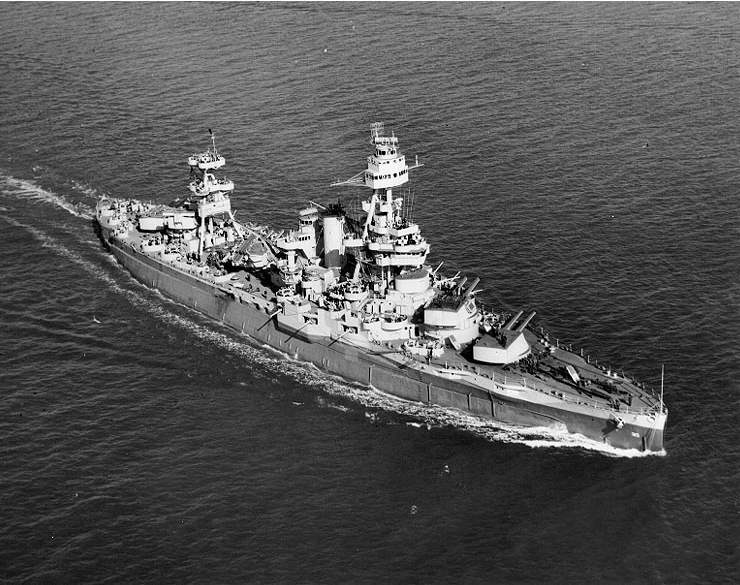
The USS Nevada was the only battleship to get underway that morning and though she did not get out of the harbor, her example served to inspire those on the battered ships in the harbor and ashore. Nevada’s commanding officer and executive officer were ashore, along with many other senior officers. But that did not stop the officers still aboard from getting the great ship underway. Her Damage Control Officer, Lieutenant Commander Francis Thomas was a reservist, he took command and as the senior officer present on the ship got her underway. As the ship sailed past the blazing wrecks along Battleship Row the second wave of Japanese attackers set upon her. Heavily damaged Thomas realized that if the Japanese succeeded in sinking Nevada in the narrow main channel it would bottle up the fleet for months. Thomas skillfully grounded the now blazing ship off Hospital Point where she sunk into the mud.

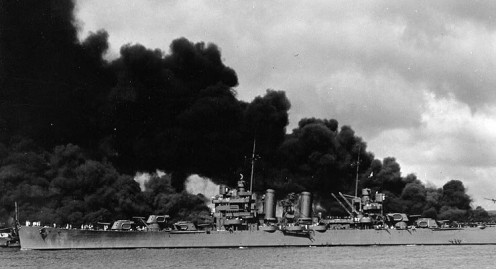
The modern light cruiser USS St. Louis was moored outboard of her sister ship USS Honolulu at the Naval Station. Her sortie was enabled by members of her crew who chopped down the gangplank and cut water lines to the shore. Under command of Captain George Rood she got underway at 0931 and was the first cruiser to get underway.

0400808

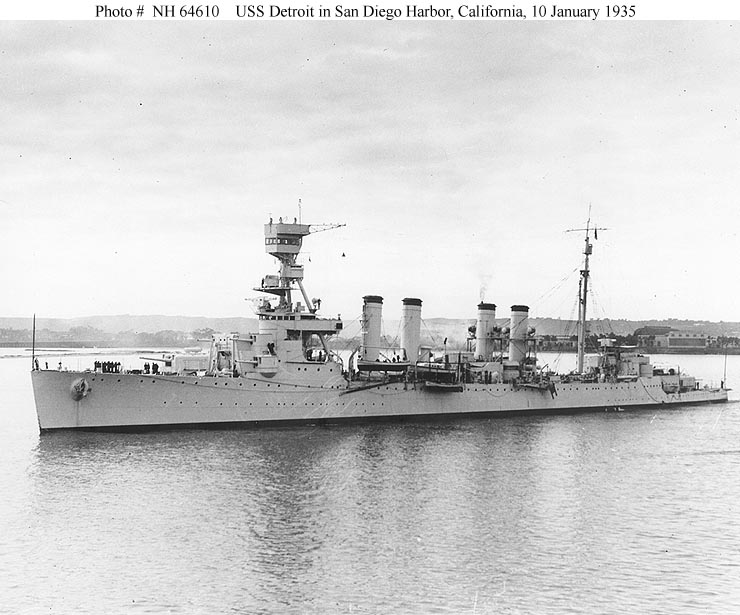
The St. Louis was joined by her sister ship USS Phoenix and the elderly light cruiser USS Detroit which was moored on the far side of Ford Island. All three ships survived the war, and in a curious footnote to history, the Phoenix was sunk in the 1982 Falklands war as the Argentine ship General Belgrano.

h68450

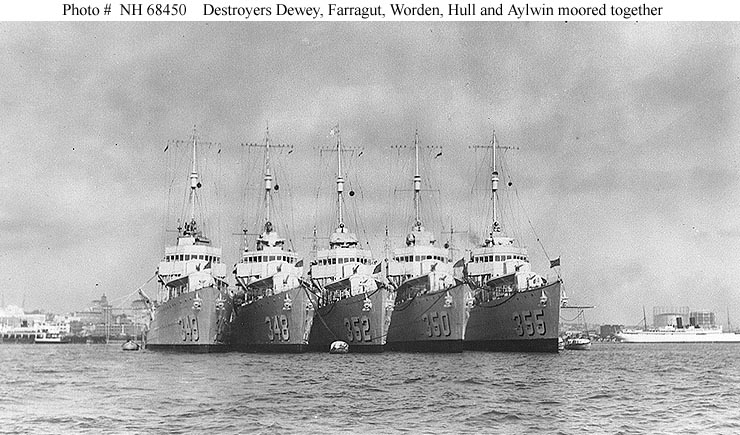
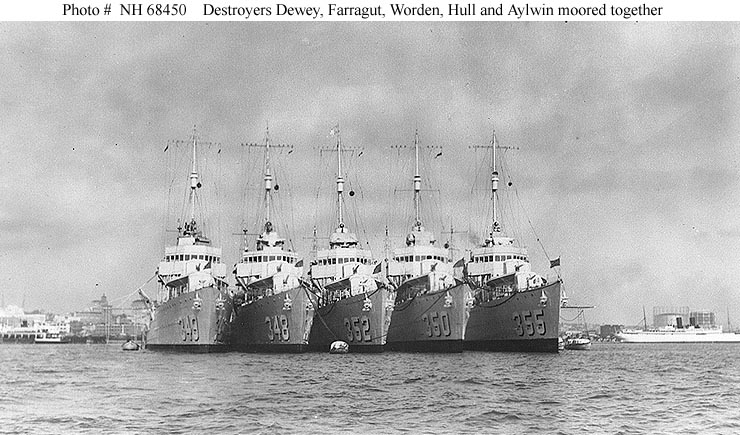
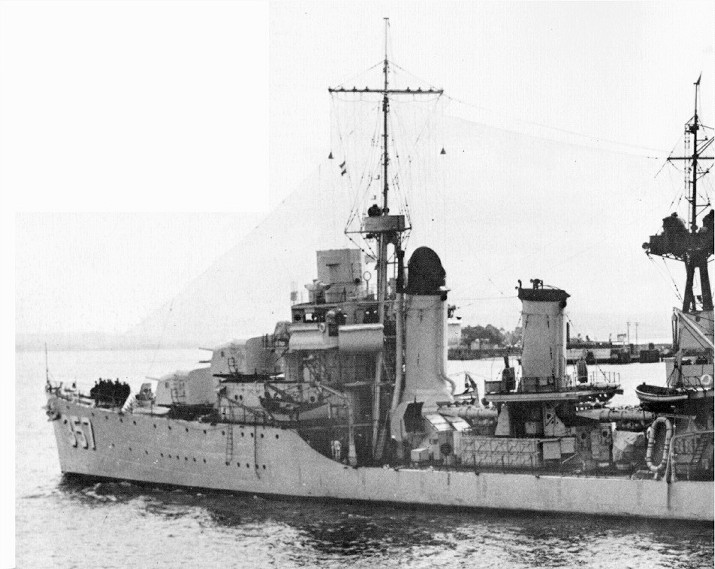
The cruisers were joined by a number of destroyers, often under the command of junior officers. The USS Blue got underway under the command of Ensign Nathan Asher, who had just three other ensigns with him as that ship got underway. She was joined by Monaghan, Dale, Henley, Phelps, Farragut, MacDonough, Worden, Patterson, Jarvis and Aylwin also under command of a junior officer, Ensign Stanley Caplan. Henley left without her commander under the command of Lieutenant Francis Fleck Jr.

h97789

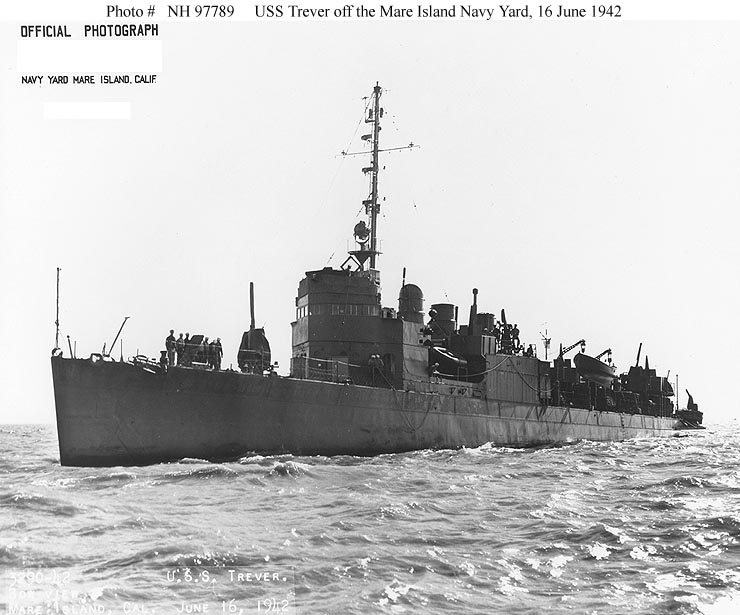
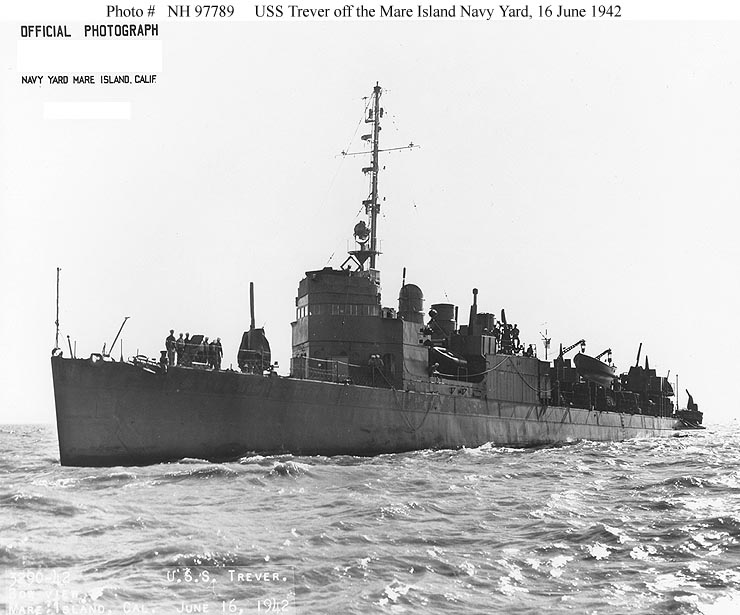
The cruisers and destroyers were joined by a number of elderly former destroyers which had been converted to Destroyer Minesweepers or Minelayers. The Ramsay, Breese, Trever and Perry all got underway, Trever also minus her commanding officer.

Some of the ships formed in a vain search for the Japanese strike force while others conducted defensive anti-submarine operations in the waters off Pearl Harbor.

The fact that all of these ships were able to get underway and navigate through the chaos of the attack, often under the command of junior officers and without key crew members was a testament to the courage and initiative of US Navy Officers and Sailors. It is a courage and initiative still in evidence today.

Peace,

Padre Steve+

1 Comment

Filed under History, leadership, Navy Ships, US Navy, world war two in the pacific

“They fight to liberate” Remembering the Men of D-Day at 70 Years

It is hard to believe now as we look at the serene beaches of Normandy that seventy years ago they were places of desperate combat in which hundreds of thousands of Allied and German soldiers, sailors, airmen and marine-commandos battled in a contest that helped free Europe of Nazi tyranny and changed the course of history.

Then they were young, most in their twenties, but some in their teens or thirties as well as a smattering of senior leaders or old career soldiers in their 40s and 50s. When I first began to read about and study the battle a good number were still alive, most about the same age as I am now. Today, their ranks thinning they are passing into history. When the 80th anniversary is celebrated, the few that remain will all be about 100 years old, and even now, the youngest of these men are nearing 90 years old.

On June 6th 1944 the Allies invaded German controlled France on the beaches of Normandy. By that evening the Allied Expeditionary Force had landed six infantry divisions on five invasion beaches and the bulk of three airborne divisions on the approaches to those beaches. Near 175,000 Allied Soldiers, Sailors, Airmen and Marine Commandos were involved in the attack and nearly 10,000 would listed be as killed, wounded or missing by the end of the day, over half on Omaha Beach.

General Dwight D. Eisenhower sent them forward with this message:

You are about to embark upon the Great Crusade, toward which we have striven these many months. The eyes of the world are upon you. The hopes and prayers of liberty-loving people everywhere march with you.  In company with our brave Allies and brothers-in-arms on other Fronts, you will bring about the destruction of the German war machine, the elimination of Nazi tyranny over the oppressed peoples of Europe, and security for ourselves in a free world….

d-day-order

The names of the invasion beaches and the units involved have been immortalized in history, in film and literature. The American 101st Airborne “Screaming Eagles,” the “All American” 82nd Airborne Division and British 6th Airborne Division “Red Devils” made the largest night airborne drop and battled Germans, the elements as the struggled to reorganize on the heels of widely scattered drops.  The Americans battled the German 91st Airlanding Division and the crack 6th Parachute Regiment, while the British faced men of the 716th “Static” Infantry Division and battle groups of the nearby 21st Panzer Division.

On Sword Beach men of the 3rd British Division and 27th Armoured Brigade teamed with the 1st Special Services Brigade composed of Army and Royal Marine Commandos made the assault, to their right on Juno Beach the Canadians of the 3rd Canadian Division, 2nd Canadian Armoured Brigade and two Royal Marine Commandos (battalions) while to their right on the middle invasion beach, God Beach the British 50th (Northumbrian) Infantry Division and 8th Armoured Brigade went ashore with elements of the British 79th Armoured Division and the 47th Royal Marine Commando.

british commandos d-day

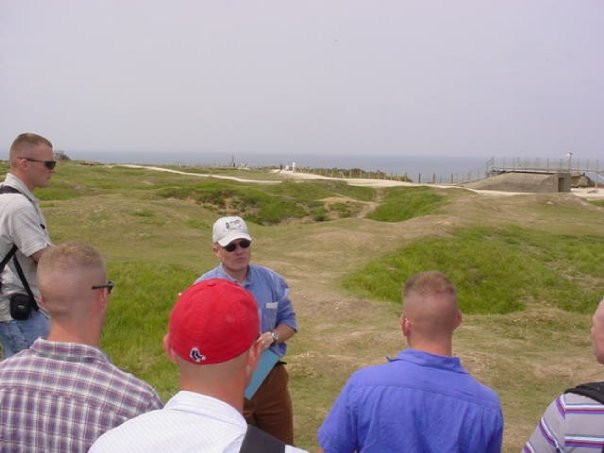
To the right of the British landed the American V Corps on Omaha Beach, the 1st Infantry Division, the famous “Big Red One” and the 29th “Blue and Gray” Infantry Division of the Virginia and Maryland National Guard. They would fight the most seasoned Germans on the beaches that day, the hardened combat veterans of the 352nd Infantry Division.  The battle of Omaha was nearly a disaster and a one point General Omar Bradley contemplated withdraw from the beach.  The American troops, including the men of the 2nd Ranger Battalion who scaled the cliffs of Point du Hoc to protect the beach from enfilade fire from German artillery mounted on the point, yet the German guns had not yet been emplaced and the Rangers fought a bitter battle against strong German resistance on that rugged mount.  On the far right the American VII Corps led by the 4th Infantry Division assaulted Utah Beach; fortunately the Americans landed away from their planned point of assault and faced little resistance. Had they landed in the correct location they might fared as their neighbors on Omaha Beach.

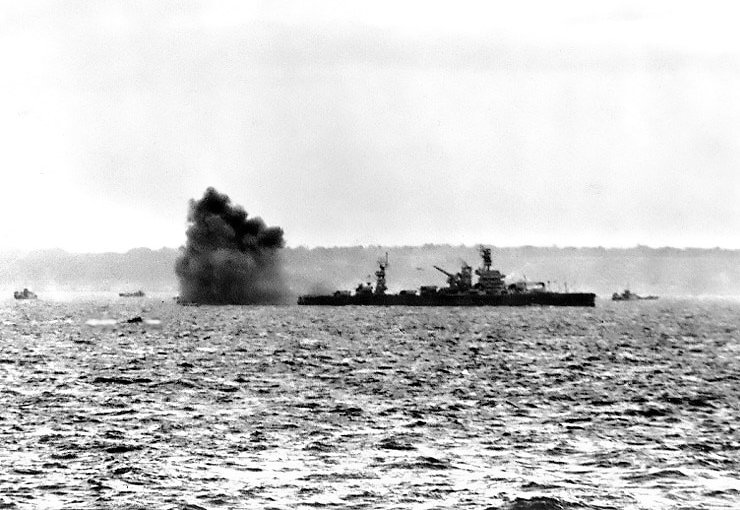
Offshore the venerable battleships HMS Warspite and HMS Ramillies and the USS Texas, USS Nevada and USS Arkansas provided fire support to the beaches aided by the Free Naval Forces of France, the Netherlands, Poland and Norway.  The French forces included the cruisers Montcalm and Georges Leygues.

Names such has St Mere-Eglise and Pegasus Bridge, the Merville Battery, Point du Hoc and Bloody Omaha remain etched in the minds of the dwindling number of surviving veterans as well as historians, military personnel and others that take the time to remember the sacrifices of these men.

imagesCAVKIRWX

The Men came from all parts of the United States and the British Commonwealth. Additionally personnel from France and other countries occupied by Nazi Germany were represented in the land, air and naval forces involved.  For the French, humiliated by their defeat in 1940 and divided by the Vichy and Free French divide were determined, despite their small numbers to liberate their homeland.

imagesCAD1R273

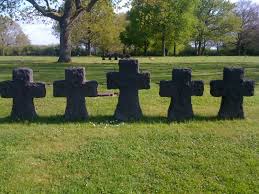
They were opposed by four German Divisions, a Luftwaffe Fallschirmjaeger regiment and elements of the 21st Panzer Division.  The Germans with nothing in the way of air support and no significant naval forces were on their own. Hitler had refused Rommel’s request to deploy Panzer divisions near the beaches and was not awakened when word came of the invasion.  German soldiers fought with considerable valor and would do so throughout the Normandy campaign, even if they fought for a regime that was evil at its core.

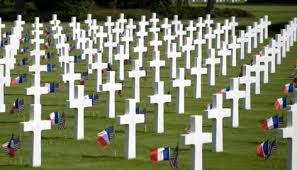
american cemetery

As the battle continued President Franklin Delano Roosevelt addressed the nation and asked all Americans to join him in this prayer:

My Fellow Americans:

Last night, when I spoke with you about the fall of Rome, I knew at that moment that troops of the United States and our Allies were crossing the Channel in another and greater operation. It has come to pass with success thus far.

And so, in this poignant hour, I ask you to join with me in prayer:

Almighty God: Our sons, pride of our nation, this day have set upon a mighty endeavor, a struggle to preserve our Republic, our religion, and our civilization, and to set free a suffering humanity.

Lead them straight and true; give strength to their arms, stoutness to their hearts, steadfastness in their faith.

They will need Thy blessings. Their road will be long and hard. For the enemy is strong. He may hurl back our forces. Success may not come with rushing speed, but we shall return again and again; and we know that by Thy grace, and by the righteousness of our cause, our sons will triumph.

They will be sore tried, by night and by day, without rest — until the victory is won. The darkness will be rent by noise and flame. Men’s souls will be shaken with the violences of war.

For these men are lately drawn from the ways of peace. They fight not for the lust of conquest. They fight to end conquest. They fight to liberate. They fight to let justice arise, and tolerance and goodwill among all Thy people. They yearn but for the end of battle, for their return to the haven of home.

Some will never return. Embrace these, Father, and receive them, Thy heroic servants, into Thy kingdom.

And for us at home — fathers, mothers, children, wives, sisters, and brothers of brave men overseas, whose thoughts and prayers are ever with them — help us, Almighty God, to rededicate ourselves in renewed faith in Thee in this hour of great sacrifice.

Many people have urged that I call the nation into a single day of special prayer. But because the road is long and the desire is great, I ask that our people devote themselves in a continuance of prayer. As we rise to each new day, and again when each day is spent, let words of prayer be on our lips, invoking Thy help to our efforts.

Give us strength, too — strength in our daily tasks, to redouble the contributions we make in the physical and the material support of our armed forces.

And let our hearts be stout, to wait out the long travail, to bear sorrows that may come, to impart our courage unto our sons wheresoever they may be.

And, O Lord, give us faith. Give us faith in Thee; faith in our sons; faith in each other; faith in our united crusade. Let not the keenness of our spirit ever be dulled. Let not the impacts of temporary events, of temporal matters of but fleeting moment — let not these deter us in our unconquerable purpose.

With Thy blessing, we shall prevail over the unholy forces of our enemy. Help us to conquer the apostles of greed and racial arrogances. Lead us to the saving of our country, and with our sister nations into a world unity that will spell a sure peace — a peace invulnerable to the schemings of unworthy men. And a peace that will let all of men live in freedom, reaping the just rewards of their honest toil.

Thy will be done, Almighty God.

imagesCA7UVUXS

Today we remember them. On the 40th anniversary of the invasion President Ronald Reagan eulogized those who fought and died for the freedom of the world:

Today, in their memory, and for all who fought here, we celebrate the triumph of democracy.  We reaffirm the unity of democratic people who fought a war and then joined with the vanquished in a firm resolve to keep the peace.

From a terrible war we learned that unity made us invincible; now, in peace, that same unity makes us secure.  We sought to bring all freedom-loving nations together in a community dedicated to the defense and preservation of our sacred values.  Our alliance, forged in the crucible of war, tempered and shaped by the realities of the post-war world, has succeeded.  In Europe, the threat has been contained, the peace has been kept.

Today, the living here assembled:  officials, veterans, area citizens, pay tribute to what was achieved here 40 years ago.  This land is secure.  We are free.  These things are worth fighting and dying for.

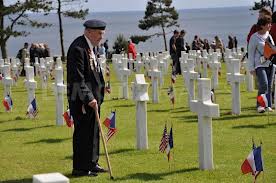
imagesCA580JS0

His words are powerful reminders of what was accomplished on that fateful day, June 6th 1944. I hope and pray that as we remember that day and those brave men that we will never forget.

Peace

Padre Steve+

3 Comments

Filed under History, Military, world war two in europe

Salvaging the Fleet: Salvage Efforts after the Attack on Pearl Harbor

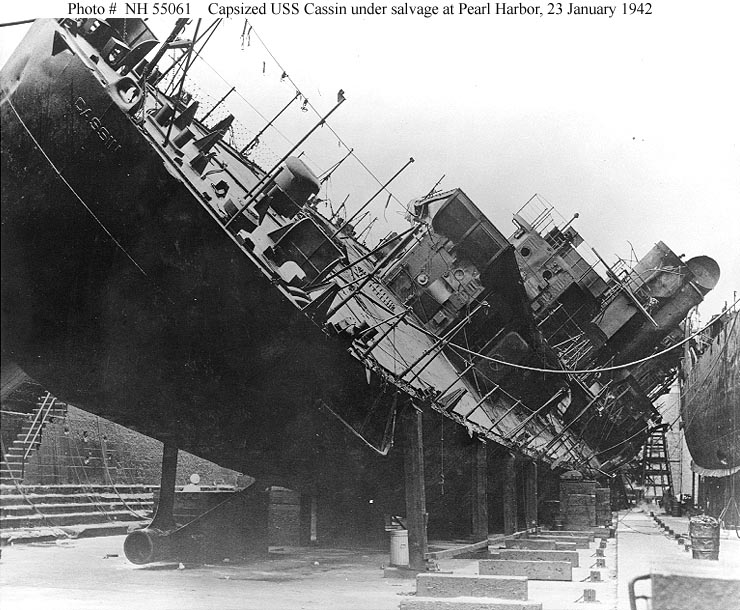
h55061

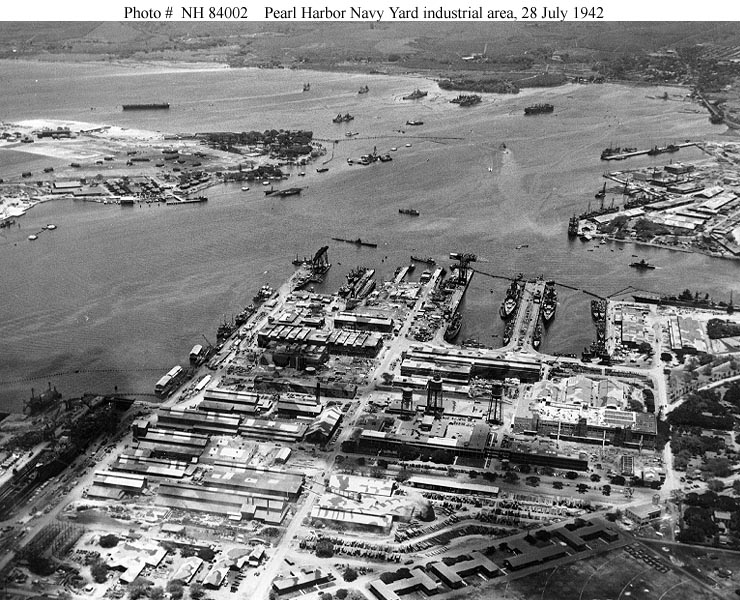
One of the more interesting aspects of the Pearl Harbor attack were the efforts of the US Navy to salvage and return to duty the ships sunk or so heavily damaged that they were thought to be irreparable after the attack. 21 ships were sunk or damaged during the attack, roughly 20% of the fleet present.

BB-37_Oklahoma052org

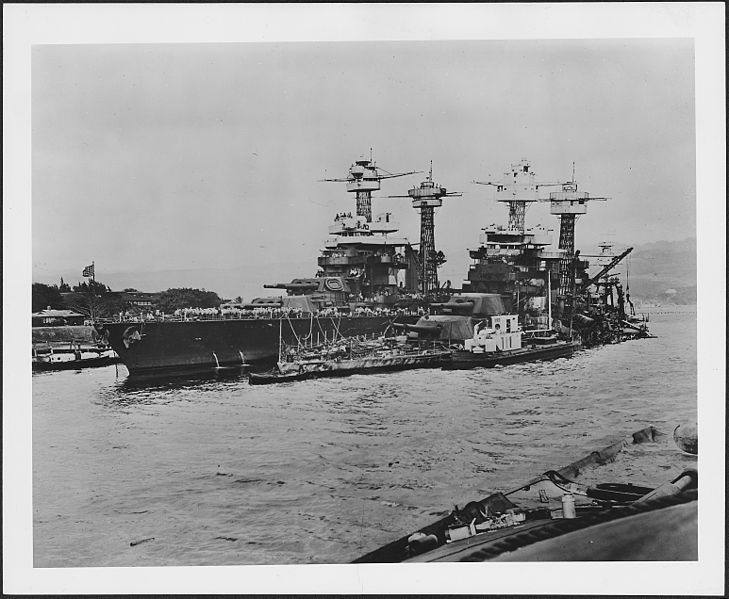
Of these were battleships, the USS Arizona sunk by a cataclysmic explosion, her broken hulk with her collapsed foremast the iconic symbol of the attack. USS Oklahoma was capsized on Battleship Row.  USS Nevada was grounded and sunk off Hospital Point after an abortive attempt to sortie during the attack. USS California and USS West Virginia lay upright on the bottom of Pearl Harbor, their superstructure, distinctive cage masts and gun turrets visible above the oily water.

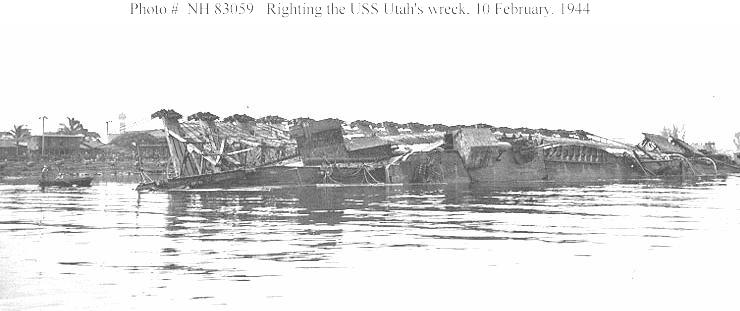
nh83059

The former battleship USS Utah lay capsized on the far side of Ford Island while the light cruiser USS Raleigh was fighting for her life barely afloat near Utah.  The ancient Minelayer USS Oglala was laying on her side next to the light cruiser USS Helena at the 1010 Dock. She was not hit by a bomb or torpedo but was said to have “died of fright” when Helena was hit by a torpedo, the blast which opened the seams of her hull. The destroyers USS Cassin and USS Downes were wrecks in the main dry dock. USS Shaw was minus her bow in the floating dry dock after exploding in what was one of the more iconic images of the attack. Other ships received varying amounts of damage.

BB-37_Oklahoma105c

As the engineers, damage control and salvage experts looked at the damage they realized that every ship would be needed for the long term fight. The building program of the US Navy was just beginning to pick up steam and it would be some time before new construction could not only make up for the losses but also be ready to fight a Two Ocean War. The decision was made to salvage and return to duty any ship deemed salvageable.

salvage10

Even the seemingly less important ships needed to be rapidly salvaged. Some which initially appeared to be unsalvageable needed at the minimum to be cleared from dry docks and docks needed by operational or less damaged ships. Likewise equipment, machinery and armaments from these ships needed to be salvaged for use in other ships.

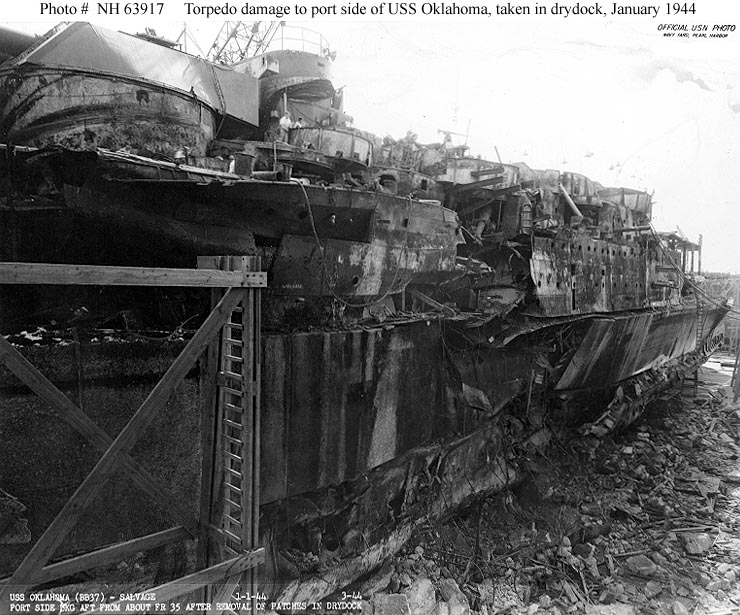
h63917

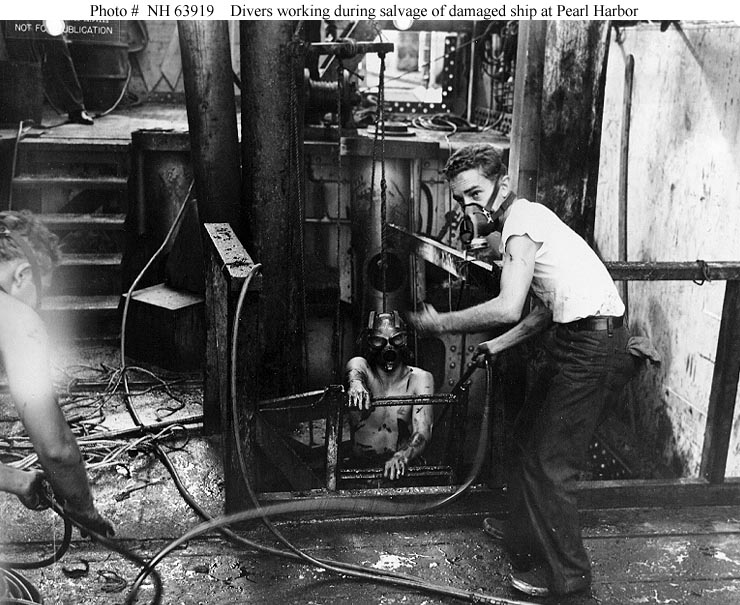
Even by modern standards the efforts of the Navy divers and salvage experts and the civilians who worked alongside them were amazing. In the end only three of the 19 ships never returned to service. The work began quickly and on December 14th Commander James Steele began to direct the salvage operations on the sunken hulks. Captain Wallin relieved Steele on January 9th 1942. Wallin formed a salvage organization of Navy officers and civilian contractors.The civilian contractors were instrumental in the operation. Many had experience in salvage operations that exceeded the military personnel.

h64493

Wallin prioritized the tasks of his organization working to recover items that could be of immediate use to the fleet such as anti-aircraft guns and to salvage less damaged ships in order to return them to service. They worked at the task through 1944. The divers faced extraordinary dangers, poisonous gas, unexploded ordnance, treacherous tides and the uncertainty of the destruction of the ships below the surface that could not be ascertained apart from diving on the wrecks.

salvage09

The divers recovered bodies whenever possible, salvaged equipment, removed weapons and ammunition, made temporary repairs and help rig the ships for righting or re-floating. In each case the salvage experts, divers and engineers faced different challenges.

h84002

Arizona was never raised. Her superstructure was cut down, main battery and some anti-aircraft guns removed. The main batter guns were delivered to the Army Coastal Artillery for use as shore batteries but none reached an operational status before the end of the war. The dives aboard were so dangerous that eventually the attempts to recover bodies ceased as several divers lost their lives in the wreck.  Over the years the National Parks Service has continued to dive on the wreck to assess it as a war grave and memorial.

h63921

Utah too was not raised. She was righted in 1942 but efforts to do more were halted because the elderly wreck had no remaining military value. Her wreck along with that of Arizona are war graves, many of their crew members, including over 1000 of Arizona’s men forever remain entombed in their ships. When I visited Pearl Harbor in 1978 as a Navy Junior ROTC Cadet and visited both memorials I was humbled at what  saw. They are haunting reminders of the cost paid by sailors during wartime.

h64496

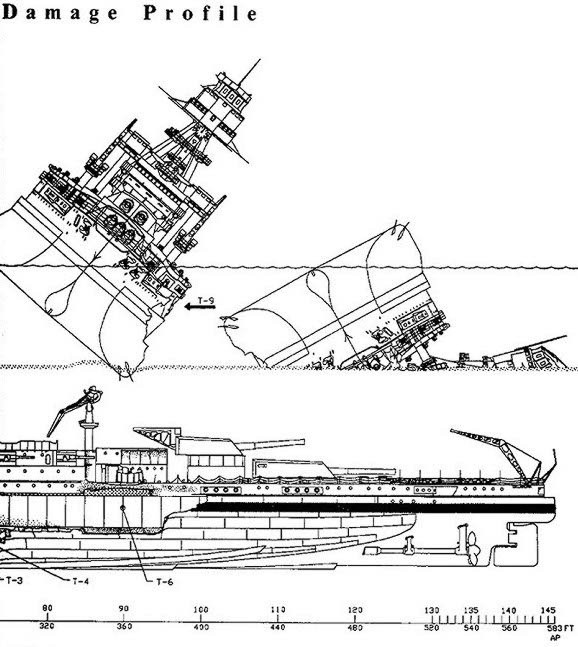
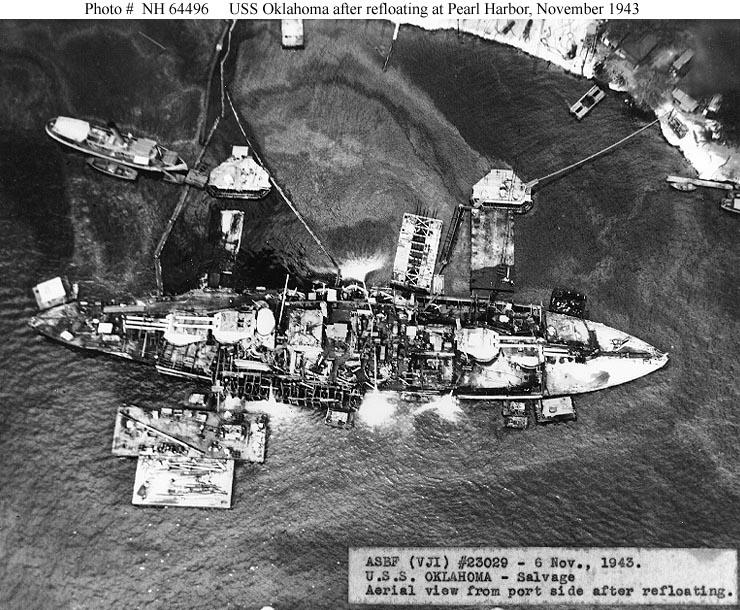
The salvage of the Oklahoma was one of the more challenging endeavors faced by Wallin’s men. Hit by at least five torpedoes during the attack the great ship capsized, her tripod masts digging deep into the mud of the harbor as she settled. Over 400 over her crew lay dead inside the ship. Since it was apparent that the ship was a total loss the salvage operations did not commence until the middle of 1942. The primary goal of the operation was to clear needed space for berthing large ships along Battleship Row. The operation involved making the ship as watertight as possible, solidifying the bottom of the harbor around her to enable her to roll and emplacing a massive system of righting frames, anchor chains and shore mounted winches and cables. The process involved cutting away wrecked superstructure, removing ammunition, weapons and the bodies of those entombed in their former home. She was completely righted in July 1943, and floated again in November. Moved to a dry dock in December she was made watertight and moored in another part of the harbor. Following the war she was being towed to a scrap yard but sank in a storm in May 1947.

h83056

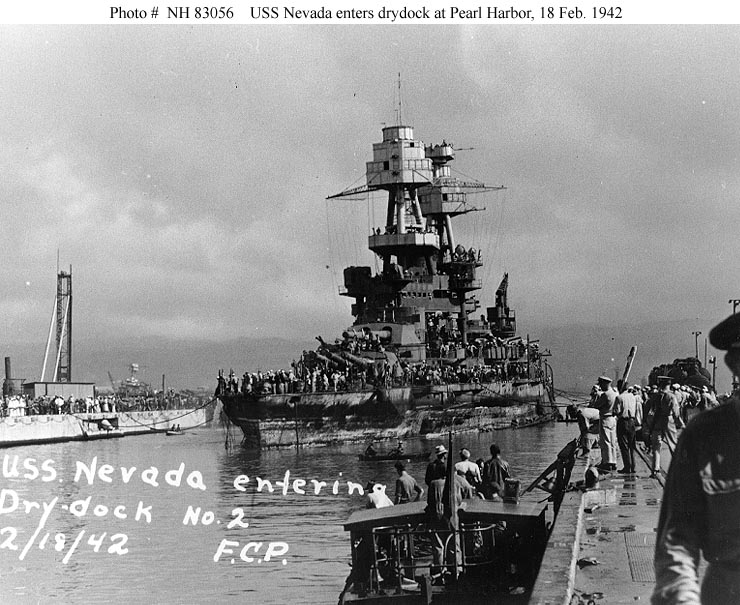
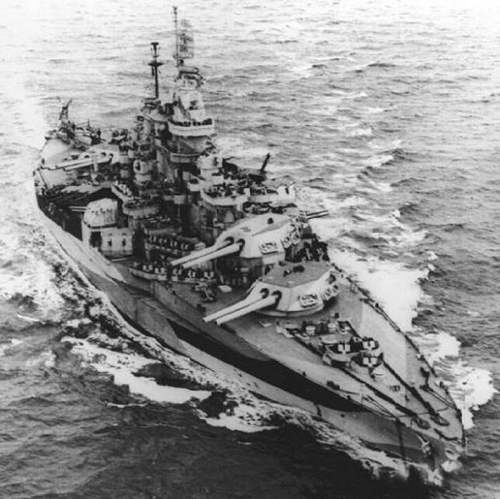
Nevada was the first major ship salvaged. She was re-floated in February 1942 and after temporary repairs sailed to the West Coast on her own power. After repairs and a significant modernization of her anti-aircraft systems was complete she returned to action in 1943 in the invasion of Attu Alaska. She participated in many amphibious operations including Normandy, Southern France, Iwo Jim and Okinawa. She survived the Atomic Bomb tests in 1946 but wrecked and radioactive she was sunk as a target off Hawaii in 1948.

g13154

h55038

California was raised in March and after temporary repairs sailed under her own power to the West Coast. Her repairs and modernization were a major undertaking. Fully reconditioned and modernized to standards of most modern battleships she returned to service in January 1944. She served in retaking Saipan, Guam, Tinian as well as Leyte Gulf were she had a significant part in the Battle of Surigao Strait. Hit by a Kamikaze she was repaired and returned to action at Okinawa and support the occupation operations of the Japanese Home Islands. She was decommissioned in 1947 and sold for scrapping in 1959.

h64474

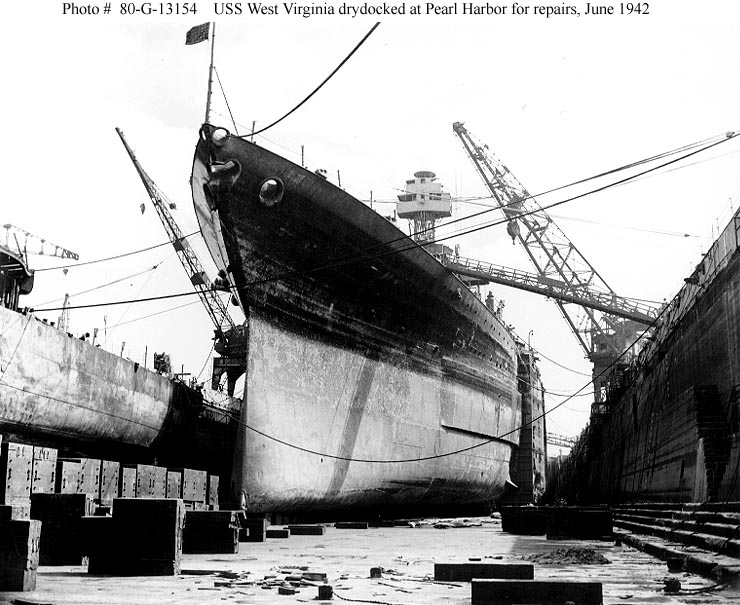
West Virginia suffered the most severe damage of the battleships returned to duty. She was raised in July 1942 and after repairs sailed to Puget Sound Naval Shipyard. Like California she was completely rebuilt and returned to action in October 1944 in time to take the lead role in destroying the Japanese Battleship Yamashiro. She served throughout the remainder of the war in the Pacific at Iwo Jima, Okinawa and the occupation of Japan.

h54564

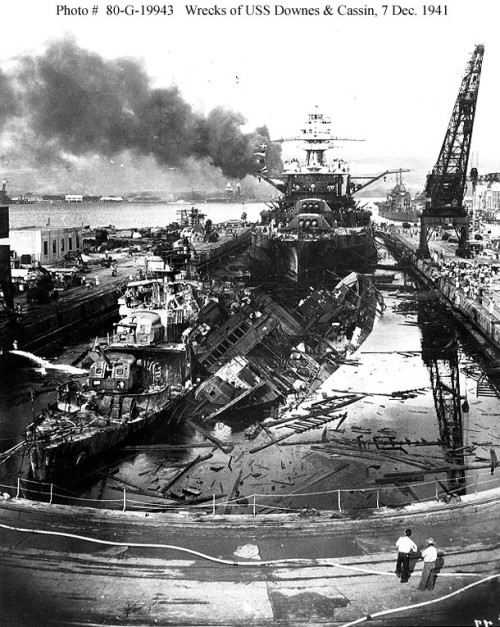
The Mahan Class destroyers Cassin and Downes were so badly damaged sitting in the Dry Dock Number One with Pennsylvania that initially they were believed beyond salvage. However after closer inspection it was determined that the hull fittings, main weapons systems and propulsion machinery on both ships were worth salvaging. These items were removed, shipped to Mare Island Naval Shipyard and installed on new hulls being constructed. The hulks of the old ships were scrapped at Pearl Harbor. Those ships were commissioned as the Cassin and Downes and served throughout the war.

h55063

Both were decommissioned in 1945 and scrapped in 1947. Their sister ship Shaw which had blown up in the floating dry dock was wrecked from her bridge forward. However the rest of the ship including her engineering spaces were intact. A temporary bow was fashioned and the ship sailed to Mare Island under her own power. Completely overhauled she was back in service by July 1942. She was decommissioned in 1945 and scrapped in 1946.

h50005

The ancient minelayer Oglala was raised in July and sent back to the West Coast where she was repaired and recommissioned as an internal combustion engine repair ship. She survived the war was decommissioned and transferred to Maritime Commission custody. She was a depot ship at the Suisun Bay Reserve Fleet until 1965 when she was sold for scrap.

h64492

The salvage feat to return these ships to duty was one of the most remarkable operations of its type ever conducted. Not only were most of the ships salvaged but most returned to duty. While none survive today many played key roles during the war. Artifacts of some of the ships are on display at various Naval Bases, Museums and State Capitals. They, their brave crews and the Navy Divers and civilian diving and salvage experts who conducted this task exhibited the finest traditions of the US Navy. The successors of the Navy divers at Mobile Diving Salvage Units One and Two still carry on that tradition today.

Peace

Padre Steve+

11 Comments

Filed under History, Military, Navy Ships, US Navy, world war two in the pacific

In Harm’s Way: The Ships that Got Underway at Pearl Harbor

They were an odd collection of ships. A battleship, two modern light cruisers, an elderly light cruiser and a collection of destroyers, destroyer minesweepers and destroyer minelayers. Yet in the midst of the din and bloody chaos of the Japanese attack on Pearl Harbor these ships, sometimes with only the most junior of officers in charge got underway and took to sea in order to seek out and engage the Japanese.

Their sortie is dramatized in the Otto Preminger film In Harm’s Way. 

http://www.tcm.com/mediaroom/video/477483/In-Harm-s-Way-Movie-Clip-Twelve-Bat-Blind-Ships.html

For the first forty minutes of the attack only two ships were underway. The USS Ward which had sunk the Japanese midget submarine outside the harbor entrance an hour before the attack began. The USS Helm was in the main channel as the attack began. They were joined over the next two hours by other ships.

g32445

The USS Nevada was the only battleship to get underway that morning and though she did not get to sea her example served to inspire those on the battered ships in the harbor and ashore. Her commanding officer and executive officer were ashore, along with many other senior officers. However her Damage Control Officer, Lieutenant Commander Francis Thomas, a reservist took command and as the senior officer present on the the ship got her underway. Then as she was battered by the second wave of Japanese attackers he skillfully grounded her off Hospital Point to keep her from being sunk in the narrow main channel.

LL lv PHUSS St Louis passing Battleship Row

The USS St. Louis was moored outboard of her sister ship USS Honolulu at the Naval Station. Her sortie was enabled by members of her crew who chopped down the gangplank and cut water lines to the shore. Under command of Captain George Rood she got underway at 0931 and was the first cruiser to get underway.

6565601_f496

USS Phoenix sortie at Pearl Harbor

She was joined by her sister ship USS Phoenix and the elderly light cruiser USS Detroit which was moored on the far side of Ford Island.  Phoenix survived the war only to be sunk in the 1982 Falklands war as the Argentine ship General Belgrano.

0400808

The destroyer USS Blue got underway under the command of Ensign Nathan Asher, who had just three other ensigns with him as that ship got underway. She was joined by Monaghan, Dale, Henley, Phelps, Farragut, MacDonough, Worden, Patterson, Jarvis and Aylwin also under command of an junior officer, Ensign Stanley Caplan. Henley left without her commander under the command of Lieutenant Francis Fleck Jr.

h68450

Others too got underway, The USS Mugford was the duty destroyer and got underway quickly, as did Cummings. The Ralph Talbot was underway by 0900. Conyngham got underway in the early afternoon. Perhaps the most interesting story was the USS Selfridge which got underway manned by a composite crew of 7 different ships.

0535702

The cruisers and destroyers were joined by a number of elderly former destroyers which had been converted to Destroyer Minesweepers or Minelayers. The Ramsay, Breese, Trever and Perry all got underway, Trever also minus her commanding officer.

h97789

Some of the ships formed in a vain search for the Japanese strike force while others conducted defensive anti-submarine operations in the waters off Pearl Harbor.

The fact that all of these ships were able to get underway and navigate through the chaos of the attack, often under the command of junior officers and without key crew members was a testament to the courage and initiative of US Navy Officers and Sailors. It is a courage and initiative still in evidence today.

Peace

Padre Steve+

4 Comments

Filed under History, Loose thoughts and musings, movies, Navy Ships, US Navy, world war two in the pacific

Battleship Row: The Story of the Battleships of Pearl Harbor

the-japanese-attack-on-pearl-harbor-everett-2

“Yesterday, Dec. 7, 1941 – a date which will live in infamy – the United States of America was suddenly and deliberately attacked by naval and air forces of the Empire of Japan…. The attack yesterday on the Hawaiian Islands has caused severe damage to American naval and military forces. Very many American lives have been lost.” Except of President Franklin D Roosevelt’s Pearl Harbor Speech December 8th 1941

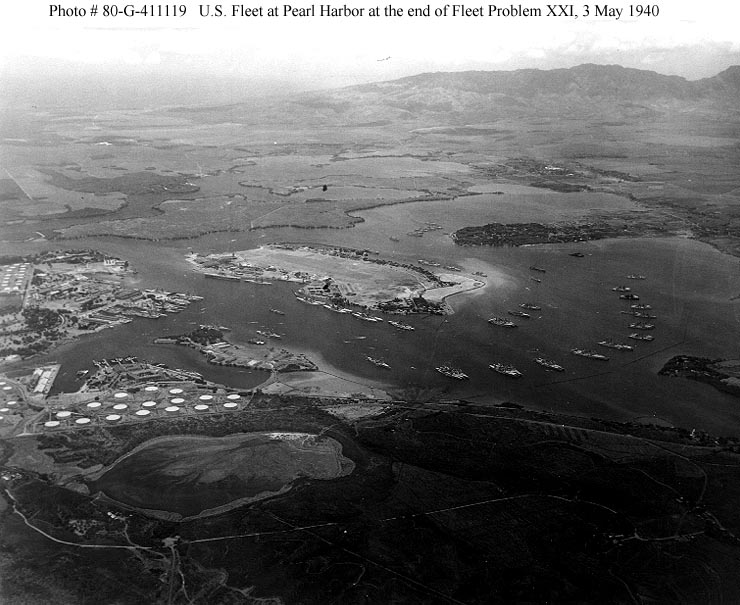
g411119

Today is the 72nd anniversary of the Japanese attack on Pearl Harbor and as we were then we are at war. Of course it is not the same kind of war and most Americans live in the illusion of peace which makes it even more important to remember that terribly day of infamy.

I remember reading Walter Lord’s classic and very readable book about Pearl Harbor “Day of Infamy” when I was a 7th grade student at Stockton Junior High School back in 1972.  At the time my dad was on his first deployment to Vietnam on the USS Hancock CVA-19.  As a Navy brat I was totally enthralled with all things Navy and there was little that could pull me out of the library.  In fact in my sophomore year of high school I cut over one half of the class meetings of the 4th quarter my geometry class to sit in the library and read history, especially naval and military history.

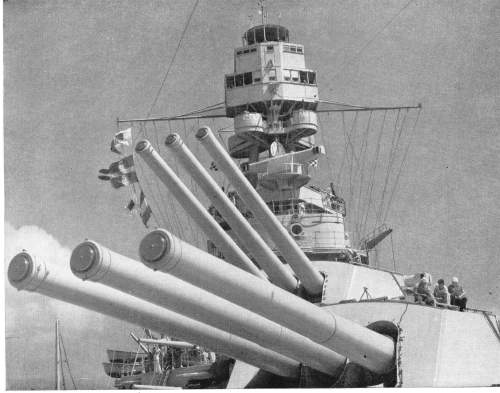
arizon-main-battery2-2

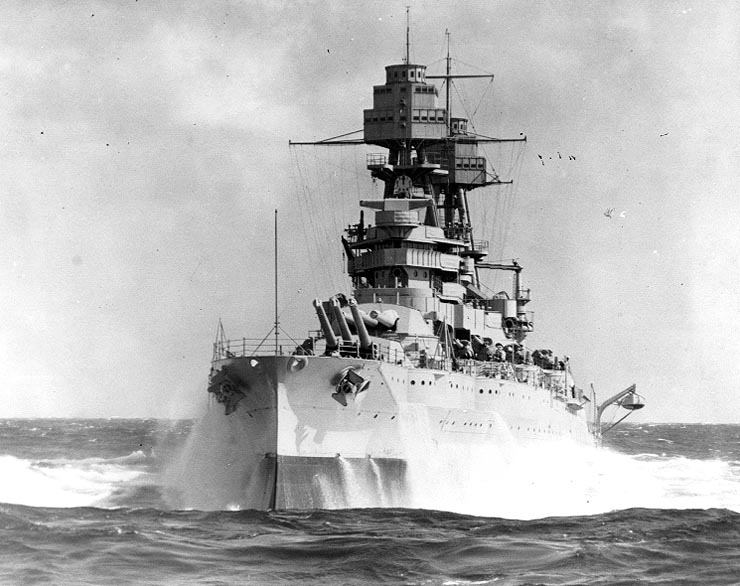
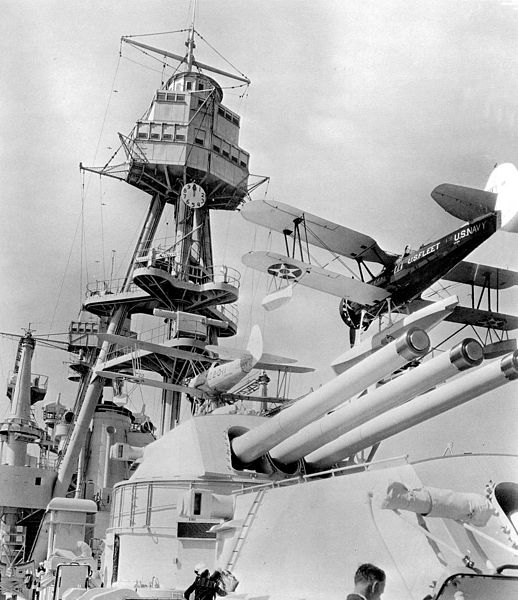
The main battery of either USS Arizona or Pennsylvania 

Over the years I have always found the pre-World War Two battleships to be among the most interesting ships in US Navy history.  No they are not the sleek behemoths like the USS Wisconsin which graces the Norfolk waterfront. They were not long and sleek, but rather squat yet exuded power. They were the backbone of the Navy from the First World War until Pearl Harbor.  They were the US Navy answer to the great Dreadnaught race engaged in by the major Navies of the world in the years prior to, during and after World War One.

pennsylvania-under-golden-gate

USS Pennsylvania passing under the Golden Gate

Built over a period of 10 years each class incorporated the rapid advances in technology between the launching of the Dreadnaught and the end of the Great War.  While the United States Navy did not engage in battleship to battleship combat the ships built by the US Navy were equal to or superior to many of the British and German ships of the era.

puyBfl

US Battleships at the Grand Fleet Review of 1937

Through the 1920s and 1930s they were the ambassadors of the nation, training and showing the flag. During those years the older ships underwent significant overhaul and modernization.

arizona-and-battleline

The Battle Force of the Pacific Fleet in 1941 included 9 battleships of which 8 were at Pearl Harbor on the morning of December 7th.  In the event of war the US War Plan, “Orange” called for the Pacific Fleet led by the Battle Force to cross the Pacific, fight a climactic Mahanian battle against the battleships of the Imperial Japanese Navy and after vanquishing the Japanese foe to relieve American Forces in the Philippines.  However this was not to be as by the end of December 7th all eight were out of action, with two, the Arizona and Oklahoma permanently lost to the Navy.

The ships comprised 4 of the 6 classes of battleships in the US inventory at the outbreak of hostilities.  Each class was an improvement on the preceding class in speed, protection and firepower.  The last class of ships, the Maryland class comprised of the Maryland, Colorado and West Virginia, was the pinnacle of US Battleship design until the North Carolina class was commissioned in 1941.  Since the Washington Naval Treaty limited navies to specific tonnage limits as well as the displacement of new classes of ships the United States like Britain and Japan was limited to the ships in the current inventory at the time of the treaty’s ratification.

uss_oklahoma

USS Oklahoma

The ships at Pearl Harbor included the two ships of the Nevada class, the Nevada and Oklahoma they were the oldest battleships at Pearl Harbor and the first of what were referred to as the “standard design” battleships. The two ships of the Pennsylvania class, the Pennsylvania and her sister the Arizona served as the flagships of the Pacific Fleet and First Battleship Division respectively and were improved Nevada’s. The California class ships, California and Tennessee and two of the three Maryland’s the Maryland and West Virginia made up the rest of the Battle Force.

california-1938

USS California passing under Brooklyn Bridge

The Colorado was undergoing a yard period at Bremerton and the three ships of the New Mexico class, New Mexico, Mississippi and Idaho had been transferred to the Atlantic before Pearl Harbor due to the German threat.  The three oldest battleships  ships of the New York and Wyoming Classes, the New York, Arkansas and Texas also were in the Atlantic. Two former battleships, the Utah and Wyoming had been stripped of their main armaments and armor belts and served as gunnery training ships for the fleet. The Utah was at Pearl Harbor moored on the far side of Ford Island.

9.athumb

The ships that lay at anchor at 0755 that peaceful Sunday morning on “Battleship Row” and in the dry dock represented the naval power of a bygone era, something that most did not realize until two hours later. The age of the battleship was passing away, but even the Japanese did not realize that the era had passed building the massive super-battleships Yamato and Musashi mounting nine 18” guns and displacing 72,000 tons, near twice that of the largest battleships on Battleship Row.

bb36_06

USS Nevada at Pearl Harbor

The Oklahoma and Nevada were the oldest ships in the Battle Force.  Launched in 1914 and commissioned in 1916 the Nevada and Oklahoma mounted ten 14” guns and displaced 27,500 tons and were capable of 20.5 knots. They served in World War One alongside the British Home Fleet and were modernized in the late 1920s. They were part of the US presence in both the Atlantic and Pacific in the inter-war years. Oklahoma took part in the evacuation of American citizens from Spain in 1936 during the Spanish Civil War.

013717


USS Oklahoma Capsized (above) and righted (below)


oklahoma-salvage

During the Pearl Harbor attack Oklahoma was struck by 5 aerial torpedoes capsized and sank at her mooring with the loss of 415 officers and crew. Recent analysis indicates that she may have been hit by at least on torpedo from a Japanese midget submarine. Her hulk would be raised but she would never again see service and sank on the way to the breakers in 1946.

nevada-1

USS Nevada aground off Hospital Point

Nevada was the only battleship to get underway during the attack.  Moored alone at the north end of Battleship Row her Officer of the Deck had lit off a second boiler an hour before the attack.  She was hit by an aerial torpedo in the first minutes of the attack but was not seriously damaged. She got underway between the attack waves and as she attempted to escape the harbor she was heavily damaged. To prevent her from sinking in the main channel she was beached off Hospital Point.

800px-USS_Nevada_(BB-36)_specs

nevada-utah-beach

USS Nevada at Normandy 

Nevada was raised and received a significant modernization before returning to service for the May 1943 assault on Attu.  Nevada returned to the Atlantic where she took part in the Normandy landings off Utah Beach and the invasion of southern France.  She returned to the Pacific and took part in the operations against Iwo Jima and Okinawa where she again provided naval gunfire support.  Following the war the great ship was assigned as a target at the Bikini atoll atomic bomb tests. The tough ship survived these tests and was sunk as a target on 31July 1948.

USS_Arizona_(BB-39)_-_1930s

USS Arizona

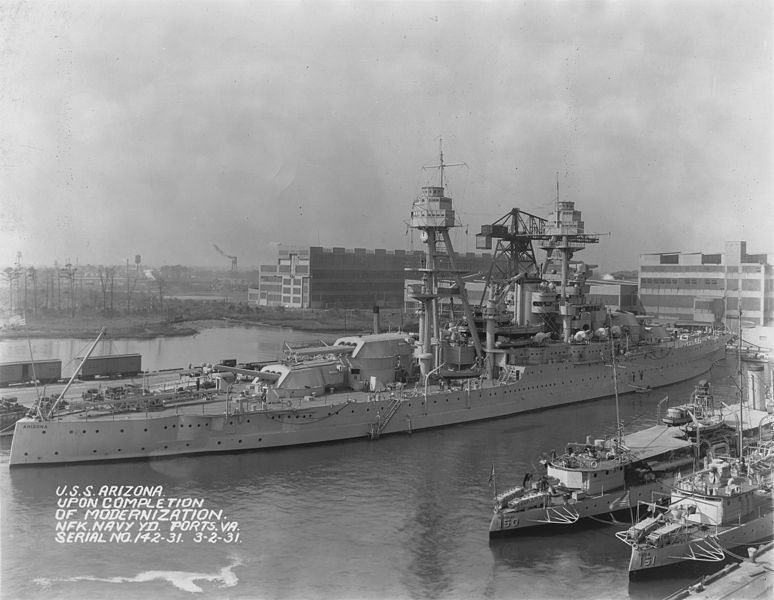
The two ships of the Pennsylvania Class were improved Oklahoma’s.  The Arizona and Pennsylvania mounted twelve 14” guns and displacing 31,400 tons and capable of 21 knots they were both commissioned in 1916. They participated in operations in the Atlantic in the First World War with the British Home Fleet. Both ships were rebuilt and modernized between 1929-1931.

518px-O3U-3s_on_USS_Pennsylvania_(BB-38)_in_1935

They were mainstays of the fleet being present at Presidential reviews, major fleet exercises and making goodwill visits around the world.  Pennsylvania was the Pacific Fleet Flagship on December 7th 1941 and was in dry dock undergoing maintenance at the time of the attack. She was struck by two bombs and received minor damage.

pennsylania-drydock

She was back in action in early 1942. She underwent minor refits and took part in many amphibious landings in the Pacific and was present at the Battle of Surigao Strait.  She was heavily damaged by an aerial torpedo at Okinawa Pennsylvania and was repaired. Following the war the elderly warrior was used as a target for the atomic bomb tests. She was sunk as a gunnery target in 1948.

774px-USS_Arizona_after_1931_modernization_NARA_19-LC-19B-1

arizona-buring

Arizona was destroyed during the attack. As the flagship of Battleship Division One she was moored next to the repair ship USS Vestal.  She was hit by 8 armor piercing bombs one of which penetrated her forward black powder magazine. The ship was consumed by a cataclysmic explosion which killed 1103 of her 1400 member crew including her Captain and Rear Admiral Isaac Kidd, commander of Battleship Division One.  She was never officially decommissioned and the colors are raised and lowered every day over the Memorial which sits astride her broken hull.

tennessee-1938

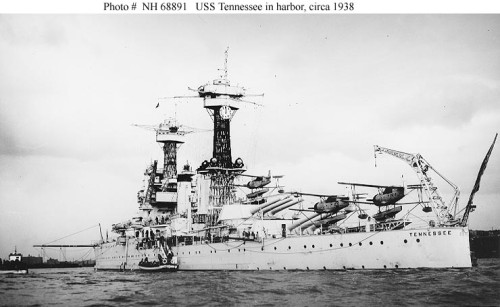
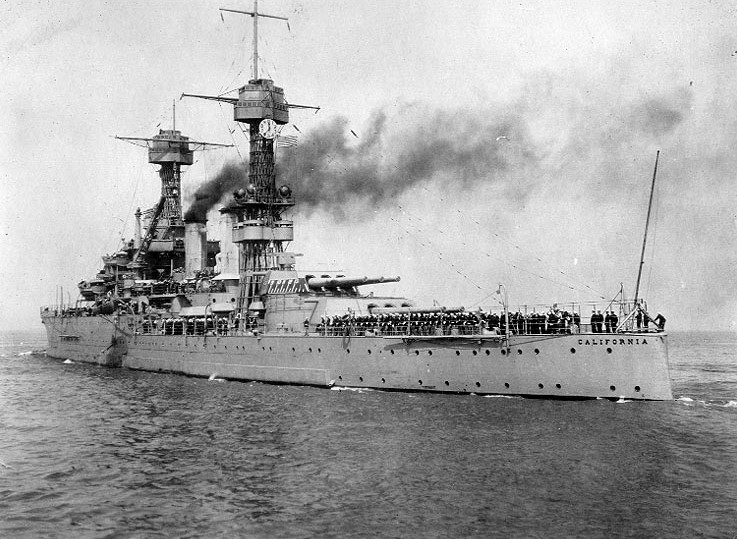
The Tennessee class ships the Tennessee and California were the class following the New Mexico class ships which were not present at Pearl Harbor. These ships were laid down in 1917 and commissioned in 1920. Their design incorporated lessons learned at the Battle Jutland. They mounted twelve 14” guns, displaced 32,300 tons and were capable of 21 knots. At Pearl Harbor Tennessee was moored inboard of West Virginia and protected from the aerial torpedoes which did so much damage to other battleships. She was damaged by two bombs. California the Flagship of Battleship Division Two was moored at the southern end of Battleship Row. She was hit by two torpedoes in the initial attack. However, she had the bad luck to have all of her major watertight hatches unhinged in preparation for an inspection.

uss_california_bb44_03

h64474

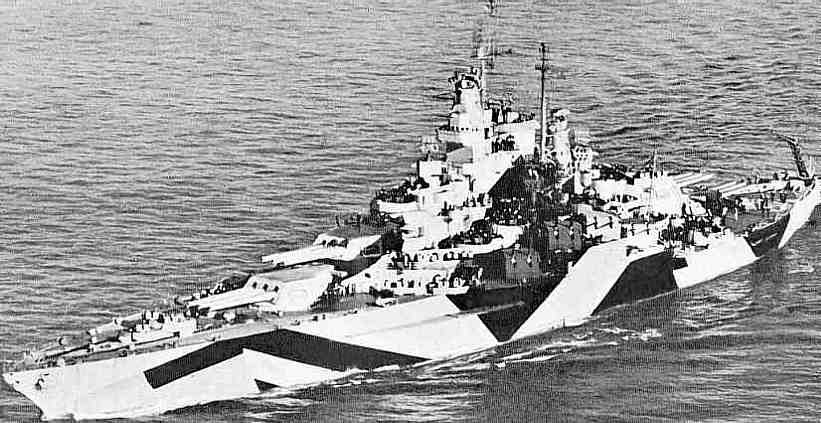
Despite the valiant efforts of her damage control teams she sank at her moorings. She was raised and rebuilt along with Tennessee were completely modernized with the latest in radar, fire control equipment and anti-aircraft armaments. They were widened with the addition of massive anti-torpedo bulges and their superstructure was razed and rebuilt along the lines of the South Dakota class.

USS California Late WWII

USS California following Modernization

014389o

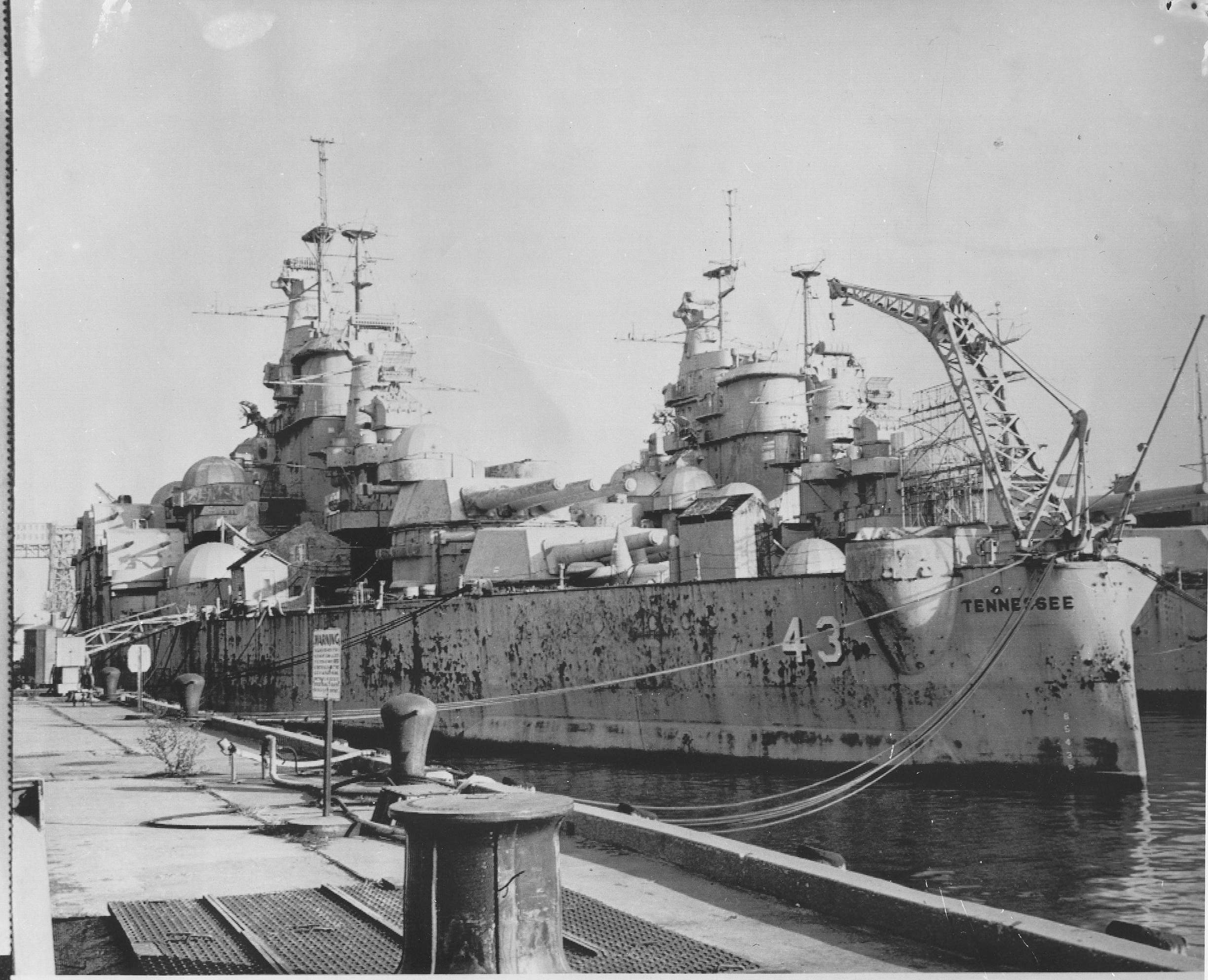
USS Tennessee with another ship, possibly California in reserve awaiting the breakers

When the repairs and modernization work was completed they looked nothing like they did on December 7th. Both ships were active in the Pacific campaign and be engaged at Surigao Strait where they inflicted heavy damage on the attacking Japanese squadron. Both survived the war and were placed in reserve until 1959 when they were stricken from the Navy list and sold for scrap.

west-virginia-1934

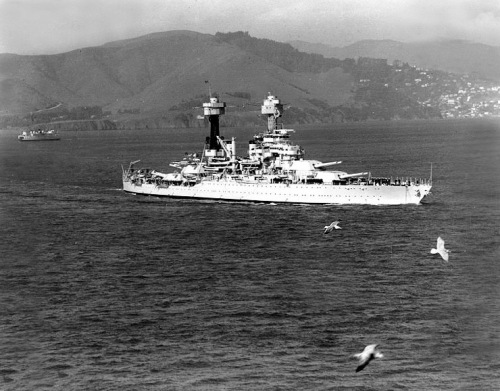
USS West Virginia 

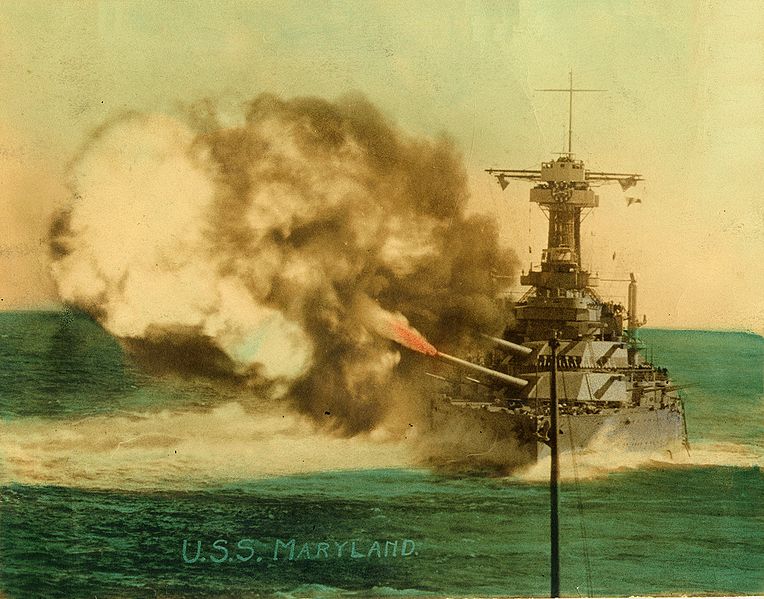
The Maryland and West Virginia were near sisters of the Tennessee class.  They were the last battleships built by the United States before the Washington Naval Treaty. and the first to mount 16” guns. With eight 16” guns they had the largest main battery of any US battleships until the North Carolina class.

764px-USS_Maryland_broadside_1920s

They displaced 32,600 tons and could steam at 21 knots. Laid down in 1917 and commissioned in 1921 they were modernized in the late 1920s. They were the most modern of the Super-Dreadnoughts built by the United States and included advances in protection and watertight integrity learned from both the British and German experience at Jutland.

09_maryland_oklahoma_pearl_harbor

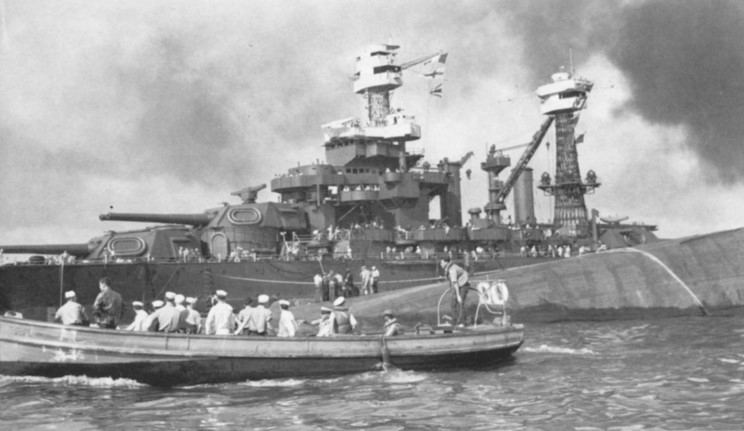
USS Maryland behind the capsized Oklahoma

At Pearl Harbor Maryland  was moored inboard of Oklahoma and was hit by 2 bombs and her crew helped rescue survivors of that unfortunate ship.  She was quickly repaired and returned to action.  She received minimal modernization during the war. She participated in operations throughout the entirety of the Pacific Campaign mainly conducting Naval Gunfire Support to numerous amphibious operations. She was present at Surigao Strait where despite not having the most modern fire control radars she unleashed six salvos at the Japanese Southern Force.

729px-Photograph_of_the_damage_done_to_the_USS_West_Virginia,_sunk_in_the_Japanese_raid_on_Pearl_Harbor_-_NARA_-_306536

754px-USS_West_Virginia_5-21-42,_Port_quarter_showing_previous_water_line_(FCP)_-_NARA_-_296915

west-virginia-damage

USS West Virginia, sunk, raised and in dry dock, note the massive damage to Port Side

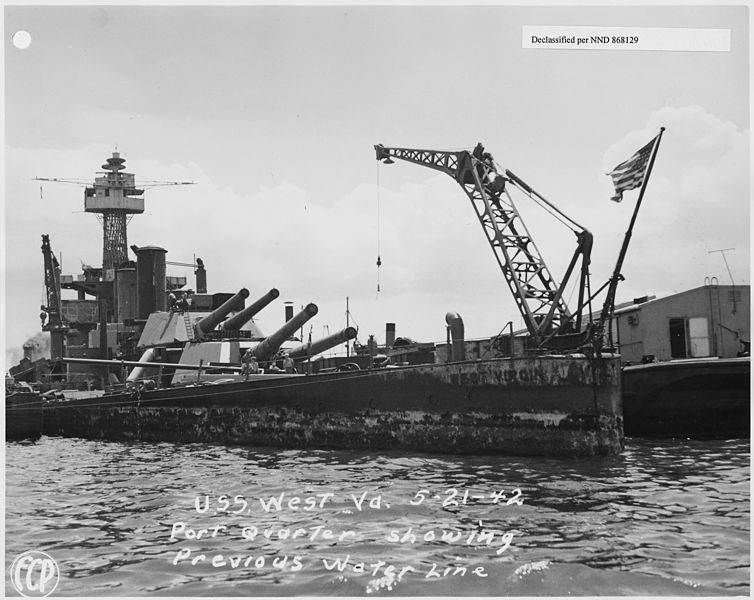
West Virginia suffered some of the worst damage in the attack. She was hit by at least 5 torpedoes and two bombs. She took a serious list and was threatening to capsize. However she was saved from Oklahoma’s fate by the quick action of her damage control officer who quickly ordered counter-flooding so she would sink on an even keel.  She was raised from the mud of Pearl Harbor and after temporary repairs and sailed to the West Coast for an extensive modernization on the order of the Tennessee and California.

west-virginia-final-config

USS West Virginia after salvage and modernization 

West Virginia was the last Pearl Harbor to re-enter service. However when she returned she made up for lost time.  She led the battle line at Surigao Strait and fired 16 full salvos at the Japanese squadron. Her highly accurate gunfire was instrumental in sinking the Japanese Battleship Yamashiro in the last battleship versus battleship action in history.  West Virginia, Maryland and their sister Colorado survived the war and were placed in reserve until they were stricken from the Naval List and sold for scrap in 1959.

The battleships of Pearl Harbor are gone, save for the wreck of the Arizona and various relics such as masts, and ships bells located at various state capitals and Naval Stations.  Unfortunately no one had the forethought to preserve one of the survivors to remain at Pearl Harbor with the Arizona.  Likewise the sailors who manned these fine ships, who sailed in harm’s way are also passing away.  Every day their ranks grow thinner, the youngest are all 89-90 years old.

As this anniversary of the Pearl Harbor attack passes into history it is fitting to remember these men and the great ships that they manned.

Peace,

Padre Steve+

4 Comments

Filed under History, Military, Navy Ships, News and current events, US Navy, world war two in the pacific

Pearl Harbor, the Missing Carriers: USS Enterprise, USS Lexington and USS Saratoga

h50931

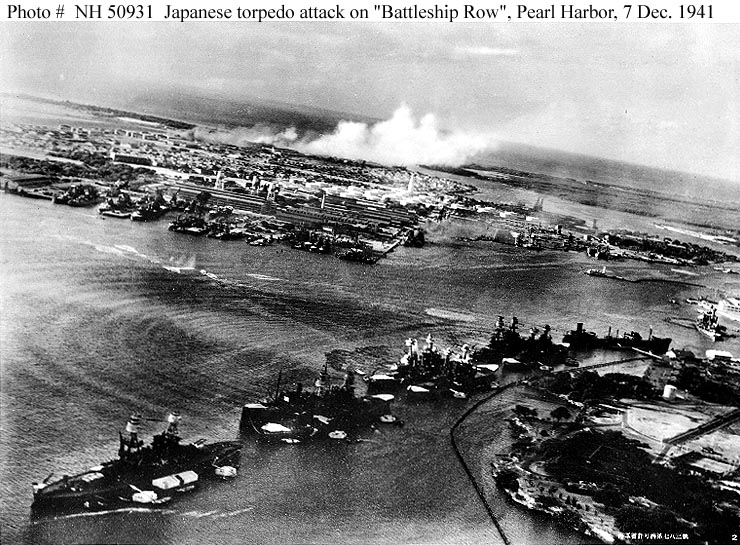
On the morning of December 7th 1941 8 of the 9 Battleships assigned to the US Pacific Fleet were in Pearl Harbor. Seven, the USS California, USS Maryland, USS Oklahoma, USS Tennessee, USS West Virginia, USS Arizona and USS Nevada were moored on Battleship Row. The USS Pennsylvania was in the massive dry dock which she shared with the destroyers USS Cassin and USS Downes. The USS Colorado, a sister ship of Maryland and West Virginia was at the Puget Sound Naval Yard being overhauled.

pearlharbor_wide-6febcbc3473e02a65f9b7b9e151905b7300c328f-s6-c30

USS West Virginia sinking at left and USS Tennessee burning at Pearl Harbor

At the time both the United States Navy and the Japanese Imperial Navy still viewed the Battleships as the heart of the fleet and the essence of naval power. Aircraft Carriers were still viewed as an adjunct and support to the traditional battle line.

Japanese-carriersJapanese Aircraft preparing to launch at Pearl Harbor

Thus as the Japanese Carrier Strike Group, the Kido Butai under the command of Vice Admiral Chūichi Nagumo approached Pearl Harbor and intelligence reports came in indicating that the carriers were not present the Japanese were not overly concerned. The lack of concern was in a sense ironic because the force they assigned to destroy the Battleships of the Pacific Fleet was the carrier strike group, not their battle line.

Kido-Butai-in-the-North-Pacific

The Kido Butai enroute to Pearl Harbor

Comprised of six carriers, the Akagi, Kaga, Hiryu, Soryu, Shokaku and Zuikaku the force embarked over 300 first line aircraft. The aviators of the air groups aboard the carriers had been training for months to attack Pearl Harbor. Their aircraft had been specially outfitted with Type 91 Model 2 aerial torpedoes designed to run in the shallow waters of Pearl Harbor and Type 99 Model 5 armor piecing bombs modified from battleship shells. These weapons would be employed with a devastating effect on the morning of December 7th 1941.

The three carriers assigned to the Pacific Fleet, the USS Saratoga, USS Lexington and USS Enterprise had been dispatched on missions that took them away from Pearl Harbor that fateful Sunday.

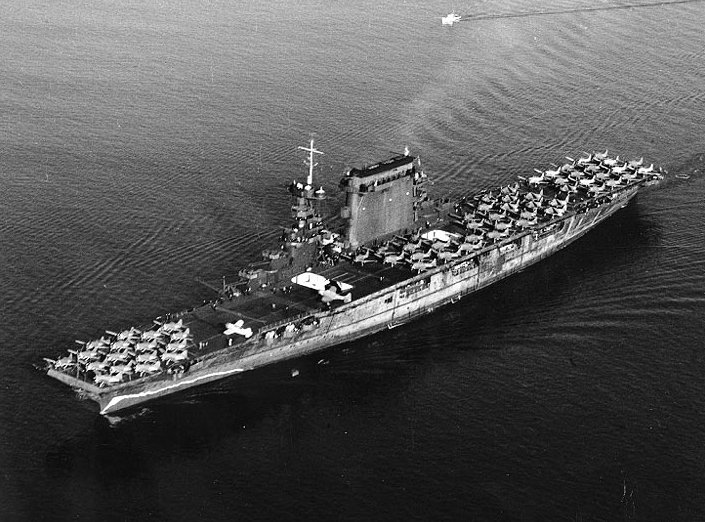
USS_Lexington

USS Lexington

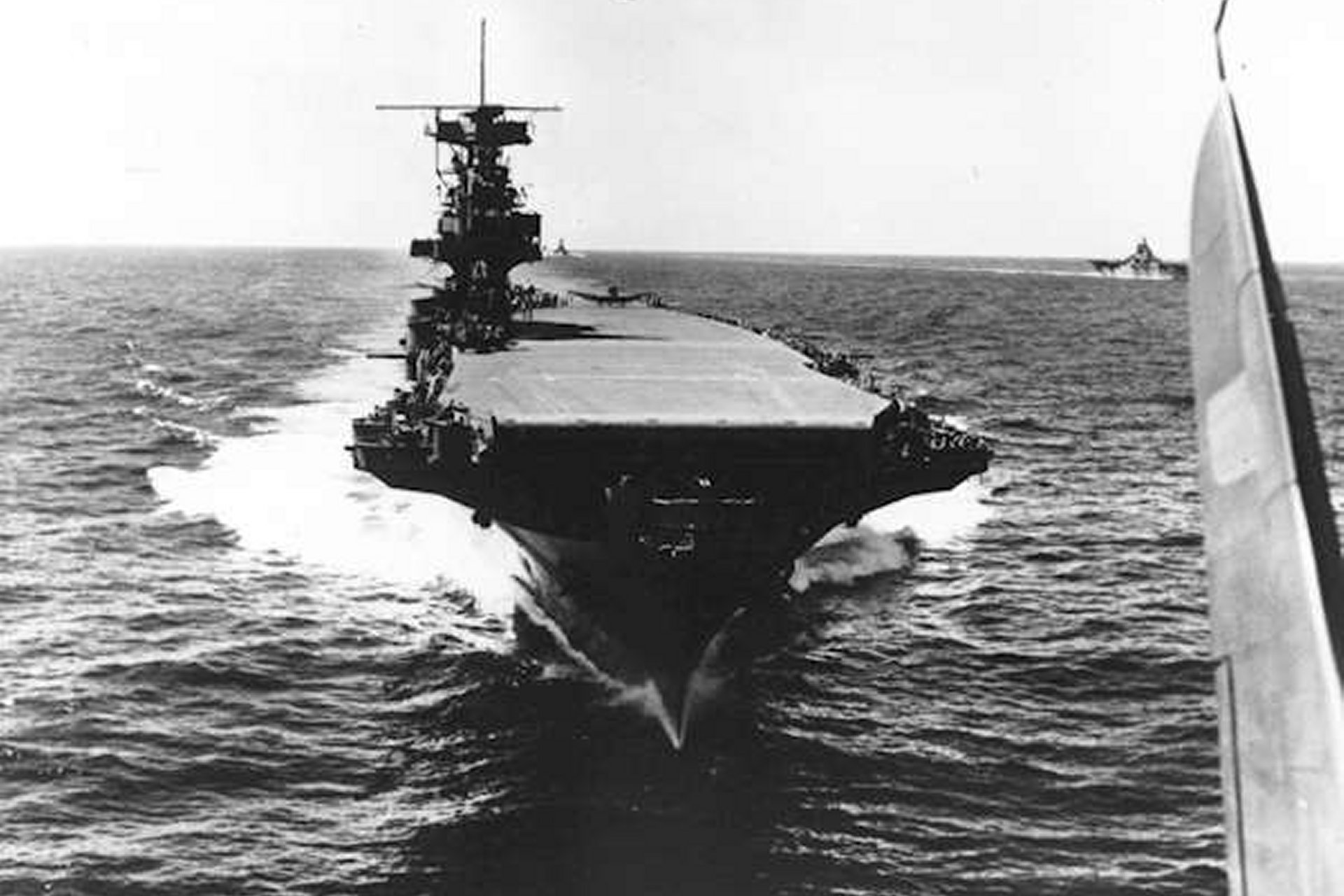
The Lexington and Task Force 12 had departed Pearl Harbor on December 5th to ferry 18 SB2U Vindicator Dive Bombers of VSMB-231 to Midway Island. Saratoga was entering San Diego to embark her air group and Enterprise which had left Pearl Harbor on November 28th to deliver VMF-211 to Wake Island was due to return to Pearl Harbor on the 7th of December. As such none of these ships were in Pearl Harbor at the time of the attack. Their absence helped save the United States and Allied cause in the Pacific.

USS_Saratoga_CV-3_underway_1942

USS Saratoga

The United States had other carriers but all were assigned to the Atlantic Fleet due to the belief that Nazi Germany was a greater threat than Japan. The USS Yorktown was at Norfolk in between deployments in support of the Neutrality Patrol. USS Ranger was returning to Norfolk from a patrol, USS Wasp was at Grassy Bay Bermuda and the newly commissioned USS Hornet was training out of Norfolk. The USS Long Island, the first Escort carrier was undergoing operational tests and training out of Norfolk.

cv-6-01USS Enterprise at Midway

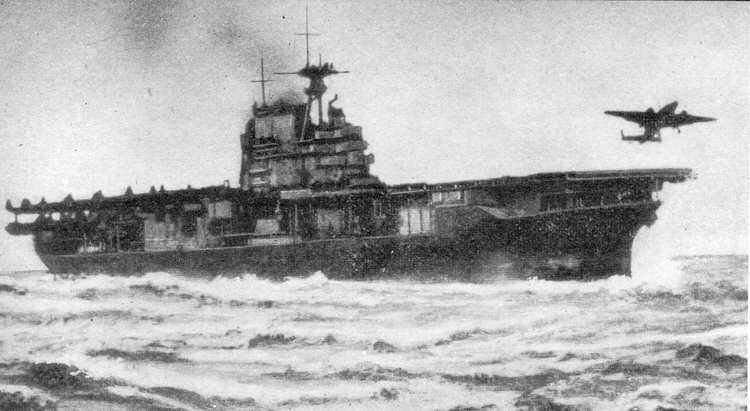
Had any of the three carriers assigned to the Pacific Fleet been in Pearl Harbor on the morning of the Japanese attack the results would have been even more disastrous for the United States. Instead the carriers began operations against the Japanese almost immediately. Carriers based on the East Coast including Hornet, Yorktown and Wasp were transferred to the Pacific. In the perilous months following the Pearl Harbor attack the US carriers took the fight to the Japanese conducting raids against Japanese held islands. In April 1942 the Enterprise and Hornet, the latter with 16 B-25 Mitchell bombers under the command of Colonel Jimmy Doolittle struck Tokyo.

gallery_30225_28868_12824874244ae0d6734af3b

USS Hornet launching the Doolittle Raiders

The result was that Admiral Isoruku Yamamoto decided to attack Midway Island to force the US fleet and its carriers into a decisive battle. Although the Japanese had lost a good number of aircrew from Shokaku and Zuikaku at the Battle of Coral Sea, while sinking the Lexington Yamamoto remained committed to the decisive battle. That battle was decisive, but not in the way Yamamoto had planned. Akagi, Kaga, Hiryu and Soryu were sunk by aircraft operating from Enterprise, Yorktown and Hornet. Yorktown was lost in the battle bat it was a decisive defeat for the Japanese.

Attack_of_the_Akagi

Sinking the Akagi at Midway

In the succeeding months in the vicious battles around the Solomon Islands the remaining US carriers proved decisive. Although Wasp and Hornet were sunk in those battles and both Saratoga and Enterprise often heavily damaged they held the line. The carriers that the Japanese missed proved decisive in turning the tide and winning the war.

22_bb48

Raised from the mud of Pearl Harbor the USS West Virginia in Tokyo Bay

Though Yamamoto did not realize it the attack on Pearl Harbor signaled the end of the supremacy of the Battleship and the ascendency of the Aircraft Carrier. By 1943 Battleships were regulated to escorting the fast carrier task forces or conducting shore bombardments. The ultimate irony was that the last battleship engagement in history was won by the survivors of the attack on Pearl Harbor. Raised from the mud the West Virginia, Tennessee, California, Maryland and Pennsylvania joined by the USS Mississippi rained destruction on two Japanese task forces attempting to penetrate Leyte Gulf and destroy the US invasion force transports at the Battle of Surigao Strait.

The ironies and intricacies of war. They are amazing.

Peace

Padre Steve+

24 Comments

Filed under History, Military, Navy Ships, US Navy, world war two in the pacific

A Global Force for Good: Happy 238th Birthday to the US Navy

Navy Heritage WWII Recruitment Poster

http://www.navy.mil/viewVideo.asp?id=17676

“A good Navy is not a provocation to war. It is the surest guaranty of peace.” Theodore Roosevelt 

For me anything to do with the United States Navy is historical as well as decidedly personal. Sunday is the 238th anniversary of the founding of the United States Navy, actually the founding of the Continental Navy but let’s not get too technical.

The fact is that back in 1775 most people and political leaders in the revolting colonies felt that founding a Navy was quite foolish. After all, who in their right mind would ever dare to challenge the might of the British Royal Navy? Even revolting colonies. But like when King George III was told that “the Colonies are revolting” he reportedly said “tell me something I don’t know.” But I digress…

In fact had General George Washington not sent a letter to the Continental Congress say that he had taken some vessels in hand to disrupt the supplies of the the British Army a Navy might not have ever been established. Timing is everything and in this case it was pretty good timing.

Since that fortuitous day in 1775 the United States Navy went from being a piss ant annoyance to the Royal Navy to the premier naval power in the world. Men like John Paul Jones, Edward Preble Stephen Decatur, Thomas Truxtun, William Bainbridge, Oliver Hazard Perry, David Farragut, David Dixon Porter, George Dewey and many more blazed a path of glory which others, great and small would continue to build on the legacy of the iron men who sailed wooden ships into harm’s way. Men like Arleigh Burke, Howard Gilmore, John C. Waldron, Maxwell Leslie, Bull Halsey, Richard O’Kane, Daniel Callahan, Raymond Spruance, Ernest Evans built upon that legacy in the Second World War. Others would do so in the Cold War, Vietnam and the Global War on Terrorism.

Great ships like the USS Constitution, USS Monitor, USS Kerasarge, USS Olympia, USS Enterprise, USS Hornet, USS Yorktown, USS Growler, USS Tang, USS Hoel, USS Johnston, USS Samuel B Roberts, USS Laffey, USS San Francisco, USS Houston and USS Arizona, USS Nevada, USS West Virginia and USS California helped build a legacy of valiant sacrifice and service often at great cost in the defense of freedom.

But over those 238 years it all it came down to the men and now the men and women who served in every clime and place, many times outnumbered and facing certain defeat who through their courage, honor and commitment helped secure the liberty of their countrymen and others around the world. Most of these men and women served in obscurity in war and peace but all had the distinction of serving in the United States Navy.

As President John F Kennedy said: “I can imagine no more rewarding a career. And any man who may be asked in this century what he did to make his life worthwhile, I think can respond with a good deal of pride and satisfaction: ‘I served in the United States Navy.'”

295_26911932058_5614_n-1

Like my father before me I can say that I am proud to have served and continue to serve in the United States Navy, because we are no matter what some may say or think,  a global force for good.

Peace

Padre Steve+

1 Comment

Filed under History, Navy Ships, US Navy

An older post of mine about Pearl Harbor as we approach the 71st anniversary of that “Day of Infamy.”

padresteve's avatarThe Inglorius Padre Steve's World

Arizona Leading the Battle Line

“Yesterday, Dec. 7, 1941 – a date which will live in infamy – the United States of America was suddenly and deliberately attacked by naval and air forces of the Empire of Japan…. The attack yesterday on the Hawaiian Islands has caused severe damage to American naval and military forces. Very many American lives have been lost.” Except of President Franklin D Roosevelt’s Pearl Harbor Speech December 8th 1941

Today is the 68th anniversary of the Japanese attack on Pearl Harbor and as we were then we are at war.

A Date that Will Live in Infamy: USS Arizona Burning

I remember reading Walter Lord’s “Day of Infamy” when I was a 7th grade student at Stockton Junior High School back in 1972.  At the time my dad was on his first deployment to Vietnam on the USS Hancock CVA-19.  As…

View original post 1,837 more words

1 Comment

Filed under History, Military, Navy Ships, traumatic national events, US Navy, world war two in the pacific

The Battleships of D-Day

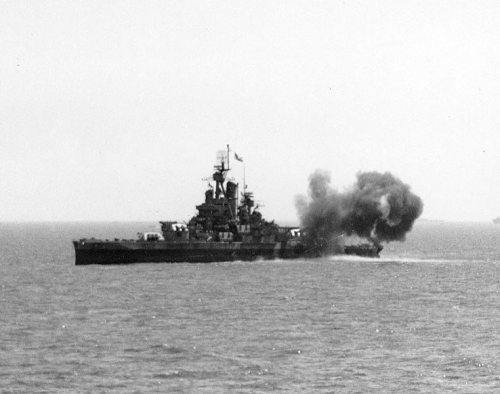
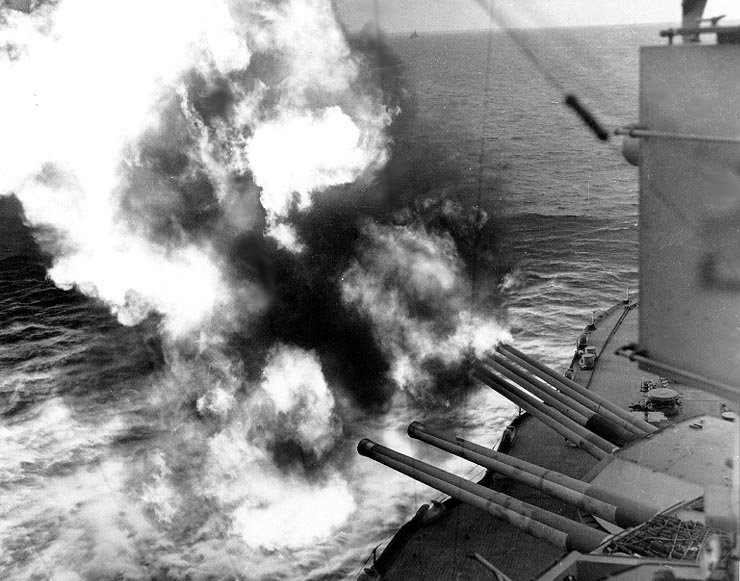
The 14″ Guns of USS Nevada in action at Normandy

On June 6th 1944 Allied Forces landed on the beaches of Normandy. Six American, British and Canadian Infantry Divisions, three Airborne Divisions and numerous supporting units came ashore in landing craft or were airdropped into Normandy. Backing them was an immense Naval Task Force which provided naval gunfire support, screened the force from German U-Boat or surface naval forces and transported the massive ground force.  It was an amazing armada.

HMS Rodney bombarding German positions off Caen

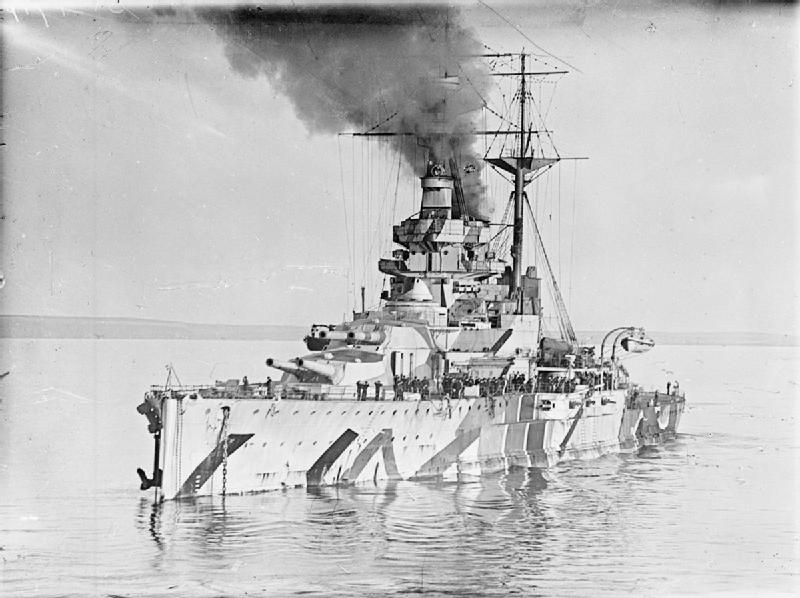
It was an armada that also is forgotten by many who read about Normandy or whose only exposure to the landings are films such as Saving Private Ryan. Today I think it is fitting to remember Battleships that served at Normandy, USS Arkansas, USS Texas, USS Nevada, HMS Warspite, HMS Ramillies and HMS Rodney.

USS Arkansas off Omaha Beach

The naval gunfire support force included Battleships, Cruisers and Destroyers as well as specialized gunfire support ships.  The largest and most powerful ships were the six American and British Battleships.  These ships were important in providing the heavy firepower needed to destroy the strongest fortifications and shore batteries and to fire at targets far beyond the shoreline that were vital for German reinforcements.

However the ships involved were not the modern behemoths which were built in the 1930s and since the beginning of the war but rather among the oldest ships still active in either the United States or the British Royal Navy. At one time they had all been the hearts for their navies but now old, slow and with less than modern armament and fire control systems they were regulated to supporting amphibious forces or escorting convoys.

USS Arkansas BB-33

The oldest of these venerable ships was the USS Arkansas BB-33 which was commissioned in 1912. A Wyoming Class Battleship she mounted twelve 12” guns in six twin turrets, two forward, two aft and two midships. She displaced just over 27,000 tons. She had spent most of the war escorting convoys in the Atlantic before being assigned to the Normandy landings. She stood off Omaha Beach dueling with German shore batteries and pounding the German troops who were making Omaha a living hell for the men of the US 1st and 29th Infantry Divisions.  She would continue her valuable service off of Normandy and would do the same in to support the landings in Southern France before steaming to the Pacific where she would do the same at Iwo Jima and Okinawa.

USS Texas BB-35

The USS Texas, BB-35 of the New York class had been in commission since 1914. She mounted ten 14” guns in 5 twin turrets, two forward, two aft and one midships and was slightly larger than the Arkansas.  More modern she was more extensively modernized between the wars than was Arkansas and was one of the first US ships to carry experimental radar sets.  She also conducted convoy operations but was used to bombard Vichy French troops and positions during Operation Torch, the Allied invasion  of North Africa.  At D-day she was in the western sector of Omaha and bombarded Point Du Hoc and cruised to within 3000 yards of the beach to clear the western exits of the beach near Vierville.  She remained in the area a number of days and would subsequently support the attack on Cherbourg, the invasion of South France and then serve in the Pacific at Iwo Jima and Okinawa.

USS Nevada BB-36

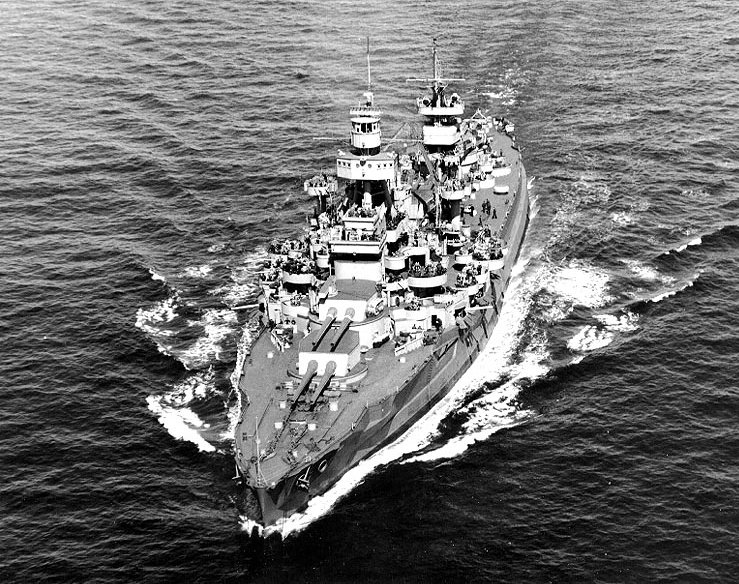
The USS Nevada BB-36 was the first of a new class of battleships which set the basic pattern of US Battleship design through the ratification of the Washington Naval Treaty. Her main battery of ten 14” guns was mounted in four turrets, mounted fore and aft two triple and 2 twin turrets.  She was he powered by oil fired boilers as opposed to coal and   was designed with a longer cruising radius to meet the demands of War Plan Orange.  Nevada received major upgrades between the wars and on December 7th 1941 was moored on Battleship Row when Peal Harbor was attacked by the Japanese. The only Battleship to get underway during the attack Nevada was set upon by Japanese aircraft as she steamed toward the harbor entrance. Heavily damaged she was grounded off Hospital Point. She was re-floated and sailed to the United States where she was heavily modernized with a modern AA battery of twin 5” 38 caliber guns, and fire direction radars. She was modernized to the point that she no longer resembled the ship sunk at Pearl Harbor. After her repair and modernization she participated in the invasion of Attu Island and did convoy escort duty before reporting for the invasion of Normandy. Nevada supported the US 4th Infantry Division at Utah Beach and subsequently served with Texas and Arkansas in South France before going to the Pacific to support the invasions of Iwo Jima and Okinawa. Had the war continued she would have been involved in the invasion of the Japanese Mainland.

HMS Warspite

The Royal Navy Battleships of D-Day were also elderly veterans. The eldest was the heroic HMS Warsipte commissioned in 1915 and a veteran of the Battle of Jutland and numerous actions during the Second World War including the slaughter of the German Destroyers at Narvik, the Battle of Cape Matapan and the invasion of Sicily and Italy.  The Queen Elizabeth Class Battleship mounted eight 15” guns in twin turrets and was extensively modernized between the wars. At Salerno Warspite was hit by three of the earliest guided missiles, the Fritz-X type launched by Luftwaffe Aircraft. She was heavily damaged and required major repairs before returning to service at Normandy. She supported British troops at Sword Beach and later Gold Beach. She again was heavily damaged by a magnetic mine and received temporary repairs to allow her to continue bombardment duties against German positions France and Belgium before being placed in reserve in January 1945.

HMS Ramillies

The HMS Ramillies was a Revenge Class Battleship commissioned in 1917. These ships were a compromise design that was smaller, slower and cheaper than the Queen Elizabeth Class but had the same main battery of eight 15” guns.  The compromises prevented them from receiving significant upgrades between the wars and limited their employment. Ramillies operated as a convoy escort and was also involved in action in  the Mediterranean and Indian Ocean. She participated in the hunt for the German Pocket Battleship Graf Spee and shielded Convoy HX-106 from the Scharnhorst and Gneisenau and later took part in the hunt for the Bismarck. However she but was not engaged against any of the German ships but her presence prevented Admiral Lutjens from risking Scharnhorst and Gneisenau to attack the convoy. She took part in the initial battle between the Royal Navy and the Italians at the Battle of Cape Spartivento getting off several salvos before her slow speed forced her out of the action. She was heavily damaged by a torpedo from a Japanese mini-submarine in Diego Suarez harbor during the invasion of Madagascar in May 1942. Following repairs and the addition of extra deck armor and modern anti-aircraft guns she returned to action at Normandy were she supported British troops ashore and drove off an attack by German Destroyers. She stayed in action firing over 1000 shells at Normandy before supporting the invasion of Southern France. Too slow to be of use in the Pacific she was placed in Reserve in January 1945.

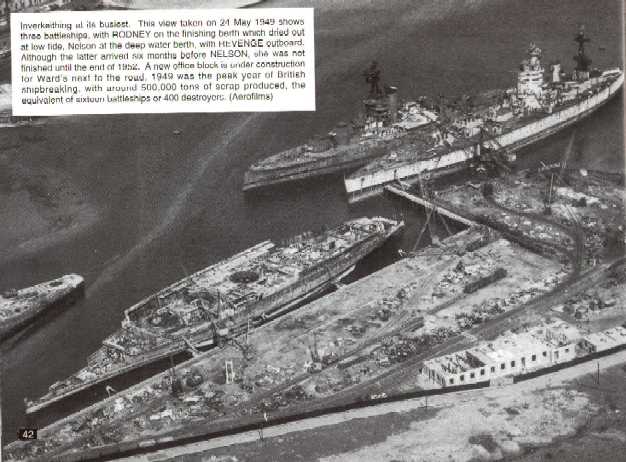
HMS Rodney

The youngest of the Battlewagons at Normandy on June 6th was the HMS Rodney which was commissioned in 1927. She and her sister ship HMS Nelson were to be the first of the post WWI super battleships and was designed as a larger and more powerful ship. With the limitations of the Washington Naval Treaty the ships were “cut down” and reduced in size and speed. Her armament made her one of the most powerful battleships of period but her engineering plant was not always reliable. Since she was relatively modern she did not receive any major refits before the war and apart from a repairs to her engines in Boston in 1941 (before the US entry into the war) and a brief refit in 1942 she received no further refits during the war. With the HMS King George V she helped sink the Bismarck and would escort convoys and participate in the Allied invasions of North Africa, Sicily and Salerno before being assigned to the Normandy invasion force attacking targets near Caen.  Her sister HMS Nelson was held in reserve and joined the battle on June 10th but she was not present on D-Day.

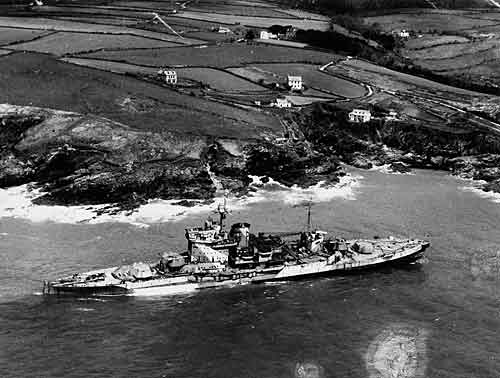
Warspite aground and Rodney being scrapped (below)

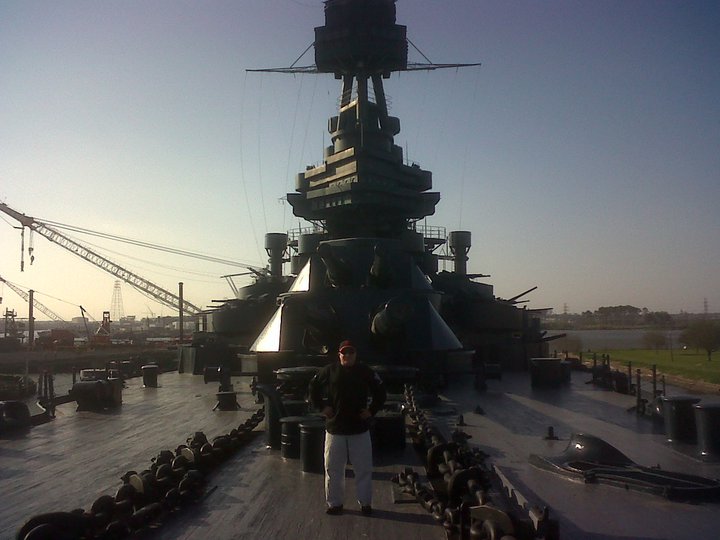
Despite their age and limitations all of these ships and their performed heroically during the war. The post war period was not as kind to the ships. Arkansas and Nevada were used in the Atomic Bomb tests at Bikini Atoll. Nevada survived and was expended as a target in 1948. All of the British ships were scrapped following the war due to their age, wear and damage incurred during the war. Warspite was being towed to the breakers when she broke a tow line and went aground. She ended up being partially scrapped in place.  Mementos of all these ships remain including a gun from Ramillies at the Imperial War Museum. The lone survivor was the USS Texas which became a museum ship and memorial at the San Jacinto battlefield in 1948. She is the last of the Dreadnought ships remaining. Other more modern US Battleships have been preserved but only Texas remains from those ships that at one time ruled the waves and pounded the Germans at Normandy.

The author aboard USS Texas in March 2011

The fire support provided by these proud ships and their consorts ensured the success of the Normandy landings. Without them it is very possible that the landings would not have succeeded and many more Allied soldiers would have died and the war extended.

To these great ships and all their heroic crews…

Peace

Padre Steve+

28 Comments

Filed under History, Military, Navy Ships, US Navy, world war two in europe

Remembering the Men of D-Day

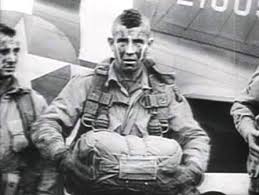
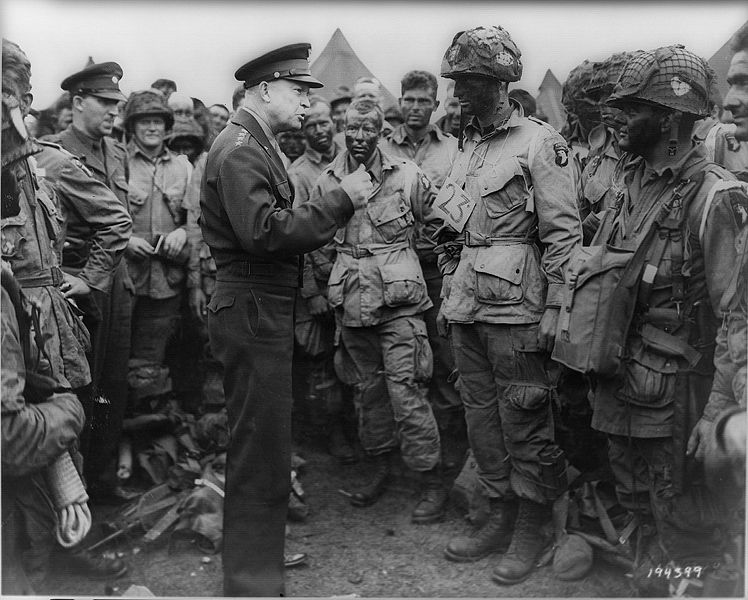
Eisenhower with Paratroopers of the 101st Airborne Division

Soldiers, Sailors and Airmen of the Allied Expeditionary Force!

You are about to embark upon the Great Crusade, toward which we have striven these many months. The eyes of the world are upon you. The hopes and prayers of liberty-loving people everywhere march with you.  In company with our brave Allies and brothers-in-arms on other Fronts, you will bring about the destruction of the German war machine, the elimination of Nazi tyranny over the oppressed peoples of Europe, and security for ourselves in a free world.

Your task will not be an easy one. Your enemy is well trained, well equipped and battle hardened. He will fight savagely.

 But this is the year 1944! Much has happened since the Nazi triumphs of 1940-41. The United Nations have inflicted upon the Germans great defeats, in open battle, man-to-man. Our air offensive has seriously reduced their strength in the air and their capacity to wage war on the ground. Our Home

Fronts have given us an overwhelming superiority in weapons and munitions of war, and placed at our disposal great reserves of trained fighting men. The tide has turned! The free men of the world are marching together to Victory!

 I have full confidence in your courage and devotion to duty and skill in battle. We will accept nothing less than full Victory!

 Good luck! And let us beseech the blessing of Almighty God upon this great and noble undertaking.

                                            SIGNED: Dwight D. Eisenhower
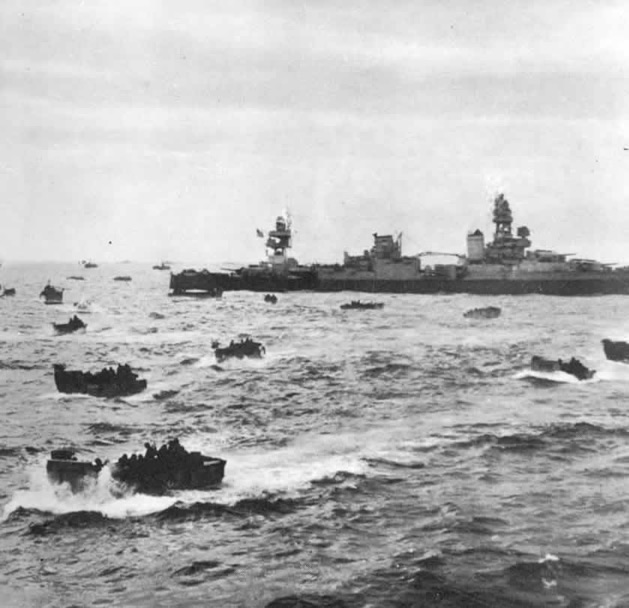
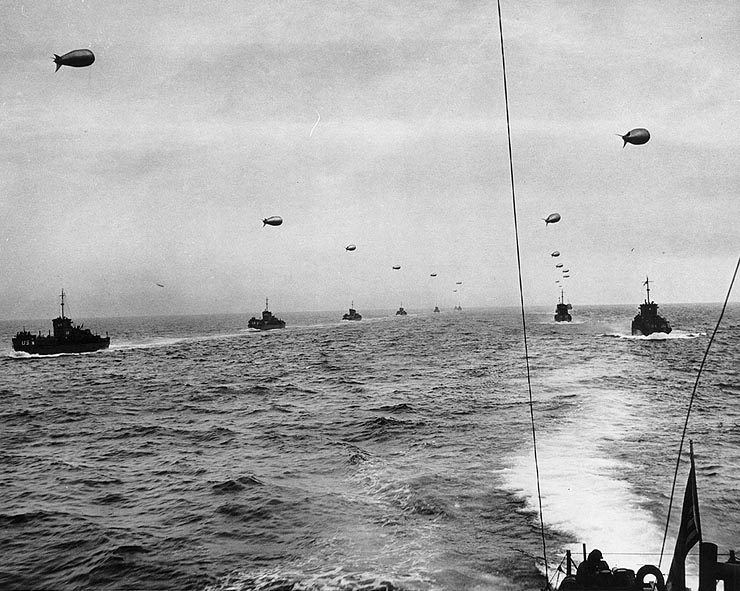
Convoy of Landing Craft Infantry (LCI) steaming toward Normandy

On June 6th 1944 the Allies invaded German controlled France on the beaches of Normandy. By that evening the Allied Expeditionary Force had landed six infantry divisions on five invasion beaches and the bulk of three airborne divisions on the approaches to those beaches. Near 175,000 Allied Soldiers, Sailors, Airmen and Marine Commandos were involved in the attack and nearly 10,000 would listed be as killed, wounded or missing by the end of the day, over half on Omaha Beach.

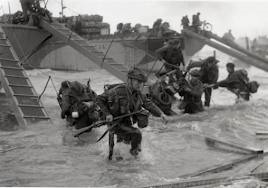
British Commandos landing on Sword Beach. Their Commander Lord Lovat is to the right of the column in the surf

The names of the invasion beaches and the units involved have been immortalized in history, in film and literature. The American 101st Airborne “Screaming Eagles,” the “All American” 82nd Airborne Division and British 6th Airborne Division “Red Devils” made the largest night airborne drop and battled Germans, the elements as the struggled to reorganize on the heels of widely scattered drops.  The Americans battled the German 91st Airlanding Division and the crack 6th Parachute Regiment, while the British faced men of the 716th “Static” Infantry Division and battle groups of the nearby 21st Panzer Division.
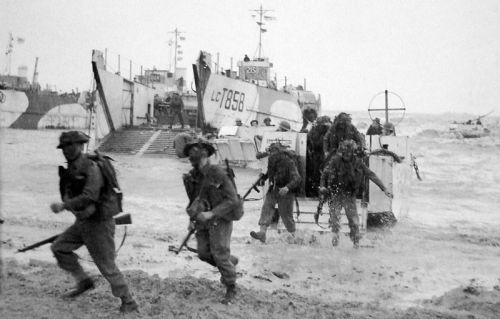
British Commandos landing at Gold Beach

On Sword Beach men of the 3rd British Division and 27th Armoured Brigade teamed with the 1st Special Services Brigade composed of Army and Royal Marine Commandos made the assault, to their right on Juno Beach the Canadians of the 3rd Canadian Division, 2nd Canadian Armoured Brigade and two Royal Marine Commandos (battalions) while to their right on the middle invasion beach, God Beach the British 50th (Northumbrian) Infantry Division and 8th Armoured Brigade went ashore with elements of the British 79th Armoured Division and the 47th Royal Marine Commando.

Omaha Beach

To the right of the British landed the American V Corps on Omaha Beach, the 1st Infantry Division, the famous “Big Red One” and the 29th “Blue and Gray” Infantry Division of the Virginia and Maryland National Guard. They would fight the most seasoned Germans on the beaches that day, the hardened combat veterans of the 352nd Infantry Division.  The battle of Omaha was nearly a disaster and a one point General Omar Bradley contemplated withdraw from the beach.  The American troops, including the men of the 2nd Ranger Battalion who scaled the cliffs of Point du Hoc to protect the beach from enfilade fire from German artillery mounted on the point, yet the German guns had not yet been emplaced and the Rangers fought a bitter battle against strong German resistance on that rugged mount.  On the far right the American VII Corps led by the 4th Infantry Division assaulted Utah Beach; fortunately the Americans landed away from their planned point of assault and faced little resistance. Had they landed in the correct location they might fared as their neighbors on Omaha Beach.
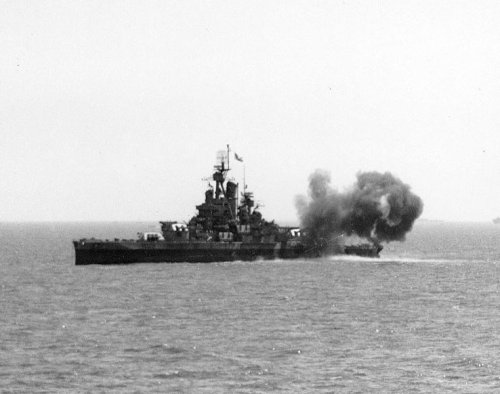
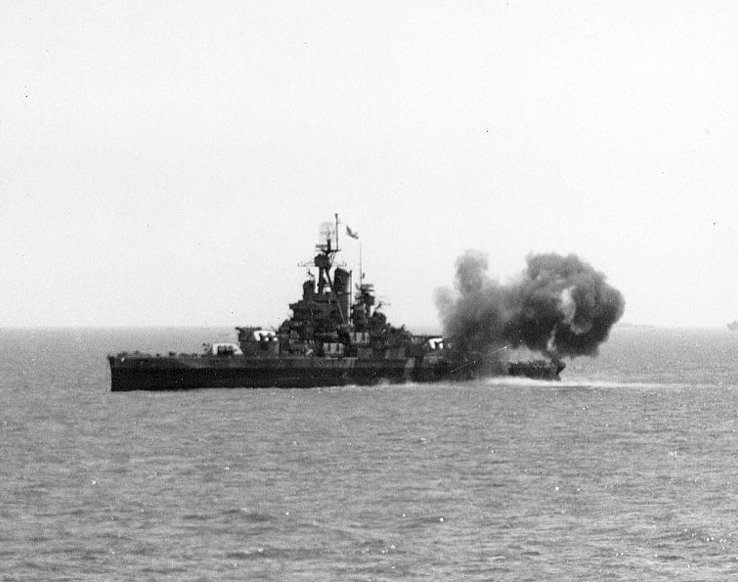
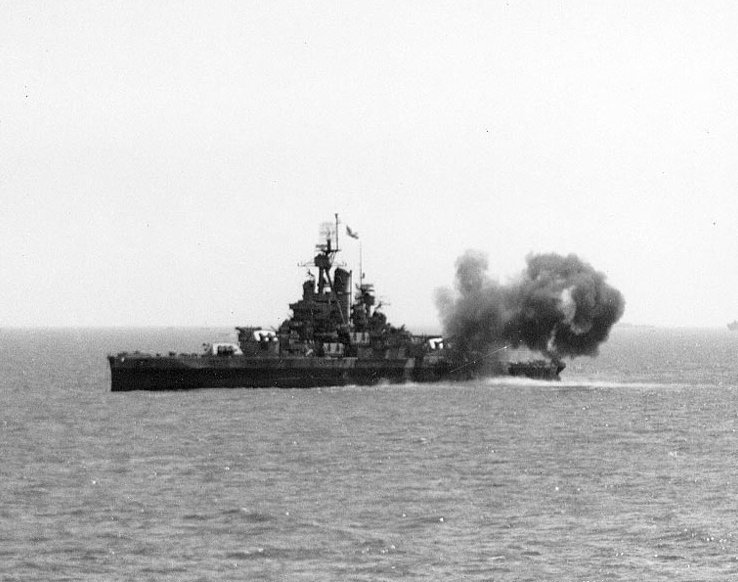
USS Nevada bombarding Normandy beaches

Offshore the venerable battleships HMS Warspite and HMS Ramillies and the USS Texas, USS Nevada and USS Arkansas provided fire support to the beaches aided by the Free Naval Forces of France, the Netherlands, Poland and Norway.  The French forces included the cruisers Montcalm and Georges Leygues.

Names such has St Mere-Eglise and Pegasus Bridge, the Merville Battery, Point du Hoc and Bloody Omaha remain etched in the minds of the dwindling number of surviving veterans as well as historians, military personnel and others that take the time to remember the sacrifices of these men.

The Men came from all parts of the United States and the British Commonwealth. Additionally personnel from France and other countries occupied by Nazi Germany were represented in the land, air and naval forces involved.  For the French, humiliated by their defeat in 1940 and divided by the Vichy and Free French divide were determined, despite their small numbers to liberate their homeland.
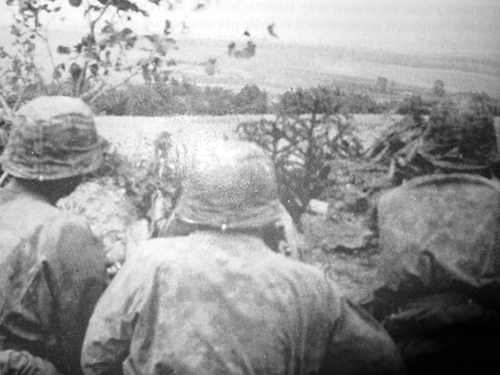
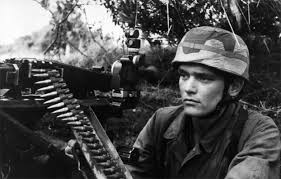
The forgotten Soldiers, Panzer Grenadiers in Normandy

They were opposed by four German Divisions, a Luftwaffe Fallschirmjaeger regiment and elements of the 21st Panzer Division.  The Germans with nothing in the way of air support and no significant naval forces were on their own. Hitler had refused Rommel’s request to deploy Panzer divisions near the beaches and was not awakened when word came of the invasion.  German soldiers fought with considerable valor and would do so throughout the Normandy campaign, even if they fought for a regime that was evil at its core.

On the night of June 6th President Franklin Roosevelt addressed the American people, offering a prayer for the nation, the troops and the success of the invasion:

My Fellow Americans:

Last night, when I spoke with you about the fall of Rome, I knew at that moment that troops of the United States and our Allies were crossing the Channel in another and greater operation. It has come to pass with success thus far.

And so, in this poignant hour, I ask you to join with me in prayer:

Almighty God: Our sons, pride of our nation, this day have set upon a mighty endeavor, a struggle to preserve our Republic, our religion, and our civilization, and to set free a suffering humanity.

Lead them straight and true; give strength to their arms, stoutness to their hearts, steadfastness in their faith.

They will need Thy blessings. Their road will be long and hard. For the enemy is strong. He may hurl back our forces. Success may not come with rushing speed, but we shall return again and again; and we know that by Thy grace, and by the righteousness of our cause, our sons will triumph.

They will be sore tried, by night and by day, without rest — until the victory is won. The darkness will be rent by noise and flame. Men’s souls will be shaken with the violences of war.

For these men are lately drawn from the ways of peace. They fight not for the lust of conquest. They fight to end conquest. They fight to liberate. They fight to let justice arise, and tolerance and goodwill among all Thy people. They yearn but for the end of battle, for their return to the haven of home.

Some will never return. Embrace these, Father, and receive them, Thy heroic servants, into Thy kingdom.

And for us at home — fathers, mothers, children, wives, sisters, and brothers of brave men overseas, whose thoughts and prayers are ever with them — help us, Almighty God, to rededicate ourselves in renewed faith in Thee in this hour of great sacrifice.

Many people have urged that I call the nation into a single day of special prayer. But because the road is long and the desire is great, I ask that our people devote themselves in a continuance of prayer. As we rise to each new day, and again when each day is spent, let words of prayer be on our lips, invoking Thy help to our efforts.

Give us strength, too — strength in our daily tasks, to redouble the contributions we make in the physical and the material support of our armed forces.

And let our hearts be stout, to wait out the long travail, to bear sorrows that may come, to impart our courage unto our sons wheresoever they may be.

And, O Lord, give us faith. Give us faith in Thee; faith in our sons; faith in each other; faith in our united crusade. Let not the keeness of our spirit ever be dulled. Let not the impacts of temporary events, of temporal matters of but fleeting moment — let not these deter us in our unconquerable purpose.

With Thy blessing, we shall prevail over the unholy forces of our enemy. Help us to conquer the apostles of greed and racial arrogances. Lead us to the saving of our country, and with our sister nations into a world unity that will spell a sure peace — a peace invulnerable to the schemings of unworthy men. And a peace that will let all of men live in freedom, reaping the just rewards of their honest toil.

Thy will be done, Almighty God.

Amen.

President Franklin D. Roosevelt – June 6, 1944

Forty years later President Ronald Reagan made one of the most memorable speeches about the landings when he spoke at Omaha Beach.

We stand today at a place of battle, one that 40 years ago saw and felt the worst of war.  Men bled and died here for a few feet of – or inches of sand, as bullets and shellfire cut through their ranks.  About them, General Omar Bradley later said, “Every man who set foot on Omaha Beach that day was a hero.”

Some who survived the battle of June 6, 1944, are here today.  Others who hoped to return never did.

“Someday, Lis, I’ll go back,” said Private First Class Peter Robert Zannata, of the 37th Engineer Combat Battalion, and first assault wave to hit Omaha Beach.  “I’ll go back, and I’ll see it all again.  I’ll see the beach, the barricades, and the graves.”

Those words of Private Zanatta come to us from his daughter, Lisa Zannata Henn, in a heart-rending story about the event her father spoke of so often.  “In his words, the Normandy invasion would change his life forever,” she said.  She tells some of his stories of World War II but says of her father, “the story to end all stories was D-Day.”

“He made me feel the fear of being on the boat waiting to land.  I can smell the ocean and feel the sea sickness.  I can see the looks on his fellow soldiers’ faces-the fear, the anguish, the uncertainty of what lay ahead.  And when they landed, I can feel the strength and courage of the men who took those first steps through the tide to what must have surely looked like instant death.”

Private Zannata’s daughter wrote to me, “I don’t know how or why I can feel this emptiness, this fear, or this determination, but I do.  Maybe it’s the bond I had with my father.  All I know is that it brings tears to my eyes to think about my father as a 20-year old boy having to face that beach.”

The anniversary of D-Day was always special to her family.  And like all the families of those who went to war, she describes how she came to realize her own father’s survival was a miracle:  “So many men died.  I know that my father watched many of his friends be killed.  I know that he must have died inside a little each time.  But his explanation to me was, “You did what you had to do, and you kept on going.”

When men like Private Zannata and all our Allied forces stormed the beaches of Normandy 40 years ago they came not as conquerors, but as liberators.  When these troops swept across the French countryside and into the forests of Belgium and Luxembourg they came not to take, but to return what had been wrongfully seized.  When our forces marched into Germany they came not to prey on a brave and defeated people, but to nurture the seeds of democracy among those who yearned to be free again.

We salute them today.  But, Mr. President (Francois Mitterand of France), we also salute those who, like yourself, were already engaging the enemy inside your beloved country, the French Resistance.  Your valiant struggle for France did so much to cripple the enemy and spur the advance of the armies of liberation.  The French Forces of the Interior will forever personify courage and national spirit.  They will be a timeless inspiration to all who are free and to all who would be free.

Today, in their memory, and for all who fought here, we celebrate the triumph of democracy.  We reaffirm the unity of democratic people who fought a war and then joined with the vanquished in a firm resolve to keep the peace.

From a terrible war we learned that unity made us invincible; now, in peace, that same unity makes us secure.  We sought to bring all freedom-loving nations together in a community dedicated to the defense and preservation of our sacred values.  Our alliance, forged in the crucible of war, tempered and shaped by the realities of the post-war world, has succeeded.  In Europe, the threat has been contained, the peace has been kept.

Today, the living here assembled:  officials, veterans, area citizens, pay tribute to what was achieved here 40 years ago.  This land is secure.  We are free.  These things are worth fighting and dying for.

Lisa Zannata Henn began her story by quoting her father, who promised that he would return to Normandy.  She ended with a promise to her father, who died 8 years ago of cancer:  “I’m going there, Dad, and I’ll see the beaches and the barricades and the monuments.  I’ll see the graves, and I’ll put flowers there just like you wanted to do.  I’ll never forget what you went through, Dad, nor will I let any one else forget.  And, Dad, I’ll always be proud.”

Through the words of his loving daughter, who is here with us today, a D-Day veteran has shown us the meaning of this day far better than any President can.  It is enough to say about Private Zannata and all the men of honor and courage who fought beside him four decades ago:

We will always remember.
We will always be proud.
We will always be prepared,
So we may always be free.

Thank you.

Let us remember those brave men who fought at Normandy as we go to bed having been the benefactors of their sacrifice for the last 67 years.

Peace

Padre Steve+

3 Comments

Filed under History, Military, world war two in europe