Tag Archives: veterans

Armed Forces Day 2012: The Disconnection of the Military and Society and the Terrible Result

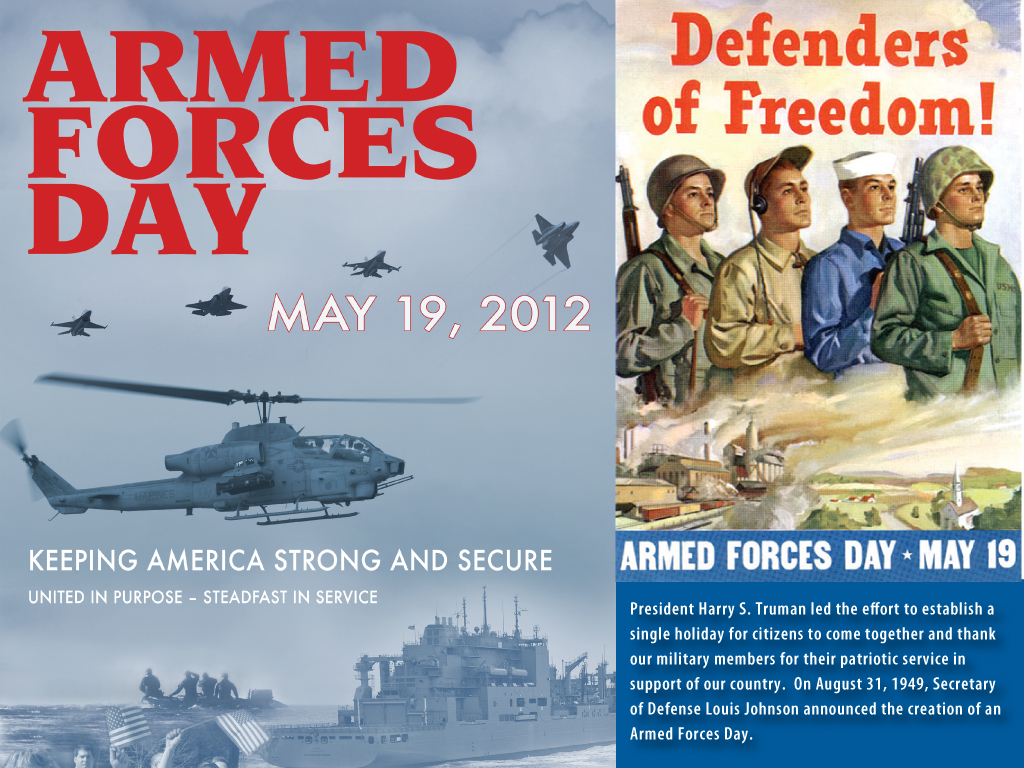
Armed Forces Day was celebrated in some locales Saturday but I would dare say that the vast majority of Americans didn’t notice it. Meanwhile under 50 “Iraq and Afghanistan Veterans” from Iraq and Afghanistan Veterans Against the War got lots of air time for throwing their “Global War on Terrorism Service Medals” away at the big anti-NATO Summit protest in Chicago. This is the Medal that those that served after September 11th 2001 received for being on active duty in the United States, not actually deployed.

Now there were a fair number of local celebrations to honor members of the Armed Forces across the country. As a member of the military I appreciate those events and the people that put them together, especially those that have taken the time to honor Iraq and Afghanistan veterans.  There are others that honor the Armed Forces every day, I think especially about the Maine Troop Greeters of Bangor Maine and the Pease Troop Greeters of New Hampshire. These men and women, many veterans themselves or related to veterans are amazing. They have been welcoming veterans back since early in the war and provide many services to the men and women of the Armed Forces that pass through Bangor Maine International Airport and the Portsmouth International Airport, the former Pease Air Force Base in Pease New Hampshire.  I have had the honor of passing through both locations, Bangor on more than one occasion. While I know that there are many others that do this they are in the minority in this country.

At any given time less than 1% of Americans are serving in all components of the military. For over 10 years we have been at war in Afghanistan and Iraq as well as other locations that we don’t like to talk about too much like Pakistan. However this has not been the effort of a nation at war. It has been the effort of a tiny percentage of the population.  As a nation we are disconnected from the military and the wars that have been going on for so long. The fact is that most Americans do not feel that they have a personal or vested interest in these wars because they have been insulated by political leaders of both parties from them. There is no draft, and no taxes were raised to fund the wars. Every single Soldier, Sailor, Marine and Airman volunteered for duty or reenlisted during this time period. Motives may have varied from individual to individual, but unlike the World Wars, Korea and Vietnam all were or are volunteers.

Many of these volunteers served in Iraq and Afghanistan. Neither war was popular, except in the very beginning when casualties were low and victory appeared to be easy and quick. We like short wars. We left Iraq last year and Afghanistan is still going to be with us for a while. In Afghanistan we followed the same path trod by the British and Soviets in trying to topple regimes and plant our respective versions of civilization in that land of brutal Pashtun, Tajik, Hazara and Uzbek warlords who war on each other as much as any foreign infidel.  It is a path that leads to heartbreak which ties down vast amounts of manpower without any significant strategic gain for the United States or NATO.  This even as war drums beat across the Middle East and nuclear armed Pakistan slips into political and social chaos and keeps a major supply route for the US and NATO to Afghanistan shut down.

The fact is that American and for that matter other NATO and coalition military personnel who have served in Iraq, Afghanistan, the Horn of Africa or at sea are in the minority in all of our countries. Thus when a few of the few of these veterans choose to make a public spectacle of themselves by tossing a medal away they get cheered and lots of media attention. Liberals applaud the medal throwers and conservatives vilify them without getting what is really going on. Both miss the tragic disconnection between the military and civilian society that is the result of public policy since the end of the Vietnam War. A relatively small professional military in comparison to the population is sent to fight wars while the bulk of the population is uninvolved.

I heard one of the organizers of the medal throwing exhibition apologize for his service. If he wants to apologize to people that generally haven’t been touched by war and haven’t had to make a single sacrifice then fine. If he wants to apologize for acts that he may have committed against Iraqis or Afghani people that is another matter, that can’t be mitigated by tossing medals over a fence. However I think that the manner of by which he and his compatriots demonstrated at the NATO Summit did nothing for those that serve. Tossing a medal away, a medal not earned for combat service is cheap. The medal that they threw away symbolically shows that they served in the homeland on active duty after the 9-11 attacks. Some did serve overseas, some in combat but to throw this particular medal away seemed an odd choice.

The right to protest and disagree with policy and the politics of war is important. It is a right which I will defend. However I think that what these veterans did was more disrespectful to their former comrades and those currently serving than it was to those that make policy. The army of lobbyists and think tank wonks that promote the politics of war regardless of who is President don’t care about this because no matter who is in office or who controls Congress they will promote policies that keep them employed and businesses enriched. Marine Major General and Medal of Honor winner Smedley Butler was quite right when he said:

War is a racket. It always has been. It is possibly the oldest, easily the most, surely the most vicious. It is the only one international in scope. It is the only one in which the profits are reckoned in dollars and the losses in lives. A racket is best described, I believe, as something that is not what it seems to the majority of the people. Only a small ‘inside’ group knows what it is about. It is conducted for the benefit of the very few, at the expense of the very many. Out of war a few people make huge fortunes.”

I may disagree with the manner of how and when these veterans protested. However, I am not going to question their motive or honor even if I disagree with their manner of protest because I came back different from war.

But then when a society sends off its sons and daughters to fight in wars that no one understands, and the vast majority of people no longer support it is no wonder that some veterans make such displays. Likewise it is understandable why other veterans have major issues with such protestors, just as many Vietnam veterans still feel the hurt of how a nation turned its back on them.

For the protestors the display may make them feel better, but it misses the bigger point of why wars like these go on for so long.  That they do is because misguided policies have brought about a chronic disconnection in our society between those that serve in the military and those that do not. But how can there not be when in the weeks after 9-11 people like President Bush and others either directly or in a manner of speaking told people to “go shopping”* as we went to war in Afghanistan? When I returned from Iraq I returned to a nation that was not at war whose leaders used the war to buttress their respective political bases.

I think that Armed Forces Day should be better celebrated but I am grateful to those people that do things every day to thank and support military personnel in thought, word and deed like the Maine Greeters and Pease Greeters. The interesting thing about these groups is that they are made up of citizens from across the political spectrum, veterans and non-veterans who simply care for and appreciate the men and women that serve in and fight the wars that no-one else can be bothered to fight.

I just hope and pray that the end in Afghanistan does not turn into an even worse historic debacle than suffered by the British or the Soviets during their ill fated campaigns. Of course the politicians, pundits, preachers and the defense contractors, banks and lobbyists will find a way to profit from this no matter how many more troops are killed, wounded or injured and how badly it affects military personnel or their families. After all, to quote Smedley Butler, “war is a racket.”

Peace

Padre Steve+

1 Comment

Filed under Foreign Policy, iraq,afghanistan, News and current events, Political Commentary

Faith and Doubt: A Reflection on Christmas

“God weeps with us so that we may one day laugh with him.” Jürgen Moltmann

There was a time in my life that faith in God, for me the Christian God, Father, Son and Holy Spirit was something that I pretty much took for granted until I had my own crisis of faith when I returned from Iraq in 2008.  It was that crisis where for all practical purposes I was an agnostic trying to believe while feeling abandoned by God and many of his people.  That crisis has etched a permanent scar in my soul which has led to some fairly major changes in my life but even more so forced me to actually enter what Saint John of the Cross called the “Dark Night of the Soul.”  Not that that is in any way a bad thing as difficult as it is.

I will not tell of how my great spiritual disciplines helped me get through this as they did not. I found it hard to pray or believe in anything for nearly two years as I struggled with abandonment. I felt that God, the Church and the Navy had abandoned me.  I was losing my battle with PTSD during that time, depressed, anxious and despairing I threw myself into my work among the critically ill ICU patients and those that cared for them.  Christmas Eve of 2008 was spent in despair as I wandered through the darkness on a cold night after leaving Mass because I could not get through it.

Though I found a community and camaraderie among those that I worked with and tried to provide spiritual care for my own condition grew worse, so much so that my clinical duties had to be curtailed in September of 2009.  I still stood the overnight duty and filled in for others as needed but for a number of months I had no ward assignments.  On one of the on call nights not long before Christmas I received a call to the ER where I was called to give the last rites to a retired Navy Medical Doctor who was a true Saint, faithful to God, his Church and the community where for years he had dedicated much of his practice to the poorest members of the community to include prisoners in the Portsmouth City Jail. He breathed his last as I prayed this prayer following the anointing of the sick:

Depart, O Christian soul, out of this world;

In the Name of God the Father Almighty who created you;

In the Name of Jesus Christ who redeemed you;

In the Name of the Holy Spirit who sanctifies you.

May your rest be this day in peace,

and your dwelling place in the Paradise of God.

Something happened that night and by Christmas Eve I realized that something was happening to me. As I wrote in Padre Steve’s Christmas Miracle on Christmas Eve of 2009 following an incredibly busy day full of life and death situations and ministry which amazed me:

“Mid afternoon I was walking down the hall and I experienced a wave of emotion flood over me, and unlike the majority of emotions that I have felt in the past couple of years this was different.  It was a feeling of grace and I guess the presence of God.  I went up and talked with Elmer the shrink about what I was feeling and the experience was awesome, I was in tears as I shared, not the tears of sadness, but of grace.  I am beginning to re-experience the grace of God, something that has been so long absent that I did not expect it, at least right now.  I didn’t do anything differently; I certainly was not working extra hard to pray more, get more spiritual or pack my brain full of Bible verses.  I was too far gone to do those things.  It was all I could do many mornings just to get out of bed and come to work.”

Since that time I have continued to recover faith and belief. I cannot say that it is the same kind of faith that I had before Iraq. No this was different, it was faith born of the terrible emptiness and pain of abandonment and despair, a faith that is not content with easy answers and not afraid to ask questions.  It is a faith in Jesus Christ, the crucified one who’s image we see hanging from the crucifix and adorning icons of the Crucifixion. It is as Jürgen Moltmann wrote in The Crucified God:

“The Symbol of the Crucifix in church points to the God who was crucified not between two candles on an altar, but between two thieves in the place of the skull, where the outcasts belong, outside the gates of the city. It is a symbol which therefore leads out of the church and out of religious longing in to the fellowship of the oppressed and abandoned. On the other hand, it is a symbol which calls the oppressed and godless into the church and through the church into the fellowship of the crucified God”

My Philosophy of Religion Professor in seminary, Dr. Yandall Woodfin told us in class that until we had “dealt with the reality of suffering and death we were not doing Christian theology.” At the time the words were offensive to me, but by the time I had graduated and also done a year of Clinical Pastoral Education they became a part of my experience, but even then that did not prepare me for the darkness that I lived in from February of 2008 until that Christmas Eve of 2009.  I would say that in addition to grappling with suffering and death that one has to add the abandonment of the outcast to the equation.

It is from this perspective that I will look at an ancient document that for many Christians is their Baptismal statement of faith or Creed.  ‘Credo in unum Deum’ “I Believe in God” is no longer for me simply a theological proposition which I both ascent to and defend, but rather an experience of God born out of pain, despair, anxiety, doubt, unbelief and abandonment finding almost no Christians willing to walk through the darkness with me, including clergy. It was if I was radioactive, many people had “answers” but none understood the questions and until my therapist Dr. Elmer Maggard asked me “how I was with the big guy?” and Commodore Tom Sitsch asked me “Where does a Chaplain go for help?”

When I finally collapsed in the summer of 2008 and met with Dr. Maggard I made a conscious decision that I would not hide what I was going through because I felt that if someone didn’t speak out then others like me wouldn’t seek help. In the nearly three years since I returned from Iraq I have encountered many people, men and women, current and former military personnel and families of veterans who came to me either in person or through this website.  Included were military chaplains also experiencing life and faith crisis. Most said that I was the first Chaplain or minister that they had met or read who said that he struggled with faith, belief and didn’t know if God existed.  In each of those encounters there was a glimmer of hope for me and I think for them, for the first time we had people that we could be open with.  Co-workers and others said that I was “real” and I certainly do not boast of that because it was painful to try to be transparent with people while in the depths of doubt and despair while hoping that somehow God would touch them with some measure of grace when I found it hard to believe.  I guess it was the fact that I was willing to walk, sometimes in unusual circumstances and locations with them even if it meant facing my own pain and doubt. I was learning something about being what Henri Nouwen called a wounded healer.  Nouwen wrote:

“Nobody escapes being wounded. We all are wounded people, whether physically, emotionally, mentally, or spiritually. The main question is not “How can we hide our wounds?” so we don’t have to be embarrassed, but “How can we put our woundedness in the service of others?” When our wounds cease to be a source of shame, and become a source of healing, we have become wounded healers.”

In the past year I have still had my times of struggle but have also found others that have gone through similar times.  People like me that have experienced the terrible effects of a crisis of faith that leads a person into despair of even to the point of life itself and all that is good. I am fortunate. I was talking with my Bishop recently in regard to the struggle that I have had in recovering the disciplines of the spiritual life. Thankfully she does understand and was encouraging. I guess that is why now when I have more compassion for someone when they tell me that they “lost their faith” especially those that have been changed by their experience of war or other trauma. I don’t necessarily have all the answers for them because I am quite obviously still figuring it out myself. However as I found sometimes it is not the person with the answers but simply the person that takes time to listen and care that is more important to a person when they struggle, especially for those that before the traumatic event had been strong believers.

I’ll write a bit more about Christmas and faith but not tonight.

Peace

Padre Steve+

3 Comments

Filed under christian life, faith, Pastoral Care, Religion

The Brotherhood: Veterans Day 2013

I am always a bit on the melancholy side on Veterans Day.  This year is no different but is a bit different because for the United States the war in Iraq is over, at least for now while the war in Afghanistan grinds on as we prepare to transition.

For me our wars are more about the incredibly small number of Americans who for the past 12 years have borne the burden of these wars.  They are my brothers and sisters, the 0.45% of Americans that serve in the military.  While this is a terribly low number it is only marginally lower than most of our previous wars.

In fact for most of our history it has always been a small minority of Americans that have fought our wars.  Kind of funny when you think about how much our culture worships militarism. World War II was an anomaly as just over 16.1 million people or 9% of the population served in the military then.  That number while large pales in comparison with percentages of those that served in other nations involved in the Second World War. The reason that I point this out is just to say that as a nation it has always been the few that have borne the cost of war. We are “the few.”

This story shall the good man teach his son;
And Crispin Crispian shall ne’er go by,
From this day to the ending of the world,
But we in it shall be remembered-
We few, we happy few, we band of brothers;
For he to-day that sheds his blood with me
Shall be my brother; be he ne’er so vile,
This day shall gentle his condition;
And gentlemen in England now-a-bed
Shall think themselves accurs’d they were not here,
And hold their manhoods cheap whiles any speaks
That fought with us upon Saint Crispin’s day.

From the Speech of King Henry V at Agincourt in Shakespeare’s “Henry V” 1599

In the midst of the petty politics surrounding the Afghan War so so ponderously and pompously purveyed by politicians and pundits of all strains I feel the need to speak up for that small band of brothers that has served in these wars. They are to steal a phrase applied to a previous generation the “New Greatest Generation” something that I am loathe to apply to much of the population at large.  You see the cost of these wars is finally beginning to sink in, at least the financial cost. The real fact of the matter is that these ill advised wars have harmed us as a military and as a nation, our superpower status which was uncontested before 9-11-2001 is challenged because our military is hollowed out, economy weakened and our moral authority questioned by those wars, war crimes and spy scandals.

I’m not so sure that the human cost factors in for most Americans because the tiny percentage of the population that serve in the wars. The fact is that the volunteer military is an insular community which for the most part is based on bases away from most of the population. We have become a society apart from the society.

We used to have big bases in or near major cities, the New York Naval Yard, the Presidio of San Francisco, Long Beach Naval Shipyard, Fort Devens Massachusetts near Boston, Fort Benjamin Harrison Indiana at Indianapolis.  But after the Cold War they and hundreds of other bases were eliminated and with them a connection to the active duty military.  That is not the fault of the people in the big cities it just happened that way, no the military with a few exceptions is based away from most of the population. As a result people may support the troops but most have no idea what they do, how they live and what they suffer.

In spite of that this many of the new Greatest Generation’s accomplishments will largely go unheralded by history. Unlike the “Greatest Generation” of World War Two they will probably not receive the full honors and accolades due them.  This brotherhood of war who have served in the current War on Terror, Iraq and Afghanistan campaigns have now been serving in a war that is now twice as long as the American involvement in World War Two.  Many, like me have been in this since the beginning and many have made multiple deployments to the combat zones.  And many of us, if not most of us would go again. I know that I would because part of me is still in Iraq; for me this war is still un-won and un-finished.

The battles, Fallujah, Ramadi, Haditha, Mosul, Baghdad, Tal Afar, Marjah, Kandahar, Anaconda, Wanat and thousands of other places significant and insignificant are vivid in the minds of those that were there. Unfortunately for most of their countrymen they might as well be on a different planet.

With no disrespect to the Greatest Generation of World War Two, most who were drafted, all of the current Soldiers, Sailors, Marines, Airmen and Coast Guardsmen volunteered to serve in time of war.

At any given time only about one half of one percent is in uniform.  In the three years and ten months of the Second World War about 16.1 Million Americans served in the military, the vast majority being draftees.  Likewise the current generation has fought the war alone.  The vast bulk of the country has lived in peace untouched by any inconvenience to daily life such as gas and food rationing, requirements to work in war industries and the draft as were citizens in World War Two.

In the Second World War Americans shared the burden which in large part has not occurred in this war.  While many have pitched in to help and volunteered to help veterans and their families the vast majority of people in this country are untouched by the war, not that there is anything wrong with that.  This is simply a comparison of the situation that those who served in World War Two and the present conflicts faced.  So I have to say that our current “Greatest Generation” is only a small part of the generation, as the line in Henry V “we few, we happy few who fought together….”

These Soldiers, Sailors, Marines and Airmen from the United States as well as our Allies who serve alongside of us are my brothers and sisters.  They too are volunteers and represent a miniscule portion of their countries population. I am friends with military personnel from the UK, Canada and Germany who have served in the various combat zones or at sea and met quite a few others from France, the Netherlands and Australia. Of course my Iraqi friends who I served with while with our advisers in Al Anbar province who are not only trying to bring peace and stability back to their country but have to worry about the possibility that their families become the target of terrorists.

There are a number of things that unite us in this relatively small brotherhood.  However, I think that this brotherhood could also be extended to our brothers who fought in Vietnam, French, Vietnamese, Australian, South Korean and American, the French who served in Algeria and the Americans and others that served in Korea.  All of these wars were unpopular. All had little support on the home front and often returning veterans found themselves isolated and their sacrifices ignored or disrespected.  For those Americans who serve in the current wars I can say that at least to this point the public has been much more supportive than they were to our Vietnam brothers, many of who were even disrespected by World War Two vets who had fought in “a real war.”  I cannot count the Gulf War in this list as it was hugely successful and the returning vets were hailed as conquering heroes with ticker tape parades.

Our shared brotherhood includes our scars, physical, psychological, neurological and spiritual.  Those who served on the ground in Iraq and Afghanistan as well as those who served in Vietnam, French Indo-China and Algeria have a common shared experience.  All fought people who didn’t or don’t like foreigners no matter how noble our intentions and who by the way have a long history of outlasting people that they believe to be invaders or occupiers.  We have had to fight wars with no front lines, no major units arrayed against us, but rather asymmetrical threats propagated by creatively devious foes who use low tech easily available technology and a willingness to sacrifice themselves and others to force attempt to kill us.  Thus we have cleverly designed and often quite powerful IEDs or Improvised Explosive Devices which can obliterate a HUMMV.

These threats create a situation where there is no front line and thus where every excursion outside of a FOB (Forward Operating Base) or COP (Coalition Outpost) is automatically a trip into a potential danger zone.  Enemies can infiltrate bases posing as local nationals in either military uniform or as workers, rockets and mortars can be lobbed onto even the largest and most secure bases at any time and any vehicle driving by you on the road could be loaded with explosives and just waiting to blow you up while insurgents with automatic weapons and Anti-Tank Rocket Propelled Grenades (RPGs) have taken down helicopters.  When you have taken fire on the road, in the air and had rockets whiz over your head you this becomes a reality that you never forget.

As a result we many men and women with physical wounds as well as wounds that have damaged the psyche or the soul.  PTSD is very common either from a direct encounter or the continual wear and tear of being in a danger zone wondering if you were to get hit that day every day of a tour.  I have lost count now of people that I know who have mild to severe symptoms of PTSD.  Traumatic Brain injury is another condition men and women attacked by IEDs, mortars and rockets experience. Likewise there are the injuries that shatter the soul.  These are the images of ruined buildings, burned out vehicles, wounded bodies, injured children, refugees and wars desolation that can leave a person’s faith in God, or ideals that he or she believes in weakened or even destroyed.  There are the smells of smoke, death, diesel, garbage and sewage that when encountered far away from the combat zone send us back.

The wars have been costly in lives and treasure.  The “up front” casualty numbers are below; they do not include those with PTSD or mild to moderate TBI. They also do not count those that have died later after their service in VA or other civilian care, those that did not report their injuries and those that have committed suicide.

Iraq                   KIA    US  4483       UK 179    Other  139           Total  4801

Afghanistan     KIA  US  2290         UK 446     Other 659        Total  3395

US Wounded   Iraq  32224      Afghanistan   17674

The financial cost: over 1.2 trillion dollars and counting.

As many idealistic and patriotic military personnel question God, their National Leadership and even themselves because of their experience in Iraq or Afghanistan.  I cannot get the image of a refugee camp on the Iraqi Syrian border full of Palestinian refugees who have nowhere to go; they had been invited to Iraq under Saddam and have been sitting on the border trying to get home for years now.  The Palestinian authority wants nothing to do with them. I cannot smell smoke or hear a helicopter or pass a freshly fertilized field without being reminded of Iraq.

These men and women are my brothers and sisters.   I have seen quite a few of my colleagues at the Naval Medical Center and Naval Hospital deploy and deploy, the medical personnel don’t get much of a break.  These are my friends and I do get concerned for them and pray earnestly for their safe return.  I wish that I could go with them because I know them and have already walked with them through the dark valley of the shadow of death in the Medical Center ICU or the wards and clinics of the Naval Hospital.  We already have a bond that will not be broken.

It is now six years since I served in Iraq and five years since my PTSD crash.  However, I still would do it again in a heartbeat.  There is something about doing the job that you were both trained to do and called to do that makes it so.  Likewise the bonds of friendship and brotherhood with those who you serve are greater than almost any known in the human experience.  Shared danger, suffering and trauma bind soldiers together, even soldiers of different countries and sometimes with enemies.

I remember the conversation that I had with an Iraqi Merchant Marine Captain on a ship that we had apprehended for smuggling oil violating the United Nations sanctions.  The man was a bit older than me, in his early 60s.  He had been educated in Britain and traveled to the US in the 1960s and 1970s. He had the same concerns as any husband and father for his family and had lost his livelihood after Saddam invaded Kuwait in 1990.   He was a gentleman who provided for his crew and went out of his way to cooperate with us.  In our last meeting he said to me: “Someday I hope that like the Americans, British and the German soldiers at the end of the Second World War can meet after the war is over, share a meal and a drink in a bar and be friends.”  That is my hope as well.

In the final episode of the series Band of Brothers there is a scene where one of the American soldiers, Joseph Liebgott who came from a German Jewish family interprets the words of a German General to his men in the prisoner compound.  The words sum up what the Americans had felt about themselves and likewise the bond that all soldiers who serve together in war have in common, if you have seen the episode you know how powerful it is, I ended up crying when I heard it the first time and cannot help but do so now that I have been to the badlands of Al Anbar Province.

“Men, it’s been a long war, it’s been a tough war. You’ve fought bravely, proudly for your country. You’re a special group. You’ve found in one another a bond that exists only in combat, among brothers. You’ve shared foxholes, held each other in dire moments. You’ve seen death and suffered together. I’m proud to have served with each and every one of you. You all deserve long and happy lives in peace.”

As do we.

Peace

Padre Steve+

3 Comments

Filed under History, Military, shipmates and veterans

The Bond

This story shall the good man teach his son;
And Crispin Crispian shall ne’er go by,
From this day to the ending of the world,
But we in it shall be remembered-
We few, we happy few, we band of brothers;
For he to-day that sheds his blood with me
Shall be my brother; be he ne’er so vile,
This day shall gentle his condition;
And gentlemen in England now-a-bed
Shall think themselves accurs’d they were not here,
And hold their manhoods cheap whiles any speaks
That fought with us upon Saint Crispin’s day.

From the Speech of King Henry V at Agincourt in Shakespeare’s “Henry V” 1599

In the midst of the petty politics surrounding the Afghan War so so ponderously and pompously purveyed by politicians and pundits of all strains I feel the need to speak up for that small band of brothers that has served in these wars. They are to steal a phrase applied to a previous generation the “New Greatest Generation” something that I am loathe to apply to much of the population at large.  You see the cost of these wars is finally beginning to sink in, at least the financial cost. I’m not so sure that the human cost factors in for most people because the tiny percentage of the population that serve in the wars. The fact is that the volunteer military is an insular community which for the most part is based on bases away from most of the population. We used to have big bases in or near major cities, the New York Naval Yard, the Presidio of San Francisco, Long Beach Naval Shipyard, Fort Devens Massachusetts near Boston, Fort Benjamin Harrison Indiana at Indianapolis.  But after the Cold War they and hundreds of other bases were eliminated and with them a connection to the active duty military.  That is not the fault of the people in the big cities it just happened that way, no the military with a few exceptions is based away from most of the population. As a result people may support the troops but most have no idea what they do, how they live and what they suffer.

In spite of that this new Greatest Generation’s accomplishments will largely go unheralded by history. Unlike the “Greatest Generation” of World War Two they will probably not receive the full honors and accolades due them.  This brotherhood of war who have served in the current War on Terror, Iraq and Afghanistan campaigns have now been serving in a war that is now twice as long as the American involvement in World War Two.  Many, like me have been in this since the beginning and many have made multiple deployments to the combat zones.  And many of us, if not most of us would go again. I know that I would because part of me is still in Iraq; for me this war is still un-won and un-finished.

The battles, Fallujah, Ramadi, Haditha, Mosul, Baghdad, Tal Afar, Marjah, Kandahar, Anaconda, Wanat and thousands of other places significant and insignificant are vivid in the minds of those that were there. Unfortunately for most of their countrymen they might as well be on a different planet.

With no disrespect to the Greatest Generation of World War Two, all of the current Soldiers, Sailors, Marines, Airmen and Coast Guardsmen volunteered to serve in time of war.  At any given time only about one half of one percent is in uniform.  In the three years and ten months of the Second World War about 16.1 Million Americans served in the military, the vast majority being draftees.  Likewise the current generation has fought the war alone.  The vast bulk of the country has lived in peace untouched by any inconvenience to daily life such as gas and food rationing, requirements to work in war industries and the draft as were citizens in World War Two.  In the Second World War Americans shared the burden which in large part has not occurred in this war.  While many have pitched in to help and volunteered to help veterans and their families the vast majority of people in this country are untouched by the war, not that there is anything wrong with that.  This is simply a comparison of the situation that those who served in World War Two and the present conflicts faced.  So I have to say that our current “Greatest Generation” is only a small part of the generation, as the line in Henry V “we few, we happy few who fought together….”

These Soldiers, Sailors, Marines and Airmen from the United States as well as our Allies who serve alongside of us are my brothers and sisters.  They too are volunteers and represent a miniscule portion of their countries population. I am friends with military personnel from the UK, Canada and Germany who have served in the various combat zones or at sea and met quite a few others from France, the Netherlands and Australia. Of course my Iraqi friends who I served with while with our advisers in Al Anbar province who are not only trying to bring peace and stability back to their country but have to worry about the possibility that their families become the target of terrorists.

There are a number of things that unite us in this relatively small brotherhood.  However, I think that this brotherhood could also be extended to our brothers who fought in Vietnam, French, Vietnamese, Australian, South Korean and American, the French who served in Algeria and the Americans and others that served in Korea.  All of these wars were unpopular. All had little support on the home front and often returning veterans found themselves isolated and their sacrifices ignored or disrespected.  For those Americans who serve in the current wars I can say that at least to this point the public has been much more supportive than they were to our Vietnam brothers, many of who were even disrespected by World War Two vets who had fought in “a real war.”  I cannot count the Gulf War in this list as it was hugely successful and the returning vets were hailed as conquering heroes with ticker tape parades.

Our shared brotherhood includes our scars, physical, psychological, neurological and spiritual.  Those who served on the ground in Iraq and Afghanistan as well as those who served in Vietnam, French Indo-China and Algeria have a common shared experience.  All fought people who didn’t or don’t like foreigners no matter how noble our intentions and who by the way have a long history of outlasting people that they believe to be invaders or occupiers.  We have had to fight wars with no front lines, no major units arrayed against us, but rather asymmetrical threats propagated by creatively devious foes who use low tech easily available technology and a willingness to sacrifice themselves and others to force attempt to kill us.  Thus we have cleverly designed and often quite powerful IEDs or Improvised Explosive Devices which can obliterate a HUMMV.

These threats create a situation where there is no front line and thus where every excursion outside of a FOB (Forward Operating Base) or COP (Coalition Outpost) is automatically a trip into a potential danger zone.  Enemies can infiltrate bases posing as local nationals in either military uniform or as workers, rockets and mortars can be lobbed onto even the largest and most secure bases at any time and any vehicle driving by you on the road could be loaded with explosives and just waiting to blow you up while insurgents with automatic weapons and Anti-Tank Rocket Propelled Grenades (RPGs) have taken down helicopters.  When you have taken fire on the road, in the air and had rockets whiz over your head you this becomes a reality that you never forget.

As a result we many men and women with physical wounds as well as wounds that have damaged the psyche or the soul.  PTSD is very common either from a direct encounter or the continual wear and tear of being in a danger zone wondering if you were to get hit that day every day of a tour.  I have lost count now of people that I know who have mild to severe symptoms of PTSD.  Traumatic Brain injury is another condition men and women attacked by IEDs, mortars and rockets experience. Likewise there are the injuries that shatter the soul.  These are the images of ruined buildings, burned out vehicles, wounded bodies, injured children, refugees and wars desolation that can leave a person’s faith in God, or ideals that he or she believes in weakened or even destroyed.  There are the smells of smoke, death, diesel, garbage and sewage that when encountered far away from the combat zone send us back.

The wars have been costly in lives and treasure.  The “up front” casualty numbers are below; they do not include those with PTSD or mild to moderate TBI. They also do not count those that have died later after their service in VA or other civilian care, those that did not report their injuries and those that have committed suicide.

Iraq                   KIA    US  4463       UK 179    Other  139           Total  4781

Afghanistan     KIA  US  1637         UK 374     Other 537        Total  2548

US Wounded   Iraq  32227      Afghanistan   11191

The financial cost: over 1.2 trillion dollars and counting.

As many idealistic and patriotic military personnel question God, their National Leadership and even themselves because of their experience in Iraq or Afghanistan.  I cannot get the image of a refugee camp on the Iraqi Syrian border full of Palestinian refugees who have nowhere to go; they had been invited to Iraq under Saddam and have been sitting on the border trying to get home for years now.  The Palestinian authority wants nothing to do with them. I cannot smell smoke or hear a helicopter or pass a freshly fertilized field without being reminded of Iraq.

These men and women are my brothers and sisters.   I have seen quite a few of my colleagues at the Naval Medical Center and Naval Hospital deploy and deploy, the medical personnel don’t get much of a break.  These are my friends and I do get concerned for them and pray earnestly for their safe return.  I wish that I could go with them because I know them and have already walked with them through the dark valley of the shadow of death in the Medical Center ICU or the wards and clinics of the Naval Hospital.  We already have a bond that will not be broken.

It is now four years since I was in the process of leaving for Iraq and three years since my PTSD crash.  However, I still would do it again in a heartbeat.  There is something about doing the job that you were both trained to do and called to do that makes it so.  Likewise the bonds of friendship and brotherhood with those who you serve are greater than almost any known in the human experience.  Shared danger, suffering and trauma bind soldiers together, even soldiers of different countries and sometimes with enemies.  I remember the conversation that I had with an Iraqi Merchant Marine Captain on a ship that we had apprehended for smuggling oil violating the United Nations sanctions.  The man was a bit older than me, in his early 60s.  He had been educated in Britain and traveled to the US in the 1960s and 1970s. He had the same concerns as any husband and father for his family and had lost his livelihood after Saddam invaded Kuwait in 1990.   He was a gentleman who provided for his crew and went out of his way to cooperate with us.  In our last meeting he said to me: “Someday I hope that like the Americans, British and the German soldiers at the end of the Second World War can meet after the war is over, share a meal and a drink in a bar and be friends.”  That is my hope as well.

In the final episode of the series Band of Brothers there is a scene where one of the American soldiers, Joseph Liebgott who came from a German Jewish family interprets the words of a German General to his men in the prisoner compound.  The words sum up what the Americans had felt about themselves and likewise the bond that all soldiers who serve together in war have in common, if you have seen the episode you know how powerful it is, I ended up crying when I heard it the first time and cannot help but do so now that I have been to the badlands of Al Anbar Province.

“Men, it’s been a long war, it’s been a tough war. You’ve fought bravely, proudly for your country. You’re a special group. You’ve found in one another a bond that exists only in combat, among brothers. You’ve shared foxholes, held each other in dire moments. You’ve seen death and suffered together. I’m proud to have served with each and every one of you. You all deserve long and happy lives in peace.”

As do we.

Peace

Padre Steve+

2 Comments

Filed under History, iraq,afghanistan, Military, PTSD, shipmates and veterans, Tour in Iraq

A Quiet Remembrance: The Fall of Dien Bien Phu May 7th 1954

French Prisoners

On May 7th in Hanoi a small remembrance was held to mark the fall of Dien Bien Phu and honor the victor, 101 year old General Vo Nguyen Giap at his home.  It was one of the few remembrances held anywhere marking that battle which was one of the watersheds of the 20th Century. A half a world away in Houston Texas a small group of French veterans, expatriates and historians laid a wreath at the Vietnam War Memorial.  In Paris an ever shrinking number of French survivors gather each year on May 7th at 1815 hours for a religious service at the Church of Saint Louis des Invalides to remember the dead and missing of the French Expeditionary Corps lost in Indochina.  This battle is nearly forgotten by time even though it and the war that it symbolized is probably the one that we need to learn from before Afghanistan becomes our Indochina.

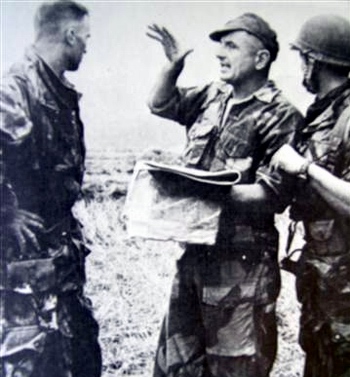
French Major Marcel Bigeard at Dien Bien Phu. A revered leader he died in 2010

On May 8th 1954 the last of the French garrison of Dien Bien Phu surrendered to the Viet Minh following the surrender of the main garrison the previous day.  It was the end of the ill-fated Operation Castor in which the French had planned to lure the Viet Minh Regulars into open battle and use superior firepower to decimate them.  The strategy which had been used once on a smaller scale the previous year at Na Son would prove to be the Göttdammerung of French colonial rule in Indochina.

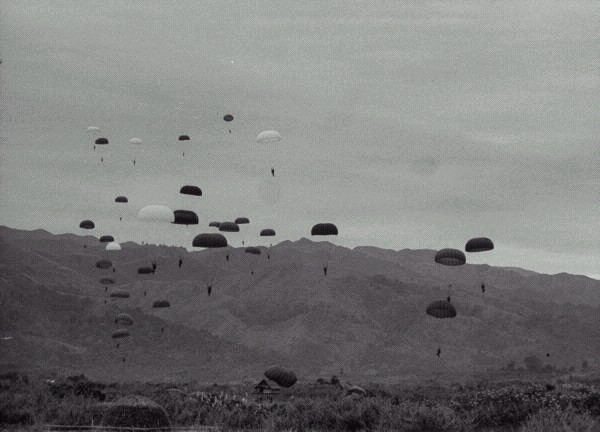
French Paras landing at Dien Bien Phu

The French had thought they had come up with a template based on Na Son in how to engage and destroy the Viet Minh which had in the years between 1945 and 1954 had turned an insurgent force into a strong Army capable of taking on large French forces.  As a result the French decided that they would attempt to draw Giap’s Army into open combat where their superiority in heavy weaponry and in the air could be used to destroy the Viet Minh. The plan was called the “Air-land base.”  It involved having strong forces in a defensible position deep behind enemy lines supplied by air.  At Na Son the plan worked as the French were on high ground and had superiority in artillery and air forces.  They were also were blessed by General Giap using human wave assaults which made the Viet Minh troops fodder for the French defenders.  Even still Na Son was a near run thing for the French and had almost no effect on Viet Minh operations elsewhere in Indochina while tying down a almost a full division of troops and a large portion of French air power. They inflicted heavy losses on the Viet Minh but did not destroy them.

The French command assumed that they had found a way to defeat the Viet Minh.  They decided to repeat the strategy used at Na-Son at the remote the remote town of Dien Bien Phu near the Laotian border.  The French desired to use Dien Bien Phu as a base from which they could conduct offensive operations against the Viet Minh and to draw Giap’s forces into a conventional fight that they thought they could win.  Unfortunately the French chose badly. Dien Bien Phu lay in a marshy valley surrounded by mountains which were covered in dense nearly impassible jungle.  It was a poor location to conduct offensive operations from and a worse place to defend.

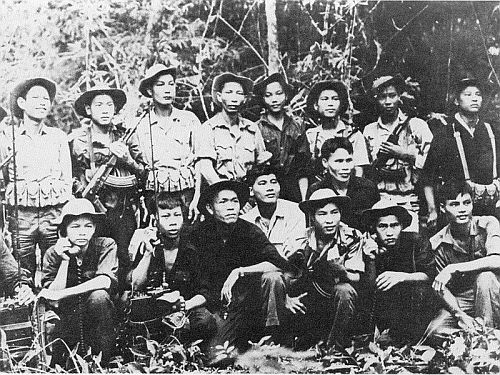
Viet Minh Main Force Regulars

The French elected to go light on artillery and due to the terrain it had to be deployed in nearly open conditions with neither cover not concealment.  Unlike Na Son the Dien Bien Phu air head was at the far end of the range of French aircraft, especially relatively weak tactical air assets.  French logistics needs were far greater than the French Air Force and American contractors could supply.  The French strong points in the valley were exposed and not mutually supporting and as such Giap and the Viet Minh were able to close with and attack each strong point in time overwhelming each after valiant French resistance.  The terrain was so poor that French units were incapable of any meaningful offensive operations against the Viet Minh.  As such they could only dig in and wait for battle.  Even so many positions were not adequately fortified and the artillery was exposed. The French garrison was a good force.  It was comprised of airborne units, the Foreign Legion, Colonial Paratroops (Marines), North Africans from Tunisia and Algeria as well as Vietnamese troops.  Many of the officers including Lieutenant Colonel Langlais and Major Bigeard commander of the 6th Colonial Parachute Battalion were among the best leaders in the French Army. Others who served in Indo-China including David Galula and Jacques Trinquier would write books which would help Americans in Iraq.  Unfortunately the French High Command badly underestimated the capabilities and wherewithal of the Giap and his divisions.

Giap rapidly concentrated his forces and built excellent logistics support.  He placed his artillery in well concealed and fortified positions which could use direct fire on French positions. Giap also had more and heavier artillery than the French believed him to have.  Additionally he brought in a large number of anti-aircraft batteries whose positions enabled the Viet Minh to take a heavy toll among French Aircraft.  Giap also did not throw his men away in human assaults.  Instead he used his Sappers (combat engineers) to build protective trenches leading up to the very wire of French defensive positions.  In time these trenches came to resemble a spider web.

Without belaboring this post the French fought hard as did the Viet Minh.  Many French positions were overwhelmed by accurate artillery and well planned attacks.  The French hoped for U.S. air intervention, even the possibility of using nuclear weapons against the Viet Minh.  They were turned down.  Relief forces were unable to get through.  The garrison died, despite the bravery of the Paratroops and Legionaries.  The French garrison was let down by their high command and their government and lost the battle due to inadequate logistics and air power.  The survivors endured a forced march of nearly 400 miles by foot to POW camps in which many died.  Many were subjected to torture and group discipline.  Few French caved to the Viet Minh interrogations but some would come away with the belief that one had to use such means to fight the revolutionaries.  French and their Algerian comrades would apply these lessons against each other within a year of their release.  French soldiers and officers were shipped from Indo-China to Algeria to wage another protracted counterinsurgency.  Militarily they had all but won the war when their government pulled out. French troops, especially the Legionaries and Paratroops felt betrayed by their nation, much like many Vietnam Vets felt about the United States government after that war.  I find today that both our government and people are caring for our returning troops in a far better manner than the past.  Even still the veterans of Iraq and Afghanistan share almost a spiritual link to our American and French brothers in arms who fought at Dien Bien Phu, the Street Without Joy and places like Khe Sanh, Hue City, the Ia Drang and the Mekong.

The lessons of the French at Dien Bien Phu and in Indo-China were not learned by the United States as it entered Vietnam.  In fact the US Army made a conscious effort to ignore the advice of those that they called “losers.”  It was an arrogance for which we paid dearly in that war.

Despite our efforts in Afghanistan and the valiant sacrifices of our Marines and Soldiers we seem to have difficulty learning the lessons of the Vietnam Wars.  Old habits die hard, counterinsurgency done right isn’t sexy and there are no easy formulas to make it work.  What works in one country may not work in another as we are found when we tried to emulate our counterinsurgency success in Iraq in Afghanistan.  Despite a lot of institutional resistance from traditionally minded Army officers we were able to apply the lessons of counterinsurgency in Iraq and work with Iraqis to make that country more secure than it was before we took this type of warfare seriously.  Despite its continued problems Iraq is doing better and will likely do well in the long run as it recovers from the damage caused by the war.  They have known civilization since antiquity and are a proud people.  Someday I hope to take up the invitation of Iraqi friends to go back as they say as a tourist.

I am concerned about Afghanistan, despite the killing of Osama Bin Laden in neighboring Pakistan because it seems that the Taliban spring offensive is off to a good start.  U.S. and NATO Forces in Khandehar and Helmand Province have been placed on a higher alert and confined to their bases following a major assault on the Afghan provincial government installations in Khandehar.  The Taliban and other Afghan insurgents are only concerned with Afghanistan and even though Bin Laden is dead the deepening rift between the United States and Pakistan will likely ensure that they will enjoy military, personnel, financial support from many in Pakistan including the Intelligence agency in the remote and ungovernable northwest territories of that country which are a safe haven much like Communist China was for the Viet Minh.

Will there be a situation where an isolated NATO garrison is overrun by Taliban forces as French forces were in Indochina?  An isolated outpost was nearly overrun at Wanat in July of 2008 and at two isolated outposts near the Pakistani border in October 2009.  One would hope not, but we cannot underestimate the Afghans and their ability to adapt to NATO tactics and weapons.   Their predecessors successfully drove out the Soviets, the British, the Persians and the Greeks.  Dien Bien Phu is a warning from history not to leave troops in places where their exposure leaves them vulnerable.

But even more Dien Bien Phu serves to remind us that in such wars it is not always the highly trained and organized Western forces that win.  These are local wars and once the momentum shifts to the insurgent they are difficult to turn around.  In a sense the French were trying to do what we are trying to do now in taking the fight to the enemy.  It turned out badly for them and it could turn out badly for us.  I hope that we don’t forget.

Peace

Padre Steve+

2 Comments

Filed under History, iraq,afghanistan, Military, vietnam

Introduction to “I Believe please Help Me Believe: The Apostle’s Creed for those Who Struggle with Faith”

“God weeps with us so that we may one day laugh with him.” Jürgen Moltmann

This is the first of a series of essays on the topic of doubt and faith related to the Apostle’s Creed.  There was a time in my life that faith in God, for me the Christian God, Father, Son and Holy Spirit was something that I pretty much took for granted until I had my own crisis of faith when I returned from Iraq in 2008.  It was that crisis where for all practical purposes I was an agnostic trying to believe while feeling abandoned by God and many of his people.  That crisis has etched a permanent scar in my soul which has led to some fairly major changes in my life but even more so forced me to actually enter what Saint John of the Cross called the “Dark Night of the Soul.”

I will not tell of how my great spiritual disciplines helped me get through this as they did not. I found it hard to pray or believe in anything for nearly two years as I struggled with abandonment. I felt that God, the Church and the Navy had abandoned me.  I was losing my battle with PTSD during that time, depressed, anxious and despairing I threw myself into my work among the critically ill ICU patients and those that cared for them.  Christmas Eve of 2008 was spent in despair as I wandered through the darkness on a cold night after leaving Mass because I could not get through it.

Though I found a community and camaraderie among those that I worked with and tried to provide spiritual care for my own condition grew worse, so much so that my clinical duties had to be curtailed in September of 2009.  I still stood the overnight duty and filled in for others as needed but for a number of months I had no ward assignments.  On one of the on call nights not long before Christmas I received a call to the ER where I was called to give the last rites to a retired Navy Medical Doctor who was a true Saint, faithful to God, his Church and the community where for years he had dedicated much of his practice to the poorest members of the community to include prisoners in the Portsmouth City Jail. He breathed his last as I prayed this prayer following the anointing of the sick:

Depart, O Christian soul, out of this world;

In the Name of God the Father Almighty who created you;

In the Name of Jesus Christ who redeemed you;

In the Name of the Holy Spirit who sanctifies you.

May your rest be this day in peace,

and your dwelling place in the Paradise of God.

Something happened that night and by Christmas Eve I realized that something was happening to me. As I wrote in Padre Steve’s Christmas Miracle on Christmas Eve of 2009 following an incredibly busy day full of life and death situations and ministry which amazed me:

“Mid afternoon I was walking down the hall and I experienced a wave of emotion flood over me, and unlike the majority of emotions that I have felt in the past couple of years this was different.  It was a feeling of grace and I guess the presence of God.  I went up and talked with Elmer the shrink about what I was feeling and the experience was awesome, I was in tears as I shared, not the tears of sadness, but of grace.  I am beginning to re-experience the grace of God, something that has been so long absent that I did not expect it, at least right now.  I didn’t do anything differently; I certainly was not working extra hard to pray more, get more spiritual or pack my brain full of Bible verses.  I was too far gone to do those things.  It was all I could do many mornings just to get out of bed and come to work.”

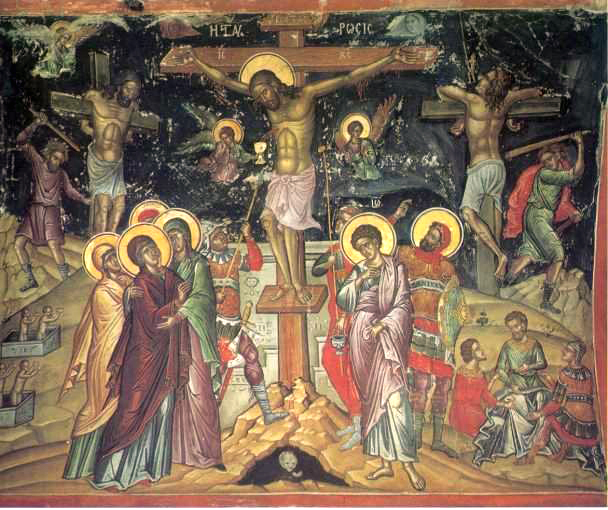
Since that time I have continued to recover faith and belief. I cannot say that it is the same kind of faith that I had before Iraq. No this was different, it was faith born of the terrible emptiness and pain of abandonment and despair, a faith that is not content with easy answers and not afraid to ask questions.  It is a faith in Jesus Christ, the crucified one who’s image we see hanging from the crucifix and adorning icons of the Crucifixion. It is as Jürgen Moltmann wrote in The Crucified God:

“The Symbol of the Crucifix in church points to the God who was crucified not between two candles on an altar, but between two thieves in the place of the skull, where the outcasts belong, outside the gates of the city. It is a symbol which therefore leads out of the church and out of religious longing in to the fellowship of the oppressed and abandoned. On the other hand, it is a symbol which calls the oppressed and godless into the church and through the church into the fellowship of the crucified God”

My Philosophy of Religion Professor in seminary, Dr. Yandall Woodfin told us in class that until we had “dealt with the reality of suffering and death we were not doing Christian theology.” At the time the words were offensive to me, but by the time I had graduated and also done a year of Clinical Pastoral Education they became a part of my experience, but even then that did not prepare me for the darkness that I lived in from February of 2008 until that Christmas Eve of 2009.  I would say that in addition to grappling with suffering and death that one has to add the abandonment of the outcast to the equation.

It is from this perspective that I will look at an ancient document that for many Christians is their Baptismal statement of faith or Creed.  ‘Credo in unum Deum’ “I Believe in God” is no longer for me simply a theological proposition which I both ascent to and defend, but rather an experience of God born out of pain, despair, anxiety, doubt, unbelief and abandonment finding almost no Christians willing to walk through the darkness with me, including clergy. It was if I was radioactive, many people had “answers” but none understood the questions and until my therapist Dr. Elmer Maggard asked me “how I was with the big guy?” and Commodore Tom Sitsch asked me “Where does a Chaplain go for help?”

When I finally collapsed in the summer of 2008 and met with Dr. Maggard I made a conscious decision that I would not hide what I was going through because I felt that if someone didn’t speak out then others like me wouldn’t seek help. In the nearly three years since I returned from Iraq I have encountered many people, men and women, current and former military personnel and families of veterans who came to me either in person or through this website.  Included were military chaplains also experiencing life and faith crisis. Most said that I was the first Chaplain or minister that they had met or read who said that he struggled with faith, belief and didn’t know if God existed.  In each of those encounters there was a glimmer of hope for me and I think for them, for the first time we had people that we could be open with.  Co-workers and others said that I was “real” and I certainly do not boast of that because it was painful to try to be transparent with people while in the depths of doubt and despair while hoping that somehow God would touch them with some measure of grace when I found it hard to believe.  I guess it was the fact that I was willing to walk, sometimes in unusual circumstances and locations with them even if it meant facing my own pain and doubt. I was learning something about being what Henri Nouwen called a wounded healer.  Nouwen wrote:

“Nobody escapes being wounded. We all are wounded people, whether physically, emotionally, mentally, or spiritually. The main question is not “How can we hide our wounds?” so we don’t have to be embarrassed, but “How can we put our woundedness in the service of others?” When our wounds cease to be a source of shame, and become a source of healing, we have become wounded healers.”

My journey through the words of the Apostle’s Creed will be less of a doctrinal exposition than a pastoral narrative of rediscovering faith. It is my hope and prayer that this feeble and imperfect attempt to experience the Apostle’s Creed will be of help to people.  People like me that have experienced the terrible effects of a crisis of faith that leads a person into despair of even to the point of life itself and all that is good.

Peace

Padre Steve+

6 Comments

Filed under christian life, faith, Pastoral Care, philosophy, PTSD, Religion

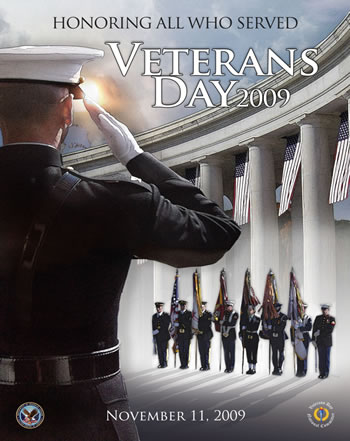
Veteran’s Day: Goodbye to 666 Lake of Fire Circle, a Golf Outing and Remembering the Veterans in my Life

veteransday2009

Today was Veteran’s Day. Amid the solemnity of the day I am still in California where I came this week to try to help my mom with my dad’s affairs and to also see my dad who is definitely in the end stages of Alzheimer’s disease.  This has been the hardest trip home in my life.  I knew I had to come, although the Abbess was against it fearing for my emotional health and perhaps she was right.  Tonight I sit in a hotel room self medicating and trying to regain some sense of sanity.

Me and last last picDad and Me back in May…He Still knew Me then

The past few days have been hell.  My dad does not know me anymore; he has almost no response to anything and stares straight ahead.  The hardest part is when I realized that he didn’t know me.  So I asked if he had seen my mother who I had taken to visit him the day before and my brother.  He said that he had seen them, and even seen my mom the morning I asked him the question.  However she had not been there that day.  So I asked if “Steve had visited yesterday.”  He got agitated and said “I don’t know any Steve yesterday.”  Today was much the same, I asked if he knew who Steve was, and he said “yes” and I asked if he had seen him and he said “no he hasn’t been here.”  This whole trip he has probably spoken under 50 words in 4 visits.  There is nothing left. For all practical purposes he is dead in a body that won’t die.  If that was not bad enough my mother has not skipped any opportunity to attack and pick at me until I broke.  I begged her to lay off, told her that I was not up to fighting with her and tried to keep my cool but she wouldn’t let up.   I cannot deal with constant conflict and a mother who calls me “a weak, politically correct pansy.”  I’m a combat veteran and went to war unarmed into hostile territory with little groups of Americans far away from the big battalions with all the heavy weapons and the women called me a “weak, politically correct pansy.  She has put me down, belittled my education, vocation and career and insulted my wife for the last time. When I told her that “everything in her life that was wrong was somebody else’s fault and not hers” she agreed.  I knew it was over at that point. This may sound un-Christian but I will not go see her again.   Tomorrow I will see my dad for what it is worth, see my brother and his family and then early Friday I will get the hell out of Dodge.  She had offered to pay for my trip out but I can’t prostitute myself for that kind of abuse.    The next time I come back it will be for my father’s funeral.  I love my brother and his family.  He and his wife are saints.  I couldn’t live that near my mother without ending up in a psychotic state, something that I came perilously close to this week.  God bless Jeff, Mel and their kids.

Me and Jeff at mickey groveWith my Brother back in May

I went golfing with my brother and nephews today.  For much of the day I couldn’t hit water if I fell out of the damned boat.  My mind was so gooned up and upset by the events of the week I couldn’t concentrate worth a shit.  Even my well hit shots were mainly slicing to the right and I embarked on a tree killing expedition.  I hit 7 trees solidly, took down a couple of decent sized branches, grazed three other trees and nailed an outhouse.  However it was really good to be out with Jeff, Darren and Nate.  Nate can really hit the ball for an 8 year old; he has the potential to be a really good golfer.  Darren doesn’t really care and is out to have fun.  He enjoyed my sarcasm as I commented on my shots and helped keep track of the number of trees that I hit and I told him that I would see how many I could try to kill before the day was out.  By the end of the round I was hitting the ball a lot better and it was going more often than not where I wanted it to go, but the first 7 holes were hell.  It makes me think of Robin Williams’ golf routine. http://www.youtube.com/watch?v=xDQd49rEF_0

As I mentioned today was Veteran’s day.  After I got my hotel I went to a local Applebee’s where I had a sirloin steak and potatoes and a couple beers on their Veterans’ day salute.  I sat at the bar with a couple about 10 years older than me; he had served on a Navy Minesweeper in Vietnam.  They were nice; I think that is why I like sitting at the bar when I go out to eat, there is a sense of community that you don’t find a lot of other places.

As it is Veteran’s day I think I will take some time to remember some of the Veterans in my life who have helped my through my life and career.  This is taken from a post that I did around Memorial Day.

I’ve been in the military for almost 28 years now.  I enlisted in the National Guard while in college and entered Army ROTC back in 1981.  Since then it has been to quote Jerry Garcia “a long strange trip.”  My dad served twenty years in the Navy.  He retired in 1974 as a Chief Petty Officer and did time surrounded in the South Vietnamese city of An Loc when it was surrounded by the North Vietnamese for 80 days in 1972.  He didn’t talk about it much when he came back; in fact he came back different from the war.  He probably suffered from PTSD.  All the markers were there but we had no idea about it back then, after all he was in the Navy not the Army.

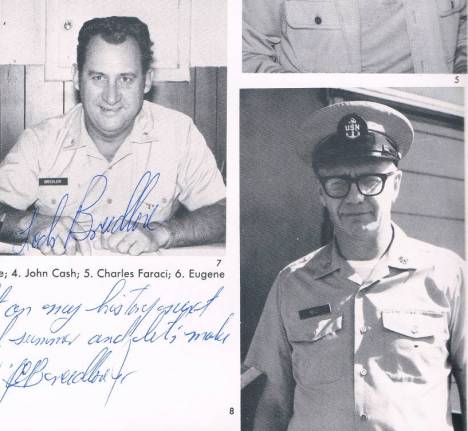
breedlove-ness2LCDR Breedlove and Chief Ness

My second view of war came from the Veterans of Vietnam that I served with in the National Guard and the Army.  Some of these men served as teachers and mentors.  LCDR Jim Breedlove and Senior Chief John Ness at the Edison High School Naval Junior ROTC program were the first who helped me along. They have both passed away in the past year and a half.  I will never forget them.  A post dedicated to them is on this blog. Colonel Edgar Morrison was my first battalion commander.  He was the most highly decorated member of the California National Guard at that time and had served multiple tours in Vietnam.  He encouraged me as a young specialist and officer cadet and showed a tremendous amount of care for his soldiers.  Staff Sergeant’s Buff Rambo and Mickey Yarro taught me the ropes as a forward observer and shared many of their Vietnam experiences. Buff had been a Marine dog handler on the DMZ and Mickey a Forward Observer.  Sergeant First Class Harry Zilkan was my training NCO at the UCLA Army ROTC program.  He was a Special Forces Medic with 7th Group in Vietnam.  He still had part of a VC bayonet embedded in his foot.  He received my first salute as a newly commissioned Second Lieutenant as well as a Silver Dollar.  I understand that after the Army he became a fire fighter.  He had a massive heart attack on the scene of a fire and died a few years later from it.  Sergeant Major John Butler was our senior enlisted at UCLA.  He served with the 173rd Airborne in Vietnam.  Sergeant First Class Harry Ball was my drill sergeant at the ROTC pre-commissioning camp at Fort Lewis Washington in 1982.  He was also Special Forces and a Ranger and served multiple tours in Vietnam.  He was quite influential in my life, tearing me apart and then building me back up.  He was my version of Drill Sergeant Foley in An Officer and a Gentleman. Like Zack Mayo played by Richard Gere in the movie I can only say: Drill Sergeant “I will never forget you.”

As I progressed through my Army career I encountered others of this generation who also impacted my life. First among them was First Sergeant Jim Koenig who had been a Ranger in the Mekong Delta.  I was the First Sergeant that I would measure all others by.  Once during a ARTEP we were aggressed and all of a sudden he was back in the Delta. This man cared so much for his young soldiers in the 557th Medical Company.   He did so much for them and I’m sure that those who served with him can attest to this as well as me. Jim had a brick on his desk so that when he got pissed he could chew on it.   He was great.  He played guitar for the troops and had a song called Jane Fonda, Jane Fonda You Communist Slut. It was a classic.  He retired after he was selected to be a Command Sergeant Major because he valued his wife and family more than the promotion.  It hurt him to do this, but he put them first. Colonel Donald Johnson was the commander of the 68th Medical Group when I got to Germany in January 1984.  Colonel “J” as well all called him was one of the best leaders I have seen in 28 years in the military.  He knew everything about everything and his knowledge forced us all to learn and be better officers and NCOs.  On an inspection visit you could always find him dressed in coveralls and underneath a truck verifying the maintenance done on it.  He served a number of Vietnam tours.  He died a few years back of Multiple Myeloma and is buried at Arlington.  Chaplain (LTC) Rich Whaley who had served as a company commander in Vietnam on more than one occasion saved my young ass at the Army Chaplain School.  He remains a friend and is the Endorsing Agent for the Church of Jesus Christ of Latter Day Saints. As a Mormon he was one of the most “Christian” men that I have ever met.  I know some Christians who might have a hard time with that, but Rich demonstrated every trait of a Christian who loved God and his neighbor.

MVC-023SMe with Major General Frank Smoker USAF (Ret) and Colonel Tom Allmon 2005

When I was the Installation Chaplain at Fort Indiantown Gap PA I was blessed to have some great veterans in my Chapel Parish.  Major General Frank Smoker flew 25 missions as a B-17 pilot over Germany during the height of the air war in Europe. He brought his wonderful wife Kate back from England with him.  Henry Boyd who I buried was one of the 101st Airborne soldiers epitomized in Band of Brothers. He had a piece of shrapnel lodged next to his heart from the Battle of the Bulge until the day he died. Scotty Jenkes was an Air Force pilot in Vietnam flying close air support. Colonel Ray Hawthorne served several tours both in artillery units and as an adviser in 1972.  CWO4 Charlie Kosko flew helicopters in Vietnam.  All these men made a deep impact on me and several contributed to my career in very tangible ways.

051Ray and his Crew from The Vietnam Veterans of America at Harbor Park

My life more recently has been impacted by others.  My friends of the veterans of the Battle of Hue City including General Peter Pace, Barney Barnes,  Tony “Limey Cartilage ” Sergeant Major Thomas and so many others have become close over the years, especially after I did my time in Iraq. They and all the Vietnam vets, including the guys from the Vietnam Veterans of America like Ray and John who man the beer stand behind the plate at Harbor Park all mean a lot to me.  My friends at Marine Security Forces Colonel Mike Paulovich and Sergeant Major Kim Davis mean more than almost any people in the world.  We traveled the globe together visiting our Marines.  Both of these men are heroes to me as well as friends.

boarding teamUSS HUE CITY Boarding Team 2002

Finally there are my friends and brothers that I have served with at sea on USS HUE CITY during Operation Enduring Freedom and the advisers on the ground in Al Anbar mean more than anything to me. Perhaps the most important is my RP, RP2 Nelson Lebron who helped keep me safe and accompanied me all over the battlefield.  Nelson who has done Iraq 3 times, Afghanistan, Lebanon and the Balkans is a hero.  The men and women of Navy EOD who I served with from 2006-2008 have paid dearly in combating IEDs and other explosive devices used against us in Iraq and Afghanistan are heroes too.  There is no routine mission for EOD technicians.

307With 1st Brigade 1st Iraqi Division Advisers in East Ramadi January 2008
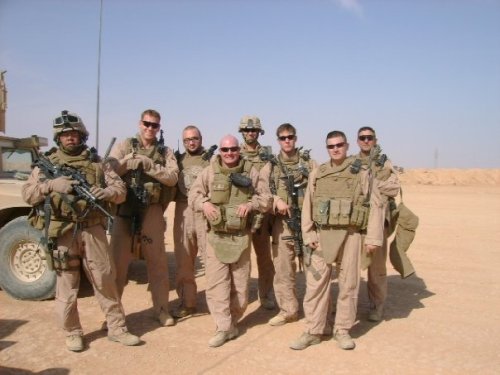
I give thanks for all them men that I mention in this post, especially my dad. God bless all of you guys. Please honor the Veterans that you know not only on Memorial Day or Veterans’ Day but every day.   Honor also those who gave their lives in the defense of liberty in all of the wars of our nation. They have earned it.

Today as I write many of my friends serve in harm’s way.  I hope that my recovery, spiritually, emotionally and physically goes well enough that I can go back with them.  For now I need to recover. My boss is right about that, if this week is any indication I’m in no shape to go back to a combat zone, bit Lord willing I will be so I can be with those I care for and serve alongside.

Peace,

Padre Steve+

Post Script: I do pray that no one takes offense at my words regarding my dealings with my mother. If someone thinks that I am wrong, or out of line they can contact me privately.  However, I have to protect me now.  I can’t help her or save her so I’m done.

12 Comments

Filed under alzheimer's disease, golf, iraq,afghanistan, Military, PTSD

Brothers to the End…the Bond between those Who Serve Together in Unpopular Wars

This story shall the good man teach his son;
And Crispin Crispian shall ne’er go by,
From this day to the ending of the world,
But we in it shall be remembered-
We few, we happy few, we band of brothers;
For he to-day that sheds his blood with me
Shall be my brother; be he ne’er so vile,
This day shall gentle his condition;
And gentlemen in England now-a-bed
Shall think themselves accurs’d they were not here,
And hold their manhoods cheap whiles any speaks
That fought with us upon Saint Crispin’s day.

From the Speech of King Henry V at Agincourt in Shakespeare’s “Henry V” 1599

We have a new Greatest Generation whose accomplishments will likely go unheralded by history and unlike the “Greatest Generation” of World War Two not receive the full honors and accolades due them.  The brothers, and for that matter sisters as well who have served in the current War on Terror, Iraq and Afghanistan campaigns have now been serving in a war that is now twice as long as the American involvement in World War Two.  Many, like me have been in this since the beginning and many have made multiple deployments to the combat zones.  And many of us, if not most of us would go again; I know that I would because part of me is still in Iraq; for me this war is still un-won and un-finished.

With MTT near SyriaAdvisers out on the Badlands of Al Anbar
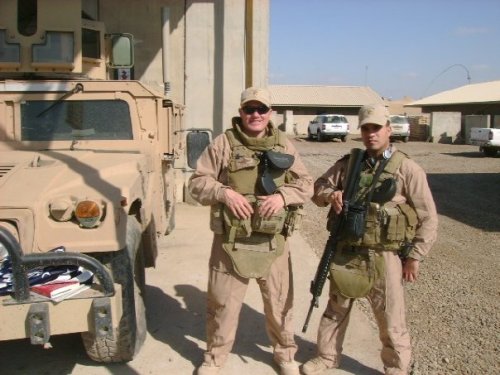
With no disrespect to the Greatest Generation of World War Two, all of the current Soldiers, Sailors, Marines, Airmen and Coast Guardsmen are volunteers, as are the members of the Reserves and National Guard.  Likewise this generation has for the most part fought the war alone as the vast bulk of the country has lived in peace untouched by any inconvenience to daily life such as gas and food rationing, requirements to work in war industries and the draft as were citizens in World War Two.  In the Second World War there was a sharing of the burden which in large part has not occurred in this war.  While many have pitched in to help and volunteered to help veterans and their families the vast majority of people in this country are untouched by the war, not that there is anything wrong with that.  This is simply a comparison of the situation that those who served in World War Two and the present conflicts faced.  So I have to say that our “Greatest Generation” is only a small part of the generation, as the line in Henry V “we few, we happy few who fought together….”

Dynamic DuoBrothers

These Soldiers, Sailors, Marines and Airmen from the United States as well as our Allies who serve alongside of us are my brothers and sisters.  I am friends with military personnel from the UK, Canada and Germany who have served in the various combat zones or at sea and met quite a few others from France, the Netherlands and Australia. Of course my Iraqi friends who I served with while with our advisers in Al Anbar province who are not only trying to bring peace and stability back to their country but have to worry about their families being targeted by terrorists.

There are a number of things that unite us in this relatively small brotherhood.  However, I think that this brotherhood could also be extended to our brothers who fought in Vietnam, French, Vietnamese, Australian, South Korean and American, the French who served in Algeria and the Americans and others that served in Korea.  All of these wars were unpopular, had little support on the home front and often left returning veterans found themselves isolated and their sacrifices either ignored or disrespected.  For those Americans who serve in the current wars I can say that at least to this point the public has been much more supportive than they were to our Vietnam brothers, many of who were even disrespected by World War Two vets who had fought in “a real war.”  I cannot count the Gulf War in this list as it was hugely successful and the returning vets were hailed as conquering heroes with ticker tape parades.

advisers convoy prepGetting Ready for A Mission

Our shared brotherhood includes our scars, physical, psychological, neurological and spiritual.  Those who served on the ground in Iraq and Afghanistan as well as those who served in Vietnam, French Indo-China and Algeria have the common shared experience of fighting people who don’t necessarily like foreigners no matter how noble our intentions and who have a long history of outlasting people that they believe to be invaders or occupiers.  We have had to fight wars with no front lines, no major units arrayed against us, but rather asymmetrical threats propagated by creatively devious foes who use low tech easily available technology and a willingness to sacrifice themselves and others to force attempt to kill us.  Thus we have cleverly designed and often quite powerful IEDs or Improvised Explosive Devices which can obliterate a HUMMV.

374Prayer Before a Mission

These threats create a situation where there is no front line and thus where every excursion outside of a FOB (Forward Operating Base) or COP (Coalition Outpost) is automatically a trip into a potential danger zone.  Enemies can infiltrate bases posing as local nationals in either military uniform or as workers, rockets and mortars can be lobbed onto even the largest and most secure bases at any time and any vehicle driving by you on the road could be loaded with explosives and just waiting to blow you up while insurgents with automatic weapons and Anti-Tank Rocket Propelled Grenades (RPGs) have taken down helicopters.  When you have taken fire on the road, in the air and had rockets whiz by you this becomes a reality that you never forget.

helos at nightA Familiar Sight to Me, Flying at Night AP Photo/David Guttenfelder
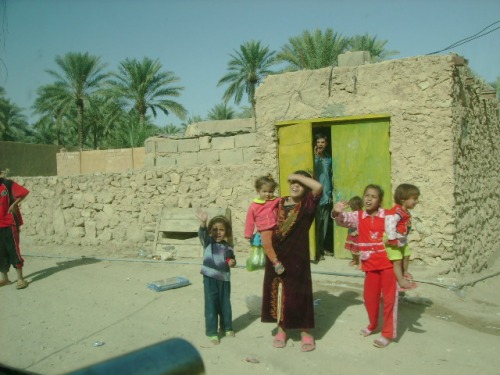
As a result we do not only have men and women with physical wounds, but wounds that have damaged the psyche or the soul.  PTSD is very common either from a direct encounter or the continual wear and tear of being in a danger zone wondering if you were to get hit that day every day of a tour.  I have lost count now of people that I know who have mild to severe symptoms of PTSD.  Traumatic Brain injury is another condition men and women attacked by IEDs, mortars and rockets experience. Likewise there are the injuries that shatter the soul.  These are the images of ruined buildings, burned out vehicles, wounded bodies, injured children, refugees and wars desolation that can leave a person’s faith in God, or ideals that he or she believes in weakened or even destroyed.  There are many idealistic and patriotic military personnel who because of what they have seen question God, their National Leadership and even themselves.  I cannot get the image of a refugee camp on the Iraqi Syrian border full of Palestinian refugees who have nowhere to go; they had been invited to Iraq under Sadaam and have been sitting on the border trying to get home for years now.  The Palestinian authority wants nothing to do with them.

237Iraqi Kids in War Torn Village on the Euphrates

These men and women are my brothers and sisters.   I have seen quite a few of my ICU staff deployed this year with more getting ready to go.  These are my friends and I do get concerned for them and pray earnestly for their safe return.  I wish that I could go with them because I know them and have already walked with them through the dark valley of the shadow of death in our ICU.  We already have a bond that will not be broken.

It is now two years since I was in the process of leaving for Iraq and a year since my PTSD crash.  However, I still would do it again in a heartbeat.  There is something about doing the job that you were both trained to do and called to do that makes it so.  Likewise the bonds of friendship and brotherhood with those who you serve are greater than almost any known in the human experience.  Shared danger, suffering and trauma bind soldiers together, even soldiers of different countries and sometimes with enemies.  I remember the conversation that I had with an Iraqi Merchant Marine Captain on a ship that we had apprehended for smuggling oil violating the United Nations sanctions.  The man was a bit older than me, in his early 60s.  He had been educated in Britain and traveled to the US in the 1960s and 1970s. He had the same concerns as any husband and father for his family and had lost his livelihood after Sadaam invaded Kuwait in 1990.   He was a gentleman who provided for his crew and went out of his way to cooperate with us.  In our last meeting he said to me: “Someday I hope that like the Americans, British and the German soldiers at the end of the Second World War can meet after the war is over, share a meal and a drink in a bar and be friends.”  That is my hope as well.

In the final episode of the series Band of Brothers there is a scene where one of the American soldiers, Joseph Liebgott who came from a German Jewish family interprets the words of a German General to his men in the prisoner compound.  The words sum up what the Americans had felt about themselves and likewise the bond that all soldiers who serve together in war have in common, if you have seen the episode you know how powerful it is, I ended up crying when I heard it the first time and cannot help but do so now that I have been to the badlands of Al Anbar Province.

“Men, it’s been a long war, it’s been a tough war. You’ve fought bravely, proudly for your country. You’re a special group. You’ve found in one another a bond that exists only in combat, among brothers. You’ve shared foxholes, held each other in dire moments. You’ve seen death and suffered together. I’m proud to have served with each and every one of you. You all deserve long and happy lives in peace.”

136A Chance Meeting with our EOD Mobile Uniit 2 Brothers

May God bless all of especially my brothers who served in with me in Iraq or have served or are serving in Afghanistan; as well as my brothers who fought in Vietnam, Indochina and Algeria.  We may never get a victory parade, but we have each other.

Peace, Steve+

5 Comments

Filed under History, iraq,afghanistan, Military, PTSD, vietnam

Remembering the Veterans in My Life…Memorial Day 2009

Today has been a day of rest and recovery from the past 10 days, especially the past 3 days when Judy had to be hospitalized. She is recovering nicely and may actually visit her friends at her church choir practice tonight even if she does not sing. I’m now finishing this post a Harbor Park, the Tides are up 1-0 and going to bat in the bottom of the 2nd.

Also please see Judy’s blog at http://abbeynormalabbess.wordpress.com/ for a good patient eye view of Epiglottitis.

honor and remember with american flag and pow flagOld Glory, the POW-MIA and Honor and Remember Flags
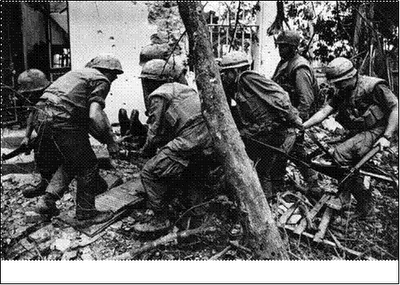
Monday is Memorial Day and I will be both on duty at the medical center as well as participating in a Memorial Day ceremony at the historic Naval Cemetery located on our grounds.  Memorial Day means a lot to me, probably more each year.  This is personal, more personal than at any time in my life.  I guess it comes with experience and maturity as well as a lot of reflection.

I’ve been in the military for almost 28 years now.  I enlisted in the National Guard while in college and entered Army ROTC back in 1981.  Since then it has been to quote Jerry Garcia “a long strange trip.”  My dad served twenty years in the Navy.  He retired in 1974 as a Chief Petty Officer and did time surrounded in the South Vietnamese city of An Loc when it was surrounded by the North Vietnamese for 80 days in 1972.  He didn’t talk about it much when he came back; in fact he came back different from the war.  He probably suffered from PTSD.  All the markers were there but we had no idea about it back then, after all he was in the Navy not the Army.

My second view of war came from the Veterans of Vietnam that I served with in the National Guard and the Army.  Some of these men served as teachers and mentors.  LCDR Jim Breedlove and Senior Chief John Ness at the Edison High School Naval Junior ROTC program were the first who helped me along. They have both passed away in the past year and a half.  I will never forget them.  A post dedicated to them is on this blog. Colonel Edgar Morrison was my first battalion commander.  He was the most highly decorated member of the California National Guard at that time and had served multiple tours in Vietnam.  He encouraged me as a young specialist and officer cadet and showed a tremendous amount of care for his soldiers.  Staff Sergeant’s Buff Rambo and Mickey Yarro taught me the ropes as a forward observer and shared many of their Vietnam experiences. Buff had been a Marine dog handler on the DMZ and Mickey a Forward Observer.  Sergeant First Class Harry Zilkin was my training NCO at the UCLA Army ROTC program.  He was a Special Forces Medic with 7th Group in Vietnam.  He still had part of a VC bayonet embedded in his foot.  He received my first salute as a newly commissioned Second Lieutenant as well as a Silver Dollar.  I understand that after the Army he became a fire fighter.  He had a massive heart attack on the scene of a fire and died a few years later from it.  Sergeant Major John Butler was our senior enlisted at UCLA.  He served with the 173rd Airborne in Vietnam.  Sergeant First Class Harry Ball was my drill sergeant at the ROTC pre-commissioning camp at Fort Lewis Washington in 1982.  He was also Special Forces and a Ranger and served multiple tours in Vietnam.  He was quite influential in my life, tearing me apart and then building me back up.  He was my version of Drill Sergeant Foley in An Officer and a Gentleman. Like Zack Mayo played by Richard Gere in the movie I can only say: Drill Sergeant “I will never forget you.”

With MTT near Syria

As I progressed through my Army career I encountered others of this generation who also impacted my life. First among them was First Sergeant Jim Koenig who had been a Ranger in the Mekong Delta.  I was the First Sergeant that I would measure all others by.  Once during a ARTEP we were aggressed and all of a sudden he was back in the Delta. This man cared so much for his young soldiers in the 557th Medical Company.   He did so much for them and I’m sure that those who served with him can attest to this as well as me. Jim had a brick on his desk so that when he got pissed he could chew on it.   He was great.  He played guitar for the troops and had a song called Jane Fonda, Jane Fonda You Communist Slut. It was a classic.  He retired after he was selected to be a Command Sergeant Major because he valued his wife and family more than the promotion.  It hurt him to do this, but he put them first. Colonel Donald Johnson was the commander of the 68th Medical Group when I got to Germany in January 1984.  Colonel “J” as well all called him was one of the best leaders I have seen in 28 years in the military.  He knew everything about everything and his knowledge forced us all to learn and be better officers and NCOs.  On an inspection visit you could always find him dressed in coveralls and underneath a truck verifying the maintenance done on it.  He served a number of Vietnam tours.  He died a few years back of Multiple Myeloma and is buried at Arlington.  Chaplain (LTC) Rich Whaley who had served as a company commander in Vietnam on more than one occasion saved my young ass at the Army Chaplain School.  He remains a friend and is the Endorsing Agent for the Church of Jesus Christ of Latter Day Saints. As a Mormon he was one of the most “Christian” men that I have ever met.  I know some Christians who might have a hard time with that, but Rich demonstrated every trait of a Christian who loved God and his neighbor.

When I was the Installation Chaplain at Fort Indiantown Gap PA I was blessed to have some great veterans in my Chapel Parish.  Major General Frank Smoker flew 25 missions as a B-17 pilot over Germany during the height of the air war in Europe. He brought his wonderful wife Kate back from England with him.  Henry Boyd who I buried was one of the 101st Airborne soldiers epitomized in Band of Brothers. He had a piece of shrapnel lodged next to his heart from the Battle of the Bulge until the day he died. Scotty Jenkes was a Air Force pilot in Vietnam flying close air support. Colonel Ray Hawthorne served several tours both in artillery units and as an advisor in 1972.  CWO4 Charlie Kosko flew helicopters in Vietnam.  All these men made a deep impact on me and several contributed to my career in very tangible ways.

image9391Marines at Hue City Tet 1968

My life more recently has been impacted by others.  My friends of the veterans of the Battle of Hue City including General Peter Pace, Barney Barnes,  Tony “Limey Cartilage ” Sergeant Major Thomas and so many others have become close over the years, especially after I did my time in Iraq. They and all the Vietnam vets, including the guys from the Vietnam Veterans of America like Ray and John  who man the beer stand behind the plate at Harbor Park all mean a lot to me.  My friends at Marine Security Forces Colonel Mike Paulovich and Sergeant Major Kim Davis mean more than almost any people in the world.  We traveled the globe together visiting our Marines.  Both of these men are heroes to me as well as friends.

Finally there are my friends and brothers that I have served with at sea on USS HUE CITY during Operation Enduring Freedom and the advisers on the ground in Al Anbar mean more than anything to me. Perhaps the most important is my RP, RP2 Nelson Lebron who helped keep me safe and accompanied me all over the battlefield.  Nelson who has done Iraq 3 times, Afghanistan, Lebanon and the Balkans is a hero.  The men and women of Navy EOD who I served with from 2006-2008 have paid dearly in combating IEDs and other explosive devices used against us in Iraq and Afghanistan are heros too.  There is no routine mission for EOD technicians.

I give thanks for all them men that I mention in this post, especially my dad. God bless all of you guys. Please honor the Veterans that you know this weekend.  Honor also those who gave their lives in the defense of liberty in all of the wars of our nation. They have earned it.

Peace, Steve+

Post Script: The game went to extra innings and the Tides lost 5-4.  They left the tying run at 3rd base in the bottom of the 12th.  That ended a 8 game winning streak.  On a positive side I was able to get a ball autographed by former Dodger’s pircher ill Singer and Pirate’s Pitcher Bob Kison.  Singer pitched in the Dodger’s rotation with Drysdale, Koufax and other greats.  He threw a no-hitter in 1970 against the pirates and now is a scout for the Nationals, Kison won game one of the 1971 World Series in six innings of releif against the Orioles who he now scouts for the Orioles.

2 Comments

Filed under Baseball, History, iraq,afghanistan, Military, vietnam

Rest Recovery and Reaction- Thoughts on Returning Home

The events of the past week have been a blur.  The trip was non-stop action with a lot of stress built in.  I am thankful that I was able to get a few moments to catch up with my brother and old friends over a couple of beers.  The day on the links was really enjoyable.  The pain of my sunburn is slowly going away.  I hope to get out a couple of times in the near future here.  If I actually play more than once a year I might actually be pretty good.

I have received much support from my friends and for this I am grateful. To know that one is not alone in times like these is a great comfort.

I found that I still have some of my PTSD reactions to noise light and crowds, especially in airports or crowded airplanes.  I get anxious and can actually feel the anxiety.  When I get trapped in a big crowd in a confined place it is really noticeable.

I wrote something else over the past few days regarding the way people on the political right and left use and abuse the military and veterans.  I’ve been stewing about it after the remarks of a prominent former elected official about a retired General with a distinguished record last week.  I’ve put off publishing it because I want to make sure that when I do it that I haven’t said something that will piss everyone off.  I’m sure that there will be some who take offense, especially when I criticize certain media personalities who are iconic.  I want people to see that it is wrong to in one sentence to praise the military and in the next criticize it when either the institution or members of the institution active or retired disagrees with their agenda, no matter what it is.  I have been pleased with President Obama protecting our troops by blocking the release of photographs which the ACLU wanted published.  Of course he realized that the photos could only put our troops in danger and inflame an already volatile region.  Likewise he is continuing to increase the size of the active duty Army and Marine Corps and has halted the reductions in the Navy and Air Force.  I think he gets the picture and is looking out for us.  I do not know when or if I will publish that article but I am going to hold off on it at least for a while.  I have become a lot more prudent about such things than I was in times past.  That being said I don’t care if the person being an ass and treating honorable men who serve faithfully in a shabby manner are liberals or conservatives.  If they want to criticize honorable men who have served the country faithfully in peace and war and they have never served I will not hesitate to call them on it.  My brotherhood with those who have served is deeper than any political party. I don’t serve Red States and Blue States but the United States.  I’m tired of people who use their influence in the media to stir up hatred and discontent and question the manner of how we do the jobs they send us to do.   Likewise for them to  question our honor and integrity, especially when most of them have never served a day in uniform is way below the belt.  May the Deity Herself preserve this miscreant Priest.  To quote Colonel Nathan R Jessup in A Few Good Men:

“Son, we live in a world that has walls and those walls need to be guarded by men with guns. Who’s gonna do it? You? … We use words like honor, code, loyalty. We use then as the backbone of a life trying to defend something. You use them as a punchline. I have neither the time nor the inclination to explain myself to a man who rises and sleeps under the blanket of the very freedom I provide and then questions the manner in which I provide it. I would rather you just said “thank you,” and went on your way. Otherwise, I suggest that you pick up a weapon and stand a post. Either way, I don’t give a damn what you think you are entitled to.”

Peace, Steve+

Post Script:  I didn’t get to recover last night.  About midnight I had to take Judy to the ER.  She is not one to usually need to do this but she developed some kind of infection that was keeping her from swallowing and possibly threatening her airway.  After a bunch of IV antibiotics, steriods, pain meds and a CT scan they decided not to admit her, though that was a near run thing. She should be fine but I didn’t get home until 0400.  To those not in the military or Germans that means Mickey’s Big hand is on the 4 and his little hand on the 12. Following this I had to go to the DMV to replace my license plates which had been stolen off my car from in front of my house.  This was not the way I thought the return would be.  God bless and thanks for the kind words, thoughts and prayers. Peace, Steve+

Leave a comment

Filed under alzheimer's disease, Military, PTSD