Tag Archives: whig collapse

When Political Parties Implode: “The Party is Split Forever…”

Friends of Padre Steve’s World,

I have been writing for some time about the coming demise of the Republican Party and the past few days I have been republishing sections of my draft text “Mine Eyes have Seen the Glory” Race, Religion, Ideology and Politics in the Civil War Era to show how the Whig and Democratic Parties imploded between 1850 and 1860.

Have a great day,

Peace,

padre Steve+

democrat condenders

The fight over Lecompton was a watershed in American politics that those who wrote the Constitution of the United States could not have imagined. The deeply partisan fight served to illuminate how easily “minuscule minorities’ initial concerns ballooned into unmanageable majoritarian crises. The tiny fraction of Missouri slaveholders who lived near the Kansas border, comprising a tinier fraction of the South and a still tinier fraction of the Union, had demanded their chance to protect the southern hinterlands.” [1] The crisis that Kansas Democrats provoked drew in the majority of Southern Democrats who came to their aid in Congress and President Buchanan. This provoked Northerner, including Democrats to condemn the Southern minority, which they believed was disenfranchising the majority of people in the territory in order to expand slavery there and to other territories in the west.

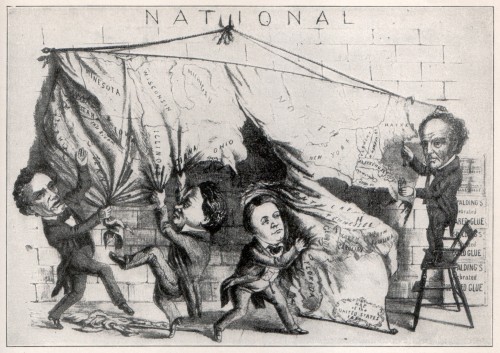
The issue of Lecompton crisis galvanized the political parties of the North and demolished any sense of national unity among the Democrats. The split in the Democratic Party mirrored the national divide and the party split into hostile Northern and Southern factions, which doomed it as a national party for the foreseeable future.

Following Lecompton the intra-party Democrat divide widened as “Pro-Douglas and pro-Buchanan Democrats openly warred on one another for the next two years; an unacknowledged but real split had taken place.” [2]
tearing1-500x353

The battle over the Lecompton Constitution also marked the first time that a coalition Northern Democrats sided with anti-slavery forces to defeat pro-slavery legislation in congress. Though the measure to admit Kansas as a slave state was defeated it was a narrow victory; the “Republicans and anti-Lecompton Douglas Democrats, Congress had barely turned back a gigantic Slave Power Conspiracy to bend white men’s majoritarianism to slavemaster’s dictatorial needs, first in Kansas, then in Congress.”  [3]

The political impact of the Lecompton crisis on the Democratic Party was an unmitigated disaster. The party suffered a major election defeat in the 1858 mid-term elections and lost its majority in the House of Representatives even though it barely maintained a slim majority in the Senate. While the victorious Republicans had won the election, they made little legislative headway since the Democrats still controlled the Senate and James Buchanan remained President. In a sense “there were two Democratic parties: one northern, on southern (but with patronage allies in the north); one having its center of power in the northern electorate and in the quadrennial party convention… the other with its center of power in Congress; one intent on broadening the basis of support to attract moderate Republicans, the other more concerned to preserve a doctrinal defense of slavery even if it meant driving heretics out of the party.” [4] Democratic Party divide fulfilled what Lincoln had said about the country, as the Democratic Party had “became increasingly a house divided against itself.” [5]

Douglas’s courageous opposition to the fraud of Lecompton would be the chief reason for the 1860 split in the Democratic Party as Southern Democrats turned with a vengeance on the man who had been their standard bearer during the 1856 Democratic primary. “Most southern Democrats went to Charleston with one overriding goal: to destroy Douglas.” [6] The party decided to meet in the Charleston to decide on their platform and the man who would be their standard bearer in the election of 1860. When the convention met in April 1860 it rapidly descended into a nightmare for the Democrats as “Southern delegates were much more intent on making a point than on nominating a presidential candidate.” [7] The “Southern delegates demanded a promise of federal protection of slavery in all the territories and a de facto veto in the selection of the party’s presidential candidate” [8] in order to block the nomination of Douglas. Southern radicals “led by William Lowndes Yancey of Alabama stood for seven days agitating for a pro-slavery platform.” [9]

democratic convnetion

Ohio Democrat George A. Pugh responded to the Southern fire-eaters and said that “Northern Democrats had worn themselves out defending Southern interests – and he declared that the Northern Democrats like himself were now being ordered to hide their faces and eat dirt.” [10] Georgia Senator Alexander Stephens who had moderated his position and was supporting Douglas wrote that the radicals “strategy was to “rule or ruin.” [11] When their attempts to place the pro-slavery measures into the party platform were defeated by Northern delegates, it prompted “a walkout by delegates from Alabama, South Carolina, Georgia, Florida, Mississippi, Louisiana, and Texas.” [12] This deprived Douglass of the necessary two thirds majority needed for the nomination and “the shattered convention adjourned, to reconvene in Baltimore on June 18,”  [13] the “incendiary rhetoric left the Democratic Party in ashes.” [14] A friend of Alexander Stephens suggested that the party might patch things up in Baltimore, but Stephens dismissed the suggestion and told his friend, “The party is split forever. The only hope was in Charleston.” [15]

Old line former Whigs who feared the disintegration of the country led by Kentucky Senator John J. Crittenden formed their own convention, the Constitutional Union Party and declared a pox on both the Buchanan and Douglas factions of the Democratic Party. They nominated a rather cold and uninspiring moderate slave owner, the sixty-four year old John Bell of Tennessee as their candidate for Constitutional Union Party President and “then chose a man who overshadowed him, Edward Everett of Massachusetts, aged sixty-seven, as the vice-presidential nominee.” [16] But this ticket had no chance of success, Bell “stood for moderation and the middle road in a country that just now was not listening to moderates, and the professional operators were not with him.” [17]

When the Democratic Party convention reconvened the results were as Stephens predicted. Another walk out by Southern delegates resulted in another and this time a final split. “Rival delegations from the Lower South States arrived in Baltimore, one side pledged to Douglas and the other to obstruction. When the convention voted for the Douglas delegations, the spurned delegates walked out, this time joined by colleagues from the Upper South.” [18] Though Douglas did not have the two-thirds majority, the convention “adopted a resolution declaring Douglas unanimously nominated.” [19]  A day later the radicalized Southern delegates nominated their own candidate, the current Vice President, John C. Breckinridge of Kentucky as their candidate “for president on a slave-code platform.” [20] 

There were now four presidential tickets, three composed of Democrats and former Whigs, “each supported by men who felt that they were following the only possible path to salvation. A Republican victory was almost certain, and the Democrats, who had the most to lose from such a victory, were blindly and with a fated stubbornness doing everything they could to bring that victory to pass.” [21]

The Democratic Party had imploded and doomed the candidacies of Douglas and Breckinridge. The Augusta Daily Chronic and Sentinel editorialized, “It is an utterly futile and hopeless task to re-organize, re-unite and harmonize the disintegrated Democratic party unless this is to be done by a total abandonment of principle… No, sensible people might as well make up their minds to the fact that the Democratic party is dissolved forever, that new organizations must take its place.”  [22]    

Notes

[1] Ibid. Freehling, The Road to Disunion Volume II: Secessionists Triumphant 1854-1861 p.140

[2] Ibid. Levine Half Slave and Half Free p.213

[3] Ibid. Freehling, The Road to Disunion Volume II: Secessionists Triumphant 1854-1861 p.142

[4] Ibid. Potter The Impending Crisis p.394

[5] Fehrenbacher, Don E. Kansas, Republicanism, and the Crisis of the Union in The Civil War and Reconstruction Documents and Essays Third Edition edited by Michael Perman and Amy Murrell Taylor Wadsworth Cengage Learning Boston MA 2011 p.94

[6] Ibid. McPherson The Battle Cry of Freedom p.213

[7] Ibid. Goldfield America Aflame p.167

[8] Ibid. Levine Half Slave and Half Free p.216

[9] Ibid. Guelzo Fateful Lightning p.121

[10] Ibid. Catton The Coming Fury p.32

[11] Ibid. McPherson The Battle Cry of Freedom p.215

[12] Ibid. Goldfield America Aflame p.167

[13] Ibid. Guelzo Fateful Lightning p.121

[14] Ibid. Goldfield America Aflame p.167

[15] Ibid. Catton The Coming Fury p.46

[16] Ibid. Potter The Impending Crisis p.417

[17] Ibid. Catton The Coming Fury p.46

[18] Ibid. Goldfield America Aflame p.168

[19] Ibid. Potter The Impending Crisis p.413

[20] Ibid. McPherson The Battle Cry of Freedom p.216

[21] Ibid. Catton The Coming Fury p.69

[22] Ibid. Guelzo Fateful Lightning p.121
Leave a comment

Filed under civil war, History, Political Commentary

When Political Parties Implode: “A Gross Violation of a Sacred Pledge”

whig-split

Friends of Padre Steve’s World,

I have been writing about the coming collapse of the Republican Party and have decided to republish some of my writings dealing with what happened to the Whig and Democratic Parties between 1854 and 1860. Today an article about how that process started from my draft text “Mine Eyes have seen the Glory” Race, Religion, Ideology and Politics in the Civil War Era.

Peace

Padre Steve+

The Compromise of 1850 was followed by another congressional act dealing with the status of the Kansas, Nebraska Territory. Both territories lay north of the line barring slavery set by the Missouri Compromise. While that act had been gutted and for all practical sense made meaningless by the Compromise of 1850, it still remained on the books and applied to the establishment of new territories.

The new legislation was sparked by those who in the interest of Manifest Destiny were committed to organizing the territories of the nation to the Pacific, and in some cases to Central America and Cuba. The man at the heart of this legislation was Democratic Senator Stephen Douglas of Illinois. Douglas saw the need for the organization of the territories and recognized that he needed Southern support for its passage. In response to pressure from Democrat Senators James Mason and Robert M. T. Hunter of Virginia, Andrew Butler of South Carolina and David Atchison of Missouri, Douglas crafted the measure and included an “explicit repeal of the ban on slavery north of 36° 30’.” [1]

The explicit use of this measure in the legislation to organize these territories created a storm in both in Washington D.C. and throughout the country. Northern opponents, including Salmon Chase condemned the bill as being “an atrocious plot” of slave power to “convert free territory” into a “dreary region of despotism, inhabited by masters and slaves.” [2] Chase and his allies published the “Appeal of the Independent Democrats” who “condemned this “gross violation of a sacred pledge” and promised to “call the people to come to the rescue of the country from the domination of slavery.” [3] Chase closed the appeal by warning that “the dearest interests of freedom and the Union are in imminent peril” and called for religious and political organization to defeat the bill.” [4]

Horace Greeley, the publisher of the New York Tribune, transformed his paper into an instrument that he used to fight against the act. In an editorial Greeley charged that the Southern slave owners and politicians were:

“not content within its own proper limits,…it now proposed to invade and overrun the soil of freedom, and to unroll the pall of its darkness over virgin territory whereon slave has never stood. Freedom is to be elbowed out of its own home to make room for the leprous intruder. The free laborer is to be expelled that the slave may be brought in.” [5]

After months of wrangling the bill was passed. Historian William Freehling described it as “the latest and most notorious pro-southern law.” [6] The last hope of those who opposed the bill was a veto by Democrat President Franklin Pierce, However, Pierce buckled to the pressure put on him by the supporters of the bill, including many Northern Democrats who supported businesses, banks, and industries that benefited from slavery. The bill for the approval of the measure by the Southern delegations of both parties was nearly unanimous. However, the bill only passed the House of Representatives only due to the support of forty-two Northern Democrats who decided to support their Southern colleagues and antagonize their own constituents and did not get the majority support of any Northern delegation other than Douglas’s own state of Illinois.

To further humiliate their Northern colleague’s Southern senators blocked a measure passed in the House that would have provided 160 acres of land from public property to new settles in the territories. The Southerners opposed that measure because they believed that the passage of such a law “would prove a most efficient ally for Abolition by encouraging and stimulating the settlement of free farms with Yankees and foreigners pre-committed to resist the participancy of slave owners in the public domain.” [7] In other words, they wanted every incentive for slaveholders to move to the new territories while making it more difficult for people who might oppose slavery to do so.

Frederick Douglass condemned the legislation and understood that the “shame of slavery was not just the South’s, that the whole nation was complicit in it.” [8]  In his 1852 Independence Day address the powerful voice of Freemen and abolitionists everywhere spoke of the hypocrisy that the new laws for bolstering the support and spread of slavery. To do so he condemned them from the words of the Declaration of Independence itself:

“Fellow citizens: Pardon me, and allow me to ask, why I am called upon to speak here today? What have I or those I represent to do with your national independence? Are the great principles of political freedom and natural justice, embodied in that Declaration of Independence, extended to us? And am I, therefore, called upon to bring our humble offering to the national altar, and to confess the benefits, and express devout gratitude for the blessing resulting from independence to us?…

What to the American slave is your Fourth of July? I answer, a day that reveals him to be more than all the days of the year, the gross injustice and cruelty to which he is the constant victim. To him your celebration is a sham; your boasted liberty an unholy license; your national greatness, swelling vanity; your sounds of rejoicing are empty and heartless; your denunciation of tyrants, brass-fronted impudence; your shouts of liberty and equality, hollow mockery; your prayers and hymns, your sermons and thanksgivings, with all your religious parade and solemnity, are to him mere bombast, fraud, deception, impiety, and hypocrisy – a thin veil to cover up the crimes which would disgrace a nation of savages. There is not a nation on earth guilty of practices more shocking and bloody than the people of these United States at this very hour.

Go where you may, search out where you will, roam through all the monarchies and despotisms of the Old World, travel through South America, search out every abuse and when you have found the last, lay your facts by the side of everyday practices of this nation, and you will say with me that, for revolting barbarity and shameless hypocrisy, America reigns without a rival…” [9]

As the pressure mounted, the established political parties began to fray at the as those most committed to perpetuating slavery became more extreme in their views. Thus, the war was preceded by the fracturing of political parties and alliances that had worked for compromise in the previous decades to preserve the Union even at the cost of maintaining slavery. The outrage in the North over the Kansas-Nebraska Act combined with the previous Compromise of 1850 provoked a political and social firestorm.

The result of this increased tension shattered the Whig and the Democratic parties along sectional lines. The Whigs in the south collapsed into insignificance and in the North had disintegrated by 1856. The election of 1854 had shattered the Whigs precarious unity, and the bitter division destroyed the party as a national party. Senator Truman Smith resigned from the Senate in disgust and noted “The Whig party has been killed off by that miserable Nebraska business.” [10]  As a result many Northern Whigs gravitated to new political parties, including the nascent Republican Party, which gained Abraham Lincoln, who like many others left the Whigs.

The Democrats now were split between Northern and Southern factions but managed to keep their outward unity for a few more years. While the Democrats were still nominally a national party the losses in 64 of 88 Northern districts in the 1854 election ensured that the party was now for most part a regional party, a party dominated by its pro-slavery Southern wing. The 1854 election had cost the Democrats seventy-four of one hundred and fifty seven seats in the House. In New England only one of thirteen Democrats retained their seats, and in many other areas of the North. Many Northern Democrats too would find homes in the new Republican Party, including William Seward, Salmon Chase, Thaddeus Stevens and Schuyler Colfax. [11]

The national Whig and Democratic Parties that had dominated American life for decades were collapsing and as they did so, the fabric of the Union itself began to fray. The Whigs and the Democrats were national parties, and as such they were an important part of the bonds that held the country together, in them leaders of the North and the South mingled, became friends and worked together, but slavery destroyed that bond. When they splinted into sectional parties, with the Whigs collapsing and the Democrats splitting into hostile Northern and Southern factions it boded ill for the country at large.

Notes

[1] Ibid. McPherson The Battle Cry of Freedom p.123

[2] Ibid. McPherson The Battle Cry of Freedom p.124

[3] Ibid. Egnal  Clash of Extremes p.208

[4] Ibid. Foner Free Soil, Free Labor, Free Men p.94

[5] Ibid. Goldfield America Aflame p.99

[6] Ibid. Freehling The Road to Disunion Volume One p.559

[7] Ibid. McPherson The Battle Cry of Freedom p.126

[8] Zinn, Howard The Other Civil War: Slavery and Struggle in Civil War America Harper Perennial, Harper and Row, New York 2011 p.20

[9] Ibid. Zinn The Other Civil War pp.20-21

[10] Ibid. McPherson The Battle Cry of Freedom p.125

[11] Ibid. Egnal Clash of Extremes p.215

1 Comment

Filed under civil war, History, Political Commentary
